All about dinosaurs, fossils and prehistoric animals by Everything Dinosaur team members.

Everything Dinosaur’s work with schools and other educational bodies. Articles, features and stories about dinosaurs and their role in education and educating young people.

9 03, 2015

Remarkable Dinosaurs Roam at John Locke Academy

By |2024-05-04T19:25:01+01:00March 9th, 2015|Categories: Educational Activities, Teaching|3 Comments

EYFS Children Learn All About Dinosaurs at John Locke Academy

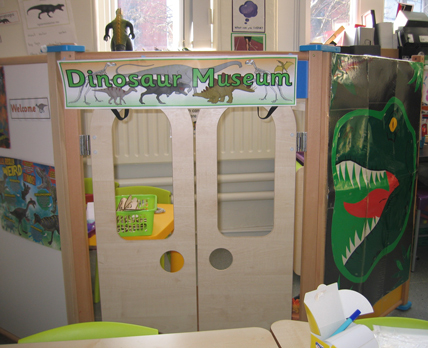
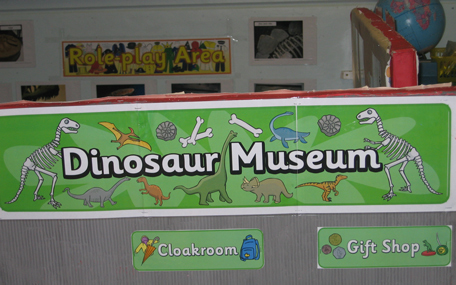
It has been a busy and exciting term for the children at John Locke Academy.  Early Years Foundation Stage have been learning all about dinosaurs with the help and support of the enthusiastic teaching team at this new school, which was only opened last September.  The Spring Term topic was entitled “Stomp, Stomp, Roar” and there were some very colourful displays of the children’s work posted up in the spacious classrooms.  A Reception class had even set up their very own dinosaur museum and the fossil expert from Everything Dinosaur who visited the school to conduct Foundation Stage dinosaur workshops, was lucky enough to be given a guided tour.

Visit our Dinosaur Museum (Reception Class)

Come visit our dinosaur museum

Come visit our dinosaur museum. Picture credit: Everything Dinosaur.

Picture credit: Everything Dinosaur

Discovering Dinosaur Eggs

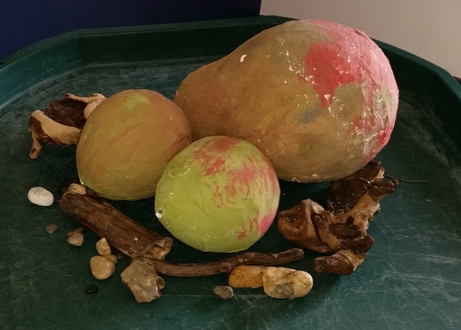
The children’s interest in all things prehistoric had been sparked by the discovery of some strange and very large eggs. What sort of creature could have laid eggs so big?  This was one of the questions posed by the teachers, all part of an exciting, learning through play focused curriculum which is currently being rolled out across the Foundation Stage (Nursery and Reception).  Using the giant eggs as a stimulus, the teaching team encouraged the children to explore what sort of animals alive today lay eggs and to make links between the size of the eggs and the size of the animal that could have laid them.  Could a dinosaur have visited their school?

“Egg-citing” Discovery Made in the Classroom

Dinosaur eggs made from a balloon covered in paper mache.

Dinosaur eggs made from a balloon covered in paper mache. Picture credit: Everything Dinosaur.

Picture credit: Everything Dinosaur

Dinosaur Workshop

Dinosaurs as a term topic had certainly enthused teachers and children alike.  Prehistoric animals such as Stegosaurus, Triceratops and the fearsome Tyrannosaurus rex are rarely out of the media spotlight these days, as our dinosaur expert pointed out when he explained that a new dinosaur species is, on average, named and described every thirty days or so.  The children demonstrated a remarkable level of knowledge, some of the Nursery class knew about geological periods and which dinosaurs lived in them.  In addition, the children were keen to point out which dinosaurs ate meat and which ones ate plants.

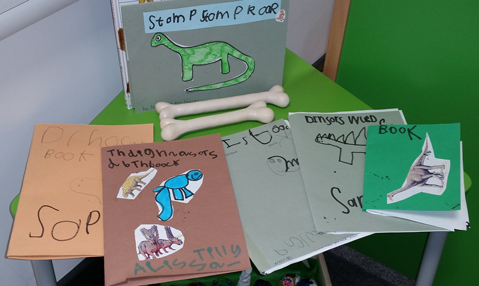
With all the wonderful examples of writing the children had produced, they needed somewhere to display them all, so one part of the dinosaur museum had been set aside as an area for showcasing all the books about prehistoric animals that the children had written.

Dinosaur Books Written by FS2 On Display

"Stomp, stomp, roar"! Reception class make books about dinosaurs.

“Stomp, stomp, roar”! Reception class make books about dinosaurs. Picture credit: Everything Dinosaur.

Picture credit: Everything Dinosaur

Working with Foundation Stage

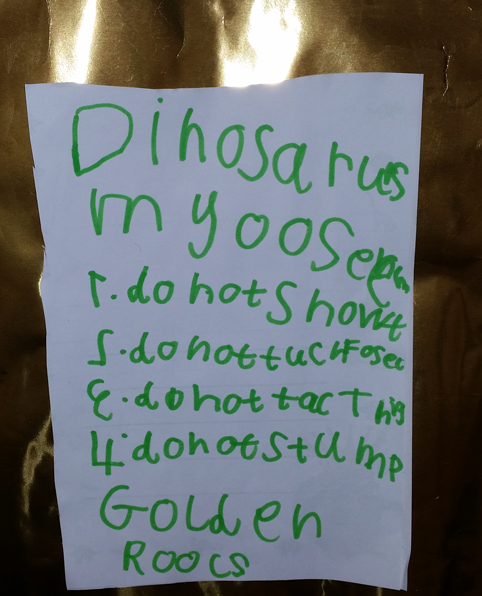
The nursery children too, had created some wonderful and very informative dinosaur themed displays, all good examples of learning through imaginative, creative play.   If you are going to have a dinosaur museum in the classroom, then just like any other museum it might be a good idea to have a set of “Golden Rules” for visitors to follow.  The children were so engrossed in the idea of their very own classroom museum that they had drafted a set of rules to help guide visitors. This certainly demonstrates the children’s ability to apply what they had been learning to an appreciation of the wider world.

“Golden Rules” Designed for the Classroom Dinosaur Museum

Children design rules for their dinosaur museum.

Children design rules for their dinosaur museum. Picture credit: Everything Dinosaur.

Picture credit: Everything Dinosaur

Learning Through Exploring

The concept of learning through exploring, developing ideas and allowing the children the freedom to challenge themselves is certainly a philosophy that John Locke himself, would have approved of.  There was lots of evidence on display demonstrating that this new school is certainly meeting learning needs, allowing the children the opportunity to fulfil their potential in a rich, diverse environment with plenty of support.

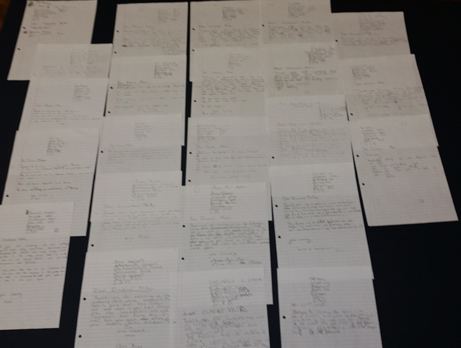
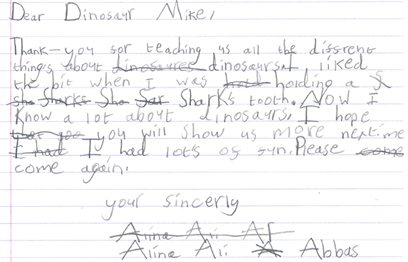
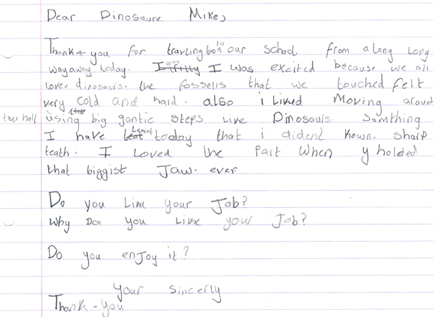
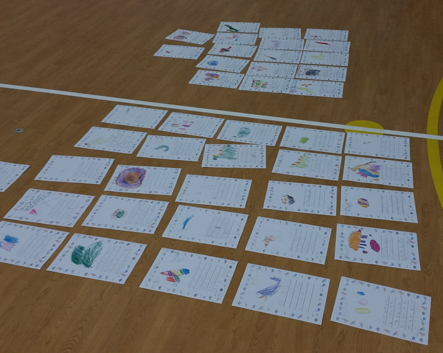
As part of the topic, the children in the two Reception classes have been working on a number of writing exercises, all aimed at helping them to develop their competence and to expand their vocabularies.  The visitor from Everything Dinosaur was presented with a large number of  questions that the children had written in preparation for the dinosaur workshop.  There were so many excellent examples that our expert had to use part of the school hall to lay them out so they could be photographed.

Dinosaur Topic Aims to Develop Writing Skills

Encouraging FS2 to write about dinosaurs.

Encouraging FS2 to write about dinosaurs. Picture credit: Everything Dinosaur.

Picture credit: Everything Dinosaur

Everything Dinosaur stocks a large range of educational, dinosaur themed toys, replica fossil animals and games: Learning Resources from Everything Dinosaur.

All in all, the topic entitled “Stomp, Stomp, Roar”, has been a “roaring success”, for the Academy.  A topic that has been enthusiastically embraced by children and teachers alike.  The children certainly enjoyed the Foundation Stage dinosaur workshops.

8 03, 2015

International Women’s Day 2015 an Important Date in the Calendar

By |2024-05-05T09:39:23+01:00March 8th, 2015|Categories: Educational Activities, Press Releases, Teaching|0 Comments

Recognising the Role of Women in Science and Education

Today, March 8th is International Women’s Day.  A day for celebrating the role of women in society, women in science and for championing the continuing struggle for equality.  Although, the origins of this special day go back to pre World War One, the fight to recognise the role of women in society continues and we at Everything Dinosaur, with our female boss, take time out to recognise the immense contribution of women to the Earth Sciences and science teaching.

Women in Science

Our team members have been lucky enough to have worked with some of the most enthusiastic and engaging science teachers in the country.  This dedicated group, many of which, at the Primary School level at least are women, are tasked with enthusing and motivating the next generation of scientists.

Take for example, Miss Sparre, a Primary School teacher we met last week.  As part of her mixed Year 1/FS2 classes’s study of dinosaurs they had turned part of the classroom into a dinosaur museum.  The children were eager to show off their museum to our fossil expert who had come to the school to conduct a dinosaur workshop.

A Science Museum in the Classroom

Come to our dinosaur museum!

Come to our dinosaur museum! Picture credit: Everything Dinosaur.

Picture credit: Everything Dinosaur

Inspiring the Next Generation of Scientists

Young Megan, (aged five), had been to the “Jurassic Coast” of Dorset and found lots of amazing ammonite and belemnite fossils, she was delighted to be able to explain what the fossils mean and we presented her with a drawing of what an ammonite looked like when it swam in the Mesozoic seas.  The contribution to science and education by women has been immense and with enthusiastic young Megan explaining that she too, wants to be a palaeontologist, the important role of women in science is set to continue.

Everything Dinosaur supplies a range of ammonite, belemnite and trilobite replicas helping young people to better understand the animals represented by iconic fossils.  To view this range in stock at Everything Dinosaur: Replicas of Fossil Animals, Toys and Games.

3 03, 2015

A Trip to the Bathonian

By |2023-03-24T17:13:22+00:00March 3rd, 2015|Categories: Educational Activities, Geology, Teaching|0 Comments

The Bathonian Stage of the Middle Jurassic

Just like a book is divided up into chapters so geological time is divided up into a series of units.  There are Eons, Eras, Periods, Epochs, and faunal stages, these are the typical units of division when it comes to exploring the geological timescale.  A point reinforced when a team member from Everything Dinosaur made a visit to Somerset recently.

The Geological Timescale

Descending order of size for the units of the geological timescale (deep time):

  • Eon for example, the Phanerozoic (visible life) from 542 mya to the present day.
  • Era for example, the Mesozoic, from 251 mya to 66 mya) or thereabouts.
  • Period, for example, the Jurassic (199 mya to 145 mya) approximately.
  • Epochs, for example, the Middle Jurassic (175 mya -161 mya) approximately.
  • Stages or Ages such as the Bathonian (167.7 mya to 164.7 mya) approximately.

We mention this, as whilst working with Year 6 children and their teachers in the Bath area, we explained that the limestone rocks in their part of the world, were used as building materials and have been quarried for centuries.  Many of the buildings around the school, and the walls of the school were constructed using these limestones.  These limestones are the preserved remains of the shells of ancient sea creatures, that lived during the Jurassic.

Bathonian Faunal Stage

The Bathonian faunal stage was named after the spa town of Bath and the limestone found in this part of south-western England.  It was included in scientific literature as early as 1843.  A number of ammonite species are recognised from this Middle Jurassic strata and they help to provide a biostratigraphic profile and assist with relative ageing of the rocks.  Bathonian rocks have provided a number of dinosaur fossil remains including sauropods, armoured dinosaurs, meat-eaters and even a distant relative of the most famous dinosaur of all Tyrannosaurus rex (Proceratosaurus).

Typical Bathonian Limestones used as Local Building Materials

A faunal stage of the Middle Jurassic named after the spa town of Bath.

A faunal stage of the Middle Jurassic named after the spa town of Bath.

It was a nice moment to ask the school children did they want to see something from the Jurassic?  When they all said yes, we simply asked them to look out of the window.

For replicas and models of Jurassic prehistoric animals and other extinct creatures: Dinosaur and Prehistoric Animal Models.

28 02, 2015

EYFS at Purston Infant School Learn All About Dinosaurs

By |2023-03-24T16:01:24+00:00February 28th, 2015|Categories: Educational Activities, Teaching|0 Comments

Foundation Unit Studies Dinosaurs

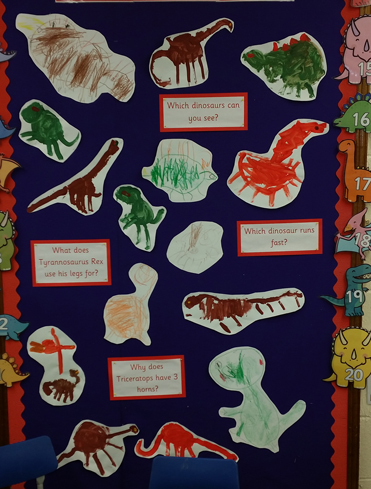
It was an exciting Friday for the children at the Foundation Unit at Purston Infant School (West Yorkshire) as yesterday, they had a visit from Everything Dinosaur to help them learn all about dinosaurs and other prehistoric animals.  The two classes of Lower Foundation Stage along with the two classes of Upper Foundation Stage have been learning about dinosaurs and there was lots of colourful artwork on display around the classrooms.

One of the Colourful Dinosaur Inspired Displays at the School

Colourful prehistoric animals.

Colourful prehistoric animals.  Picture credit: Everything Dinosaur.

Picture credit: Everything Dinosaur

Foundation Unit Studies Dinosaurs

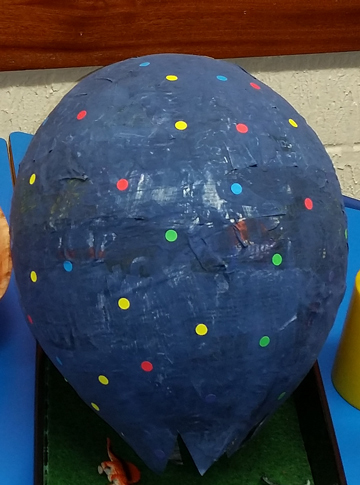
The children have two beautiful, giant dinosaur eggs to look after.  Both the eggs were made from paper mache.  In discussion, with the teaching team we suggested that an extension activity could involve the children thinking about what sort of animals lay eggs/do not lay eggs.

Perhaps a classroom display could be created with the children being encouraged to list the types of animals they know that lay eggs.  Can the children sort and group the animals that they have thought of?  For example, those with scales, those with feathers, those that can fly etc.  What might a dinosaur nest be made off?  Can the children sort out different types of material and work out which materials would be good/would not be good to line a nest for a dinosaur egg?

A Giant Dinosaur Egg in a Classroom

A big, blue dinosaur egg.

A big, blue dinosaur egg. Picture credit: Everything Dinosaur.

Picture credit: Everything Dinosaur

A Dinosaur Workshop

Under the enthusiastic tutelage of the teachers and their support staff the children were certainly enjoying this term topic and there was lots of evidence on display of the children enjoying a broad based, varied activity topic.  The Lower Foundation Stage children had a wonderful sensory bin filled with sand and small stones as well as dinosaur skeletons for them to explore.  In addition, dinosaur models had been made using all sorts of household odds and ends, helping the children to learn about the properties of different materials.

The older children in the two Upper Foundation Stage classes (Monkeys 1 and Monkeys 2) had been busy painting their favourite dinosaurs and there was lots of expressive artwork posted up around the classroom as well as plenty of evidence of vocabulary development.

Fossil Themed Counting Activities

During the dinosaur workshops with the children, our dinosaur expert encouraged the children’s confidence with counting by introducing simple dinosaur fossil themed counting activities all developed with the aim of helping the budding young palaeontologists to improve their confidence in counting and their understanding of numbers.

Enabling Children to Explore and Play Using a Wide Range of Media

Using different media, important in learning and development.

Using different media, important in learning and development. Picture credit: Everything Dinosaur.

Picture credit: Everything Dinosaur

Our dinosaur expert, promised to email over some more extension resources to help support the scheme of work prepared by the dedicated teaching team, one of whom stated “the children were very responsive and enjoyed looking at all the resources”.

To view the range of prehistoric animal toys and games stocked by Everything Dinosaur: Dinosaur Toys and Gifts.

19 02, 2015

Exploring Astonishing Dinosaurs at Hadfield Infant School

By |2024-05-04T21:51:08+01:00February 19th, 2015|Categories: Educational Activities, Main Page, Teaching|0 Comments

Foundation Stage/Year 1/Year 2 Study Dinosaurs and Fossils – Exploring Dinosaurs and Fossils

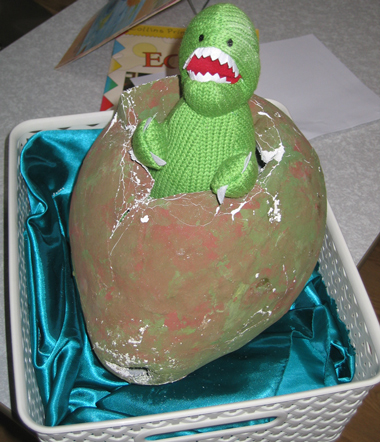
Children at Hadfield Infant School have had a busy day learning all about dinosaurs, fossils and life in the past.  The children in Reception, Year 1 and Year 2 have started a term topic all about prehistoric animals.  Some of the children found a “dinosaur egg” in their classroom, what type of dinosaur could have laid such a big egg?

Exploring Dinosaurs

The egg had started to hatch and sure enough, the children had a baby dinosaur to look after.  We hope that they will learn all about dinosaur plant-eaters and meat-eaters so that they can work out what to feed it!

The Dinosaur Egg in One of the Classrooms

Schoolchildren discover dinosaur egg.

Schoolchildren discover dinosaur egg.  A teaching resource for a dinosaur and fossils term topic. Picture credit: Everything Dinosaur.

Picture credit: Everything Dinosaur

What if the Dinosaur Escapes?

What would happen if the baby dinosaur escaped one evening?  Where would the dinosaur go?  Can the children follow the dinosaur’s travels around the world?

Our dinosaur expert felt very much at home at the school today.  On the wall in the hall where he had been working was a big picture with lots of bones in it.  The children learned that scientists look at the fossilised bones of dinosaurs so that they can work out what they looked like and how they lived.

A Great Backdrop for a Dinosaur Workshop

Learning all about fossil bones of dinosaurs.

Learning all about fossil bones of dinosaurs.  Picture credit: Everything Dinosaur.

Picture credit: Everything Dinosaur

Everything Dinosaur Answering Questions

With the enthusiastic support of the teaching team the children will have a wonderful and engaging topic to study up to the end of the spring term.  There were so many amazing questions asked during the day, questions such as what was the biggest crocodile of all time?  How big were the plates on the back of Stegosaurus?  Good job the children had been working on their phonics to help them work out the difference between big, bigger and biggest.

We sent over some extension resources to help the teaching team answer some of the questions that we did  not get round to in our dinosaur workshop.  We think this term topic is going to be a “roaring success”!

To view Everything Dinosaur’s website: Everything Dinosaur.

10 02, 2015

Bamford Academy Foundation Stage Study Spectacular Dinosaurs

By |2024-05-04T21:54:50+01:00February 10th, 2015|Categories: Educational Activities, Main Page, Teaching|0 Comments

Chicks and Ducklings Learn All About Dinosaurs

For children in the Chicks and Ducklings classes at Bamford Academy, this term has been a very busy one as they have been learning all about dinosaurs, fossils  and life in prehistoric times. There were lots of colourful dinosaur themed artwork on display in the classroom and the budding young palaeontologists had looked at dinosaur eggs and pinned up many different types of prehistoric animals on the classroom’s “WOW” wall.

Class 1 and 2 Have Discovered That There Were Many Different Types of Prehistoric Animal

Lots of different extinct animals on display.

Lots of different extinct animals on display.

Picture credit: Bamford Academy/Everything Dinosaur

Foundation Stage Study Dinosaurs

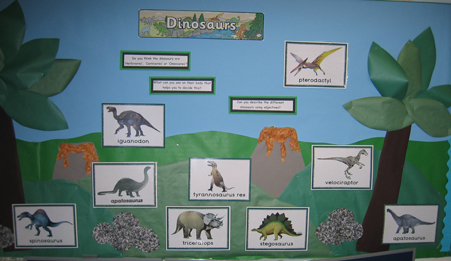
Everything Dinosaur’s fossil expert who visited the school was shown where the volcanoes were in the picture and another very knowledgeable child pointed out that dinosaurs laid eggs.  During the tactile dinosaur workshop we looked at describing words for dinosaurs and fossils.  Real fossils feel cold and hard and some fossils can be really heavy.  When it came to considering appropriate describing words for a jawbone from a Triceratops, the children came up with words like “large” and “massive”, it took three of us to carry the jaw round to show the class, our expert was reliably informed that the teeth of Triceratops feel rough!

The children were keen to take part and we had lots of describing words volunteered, one little girl, stated that the tooth of “Tyrannosaurus rex was gigantic!”

Lots of Evidence on Display of Activities to Develop Vocabularies

Lots of describing words for dinosaurs on display.

Lots of describing words for dinosaurs on display.

Picture credit: Bamford Academy/Everything Dinosaur

Comparing Our Bodies to the Bodies of Dinosaurs

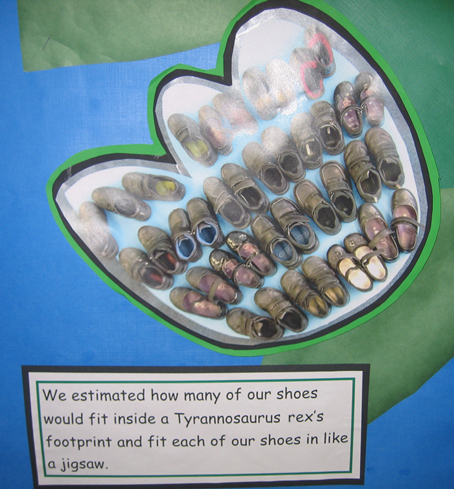
A key theme of the teaching topic had been comparing our bodies to those of dinosaurs.  The enthusiastic teaching team had come up with a very creative way of demonstrating how big T. rex was.  A drawing of the three-toed print of a Tyrannosaurus rex was made and the children counted how many pairs of their shoes would it take to fill up the footprint.  The feet of some dinosaurs were very big and it was wonderful to see such a thoughtful method used to demonstrate just how large some dinosaurs were.

Working out the Size and Scale of Some Dinosaurs

Measuring and comparing.

Measuring and comparing.

Picture credit: Bamford Academy/Everything Dinosaur

Some dinosaurs really did make enormous footprints.  The very biggest dinosaurs made footprints so large that if the track was filled with water a member of Chicks or Ducklings class could have had a bath in it?

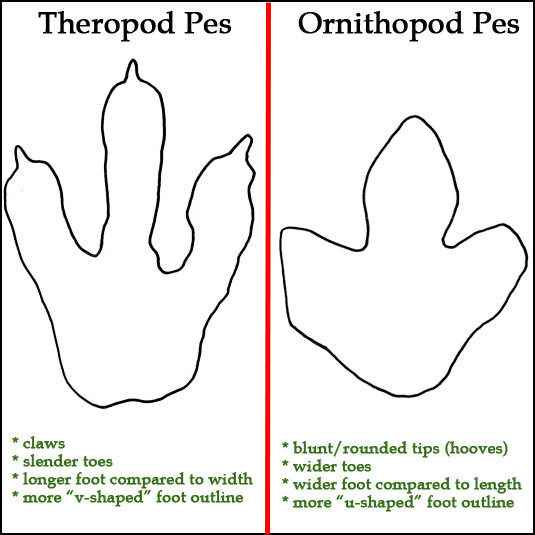
Getting to Grip with Dinosaur Footprints

Comparing different types of dinosaur footprint.

Theropod print compared to an ornithopod print.

Picture credit: Everything Dinosaur

The picture above shows one of Everything Dinosaur’s teaching aids showing two different types of dinosaur track.

Herbivores and Carnivores

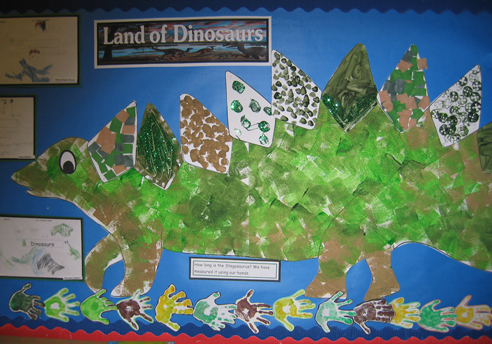
We looked at plant-eaters as well as meat-eaters and the children were keen to demonstrate their knowledge as to what Triceratops and other dinosaurs ate.  It is a pity that we did not have any Stegosaurus fossils to show the children as there was a lovely, friendly Stegosaurus painted on one of the walls outside the classroom area.   The teaching team had encouraged the children to decorate the plates that ran along this dinosaur’s back and the children had also measured how long this dinosaur was by comparing it to the size of their own hands.

Measuring a Stegosaurus

How many hands?

How many hands?

Picture credit: Bamford Academy/Everything Dinosaur

Dinosaurs as a term topic has certainly proved to be very popular with the children and it was clear that a very effective, creative and challenging scheme of work for this topic had been prepared by the teaching team.

Everything Dinosaur stocks a wide range of educational, dinosaur themed toys and games including replicas of iconic prehistoric animals.  To see what is available: Everything Dinosaur Educational Toys, Games and Gifts.

3 02, 2015

Beautiful Seabirds and Pterosaurs with Reception

By |2024-05-04T21:42:08+01:00February 3rd, 2015|Categories: Educational Activities, Teaching|0 Comments

Reception Class Stomping Like Dinosaurs and their Dinosaur Exhibit

Another busy day for Reception class at Eaton Primary School as they have been studying dinosaurs and other animals that lived long ago.  Our dinosaur expert was very impressed with the colourful dinosaur drawings that had been posted up around the classroom.

A Dinosaur Workshop

Under the expert tutelage of teacher Mrs Duffell, ably supported by Miss Parker (Teaching Assistant), the children had been learning together, helping each other to explore prehistoric animals.  Reception class had learned about fossils and how some of them are formed, they had used charcoal to create some very decorative ammonite fossil drawings, it was helpful to have ammonite fossils available for the children to handle.  Some wonderful use of vocabulary as the eager young palaeontologists explored how fossils felt.

Dinosaurs and Prehistoric Animals

There were some very confident counters as the class compared the size of their hands to the footprints of various dinosaurs.  Our dinosaur expert, who had visited the school for the morning, also had his hand measured.  He was told that some dinosaurs had small feet and left small footprints, whilst other dinosaurs had massive feet and left massive, huge footprints.  A lovely example of children using language to express ideas and demonstrate understanding.

Seabirds and Pterosaurs

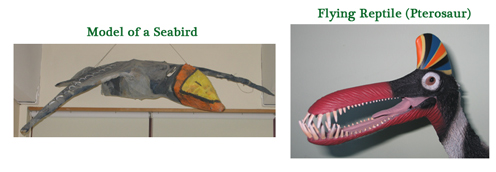
A special dinosaur shop/exhibit had been set up in a corner of the classroom, a great location for role play.  Hanging above this area was a wonderful model of a seabird, that reminded our dinosaur expert of a pterosaur (flying reptile).  Pterosaurs were not dinosaurs, but they were related to the group of reptiles called the Dinosauria.  Many pterosaurs adapted to life in marine habitats and just like many seabirds today, they hunted fish.  Whilst the big ammonites under the water caught fish, flying over the waves pterosaurs were on the lookout for any fish foolish enough to swim close to the surface.

The seabird model, reminded us of the pterosaur called Guidraco, a flying reptile whose fossils have been found in China.  The name of this flying reptile translates as “malicious ghost dragon”, with those sharp teeth even the most slippery fish would not escape.

Comparing the Model Seabird to a Pterosaur

Comparing a seabird to a flying reptile.

Comparing a seabird to a flying reptile.

Picture credit: Everything Dinosaur

Guidraco Pterosaur

When it came to designing the Guidraco replica, it was suggested that since this animal lived in a marine habitat, perhaps it should be coloured in a similar way to a Puffin.  The colourful crest on the pterosaur reminds us of the large, colourful beak of the seabird that hangs over the dinosaur shop area.  Both Puffins and Guidraco pterosaurs ate fish and the big teeth of the pterosaur are quite impressive, but not as big as those of a meat-eating dinosaur like Tyrannosaurus rex.

A challenge was set, could the young palaeontologists work out how big a T. rex tooth was?  Could they answer the question which was bigger a Tyrannosaurus rex tooth or a banana?  No doubt the Reception class will have fun with this investigation and perhaps they can think of creative ways in which they could display the information.

To conclude the visit, the children performed their dinosaur stomping song, lots of fierce dinosaur expressions all around the classroom.

The Guidraco model used to compare to the Reception class seabird is the 1:4 scale CollectA Guidraco model from the company’s Supreme/Deluxe replica range: CollectA Deluxe/Supreme Prehistoric Life.

30 01, 2015

Colourful and Attractive Dinosaurs Helping Reception Children

By |2024-05-04T21:48:49+01:00January 30th, 2015|Categories: Educational Activities, Teaching|0 Comments

Dinosaurs Helping Reception with Vocabulary and Maths

Children in Reception class at St Michael and St John’s R.C. school have been learning all about dinosaurs this term.  With the enthusiastic help of teachers Mrs Collinge, Mrs Clarkson and teaching assistants Mrs Venguedasalon and Mrs Lambert the budding young palaeontologists have been designing their very own dinosaurs and creating lots of very colourful artwork.  The children have been exploring some of the vocabulary associated with prehistoric animals, there was plenty of evidence of meat-eaters, plant-eaters and other terms related to animals, habitats and food chains.

Imaginative, Creative Dinosaurs on Display

Colourful dinosaurs including a "Spikeosaurus".

Colourful dinosaurs including a “Spikeosaurus”.

Picture credit: St Michael and St John’s R.C. School/Everything Dinosaur

Dinosaurs Helping Reception

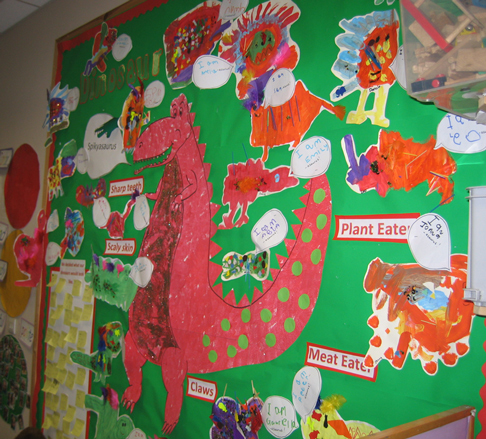
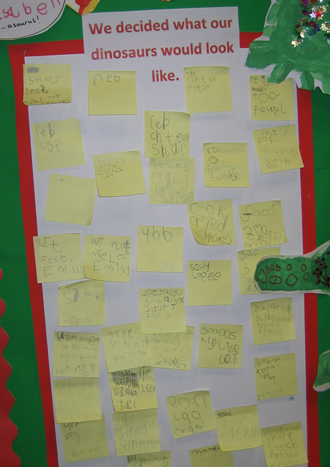
The children had designed their own dinosaur and a number of very imaginative creations were on show, surrounding a large, red “Spikosaurus” with its green spotted tail.  Reception class has thought hard about the sort of questions they would like answers to as they explored dinosaurs and part of the children’s display featured post-it notes with questions the children had written.

Questions All About Dinosaurs

All about dinosaurs.

All about dinosaurs. Lots of questions had been prepared.

Picture credit: St Michael and St John’s R.C. School/Everything Dinosaur

Care had been taken with the use of capital letters and full stops and it was clear that phonics sounds had helped the pupils to write their questions down as they considered how to design their very own dinosaur.  There were many examples around the classroom demonstrating how literacy aims had been woven into the prehistoric animal themed teaching activities.

Confidence with Numbers

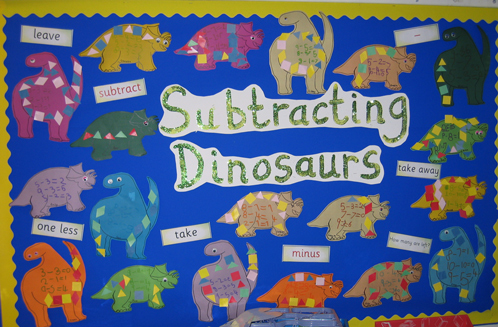
Numeracy and confidence with numbers had also been carefully considered as part of the scheme of work.  Part of classroom had been dedicated to a dinosaur themed addition and subtraction area, with pictures of Triceratops, Apatosaurus and other dinosaurs being used to help the children familiarise themselves with terms associated with adding and taking away.

Dinosaurs Explore Numeracy

Subtracting dinosaurs

Subtracting dinosaurs.

Picture credit: St Michael and St John’s R.C. School/Everything Dinosaur

Everything Dinosaur had visited the school in support of the term topic, conducting a morning of activities with Reception and Class Three.  Both classrooms were covered in examples of the children’s work. Class Three had compiled an impressive timeline which explained key developments in the history of human civilisation.  Our visit helped to reinforce learning as these Lower Key Stage 2 children explored rocks and fossils.  One little boy in Class Three even brought in a lovely fossil of a fish and some of the Reception children showed us their dinosaur books.

We had a great time helping the children learn about life in the past and how fossils form, the school is certainly a vibrant, dynamic learning environment.

To view the range of prehistoric animal themed toys and gifts including replicas of iconic fossil animals: Dinosaur Themed Toys and Gifts.

28 01, 2015

Spectacular Dinosaurs for a Special Science Topic

By |2024-05-04T21:48:20+01:00January 28th, 2015|Categories: Educational Activities, Teaching|0 Comments

Year 1 and Reception Enjoy Learning About Dinosaurs

Children at Hambleton C of E Primary School had an exciting day learning all about dinosaurs and fossils as one of our dinosaur experts visited their school.  Year 1 have been studying dinosaurs for their science topic this term and the budding young palaeontologists had prepared a list of questions.  Answers were provided during the dinosaur workshop.  Questions asked included how did the dinosaurs become extinct?  What colour were dinosaurs?  Which was the biggest dinosaur of all?

Year 1 Had Prepared Questions all About Dinosaurs

Preparing questions about dinosaurs.

Preparing questions about dinosaurs. Picture credit: Everything Dinosaur

Picture credit: Everything Dinosaur

Science Topic Dinosaurs

The children wanted to know all about Tyrannosaurus rex, Finlay asked how long did T. rex live for?  That’s an excellent question and one that was that not answered during the morning of dinosaur and fossil themed activities.  Like most animals, few tyrannosaurs made it into adulthood.  Predation, disease, parasites, starvation and injuries would have all placed a heavy toll on a given population of these meat-eating, theropods.  However, if a T. rex did survive into adulthood, then we estimate that it might have lived for some thirty years or so.  Calculating just how long a Tyrannosaurus rex lived is quite a tricky task, however, a number of studies have been published looking into the growth rates and potential life spans of the Dinosauria.

Here is a link to an article we published a few years ago that compared the growth rates of tyrannosaurs and their potential prey (duck-billed dinosaurs): Duck-Billed Dinosaurs Grew Up Fast to Avoid Being Eaten.

We certainly had some amazing questions from the Year 1 children.

Reception Class Has a Dinosaur Day

The enthusiastic prehistoric animal fans in Reception class had a dinosaur day to coincide with Everything Dinosaur’s visit.  Mrs Parkin and Mrs Bingham had prepared lots of themed activities and some of the children had brought in dinosaur toys from home. Whilst the Reception class waited for a “dinosaur egg” to hatch they set about building their very own prehistoric playground for the dinosaurs.  Our expert was shown where the dinosaurs could hide in the cave and where the river was so that the dinosaurs could have a drink and go for a swim if they wanted to.  It was great to see such imaginative, creative play.  The children were certainly engaged with the topic.

Reception Class Build a Playground for their Dinosaurs

A habitat for dinosaurs.

A habitat for dinosaurs. Picture credit: Everything Dinosaur

Picture credit: Everything Dinosaur

We explored some of the vocabulary associated with animals and what they ate.  In addition, whilst building the dinosaur habitat, the children were learning about the resources that living things require to keep them alive.  One of the favourite parts of the dinosaur workshop was when the children got the chance to engage in role play, reproducing behaviours and pretending to be huge, herbivores.

To visit Everything Dinosaur’s award-winning website: Everything Dinosaur.
26 01, 2015

Class Two Study Dinosaurs and Rare Fossils

By |2024-05-04T21:47:16+01:00January 26th, 2015|Categories: Educational Activities, Teaching|0 Comments

Learning All About Dinosaurs and Prehistoric Animals with Class Two

Children in Class Two study dinosaurs with the help of Everything Dinosaur.

A very busy morning with the Year 2 class at St Malachy’s R.C. Primary who have been studying dinosaurs and prehistoric animals.  The children had been learning all about when the dinosaurs lived, where they lived and how they became extinct.  Miss Butterfield and Mrs Parker had been teaching the children all about continents and countries and a most impressive map had been created which showed where in the world some dinosaurs lived.

Class Two Study Dinosaurs

Mapping the Dinosaurs

Where did dinosaurs live?

Where did dinosaurs live? Picture credit: Everything Dinosaur.
Picture credit: Everything Dinosaur

Can you spot a spelling mistake?  We wonder if any of the children have spotted the mistake, we think this is the teacher’s very clever way of encouraging the children to be observant.

Making Dinosaur Posters

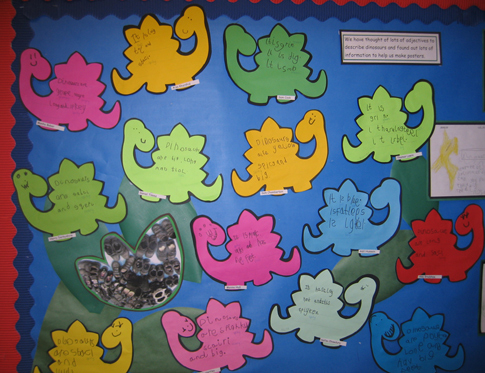
As part of the ICT element of the curriculum for the spring term, the children had been making some dinosaur posters and learning how to copy and paste material from the internet.  Some lovely examples of posters were on display on the classroom wall and outside in the corridor.  They certainly brightened up the corridor.  Our dinosaur expert set the class some challenges, one of which was to come up with some science posters based on the information provided.  In addition, the children demonstrated their use of adjectives and we had some wonderful examples, especially when it came to describing the fossil teeth.

To cater for the design/technology (DT) and art elements of the curriculum, teacher Miss Butterfield, aided by Mrs Parker (teaching assistant) had been helping the children to design and create different prehistoric animal models, including a super sculpture of a fearsome Velociraptor.

A Wonderful Sculpture of a Velociraptor

On guard in the classroom.

On guard in the classroom. Picture credit: Everything Dinosaur.
Picture credit: Everything Dinosaur

Thinking Carefully About Materials

The children had to think carefully about which materials to choose and they had been challenged to use different media to create their prehistoric animal pictures.  We saw some lovely examples of artwork including a dinosaur called “Spike-0-saurus”, a very spiky dinosaur, hence his name.

Making Dinosaur Models and Artwork Using Different Resources

Lots of colourful prehistoric animals on display.

Lots of colourful prehistoric animals on display. Picture credit: Everything Dinosaur.
Picture credit: Everything Dinosaur

So many different types of dinosaur model had been made that some had even been put on display outside in the corridor.  It made our dinosaur expert feel very happy as he passed lots of models of stegosaurs on his way to the classroom.  The children compared parts of their bodies to the bodies of dinosaurs, some of the bones and casts that the children saw helped them to appreciate just how big some dinosaurs were.   It looks like Class 2 are having fun learning all about palaeontologists and life in the past.

To view the huge range of dinosaur themed toys and gifts available from Everything Dinosaur: Toy Dinosaurs and Gifts.

Go to Top