All about dinosaurs, fossils and prehistoric animals by Everything Dinosaur team members.

Everything Dinosaur’s work with schools and other educational bodies. Articles, features and stories about dinosaurs and their role in education and educating young people.

25 06, 2015

Year 1 Go “Walking with Dinosaurs”

By |2023-03-31T21:12:58+01:00June 25th, 2015|Categories: Educational Activities, Main Page, Teaching|0 Comments

“Walking with Dinosaurs” with Year 1

Class One and Class Two (Year 1), at Thorpe Hesley Primary School (South Yorkshire), have been studying dinosaurs over the summer term and Everything Dinosaur were invited in to help enthuse pupils and teachers alike with the term topic entitled “Walking with Dinosaurs”.

The children had lots of questions about prehistoric animals and over the course of the two workshops, our dinosaur expert did his best to answer them all.  We had some super questions from the children and even the teachers asked a few questions.  For example, Mrs Oakley, the teacher of Class Two asked what colour were dinosaurs?

“Walking with Dinosaurs”

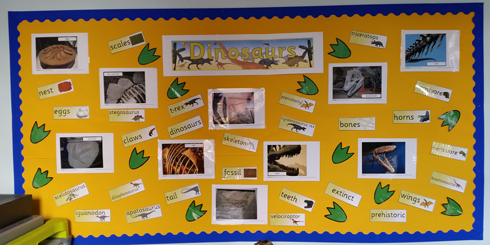
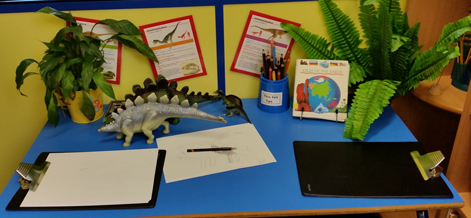
As part of the scheme of work prepared for this topic, the dedicated teaching staff had laid out a number of dinosaur themed workstations for the children.  There was part of the well-organised classroom dedicated to dinosaur art and the children were encouraged to have a go at drawing dinosaurs.  There were some lovely examples of the children’s drawings on display.

A Well Thought Out Workstation Encouraging Children to Draw

Well thought out dinosaur themed workstation

Well thought out dinosaur themed workstation

Picture credit: Thorpe Hesley Primary/Everything Dinosaur

Dinosaur Models in School

The picture shows two Stegosaurus dinosaur models. To view the range dinosaur and prehistoric animal models in stock at Everything Dinosaur: Dinosaur Toys, Dinosaur Models.

The workstation was well lit, and roomy.  All the resources were handy to help the children with their illustrations.  Mr Docherty, told us about a little boy who loved Megalodon “O. megalodon“,  was an extinct type of shark, that may have measured more than fifteen metres long.  The children looked at some super-sized shark fossils as we explored how fossils feel and thought of suitable adjectives for them.

In addition, amongst the prehistoric animal extension resources Everything Dinosaur emailed over to the school after our visit, we made sure to include a Megalodon fact sheet and scale drawing.

Marine Reptile Drawings

We also included a set of marine reptile drawing materials, as well as pictures of ammonites so that the children could create their very own prehistoric seascape.

Dinosaurs Appeal to Kinaesthetic Learners

Lots of tactile handling of different materials.

Lots of tactile handling of different materials.

Picture credit: Thorpe Hesley Primary/Everything Dinosaur

Extension Ideas and Activities

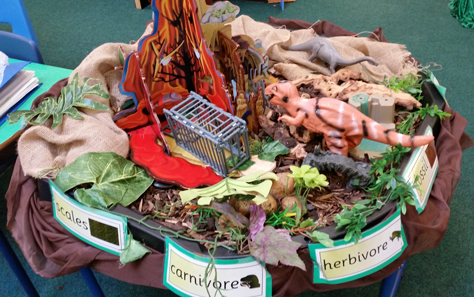
Our dinosaur expert explored herbivores and carnivores and we looked at dinosaur teeth.  Some of the children’s names are very similar to the names of prehistoric animals, this permitted us to send over some additional information on armoured dinosaurs such as Lexovisaurus and Scelidosaurus harrisonii.  Perhaps these additional extension resources sent over to Mrs Oakley and Miss Moran (Class One teacher), will inspire the budding young palaeontologists to have a go at designing their very own dinosaur.  If they do, we would want to see lots of labels on their model or drawing, an opportunity to utilise more adjectives.

As for the colours the children choose, the information we emailed over to Mrs Oakley in answer to her question about dinosaur colouration may help.  The children could also be encouraged to think about habitat and environment.  What colour might a plant-eating dinosaur living in a forest be?  What colour might a meat-eating dinosaur that lived in a desert be?  Can we introduce ideas like camouflage, perhaps looking at animals alive today to help inspire the classes?

For further information on Everything Dinosaur’s product range: Email Everything Dinosaur.

Sir Richard Owen

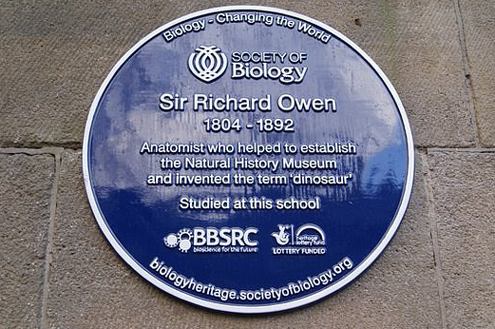
The pronunciation of prehistoric animals and all the terms that palaeontologists use can be a bit of a challenge.  Hopefully, the guide we gave Mrs Marshall (teaching assistant) will help.  Having met a young boy called Owen we explained that the word “dinosaur” was first coined by an Englishman (Richard Owen, later Sir Richard Owen).  We sent across some information all about this famous Victorian scientist, who recently had a blue plaque erected at his former school in Lancaster.

May be the children could create their very own blue plaque for Thorpe Hesley Primary, to celebrate studying “Walking with Dinosaurs”.

Blue Plaque Erected at the Former School of Sir Richard Owen

Sir Richard Owen honoured.

Sir Richard Owen honoured.

Picture credit: LRGS

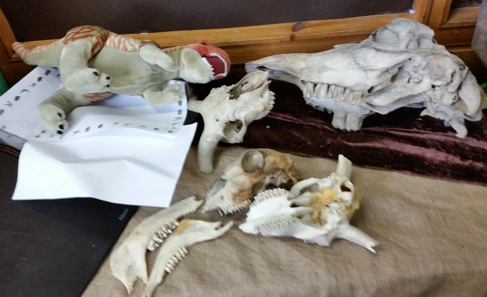
The Year 1 teaching team which also includes Mr Meares, Mrs Burns along with school visitor Mrs Hawkins even provided the children with some bones of animals to explore.  Our dinosaur expert enjoyed looking at the various skulls of farm animals that had been brought in.  We even recognised the T. rex soft toy that had been placed next to the cranial material (skulls and jaws).  We are not sure what a real Tyrannosaurus rex would have made of it all.

Year 1 Children Can Explore the Bones of Animals

Wonderful use of different materials to show different properties.

Wonderful use of different materials to show different properties.

Picture credit: Thorpe Hesley Primary School

21 06, 2015

Dinosaur Day with Year 1

By |2023-03-31T08:19:21+01:00June 21st, 2015|Categories: Educational Activities, Main Page, Teaching|0 Comments

Abbey Hey Primary Academy and Dinosaurs

Another busy week with lots of dinosaur workshops with team members travelling to Staffordshire, Derbyshire and Lancashire.  There was just enough time to squeeze in a trip to Abbey Hey Primary Academy to meet all the budding young palaeontologists in Year 1 for a special dinosaur day.  The children in classes 1Wh, 1G and 1W have been studying dinosaurs and learning all about these amazing prehistoric creatures with the help of their enthusiastic teaching team.  Out in the playground our dinosaur expert spotted some wonderful dinosaur shaped chalk boards

Playground Jurassic Park

Fun and creative dinosaur themed playgrounds.

Fun and creative dinosaur themed playground accessories.

Picture credit: Everything Dinosaur

Dinosaur Day

With three classes to teach there was no time to lose, so it was straight into the Infants Hall to conduct the first dinosaur workshop with Miss Whitty’s class (1Wh) assisted by Miss Ahmed and Mr Jackson.  We were most impressed with the pictures that had been posted up onto Abbey Hey’s school website.  Clearly the children enjoyed themselves and they certainly had learned a lot.

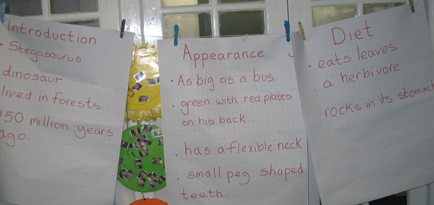
Next it was onto class 1G, to visit the children in their classroom and to conduct a second dinosaur and fossil themed session.  Our dinosaur expert marvelled at the wonderful examples of dinosaur inspired writing he saw posted up around the classroom.  The children had focused on two dinosaurs, the armoured Stegosaurus and the fearsome Tyrannosaurus rex, they had been working out what these dinosaurs were like and compiling a list of dinosaur facts on flip charts.

Stegosaurus and T. rex Inspired Facts 

Learning facts about dinosaurs.

Learning facts about dinosaurs.

Picture credit: Everything Dinosaur

Pupils Really Engaged with the Term Topic

Teacher, Miss Ellison explained that the pupils had been really engaged with this term topic and they had loved working out just how big some dinosaurs were.  Miss Russell and Miss Farrington took plenty of photographs during the dinosaur workshop, these would help in the planned recall and recount activity that the teaching team had prepared for the afternoon.  There was even a model of a big dinosaur egg in the classroom, this topic certainly seems to have captured the imagination of the teachers.

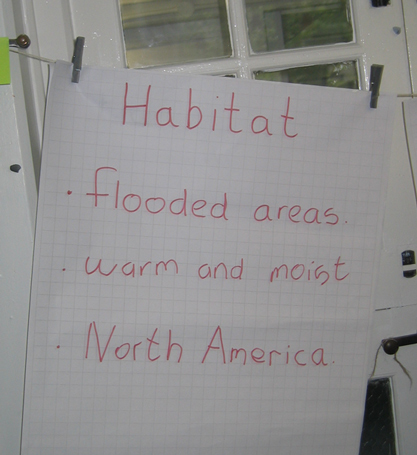
Year 1 Children Have Been Learning About Dinosaur Habitats

Year 1 explore dinosaur habitats.

Year 1 explore dinosaur habitats.

Picture credit: Everything Dinosaur

Dinosaur Habitats

A number of the classes had created their own dinosaur habitats, learning about what animals need to keep them healthy and happy.  Good job the children knew how to distinguish the carnivores from the herbivores.

In the afternoon, it was time to work with class 1W.  Miss Sarwar (the teacher), had briefed our dinosaur expert on exactly where the children were on the term topic, as a result we were able to help reinforce learning and check understanding as we explored prehistoric animals with the class.  Miss Heap and Miss Statham (teaching assistants) were on hand to help the enthusiastic children learn how Triceratops used its horns, how ammonites caught fish and the special, secret powers of armoured dinosaurs.

A spokesperson for the school, commented on the school’s class pages:

Year 1 had a visit from a dinosaur expert [Everything Dinosaur].  They were shown dinosaur fossils dating back over 150 million years.  The children thoroughly enjoyed the day and they learnt some much more about dinosaurs.”

To learn more about Everything Dinosaur’s range of inexpensive dinosaur themed toys and gifts: Dinosaur Toys and Gifts.

20 06, 2015

New Study Suggests Sixth Mass Extinction Phase

By |2024-05-05T14:18:40+01:00June 20th, 2015|Categories: Dinosaur and Prehistoric Animal News Stories, Educational Activities, Main Page, Teaching|1 Comment

Our Planet is Entering New Mass Extinction Phase

A team of international scientists based in the United States and Mexico have published a report declaring that a sixth mass extinction event is well under way and our species is running out of time to reverse this trend through conservation efforts.  Everything Dinosaur team members have written a number of articles on this blog about reports detailing the current rate of extinctions being recorded and the irreversible loss of ecosystems and biota.

Sixth Mass Extinction

This latest research takes a more conservative approach to calculating species loss than many earlier studies and this study focuses on the impact on vertebrates.  Even so, the team conclude that animals with back bones are becoming extinct more than 114 times faster than the “normal”, background extinction rate.

Scientists from Universidad Nacional Autónoma de Mexico, (Mexico), the University of California, Stanford University, Princeton University and the University of Florida state that the Earth is entering the sixth great mass extinction event, some sixty-five million years after the fifth mass extinction which ended the reign of the dinosaurs.

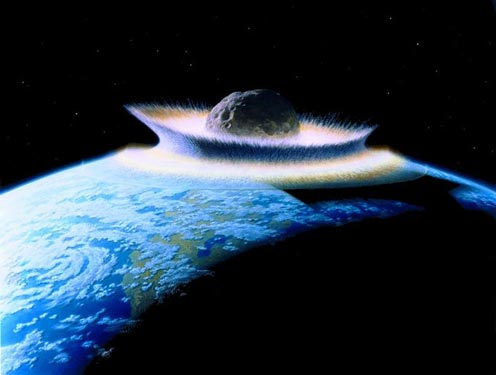
Report States This is the Greatest Extinction Phase Since the Demise of the Dinosaurs

Cataclysmic impact event that led to the extinction of the dinosaurs.

Cataclysmic impact event that led to the extinction of the dinosaurs.

Picture credit: Don Davis commissioned by NASA

Mass Extinctions Recorded in the Fossil Record

The fossil record suggests that there have been five major extinction events in the Phanerozoic Eon which represents the last 545 million years or so of our planet’s history.  The term Phanerozoic is derived from the Greek, for “visible life”, this reflects that the preserved fossilised remains of organisms become much more plentiful in rocks dated from 545 million years ago and younger.

Over this huge amount of time, there have always been extinctions.  Scientists are aware of the fact that there is a “background” level of extinction, but in this new research, the scientist report that amongst vertebrates the current trends suggest extinction rates 114 times faster than normal.

A Table Showing the Five Previous Mass Extinctions

Mass Extinction in Summary

Table credit: Everything Dinosaur

For model and replicas of prehistoric animals: Dinosaur Models and Prehistoric Animal Figures.

Scientists Comment on the Sixth Mass Extinction Event

Gerrado Ceballos, (Universidad Nacional Autónoma de Mexico), lead author of the paper, that has just been published in the academic journal “Science Advances” commented:

“We are now entering the sixth great mass extinction event.  If it is allowed to continue, life would take many millions of years to recover and our species itself would likely disappear early on.”

The report concludes that since 1900, more than four hundred species of vertebrates have died out.  Such a loss would normally occur over 10,000 years if extinction rates were at the normal, background level.

The rapid loss of biodiversity is put down to the effect of an increasing human population on our planet.   The number of humans living on our planet is estimated to have been around 1.9 billion in 1900, today, the human population is estimated to be around 7.325 billion, an increase of 385% over the last one hundred and fifteen years.  The expansion of urban populations, pollution, loss of habitats, deforestation and climate change are some of the reasons for the dramatically increasing loss of vertebrates according to the paper’s authors.

Key Vertebrate Species Dying Out

With the disappearance of key vertebrate species from an ecosystem, the other components such as insects and plant life will also be affected.   The report states that beneficial insects such as pollinating bees could be lost to humanity within three human generations.  The loss of these pollinators would have a huge impact on human food resources and place our own species Homo sapiens very much under threat.

To read an article written in 2014 about potential mass extinctions: Heading for a Sixth Mass Extinction?

The number of global mass extinction events preserved in the fossil record has been challenged recently.  Back in April of this year, Everything Dinosaur reported on a new study that suggested that there had been an additional, major extinction event around 260 million years ago in the Permian.  This extinction phase preceded the End Permian extinction event that is believed to be the most devastating extinction known from the Phanerozoic.  Some 95% of all life is believed to have died out.

To find out more: A Sixth Mass Extinction Event?

11 06, 2015

Updating the Exclusive Everything Dinosaur School Site

By |2024-05-05T13:42:34+01:00June 11th, 2015|Categories: Educational Activities, Teaching|0 Comments

A Busy Teaching Schedule for the Summer Term

The relatively short summer term is in full swing and so are the plans for teaching activities at Everything Dinosaur with team members undertaking a number of dinosaur and fossil workshops with children aged from 4 years up to Key Stage 3.  The Everything Dinosaur “Dinosaurs for Schools” web site, a bespoke on line presence for teachers and home educationalists, is constantly being updated with helpful posts and additional downloads of free to use dinosaur and fossil themed teaching resources.

With evolution and natural selection being incorporated into the English national curriculum, the demand for our experts is at an all time high, but team members remain determined to help all the teachers and education specialists that contact the company.

Planning and Preparing So That More Support Can Be Provided

Everything Dinosaur school website.

Planning schemes of work to support teachers.

Picture credit: Everything Dinosaur

Everything Dinosaur

Commenting on the company’s proposed teaching plans for the summer term a spokesperson for the Cheshire based organisation stated:

“We know how busy teachers are at the moment, there is so much to squeeze into this term and on top of this many senior leadership teams are well advanced with their schemes of work for 2016.  We too have put in place measures to help ensure that we can keep creating new downloadable teaching resources as well as posting up additional articles on our schools website to provide further support.  Rest assured, we shall keep working on this throughout this term and into the summer recess so educationalists can rely on us for useful, informative and helpful dinosaur and fossil themed teaching resources.”

To view the Everything Dinosaur web site: Everything Dinosaur.

In addition, the schools website will have a number of new features incorporated within it over the next two weeks.  New “quick links” will be included in the site to help teachers and learning practitioners navigate quicker to key areas such as being able to contact one of our dinosaur and fossil experts directly via email.

These improvements to this element of Everything Dinosaur’s on line presence are designed to provide an even speedier service to teachers, permitting questions about dinosaurs, requests for advice about lesson plans and so forth to be handled even quicker than before.

Everything Dinosaur must be doing something right when it comes to dinosaur workshops in schools.  Feedback from teachers and teaching assistants averages a very impressive 4.8 stars out of a maximum of 5 stars.

8 06, 2015

What is Oolitic Limestone? That’s a Good Question

By |2024-05-05T14:12:54+01:00June 8th, 2015|Categories: Educational Activities, Geology, Main Page, Teaching|0 Comments

Oolite (Egg Stone) Get up Close to Limestone

One of the joys of having Smartphones around the office is that these can be borrowed and taken out on fossil hunting expeditions.  Yes, they have all sorts of features, most of which we don’t use, but the camera has proved a boon. With twenty megapixels to play with team members have been able to take some lovely photographs of fossil discoveries and geological landscapes.  With this sort of imaging technology widely available there are more pictures of fossils being taken than ever before, but sometimes the rocks that contain the fossils can prove to be just as interesting, take oolitic limestone for example.

Oolitic Limestone

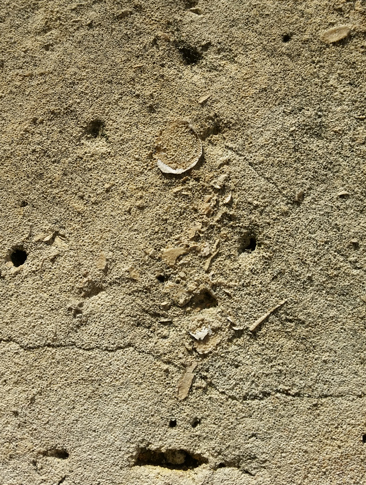
 A Photograph of Oolitic Limestone (Building Stone)

"egg stone" seen in a building.

Some “egg stone” seen in a building. Picture credit: Everything Dinosaur

Picture credit: Everything Dinosaur

Cotswold Building Stone

The picture above shows Cotswold building stone (Middle Jurassic), limestone that was laid down in a marine environment and a number of small shelly fossils have been preserved along with natural casts of shells.  If you were to run your hand over this finely chiselled piece of building stone it would still feel quite rough, having the texture of coarse sand paper.  It is oolitic limestone, otherwise known as “egg stone” and close up the surface of the stone has a remarkable appearance.

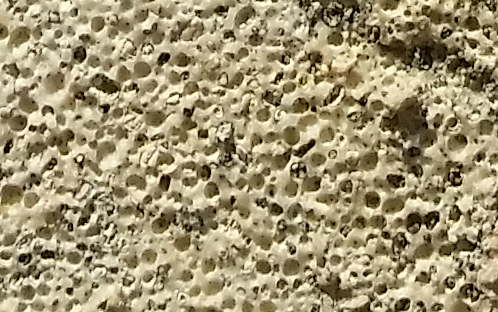
A Close Up of the Limestone Material

Made up of tiny spherical shapes.

Made up of tiny spherical shapes. Picture credit: Everything Dinosaur.

Picture credit: Everything Dinosaur

The powerful digital camera on the Smartphone can pick up fine details such as the small, bubble-like appearance of the surface of the limestone.  These are the remnants of the ooliths (sometimes also called ooids) that make up the rock.  Grains of sand or fragments of seashell are rolled around the sea floor and as they do, they collect calcium carbonate (CaCO3).  Concentric layers are formed and these give the rock its characteristic “egg stone” appearance, as the surface of the rock looks like fish roe (fish eggs). Hence the term oolitic limestone.

Limestone Oolite (Egg Stone)

Oolite (egg stone) is sedimentary rock and although most ooids are formed from the collection of calcium carbonate, this is not always the case as these structures can be composed of phosphate, dolomite or even chert.  The ancient Greek word for egg is  òoion and this might be the source of the derivations associated with this geologic structure.

In geology, sedimentary rock can be classified according to the composition of the rock as well as the diameter of the “egg stone” structures that are observed within it.  For example, oolites are technically defined as being composed of ooids that range in diameter between 0.25 mm to 2 mm.

Classifying the Rock Types

Rocks composed of ooids of a larger than 2 mm diameter are called pisolites (made up of spherical shapes called pisoids).  The terms pisolite and pisoids come from the ancient Greek word for pea, so think of the size of the spherical shapes observed in the stone like a group of small peas.

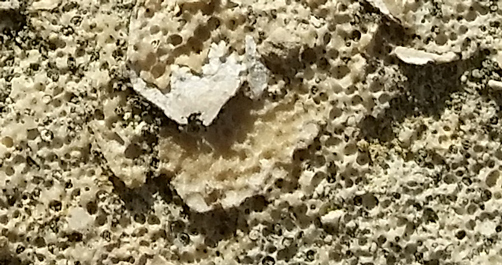
Oolitic Limestone can be Full of Fossils

Fossil shell fragments in the oolitic limestone.

Fossil shell fragments in the oolitic limestone. Picture credit: Everything Dinosaur.

Picture credit: Everything Dinosaur

Ooids are normally formed in warm, shallow seas that contain a lot of calcium and other minerals dissolved within the seawater.  Intertidal movements or currents aid in the transport of the material which helps in the formation of the ooid structures, but oolitic material can also form in freshwater.  Fragments of shell or a sand grain can act as a “seed” giving the calcium carbonate a medium which it can form around.

As these tiny “seeds” tumble around the sea bed they accumulate layers of precipitated calcite (another term for calcium carbonate), the size of the ooid (or pisoid) formed indicates the length of time the object has been exposed to the sea water before being buried by further sediment deposition.

Size Indicates Time on the Seafloor

Therefore, pisoids, being larger than ooids have been present on the seafloor longer than ooids.  Oolites with their “egg stone” grains superficially resemble sandstone and they can be white, grey or even yellow in colour (such as Portland limestone).  Under a high powered magnifying glass (or within a 20 megapixel image), the concentric rings which form the ooids can be easily made out.

Oolitic limestones are popular building materials, for example Cotswold limestone (oolitic limestone), as they are hard, resist erosion and come in a variety of hues and colours.  As they have an even structure they can be cut or sculpted in any direction.  Take a look at some of the older, stone buildings in your town.  If you live in the UK, chances are that some of these building stones are oolitic limestone and if you have a powerful camera you can record surface details yourself and record the ooids.

For models and replica of Jurassic dinosaurs and other prehistoric creatures: Nanmu Studio Jurassic Series Dinosaur and Prehistoric Animal Models.

25 05, 2015

My First Toy Dinosaurs Model Set

By |2023-03-30T10:54:17+01:00May 25th, 2015|Categories: Dinosaur Fans, Educational Activities, Everything Dinosaur Products, Photos of Everything Dinosaur Products, Press Releases, Product Reviews, Teaching|0 Comments

My First Toy Dinosaurs Model Set (6 Rubber Dinosaurs)

Great for imaginative, creative play, a set of six rubber dinosaurs from Everything Dinosaur.  An ideal gift for the young dinosaur fan in your family or as a play set for use in schools.  The set of six dinosaur models includes a Tyrannosaurus rex, a long-necked Brachiosaurus, the plated dinosaur Stegosaurus, along with a bright and colourful duck-billed dinosaur, a Parasaurolophus.  The set also includes a horned dinosaur (Triceratops), and a wonderful armoured dinosaur, an Ankylosaurus.  This set of soft rubber dinosaurs makes an ideal my first dinosaurs model set as these prehistoric animals are suitable for children from three years and upwards.

My First Toy Dinosaurs Model Set (6 Rubber Dinosaurs)

A set of six rubber dinosaurs, great for tactile play.

A set of six rubber dinosaurs, great for tactile play.

Picture credit: Everything Dinosaur

My First Toy Dinosaurs

The teaching team at Everything Dinosaur have specially chosen this toy dinosaurs set as the models represent typical examples of dinosaurs and show the variety of these ancient reptiles that once roamed our planet.  The models are made from soft rubber and they are great for imaginative, tactile play.

To view the range of educational dinosaur toys including replicas of iconic fossil animals available from Everything Dinosaur: Everything Dinosaur Models, Toys and Games.

This really is a super set of soft and squeezy rubber dinosaurs.  The set makes an ideal, my first dinosaur model set for any young dinosaur fan.  They are a great way for young minds to explore materials and discover the world of dinosaurs.

One of our customers wrote this review:

“Loved the colourful models, six different ones that my little boy just loves.  A great first dinosaur model set.  Soft and squeezy rubber dinosaurs, very well made.”

Thanks for your review Mrs Jacobs.

Everything Dinosaur supplies a set of useful dinosaur fact sheets about the animals featured in this set.  This is a great dinosaur themed resource for schools.

21 05, 2015

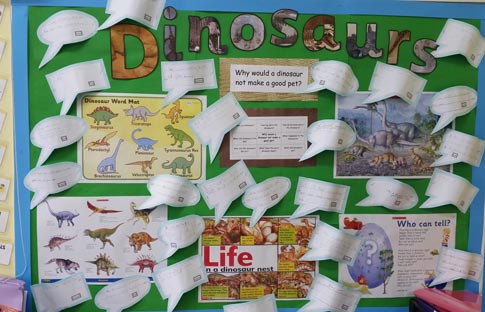
Would a Dinosaur Make a Good Pet?

By |2023-03-30T07:51:43+01:00May 21st, 2015|Categories: Dinosaur Fans, Educational Activities, Teaching|0 Comments

Year 2 at St Joseph’s Catholic Primary School Consider a Pet Dinosaur

Children in Year 2 at St Joseph’s Catholic Primary School (Matlock, Derbyshire), have been tackling the tricky question of would dinosaurs make good pets?  This poser is one of the questions being explored as part of a series of themes for the summer term.  So far the children have learned about dinosaur eggs and taken part in some outdoor measuring activities under the guidance of their enthusiastic teacher Miss Sutcliffe.  It’s a good job the school has a large playground, especially when it comes to working out how tall a Brachiosaurus was.

Everything Dinosaur Visiting Schools

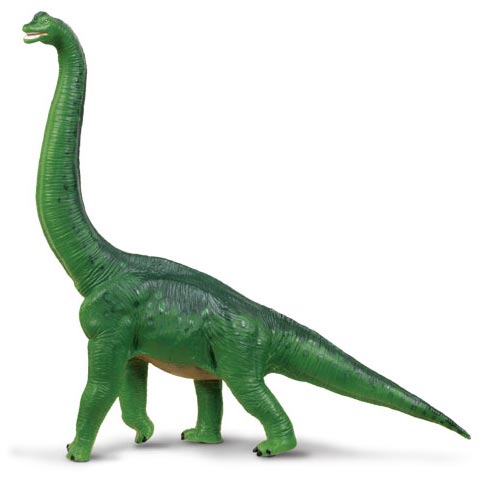
Brachiosaurus was one of the largest of the dinosaurs, a huge plant-eater, fossils of which have been found in Upper Jurassic rocks.  The children estimated that a twelve metre tall Brachiosaurus would be the same height as nineteen Year 2 children.  This is a super exercise and certainly helps children gain an appreciation of the size and scale of some of the biggest dinosaurs.

One of the Biggest Dinosaurs of the Late Jurassic

A typical Brachiosaur.

A typical brachiosaur.

Picture credit: Everything Dinosaur

Brachiosaurus

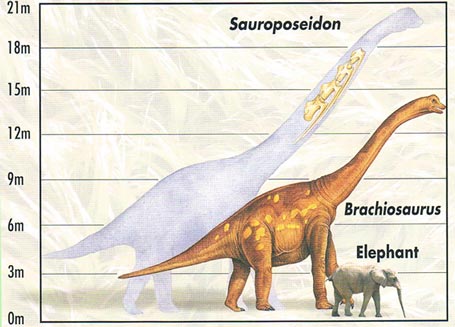
Trouble is, Brachiosaurus (the name means “Arm Lizard” as the forelimbs were larger than the back legs), was not the tallest of the Dinosauria.  As more fossils have been found so different contenders for the “tallest dinosaur “accolade are proposed.  One contender, known from four neck bones and a handful of other fossil specimens found in rocks dating from the Early Cretaceous of the United States, is Sauroposeidon (the name means “Earthquake Lizard”).  Sauroposeidon is pronounced sore-oh-poh-sigh-don.  One of the neck bones measures 1.4 metres long, that is taller than most of the Year 2 children at the school.

Size estimates for Sauroposeidon do vary.  With so few fossils to study, it is difficult to work out just how tall, or indeed just how long or how heavy this dinosaur was.  Palaeontologists are not even sure if Sauroposeidon had the same basic body shape of Brachiosaurus.  However, if it did, then it could have been around 18-20 metres tall.

Sauroposeidon Compared to Brachiosaurus

Scaling up Sauroposeidon and comparing it to Brachiosaurus and an extant African elephant.

Scaling up Sauroposeidon and comparing it to Brachiosaurus and an extant African elephant.

If nineteen Year 2 children are as tall as a twelve metre high Brachiosaurus, then can the class work out how many of them would be needed to be the same height as a twenty metre tall Sauroposeidon?

Everything Dinosaur supplies a range of long-necked prehistoric animal models to schools, home educators and museums.  To view the models and replicas section of the website: Everything Dinosaur Prehistoric Animal Models.

Everything Dinosaur Workshop

Miss Sutcliffe and her teaching assistant have certainly developed a challenging and engaging scheme of work for the class.  The dinosaur workshop we conducted certainly helped as we were able to answer the children’s questions and some of those questions were quite challenging.  For example, we were asked how did dinosaurs chew bones?  Fortunately, some of the fossils we had with us were useful in demonstrating how some types of dinosaur ate.

Everything Dinosaur’s work in schools has received praise.  To read an article about Everything Dinosaur being mentioned by Ofsted: Praised by Ofsted.

The spacious and well-organised classroom had lots of dinosaur themed displays.  We were informed that after our visit the children would be designing a habitat for their dinosaurs.  This links nicely into the English national curriculum as this enables the children to learn about living creatures and what they need to survive.

Extension Activities

Perhaps the children can compare the world of the dinosaurs with habitats seen today and the types of animals that exist in those habitats.   It was pleasing to note that Year 2 had a good grasp of the terminology related to ecosystems and food chains.  For example, the children were able to explain all about omnivores.  Our cast of the lower jaw of a pachycephalosaur (Dracorex hogwartsia), proved useful when it came to explaining about animals that ate both meat and plants.  Dracorex might make a good pet dinosaur, it would have helped keep the school’s vegetable garden pest free, but a downside might be that it would be tempted to eat all the flowers!

A Colourful Dinosaur Themed Display in the Classroom

St Joseph's Catholic Primary School (Year 2) dinosaur display.

St Joseph’s Catholic Primary School (Year 2) dinosaur display.

Picture credit: Year 2/Everything Dinosaur

We set the class a number of challenges as part of the extension ideas and activities we discussed with Miss Sutcliffe and we look forward to hearing how the children get on as they explore all things dinosaur for their summer term topic.

To learn more about Everything Dinosaur’s science outreach: Contact Everything Dinosaur.

13 05, 2015

Retracing the Beak of Birds to the Snout of Dinosaurs

By |2023-03-28T08:12:21+01:00May 13th, 2015|Categories: Dinosaur and Prehistoric Animal News Stories, Dinosaur Fans, Educational Activities, Main Page, Palaeontological articles, Teaching|0 Comments

Reverse Genetic Engineering to Produce a Dinosaur Snout

A team of scientists based in the United States have tweaked the developmental processes that take place in chicken embryos to re-engineer the snouts of their dinosaur ancestors.  The research team led by University of Yale palaeontologist, Bhart-Anjan S. Bhullar and developmental biologist Arhat Abzhanov (Harvard University), have produced the first bird embryos that possess a snout similar to a dinosaur’s nose rather than a beak.  The chicken embryos developed palatial bones and a jaw configuration that resembles that seen in the fossil record, specifically in the Dromaeosauridae, a group of dinosaurs that are closely related to modern Aves.

Bird Embryos Possess a Snout Similar to a Dinosaur Snout

The dromaeosaurs, sometimes referred to as the “raptors” belong to the Suborder Theropoda.  They are part of a clade of agile dinosaurs that reduced their tails, lost their teeth and evolved into Aves (birds).  Typical dromaeosaurids are Velociraptor, Deinonychus and the recently named Saurornitholestes sullivani.

To read an article about the newly described Saurornitholestes sullivaniSniffing Out a New Dinosaur Species.

As the Yale University press release states: “Just don’t call them Dino-chickens!”

Tweaking the Beak from Dromaeosaurs to Modern Birds
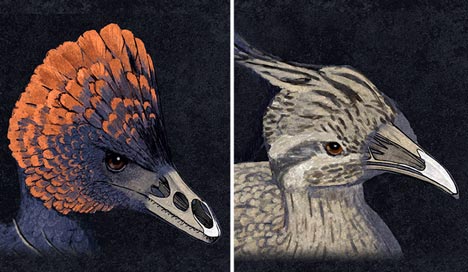
From the Dinosauria (left) to the beaks of modern Aves (right).

From the Dinosauria (left) to the beaks of modern Aves (right).

Picture credit: John Conway

Manipulating Chicken Embryos

The scientists were not in the business of trying to create a living dinosaur.  Manipulation of chicken embryos has taken place for several years, all part of research to help the understanding of how molecular processes affect the development of organisms.

Commenting on this research, which has just been published in the journal “Evolution”, lead author Dr Bhart-Anjan S. Bhullar (Department of Organismic and Evolutionary Biology, Yale) stated:

“Our goal here was to understand the molecular underpinnings of an important evolutionary transition, not to create a “dino-chicken” simply for the sake of it.”

Researching Cranial Development

For the young doctor, this is all part of his on-going research into cranial development in very young animals.  It is not part of a concerted effort to bring back the Dinosauria, a sort of “Jurassic Park from the embryo upwards”, as explained by a spokesperson from Everything Dinosaur.

There are a huge variety of bird beaks, from the curved, tearing and cutting beaks of eagles, to the sophisticated sieves of flamingos.  The beak is an essential component of avian anatomy and the researchers are trying to unravel how the beak evolved from its reptilian ancestry.  A quantitative analysis of fossils closely associated with the origins of birds was undertaken along with a study of extant animals including lizards, crocodiles and birds.

How the Beak of Birds Evolved

This examination allowed the scientists to develop a hypothesis as to how the bird beak may have evolved from the Dinosauria and the developmental stages that were involved.

The team identified that both major living lineages of birds, the abundant Neognathae (which includes virtually all species of extant birds) and the much rarer  Palaeognathae (which comprises the Tinamou family of birds from South and Central America plus the flightless ratites – cassowary, ostrich, kiwi, rhea, for example), differ from reptiles that are not closely related to birds and from mammals in that they have a unique, median gene expression zone of two different facial development genes early in embryonic development.  This median gene expression had previously only been identified in chicken embryos.

Turning Back the Evolutionary Clock

In order to have an embryo revert to its ancestral state, before the beak as it were, the gene expression for beak formation in the young chicken had to be turned off.  Microscopic beads coated in a molecule inhibiting substance were used to inhibit the activity of the proteins produced by the bird specific, median signalling zone in the chicken embryos.  This led the embryo to revert back to its reptilian ancestry with a more dinosaur-like snout forming and surprisingly, the palatine bone in the root of the mouth was also altered.

Changing the Faces of Embryos (Modified Chicken Embryo with Snout)
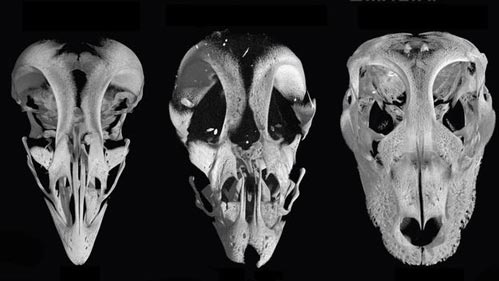
Normal chick (left), modified chicken embryo (centre), alligator embryo (right)

Normal chick (left), modified chicken embryo (centre), alligator embryo (right)

Picture credit: Evolution

Unexpected Changes

Dr Bhullar was surprised by the additional changes seen in the palatine bone, he stated:

“This was unexpected and demonstrates the way in which a single, simple developmental mechanism can have wide-ranging and unexpected effects.”

Commenting on the research, Professor Michael Benton (Bristol University), someone who knows a great deal about bird evolution, explained that this new study shows that the beak of birds develops very different from the snouts, noses and jaws of reptiles.  A different set of genes are involved.

He stated:

“That’s what proves the beak is a real adaptation or “thing”, not just a slightly different nose shape”

Why Dinosaur Snouts and Bird Beaks?

Intriguingly, although the fossil record for bird evolution is far from complete, the fantastically well preserved bird fossils of Lower Cretaceous deposits from China, specimens of Confuciusornis for instance, show that by around 125 million years ago the toothless beak had evolved.

Why the beak came about remains a point of significant debate, however, one of the most often cited reasons for a lighter, toothless structure is that as birds became more efficient fliers and spent more time in the air, the loss of a heavy, bony jaw lined with teeth was just one of a number of anatomical adaptations that occurred to help improve powered flight.

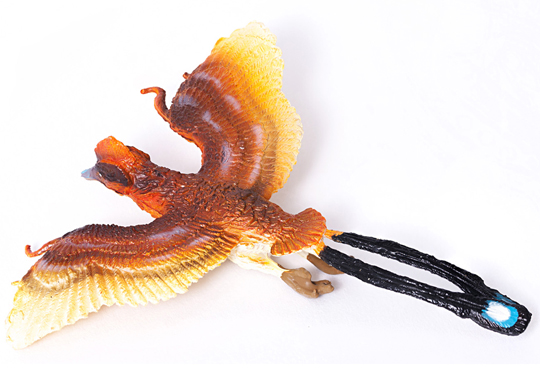
A Model of the “Early Bird” Confuciusornis sanctus from China
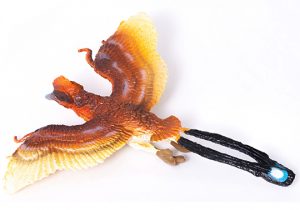
PNSO Age of Dinosaurs Confuciusornis model.

Confuciusornis model (PNSO Age of Dinosaurs).

Picture credit: Everything Dinosaur

The picture (above), depicts the PNSO Confuciusornis replica. There are a number of feathered prehistoric animal models in the PNSO range: PNSO Age of Dinosaurs.

Important Implications

The American based researchers are confident that their work has important implications for other geneticists and for palaeontologists.  For example, if a single molecular mechanism was responsible for this transformation, there should be a corresponding, linked transformation in the fossil record.  The flightless, man-sized Hesperornis, a genus of prehistoric bird known from the Late Cretaceous of North America could demonstrate that link.

An Illustration of Hesperornis (Traditional View)
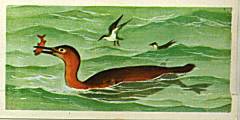
Hesperornis catching a fish.

Hesperornis catching a fish.

Picture credit: Everything Dinosaur/Brooke Bond

Dr Bhullar said:

“This is borne out by the fact that Hesperornis, discovered by Othniel Charles Marsh of the Yale Peabody Museum of Natural History, which is a near relative of modern birds that still retains teeth and the most primitive stem avian with a modern-looking beak in the form of a fused, elongate premaxillae, also possesses a modern bird palatine bone.”

The premaxillae are the bones that form the tip of the upper jaw (anterior portion) of most animals, but are enlarged and fused to form the beak of birds.

Finding a Hypothetical Developmental Path

Moving forward, the quantitative analysis to establish a proposed hypothetical developmental path of a lineage of animals which could be tested by inhibiting the behaviour of proteins in embryos can be probably be used to investigate a wide range of underlying developmental mechanisms in organisms.

The dinosaur/bird link is now well established, a theory once proposed by the likes of Henry Govier Seeley back in the 1880’s is widely accepted.  Back in 2013, Everything Dinosaur reported on research from an international team of scientists, including researchers from the Royal Veterinary College (London), that looked at how the posture of birds was derived from the gait of small, cursorial dinosaurs.

To read more about this study: The Birds Have the Dinosaurs to Thank for their Crouching Gait.

Everything Dinosaur notes the support of Yale University in the compilation of this article.

5 05, 2015

Great Work from Great Wood Primary School

By |2023-03-27T07:26:25+01:00May 5th, 2015|Categories: Educational Activities, Main Page, Teaching|0 Comments

Year 2 Learn All About Dinosaurs in the Great Outdoors – Dinosaur Workshop

It was certainly an interesting morning when Everything Dinosaur visited the two classes of Year 2 at Great Wood Primary School (Morecambe).  The children had just started learning all about prehistoric animals as part of their term topic “Jurassic Forest”.  One of our fossil experts visited the school as part of the planned scheme of work to help inspire and enthuse children and teachers alike.  Unfortunately, the fire alarm sounded part way through the first session and the whole school had to be evacuated.

Dinosaur Workshop

However, it was a sunny day, so undaunted, we were able to continue by moving everything outside.  With the minimum of fuss, the pupils in Mrs Parkin’s class settled themselves down in the playground  and we were able to deliver a second workshop.   Everything Dinosaur’s “Dinosaur Mike” challenged the two classes (2T with Mrs Todd and 2P with Mrs Parkin), to send in thank you letters as part of an agreed extension activity to help encourage the children with their composition and sure enough, at the end of last week, we received a large envelope which contained letters and some very colourful dinosaur drawings.

 A Wonderful Set of Letters Sent in by Year 2

Letters and drawings sent in by children at Great Wood Primary.

Letters and drawings sent in by children at Great Wood Primary.

Picture credit: Everything Dinosaur

Dinosaur Workshop at Great Wood Primary School

Writing a thank you letter to Everything Dinosaur is a good way for the teaching team to check learning following a recount activity.  This composition exercise helps young learners practice sentence sequencing, planning their writing, as well as spelling and the layout and format of a letter.  The children can also read their letters out aloud as part of a further teaching activity within the class.

Examples of Thank You Letters Received by Everything Dinosaur

Super examples of letter writing from the children.

Super examples of letter writing from the children.

Picture credit: Everything Dinosaur

Thank you Eva and Zak for your lovely letters.

Thank You Letters and Drawings

Some children had taken the opportunity to draw pictures of fossils and prehistoric animals on the back of their thank you letters.  We were impressed with the drawings and we shall pin some of these up onto our warehouse notice board.

Year Two Sent in some Colourful Drawings

Can you spot the Ammonites?

Can you spot the ammonites?

Picture Credit: Everything Dinosaur

Super writing from Izzy and Mae with two lovely drawings too.

To learn more about the team members at Everything Dinosaur: About Us.

So Many Letters for Us to Read!

An example of one of the letters we received, thank you Dylan.

An example of one of the letters we received, thank you Dylan.

Picture credit: Everything Dinosaur

Dinosaur Mike commented:

“Once it was realised that the fire alarm going off was due to building work being undertaken around the school, the teaching team and administration staff at Great Wood Primary soon got all the children organised.  After the fire drill procedures had been carried out, we were able to continue the dinosaur themed workshop outside.  Fortunately, it was sunny and not too cold.  We were able to adjust our lesson plan and continue working.  We do appreciate that, just like the teachers, we sometimes have to be very flexible.”

Nina’s Very Bright and Cheerful Thank You Letter

We were sent lots of very colourful letters.

We were sent lots of very colourful letters.

Picture credit: Everything Dinosaur

How Long Did the Dinosaurs Last?

Nina asked “How long did the dinosaurs last?”  The first dinosaurs evolved perhaps as early as 240 million years ago, the last of the Dinosauria died out 66 million years ago.  That’s a really good question, well done Nina.

Our thanks to 2T and 2P for sending us some wonderful examples of writing.

Everything Dinosaur stocks a wide range of dinosaur themed toys and games: Dinosaur Themed Toys and Games.

1 05, 2015

Exciting Dinosaur Day at Yew Tree Primary

By |2024-05-05T13:37:54+01:00May 1st, 2015|Categories: Educational Activities, Main Page, Teaching|0 Comments

Key Stage 1 Study Dinosaurs – Dinosaur Day at School

A busy day yesterday working with Year 1 and Year 2 classes at Yew Tree Community Primary School in Tameside.  Arriving nice and early our dinosaur expert was able to have a chat to the teaching team to gain an appreciation of the learning objectives and to ensure that the dinosaur workshops dove-tailed into the overall scheme of work.  Like many primary schools, Yew Tree Community has experienced a big increase in pupil numbers in recent years and Key Stage 1 is made up of five classes, so in order to maximise the amount of teaching, the school hall was used for the day (apart when lunch was served and then it was a question of dinner with the dinosaurs).

Dinosaur Day

The Children were Keen to Show the “Dinosaur Eggs” They had Discovered

Very colourful "dinosaur eggs".

Very colourful “dinosaur eggs”.

Picture credit: Everything Dinosaur

Dinosaur Workshop at School

The dedicated teaching team had developed an exciting range of activities, all part of the dinosaur term topic.  The photographs taken during the dinosaur workshops will certainly support the teaching work, with lots of recounting and recalling.  During the lunch break, Everything Dinosaur’s workshop leader saw some lovely examples of creative writing undertaken by Year 1, the children had certainly been inspired by the fossils.  After a busy day of teaching, it was straight back to the office to email over further materials and extension resources for use in a number of activities that we had planned with the teaching team during the course of the day.

Everything Dinosaur stocks an extensive range of educational, dinosaur themed toys and games: Everything Dinosaur Toys and Gifts.

With the first part of the Summer Term quite short, there is a lot to pack in so it was important to get the extension materials emailed over to the school as quickly as we could.

To contact Everything Dinosaur to learn more about our science communication work: Contact Everything Dinosaur.

Go to Top