All about dinosaurs, fossils and prehistoric animals by Everything Dinosaur team members.
Everything Dinosaur’s work with schools and other educational bodies. Articles, features and stories about dinosaurs and their role in education and educating young people.
Whilst searching through our extensive archives, we came across a photograph taken during one of our many visits to schools to conduct dinosaur and fossil themed workshops. The children in a Year 1 class at Wellgate Primary have used prehistoric animal drawings to help inspire them in their art classes. Various drawings of dinosaurs and fossils were used to help the children gain an appreciation of perspective and to learn about the influence of shading on the appearance of a drawing. How very creative!
Black and White Illustrations Using Dinosaurs and Fossils
The teacher instructed the children to only use pencil to shade in their drawings and not to add anything else to their illustrations. This display formed part of an extensive collage that highlighted various painting and drawing styles, all focused on the theme of fossils and prehistoric animals. Our dinosaur and fossil expert who visited the school to conduct a workshop, took the picture to demonstrate the creative approach to the scheme of work adopted by the teaching team with its cross-curricular touch points clearly evident.
It looks like we have some budding future palaeoartists, all the various pieces of art made a fantastic display.
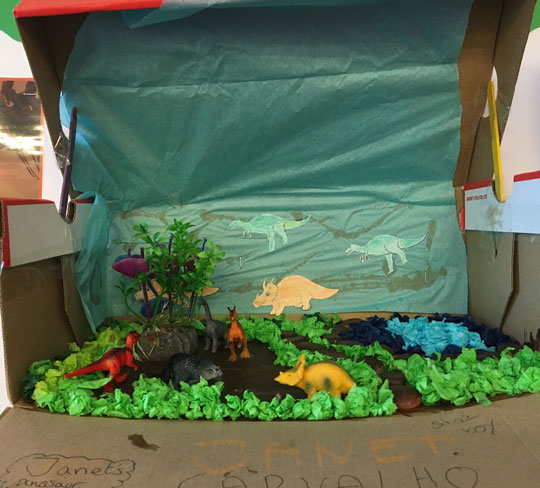
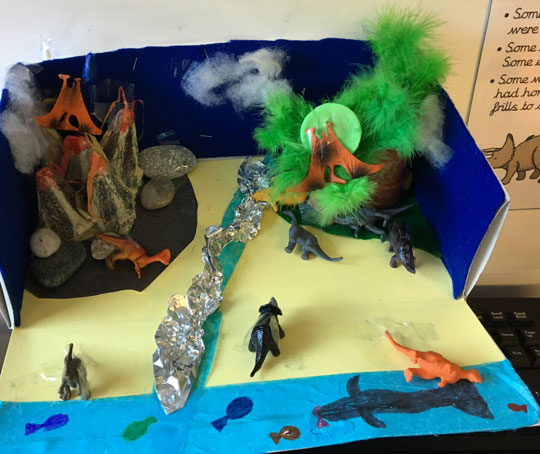
The children in Year 4 at Langley Hall Primary Academy have begun their topic for the second half of the Spring Term. The four classes are studying dinosaurs, fossils and life in the past. The enthusiastic young scientists have been creating mini dinosaur worlds depicting prehistoric scenes and what a fantastic display of dinosaur dioramas they make!
Dinosaur Landscapes
Children in Year 4 at Langley Hall Primary Academy Have Made Mini Dinosaur Dioramas
A collection of dinosaur dioramas created by children in Year 4 at Langley Hall Primary Academy.
Picture credit: Langley Hall Primary Academy/Everything Dinosaur
The four classes have been named after famous artists. There is Matisse, Degas, Klee and O’Keeffe classes, clearly the children have been inspired by these artists as they made their very own prehistoric scenes.
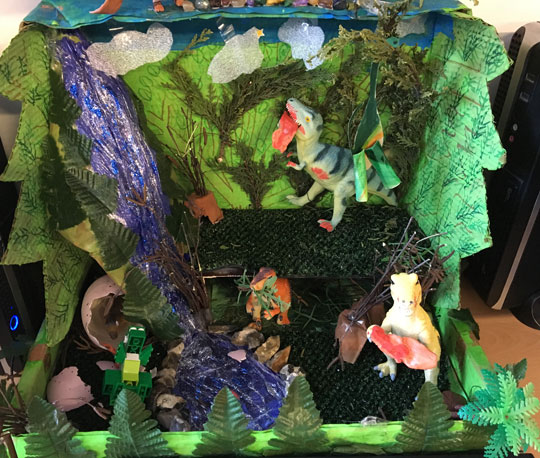
A Range of Materials Have Been Used to Create the Prehistoric Landscapes
Dinosaur dioramas created by children in Year 4 at Langley Hall Primary Academy.
Picture credit: Langley Hall Primary Academy/Everything Dinosaur
Using Different Materials to Create Prehistoric Scenes
Lots of different materials have been used to create prehistoric scenes. For example, some of the children made plants out of pieces of coloured tissue paper, whilst one pupil collected moss to provide flora for their dinosaur diorama. The prehistoric animal models have plenty of different textures to explore, some children used small pieces of gravel in their scenes, whilst one innovative young scientists used couscous to make a sand effect. Can you spot the chicken egg in the photograph below? During the workshops that Everything Dinosaur conducted with the children over the course of a day, the pupils discovered that chickens are dinosaurs (avian dinosaurs).
Can You Find the Dinosaur Egg?
Dinosaur worlds created by children in Year 4 at Langley Hall Primary Academy.
Picture credit: Langley Hall Primary Academy/Everything Dinosaur
One of the Year 4 classes is named after Georgia O’Keeffe. Georgia O’Keeffe was an American painter, best-known for her modernist approach to her subject matter. Many of her paintings feature the atmospheric landscapes of the Ghost Ranch region of New Mexico. The sandstones, siltstones and mudstones of this region date from the Triassic geological period and Ghost Ranch is famous for its dinosaur fossils. Fossils of freshwater Coelacanths are also associated with the region (Chinle Formation). Our dinosaur expert challenged the children to research the story of the Coelacanth and its rediscovery as part of several extension activities that were suggested during the workshops.
A Variety of Ecosystems and Habitats
Dinosaurs as a term topic permits lots of cross-curricular activities. Everything Dinosaur provided some numeracy-based as well as literacy-based extension activities and the dioramas can be used to help explore and reinforce learning about food chains and different habitats. For instance, in the prehistoric scene (below), the Year 4 pupil has used a range of materials to depict different environments. They have even included some aquatic animals in their prehistoric scene. Could add a drawing of a Coelacanth to their diorama?
A Prehistoric Scene Using Various Materials to Create Different Habitats
Prehistoric landscapes created by children in Year 4 at Langley Hall Primary Academy.
Picture credit: Langley Hall Primary Academy/Everything Dinosaur
Whilst delivering a dinosaur and fossil workshop with a Year 1 class, we were asked to help inspire the children by providing some inspirational poems about prehistoric animals. The class had been looking at poetry and its rhythmic qualities, writing poems about animals that lived close to the Poles when they were studying “life in the freezer” during the first part of the Spring Term. The teacher wanted to reintroduce this exercise, but this time to tie it in with the topic for the remainder of the Spring Term – dinosaurs.
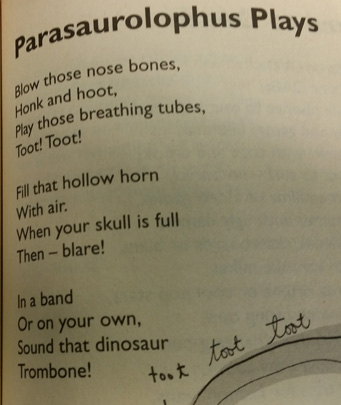
A Poem About Parasaurolophus
A poem about the hadrosaur Parasaurolophus. Picture credit: Everything Dinosaur.
Picture credit: Everything Dinosaur
Poems in the Dinosaur and Fossil Workshop
Fortunately, the Everything Dinosaur fossil expert had spotted numerous dinosaur and fossil themed poems during his many school visits and he was able to share some of these resources with the teaching team. Our team member had even come across a short piece of prose dedicated to the Late Cretaceous duck-billed dinosaur Parasaurolophus, a plant-eater with a bizarre head crest.
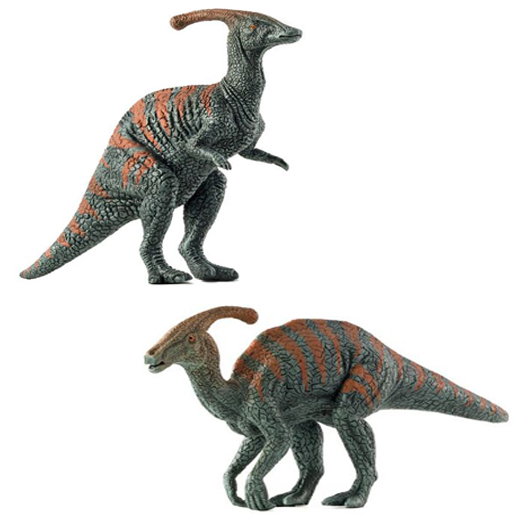
The Duck-billed Dinosaur Parasaurolophus
The Mojo Parasaurolophus dinosaur models (biped and quadruped). Note the bizarre head crest.
The models in the image (above) can be found in the Mojo Fun models range.
The role the crest played is debated by palaeontologists. It may have had a flap of skin, attaching the crest to the back of the neck and this might have been brightly coloured, allowing the crest to be used as an effective device for visual communication. The crest itself, could have played a role in signalling, perhaps its size and length demonstrated maturity or fitness for breeding. The dinosaur’s nostrils were connected to the crest by a series of complicated hollow tubes.
Some palaeontologists have speculated that the crest could have acted as an amplifier or resonating device giving these dinosaurs very distinctive calls.
Whatever the purpose of that head crest, it was good to find a poem about a “tooting” Parasaurolophus!
1B and 1EN Classes at Green End Primary Study Dinosaurs
It was an exciting end to the week for the children in Year 1 at Green End Primary (M19, Manchester), as the school was visited by a team member from Everything Dinosaur. The children in 1B and 1EN have started to learn all about dinosaurs, fossils and life in the past and Everything Dinosaur was invited in to help launch this challenging term topic.
Fossils and Life in the Past
Two workshops were conducted with the enthusiastic, young dinosaur fans over the course of a morning, one for each of the classes. During a short briefing with the teachers, our proposed lesson plan was reviewed and steps were taken to ensure that our dinosaur expert covered key points that the teaching team wanted to emphasise. As well as acting as a provocation for the topic, the teachers were keen to reinforce learning about food chains and as Mary Anning was going to be studied in class, our dinosaur expert was able to adjust his lesson plan to accommodate this learning need.
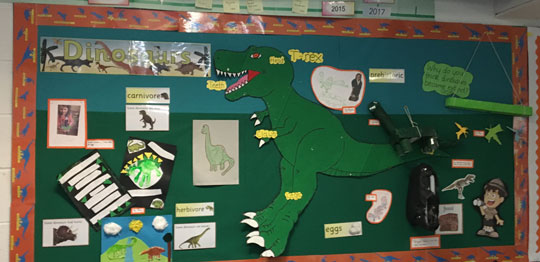
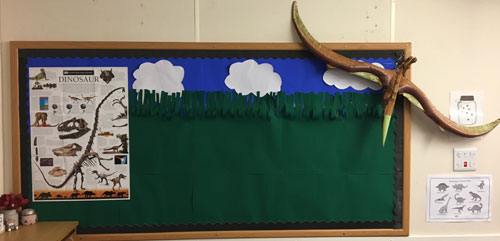
A Beautiful Dinosaur Display in One of the Year 1 Classrooms
Year 1 children at Green End Primary have created a wonderful dinosaur display. Picture credit: Everything Dinosaur.
Picture credit: Everything Dinosaur/Green End Primary
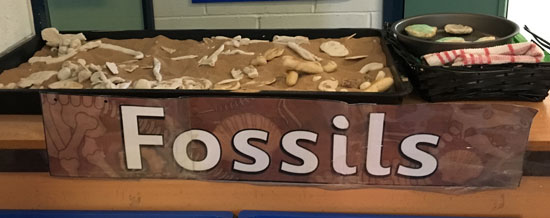
As part of a wide range of challenging activities, the children had been making their own salt dough fossils. These fossils were on display in the sand tray. Our dinosaur expert was invited to examine the children’s work. The children enjoyed making the fossils and learning about life in the past.
Children in Year 1 Make Salt Dough Fossils
Salt dough fossils created by Year 1 children (class 1EN and 1B).Picture credit: Everything Dinosaur.
Picture credit: Everything Dinosaur/Green End Primary
Ammonites
During the workshop, the Year 1 children were given the chance to handle some real fossils and to learn how fossils form. The ammonite fossils proved to be very popular, especially the very large ones. These fossils are typical of the “sea shells on the sea shore”, that Mary Anning collected. We included a tongue twister all about Mary Anning with the additional teaching resources that our dinosaur expert provided.
As part of our work in schools, we encourage the teaching team to take lots of photographs of the children during the workshops. These photographs are very helpful when it comes to recall and recounting activities after the workshop has been concluded. Can the children, simply by looking at a photograph, recall key points from that part of the lesson? We recommend the children are asked without prompting initially, teachers are often surprised by the amount of information that the children have retained.
A Dinosaur Themed Display in One of the Year 1 Classrooms
A horned dinosaur is at the centre of this Year 1 dinosaur display.Picture credit: Everything Dinosaur.
Picture credit: Everything Dinosaur/Green End Primary
One of the teachers promised to send in a picture of some of the children’s work, we look forward to seeing the results of the research conducted by the Year 1 classes.
The children in the Reception class at Egerton Primary School, (Knutsford, Cheshire) were visited by Everything Dinosaur, with “Dinosaur Mike” delivering a dinosaur and fossil workshop to help enthuse the Foundation Stage 2 children as they learn about fossils and life in the past. The spacious and well-appointed school hall reverberated with the sound of stomping armoured dinosaurs and ammonites catching fish. During the workshop, our dinosaur expert set the children a special challenge. Could they design their very own dinosaur and label parts of the body?
A Dinosaur and Fossil Workshop
The Reception Class at Egerton Primary School Sent Dinosaur Letters and Drawings
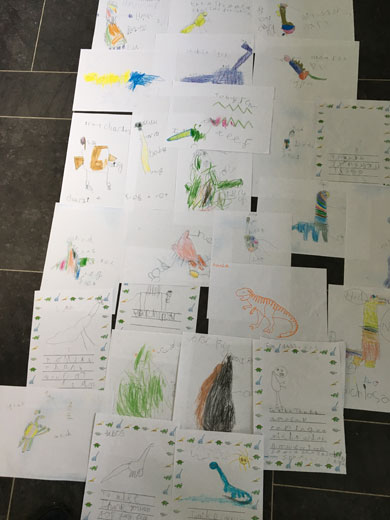
Dinosaur letters and drawings from the Reception class at Egerton Primary School. Picture credit: Everything Dinosaur.
With the help and support of the enthusiastic teaching team, the children were keen to take up Everything Dinosaur’s challenge. Sure enough, we received at our offices, a set of super prehistoric animal drawings and dinosaur themed letters from the children.
Long-necked Dinosaur Drawings from Foundation Stage 2
Super sauropod drawings from Egerton Primary School (Reception class).Picture credit: Everything Dinosaur.
As part of our proposed extension activity, we challenged the Reception class to think up suitable names for their very own dinosaur designs. During the morning visit, our dinosaur expert met a budding, young scientist called Maya. He explained to her and her classmates that there already was a dinosaur called Maiasaura (May-ah-sore-ah). Maya had a name very similar to a Cretaceous, plant-eating dinosaur. When back in the office, “Dinosaur Mike” emailed over a Maiasaura fact sheet and scale drawing of Maiasaura to help inspire the children with their own dinosaur designs.
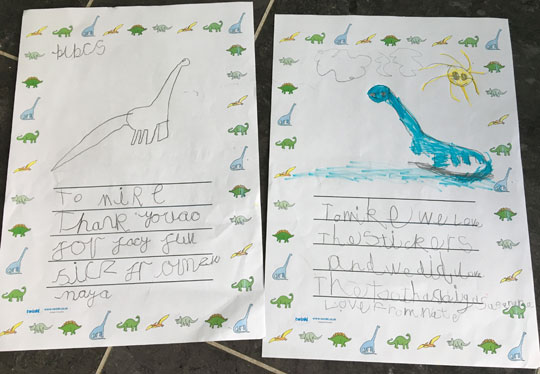
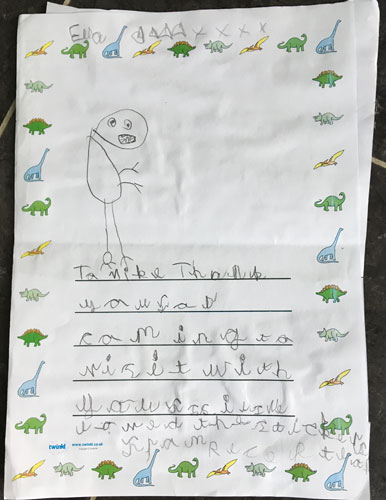
We received some beautiful drawings and some lovely labelled dinosaurs. Several children wrote a short thank you note to our dinosaur expert. Wonderful evidence of gaining confidence with writing along with finger spacing of words being demonstrated and some basic grammar shown too!
A Dinosaur Themed Letter Writing Exercise (Egerton Primary School – Reception Class)
A letter to “Dinosaur Mike” from Reception class children at Egerton Primary School. Picture credit: Everything Dinosaur.
A Letter Writing Exercise After the Dinosaur and Fossil Workshop
A simple letter writing exercise such as the dinosaur thank you notes, can help children gain confidence and assists in the development of hand-eye co-ordination and fine motor skills. Our thanks to all the children and the teachers in the Reception class at Egerton Primary, we have posted some of the children’s letters and drawings onto our warehouse wall.
Hanging Heaton Primary Prepares for Dinosaur Term Topic
Pupils and staff at Hanging Heaton CE (VC) Junior and Infant School (near Dewsbury, West Yorkshire), have been busy preparing their classrooms for the start of the special Spring Term topic – dinosaurs. Children in class 1 and class 2, comprising the Reception and Key Stage 1 cohorts at the school, will be learning all about dinosaurs, fossils and prehistoric animals for the rest of this term. To help kick-start the topic, Everything Dinosaur was invited into the school to provide a provocation in the form of a dinosaur workshop to help enthuse the children.
Class 1 (Reception and Year 1) Have Prepared a Palaeontology Lab Display
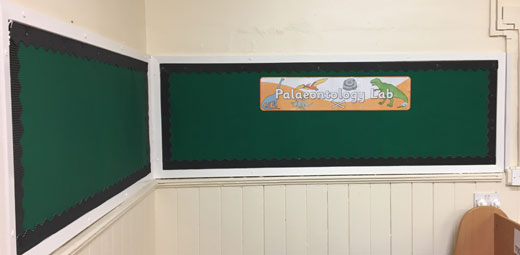
The FS2/Year 1 class have a palaeontology laboratory.
Picture credit: Hanging Heaton CE (VC) Junior and Infant School/Everything Dinosaur
Tidy and Spacious Classrooms Ready for Dinosaurs
Our dinosaur expert had the opportunity to see the classrooms prior to starting the morning of dinosaur and fossil themed workshops. The classrooms were tidy and spacious and the dedicated teachers, with the support of the learning support assistants had prepared a number of display boards to showcase the children’s work as they study dinosaurs. The children in the mixed class of Reception and Year 1 are going to have a palaeontology laboratory in the corner of their classroom. Perhaps, some of the extension activities we proposed, such as creating a prehistoric animal might end up being put up on the display board.
Class 2 (A Mixed Year 1 and Year 2 Class) Ready for the Dinosaurs Term Topic
Year 1/2 classroom ready for the dinosaurs term topic.
Picture Credit: Hanging Heaton CE (VC) Junior and Infant School/Everything Dinosaur
The children demonstrated some amazing pre-knowledge, confidently talking about the largest dinosaurs and explaining the differences between meat-eaters and plant-eaters. They also asked lots of questions about different types of prehistoric animals. One little boy (George), wanted to know what sort of dinosaurs hunted Styracosaurus. Our dinosaur expert was able to explain that when Styracosaurus (a horned dinosaur), roamed North America in the Late Cretaceous, there were several types of tyrannosaur and other predators that might have considered this very spiky reptile as dinner.
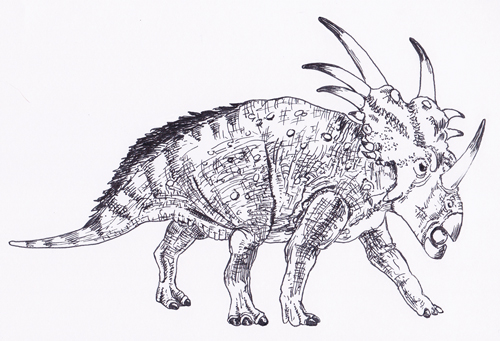
A Drawing of the Horned Dinosaur Styracosaurus (S.albertensis)
A drawing of the horned dinosaur Styracosaurus.Picture credit: Everything Dinosaur.
Picture credit: Everything Dinosaur
The picture (above) shows a Styracosaurus illustration. This drawing is based on the CollectA Deluxe Styracosaurus figure.
Prior to the two workshops, our dinosaur expert had a short meeting with the teaching lead for the term topic to ensure that learning objectives would be incorporated into the sessions. In addition, the Everything Dinosaur team member was able to provide a number of additional teaching resources to support the school’s scheme of work, including a dinosaur footprint measuring exercise, a motor skills test linked to writing for the Reception children and a dinosaur themed geography exercise to help the Key Stage 1 children learn about the continents.
We look forward to seeing pictures of the classroom display boards filled up with examples of the children’s dinosaur and fossil themed learning.
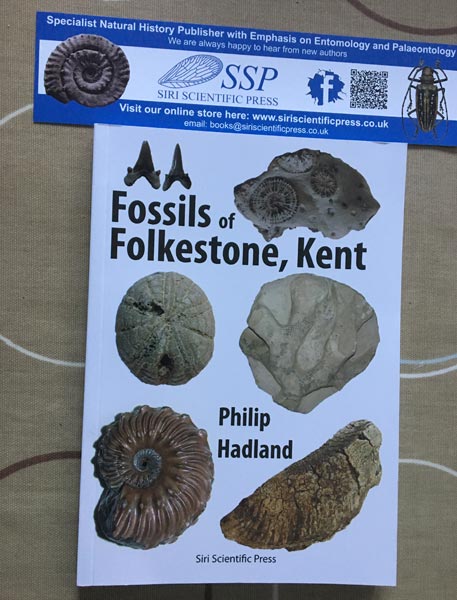
Fossil collecting is a popular hobby and there are a number of excellent general guide books available. However, the newly published “Fossils of Folkestone, Kent” by geologist and museum curator Philip Hadland, takes a slightly different perspective. Instead of focusing on lots of fossil collecting locations, Philip provides a comprehensive overview of just one area of the Kent coast, the beaches and cliffs surrounding the port of Folkestone.
Here is a book that delivers what its title implies, if you want to explore the Gault Clay, Lower Greensand and Chalks around Folkestone then this is the book for you.
The Fossils of Folkestone, Kent by Philip Hadland – A Comprehensive Guide
Fossils of Folkestone, Kent by Philip Hadland and published by Siri Scientific Press and priced at £12.99 plus postage.
Picture credit: Everything Dinosaur
A Comprehensive Overview of the Geology and the Palaeoenvironment of the Folkestone Area
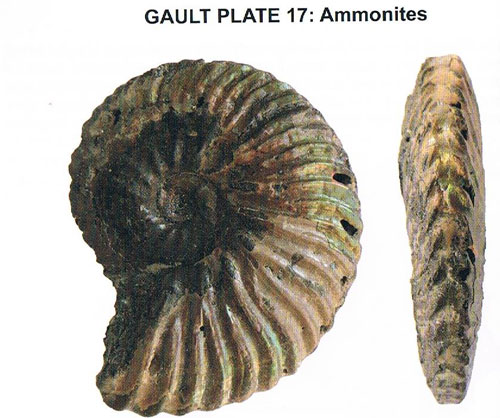
The author clearly has a tremendous affection for this part of the Kent coast. His enthusiasm is infectious and the reader is soon dipping into the various chapters, dedicated to the rock formations exposed along the cliffs and the fossil delights to be found within them. Folkestone is probably most famous for its beautiful Gault Clay ammonites, the clay being deposited around 100 million years ago and a wide variety of these cephalopods can be found preserved in the rocks. The book contains more than 100 full colour plates, so even the beginner fossil hunter can have a go at identifying their fossil discoveries.
Clear Colour Photographs Help with Fossil Identification
Anahoplites praecox fossil from Folkestone.
Picture credit: Siri Scientific Press
Surprises on the Shoreline
The book begins by explaining some of the pleasures of fossil hunting, before briefly outlining a history of fossil collecting in the Folkestone area and introducing some of the colourful characters who were prominent fossil collectors in their day. The geology of the area is explored using terminology that the general reader can understand and follow, but academics too, will no doubt gain a lot from this publication.
Intriguingly, the Cretaceous-aged sediments were thought to have been deposited in a marine environment, however, the Lower Greensand beds have produced evidence of dinosaur footprints. The palaeoenvironment seems to have been somewhat more complex than previously thought, the Lower Greensand preserving evidence of inter-tidal mudflats, that were once crossed by dinosaurs. Isolated dinosaur bones have also been found in the area and the book contains some fantastic photographs of these exceptionally rare fossil discoveries.
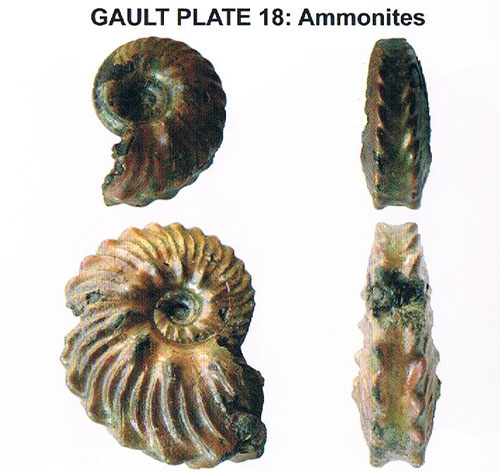
Helping to Identify Fossil Finds
Folkestone fossils – ammonites.
Picture credit: Siri Scientific Press
Prehistoric Mammals
To help with identification, the colour plates and accompanying text are organised by main animal groups. There are detailed sections on bivalves, brachiopods, corals, crustaceans, gastropods, belemnites and ammonites. There are plenty of photographs of vertebrate fossils too and not just fish and reptiles associated with the Mesozoic. Pleistocene-aged deposits are found in this area and these preserve the remains of numerous exotic prehistoric animals that once called this part of Kent home.
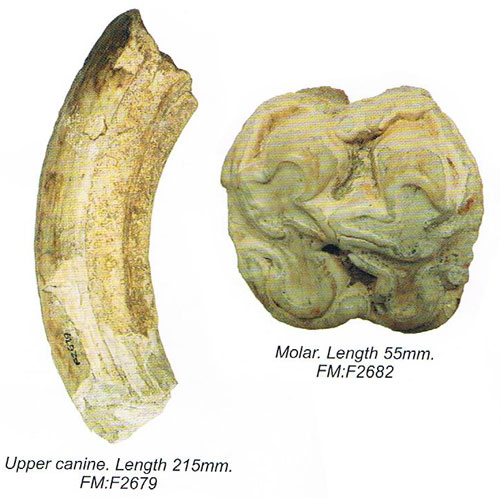
Fossil Teeth from a Hippopotamus Which Lived in the Folkestone Area During a Warmer Inter-glacial Period
Pleistocene mammal fossils from Folkestone (Hippopotamus upper canine and molar).
Picture credit: Siri Scientific Press
“Fossils of Folkestone, Kent”
The author comments that the presence of hippos, along with other large mammals such as elephants as proved by fossil finds, demonstrates how very different Folkestone was just 120,000 years ago. It is likely that humans were present in the area, evidence of hominins have been found elsewhere in England and in nearby France, but as yet, no indications of human activity or a human presence in this area have been found. Perhaps, an enthusiastic fossil hunter armed with this guide, will one day discover the fossils or archaeology that demonstrates that people were living in the area and exploiting the abundant food resources that existed.
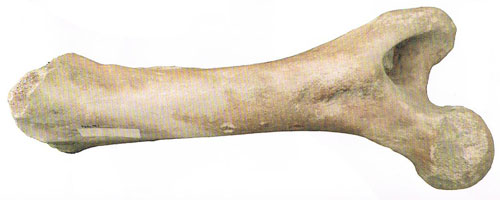
A Partial Femur from a Large Hippopotamus Provides Testament to the Exotic Pleistocene Fauna
A partial femur (thigh bone) from a Hippopotamus.
Picture credit: Siri Scientific Press
With a foreword by renowned palaeontologist Dean Lomax, “Fossils of Folkestone, Kent” is an essential read for anyone with aspirations regarding collecting fossils on this part of the English coast. The book, with its weather-proof cover, fits snugly into a backpack and the excellent photographs and text make fossil identification in the field really easy.
If your New Year’s resolution is to get out more to enjoy the wonders of the British countryside, to start fossil hunting, or to visit more fossil collecting locations, then the “Fossils of Folkestone, Kent” by Philip Hadland would be a worthy addition to your book collection.
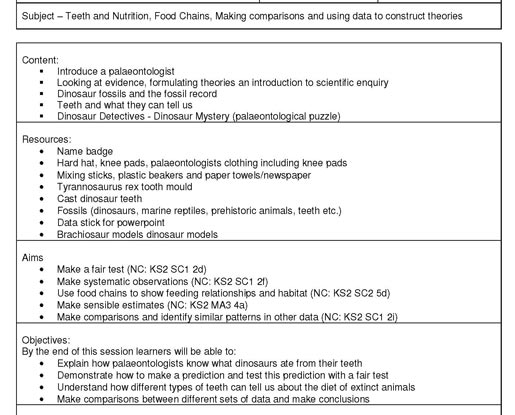
Lesson Plans for Dinosaur and Fossil Workshops Despatched
All the lesson plans and teaching notes relating to Everything Dinosaur’s dinosaur and fossil workshops in schools have been sent out. At this time of year, we appreciate how busy teachers and teaching assistants are, so we always make sure that the arrangements are in place for the dinosaur and fossil themed workshops scheduled for the first few weeks of January.
Everything Dinosaur and Teaching Work
With the teaching assignments concluded for the autumn term, our attention turns to preparing the lesson plans, teaching resources and extension activities in readiness for the first of our dinosaur themed workshops scheduled for the first four weeks of next month.
Lesson Plans Sent Out and Arrangements Finalised
Example lesson plan (Key Stage 2). Picture credit: Everything Dinosaur.
Picture credit: Everything Dinosaur
Helping Teachers and Teaching Assistants
Planning the scheme of work for the school year takes up a significant proportion of the teaching team’s time. The last thing we want them to worry about is any school visits. Our prompt supply of information helps the teaching team to maximise the learning objectives and ensures what we intend to cover in our dinosaur and fossil workshop meets the needs of the children and dove-tails into the topic and the scheme of work.
Everything Dinosaur’s timely emails gives hard-pressed teachers and teaching assistants one less thing to worry about as they prepare for the start of the spring term.
In our communication with the school we provide advice and suggestions in order to help maximise the teaching objectives and to accommodate individual learning needs. Furthermore, we suggest that a member of staff has a smart phone, camera, or Ipad on hand to take lots of photographs. These photographs are very helpful when it comes to recall and recounting activities. We are also happy to discuss extension ideas and normally assist with the term topic planning by providing useful additional teaching resources for the class to use.
Although much of the spring term is booked up, Everything Dinosaur does still have a few dates available. To enquire about the possibility of a school visit from one of our dinosaur experts, simply, email the company: Contact Everything Dinosaur.
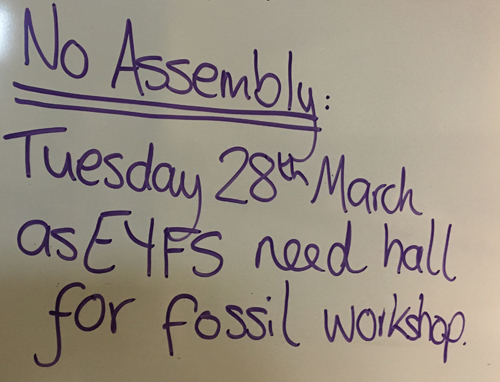
Our Timely Correspondence Allows Plenty of Scope for the School to Prepare
Dinosaurs and fossils in the school hall – all sorted thanks to meticulous planning.
Picture credit: Everything Dinosaur
Extension Activities
In addition to delivering the dinosaur and fossil themed workshop, our team members usually bring some additional teaching resources with them. These resources have been developed by our own teaching team and are designed to fit in with the curriculum. For example, for a reception class, the extension resources might include an activity that explores the properties of materials, for older Key Stage 1 children, the extension plans might involve the conducting of simple experiments.
For those children in Key Stage 2 the extension ideas could include an investigation leading to the writing of a non-chronological report. Naturally, for Key Stage 3 and older students, the extension activities meet their learning needs and often involve independent problem solving and investigation, along with exploring some of the ethical dimensions associated with gene manipulation and the advance of genetics, as related to evolution and adaptation.
Listing Extension Ideas After a Dinosaur Workshop
A teacher lists the extension ideas during a dinosaur workshop. Picture credit: Everything Dinosaur.
Our thanks to Dionne in Year 5 who sent Everything Dinosaur a lovely thank you letter accompanied by a dinosaur drawing after we visited her school recently. Dionne wrote to say that “today was extraordinary” and she really enjoyed holding all the fossils.
Drawing and Thank You Letter Received by Everything Dinosaur
Dinosaur letter and drawing sent in by Dionne in Year 5.
Everything Dinosaur had been invited into Dionne’s school to work with the class of Year 5 children for a morning delivering a dinosaur workshop in school. One of a number of extension activities that arose over the course of the morning was to have the children write thank you letters to us. We duly received an amazing bundle of letters from the children, lots of them had dinosaur drawings too.
Our thanks to all the children who sent letters into our offices, we have enjoyed reading them and we have even posted up some of the pictures on the wall of our warehouse.
Our thanks to the Year 5/6 class at Streethouse Junior, Infants and Nursery School (West Yorkshire), for sending in some super dinosaur letters and some amazingly colourful prehistoric animal posters. We set this Key Stage 2 class a series of extension exercises (hope the children have enjoyed researching the Coelacanth), one of the extensions involved writing a thank you letter and sending them into our office. We have received a collection of wonderful dinosaur-themed correspondence.
Dinosaur Letters Sent by Schoolchildren
A collection of correspondence from Year 5/6 pupils.
Picture credit: Streethouse Junior, Infants and Nursery School
Answering Questions About Dinosaurs
Violet wanted to know if we could name a dinosaur, what would we call it? That is a very good question, given that Violet lives in Yorkshire and that numerous dinosaur fossils have been found in that part of the world, if we were lucky enough to find a new dinosaur in northern England, we might have to name it “Yorkshiresaurus”.
Violet’s Letter
A thank you letter from Violet.
Picture credit: Streethouse Junior, Infants and Nursery School
Jack explained in his letter that Tyrannosaurus rex could have been a hunter as well as a scavenger. Kelsey asked if drift wood was a fossil? Drift wood that you find on the beach is not a fossil, but if it gets buried in the sand then it can be fossilised. At Everything Dinosaur, we have lots of fossils of plants and trees, the oldest of which are around 360 million years old. Laura wrote to say that she enjoyed holding the fossils and learning about bones.
Archie’s Very Colourful Prehistoric Animal Drawings
We received lots of colourful dinosaurs from Year 5/6.
Picture credit: Streethouse Junior, Infants and Nursery School
Dinosaur Letters
Kai wanted to know what was the fiercest dinosaur? That, is quite a difficult question to answer. The meat-eating dinosaurs belong to a group called the Theropoda, the big carnivores were very dangerous, but some of the smaller, carnivorous dinosaurs, if they were around today, would probably have wanted to add Year 5/6 pupils to their diet.
Perhaps the children can look up dinosaurs such as Saurornitholestes and Atrociraptor and produce a poster with lots of dinosaur facts. Our thanks to Kaya for including a picture of a marine reptile in the thank you letter that we received. Charlie sent us a beautiful spotted long-necked dinosaur and described the morning of activities as “awesome”, whilst Cameron enjoyed learning about Megalodon and Evie wanted us to come back and visit the class again.
Tyler and His Thank You Letter
Stegosaurus featured in a number of the children’s letters.
Picture credit: Streethouse Junior, Infants and Nursery School
Amazing Posters and Letters Sent in by Year 5/6
Amazing dinosaur posters from Year 5/6.
Picture credit: Streethouse Junior, Infants and Nursery School
What is our Favourite Dinosaur?
A number of the children asked what was our favourite dinosaur? We have been recently working on a really odd dinosaur called Sciurumimus, which means “squirrel mimic” as when this dinosaur was young, it had a bushy tail just like a squirrel.
Great Writing from the Children Including this Example from Jayden
A thank you letter from Jayden.
Picture credit: Streethouse Junior, Infants and Nursery School
“Dinosaur Mike” who had visited the school to conduct the morning workshop with the class, commented:
“I want to say a big thank you to all the children in Year 5/6 at Streethouse Primary. My colleagues and I enjoyed looking at the posters and reading the letters that were sent in. Some wonderful hand-writing and great grammar. Congratulations to you all!”