All about dinosaurs, fossils and prehistoric animals by Everything Dinosaur team members.
Everything Dinosaur’s work with schools and other educational bodies. Articles, features and stories about dinosaurs and their role in education and educating young people.
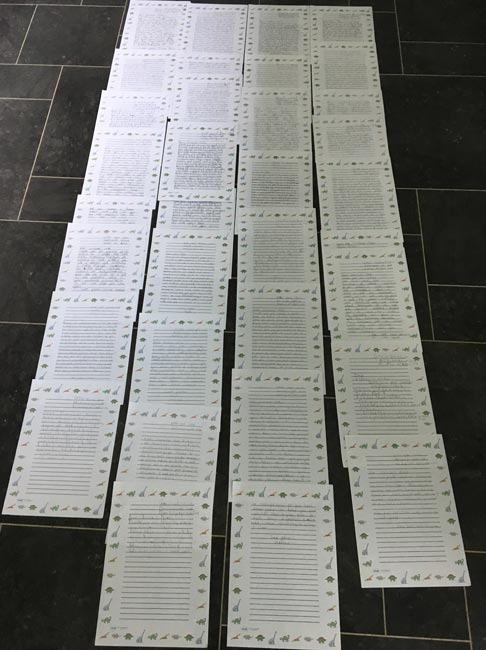
Children in Year 2 at Great Wood Primary (Lancashire), sent in some super thank you letters to team members at Everything Dinosaur following a workshop at their school. The pupils have been learning all about dinosaurs for their summer term topic and last month, an Everything Dinosaur team member was invited into the school to deliver two dinosaur and fossil themed workshops, one for each Year 2 class.
A Set of Thank You Letters Sent to Everything Dinosaur by One Year 2 Class
Pupils at Great Wood Primary sent thank you letters to Everything Dinosaur. Picture credit: Everything Dinosaur.
Picture credit: Everything Dinosaur
Beautiful Letters from Year 2
During our workshop, lots of extension ideas surfaced and we always try to support the lesson plans and scheme of work of the teaching team. Challenging the class to write a letter to us gives an opportunity for the children to practice their handwriting and use of grammar. We received two sets of letters, one from each class and it was great to see such excellent examples of letter writing. Some of the children produced long letters, using two sheets of A4 paper, that is brilliant!
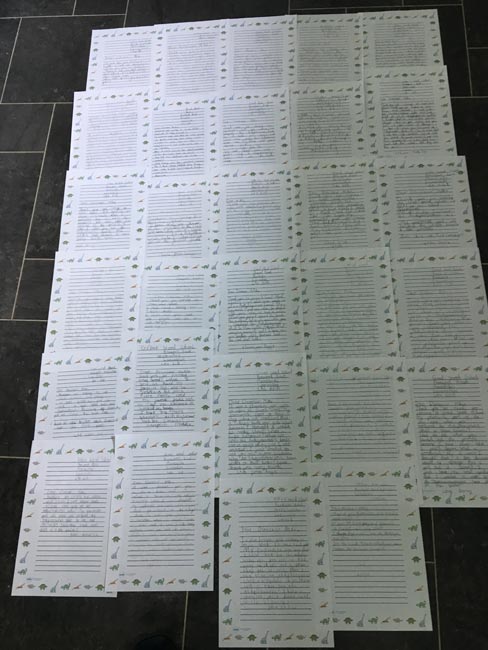
Lots and Lots of Letters for Us to Read – Here are the Letters from the Second Class
Children send in letters about dinosaurs. Picture credit: Everything Dinosaur.
Picture credit: Everything Dinosaur
Dinosaur Mike, who conducted the two workshops with the eager young palaeontologists from Great Wood Primary praised the children, saying:
“It was a great honour to receive the letters from Year 2. The correspondence was held up in the post and we had to go to the Royal Mail delivery centre to pick them up, but the trip was so worthwhile as we came back with two sets of super thank you letters. We really appreciate the letters and we have read them all.”
Everything Dinosaur Puts the Letters on Display
The team have read them all and they hope to post up responses to some of the questions the children asked. After laying the letters out onto the packing room floor in the company’s warehouse so they can be photographed, the letters will shortly be pinned up to the warehouse notice board. They will make a super display and they will help to remind Dinosaur Mike of his visit to the school. In the letters, the children inform us about their favourite part of the workshop. It seems that the children really enjoyed comparing their brain to the brain of a giant armoured dinosaur and handling fossils. The Tyrannosaurus rex tooth segment was also a favourite.
We wish the children and their hardworking Key Stage 1 teaching team every success with their dinosaur themed term topic and thank you once again for sending into Everything Dinosaur the wonderful correspondence.
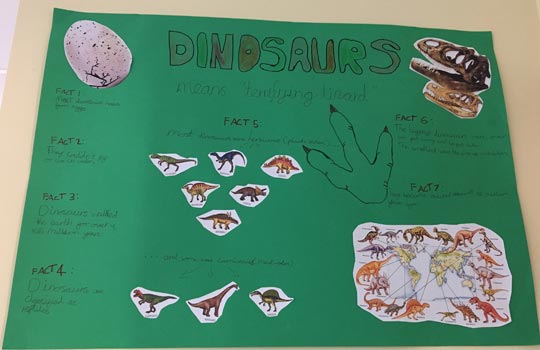
Children in Year 1 compiled lots of facts about dinosaurs and prehistoric animals as part of a term topic on life in the past. The enthusiastic teaching team had challenged the pupils to conduct some independent research into dinosaurs and other creatures that lived before people.
The children were given a choice, they could research a single animal such as Brontosaurus, Triceratops or Tyrannosaurus rex, or they could create a poster about dinosaurs in general. The only prerequisite stated by the teachers was that the children’s work had to include lots of information, lots of facts.
Children in Year 1 Compile Dinosaur and Prehistoric Animal Posters
Year 1 children design dinosaur posters. Picture credit: Everything Dinosaur.
Picture credit: Newport Infant School (Squirrel Class)/Everything Dinosaur
Demonstrating Knowledge About Dinosaurs
During our visit to the school to conduct a series of dinosaur workshops with the Year 1 classes, the children were keen to demonstrate their knowledge confidently asserting that dinosaurs laid eggs and that dinosaur fossils could be found all over the world, even in Australia! We provided a number of extension resources to help support the school’s scheme of work, including a challenge to the children to create a non-chronological report on the life and times of the famous scientist Sir Richard Owen, highly appropriate since one of the children was called Owen.
Producing Dinosaur Posters for Display at the School
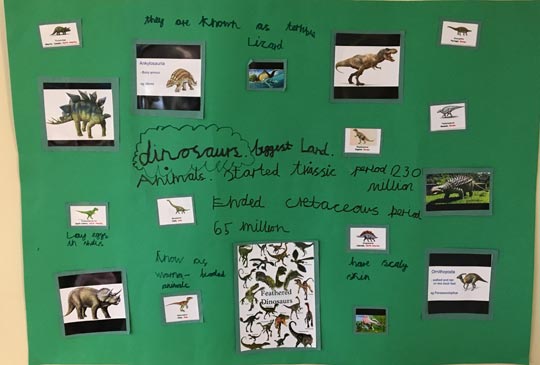
Dinosaur facts compiled by Year 1 children. This poster features a lot of different dinosaurs including herbivores and carnivores. To date, something like 1,300 dinosaur genera have been described. Picture credit: Everything Dinosaur.
Picture credit: Newport Infant School (Squirrel Class)/Everything Dinosaur
For further information about Everything Dinosaur’s work in schools and to enquire about our outreach work: Contact Everything Dinosaur.
Dinosaurs as a Teaching Topic
Learning about dinosaurs provides plenty of opportunities for cross-curricular activities. For example, the children had been exploring the properties of different materials by making prehistoric animal models and this topic has lots of scope to include writing activities (fiction and non-fiction writing). Everything Dinosaur’s workshop leader challenged the classes (and their teachers), to produce a dinosaur themed poem. A piece of prose that features a prehistoric animal, an intriguing idea that helps the children explore different types of writing and gives them the opportunity to develop their vocabulary, introducing the idea of stanzas, cadence, verses and iambic pentameter.
A spokesperson from Everything Dinosaur commented:
“Our workshops provided the ideal provocation to kick-start the children’s term topic. Dinosaurs and prehistoric animals certainly enthused the pupils and they were eager to demonstrate their pre-knowledge and to show their visitor all the posters, fact sheets and non-chronological reports on life in the past that they had created. The teachers too, were very enthusiastic and eager to learn, taking lots of notes and photographs during the sessions with the three classes.”
Hedgehog, Squirrel, and Deer Classes Study Dinosaurs
The children in Year 2 at Newport Infant School (Shropshire), had an exciting day today when one of our dinosaur experts visited them to kick-start their new term topic all about dinosaurs, fossils and life in the past. The three classes that make up the Year 2 cohort – Hedgehog, Squirrel and Deer had been set a challenge by their teachers over the holiday period. Could the children create something to do with dinosaurs and then bring it into school?
Learning About Dinosaurs
The children set about this task with relish and our dinosaur expert was able to see the results of the children’s hard work, plus we suspect, the efforts of one or two grown-ups that also got involved in the project.
Examples of Dinosaur Models on Display in Deer Class (Year 2)
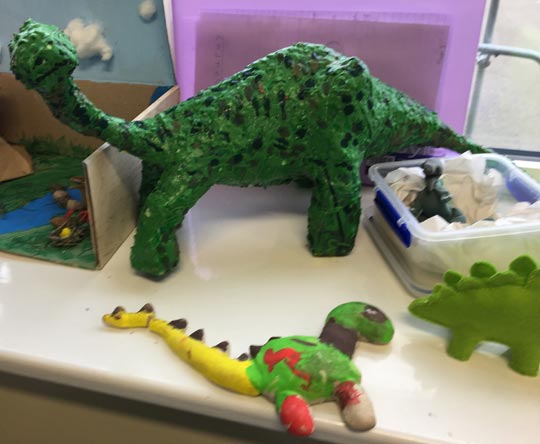
Children in Deer class (Year 2) made dinosaur models including some amazing, blue dinosaurs.Picture credit: Everything Dinosaur.
Picture credit: Newport Infant School (Deer Class)/Everything Dinosaur
Lots of Dinosaur Themed Craft Ideas
The hard-working and dedicated teaching team deliberately kept the brief for the children quite vague. It did not matter what the pupils produced, so long as it had something to do with dinosaurs. A wide variety of different craft ideas were showcased as our dinosaur expert toured the three classrooms. There were lots of prehistoric animal models, with many different types of materials used including cardboard, modelling clay and papier mâché.
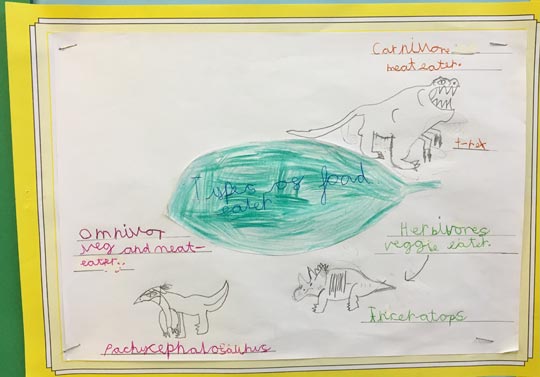
Some children had chosen to produce a poster or a set of dinosaur fact sheets. We spotted a poster in Hedgehog class which examined the diets of different dinosaurs, herbivore, omnivore or carnivore. This poster was very timely, as we found out that the teachers had set the children a spelling list for them to learn this week and the words carnivore, herbivore and omnivore were included on the list.
Exploring the Diets of Different Dinosaurs
Year 2 children explore dinosaur diets (Hedgehog class). Picture credit: Everything Dinosaur.
Picture credit: Newport Infant School (Hedgehog Class)/Everything Dinosaur
This large primary school provides lots of exciting learning opportunities and the teaching team have created an imaginative scheme of work for the summer term. The colourful prehistoric animals and cleverly created posters have set the scene for what will be a fascinating and varied topic. During our visit, we set the classes a variety of challenges ourselves, these included learning about reptiles alive today, producing poems about dinosaurs and researching famous fossil hunters such as Mary Anning.
Some of the Dinosaur Models on Display in the Squirrel Classroom
For many schools in the United Kingdom, this week sees the start of the summer term. Everything Dinosaur team members have a very busy itinerary with lots of school visits and other activities planned. With their teaching qualifications and knowledge about dinosaurs, fossils and life in the past, our team members offer a wide variety of teaching activities and fossil workshops. The summer term is going to be very busy, with lots of school visits booked into our teaching schedule.
Dinosaurs in School
Questions about dinosaurs prepared by a class in readiness for a visit from Everything Dinosaur.
Picture credit: Everything Dinosaur/Mansel Primary School
Everything Dinosaur Team Members Answering Questions
Our dedicated, hard-working and knowledgeable team members provide dinosaur themed teaching activities from Early Years Foundation (EYFS) and Reception through to Key Stage Four and beyond. Whether it is a term topic, part of a science week or a special event, fossils and dinosaurs in school can help enthuse and motivate the next generation of scientists. We do our best to answer all the queries and questions from the pupils, sometimes we even have to get involved with a little bit of impromptu fossil identification as the children bring in fossils and other objects that they have found for us to identify.
A spokesperson from Everything Dinosaur commented:
“This term [summer 2018], is likely to be our busiest we have so many school visits planned. We are looking forward to meeting all the eager and enthusiastic children as well as the dedicated teachers, learning support providers and teaching assistants who create such amazing lessons and schemes of work for the children.”
A Very Full Display Board in the Middle of a Dinosaur Term Topic
A dinosaur museum in a classroom. Picture credit: Everything Dinosaur.
Picture credit: Everything Dinosaur/Brookfield Primary School
Dinosaurs as a Term Topic
Dinosaurs and life in the past makes a great term topic. Topic areas such as “Footsteps in the Past” and “Jurassic Forest” have been created to help schools engage in cross-curricular activities and to deliver imaginative and creative schemes of work for their pupils. Many children have quite a lot of pre-knowledge when it comes to the Dinosauria. Starting a term topic can help learners to gain more confidence and simple experiments and activities can enhance the work done by the school to help develop scientific working.
For further information on Everything Dinosaur’s activities in schools and to request a quotation (we are already taking bookings for 2019), simply drop us an email: Contact Us.
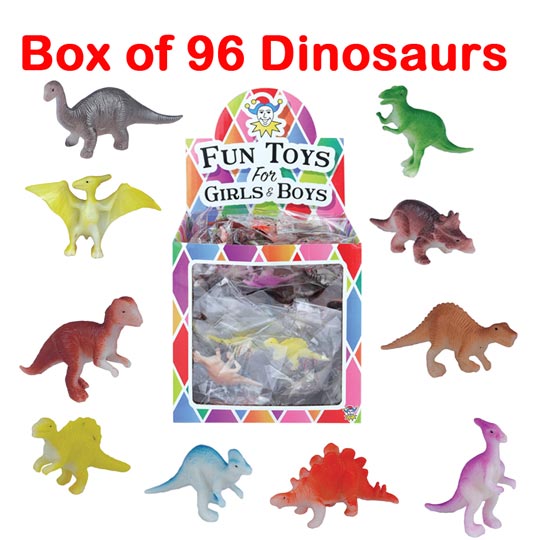
Everything Dinosaur has updated the box of mini dinosaur and prehistoric animal models to include a replica of the flying reptile Pteranodon. This popular set of prehistoric animal figures is sold either as a box of 96 models, or the little dinosaur and prehistoric animal models can be purchased individually. The pterosaur Pteranodon joins the likes of Stegosaurus, Apatosaurus and a horned dinosaur in the prehistoric animal box, a collection of prehistoric animals from the Age of Dinosaurs.
Colourful Mini Dinosaur and Prehistoric Animal Models
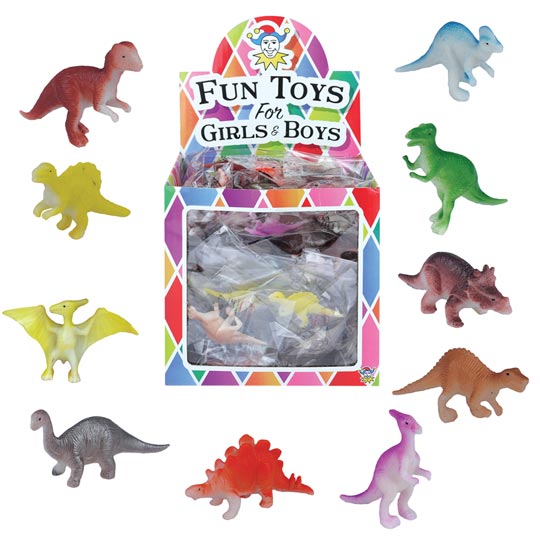
Dinosaur and prehistoric animal models.
Picture credit: Everything Dinosaur
Prehistoric Animal Models for Party Gift Bags
With at least ten different models per box, these little prehistoric animal figures are ideal for party gift bags and for use in dinosaur themed party games. They make really useful cake decorations, for all those busy grown-ups baking dinosaur themed birthday and celebration cakes for their budding young palaeontologists. Plastic and robust, the mini dinosaur and prehistoric animal models make very colourful cake toppers.
A Box of Assorted Prehistoric Animals and Dinosaurs
Dinosaur and prehistoric animal models – ideal for parties or for use in schools to help young children gain more confidence with numbers and to aid the development of motor skills.
Our mini dinosaur and prehistoric animal models have proved very effective teaching aids in school. The mini dinosaur models are used to help children get to grips with numbers and these bright and colourful figures help inspire and motivate many young children as they make super counters and props for use in counting exercises.
The variety of the figures in a box of 96 provides plenty of opportunities for sorting these little models into different groups. For example, we have used them to help sort out all the red coloured models into one group, all the yellow coloured models into another. In addition, we have seen children differentiate and sort the models according to how many legs the animal walks on (two legs or four).
As an extension for more capable learners linked to the Key Stage 1 curriculum is to challenge pupils to sort the figures into meat-eaters and plant-eaters, linking the counting game to an element of the national curriculum that explores simple food chains and food webs.
Tactile Models – Great for Kinaesthetic Learning
Mini dinosaur and prehistoric animal models available from Everything Dinosaur.
A Wide Variety of Prehistoric Animal Models
Lots of different types of dinosaur models are included, plant-eaters, meat-eaters, Jurassic dinosaurs, Cretaceous dinosaurs, pterosaurs and such like. Great for counting and sorting games. a box of 96 mini dinosaurs and prehistoric animal figures. Each model measures around 4 to 5 centimetres in length, just the right size for young children in Reception or Year 1 to handle.
To view the mini dinosaur and prehistoric animal models and to see the extensive range of inexpensive dinosaur and prehistoric animal themed gifts and educational materials supplied by Everything Dinosaur, simply click this link: Dinosaur Themed Educational Toys and Models.
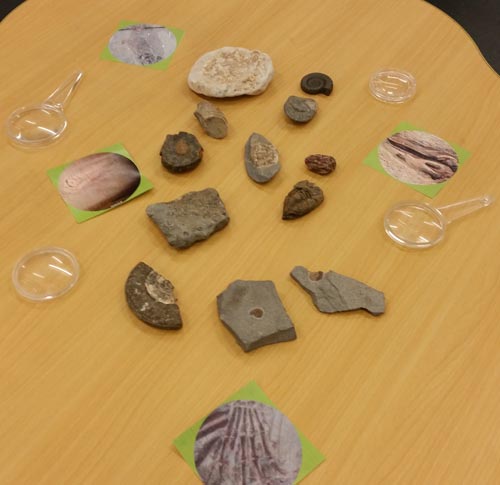
Whilst on one of our many visits to schools to deliver a workshop to Key Stage 2, we discussed with the teaching team how to add more tactile elements to the school’s scheme of work. We suggested a number of dinosaur and prehistoric animal themed exercises including dedicating a table to create a work station so that fossils could be examined by the children. With some magnifying glasses borrowed from the science cupboard and some scraps of paper on stand-by so that the budding palaeontologists could take notes, it only needed a handful of fossils to complete the fossil study area.
A Fossil Work Station in the Classroom
Ready to study fossils. Picture credit: Everything Dinosaur
Picture credit: Everything Dinosaur
Fossils on the Display Table
The fossils consisted of fragments of large ammonites, a complete Promiceras (P. planicosta), some Promicroceras ammonites, along with Arnioceras and Asteroceras pieces, all of which come from Dorset (Jurassic Coast). To this mix of cephalopods, we added crinoids, fossilised seed cones, examples of fossil coral and some pieces representing various trilobites including a large and rather beautiful Calymene trilobite that dates from the Silurian.
Being able to handle fossils provides kinaesthetic learners with lots of stimulation, could the children find similar fossils in the text books that they found in library? Could the work out what sort of creature/plant the fossil might represent. Can they describe the fossil? Can they produce an accurate drawing of the object? We even suggested a measuring exercise to help the children gain confidence using rulers.
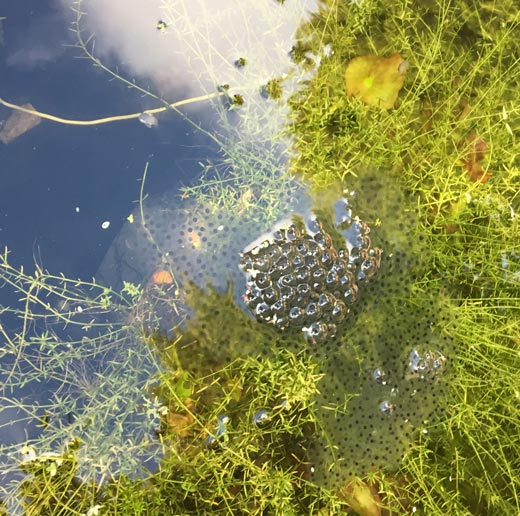
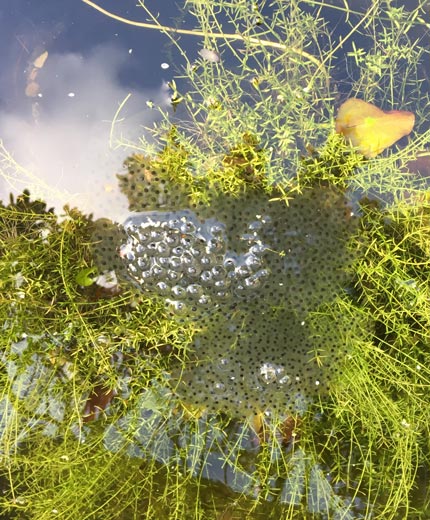
After a false start, when we noticed one clump of unfertilised frog spawn in our pond, we are happy to announce that on the morning of the 17th March we spotted three clumps of newly laid frogspawn. The first eggs were produced on the 20th of February, just prior to a sudden cold snap. Whether a female frog had been stressed we don’t know, but despite our careful gathering of the tennis ball-sized clump of spawn and storing it in a goldfish bowl along with some of the pond water and pond weed, the eggs failed to develop. Our intention was to protect the spawn from the extremely cold weather and then once the snow had melted, to re-introduce the spawn into the pond.
Frog Spawn in the Office Pond (March 2018)
Frogspawn 2018, at least three clumps of spawn have been spotted.
Picture credit: Everything Dinosaur
Later Than Last Year
The spawning has taken place around a week later than last year. We suspect the cold weather delayed the onset of breeding. Hopefully, with the approach of warmer weather (no snow at least), this spawn will be able to develop and soon we will have tadpoles to observe. The amount of spawn, is about average, we estimate that three females laid eggs. Although the eggs tend to merge into one, single mat of jelly, if you can observe the egg masses before they swell you can get a reasonable idea of the number of fertile females present.
We Intend to Keep a Close Watch on the Frogspawn
Frogspawn 2018.
Picture credit: Everything Dinosaur
Our pond is a haven for wildlife and we hope that at least some of the tadpoles make it to adulthood. Common Frogs (Rana temporaria) inhabit our pond, although sadly, these animals like most of the native British amphibians are no longer common. At least our little pond is helping with conservation efforts.
Class 1 at Ysgol Bro Carmel Enquire About Diplodocus
The children in class 1 at Ysgol Bro Carmel Nursery and Primary School in North Wales have been learning all about dinosaurs this term. The class teacher, Mrs Metcalfe emailed Everything Dinosaur and explained that as part of the diverse and varied teaching programme, the eager, young palaeontologists had some questions about Diplodocus for us. A diplodocid had been spotted in the school yard and the children had been writing instructions on how to trap this long-necked dinosaur. Could Everything Dinosaur offer some assistance?
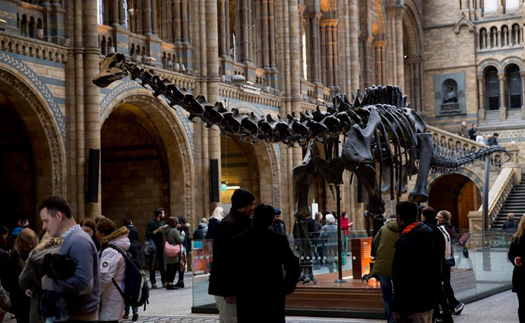
Diplodocus on Display at the Natural History Museum (London)
Diplodocus on display in a museum, this long-necked dinosaur is proving to be very popular with the Class 1 children at Ysgol Bro Carmel.
Answering Questions About Dinosaurs and Diplodocus
What Did Dinosaurs Eat?
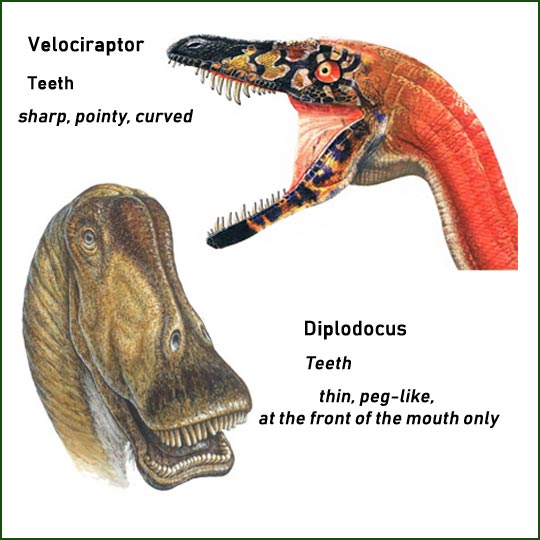
Palaeontologists can work out what extinct dinosaurs liked to eat by looking at their fossilised teeth. The shape of the teeth can tell a scientist a lot about the type of food that dinosaurs ate. The teeth of Velociraptor are sharp, pointed and curved. This suggests that Velociraptor was a meat-eater (carnivore). The teeth of diplodocids are a very different shape when compared to the teeth of the fearsome Velociraptor. Diplodocus only had teeth at the front of its mouth, these teeth were thin and looked like pegs.
Comparing the Teeth of a Meat-eater (Velociraptor) to the Teeth of a Plant-eater (Diplodocid)
Comparing the teeth of the carnivore Velociraptor to the herbivore (sauropod).
Picture credit: Everything Dinosaur from original illustrations by Michael Skrepnick and Zhao Chuang
Diplodocus was a plant-eater (herbivore), this dinosaur probably spent most of his life eating plants.
How is Diplodocus Different from Brontosaurus?
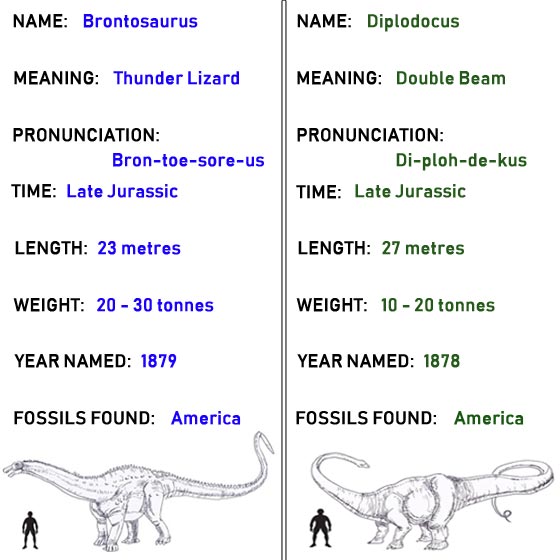
Diplodocus and Brontosaurus were closely related. Both were plant-eaters and they probably liked to eat the same types of plants. These long-necked dinosaurs lived in the Late Jurassic and their fossils have been found in the same country (United States of America). Diplodocus was different from Brontosaurus in a number of ways. It had a much longer tail and its neck was longer and more slender than Brontosaurus. Brontosaurus was probably much heavier than Diplodocus.
Similarities and Differences Between Brontosaurus and Diplodocus
Brontosaurus compared to Diplodocus.Picture credit: Everything Dinosaur.
Picture credit: Everything Dinosaur
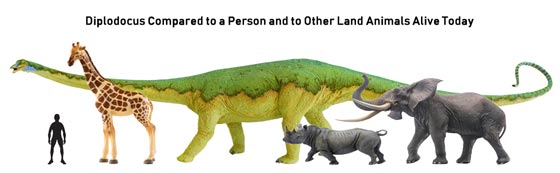
How big is a Diplodocus?
We have provided some information about the size of Diplodocus in the picture above. Can the children work out how much longer Diplodocus was compared to Brontosaurus? Why have we put a picture of a person next to our two dinosaur drawings (above), can the children think like scientists and come up with the answer?
How Could We Trap a Diplodocus if it was Alive?
Trying to trap a Diplodocus might be quite dangerous, after all, this plant-eating dinosaur was much bigger than any land animals alive today. The children have probably come up with some amazing ideas and suggestions. You could dig a big pit and cover it with tree branches then chase the Diplodocus towards the hole, if the Diplodocus fell in, it would probably get stuck, so long as the hole was deep enough. However, this might hurt the dinosaur, so perhaps instead of trying to force the dinosaur to try and do something, it might be better to persuade it to come to you.
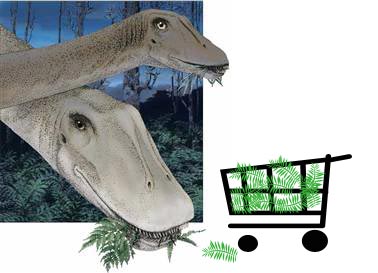
Since Diplodocus needed to eat a lot of plants, class 1 could perhaps persuade it to come and visit them by putting out some of its favourite food. If the children collected lots and lots of ferns (Diplodocus probably ate around 200 kilograms of plants every day), filling a shopping trolley with Diplodocus treats, might persuade the dinosaur to come and visit the children in the playground.
Attracting Diplodocus into the Playground by Providing Some of its Favourite Food
No need to catch a Diplodocus, try attracting it into the playground by leaving out some of its favourite food.
People attract dinosaurs into their gardens every day, even though they probably don’t realise they are doing this. Birds are so closely related to dinosaurs, that we should not call birds “birds” at all. They are “avian dinosaurs”. If you have a bird table at your school or in your garden you can watch dinosaurs feeding. Check out the feet on birds like the sparrow, thrush and blackbird, they have claws just like a dinosaur and they walk on three toes just like Tyrannosaurus rex!
How Long is the Neck of a Diplodocus? How Long is the Tail of Diplodocus?
A complete fossilised neck of Diplodocus has never been discovered. All the bones that make up a tail of a Diplodocus have never been found. When you visit a museum and see a spectacular mounted skeleton like “Dippy” the Diplodocus which used to be on display at the Natural History Museum (London), the skeleton you see consists of the bones of several individuals put together to make a single exhibit.
Missing bones are made as models and added to the skeleton to make it look complete. Most palaeontologists think that Diplodocus had around fourteen or fifteen neck bones and the neck measured about eight metres long. A baby Diplodocus had a relatively short neck, when it hatched (as far as we know, all dinosaurs hatched from eggs, just like birds today), as the Diplodocus grew, its neck got longer and longer. The whip-like tail of Diplodocus was longer than its neck. Size estimates for the tail of a Diplodocus are difficult to make, but Everything Dinosaur’s fossil experts suggest that the tail of a fully-grown Diplodocus could have been around fourteen metres long, that’s longer than a Badminton court!
Comparing a Diplodocus to Large Land Animals Alive Today
Diplodocus compared to animals alive today.
Picture credit: Everything Dinosaur
Our thanks to all the children in class 1 at Ysgol Bro Carmel Nursery and Primary School, we hope our answers to your questions help you with your term topic.
The Google doodle for the UK and Ireland today is a pair of dinosaurs (we think). The doodle has been put up in honour of Mother’s Day and the painting represents one child’s view of a mother dinosaur with its baby. At least to us, who spend a lot of the time looking at dinosaurs, this is what the drawing resembles.
Google Doodle Dinosaurs
Google Doodle March 11th 2018 for Mother’s Day.
Picture credit: Google
Do Armoured Dinosaurs Make Good Parents?
Whether or not the non-avian dinosaurs made good parents is a topic often debated amongst palaeontologists. Like their close relatives, the birds, non-avian dinosaurs probably adopted a range of strategies when it came to looking after their young. Nesting sites discovered in the United States strongly suggest that Maiasaura, (M. peeblesorum), a Late Cretaceous hadrosaur, fed their young and looked after them, whilst other types of dinosaur probably adopted different behaviours.
The person in the picture provides a scale so the size of this dinosaur can be estimated. Picture credit: Everything Dinosaur.
Picture credit: Everything Dinosaur
Fossils of very young Maiasaura indicate that these dinosaurs were not capable of leaving their nest and that they were dependent on the adult animals to feed them.
At the other end of what is a spectrum, precocial animals are born ready to lead much more independent lives. Precocial young are able to leave the nest shortly after birth/hatching and are capable of feeding themselves. As for evidence of armoured dinosaurs and their behaviour with regards to bringing up baby, the evidence is less substantial. However, a number of young individuals of armoured dinosaurs have been found in a single bone bed. The fossils come from an armoured dinosaur known from northern China (Inner Mongolia), called Pinacosaurus (P. grangeri). If these young Pinacosaurus died together, it does suggest that these animals lived in social groups. This may have implications for parenting behaviour.
Late Cretaceous Northern China
Late Cretaceous China. Pinacosaurus can be seen in the foreground.
Picture credit: Zhao Chuang
Research Papers on Dinosaurs
Team members at Everything Dinosaur also recall coming across a research paper that reported upon the discovery of an adult armoured dinosaur and a juvenile being found together. Although, it is difficult to interpret the exact circumstances, the fossils could represent an adult and offspring having perished together.
An Armoured Dinosaur Themed Artwork on Display in School
How many hands?
Picture credit: Bamford Academy Foundation Stage
On this Mothering Sunday, it is fitting to consider whether dinosaurs were altricial or precocial. It is likely, that just like birds, the Dinosauria exhibited a number of behaviours.
A “Handy” Illustration of a Monster Created by School Children
A “handy” way to create a prehistoric animal in the classroom.
Everything Dinosaur Helping to Honour Female Scientists
With International Women’s Day having been very much in the news this week, Everything Dinosaur is taking this opportunity to honour two female pioneers in the Earth sciences, both called Mary. Today, March 9th, is the anniversary of the death of Mary Anning, the famous amateur fossil collector from Dorset who did much to bring the amazing geology of that part of the coast of southern England to the world’s attention. It is only in the last few decades that her contribution to the nascent science of palaeontology has begun to be recognised. As part of our continuing work in schools, we have developed a lesson plan based around researching the life of Mary Anning for Key Stage 1 and Key Stage 2 pupils.
Everything Dinosaur’s Non-chronological Report Focused on Mary Anning
A non-chronological report exercise based on the life and work of Mary Anning. Picture credit: Everything Dinosaur.
Picture credit: Everything Dinosaur
A Non-chronological Report Focused on Mary Anning
A non-chronological report is a non-fiction report that is not written in time order. Usually written in the third person, these reports help children to practice structuring texts and working with a variety of writing styles. They involve a planning phase in which the compiler has to research the subject area and to decide what to include or discard. It helps children to evaluate sources of information, encourages cross-checking of references and provides the opportunity for the teacher to check learning. Everything Dinosaur’s lesson plan includes a template for the creation of a non-chronological report focused on the life and work of Mary Anning.
Mary Anning Honoured in a Google Doodle
Google pays tribute to Mary Anning (1799-1847).
Picture credit: Google
Mary Douglas Leakey (1913-1996)
The British palaeoanthropologist Mary Leakey, who along with her husband Louis, did much to improve our understanding of the evolution of humankind has also been the subject of a Google doodle. Everything Dinosaur is working towards honouring the work of this ground-breaking scientists by having a blue plaque erected at her childhood home in London. We shall update blog readers with regards to our progress in the near future.