All about dinosaurs, fossils and prehistoric animals by Everything Dinosaur team members.

Drawings of dinosaurs and other prehistoric animals either done by team members or sent into Everything Dinosaur.

12 06, 2012

The Fantastic “Thunder Beast” Megacerops

By |2024-04-23T16:04:11+01:00June 12th, 2012|Categories: Dinosaur and Prehistoric Animal Drawings, Everything Dinosaur News and Updates|0 Comments

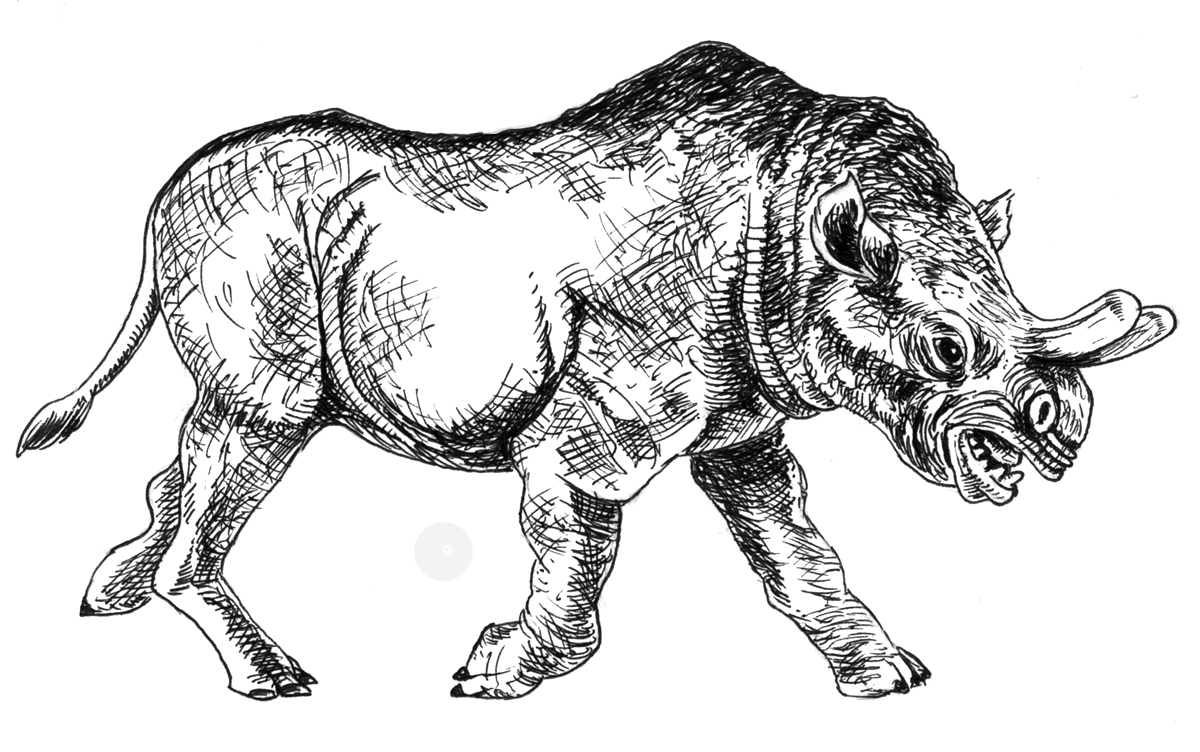
Megacerops – A Brontothere otherwise known as a “Thunder Beast”

Just time to post up a drawing of Megacerops, a member of a family of prehistoric mammals known as Brontotheres, or “Thunder Beasts”.  This drawing was commissioned by Everything Dinosaur so that a fact sheet on this prehistoric animal could be produced to mark the creation of the CollectA Megacerops model.

An Illustration of Megacerops

“Large Horn Face” – Megacerops.

Picture credit: Everything Dinosaur

CollectA Megacerops Model

Although this animals superficially resembled modern-day rhinos, they are in fact more closely related to horses.  Our thanks to Mike Fredericks who we commissioned to create this drawing for Everything Dinosaur.

To view the CollectA model range including scale models (1:20 scale) of prehistoric mammals: CollectA Deluxe Prehistoric Mammal Models.

11 03, 2012

Kosmoceratops – Most Ornate of the Ceratopsians

By |2023-01-28T18:26:47+00:00March 11th, 2012|Categories: Dinosaur and Prehistoric Animal Drawings, Everything Dinosaur News and Updates, Everything Dinosaur Products|1 Comment

Preparing for the arrival of Kosmoceratops Models

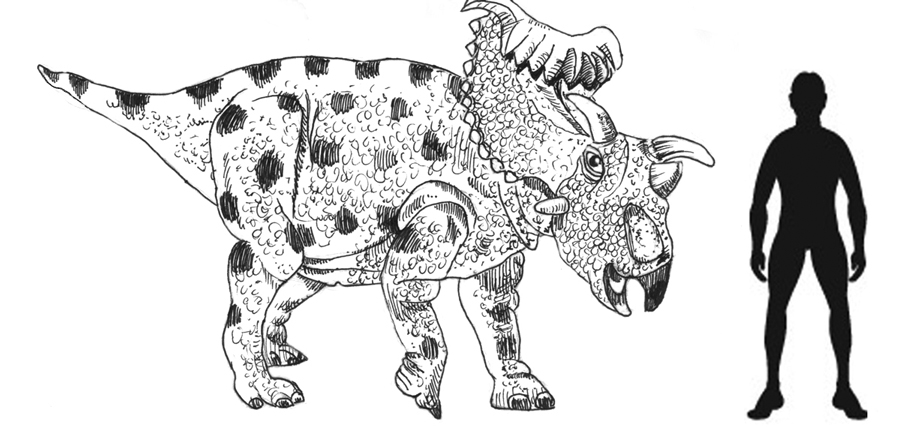
All is in readiness to receive the new CollectA dinosaur models, they will be arriving sometime next week at Everything Dinosaur.  Team members have been finalising the fact sheets and checking over the data in preparation for sending them out with customer orders.  As part of our preparations to receive the CollectA prehistoric animal models we have commissioned a series of drawings of the prehistoric animals featured in the new releases – animals such as Kosmoceratops, Mapusaurus and Utahceratops.

Kosmoceratops

The Scale Drawing of Kosmoceratops

Ornate horned face – Kosmoceratops.

Picture credit: Everything Dinosaur

The new models include scale models, as well as not to scale replicas.  We are particularly looking forward to the Neanderthal figures and the chance to replenish our stocks of Plateosaurus and Torosaurus.

To view the CollectA not-to-scale prehistoric animal models: CollectA Prehistoric Life Models.

6 03, 2012

Young Artists at Openshaw Primary School Display their Unique Dinosaur Art

By |2024-04-23T06:58:13+01:00March 6th, 2012|Categories: Dinosaur and Prehistoric Animal Drawings, Educational Activities, Everything Dinosaur News and Updates|0 Comments

Dinosaur Artwork on Display

Following a visit from one of Everything Dinosaur’s teacher/palaeontologists to Higher Openshaw Community School in Manchester, the young, enthusiastic pupils were sent some dinosaur drawing materials to help illustrate some of the teaching topics covered that term by their teacher Ms Boyd and her colleagues.  The children produced some excellent illustrations and they were keen to have their dinosaur artwork on display.

Dinosaur Artwork on Display

We really enjoyed working with the junior palaeontologists at the school and their teacher very kindly sent us some examples of the children’s artwork that they had produced with the drawing materials we had sent them.

Dinosaur and Prehistoric Animals ( Higher Openshaw Community School)

A Jurassic scene.

Picture credit: Everything Dinosaur/Higher Openshaw

At Everything Dinosaur, we try to give pupils a sense of deep, geological time and that different prehistoric animals lived in different geological periods.  The drawing materials that we sent the school included a Jurassic landscape with authentic Jurassic aged plants.  The school children were then able to add their own Jurassic aged prehistoric animals , as we had emailed them specifically, dinosaurs and flying reptiles that lived during the Jurassic.

Pupils Illustrate Dinosaurs

Jurassic Park – By Higher Openshaw Community School

School pupils illustrate dinosaurs.

Picture credit: Everything Dinosaur/Higher Openshaw

Our congratulations to all the school children involved in the dinosaur teaching topics, their artwork and illustrations are super.

Dinosaurs on the Prowl

A bright red Stegosaurus on the prowl.

Picture credit: Everything Dinosaur/Higher Openshaw

The picture above shows a bright red Stegosaurus as drawn by one of the pupils with a Pterosaur (Rhamphorhynchus) flying overhead.  The colouration on the Stegosaur is particularly apt as palaeontologists believe that this plant-eating dinosaur could flush their plates with blood, making them turn bright red.  Scientist Ken Carpenter proposed that with such a rich blood supply to the dermal plates, they could have been flushed with blood at will making a colourful and impressive display.

Openshaw’s Young Dinosaur Illustrators

A very colourful Jurassic scene.

Picture credit: Everything Dinosaur/Higher Openshaw

They are certainly very colourful scenes and we enjoyed working with the school children and helping them to study dinosaurs.

An Allosaurus Hiding in the Ferns

A hiding Allosaurus.

Picture credit: Everything Dinosaur/Higher Openshaw

For dinosaur themed educational materials, toys and games: Learning Materials – Dinosaur Toys and Games.

15 11, 2011

Planet Dinosaur a Helpful Pronunciation Guide Part 2

By |2024-04-22T12:02:38+01:00November 15th, 2011|Categories: Dinosaur and Prehistoric Animal Drawings, Dinosaur and Prehistoric Animal News Stories|0 Comments

Planet Dinosaur Pronunciation Guide (D to M)

In response to enquiries we have compiled a pronunciation guide to accompany the prehistoric animals featured in the recent BBC television series “Planet Dinosaur”.  One of our tasks was to review the book that goes with this six-part television series, the book is called “Planet Dinosaur – The Next Generation of Giant Killers”, it is jam packed full of fascinating facts and the storyboard layout makes it an excellent read.

“Planet Dinosaur”

There are so many animals featured in the series, that we have divided the pronunciation guide into three parts, below is the second part of our list – animals from the series (D-M).

Everything Dinosaur’s Pronunciation Guide to “Planet Dinosaur”

Pronunciation guide (D to M).

Table credit: Everything Dinosaur

For the mums and dads struggling to keep up with their young, enthusiastic dinosaur fans this should prove helpful.  Everything Dinosaur team members have created a handy pronunciation guide to dinosaurs and prehistoric animals that featured in the recent television series “Planet Dinosaur.”

For models and replicas of prehistoric animals, many of which have featured in “Planet Dinosaur”: Prehistoric Life Models and Figures (CollectA).

8 11, 2011

Young Palaeontologists Make Their Mark at School

By |2023-01-23T13:52:33+00:00November 8th, 2011|Categories: Dinosaur and Prehistoric Animal Drawings, Dinosaur Fans, Educational Activities|0 Comments

Staveley Primary School’s Young Dinosaur Fans

Pupils at Staveley Community Primary and Nursery School (North Yorkshire) got the chance to get up close to Tyrannosaurus rex and Triceratops this week, when one of our team members came to visit Class 2 (year 1/reception) as part of the school’s teaching topic on dinosaurs.  After a morning of dinosaur themed activities and looking at fossils, helped by Mrs Lilley and Miss Richardson, the class was given the opportunity by their teacher Mrs Moss to design their very own dinosaur.

Young Palaeontologists

We were very kindly sent some examples of the children’s work and what an amazing mixture of prehistoric animals the pupils created.  Daniel sent us a drawing of his fearsome “Spikeosaurus”,  Anna did a drawing of “Spottyosaurus” both dinosaurs were aptly named as we don’t think we have ever seen such a spiky dinosaur as Daniel’s, or indeed one as spotty as the one in Anna’s picture.  Reuben created his own version of Microraptor giving us “blooasaurus” a big crest of blue feathers and a pair of very large wings, whilst William drew a “Belly-a-saurus” explaining that this particular bright red beastie was so called as it had a very big belly.  Finlay who along with Alex and Finlay2 had helped to cast a Velociraptor claw for the school’s dinosaur museum, provided us with a bright yellow “Finlayosaurus”, a sort of five-legged, daffodil coloured Stegosaurus-like creature, certainly one of the most colourful dinosaur drawings we have received in a long while.

Some of the Dinosaur Drawings Created by Class 2

Some of the amazing dinosaur pictures from Class 2.

Picture credit: Staveley Primary School

The girls in the office were particularly keen on Joe’s “Chocolate-oh-saurus”, combining two of their favourite things – chocolate and dinosaurs.  Team members also liked Max’s two-headed, long-necked dinosaur, what a monster, but perhaps the scariest looking of all was the drawing created by Maxine – were not sure how to pronounce the name of her ferocious looking prehistoric animal, we think it is something like “Mon-tee-tee-ex-tre-rex”.

A Dinosaur Museum

The children and their teachers have created their own dinosaur museum to exhibit their work and fossils that the children have found on their holidays.  All part of the term topic involving teaching about dinosaurs and fossils in schools.

The Dinosaur Museum Created by the Class

The pupil’s very own dinosaur museum.

Picture credit: Staveley Primary School

The museum contains lots of amazing objects that the pupils have collected, including the cast of the Velociraptor killing claw and the data sheet that Everything Dinosaur provided them with during the visit.  This fossil was cast by three volunteers from the class.

The Dinosaur Museum is Full of Fascinating Exhibits

Lots of fossils that the pupils have found.

Picture credit: Staveley Primary School

We have pinned up all the illustrations onto our notice board in the warehouse, they make us smile when we walk past them.  Our thanks to all the budding palaeontologists who helped with the experiments on the day and to those pupils who drew the dinosaur pictures for us.

For replicas of iconic animals from the fossil record including ammonites and trilobites as well as other prehistoric animal figures: Prehistoric Life Models (CollectA Figures).

23 05, 2011

Old Hollow Tooth – Woolly Rhinoceros

By |2023-03-08T09:13:11+00:00May 23rd, 2011|Categories: Animal News Stories, Dinosaur and Prehistoric Animal Drawings, Main Page|0 Comments

Coelodonta antiquitatis – Our Favourite Perissodactyl

The origins of the ungulates (hoofed mammals) go back to the Palaeocene and this great group of mammals that includes such familiar creatures as deer, pigs, camels, horses not to mention whales and dolphins, was soon divided into animals with even-toed hooves (Artiodactyls) and the odd-toed hooves (Perissodactyls).

Coelodonta antiquitatis

From this vast group of warm-blooded animals it is difficult to pick a favourite but if pushed we would say that it would be that member of the Perissodactyls – the Woolly Rhino (Coelodonta antiquitatis).  These members of the rhinoceros family may have evolved in China, but they spread right across the northern hemisphere and survived up to around 10,000 years ago.

Standing around 2.2 metres tall at the shoulder, these heavy weight grazers resemble the rhinos found in Africa today, but have a thick coat of fur and extraordinarily long horns, sometimes more than 2 metres long.

An Illustration of a Woolly Rhino

Picture credit: Everything Dinosaur

The man we have drawn provides an approximate scale.

Named and described by the German naturalist J. F. Blumenbach in 1807, these shaggy animals had short legs, short ears (adaptations for a cold climate) and most probably short eyesight (rhinos today have poor vision).  Weighing up to 2,000 kilogrammes, with perhaps some males being even heavier these were extremely dangerous animals despite being entirely herbivorous.

A Model of a Woolly Rhinoceros (Coelodonta antiquitatis)

Woolly Rhino (Coelodonta antiquitatis).

A model of a Woolly Rhino. Great care has been taken to depict the anterior horn on the new Papo model.

Picture credit: Everything Dinosaur

The picture (above) shows the Papo Woolly Rhinoceros model: Papo Prehistoric Animal Figures.

Woolly Rhinoceros

There are several reasons why we like the Woolly Rhino, firstly there are lots of fossils of them, from their preserved horns and skin to their shed teeth.  The fossils of these creatures have been found all over Europe and in parts of the UK.  Secondly, these animals are often featured in movies and artwork showing Ice Age animals and thirdly, there are some super cave paintings of them provided by our ancestors.  We also love all the stories and myths that surround these animals, for example fossil Woolly Rhino horns eroding out of the permafrost in Siberia were mistaken for the giant claws of a huge bird that was supposed to live in the far north.

The natives would tell stories of this ferocious monster that could snatch up a reindeer in its terrible claws.  It was many years before the link was made between these claw-like fossils and the remains of Ice Age animals that had once roamed that part of the world.

15 05, 2011

Pangea Did Have Boundaries – Speciation Prevailed

By |2023-03-07T10:23:17+00:00May 15th, 2011|Categories: Dinosaur and Prehistoric Animal Drawings, Geology, Main Page, Palaeontological articles|0 Comments

New Study Suggest Mammals Liked some Parts, Reptiles Others

One of the conundrums in the science of palaeontology, is why given the uniformity of Pangea during the Triassic was there such a huge increase in the diversity of vertebrate life?.  For speciation to occur, (new species to evolve), so the theory of evolution goes, a group of one species of animals needs to become separately from another group of animals from the same species.

For example, if you have a species of leaf-eating lizard living on the coast and in a freak storm a number of individuals are washed out to sea, perhaps floating on broken branches that have become detached from trees during the storm.  These lizards, would be able to survive a long period afloat as they need little food or water being cold-blooded.  After several weeks, the tides and currents takes this floating raft of storm debris towards a small island many hundreds of miles from the mainland where these lizards used to live.

The branches and the lizards that they contain that have have survived get washed ashore and these little mariners find themselves in a new environment.  The habitat may be different, the plant life strange and even the food chains which the lizards are introduced to as interlopers may be different.  If this population remains isolated from the mainland leaf-eating population then there is every chance that over time, the lizards will evolve and adapt to their new homes – perhaps becoming over many generations so different from the mainland lizards that they can no longer breed with them and thus, these island lizards would be classified as a separate species.  With a different diet of leaves, perhaps due to the limited number of trees on the island, the lizards may well evolve into animals with a more omnivorous diet.  Their dentition could change, the size of the jaw muscles, the anatomy of the gut and so on.

More than 200 million years ago, mammals and reptiles lived in their own separate worlds on the super-continent Pangaea, despite little geographical incentive to do so. Mammals lived in areas of twice-yearly seasonal rainfall; reptiles stayed in areas where rains came just once a year. Mammals lose more water when they excrete, and thus need water-rich environments to survive. Results are published in the Proceedings of the National Academy of Sciences.

With the super-continent of Pangea covering much of one hemisphere and being made up of North America, Europe, North Asia, Africa, South America, scientists have puzzled over why the rise and spread of so many vertebrates such as the dinosaurs, when the opportunity for a “gene pool” of a species to become isolated would have been so limited.  There were few geographical boundaries to the physical movement of animal populations, no great, continuous mountain chains, no impassable deserts, ice fields and such like.  If animals roamed freely across Pangea, gene pools would have remained very readily accessible from animals of that species moving into any area and the opportunities for extensive speciation would have been lost.  However, mammals and reptiles did keep to their own areas, each type preferring a particular climate (mammals liking hot and wet, reptiles being more successful in the drier areas.

Triassic Fossils

In a paper published in the scientific journal “The Proceedings of the National Academy of Sciences”,  a team of researchers have concluded that more than 200 million years ago, mammals and reptiles lived in their own separate worlds on the super-continent Pangea.  Despite little geographical incentive to do so.  Mammals lived in areas of twice-yearly seasonal rainfall; reptiles stayed in areas where rains came just once a year.  Mammals lose more water when they excrete, compared to reptiles and birds and thus need water-rich environments to survive.

Studying a transect of Pangea stretching from about three degrees south to 26 degrees north (a long swath in the centre of the continent covering tropical and semi-arid, temperate zones), a team of scientists led by Jessica Whiteside at Brown University (Rhode Island, USA) has determined that reptiles, represented by a group called procolophonids, lived in one area, while mammals, represented by a precursor species called traversodont cynodonts, lived in another.  Though similar in many ways, their paths evidently did not cross.

Assistant Professor Whiteside commented:

“We’re answering a question that goes back to Darwin’s time.  What controls where organisms live?  The two main constraints are geography and climate.”

Turning to climate, the frequency of rainfall along lines of latitude directly influenced where animals lived, the scientists conclude. In the tropical zone where the mammal-relative traversodont cynodonts lived, monsoon-like rains fell twice a year.  But farther north on Pangea, in the temperate regions where the procolophonids predominated, major rains occurred only once a year.  It was the difference in the precipitation, the researchers conclude, that sorted the mammals’ range from that of the reptiles.

On Pangea, the mammals needed a water-rich area, so the availability of water played a decisive role in determining where they lived.

Assistant Professor Whiteside added:

“It’s interesting that something as basic as how the body deals with waste can restrict the movement of an entire group.”

In water-limited areas, “the reptiles had a competitive advantage over mammals,” Whiteside commented.  She thinks the reptiles didn’t migrate into the equatorial regions because they already had found their niche.

The researchers compiled a climate record for Pangea during the Late Triassic period, from 234 million years ago to 209 million years ago, using samples collected from lakes and ancient rift basins stretching from modern-day Georgia to Nova Scotia.  Pangea was a hothouse then; temperatures were about 20 degrees Celsius hotter in the summer, and atmospheric carbon dioxide was five to 20 times greater than today.  Yet there were regional differences, including rainfall amounts.

Glossopteris Plant Fossils – Provide an Insight to Pangea

Glossopteris fossil leaves.

Examples of Glossopteris fossils from different parts of the world – India (left) and Australia (right). Picture credit: Everything Dinosaur.

Picture credit: Everything Dinosaur

The researchers base the rainfall gap on variations in Earth’s precession, or the wobble on its axis, coupled with the eccentricity cycle, based on Earth’s orbital position to the sun.  Together, these Milankovitch cycles influence how much sunlight, or energy, reaches different areas of the planet.  During the Late Triassic, the equatorial regions received more sunlight, thus more energy to generate more frequent rainfall.  The higher latitudes, with less total sunlight, experienced less rain.

The research is important because climate change projections for our own time on planet Earth, show areas that would receive less precipitation, which could put mammals there under stress.

Typical Terrestrial Life During the Late Triassic

A Triassic scene from the dinosaur timeline poster.

Triassic scene from the dinosaur timeline poster. Typical terrestrial life during the Late Triassic.

Relating the Pangea evidence to today’s problem with climate change, research graduate Danielle Grogan, part of Associate Professor’s Whiteside research Group stated:

“There is evidence that climate change over the last 100 years has already changed the distribution of mammal species.  Our study can help us predict negative climate effects on mammals in the future.”

For models and replicas of Triassic prehistoric animals including early dinosaurs: CollectA Deluxe Prehistoric Animal Scale Models.

20 02, 2009

A Drawing of the Bizarre Stegosaur – Wuerhosaurus

By |2022-12-20T13:09:02+00:00February 20th, 2009|Categories: Dinosaur and Prehistoric Animal Drawings|0 Comments

Wuerhosaurus Illustrated

One of the more unusual of all the Dinosauria, our drawing of Wuerhosaurus, a Chinese stegosaur.  Everything Dinosaur commissions drawings of prehistoric animals including members of the Stegosauria clade and other ornithischian dinosaurs.  These drawings are used to help our education programmes and feature in the Everything Dinosaur prehistoric animal fact sheets that are sent out with orders of dinosaur and prehistoric animal models and toys purchased from the company’s award-winning website.

Odd stegosaur from China, an illustration of the Chinese stegosaur Wuerhosaurus (W. homheni).

Picture credit: Everything Dinosaur

Wuerhosaurus (W. homheni and W. ordosensis)

Fossils found in the early 1970s (Lianmugin Formation of the Junggar Basin in the Xinjiang region of western China), led to the erection of the genus Wuerhosaurus and the species W. homheni in 1973. This armoured dinosaur was formally named and described by the famous Chinese palaeontologist Dong Zhiming in 1973. Fragmentary fossils of a second, slightly smaller Wuerhosaurus species led to the erection of W. ordosensis in 1993. This second species was also named and described by Dong Zhiming.

The PNSO Wuerhosaurus dinosaur model.
PNSO Wuerhosaurus model. A replica of the strange stegosaur from the Early Cretaceous of China.

To view models of the Chinese, Early Cretaceous stegosaur Wuerhosaurus and other figures and replicas of armoured dinosaurs: Dinosaur and Prehistoric Animal Models.

4 02, 2009

A Picture of the Titanosaur Saltasaurus by Everything Dinosaur

By |2022-12-13T10:31:19+00:00February 4th, 2009|Categories: Dinosaur and Prehistoric Animal Drawings|0 Comments

A Picture of the Dinosaur Called Saltasaurus by Everything Dinosaur

One of Everything Dinosaur’s favourite South American titanosaurs, the armoured Saltasaurus, whose fossils are known from Argentina.

A Scale Drawing of the Titanosaur Saltasaurus

Here comes a titanosaur!

Picture credit: Everything Dinosaur

The Saltasaurus dinosaur drawing is just one of the many hundreds of dinosaur pictures in the Everything Dinosaur database.

To view models of titanosaurs in stock at Everything Dinosaur: CollectA Age of Dinosaurs Popular Range.

7 01, 2009

Exclusive Jurassic Scene Prepared for Dinosaur Workshops

By |2024-04-15T13:51:47+01:00January 7th, 2009|Categories: Dinosaur and Prehistoric Animal Drawings, Everything Dinosaur News and Updates|0 Comments

Helping Young School Children to Learn about Prehistoric Food Chains

All finished, Everything Dinosaur has completed a project where they have put together a series of prehistoric scenes depicting a typical environment and the typical flora (plants) to be found in the Triassic, the Jurassic and the Cretaceous geological periods.  The project has taken some time to complete as we wanted to get this concept right so that we could deploy these prehistoric animal themed teaching guides when discussing food chains and food webs with Key Stage one and Key Stage two children.

Jurassic Scene (Just add Dinosaurs and Other Prehistoric Animals)

Just add dinosaurs!

Just add dinosaurs!  Everything Dinosaur team members have created a realistic, authentic prehistoric landscape ready to be populated with dinosaurs.

Picture credit: Everything Dinosaur

Dinosaur Workshops

When Everything Dinosaur team members visit schools to teach about dinosaurs and fossils, we always dove-tail our teaching into key aspects of the national curriculum with a special focus on science, literacy and maths.  By producing these prehistoric backgrounds we can discuss food chains and food webs helping young children to understand environments of the past.  The teaching team can then utilise this knowledge and reinforce the learning by discussing food chains and food webs seen today.  With so many children loving dinosaurs, then using dinosaurs to help teach about food webs is a really good idea and we are sure our new scenes will help the children learn more about fundamental aspects of science encompassed within the UK’s national curriculum.

To learn more dinosaur toys and gifts available from Everything Dinosaur: Visit Everything Dinosaur.

Go to Top