All about dinosaurs, fossils and prehistoric animals by Everything Dinosaur team members.

Drawings of dinosaurs and other prehistoric animals either done by team members or sent into Everything Dinosaur.

3 11, 2008

The Beautiful Gastonia – A Heavily Armoured Dinosaur

By |2024-04-12T08:20:37+01:00November 3rd, 2008|Categories: Dinosaur and Prehistoric Animal Drawings, Dinosaur Fans, Main Page|1 Comment

Gastonia burgei – Related to Polacanthus

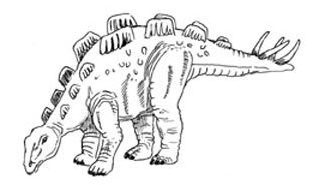
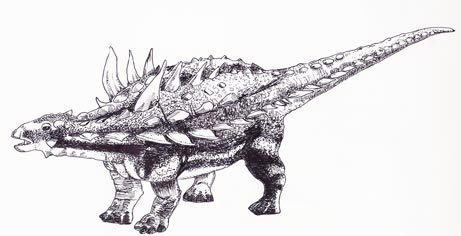
Discovered in the same quarry as fossils of the fearsome theropod Utahraptor (Grand County, Utah), the heavily armoured Gastonia is believed to be a close relative of the English polacanthid called Polacanthus (P. foxii and P. rudgwickensis).  More fossil material has been ascribed to the Gastonia genus from this one location, believed to represent a substantial bone bed than from any other member of the polacanthid clade.  Unfortunately, such is the wealth of isolated and fragmentary dermal armour found at the fossil dig site, that palaeontologists remain uncertain as to the layout and orientation of this dinosaur’s defensive armour.  This makes reconstructions of this plant-eating dinosaur very difficult.

Measuring up to five metres in length, this dinosaur is reputed to be the most heavily armoured of all the dinosaurs known to science.  It had a sacral shield of thick armour over the hips and pairs of spines that ran down the body from the neck and shoulders.  These probably stuck out sideways and upwards to afford this creature maximum protection.  The tail was long and narrow and it probably had sharp spikes sticking out of the side which would have have made the tail a formidable defensive weapon.  Examination of the hip bones and femur indicate that the tail could be swung in a horizontal arc with considerable force, easily enough force to knock an attacking Utahraptor off its feet.

An Illustration of Gastonia (G. burgei)

A drawing of the heavily armoured Gastonia.

A drawing of the heavily armoured Gastonia.  Picture credit: Everything Dinosaur.

Picture credit: Everything Dinosaur

Gastonia

Named in 1998, after Robert Gaston, this dinosaur with its heavy body and spiky armour would have been a formidable opponent for any hungry theropod brave enough to attack.

Everything Dinosaur stocks a range of armoured dinosaur models and replicas: Dinosaur and Prehistoric Animal Models.

24 10, 2008

The Amazing Sauroposeidon – A Super-sized Dinosaur

By |2026-04-07T14:08:03+01:00October 24th, 2008|Categories: Dinosaur and Prehistoric Animal Drawings, Dinosaur Fans, Main Page|0 Comments

Sauroposeidon The Tallest Known Dinosaur

Originally described from four cervical vertebrae (neck bones), discovered in Oklahoma (Antlers Rock Formation), Sauroposeidon is classified as a member of the Macronaria clade of sauropods and it might have been the tallest terrestrial animal ever.  When the neck bones of Sauroposeidon were first found, it was thought that they represented petrified wood as they were so big.  A number of other fossil specimens from Early Cretaceous strata have now been assigned to Sauroposeidon (Late Aptian to Early Albian faunal stages), intriguingly, the number of long-necked dinosaurs known from North America at this time in the Cretaceous is very low.  Sauroposeidon may be the last known sauropod from North America until the evolution of Alamosaurus which is known from Upper Cretaceous strata nearly forty million years younger.

Sauroposeidon

Based on scaled up versions of the brachiosaurid Giraffatitan (G. brancai), it has been estimated that the height of the head of a fully grown Sauroposeidon (S. proteles) would have been around the twenty metres mark.

The actual size of this dinosaur is difficult to estimate, it may have been much more gracile than other members of the Macronaria.  Some palaeontologists have speculated that Sauroposeidon weighed as much as sixty metric tonnes and measured over thirty-two metres in length.

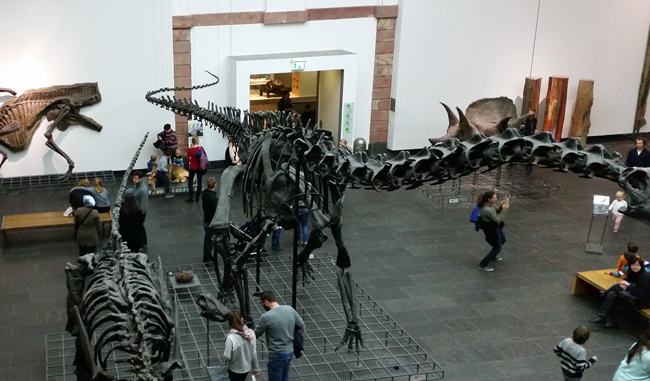
A Giant Sauropod Exhibit in a Museum

Sauropod skeleton (cast) on display.

A sauropod (diplodocid) skeleton exhibit on display at the Frankfurt Natural History Museum (Naturmuseum Senckenberg). Picture credit: Everything Dinosaur.

Picture credit: Everything Dinosaur

The species name “proteles” is derived from the Greek and it means “perfect before the end”.  This refers to Sauroposeidon’s status as one of the last sauropods known from Lower Cretaceous strata of North America. Sauroposeidon was probably a specialist, in terms of its feeding behaviour.  If indeed, it was a super-sized brachiosaurid it would have specialised in feeding on the tops of trees.  It was probably invulnerable to attack as an adult but young dinosaurs and juveniles were probably hunted by the large theropod Acrocanthosaurus (A. atokensis).  Some palaeontologists have speculated that the famous “dinosaur chase” footprint fossils from the bed of the Paluxy River, Texas, represent a Sauroposeidon being stalked by an Acrocanthosaurus.

“Lizard of Poseidon”

The genus name is from the Greek meaning “lizard of Poseidon”, the Greek deity whose domain was the sea and who was thought to be responsible for earthquakes.  In 1999, when press releases were sent out announcing the discovery of a huge dinosaur from the United States, “Earthquake lizard” seemed a highly appropriate name.

Everything Dinosaur stocks a range of sauropod figures, including the large models in the PNSO range: PNSO Age of Dinosaurs Figures and Models.

2 10, 2008

How to Pronounce Coelophysis

By |2023-02-25T17:07:27+00:00October 2nd, 2008|Categories: Dinosaur and Prehistoric Animal Drawings, Dinosaur Fans, Main Page|0 Comments

Pronouncing “Hollow Form” The Agile Coelophysis

The Late Triassic theropod whose fossils have been famously found at the Ghost Ranch quarry (New Mexico, United States) causes one or two problems for young dinosaur fans when it comes to pronunciation.  Coelophysis is pronounced “See-low-fy-sis”, it might be spelt with a “C” but in reality, the “C sound” is soft and “See-low-fy-sis” is how this dinosaur should be pronounced.

One of the most successful dinosaurs of the Late Triassic, the brain of this dinosaur was larger than its reptilian ancestors and it had keen senses, making this three metre long theropod a formidable hunter.  As for its diet, it would have been capable of catching and eating a range of small animals including insects, small reptiles, amphibians and fish.  It was very probably a generalist carnivore eating a wide range of prey items.

An Illustration of Coelophysis (C. bauri)

Coelophysis of the Late Triassic.

Coelophysis of the Late Triassic.

Picture credit: Mike Fredericks

Coelophysis

The name means “Hollow Form”, a reference to this dinosaur’s hollow and light limb bones.  Note the needle-like teeth in the long, narrow jaws.

Everything Dinosaur stocks a large range of prehistoric animal models including Safari Ltd which includes a replica of Coelophysis: Safari Ltd. Wild Safari Prehistoric World.

2 05, 2008

Studying Those Nasty but Amazing Velociraptors

By |2024-04-12T08:50:21+01:00May 2nd, 2008|Categories: Dinosaur and Prehistoric Animal Drawings, Dinosaur Fans, Main Page|0 Comments

Vicious Velociraptors

Although much smaller than the “Velociraptors” depicted in the Jurassic Park trilogy, this little theropod dinosaur was armed with a seven centimetre long, strongly curved second toe claw and it possessed about eighty sharp teeth in its jaws.  Described by some palaeontologists as being “poodle-sized”, it may have been one of the smaller “raptors”, but its vicious reputation as so successfully portrayed in the cinema was strongly deserved.

An Illustration of Velociraptor

Vicious Velociraptor.

Vicious Velociraptor.  Picture credit: Everything Dinosaur.

Picture credit: Everything Dinosaur

Vicious Velociraptor

Like all members of the Dromaeosauridae (swift lizards), this dinosaur had a long, stiff tail.  The tail could not be raised very high, but it could be moved from side to side.  It has been speculated that the tail functioned like a rudder to help the animal to balance as it ran.  It probably fed on small lizards, mammals, baby dinosaurs and even dinosaur eggs, but in a pack it would have been capable of mobbing and bringing down much larger prey.

As for its vicious reputation, this is well deserved.  It was probably a cannibal too.  A baby Velociraptor skull has been discovered with two little holes in the top.  The teeth of an adult Velociraptor fit perfectly into these holes – nasty critter that Velociraptor (Velociraptor mongoliensis).

The Beasts of the Mesozoic model range contains lots of articulated replicas including V. mongoliensis. To view this excellent range: Beasts of the Mesozoic Models and Figures.

8 03, 2008

New Notes on Postosuchus

By |2024-04-12T08:22:47+01:00March 8th, 2008|Categories: Dinosaur and Prehistoric Animal Drawings, Dinosaur Fans, Press Releases|0 Comments

Postosuchus kirkpatricki – Fierce Prehistoric Animal

Postosuchus (P. kirkpatricki) was a member of the Order Rauisuchia of reptiles.  This Late Triassic predator whose fossilised remains have been found in Arizona, New Mexico, North Carolina and the state of Texas was made famous in 1999 when it appeared in the first episode of the ground breaking BBC documentary series “Walking with Dinosaurs”.  The name Postosuchus means “after or post crocodile”, a reference to this extinct creature’s affinity with the crocodile family.  The genus name also gives a nod towards Post Quarry, a fossil location close to the small town of Post in Garza County (Texas).

An Illustration of Postosuchus

Scale drawing of Postosuchus

Scale drawing of Postosuchus.  Picture credit: Everything Dinosaur.

Picture credit: Everything Dinosaur

Notes on Postosuchus

After this predator’s appearance on the television documentary series it has become one of the most popular non-Dinosaurian prehistoric animals known from the Triassic geological period amongst enthusiasts of all things Mesozoic.

Everything Dinosaur currently stocks the Postosuchus prehistoric animal model that is part of the Wild Safari Prehistoric World range of figures.  To view this range: Wild Safari Prehistoric World Figures.

19 02, 2008

A Special Nemicolopterus Illustration

By |2024-04-11T10:37:32+01:00February 19th, 2008|Categories: Dinosaur and Prehistoric Animal Drawings|0 Comments

Illustrating a Pterosaur

Our knowledge of the Pterosauria has grown remarkably over the last decade or so.  There have been some fantastic flying reptile fossil discoveries in Europe, South America (Brazil) and China.  One of Everything Dinosaur’s favourite illustrations of a recent pterosaur discovery is this lovely image of the small, insect eating Nemicolopterus.

Nemicolopterus Illustration

Nemicolopterus Illustrated

Small agile flier.

Small agile flier.  An illustration of the recently described pterosaur Nemicolopterus.

Picture credit: Michael Skrepnick

To read more about what is believed to be one of the smallest members of the Pterosauria discovered to date: Tiny Pterosaur from China.

We really like this picture as it shows a pterosaur with a dragonfly which gives the viewer a sense of scale and there is a Maidenhair branch (Ginkgo) in the illustration too.  This flying reptile had a wing span of around 25 centimetres and it has been named Nemicolopterus crypticus.

The Chinese model manufacturer recently introduced a small replica of this tiny pterosaur, to view this figure and the rest of the replicas in the range: PNSO Age of Dinosaurs Figures.

13 12, 2007

A “Selection Box” of Prehistoric Animal Drawings

By |2022-11-06T08:07:19+00:00December 13th, 2007|Categories: Dinosaur and Prehistoric Animal Drawings|0 Comments

Prehistoric Animal Drawings from Everything Dinosaur

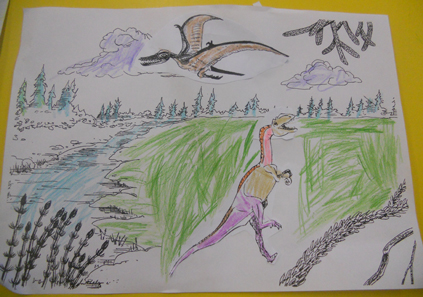
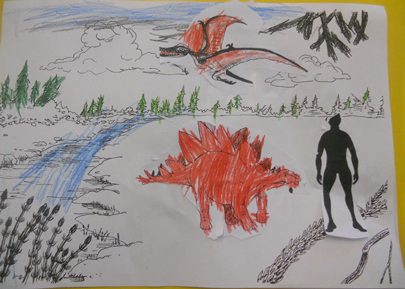
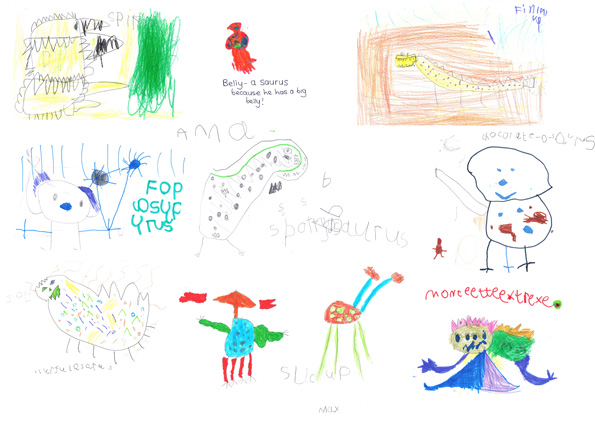
Whilst trawling through the extensive Everything Dinosaur database, we came across a selection of prehistoric animal drawings.  Team members are not sure where these have originated from or indeed which extinct animals from prehistory they represent but as they were quite colourful, we thought we would post them up.  Everything Dinosaur sends out a lot of drawings and other educational materials to schools as part of the company’s outreach programme that involves teaching about dinosaurs in school and delivering dinosaur workshops.  This is certainly quite an assortment of dinosaurs and prehistoric animals.

A “Selection Box” of Prehistoric Animal Drawings

A "selection box" of prehistoric animal drawings.

A “selection box” of prehistoric animal drawings.

Picture credit: Everything Dinosaur

Prehistoric Animal Drawings

But which animals do the drawings represent?  This has led to some debate amongst Everything Dinosaur team members, we can’t agree on them all but reading from left to right as you look at the picture, this is what we think:

  • Hypsilophodont (Hypsilophodon, Leaellynasaura, Drinker, Changchunsaurus, Qantassaurus etc.)
  • Cetiosaurus
  • Camarasaurid – Camarasaurus?
  • Allosaurid – Sinraptor?
  • Rhamphorhynchus
  • Stegosaurus

However, we could be wrong of course, that’s one of the challenges of vertebrate palaeontology, trying to work out what long dead animals looked like.

To view the huge range of prehistoric animal models in stock at Everything Dinosaur: Dinosaur and Prehistoric Animal Drawings.

11 12, 2007

Prehistoric Tree Drawings for Use in Schools

By |2022-11-06T08:02:14+00:00December 11th, 2007|Categories: Dinosaur and Prehistoric Animal Drawings, Educational Activities, Everything Dinosaur News and Updates|0 Comments

Mesozoic Flora – Trees for use in Dinosaur Scenes

As well as producing fact sheets on prehistoric animals that team members can send out with every named dinosaur that Everything Dinosaur sells, the dinosaur experts in the company have also been working on the designs for some drawings of prehistoric trees, – cycads, bennettitales and so forth.  These drawings will be used to help our work in schools when we conduct dinosaur workshops.  We can show the young dinosaur fans the sort of plants that herbivorous dinosaurs ate. 

Drawings of Prehistoric Plants

Prehistoric plants.

Prehistoric plants!  Everything Dinosaur team members have been working on some prehistoric plant drawings including cycads and bennettitales.

Picture credit: Everything Dinosaur

Prehistoric Plants

CollectA have produced a range of accurate replicas of prehistoric plants including replicas of cycads, palms and a model of a Ginkgo biloba tree.

CollectA Ginkgo biloba model part of a range of replicas of prehistoric plants.

The CollectA Ginkgo biloba tree model.

To view the various prehistoric plant models available from Everything Dinosaur: CollectA Models of Prehistoric Plants and Prehistoric Animals.

When teaching about dinosaurs in schools, Everything Dinosaur team members build in aspects of the lesson plan that links to parts of the national curriculum such as food chains, food webs and the role of herbivores and carnivores in ecosystems.

15 10, 2007

Ewan’s Drawing of a Therizinosaurus (Segnosaur)

By |2022-11-04T10:25:19+00:00October 15th, 2007|Categories: Dinosaur and Prehistoric Animal Drawings|0 Comments

Ewan’s Drawing of a Therizinosaurus

Everything Dinosaur gets sent lots of dinosaur drawings and illustrations by young dinosaur fans.  Whether they are inspired by their dinosaur toys or models, or just fans of dinosaurs, it does not matter to us as we love to receive pictures of prehistoric animals.  Our thanks to Ewan for sending into Everything Dinosaur his drawing of a Therizinosaurus.

Budding dinosaur hunter Ewan sent in a wonderful picture of the bizarre theropod called Therizinosaurus, super colouring in Ewan!

Ewan’s Therizinosaurus Dinosaur Drawing

Great picture of a "Scythe Lizard"

Great picture of a “Scythe Lizard”.

Picture credit: Ewan/Everything Dinosaur

Drawing of a Therizinosaurus

We look at every illustration that we receive and we post them up on our warehouse wall next to where we store the dinosaur models.  Thank you Ewan for your fantastic drawing of a prehistoric animal.

To view Everything Dinosaurs range of dinosaur toys and models: Visit Everything Dinosaur

8 07, 2007

Everything Dinosaur (A Unique Gigantopithecus Drawing)

By |2024-04-01T08:56:39+01:00July 8th, 2007|Categories: Dinosaur and Prehistoric Animal Drawings|0 Comments

Gigantopithecus Drawing

The original King Kong film was released in 1933.  Merian C Cooper (who produced the film) along with Edgar Wallace (a crime fiction writer responsible for the screen play) wrote the story.  The 1925 film “The Lost World”, based on the book of the same name by Sir Arthur Conan Doyle, heavily influenced their tale.  An expedition explores a mysterious island “Skull island” with a gigantic ape known as Kong.  Kong falls for the beautiful actress, who accompanied the expedition, when she is offered to Kong as a sacrifice.  She is rescued, Kong is captured and taken to New York where the ape breaks from his shackles and meets his end on top of the Empire State building.  “Beauty killed the Beast”.

The fossil record for primates and early human ancestors is very incomplete although there is no evidence to suggest that giant gorillas roamed the Earth.  However, sometimes real life can reflect fiction, two years after King Kong was released a German palaeoanthropologist Ralph von Koenigswald purchased a very large molar (back tooth) from a Hong Kong pharmacy.  Chinese doctors used “dragons teeth” fossils and bones found in remote caves in their traditional medicines.  Koenigswald correctly identified that the tooth belonged to a new primate species.  He went onto name the animal Gigantopithecus blacki.  Gigantopithecus means “gigantic ape”, the scale drawing below gives an impression of the estimated size of a male G. blacki.

Gigantopithecus Illustrated

A scale drawing of the giant ape.

A scale drawing of the giant ape.

Picture credit: Everything Dinosaur

Go to Top