All about dinosaurs, fossils and prehistoric animals by Everything Dinosaur team members.

Drawings of dinosaurs and other prehistoric animals either done by team members or sent into Everything Dinosaur.

29 11, 2012

New Research Suggests “Big was Not Always Better” for Feathered Dinosaurs

By |2023-02-08T17:21:49+00:00November 29th, 2012|Categories: Dinosaur and Prehistoric Animal Drawings, Palaeontological articles|2 Comments

American Researchers Study Changes in Body Size for Feathered Dinosaurs who were Facultative Herbivores

A team of researchers from the United States have challenged a theory regarding how the likes of the Oviraptors, ornithomimids and the therizinosaurs evolved over time.  Fossils of these types of dinosaur have been found in Upper Cretaceous aged rocks across the Northern Hemisphere.  Palaeontologists believe that these types of dinosaur, classified as theropods, adapted to a herbivorous diet, or at least became omnivorous, eating less meat.  Oviraptors, ornithomimids and the therizinosaurs were descended from dinosaurs that were carnivores.  However, over time they adapted to eating plants and some of these dinosaurs, those found in Maastrichtian or Campanian aged faunal strata (the very end of the Cretaceous), evolved into giants.

Giant Feathered Dinosaurs – Researching into “Big Birds”

Scale drawings of large members of the dinosaur families studied.

Picture credit: North Carolina State University, with additional annotations by Everything Dinosaur

Feathered Dinosaurs

One of the theories postulated about why some of these dinosaurs grew so big, states that large size was an advantage as this enabled herbivores to evolve larger guts and digestive tracts that would be needed to help them process tough, fibrous plant material efficiently so that nutrients could be extracted.  Some genera did grow big!  For example, the dinosaur known as Gigantoraptor (G. erlianensis), fossils of which were discovered in Inner Mongolia in 2005, was tall enough to look Tyrannosaurus rex in the eye.  This fossil specimen indicates an animal over five metres tall and eight metres long, weighing perhaps as much as one and a half metric tonnes.

To view replicas of feathered dinosaurs: CollectA Deluxe Models – Feathered Dinosaur Figures.

The Chinese scientists who made the discovery, have estimated that this individual was not fully grown so adult Gigantoraptors were probably much bigger.  Gigantoraptor has been classified as a member of the Oviraptoridae.  Most of the other members of the Oviraptor family were much smaller.

Examples of Gigantism

Similar examples of gigantism can be found in the ornithomimids and the therizinosaurids.  Therizinosaurus cheloniformis, also from Mongolia; may have been up to twelve metres in length, many times bigger than other therizinosaurs, or as they are sometimes called segnosaurs.  Amongst the Late Cretaceous members of the Ornithomimosauria, there were also giants.  A pair of 2.6 metre long arms discovered in the Nemegt Formation (Gobi desert of Mongolia) in 1965 have been ascribed to an enormous ornithomimid which was perhaps up to twelve metres in length.  This dinosaur was formally named and described in 1970, the world was introduced to Deinocheirus mirificus (terrible hand).  Despite its terrifying hands, this dinosaur is not thought to have been a carnivore.

Deinocheirus – “Terrible Hands”

“Big Bird” – Deinocheirus.

Picture credit: Everything Dinosaur

Closely Related to Modern Birds

Most species belonging to these three types of dinosaur family possessed a horny, toothless beak and relatively small heads in proportion to the size of their bodies.  A number of fossils found also indicate that these dinosaurs may have been covered in simple, proto-feathers, designed not for flight but to help insulate these active animals and keep them warm.  Palaeontologists think that creatures such as the Oviraptoridae were closely related to today’s modern birds.

The research team from North Carolina, aided by colleagues from the Field Museum in Chicago, mapped out the fossil evidence from these three different types of dinosaur and attempted to model whether as the animals evolved they tended to generally increase in body size.  Statistical analysis was employed to test whether the theory that later forms of these prehistoric animals were indeed larger than their ancestors.

The scientists discovered, that although there were giant forms, there was not a clear linear trend towards gigantism with these types of dinosaur.  The evolution for the trait that makes an animal bigger than its ancestors seems to have been a passive process, there may have been large forms, but at the same time many types of ornithomimids, members of the Oviraptoridae and therizinosaurs remained small.

Published in an Academic Journal

The academic paper detailing the results of this analysis have been published in the scientific journal, the Proceedings of the Royal Society – Biology.   The evidence suggests that just because a dinosaur adapts to a more herbivorous diet does not necessarily mean that they have to evolve into bigger forms to accommodate a larger gut.  The work of these scientists does not rule out diet as affecting the size of animals, but suggests that other factors such as stable environments, the lack of competition and the amount of resources within a habitat play a significant part.

Where resources were plentiful, such as the area that was to form the strata of the  Nemegt Formation of Mongolia, some types of therizinosaur for instance could grow into a giant form (T. cheloniformis), however, in other parts of the world, perhaps where there was more competition from other herbivorous dinosaurs gigantism did not occur.

The conclusions made by the researchers do challenge some of the accepted thinking about these dinosaurs.  There is a problem with this study, one that is acknowledged by the research team.  The fossil record for these prehistoric animals is far from complete and in their study, some uneven sampling of the fossil material may have taken place.  If it is assumed that smaller species tend to be more abundant in an environment than large species and if it is assumed that more specimens of smaller species will be preserved as fossils as a result, then the amount of small dinosaurs known from the fossil record may be an over representation of their actual numbers, whilst larger species the likes of Deinocheirus, Therizinosaurus and Gigantoraptor may be understated.

28 11, 2012

Artistic Pterosaur Fans Draw Pteranodon (Beautiful Drawings)

By |2024-04-24T20:15:49+01:00November 28th, 2012|Categories: Dinosaur and Prehistoric Animal Drawings|0 Comments

A Pair of Flying Reptiles

At Everything Dinosaur we are always delighted to receive pictures of dinosaurs and other prehistoric animals.  Here is an example of a colourful pair of flying reptiles, (Pteranodons), members of the Order Pterosauria drawn by pterosaur fans.  With their mustard yellow bodies, bright blue wings and red faces these animals from the Late Cretaceous are certainly very colourful.

A Pair of Patrolling Pterosaurs

Pterosaurs taking to the wing!  A drawing of a pair of flying reptiles.

Picture credit: Everything Dinosaur

Pterosaur Fans

We think this picture is one from the Travel Dinosaur Colour and Go sets that can be found at the Everything Dinosaur website: Visit Everything Dinosaur’s Website.

If dinosaur fans want to send in pictures to us at Everything Dinosaur, they are most welcome to do so, simply send them to the contact address that can be found on the Everything Dinosaur website, or drop team members an email.

Drawings and illustrations of prehistoric animals and extinct creatures are always welcome.

27 11, 2012

Woolly Mammoth Blood Goes on Display in Canadian Museum

By |2023-02-08T16:51:51+00:00November 27th, 2012|Categories: Animal News Stories, Dinosaur and Prehistoric Animal Drawings|0 Comments

Blood from a Woolly Mammoth on Exhibit for the Very First Time

A small vial of deep red mammoth haemoglobin along with a portion of mammoth tusk recovered from Grunthal, Manitoba (Canada), are the latest additions to the Canadian Fossil Discovery Centre and its first Ice Age exhibit allowing people an unprecedented opportunity to get up close and personal to an ancient creature which became extinct approximately 10,000 years ago.  With the possibility of geneticists being able to clone a Woolly Mammoth becoming closer, visitors to the museum have the opportunity to view some of the material, the like of which may play a role in the bringing back to life of an extinct species.

Woolly Mammoth Haemoglobin

The exhibit was made possible thanks to a donation of the haemoglobin from Winnipeg’s Kevin Campbell, a University of Manitoba professor of environmental and evolutionary physiology and vice-president of the board for the museum.

An Opportunity to Get Close to Woolly Mammoths

Sample of Mammoth haemoglobin on display at Canadian museum.

Picture credit: Everything Dinosaur

Campbell, whose research was instrumental in the resurrection of the haemoglobin, explained how recent advances in biotechnology enabled him to not only re-create functional genes from extinct animals, but also to faithfully assemble and study the proteins the genes once encoded. By doing so they were able to determine some remarkable ‘living’ characteristics of Woolly Mammoths.

For models of prehistoric elephants and other extinct creatures: Prehistoric Elephants and Prehistoric Animal Figures (Eofauna Models).

Professor Campbell explained:

“For instance, resurrecting this red blood cell protein haemoglobin from a Woolly Mammoth has shown that the normally temperature sensitive protein evolved novel adaptations that, unlike living (tropical) elephants, enabled it to do its job of delivering oxygen to body tissues in the cold conditions these beasts faced.”

He went onto add:

“Prior to these new techniques we had no way to deduce, let alone test for, these kinds of attributes from fossilised remains.  Being able to re-create and study authentic genetic material from extinct species is a whole new frontier in palaeo-biology and research into ancient life.”

The last time of species, H. sapiens got this close to a Woolly Mammoth (Mammuthus primigenius) was something like 10,000 years ago.  The Canadian Fossil Discovery Centre’s acting executive director, Peter Cantelon exclaimed:

“We are thrilled to be able to be at the forefront of palaeo-biology with this one-of-a-kind display.  If you were to go back in time with a syringe, remove Mammoth blood and separate out the haemoglobin, this is exactly what you would have.”

Cloning Extinct Species

The cloning of extinct species such as the Quagga, the Woolly Rhino and of course the Woolly Mammoth is now a possibility thanks to developments in the extraction, storage and study of ancient DNA (deoxyribonucleic acid).  However, this aspect of science is extremely controversial.  There seems to be an almost daily stream of reports related to the study of  “Ancient DNA”, for example, team members at Everything Dinosaur recently had their attention drawn to a scientific paper (yet to be peer reviewed) that discussed the DNA evidence for the existence of “Big Foot” and where it might fit on the hominin family tree.

To read an article on the possibility of bringing extinct animals back: Resurrecting Prehistoric Animals.

When working with Year 6 pupils yesterday, at a school in the Lake District (North-west England), the moral implications for bringing back a long dead animal such as a Woolly Mammoth was discussed.

Does because we can, does this mean we should?

21 11, 2012

Beautiful Prehistoric Animal Themed Artwork from Young Palaeontologists

By |2024-04-24T17:23:52+01:00November 21st, 2012|Categories: Dinosaur and Prehistoric Animal Drawings|0 Comments

A Pair of Pterosaurs Take to the Air

A colourful pair of Pteranodon’s soaring across the sky in this clever piece of prehistoric artwork from a young dinosaur (or should that be pterosaur) fan.

An Impression of Pterosaurs in Flight

Pteranodon takes to the air!  A colourful illustration of a pair of Late Cretaceous pterosaurs in flight.

Picture credit: Everything Dinosaur

Prehistoric Artwork

We like the way some extra vegetation has been added to the drawing.  The illustration itself comes from the Dinosaur Colour and Go Travel set that proved a big hit with our testers.  These large pterosaurs lived at the end of the Cretaceous, the species depicted here (Pteranodon longiceps) is best known from fossil material found in the United States.  The wingspans of some specimens are in excess of nine metres, making these creatures some of the largest flying creatures ever to exist.

To see the range of educational toys and games available from Everything Dinosaur: Dinosaur and Prehistoric Animal Toys and Gifts.

Nobody knows exactly what colour these flying reptiles were, although they did probably have colour vision.  We love the blue and purple wings and the flash of red in these reptile’s mouths.

At Everything Dinosaur we are always pleased to see drawings and pictures of prehistoric animals done by young dinosaur fans, just send any images (jpg files etc.): Contact Everything Dinosaur by Email.

You never know, your drawing could be published on line in our blog or on our social media pages such as Facebook.

14 11, 2012

New Dinosaur Travel Colour Book Reviewed

By |2024-04-24T17:23:01+01:00November 14th, 2012|Categories: Dinosaur and Prehistoric Animal Drawings, Everything Dinosaur Products, Product Reviews|1 Comment

Clever Colouring Set for Young Dinosaur Fans on the Go

With the daunting prospect of having to visit relatives over the forthcoming holidays and the subsequent long journey with the family that this entails, getting the chance to review any product that might just keep little ones travelling with you entertained was an opportunity to good to miss.  The Colour and Go Dinosaur Travel Colouring Book is a thoughtfully designed colouring set that can be used to keep young dinosaur fans occupied when travelling.

The Colour and Go Colouring Set from Everything Dinosaur

A great little travel set featuring prehistoric animals to colour in.

Picture credit: Everything Dinosaur

Dinosaur Travel Colouring Book

The set consists of eighteen tear away prehistoric animal themed drawings all bound together in a pad which is spiral bound by a funky red spiral.  This pad fits into a study pocket book that can be flipped over so that the drawing materials can be accessed.  Fitting snugly along the side of the drawing pad are a set of ten washable marker pens, so in essence this is a self contained colouring set.  The marker pens have bright white lids so if one is dropped whilst in the car or on a train they can easily be found.  The pens themselves are of excellent quality and fit into a handy cardboard storage box which is glued to the carry case thus ensuring that the marker pens are always on hand when it is time to draw.

The pad measures a pocket-sized seventeen centimetres by fourteen centimetres and the actual illustrations are sixteen centimetres by twelve centimetres in size.

One of the Eighteen Illustrations Featured in the Set

Swishing his tail with excitement, waiting to be coloured in.

Picture credit: Everything Dinosaur

Dinosaur Drawings

The drawings feature a range of prehistoric animals.  There is of course a Tyrannosaurus rex but alongside the Triceratops, Stegosaurus and long-necked dinosaur, it was pleasing to see flying reptiles, Dimetrodon (not a dinosaur but a pelycosaur from the Late Permian geological period), and even a Parasaurolophus included.

The drawings have lots of detail for the young palaeontologists to colour in.  For example, there is a bright sun with a face in one picture, a volcano is shown in an illustration and a nest of dinosaur eggs in another.  The young artists who helped with the testing of this product by colouring in the drawings, all agreed that their favourite drawing was the one that featured a T. rex guarding his pile of bones.

Dinosaur Drawing Materials

If the illustrations are photocopied or scanned then they can be blown up to make larger drawing materials and us grown-ups can have for themselves a ready source of cute dinosaur images to help keep our charges amused during a rainy day.  Each drawing once completed can be carefully torn off the pad and pinned up as a mini poster.  It was best if the drawings stayed on the pad until they were safely at home, this is why there is a spiral binder for the drawing pad, as children can easily flip through the set to choose a drawing that they have not completed yet.

One of the Completed Illustrations

Great travel art set.

Picture credit: Everything Dinosaur

The Colour and Go Dinosaur Travel Colouring Book, is light and easy for a child to carry around.  It fitted nicely into a rucksack pocket and the hidden magnet built into the side of the carry case flap ensured that everything stayed safe and secure.

What to do with the completed dinosaur drawings?  A number of ideas were explored.  Yes, the young palaeontologists can carefully tear out their drawings from the pad (each page is perforated to assist with this), then they can be put on display perhaps on the fridge or in the child’s bedroom.  However, another suggestion was to use these postcard-sized drawings as postcards, simply put a stamp on the front and write on the back – a great idea if this set is used to entertain children when going away on holidays.

They Make Great Party Invitations

Another suggestion was to use these drawings as clever party invitations.  Date, time, the place and so on can be printed on the back whilst the young invitee has a dinosaur illustration to colour in as well as a party to look forward to.  The illustrations are on quite thick card, so all these ideas are extremely practical.

An enterprising Mum of a keen dinosaur fan, took some of the drawings that her daughter had done and got them laminated.  She was then able to have a unique, bespoke drinks coaster for her daughter – very clever indeed.

It was great to see a drawing of a young explorer, equipped with a tent included in the set.  The children could imagine themselves visiting their own dinosaur land.  We loved the wooden sign that was deliberately left blank in one of the drawings, this gave the young artists the chance to create their own name for the dinosaur spotting expedition.

Designed for children from 3 years and upwards, this little, inexpensive colouring set kept our testers quiet for a long time, each drawing took in some cases more than an hour of concentrated colouring in to complete.

To view Everything Dinosaur’s range of dinosaur themed crafts and art sets: Prehistoric Animal and Dinosaur Toys and Gifts.

A big hit and an entertaining diversion on long journeys.

17 09, 2012

Potential New Plesiosaurus Species Discovered in Canada

By |2023-02-04T18:25:57+00:00September 17th, 2012|Categories: Dinosaur and Prehistoric Animal Drawings, Dinosaur Fans|0 Comments

Grandfather finds Plesiosaur Fossils

Palaeontologists in the Grande Prairie region of Alberta (Canada), have something new to study after a retired farmer and his grandson discovered the fossilised remains of a Cretaceous plesiosaur whilst walking along the Smoky River.  For many palaeontologists, including Dr Philip Bell who was asked to examine the fossils, this summer has been a particularly stressful one after a number of vertebrate fossil sites were attacked by vandals and looted.

Cretaceous Plesiosaur

For Dr Bell the prospect of studying a potential new species of marine reptile may go some way to compensate him and his colleagues over the loss of hadrosaur material after the spate attacks on fossil dig sites.

To read more about the vandalism: Vandals in Alberta damage Duck-Billed Dinosaur Skeleton.

Norm Dyck and his young grandson were just walking along the banks of the Smoky River when they stumbled upon the large matrix of fossilised bones that had eroded out of one of the banks.  Knowing that they had found fossil bone, but not knowing quite what animal it might be, they took their discovery along to Dr Bell.

For Dr Bell, a project palaeontologist at the nearby Pipestone Creek Dinosaur Initiative, a preliminary examination proved that this was not dinosaur material, he stated:

“I realised that these were not dinosaur bones, they were something different”

The fossils have been identified as articulated vertebrae (back bones) from  a long-necked pliosaur (plesiosaur).  Plesiosaurs were a group of marine reptiles, distantly related to the Dinosauria.  These animals evolved in the Mesozoic and lived right up until the end of the Cretaceous.  Many were long-necked, fish-eaters and some specimens grew up to more than 12 metres in length.

An Illustration of a Typical Plesiosaur

Agile Mesozoic marine reptiles.

Picture credit: Everything Dinosaur

The vertebrae and other fragments of fossil bone found by Mr Dyck suggest that this individual may have been about three metres long.  It is not known at this time whether the fossils represent a new species.

A New Species?

The Grande Prairie region may be better known for its Late Cretaceous dinosaur fossils, but towards the end of the Cretaceous the Western Interior Seaway (an inland sea that covered much of Canada, the United States and ran down to the Gulf of Mexico), waxed and waned and the Grande Prairie area found itself part of this shallow, tropical sea.

Other plesiosaur fossils have been found in the Canadian Province of Alberta.  For example, plesiosaur fossils occur throughout the Dinosaur Park Formation across the Dinosaur Provincial Park, but they are rare and generally poorly preserved.  Other plesiosaur fossils have been found in the south of the Province, discovered in oilsands.

To read about a recent Canadian plesiosaur fossil discovery: Plesiosaur rises to the Surface.

As Dr Bell freely admits, some of the strata along the Smoky River has yet to be fully mapped and explored by his team.  This discovery “bodes very well for the future”, according to Dr Bell.  It is likely more marine reptile fossils are out there awaiting discovery.  Dr Bell and his colleagues hope to be able to explore the area where the grandfather and grandson team made their fossil find.

The fossil has been donated to collection being prepared for the Philip J. Currie Dinosaur Museum which is under construction at the nearby town of Wembley.

For Philip Bell and his colleagues after the trouble they have had from vandalism, the discovery is a welcome silver lining to a trying summer when several sites were looted and wrecked.  Norm Dyck’s action in donating the fossil shows the supportive side to the community.

Dr Bell added:

“It’s really heartening to see people are genuinely interested and supportive of this work.  They want to see this museum [Philip J. Currie Dinosaur Museum] built, they want to see these treasures protected for future generations.”

Let’s hope that the Smoky River plesiosaur proves a welcome tonic for the palaeontologists and field workers of Grande Prairie.

For models and figures of plesiosaurs and other marine reptiles: Papo Marine Reptile Models and Figures.

26 08, 2012

Our Favourite, Fantastic Dinosaur Books (Part 2)

By |2024-01-02T06:57:57+00:00August 26th, 2012|Categories: Book Reviews, Dinosaur and Prehistoric Animal Drawings, Dinosaur Fans, Everything Dinosaur News and Updates|5 Comments

Dinosaurs and Other Prehistoric Reptiles (Jane Werner Watson)

Continuing the discussion amongst team members at Everything Dinosaur about favourite dinosaur books, it would be remiss of us if we did not include the beautifully illustrated “Dinosaurs and Other Prehistoric Reptiles”.  This hardback dinosaur book was first published in 1966 (we think), our office copy dates from 1973 and is the sixth re-print of this wonderful children’s dinosaur book.  Sub-titled “Mighty Monsters of the Past”, this book was written by Jane Werner Watson and illustrated by the fantastically talented Rudolph F. Zallinger.

Favourite Dinosaur Books

The Front Cover of this Favourite Dinosaur Book

Beautiful dinosaur book.

Picture credit: Everything Dinosaur

The book provides a brief preamble discussing life before the dinosaurs starting with the move onto land by certain species of fish, the lush forests of the Carboniferous before moving onto depict life in the Age of Reptiles (Triassic to Cretaceous).  The text is easy to read for a young child and inserts facts about the prehistoric animals covered within a narrative that explains what is going on in the superbly illustrated pictures by Rudolph F. Zallinger.  The artwork is simply amazing, and the award winning Zallinger depicts his subjects in a series of lively dioramas with many of the prehistoric animals depicted as highly colourful creatures.  For example, a red and blue Allosaurus or a blue and purple Plateosaurus.

Ornitholestes and Archaeopteryx Illustrated by Zallinger

Beautiful and detailed drawings.

Picture credit: Rudolph F. Zallinger

In the above illustration, an Ornitholestes (theropod dinosaur) is pursuing early birds such as Archaeopteryx.  This illustration draws heavily on the work of another great dinosaur illustrator Charles Knight.  Zallinger’s attention to detail and desire to show such terrific backgrounds is perhaps what makes the artwork in this book so outstanding.  Although a lot of the illustrations within this book are now outdated in terms of our knowledge about the Dinosauria, for instance sauropods are depicted as aquatic, swamp-dwelling creatures the pictures are simply wonderful to behold.

Running through the book is a timeline starting with the emergence of mankind and then slowly travelling backwards in time to 293 million years ago (when the timeline suddenly runs out).  The last animal featured is the Eusthenopteron,

The Timeline at the Foot of Each Page

Travelling backwards in time.

Picture credit: Everything Dinosaur

In the timeline, a Styracosaurus is seen preceding the emergence of Triceratops towards the end of the Cretaceous geological period.

The Beasts of the Mesozoic series contains articulated figures of both Triceratops and Styracosaurus (whilst stocks last): Articulated Dinosaurs – Beasts of the Mesozoic.

The book may be outdated, but it still provokes many happy childhood memories for team members at Everything Dinosaur.

12 06, 2012

The Fantastic “Thunder Beast” Megacerops

By |2024-04-23T16:04:11+01:00June 12th, 2012|Categories: Dinosaur and Prehistoric Animal Drawings, Everything Dinosaur News and Updates|0 Comments

Megacerops – A Brontothere otherwise known as a “Thunder Beast”

Just time to post up a drawing of Megacerops, a member of a family of prehistoric mammals known as Brontotheres, or “Thunder Beasts”.  This drawing was commissioned by Everything Dinosaur so that a fact sheet on this prehistoric animal could be produced to mark the creation of the CollectA Megacerops model.

An Illustration of Megacerops

“Large Horn Face” – Megacerops.

Picture credit: Everything Dinosaur

CollectA Megacerops Model

Although this animals superficially resembled modern-day rhinos, they are in fact more closely related to horses.  Our thanks to Mike Fredericks who we commissioned to create this drawing for Everything Dinosaur.

To view the CollectA model range including scale models (1:20 scale) of prehistoric mammals: CollectA Deluxe Prehistoric Mammal Models.

11 03, 2012

Kosmoceratops – Most Ornate of the Ceratopsians

By |2023-01-28T18:26:47+00:00March 11th, 2012|Categories: Dinosaur and Prehistoric Animal Drawings, Everything Dinosaur News and Updates, Everything Dinosaur Products|1 Comment

Preparing for the arrival of Kosmoceratops Models

All is in readiness to receive the new CollectA dinosaur models, they will be arriving sometime next week at Everything Dinosaur.  Team members have been finalising the fact sheets and checking over the data in preparation for sending them out with customer orders.  As part of our preparations to receive the CollectA prehistoric animal models we have commissioned a series of drawings of the prehistoric animals featured in the new releases – animals such as Kosmoceratops, Mapusaurus and Utahceratops.

Kosmoceratops

The Scale Drawing of Kosmoceratops

Ornate horned face – Kosmoceratops.

Picture credit: Everything Dinosaur

The new models include scale models, as well as not to scale replicas.  We are particularly looking forward to the Neanderthal figures and the chance to replenish our stocks of Plateosaurus and Torosaurus.

To view the CollectA not-to-scale prehistoric animal models: CollectA Prehistoric Life Models.

6 03, 2012

Young Artists at Openshaw Primary School Display their Unique Dinosaur Art

By |2024-04-23T06:58:13+01:00March 6th, 2012|Categories: Dinosaur and Prehistoric Animal Drawings, Educational Activities, Everything Dinosaur News and Updates|0 Comments

Dinosaur Artwork on Display

Following a visit from one of Everything Dinosaur’s teacher/palaeontologists to Higher Openshaw Community School in Manchester, the young, enthusiastic pupils were sent some dinosaur drawing materials to help illustrate some of the teaching topics covered that term by their teacher Ms Boyd and her colleagues.  The children produced some excellent illustrations and they were keen to have their dinosaur artwork on display.

Dinosaur Artwork on Display

We really enjoyed working with the junior palaeontologists at the school and their teacher very kindly sent us some examples of the children’s artwork that they had produced with the drawing materials we had sent them.

Dinosaur and Prehistoric Animals ( Higher Openshaw Community School)

A Jurassic scene.

Picture credit: Everything Dinosaur/Higher Openshaw

At Everything Dinosaur, we try to give pupils a sense of deep, geological time and that different prehistoric animals lived in different geological periods.  The drawing materials that we sent the school included a Jurassic landscape with authentic Jurassic aged plants.  The school children were then able to add their own Jurassic aged prehistoric animals , as we had emailed them specifically, dinosaurs and flying reptiles that lived during the Jurassic.

Pupils Illustrate Dinosaurs

Jurassic Park – By Higher Openshaw Community School

School pupils illustrate dinosaurs.

Picture credit: Everything Dinosaur/Higher Openshaw

Our congratulations to all the school children involved in the dinosaur teaching topics, their artwork and illustrations are super.

Dinosaurs on the Prowl

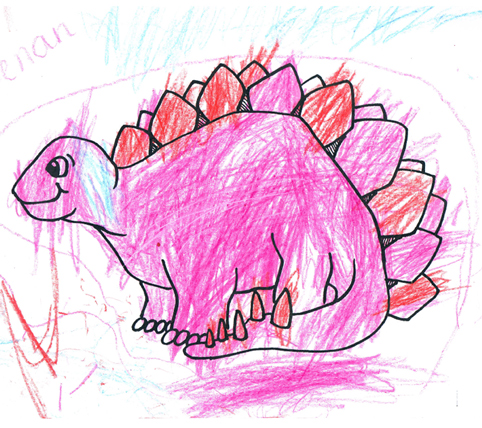
A bright red Stegosaurus on the prowl.

Picture credit: Everything Dinosaur/Higher Openshaw

The picture above shows a bright red Stegosaurus as drawn by one of the pupils with a Pterosaur (Rhamphorhynchus) flying overhead.  The colouration on the Stegosaur is particularly apt as palaeontologists believe that this plant-eating dinosaur could flush their plates with blood, making them turn bright red.  Scientist Ken Carpenter proposed that with such a rich blood supply to the dermal plates, they could have been flushed with blood at will making a colourful and impressive display.

Openshaw’s Young Dinosaur Illustrators

A very colourful Jurassic scene.

Picture credit: Everything Dinosaur/Higher Openshaw

They are certainly very colourful scenes and we enjoyed working with the school children and helping them to study dinosaurs.

An Allosaurus Hiding in the Ferns

A hiding Allosaurus.

Picture credit: Everything Dinosaur/Higher Openshaw

For dinosaur themed educational materials, toys and games: Learning Materials – Dinosaur Toys and Games.

Go to Top