All about dinosaurs, fossils and prehistoric animals by Everything Dinosaur team members.

Fossil finds, new dinosaur discoveries, news and views from the world of palaeontology and other Earth sciences.

23 10, 2015

New 2016 Prehistoric Animal Models from Safari Ltd

By |2023-04-07T14:53:07+01:00October 23rd, 2015|Categories: Dinosaur and Prehistoric Animal News Stories, Dinosaur Fans, Educational Activities, Everything Dinosaur News and Updates, Everything Dinosaur Products, Main Page, Press Releases|0 Comments

New Prehistoric Animal Models (Safari Ltd) 2016

With the news that Safari Ltd had ended its twenty-eight year partnership with the Carnegie Museum of Natural History, which broke in the spring, model collectors and dinosaur fans alike have been eagerly awaiting developments.  What prehistoric animal models would come out in 2016?  Everything Dinosaur can now reveal that information, the wait is over and enthusiasts of all things Dinosauria et al are not going to be disappointed.

Here are the new prehistoric animals:

  • Plesiosuchus
  • Iguanodon
  • Masiakasaurus
  • Shunosaurus
  • Carcharodontosaurus
  • Plus re-issues of previous Safari Ltd models, the baby Woolly Mammoth, the Megatherium (giant ground sloth), Amebelodon and the glyptodont Doedicurus.

Everything Dinosaur intends to stock all these items, we will do all we can to keep our customers and fellow prehistoric animal fans informed about deliveries into our warehouse.

Wild Safari Prehistoric World

There are a total of five new replicas, this is the same total as last year, the 1:10 scale Carnegie Collectibles Velociraptor, plus four not to scale models under the Wild Safari brand that has now become the flagship brand for prehistoric animal replicas the Florida-based company makes.

Let’s take a look at the new models in turn, firstly the Plesiosuchus model (marine crocodile).  This Late Jurassic carnivore was one of the super predators of the shallow seas that covered much of Europe.  It is estimated to have been around seven metres in length, approximately the size of the largest Saltwater crocodiles (Crocodylus porosus) found today.  Plesiosuchus means “near crocodile” and is pronounced Plee-see-oh-sook-us.  It was a member of the Metriorhynchoidea (pronounced Met-ri-oh-rink-oi-deer [A super family of the Crocodylomorpha]).  It is great to see a model of a metriorhynchid from Safari Ltd.

New for 2016 the Wild Safari Dinos Plesiosuchus
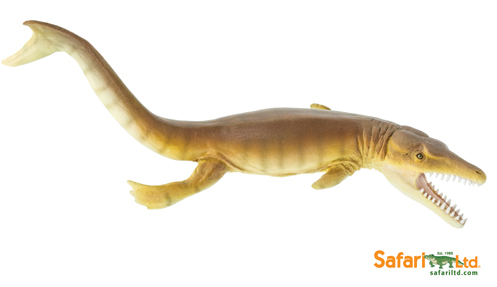
Available soon from Everything Dinosaur.

Available from Everything Dinosaur.

Picture credit: Safari Ltd/Everything Dinosaur

The Plesiosuchus replica measures a fraction over seventeen centimetres and is around four and half centimetres tall (it’s the tail).

Now the Iguanodon model comes into focus.  It is great to see another ornithopod in the Safari Ltd Prehistoric Life model collection.

New for 2016 the Wild Safari Dinos Iguanodon
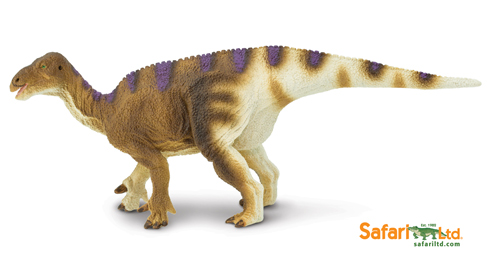
Some very striking colours on this new replica.

Some very striking colours on this new replica.

Picture credit: Safari Ltd/Everything Dinosaur

Several Iguanodontid Models Made

Over the years, there have been a number of iguanodont models made, with the retirement of the Carnegie Collectibles Iguanodon replica, it is great to see this introduction.  Iguanodon is brought bang up to date, the bipedal pose of the earlier model, launched in 2007 and effectively a re-paint of an even earlier Carnegie replica, has been replaced by a walking on all four limbs approach.  The body proportions seem much more accurate and we love the thickened base of the tail.

These ornithopods were powerful animals and indeed the base of the tail and pelvis were very robust.  The model has been given a striped colour scheme and we adore the flashes of purple, not a colour associated very often with dinosaur models.  It is a nice touch.  The model measures 18.5 cm by 7 cm.

New for 2016 – Shunosaurus
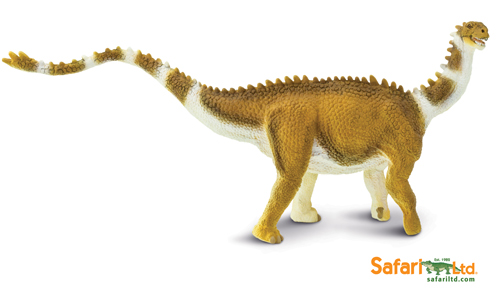
Available soon from Everything Dinosaur - Shunosaurus.

Available soon from Everything Dinosaur – Shunosaurus.

Picture credit: Safari Ltd/Everything Dinosaur

“Sauropod Crossed with a Llama”

The “sauropod crossed with a Llama”, as an Everything Dinosaur member of staff termed this replica when trying to decipher the double page advert that showed a glimpse of this figure, turns out to be a Shunosaurus.  The colourful figure measures 16.5 cm in length and that detailed head stands around 7 cm high.  One of the best known of all the Chinese Dinosauria, certainly the best known sauropod, thanks to the huge fossil assemblage excavated from the Dashanpu Quarry site (Sichuan Province).  This looks like an excellent interpretation of the extensive fossil material.  Well done Safari Ltd for bringing out such an interesting replica.

“Vicious Lizard” – Masiakasaurus
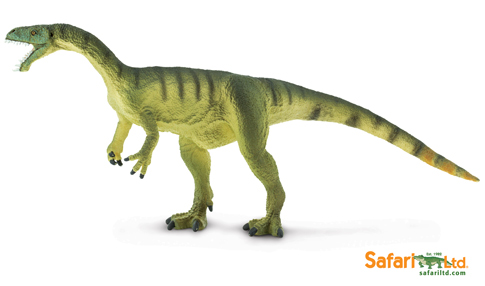
Available from Everything Dinosaur.

Available from Everything Dinosaur.

Picture credit: Safari Ltd/Everything Dinosaur

Masiakasaurus

A new fact sheet will be required for the fourth new prehistoric animal figure we are featuring here – Masiakasaurus, (the name means vicious lizard).  An agile theropod that lived on the island of Madagascar in the Late Cretaceous.  The forward pointing teeth have been very well depicted in this new for 2016 replica.  We suspect that this is the first dinosaur model made by Safari Ltd, whose scientific name was inspired by a band member of Dire Straits.

The formal, binomial name for this two metre long terror is Masiakasaurus knopfleri.  It was the music of Dire Straits’s front man Mark Knopfler that inspired the field team behind this particular dinosaur fossil discovery.

To read about the discovery and naming of another theropod dinosaur from Madagascar: New Dinosaur Discovery from Madagascar.

The design team at Safari Ltd have taken into careful consideration details of this dinosaur’s known skeleton (about two-thirds of all the bones in the skeleton have been described to date).  Note the position of the hands and digits, although an abelisaurid, Masiakasaurus had proportionately much longer front limbs than other members of this theropod dinosaur family.

An Attractively Painted Model

It is an attractively painted model, the stripes and green markings are a good choice, it is likely that this dinosaur, required camouflage to help it avoid being spotted by larger meat-eaters that shared its floodplain environment.

The new Safari Ltd Masiakasaurus is around 18.5 cm in length and stands an impressive 8.25 cm tall.

New for 2016 – Carcharodontosaurus
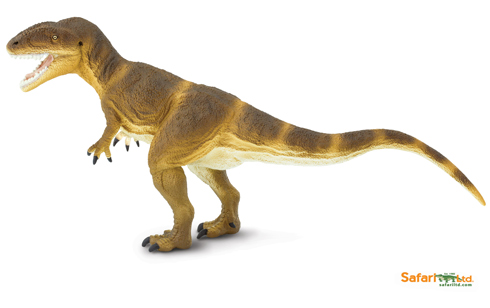
Say hello to "shark-toothed lizard".

Say hello to “shark-toothed lizard”.

Picture credit: Safari Ltd/Everything Dinosaur

Carcharodontosaurus

One of the largest theropods known, Carcharodontosaurus is a firm favourite amongst dinosaur fans and model collectors alike.  It is great to see this interpretation by Safari Ltd.  We had thought that the large, meat-eating dinosaur was going to be a megalosaur, we got wrong but we are delighted to see this North African monster join the Safari Ltd “Prehistoric Life” fold.  At an impressive 22.75 cm long and standing 10.25 cm tall this is the biggest model dinosaur that Safari Ltd are bringing out next year.

To view Everything Dinosaur’s existing range of prehistoric animals from Safari Ltd: Wild Safari Prehistoric World Models.

Look out for announcements on Everything Dinosaur’s Facebook page, Twitter feed and on this blog site.  More information including when they will be in stock will be posted up soon.
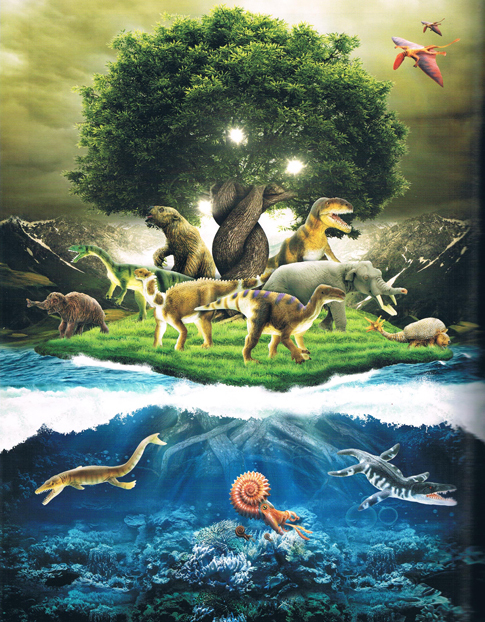
Prehistoric Animal Models.

As seen in Prehistoric Times magazine, the Wild Safari Prehistoric World advert featuring some of the new prehistoric animal models.

Check out Everything Dinosaur’s Facebook page for pics of the prehistoric mammal models that are being re-introduced by Safari Ltd.

Find Everything Dinosaur on Facebook: Everything Dinosaur on Facebook.
16 10, 2015

Las Hoyas Provides Scientists with a “Furry Friend”

By |2023-04-07T12:19:41+01:00October 16th, 2015|Categories: Dinosaur and Prehistoric Animal News Stories, Dinosaur Fans, Main Page|0 Comments

Cute Ancient Mammal Lived in Tough Cretaceous Times

A superbly preserved fossil of an early type of mammal found in sediments that date from 125 million years ago (Early Cretaceous), demonstrates that mammals had effectively evolved the same type of fur seen in extant mammals today.  Many of these mammals may have been very small.  Their fur provided them with a defence against attack from dinosaurs and other predators.  However, not everything was rosy in the Cretaceous garden for this little furry critter, in between dodging hungry dinosaurs and crocodiles it seems that it suffered from a fungal disease that attacked the hairs that made up its coat.

Mesozoic Mammals

The fossil was excavated from the limestone lake bed sediments at Las Hoyas in the Iberian mountains of Cuenca Province (central Spain).  It was discovered back in 2012, when a field team under the direction of Angela Buscalioni (a palaeontologist at the University of Madrid), was exploring the finely grained sediments in a bid to find more specimens of early birds, fossils of which, have made the Las Hoyas site one of the most important Lagerstätten sites in the world for vertebrate fossils dating from the Barremian faunal stage of the Cretaceous.  The almost intact fossil was brought to the University of Bonn.  A paper detailing the discovery has just been published in the journal “Nature”.

Fossils from Las Hoyas

The animal which was around 22 cm long, has been identified as a member of the Eutriconodonta, a diverse Order of primitive mammals which probably evolved in the Jurassic.  The phylogenetic relationship between eutriconodonts and modern mammals remains unclear, but many academics argue that these animals are closely to today’s mammals (monotremes, placentals and marsupials) than the Multituberculata.  Everything Dinosaur, earlier this month reported on the discovery of a multituberculate mammal from New Mexico, an animal that lived just a few hundred thousand years after the extinction of the non-avian dinosaurs.

To read about this Cenozoic multituberculate: Mammals Quick off the Mark after Dinosaur Extinction.

Spinolestes xenarthrosus

This new species has been named Spinolestes xenarthrosus.  The name roughly translates as “spiny, strange jointed one”.  It is derived from the spiny, defensive hairs found on the back, whilst the species name refers to the strengthened joints of the vertebrae.  A similar anatomical feature is seen in extant members of the Xenarthra such as anteaters, armadillos and sloths.  It is also observed in a small shrew from the Congo Basin.

The Prepared Fossil Specimen (Spinolestes xenarthrosus)

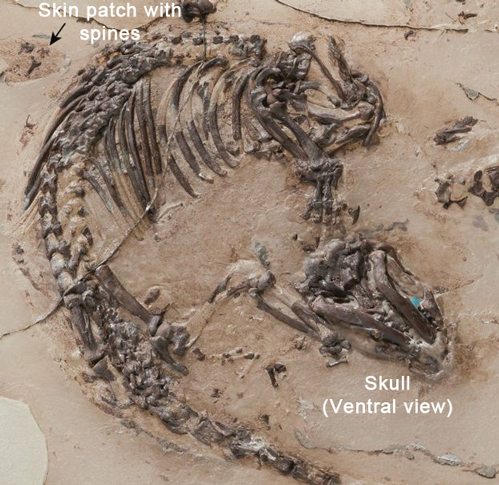
The prepared holotype specimen - S. x

The prepared holotype specimen – S. xenarthrosus.

Picture credit: Georg Oleschinski with additional annotation by Everything Dinosaur

The picture above shows the prepared holotype specimen that has been set in resin.  The skull, seen towards the right of the photograph is viewed from below.  An arrow (top right) points to a patch of preserved skin that shows dermal hairs which acted as defensive spines.

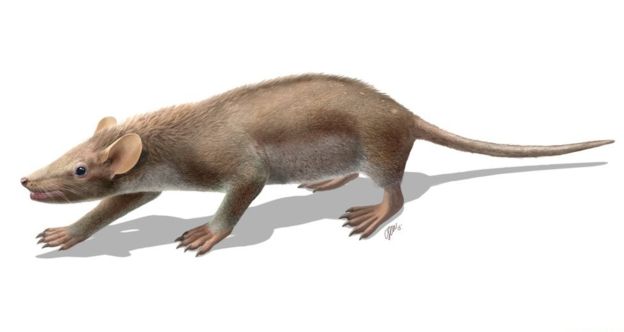
An Illustration of Spinolestes xenarthrosus

Described as "cute" by scientists.

Described as “cute” by scientists.

Picture credit: Oscar Sanisidro

Defensive Spines

As well as the defensive spines which probably broke off if a predator bit the back of this fast running mammal, letting Spinolestes escape but leaving the attacker with a mouthful of spines for their trouble, the rump of Spinolestes was partially covered in horny scutes.  Commenting on these points, lead author Professor Thomas Martin (Steinmann Institute of Geology, Mineralogy and Palaeontology of the University of Bonn), stated:

“We are familiar with these characteristics in modern spiny mice from Africa and Asia Minor.  If a predator grabs them by the back, the spines detach from the skin.  The mouse can escape and the attacker is left with nothing more than a mouthful of spines. It is possible that these structures served a similar purpose in the case of Spinolestes.”

Best Preserved Mesozoic Mammal (Spinolestes xenarthrosus)

The fossil may well represent the best preserved mammal known from the Mesozoic and although described as mouse-like in some media reports, Spinolestes was only distantly related to modern mice (rodents).

Professor Martin explained:

“We are not able to classify the finding in any of the groups of mammals alive today.  It displays characteristics which we also find in today’s mammals.  However, these are not signs of relatedness but rather they developed independently – throughout the course of evolution, they have been ‘invented’ many times.”

This is an example of convergent evolution.

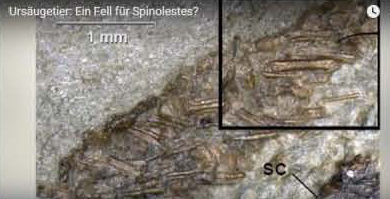
A Magnified Area of the Fossil Showing Guard Hairs (Proto Spines)

SC = area showing dermal scutes on the skin.

SC = area showing dermal scutes on the skin.

Picture credit: University of Bonn

It is likely that Spinolestes had a similar lifestyle to that of a mouse or a rat, scurrying through the undergrowth and using its keen senses to keep out of trouble.  It may also have been nocturnal.  The Las Hoyas deposits may lack dinosaurs (only a handful of different dinosaurs are known from the site), but there were plenty of other predators around capable of making a meal out of this particular eutriconodont.

A Strong Back

Convergent evolution also accounts for the anatomical features seen in the vertebrae.  Individual bones in the back have supporting appendages that interlock the vertebrae together.  The back is incredibly strong, much stronger than the backs of other similar sized animals.  This feature is also found in the Hero Shrew (Scutisorex somereni) which comes from Central Africa.  The Hero Shrew uses its strong back to help force itself under logs as it looks for insects to eat.  It could be speculated that Spinolestes evolved a strong back for a similar purpose.

Signs of a Fungal Disease on the Fur

Such is the exquisite preservation of the fossil, that individual hairs of the fur can be studied.  The state of some of the tiny fossilised hairs suggests that this animal was suffering from a fungal disease of the fur.  This suggests that early mammals may have suffered from similar diseases as their modern counterparts.  This fossil may help scientists to assess the taxonomic position of the Eutriconodonta in relation to extant mammals.

For models and replicas of prehistoric animals and other Mesozoic creatures: Mojo Fun Prehistoric and Extinct Models.

Summarising the team’s research, Professor Martin stated:

“One hundred twenty-five million years ago, Spinolestes was very well adapted to its ecological niche – through horny scutes and spines on its back as well as through its reinforced spine.  We have to revise our thinking, mammals were indeed very small during the time of the dinosaurs.  But they were certainly not primitive.”

To read an article on a carnivorous dinosaur, whose fossils have been found at Las Hoyas: One Lump or Two for a Dinosaur.

13 10, 2015

Remarkable Eggshells Tell Scientists About Dinosaur Body Temperatures

By |2024-05-05T18:09:54+01:00October 13th, 2015|Categories: Dinosaur and Prehistoric Animal News Stories, Dinosaur Fans, Main Page, Palaeontological articles|0 Comments

Endotherms or Ectotherms the Debate Gets “Egg-citing”

The debate as to whether dinosaurs were warm-blooded (endothermic) like mammals and birds or cold-blooded (ectotherms) like crocodiles and lizards, has taken a further twist with the publication of a study published in the journal “Nature Communications”.

Chemically Analysing Eggshells To Calculate Dinosaur Body Temperatures

Scientists have used a new method to chemically analyse dinosaur eggshells which has helped them gauge the long extinct animal’s body temperature.  Armed with this data and an estimate of the temperature of the surrounding environment, the researchers can postulate about whether dinosaurs had high metabolic rates and active life-styles or whether like alligators and lizards they tended to be only capable of short bursts of activity.

The team’s findings suggest that dinosaurs were neither true endotherms or completely ectothermic, but somewhere in between – mesotherms.  In addition, as two different types of dinosaur produced different results, this new study indicates that body temperature differed between dinosaur genera.

Research Suggests that Oviraptorid Dinosaurs were Mesothermic

"Conch Thief" feeding by the lake shore.

Not warm-blooded or cold-blooded but somewhere in between.

Dinosaurs Probably Mesotherms

The conclusions drawn by the scientists are similar to those made by a team of American researchers who reported in 2014.  Following an extensive analysis of the histology and ontogeny of fossilised bones (analysis of bone cells and growth) these scientists concluded that dinosaurs were probably mesotherms.

To read more about the 2014 research: Goldilocks and Dinosaurs the warm-blooded/cold-blooded Debate.

Why all the Fuss?

The argument as to whether the Dinosauria were endothermic or ectothermic has raged for over 150 years.  It was once thought that dinosaurs were slow-moving, sluggish, very lizard-like creatures.  They had to bask in the sun or rely on other external sources of heat to help warm their bodies before they could become active.   This meant that they were probably not very active at night, it also suggested that they had similar life-styles to extant reptiles such as crocodiles, snakes and lizards.  These creatures can be very mobile, but only for short periods and they soon become tired.

Thomas Henry Huxley (1825-1895), was one of the first scientists to challenge this view.  He argued that birds and dinosaurs were closely related.  In the 1960s there was a revolution in thinking with regards to dinosaurs.  John Ostrom’s work on the theropod dinosaur Deinonychus led to dinosaurs being depicted as much more agile, fast-moving animals.  Ostrom produced carefully argued and extremely detailed studies on dinosaur biology and anatomy and he depicted them as much more bird-like creatures capable of complex behaviour – more reminiscent of today’s mammals than like today’s reptiles.

Dynamic Dinosaurs – Active and Agile Animals

Robert Bakker (student of John Ostrom) championed the agile, active dinosaur theory.

Robert Bakker (student of John Ostrom) championed the agile, active dinosaur theory.

Robert Bakker, a student under the tutelage of Ostrom developed these ideas further and portrayed dinosaurs as warm-blooded creatures, it was Bakker who produced the famous illustration of Deinonychus shown above and it was Bakker who influenced a lot of thinking regarding the Dinosauria with his ground-breaking book “The Dinosaur Heresies”, which was published in 1986.

A Study of Rare Isotopes

The research team utilised a pioneering procedure which allows the internal temperature of female dinosaurs to be plotted by analysing the behaviour of two rare isotopes found in calcium carbonate, a key ingredient in eggshells.  A total of nineteen dinosaur eggs were included in the study, they represent two very different types of dinosaur.  Eggshells from Argentina came from a large titanosaur (Sauropoda), the eggshells collected in the Gobi desert, Mongolia, represent fossils from a small theropod dinosaur, an oviraptorid.

The isotopes oxygen-18 and carbon-13 tend to cluster together at colder temperatures.  The amount of clumping enabled the scientists to calculate the body temperature of the mother.  Chemical analysis of the surrounding rock matrix permitted the researchers to estimate the temperature of the palaeoenvironment at around the time the eggs were laid.

Dinosaur Body Temperatures

The analysis of these eggshells, all of which were collected from Upper Cretaceous strata, suggest that the titanosaur’s body temperature had been around 38 degrees Celsius at the time of laying.  This is a little higher than our own internal body temperature (37 degrees Celsius).  The implication is that the Titanosaur had an internal body temperature similar to that of a endotherm, although it has to be considered that the huge gut of this giant herbivore, essentially an enormous, heat-producing digestive vat would probably have influenced the internal temperature.

The sheer size of the animal, volume compared to surface area, would have probably helped it to maintain a relatively constant body temperature.  Thermo-regulation for such large animals is not so much as trying to keep warm, heat loss from a large body is much less severe than with a small animal, for example.  In the case of the titanosaurs, once they warmed up they probably stayed warm for a very long time, keeping cool could have been more of a problem (that’s why African elephants have big ears).

For dinosaur models and prehistoric animal figures: Dinosaur Models and Prehistoric Animal Figures.

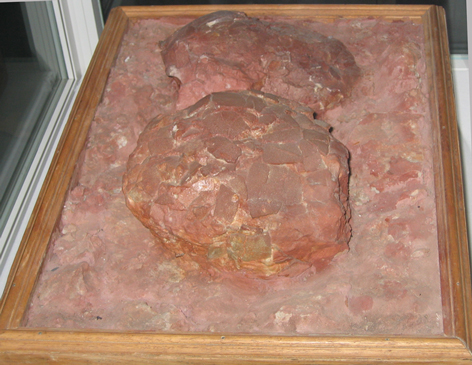
Typical Titanosaur Eggs

An example of Titanosaur fossil eggs.

An example of titanosaur fossil eggs (Hypselosaurus).

Picture credit: Everything Dinosaur

Studying Oviraptorids

The results from the much smaller oviraptorid paint a different picture.  These dinosaurs were very closely related to birds, but the body temperature plotted is much lower than an endotherm.  The scientists calculated that the theropod had an internal temperature of around 32 degrees Celsius, but this was at least six degrees warmer than the environment.  This suggests that oviraptorids, dinosaurs that were closely related to birds were able to raise their body temperatures above that of their surroundings.

Commenting on these results, lead author Robert Eagle (University of California Los Angeles) stated:

“The temperatures we measured suggest that at least some dinosaurs were not fully endotherms [warm-blooded] like modern birds.  They may have been intermediate, somewhere between modern alligators and crocodiles and modern birds”.

This study supports the idea that dinosaurs could produce heat internally and raise their body temperature higher than their surrounding environment, but they were unable to maintain this temperature at a consistent level like a mammal or a bird (endotherms).  The scientists conclude that if the dinosaurs were mesothermic, they were probably more active than alligators but not as active as birds or mammals.

No Strong Evidence for Either Ectothermy or Endothermy

The international research team state that they could not observe any strong evidence either for ectothermy or endothermy in the species examined.  The body temperatures calculated for the titanosaur and the oviraptorid indicate that variable thermoregulation likely existed among non-avian dinosaurs and that not all dinosaurs had body temperatures in the range of that seen in extant birds.

Link to an article published in June 2015, that postulates that the Dinosauria were endothermic: Dinosaurs were Warm-blooded Debate Hots Up.

12 10, 2015

Rare Fossil Claw Hints at Minnesota’s Cretaceous Past

By |2024-05-05T17:09:08+01:00October 12th, 2015|Categories: Dinosaur and Prehistoric Animal News Stories, Dinosaur Fans, Main Page|0 Comments

Meat-Eating Dinosaurs Once Roamed Minnesota

The American State of Minnesota might border North and South Dakota but despite the treasure trove of dinosaur fossils from the Peace Garden State (North Dakota) and the Mount Rushmore State (South Dakota), the Land of a Thousand Lakes (Minnesota) has yielded only a couple of dinosaur fossil finds to date.

Theropod Dinosaur Claw Bone

However, that may be about to change as researchers from the Science Museum of Minnesota, based in Saint Paul, have announced the discovery of a theropod dinosaur’s claw bone.  This is only the third documented dinosaur fossil discovery from Minnesota.

Minnesota Dinosaur Claw

Cretaceous Theropod Claw from Minnesota.

Cretaceous theropod Claw from Minnesota.

Picture credit: Mark Ryan, Science Museum of Minnesota

Fossil Claw

The lack of dinosaur fossils, or indeed Mesozoic fossils in general can be explained by the fact that the rocks that may have held such fossils have been eroded away.  Extensive glaciation in the north, central parts of the United States removed much of this material and indeed it is the action of glaciers that led to the unique geology and landscape of much of this part of America.  In addition, for much of the Mesozoic, this part of America was underwater.

The fossil claw that measures approximately four and half centimetres in length when measured with the curvature of the claw taken into account, was found at the Hill Annex Mine, part of the extensive iron ore rich Mesabi Iron Range in north-eastern Minnesota.

Minnesota’s Cretaceous Past

Although it is difficult to assign a dinosaur family to this fossil, palaeontologists from the Science Museum of Minnesota have suggested that it is the claw from a theropod dinosaur and that it dates from the Late Cretaceous, around 90 million years ago (Cenomanian/Turonian faunal stages).  Informed sources have stated that this is only the third documented dinosaur fossil found from this State.  Although many famous dinosaurs are known from the United States, the fossils of these long, extinct creatures are not spread uniformly across America.  In fact, more than a dozen States in the Union have no record of dinosaur fossils whatsoever.

With the discovery of a partial femur (thigh bone) from a theropod dinosaur last year, Washington State become the 37th U. S. State to have fossils of the Dinosauria recorded within its boundaries.  This prompted Everything Dinosaur team members to produce a map identifying which States in America had dinosaur fossils and which did not.

To read more about which States have dinosaurs: Washington State the 37th U.S. State with a Dinosaur.

Unable to Identify the Genus

Researcher at the Science Museum of Minnesota, John Westgaard explained that it was not possible to identify a dinosaur genus, but when questioned further he suggested that the fossil claw could have belonged to a Velociraptor-like dinosaur.

A spokesperson from Everything Dinosaur stated that it was not possible to be more specific about the fossil specimen but as the claw has been dated to around 90 million years ago, this was a significant discovery as little is known about the fauna of North America from this part of the Cretaceous.

To read about the discovery of the dinosaur thigh bone from Washington State: Washington State’s First Dinosaur.

Highlighting Minnesota’s Cretaceous Past

The other Minnesota dinosaur fossil finds are equally fragmentary and also date from the Late Cretaceous.  An unknown genus of duck-billed dinosaur is known from a few bones and teeth.

Everything Dinosaur stocks a range of replica dinosaur claws and dinosaur teeth: Dinosaur Claws and Dinosaur Teeth.

10 10, 2015

Unborn Foal Identified from Remarkable Ancient Horse Fossil

By |2024-05-05T18:11:25+01:00October 10th, 2015|Categories: Dinosaur and Prehistoric Animal News Stories, Main Page, Photos/Pictures of Fossils|0 Comments

Eurohippus messelensis – Fossil Reveals Ancient Foetus

The fossilised remains of an ancient, prehistoric horse that once roamed southern Germany has revealed the presence of an unborn foal.  Scanning electron microscopy of the beautifully preserved fossil has revealed the bones of a foetus, this is the oldest fossilised equine foetus discovered to date and reveals that the horse reproductive system was already highly developed by the early Middle Eocene.

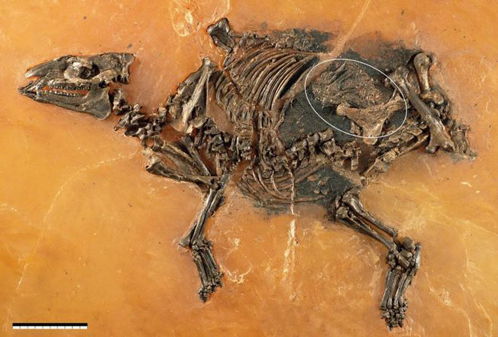
Ancient Horse – Eurohippus messelensis

Ancient Horse Fossil Reveals Unborn Foal

Eurohippus foetus fossil from the Messel Shale.

Eurohippus foetus fossil from the Messel Shale.

Picture credit: Senckenberg Research Institute

The position of the foetus in the mare is marked by the white ellipse in the picture above.  Scale bar equals 10 centimetres.  The fossil has been set in resin, this is a standard procedure to help preserve the fossils from the Messel oil shales.

An Ancient Horse

Details of the research, conducted by scientists from the Senckenberg Research Institute (Frankfurt) and the University of Veterinary Medicine (Vienna), have been published in the academic journal PloS One.  The fossil, an early horse called Eurohippus messelensis, was excavated from the Messel Shales near Darmstadt (Germany) in 2000 but it was only after recent high resolution micro-X-ray studies in combination with the scanning electron microscopy that the 12.5 centimetre long foetus was found.

Most of the skeleton is intact (post cranial material) and elements of the placenta can be determined.  Based on a comparison with modern horses, the position of the foetus, which was near full term at the time of death, is almost identical to that seen in today’s mares which are at roughly the same stage of pregnancy.

Death of the Mare

The death of the potential mother-to-be and the unborn foal are not related to any potential complications that arose during parturition.  It seems that this little, ancestral horse that was just thirty centimetres high at the shoulder, ended up in a large, deep lake and was quickly buried in the oxygen depleted sediments at the bottom.  These sediments eventually became the oil shales which make this part of southern Germany so famous.

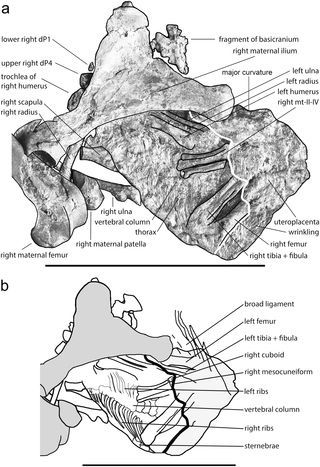
A Line Drawing of the Exposed Side of the Foetus

Scale bar 10 cm (A and B)

Scale bar 10 cm (A and B)

Picture credit: Senckenberg Research Institute, Jörg Habersetzer; line drawing (b) by  Jens Lorenz Franzen.

The picture above (a) shows the foetus position in relation to the bones of the adult and maps out the position of the placenta (line drawing b).

How did the Ancient Horse Die?

The oil shales of Messel contain a huge amount of fossils, both aquatic and terrestrial species, but how did this rich fossil assemblage come about?  This part of Germany was located ten degrees further south during the early Middle Eocene than it is today.  It is believed to have been a very geologically active area and infrequent releases of large concentrations of poisonous gases from the deep lakes in the area could have devastated the local ecosystem.

Deadly releases of carbon dioxide mixed with hydrogen sulphide would have quickly suffocated animals in the water and once these gases had reached land they would quickly overcome any animal in close proximity to the shore.  Corpses would have been washed into the lake by rains and eventually they would have drifted down to the bottom, where the lack of oxygen and bacteria would have facilitated their excellent preservation.  This theory also accounts for the number of bird and bat fossils found in these oil shale deposits.

Any animal flying over the lake and encountering the gas cloud would be affected and fall into the water.  Bat fossils are amongst the most numerous of all the terrestrial vertebrate fossils found at the Messel quarry site.

Such a scenario was depicted in the “Walking with Beasts” episode “New Dawn” made by the BBC.

Eurohippus (E. messelensis) is one of a number of early ungulates known from the Messel shales of Germany.

Everything Dinosaur stocks a range of prehistoric mammal models and replicas: Models of Prehistoric Mammals.

6 10, 2015

The Hands and Feet of Homo naledi Studied in Two New Papers

By |2024-05-05T18:11:57+01:00October 6th, 2015|Categories: Dinosaur and Prehistoric Animal News Stories, Main Page, Palaeontological articles|0 Comments

Two New Papers Published on Homo naledi

Two new papers on the latest hominin to be added to the human family tree have just been published in the academic journal “Nature Communications”.  Less than one month has passed since Everything Dinosaur blogged about the amazing fossil finds in the Rising Star Cavern, part of a cave system located in an area known as the Cradle of Human Kind close to Johannesburg.

A New Species of Hominin

Researchers from the Evolutionary Studies Institute (University of Witwatersrand), in association with National Geographic, the Department of Science and Technology and the National Research Foundation of South Africa announced the discovery of a new species of hominin – Homo naledi.

These papers focus on the anatomy of the hands and feet respectively, but why the fascination with the fingers and toes of this South African species?  The explanation is simple, the hands and feet can provide scientists with valuable information as to how human H. naledi may actually have been.

The Hand and Foot of Homo naledi

The hand and the foot of Homo naledi.

The hand and the foot of Homo naledi.

Picture credit: Peter Schmid and William Harcourt-Smith, Wits University

Good at Climbing but Also Adapted for Bipedal Walking

The papers reflect just how remarkable the discovery of Homo naledi was.  The first point to make is that palaeoanthropologists do have a lot of bones to study.  In total, some 1,550 numbered fossil elements have been retrieved from the difficult to access cave.

Taken together these two papers indicate that this human-like creature, was uniquely adapted to both an arboreal existence (tree climbing) and walking on the ground.  In addition, the structure of the bones in the hand suggest that these hominins were capable of intricate hand movements and precise manual manipulation.

The titles of the two papers, state precisely what they are about, full marks to the research team for their brevity.  No long-winded titles here, these papers do “exactly what it says on the tin.”

  1. The foot of Homo naledi
  2. The hand of Homo naledi

The research were conducted by a team of international scientists associated with the Evolutionary Studies Institute at the University of the Witwatersrand in South Africa, home of the Rising Star Expedition team that made the 2013-discovery at the Cradle of Human Kind.  According to the researchers, when considered together, these papers indicate a decoupling of upper and lower limb function in H. naledi, and provide an important insight into the skeletal form and function that may have characterised early members of the Homo genus.  An evolutionary tree that eventually led to our own species Homo sapiens.

The Foot of Homo naledi

Lead author, of the paper published on the pes (foot), William Harcourt-Smith and his colleagues describe the H. naledi foot based on 107 foot bones recovered from the floor of the Denaldi Chamber (Rising Star), including a well preserved adult right foot.  They show the H. naledi foot shares many features with a modern human foot, indicating it is well-adapted for standing and walking on two feet (bipedalism).

However, there are differences from the bones found in the foot of a Neanderthal, or our own feet for that matter.  For example, the authors note that the Homo naledi foot differs in having more curved toe bones (proximal phalanges) and the arch of the foot is not so pronounced.

The Hand of Homo naledi

Lead author, of the paper that describes the hand, Tracy Kivell (University of Kent) and her colleagues describe the hand of Homo naledi based on an assessment of approximately 150 hand bones from the cave.  One of the key finds was a nearly complete adult right hand (manus), it was missing one small bone in the wrist.

This is an exceptionally rare find in the human fossil record.  As the tiny toe and finger bones were found in a number of cases in almost perfect articulation, this rules out the possibility of water having run through the cave at some point after the bodies came to be at that location.  Running water would have scattered the bones but the scientists found this not to be the case.

Corpses Deliberately Placed in a Part of the Cave

It is likely that the bodies have remained undisturbed, this suggests that the corpses may have been deliberately placed in this part of the cave system.  For such a small-brained hominin to show care for the deceased is very unexpected and more research is required to date the fossils and to try to understand how the remains of at least fifteen individuals came to be in the cavern.

The Delicate Finger Bones Preserved in Articulation in the Cavern

The hand of Homo naledi

The hand of Homo naledi.

Picture credit: Marina Elliott

A Unique Combination of Anatomical Traits

The H. naledi hand reveals a unique combination of anatomy that has not been found in any other fossil human before.  The wrist bones and thumb show anatomical features that are shared with Neanderthals and humans and suggest powerful grasping and the ability to use stone tools.  The thumb is particularly robust, this is a trait only found in recent hominins.

However, the finger bones are more curved than most early fossil human species, such as Lucy’s species Australopithecus afarensis, suggesting that H. naledi still used their hands for climbing in the trees.  This mix of human-like features in combination with more primitive features demonstrates that the H. naledi hand was both specialised for complex tool-use activities, but still used for climbing locomotion.

Commenting on the significance of the Homo naledi hand, Dr Kivell stated:

“The tool-using features of the H. naledi hand in combination with its small brain size has interesting implications for what cognitive requirements might be needed to make and use tools, and, depending on the age of these fossils, who might have made the stone tools that we find in South Africa.”

Age is the Key

More research will be carried out into this remarkable South African fossil discovery.  The key question is determining the age of the fossils.  Obtaining an accurate date for Homo naledi would help palaeoanthropologists place this species within the human lineage.  For example, this could be a tool-using, human-like creature that lived some three million years ago, or perhaps a more recent member of the hominin family, a human-like creature that retained some ancient Australopithecine traits that survived until much more recently.

This latter scenario is not that far-fetched, discoveries on the Indonesian island of Flores stunned the world of anthropology when it was revealed that a dwarf species of human (Homo floresiensis) had lived on the heavily forested island until, perhaps, as recently as 12,000 years ago.

Intricate Manipulation

The paper on the hand, opens up a debate amongst scientists.  The hand looks capable of intricate manipulation, indicating tool usage, but the brain of Homo naledi is estimated to have been not much bigger than a chimps.  If the hypothesis is correct, that the use of tools changed the shape of the bones in the hand, then the implication is that a small-brained hominin was making and using complex tools.  Comparing the hand anatomy to our own species and to that of the Neanderthal (H. neanderthalensis), Dr Kivell commented

“They [Neanderthals and humans] make tools, complex tools, and use them all the time, enough so that it’s actually changed their morphology.  Perhaps naledi was using tools that were made out of different materials or doing some other forceful, precision-grip manipulations, but the most straight-forward explanation is that naledi is making and using tools.”

Human-like Hands

This may be the most straight forward explanation but there may be other reasons why those hands are so human-like.  Analysis of the teeth will provide a detailed picture of the diet of these creatures.  If, as has already been proposed that they were largely vegetarian, then the hands could have evolved grasping and manipulation traits to help them search for seeds, to pluck fruits and to hold small items of food.  Clearly, the Rising Star fossils will provide scientists with a unique opportunity to learn more about hominin evolution.  Now, if we can only get an accurate date…

Safari Ltd created a hominin model set that includes replicas of significant species in the evolution of Homo sapiens: Wild Safari Models and Figures.

To read about the cave discovery: Homo naledi A New Species of Hominin from South Africa.

Everything Dinosaur acknowledges the help and assistance of the media team at the University of Witwatersrand in the compilation of this article.

5 10, 2015

Mammals Quick off the Mark after Dinosaur Extinction

By |2023-04-06T07:50:04+01:00October 5th, 2015|Categories: Dinosaur and Prehistoric Animal News Stories, Dinosaur Fans, Main Page|0 Comments

Kimbetopsalis simmonsae – Shedding Light on Ancient Mammals after the Dinosaur Extinction

A newly described species of ancient mammal, one that existed around half a million years or so after the Cretaceous mass extinction event that saw the demise of the dinosaurs – the dinosaur extinction, is helping scientists to understand more about how the Mammalia Order radiated and diversified.  The discovery from New Mexico (Nacimiento Formation), has been named Kimbetopsalis simmonsae, it seems that mammals were quick to take advantage of the vacuum left in terrestrial habitats by the dinosaurs.

Kimbetopsalis simmonsae

An Illustration of What Kimbetopsalis simmonsae Might Have Looked Like

An illustration of Kimbetopsalis simmonsae.

An illustration of Kimbetopsalis simmonsae.

Picture credit: Sarah Shelley

A Lucky Find for a Student

The fossils, which consist of the back of the jaws, part of the brain case and incisors from the front of the mouth were found during an exhibition to the San Juan Basin of New Mexico last year.  Remarkably, the first evidence, the back of the jaws was found by University of Nebraska-Lincoln student Carissa Raymond, this was her first fossil hunting field trip.

The field team consisted of two other students, recruited by University of Nebraska-Lincoln palaeontologist Ross Secord and Steve Brusatte (University of Edinburgh).  Thomas Williamson, curator of palaeontology at the New Mexico Museum of Natural History and Science, based in Albuquerque and a specialist in Late Cretaceous/Early Palaeocene fauna was also part of the group.

The paper describing this new species of prehistoric animal has just been published in the journal of the Linnean Society.  K. simmonsae was a member of the multituberculates, a group of mammals that first evolved in the Jurassic.  They thrived during the age of dinosaurs, but were mostly small and many described species are thought to have been nocturnal.  Although, building up a more complete picture is difficult as most genera are known from only a few isolated teeth.

Beaver-sized Mammal

This beaver-sized mammal represents a relatively large example of this sub-order of mammals, the animal was named after the Kimbeto Wash area of the New Mexico Badlands, where the fossils were found.

Dr Stephen Brusatte, lead researcher on the study, explained:

“We realised pretty quickly that this was a totally new type of mammal that no-one has seen before, the other part of the name – psalis, means “cutting shears” and is in reference to the blade-like teeth [incisors].”

The Fossils of Kimbetopsalis simmonsae Note the Peculiar Cusps on the Molars and Premolars

Remarkable fossil find from New Mexico - Kimbetopsalis simmonsae.

Remarkable fossil find from New Mexico – Kimbetopsalis simmonsae.

Picture credit: Dr. Steve Brusatte University of Edinburgh

The Multituberculata Mammals

The multituberculate mammals are generally regarded as the earliest plant-eating mammals to have existed.  The teeth of K. simmonsae are typical of this group, the long chisel-like front teeth and the back teeth, the chewing teeth, with their parallel rows of cusps.  It is these back teeth with their distinctive cusps arranged in either two or three rows that gives the Multituberculata group their name.  This discovery is the first new multituberculate to be found in the San Juan Basin in more than a century.

Members of the Field Team Pose for a Photograph

left to right

left to right Sarah Shelley, Eric Davidson, Carissa Raymond, Steve Brusatte and Ross Secord

Picture credit: Thomas Williamson/Reuters

Fossils of another multituberculate from the genus Taeniolabis are known from this area, however, the newly described Kimbetopsalis simmonsae come from a geologically much older stratigraphic layer. Taeniolabis species represent some of the largest Multituberculata so far described, with some specimens estimated to about as big as an Alsatian dog and one species Taeniolabis taoensis possibly exceeding 100 kilogrammes in weight, although they were probably entirely herbivorous.

It has been proposed that Kimbetopsalis simmonsae may have been an ancestor of the Taeniolabis genus, part of a trend towards larger and larger mammals as the Mammalia radiated out and new species evolved to take advantage of the extinction of the dinosaurs.  It seems that the mammals may have been quick off the mark to exploit the niches left after the dinosaur extinction.

Extinction of the Multituberculates

This type of mammal was soon destined to go the same way as the dinosaurs.  By the Late Eocene, these creatures were becoming increasingly rare and by the Early Oligocene Epoch (around 32-30 million years ago), the Multituberculata were extinct.  Why these mammals died out, remains an area of debate amongst palaeontologists.  This group left no living descendants and a number of reasons why they became extinct have been proposed, one of the more plausible and popular explanations is increased competition from placental mammals, particularly rodents.

Rodents are the most diverse and most specious of all the types of mammal living today.  Perhaps it was the evolution and rapid spread of the rodents that finally led to the demise of the Multituberculata, a group that had outlived the Dinosauria.

To read an earlier article that traces the origins of the Multituberculata: Tracing the Origins of the Multituberculates.

Dinosaur Extinction

Commenting on the significance of this fossil discovery, Dr Thomas Williamson said:

“Finding this new mammal was a pleasant surprise.  It helps fill an important gap in the record of this group of mammals.  It’s interesting that this odd, now extinct group, was among the few to survive the mass extinction and thrive in the aftermath.  It may be because they were among the few mammals that were already well-suited to eating plants when the extinction came.  This new species helps to show just how fast they were evolving to take advantage of conditions in the post-extinction world.”

Visit Everything Dinosaur’s website: Everything Dinosaur.

4 10, 2015

“Bent Fence Post” Turns out to be Woolly Mammoth Fossils

By |2023-04-06T07:48:26+01:00October 4th, 2015|Categories: Dinosaur and Prehistoric Animal News Stories, Main Page, Palaeontological articles|0 Comments

Farmer Finds Partial Woolly Mammoth Fossil in Field

Farmers in certain parts of the south-west of England can occasionally turn up pieces of ammonite fossil as they plough their fields, but a farmer from Michigan came up with an elephant-sized surprise when he and a neighbour were digging in their soya bean field.  They have unearthed the partial skeleton of a male Woolly Mammoth, one that is believed to be between 10,000 and 15,000 years old.

Woolly Mammoth

James Bristle a resident of Washtenaw County (west of Detroit), thought he had uncovered something a little more prosaic, when he excavated a “wood-like” object, he explained:

“We thought it was a bent fence post.  It was covered in mud.”

However, upon closer inspection the strange object, started to look more like bone.  It turned out to be a rib bone from the extinct elephant.  The grandson came over to take a look and he was speechless, quite a feat when you consider just how noisy most five-year olds are.  Mammoths and Mastodons roamed North America until the latter stages of the Pleistocene Epoch, this specimen may represent one of the last Woolly Mammoths to have lived in this part of this world.  Just a few thousand years, perhaps in this animal’s case, just a few hundred years later, all the prehistoric elephant species of North America had become extinct.

A Model of a Woolly Mammoth

Woolly Mammoth Model without the usual brown coat

Woolly Mammoth model, typical of this type of prehistoric elephant.

Picture credit: Everything Dinosaur

Confirmed by Palaeontologists

University of Michigan Professor Dan Fisher has been leading the excavation, to remove the animal’s remains before exposure to the air invites further decay of the bones and teeth.  The partial skeleton consists of the skull, pelvis, two, huge curved tusks, the shoulder blades and numerous vertebrae and rib fragments.  About thirty Woolly Mammoth fossilised skeletons have been reported from the State of Michigan.

Examination of the teeth indicates that the animal was adult and about forty years of age when it died.  Speculating on how the body came to be under a soya bean field, palaeontologists have explained that the surrounding matrix suggests a still body of water.  This animal could have been hunted by humans, butchered and then placed in a pond to help preserve the meat.  Placing a carcase in water to help preserve it, is believed to have been a relatively common practice amongst the human inhabitants of North America.  The water would perhaps have iced over quite soon after the kill and the cold water and ice would have kept the meat relatively fresh.

To view models of Woolly Mammoths and other prehistoric animals: Prehistoric Mammal Models and Replicas.

A spokesperson from Everything Dinosaur commented:

“Consider the site of this discovery as an early example of a freezer.  Storing resources for use at a future date, planning ahead, is one of the traits associated with our species.  This sizeable beast would have provided a huge amount of food to a group of nomadic hunters”

According to Professor Fisher, the soya bean field discovery represents one of the most complete Woolly Mammoth skeletons ever found in the State.  Once all the bones have been removed, they will be carefully examined and a detailed analysis undertaken.  The scientists will hope to find tell-tale marks in the bone to indicate human butchery.

The Professor stated:

“Study of the bones may shed light on when humans arrived in the Americas, a topic of debate amongst archaeologists.”

To read an article about the latest research into Mammoths: Woolly Mammoth Genome is Sequenced.

2 10, 2015

Mapping the Lives of a Population of Dinosaurs

By |2023-04-06T07:44:01+01:00October 2nd, 2015|Categories: Dinosaur and Prehistoric Animal News Stories, Dinosaur Fans, Main Page, Palaeontological articles|0 Comments

Maiasaura peeblesorum – The Maiasaura Life History Project

Years of excavation at the quarries identified as nesting sites for the hadrosaur known as Maiasaura (M. peeblesorum) has yielded an immense amount of data.  However, a team of scientists from Montana State University, Oklahoma State, and the Indiana Purdue University have taken the field research in a different direction and used an immense fossil deposit covering over two thousand square metres to report on the largest dinosaur population growth study ever undertaken.

Studying a Dinosaur

The team’s findings make quite sombre reading for any would-be duck-billed dinosaur (not that they could read, we know).  Mortality rates for animals under twelve months of age were nearly 90%, whilst if you got passed your eighth birthday, the odds were beginning to stack up against you for living much longer.  These dinosaurs lived in tough times.  The numbers might sound frightening but mortality rates in extant antelope and other herbivores on the African savannah, are in some cases very similar.  Predatory dinosaurs probably did not fare any better.

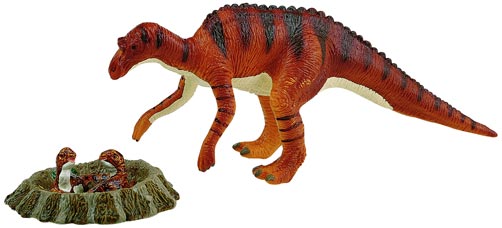
Maiasaura peeblesorum – Model by Safari Ltd

Model of "Good Mother Lizard"

Model of “Good Mother Lizard”.

Picture credit: Everything Dinosaur

The model (above), is from the Safari Ltd model range. To view this range: Dinosaur Models from Safari Ltd.

Maiasaura peeblesorum

Maiasaura was a large, flat-headed, duck-billed dinosaur that inhabited North America during the Late Cretaceous.  The first fossils of Maiasaura were found in the Badlands of western Montana in 1978, by a team of American scientists led by the famous palaeontologist Jack Horner.  These field teams discovered consisted of a number of nests, eggs, baby Maiasaura, juveniles as well as adult specimens.  The area was renamed “Egg Mountain”.  Approximately, 200 individual specimens have been excavated, providing evidence of the nesting behaviour of dinosaurs.

Altricial Behaviours

Published papers on these fossils were amongst the first to put forward the hypothesis that some types of baby dinosaurs were altricial, that is, heavily dependent on their parents for food and protection.  Here was evidence of dinosaurs being raised in nests.

This new research published this week in the journal “Paleobiology” provides the most detailed life history of any dinosaur and has created a framework to which all other dinosaurs can be compared.

New Research

Commenting on the significance of the research, Jack Horner, curator of the Museum of the Rockies and a man synonymous with all things Maiasaura stated:

“This is one of the most important pieces of palaeontology involving MSU [Montana State University] in the past twenty years.  This is a dramatic step forward from studying fossilised creatures as single individuals to understanding their life cycle.  We are moving away from the novelty of a single instance to looking at a population of dinosaurs in the same way we look at populations of animals today.”

The research was led by Holly Woodward Ballard, Assistant Professor of Anatomy at Oklahoma State University, who prior to her appointment to this post, undertook her PhD at Montana State University.  Holly specialises in studying osteohistology (growth patterns of animals preserved in bone tissue) to map population growth dynamics in extinct vertebrates.  This data can then be used to create a model for palaeohistologic inferences, examining how individuals vary within a population, growth rates and survival rates.

Analysing Bone Micro-structure

To complete the research, the team analysed the fossil bone micro-structure (histology) of fifty Maiasaura tibiae (lower leg bones).  The bone histology reveals aspects of growth that cannot be ascertained by observation of the external structure and shape of the bone.  The histology reveals information such as growth rate, metabolism, age of maturity, and the age at death.

Assistant Professor Woodward Ballard explained:

“Histology is the key to understanding the growth dynamics of extinct animals.  You can only learn so much from a bone by looking at its shape, but the entire growth history of the animal is recorded within the bone.”

To a statistician a sample of just fifty may not sound like much, but to a vertebrate palaeontologist where a species can be known from a single bone or even a single tooth the Maiasaura fossil assemblage from the Badlands of Montana represents an absolute treasure trove of dinosaur fossil material.

How Quickly These Dinosaurs Grew

The published paper provides an insight into how quickly Maiasaura babies grew up.  It had bird-level growth rates throughout most of its life, its bone tissue most closely resembles that of a modern warm-blooded (endothermic) mammal such as an elk.

The speed of growth might have something to do with the fact that the bigger you got the less chance of you ending up as a meat-eater’s lunch.  Everything Dinosaur has reported previously on a study into the histology of another hadrosaur, called Hypacrosaurus that showed that these herbivores grew faster than the carnivorous dinosaurs that co-existed with them.

To read more about this study: Duck-Billed Dinosaurs Grew Fast to Avoid Tyrannosaurs.

Bone Histology

The bone histology also recorded major events in the life of individuals such as the different ages when animals died.

Elizabeth Freedman Fowler, curator of palaeontology at the Great Plains Dinosaur Museum in Malta (Montana), conducted the statistical analysis of the research data, she commented:

“By studying the clues in the bone histology, and looking at patterns in the death assemblage, we found multiple pieces of evidence all supporting the same timing of sexual and skeletal maturity.”

With these dinosaurs, they probably were mature enough to breed within the third year of life and had an average adult body weight of 2,300 kilogrammes in eight years.  Life was tough for these herbivorous dinosaurs, especially the very young or the very old.  The average mortality rate for those less than twelve months of age was 89.9%, for individuals eight years and older it was 44.4%.  These figures sound alarming but most of the garden birds hatched this spring will not survive their first winter.

If a Maiasaura made it through two years, they enjoyed a six-year window of peak physical and reproductive fitness, when the average mortality rate was just 12.7%.

Maiasaura peeblesorum

Assistant Professor Woodward Ballard added:

“By looking within the bones and by synthesizing what previous studies revealed, we now know more about the lift history of Maiasaura than any other dinosaur and have the sample size to back up or conclusions.  Our study makes Maiasaura a model organism to which other dinosaur population biology studies will be compared.”

Study Shows Considerable Variation with an Extinct Animal Population

The research also highlighted the extent of individual size variation within an extinct population of animals.  Earlier studies had linked age to the size of dinosaur limb bones, this method may not be that accurate based on this new data.  Histology studies examining a subset of dinosaur bones (such as femora or tibiae) had been carried out before with an assumed age for an animal calculated on the length of these key bones.  The length of the bone may be misleading, it is only by exploring the micro-structure of the bone that age details can be revealed.

Holly outlined how their research challenged the findings of earlier studies:

“Our results suggest you can’t just measure the length of a dinosaur bone and assume it represents an animal of a certain age. Within our sample, there is a lot of variability in the length of the tibia in each age group.  It would be like trying to assign an age to a person based on their height because you know the height and age of someone else.  Histology is the only way to quantify age in dinosaurs.”

The Maiasaura Life History Project

The Maiasaura research does not end with the publication of this paper.  This is only one of a series of proposed study areas.  Assistant Professor Woodward Ballard intends to lead a number of annual summer excavations up into the Badlands of Montana to collect more specimens.  The scientists want to keep working on the extensive bonebeds and build up a much more complete picture of the daily lives and struggles of these dinosaurs.

Clearly excited about the opportunity the huge bonebed presents, Holly stated:

“Our study kicks off The Maiasaura Life History Project, which seeks to learn as much as possible about Maiasaura and its environment seventy-six million years ago by continuing to collect and histologically examine fossils from the bonebed, adding statistical strength to the sample.  We plan to examine other skeletal elements and make a histological “map” of Maiasaura, seeing if the different bones in its body grew at different rates, which would allow us to study more aspects of its biology and behaviour.  We also want to better understand the environment in which the Maiasaura lived, including the life histories of other animals in the ecosystem.”

Everything Dinosaur wishes all those involved in The Maiasaura Life History Project every success and we look forward to reporting on further research in the near future.

Visit Everything Dinosaur’s award-winning website: Everything Dinosaur.

1 10, 2015

Why Did Dinosaurs Have Small Eyes?

By |2023-04-06T08:10:11+01:00October 1st, 2015|Categories: Dinosaur and Prehistoric Animal News Stories, Dinosaur Fans, Main Page|0 Comments

Small-eyed Dinosaurs Let’s Keep Things in Proportion

Telephone calls and emails into the “dino den” otherwise known as the office at Everything Dinosaur last night, when the popular Radio 2 early evening show, Simon Mayo Drivetime, provided a prehistoric themed poser as part of a regular slot helping out with listener’s homework.  One of the two questions sent in involved the Dinosauria, why did dinosaurs have such small eyes?

Does Everything Dinosaur Have A View on Question B?

Any views on question two?

Any views on question two?

Picture credit: Simon May Drivetime Facebook

Small-eyed Dinosaurs?

In short, dinosaurs did not have small eyes, in fact, the eyes of some dinosaurs were quite large in proportion to the rest of their body and the word “proportion” is the key here, but more about that later.  You see, (no pun intended), it all depends on the type of dinosaur you look at.  Not all dinosaurs were the bus-sized, meat-eaters so popular with little boys and girls, as shown in the picture above.  That fearsome dinosaur looks like Carcharodontosaurus saharicus (Car-car-oh-dont-toe-sore-us, sa-har-ri-kus) as depicted in the BBC television series “Planet Dinosaur” which was first aired in the autumn of 2011.

The grey, long-necked dinosaurs in the background would have dwarfed even the largest carnivore.  They look like Paralititan stromeri, colossal animals that could have reached lengths in excess of thirty metres or more and perhaps weighed seventy tonnes.

Studying the Skull

Take a look at a skull of a much smaller dinosaur, a member of the Velociraptor family for example, and you will see that the orbit (the eye socket) is relatively large when the dimensions of the rest of the skull are taken into consideration.

Dromaeosauridae (Family) and Typical Dromaeosaurids such as the Velociraptorinae did not have Small Eyes

Getting into a Flap over Velociraptors

No small eyes here on a Velociraptor.

Dinosaurs such as Velociraptor are very closely related to modern birds.  Birds have very large eyes in proportion to their body size.  After all, if you are going to fly, having large eyes coupled with excellent eyesight makes a lot of sense.  Members of the bird Order (Aves), have the biggest eyes relative to their body mass amongst the vertebrates, some species have eyes so large that eye movement is limited within the orbit of the skull, when some birds want to have a good look around they have to turn their heads, the eyes cannot move independently in their sockets.

Turning Your Head to Have a Look Round

CollectA Feathered T. rex

Turning your head to look around.  Picture credit: Everything Dinosaur.

What About Those Really Big Dinosaurs?

This is all very well, some dinosaurs had proportionately big eyes, but what about those really big dinosaurs, animals like  Carcharodontosaurus and the monstrous  Paralititan mentioned earlier?  It’s that word again “proportion”.  In proportion to their bodies, large dinosaurs did have relatively small eyes, this phenomenon is observed in large mammals today, elephants, rhinos and the largest animals of all the cetaceans (whales and dolphins).

Really big animals tend to have eyes that look small. The actual diameter of the eye might be much bigger than our own, but since the skull is so big compared to ours, then the eye seems much smaller in comparison.

Newly hatched dinosaurs had big eyes in proportion to their body size.  As the animal grew so its body proportions changed and gradually the eye became much smaller when compared to the rest of the body.

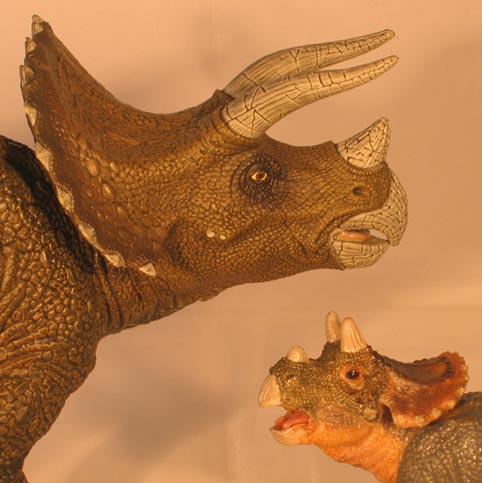
Baby Dinosaurs Had Bigger Eyes when Compared to the Adults

Papo Triceratops and baby Triceratops models - allometric growth. Small-eyed dinosaurs.

The baby Triceratops figure next to the adult Papo Triceratops.  Baby dinosaurs had proportionately bigger eyes than adult dinosaurs.

Picture credit: Everything Dinosaur

Perfectly Adapted to Their Environment

It’s worth remembering that despite a common public misunderstanding, dinosaurs were perfectly adapted to their environments and way of life.  As a clade, the Dinosauria has been around for some 800 times longer than our own species.  From what we know of the closest living relatives of the dinosaurs, the birds, these reptiles probably had excellent colour vision and in many cases their visual acuity, ability to see movement and their colour vision spectrum were much better than ours.

Think of it this way, studies of the internal structure of the skull of Tyrannosaurus rex indicate that this ferocious predator had a optic nerve about as thick as an adult man’s thumb.  That’s a lot of data going into that part of the brain dedicated to processing information from the eyes (occipital centre).

Tyrannosaurus rex

The orbits (eye sockets), in the skull of “Sue”, the largest mounted T. rex skeleton, measure nearly 10.5 cm across, this suggests that this dinosaur had eyeballs around 8 cm in size, that’s bigger than a tennis ball.  These eyes were held aloft some four metres in the air, an excellent viewing platform.  In addition, the position of the eyes in the skull gave this theropod a degree of binocular (stereoscopic vision), probably greater depth perception than ours.  Ideal if you are an ambush predator.

Forward Facing Eyes of an Apex Predator

A three-dimensional reconstruction of a T. rex skull.

A three-dimensional reconstruction of a T. rex skull.

“King of the Tyrant Lizards”

Research into the eyesight of Tyrannosaurus rex, published in 2006 by the University of Oregon concluded that big, Late Cretaceous meat-eaters like the “King of the Tyrant Lizards” may have had eyesight that was at least ten times* better than our own.  Vision may not have been the primary sense of T. rex, but those proportionately small eyes could have very probably spotted you before you had seen it and that’s quite a sobering thought.

Comparing the Orbits of Two Types of Tyrannosauroids

The orbit of a Tyrannosaurus rex is compared to the eye socket of a Raptorex

The orbit of a Tyrannosaurus rex is compared to the eye socket of a Raptorex kriegsteini.

Picture credit: Paul Sereno

Stevens, K.A. 2006 Binocular vision in theropod dinosaurs. Journal of Vertebrate Paleontology 26(2):321-330. *visual acuity up to thirteen times was stated in the paper.

For dinosaur themed toys, models and games: Visit Everything Dinosaur.

Go to Top