All about dinosaurs, fossils and prehistoric animals by Everything Dinosaur team members.

Fossil finds, new dinosaur discoveries, news and views from the world of palaeontology and other Earth sciences.

25 11, 2015

Iguanodon is Older Than You Think

By |2023-04-09T07:13:40+01:00November 25th, 2015|Categories: Dinosaur and Prehistoric Animal News Stories, Dinosaur Fans, Main Page|0 Comments

Public and Private Announcements Regarding Gideon Mantell’s Iguanodontid

Many young dinosaur fans, eager to demonstrate their in-depth knowledge when it comes to the Dinosauria are happy to assert that the Iguanodon was the second dinosaur to be formally named and described. Some of the more confident, young scientists point out that this was the first dinosaur to be named by Gideon Mantell.  Trouble is, when it comes to Britain’s relationship with the iguanodontids it is certainly an enduring relationship but a rather complicated one as well.

Iguanodon

The fossilised bones of this ornithopod feature prominently in regional museums, especially those in southern England.  This Early Cretaceous herbivore is probably the genus most associated with the British Isles and its Dinosauria.  Iguanodon is even depicted on the coat of arms of the town of Maidstone (Kent) and two years ago it was included in a set of stamps designed by British palaeoartist John Sibbick.  Everything Dinosaur team members were asked to help out Royal Mail by providing the text for the press releases concerning these special stamps.  Yes, we wrote lots and lots about Iguanodon.

Iguanodon Featured on a Set of Royal Mail Stamps (2013)
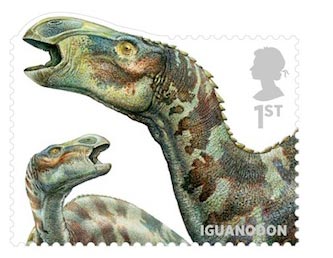
The Ornithopod Iguanodon on a stamp.

The ornithopod Iguanodon on a stamp.  Is this Britain’s iconic dinosaur?

Early Fossil Discoveries

However, as with much of the information that relates to early English fossil discoveries, nothing is as straight forward as it seems.  For example, the name Iguanodon or at least “Iguanadon” appeared in print prior to Mantell’s letter to the Royal Society which was read out at a meeting of The Society on February 10th 1825.  It had been thought that the first public announcement of Iguanodon had taken place on that date.

Freelance palaeontologist and Isle of Wight based dinosaur hunter Martin Simpson has unearthed a newspaper report from the Hampshire Telegraph published on the 20th December 1824 that describes this dinosaur, well, the name given is “Iguanadon”.  This means that this dinosaur’s announcement took place seven weeks earlier than previously thought.

The Hampshire Telegraph and Iguanodon

The Hampshire Telegraph report covers the matters arising at a meeting of the Portsmouth Philosophical Society that took place on December 17th.  It seems that Gideon Mantell has written to the Portsmouth Philosophical Society shortly after settling on the name Iguanodon “Iguana Tooth”.  So it seems that it was Portsmouth not London where the name Iguanodon was first officially heard.

Pompeysaurus

It seems likely that other fossils representing iguanodontids had come to the attention of academics, long before the fabled teeth find by Mary Ann Mantell (Gideon Mantell’s wife) around 1822.  Reports of bones found in the Tilgate Forest area, at the time attributed to reptiles such as crocodiles and alligators, date from at least ten years before.  Indeed, such is the volume of large ornithopod fossil bones from southern England that in the year 2000, a revision of the Iguanodon family took place.

Many of the species that had been erected were declared nomen dubium (dubious in the their validity), fossils were assigned to other genera.  Now the Iguanodon holotype material is actually fossil material associated with Belgium (Iguanodon bernissartensis) and strictly speaking, only two species are currently included in this genus (I. bernissartensis) and the recently described Iguanodon galvensis from Spain.

There have been many models and replicas of Iguanodon produced.  Most model manufacturers have at least one ornithopod in their model range.  PNSO for example, have produced a large Iguanodon model.

To view the PNSO range of prehistoric animal figures: PNSO Age of Dinosaurs Models.

Press Release

In a press release which provides details of an article to feature in the next edition of “Deposits Magazine”, Martin Simpson is quoted as saying:

“It would be nice if she [Mary Ann Mantell] eventually had a species named after her to celebrate her role in the discovery of Iguanodon, one of the world’s most important dinosaurs.  I’m really excited to have discovered this unknown snippet of information which adds to the history of British dinosaurs and which will really appeal to all the dinosaur aficionados out there.”

The Crystal Palace Iguanodon – Or Is It?
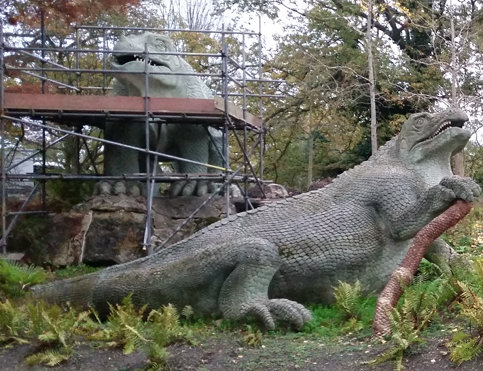
A pair of Iguanodons study the Crystal Palace landscape.

A pair of Iguanodons study the Crystal Palace landscape.

Picture credit: Everything Dinosaur

Everything Dinosaur acknowledges the help of a press release sent in by Jenny Hawthorn.

Perhaps the Natural History Museum Knew All About “Iguanadon” All Along

Spelling error on the box.

Spelling error on the box.

Picture credit: Everything Dinosaur

Everything Dinosaur stocks the Natural History Museum model range: Natural History Museum Dinosaur Models.

21 11, 2015

Beautiful Baby Dinosaur Returns Home

By |2024-05-05T14:53:52+01:00November 21st, 2015|Categories: Dinosaur and Prehistoric Animal News Stories, Dinosaur Fans, Main Page|0 Comments

Baby Oviraptorosaur May Be New Species of Giant Feathered Dinosaur

The fossilised remains of a baby dinosaur, identified as a member of the Oviraptorosauria clade have been returned to China, some twenty years or so after it was taken out of the country.  The baby dinosaur, a hatchling, may represent a new species of dinosaur, possibly a dinosaur that could have grown to about eight metres in length, around the size of Gigantoraptor (G. erlianensis) which is the largest species of this type of feathered dinosaur described to date.

Gigantoraptor

To read about the discovery of the 1,400 kilogramme Gigantoraptor: New Chinese Dinosaur Described – Gigantoraptor.

There is a large market for illegally obtained dinosaur fossils from China, many fossils found by local farmers such as dinosaur eggs and even baby dinosaurs, end up being carefully collected and smuggled out of the country to become part of a wealthy individual’s private collection.  This is what happened to the baby dinosaur fossil, it was found perhaps in the mid 1990s amongst a collection of fossilised eggs in the Henan Province of China, it would have moved through various parties until eventually winding up in the hands of a private collector in America.

The Fossilised Remains of “Baby Louie” – An Oviraptorosaur

"Baby Louie" returns home to China.

“Baby Louie” returns home to China.

Picture credit: Darla Zelenitsky (University of Calgary) with additional annotation by Everything Dinosaur

Baby Dinosaur

The nearly complete fossil specimen was eventually purchased by the Indianapolis Children’s Museum (purchased in 2013), even though it was now in a museum collection, detailed scientific study of the fossil material was not possible, to provide a more complete understanding of the significance of this dinosaur, it would need to be examined in conjunction with other dinosaur egg fossils from the same Upper Cretaceous strata.

The fossil, nick-named “Baby Louie” after photographer, documentary maker and acclaimed contributor to National Geographic, Louie Psihoyos, was returned to China and now resides in the collection of the Henan Geological Museum, where scientists are confident that with other contemporaneous fossil material available, much more will be learned about this particular dinosaur species.

Darla Zelenitsky, of the University of Calgary, recently updated the Society of Vertebrate Palaeontology at their annual conference held in Dallas, (Texas), about the progress being made with the research.

Dr Zelenitsky stated:

“I have initially started doing research on the specimen in an attempt to identify the parentage of the eggs, but interpreting the fossil wasn’t so simple.  Most dinosaurs are named from adult specimens and multiple studies have underscored the fact that dinosaurs changed dramatically as they grew up.”

Unable to Speculate on the Nature of the Species

Although it has been widely accepted that the fossil represents a baby oviraptorosaur, it has proved difficult pining down a genus or indeed erecting a new species for this fossil.

Darla Zelenitsky summarised the problems:

“Because of the nature of the preservation and the immaturity of the skeleton, who laid the eggs was difficult to identify from the skeleton alone.  The best bet seemed to be some kind of oviraptorosaur, feathery theropod dinosaurs that had strange crests, and strange beaks.  Yet baby Louie seemed to large for such a species”.

A Dinosaur Described in 2007

It was not until that Gigantoraptor was described in 2007, that scientists became aware that some types of this theropod dinosaur could grown to be very sizeable animals.  Most members of this clade tend to be just a couple of metres in length, some such as Caudipteryx are a lot smaller than that.

Dr Zelenitsky added:

“The eggs themselves suggest oviraptorosaur, but their size indicated an adult egg-layer that would have been more than a dozen times larger than most oviraptorosaurs known at the time.”

Whilst it is still not possible to assign a species to the fossil, the discovery of Gigantoraptor suggests that “baby Louie” could have grown to a similarly large size.  Although it is difficult to speculate given the paucity of the fossil evidence, it has been suggested that this young dinosaur could have grown to be the size of Gigantoraptor.

Could Baby Louie Have Grown to the Size of Gigantoraptor?

Feathers used for display and courtship.

Feathers used for display and courtship.

Picture credit: BBC (Planet Dinosaur Television Series)

Now that the specimen is in Henan Province, Dr Zelenitsky and her colleagues can put together a sustained research project to learn as much as they can about how oviraptorosaurs grew and matured.

CollectA have introduced a model of the feathered dinosaur Gigantoraptor.  To view this figure and the other dinosaur models in the CollectA range: CollectA Prehistoric Life Models.

18 11, 2015

The Remarkable Jack Horner Announces Retirement (Well Almost)

By |2024-05-05T14:55:15+01:00November 18th, 2015|Categories: Dinosaur and Prehistoric Animal News Stories, Dinosaur Fans, Famous Figures|0 Comments

Jack Horner Calls it a Day

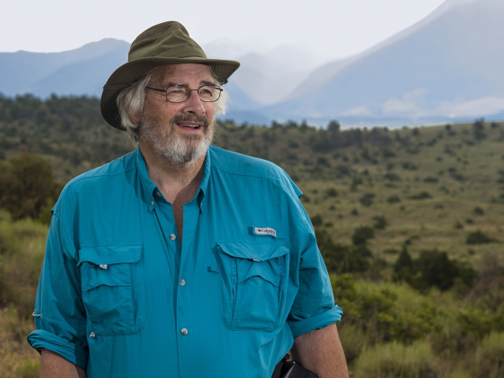
Jack Horner, one of the world’s most famous palaeontologists, has announced his retirement from the post of Curator of Palaeontology at the Museum of the Rockies after thirty-three years in the post.  John “Jack” Horner, the Regents Professor of Palaeontology at Montana State University has enjoyed a sparkling career having been thrust into the scientific limelight with the discovery of Maiasaura (M. peeblesorum) and the implications on dinosaur nesting behaviour and how dinosaurs raised their young which subsequently arose.

The Very Influential Jack Horner

Palaeontologist John "Jack" Horner.

Palaeontologist John “Jack” Horner.

Picture credit: Montana State University

Jack Horner Announces Retirement

The scientist who advised on the Jurassic Park franchise and is credited with being the inspiration behind the character Dr Alan Grant (at least in part), will not be hanging up his geological hammer just yet.  Although he is retiring from some of his commitments, he has lots of other projects which are going to keep him busy well into his seventies.

Commenting on the announcement of his retirement, the Professor stated:

“You can be assured that I’ll not be slowing down any time soon.  I will be pursuing a number of projects, including helping another museum amass a large dinosaur collection and finishing a couple more books.  I also have a very exciting project that I’m not yet ready to announce.”

Jack Horner’s official retirement date is June 30th 2016, just shortly after his seventieth birthday.  Montana State University intends to hold a special public event on the campus to celebrate the Professor’s contribution to vertebrate palaeontology.

Shelley McKamey, (Executive Director of the Museum of the Rockies) stated:

“Jack and his team of staff and graduate students have amassed the largest collection of dinosaur fossils from the United States.  He opened the science of palaeontology to the general public and sparked the imagination of countless aspiring palaeontologists.”

A Famous Palaeontologist

Professor Horner, has championed the theory that dinosaurs were warm-blooded, he has also courted controversy in his rich and varied career, playing a pivotal role in the Tyrannosaurus rex “scavenger versus hunter” debate.

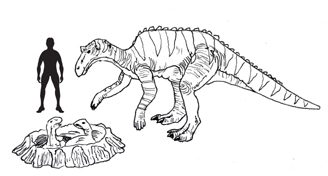
The discovery of “Good Mother Lizard” – Maiasaura, in the late 1970’s brought about a complete revision of theories relating to dinosaurs and their parenting strategies.  Jack Horner and his colleagues demonstrated that some dinosaurs provided extensive parental care (Maiasaura young were altricial – incapable of feeding themselves).

Maiasaura – Described by Jack Horner and Robert Makela in 1979

"Good Mother Lizard"

“Good Mother Lizard”

Picture credit: Everything Dinosaur

For models and replicas of ornithischians and other prehistoric animals: CollectA Prehistoric Life Models and Figures.

Long-time collaborator and University of California, Berkley professor Kevin Padian, wrote:

“It is difficult to imagine someone who, rising from such considerable obstacles, has achieved so much, given back so much to the profession, stimulated so much new investigation and supported so many younger colleagues and students.”

The search to replace John “Jack” Horner has started in earnest, however, finding a replacement with the same charisma and with the same high regard in this field of scientific endeavour is going to prove difficult.

Everything Dinosaur is grateful to Montana State University for the compilation of this article.

15 11, 2015

Tracing the Family Tree of the Brachylophosaurini

By |2023-04-08T11:15:40+01:00November 15th, 2015|Categories: Dinosaur and Prehistoric Animal News Stories, Dinosaur Fans, Main Page|0 Comments

New Dinosaur Species from Montana – Probrachylophosaurus

The hadrosaurs, commonly referred to as the “duck-billed” dinosaurs were a highly successful group of Cretaceous ornithischian dinosaurs that dominated the mega fauna of most of Asia, North America and Europe towards the end of the Mesozoic.  Many different types of genera are known and there is a general consensus amongst palaeontologists in terms of the taxonomic relationships between most species.

However, even though these large herbivores were abundant and the fossil record of these animals as collected from famous formations such as Hell Creek, Dinosaur Provincial Park (North America), and the Jingangkou Formation of eastern China, is quite detailed when compared to other types of dinosaur, there is still a lot we don’t know about these animals.

The “Super Duck” Probrachylophosaurus

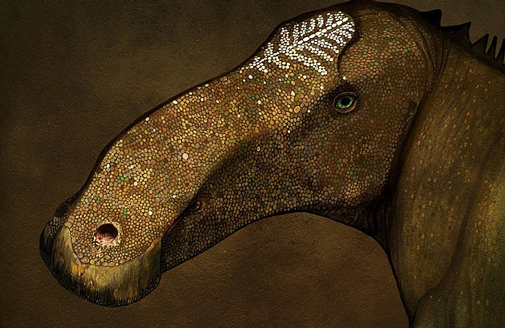
Talented artist John Conway was commissioned to produce this illustration for the press release.

Talented artist John Conway was commissioned to produce this illustration for the press release.

Picture credit: John Conway

Probrachylophosaurus bergei

The publication of a paper announcing the discovery of a new “duck-billed” dinosaur, nick-named “super duck”, in the prestigious journal PLOS One, sheds new light on how one particular group of these prehistoric animals evolved over time.

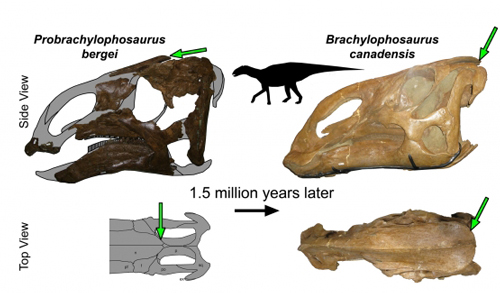
The new dinosaur has been named Probrachylophosaurus bergei, it translates as “before short-crested lizard” in reference to the fact that this new genus was found in strata that was laid down earlier than the very closely related Brachylophosaurus canadensis.  Indeed, in the paper written by Professor Elizabeth Freeman Fowler (Montana State University) in collaboration with her mentor and fellow Montana State University palaeontologist Jack Horner, the authors outline the anatomical similarities between these two members of the Brachylophosaurini clade that suggest that Probrachylophosaurus was ancestral to the later Brachylophosaurus.

A Dinosaur “Missing Link”

This newly named dinosaur could be regarded as a “missing link” neatly fitting in between a much older type of “duck-billed” dinosaur (Acristavus) and Brachylophosaurus.  In addition, when all three skulls of these related dinosaurs are studied, they reveal an evolutionary link towards the development of evermore elaborate crests as display structures.

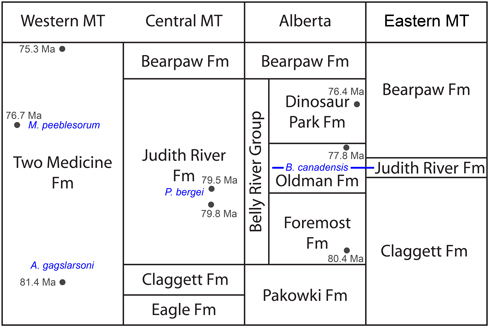
Tracing the Timeline Showing Evolutionary Transition in the Brachylophosaurini

Mapping the evolutionary transitions that led to more elaborate crest development.

Mapping the evolutionary transitions that led to more elaborate crest development.

Picture credit: PLOS One

The diagram above shows the relative positions of fossil finds of dinosaurs that are grouped into the brachylophosaur clade (Brachylophosaurini).  Acristavus gagslarsoni, from the lower portion of the Two Medicine Formation of western Montana lived around 81 million years ago.  It had no nasal crest.  Brachylophosaurus canadensis is known from Canada, the Oldman Formation of the Belly River Group, these fossils date to around 78 million years ago.  B. canadensis had a flattened, almost paddle-shaped nasal crest which projected backwards over the skull roof.

The Brachylophosaurini

The very well known and more recent Maiasaura peeblesorum is also a member of the Brachylophosaurini.  The fossils of Maiasaura are associated with the upper portions of the Two Medicine Formation of western Montana and it had quite a substantial bump on its snout, a much larger more striking crest.

Commenting on the significance of Probrachylophosaurus, Professor Freedman Fowler stated:

“The crest of Probrachylophosaurus is small and triangular and would have only poked up a little bit on the top of the head, above the eyes.  Probrachylophosaurus is therefore exciting because its age – 79 million years ago – is between Acristavus and Brachylophosaurus, so we would predict that its skull and the crest would be intermediate between these species.  And it is.  It is a perfect example of evolution within a single lineage of dinosaurs over millions of years.”

Skull Comparisons between Probrachylophosaurus and the Later Brachylophosaurus

Skull comparisons between Hadrosaurs.

Skull comparisons between hadrosaurs.

Picture credit: PLOS One

The picture above compares  some of the known cranial material from P. bergei with a crest of the later Brachylophosaurus canadensis (left lateral and dorsal views).  The green arrow indicates the extension to the naris and other bone changes that led to the evolution of a more prominent and pronounced crest in Brachylophosaurus.

Professor Freedman Fowler with the Probrachylophosaurus Illustration and Cranial Fossil Casts

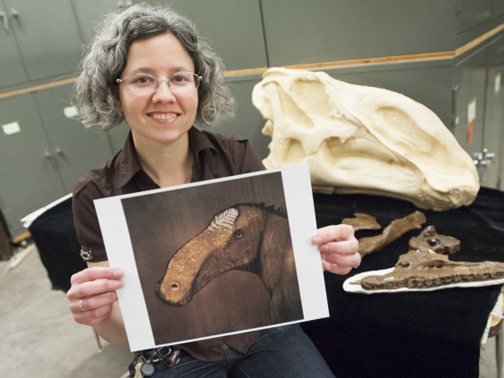
Professor Freedman with an illustration, and casts of the skull material.

Professor Freedman with an illustration, and casts of the skull material.

Picture credit: PLOS One

Newest Member of the Duck-billed Dinosaurs

This newest member of the “duck-billed” dinosaurs was nick-named “super duck” after it emerged although not fully grown, this dinosaur would have measured close to ten metres in length.  Body mass estimates suggest an adult weight in excess of five tonnes.  The fossils, including substantial post-cranial material were discovered in 2007, near to the town of Rudyard in north central Montana.  The species name honours Sam Berge one of the landowners who allowed access to the site to excavate the exposed fossils.

A nearby dig site revealed a fragmentary juvenile of the transitional Probrachylophosaurus, which suggests that successive generations of the Brachylophosaurus lineage grew larger crests by changing the timing or pace of crest development during growth into adulthood.  This change in the timing or rate of development is called heterochrony, a process which is being increasingly recognised as a major driving force in evolution.

Heterochrony

Explaining the importance of heterochrony and how fossils of juvenile dinosaurs can assist scientists in piecing together evidence regarding change in populations, the professor said:

“Heterochrony is key to understanding how evolution actually occurs in these dinosaurs, but to study heterochrony we need large collections of dinosaurs with multiple growth stages, and a really precise time framework for the rock formations that we collect them from.”

The well-documented and accurately dated Campanian-Maastrichtian faunal stages as mapped out in the exposed Upper Cretaceous strata of North America provide palaeontologists with an opportunity to map heterochroneous relationships between animals of different ages but of the same species.  These in turn can permit the analysis of how these changes influenced the macro-evolution of the entire lineage.

An Illustration of the Closely Related (But Later) Brachylophosaurus

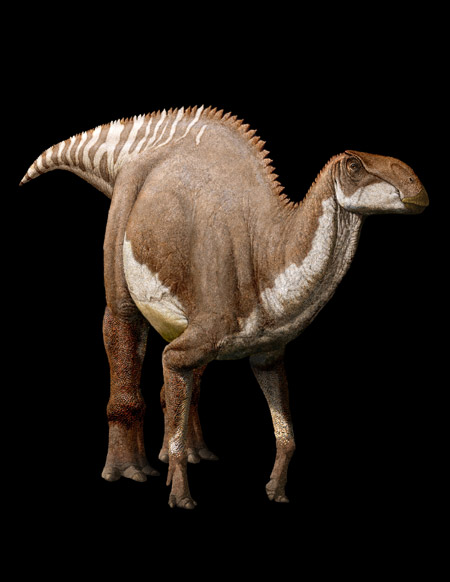
Brachylophosaurus illustrated.

Brachylophosaurus illustrated.

Picture credit: Houston Museum of Natural Science

PNSO have introduced a range of replicas of hadrosaurs and other ornithischian dinosaurs.  To view this range: PNSO Age of Dinosaurs.

14 11, 2015

Celebrating South African Dinosaurs with an Exclusive Poster

By |2024-05-05T14:59:43+01:00November 14th, 2015|Categories: Dinosaur and Prehistoric Animal News Stories, Dinosaur Fans, Educational Activities, Main Page|0 Comments

Poster Celebrates South African Dinosaurs

Earlier this week, scientists from the Evolutionary Studies Institute of Witwatersrand University (Johannesburg) put on display the fragmentary fossils of a huge dinosaur which roamed South Africa.  The fossils date from the Early Jurassic and represent an plant-eating dinosaur, a sauropod that measured perhaps in excess of sixteen metres.

Celebrating South African Prehistoric Animals

There have been a number of remarkable fossil finds over the last two years or so in South Africa.  These discoveries have helped to shed new light onto the fauna and flora of the Late Triassic and the Early Jurassic geological periods.  The announcement of the latest dinosaur discovery the “Highland Giant” coincided with the celebration of UNESCO’s World Science Day for Peace and Development.  A special poster has been commissioned to celebrate South African dinosaurs and other prehistoric life.  This poster was designed by artist and poet Maggie Newman.

Celebrating the  Prehistoric Life of South Africa

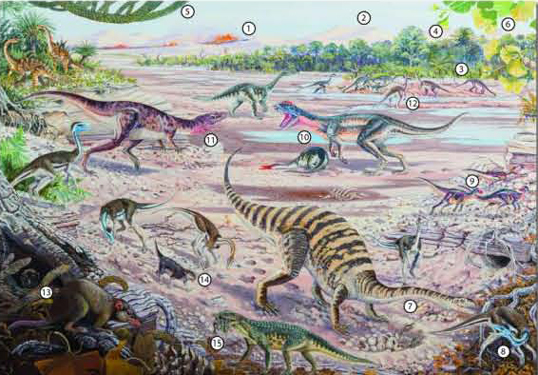
The prehistoric life of South Africa.

The prehistoric life of South Africa.

Picture credit: The Evolutionary Studies Institute (Witwatersrand University)

South African Dinosaurs

The beautiful and very detailed poster depicts South Africa some 200 million years ago (Hettangian faunal stage of the Early Jurassic), a time when the continents were formed into a super-sized landmass that was beginning to split apart.  Dinosaurs were becoming the dominant terrestrial fauna but they shared the land with a wide range of other bizarre reptiles as well as some synapsids that were from the branch of the Tetrapoda that would lead to modern mammals.

Poster Key

This poster shows a scene in South Africa between 200 and 183 million years ago.  At the time the continents were splitting apart and there were many volcanic eruptions (1).  The climate was drying and there were sand dunes (2), tree ferns (3), yellowood (4), monkey puzzle (5) and ginkgo trees (6) formed patches of forest.  Early dinosaurs like this egg-laying Massospondylus (7) are shown fending off a hungry Coelophysis (8).  Heterodontosaurus (9) was different from other dinosaurs because it had incisor, canine and molar type teeth for cutting, biting and grinding up their plant food.

“Different Types of Teeth”

The name Heterodontosaurus means “different types of teeth” and this interesting small animal may have had quills like a porcupine.  In the scene, three Heterodontosaurus are fleeing a kill made by a crested dinosaur called Dracovenator (10), a relative of Dilophosaurus.

The Dracovenator is being threatened by a Ceratosaur (11).  The herbivorous Aardonyx dinosaurs (12) in the background are foraging peacefully.  Dinosaurs were not the only animals alive at this time.  Megazostrodon (13) was a small insect eating animal closely related to the earliest mammals.  Tritylodon (14) was a mammal ancestor with teeth like a dassie (Rock Hyrax – Procavia capensis).  The animal that looks like a lizard (15) is a small armoured land-dwelling crocodile called Protosuchus.

The original fossils of the dinosaurs and other prehistoric animals depicted in the poster are on display at institutions and museums around South Africa.

Dr Choiniere Comments

Dr Jonah Choiniere (senior researcher at the Evolutionary Studies Institute at Witwatersrand University) stated:

“We think that this poster will show young learners…. ‘yes, South Africa does have dinosaurs’.  We hope that it will get them excited about studying the science behind South Africa’s incredible palaeosciences heritage.”

The poster is available for free and upon request to all visitors to the Origins Centre while stocks last and it will also be distributed to science centres, museums and visiting schools in the country.

To read an article all about the latest addition to the dinosaur dominated fauna of South Africa: South Africa’s “Highland Giant”.

Everything Dinosaur would like to take this opportunity to thank those institutions involved with the commissioning of the poster, helping to inform and to educate people about life in the past.

For additional information about prehistoric animals contact Everything Dinosaur: Email Everything Dinosaur.

11 11, 2015

The “Highland Giant” of the Karoo Basin

By |2023-04-08T10:48:49+01:00November 11th, 2015|Categories: Dinosaur and Prehistoric Animal News Stories, Dinosaur Fans, Main Page|0 Comments

Femur of Giant Dinosaur Put on Display

The fossilised bones of the largest dinosaur ever found in South Africa were put on display at the Witwatersrand University Origins Centre this week.  The dinosaur has been nicknamed the “Highland giant”.  The fragmentary remains, including a colossal partial femur (thigh bone), represent a plant-eating dinosaur that once roamed the land that is now known as the Lesotho Highlands some 200 million years ago.

Huge Plant-eating Dinosaur

The size of this, as yet, unnamed dinosaur is certainly impressive.  At an estimated fourteen tonnes, it was twice as heavy as Tyrannosaurus rex, but its sheer bulk is of limited interest to palaeontologists.  What is much more significant is that this specimen indicates the presence of very large dinosaurs in this part of the world during the Early Jurassic (Hettangian stage), it extends the faunal mix that existed in this region of the super-continent Gondwana, just a few million years after the Triassic/Jurassic extinction event.

A Scale Drawing Comparing the South African Sauropod to Well-known Dinosaurs and a Human (with Dog)

Dipolodcus, T. rex and the

Diplodocus, T. rex and Aardonyx celestae are compared.

Picture credit: Witwatersrand University Origins Centre

The picture above also includes Aardonyx, a basal sauropodomorph from South Africa.  Aardonyx has been described as a transitional form of lizard-hipped plant-eater, showing a trend in this part of the Dinosauria for heavier and heavier animals that eventually evolved into obligate quadrupeds.

To read an article about the discovery and naming of Aardonyx: South Africa’s Transitional Dinosaur Fossil.

The “Highland Giant”

Nick-named the “Highland Giant” the first fossils of this huge basal sauropod were found during excavations under the Caledon River for the Lesotho Highlands Water Project some twenty years ago.  The bones were so bulky that they were stored in separate storage rooms.  It was only after the fossil specimens were relocated to new storage facilities that it was realised that the fossils represented the remains of a single, individual dinosaur.

Papo of France have introduced a range of sauropod figures: Papo Dinosaur Models.

Commenting on the fossil find, Dr Jonah Choiniere, a senior researcher at the Evolutionary Studies Institute at Witwatersrand University stated:

“This is the biggest dinosaur we have ever found.  We do not know what the species is, hopefully we will know in a year or so.  We are not sure if this is a new species.”

Dr Jonah Choiniere with Some of the Fossil Material

Dr. Choiniere with the fossils of the  "Highland Giant"

Dr Choiniere with the fossils of the “Highland Giant”.

Picture credit: Witwatersrand University Origins Centre

Lower Jurassic Fossils

Other fossils collected in the same region have been associated with this giant sauropod, the picture above shows Dr Choiniere with some of the fossils, having a person in the picture provides a handy scale.  Recently, there have been a number of important dinosaur discoveries from South Africa.  For example, in August Everything Dinosaur reported on the naming of Pulanesaura (basal sauropod) and in June, team members produced an article featuring Sefapanosaurus.

Pulanesaura article: Pulanesaura – A Case of “Four Legs Being Better than Two”.

Sefapanosaurus article: New Sauropodomorph from South Africa.

Fossils of the Early Jurassic Sauropod Have Come to Light Over Twenty Years

Fossils of the "Highland Giant" include claws and a vertebra.

Fossils of the “Highland Giant” include claws and a vertebra.

Picture credit: Witwatersrand University Origins Centre

Everything Dinosaur acknowledges the assistance of a press release from the University of Witwatersrand in the compilation of this article.

8 11, 2015

“Fanged Eels” and “Fire Frogs” of the Permian

By |2023-04-08T10:17:40+01:00November 8th, 2015|Categories: Dinosaur and Prehistoric Animal News Stories, Main Page, Palaeontological articles|0 Comments

“Fanged Eels” and “Fire Frogs” of the Permian

An international team of scientists led by researchers from the Field Museum of Chicago (USA) and the Natural History Museum (London), have unearthed an large number of vertebrate fossils that provide an insight into the fauna that existed in a huge, lowland swamp that covered a part of the southern portion of the ancient super-continent Pangaea.

The fossils are extremely significant as most of what palaeontologists know about life on Earth some 278 million years ago comes from fossils found in North America and Europe.  Vertebrate fossils from South America dating from the Artinskian faunal stage of the Early Permian are extremely rare.

“Fanged Eels” and “Fire Frogs”

Amongst the significant fossil finds, the scientists writing in the journal “Nature Communications” describe fanged eel-like amphibians, hunters with huge mouths that resemble giant salamanders and a reptile which was previously unknown from South America.

A Bizarre Watery World Dominated by Amphibians

Evidence of the fauna of Brazil some 278 million years ago has been unearthed.

Evidence of the fauna of Brazil some 278 million years ago has been unearthed.

Picture credit: Andrey Atuchin

The large lakes and swamps were home to an ancient ecosystem that was like nothing around today.  Amphibians dominated this watery world and these newly described fossils from the Parnaiba Basin of north-eastern Brazil provide a detailed record of the fauna that was present in the southern part of Pangaea close to the tropics.

Commenting on the discoveries, one of the authors of the report, Chicago Field Museum scientist Ken Angielczyk stated:

“Almost all of our knowledge about land animals from this time, comes from a handful of regions in North America and western Europe, which were located near the equator.  Now we finally have information about what kinds of animals were present in areas farther to the south, and their similarities and differences to the animals living near the equator.”

For example, the lizard-like creature named Captorhinus aguti was previously known from fossils found in  the south-western United States, this research extends this animals faunal range by a considerable margin.

The Early Reptile Captorhinus aguti

A resident of Brazil - Captorhinus.

A resident of Brazil – Captorhinus.

Picture credit: Field Museum (Chicago)

This reptile reached lengths of around half a metre, it had batteries of crushing teeth and it has been suggested that this Eureptile was probably herbivorous.

Fanged Eel-like Amphibians

The fanged amphibian is a new species, it has been named Timonya annae.  Measuring up to forty centimetres in length, this amphibian has been described as a cross between a freshwater eel and a Mexican salamander.  Although capable of moving around on land, it was very much at home in the water where it hunted small fish, other amphibians and invertebrates.

A Close up of the Newly Described Permian Amphibian Timonya annae

A fanged amphibian from the Early Permian.

A fanged amphibian from the Early Permian.

Picture credit: Andrey Atuchin

Lurking in the background of the picture above is a large, predatory amphibian, a member of the Rhinesuchidae family.  As far as we at Everything Dinosaur are aware, the genera or  species has not been identified within the scientific paper.  It would have been one of the top aquatic predators in the lake system perhaps reaching lengths in excess of 1.2 metres.

The Beautifully Preserved Skull of Timonya annae

A close up of the Timonya skull.

A close up of the Timonya skull.

Picture credit: Juan Cisneros

Fire Frogs

The other new species of amphibian has been named Procuhy nazarienis (pronounced pro-coo-ee naz-ar-ee-en-sis), the name means “fire frog” in the native Timbira language of this part of Brazil.  It was closely related to T. annae and the name was inspired by the Pedra de Fogo Formation (Rock of Fire), where the fossils were found.

The strata in the Lower Pedra de Fogo Formation (the stratigraphic zone that contains the fossils), are well known as they contain flints which were used to make fires.  The term “frog” is also misleading, these amphibians were not closely related to extant frogs or indeed to that branch of the Amphibia that gave rise to the frog lineage.

CollectA have recently introduced a range of Palaeozoic animal replicas in their CollectA Prehistoric Life model range: CollectA Prehistoric Life Models.

Everything Dinosaur acknowledges the contribution of the Field Museum in the compilation of this article.

3 11, 2015

Dakotaraptor a New Giant Raptor

By |2024-05-05T15:03:43+01:00November 3rd, 2015|Categories: Dinosaur and Prehistoric Animal News Stories, Dinosaur Fans, Main Page|0 Comments

Dakotaraptor steini and Niche Partitioning

An international research team which included scientists from the University of Kansas, Pete Larson (Black Hills Institute of Geological Research) and Bob Bakker (Houston Museum of Science and Nature) , have finally solved a hundred year mystery with the describing of a very large dromaeosaurid from fluvial deposits that form part of the famous Hell Creek Formation exposed in South Dakota.  Teeth, very typical of a dromaeosaurid, had been found in the Late Maastrichtian deposits indicating the presence of a very large “raptor”, however, no bones to link to the teeth were known.

However, a paper published in “Paleontological Contributions” describes Dakotaraptor (D. steini) and a new super-sized Dromaeosaur has been introduced to the world.

Dakotaraptor – A Fearsome Predator

Dakotaraptor steini

Dakotaraptor steini – a giant raptor.

Picture credit: Emily Willoughby

Dakotaraptor

At an estimated five and half metres in length, this new meat-eating dinosaur, known from fragmentary remains representing two individuals fills a niche within the food web of the fauna represented by the vertebrate fossils associated with the famous Hell Creek Formation.  A number of small theropods are known as well as the super-sized tyrannosaurs such as T. rex.  Dakotaraptor represents a sort of “halfway house” when it comes to the carnivores associated with Hell Creek

Its limbs and body are very similar to the smaller dromaeosaurids known from this part of the world, dinosaurs such as Dromaeosaurus, (the first dromaeosaurid ever described), Saurornitholestes, and the recently named Acheroraptor but proportionately much larger.  Dakotaraptor was one “raptor” that actually did grow to be as big as the “Velociraptors” featured in the Jurassic Park franchise.

The Beasts of the Mesozoic range includes a variety of feathered dromaeosaurid models.  To view the Beasts of the Mesozoic range: Beasts of the Mesozoic Articulated Dinosaur Figures.

Commenting on the size and scale of Dakotaraptor, co-author of the publication and Kansas University palaeontologist, David Burnham said:

“This new predatory dinosaur also fills the body size gap between smaller theropods and large tyrannosaurs that lived at this time.”

Fossils Found in 2005

The fossils were found in 2005, lead author of the research, Robert DePalma, (curator of vertebrate palaeontology at the Palm Beach Museum of Natural History) led the field expedition to Harding County (South Dakota) where the specimens were located.  At the time, he was a graduate student studying under former Kansas University professor and curator Larry Martin, who sadly passed away in 2014.

He explained:

“This Cretaceous period raptor would have been lightly built and probably just as agile as the vicious smaller theropods such as Velociraptor.”

As Big as the “Jurassic Park” Raptors

In addition to being roughly the size of the iconic “Raptors” from Jurassic Park, there are two very exciting skeletal features preserved in Dakotaraptor.  The paper describes a massive dromaeosaur sickle claw on the middle toe.  It measures 16 cm from top to bottom and 24 cm along the outer curve.  This was an impressively large raptorial claw, even for an animal this size.

The ulna, a bone in the forearm, bares 15 large and distinct quill knobs, or ulnar papillae, which are reinforced attachment points on the wings of birds and other dinosaurs where the large, pennaceous feathers attach.  This makes Dakotaraptor the largest known dinosaur with confirmed wings.

Reconstructed Dakotaraptor Wing and Proposed Plumage

The "wings" of Dakotaraptor.

The “wings” of Dakotaraptor.

Picture credit: Robert DePalma

Dakotaraptor may not have competed directly with adult tyrannosaurs.  Perhaps it adopted a different hunting strategy or specialised in attacking a different sort of prey.  By doing this it would have avoided direct competition between it and other large predatory dinosaurs. This is an example of niche partitioning.

When asked by Everything Dinosaur about this particular aspect of the research, Robert DePalma explained:

“Niche partitioning is a given, Dakotaraptor had to occupy a distinct ecological niche.  If it coexisted with the other large predators, had the same herbivores available to them, and did not out compete each other to extinction, then there had to be different strategies going on.”

Everything Dinosaur acknowledges the assistance of Kansas University and Robert DePalma in the compilation of this article.

31 10, 2015

Happy Halloween from Everything Dinosaur

By |2023-04-07T15:24:08+01:00October 31st, 2015|Categories: Dinosaur and Prehistoric Animal News Stories, Dinosaur Fans, Main Page|0 Comments

Happy Halloween from Everything Dinosaur – Gargoyleosaurus

This time of year children go out “trick or treating”.  This is an American custom that seems to have taken hold this side of the Atlantic.  In palaeontology, the United Kingdom does not always follow where America leads.  For example, the spelling of palaeontologist, the Americanised paleontologist is a “bone” of contention with Everything Dinosaur office staff, but we content ourselves with the thought that a number of dinosaur families were first identified from fossil remains discovered in the British Isles.

The United States may have iconic dinosaurs such as Tyrannosaurus rex and Brontosaurus, but the United Kingdom had named and described its first meat-eating dinosaur and what was eventually to become known as a sauropod many years before the likes of T. rex and Brontosaurus were discovered.

Gargoylesaurus

With Halloween, we turn our attention to Gargoyleosaurus (G. parkpinorum), whose fossilised remains come from Albany County, Wyoming (United States).  It seems appropriate to discuss “Gargoyle lizard” at this time of year.  This four-metre-long armoured dinosaur which once roamed the western United States some 150 million years ago, has been classified as member of the Ankylosauria clade.  It is one of the earliest examples known of an ankylosaur.

The Late Jurassic Armoured Dinosaur Gargoyleosaurus parkpinorum

An early member of the Ankylosauria clade.

An early member of the Ankylosauria clade.

Polacanthid Dinosaurs

Specifically, cladistic analysis (Thompson et al 2012 and Chen et al 2013) have assigned the Gargoyleosaurus genus to the polacanthids.  The first member of the Polacanthidae family was named and described back in 1865 (Polacanthus foxii) from fossils found on the Isle of Wight.  Gargoyleosaurus was first named and described back in 1998, (Ken Carpenter, Clifford Miles and Karen Cloward), some 133 years after the first member of the polacanthid family was established.

When the subsequent paper describing a well-preserved skull and post cranial elements was first published (in the journal Nature), this dinosaur was named Gargoyleosaurus parkpini.

The holotype material had been found by J. Parker and Tyler Pinegar and the species name honoured them.  However, the specific (trivial) name had to be changed as it broke the rules for binomial classification under ICZN (International Code of Zoological Nomenclature) guidelines.  The singular Latin suffix “i” is not allowed to be used if it honours a number of people.  As a result the trivial name of this dinosaur was changed in 2001 to G. parkpinorum.

PNSO Age of Dinosaurs

PNSO have a large range of armoured ornithischian models: PNSO Age of Dinosaurs.

Gargoyleosaurus (pronounced gar-goy-lee-oh-sore-us) and other members of the Polacanthidae are discussed in depth in a newly published book by the very talented William T. Blows entitled “British Polacanthid Dinosaurs”

British Polacanthid Dinosaurs by William T. Blows

Written by William T. Blows.

Written by William T. Blows.

Picture credit: Siri Scientific Press

Everything Dinosaur recommends this excellent dinosaur book.

To order a copy and for further details on “British Polacanthid Dinosaurs” visit: Siri Scientific Press.

29 10, 2015

In a Flap over an “Ostrich Mimics” Feathers

By |2023-04-07T15:17:54+01:00October 29th, 2015|Categories: Dinosaur and Prehistoric Animal News Stories, Dinosaur Fans, Main Page|0 Comments

A Densely Feathered Ornithomimid from Dinosaur Provincial Park

Published in the scientific journal “Cretaceous Research”, why is everybody so excited about the discovery of yet another fossil of a theropod that shows feathers (at least integumental structures which include feathers)?  Lots of media coverage on this fossil discovery, so why such a flap?

A Feathered Ornithomimus

The answer is fairly straight forward, the fossil (UALVP 52531), represents an Ornithomimus, a type of theropod dinosaur which had a small head perched on top of a long, slender neck, long legs and a very long tail.  Think of Ornithomimus and its kin, the Ornithomimidae, as being very similar to a modern Ostrich (Struthio camelus), but with a tail of course.  It is only the third Ornithomimus fossil to indicate that these Late Cretaceous dinosaurs had feathers and the first ornithomimid specimen to preserve a tail which shows extensive plumes, feathers which are longer than those present on the remainder of the body.

To read about the discovery of the first feathered ornithomimid dinosaur to be found in the Western Hemisphere, an article published by Everything Dinosaur in 2012: Canadian Researchers Find Evidence of Feathers in Ornithomimus.

The Fossil Material (UALVP 52531)

The feathered fossil.

The feathered fossil.

Picture credit: University of Alberta/”Cretaceous Research”

From the Dinosaur Provincial Park of Alberta

The specimen, pictured above had been collected during a 2009 expedition to the Dinosaur Provincial Park Formation of Alberta (Canada).  It had been identified as an Ornithomimus, but as the head and forelimbs were missing it had largely been ignored.  Aaron van der Reest, a palaeontology student at the University of Alberta was given the task of preparing the specimen, carefully removing the matrix to reveal more of the leg bones which can be seen in the lower portion of the photograph.

Within twenty minutes of working on the tail section, he came across some blackened impressions, these turned out to be feathers.  What started out as an undergraduate project has catapulted Mr van der Reest into the world of published academia.

Two Years of Careful Preparation

After two years of careful preparation, this specimen has shed new light on the integumentary coverings of ornithomimids.  It will help scientists to understand more about the different types of feathers and feathery structures that existed amongst the Dinosauria.

Commenting on the seventy-five million year old specimen (Campanian faunal stage of the Late Cretaceous), David Evans, curator of Vertebrate Palaeontology at the Royal Ontario Museum (Toronto) stated:

“It’s drop-dead gorgeous.  It is the most complete feathered dinosaur specimen found in North America to date.”

The partial, articulated specimen is the first ornithomimid to preserve a tail with extensive feathers.  These tail feathers are slightly longer than those present on the rest of the body.  Intriguingly, the underside of the tail and the hind limb distal to the middle of the femur appear to have no feathers at all.  This plumage pattern mapped out on the preserved Ornithomimus is very similar to that seen in an extant Ostrich (Struthio camelus).

The configuration of body feathers in Ostriches and other Palaeognaths (the Cassowary, Emu, Rhea and so forth), aids thermoregulation.  The feather pattern seen in this Ornithomimus specimen probably served the same function, further evidence that this Theropod dinosaur was endothermic (warm-blooded).

An Illustration of a Feathered Ornithomimus

Feathered Ornithomimus illustration.

Feathered Ornithomimus illustration.

Picture credit: Julius Csotonyi

Feathered Ornithomimid

The fossil also shows the body outline around the legs, including skin patches in front of the femur, the authors of the scientific paper on this specimen suggest that the resting position of the femur was positioned more anteroventrally in ornithomimids than in most other Theropoda, and as a result may have been transitional to the situation in extant birds.

The research team conclude that whilst UALVP 52531 is not the first feathered ornithomimid dinosaur known from North America, the quality and extent of the feather and skin preservation is without equal.  It is from this specimen that much more can be learned about the likely function of the integumentary covering in Ornithomimus and non-avian theropods in general.

So, that’s why there has been such a flap.

Everything Dinosaur stocks an extensive range of feathered dinosaur replicas and figures, to view this range: Everything Dinosaur Models and Figures.

Go to Top