All about dinosaurs, fossils and prehistoric animals by Everything Dinosaur team members.

Fossil finds, new dinosaur discoveries, news and views from the world of palaeontology and other Earth sciences.

9 12, 2015

Big-eyed Mosasaur from Japan – A Night Time Hunter?

By |2023-04-09T16:58:32+01:00December 9th, 2015|Categories: Dinosaur and Prehistoric Animal News Stories, Dinosaur Fans, Main Page, Photos/Pictures of Fossils|0 Comments

Phosphorosaurus ponpetelegans – New Species of Mosasaur Announced

An international team of researchers, including scientists from the Royal Tyrrell Museum, the University of Alberta (Canada), the University of Cincinnati (USA), Hobetsu Museum and Fukuoka University (Japan), have announced the discovery of a new species of mosasaur found in Upper Cretaceous rocks in Japan.  This three-metre-long predator may have specialised in hunting in deep water or perhaps it evolved to fill a specific ecological niche, that of a night hunter preying on bioluminescent fish and squid.

The Newly Described Phosphorosaurus ponpetelegans
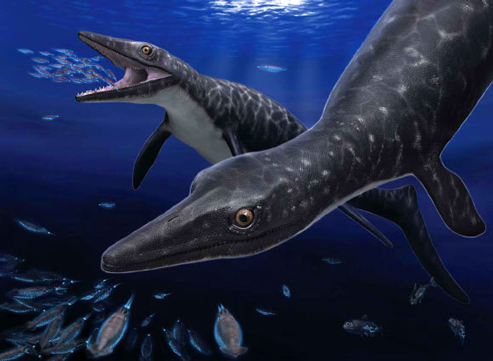
The first Japanese Mosasaur to be identified.

Rare Japanese mosasaur identified.

Picture credit: Tatsuya Shinmura / Ashoro Museum of Palaeontology / Trustees of the Natural History Museum, (London).

A Large-eyed Mosasaur

Growing to around the size of an extant American Alligator (C. mississippiensis), this large-eyed mosasaur from the island of Hokkaido (northern Japan), was probably most closely related to another species of Late Cretaceous mosasaur, but one from Belgium thousands of miles away (P. ortliebi).  This fossil find, consisting of beautifully preserved cranial material plus some post cranial elements, will help palaeontologists to build a better understanding of the biogeographical distribution of certain types of mosasaur towards the end of the Mesozoic.

In 2009, scientist Tomohiro Nishimura (Hobetsu Museum), recovered a calcareous nodule from one of the tributaries of the Pankerusano-sawa Creek, about 3 miles east of the town of Hobetsu.  The rivers in this part of Hokkaido cut through sandstones which were laid down at the very end of the Age of Dinosaurs (Hakobuchi Formation of the uppermost Yezo Group), the fossil is believed to have come from the lowermost strata representing the early part of the Maastrichtian age, approximately 71 million years ago.

Mosasaur Creek!  The Rivers Cut Through the Loosely Compacted Sandstones
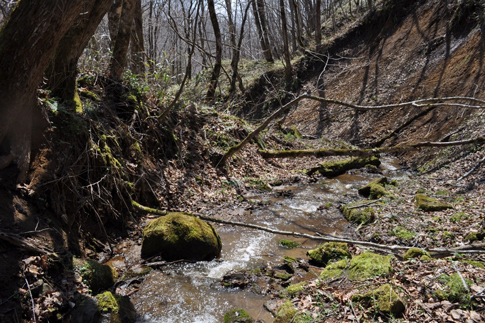
Small rivers cut deep channels in the sandstone.

Small rivers cut deep channels in the sandstone.

Picture credit: University of Cincinnati

Rivers Cutting Through Loosely Compacted Sandstones

The picture above shows the topography of the area.  Shallow soils overlie sandstones.  The action of rivers results in deep channels being cut in the rock.  This erosion can expose fossils such as ammonites and occasionally the fossilised bones of marine vertebrates.

Views of the Remarkably Well-Preserved Skull
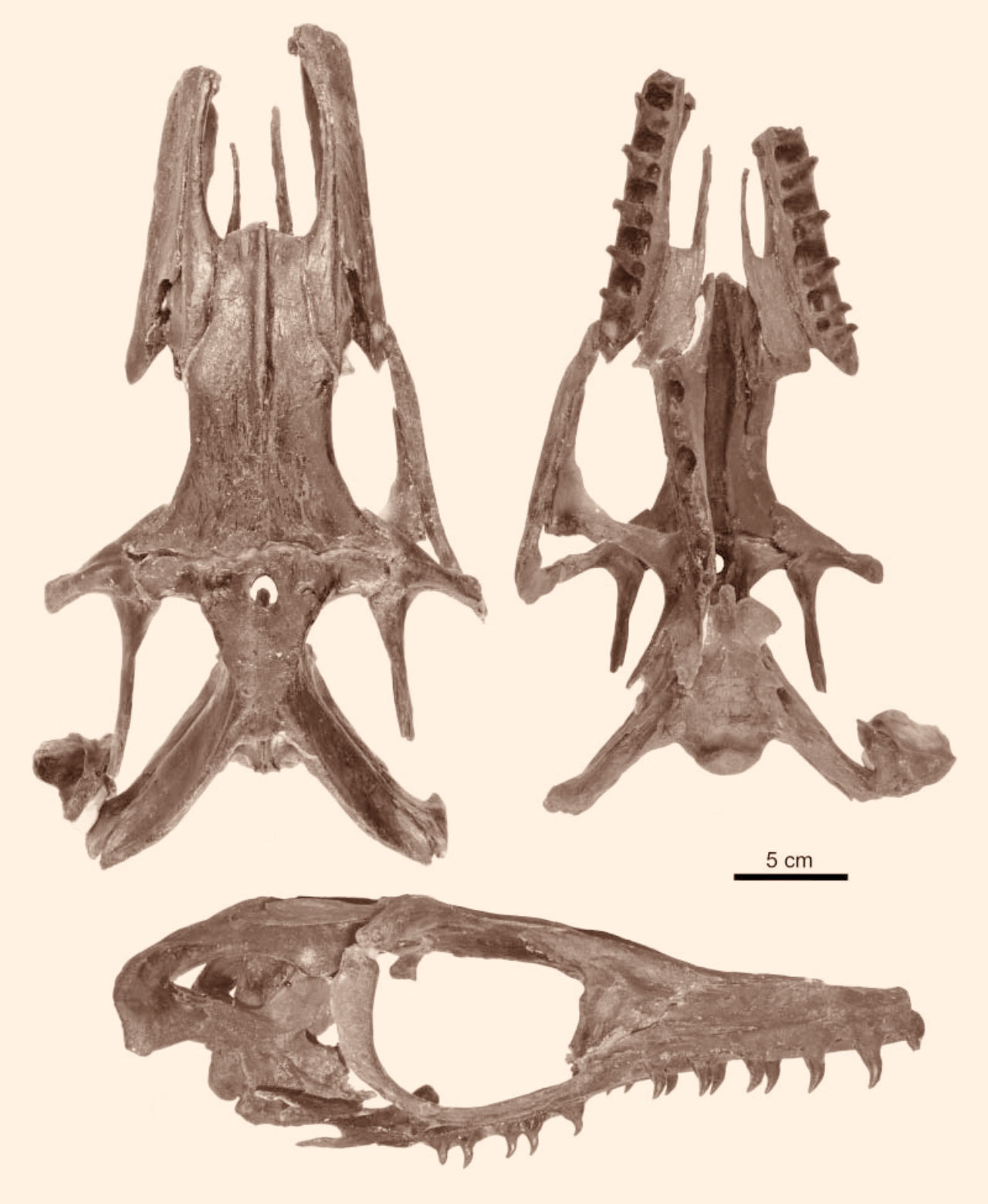
Dorsal view (left), ventral view (right), lateral view (bottom). Scale bar = 5cm.

Dorsal view (left), ventral view (right), lateral view (bottom).
Scale bar = 5 cm.

Picture credit: Takuya Konishi et al.

Phosphorosaurus ponpetelegans

Phosphorosaurus ponpetelegans means “phosphorus lizard from an elegant creek”,  co-existed with much larger mosasaurs, ten-metre plus monsters that were the apex predators.  The scientists propose that P. ponpetelegans adapted to an ecological niche, that of a night time predator or perhaps a deep water hunter.  The almost complete skull was slowly removed from its rocky matrix by being placed in a bath of dilute acid each night.  Once the skull bones had been freed from the rock, the researchers set about piecing the skull together.

Huge Eyes

This marine reptile had huge eye sockets and a reduced snout when compared to other mosasaurs.  As the fossil skull was so well preserved the scientists have been able to determine that Phosphorosaurus ponpetelegans had binocular vision, its eyes were located on the front of its face, providing depth perception.  Most other mosasaurs have eyes towards the side of their heads.  This gives them a large, all round field of view but they lack the depth perception to the extent demonstrated by a study of Phosphorosaurus cranial material.

The Huge Orbit (Eye Socket) of P. ponpetelegans
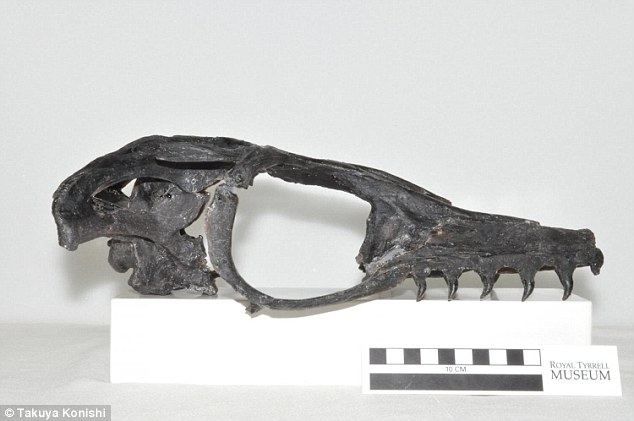
The skull in lateral view showing the huge eye-socket.

The skull in lateral view showing the huge eye-socket.

Picture credit: Takuya Konishi et al.

Commenting on the significance of the size and position of the eyes, lead author Takuya Konishi explained:

“The forward-facing eyes on Phosphorosaurus provide depth perception to vision, and it’s common in birds of prey and other predatory mammals that dwell among us today.  But we knew already that most mosasaurs were pursuit predators based on what we know they preyed upon — swimming animals.  Paradoxically, these small mosasaurs like Phosphorosaurus were not as adept swimmers as their larger contemporaries because their flippers and tail fins were not as well developed.”

A Nocturnal Hunter?

The researchers depict Phosphorosaurus has a nocturnal hunter.  Although the pursuit of prey in deeper water cannot be ruled out.  Phosphorosaurus could be thought of as an owl, whereas the diurnal, larger, more streamlined mosasaurs in the ecosystem were the equivalent of day time hunters such as hawks and eagles.  The binocular vision in nocturnal animals doubles the number of photoreceptors to detect light.  Just like an extant owl, this small mosasaur had very large eye sockets.

A Comparison of the Binocular Vision Potential of Different Mosasaurs
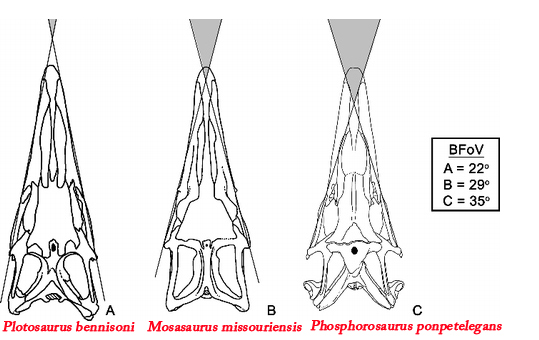
The forward facing vision of Mosasaurs are compared.

The forward facing vision of mosasaurs are compared.

Picture credit: The Journal of Systematic Palaeontology with additional notation by Everything Dinosaur

Key

BFoV = Binocular Field of Vision

A Binocular Field of Vision

In the line drawing above, the field of vision of Phosphorosaurus ponpetelegans (c) is compared to two other mosasaurs.  The skulls are drawn not to scale.  Plotosaurus bennisoni (a) was a much larger, more streamlined mosasaur.  Its fossils come from Upper Cretaceous rocks found in California.  It grew to lengths in excess of twelve metres and it was very probably an open ocean predator relying on its pursuit speed to catch its prey, which probably included other mosasaurs and marine reptiles.  The binocular field of vision for the long-snouted Plotosaurus bennisoni has been calculated to around 22 degrees.  Mosasaurus missouriensis (b)was also a large, apex predator.

Size estimates vary, but this mosasaur, whose fossils come from North America, could have been four times the size of Phosphorosaurus.  It too, was an ocean going predator, but it is depicted as being more bulky and therefore less streamlined than Plotosaurus.  Its binocular field of vision has been calculated at around 29 degrees.  In contrast, the much smaller, shorter snouted Phosphorosaurus with its forward facing and proportionately much larger eyes had a binocular field of vision of around 35 degrees.

What Did Phosphorosaurus Hunt?

Numerous fossils of cephalopods such as squid and ammonites have been recovered from the same strata as the Phosphorosaurus fossil remains.  In addition, fossils of ancient lantern fish have also been found.  The scientists speculate that this mosasaur may have hunted the bioluminescent fish and squid at night.  Larger mosasaurs in the area hunted during the day.

Discussing the potential ecological niche of Phosphorosaurus ponpetelegans Takuya Konishi stated:

“If this new mosasaur was a sit-and-wait hunter in the darkness of the sea and able to detect the light of these other animals, that would have been the perfect niche to co-exist with the more established mosasaurs.” 

Exquisitely Preserved Skull of Phosphorosaurus ponpetelegans

Such is the exquisite quality of the preserved skull, that the researchers hope to be able to piece together more details concerning the evolution and radiation of the mosasaur group as a whole.  Phosphorosaurus has been assigned to the Halisaurinae subfamily of mosasaurs.  Its discovery will help to fill the gap between similar types of mosasaur fossils found in Europe and the Middle East and those from the Eastern Pacific.

Biogeographical Distribution of Late Cretaceous Halisaurine Mosasaurs
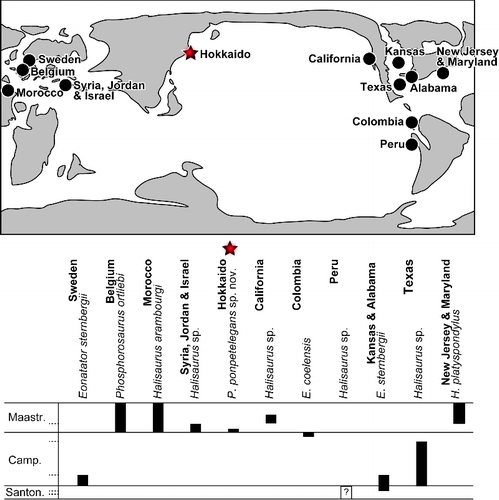
The distribution of the Halisaurine Mosasaurs (Late Cretaceous).

The distribution of the Halisaurine mosasaurs (Late Cretaceous).

Picture credit: Journal of Systematic Palaeontology with additional notation by Everything Dinosaur

The red mark indicates the Phosphorosaurus ponpetelegans fossil location.  It is the most northerly Halisaurine mosasaur discovered to date.

The Teeth of Phosphorosaurus ponpetelegans
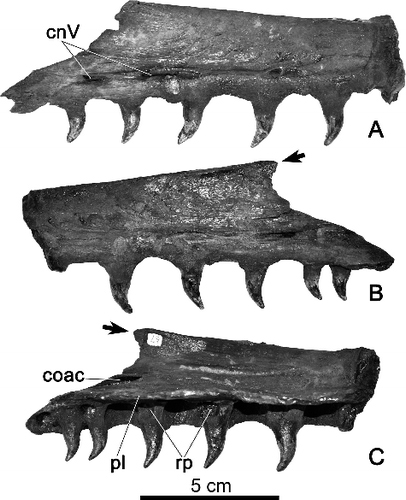
The curved and widely spaced teeth support the idea that this Mosasaur hunted squid.

The curved and widely spaced teeth support the idea that this mosasaur hunted squid.

Picture credit:  Takuya Konishi et al.

PNSO of China have created a range of mid-sized prehistoric animal figures including a Mosasaurus.  To view this range: PNSO Age of Dinosaurs Figures.

8 12, 2015

Australia’s Newest Dinosaur Described in New Scientific Paper

By |2024-05-05T18:19:14+01:00December 8th, 2015|Categories: Dinosaur and Prehistoric Animal News Stories, Dinosaur Fans, Main Page|0 Comments

Kunbarrasaurus ieversi – Sheep-sized Armoured Dinosaur from Australia

Australia has its newest dinosaur.  Kunbarrasaurus has been identified from fossil remains formerly described as Minmi paravertebra following an in-depth, three-dimensional analysis of the skull.  This sheep-sized armoured dinosaur roamed what was to become Queensland around 100 million years ago.

A New Armoured Dinosaur from Australia Kunbarrasaurus

The fossil material, including a very well preserved skull was discovered in 1989 and assigned to the genus Minmi, however, extensive analysis of the fossil began in 2007 and the specimen was subjected to extensive CT scanning and three-dimensional modelling to reconstruct the palate, braincase, inner ear and nasal cavities.  The research team found that this basal member of the clade Ankylosauria was sufficient different from Minmi to warrant setting up in its own genus.

An Illustration of the Lightly Armoured Kunbarrasaurus (K. ieversi)

Kunbarrasaurus ieversi of the Cretaceous (Australia).

Kunbarrasaurus ieversi of the Cretaceous (Australia).

Picture credit: University of Queensland/Australian Geographic

The fossil which is partially articulated, was found eroding out of the mudstone rock exposed at Marathon Station, near Richmond (north-western Queensland).  The strata which makes up the Allaru Formation from which the specimen was excavated, represents a shallow, low energy marine environment.  It is likely that the corpse of this two-metre-long dinosaur was washed out to sea.  Or perhaps this dinosaur was washed out to sea and drowned, either way, its carcase sank and settled on the seabed and it was quickly buried providing excellent conditions for fossilisation and fossil preservation.

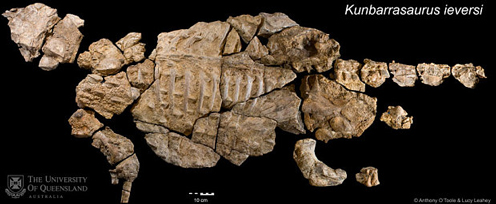
The Fossilised Remains of Kunbarrasaurus

The skull is to the left of the photograph.

The skull is to the left of the photograph.

Picture credit: University of Queensland

Significant Ankylosaur Discovery

The fossils, part of the Queensland Museum collection, represent the most complete dinosaur fossil found to date from eastern Gondwana (Antarctica, India, New Zealand and Australia).  In addition, it is the most complete ankylosaurian fossil known from that ancient, southern super-continent.  The cranial material (skull) is exceptional.  It is one of the few skulls associated with the Ankylosauria clade in which the sutures have not fused or been obliterated by the presence of heavy, dermal armour or the remodelling of bone.

The name Kunbarrasaurus (pronounced koon-bah-rah-sore-us)  means “shield lizard” in the local Mayi language of the indigenous Wunumara people from this part of Queensland.  The species name honours Mr Ian Ievers, the property manager at Marathon Station who discovered the fossil.

Commenting on the study, lead researcher Lucy Leahey, a PhD student at Queensland University stated:

“Ankylosaurs were a group of four-legged, herbivorous dinosaurs, closely related to stegosaurs.  Like crocodiles, they had bones in their skin and are commonly referred to as ‘armoured’ dinosaurs.”  When it was first studied back in the 1990s, the fossil was placed it in the same genus as Australia’s only other named Ankylosaur, Minmi, which is based on some bones from Roma in south-western Queensland.”

Computerised Tomography Yields Clues to Identity

Although a total of seven fossil specimens had been assigned to the genus Minmi, only two had been studied in detail.  In collaboration with scientists from the Denver Museum of Nature and Science the specimen was subjected to a detailed CT scan and from this Professor Lawrence Witmer (Ohio University) was able to reconstruct a complex, three-dimensional model of the skull, the nasal cavities and the inner ear.

Three Dimensional Cranial Osteology Study of Kunbarrasaurus

3-D Map of skull material.

3-D Map of skull material.

Picture credit: University of Queensland

Kunbarrasaurus

Professor Witmer added:

“The CT reconstruction revealed that Kunbarrasaurus had a more complicated airway than other dinosaurs, but less so than ankylosaurs from the Northern Hemisphere.  The inner ear is proportionately enormous and unlike anything we have seen before in a dinosaur.”

Explaining that the inner ear configuration resembles that seen in a Tuatura or a turtle the scientists remain puzzled as to this complicated structures purpose.

One of the paper’s authors Dr Steve Salisbury (Queensland University) stated that the team did not know why the inner ear was shaped in this way.  In addition, the nasal (airway) passages in the skull were also very sophisticated, but not as those seen in more derived, later ankylosaurs found in North America.  These airways could have helped to give this plant-eating dinosaur a powerful sense of smell, or they may have helped keep the brain cool.

For the moment, Kunbarrasaurus has been classified as basal member of the Ankylosauria clade, Dr Salisbury said:

“It [Kunbarrasaurus] appears to represent an early, less heavily armoured member of the group, close to the point at which the Ankylosaurs diverged from the other main lineage of armoured dinosaurs, the Stegosaurs.”

A Single Fossilised Footprint

A single fossilised footprint found in south-eastern Queensland indicates that there may have been at least one type of Stegosaur that lived in this part of the world during the Middle Jurassic.  A spokesperson from Everything Dinosaur commented:

“There is some tantalising evidence to suggest that a number of different types of thyreophoran dinosaur existed in what was to become Queensland during the Jurassic and into the Early Cretaceous.  Tracks and footprints have been recorded from a number of locations and from a number of different aged strata but body fossils are exceptionally rare.  Kunbarrasaurus is only the second armoured dinosaur to be named from Australia.”

For replicas and models of armoured dinosaurs and prehistoric animals: PNSO Age of Dinosaurs Replicas.

7 12, 2015

Duck-billed Dinosaur Blood Described in New Paper

By |2024-05-05T18:20:40+01:00December 7th, 2015|Categories: Dinosaur and Prehistoric Animal News Stories, Dinosaur Fans, Main Page|0 Comments

Researchers Discovery Mineralised Blood Vessels in 80 Million-Year-Old Dinosaur

Stories of dinosaur soft tissue discoveries are becoming relatively common.  The unprecedented power of some of the very latest analytical tools are provided palaeontologists and other researchers with remarkable insights into the lives of the Dinosauria and other extinct creatures.  Once upon a time, the concept of a “dinosaur biologist” was just a pipe dream, but being able to study the biology of non-avian dinosaurs is becoming a distinct possibility.

American scientists including researchers from North Carolina State University and the University of Texas (Austin, Texas) have published details of the discovery of mineralised blood vessels preserved within the fossils of a duck-billed dinosaur – Brachylophosaurus canadensis.

A paper detailing the research “Timothy P. Cleland et al. Mass Spectrometry and Antibody-Based Characterization of Blood Vessels from Brachylophosaurus canadensis”, has just been published in the “Journal of Proteome Research”.

Blood Vessels from the Demineralised Fossilised Bones of a Duck-billed Dinosaur (B. canadensis)

d

Analysis strongly suggests that these are blood vessels.

Picture credit: Mary Schweitzer, North Carolina State University

Dinosaur Blood

Mary Schweitzer, one of the authors of the paper, is a leading authority on the identification of potential soft tissue remains in the fossils of extinct species.  In 2007, she was one of a group of scientists that published a paper detailing the discovery of soft tissue remains within the sixty-eight-million-year-old fossilised femur of a Hell Creek tyrannosaur.  Dr Schweitzer, formerly based in Montana is the Research Curator (palaeontology) at the North Carolina Museum of Sciences, part of North Carolina State University.

To read two articles related to the Dr Schweitzer’s research: The Hunt for Dinosaur DNA and also: Ancient Mosquito Fossil with its Victim’s Blood.

The leader of the research, Dr Tim Cleland (University of Texas) commented:

“This study is the first direct analysis of blood vessels from an extinct organism and provides us with an opportunity to understand what kinds of proteins and tissues can persist and how they change during fossilisation.”

Brachylophosaurus canadensis – Contribution to the Advancement of Science

Thanks to the extensive fossil material associated with this Late Cretaceous hadrosaur, scientists have been able to gain a great deal of information about this particular member of the Dinosauria.  For example, a superbly well-preserved specimen allowed palaeontologists to identify dinosaur stomach contents, other specimens have contributed to our understanding of the radiation and evolution of duck-billed dinosaurs and in 2009, a team of American researchers found evidence of proteins in the femur of a Brachylophosaurus: Dinosaur Femur Reveals Dinosaur Proteins.

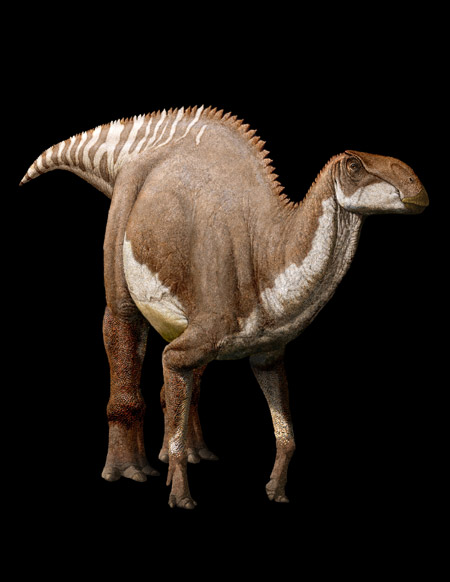
An Illustration of the Duck-billed Dinosaur Brachylophosaurus canadensis

Brachylophosaurus illustrated.

Brachylophosaurus illustrated.

Picture credit: Houston Museum of Natural Science

Structures Resembling Blood Vessels

Structures which resembled blood vessels have been recovered before from fossil dinosaur bones after removal of the mineral material (demineralisation).  In this study, the research team set about testing these structures to see if they were likely to be endogenous to the bone (belonging to Brachylophosaurus) or whether such structures were the result of bacteria colonising the empty spaces in the bone after the original organic components had rotted away.

Using high-resolution mass spectrometry and an immunofluorescence study the scientists found two lines of evidence to support the idea that these structures did originate from the dinosaur and that they represent components of the blood vascular system.  Firstly, peptide sequencing of the extracts from the bone proved to be consistent with peptides from extant archosaurian blood vessels (ostrich and chickens).  Secondly, proteins identified by the mass spectrometry assessment could be localised to the tissues using antibodies specific to these proteins.

One of the proteins identified was myosin, it is found in the smooth muscles associated with the lining of blood vessels.  The scientists report that:

“When all data are taken into consideration, the most parsimonious explanation is that these vessels, derived from demineralised dinosaur bone, are endogenous.”

Outlining the implications for this research, Dr Cleland explained:

“This will provide new avenues for pursuing questions regarding the evolutionary relationships of extinct organisms, and will identify significant protein modifications and when they might have arisen in these lineages.”

Visit Everything Dinosaur’s website: Everything Dinosaur.

6 12, 2015

Isle of Skye Sauropods and Their Water World

By |2023-04-09T16:33:00+01:00December 6th, 2015|Categories: Dinosaur and Prehistoric Animal News Stories, Dinosaur Fans, Main Page, Palaeontological articles|0 Comments

Sauropod Tracks Suggest a Preference for Water

For much of the 19th and 20th centuries, those behemoths of the Dinosauria, the sauropods, were depicted as aquatic animals, at home in the deep water of large lakes, where their enormously heavy bodies could be supported by the water and their weak, peg-like teeth could cope with the soft and lush lakeside vegetation.  A substantial amount of evidence was put forward by scientists to support this hypothesis, not least of which was trackway evidence.

Most sauropod tracks were associated with soft mud, the sort of conditions found close to large bodies of water.  Therefore, it seemed logical to depict these super-sized reptiles as animals at home in lacustrine (lakes), estuaries or riverine dominated habitats.  Thanks to some remarkable Middle Jurassic sauropod footprints, this idea of long-necked dinosaurs preferring to live near to water might just be resurrected and find favour once again in palaeontological circles.

Dinosaur Tracks (Sauropoda) Discovered on the Isle of Skye

Sauropod tracks in hyporelief (Isle of Skye)

Sauropod tracks in hyporelief (Isle of Skye).

Picture credit: University of Edinburgh/Scottish Journal of Geology

Went Out for An Ichthyosaur Came Back with an Ichnogenus!

A party of scientists from Edinburgh University in collaboration with local fossil experts were working on the northern part of the Isle of Skye conducting research into the fauna and flora preserved in strata that makes up the bay just south of the ruin of Duntulm Castle.  Although it is difficult to precisely date the vertebrate fossils found in these rocks, these sediments are believed to preserve evidence of life during the Middle Jurassic and since there are only a handful of highly fossiliferous sites dating from this time in geological history to be found anywhere in the world, the Isle of Skye represents an extremely important location for scientists.

Ironically, the team, which included Dr Steve Brusatte from the School of GeoSciences (Edinburgh University), had set out to recover some Ichthyosaurus fossils but the area where the marine reptile lay remained covered by the high tide.

Sauropod Tracks

Although disappointed, the team continued to document the variety of fossils located on the foreshore and as the light from the relatively low sun cast shadows along the rocky coastline, Dr Brusatte and his colleague Dr Tom Challands came across some large lumps of raised rock.  Protruding from one lump of rock were extensions of the material that gave the distinct impression of digits and substantial claws, particularly on digits I and II.  This pattern is diagnostic of the hind footprint from a sauropod dinosaur.

The Left Hind Foot (Pes) of a Sauropod Dinosaur Isle of Skye

a = dorsal view, whilst b = anterior view, the digits are marked.  Lens cap = 5 cm.

a = dorsal view, whilst b = anterior view, the digits are marked. Lens cap = 5 cm.

Picture credit: University of Edinburgh/Scottish Journal of Geology

The picture above shows one of the rear feet of the sauropod (left pes), the digits are marked and the lens cap, in the picture to provide scale, measures five centimetres in diameter.  The prints are in hyporelief (convex and raised).  The tracks were found in three beds in total (bed 34 and 35 provided trackways, whilst bed 9 provided single prints identified as those from a sauropod plus additional individual tridactyl prints identified as having been made by a large theropod.

The footprints, the largest of which is around seventy centimetres in diameter were made by animals that were around fifteen metres in length and weighed in excess of ten tonnes.  The tracks are the first Sauropod tracks to be found north of the border and represent the largest dinosaur known from Scotland.

Long-Necked Dinosaurs Walking Across a Salt Water Lagoon

The beds from which the prints come from also contain shark teeth, and the remains of marine molluscs.  The strata does not exhibit any signs of mud cracks or drying out, so this evidence, along with the associated fossils, suggests that the sauropods were wading across a shallow salt water lagoon.  Although an ichnogenus has yet to be assigned to these tracks, the University of Edinburgh research team have proposed that the prints are similar to the ichnogenus Breviparopus or perhaps Parabrontopodus.

Sauropod Tracks Discovered on the Isle of Skye

Concave epirelief trackways in bed 35 (Isle of Skye).

Concave epirelief trackways in bed 35 (Isle of Skye).

Picture credit: University of Edinburgh/Scottish Journal of Geology

If you examine the picture above carefully, you can see that despite the size of the prints, they are quite close together.  The footprints of titanosaurs for example, tend to be much wider apart.  These are “narrow gauge” prints perhaps indicative of a cetiosaurid or a diplodocid dinosaur.

To view models and replicas of sauropod dinosaurs: Mojo Fun Prehistoric Animal Models.

Implications for the Habits of Sauropods

As sauropod prints are found in three different beds it could be suggested that these dinosaurs were frequent visitors to this sort of salt water habitat.  Although, it has to be pointed out that it is difficult to determine how much time elapsed between the deposition of the different beds.  The strata could have been laid down over a few centuries or there could be thousands of years between these bedding planes.  One thing that the scientists can be fairly confident about is that between some of the beds in this area there are large concretions of limestone.

The algae and other micro-fossils such as dinoflagellate and preserved palynomorph fossils indicate that these sediments date from the Bathonian age (167.7 to 164.7 million years ago approximately).

A Line Drawing of Some of the Epirelief Prints Showing the “Narrow Gauge” of the Dinosaur Tracks

A line drawing of the Sauropod trackways from bed 35.

A line drawing of the sauropod trackways from bed 35.

Picture credit: University of Edinburgh/Scottish Journal of Geology

Why Live Close to Salt Water?

Dr Challands described the moment when the team became aware of the significance of their discovery as an “epiphany”.  Details of the tracks have been published in the “Scottish Journal of Geology” and these trackways and others like them found elsewhere in the world (including England), have led some palaeontologists to re-examine the evidence for sauropods being entirely terrestrial animals.  The researchers writing in the journal state:

“The Skye site presents a confluence of evidence for sauropods living in the region of a submerged lagoon over multiple generations.”

There might have been a number of advantages for the sauropods if they lived close to large bodies of water, for example:

  • Sandy beaches would have made natural thoroughfares for these large creatures providing access to the edge of forests adjacent to the shoreline.
  • Open areas would have limited the chances of these plant-eating dinosaurs being ambushed by theropods.
  • Lagoons are associated with abundant food supplies.
  • By wading or wallowing in the water these creatures would have been able to cool their large bodies very effectively.
  • The salt water and mud would have provided relief from biting insects.
  • Few predators would have been prepared to venture out into the lagoon to hunt the sauropods.

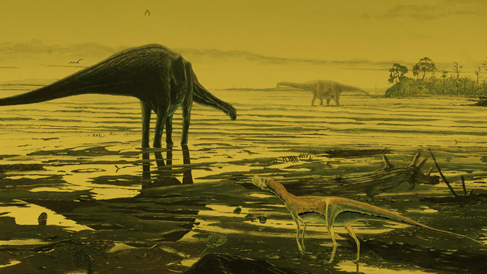
The Isle of Skye in the Middle Jurassic

The Isle of Skye (Bathonian faunal stage).

The Isle of Skye (Bathonian faunal stage).

Picture credit: Jon Hoad

The illustration above shows two sauropods on the mud flats of the lagoon, whilst in the foreground a small, theropod (Ornitholestinae subfamily) looks on warily.

A Significant Middle Jurassic Discovery

Commenting on the trace fossils and their importance to palaeontology, Dr Brusatte stated:

“The Middle Jurassic was a really interesting period in the history of life, when there was a whole lot of evolution going on. What is really frustrating is that we have a lot of fossils from different places with fossils from the Early Jurassic and the Late Jurassic, but there is relatively little fossil-bearing Middle Jurassic rock around.”

The Isle of Skye fossils pose some intriguing questions, these tracks most likely were made by primitive sauropods at a time when the Sauropoda were beginning to radiate, differentiate and evolve into a number of new forms.

In addition, the strata preserves evidence of multiple generations of sauropods inhabiting lagoonal environments, which suggests the intriguing possibility that these huge creatures might have sought out such habitats, preferring them to inland areas.

Do these tracks preserve evidence of Isle of Skye sauropods and their water world?

5 12, 2015

Xenokeryx and Giraffes – Something to Ruminate On

By |2023-04-09T16:22:47+01:00December 5th, 2015|Categories: Dinosaur and Prehistoric Animal News Stories, Main Page|0 Comments

Miocene Ruminant Related to Modern Giraffes

If we set aside those ubiquitous rodents for a moment, then the ruminants could rightly lay claim to being one of the most diverse, geographically widespread and successful of all the mammals.  The first ruminants appeared during the Eocene Epoch and they certainly evolved into some weird and wonderful forms.  Take the latest edition to the ruminant family Xenokeryx amidalae for example, this strange Miocene beast with three horns and fangs may have helped resolve the taxonomic affinities of giraffes and the enigmatic okapi within the Class Mammalia.

Xenokeryx amidalae

An Illustration of the Newly Described Xenokeryx amidalae

Xenokeryx illustration

Xenokeryx illustration.

Picture credit: Departamento de Paleobiología, Museo Nacional de Ciencias Naturales-CSIC, Madrid, Spain

Ruminants include camels, deer, giraffes, goats, bovoids (cattle), sheep, antelopes, gazelles and a number of extinct families.  They have a highly specialised digestive tract that allows them to extract nutrients from tough plant matter through the process of fermentation.  Many evolved horns or antlers for use in fighting or display.

Palaeomerycids

Prior to this Spanish discovery one ancient group of ruminants the extinct palaeomerycids were thought to be closely related to the lineage of ruminants that led to the deer and antelope (dromomerycids).

However, analysis of the skull, teeth and horns of Xenokeryx amidalae suggests that the palaeomerycids are ancestral to the giraffids, represented today by the giraffe and the okapi.

A New Type of Palaeomerycid

The researchers from the National Museum of Natural Sciences (Madrid), in conjunction with Berlin based colleagues were able to examine the beautifully preserved fossilised remains of an entirely new type of palaeomerycid.  These fossils were unearthed from a fossil site first explored in 1989 located near to the town of Loranca del Campo (Cuenca Province, Spain).  A number of vertebrate fossils have been collected from this highly fossiliferous site (La Retama), representing the flora and fauna of an open grassland dotted with isolated lakes.

The rocks that have produced the fossils of X. amidalae have been dated to around 15.9 to 15.4 million years ago (Langhian faunal stage of the Miocene).  Many of these early ruminants had fang-like teeth, some living deer species still have these teeth, they are used to settle disputes in the herd or in fights over mates.

Skull Material Including the Occipital Appendage (A-C) and he Cranial Ossicones (D-I)

Cranial material including a bizarre "T-shaped" bony appendage.

Cranial material including a bizarre “T-shaped” bony appendage.

Picture credit:  Departamento de Paleobiología, Museo Nacional de Ciencias Naturales-CSIC, Madrid, Spain

Three Horns

Like all palaeomerycids, Xenokeryx possessed three horns.  One was a strange “T-shaped” occipital process that formed a bizarre structure at the top of the skull.  The other bony horns (referred to as ossicones) were positioned over the eyes.  It is the strange occipital appendage that gave rise to the trivial name for this new palaeomerycid.  The bony structure reminded the scientists of the bizarre headgear of Queen Padme Amidala from the planet Naboo in the fourth Star Wars movie “The Phantom Menace”.  The genus name, Xenokeryx translates as “strange or alien horn”.

A New Analysis of the Ruminant Family Places Xenokeryx Basal to the Giraffids

Ancient ruminants (top) compared to extant ruminants (bottom) Queen Amidala (Star Wars) headdress inspires trivial name.

Ancient ruminants (top) compared to extant ruminants (bottom) Queen Amidala (Star Wars) headdress inspires trivial name.

Picture credit: Israel M. Sánchez (Museo Nacional de Ciencias Naturales-CSIC, Madrid, Spain).  The illustration of Pediomeryx is by Tori Morris.

The picture above shows the newly described Spanish palaeomerycid Xenokeryx (top left) compared to the North American extinct dromomerycid Pediomeryx (top right).  An extant giraffe is picture below the Xenokeryx whilst the photograph underneath Pediomeryx is that of an extant muntjac (genus Muntiacus), a  small deer.

Star Wars Inspiration

The study suggests that just as in the picture above the animals on the left are more closely related to each other than they are to the animals depicted on the right.  The photograph of Queen Amidala provides a clue to the inspiration behind the species name.

Commenting on the study, lead author of the research, Israel M. Sánchez stated:

“Xenokeryx has not only allowed us to learn more about the group ruminants to which it belongs, the palaeomerycids, but also has provided critical data about the origin and early history of the evolutionary line of one of the strangest ruminants families today the giraffes. “

The X. amidalae fossils have provided scientists with a better understanding of palaeomerycid anatomy and permitted the phylogenetic tree to be redefined for the ruminant group, nesting the palaeomerycids away from deer and antelope and within a clade that includes giraffes, the okapi and their ancestral forms.

A Close Up of the Spectacular Bony Skull Ornamentation (Occipital Appendage)

Fossil evidence suggests an ancestor of extant giraffes.

Fossil evidence suggests an ancestor of extant giraffes.

Picture credit: Departamento de Paleobiología, Museo Nacional de Ciencias Naturales-CSIC, Madrid, Spain

This new fossil find and the subsequent research has certainly given palaeontologists something to chew over.

4 12, 2015

Fearsomely Fanged Triassic Pterosaur from Utah Described from New Fossil Discovery

By |2024-05-05T14:49:46+01:00December 4th, 2015|Categories: Dinosaur and Prehistoric Animal News Stories, Dinosaur Fans, Main Page|0 Comments

New Pterosaur Genus Discovered in Utah

Much excitement was generated at the annual Society of Vertebrate Palaeontology conference in Dallas (Texas), when Brooks Britt, an Associate Professor of Geology at Brigham Young University (Utah) updated the audience on a remarkable fossil discovery from north-eastern Utah, close to the State border with Colorado.  During the Late Triassic, the western part of North America was covered in vast sand dunes.  The area resembled the Sahara of today.  Just like in the Sahara, there were pockets of life clustered around water sources.

Associate Professor Britt and his colleagues have for some years now been excavating the fossilised remains of fauna that lived around an oasis approximately 210 million years ago.  For these residents, surrounded by the desert, their collective luck ran out when during a severe drought the water evaporated and much of this ancient ecosystem was wiped out.  The bad luck of the Triassic animals is good fortune for palaeontologists as they have been able to piece together a remarkable picture of the fauna of this Late Triassic oasis.

Triassic Pterosaur

One of the most impressive discoveries made so far, came in 2014.  The quarry known as the Saints and Sinners Quarry had been explored for more than a decade.  The beds that make up the quarry are fossiliferous as they represent lake shoreline sediments, rocks laid down at an oasis that was surrounded by vast desert dunes.  Brigham Young University student Scott Meek unearthed from the sandstone the partial remains of a pterosaur.

Pterosaur fossils from the Late Triassic and Early Jurassic are rare in North America.  The specimen has yet to be formally described and named but it does represent a new species (most likely a member of the Dimorphodontidae family or possibly ancestral to this pterosaur family).

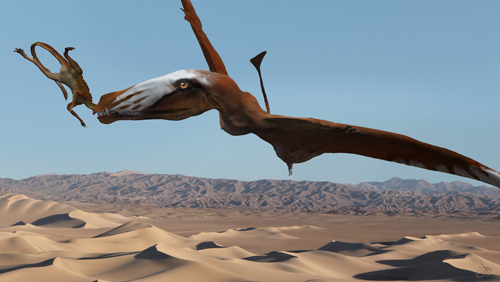
An Concept Drawing of the New Late Triassic Pterosaur from Utah

Four-fanged hunter of the oasis.

Four-fanged hunter of the oasis.

Picture credit: Josh Cotton

Although not large when compared to later members of the Pterosauria, the Utah specimen had a wingspan of around 1.3 metres, making it about the size of a modern day European Herring Gull (Larus argentatus).  It had a large head and a jaw lined with over one hundred pointed teeth (110 in total).

Fangs on a Triassic Pterosaur

Four of the teeth, located towards the front of the lower jaw were more like fangs.  The largest of them measures 2.5 centimetres long.  This is one pterosaur that would have looked very mean indeed!  The orbits (eye-sockets) are smaller than seen in other members of the Dimorphodontidae family, perhaps as this flying reptile lived in a very bright and sunlit environment with lots of glare from the surface of the lake and the surrounding desert it may have evolved smaller eyes to help protect its vision from the excessive bright light, although this is only speculation on our part and we await with interest the scientific paper on the pterosaur specimen that will probably be published next year.

A Triassic Oasis – Teeming with Life

Associate Professor Britt specialises in studying sediments.  These sediments help to build up a picture of the climate and the environment at the time.  These sandstones have also revealed what happened to the animals that depended on the oasis and why the fossil assemblage came to be formed, Brooks Britt explained:

“The animals likely died during a severe drought, and the sediments indicate their carcasses were buried when the rains returned to normal and the lake filled, with the lapping waves burying the bones with sand.”

The fossil is also relatively three-dimensional.  Most pterosaur fossil bones are easily crushed and distorted.  Associate Professor Britt added:

“Outside of a find in Greenland, this is the first good Triassic pterosaur from North America.”

The scientists also found a wealth of other vertebrate fossils, including at least twenty individual Coelophysoid theropod specimens, plus the teeth of a much more substantial meat-eating dinosaur.  In addition, cursorial crocodylomorph fossils (the victim in the pterosaur illustration), along with evidence of sphenosuchians and a drepanosaurid, a representative of a bizarre group of Late Triassic reptiles that may have been arboreal, were discovered.

Why Didn’t the Pterosaur Fly Away?

All the other vertebrate fossils found at the dig site are from entirely terrestrial animals.  These animals would have been effectively trapped by the desert and not capable of travelling the distance required to find a new habitat when the oasis began to dry up, but why didn’t the pterosaur just fly away?  Perhaps other pterosaurs were able to leave and this fossil represents an old or sick individual.

Or alternatively, the shape of the pterosaur’s wings may provide a clue.  The wings of this creature are relatively short and broad, suggesting that they were not adapted to long distance flight.

These wings are more suited to short flights with the need to dodge and to weave, perhaps round obstacles such as trees.  This new pterosaur may have been an agile flier well suited to a life hunting in the trees close to the lake, but once the lake dried up, it may not have been capable of travelling the large distance required in order to find a new home.

We look forward to reading more about the “Saints and Sinners” pterosaur in 2016.

For scale models of pterosaurs and other prehistoric animals: CollectA Deluxe Scale Prehistoric Animal Models.

3 12, 2015

Ancient Mom – Oldest Brood of Preserved Embryos Found

By |2023-04-09T15:47:18+01:00December 3rd, 2015|Categories: Dinosaur and Prehistoric Animal News Stories, Main Page|0 Comments

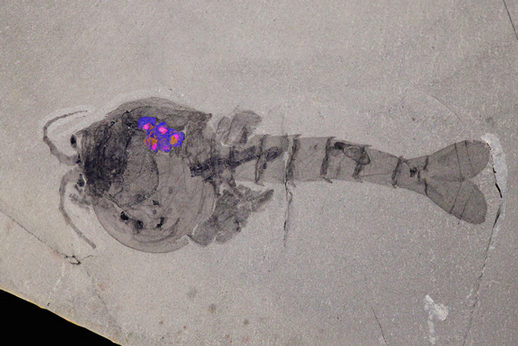
Evidence of Survival Strategies – Caring for Young (Waptia fieldensis)

The Cambrian was a critical time in the history of life on our planet and the Burgess Shale deposits of British Columbia have helped scientists to piece together a lot of data on the diverse marine fauna that evolved during this geological period. Some sophisticated survival strategies have been identified, including the earliest evidence recorded of brood care in an invertebrate.  A research paper published this month details the discovery of a shrimp-like creature with about two dozen eggs preserved with embryos inside its body, making it the earliest example of brood care with preserved embryos in the fossil record.

Waptia fieldensis Fossil Scanning Electron Microscope

The  eggs are highlighted purple in this scanning electron microscope image.

The eggs are highlighted purple in this scanning electron microscope image.

Picture credit: Royal Ontario Museum

Waptia fieldensis

The marine arthropod known as Waptia fieldensis is one of the more abundant fossils to be found preserved in the rocks that mark the location of the Burgess Shales.  The animal was named and scientifically described in 1912 by the great Charles D. Walcott, the American geologist who discovered the Burgess Shale deposits back in 1909.  The fossils preserve the fauna of the Middle Cambrian (about 508 million  years ago), in exquisite detail.

The research team was composed of scientists from the Royal Ontario Museum (Toronto) and the Université Claude Bernard (Lyon, France), they examined a total of 979 Waptia specimens from the Royal Ontario Museum’s own extensive Burgess Shale fossil collection and a further 866 specimens housed at the Smithsonian Institution National Museum of Natural History (Washington D.C.).  From this sample, the team identified five fossils from the Canadian collection that contained eggs.

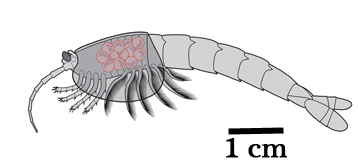
An Illustration of Waptia fieldensis

Waptia fieldensis grows to a maximum size of around 8 centimetres.

Waptia fieldensis grows to a maximum size of around 8 centimetres.

Picture credit: Royal Ontario Museum

Looking after the young, including carrying the eggs or juveniles is a form of parental care.  This is a survival strategy as it enhances the offspring’s chances of becoming an adult.  Rather than abandoning the eggs, these little creatures, which are distantly related to extant crabs, lobsters and shrimps, gave their babies a better chance of survival.  The implication is that there were a large number of predators around who would have happily consumed the young and therefore a strategy such as this would have made sense within a complex food web.

For models and replicas of Palaeozoic invertebrates and other prehistoric animals: CollectA Prehistoric Life Models.

When Did Parental Care Arise?

One of the outstanding questions in palaeontology is at what point did such brood care strategies arise?  Parental care is known to have evolved independently in a number of different types of animal, it has been thought that such strategies evolved as a response to predation pressure, a harsh environment or an environment where resources such as food and shelter were not consistently available (ephemeral resources).

Lead author of the academic paper, Jean-Bernard Caron, (Curator of Invertebrate Palaeontology, Royal Ontario Museum) stated:

“As the oldest direct evidence of a creature caring for its offspring, the discovery adds another piece to our understanding of brood-care practices during the Cambrian explosion, a period of rapid evolutionary development when most major animal groups appear in the fossil record.”

Co-author Jean Vannier (Senior Researcher at the Université Claude Bernard), added:

“This creature is expanding our perspective on the diversification of brood care in early arthropods.”

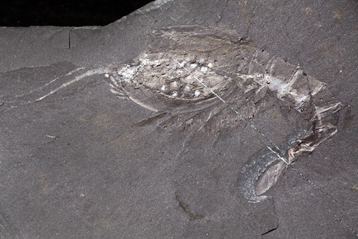
A Fossil of Waptia fieldensis (Burgess Shale)

A fossil of the ancient Arthropod W. fieldensis.

A fossil of the ancient arthropod W. fieldensis.

Picture credit: Royal Ontario Museum

Eggs Held in Place on the Underside of the Carapace

The clusters of eggs were held in place on the underside of the carapace, significantly all the specimens carrying embryos showed small clutch sizes.  Up to twenty-four eggs were recorded per specimen, the eggs were also relatively large compared to many extant arthropod species (egg size over 2 mm).  It seems that this ancient arthropod evolved a breeding strategy that involved the production of fewer offspring but the low numbers were balanced by the greater degree of parental care shown.

In simple terms, some arthropods produce many hundreds of eggs but these are scattered and left to drift, to fend for themselves, what we at Everything Dinosaur call this a “blunderbuss” approach to reproduction.  If only two or three of these eggs make it to adulthood and breed then the survival of the species is secured for at least another generation.  However, W. fieldensis seems to have adopted a different strategy, investing more time, energy and care per embryo, a sort of “rifle” approach to reproduction.

Different Parental Strategies Observed in Cambrian Fossils

The strategy adopted by W. fieldensis is in contrast with the arthropod called Kunmingella douvillei from the Chengjiang biota (ca. 515 million years ago).  K. douvillei fossils from China, show that this nektonic animal had a high number of small eggs.  No embryos have as yet, been identified in the Chinese fossil material.  As Waptia fieldensis lived some 7 million years after Kunmingella douvillei, it suggests that there was a rapid evolution of a variety of modern-type life-history traits, including a greater investment in offspring survivorship, soon after the Cambrian explosion.

Jean Vannier explained:

“The relatively large size of the eggs and the small number of them [in W. fieldensis] contrasts with the high number of small eggs found previously in another bivalved arthropod, known as Kunmingella douvillei.  And though that creature predates Waptia by about 7 million years, none of its eggs contained embryos.”

The fact that W. fieldensis and K. douvillei carried their eggs in different ways hints that brood care evolved in a number of directions during the Cambrian period.  In addition, the bivalved carapace likely played an important role in arthropods’ brood care, as researchers have already noted the structure’s presence in egg-carrying Middle Ordovician ostracods dating to 450 million years ago.

The study was published online Dec. 17 in the journal Current Biology.

Visit Everything Dinosaur’s award-winning website: Everything Dinosaur.

2 12, 2015

Texas Pterosaurs and Their Close English Cousin

By |2023-04-09T13:53:22+01:00December 2nd, 2015|Categories: Dinosaur and Prehistoric Animal News Stories, Dinosaur Fans, Main Page|0 Comments

North America’s Newest Pterosaur – Cimoliopterus dunni

A new species of fish-eating, toothy flying reptile has been named and described from a partial rostrum found by an amateur fossil hunter in Texas.  This new Texas pterosaur named Cimliopterus dunni is the second in the Cimliopterus genus, the first, now named Cimliopterus cuvieri is known from fossil material found close to Maidstone in Kent (southern England).  This newly described Texan pterosaur links Texas to England according to the author of the scientific paper just published in the academic journal the “Journal of Vertebrate Paleontology”, Dr Timothy S. Myers.

The Fossilised Rostrum (beak) of the New Texan Pterosaur

Texas Pterosaur had an English cousin.

Texas pterosaur had an English cousin.

Picture credit: Hillsman Jackson, Southern Methodist University

In the picture above, the Texas fossil specimen, found in 2013 is compared against the illustrations made of the 1851 Maidstone fossil find.

Small Fossil = Big Problems

Both the English 1851 pterosaur fossil (found in a chalk pit near Maidstone, Kent) and the Texas material belong to the family of pterosaurs called the Ornithocheiridae, a diverse and globally distributed pterosaur family.  They have both been assigned to the genus Cimoliopterus, however, the English fossil material was known by several other names before finally being assigned a genus of its own back in 2013, coincidently the same year as the Texas rostrum was found, as prolific amateur fossil collector Brent Dunn was exploring the spillway of Lake Lewisville, north of Dallas.

Many of the pterosaur fossils found in southern England and assigned to the Ornithocheiridae are extremely fragmentary.  During the latter half of the 19th century some of the leading scientists of the time, Owen, Seeley and Hooley studied the very worn and poorly preserved pterosaur fossils excavated from the upper Cretaceous chalk deposits of southern England.  Between name they named a number of genera, most of which were based on mere scraps of fossils with very few if any clearly defined autapomorphies (distinctive anatomical features).

Assigned to the Pterodactylus Genus

When first described, the Maidstone specimen was assigned to the Pterodactylus genus, over the years this assessment fell out of favour and various other names were erected.  Richard Owen for example, re-named this specimen as Coloborhynchus cuvieri.  Further revisions followed, just two years ago the specimen was assigned its own genus and named Cimliopterus cuvieri (Rodrigues and Kellner).  The genus name means “chalk wing”, the species name in this case honours the French scientist and anatomist Georges Cuvier.  The Texas trivial name honours the fossil finder – Brent Dunn who sadly passed away a few months after his discovery.

As both the English and American fossils were found in marine sediments, biostratigraphical dating has been carried out.  These fossils date from the Cretaceous, from around 94 million years ago, a time when the Atlantic was beginning to open up and North America was splitting away from Europe as the super continent of Laursaia broke up.

Pterosaur Relatives from Two Diverging Landmasses

Closely related flying reptile species one from the southern United States and one from southern England suggests that these reptiles moved between North America and England earlier in the Cretaceous, despite the gradual widening of the nascent Atlantic Ocean, a process that is on-going today.  They are different species so some evolutionary divergence must have occurred, in essence two groups of the same species became separated and gradually over time they took slightly different evolutionary paths resulting in two distinct species being found in the fossil record.

Commenting on his research, Dr Myers (Research Curator, Shuler Museum of Palaeontology, Southern Methodist University) stated:

“The Atlantic opened the super-continent Pangaea like a zipper, separating continents and leaving animal populations isolated, so gene flow ceased and we start to see evolutionary divergence.  Animals start to look different and you see different species on one continent versus another.  Pterosaurs are a little trickier because unlike land animals they can fly and disperse across bodies of water.  The later ones are pretty good flyers.”

A Typical Member of the Ornithocheiridae (Guidraco from China)

Model has an articulated jaw.

Model has an articulated jaw.

Picture credit: Everything Dinosaur

The picture above shows a typical member of the Ornithocheiridae pterosaur family.  As a group they are noted for their dentition (teeth), the long and pointed fangs of these creatures were particularly well suited to catching fish.  Most of the fossils of ornithocheirids are associated with marine deposits, so it has been suggested that these pterosaurs were accomplished fliers able to soar effortlessly over the sea rather like some species of sea bird do today.

The CollectA Deluxe model range contains a number of scale models of iconic pterosaurs: CollectA Deluxe Prehistoric Life Models.

The Lack of Toothy Pterosaur Fossils from North America

The fossil record to date shows that toothed pterosaurs are generally abundant during the Cretaceous in Europe, Asia and South America, but the fossils of this type of flying reptile are exceedingly rare in North America.

The new Texas native, Cimoliopterus dunni, is only the third toothed pterosaur species from the Cretaceous of North America.   All three of the toothy Cretaceous-era pterosaurs discovered so far from North America were found in the “Lone Star” State.   Even so, Cimoliopterus dunni is most closely related to England’s Cimoliopterus cuvieri and not to the other two genus of Texan toothy pterosaur so far named (Aetodactylus halli, also named by Dr Myers (2010) and Uktenadactylus wadleighi* which was named in 1994).

Texan Pterosaurs

Despite all three Texan toothed pterosaurs being assigned to the Ornithocheiridae family, the two other pterosaurs are associated with older strata.  In the case of Uktenadactylus*, these fossil remains are associated with rocks at least ten million years older than the marine shale deposits where the rostrum of Cimoliopterus dunni was found.

To read Everything Dinosaur’s article on the discovery of Aetodactylus: The Expanding Ornithocheiridae, say hello to “Eagle Finger” of Texas.

Ironically, Uktenadactylus also has a very close relative known from England – Coloborhynchus clavirostris known from the Albian age Cambridge Greensand deposits which underlie many of the chalk formations to be found in England.

Dr Myers explained:

“Given the small sample size, it’s odd that we have two that are so closely related to the English species.  It’s hard to draw any statistically significant conclusions from that, but it definitely indicates this is not a one-off, and that there was some relatively strong, significant connection.  Two means a lot more than one in this case.”

Dr Myers is not hypothesising about a land bridge connecting these two continents, although sea levels may have fluctuated over time resulting in these types of pterosaur indulging in a bit of “island hopping” only for the sea levels to rise again, isolating groups of these flying reptiles which led to the speciation.

The Bizarre Global Distribution of the Toothed Pterosaurs

Despite the identification of a third species of toothy Pterosaur from Texas, the mystery of why there is so little evidence to tie in North American and South American Pterosauria remains.

Dr Myers added:

“There are toothed Pteranodontoids in South America, lots of individuals and lots of different species, but no close relatives to the toothed Pteranodontoids in North America.  That might indicate there was some barrier to dispersal from the south.  It’s unusual we don’t see a connection between these pterosaur populations.  Maybe we will when we find more of this material.”

The quest to find more toothed pterosaur specimens can catch even the most dedicated and experienced palaeontologist out.  Back in January 2011, Everything Dinosaur reported on the naming of a new genus of toothed pterosaur identified from a partial jaw discovered in Canada.  The pterosaur was named Gwawinapterus beardi.  However, subsequent analysis revealed that the fossil specimen was more likely to have come from a prehistoric predatory fish.

To read about the Canadian discovery: New Pterosaur with Teeth Like a Piranha.

Gwawinapterus Unravelled: Mistake in Naming Flying Reptile.

*Formerly known as Coloborhynchus wadleighi.

30 11, 2015

Late Cretaceous Eastern North America into the Spotlight

By |2023-04-09T07:37:52+01:00November 30th, 2015|Categories: Dinosaur and Prehistoric Animal News Stories, Dinosaur Fans, Main Page|2 Comments

Ceratopsians from Appalachia

A serendipitous discovery made by Dr Nick Longrich (University of Bath), whilst exploring the fossil collection of the Yale Peabody Museum (New Haven, Connecticut) has helped to provide a tantalising glimpse into the Late Cretaceous dinosaur fauna of North America.

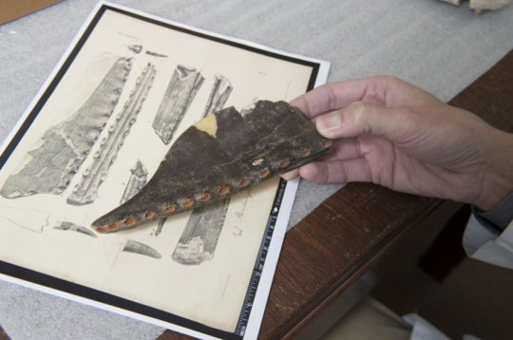
Fragment of Jawbone from North America

The fragment of upper jawbone (maxilla) has been identified as coming from a early member of the horned dinosaur family and it reinforces the idea that thanks to the Western Interior Seaway, the dinosaurs on the eastern part of the landmass that we now know as North America were very different and genetically diverging from the dinosaurs living on the western part of the continent.

Although to the casual observer the fossil specimen looks like a mere scrap of fossil bone, this is the first evidence of a horned dinosaur found in eastern North America.

An Artists Impression of What the Dog-sized Dinosaur Would Have Looked Like

First fossil evidence of Ceratopsians in eastern North America.

First fossil evidence of Ceratopsians in eastern North America.

Picture credit: Nicholas Longrich/University of Bath

A Dog-sized Dinosaur

Described as being about the size of a Labrador dog, Dr Longrich has not been able to assign a genus to his fossil find.  However, this does represent a new species, one that is difficult to name given the lack of fossil material.

Dr Longrich (from the Milner Centre for Evolution, part of the Department of Biology and Biochemistry at Bath University), was examining some of fossils held in the collection of the Peabody Museum at Yale University when he noticed the jaw fragment.  It had been found on a farm in North Carolina in 1985 and labelled as a maxilla from a duck-billed dinosaur.

Intrigued by the bizarre shape of the bone and not being able to place the maxilla within any hadrosaurid genus that was familiar to him, Dr Longrich decided to study this fragment in greater detail.

Views of the Maxilla Identified as Ceratopsian

Various views, dorsal, lateral,ventral etc.

Various views, dorsal, lateral, ventral etc.

Picture credit: Nicholas Longrich/University of Bath

Although the fossil bone was only around four centimetres in length, Nicholas was able to compare this fragment of upper jaw with other ornithischian dinosaurs and the short teeth sockets, the tooth socket arrangement in the jaw and their shape and the way that the toothrow curved led him to assign this fossil to the Leptoceratopsidae family.

Introducing the Leptoceratopsids

The Leptoceratopsidae are a family of ceratopsids known from fossil finds from Asia and North America, although some fragmentary fossils from Sweden and Australia have been assigned by some authors to this family.  They are characterised by their small size (less than three metres long), presence of a neck frill but no horns other than pronounced jugal bones.  They may have been facultative bipeds, mostly walking on all fours but with the ability to walk or run on their hind legs should the need have arisen.

Regarded as basal ceratopsians, this is a bit of a misnomer as the group persisted until the very end of the age of dinosaurs with a number of species living alongside the giant quadrupeds such as the better known horned dinosaurs such as Styracosaurus, Triceratops and Centrosaurus.

The number of genera in this family has been swelled in recent years due to a number of new fossil discoveries such as Zhuchengceratops from China and Gryphoceratops and Unescoceratops from southern Alberta (Canada).

A Unique Slender and Down-turned Toothrow

The maxilla has some unique autapomorphies (unique anatomical characteristics).  It is long, narrow and down-curved, this suggested a specialised feeding strategy.  What exactly this little herbivorous dinosaur fed on is open to speculation but during the time when it lived (around 77 million years ago), the flowering plants were rapidly evolving.  Perhaps, it evolved to feed on a certain group of plants that represented the undergrowth of forests and woodlands.

A Dinosaur from a “Lost Continent”

During the later stages of the Cretaceous, rising sea levels cut the continent of North America in two.  In the east, the long spit of land called Laramidia existed and thanks to the wealth of fossil finds from Alberta, Utah and Montana a great deal is known about the dinosaur fauna that roamed the eastern part of the divided landmass.

The fauna of the eastern part, called Appalachia, is not well known in comparison.  Fossil discoveries have been few and far between, much of the Cretaceous-aged fossil bearing material has been eroded away and not a great deal of sedimentary, fossil-bearing strata is exposed in the eastern part of the United States when compared to the vast open spaces of the west.

The Continent of North America During the Late Cretaceous

A mixing of faunas, at least amongst elements of the Ceratopsidae.

Lots of information known about Laramidia ceratopsids but this is the first fossil ceratopsid bone identified from Appalachia.

Picture credit: University of Bath

The leptoceratopsid fragment fits into a larger pattern of dinosaur evolution.  It does not resemble any of the Leptoceratopsidae genera known from Laramidia.  This suggests that as the landmass of Appalachia became more and more isolated, genetic divergence occurred with the isolated dinosaur species evolving different forms from their cousins in the west.

For models and replicas of North American dinosaurs and other prehistoric animals: Wild Safari Prehistoric World Models and Replicas.

Asian Dinosaurs in North America?

Many of the dinosaurs from Laramidia resemble Asian dinosaurs more closely than those identified from Appalachia.  Tyrannosaurus rex for example, had an Asian cousin Tarbosaurus bataar.  There is also a close resemblance in hadrosaur faunas.  From time to time as sea levels rose, the northern tip of Laramidia was able to connect with Asia, a land-bridge was formed and this enabled periods of fauna exchange between the continents to occur.  However, Appalachia remained an island for much of the Late Cretaceous and this permitted a largely unique dinosaur fauna to evolve.

Dr Longrich’s paper on the Leptoceratopsidae maxilla has been published in the academic journal “Cretaceous Research”.  Thanks to his keen eyesight whilst exploring the Peabody Museum, the Late Cretaceous dinosaur fauna of eastern North America is well and truly in the spotlight.

Visit Everything Dinosaur’s award-winning website: Everything Dinosaur.

28 11, 2015

The Amazing Jehol Biota and Sea Turtle Origins

By |2024-05-05T14:51:00+01:00November 28th, 2015|Categories: Dinosaur and Prehistoric Animal News Stories, Dinosaur Fans, Main Page, Palaeontological articles|0 Comments

Scientists Use Chinese Cretaceous Turtle Fossils to “Crack” Turtle Evolution

Turtles and tortoises are representatives of a very ancient group of reptiles and scientists have much still to learn about their origins and how the Chelonia (the name given to tortoises, turtles and terrapins) evolved, but new research by a joint German, Hungarian and Chinese research team is helping to shed some light on these shelled creatures.  The scientists have been studying the beautiful, fossilised remains of Early Cretaceous turtles from north-eastern China in a bid to determine how the first sea turtles arose.

The extant sea turtles found today, represent just a tiny portion of what was once, a hugely diversified group.  There are just seven species, the majority of which are very vulnerable to extinction.  The first sea turtle fossils appear in Cretaceous aged rocks some 130 million  years old, it is very likely that these marine animals evolved from a common, freshwater ancestor, although this ancestor has yet to be identified.

A New Study of the Jehol Biota

In this new study, Dr Chang-Fu Zhou of the Shenyang Normal University of Liaoning and Dr Márton Rabi of the Biogeology Workgroup of the University of Tübingen and the Hungarian Academy of Sciences tried  to identify the ancestors of modern sea turtles from amongst the many excellent turtle fossils that represent the famous Jehol Biota of the Early Cretaceous of north-eastern China.

An Example of One of the Exquisitely Preserved Turtle Fossils Affiliated to the Jehol Biota

The newly-described fossil species, Xiaochelys ningchengensis, from northeastern China’s Jehol Biota; right: an illustration of the skeleton incorporating positive and negative impressions preserved in the layers of stone

The newly-described fossil species, Xiaochelys ningchengensis from north-eastern China’s Jehol Biota; right: an illustration of the skeleton incorporating positive and negative impressions preserved in the layers of stone.

Picture credit: Chang-Fu Zhou

The picture above shows the slab and counter slab of the newly described Cretaceous turtle Xiaochelys ningchengensis from north-eastern China.  To the right of the photograph a line drawing has been produced to show the preserved features of the shell (scale bar = 20 mm).

The Importance of the Jehol Biota

The Jehol Biota is a rich Cretaceous ecosystem preserved in a multi-layered rock formation cropping out in the Chinese provinces of Liaoning, Hebei and Inner Mongolia.  The habitat represented is that of a temperate forest zone, with large lakes in situ.  Nearby, volcanoes occasionally covered the area in fine ash and this led to the exquisite preservation of many of the fossils to be found in these regions.  The most famous fossils associated with these strata are feathered dinosaurs, animals such as Sinosauropteryx, Sinornithosaurus, Microraptor and the recently described  Zhenyuanlong suni.

To read an article about the significance of the Jehol Biota: Unravelling the Sequence of Deposition in North-eastern China.

To read an article about the “winged dragon”  Zhenyuanlong suni: A New “Winged Dragon” from China.

North-eastern China Around 130-125 Million Years Ago

A rich and diverse Jurassic environment dominated by small mammals, Pterosaurs and feathered Theropods.

A rich and diverse environment dominated by small mammals, pterosaurs and feathered theropods.

Picture credit: Julia Molnar

Models of Prehistoric Animals

PNSO of China have created a range of prehistoric figures, many of which represent pterosaurs, dinosaurs and other creatures associated with the Jehol Biota: PNSO Age of Dinosaurs.

Ironically, despite this part of the world’s connection with feathered dinosaurs, the first vertebrate of the Jehol Biota to be described was a freshwater turtle (1942).

Xiaochelys ningchengensis – A New Species of Freshwater Turtle

The research team have described a new species of freshwater turtle, adding to the rich vertebrate assemblage known to have existed in this part of the world during the Early Cretaceous.  A study of the fossils of X. ningchengensis was undertaken to ascertain whether this ancient turtle, whose shell was not much bigger than a saucer, was a potential ancestor of today’s sea turtles.

Dr Zhou and Dr Rabi applied comparative morphological assessment techniques to try to map this turtle’s position in relation to other members of the Chelonia, this produced a comprehensive phylogeny diagram of turtle evolutionary relationships leading to today’s living turtle species.  The scientists wanted to test an earlier hypothesis that the Jehol Biota turtles belong to a lineage that eventually gave rise to extant marine reptiles.

Dr Zhou explained:

“According to our findings, the Jehol turtles are instead found on the lineage leading to the Cryptodiran turtles.”

An Illustration of Xiaochelys ningchengensis

An illustration of the freshwater turtle Xiaochelys

An illustration of the freshwater turtle Xiaochelys.

Picture credit: W. S. Wang

Xiaochelys ningchengensis

In the picture above, the small, freshwater turtle Xiaochelys ningchengensis has caught a fish (Lycoptera spp.) fossils of these fish are associated with the same strata as the X. ningchengensis material.  Xiaochelys (pronounced sho-ow-key-lis) comes from the Chinese Pinyin “Xiao” a reference to the small size of this taxon and the Greek for turtle “chelys”.  The trivial name honours the type locality, Ningcheng County (Inner Mongolia).  The research has been published in the latest edition of the academic journal “Scientific Reports”.

The cryptodires, which also include sea turtles, are able to pull their heads and necks vertically into their shells using an S-shaped motion.  The statistical analysis only just placed the likes of Xiaochelys outside the ancestral line of modern turtles, so it is quite likely that this Cretaceous turtle was quite similar to those types of turtle that were ancestral to the modern forms.

Dr Zhou added:

“These well-preserved fossils give us insights into the origin of cryptodires.  About three-quarters of today’s turtles belong to that group.”

Evolutionary Changes

It is not clear however, just how the main adaptations of marine turtles arose.  These evolutionary changes included the reduction of their skeleton and the development of large, rigid paddles which enable the creatures to swim in a style which is best described as “flying underwater”.  The Chelonia, throughout their long evolutionary history seemed to have evolved into a myriad of forms with several lineages “flipping” between a terrestrial and fully aquatic existence.  Scientists still don’t really understand how the Chelonia evolved and changed since they first appeared many millions of years ago.

Everything Dinosaur acknowledges the help of Tübingen University in the compilation of this article.

Visit Everything Dinosaur’s award-winning website: Everything Dinosaur.

Go to Top