All about dinosaurs, fossils and prehistoric animals by Everything Dinosaur team members.

Fossil finds, new dinosaur discoveries, news and views from the world of palaeontology and other Earth sciences.

22 12, 2015

Famous Hollywood Star Agrees To Return Rare Dinosaur Fossil

By |2024-05-05T18:25:23+01:00December 22nd, 2015|Categories: Dinosaur and Prehistoric Animal News Stories, Dinosaur Fans, Main Page|0 Comments

Nicolas Cage Agrees to Return Tarbosaurus bataar Dinosaur Skull to Mongolia

The film actor and producer Nicolas Cage, he of films such as “Lord of War” and “Con Air” has agreed to return a rare dinosaur skull back to the Mongolian Government.  The Oscar-winning actor purchased the skull back in 2007, unaware that the specimen he had bought was stolen.  The Upper Cretaceous cranial material is from an Asian tyrannosaur, Tarbosaurus bataar, a close relative of the famous North American dinosaur Tyrannosaurus rex.

Nicholas Cage Dinosaur Fan

At the time of the purchase, it was reported that Mr Cage had out-bid fellow Hollywood “A-lister” Leonardo DiCaprio for the mounted skull fossil.

A Mounted Tarbosaurus bataar Fossil Skeleton

Mounted Tarbosaurus Specimen.

Mounted Tarbosaurus Specimen.

Picture credit: Heritage Auctions

Mr Cage purchased the skull for $276,000 USD (£185,000 GBP) from a Beverley Hills gallery (I. M. Chait), he was subsequently issued with a certificate of authenticity by the gallery.  U.S. Customs officials have not accused the actor or the gallery of any wrong doing.

Contacted by the Department of Homeland Security

A publicist for Mr Cage, Alex Schack commented that the actor had been contacted last year by officials from the Department of Homeland Security and informed that the skull was most likely illegally smuggled out of Mongolia.  The removal of artefacts and other items of “cultural significance” has been outlawed in Mongolia for decades, in fact, we at Everything Dinosaur believe that this law was in place before T. bataar was officially named and described (1955).

The office of Preet Bharara, U.S. attorney in Manhattan, filed a civil forfeiture complaint last week to take formal possession of the tyrannosaur skull material.  Preet Bharara had acted in 2012 as the prosecutor in the case involving Florida resident Eric Prokopi, who was found guilty over the falsifying of import documents related to a Tarbosaurus fossil skeleton that he had arranged to ship into the United States.  Mr Prokopi was imprisoned for his actions but as part of his guilty plea he helped U.S. Customs recover a further seventeen dinosaur fossils that had been smuggled out of Mongolia.

The Tarbosaurus Fossil Auction

To read the original article on the auction of a Tarbosaurus dinosaur fossil: Tyrannosaurid Fossil Goes Up for Auction.

At the time this first article was posted (May 2012), Everything Dinosaur along with other vertebrate palaeontologists and dinosaur fans supported a petition to stop the auction taking place.

To read an article about the seizure of the Tarbosaurus specimen (June 2012): Seizing a Tyrannosaur!

The outcome of the case against Mr Eric Prokopi (December 2012): Florida Man Pleads Guilty in Dinosaur Smuggling Case.

The return of the Tarbosaurus fossil skeleton to Mongolia (May 2013): Dinosaur Fossils to be Handed Back to Mongolia.

Tarbosaurus bataar Apex Predator of Late Cretaceous Asia

Alarming Reptile - Mounted Skeleton sold at Auction leads to Legal Dispute

Alarming Reptile – Mounted Skeleton sold at Auction led to a legal dispute.

Picture credit: Everything Dinosaur

PNSO include a replica of a Tarbosaurus in their dinosaur model range: PNSO Dinosaur Models.

Dinosaur Skeletons in Auctions

It is unclear whether Mr Cage or his associates had any dealings with Mr Prokopi.  The I. M. Chait gallery has previously purchased and sold an illegally smuggled hadrosaurid dinosaur skeleton which had been procured from Mr Prokopi.

U.S. attorney, Preet Bharara had described Eric Prokopi as a “one-man black market in prehistoric fossils”, but we at Everything Dinosaur suspect things are very different.  Sadly, the practice of smuggling fossils and other rare and precious objects out of Asian, South American and African countries is relatively common place.   A spokesperson from Everything Dinosaur stated:

“Whilst we are delighted to hear that dinosaur fossils are being returned to their country of origin, so long as there are people prepared to pay vast sums for fossils, so the smuggling racket will continue.  There will always be a black market in fossils and it’s not just the “headliners” like dinosaur skulls that concern us, we shudder to think how many Christmas fossil gifts purchased on line in all innocence have their origins in the murky world of falsifying documents, fossil smuggling and the black market.”

Tarbosaurus bataar Compared to Tyrannosaurus rex

The table published below provides a comparison between these Late Cretaceous tyrannosaurids:

Tarbosaurus bataar Compared to Tyrannosaurus rex

A tale of the tape for two tyrannosaurids.

A tale of the tape for two tyrannosaurids.

Table credit: Everything Dinosaur

Well Mr Cage, here’s one “National Treasure” heading home to its rightful owners.

21 12, 2015

The Swimming Speed of Plesiosaurs Examined in New Research

By |2024-05-05T18:25:49+01:00December 21st, 2015|Categories: Dinosaur and Prehistoric Animal News Stories, Dinosaur Fans, Main Page|1 Comment

Computer Simulations, Penguins, Plesiosaurs and Underwater Flight

Recently, Everything Dinosaur published an article on a fascinating piece of research published in the academic journal “PLOS Computational Biology” which focused on how plesiosaurs propelled themselves through the water.  The paper had been written by researchers at the School of Interactive Computing, (Georgia Institute of Technology, Atlanta, Georgia, USA) with the collaboration of Dr Adam Smith (Nottingham Natural History Museum, Wollaton Hall, Nottinghamshire).

Plesiosaur Swimming Speed

A three-dimensional model of a plesiosaur based on the Early Jurassic Meyerasaurus was used to examine how this marine reptile might have swam.  The computer simulations implied a forelimb dominated approach with the hind-limbs having a likely role not in active locomotion but in manoeuvring and stability.

Recently Published Paper Tackles How Plesiosaurs Moved in Water

Plesiosaur "flight" study.

The most effective swimming motion for the plesiosaur is flapping the two front flippers in an underwater flight motion

Picture credit: Royal Tyrrell Museum/Sabrowski/CP

In essence, these extinct reptiles may have “flown” through the water in the same way that extant penguins and turtles do today.

Swimming Plesiosaurs

One point team members at Everything Dinosaur picked up on was the velocities recorded during computer simulations of different limb configurations and different ranges of movement within the joints.  The speeds seemed remarkably low to us, especially when one considers how robust some of the limb bones of plesiosaurs seem to be.  A few weeks ago, team members were allowed to view some fossil bones from a plesiosaur that had been excavated over a series of dives off the coast of Dorset.  The humerus (upper arm bone) in particular was most impressive and it obviously came from a large and powerful swimmer.

Swimming Speeds Recorded in the 3-D Study

Swimming speeds of plesiosaurs.

Rear flippers don’t seem to contribute much to velocity.

Picture credit: Liu at el/PLOS Computational Biology

The bar graph above shows the speed of the best motions that were found by the optimisation for each of the joint ranges (narrow, medium, wide).  They do not correspond to the maximum swimming speed likely to be achieved by a plesiosaur, although previous studies involving the plesiosaur genus used as the basis for the three-dimensional model (Meyerasaurus), suggested a swimming speed of around 0.4 metres/second.

Dr Smith Provides Clarification

We expressed our surprise with regards to the velocity cited in this research and emailed Adam Smith asking him to clarify the readings obtained.  Dr Smith email swiftly back explaining:

“The speeds we reported are not estimates of maximum swimming speeds.  We used speed only as a way to compare efficiency of simulations using all limbs versus simulations using just one pair of limbs (using identical joint ranges).  Comparison between simulations under *different* joint ranges are meaningless because all the simulations have the same beat frequency.  This is why the simulations with wider ranges are faster – the limbs move further in the same amount of time.”

The focus of this particular piece of research, the utilisation of state-of-the-art computer modelling to examine the locomotion of a Plesiosaur whose fossilised remains come from Lower Jurassic strata located in Germany, was on the range of motion of the limbs, calculating the maximum speed of the animal did not come within the parameters of the research brief.

Dr Smith added:

“If we put more energy into the simulations [by increasing the frequency of the limb beats] then they would certainly move more rapidly.  However, we wanted to ensure that our swimming motions were biologically possible, so we made sure the beat frequency was quite conservative.”

The Plesiosaur Clade (Plesiosauria)

The plesiosaur clade (Plesiosauria) consists of a very wide variety of prehistoric creatures ranging in size from around 1.5 metres in length to more than 15 metres long.  Swimming speeds are likely to have varied amongst species with different swimming abilities being consistent with different forms of feeding and hunting strategies.

To determine the maximum velocity of these creatures would involve calculating the muscle mass of a number of different sized individuals and looking at the influence on forward speed of different speeds of limb movement within a framework of what was biologically possible.  In addition, the metabolism of the animal would have to be considered.

Papo have a number of marine reptiles in their model range including a Plesiosaurus figure: Papo Marine Reptile and Dinosaur Models.

Estimating Maximum Velocity

Dr Smith explained that estimating the maximum velocity of a plesiosaur was beyond the scope of this project but he teased:

“Maybe a future research project!”

Perhaps, we will have the answer one day to the theoretical question, how close to the beach would you have to be to allow you to escape before a large predatory marine reptile caught up with you?

How Much of a Head Start Would You Have Needed?

Pliosaurus scale drawing. Huge pliosaur remains.

A scale drawing of a Pliosaurus. Picture credit: Everything Dinosaur.

Picture credit: Everything Dinosaur

To read the recent article which highlighted the research into the locomotion of plesiosaurs: Computer Simulations, Penguins, Plesiosaurs and Underwater Flight.

20 12, 2015

Rare Scottish Shark Fossil Honoured

By |2024-05-05T18:26:11+01:00December 20th, 2015|Categories: Dinosaur and Prehistoric Animal News Stories, Dinosaur Fans, Everything Dinosaur News and Updates, Main Page|0 Comments

Plaque and Cairn for the “Bearsden Shark”

It might not quite match the celebrity status of the Loch Ness Monster, but a metre long prehistoric shark which once swam in a shallow sea that covered much of Scotland, has been honoured by having a cairn and a plaque erected on the site where its fossils were found back in 1981.

The shark named Akmonistion zangerli is represented by one of the most complete cartilaginous fish fossils known from the Carboniferous, it is a member of the Stethacanthidae family of ancient sharks nick-named “the ironing board sharks” due to the shape of the male sharks dorsal fin.  The shark is known locally as the “Bearsden shark” as the fossils come from Manse Burn close to the town of Bearsden which is located just to the north-west of the city of Glasgow.

The Beautiful “Bearsden Shark” Fossil

Now housed in the collection of the Huntarian Museum (Scotland)

Now housed in the collection of the Hunterian Museum (Scotland).

Picture Credit: The Hunterian Museum

A Scottish Shark

The picture above shows the fossilised remains of Akmonistion zangerli.  The broad head is to the left of the picture and the bizarrely shaped dorsal fin can be clearly made out.  The black shales from which this fossil was extracted represent sediments laid down at the bottom of an ancient sea.   A lack of current and a very poor level of oxygen at the bottom of the sea permitted the excellent preservation of the cartilage that made up the skeleton of this prehistoric fish.  Dr Neil Clark who was present at the unveiling of the plaque to commemorate this important discovery, carried out his PhD on the fossil, he stated:

“This is the best preserved fossil shark of its time in the world.  It was a very special discovery because in most fossils it is only the hard shelly, or bony, structures that are preserved while the soft tissues generally rot away.  From the tip of its nose to the end of its tail, its fragile cartilage skeleton is almost intact after 330 million years locked in the black shales of Bearsden.  Even the partly digested remains of its last fish supper lie undisturbed still within the bowels.”

The actual fossil is on display at the Hunterian Museum (Glasgow University), but a small community group, aided by funding, including a generous donation by the company Tarmac has campaigned for the fossil find to be marked in some way at Manse Burn.  Earlier this week, a cairn and  a plaque commemorating the importance of this discovery was unveiled.

Photograph Shows Campaign Team

The photograph issued to the press shows (L to R) Amanda Stewart (Chairwoman of the Baljaffray Residents Association who started the campaign, Nan Lawless, Dr Neil Clark (Curator of Palaeontology at the Hunterian Museum), Andrew Kent, Neil Buchanan, Stephen Cowan, Debbie Macrae and Provost for East Dunbartonshire Una Walker.

Akmonistion zangerli

Provost Una Walker said:

“It is a source of great pride that such a significant scientific discovery was made in our area and it is thanks to the hard work of the local residents that the site is now properly marked.”

Although formally named Akmonistion zangerli back in 2001, the shark is still affectionately called the “Bearsden Shark” by locals.  The site itself has received special protection as a site of special scientific interest (SSSI).

A Model of a Typical Member of the Stethacanthidae Shark Family

Part of the Safari Ltd "Prehistoric Shark Toob)

Part of the Safari Ltd “Prehistoric Shark Toob)

Picture credit: Everything Dinosaur

The picture above shows a model of a typical Stethacanthidae shark like Akmonistion zangerli, it is one of the excellent shark models in the prehistoric shark toob made by Safari Ltd.

To view the range of Safari Ltd prehistoric animal models including the prehistoric shark toob: Safari Ltd. Wild Safari Prehistoric World Models.

18 12, 2015

Computer Simulations, Penguins, Plesiosaurs and Underwater Flight in New Study

By |2024-05-05T18:16:08+01:00December 18th, 2015|Categories: Dinosaur and Prehistoric Animal News Stories, Dinosaur Fans, Main Page|2 Comments

Plesiosaurs “Flew” Through the Water Like Penguins

Plesiosaurs roamed the seas for much of the Mesozoic.  The fossil record demonstrates that this group of long-necked, round-bodied marine reptiles were highly successful, with a global distribution and a geological record of some 135 million years or so.  However, ever since Mary Anning discovered the “sea dragon”, plesiosaur fossil at Lyme Regis in 1823, scientists have puzzled over how these animals actually moved through the water.

Studying Plesiosaurs

A team of scientists including Dr Adam Smith (Nottingham Natural History Museum, Wollaton Hall), have used computer modelling to recreate plesiosaur locomotion.  It turns out that these extinct creatures most likely used their two front flippers to effectively “fly” through the water, much in the same way as penguins and turtles do today.

Scientists Use a Computer Simulation to Unravel the “Flight” of a Plesiosaur

The most effective swimming motion for the plesiosaur is flapping the two front flippers in an underwater flight motion

The most effective swimming motion for the plesiosaur is flapping the two front flippers in an underwater flight motion.

Picture credit: Liu et al. 

The Plesiosaurians

Plesiosaurs are part of the Sauropterygia, taxonomically a Superorder which was defined by Richard Owen in 1860 and encompasses a diverse range of marine reptiles such as the nothosaurs, the Pistosauroidea and the Plesiosauria.  Although the Sauropterygia consist of a myriad of marine reptiles with many different bauplans (body plans), they are united by having a modified pectoral girdle designed to provide support for the powerful strokes of the front flippers.

It seems that in some of the Plesiosauria at least, this modified pectoral girdle and other anatomical adaptations permitted these animals to swim primarily with the forelimbs, using an unmodified flight stroke to “fly” through the water.

A Long Evolutionary History

Throughout that long evolutionary history of the plesiosaurs,  a unique body plan with two pairs of large, wing-like flippers was maintained, but just how these animals propelled themselves through the water has remained a controversial subject.   In this new study, published in the open access publication “PLOS Computational Biology” the researchers adopted a novel approach using a digital, three-dimensional, articulated computer model to simulate the actions of this type of marine reptile swimming.

A large number of simulations were conducted to test the efficiency of various swimming methods and the team concluded that within the biologically possible range of limb motion, the simulated plesiosaur moved primarily with its forelimbs using an unmodified underwater flight stroke, in essence, the same locomotion method found in extant penguins and turtles.

Plesiosaurs “Flew” in the Water Like Penguins

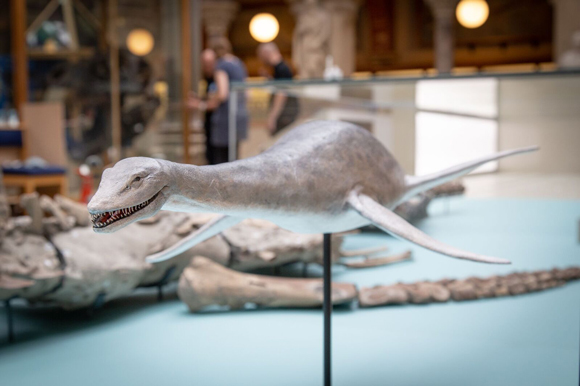
Oxford University Museum of Natural History plesiosaur.

A replica of a long-necked plesiosaur swims into view.

Picture credit: Everything Dinosaur

Using a Computer Model

Surprisingly, the computer model demonstrated that the rear flippers flapping added little to the forward speed of the plesiosaur studied.  Instead, the back flippers of plesiosaurs were probably used for steering and stability, a sort of underwater version of rear wheel steer and front wheel drive.

The researchers involved in the study were Shiqiu Liu, Yuting Gu, Jie Tan, C. Karen Liu and Greg Turk from the School of Interactive Computing, (Georgia Institute of Technology, Atlanta, Georgia) along with palaeontologist Dr. Adam Smith (Nottingham Natural History Museum, Wollaton Hall).

Commenting on the study, Dr Smith stated:

“Plesiosaur swimming has remained a mystery for almost 200 years, so it was exciting to see the plesiosaur come alive on the computer screen.  Our results show that the front limbs provide the powerhouse for plesiosaur propulsion while the hind limbs are more passive”.

A Bar Chart Comparing the Forward Speeds Achieved in the Simulation

Rear flippers don't seem to contribute much to velocity.

Rear flippers don’t seem to contribute much to velocity.

Chart credit: Liu at el/PLOS Computational Biology

Plesiosaur Velocity

In the table above the velocity of a typical plesiosaur was calculated over a series of joint ranges (wide, medium and narrow).  Measurements were taken when forelimb-only flapping, hind-limb-only flapping and both pairs of limbs together were flapped.  Note that the forward speed in the forelimb-only tests are superior or broadly equivalent to the velocity achieved when both pairs of limbs moved together.  When hind-limb-only optimisations were tested the speed was greatly reduced.

Interestingly, these swimming speeds are relatively slow given the length of time these creatures had to evolve.  Elite human athletes can swim at around two metres per second for short periods.  Although plesiosaurs are likely to be much more agile in water than a person, the velocity recorded in the computer simulation is much lower than we, at Everything Dinosaur would have expected.  Most fish would have easily been able to swim faster, perhaps, as most palaeontologists predict, that long neck holds the key to the hunting strategy of the plesiosaurs.

Plesiosaurs and Marine Reptile Models

The CollectA Prehistoric Life model range contains several plesiosaur models: CollectA Prehistoric Life Models.

The species used as the template for the computer model was Meyerasaurus victor, known from the Lower Jurassic of Germany.  This small (3.5 metre long), plesiosaur is known from an almost complete articulated skeleton which is on display at the Natural History Museum of Stuttgart (Germany).  Meyerasaurus had a typical body plan amongst the Plesiosauria, with a moderately long neck, so it was considered to be an ideal candidate to represent the clade.

The research team  hopes to modify their computer programme to assess how the rear flippers helped in the manoeuvrability of these marine reptiles.  Just how agile were plesiosaurs in water?  The computer model can also be used to better understand the swimming motion of other prehistoric animals such as the short-necked plesiosaurs – the pliosaurs.

A Surrey Pliosaur

To read a recently published article about a Surrey pliosaur specimen that links Dorking to Kansas: Pliosaur Skull Links Dorking to Kansas.

Everything Dinosaur acknowledges the help of the press release from the Georgia Institute of Technology and Dr Adam Smith in the production of this article.

17 12, 2015

Rare Pliosaur Skull Links Dorking to Kansas

By |2024-05-05T18:16:48+01:00December 17th, 2015|Categories: Dinosaur and Prehistoric Animal News Stories, Dinosaur Fans, Main Page, Palaeontological articles|0 Comments

Pliosaur Skull Links Dorking to Kansas

For much of the later stages of the Cretaceous, the area that is now known as the British Isles lay underwater.   Bad news if you are searching for evidence of terrestrial dinosaurs, however, the limestones and chalk deposits associated with southern England can still yield some exciting surprises for vertebrate palaeontologists.  Take for example, the research of Dr Roger Benson (University of Oxford, Dept. of Earth Sciences), who has been examining the fragmentary remains of pliosaurs associated with the lithostratigraphic unit of strata known as the Chalk Group.

Analysis of a Pliosaur Skull

Dr Benson’s analysis of a pliosaur specimen housed in the collection of the Dorking Museum and Heritage Centre reveals that the fossils may have been misidentified, by none other than Sir Richard Owen, the anatomist who is credited with the naming of the Order Dinosauria.

An Illustration from the Original 1858 Monograph by Richard Owen

One of the original lithographs from Owen's 1858 paper.

One of the original lithographs from Owen’s 1858 paper.

Picture credit: The Pterosaur Database/Dr R Benson (Supplement (No. III) to the Monograph on the Fossil Reptilia of the Cretaceous Formations: 1858).

The illustration above shows some of the skull fossils and teeth described by Richard Owen as the pliosaur Polyptychodon interruptus.  The smaller illustrations to be found in the lower portion of the picture depict various pterosaur fossils.

What are Pliosaurs?

Pliosaurs, or those animals that make up the Pliosauridae clade, are an extinct group of marine reptiles, that along with the long-necked plesiosaurs make up the Order Plesiosauria.  Pliosaurs tend have short necks and large, broad skulls.  They have a worldwide fossil distribution and they first appeared during the Early Jurassic with many of these reptiles evolving into giants that specialised in hunting other marine vertebrates like today’s killer whales.  Famous prehistoric animals such as Liopleurodon and the Australian Kronosaurus are examples of pliosaurs.

An Illustration of a Typical Pliosaur (Pliosaurus brachydeirus)

A scale drawing of a Pliosaurus.

A scale drawing of a pliosaurus.

Picture credit: Everything Dinosaur

Having dominated marine environments for the best part of a 100 million years, with many forms becoming apex predators, towards the early Late Cretaceous remains of these reptiles disappear from the fossil record.  Around ninety million years or so ago, these sea monsters died out.  Why the pliosaurs became extinct remains a mystery.

Studying Fossil Material

It is important for palaeontologists to gain as much information as they can from existing fossil specimens.  Perhaps, thanks to the careful research of Dr Benson and the presence of many fine fossil collections held in regional museums, one day scientists may have a more complete understanding of how these great reptiles evolved and radiated out into so many forms dominating a number of marine palaeoenvironments.  Scientists might even be able to provide information on why these leviathans went into decline and died out.

The Dorking Pliosaur Specimen

During the early part of the 19th century a number of fossils of marine reptiles were collected by amateur geologists and naturalists.  One such collection, which had been the amassed by the first Baron Ashcombe was donated to the Dorking Museum in 1948 by the first Baron’s grandson.  Amongst the specimens donated was the relatively complete skull of a pliosaur which had been discovered sometime in the 1850s.

The first Baron Ashcombe had used his influence to invite none other than Richard Owen to examine the fossil collection.  Richard Owen, who was later to help found the Natural History Museum (London), described this skull as an example of the pliosaur Polyptychodon interruptus (Po-lip-tie-ko-don in-terr-rupt-us), the name means ” broken apart fin shaped tooth”.

A Pliosaur Skull

When Dr Benson visited the Dorking Museum and Heritage Centre to inspect the skull material, he noted a number of similarities between this fossil specimen and the fossils of another pliosaur, known from North America.  In addition, Dr Benson’s study revealed that most other fossils of Polyptychodon species come from rocks that are much older than the ones found in the chalk pits in this part of Surrey (southern England).  This casts doubt over the original conclusions drawn by the celebrated anatomist Richard Owen.  It seems that the Dorking specimen may represent a type of pliosaur whose fossils are associated with Kansas.

A Fragment of the Lower Jaw

Individual tooth sockets (alveoli) can be made out along the jawbone.

Individual tooth sockets (alveoli) can be made out along the jawbone.

Picture credit: Dr Roger Benson (Oxford University)

Affinities with Brachauchenius

Although Owen thought the Dorking specimen belonged to Polyptychodon the shape of the skull (morphology) suggests to Dr Benson that this specimen may actual be another type of pliosaur altogether.  Dr Benson concludes that the Dorking specimen shares many similarities with a pliosaur known as Brachauchenius (Brak-ow-ken-ee-us) whose fossils are mainly associated with the Western Interior Seaway of the early Late Cretaceous that covered most of the land that is now known as the United States.

According to Dr Benson’s research, most other specimens assigned to the Polyptychodon genus are around 115 million years old (Aptian age of the Cretaceous), but the Dorking fossil material comes from much younger strata, rocks that date from around 90-95 million years ago (Cenomanian to Turonian age).  This indicates that the pliosaur fossils within the collection of the Dorking Museum and Heritage Centre represents one of the last of the pliosaurs.

Part of the Lower Jaw Bone

Lateral view of part of the Pliosaur lower jaw.

A view of part of the pliosaur lower jaw.

Picture credit: Dr. Roger Benson (Oxford University)

Knowledge of the Pliosauridae

Our knowledge of the Pliosauridae has improved enormously since the time of Richard Owen, as has our knowledge of stratigraphy.  These collections, many of which are housed in small regional museums can still have a very significant role in research, for example, in this instance, helping to build up a better picture of an ancient marine fauna.

Everything Dinosaur stocks a wide range of pliosaur and plesiosaur models: Sea Monsters and Marine Reptile Models.

The Museum’s Chairman, Nigel Arch, commenting on Dr Benson’s visit stated that it was:

“A good example of the value of our collections and the fact that we can always learn more.  It is wonderful to think that the study of this specimen, found locally and collected by a local person, is still contributing to scientific knowledge today.” 

A Pliosaur Tooth of P. interruptus

Compare Dr. Benson's photograph to the Pliosaur tooth depicted in Owen's monograph.

Compare Dr Benson’s photograph to the pliosaur tooth depicted in Owen’s monograph.

Picture credit: Dr Roger Benson (Oxford University)

Dr Benson put his research into context, explaining:

“Pliosaurs were giant marine reptiles that could swim across oceans, specimens like the Dorking pliosaur show that this is true because similar fossils are also found in America”.

The Importance of Regional Museums

Regional museums such as the the Dorking Museum and Heritage Centre house many fine specimens assisting in the preservation of an amazing geological and fossil record.

Research using some of the specimens from within these collections can help to shed light on the diversity and distribution of pliosaur genera.  Who knows, perhaps locked away in some cabinet, part of the prized fossil collection of another regional museum may lay the fossilised bones of another mislabelled specimen, one that could provide clues as to the why the Pliosauridae became extinct.

15 12, 2015

New Sail-Backed Dinosaur from Early Cretaceous Spain

By |2023-04-09T18:31:12+01:00December 15th, 2015|Categories: Dinosaur and Prehistoric Animal News Stories, Dinosaur Fans, Main Page, Palaeontological articles|0 Comments

Morelladon beltrani – A Spanish Sail-Backed Dinosaur

A team of Spanish scientists have published details of a new genus of plant-eating dinosaur which roamed the Iberian Peninsula about 125 million years ago (Early Cretaceous).  The dinosaur named Morelladon beltrani is believed to have been closely related to Iguanodon and the discovery helps to reinforce the belief held by many palaeontologists that the Ornithopoda were extremely diverse in Europe during this part of the Cretaceous.

Sail-backed Dinosaur

The dorsal vertebrae have large, extended neural spines a feature seen in other Early Cretaceous ornithopods, dinosaurs such as Ouranosaurus from Niger.  These spines may have supported a hump or perhaps a sail-like structure, the purpose of which remains open to debate.

An Illustration of Morelladon beltrani

An illustration of Morelladon.

An illustration of Morelladon.

Picture credit: Universidad Nacional de Educación a Distancia (Spain)

This new species of dinosaur has been named from the fossilised remains of a single animal, preserved bones consist of dorsal vertebrae, the sacrum, partial ribs, the pelvic girdle, isolated teeth from the lower jaw and the right tibia.

However, despite a lack of cranial material, the team of scientists from the Spanish equivalent of the Open University (Universidad Nacional de Educación a Distancia) and the Autonomous University of Madrid (Universidad Autónoma de Madrid), identified eight unique anatomical features (autapomorphic features) that enabled a new genus to be established.

Elongated Neural Spines

One of the unique anatomical features identified were the very elongated and tall neural spines of the dorsal vertebrae.  Such features are known in other plant-eating dinosaurs, such as the Ouranosaurus (Ouranosaurus nigeriensis) from the Early Cretaceous of Africa and although Morelladon is related to Ouranosaurus, a phylogenetic analysis carried out by the Spanish team suggests that this new Spanish dinosaur is more closely related to other western European dinosaur taxa.  Dinosaurs such as Iguanodon (I. bernissartensis) from Belgium and Mantellisaurus atherfieldensis (from England).

The Extended Neural Spines of the Dorsal Vertebrae

A photograph of the fossil material and accompanying line drawing.

A photograph of the fossil material and accompanying line drawing.

Picture credit: Universidad Nacional de Educación a Distancia (Spain)/PLOS One

Close to the City of Morella

The fossils come from a dig site within a quarry about five miles south-west of the city of Morella (Castellón Province), on the eastern coast of Spain.  The specimen was excavated from a red clay bed dated to the Upper Barremian age (125 million years ago), part of the Arcillas de Morella Formation.  The dinosaur’s name means “Morella tooth”, after the location of the fossil find and in keeping with the naming of Iguanodon, which itself means “iguana tooth”.  The trivial name honours quarry owner, Víctor Beltrán who has been prominent in the excavation and research of a number of Cretaceous vertebrates from this part of Spain.

The Fused Sacral Vertebrae of the Specimen (Sacrum)

The sacrum (fused vertebrae over the hips) of Morelladon.

The sacrum (fused vertebrae over the hips) of Morelladon.

Picture credit: Universidad Nacional de Educación a Distancia (Spain)/PLOS One

Measuring up to six metres long and standing around 2.5 metres high at the hips, this new genus supports the hypothesis that the Iberian Peninsula in the Early Cretaceous was home to a large number of different types of Iguanodon-like herbivorous dinosaurs.

Why the Tall Neural Spines?

There have been a number of theories put forward to explain the presence of elongated neural spines in some types of dinosaur.  For example, one of the most famous of all the meat-eating dinosaurs – Spinosaurus had neural spines which supported a structure its back, often referred to as a “sail” that must have been more than two metres high.  The neural spines of Morelladon hint at a much smaller feature, around half a metre tall.

It has been proposed that since this dinosaur lived in a delta subject to distinct seasons the spines could have supported a fleshy hump where food reserves and fat could be stored to help the animal through leaner times.  Extant North American buffalo (Bison bison) have dorsal spines that support such structures.  The spines could also have supported a sail-like structure, perhaps this had a role in communication within the herd, or display.

Commenting on another potential purpose for the structure, Dr Fernando Escaso (Universidad Nacional de Educación a Distancia) stated:

“The “sail” could have helped in heat exchange [thermoregulation] by releasing excess body heat into the environment as do the ears of the modern-day elephants.”

An effective heat exchanger would have been useful for such a large-bodied animal.  Everything Dinosaur team members suspect that oxygen isotope analysis from the many different types of teeth found in eastern Spain in Early Cretaceous rocks, would provide palaeontologists with a lot of information about the palaeoclimate.  For instance, some researchers claim that there was an annual average temperature range of thirty-six degrees with temperatures in excess of 40 degrees Celsius being recorded with annual lows of around 4 degrees C.

What are Styracosternan Dinosaurs?

Other media sources have cited the comment that Morelladon represents a new member of the styracosternan sub-group of the clade Iguanodontia.  What does this mean?  In the mid 1980s it had become clear to many palaeontologists that the division of the Ornithopoda into large bodied forms such as Iguanodon and Dollodon and smaller forms such as Hypsilophodon was over simplistic.

A number of academics proposed new classifications of these bird-hipped dinosaurs, for example Paul Sereno (1986) proposed a new clade within the Ornithopoda called the Ankylopollexia “stiff thumbs”.  This clade included the camptosaurs, iguanodonts, Ouranosaurus and the hadrosaurids “duck-billed dinosaurs”.  This clade was further divided by Sereno et al (1986) into the Styracosterna, which included all the Ankylopollexia members with the exception of the camptosaurids (Camptosauridae family).

  1. Ankylopollexia = a clade of the iguanodontian dinosaurs
  2. Styracosterna = a clade of the iguanodontian dinosaurs the same as Ankylopollexia but with the camptosaurids excluded.

Therefore, the Styracosterna dinosaurs can be divided as a sub-group of the Iguanodontia clade that contains all the “duck-billed dinosaurs” and all the dinosaurs more closely related to them than to the Camptosauridae.

Phylogenetic relationships of Morelladon beltrani within the Iguanodontia Clade

Phylogenetic relationships of Morelladon beltrani with the Styracosterna.

Phylogenetic relationships of Morelladon beltrani with the Styracosterna.

Picture credit: PLOS One with additional annotation by Everything Dinosaur

The diagram above shows how the Styracosterna fit into the clade Iguanodontia.   Phylogenetic analysis places Morelladon beltrani firmly in the with the styracosternan dinosaurs but more closely related to Western European iguanodonts such as Iguanodon bernissartensis and Mantellisaurus atherfieldensis than to other Iberian styracosternans such as Delapparentia turolensis and Proa valdearinnoensis.

For models and replicas of ornithopods and other prehistoric animals: CollectA Age of Dinosaurs.

14 12, 2015

Another Potential Leptoceratopsid from China

By |2023-04-09T18:23:13+01:00December 14th, 2015|Categories: Dinosaur and Prehistoric Animal News Stories, Dinosaur Fans, Main Page|0 Comments

Ischioceratops zhuchengensis – Potentially a New Leptoceratopsid

A team of international scientists including researchers from the Institute of Vertebrate Palaeontology and Palaeoanthropology (Beijing), the Chicago Field Museum and the Zhucheng Dinosaur Museum, (Zhucheng, Shandong Province, China) have published a paper on the fossilised bones of a Late Cretaceous leptoceratopsid, one that although scientifically named may turn out to be further material that ends up assigned to Zhuchengceratops.

Ischioceratops zhuchengensis

This new dinosaur has been named Ischioceratops zhuchengensis but as the fossils were found at about the same stratigraphic level as the holotype material assigned to Zhuchengceratops, Ischioceratops may end up as a junior synonym of Zhuchengceratops inexpectus.  Let’s explain.

A New Leptoceratopsid

The Holotype Material of Ischioceratops zhuchengensis 

Left lateral view (A), line drawing (B) and skeletal placement (C)

Left lateral view (A), line drawing (B) and skeletal placement (C).

Picture credit: PLOS One

The picture above shows the fossil material used to describe and name this new genus of the family Leptoceratopsidae.  The fossils found include the right femur (thigh bone), plus the lower leg bones from the right hind limb (tibia and fibula), along with the anterior portion of the tail (articulated tail bones), a complete sacrum, both halves of the pelvis and a number of ossified tendons.

Although a only a portion of the skeleton representing a single individual has been found, and it is from the animals backside, not to put too fine a point on it, the morphology of the bones, especially those bow shaped ischia have enabled scientists to firstly, confidently assign these fossils to the Leptoceratopsidae family and secondly to erect a new genus for this Chinese dinosaur.

A Dorsal (Top Down) View of the Fossil Material

A top down view of the fossil material with the left ischium ringed in the photograph and highlighted in the line drawing.

A top down view of the fossil material with the left ischium ringed in the photograph and highlighted in the line drawing.

Picture credit: PLOS One

The picture above shows the unique shape of the ischia (a pair of bones that make up part of the pelvic girdle.  The bone is curved sharply towards the proximial end of the bone (part of the bone closest to the animal’s trunk).  In the photograph above the left ischium in the photograph has been ringed and in the line drawing opposite the same bone has been highlighted.

Although there has been some distortion and displacement as part of the fossilisation process the research team are confident that is the shape of the actual bone and therefore they have erected a new genus.

Assigning a Leptoceratopsid to a New Genus

Naturally, with such a unique autapomorphy (distinctive anatomical feature) associated with the ischia, it is only appropriate to name this new dinosaur after this feature.  Hence the name Ischioceratops zhuchengensis (this means ischium horn-face from Zhucheng), the trivial name honours the fossil find location, the city of Zhucheng, in the south-east of Shandong Province.

Assigning the Fossils to a New Genus based on the Ischia

Ossified tendons indicate a member of the Ornithischia and the shape of the actual bones suggests that this animal was an example of a leptoceratopsid. Those never-seen-before ischia have resulted in the erection of a new genus.  No other dinosaur known* has a pelvic bone quite shaped like these two, therefore the research team felt confident that a new dinosaur could be added to the fold.

Left Side Views of Other Ornithischian Dinosaurs Compared to Ischioceratops

Not line drawings are not to scale.

Note line drawings are not to scale.

Picture credit: PLOS One with modification and additional annotation by Everything Dinosaur

The picture above shows a number of line drawings of the left ischium of a number of well-known ornithischian (bird-hipped), dinosaurs.  Although more closely related to the ceratopsians listed (E to F) than to the other bird-hipped dinosaurs included in the diagram, the unique shape of the ischium of Ischioceratops can clearly be seen.  It is on this basis, that the dinosaur fossils, currently part of the collection of the Zhucheng Dinosaur Museum have led to the establishment of a new dinosaur genus.

The fossil material has been dated to the Late Cretaceous (72 million years ago to 66 million years ago approximately – Maastrichtian faunal stage) and based on the femur length of around 29 centimetres, in comparison to the femur length of the related Brachyceratops, Everything Dinosaur estimate that this plant-eating dinosaur was around 1.8 to 2 metres long.

The Fly in the Ointment – An Uneasy Feeling in our Hip Pocket

Unique morphology, so far so good for Ischioceratops, but there may be a problem to the establishment of this new dinosaur name.  The site where the fossils were found, known as the Kugou quarry has yielded a great quantity of vertebrate fossil bones, including other ceratopsids.  Back in 2010, another new leptoceratopsid dinosaur was named from the Kugou quarry location – Zhuchengceratops (Z. inexpectus).

These fossils were found at the same level in the strata as the newly named Ischioceratops.

Ischioceratops zhuchengensis and Zhuchengceratops inexpectus

Sadly, the fossil material ascribed to Zhuchengceratops (ribs, vertebrae, skull, jaw bone etc.) represent bones from the front of the animal.  Ischioceratops and Zhuchengceratops do not have any overlapping fossil bones to allow a direct comparison to be made.  Therefore, it is possible that the fossils found and described as a new genus could represent the back end of the already described Zhuchengceratops.

The authors of the scientific paper acknowledge this potential threat to their new dinosaur.  Hopefully, future fossil discoveries will settle the argument and we will know for sure whether Ischioceratops and Zhuchengceratops are two different, but closely related dinosaurs that co-existed or whether  Ischioceratops is a junior synonym of Zhuchengceratops.

PNSO have included a wide variety of horned dinosaurs including basal members of the Ceratopsia in their model range: PNSO Age of Dinosaurs.

What Does the Term “Junior Synonym” Mean?

A synonym is another name for an item, a synonym is a word that means exactly the same as another word in the same language.  It comes from the ancient Greek for “with word”.  When it comes to erecting new taxa, the first name used to describe the organism becomes the senior synonym and any other names coined afterwards are referred to as the junior synonyms.  In this instance, should further fossil discoveries prove that Ischioceratops and Zhuchengceratops are indeed the same dinosaur, then Zhuchengceratops (first coined in 2010) will become the senior synonym and Ischioceratops (2015) will become the junior synonym.

No other dinosaur known* – the bow shaped ischia could end up being assigned to Zhuchengceratops.   Ischioceratops and Zhuchengceratops could be conspecific (the same species).

To read a recently published article about the discovery of leptoceratopsid fossil material from the eastern United States: Leptoceratopsidae from Appalachia in the Spotlight.

13 12, 2015

The Dinosauria Sprinted Out of the Blocks

By |2023-04-09T17:59:40+01:00December 13th, 2015|Categories: Dinosaur and Prehistoric Animal News Stories, Dinosaur Fans, Geology, Main Page|0 Comments

New Study Suggests the Dinosaurs Evolved Quickly

An international team of researchers have accurately dated rock layers exposed in north-western Argentina deposited during the Triassic.  The subsequent geological timeline they have been able to construct suggests that the time elapsed between the emergence of early dinosaur relatives and the origin of the first dinosaurs is much shorter than previously believed.  In essence, the dinosaurs evolved quickly, the Dinosauria evolved much more rapidly than previously thought.

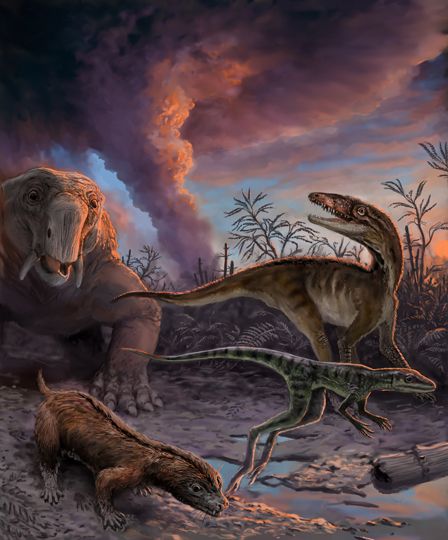
North-western Argentina Around 235 Million Years Ago

Diverse fauna of north-western Argentina

Diverse fauna of north-western Argentina including ancestral dinosaurs.

Picture credit: Victor Leshyk

The Triassic – A Time of Transition

The vertebrate fauna of the Triassic (approximately 251 million to 201 million years ago), changed dramatically.  Few of the fossil lineages found in Lower Triassic rock formations can be found in strata laid down later on.  The mass extinction event that marked the end of the Palaeozoic and the beginning of the Mesozoic led to a radical shift in the diversity, type and geographical distribution of back-boned land animals and arguably, the emergence of more modern-looking ecosystems.

To help unravel some of the mysteries surrounding this “faunal shift” and to more accurately date the appearance of the first dinosaurs, the scientists travelled to north-western Argentina (La Rioja Province) and set about dating different beds that make up the exposed sandstones and mudstones of the Chañares Formation.

The Dinosaurs Evolved Quickly

The debate as to where and exactly when the first dinosaurs evolved is one of those topics that comes up frequently at symposiums and conventions.  The evidence suggests that the Dinosauria first appeared in the Southern Hemisphere and for a long time South America was thought to have been the place they originated from.  Research published in 2013 challenged this idea, proposing that Africa may have been home to the first dinosaurs, but exactly when did the dinosaurs as an Order of reptiles (Dinosauria) really take off?  At what point in geological time did the dinosaurs commence their journey to becoming the dominate terrestrial life forms of the Mesozoic?

To read an article regarding the possibility of dinosaurs having first evolved in Africa: Africa – The Cradle of the Dinosauria?

 Problems Accurately Dating Deep Time

The sedimentary exposures of the Chañares Formation permit accurate stratigraphic dating because of a quirk of fate.  Back in the Triassic, this part of the world was a lush, tropical paradise, however, nearby volcanoes from time to time deposited vast amounts of ash in the area.  These ashes formed easily recognisable layers (called tuffs) and within these layers the scientists, which included researchers from the University of Buenos Aires, the University of Brasília (Brazil), along with American colleagues and collaborators from Argentina’s National Scientific and Technical Research Council, were able to identify microscopic crystals called zircons.  It is these zircon crystals that hold the key to accurate dating of geological deposits.

Zircon Crystals and Radiometric Dating of the Chañares Formation

The uniform decay of radioactive elements allows an accurate date of geological formations.

The uniform decay of radioactive elements allows an accurate date of geological formations.

Picture credit: Everything Dinosaur

The research team took samples from the various ash layers and noted their position within the sedimentary beds and the vertebrate fossils associated therein.  Zircon crystals were identified within the volcanic layers and these were radiometrically dated using the ratio of uranium decay to lead isotopes.  In this way, thanks to advances in mass spectrometry the team were able to determine an accurate age of the zircon and by inference the age of the fossil bearing sedimentary layers above and below the ash layers.

Dating Zircon Crystals Using Uranium Decay

The technique has been used before, for example to date the lower portions of the Chinle Formation of the United States (U-PB ID-TIMS zircon geochronology dating method [uranium to lead]).

So what would have been bad luck for the fauna and flora around at the time, a devastating deposit of choking volcanic ash, has permitted palaeontologists to be able to date with considerable accuracy the deposition timeline of this part of the Chañares Formation.

Identifying the Ash Layers for Sampling (Chañares Formation)

Co-author Adriana Mancuso (right) points to a volcanic ash layer (tuff) in the Chañares Formation that was sampled for radioisotopic dating.

Co-author Adriana Mancuso (National Scientific and  Technical Research Council) points to a volcanic ash layer (tuff) in the Chañares Formation that was sampled for radiometric dating.

Picture credit: Randall Irmis (University of Utah)

What Does the Accurate Triassic Timeline Reveal?

It had been thought that the strata was around 226 to 228 million years old (early Late Triassic, the Carnian faunal stage).  However, this study indicates that these rocks were laid down much earlier in the Triassic, perhaps 5 to 10 million years earlier, making the rocks, effectively Middle Triassic in age (234 to 236 million years old, the Ladinian faunal stage).  Fossils of dinosaur precursors, known as dinosauromorphs, Archosaurs that are very closely related to the Dinosauria and the ancestors of the dinosaurs are found in these rocks.

The first dinosaur fossils date from around 230 million years ago approximately, perhaps even earlier.  This means that the true dinosaurs evolved from the dinosauromorphs much quicker than previously thought.  There was a much more rapid transition from a world with dinosauromorphs to a terrestrial ecosystem with dinosaurs in it.  In short, dinosaurs very quickly became established – dinosaurs evolved quickly.

The Fossil Assemblage of the Chañares Formation (Schematic Diagram)

Vertebrate fossils found include a range of Tetrapods including Dinosauropmorphs and Dicynodonts.

Vertebrate fossils found include a range of tetrapods including dinosauromorphs and dicynodonts.

Picture credit: Everything Dinosaur (inset photograph Randall Irmis)

Everything Dinosaur stocks a wide variety of Triassic figures and replicas: Triassic Models and Figures.

Commenting on the significance of this new study, which has just been published in the Proceedings of the National Academy of Sciences (USA), Randall Irmis stated:

“To discover that these early dinosaur relatives were geologically much younger than previously thought was totally unexpected.”

What Does This Mean for Other Middle Triassic Formations Elsewhere?

This shift in the date for these deposits that make up a portion of the Chañares Formation has serious implications for other fossil-bearing strata that were also believed to represent the Middle Triassic.  Similar types of vertebrate fossil are found in the Santa Maria Formation (southern Brazil) and in the Karoo Basin (South Africa), but none of these formations have been radiometrically dated.  These too, could be 5 to 10 million years older than previously thought.

Summarising the research a spokesperson from Everything Dinosaur explained:

“The geological dates for certain fossil assemblages may have to be reconsidered in the light of these findings.  The evolution and subsequent radiation of the Dinosauria has become somewhat concertinaed.  This research suggests a much more rapid evolution from dinosauromorphs to true dinosaurs than previously thought.”

Why Did the Dinosaurs Evolve Rapidly?

The first dinosaurs believed to have evolved were the saurischian theropods.

These archosaurs were bipeds and their skeletons show that they had an advantage over many of the other predators (bipedal and quadrupedal) around at the time.  Firstly, the pelvic area has a fully open acetabulum (the rounded hole in the pelvis where the head of the femur fits).  This allows the hind legs to locate much more directly under the body, providing a more efficient locomotion.  Secondly, the femur itself has a ball-shaped head turned slightly inward to slot into the acetabulum.  This arrangement, also supports the hind legs located directly under the hips.

These anatomical features, (plus one or two others), evolved to permit these theropods to develop stronger legs making them faster and more powerful than other archosaurs.  These strong legs seem to have enabled the dinosaurs to “sprint out of the evolutionary blocks”, leading to their domination of terrestrial ecosystems for the best part of 160 million years or so.

11 12, 2015

Stunning Lufengosaurus Fossils Hold Up New Road

By |2024-05-05T18:18:16+01:00December 11th, 2015|Categories: Dinosaur and Prehistoric Animal News Stories, Dinosaur Fans, Main Page|0 Comments

Lower Jurassic Fossils Lead to Chinese Road Hold Ups

Chinese news agencies have released some remarkable photographs showing the preserved remains of two types of Early Jurassic herbivorous dinosaur, whose fossils have been found during a road building project in Yunnan Province (south-western China).  The dinosaurs have been identified as two different species within the Lufengosaurus genus, in fact, Lufengosaurus has only two recognised species within the genus, it is quite unusual to find examples of the same genera in such close proximity.  These fossils were found less than five hundred metres apart. It is a case of Lufengosaurus fossils holding up road building.

Lufengosaurus Fossils

Once the construction workers had realised that they had stumbled across some dinosaur bones, palaeontologists from the Institute of Vertebrate Palaeontology and Palaeoanthropology (Beijing) were called in and the fossils were carefully excavated.  The picture above shows the preserved rear end of Lufengosaurus magus.  The hind limbs, dorsal area and the anterior portion of the tail have been preserved in almost perfect articulation.  A spokesperson for the Institute of Vertebrate Palaeontology and Palaeoanthropology explained that measurements of the hind limbs and tail bones suggest that this dinosaur would have been around nine metres in length.

Early Jurassic Prosauropods

The Lufengosaurus magus material consists of three sacral vertebrae, rib bones, the pelvis, thirteen dorsal vertebrae, tail bones and the complete hind legs.   The other Lufengosaurus material, assigned to the smaller of the two species L. huenei consists of elements of the leg bones, dorsal vertebrae and two tail bones from the anterior end of the tail.

How to Preserve the Fossils?

The Director of the Department for Geological Heritage Protection at the Lufeng Land Resources Bureau stated that a museum might be built over the site to preserve the fossils in situ.  This could mean that the road that was being built could end up being diverted.

Lufengosaurus Profile

Although a number of media reports suggest that the fossils are about 180 million years old, team members at Everything Dinosaur suspect that the fossils are at least fifteen million years older.  Lufengosaurus was a long-necked, bipedal plant-eating dinosaur with a small head, a large, round body and the hind limbs were bigger, longer and more robust than the forelimbs.  Regarded as a prosauropod, debate surrounds this dinosaur as to whether or not it is very closely related to the European prosauropod Plateosaurus.  Other writers have suggested that this dinosaur may be more closely related to Massopondylus.  CollectA made a very good quality replica of this dinosaur.  This was introduced into the “Prehistoric World” range of not to scale models in 2012.

To see the Lufengosaurus model and other replicas in the “Prehistoric World” range: CollectA Prehistoric Life Dinosaur Models.

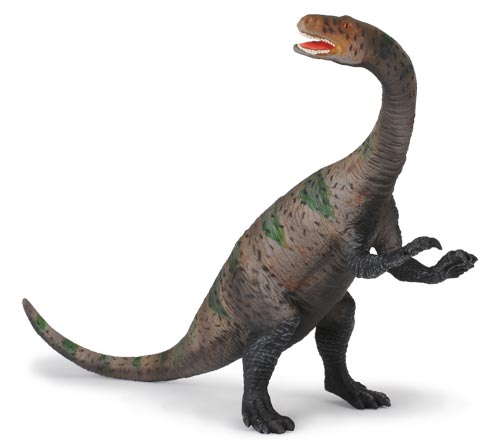
The CollectA Lufengosaurus Model

The CollectA Lufengosaurus model.

The CollectA Lufengosaurus model.

Picture credit: Everything Dinosaur

To view the range of prehistoric animal figures and replicas available from Everything Dinosaur: Prehistoric Animal Models and Figures.

10 12, 2015

New Dog-sized Dinosaur and Chasing “Ghosts”

By |2024-05-05T18:19:40+01:00December 10th, 2015|Categories: Dinosaur and Prehistoric Animal News Stories, Main Page, Palaeontological articles|0 Comments

Hornless Hualianceratops wucaiwanensis

So, details regarding  the dog-sized newest member of the Ceratopsia has been published in the on-line academic journal PLOS One.  Say hello to Hualianceratops wucaiwanensis (pronounced as wal-lee-an-sera-tops woo-sigh-wan-en-sis), a small plant-eating dinosaur at the very foot of the dinosaur family tree that would lead to the mighty horned dinosaurs, animals such as Triceratops, Styracosaurus and Pachyrhinosaurus.

New Horned Dinosaur Without Any Horns

Hualianceratops illustrated.

Hualianceratops illustrated.

Picture credit: Portia Sloan Rollings

Ever Expanding Horned Dinosaurs

Over the last ten years or so there have been a remarkable number of new genera of horned dinosaur erected, mostly representing Late Cretaceous ceratopsians from North America.  Back in July, for example, Everything Dinosaur team members wrote an article about the latest edition to the centrosaurine group of horned dinosaurs  Wendiceratops (W. pinhornensis).  The month before that, the other great subfamily of the ceratopsians, the chasmosaurines got a new member (Regaliceratops peterhewsi).  Whilst there is undoubtedly lots of attention focused on the six-metre-plus, very ornate giants of North America, palaeontologists, as yet, don’t really understand how the horned dinosaurs evolved, or indeed, little is known about the phylogenetic relationships of some of the earliest forms.

Hualianceratops

Step into the frame Hualianceratops (the name translates as “ornamental face”), here’s a half-metre-long dinosaur that may shed some much needed light on ceratopsian ancestry.  Ironically, Hualianceratops manages to hint at future fossil discoveries without providing a great deal of data about itself.

To read the article on Wendiceratops pinhornensis: Southern Alberta’s Wendiceratops.

To read an article describing the discovery of Regaliceratops: New Horned Dinosaur Causes a Royal Rumble.

The angular and the dentary (bones that form the lower jaw along with the predentary) have a roughened texture (rugose).  It is this rough texturing not known in any other basal Asian ceratopsian that gives this little dinosaur its genus name.  The species or trivial name comes from the Chinese Wucaiwan “five colour bay” from the area in Xinjiang Province where the fossils were found.  The strata forms part of the famous Junggar Basin (Shishugou Formation).

Views of the Lower Jaw of Hualianceratops

The mandible of Hualianceratops wucaiwanensis (IVPP V18641)

The mandible of Hualianceratops wucaiwanensis (IVPP V18641).

Picture credit: PLOS One

Roughened Texture

The picture above shows two photographs of part of the lower jaw of this little dinosaur, the angular bone (an) and the dentary (d) have a roughened texture.  The fossil material consists of the majority of the skull, plus some fused sacral vertebrae and portions of the lower limbs which include an almost complete left hind leg.  It is from these bones that the scientists have been able to deduce that Hualianceratops was a biped, moving around on its back legs, in contrast to the much larger, heavier and later North American ceratopsians such as the famous Triceratops.

Post Cranial Fossil Material (Lower Limbs and Left Foot (Pes)

A partial hind limb and the left foot of Hualianceratops.

A partial hind limb and the left foot of Hualianceratops.

Picture credit: PLOS One

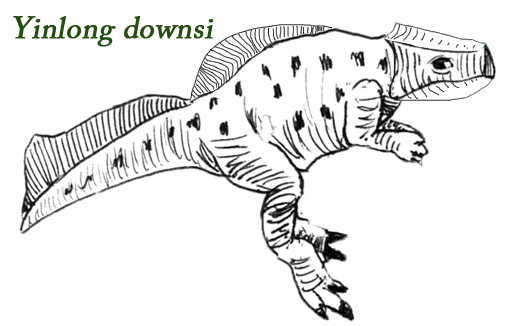
The researchers behind the scientific paper, published this week in PLOS One, consist of a team from the University of Washington and from the Institute of Vertebrate Palaeontology and Palaeoanthropology, (IVPP), part of the Chinese Academy of Sciences.  These institutes have been collaborating since 2002, exploring numerous fossil sites in north-western China.  A number of early ceratopsians have already been named as a result of this research programme.  The oldest known member of the horned dinosaur family Yinlong (Yinlong downsi) was found in the same Formation by these researchers.  It was formally named and described back in 2006.

An Illustration of Yinlong downsi Earliest Known Ceratopsian

Yinlong downsi, the earliest known Ceratopsian dinosaur.

Yinlong downsi, the earliest known ceratopsian dinosaur.

Picture credit: Everything Dinosaur

Hornless Hualianceratops

The newly described Hualianceratops would have looked very similar, but it was slightly shorter and stockier.  The bristles are speculative, no evidence of bristle-like structures have been found in association with Yinlong or Hualianceratops fossil material, as far as team members at Everything Dinosaur are aware, but if the related psittacosaurs had such structures it can be speculated that these little dinosaurs also sported similar quills and bristles.  Both Yinlong and Hualianceratops, despite being classified as basal horned dinosaurs, did not have any horns.

The genus name Yinlong means “hidden dragon”, this does not reflect any great difficulties of extracting the fossil from the dig site, but merely pays homage to the fact that Xinjiang Province provided most of the location shots for the award winning Chinese film “Crouching Tiger, Hidden Dragon”.

Both Hualianceratops and Yinlong were found in the same fossil bed, although Yinlong’s location suggests that this animal lived before Hualianceratops evolved.  The age of the rocks in the Junggar Basin are difficult to date accurately, there is considerable debate as to the precise age of the strata, however, the rock layer from which these two dinosaurs were extracted has been dated to the Oxfordian age (Late Jurassic, approximately 163.5 to 157.3 million years ago).

Greater Diversity of Late Jurassic Horned Dinosaurs

The discovery of a new type of horned dinosaur from Upper Jurassic rocks provides evidence that as early as 160 million years ago, a number of Ceratopsia genera had already evolved.  These little hornless horned dinosaurs were much more diverse much earlier in geological time than previously thought.

Commenting on the discovery, Professor Catherine Forster, a biologist at George Washington University and co-author of the scientific paper on Hualianceratops, stated:

“Finding these two species in the same fossil bed reveals there was more diversity there than we previously recognised.  It suggests that the ceratopsian dinosaurs already had diversified into at least four lineages [possibly five] by this time in the Jurassic Period.”

Looking for Ghosts

That’s really the significance of these fossil finds, prior to 2006, not a single ceratopsian was known from the beginning of the Late Jurassic.  Although, the exact evolutionary path of the Ceratopsia remains unknown and the exact relationship between the likes of Yinlong, Hualianceratops and the closely related Psittacosaurus is unclear, because of these fossil discoveries and similar finds in China, palaeontologists can work out that there must be other early horned dinosaurs awaiting discovery.

Hualianceratops and the Ghosts (Ghost Lineages)

Hualianceratops and the ghost lineages..

Hualianceratops and the ghost lineages.

Picture credit: PLOS One with additional annotation from Everything Dinosaur

“Ghost Lineages”

Comparing the features of known early horned dinosaur fossils has led scientists to identify a number of “ghost lineages” in the early horned dinosaur family tree.  In this instance, when the family tree of these basal ceratopsians is pieced together, the “best fit” that can be made indicates that there are a number of pieces missing.  These are ghost lineages, an evolutionary line that has no traces in the fossil record.  In simple terms, if the fossils of the “ghosts” have been preserved, then nobody has found them yet.

The researchers conclude that, based on the fossils that have been found at least five ceratopsian lineages were present at the beginning of the Late Jurassic.

  1. Yinlong
  2. Hualianceratops
  3. The ghost lineage that led to the psittacosaurs (dotted red line on the left of the picture)
  4. A ghost lineage that led to the later horned dinosaurs Chaoyangsaurus and Xuanhuaceratops (middle red dotted line)
  5. The ghost lineage that led to the evolution of the later Neoceratopsia (the red dotted line on the right)

Potentially, there are more “hidden dragon” fossils waiting to be found.  Perhaps, the name for the next basal horned dinosaur to be found from this part of north-western China will be inspired by another film, not “Crouching Tiger, Hidden Dragon” but “Ghostbusters”!

PNSO have created a range of small, model prehistoric animals including several horned dinosaurs.  To see this range: PNSO Age of Dinosaurs.

Go to Top