All about dinosaurs, fossils and prehistoric animals by Everything Dinosaur team members.

Fossil finds, new dinosaur discoveries, news and views from the world of palaeontology and other Earth sciences.

19 01, 2016

Wales Gets a New Dinosaur – Dracoraptor

By |2023-04-12T08:58:52+01:00January 19th, 2016|Categories: Dinosaur and Prehistoric Animal News Stories, Dinosaur Fans, Main Page|0 Comments

The Dragon Thief of Wales – Dracoraptor hanigani

The beautifully preserved meat-eating dinosaur fossil found at Lavernock Point (south Wales) has been formally named and described.  Say hello to Dracoraptor hanigani, a two-metre-long predator whose fossilised remains were found by brothers Rob and Nick Hanigan.  Reporting in the open-access on-line journal “PLOS One”, the fossilised material very probably represents the oldest known Jurassic dinosaur found to date in the British Isles.

Dracoraptor hanigani – An Agile Little Hunter

On display the fossils with a skeleton reconstruction.

On display the fossils with a skeleton reconstruction.

Picture credit: National Museum of Wales

To read more about this exciting fossil find: Welsh Dinosaurs – New Early Jurassic Theropod from South Wales.

“Dragon Thief”

The genus name means “dragon thief”, in honour of one of the national symbols of Wales, the species name honours the two fossil-hunting brothers who found it.  This little hunter may only be distantly related to the “raptors”, but it does represent a significant fossil find, as dinosaurs are particularly rare in Lower Jurassic rocks.  Dracoraptor, lived on an island archipelago, some 201.3 million years ago, plus or minus 200,000 years, the preserved bones and teeth (some 40% of the skeleton), have been so precisely dated in geological terms thanks to biostratigraphic dating of the strata.

The rock layers can be divided up into distinct zones (biozones) based on the characteristic fossils that layer contains.  The dinosaur’s remains were found between two well-documented zonal layers.  It was found above a conodont* zone (Chirodella verecunda), associated with the very end of the Triassic and below an ammonite zone Psiloceras planorbis, which is associated with the first faunal stage (Hettangian) of the Jurassic.

*Conodonts are an extinct group of tiny, jawless, marine animals that had mouths filled with several pairs of tooth-bars.  They are believed to be related to early, jawless fish and probably superficially resembled eels.  Their distinctive teeth, often found in abundance, provide very useful “markers” in rocks, helping palaeontologists to date the relative ages of different rock layers.  Conodonts became extinct at the end of the Triassic.

Helping to Understand the Early Diversity of the Dinosauria

The fossil, collected from a cliff fall at Lavernock Point, has had a charmed life.  Firstly, the fossil was found in marine sediments, apparently, the carcase of this little dinosaur was washed out to sea and settled on the sea floor.  Sea urchins crawled over it and most likely fed on the rotting flesh, some of these sea urchins have been preserved in the surrounding rock matrix.

Currents did not disturb the bones.  This explains why the specimen is so complete.  In addition, if Rob and Nick Hanigan had not chanced upon the specimen, the fossils would have been washed out to sea and lost forever in just a few days.

Dracoraptor hanigani

Furthermore, Everything Dinosaur reported on the serendipitous discovery of more of the specimen, by third year palaeontology student Sam Davies, who coincidently is tutored by one of the authors of the PLOS One paper, Dr David Martill (School of Earth and Environmental Sciences, University of Portsmouth).

To read more about Sam’s lucky find: Lucky Find Puts Welsh Dinosaur on a Firm Footing.

Views of One of the Teeth Associated with the Specimen (Presumed to be from the Upper Jaw)

This dinosaur probably ate insects and other small animals.

This dinosaur probably ate insects and other small animals.

Picture credit: PLOS One

Explaining the significance of this fossil discovery, co-author of the paper Steven Vidovic (PhD Researcher at Portsmouth University), commented:

“It’s right at that point in the diversification of dinosaurs where so-called theropod dinosaurs,  the meat-eating ones, became what are called neotheropods.  It’s from this moment onwards that they go on to become all the forms we know, like T. rex, Velociraptor and even birds.”

Very Rare Fossil Find

Early Jurassic dinosaur fossils are extremely rare and this particular specimen, which may represent an immature adult, is very important as it provides data on the evolution of meat-eating dinosaurs so soon after the Triassic/Jurassic extinction event.  Dracoraptor hanigani is the first dinosaur to be described from the Jurassic of Wales.  It probably lived on a small island (part of St David’s Archipelago), or perhaps its corpse had been washed out sea from the nearby, larger land mass known as the Welsh Massif.  It is one of very few early theropod remains found in Europe.

The Palaeogeography of the Early Jurassic (Europe – Hettangian)

Europe consisted of a series of islands 200 million years ago.

Europe consisted of a series of islands 200 million years ago.

Picture credit: PLOS One

The picture above show the palaeogeography of western Europe, approximately 200 million years ago.  Modern western Europe has been superimposed to provide a reference.  The numbers in the small, yellow circles record the location of other early theropod or neotheropod discoveries:

  1. Isle of Skye
  2. Barrow upon Soar (Leicestershire)
  3. Wilmcote (Warwickshire)
  4. Lavernock Point – the location of the Dracoraptor find
  5. Dorset
  6. Airel (France)
  7. Brouch (Luxembourg)

Everything Dinosaur stocks a variety of theropod models and figures: Dinosaur and Prehistoric Animal Figures.

A cladistic analysis suggests that Dracoraptor was a basal neotheropod.  It may have been related to Tawa hallae and Daemonosaurus chauliodus ( both from the Ghost Ranch location, New Mexico, United States).  Everything Dinosaur has written about the discovery of both Tawa and Daemonosauru. For further information on these fast-running little predators, see the links below.

To read more about Tawa: New Theropoda Dinosaur Discovery Sheds Light on Dinosaur Diversification.

To read more about Daemonosaurus: Little Demon from the Dawn of the Dinosaurs.

15 01, 2016

Canada has its First Dimetrodon

By |2023-04-11T21:18:55+01:00January 15th, 2016|Categories: Dinosaur and Prehistoric Animal News Stories, Dinosaur Fans, Main Page|0 Comments

Canada’s First Dimetrodon

A fossil found by a farmer digging a well on Prince Edward Island over 160 years ago has been finally identified by a student whilst studying for a PhD at the University of Toronto Mississauga.  The fossil, which consists of elements of the snout and upper jaw was once thought to have come from a meat-eating dinosaur, but a new analysis reveals that fearsome Dimetrodons once roamed Canada.  This is the first evidence that these giant, sail-backed reptiles from the Permian lived on the landmass that was to eventually form Canada.

Canada’s First Dimetrodon

Evidence of Dimetrodon in Canada

The curved teeth in the upper jaw can be clearly made out.

The curved teeth in the upper jaw can be clearly made out.

Picture credit: (Carleton University/University of Toronto Mississauga)

Location Remains a Mystery

The location of the fossil find remains a mystery, there may be more elements of this individual preserved, but the farmer did not provide a map of the location and what notes that have been attributed to this specimen make no mention of the actual spot where the discovery was made.  All we know is that the well was being dug near the French River (Prince Edward Island).

The specimen was acquired by the Academy of Natural Sciences (Philadelphia, USA) and Joseph Leidy, one of the world’s most eminent palaeontologists, studied it and named it Bathygnathus borealis.  Leidy thought that the fossilised bones and teeth (fragments of the premaxilla, a partial maxilla and elements of the naris along with several teeth), resembled those of Theropod dinosaurs that had been found in England.  Professor Leidy had incorrectly identified this fossil material as a dinosaur, making it the first dinosaur known from Canada.

A Probably Mammal-like Reptile

A review of the fossil in 1905, identified it as a probable mammal-like reptile, however, it was a paper published in the academic journal “The Canadian Journal of Earth Sciences”, late last year that finally cleared up the mystery identifying the animal as a member of the Dimetrodon genera.

Lead author of the paper, Kirstin Brink who worked on the fossil whilst at the University of Toronto Mississauga, and a specialist in examining the teeth of prehistoric animals, explained:

“It’s really exciting to discover that the detailed anatomy of the teeth has finally allowed us to identify precisely this important Canadian fossil.”

An Illustration of the Canadian Dimetrodon

An illustration of Dimetrodon borealis, the insert shows the location of the fossil on the animal.

An illustration of Dimetrodon borealis, the insert shows the location of the fossil on the animal.

Picture credit: Danielle Dufault

Dimetrodon – A New Species

Dimetrodon is perhaps one of the most famous of all the animals known from the Palaeozoic Era.  Several species of these sail-backed reptiles are known and their fossils have been found in the United States, Europe and now Canada.  The largest species, animals like D. grandis were the apex predators of terrestrial environments during the Late Permian, with some animals growing to around 3.5 metres in length.  Although not a dinosaur, Dimetrodon seems to have become forever linked with the Dinosauria.  For example, Dimetrodon models are often included in dinosaur model sets.

A Dimetrodon Model

A large Dimetrodon model.

A large Dimetrodon model, although not a dinosaur this type of animal is frequently featured in Everything Dinosaur’s social media posts.

Picture credit: Everything Dinosaur

Kirstin has specialised in studying the preserved teeth of prehistoric animals.  Using parsimonious relationship analysis (family trees) and high resolution imaging, the researchers were able to link the teeth to the Dimetrodon genus.  The teeth are “ziphodont”, that is, they are serrated along the cutting edge.  Dimetrodon is thought to be the first terrestrial vertebrate to possess such teeth.

Professor Robert Reisz (University of Toronto Mississauga), one of the author’s of the research paper published last year stated:

“These are blade-like teeth with tiny serrations along the front and back of the teeth, similar to a steak knife.  The roots of these teeth are very long, around double the length of the crowns.  This type of tooth is very effective for biting and ripping flesh from prey.”

What’s in a Name?

Long tooth roots and these ziphodont serrations are diagnostic of Dimetrodon, ironically, the renaming of this animal from Bathygnathus borealis to Dimetrodon borealis might spell trouble for all fans of this sail-backed reptile.  As Bathygnathus was named before the Dimetrodon genus was erected, then technically, under the strict guidelines of the International Code of Zoological Nomenclature (ICZN) the name given first should take precedence.

In essence, all fossil material related to the Dimetrodon genus should be renamed as Bathygnathus (the name means “deep jaw from the north”).

Dr Brink, now based at the University of British Columbia expressed her concern:

“What we’re hoping will happen is the priority will be reversed so we can keep Dimetrodon as a valid name, just because it’s so well known among the public and other scientists as well.”

Although the fossil material has not turned out to be a dinosaur, the naming of a new species of Dimetrodon, one that lived further north than any other species of Dimetrodon so far described, still makes this specimen a very remarkable fossil indeed.

CollectA produced a 1:20 scale model of Dimetrodon and also recently introduced a 1:20 scale model of another pelycosaur Edaphosaurus: CollectA Deluxe/Supreme Prehistoric Animal Figures.

13 01, 2016

“Shiva’s Beast” Goes on a Diet

By |2026-08-16T06:18:23+01:00January 13th, 2016|Categories: Dinosaur and Prehistoric Animal News Stories, Main Page|0 Comments

Sivatherium giganteum – Not Quite So Giganteum!

A re-assessment of an ancient prehistoric mammal that once roamed the foothills of the Himalayas, has led to the palaeontological shrink ray being employed once again.  The beast, an ancient giraffid named Sivatherium giganteum (pronounced See-vah-fear-ree-um jai-gant-tee-um) was once thought to be some form of missing link between elephants and giraffes, 19th century scientists thought that it was about as big as an African elephant.  However, a digital reconstruction and re-examination of the fossilised bones of these herbivores has led to a new body mass estimate of around 1,250 kilogrammes (a range of 857 kg to 1,812 kg).

Sivatherium giganteum – Once Thought to be a Missing Link Between Elephants and Giraffes

Fossils found in Africa and Asia.

Fossils found in Africa and Asia.

Picture credit: Science Photo Library

Sivatherium giganteum

The first fossil specimen to be scientifically studied was found by Scottish geologist Hugh Falconer who accompanied the English engineer Proby Thomas Cautley on an expedition to map the terrain of the Sivalik Hills in the sub-Himalayas region of India.  A scientific paper naming and describing this animal was published in a journal called the “Philosophical Magazine Series” back in 1836.  Despite further fossil finds and the naming of a number of Sivatherium species (India and Africa), until now there had been no attempt at a complete skeletal reconstruction of the creature.

Calculating the Body Mass of an Extinct Mammal

The bones that make up the skeleton were digitally mapped and then the animal was reconstructed.  The researchers, which included scientists from the Royal Veterinary College, were able to calculate a range of body masses for this impressive beast, although this new research (published in Biology Letters), suggests that the 19th century study did over estimate the body mass by a considerable margin.

Commenting on the work of his predecessors, Christopher Basu (co-author of the new study) stated that the 19th century team did a “beautiful job at describing it and taking measurements, although it turns out the body mass calculation was educated guesswork.”

As part of a wider investigation into the anatomy of modern giraffes, the three-dimensional computer model of S. giganteum provides a much more accurate estimate of body mass.  “Shivas Beast” had particularly robust bones and the body mass estimate provided by the earlier research was based on a volumetric measure.  However, assessment of the weight bearing capacity of the humerus (humeral circumference) and other measurements in this new study provides a more accurate reading.

One of the Largest Ruminants Known to Science

Although, not quite on the scale of a modern African elephant, Sivatherium giganteum is one of the largest ruminants known to science.  Males may well have been slightly heavier than the average body weight given in this new research, they had very large horns and these spectacular appendages would have increased their overall body mass.

Skeletal Reconstruction of Sivatherium giganteum

scale bar = 1 metre.

scale bar = 1 metre.

Picture credit: Royal Veterinary College/Biology Letters

In the picture above the skeletal reconstruction in green (top) shows Sivatherium modelled against a modern Giraffa.  The outline in purple and the bones (also in purple) provide an outline of the minimum body proportions modelled onto the skeletal frame.

To view Everything Dinosaur’s range of prehistoric mammal models: Prehistoric Mammal Models.

Commenting on the study, carried out in association with Liverpool John Moores University, PhD student Christopher Basu explained:

“As a palaeontologist, it is really important to understand the basic question – how big was this animal?  This was probably the largest giraffe relative to have ever existed, which makes it the largest ruminant that’s ever existed.  It’s a rare animal, it’s pushing the limits of its anatomy.”

A Short Neck and a Robust Body

With its short neck and robust body, S. giganteum may not look much like a modern giraffe, but surprisingly, this animal co-existed with modern giraffes in Africa.  Fossil evidence suggests that Sivatherium may have survived into the Holocene Epoch.  In addition, archaeologists have discovered a series of rock drawings dating from between 10,000 and 8,000 years ago at various locations in the Sahara region of North Africa that depict animals that resemble Sivatherium.  Although, it is difficult to say beyond doubt that these images resemble Sivatherium it is an intriguing and interesting thought.

The Reconstructed Skeleton of Sivatherium giganteum

Biggest ruminant known to science.

Biggest ruminant known to science.

Picture credit: Royal Veterinary College/Biology Letters

To read an article about an ancient ruminant and its links to a Star Wars character: Xenokeryx and Giraffes – Something To Ruminate On.

12 01, 2016

“Attenborough and the Giant Dinosaur”! A New TV Programme

By |2024-05-05T18:28:27+01:00January 12th, 2016|Categories: Dinosaur and Prehistoric Animal News Stories, Dinosaur Fans, Main Page, TV Reviews|0 Comments

BBC Announces Date for TV Programme About “World’s Biggest Dinosaur”

Exciting news for dinosaur fans of all ages.  The BBC has ended the embargo on a new documentary programme outlining the discovery and study of over two hundred giant dinosaur bones found in Argentina.  The fossils represent a new species of enormous long-necked dinosaur (titanosaur) and when finally named and scientifically described, this could be the largest dinosaur known to science, surpassing the likes of Argentinosaurus (A. huinculensis) and Futalognkosaurus dukei, fossils of which also come from Argentina.

Sir David Attenborough Lies Alongside a Giant Femur (Thigh Bone)

Potentially the biggest terrestrial animal known to science.

Potentially the biggest terrestrial animal known to science.

Picture credit: BBC

The picture above provides a sense of scale for the huge animal, Sir David Attenborough is lying next to right femur (thigh bone) which measures 2.4 metres long.  This is the largest thigh bone ever found from a terrestrial animal.  Femora circumference data suggests a body mass in excess of seventy tonnes.

To read Everything Dinosaur’s report on the discovery of the fossil bones: The Biggest Dinosaur of All! A New South American Contender.

A Graveyard of Giant Dinosaurs

The television programme will be shown on BBC1 at 6.30pm on Sunday, 24th January.  It tells the story of how the fossils (over 220 of them have been excavated and catalogued), were found and follows the scientific research from excavation, preparation and cleaning right up to the unveiling of a life-sized model of the new type of titanosaur.  With such a large number of bones to examine, the scientists have been able to build up quite a detailed picture of this dinosaur.  The fossilised bones represent a total of seven individual dinosaurs, the largest of which was the one that the Canadian and Argentinian team of model makers based their reconstruction on.

To conclude the programme, Sir David will unveil the new reconstruction of this enormous herbivore.  The model measures 37 metres long, that’s almost the equivalent of tacking the playing surface of Wimbledon’s Centre Court onto the length of a basketball court.  For comparison, “Dippy” the Diplodocus replica housed at the Natural History Museum (London), is only 26 metres long.  The reconstruction of Argentinosaurus huinculensis, housed in the Museo Municipal Carmen Funes, Plaza Huincul (Neuquén Province, Argentina) is around 35 metres in length.

The Reconstruction of A. huinculensis (Museo Municipal Carmen Funes)

The largest dinosaur yet described.

The largest dinosaur yet described, but under threat.

Picture credit: Museo Municipal Carmen Funes, Plaza Huincul

Giant Dinosaur

Recalling the problems associated with the excavation of such huge fossils, Dr Diego Pol, lead scientist heading up the research team based at the Museum of Palaeontology Egidio Feruglio, (Trelew, Argentina) stated:

“It was like a palaeontological crime scene, a unique thing that you don’t find anywhere else in the world with the potential of discovering all kinds of new facts about titanosaurs.  According to our estimates this animal weighed 70 tonnes.  A comparison of the back bones shows that this animal was ten per cent larger than Argentinosaurus, the previous record holder.  So we have discovered the largest dinosaur ever known.”

The date when this animal roamed differs in the press release from that stated earlier when Everything Dinosaur first published details of the fossil discovery.  The BBC press release suggests that this giant dinosaur roamed around 101 million years ago, whilst our data suggests that it lived slightly later, around 95 million years ago (Cenomanian faunal stage of the Cretaceous).

The heart of this huge beast would have weighed something like 200 kilogrammes and with a circumference estimated at two metres it would have pumped ninety litres of blood round the body with one huge beat.  That’s more liquid than the average amount of water that people have a bath in.

“Attenborough and the Giant Dinosaur” will broadcast on BBC1 on Sunday 24 January at 6.30pm.  It will be available on the BBC catch up services and we at Everything Dinosaur are eagerly looking forward to watching the programme.

Sir David Attenborough and the Giant Dinosaur Thigh Bone

That is a very big thigh bone!

That is a very big thigh bone!

Picture credit: BBC

Safari Ltd have introduced a range of titanosaur models and figures: Safari Ltd. Wild Safari Prehistoric Animal Models.

Not the End of the Story

A formal scientific paper will be published shortly and this new dinosaur will be given a scientific name, it is likely to be a record breaker and regarded as the largest land living animal known to science.  However, readers of this blog know that Everything Dinosaur takes a keen interest in such matters, check out the link below that hints at the presence of even larger dinosaurs within the fossil record:

 One hundred tonne titanosaurs?: Giant Fossil Titanosaur Tooth Hints at “Enormosaurus”.

11 01, 2016

New Giant Cretaceous Marine Crocodile from Tunisia

By |2024-05-05T18:28:56+01:00January 11th, 2016|Categories: Dinosaur and Prehistoric Animal News Stories, Dinosaur Fans, Main Page|0 Comments

Prehistoric Crocodile – Machimosaurus rex

A team of international scientists including researchers from the University of Bologna (Italy), the University of Alberta (Canada) and the Office National Des Mines, Service Patrimoine Géologique (Tunis, Tunisia), have announced the discovery of the fossilised bones of a huge prehistoric marine crocodile, the largest member of the Teleosauridae (marine crocodyliforms), described to date.  The ancient crocodile provides proof that these types of marine reptile did not become extinct at the end of the Jurassic.

An Illustration of the Super-sized Marine Crocodile (Machimosaurus rex)

Probably preyed on turtles.

Probably preyed on turtles.

Picture credit: Davide Bonadonna

Marine Crocodile Fossil Remains

The fossil material which includes a nearly complete skull plus post cranial elements such as ribs, cervical and dorsal vertebrae plus one bone from the forelimbs, comes from Lower Cretaceous rocks of Tataouine (southern Tunisia).  The giant crocodile, named Machimosaurus rex was probably an ambush predator of the lagoonal environments on the shores of the Tethys Ocean.  It lived approximately 130 million years ago in the Early Cretaceous (Barremian faunal stage of the Cretaceous).

A Scale Drawing of M. rex Showing the Fossil Material Found

A scale drawing showing known fossil material and close up of the skull (dorsal view).

A scale drawing showing known fossil material and close up of the skull (dorsal view).

Picture credit: Marco Auditore

Marine Crocodile

At an estimated ten metres in length, and perhaps weighing more than three tonnes, not only is this the largest marine crocodile known to science, but it is also the largest crocodylomorph known from the Barremian faunal stage.  There are larger crocodiles known from the fossil record, Deinosuchus of North America and Sarcosuchus from Africa for example, but these animals lived later in the Mesozoic.  Machimosaurus rex with its skull measuring 160 centimetres in length, was certainly bigger than any extant crocodile.

The relatively short snout and the shape of the teeth (blunt and bullet shaped), suggest that this big “croc”, like many other members of the Machimosaurus genus, specialised in hunting turtles, but it may also have ambushed unwary dinosaurs and other animals should they have got too close to the water’s edge.

PNSO have added a marine crocodile replica to their Age of Dinosaurs model range: PNSO Age of Dinosaurs Figures.

Field Team Members Pose with the Skull in Situ

The field team pose with the fossilised skull.

The field team pose with the fossilised skull.

Picture credit: Federico Fanti

A Skull Bigger than Tyrannosaurus rex

The Machimosaurus genus contains a number of species, most of which were named and described in the 19th century.  Their fossils are widespread with specimens having been recorded from Switzerland, France, Germany and England, although the Tunisian specimen is the only one known from Cretaceous strata.

University of Alberta PhD student Tetsuto Miyashita, a co-author of the scientific paper that was published this week in the journal “Cretaceous Research” stated:

“These teeth weren’t for cutting or piercing flesh.  They were built for crushing bones.”

Hence the speculation that along with other machimosaurs, this crocodile specialised in hunting and eating turtles.

Unexplored and Fieldwork is Challenging

This part of Tunisia remains relatively unexplored and fieldwork was difficult as the region is politically unstable.  However, the scientists hope to be able to return to the area in the near future to look for more post cranial material and to search for evidence of other vertebrates that shared this crocodile’s watery habitat.

Commenting on the significance of the discovery, lead author, palaeontologist Dr Federico Fanti (University of Bologna) said:

“The fossils indicate that M. rex belonged to a group of crocodiles that inhabited the sea and coastal areas around the end of the Jurassic Period, but the species is not directly related to modern-day crocodiles.”

Surviving into the Cretaceous

It had been thought that the teleosaurids had died out at the end of the Jurassic, but the discovery of Machimosaurus rex refutes this hypothesis.  It seems likely that the paucity of the fossil record for these types of crocodiles from Gondwana may have skewed the data to suggest that these marine crocodiles became extinct at the end of the Jurassic.  Although, local extinction events may have occurred, it seems likely that more fossils of crocodylomorphs that get assigned to the Machimosaurus genus will be found in Cretaceous-aged rocks.

Dr Fanti added:

“Therefore, this discovery sheds new light on the hypothesised mass extinction event at the end of the Jurassic, a biological crisis currently much less understood than the famous extinction at the end of the Cretaceous that wiped out the dinosaurs.” 

A Picture of Machimosaurus spp. Cranial Material

Typical skull material assigned to the Machimosaurus genus and line drawing (below).

Typical skull material assigned to the Machimosaurus genus and line drawing (below).

Picture credit: Wikipedia Commons

Palaeontology can Sometimes be a Dangerous Business

This part of Tunisia remains politically unstable and field work has been hampered, but members of the research team are hopeful that they will be able to return to complete their survey of the area.  Sadly, barely a week after the field team left Tunis then ISIL inspired terrorists attacked the Bardo National Museum in Tunis (18th March 2015), killing more than twenty people and injuring a further forty-two.

Reflecting on the current troubles in that part of the Arab world, Tetsuto Miyashita said:

“Sometimes we are reminded that our endeavour to unlock the ancient mysteries is only possible through peace, freedom and sheer goodwill of people.  We were touched by the kindness and hospitality of Tunisians when we were there.  Nothing could make me happier than us working together again to get to that big monster.”

8 01, 2016

Dance of the Dinosaurs

By |2023-04-11T08:02:08+01:00January 8th, 2016|Categories: Dinosaur and Prehistoric Animal News Stories, Dinosaur Fans, Main Page|0 Comments

A Dinosaur Goes a Wooing?

The link between the Dinosauria and birds is well established.  However, to what extent can we view the behaviour of our feathered friends today and infer behaviours in the long extinct dinosaurs?  Thanks to some new research published this week in the academic journal “Scientific Reports”, palaeontologists may have  gained an insight into the courtship and mating behaviours of theropod dinosaurs.

Courtship and Mating Behaviours of Theropod Dinosaurs

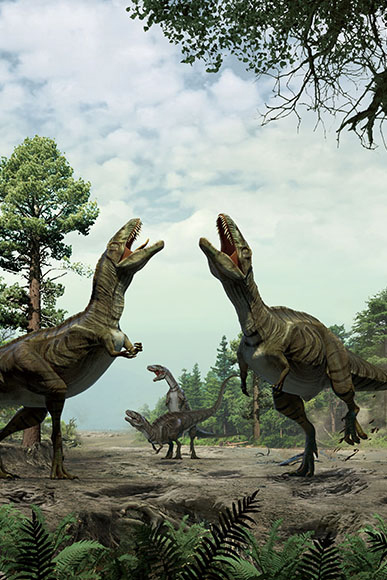
The research team, which included scientists from South Korea, China, Poland as well as the United States, conclude that trace fossils consisting of gouges and scrapes preserved in sandstone strata that is estimated to be around 100 million years old, preserve evidence of dinosaurs engaging in courtship and mating behaviours similar to extant birds.  The scrapes, gouges and scratches, some of which cover an area the size of a bathtub, have been interpreted as being similar to “nest scrape display” as seen in modern Aves.

Dinosaurs Displaying and Undertaking Ritualised Courtship Displays

An artist imagines the Cretaceous Courtship Scene

An artist imagines the Cretaceous courtship scene.

Picture credit: (Lida Xing and Yujiang Han / University of Colorado, Denver)

Dance of the Dinosaurs

The study was led by Professor Martin Lockley (University of Colorado) a highly respected specialist in dinosaur tracks and footprints (ichnologist).  The team interpret the trace fossils as evidence of courtship behaviour in theropod dinosaurs as the dinosaurs demonstrated their ability to make suitable mates by excavating pseudo nests.  Various trace fossil sites were studied and mapped, most of which are associated with the Upper Cretaceous deposits of the Dakota sandstone and mudstone formation of western Colorado.

Professor Lockley explained:

“These are the first sites with evidence of dinosaur mating display rituals ever discovered, and the first physical evidence of courtship behaviour.  These huge scrape displays fill in a missing gap in our understanding of dinosaur behaviour.”

Scientists Provide a Sense of Scale to the Scrape Marks

Martin Lockley (right) and Ken Cart pose beside large Theropod dinosaur scrapes in western Colorado.

Martin Lockley (right) and  co-author Ken Cart pose beside large theropod dinosaur scrapes in western Colorado.

Picture credit: University of Colorado

Could They Be Signs of Digging for Water or Food?

In their review of the trace fossil evidence, the scientists dismiss the idea that the marks could have been made by meat-eating theropod dinosaurs looking for food.  Back in 2010, Everything Dinosaur reported on a remarkable trace fossil found in Utah which suggested that a deinonychosaurid dinosaur had been digging out a potential prey animal from its burrow.  However, no evidence of burrows or other signs of prey were found in association with the scrapes.

To read about the evidence of a dinosaur potentially digging mammals out of their burrow: Trace Fossils Suggest a Dinosaur Digging for its Supper.

Not “Scratch Digging”

As for whether the marks represent dinosaurs digging for water, after all much of the Dakota sandstone and mudstone was laid down in association with rivers and streams, the researchers conclude that this is unlikely.  Whilst elephants and other terrestrial vertebrates do dig into dried up river beds to find water, the authors conclude that these marks are not “scratch digging” as any attempt to dig to the level of the water table would produce a pooling of water which would have washed away any scrape marks made in the sediment.

A Map of One of the Study Sites (Club Gulch – Western Colorado)

Map of Club Gulch site (a) prepared in Photoshop CS5 by MGL, with natural colour photogrammetic image (b) at same scale by RTM and LGB. Coloured image (inset in a) shows three large scrapes, together covering 5 m. Digging traces are classified as paired (bilobed) or single, with or without scratch marks and adjacent sand aprons.

Map of Club Gulch site (a) prepared in Photoshop CS5 by MGL, with natural colour photogrammetic image (b) at same scale by RTM and LGB. Coloured image (inset in a) shows three large scrapes, together covering 5 m. Digging traces are classified as paired (bilobed) or single, with or without scratch marks and adjacent sand aprons.

Picture credit: Scientific Reports

Dance of the Dinosaurs in “Leks”

The display arenas, also referred to as “leks” were found in two National Conservation Areas (Dominguez-Escalante and Gunnison Gorge) on property permitted by the Bureau of Land Management near Delta, Colorado.  The biggest site had approximately sixty preserved scrapes, located in a single bed of sandstone covering an area of 750 square metres.  The scientists also studied potential dinosaur mating/courtship fossil sites at the Dinosaur Ridge, a National Natural Landmark, just west of the city of Denver.

It is assumed that the males competed with each other to impress the females.  The females, choosing the most impressive male performers as their consorts.  Similar mating selection behaviours are common in tetrapods alive today, however, until now scientists could only speculate about dinosaur mating behaviour although in theropods at least, it had been assumed it might be similar to that of their modern avian relatives.

Dinosaurs Strutting Their Stuff

The discovery of a number of feathered varieties including oviraptorids with ornate tail feathers has led a number of palaeontologists to speculate that some theropod dinosaurs performed elaborate displays in order to win a mate or to gain status amongst the flock.  Research from the University of Alberta (Canada), proposed that some dinosaurs had compressed tail vertebrae that formed a pygostyle, as seen in many extant birds.  This structure would have enabled the dinosaurs to shake their tail feathers.

To read an article that provides more detail on this research: Dinosaurs Shaking Their Tails.

Commenting on this new study, Professor Lockley stated:

“The scrape evidence has significant implications.  This is physical evidence of pre-historic foreplay that is very similar to birds today.  Modern birds using scrape ceremony courtship usually do so near their final nesting sites.  So, the fossil scrape evidence offers a tantalising clue that dinosaurs in ‘heat’ may have gathered here millions of years ago to breed and then to nest nearby.”

A Line Drawing with Key of One of the Trace Fossil Sites Studied

The coloured image shows three large scrapes.

The coloured image shows three large scrapes.

Picture credit: Scientific Reports

4 01, 2016

Prehistoric Elephants Roamed the Isle of Wight

By |2023-04-10T07:43:58+01:00January 4th, 2016|Categories: Dinosaur and Prehistoric Animal News Stories, Dinosaur Fans, Main Page|0 Comments

Beachcomber Finds Prehistoric Elephant Shoulder Bone

An exceptionally low tide and a sharp-eyed beachcomber combined to permit another addition to be made to the prehistoric fauna of the Isle of Wight.  This small island off England’s southern coast, might be nick-named “the dinosaur fossil capital of Great Britain”, thanks to the wonderful, Early Cretaceous dinosaur fossil finds that have been made, but this new fossil represents a much more recent resident.

Prehistoric Elephant

Paul Hollingshead was exploring the rocks and sand ledges exposed by a really low tide back in March 2015, when he noticed a strange brown object partially sticking out of the mud.  He had been hoping to pick up some old fishing leads that he could melt down and recycle, but instead he thought he had stumbled upon the bone from a dinosaur.

Paul Hollingshead with his Children and the Prehistoric Elephant Fossil

Paul and his family show off their fossil find behind an Iguanodon exhibit.

Paul and his family show off their fossil find behind an iguanodont exhibit.

Isle of Wight Geology

The geology of the Isle of Wight is quite complicated.  Less than 10% of the island has exposures of Cretaceous aged strata (Wealden Group), the majority of the rocks are much more recent, dating from the Pleistocene Epoch for example.  The large fossil bone has been identified as belonging to an extinct straight-tusked elephant  Palaeoloxodon antiquus that roamed this part of Europe during a warm interglacial period when annual average temperatures were at least three degrees Celsius higher than today.

The bone is estimated to be around 100,000 years old – (Ipswichian stage) and it has been put on display at the local museum at Sandown.  In the picture above, finder, Paul shows off the scapula (shoulder bone) with his daughter Lily and son Shay looking on.  In the background is an exhibit of a more famous Isle of Wight resident an iguanodont.

That Big Elephant Family

Palaeoloxodon antiquus, is just one species in the Palaeoloxodon genus, these elephants were particularly widespread during the Pleistocene with fossils associated with Germany, Cyprus, Malta, Africa and Kent (southern England).  Many of these types of elephant become isolated in southern Europe as sea levels rose leading to dwarf forms having been identified on a number of Mediterranean islands.  The legend of the one-eyed cyclops may originate from prehistoric elephant skull fossil finds.

To read more about the potential link between ancient elephants and monsters from Greek legend: Dwarf Elephants and Legends.

The extant elephants, those species that are alive today, are members of the Elephantidae family, but there were a number of closely related other elephant families, all of which are now extinct.

Prehistoric Elephant Fossil

Straight-Tusked Elephant (Amebelodon)

Amebelodon due to be retired in 2013.

A straight-tusked “shovel-tusker”.

Picture credit: Everything Dinosaur

For models and replicas of prehistoric elephants and other animals: Eofauna Scientific Research Models.

Commenting on his fossil discovery, Mr Hollingshead stated:

“I remember it was a big five-metre tide, so I knew the water would go out a long way, when I saw what looked like a bit of bone showing from the sand.  I stopped and realised it was a bit bigger, so I started clearing all of the sand and stones away from it.  I was shocked how big it was and spent around two and a half-hours digging it out.  I was hoping it was a dinosaur bone, so was quite shocked to find out it was from an elephant.”

A Shoulder Bone

The prehistoric elephant shoulder bone has been donated to the island’s Dinosaur Isle Museum.  It has taken several months to prepare the fossil for display as, in geological terms the bone is very young, so young in fact that the permineralisation process (the replacement of organic matter with minerals), is not complete.  Extensive conservation was required to prevent the bone from disintegrating.

Click on the link below to read about a remarkable elephant discovery from Kent.

Giant Prehistoric Straight-Tusked Elephant from Kent: Homo heidelbergensis and the Straight-Tusked, Giant Elephant from Kent.

28 12, 2015

Dinosaur Forelimbs at Rest as New Study Explores Locomotion

By |2024-05-05T18:24:56+01:00December 28th, 2015|Categories: Dinosaur and Prehistoric Animal News Stories, Dinosaur Fans, Main Page|0 Comments

Putting Dinosaur Forelimbs in Their Place

Ask any young dinosaur fan to tell you some facts about the body of Tyrannosaurus rex and you can bet that after that huge skull, powerful bite, and those awesome teeth are mentioned, a comment will be passed regarding those very short arms.

New research published this month in the academic, on line journal PLOS One puts the forelimbs of the Dinosauria centre stage, the study conducted by scientists from  Fayetteville State University (North Carolina) and South-east Missouri State University suggests that the position of the arm bones in many museum reconstructions, the front legs of many a dinosaur model may be wrong.  The study does not pretend to be the last word on dinosaur limb placement, but it does point out that a number of museum exhibits have different reconstructions amongst mounted dinosaur skeletons.

Ceratopsidae (Horned Dinosaurs) Were Included in the Study

Centrosaurus (top) and Styracosaurus (bottom)

Centrosaurus (top) and Styracosaurus (bottom).

Picture credit: PLOS One with additional annotation by Everything Dinosaur

The picture above shows two articulated specimens of horned dinosaur, both centrosaurines.  The research team only used dinosaurs that had specimens which had been preserved in articulation.  In this way, the resting pose of the shoulder blades (scapulae) and the forelimbs can be summarised without having to be too concerned with distortion or extensive crushing which may have resulted from the fossilisation process.

Dinosaur Forelimbs

The photographs show that the ceratopsid sacrum (vertebrae over the pelvis) is horizontal, that is parallel with the ground when the humerus is held horizontally.

As both specimens in the picture above are shown in right lateral view (viewed from the right side), we have outlined the approximate position of the right humerus, it can be seen to be held almost horizontal.  The black line through the long axis of the sacrum is sub-parallel with the line that serves as a proxy for the horizontal by connecting the tips of the metapodials (the long bones in the hand) of the right forelimb (with the horizontal humerus) and a line drawing showing the right rear leg re-positioned to simulate a normal standing pose.

It’s All in the Pose

The lead author of the research biologist Phil Senter (Associate Professor in the Department of Biological Sciences, Fayetteville State University, along with is co-collaborator Professor Jim Robins, used their own photographs of mounted skeletons in combination with museum figures to analyse the correct angle of the resting position of the shoulder blades, the coracoid and the front limb bones.  In addition to selecting only articulated individuals to study, the scientists studied those animals that were preserved lying on their sides and for each of the animal’s included in the study the front limb joints had to be preserved in an articulated state, providing as much information as possible with regards to their position when the animal was alive.

Basal Ornithopods, early theropods and dinosaurs close to evolutionary split into Aves (birds) were included in the research.

Although the focus was on bipedal dinosaurs, facultative bipeds such as Edmontosaurus and Parasaurolophus were included in the genera examined. The long axis of the scapular blade (shoulder bone) was found to be most horizontal in bipedal saurischians, most vertical in basal members of the Ornithopoda, and intermediate in hadrosauroids.

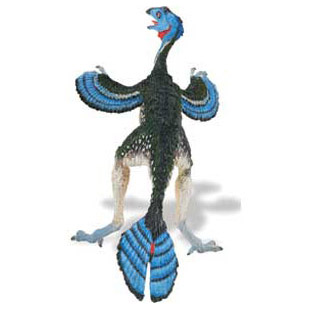
The Little Chinese Theropod Caudipteryx was Included in the Study

Included in the limb position study.

Included in the limb position study.

Picture credit: Everything Dinosaur

Implications for Theropod Dinosaurs

The research suggests that in bipedal dinosaurs other than theropods with semi-lunate carpals (semi-lunate carpals are unique in the Maniraptora which include dinosaurs such as Velociraptor, Microraptor, Oviraptor, Khaan and Caudipteryx), the resting position of the elbow is close to a right angle and the resting orientation of the wrist is such that the hand exhibits little deviation from the rest of the arm.  However, in the Theropoda with those more flexible wrists (thanks to the semi-lunate carpals), the elbow and wrist are more flexed at rest, with the elbow at a more acute angle and the wrist approximately held at ninety degrees.

Theropods with Semi-lunate Carpals Such as Velociraptor Have Elbows and Wrists More Flexed at Rest

The model in the picture shows the proposed configuration (inset).

The model in the picture shows the proposed configuration (inset).

Picture credit: Everything Dinosaur

The Caudipteryx and the Velociraptor models depicted in this article are part of the Safari Ltd range of prehistoric animal figures. To view this range: Wild Safari Prehistoric World Animal Models.

Whilst this may not be a definitive study, due to the relatively low numbers of skeletons assessed, it does have significant implications for the curators of dinosaur collections in museums aiming to mount an anatomically correct exhibit.  It may be time to re-adjust those forelimbs in order to better reflect this interpretation of the fossil record.

26 12, 2015

Remarkable Wyoming Fossil Find Helps to Explain Mammalian Carnivore Evolution

By |2024-05-05T18:24:14+01:00December 26th, 2015|Categories: Dinosaur and Prehistoric Animal News Stories, Dinosaur Fans, Main Page|0 Comments

“Polecat Dogs” Galecyon mordax et al and Mammalian Carnivore Evolution

As 2015 draws to a close, after all, this time next week it will be 2016, team members at Everything Dinosaur have been reviewing a paper published in the most recent issue of the “Journal of Vertebrate Palaeontology” (we can’t bring ourselves to use the “Americanised” spelling), entitled: “The postcranial skeleton of Galecyon: evidence for morphological and locomotor diversity in early Hyaenodontidae (Mammalia, Hyaenodontida)”.

An Early Eocene Carnivore

Exactly one hundred years ago the fossil bones of an Early Eocene carnivorous mammal were scientifically described.  The fossils, including skull bones, jaw fragments and teeth were between 55 million and 50 million years of age and demonstrated an early radiation of the Mammalia towards larger predators after the demise of the Dinosauria.

Subsequently the fossil bones were assigned to the genus Galecyon and a number of species have been erected for example, Galecyon mordax (the name translates from the Latin as “biting polecat dog”- we think).

In this newly published paper, scientists from the University of Arizona in collaboration with colleagues from The Johns Hopkins University (Baltimore, Maryland) were able to pull together a number of Galecyon fossil finds, including limb bones and from this study they have concluded that this fox-sized hunter was on the way to becoming a fully terrestrial carnivore.

An Artist’s Rendition of the Ancient Carnivore

An artist’s rendition of the shape of Galecyon, with its fossilised bones laid out anatomically. Background shows fossil formation, right humerus (inset).

An artist’s rendition of the shape of Galecyon, with its fossilised bones laid out anatomically. Background shows fossil formation, right humerus (inset).

Picture credit: Journal of Vertebrate Palaeontology

Galecyon mordax

The picture above shows a silhouette of the Early Eocene carnivore with the fossil bones used in the study placed in the correct anatomical position.  The Willwood Formation of Wyoming (southern Bighorn Basin), the location where the majority of the Galecyon material come, from is shown in the background.  The enlarged bone featured is the right humerus (upper arm bone).  From the subsequent analysis of the limb bones, the researchers were able to deduce that Galecyon was better adapted to a cursorial, terrestrial existence than its contemporaries which showed anatomical adaptations more akin to a climbing (scansorial) habit.

On the Road to the Carnivora

Prior to the evolution of the mammalian order Carnivora (the carnivores), which includes cats, dogs, seals, walruses, bears and raccoons, North America was dominated by group of primitive meat-eating mammals called hyaenodontids.  This group of placental mammals, in turn, have their origins in the Palaeocene Epoch.  Fossils, particularly teeth are relative common in Wyoming but other material, especially postcranial material is exceptionally rare.  Using a recently discovered more complete specimen and other referred material, the authors were able to piece together a better idea of how Galecyon moved.  This helps to provide a better understanding of how the hyaenodontids were evolving.

Lead author of the study, Dr Shawn Zack (University of Arizona) explained:

“The skeleton of Galecyon shows why we keep looking for fossils even in places where we already have a lot of specimens.  When this skeleton was found, tens of thousands of mammalian fossils had been collected from the Bighorn Basin, but this was the first decent skeleton of this animal.”

Wyoming Fossil

Weighing between five and seven kilogrammes, Galecyon was only about the size of a European Red Fox (Vulpes vulpes) and the fossil limb bones show that it was not entirely scansorial (tree climbing), like some of its hyaenodontid Early Eocene contemporaries.  Nor was it a fast runner like some of the later hyaenodontids such as those genera that flourished in the Oligocene.  However, the team were able to infer locomotory abilities and show progression towards a more agile, pursuit predator existence.  For Galecyon itself, this new research suggests it was the Early Eocene equivalent of a skunk or a wolverine.

Helping to Build up the Hyaenodontid Family Tree

The postcranial material also allowed the researchers to explore the evolutionary relationships between different hyaenodontids.  Teeth are the most common parts of the skeleton found, so dental characteristics can be investigated, but the new specimen allows for other additional parts of the skeleton to be studied too.

Commenting on the significance of this study, Dr Zack stated:

“This study shows that postcranial and dental morphology support different patterns of hyaenodontid relationships.  That is an indication that there is still a lot to learn about hyaenodontid evolution.  In addition, this study shows that early hyaenodontids had diverse habitat preferences, which helps explain how several different hyaenodontids were able to co-exist in the same faunas, despite having similar diets and comparable body sizes.”

Everything Dinosaur stocks a range of prehistoric animal models including several replicas of Cenozoic carnivores: Models of Prehistoric Mammals.

23 12, 2015

Slow Rise of Oxygen Led to Explosion of Life

By |2023-04-09T21:49:53+01:00December 23rd, 2015|Categories: Dinosaur and Prehistoric Animal News Stories, Dinosaur Fans, Main Page|0 Comments

Selenium Isotope Analysis Supports Idea of Progressive Oxidation

Most complex life on Earth, that is organisms that have evolved beyond the unicellular stage, depend on oxygen.  Fundamentally without O2, life on our planet would be very different, for one thing this highly reactive element is needed before amino acids and hence proteins can form.  Every breath you take reinforces the importance of oxygen to our planet’s great diversity and variation of life.  However, when did the oxygenation of our planet begin and how quickly did oxygen build up on Earth to allow complex life forms and more complicated ecosystems to evolve?

Earth Seven Hundred Million Years Ago – A Frozen Planet

Did these extreme conditions assist the evolution of complex life forms

“Snowball Earth” – progressive oxidation.

Picture credit: Everything Dinosaur

A new study published in the academic journal “Nature Communications” carried out by a team of international scientists, including researchers from University College London, Leeds University and the University of Washington, suggests that it took around 100 million years for oxygen levels in the atmosphere and oceans to rise to a level that allowed a rapid increase in the diversity and variety of life on Earth.

This research, that involved analysing selenium isotope concentrations from seven different locations, indicates that there was not a steady and sustained rise in O2 levels over this period, oxygen concentrations fluctuated, the amount of O2 increased in fits and starts leading to a substantial increase in life around 600 million years ago.

Which Came First More Animals or More Oxygen?

One of the fundamental questions that the scientists sought an answer to in this Natural Environment Research Council funded project was this – did rising oxygen levels permit the explosion of animal life recorded in the fossil record from about 600 million years onwards or was it a change in animal evolution that kick-started the rise of oxygen?

In simple terms:

  • Did rising O2 levels lead to an expansion in complex animal life?

OR

  • Did an expansion of more complex animal forms give rise to greater levels of oxygen?

This research suggests that the rise of O2 began significantly earlier than previously thought and the increase of oxygen was not a linear one, O2 levels rose, stalled and rose again over a vast period of geological time (at least 100 million years).  If the conclusions reached by the scientists are correct, then it is likely that early animal evolution was kick-started by an increase in the amount of oxygen available, rather than a change in animal behaviour leading to greater levels of O2 in the atmosphere and oceans.

Explaining the purpose of the isotope study, lead researcher Dr Philip Pogge von Strandmann (University College London) stated:

“We want to find out how the evolution of life links to the evolution of our climate.  The question on how strongly life has actively modified Earth’s climate, and why the Earth has been habitable for so long is extremely important for understanding both the climate system, and why life is on Earth in the first place.”

Starting at the Bottom – Marine Shales Actually…

To gain a better understanding of Earth’s climate during the Neoproterozoic (that vast era of geological time from about a billion years ago to 542 million years ago), the international team of scientists analysed selenium isotope data retrieved from samples of marine shales laid down at the bottom of the sea at different times from seven different locations to piece together a global picture of oxygen levels in the oceans and the atmosphere.

Strata studied included rocks across the United States, China and Canada and this work was conducted with the collaboration of Utah State University, Birkbeck (London) and Bristol University along with scientists from the University of Southern Denmark.

Selenium Isotopes

Selenium isotopes from marine shales can act as a indicator of global oxygenation conditions.  Lighter Se (selenium) isotopes recorded in shales generally indicate more oxygen rich conditions.  So by measuring the different selenium isotope ratios recorded in rocks of different ages, the scientists can start to build up a picture of the amount of O2 on the planet, specifically the level of oxygen in deep water, which in turn reflects on the amount of oxygen likely to exist elsewhere on the planet such as near to the coasts and in the atmosphere.

The selenium isotope analysis revealed that it took over 100 million years for the amount of oxygen in the atmosphere to climb from less than 1% to over 10% of today’s current level (20.8%).

Dr Pogge von Strandmann said:

“We took a new approach by using selenium isotope tracers to analyse marine shales which gave us more information about the gradual changes in oxygen levels than is possible using the more conventional techniques used previously.  We were surprised to see how long it took Earth to produce oxygen and our findings dispel theories that it was a quick process caused by a change in animal behaviour.”

Specifically the researchers focused on looking at strata laid down during the Cryogenian (720-635 million years ago) and Ediacaran (635-542 million years ago), towards the end of the Neoproterozoic.

During the period studied, three big glaciations –the “Snowball Earth” Sturtian (about 716 million years ago), and the Marinoan (635 million years ago) glaciations and the smaller Gaskiers glaciation (about 580 million years ago) occurred in which much of the planet (if not all of it), was covered in ice with the seas frozen and glaciers dominating the land.

As temperatures dropped, so the conditions for life that did exist at the time became extremely harsh.  However, when the temperature of the Earth rose, the glaciers melted and released vast quantities of mineral nutrients into the oceans.  The research team hypothesise that the ice melt and increased nutrient mix in the sea helped cause oxygen levels to rise in the deep ocean.

Glaciation and Subsequent Melt Boosted Oxygen Levels

Increased oxygen due to glacier melt.

Increased oxygen due to glacier melt.

Picture credit: Everything Dinosaur

Increased nutrients in a marine environment leads to more ocean plankton, which will bury and trap organic carbon in sediments at the bottom of the sea when they die.  Burying carbon results in oxygen increasing, dramatically changing conditions on our planet.  Up until this paper was published, oxygenation was thought to have occurred after the relatively small Gaskiers glaciation melted in the middle of the Ediacaran.

The findings from this study suggests that oxygenation occurred much earlier, linking a rise in O2 levels to the Marinoan glaciation, after which animals began to flourish in the improved conditions.  As life flourished so more and more diversity came about.  This led to the Cambrian explosion, a burst of evolution that began around 542 million years ago.

Everything Dinosaur stocks a range of models of Palaeozoic creatures such as trilobites, horseshoe crabs and cephalopods: CollectA Prehistoric World Models.

Oxygen a Slow Fuse

Professor David Catling (University of Washington), a co-author of the scientific paper stated:

“Oxygen was like a slow fuse to the explosion of animal life.  Around 635 million years ago, enough oxygen probably existed to support tiny sponges.  Then, after 580 million years ago, strange creatures, as thin as crêpes, lived on a lightly oxygenated floor of the sea.  Fifty million years later, vertebrate ancestors were gliding through oxygen-rich seawater.  Tracking how oxygen increased is the first step towards understanding why it took so long.  Ultimately, a grasp of geologic controls on oxygen levels can help us understand whether animal-like life might exist or not on Earth-like planets elsewhere.”

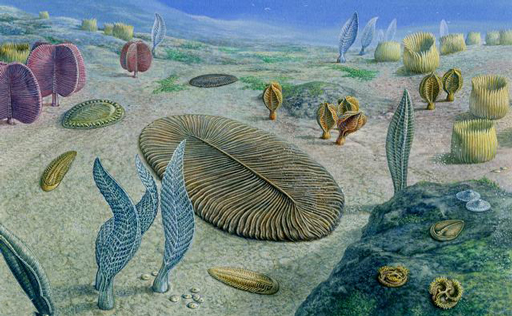
Oxygen and the Slow Fuse to More Diverse Complex Life

Life in the Ediacaran.

Life in the Ediacaran.

Picture credit: John Sibbick

Related Articles

To read an article (2012), that looks at some of the world’s oldest fossils: Are these the oldest fossils known?

Research (2014), suggests that multicellular life began earlier than previously thought: New research suggests multicellular life started earlier.

From August 2015, an article covering details of a study into ancient animal reproduction: Earliest evidence of reproduction in a complex organism.

Go to Top