All about dinosaurs, fossils and prehistoric animals by Everything Dinosaur team members.

Fossil finds, new dinosaur discoveries, news and views from the world of palaeontology and other Earth sciences.

29 09, 2015

One Step Closer to Determining the Colour of Dinosaurs

By |2023-04-05T17:42:34+01:00September 29th, 2015|Categories: Dinosaur and Prehistoric Animal News Stories, Dinosaur Fans, Main Page|0 Comments

Bat Study Helps to Confirm Melanosome Detection in Fossils

Melanin is a very widespread, natural pigment found in the animal kingdom.  Different forms of melanin are responsible for the colour of organisms, the black and the brown/reddish hues, for example.  Over the last few years, studies have attempted to identify evidence of melanosomes (the specialised part of the animal cell which synthesises, stores and transports the pigment), within the fossil record, but why is the search for an understanding about the colour of long dead creatures so important?

Colour Holds Key to Behaviour

In living animals today, colour patterns are closely linked to behaviours and colouration provides information on how these creatures interact with their environments.  From the ornate and beautiful peacock to the striking pigmentation of an okapi, knowledge of the colour of an organism provides scientists with a host of information.

If only we had such insights for long extinct animals, well we do, but the identification of preserved melanosomes in the fossil record has proved controversial.  The interpretation of the structures found has led to some very colourful debates.  Are scientists able to infer pigmentation from these preserved remains?

Shapes of Structures Seen Under Very High Magnification Can Provide a Clue to Original Colour

Interpretation of melanosomes.

Interpretation of melanosomes.

Even the Dinosauria has been dragged into the discussion, back in 2010, Everything Dinosaur reported on research led by Bristol University that attempted to identify the colour of feathers preserved in the fossils of a little Chinese theropod dinosaur Sinosauropteryx.

To read more about this research: A Ginger Dinosaur.

Newly Published Paper

Now a new paper produced by scientists from the University of Bristol in collaboration with colleagues from Virginia Tech and a number of other American academic institutes, backs the earlier research suggesting that the chemical preservation of melanin is possible within the fossil record.  The scientists studied a range of exceptionally well-preserved vertebrate fossils including specimens dating back to the Carboniferous and much more recent fossil material, the bats from the Early Tertiary shales of Messel in Germany, for example, along with some even more recent Miocene fossils.

The team were able to show that melanin is preserved in a number of soft-bodied fossils, but its burial under high pressure and temperature, all part of the fossilisation process does alter its original chemistry.  Other scientists had proposed that the structures thought to be melanosomes preserved in the fossil record, were actually bacteria that had become part of the fossil structure as they preserved the bacterial action of the original organic remains decomposition.  The research team concludes that the relatively widespread occurrence of melanin found allows them to dismiss the suggestion that these structures are microbial in origin.

Are We Closer to Determining the Colour of Dinosaurs?

Dr Jakob Vinther (Bristol University), one of the authors of the paper published in the PNAS (Proceedings of the National Academy of Sciences – America), replicated the conditions under which fossils form and then subjected the samples to analysis using extremely sensitive ion mass spectroscopy (TOF-SIMS – time-of-flight ion mass spectroscopy), the scientists were able to map how the melanin chemical composition would change over time and then compared their results to what was found in a chemical analysis of the fossil record.

Dr Vinther stated:

“This is a great leap forward in our understanding of how fossils are preserved.  We now know how melanin is preserved and we have the methods to confidently detect it.”

In short, if scientists now know how the pigment behaves during fossilisation and what its chemical signature should be after the fossilisation process has occurred, then they should be able to identify melanin in fossils by looking for this tell-tale signature.

Two Distinct Types of Melanin

There are two distinct types of melanin, eumelanin is responsible for the colour black and these structures resemble tiny sausage shapes when examined under high magnification.  The second type, responsible for the reddish/brown hues is phaeomelanin and its structures look much more circular when viewed under a microscope.  Importantly, structures which resemble these shapes have been spotted in the fossil record, as they have different chemical signatures, a chemical analysis can be used to back up observations regarding observed melanin structures.

Everything Dinosaur stocks a wide range of colourful prehistoric animal models including a replica of a feathered dinosaur: CollectA Prehistoric Life Models.

Prehistoric Bats Under the Spotlight

Take for example, those prehistoric bat fossils from the Messel shales which date from the Eocene Epoch.  Two species were studied and microscopic analysis of the beautifully preserved fur showed shapes that looked like the more circular structures associated with phaeomelanin (reds and browns).  The time-of-flight ion mass spectroscopy confirmed this interpretation.

Chemical signatures found support the idea that those circular structures would have meant that when these bats lived some fifty million years ago, the bats would have been reddish-brown in colour.  By using the morphological analysis backed up by the chemical signature study, the team could conclude with a high degree of certainly that these two species of bat were effectively brunettes.

A Fossil Bat – Palaeochiropteryx (Messel, Germany) from the Study

Reddish/brown bats of the Eocene.

Reddish/brown bats of the Eocene.

Picture credit: Dr Jakob Vinther

The Colour of Dinosaurs

Also involved in this study were scientists from the University of Texas at Austin (Texas), along with Caitlin Colleary, who had done his Masters Degree at Bristol University but was now a PhD student at Virginia Tech.

Outlining the extent of their study, Caitlin said:

“We have now studied tissues from fish, frogs, and tadpoles, hair from mammals, feathers from birds, and ink from octopus and squids.  They all preserve melanin, so it’s safe to say that melanin is all over the place.  Now we can confidently fill in some of the original colour patterns of these ancient animals.”

This area of research is likely to remain controversial for a while longer.  So much depends on how we interpret the morphology of these tiny structures.  This research does provide a chemical method of helping to back up findings, however, we suspect that the debate amongst scientists will rumble on.  After all, in scientific research of this nature, hardly anything is as clear as black and white.

More research into the colour of dinosaurs (August 2015): The Colour of Dinosaurs.

Dinosaurs may have laid coloured eggs (May 2015): Did Dinosaurs Lay Coloured Eggs?

Working out the colour of dinosaurs may have become a little more complicated: Working out the Colour of Dinosaurs Just Got Harder.

The colour of marine reptiles: Marine Reptiles and their “Little Black Numbers”.

Everything Dinosaur acknowledges the help of Bristol University in the compilation of this article.
27 09, 2015

New Research on the Coelacanth Shows it Has a Vestigial Lung

By |2023-04-05T17:27:48+01:00September 27th, 2015|Categories: Dinosaur and Prehistoric Animal News Stories, Dinosaur Fans, Main Page|0 Comments

The Weird and Wonderful Coelacanth – Once an Air Breather

An international team of researchers led by scientists at the Department of Zoology at the University of Rio de Janeiro (Brazil), have discovered that the bizarre “living fossil” Coelacanth has a vestigial lung in its abdomen.  This organ, now obsolete, is an evolutionary left over from when the ancestors of the extant species lived in oxygen poor waters millions of years ago.

The fossil record of the Coelacanths part of the group of predatory Sarcopterygian fishes, dates back to the Devonian (about 410 million years ago), once widespread, living in a variety of freshwater and marine habitats these fish were believed to have died out at around the same time as the dinosaurs.  However two extant species are known, both in the genus Latimeria (Latimeria chalumnae and L. menadoensis).  Latimeria chalumnae is found in deep water between 200 and 400 metres deep off the coast of South Africa with a particular concentration around the Comoros Islands.

Coelacanth Specimen Caught in 1938

The first specimen known to science was caught in 1938.  Latimeria chalumnae is coloured deep blue with white spots.  The second species L. menadoensis, is predominantly brown in colour and it was scientifically described in 1999.  This species seems to be confined to the deep waters off the Indonesian island of Sulawesi.

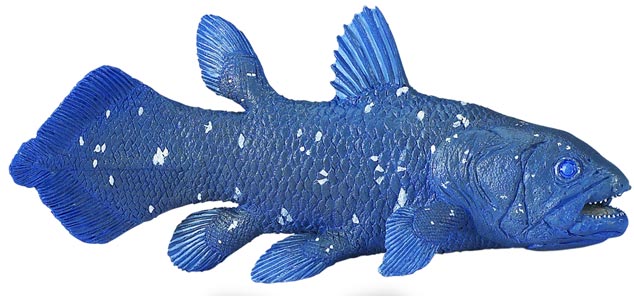
A Model of a Coelacanth

Ancient fish model - Coelacanth

Ancient fish model – Coelacanth

Picture credit: Everything Dinosaur

Safari Ltd have created a beautiful model of a Coelacanth: Safari Ltd. Wild Safari Prehistoric World.

Latimeria chalumnae

The team of international researchers which also included scientists from France and Japan studied a total of five Latimeria chalumnae specimens a various growth stages and following dissections as well as three-dimensional reconstructions they discovered that the vestigial lung is proportionally much larger in the Coelacanth embryo but the growth of this organ slows down as the fish matures.  This suggests that the ancestors of modern Coelacanths evolved a lung to help supplement their breathing, perhaps as a result of living in low oxygen environments.

The deep water habitat of the two known species alive today are very stable and oxygen levels are relatively constant.  As a result, the lung is not needed and it has become obsolete.  A fatty organ has also been noted, this seems to act as a buoyancy aid.  This research has been published in the journal “Nature Communications”.

Three Dimensional Reconstructions Showing the Development of the Vestigial Lung in Coelacanths

Three-dimensional images showing the development of the Coelacanth lung at different fish growth stages.

Three-dimensional images showing the development of the Coelacanth lung at different fish growth stages.

Picture credit: Brito et al (Nature Communications)

The picture above shows right lateral views of the specimens in the study showing the development of the lung.  Pictures (a-d), early embryo with approximate length four cm.  In pictures (e-h), the embryo is shown with a yolk sac around thirty centimetres in length.  Pictures (i-l) an adult animal, approximate length 1.3 metres.  Yellow = oesophagus and stomach, green the fatty organ and red equals the vestigial lung.  The obsolete lung is proportionally much larger in the embryo than in the adult animal.

Studying Fossil Coelacanths

The presence of a strange, calcified sheath in the abdominal cavity of fossil Coelacanths, has been known for over 150 years.  However, palaeontologists were not sure what these calcified plates represented.  It had been thought that it was some sort of specialised internal organ, perhaps functioning like a swim-bladder.  Only recently has this organ present in fossil Coelacanths been identified as a pulmonary organ (lung), positioned adjacent to the fish’s gut.

Although the anatomy of living Coelacanths has been studied extensively, little evidence concerning the presence of a lung in extant species had been found.  However, it had been noted that adult animals had a large, fatty organ in the location where the lung was thought to be.  How these structures found in modern Coelacanths related to the structures seen in fossils remained unclear.  In this new research, the existence of a vestigial lung in L. chalumnae is confirmed.

In addition, the scientists propose homology (shared ancestry) between this lung and calcified lung found in fossils.  The parallel development of a fatty organ for buoyancy control suggest a unique adaptation amongst the Coelacanth family for living in deep water environments.

Fish Evolution and the Coelacanth

Over the long course of this fishes evolution, the adaptation to living in stable, deep water, marine environments with its very low variations in oxygen content, may have resulted in the loss of the lung function.  As the lung becomes proportionally smaller in adult specimens so there is an increase in the size of the fatty organ.  This organ may help to stabilise this relatively large fish in the water column, an adaptation to living at depths of more than 200 metres.

The researchers speculate that adapting to a deep water environment may help to explain the survival of some Coelacanths.  The stable, unchanging, deep water environments might have been much less affected by the global environmental crises marked by the End Cretaceous extinction event.  Late Cretaceous Coelacanths inhabiting shallow marine environments or freshwater may not have been so lucky, hence their extinction.

26 09, 2015

The Rediscovering of Australia’s First Cretaceous Dinosaur

By |2023-04-05T17:22:08+01:00September 26th, 2015|Categories: Dinosaur and Prehistoric Animal News Stories, Dinosaur Fans, Main Page|0 Comments

Original Quarry where Fossils of Austrosaurus Found Re-Located – Australia’s First Cretaceous Dinosaur

More fossils of the very first Cretaceous dinosaur to be described from Australia have been excavated over the winter months and scientists could be on the verge of solving a mystery surrounding whether the titanosaur named Austrosaurus mckillopi deserves to be a valid genus or not.

The winter months (Southern Hemisphere), are the best months to conduct field work in Queensland (Australia), although still hot, the daytime temperatures are nowhere near as high as they are in the summer and the months of June through to the early part of September are regarded as the season of field work when volunteers join palaeontologists on organised digs, excavating the rich Mesozoic fossil heritage of this Australian State.  Austrosaurus means (southern lizard), scientists have estimated that this dinosaur may have reached lengths in excess of fifteen metres.

For replicas of prehistoric animals and other figures: CollectA Prehistoric Life Models.

Australia’s First Cretaceous Dinosaur

Back in 1932, a farm worker found some fragments of bone that turned out to be vertebrae from a huge titanosaur.  The fossils were very unusual as the location of the fossil find – Clutha Station close to the settlement of Richmond had provided scientists with some excellent examples of marine reptiles.  The sediments deposited in this area represented a marine environment, however, the carcase of a large, herbivorous dinosaur had been washed out to sea and the fossils had been exposed on the surface due to erosion.  Sadly, the fossil location was lost and although a dinosaur was named based on the fragmentary remains (Austrosaurus), no further material could be recovered.

That was until last year, when the mayor of Richmond John Wharton set out to search the Clutha Station area in a bid to re-discover the fossil site.  Searching by truck did not prove successful, but when a helicopter was hired, two wooden posts in the ground were soon spotted from the air and on further inspection this proved to be the site of the 1932 fossil discovery.  A preliminary investigation led to a full-scale excavation taking place during this year’s field work season.

Finding Fossil Bones

A number of pinkish-white bones were excavated, including some very well preserved rib bones, the largest of which measure 1.6 metres in length.  These bones are very likely part of the same skeleton as the vertebrae discovered in 1932.  The bones are currently on display at the Kronosaurus Korner museum in Richmond. Further preparation and cleaning will be undertaken and then an analysis carried out comparing this, now more complete skeleton to the fossilised remains of Wintonotitan wattsi, another Australian titanosaur, whose fossils have been recovered from rocks of a similar age, but the majority of these fossil finds have taken place to the south of the town of Richmond (near to Winton).

Dr Steve Poropat, a scientist from the Australian Age of Dinosaurs Museum (based at Winton), the town after which Wintonotitan was named stated:

“Rediscovering a historical dinosaur dig site was almost more exciting than finding a brand new one.  Once we knew where the site was, we knew we had the chance to find more of the same Austrosaurus specimen and all that was separating us from it was a metre or so of black soil.”

Trying to Find the Original Dig Site

Attempts had been made in the 1970s and 1980s to relocate the original Austrosaurus dig site, but they had all been unsuccessful.  Thanks to the dedicated folk of Richmond and the surrounding area, Australian scientists have the opportunity to learn more about the first Cretaceous dinosaur to be described in Australia and to find out whether Wintonotitan and Austrosaurus deserve to be separate genera.

An Illustration of Austrosaurus (Austrosaurus mckillopi)

A scale drawing of Austrosaurus.

A scale drawing of Austrosaurus.

In January, Everything Dinosaur predicted that this year would be an important one for Australian dinosaur discoveries.  There have been a number of fantastic fossil finds and it is great to hear the 1932 fossil site has been rediscovered.

To read more about Everything Dinosaur’s predictions for 2015: Palaeontology and Fossil Predictions for 2015.

To read more about other titanosaur discoveries from Australia including Wintonotitan: A Trio of Aussie Dinosaurs.

25 09, 2015

Potential New Species of Horned Dinosaur Reported

By |2023-04-05T17:15:31+01:00September 25th, 2015|Categories: Dinosaur and Prehistoric Animal News Stories, Dinosaur Fans, Main Page|0 Comments

Potential New Addition to the Ceratopsidae Family

Everything Dinosaur has received reports that scientists from the Museum of the Rockies (Bozeman, Montana), may have discovered a new species of horned dinosaur (Ceratopsidae family).  The fossils including elements of the skull were originally found during fieldwork on the Judith River Formation back in 2012, but it was not until this week that researchers realised that the bones could represent a new species of horned dinosaur.

Horned Dinosaur

The Judith River Formation, part of the Judith River Group, is famous for its vertebrate fossils and a number of dinosaur genera have been described from the various sub-divisions that make up the Judith River Formation, although, as far as we at Everything Dinosaur there has never been any sauropod fossils associated with this particular geological feature.

Numerous ornithischian and theropod dinosaur fossils have been found, although a number of genera that have been named are based on very fragmentary remains, a consequence of this part of Montana being first explored during the “Bone Wars” of the late 19th century by scientists such as Edward Drinker Cope.

Eighty-five Percent of One Individual Dinosaur

As the fossils, which represent about eighty-five percent of one individual, were found very close to the Careless Creek Ranch site where the first fossilised remains of the small horned dinosaur known as Avaceratops (A. lammersi), were discovered back in 1981, it was thought that the bones represented another specimen of Avaceratops.  However, as researchers from the Museum of the Rockies removed the fossils from their protective plaster and burlap jackets it was noted that the skull morphology was somewhat distinctive and different from that seen in the Avaceratops holotype.

In addition, this specimen seemed to lack a nasal horn.  This data has led the researchers to speculate that this could be a brand new species of horned dinosaur.

Commenting on the work carried out so far, John Scannella, Palaeontology Collections Manager for the Museum explained:

“What’s important is that before a new dinosaur species is named that the bones that are supposed to belong to this new species of dinosaur are closely studied by palaeontologists and compared to other specimens that might look similar.”

An Illustration of the Dinosaur Called Avaceratops (A. lammersi)

A scale drawing of Avaceratops.

A scale drawing of Avaceratops.

Picture credit: Everything Dinosaur

Is This a New Species of Ceratopsian?

If the fossil represents a new species then it can possibly help palaeontologists to learn more about the radiation of the Ceratopsidae that took place during the Early to Middle Campanian faunal stage (around 79 to 77 million years ago).  If the fossils turn out to be another example of an Avaceratops, than ironically they could have a far greater significance.  The relationship between Avaceratops and other members of the horned dinosaur family tree is not clear (phylogeny).

For models and replicas of Avaceratops (whilst stocks last) and other horned dinosaurs: Beasts of the Mesozoic Models.

Avaceratops is regarded as a basal member of the centrosaurine dinosaurs, but this position has been debated.  In addition, the actual size of this dinosaur remains uncertain.  The holotype material has been regarded as representing a sub-adult, even a juvenile specimen.  In Everything Dinosaur’s illustration we show Avaceratops as being relatively small for a Late Cretaceous member of the Ceratopsidae.  However, other researchers who have looked at more recent fossil finds suggest that this dinosaur could have reached lengths of over four metres and weighed in excess of one tonne.

If these new fossils do indeed represent another Avaceratops, then with eighty-five percent of the skeleton to study, palaeontologists might learn a lot more about how Avaceratops grew and where it fits into the horned dinosaur family.

Potentially a New Horned Dinosaur

A spokesperson from Everything Dinosaur stated:

“The problem with horned dinosaurs is that they seem to have changed substantially as they grew up and matured.  As features such as horns and neck frills change, then it can take a very long time to determine whether this is really a new species or just a specimen at a younger or older growth stage than the fossils of an already described species.”

Avaceratops has been very much one of Everything Dinosaur’s “dinosaurs of the week” this week.  During a school visit, we met a young girl called Ava and we explained all about the dinosaur that shares her name. We even sent over a picture of Avaceratops so the class could see what we think this dinosaur looked like.  Avaceratops was named after Ava Cole, the wife of Eddie Cole who found the first fossils of this herbivorous dinosaur.

24 09, 2015

Latest Dinosaur from Alaska

By |2023-04-05T17:07:15+01:00September 24th, 2015|Categories: Dinosaur and Prehistoric Animal News Stories, Dinosaur Fans, Main Page|0 Comments

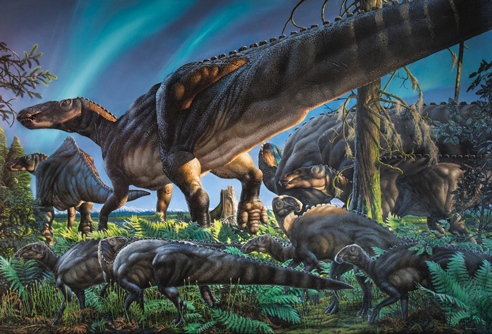
New Dinosaur Species Suggests Unique Fauna of Late Cretaceous Alaska (Ugrunaaluk kuukpikensis)

Scientists have announced a new species of duck-billed dinosaur that once roamed the polar forests of Alaska.  The dinosaur, named Ugrunaaluk kuukpikensis pronounced 00-grew-na-luck kook-pik-en-sis, reached lengths in excess of nine metres and its discovery further supports the theory that during the Late Cretaceous, Alaska supported a unique dinosaur fauna.

An Illustration of a Herd of Ugrunaaluk (U. kuukpikensis)

Duck-billed dinosaur would have seen the northern lights.

Duck-billed dinosaur would have seen the northern lights.

Picture credit: James Havens

Ugrunaaluk kuukpikensis

The fossils, which include the remains of a number of individuals, came from the Liscomb Bone Bed, a highly fossiliferous layer of rock along the Colville River in the Prince Creek Formation.  These rocks consist of flood plain deposits and shed light on life in the far north of the American continent some 69 million years ago (Maastrichtian faunal stage).

The Colville River area has produced evidence of a number of dinosaur species that suggest that the wildlife existing at the very top of the landmass known as Laramidia at the end of the Age of Dinosaurs was not found anywhere else in the world.  Recent fossil finds include teeth of giant troodontids and a polar tyrannosaur.

To read more about the tyrannosaurid discovery: Nanuqsaurus – Polar Bear Lizard.

One of the lead authors of the scientific paper that details this discovery (published in the quarterly journal Acta Palaeontologica Polonica), Pat Druckenmiller stated:

“Today we find these animals in polar latitudes.  Amazingly, they lived even farther north during the Cretaceous.  These were the northern-most dinosaurs to have lived during the Age of Dinosaurs.  They were truly polar.”

Earth sciences curator at the University of Alaska Museum of the North, Dr Druckenmiller worked with University of Alaska Fairbanks graduate student Hirotsugu Mori and Florida State University’s Gregory Erickson in order to piece together the fossilised and disarticulated remains.  However, the naming of this dinosaur involved Ronald Brower Senior, an expert on Alaskan native peoples.  The scientists wanted to give their new dinosaur a name that honoured the Iñupiaq people who live along the Colville River.

Honouring the Iñupiaq People

Mr Brower, a teacher at the University of Alaska Fairbanks Alaska Native Language Centre and an expert on the culture and history of the Iñupiaq, helped the team come up with Ugrunaaluk kuukpikensis, the name translates as “ancient grazer”, a reference to the extensive dental battery these dinosaurs possessed, vital if they were able to cope with a diet of coarse pine needles, fir cones and ferns.

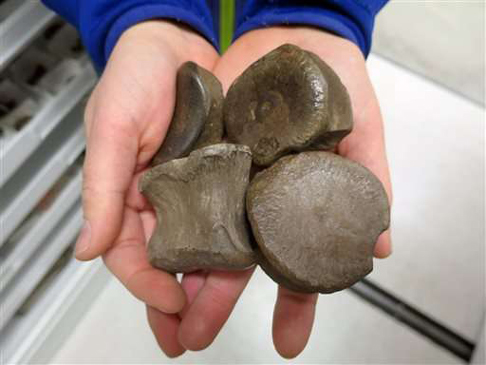
Some of the Duck-Billed Dinosaur Fossil Bones from the Site

Caudal vertebrae (tail bones)

Caudal vertebrae (tail bones).

Picture credit: Pat Druckenmiller/University of Alaska Museum of the North

Permanent Residents?

Although the Arctic is much colder today than it was back in the Late Cretaceous, these dinosaurs, if they had been permanent residents*, would have endured many months of complete darkness and an average annual temperature of around nine degrees, that’s about the equivalent annual average temperature of Toronto (Ontario, Canada) today.  These substantial herbivores would have been well used to seeing snow and ice.

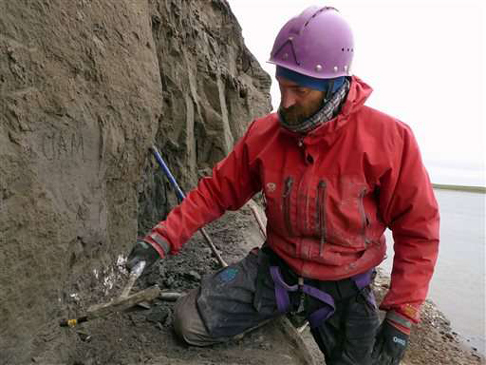
Dr Pat Druckenmiller Digging for Dinosaur Fossils

The research team had to endure a variety of extreme weathers including snow falls.

The research team had to endure a lot of extreme weather including snow falls.

Picture credit: Greg Erickson/University of Alaska Museum of the North

Ugrunaaluk kuukpikensis – An Important Discovery

This is the fourth unique dinosaur species to be identified from this part of the world.  The researchers propose that these dinosaurs were specially adapted to survive the harsh climate and that northern Laramidia supported a unique ecosystem.  The absence of any crocodile, lizard or turtle bones from the deposit suggests that ectotherms (cold-blooded reptiles) could not cope with the cold at this latitude.

*As to whether these duck-billed dinosaurs were residents or seasonal migrants has caused some debate amongst palaeontologists.  Some scientists have proposed that these large herbivores migrated up to these latitudes so that they could take advantage of the abundant plant growth in the summer months, when there would have been almost permanent daylight.  However, Greg Erickson believes that the young hadrosaurs found at the site were too small to be able to undertake such an extremely long migration.  He thinks that the dinosaurs were permanent residents.

The Florida State University scientist explained these dinosaurs may have had physiologies more like birds or mammals.  The researchers hope to study the fossils in more detail so that they can understand more about how such large reptiles were able to survive so far north.

As to where Ugrunaaluk kuukpikensis fits into the hadrosaur family tree, the dinosaur resembles an Edmontosaurus, but it was ascribed its own genus based on differences in the anatomy of the skull and differences in the morphology of some of the other post cranial fossil material.

23 09, 2015

Understanding the Astonishing Azhdarchid Pterosaurs

By |2024-05-05T17:06:46+01:00September 23rd, 2015|Categories: Dinosaur and Prehistoric Animal News Stories, Dinosaur Fans, Main Page|0 Comments

What Role in Ecosystems did Giant Azhdarchid Pterosaurs Have?

Ask a young dinosaur fan to name a flying reptile and in all likelihood they will come out with the name of one of the really large Late Cretaceous pterosaurs.  Pteranodon will probably feature (member of the Pteranodontia), which once boasted as many as eleven species in this genus, but now most palaeontologists except the revision down to just two (P. sternbergi and the geologically younger P. longiceps).

Azhdarchid Pterosaurs

However, matching Pteranodon in popularity and exceeding it in terms of wingspan come the likes of Hatzegopteryx and Quetzalcoatlus.  These two flying reptiles are representatives of the enigmatic Azhdarchidae and as such could be regarded as the most spectacular of all the flying reptiles known to science.

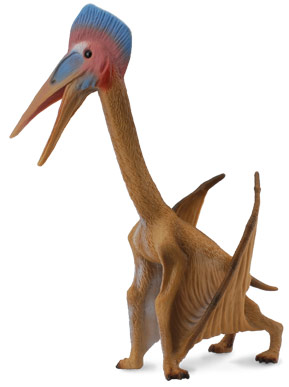
A Model of the Giraffe-sized Pterosaur Called Hatzegopteryx

The CollectA Hatzegopteryx

The CollectA Hatzegopteryx.

Picture credit: Everything Dinosaur

The picture above features the CollectA Hatzegopteryx model, to view the range of pterosaurs and other flying reptiles in this series: CollectA Prehistoric Life Models.

Azhdarchid Pterosaur Study

There is no doubting some of these azhdarchid pterosaurs were giants, Hatzegopteryx (H. thambema), for example, was taller than a giraffe and its wingspan could have exceeded twelve metres.  Quetzalcoatlus from Upper Cretaceous sediments of Texas, is believed to have been even bigger.

When the huge skull is considered, one of the largest known in the tetrapods (excluding marine animals such as the cetaceans), when the robust post cranial fossil material associated with Hatzegopteryx is examined closely, it seems incredible that these large creatures were able to take to the air.  However, when the global distribution of the fossils is considered along with aerodynamic wing shape studies, it seems that most of the Azhdarchidae were indeed accomplished fliers.

An Important Question to Answer

This begs the question, what role in the Late Cretaceous ecosystem did these toothless giants have?  There have been a number of research papers published exploring this area of pterosaur research.  Recently, Mark Witton, a leading expert on the Pterosauria (University of Portsmouth) collaborated with Darren Naish (University of Southampton) to produce an intriguing paper in the latest edition of the quarterly journal “Acta Palaeontologica Polonica” on this very subject.

Both these eminent British scientists have written extensively on the Pterosauria before, but in this new paper entitled “Azhdarchid Pterosaurs: Water-trawling Pelican Mimics or “Terrestrial Stalkers”?”, they conclude that large azhdarchid pterosaurs were very probably terrestrial hunters, perhaps filling a role in ecosystems similar to that of the Maribou Stork (Leptoptilos crumenifer) today.

Terrestrial Predators

These storks are large wading birds and are widespread in sub-Saharan Africa.  They have a reputation for eating almost anything that can fit into the mouths including rubbish from garbage dumps.  They do feed on carrion and it has been proposed that azhdarchid pterosaurs were scavengers too, but these heavy birds also stalk and feed upon a variety of small vertebrates such as frogs, lizards, other birds and small mammals.

The idea that the likes of Hatzegopteryx and Quetzalcoatlus were largely terrestrial hunters, stalking prey – has been challenged on a number of occasions, three main concerns over this hypothesis have been raised:

  1. Fossils of azhdarchid pterosaurs are frequently found in aquatic deposits
  2. Aerial water-trawling, where the beak is pulled through the water to catch food in an enlarged throat pouch like that seen in extant pelicans is a more likely feeding strategy
  3. Large, slow-moving pterosaurs would have been very vulnerable to attack from other predators as they roamed the land

The Ecology of Azhdarchid Pterosaurs

In this new paper, Mark and Darren examine the evidence for these claims and conclude that the fossil evidence does indeed support the idea that these large animals were indeed terrestrial foragers.  Firstly, the fact that fossils of azhdarchids are found in strata that represent lacustrine, riverine or marine environments is dismissed as having no real significance with regards to the behaviour of these flying reptiles.  Water transport and deposition accounts for a huge proportion of the vertebrate fossil record and therefore, the deposition in aquatic deposits probably has no bearing on the actual lifestyles of these creatures.

Secondly, it is true, that pelicans are very efficient feeders and their pouches do help them forage, but an examination of the joint function of pterosaur jaws indicates that they are entirely different to those of the jaws of pelicans. Pelican beaks are highly specialised compared to those of all other tetrapods, studies of azhdarchid jaw (albeit from very crushed remains in most cases), fossils, suggest that these pterosaur jaws are anatomically very different from those of pelicans.

The researchers cannot find any strong evidence to support the idea that azhdarchids foraged like pelicans.

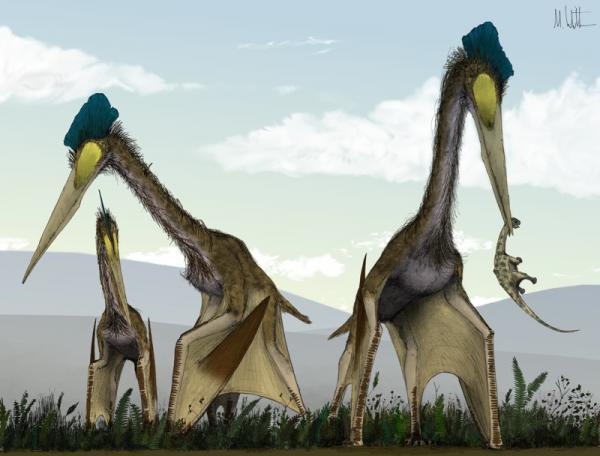
A Flock of Azhdarchid Pterosaurs Doing What They Do Best – Ground Foraging

Some Pterosaurs were as tall as a giraffe.

Some Pterosaurs were as tall as a giraffe.

Picture credit: Mark Witton

Reviewing Jaw Expansion

In addition, the estimated amount of jaw expansion present in azhdarchids was proportionately much smaller when compared to that of pelicans, even when the asymmetrical jaw joints of azhdarchids are considered.  Lots of other reptiles from the fossil record also show evidence of asymmetrical jaw joints, yet there is no evidence to suggest that these creatures too, indulged in pelican-like feeding behaviour.

Finally, the researchers refute the idea of these pterosaurs being particularly prone to attack once on the ground.  Trace fossils indicate that pterosaurs were quite capable walkers on land and although encumbered by their wings, they were not completely helpless.  There are lots of birds around today that adopt a terrestrial foraging strategy, the risks to stalking pterosaurs from a large theropod attack are probably overstated.

Pterosaur Take-offs

For example, studies of pterosaur take-offs indicate that these creatures could probably take to the air quite quickly and when you consider that they would have had a pair of sharp eyes perched some five metres off the ground, the likelihood of a meat-eating dinosaur ambushing them would have been considerably reduced.

So, after a careful examination of the available evidence, the researchers conclude that terrestrial foraging for the likes of Hatzegopteryx remains the most likely feeding strategy.  This gives a whole new meaning to the idea of “picking something up for dinner”.

Back in 2013, Mark P. Witton wrote a fantastic book all about the Pterosauria, it was called “Pterosaurs, Natural History, Evolution, Anatomy” and it is well worth purchasing.

Here is Everything Dinosaur’s book review: Pterosaurs Reviewed.

20 09, 2015

Redefining the Neanderthals at a Special Conference

By |2024-05-05T15:14:04+01:00September 20th, 2015|Categories: Dinosaur and Prehistoric Animal News Stories, Main Page, Palaeontological articles|0 Comments

Changing Perceptions Towards Homo neanderthalensis

The Gibraltar Museum is holding a special conference at the end of September.  It is in part a celebration of the Museum’s eighty-five year history but it also sets out to re-dress some of the misconceptions about our nearest ancestor, the Neanderthal.  The idea that these hominins were nothing more than blood-thirsty, brutal creatures, a view held as sacrosanct for much of the 20th century, has now been altered for ever as recent discoveries by palaeontologists and palaeoanthropologists have shed new light on our closest ancestor, one that walked amongst us as recently as 28,000 years ago.

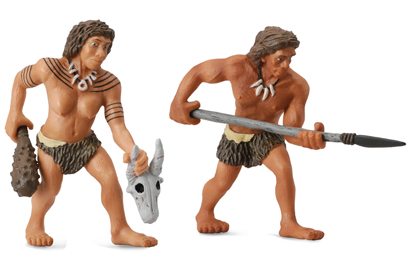
Neanderthals

Neanderthal – Our Closest Relative

CollectA Neanderthal Models.

Human and Neanderthal genetic research likely to be discussed at the conference.

The models shown above are Neanderthal figures which are part of the CollectA Prehistoric World model range: CollectA Prehistoric Models and Figures.

High profile speakers and international scientists, all specialists in the study of human evolution, will converge on Gibraltar to discuss how our views have changed in a conference entitled “Redefining the Neanderthals”.

Evidence from Gibraltar

Gibraltar is a very appropriate location to hold such a conference.  It was in Gibraltar that the first Neanderthal skull was found and studied by scientists, although the find (1848), took place before the Neanderthal species was named.  Neanderthal occupation has been identified in at least ten caves in the area, in fact, the Neanderthals who lived on the coastal plain that once existed where the rock of Gibraltar now stands may have been some of the very last of their species.

The Neanderthal caves and the surrounding area has been nominated for World Heritage Status, if these locations are granted such status, it would give the caves the same standing in scientific circles as the Great Barrier Reef, and the Jurassic Coast of Dorset.

The conference will also highlight Gibraltar as an exceptionally important part of the world for Neanderthal studies.  It will run from the 24th to 26th September and invited delegates will be given the opportunity to visit some of the research sites on Sunday the 27th.  Professor Chris Stringer (Natural History Museum, London) will deliver the opening address.  Speakers will come from a number of countries including Spain, Italy, Croatia, Germany and the United States.

A Wide Variety of Topics to Discuss

Topics to be discussed will include how the Neanderthals were able to exploit raptors and corvids (crows), for a number of purposes.  For example, eagle talons have been used as jewellery (reported from Croatia earlier this summer).

The conference will provide a fresh insight into the Neanderthals, a sophisticated, perfectly adapted hominin whose extinction remains a mystery as there is a growing body of evidence to suggest that these people were smart, strong, capable of language and developed sophisticated cultures.

Why they are gone yet we are here is one of the questions likely to be debated.

If you don’t think the Neanderthals were smart, try catching a crow, or an eagle for that matter!

Visit Everything Dinosaur’s award-winning website: Everything Dinosaur.

19 09, 2015

Thieves Steal Rare Fossils from Devon Cave

By |2024-05-05T17:07:41+01:00September 19th, 2015|Categories: Dinosaur and Prehistoric Animal News Stories, Main Page|0 Comments

Fossils from the Joint Mitnor Cave Stolen

Sad news to report today.  It has come to our attention that thieves have ransacked the fossil deposits preserved at Joint Mitnor Cave located near the town of Buckfastleigh in Devon.  Items stolen include a beautifully preserved prehistoric elephant’s tooth that is believed to be around 100,000 years old.  Devon and Cornwall Police are currently investigating the theft, with the high prices that fossil teeth and bones can fetch on the black market, such thefts are becoming all too common.

The Joint Mitnor Cave

The Joint Mitnor Cave, named after the people who discovered it, is located in a limestone quarry (Higher Klin Quarry), one of a sequence of caves that once formed a much larger structure.  The caves were originally formed as water, part of the River Dart system, percolated down and slowly eroded away the Devonian limestone rocks to form caverns.  The door guarding the cave was smashed and the thieves removed a number of fossil specimens.

The cave is one of a number of such sites managed by the William Pengelly Cave Studies Trust, at just over fifty metres long it is not that big, but during the last interglacial period, part of the roof of the cave collapsed creating a trap in which unwary animals could fall into.

Rare Fossils

The fossilised bones of Hippos, Hyenas, Elephants and Bison have been found.  Most of the fossils had been removed and taken to the Natural History Museum (London) back in the 1960s but a number of specimens had remained in situ so that visitors could see the fossils and learn how such fossils in caves form.

The Elephant Tooth Fossil Photographed in the Cave

An elephant tooth lies adjacent to some crushed bison bones.

An elephant tooth lies adjacent to some crushed bison bones.

Picture credit: William Pengelly Cave Studies Trust

The Richest Deposits of Mammalian Remains Found in a British Cave

The cave contained the richest deposits of mammalian remains found in a cave in Britain.  The fossils date to the Ipswichian stage of the Pleistocene Epoch.  Alan Finch, secretary of the William Pengelly Cave Studies Trust commented that the stolen elephant tooth (straight-tusked elephant) was “presumably regarded as a trophy.”

The secretary added:

“Its loss is a serious blow to those who have been custodians of the site for over fifty years and to the general scientific community.”

A Site of Special Scientific Interest (Rare Fossils)

The cave has been classified as a Site of Special Scientific Interest (SSSI) and although it is not possible to place a value on the fossils, given the high demand for prices these days, the tooth alone could sell for hundreds of pounds.  The theft is believed to have taken place sometime between the 3rd of September and September 12th.  The fossils could find their way onto an on line auction site, or perhaps they were stolen to order and will end up in the hands of a private collector.

Commenting on the robbery a spokesperson from Everything Dinosaur stated:

“The caves have been open for more than fifty years and have acted as an educational resource centre as well as a location for scientific demonstrations.  It is such a shame that this has happened.”

The Trust is supported by lottery funding and grants from the Nature Conservancy.

If anyone has information concerning the whereabouts of the stolen fossils or information about the theft, Devon and Cornwall Police can be contacted here: Contact Devon and Cornwall Police.

12 09, 2015

Mapping the Dinosaur Heritage of Western Australia

By |2023-04-05T14:44:51+01:00September 12th, 2015|Categories: Dinosaur and Prehistoric Animal News Stories, Dinosaur Fans, Main Page|0 Comments

Dinosaur Tracks Getting Mapped in Western Australia

The extensive dinosaur tracks that can be found along the coast of western Australia are getting plenty of tender loving care as a team of scientists led by researchers from the University of Queensland attempt to map and produce three-dimensional images of all these ancient trace fossils.  Researchers are setting out to map the dinosaur heritage of western Australia.

The fossilised footprints, permitting palaeontologists to go “walking with dinosaurs” are found near to the town of Broome (Western Australia) and north along the coast of the Dampier Peninsula, a relatively remote area, some nine hundred kilometres south-west of the city of Darwin.  The dinosaur trackways were granted National Heritage status, after a successful lobbying campaign, back in 2011, yet scientists have not been able to map all the tracks and prints preserved in this area, famous for its high tides.

Australia’s Dinosaur Heritage

The tides are part of the problem, this is a macro-tidal environment with tidal surges in excess of ten metres frequently occurring.  A number of prints are only exposed for a few hours a day whilst other tracks are only exposed on extremely low tides that occur just a couple of times per year.

A Jumble of Sauropod Prints Exposed on the Shoreline

These tracks could have been made by a herd of Sauropods.

These tracks could have been made by a herd of sauropods.

Picture credit: Dr Steve Salisbury

The Dinosaurs of Western Australia

Back in the spring of 2014, Everything Dinosaur reported in this blog on the calls for more research to be done on this unique fossil assemblage.   The hundreds of tracks represent many kinds of Early Cretaceous dinosaurs – theropods, stegosaurs, ornithopods and sauropods.  Some of the footprints believed to have been made by sauropods (long-necked, large-bodied, long-tailed giants) measure over 1.5 metres in diameter, making them some of the largest dinosaur trace fossils known to science.

To read this earlier article: Call for More Work to be Done on Western Australia’s Dinosaur Tracks.

Although, some of the tracks, especially the three-toed (tridactyl) prints are very obvious, the only way the extent of the tracks can be fully appreciated is by viewing them from the air.  Drones and light aircraft have been employed by the researchers to photograph and plot the dinosaur footprints.  In addition, some of the drones and aircraft have been kitted out with LiDAR equipment, which is helping to create a three-dimensional map of the terrain.  LiDAR (light detection and ranging), uses pulsating laser lights to plot features in the landscape in combination with satellite positioning technology to make highly accurate maps of the tracks.

A Variety of Research Methods Employed

More mundane research methods are also being employed such as photographing individual prints and making silicon rubber moulds.  All this research is very worthwhile as some of the prints are being rapidly eroded away by the action of the sea and tides.

Drones are Used to Plot the Dinosaur’s Movements

Dr. Salisbury and colleagues are using drones to plot the trackways.

Dr Salisbury and colleagues are using drones to plot the trackways.

Picture credit: Damian Kelly

Early Cretaceous Dinosaur Tracks

It is believed that these tracks were made in the Early Cretaceous, around 130 million years ago (Barremian faunal stage of the Cretaceous), these fossils are something like twenty million years older than the dinosaur fossils associated with Queensland such as the titanosaurs Diamantinasaurus and Wintonotitan.

Commenting on the mapping project, Dr Steve Salisbury (University of Queensland) stated:

“These tracks are at least 15 to 20 million years older than the majority of dinosaur fossils that have been found at sites in eastern Australia.  We can, to a degree, accurately reconstruct scenes that happened 130 million years ago.  That’s not imagination, that’s piecing it together from the evidence found in the rocks.  It’s a powerful way of bringing these ancient worlds back to life.”

We at Everything Dinosaur wish the research team every success with their colossal mapping effort.  They are helping to preserve and to secure data from a very important Early Cretaceous fossil site.

CollectA have produced a number of models of dinosaurs that once roamed Gondwana, including titanosaurs, stegosaurs and theropods: CollectA Deluxe Prehistoric World Figures.

10 09, 2015

Homo naledi – New Species of Hominin from South Africa

By |2023-04-05T14:37:05+01:00September 10th, 2015|Categories: Dinosaur and Prehistoric Animal News Stories, Main Page, Palaeontological articles|0 Comments

New Human-Like Species Homo naledi

Researchers from the Evolutionary Studies Institute (University of Witwatersrand), in association with National Geographic, the Department of Science and Technology and the National Research Foundation of South Africa have announced the discovery of a new species of hominin whose fossils were found in an almost inaccessible chamber in a cave system located in the Cradle of Human Kind, on the outskirts of Johannesburg (South Africa).

Homo naledi

This new species named Homo naledi shows a mixture of Australopithecine traits such as primitive hips and shoulders, but size of the teeth, the slender jaw and wrist bones are remarkably like our own.  Cautious not to refer to this new species as a “missing link” in our own evolution, anthropologists have suggested that the fossils will provide an unprecedented amount of data on how the human family evolved.  As for brain size, the brain of this new species was roughly the size of an extant gorilla.

In total, an astonishing 1,550 bones were recovered from the chamber, these represent fifteen individuals ranging from young children, to adults to the elderly.  The discovery is the largest single collection of hominin fossils found together in the whole of Africa.  Researchers are confident that these fossils will change our ideas about human ancestry.

An Amazing Fossil Hominin Collection (Homo naledi)

The most extensive hominin fossil find from Africa

The most extensive hominin fossil find from Africa.

Picture credit: John Hawks/University of Wisconsin-Madison/University of Witwatersrand

First Fossils Found in 2013

The first set of fossils were discovered in 2013 in a cavern known as the Rising Star (Dinaledi Cave) by Witwatersrand students and volunteer cavers.  The fossils were found in a chamber, some ninety metres from the actual main cave entrance.  The passage to the cavern where the bones lay was so narrow that only small members of the exhibition team could squeeze through to retrieve them.

For Professor Lee Berger (Evolutionary Studies Institute), he had to watch via a video relay, as the students and volunteers carefully removed the bones.

Professor Berger commented:

“With almost every bone in the body represented multiple times, Homo naledi is already practically the best-known member of our lineage.”

This new species of hominin was named after the cave in which the fossils were found.  In the local Sesotho language, the caves are known as Dinaledi, the naledi component means “star”.

A Reconstruction of the Face of Homo naledi

Image credit National Geographic

Image credit National Geographic.

Picture credit: National Geographic

The Meticulous Efforts of a Dedicated Team

A clearly delighted Professor Berger, was astonished to have so many fossils of the same species to study thanks to the meticulous efforts of the team in the cavern to recover the bones.

The professor explained:

“We are going to know everything about this species.  We are going to know when its children were weaned, when they were born, how they developed, the speed at which they developed, the difference between males and females at every developmental stage from infancy, to childhood to teens to how they aged and how they died.”

A Comparison of the Right Hand of H. naledi with the Right Hand of  Homo sapiens

Very similar wrist bones but curved finger bones more like an ape.

Very similar wrist bones but curved finger bones more like an ape.

Picture credit: Peter Schmid SPL/University of Witwatersrand

The wrist bones are very similar to a modern human’s but the finger bones are more curved, a primitive trait associated with an ancestry of tree climbing (gripping branches).

How Did the Bones Get into the Cavern?

One of the mysteries about the fossil find is how did the bones get into the cavern?  The entrance to the cavern does not seem to have been exposed at the surface and the entrance to the chamber has always been small according to the research team.  There is no evidence of a predator having dragged the bones into its den (no signs of feeding on the bones).

In addition, there is no evidence that the bones were washed into the cave by flood waters, there is an absence of other material in the cave to suggest that this had happened.  The only other bones found are those of small birds and mice, animals that probably wandered into the cave and became trapped.

Considering Theories

It has been proposed that this group of human-like creatures fled into the cave for some reason and died there, but an alternative theory, one that has significant implications for our own species and what defines us as “human”, is that the cavern could have been a burial chamber for these hominins.  If a member of the group died, the body was carried into the depths of the cave and purposefully deposited at that location.   This could be evidence of one of the first ever burial sites known from the hominin fossil record.

A Reconstructed skull of Homo naledi

A new species of South African hominin

A new species of South African hominin.

Picture credit: Witwatersrand University

The implications of this hypothesis were succinctly summed up by Professor Berger when he stated:

“We are going to have to contemplate some very deep things about what it is to be human.  Have we been wrong all along about this kind of behaviour that we thought was unique to modern humans?”

If indeed Homo naledi was capable of some form of ritualistic behaviour towards its own dead, what prompted such actions?  Could this hominin have been capable of abstract, symbolic thought – something that has only been associated with much more recent humans, within the last 200,000 years or so.  Is altruistic thinking such as having a sense of bereavement or reverence for the dead an inherited behaviour that runs deep within the human evolutionary line?

How Old are the Fossils?

The age of the fossils is proving a little difficult to assess.  The lack of mammalian bones that are contemporaneous prevents an assessment of age based on a faunal study.  There is a lack of strata to date from within the cave so analysis of any surrounding matrix is not appropriate for this location.  This species could have lived quite recently but it is also possible that Homo naledi could have lived more than three million years ago.  More dating evidence is required to permit scientists to place this new species in the appropriate point in the hominin evolutionary tree.

A note of praise to the brave cavers and student volunteers, most of them women who had to brave a claustrophobic crawl through narrow tunnels before squeezing through one last tight spot to get to the chamber where the bones lay.

Girls Rock!  Some of the Student Volunteers who Helped Remove the Bones

You had to be small to enter the cavern entrance.

You had to be small to enter the cavern entrance.

Picture credit: Witwatersrand University

“Underground Astronauts”

The excavation team were nicknamed “underground astronauts”, thanks to all the field team for helping to bring together such a huge amount of data (the paper has just been published in Elife).

The final word should go to Professor Berger, when asked where does Homo naledi fit in with our own evolution, the Professor said:

“What we are seeing is more and more species of creatures that suggests that nature was experimenting with how to evolve humans, thus giving rise to several different types of human-like creatures originating in parallel in different parts of Africa.  Only one line eventually survived to give rise to us.”

Go to Top