All about dinosaurs, fossils and prehistoric animals by Everything Dinosaur team members.

Fossil finds, new dinosaur discoveries, news and views from the world of palaeontology and other Earth sciences.

9 09, 2015

The Deadly Predator “Lightning Claw”

By |2023-04-05T14:32:13+01:00September 9th, 2015|Categories: Dinosaur and Prehistoric Animal News Stories, Dinosaur Fans, Main Page|0 Comments

Fragmentary Fossils from Australia Provide Clues to the Origins of the Megaraptorids

Meet Australia’s largest known theropod, a predator that would have exceeded seven metres in length and a dinosaur armed with dreadfully sharp and powerful claws.  Claws, that unlike the dromaeosaurids the famous “raptors”, with their sickle-toe killing claws, were found on the hands.  Say hello to the newest member of a bizarre group of theropods the megaraptorids, although you can’t be formally introduced yet, as this meat-eater does not have a scientific name.

Australia’s Largest Meat-Eating Dinosaur Known to Date

An Early Cretaceous predator.

An Early Cretaceous predator.

Picture credit: Julius T. Csotonyi

The Megaraptorid Phylogeny

The megaraptorids are represented by a number of genera, most of which are known from very few, fragmentary fossils.  Their phylogenetic relationship with other theropods remains in doubt, some palaeontologists have suggested that this group of meat-eating dinosaurs from the Southern Hemisphere may be related to the Coelurosauria clade, whilst other scientists have proposed that this group should be nested within the allosaurids.

Whatever the exact taxonomic relationship, these dinosaurs are characterised by having large hand claws, specifically an oversized first digit (thumb claw).  This new Australian dinosaur, whose fossils were found in an opal mine back in 2005, is no exception, based on a partial manual ungual (claw bone), it has been estimated that this carnivore had a twenty-five centimetre long thumb claw.

Megaraptorid

This newest member of the theropod family of Australia, is just one of two meat-eating dinosaurs to be known from more than a single bone* from “Down Under”.  It has been nicknamed “Lightning Claw”, this has nothing to do with this dinosaur’s imagined reactions, but a reference to the outback town of Lightning Ridge in New South Wales, where the fossils were found by opal miners Rob and Debbie Brogan.

The fossils are natural casts of opal and consist of a metatarsal, parts of the forearm, pieces of rib, fragments of the pelvis and a partial giant claw from the right hand.

Views of the Natural Cast of the Proximal End of the Claw

The strong hands with their highly recurved claws could have been used to dismember prey.

The strong hands with their highly recurved claws could have been used to dismember prey.

Picture credit: Bell et al 2015

Australovenator wintonensis

* The other Australian theropod dinosaur known from more than one bone is Australovenator (Australovenator wintonensis) the fossils of which come from Queensland but were found in strata at least 10 million years younger than the New South Wales fossil find.

Since Australovenator also possessed over-sized hand claws, it is likely that these two dinosaurs were related, the interpretation of “Lightning Claw” created by the very talented Julius Csotonyi, is based on more substantial dinosaur remains including those of Australovenator.

A Model of the Dinosaur Called Australovenator
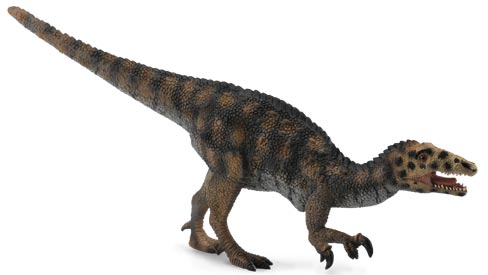
The CollectA Australovenator replica.

The CollectA Australovenator replica.

Picture credit: Everything Dinosaur

Dinosaur Models

The dinosaur model pictured above is the CollectA Prehistoric World Australovenator replica, to view this large model range: CollectA Prehistoric World Dinosaur Models.

Lead author of the scientific paper, just published in the journal “Gondwana Research”, Dr Phil Bell (University of New England), explained the significance of these opalised fossils:

“I immediately recognised this fossil was something new.  When I compared it to other Australian and South American dinosaurs, it was clear it was a megaraptorid which is a relatively rare group of dinosaurs, mostly known from Argentina.”

Grappling Hooks for Hands

Dr Bell along with co-authors from the University of Bologna (Italy) and Elizabeth Smith of the Australian Open Centre, which received the fossils as a donation from Rob and Debbie Brogan, have stated that the nasty predator with grappling hooks for hands, a sort of Freddy Krueger of the Dinosauria, roamed the flood plains of New South Wales around 110 million years ago (Albian faunal stage).  The age of the strata is significant as this makes “Lightning Claw” the earliest representative of the megaraptorids known.

Australia’s Cretaceous dinosaur fauna is largely made up of dinosaurs that are known from elsewhere on the landmasses that once made up the super-continent of Gondwana.  It had been thought that the majority of the Australian dinosaurs were immigrant taxa.  This may be a too simple explanation and a more complex two-way faunal interchange between Australia, Antarctica and South America may have taken place.

Commenting on this Dr Bell stated:

“What is fascinating about this discovery is it changes the popular notion that Australian dinosaurs came from ancestors derived from Africa and South America – instead the “Lightning Claw” appears to be the ancestor of all megaraptorids, meaning this group appeared first in Australia.”
8 09, 2015

A New British Dinosaur is Announced – Horshamosaurus

By |2023-04-05T14:27:44+01:00September 8th, 2015|Categories: Book Reviews, Dinosaur and Prehistoric Animal News Stories, Dinosaur Fans, Main Page|0 Comments

Many Spined Polacanthus Makeover ( Horshamosaurus)

If you ask dinosaur fans to name an English dinosaur then many will, no doubt propose Iguanodon, Megalosaurus or Baryonyx.  True, these are all members of the Dinosauria clade whose fossils have been found in Britain, but examples of fossils that represent these three genera can be cited from other countries as well.  For example, Iguanodon fossils are also known from Belgium, Baryonyx material has been collected in Spain and Megalosaurus has become a bit of a taxonomic waste basket for all sorts of Jurassic theropod fossils from Europe.

A New Polacanthid

We suspect that if a survey of this sort was to be conducted, there would be very few mentions of Polacanthus, a dinosaur which could, with some justification, lay claim to being truly English*.  However, following a reassessment of the fossil material, one of the two species of armoured dinosaur assigned to the Polacanthus genus has been set apart and placed into its own genus.  Polacanthus rudgwickensis has been placed in the newly erected genus Horshamosaurus.  This latest twist in the story of Polacanthus comes almost 150 years to the day when Richard Owen first introduced the term to the wider public in an anonymously written article that appeared in the “Illustrated London News” of September 1865.

The name Polacanthus had originally been proposed the year before at a meeting of the British Association for the Advancement of Science in response to armoured dinosaur fossils discovered on the Isle of Wight.

Polacanthus and Horshamosaurus

An Illustration of Polacanthus

Lovely example of a customer's artwork

Lovely example of a Polacanthus.

Picture credit: Chris

Polacanthus rudgwickensis

Polacanthus rudgwickensis was described by William T. Blows in 1996.  Now retired after a long and distinguished career lecturing in the neurosciences (City University, London), a 220 page book written by William T. Blows, that provides a comprehensive account of the history of British polacanthids, has just been published by Siri Scientific Press.

The book entitled “British Polacanthid Dinosaurs – Observations on the History and Palaeontology of the UK Polacanthid Armoured Dinosaurs and their Relatives” is available at the link below:

UK Polacanthid Armoured Dinosaurs: Siri Scientific Press.

Horshamosaurus

This publication contains a complete description of the new genus and includes detailed illustrations of all the fossilised elements that have been assigned to this new genus, the very latest addition to the compendium of British dinosaurs.  The Horshamosaurus material comes from exposed Lower Cretaceous Barremian Wealden deposits located at an old brickworks – Rudgwick quarry, approximately six miles west of the town of Horsham in West Sussex.  The fossil material was discovered in 1985 and put on display at local Horsham Museum, where it had been labelled as a specimen of an Iguanodon.

The Location of the Fossil Finds Now Assigned to Horshamosaurus

Rudgwick quarry the location of the Polacanthus fossil discovery.

Rudgwick quarry the location of the Polacanthus fossil discovery.

The picture above shows the brickworks quarry at Rudgwick.  The specimen of Horshamosaurus was found approximately where the man is standing (left of the photograph).  The fossil material consists of one partial dorsal vertebra, a dorsal vertebra centrum, an anterior caudal vertebra, fragments of other bones from the spine, part of the left shoulder blade (scapula), with a fused coracoid fragment, pieces of rib and limb bones (part of a humerus, a nearly complete right tibia).

The Nearly Complete Dorsal Vertebra of the Specimen

Seen in posterior, lateral and anterior view.

Seen in posterior, lateral and anterior view.

One of the First Armoured Dinosaurs to be Scientifically Described

The Polacanthus genus was one of the first armoured dinosaurs to be scientifically described, it was named long before the more famous thyreophorans such as Stegosaurus and Ankylosaurus and thanks to the fossil material from the Isle of Wight and southern England, Polacanthus can be regarded very much as an English dinosaur.

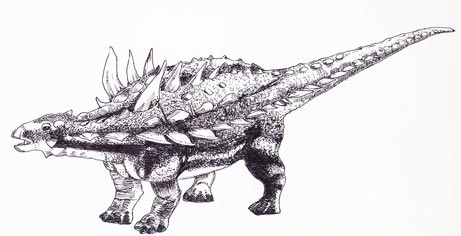
*Fragmentary remains tentatively assigned to Polacanthus have been excavated from Lower Cretaceous deposits in Europe, but due to the paucity of these fossil finds and their poor state of preservation demonstrating any unique traits diagnostic for this genus (autapomorphies) has proved controversial.  Perhaps the best known of all the Polacanthidae family is Gastonia (G. burgei), fossils of which come from similarly aged strata (Barremian faunal stage) found in Utah (United States).

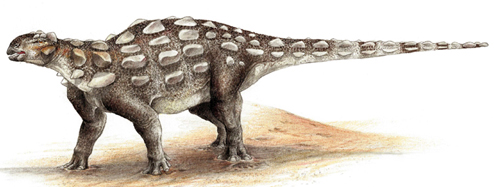
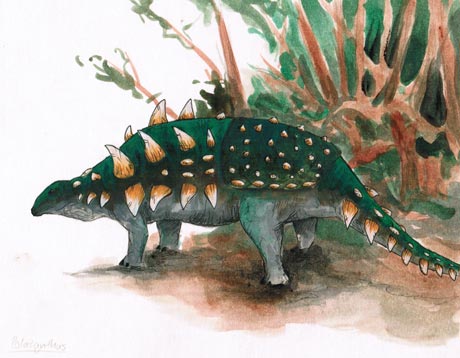
An Illustration of Gastonia (Gastonia burgei)

A drawing of the heavily armoured Gastonia.

A drawing of the heavily armoured Gastonia.

Picture credit: Everything Dinosaur

All About British Polacanthids

"British polacanthid Dinosaurs".

Written by William T. Blows.

The name Polacanthus (pronounced Pole-ah-can-thus) translates as “many or multiple spines” a reference to this quadruped’s extensive dermal armour.

For models and replicas of armoured dinosaurs and other prehistoric creatures: CollectA Age of Dinosaurs Popular Range.

6 09, 2015

Amazing Dinosaur Footprint Discovered In British Columbia

By |2023-12-12T08:42:24+00:00September 6th, 2015|Categories: Dinosaur and Prehistoric Animal News Stories, Dinosaur Fans, Main Page|0 Comments

Tyrannosaur Footprint Found in British Columbia

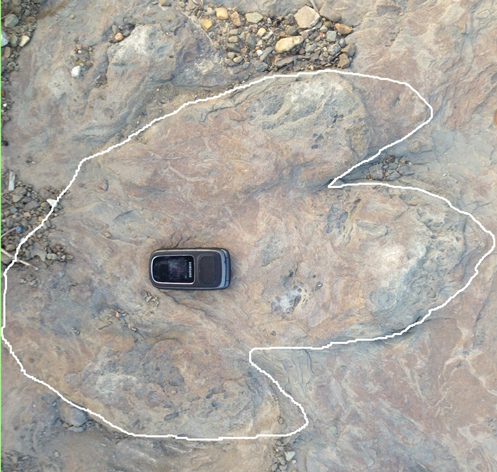
Palaeontologists and ichnologists (scientists who study trace fossils including footprints), are examining the preserved impression of a three-toed footprint made by a large dinosaur during the Late Cretaceous.  The single print measures fifty-nine centimetres long and it may have been made by a substantial tyrannosaurid.

Dinosaur Footprint

The footprint was found approximately ten kilometres from the small settlement of Tumbler Ridge.  Something like fifteen tyrannosaur footprints have been discovered to date, from locations as far apart as New Mexico, Alberta and Mongolia, but this is the ninth print to have been reported from British Columbia.  The print was found by Carina Helm, a geography student at the University of British Columbia who was out working in the area with her father.  The track was found on August 20th.

Explaining the circumstances behind the discovery, Carina explained:

“My dad and I were returning in the evening from repairing boardwalks on one of the hiking trails, when I told him I knew of some big exposed rock slabs.  We worked out that these were maybe from an age that could feature dinosaur tracks, so we decided to make a detour to have a look.”

The father and daughter team did not have to search for long to find the fossil.

The Three-Toed Dinosaur Footprint

The white line helps to show the outline of the track.

The white line helps to show the outline of the track.

Picture credit: The Helm Family

Commenting on the Dinosaur Footprint Discovery

Looks like mobile phones have lots of uses, for example, the phone in the picture helps to show scale.

Carina added:

“The very first rock I went to, right beside the road, had this huge track-shape on it with three toes.  I thought, surely, that is too big to be a footprint?  I showed it to my dad and next thing he was on his cell-phone to Rich McCrea telling him about the find.”

The Peace Region Palaeontology Research Centre

Rich McCrea, is one of the palaeontologists at the The Peace Region Palaeontology Research Centre (P.R.P.R.C.), based in Tumbler Ridge.  This institute was founded in 2003 to help excavate, preserve and showcase the vertebrate body and trace fossils associated with this part of the Canadian Province.  Most of the footprints alleged to have come from large theropods that have been found in this region have come from remote, difficult to access locations.  In contrast, this new find was close to a road and is much more accessible.

A Likely Tyrannosaurid Track

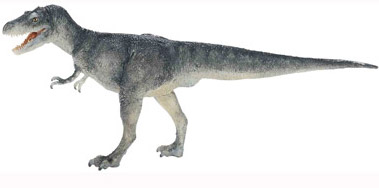
Rich and colleague Lisa Buckley were able to confirm that this track was most likely made by a tyrannosaurid.  Although the print measures fifty-nine centimetres long, the foot that made it would actually have been bigger, the tip of the longest toe and its claw impression have been eroded away.  When asked to speculate the type of tyrannosaur that might have made this track, the P.R.P.R.C. palaeontologists have suggested that this track could  have been made by an Albertosaurus.

A Model of an Albertosaurus (Large, Late Cretaceous Tyrannosaur)

Albertosaurus (Carnegie Collectibles)

Albertosaurus (Carnegie Collectibles – Safari Ltd).

Picture credit: Everything Dinosaur

To view the range of prehistoric animals made by Safari Ltd: Safari Ltd Dinosaur Models.

Outlining how the scientists concluded that this was indeed the footprint of a tyrannosaur, Rich McCrea stated:

“It can sometimes be a challenge to identify the maker of a single print, especially one that has been weathered by the elements.  Even with the tips of the digits (the claw impressions), eroded away, the footprint found by Carina Helm still possesses characteristics that make it identifiable as the product of a meat-eating (theropod) dinosaur.  In addition to the morphological features of the footprint, which bears great similarity to the ones discovered in the Autumn of 2011 and subsequently ascribed to the ichnospecies Bellatoripes fredlundi, the size of the print and the age of the rocks it was found in provide further evidence that the track-maker was a tyrannosauroid.”

A Problem Fossil

This fossil is posing a bit of a problem for the Tumbler Ridge Museum Foundation, the organisation that established the P.R.P.R.C., the fossil is close to a road and therefore it could be vandalised or stolen.  Attempts could be made to remove the specimen, but this too, presents problems.  The slab of rock containing the print is large and transporting the fossil to Tumbler Ridge would present quite a logistical challenge.

Young Carina is proving to have quite a knack for finding trace fossils, earlier in the Summer, she was part of a team that found two other trackways preserved in much older rocks in the Tumbler Ridge area.

5 09, 2015

New Study Suggests Chelonia Evolved from Diapsids

By |2024-02-25T07:38:06+00:00September 5th, 2015|Categories: Dinosaur and Prehistoric Animal News Stories, Dinosaur Fans, Main Page, Palaeontological articles|0 Comments

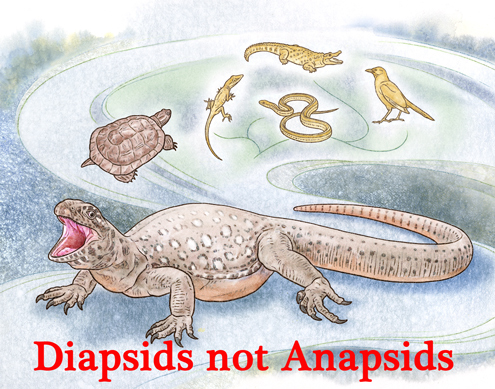
Turtles and their Kin Diapsids Not Anapsids

A study into an ancestral form of the Chelonia (turtles, tortoises and terrapins) has revealed that the skull had a pair of holes in it just behind the eye.  So what, you might say, but this is a big deal, a very big deal, as it means that the history of the reptiles and any subsequent cladograms (family trees), constructed will have to be fundamentally changed.  This new research using the skulls of 260-million-year-old South African Permian reptiles suggests that turtles and their kin are not anapsid reptiles but that this group evolved from diapsids.  The Chelonia evolved from diapsids.

Chelonia – Very Ancient Reptiles

Unravelling the history of the Reptilia is a very complicated process.  However, a tenet in helping to establish evolutionary relationships between different types of reptile is the anatomy of their skulls.  It is differences in the number of holes found in the skull behind the eye socket that has helped palaeontologists to understand more about how the first reptiles evolved from amphibians.  Skull anatomy has been used to map the radiation of different forms of reptile, those that led to the birds, crocodiles and the dinosaurs and those who took a different evolutionary line eventually leading to mammals.

A New Scientific Study

Some of this may have to be re-examined in the light of new research conducted by Dr Gaberiel Bever (Honorary Research Associate at Witwatersrand University and scientist at the New York Institute of Technology) with co-author of the scientific paper, just published in “Nature”, Dr Tyler Lyson of the Denver Museum of Nature and Science.  Three-dimensional models of the skull of the ancestral turtle, a primitive reptile named Eunotosaurus have revealed that this reptile was a diapsid, suggesting that the tortoises and turtles evolved from diapsids and not from what are thought to be more primitive reptiles with anapsid skulls.

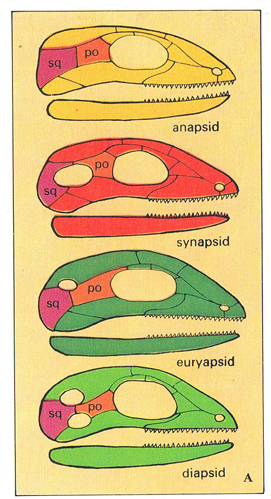
Four Basic Types of Reptile Skull

anapsid, synapsid, euryapsid and diapsid

Anapsid, synapsid, euryapsid and diapsid

Picture credit: Before the Ark/BBC

Attempting to Unravel the Phylogeny

A traditional method of attempting to unravel the phylogeny of early reptiles is to examine the layout of the bones in the skull.  There are four basic skull patterns for reptiles (living and extinct forms):

  • Anapsid – the most simple skull type with the skull bones only having holes for the eyes and the nostrils. Up until this research was published, turtles, tortoises and terrapins were thought to belong to this group.
  • Synapsid – has one hole behind the eye socket on either side of the skull between the squamosal and the postorbital skull bones (sq and po), the lower opening when compared to diapsids.
  • Euryapsid – has one hole behind the eye socket above the squamosal and the postorbital skull bones (sq and po), the upper opening when compared to diapsids.
  • Diapsid – has two holes behind the eye socket on either side of the skull (lower and upper openings in the skull between the squamosal and postorbital bones.

Helping in the research effort involved using CT scans and computer modelling techniques to produce three-dimensional images of the fossil skulls, were Yale University’s Daniel Field and Bhart-Anjan Bhullar (Assistant Professor, Department of Geology & Geophysics).

From the Famous Karoo Basin

The fossilised skulls come from the famous Karoo Basin and are assigned to an ancient ancestor of modern turtles called Eunotosaurus africanus, Everything Dinosaur reported on the significance of these fossils in terms of tracing the evolutionary history of the turtle family back in 2013.

To read more about E. africanus: How the Turtle Got Its Shell.

Commenting on their research Dr Gaberiel Bever stated:

“Eunotosaurus is a critical link connecting modern turtles to their evolutionary past.”

Chelonia Evolved from Diapsids.

Dr Bever and his co-workers examined high-resolution images created by computer tomography (CT scans).  Their research revealed the complex anatomy of the Permian skulls and supports the theory that animals like Eunotosaurus are indeed the ancestors of today’s tortoises, terrapins and turtles.  Once the skull anatomy had been mapped, the team re-drew the cladogram of the Reptilia based on their findings.

Dr Bever explained:

“Using imaging technology gave us the opportunity to take the first look inside the skull of Eunotosaurus.  What we found not only illuminates the close relationship of Eunotosaurus to turtles, but also how turtles are related to other modern reptiles.”

A key finding of the study was that Eunotosaurus had a pair of openings set behind the eyes. Eunotosaurus was a diapsid.

The Chelonia Are More Closely Related to Other Reptiles Than Previously Thought

Eunotosaurus a diapsid reptile.

Eunotosaurus a diapsid reptile.

Picture credit: Witwatersrand University with additional annotation by Everything Dinosaur

Were the Ancestors of Turtles Diapsids?

This suggests that the ancestors of the turtle lineage were not very primitive anapsids, with skulls similar to those found in amphibians, they were diapsids and therefore the turtle family is more closely related to crocodiles, lizards, snakes, birds and dinosaurs than previously thought.

The holes behind the eye socket served to lighten the skull to help make it more manoeuvrable.  The jaw muscles were able to lengthen and flex to a greater degree, this would have given Eunotosaurus a more powerful and quicker bite than modern tortoises and their kin.

Explaining the significance of this study Dr Bever stated:

“We can now draw the well-supported and satisfying conclusion that Eunotosaurus is the diapsid turtle.”

In linking turtles to their diapsid ancestry, the skull of Eunotosaurus also reveals how the evidence of that ancestry became obscured during later stages of turtle evolution.

“The skull of Eunotosaurus grows in such a way that its diapsid nature is obvious in juveniles but almost completely obscured in adults.  If that same growth trajectory was accelerated in subsequent generations, then the original diapsid skull of the turtle ancestor would eventually be replaced by an anapsid skull, which is what we find in modern turtles.”

Re-drawing the Reptile Cladogram – Chelonia Evolved from Diapsids

This new study means that the reptile cladogram will have to be re-drawn.  This research helps to cement the phylogenetic relationships between different reptile groups, but the researchers admit that this study is not the end of the matter, merely a beginning.

Witwatersrand University Professor Bruce Rubidge, who has been leading the collaborative effort to explore the rich vertebrate fossil assemblage of the Karoo Basin, explained that although the focus of the research had been on piecing together evidence to outline the diverse fauna of the Middle and Late Permian, their work had implications for studying modern reptiles too.

He stated:

“This is a major step towards understanding the interrelationships of reptiles.  Also of great significance is that Eunotosaurus, which is known only from South Africa, is a critical transitional form in the origin of tortoises and this finding indicates that the tortoise lineage had its origins in Gondwana.”

Dr Bever summarised the way forward for the research team:

“There is still much we don’t know about the origin of turtles or which of the other diapsid groups form their closest cousin?  What were the ecological conditions that led to the evolution of the turtle’s shell and the anapsid skull?  How much of the deep history of turtle evolution can be discovered by studying the genes and developmental pathway of modern turtles.”

One thing that is for sure, most of the published works on the phylogenetic relationships between the Reptilia (alive and extinct) have just become in need of an update.

Visit Everything Dinosaur: Everything Dinosaur.

4 09, 2015

A Tale of Ancient Tails in the Ankylosauridae

By |2023-04-05T14:00:29+01:00September 4th, 2015|Categories: Dinosaur and Prehistoric Animal News Stories, Dinosaur Fans, Main Page|0 Comments

How Did the Ankylosaur Get Its Club Tail?

Dinosaurs as “Living Tanks”

Ankylosaurs are often described as “living tanks” these quadrupeds seemed to have taken body armour to the extremes with some specimens such as Saichania from Asia and the Late Cretaceous North American ankylosaurids Euoplocephalus and Ankylosaurus even having armoured eyelids.  They were a very diverse and widespread group of ornithischian dinosaurs, in every sense of the world.  True, ankylosaur fossils have been recorded from China, Mongolia, Canada, the United States, Australia and there have even been fragmentary bones attributed to an ankylosaur found near Folkestone (Kent, England).

In addition, these animals have very wide pelvic regions in proportion to the rest of their robust bodies.  The wide pelvis is an adaptation to accommodate a large gut.

Heavily Armoured Dinosaurs with a Long Evolutionary History

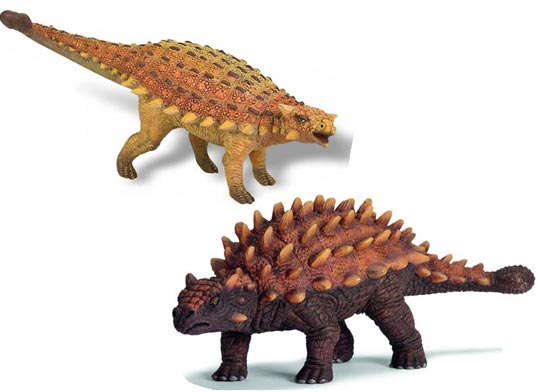
Armoured dinosaur models.

Armoured dinosaur models.

Picture credit: Everything Dinosaur

Most children can describe these herbivores, they may be very well known members of the Dinosauria, with an albeit brief appearance in the film “Jurassic World” adding to their popularity, however, a mystery surrounding the Ankylosauridae may finally have been solved.

How Did the Ankylosaur Tail Club Evolve?

By mapping the evolutionary history of these armoured dinosaurs from their Jurassic origins through to the very end of the Cretaceous the answer as to how some members of the Ankylosauridae developed that distinctive tail club may have finally been resolved.

According to research published in the academic publication “The Journal of Anatomy”, the fused tail came first and the bony club evolved later. Postdoctoral researcher Victoria Arbour (North Carolina State University and the North Carolina Museum of Natural Sciences), authored the report, a study she started when at the University of Alberta under the tutelage and guidance of renowned palaeontologist Professor Phil Currie.

Studying the Ankylosauridae Family

Victoria has spent a large part of her career studying the Ankylosauridae and she is viewed by Everything Dinosaur team members as the “go to” person when it comes to the ankylosaurids.

For example, back in October 2014, Everything Dinosaur reported on a new species assigned to the Ankylosauridae named by Victoria – Zaraapelta (Z. nomadis), fossils of which were found during an expedition to Mongolia led by Professor Currie.

To read more about Zaraapelta: Zaraapelta – In Praise of Victoria Arbour.

This new study involved examining the fossilised remains of some of the earliest known ankylosaurids, dinosaurs like the Chinese Liaoningosaurus from Yixian County, Liaoning Province (north-eastern China), as well as many Late Cretaceous forms.  An ankylosaur’s tail is composed of a handle and a bony knob.  The knob is comprised of fused osteoderms, a special kind of bone formed in the skin.  The handle is represented by the distal end of the tail (caudal vertebrae) that support the weight of the knob.

Commenting on the Study

Victoria explained:

“In order for an ankylosaur to be able to support the weight of a knob and swing it effectively, the tail needs to be stiff, like an axe handle.  For that to occur, the vertebrae along the tail had to become less flexible, otherwise the momentum generated by the knob’s weight could tear muscle or dislocate vertebrae.”

Gobisaurus – A 90-Million-Year-Old Ankylosaur

Tracing the tale of the Ankylosaurus tail.

Tracing the tale of the Ankylosaurus tail.

Picture credit: Sydney Mohr

A Tale of Tails

Other ankylosaurids included in the analysis were Gobisaurus (Turonian faunal stage of the Cretaceous) and Pinacosaurus from the younger Campanian faunal stage of the Cretaceous.

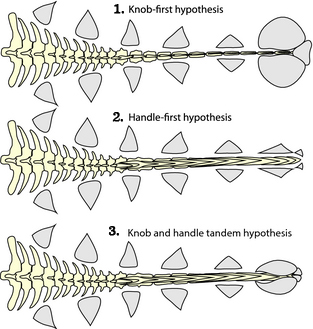
Three Ways in Which the Ankylosaurid Tail Could Have Evolved

There are three ways in which the bony club and the fused, stiffened tail could have evolved:

  1. Bony club first – early ankylosaurids would show evidence of osteoderms forming and enveloping the end of the tail
  2. Handle first – primitive members of this family would have overlapping or fused tail bones
  3. The club and handle could have evolved simultaneously, if this was the case, then Early Cretaceous ankylosaurids would show both anatomical features, perhaps with tails getting stronger and tail clubs getting heavier over time

How Did the Ankylosaurs Get their Unusual Tails?

Three different theories of ankylosaurid tail evolution.

Three different theories of ankylosaurid tail evolution.

Picture credit: Journal of Anatomy

Comparative Analysis

The comparative analysis revealed that by the Early Cretaceous, ankylosaurids had begun to develop stiff tails with fused caudal vertebrae.  The bony knob feature did not appear in the fossil record until the Late Cretaceous.

Dr Arbour concluded:

“While it’s possible that some of the species could still have developed the handle and knob in tandem,” it seems most likely that the tail stiffened prior to the growth of the osteoderm knob, in order to maximise the tail’s effectiveness as a weapon.”

The upshot of this conclusion is that ankylosaurs used their tails as defensive weapons first and then only later did the heavy club on the tail evolve.   Commenting on this work a spokesperson from Everything Dinosaur stated:

“This is a fascinating study, one can speculate that the bony club tail evolved in response to the emergence of bigger and more dangerous theropod predators such as the tyrannosaurids that could be regarded as the apex terrestrial predators in the Northern Hemisphere towards the end of the Mesozoic.”

The Tail Bones of Ankylosaurs

Caudal anatomy of Ankylosaurs.

Caudal anatomy of ankylosaurs.

Picture credit: Journal of Anatomy

Tail Clubs

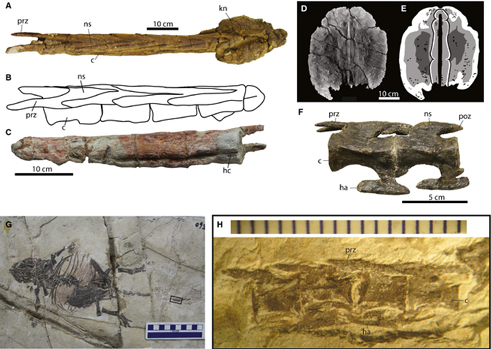
The picture above shows (A) an oblique dorsal view of the tail club of Dyoplosaurus acutosquameus from Canada, the fossils of which are around 76 million years old (Campanian).  This is typical of the derived Ankylosaurine tail  with a fused tail and a bony club.  Gobisaurus (G. domoculus) line drawing is (B) a left lateral view of this earlier ankylosaurid’s tail showing fusing of the bones.

Picture (C) shows the same fossil specimen as (B), but this time viewed from the other side, the deep groove running along the bottom is the haemal canal.  X-ray (D) and the interpretive drawing (E) are from an ankylosaur tail from Alberta, the last tail bone is small and rounded when compared to the long distal caudal bones.  Picture (F) shows two tail bones from Mymoorapelta maysi, a basal member of the Ankylosauria known from the Late Jurassic of the United States.

Typical of Nodosaurids and Basal Ankylosaurs

This anatomy is typical of nodosaurids and other basal ankylosaurs, the prezygapophyses (forward projecting points of bone located on the neural arch of the vertebrae), overlap the adjacent vertebrae by about 25% of the centrum (the main part of the vertebra situated below the neural arch).  In contrast, picture (G) shows the fossilised remains of Liaoningosaurus (L. paradoxus) which dates from the Aptian faunal stage making the fossil some 120 million years old.  The boxed area in (G) is highlighted and magnified (H).  In Liaoningosaurus the prezygopophyses overlap the preceding vertebra by at least 50% including a much more fused and stiffened tail, more typical of later ankylosaurids.

Ankylosaur Tail Club

 This research has provided new evidence to help scientists understand the evolution of ankylosaurid tails.  Fossils from China such as those of Liaoningosaurus suggest that the mechanism to support a tail club may have evolved at least forty million years before it was taken to extremes by the Late Cretaceous ankylosaurs such as Euoplocephalus and Pinacosaurus.  Early ankylosaurids evolved the handle first, those distal ossified osteoderms came later.

For models and replicas of armoured dinosaurs and other prehistoric creatures: PNSO Age of Dinosaurs.

1 09, 2015

The Oldest Known Eurypterid is Described from Remarkable Fossil

By |2024-05-05T14:46:19+01:00September 1st, 2015|Categories: Dinosaur and Prehistoric Animal News Stories, Photos/Pictures of Fossils|0 Comments

Not Jaws but Claws Pentecopterus decorahensis

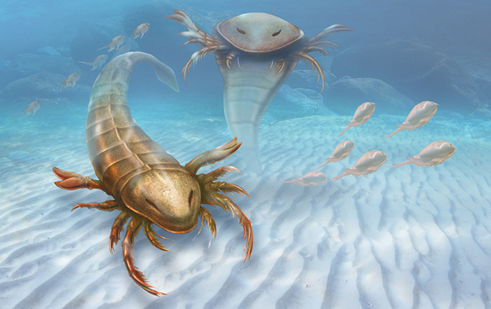
Named after an ancient Greek ship (penteconter) which was renowned for its speed and agility, a new and somewhat surprising addition to the mega-fauna of the Middle Ordovician has been described in a paper published in the academic journal “BMC Evolutionary Biology – Bio Med Centre”.  Enter Pentecopterus decorahensis (pent-tee-kop-ter-rus dek-kor-rah-en-sis), which at around 1.7 metres in length suggests that this was an apex predator of the brackish, shallow marine environment represented by shale deposits located in north-east Iowa (United States).

A Very Fearsome Arthropod – P. decorahensis

Ancient predator of the Middle Ordovician.

Ancient predator of the Middle Ordovician.

Picture credit: Patrick Lynch/Yale University

Pentecopterus decorahensis

This armour-plated, marine predator is a member of the Order Eurypterida, an extinct group of arthropods distantly related to spiders and lobsters.  These creatures are often referred to as sea scorpions as they are distantly related to modern-day scorpions too.  With its streamlined body, grasping limbs for trapping prey and large, well-protected head this formidable carnivore would have dined on a variety of invertebrates as well as jawless fishes.

Winneshiek Lagerstätte

The fossils are part of the extraordinary Winneshiek Lagerstätte fauna (Iowa) and have been dated to around 467 million years ago (Darriwilian faunal stage of the Middle Ordovician).  Something in excess of 250 different eurypterid species have been described, but only eleven species have been documented from the Ordovician (488-443 million years ago) to date.  P. decorahensis is the oldest known, extending the documented range of the eurypterids by more than nine million years.

Commenting on the fossils, James Lamsdell of Yale University and the lead author of the study stated:

“This shows that eurypterids evolved some ten million years earlier than we thought and the relationship of the new animal to other eurypterids shows that they must have been very diverse during this early time of their evolution, even though they are very rare in the fossil record.”

Some of the Fossil Specimens that have been Found

Examples of fossil specimens.

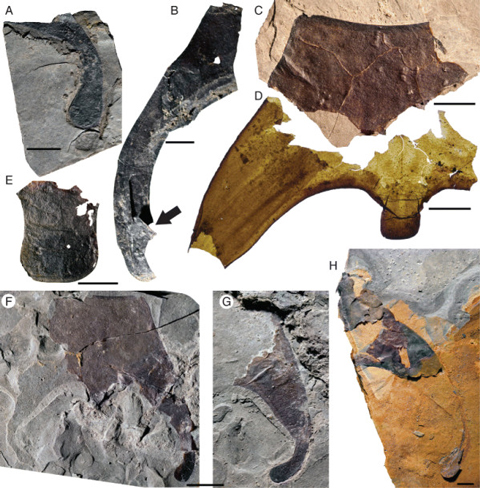
Examples of fossil specimens, scale bars = 10 mm.

Picture credit: Lamsdell et al

Highly Fossiliferous Strata

The highly fossiliferous strata was discovered by an Iowa Geological Survey team (University of Iowa), close to the Upper Iowa River.  A temporary dam had to be constructed to allow the fossil site to be excavated. More than 150 fossils of Pentecopterus have been found, many of them representing juveniles.

University of Yale palaeontologist Derek Briggs, a co-author of the study explained that the shale deposits represent an ecosystem that became established when the sea flooded a meteorite impact crater some three miles across.  The weak currents coupled with the oxygen depleted bottom contributed to the remarkable state of preservation of the fossil material.  Even tiny hairs on the limbs can still be seen.

An Enormous Arthropod (Pentecopterus decorahensis)

Although, enormous for an arthropod, it is not the biggest eurypterid known, Everything Dinosaur has reported on a number of very large fossil sea scorpions

To read more about giant eurypterids: Giant Eurypterid Tracks Discovered in Scotland.

Giant Devonian Sea Scorpion: Claws! of the Devonian.

The largest living member of this Phylum today is the Japanese spider crab (Macrocheira kaempferi), the diameter of the legs of the largest males can be in excess of 3.5 metres and some specimens have weighed more than fifteen kilogrammes.

Everything Dinosaur Comments

A spokesperson from Everything Dinosaur stated:

“Thanks to the remarkable Winneshiek Lagerstätte scientists have been able to look into a window of marine life from some 467 million years ago.  Anyone taking a dip in the brackish waters that linked this part of Iowa to the seas surrounding the ancient land mass of Laurentia had better watch out.  This was one arthropod capable of giving you more than just a “nip” with its claws.”

CollectA have created a range of replicas that represent significant ancient invertebrates from the fossil record: Replicas of Iconic Fossil Invertebrates (CollectA).

31 08, 2015

Will We Ever Know All the Dinosaurs?

By |2023-04-05T13:03:34+01:00August 31st, 2015|Categories: Dinosaur and Prehistoric Animal News Stories, Dinosaur Fans, Main Page|0 Comments

How Good is the Fossil Record of the Dinosaurs

With something like 1,200 different genera of dinosaur now described, our knowledge of the Dinosauria has increased a great deal, especially over the last twenty years or so.  Many different types of dinosaur have been discovered and we at Everything Dinosaur try to keep a database using this blog.  For example, since the beginning of July, we have written articles about a newly discovered, very bird-like oviraptorid from southern China (Huanansaurus ganzhouensis), North America’s latest ceratopsian discovery (Wendiceratops), the new dromaeosaurid from Liaoning Province (Zhenyuanlong suni) and most recently, the basal sauropod Pulanesaura from South Africa.

How Good is the Dinosaur Fossil Record?

Just over the weekend, we reported on a giant horned dinosaur skull from South Dakota that might well turn out to be a new species of ceratopsian, albeit, one that would be very closely related to Triceratops.

However, will palaeontologists ever be able to create a definitive list of all the dinosaurs?  What percentage of the Dinosauria will ever be known?  Scientists at Bristol University have set about trying to find out by assessing just how good the fossil record for the dinosaurs actually is.

So Many Different Types of Dinosaurs Described

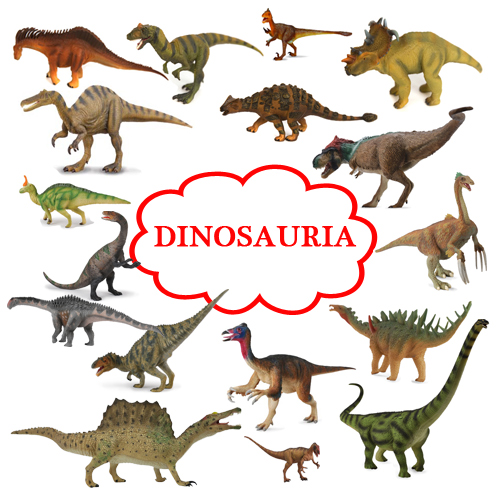
So many different types of dinosaur.

So many different types of dinosaur.

Picture credit: Everything Dinosaur

Trying to Calculate How Good the Dinosaur Fossil Record Is

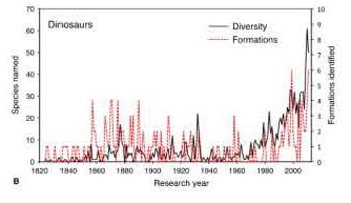
Professor Mike Benton of the University of Bristol, set out to assess how good the fossil record is for the Dinosauria and for early tetrapods in a bid to answer the question as to whether the fossil record adequately represents the patterns of diversity of animals through time.  A number of other authors have attempted to assess the quality of the fossil record and in this new study, published in the journal “Palaeontology”, the journal of the Palaeontological Association, Professor Benton set out to plot how the knowledge of dinosaurs has been accumulated since the first scientific description (Megalosaurus) back in 1824.

The research does not provide a definitive answer with regards to how representative the vertebrate fossil record actually is, but this study does suggest caution needs to be taken when using some popular methods to try and remove bias from the known fossil record of the Dinosauria as well as the other Tetrapods included in the analysis.

Plotting the Number of New Species Named Against the Number of Newly Discovered Fossil Bearing Formations

Number of species against number of new fossil bearing formations.

Number of species against number of new fossil bearing formations.

Graph credit: Bristol University

Professor Benton Comments

Professor Benton explained:

“In the past ten years, many palaeontologists have tried to find the true pattern of evolution by using measures of sampling to estimate where the fossil record is well known or poorly known.  But it turns out that many of the popular methods are not doing what they are supposed to.”

The Bristol-based palaeontologist plotted the history of research into the Dinosauria from 1820 to the present day.  He logged the number of new species described and how the patterns of discovery match the patterns of discovery of new geological formations.  He noted that the patterns of discovery are closely linked, one or two new dinosaurs for each fossil-bearing geological formation that is newly explored.

More Fossil Bearing Geological Formations Discovered = More Dinosaurs Described

If there is a significant link between the number of dinosaurs described and the number of new geological formations discovered then how does this connection work?  This link can be explained in two ways:

  1. Rock formation discoveries drives dinosaur fossil finds
  2. Dinosaur fossil finds drives the discovery of new fossil-bearing formations

The usual view is that (1) is correct, that rocks drive fossil finds.  Palaeontologists are keen to find new dinosaur species, but the new species could only be found if they explored new rock formations around the world.  It could be argued that our ability to discover new types of dinosaurs (or any fossil group for that matter) is dependent on the availability of suitable rock formations to explore.

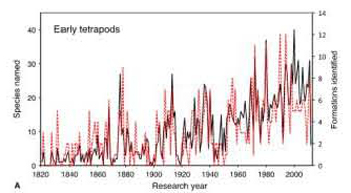
Plotting the Link between Early Tetrapod Discoveries and Rock Formations

Early Tetrapod discoveries 1820-2015.

Early tetrapod discoveries 1820-2015.

Graph credit: Bristol University

The graph above shows the same relationship in early tetrapod fossil discoveries from 1820 to the present day, but if there is a causal relationship between fossil finds and formations then how does this relationship work?

Fossil Record

The opposite view is that fossil discoveries drives the search for new rock formations.  Palaeontologists set out to look for new dinosaurs in a very focused and disciplined way.  When new dinosaurs are found they would often add a new dinosaur-bearing formation to the known list.  In this case, the limiting factor is not simply the availability of suitable rock formations to explore because scientists do not search systematically but they go straight to areas when they hear there are bones to be excavated.

Professor Benton added:

“I have been worried for a while that some of the popular correction methods actually make things worse.  By removing the numerical signal of the formations, localities or collections they were actually removing a huge amount of real information, and producing a resulting curve that is meaningless.  The fossil record is clearly incomplete, and it is clearly biased by many factors, but many of the supposedly “corrected” diversity curves we have seen recently may actually be further from the truth than the raw data.”

A New Analysis

This new analysis does not provide us with a definitive answer as to the diversity of the Dinosauria, or indeed, for any other fossil group of vertebrates.  However, we can infer from what we already have discovered that there are very probably a lot of weird and wonderful dinosaurs yet to be found.  It is not possible to state that we, after 195 years of research (1820 to 2015), have identified 10%, 50% or even 1% of all the types of dinosaurs that have ever existed, such statements by their very nature are likely to be invalid.

This new research does provide a clearer picture of why there is such a close correlation between dinosaur species numbers with formations, localities or collections.  The numbers of all four are connected because they are all telling much the same story, they are measuring the same history of life on Earth and our knowledge.  Professor Benton concludes that it is not possible to isolate one or other of these measures and then try to use it as an independent yardstick for sampling.

New Dinosaurs Will Be Discovered

There is one certainty, well, it’s almost a certainty.  New types of dinosaur will be discovered in the future and if the graph developed by Professor Benton is anything to go by, a lot of new dinosaurs (at least compared to the historical data), will be discovered in the next few years and Everything Dinosaur will do its best to blog about them.

For models and replicas of dinosaurs and prehistoric animals: Prehistoric Animals and Dinosaur Figures.

Everything Dinosaur acknowledges the help of a Bristol University press release in the compilation of this article.

30 08, 2015

Stem Acrodontan Lizard – The First of Its Kind from South America

By |2023-04-05T12:54:23+01:00August 30th, 2015|Categories: Dinosaur and Prehistoric Animal News Stories, Dinosaur Fans, Main Page|0 Comments

Revising Lizard Evolution in Gondwana

The Squamata (lizards and snakes), might be the most diverse and specious of all the extant reptiles but their evolutionary history remains a mystery.  The preservation potential of these reptiles can vary dependent on the characteristics of the ancient ecosystems which they inhabited.  In addition, the small size of many of the early species of lizard and snake makes finding fossilised bones and other clues as to the history of this Order all the more difficult.

However, a team of scientists including Tiago R. Simões (Dept of Biological Science, University of Alberta), have published a paper in the journal “Nature Communications” that sheds light on the evolution of the iguanas and their near relatives.

Studying the Iguanians

The family of extant reptiles known as the iguanians (iguanas and agamids) are one of the most diverse and widespread type of lizard today.  However, like other types of lizard, their evolutionary origins are uncertain.  There are two main divisions within this family, firstly there is a sub-group called the acrodonts, these lizards have no root or socket to their teeth and the teeth are attached to the top of the jaw bones.  In the other sub-group, the pleurodonts they do not have roots on their teeth either, but instead the teeth attach to the inside portion of the jaw.

Acrodont iguanians are confined to the Old World, while pleurodont iguanians are found only in the Americas.  A newly described fossil however, breaks this pattern.  The international team of scientists have published a paper on a Late Cretaceous acrodont iguanian, the oldest known New World acrodont iguanian.

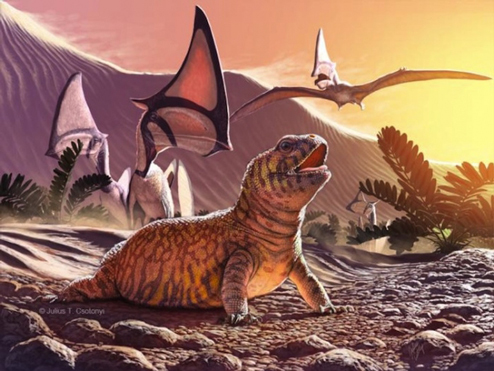
An Illustration of the First New World Acrodont Iguanian – G. sulamericana

The fossils date from around 80 million years ago.

The fossils date from around 80 million years ago.

Picture credit: Julius Csotonyi

Gueragama sulamericana

The fossils, including the holotype material, a partial lower jaw come from the Goio-Erê Formation, exposed near Cruzeiro do Oeste, in Paraná State, southern Brazil.  Fossils found in this locality represent an arid, very dry environment dominated by pterosaurs and large dinosaurs.  However, scurrying around the hot, desert-like environment was a short, rather stubby lizard.  It has been named Gueragama sulamericana, which translates from the local dialect and Portuguese as “ancient agama from South America”.

The discovery of these fossils of an ancient, New World acrodont means that in the distant past, lizards with the acrodont dentition had a worldwide distribution and were very probably widespread across the ancient landmass of Gondwana.

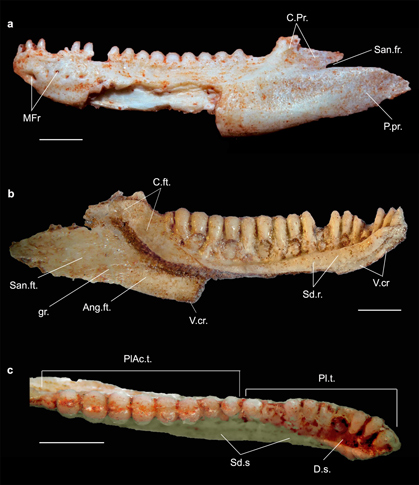
The Holotype Jaw Fossil (Various Views)

An ancient toothy lizard.

An ancient toothy lizard.

Picture credit: Universidade do Contestado, Santa Catarina, Brazil.

Scale bar in the picture = 2 mm.

Fossil Discovery Raises Questions

A number of questions have been raised with this discovery, for example, if only the pleurodont iguanians are found in the New World today, then what happened to the acrodonts that once lived in this part of the world too?

Lead author of the scientific paper, Tiago R. Simões stated:

“It becomes clear acrodontan iguanians migrated throughout the southern continents much earlier than previously thought (actually reaching regions where they do not inhabit today) by the order of tens of millions of years.”

This new research extends the fossil diversity of Late Cretaceous Brazil and suggests that the arid deserts of this part of the world may have supported a greater range of lizards than previously thought.  The scientists hope to find more lizard fossils, including material representing Gueragama so that they will be better able to understand the evolution and radiation of the stem acrodontans.

As for the date given to the G. sulamericana fossil material, we at Everything Dinosaur estimate these fossils to be more than 80 million years of age.  The strata which makes up this part of the Goio-Erê Formation is believed to date from the Turonian to the early Campanian faunal stages of the Late Cretaceous (90-80 million years ago, approximately).

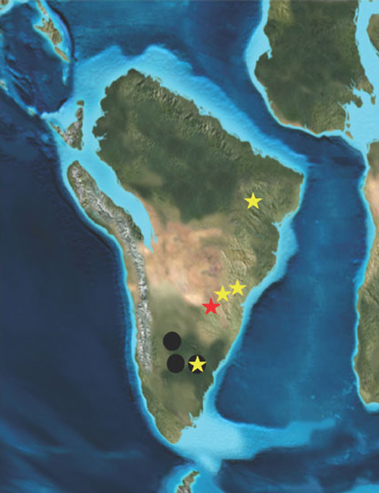
Late Cretaceous South America

South America in the Late Cretaceous

South America in the Late Cretaceous

Picture credit: Nature Communications

Fossil Finds in South America

Between the Aptian/Albian faunal stages and the Campanian faunal stage of the Cretaceous, sphenodontians were thought to be the dominate animals filling the iguanian niche.  Sphenodontian fossils have been found in northern Patagonia, in the provinces of Chubut (Tres Cerros), Río Negro (Los Alamitos, Cerro Tortuga, Cerro Bonaparte and La Buitrera) and Neuquén (El Chocón), these discoveries are represented by black circles on the map above.

Lizards were present in the state of Ceará in north-eastern Brazil (Araripe Basin), as well as in the south-eastern/southern states of Minas Gerais (Peirópolis), São Paulo (Marília and Presidente Prudente) and Paraná (Cruzeiro do Oeste), and in the province of Río Negro (Cinco Saltos and La Buitrera), Argentina, represented by yellow stars on the map. The red star indicates the type locality of G. sulamericana in southern Brazil.

Recently, Everything Dinosaur reported on another Brazilian Squamata fossil discovery.  Spotted by chance on a tour of a German museum, scientists have identified the first example of a four-footed snake, an animal believed to be a transitional creature between limbed lizards and true snakes.

To read this article: Fossil Snake with Four Limbs Described.

29 08, 2015

Super-sized Ceratopsian Skull Might be New Species

By |2023-04-05T12:49:09+01:00August 29th, 2015|Categories: Dinosaur and Prehistoric Animal News Stories, Dinosaur Fans, Main Page|0 Comments

Horned Dinosaur Skull Found in South Dakota Might Be New Species

The small town in Buffalo in the north-west of South Dakota was so named as back in the 19th century vast herds of buffalo (American bison), roamed across this part of the world.  However, another type of horned animal has got local townsfolk excited, one that would have dwarfed even the largest of today’s hoofed giants, a very-well preserved partial skull and jaws of a huge horned dinosaur which might turn out to be a new species.

Acquired from a Fossil Collector

Fossil collector and dealer Alan Detrich purchased the dinosaur skull found in Harding County from another fossil collector John Carter back in 2012, but it has taken more than two and a half years to prepare the specimen ready for sale.  When the fossil skull and lower jaw were first excavated it was thought that the bones represented a very large specimen of Triceratops (T. horridus).  However, with the fossil completely exposed, Alan along with Neal Larson (Larson Paleontology Ltd) who was tasked with preparing the fossil, believe that this could be a brand new species of horned dinosaur.

Over the last fifteen years or so, a number of new North American horned dinosaurs have been named and described, however, if proved to represent a new species, this dinosaur skull could be heralded as one of the most spectacular dinosaur discoveries of all, the nasal horn alone measures nearly forty-five centimetres long and the skull itself is over 1.82 metres in length.

Ceratopsian Skull

Commenting on the unusually large nasal horn, Alan Detrich stated:

“They are [Triceratops nose horns] usually half that size and the skull is eight feet long, which would be a monster skull for a Triceratops.”

Neal Larson, the founder of Larson Paleontology Unlimited and a co-founder of the Black Hills Institute of Geological Research with his brother Pete Larson, who coincidently is also working on a centrosaurine specimen at the moment, was given the task of trying to prepare the specimen.  It took over 1,000 pain-staking hours to carefully excavate the fossil from its iron siderite matrix.  The preparation work was extremely difficult, as despite the robust nature of the fossil bones, the matrix with its iron component (iron carbonate) was extremely hard.

A Ceratopsian Exhibit at a Museum (Triceratops)

Triceratops Fossil on Display

A cast of a Triceratops skeleton on display at the Naturmuseum Senckenberg (Natural History Museum – Frankfurt). On the left a wall mounted example of a Plateosaurus can be seen.  Is the Buffalo skull a new species?

Picture credit: Everything Dinosaur

For articulated models of ceratopsians and other dinosaurs: Beasts of the Mesozoic Articulated Dinosaur Models.

A Large Centrosaurine Skull

A spokesperson from Everything Dinosaur exclaimed:

“It’s only when you see a person stood next to the beautifully preserved skull that you can really appreciate just how big the animal actually was.  This is certainly one of the largest centrosaurine skulls that we have seen.”

For Neal, who holds a degree in geology and has been excavating fossils for some forty years now, the ceratopsian skull represented a tough challenge given the hardness of the surrounding matrix.

He stated:

“I immediately had my suspicions this was something new because of the size and placement of the nasal horn.  They’re usually in the middle of the nose, not the front and it’s twice as large as most of them.  On top of that, the frill at the top of the skull curves upward. They usually lay back.”

Ceratopsian Skull Could Represent a New Species

The skull has a strange ridge under the jaw, something that is not seen in Triceratops skull material.  Mr Detrich is now trying to find a museum to house this specimen, preferably in the United States, potential buyers for this huge dinosaur skull are currently being contacted.

The Ceratopsians of North American seem to have evolved into a very diverse range of forms during the Late Cretaceous.  Some of the skulls of these herbivorous dinosaurs were truly immense.  As a clade, the ceratopsians are considered to have the largest skulls in proportion to the rest of their bodies of any known vertebrate.  A few years ago, Everything Dinosaur reported on the discovery of another enormous horned dinosaur skull, this time from Alberta, Canada, a dinosaur that was believed to be an ancestor of Triceratops.

To read about this fossil discovery: Enormous Skull of Eotriceratops Discovered.

28 08, 2015

The Colour of Dinosaurs? What a Great Question!

By |2024-05-05T14:37:00+01:00August 28th, 2015|Categories: Dinosaur and Prehistoric Animal News Stories, Dinosaur Fans, Main Page|0 Comments

Fossilised Dinosaur Feathers Do Contain Evidence of Original Colours

Over the last five years or so, a number of scientists from around the world have been trying to crack a dinosaur-sized puzzle.  Could fossils preserve some evidence of the colouration of long dead animals?  Could palaeontologists and that talented body of palaeoartists that work with them, finally be able to depict a prehistoric animal as it would have looked like in real life?

A New Scientific Study

A new paper published in the academic journal “Scientific Reports” moves the debate forwards to some extent.  Researchers, led by Johan Lindgren (Lund University, southern Sweden), including graduate students from the aptly named Brown University (Rhode Island, U.S.A) have analysed the fossilised remains of a Middle Jurassic dinosaur and found that the melanosomes preserved within the fossil not only resemble animal pigment structures found today but they also have a very similar, almost identical chemical signature.

This study supports the hypothesis and indeed, strengthens it, that scientists can work out the colouration of long extinct animals including feathered dinosaurs.

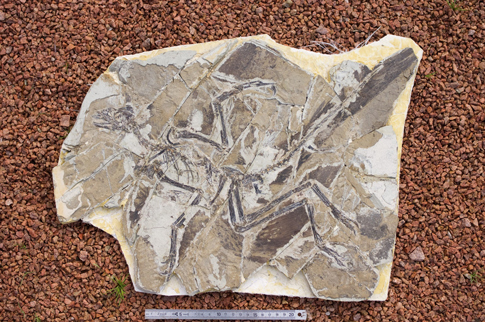
The Specimen Used in the Study – Anchiornis Fossil

Feathers reveal chemical signatures that supports colour hypothesis.

Feathers reveal chemical signatures that supports colour hypothesis.

Picture credit: Thierry Hubin

Anchiornis huxleyi

Named and described back in 2009, from fossil material found in Liaoning Province (north-eastern China), this little dinosaur was covered in feathers.  It stood about twenty centimetres tall and it had long flight feathers on its forelimbs and hind legs.  Three specimens have been described in detail, but there are believed to be many more examples held in private collections.  The exact geological age of this very bird-like dinosaur remains controversial.

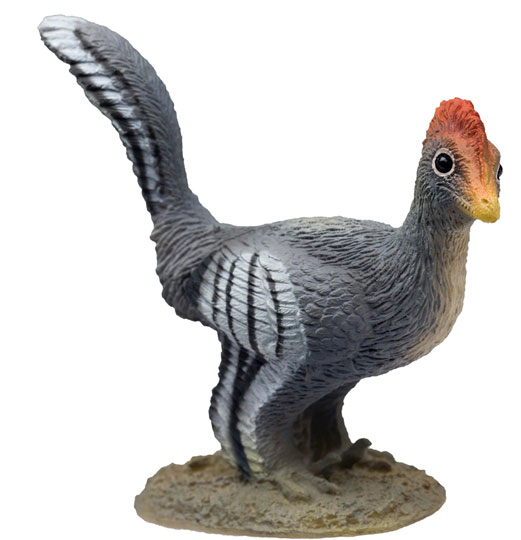
A Model of Anchiornis huxleyi (PNSO Age of Dinosaurs)

PNSO Luffy the Anchiornis Dinosaur Model

The PNSO Luffy the Anchiornis dinosaur model from the “Age of Dinosaurs” model range.  A replica of Anchiornis.

To view the PNSO Age of Dinosaurs model range: PNSO Age of Dinosaurs Model Range.

It has proved very difficult to date the lake environment deposits where these fossils have been found.  Some palaeontologists have suggested that Anchiornis could be as young as 150 million years old, other scientists have proposed that the fossils date from around ten million years earlier.

To read about the scientific description of Anchiornis (A. huxleyi): Older than Archaeopteryx?

Fossilised Dinosaur Feathers

Colour analysis on the very well preserved second specimen (see picture above), has been carried out before, but this time, as well as finding melanosome structures, the researchers conducted two different kinds of chemical analysis to see if animal eumelanin pigment could be detected.  Melanin is a natural pigment found in most animals, there are three main sub-components of melanin, the most common form is the pigment eumelanin.

The researchers conducted an ion mass spectrometry test and also an infrared reflectance spectroscopy analysis to discern the chemical signatures of the rod-like structures that have been observed in the fossilised feathers of the dinosaur once the fossil had been subjected to electron microscopy.  The team then compared the molecular signatures of the fossil sample to the signature of melanin in living animals.  The observed signatures were almost identical.  The only small difference in the chemical make-up was attributed to the presence of sulphur in the fossil material.

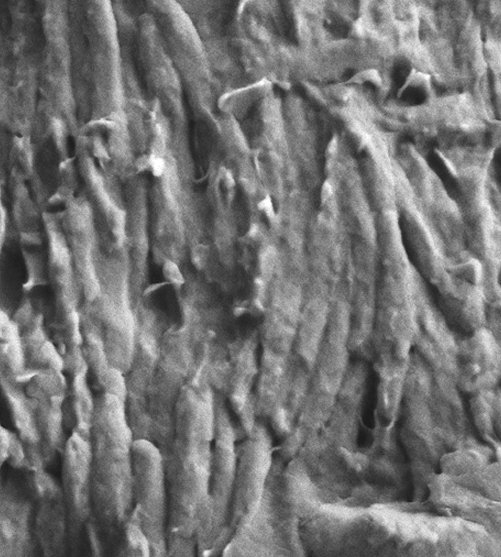
Electron Microscopy Shows Tiny Structures in the Fossil Feathers

Structures identified under extreme magnification.

Structures identified under extreme magnification.

Picture credit: Lund University (Johan Lindgren)

A Palaeontological “Hot Potato”

The hypothesis that the structures which produce the melanin pigmentation, the melanosomes could be preserved in fossils is controversial.  Electron microscope studies of a number of feathered dinosaur fossils has revealed strange structures which have been interpreted as melanosomes by some scientists.

The shape of these structures providing clues to the colouration of the animal.  For example, in the case of Anchiornis, the rod-like, sausage-shaped structures, if they are melanosomes, indicate that this little Chinese dinosaur was mostly covered in dark, probably black feathers.

Controversial Conclusions Regarding Fossilised Dinosaur Feathers

Such conclusions have been hotly debated.  Some opponents have argued that the structures observed could be other types of organic residue such as the fossilised remains of microbes.  Other scientists have argued that there is a “fossilisation bias” when it comes to the colour spectrum and that melanosomes that give dark pigments may be more likely to survive the fossilisation process than other types, so there is a strong, black bias when it comes to interpreting the colour palette of a long, extinct animal.

Rod-Like Structures the Melanosomes

Sausage-shapes - potential melanosomes.

Sausage-shapes – potential melanosomes.

Picture credit: Lund University (Johan Lindgren)

Commenting on this latest research, Ryan Carney (Brown University) stated:

“We have integrated structural and molecular evidence that demonstrates that melanosomes do persist in the fossil record.  The evidence of animal-specific melanin in fossil feathers is the final nail in the coffin that shows that these microbodies are indeed melanosomes and not microbes.”

In essence, what this team has done is to move on the debate.  Morphological evidence (structures that look like melanosomes), are no longer the only evidence being put forward to suggest the colour of feathered dinosaurs.  There is now chemical evidence to support the theory that melanosomes can be preserved in fossils.

Dinosaur Colours

In order to help rule out a misinterpretation of the data, the team also analysed the observed spectral signatures of the melanins produced by microbes.  The closest match the team achieved was between the fossil material and the signature from extant animal melanin.

Student Carney, went onto add:

“This is animal melanin, not microbial melanin and it is associated with these melanosome-like structures in the fossil feathers.”

To read other articles published by Everything Dinosaur which relate to the colour of extinct animals:

Melanosomes in feathered dinosaurs: Melanosomes Provide Further Evidence for Feathered Dinosaurs.

Working out the colour, a problem: Working Out the Colour of Prehistoric Animals just got Harder.

Marine Reptiles and colour: Marine Reptiles Dressed in “Little Black Numbers”.

Go to Top