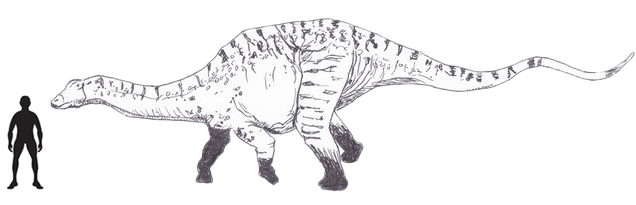
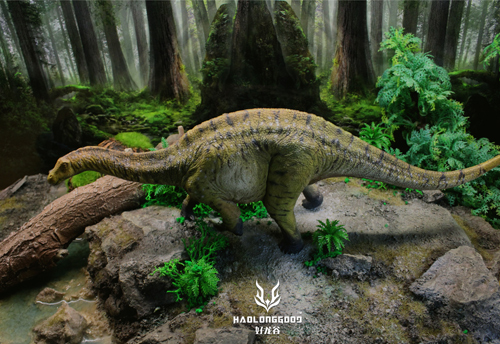
Everything Dinosaur has commissioned a Dicraeosaurus scale drawing to use in a fact sheet in anticipation of the arrival of the Haolonggood Dicraeosaurus model. The Haolonggood shipment is due to arrive at the company’s warehouse in a few days.
Everything Dinosaur has commissioned a Dicraeosaurus scale drawing to accompany the fact sheet being written in anticipation of the arrival of the Haolonggood Dicraeosaurus model. Picture credit: Everything Dinosaur.
Picture credit: Everything Dinosaur
Dicraeosaurus Scale Drawing
The Haolonggood Dicraeosaurus sauropod model has a scale of 1:35. The figure measures a fraction under 36 cm long. It stands approximately 9.5 cm high.
Two species have been named. Both the type species Dicraeosaurus hansemanni and the potentially geologically younger D. sattleri are known from numerous skeletons, many of which are nearly complete. Dicraeosaurus had a short neck, and a relatively large head. The jaws were more robust than those of other diplodocids. It is likely that this sauropod fed on coarse plant material.
The green Haolonggood Dicraeosaurus dinosaur model.
Dicraeosaurus is regarded as one of the largest of the dicraeosaurid dinosaurs. Palaeontologists estimate that it grew to a length of around fifteen metres.
A spokesperson from Everything Dinosaur commented that the team members were looking forward to the arrival of the Haolonggood models.
The spokesperson added:
“We expect the PNSO and Haolonggood shipments to arrive at our warehouse on the same day. It is likely that they will arrive next Wednesday [20th September]. We have made plans to ensure we can unpack the shipment rapidly and then get these sets of figures on-line quickly.We have also allocated some time that day to contact all those customers who wanted to be informed when the PNSO and Haolonggood figures arrived.”
The discovery of a new species of horned dinosaur from the Judith River Formation of Montana has been announced. The new dinosaur named Furcatoceratops elucidans has been assigned to the Nasutoceratopsini subfamily of the Centrosaurinae. This ceratopsian is known from a single, sub-adult specimen (holotype number NSM PV 24660). However, the nearly complete and three-dimensionally preserved bones have the potential to yield valuable data on early centrosaurines. The fossil material was first described in 2015, it was reputed to represent an Avaceratops.
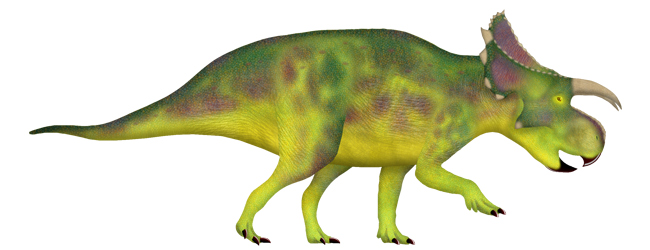
A Furcatoceratops life reconstruction. The recently described (2023), ceratopsid Furcatoceratops elucidans shown in lateral view. Picture credit: Tim Bollinger.
Furcatoceratops elucidans
The disarticulated skeleton was collected from the upper Coal Ridge Member of the Judith River Formation. The fossil material is believed to around 75.6 million years old (Campanian faunal stage of the Late Cretaceous). Postcranial material recovered included a substantial proportion of the left side of the body, including a complete left front limb and parts of the pelvis. In addition, a significant amount of skull material was excavated.
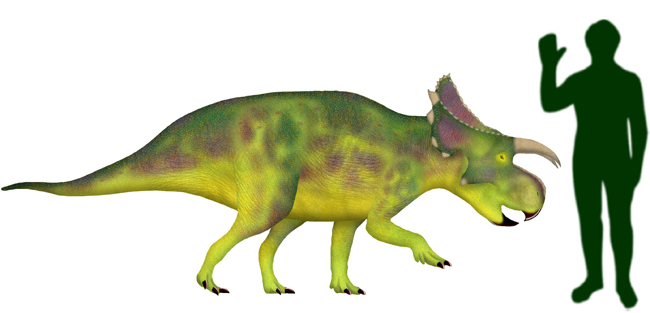
Although the fossil specimen represents a sub-adult, researchers estimate that this herbivorous dinosaur probably reached a maximum length of around four metres. It may be possible to calculate an accurate assessment of bodyweight using circumference measurements of the left femur. Consequently, it may be possible to demonstrate that a fully grown adult Furcatoceratops would have weighed over five hundred kilograms.
A scale drawing showing the newly described centrosaurine Furcatoceratops elucidans. This horned dinosaur from the Judith River Formation of Montana is thought to have been around four metres in length. Picture credit: Tim Bollinger.
A Significant Ceratopsid Fossil Discovery
The authors of the scientific paper conducted a phylogenetic assessment and concluded that F. elucidans was closely related to Nasutoceratops titusi from Utah and Avaceratops lammersi, which is also known from the Judith River Formation. Although Avaceratops lammersi was scientifically described in 1986, palaeontologists have remained uncertain with regards to classifying ceratopsid fossil material associated with other strata within the Coal Ridge Member.
The Furcatoceratops fossils will permit palaeontologists to study postcranial autapomorphies. Research on centrosaurines will be less reliant on skull fossil characteristics. Therefore, the Furcatoceratops holotype will likely be valuable for understanding previously neglected aspects of ceratopsian anatomy.
The genus translates as “forked horn face”, presumably a reference to the curved shape of the prominent brow horns. The species name comes from the Latin for “enlightening”, which reflects the significance of the holotype in terms of providing insights into ceratopsid anatomy and growth rates.
Scale Drawing and Illustration
Everything Dinosaur team members were composing a blog post about Furcatoceratops when an email was received from American artist Tim Bollinger. We checked out his DevianArt page: Total Dino Site. and discovered that he had drawn Furcatoceratops.
Tim stated:
“I love everything you are doing at Everything Dinosaur. I am a dinosaur enthusiast myself, and an aspiring palaeoartist I would love to be involved with Everything Dinosaur in any way possible.”
We explained that we get many requests such as this. However, in a bid to showcase his work, we asked and received permission to feature Tim’s illustration of Furcatoceratops in our blog post.
Everything Dinosaur acknowledges the assistance of artist Tim Bollinger in the compilation of this article.
Take a look at Tim Bollinger’s work under the moniker UnexpectedDinoLesson:
The scientific paper: “Furcatoceratops elucidans, a new centrosaurine (Ornithischia: Ceratopsidae) from the upper Campanian Judith River Formation, Montana, USA” by Hiroki Ishikawa, Takanobu Tsuihiji and Makoto Manabe published in Cretaceous Research.
Angiosperms are great survivors! Anyone having to remove dandelions and buttercups from their lawn or garden border will testify to this. However, a new study demonstrates that flowering plants are truly nature’s great survivors. The angiosperms came through the K-Pg extinction event relatively unscathed. This extinction event may even have assisted flowering plants as they became the dominant flora on our planet.
The study by researchers from the University of Bath in collaboration with colleagues from the Universidad Nacional Autónoma de México (Mexico) shows that flowering plants were not too badly affected by the extinction event that wiped out the non-avian dinosaurs.
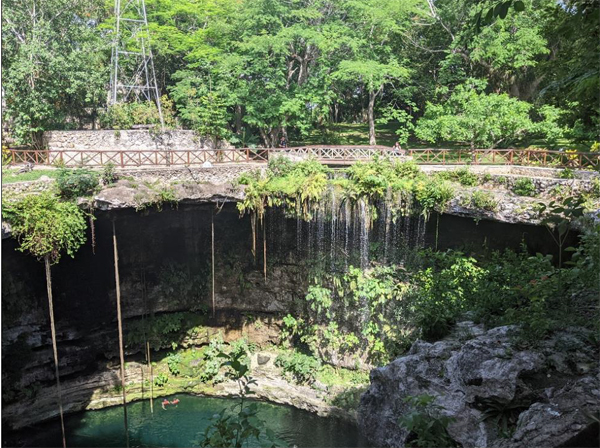
Plant diversity at a cenote (sinkhole) near the Chicxulub crater caused by the asteroid hit 66 million years ago. Picture credit: Jamie Thompson.
Mass Extinction Events
Scientists have detected evidence of five major extinction events during the Phanerozoic Eon. The most famous is the end-Cretaceous extinction event that saw the demise of the non-avian dinosaurs. An extra-terrestrial bolide impact may have contributed to the eradication of around 75% of all species. The impact on the angiosperms had not been explored until now.
Plant fossils are relatively rare compared to the body and trace fossils of animals. This makes it very difficult for palaeontologists to assess how genera might have been affected by extinction events.
If the fossil record is too poor and fragmentary to provide data, then an alternative method of analysis must be found. Dr Jamie Thompson of the Milner Centre for Evolution (University of Bath) and Dr Santiago Ramírez-Barahona of Universidad Nacional Autónoma de México analysed evolutionary trees constructed from mutations in the DNA sequences of up to 73,000 living species of flowering plants. Using complex statistical methods, they fitted “birth-death” models to estimate the rates of extinction throughout deep geological time.
From the time of the dinosaurs, but flowering plants were relatively unscathed by the K-Pg extinction event.Picture credit: Everything Dinosaur.
Picture credit: Everything Dinosaur
Angiosperms Flourished After the Extinction Event
The fossil record suggests that the K-Pg event had a strong regional impact on flowering plant species extinctions. However, it only had a minor impact on the extinction rates of major lineages (families and orders). These lineages survived and flourished. Out of approximately 400,000 extant plant species, around 300,000 are angiosperms.
Molecular clock evidence suggests that the vast majority of angiosperm families around today existed before the end-Cretaceous event. Species including the ancestors of orchids, water lilies, magnolia and mint all shared Earth with the dinosaurs.
Commenting on the study, co-author Dr Jamie Thompson stated:
“After most of Earth’s species became extinct at K-Pg, angiosperms took the advantage, similar to the way in which mammals took over after the dinosaurs, and now pretty much all life on Earth depends on flowering plants ecologically.”
Angiosperms are Great Survivors – How?
Despite being unable to walk and relying on the sun for energy and food, how did the flowering plants become so successful?
Fellow author Dr Ramírez-Barahona explained:
“Flowering plants have a remarkable ability to adapt. They use a variety of seed-dispersal and pollination mechanisms, some have duplicated their entire genomes and others have evolved new ways to photosynthesise.”
The seeds of many angiosperms are also extremely robust and remain dormant for years until the right conditions occur to allow them to germinate.
The study is published in Biology Letters and the project was supported by benefactors Roger and Sue Whorrod.
Everything Dinosaur acknowledges the assistance of a media release from the University of Bath in the compilation of this article.
The scientific paper: “No phylogenetic evidence for angiosperm mass extinction at the Cretaceous–Palaeogene (K-Pg) boundary” by Jamie B. Thompson and Santiago Ramírez-Barahona published in Biology Letters (Royal Society Publishing).
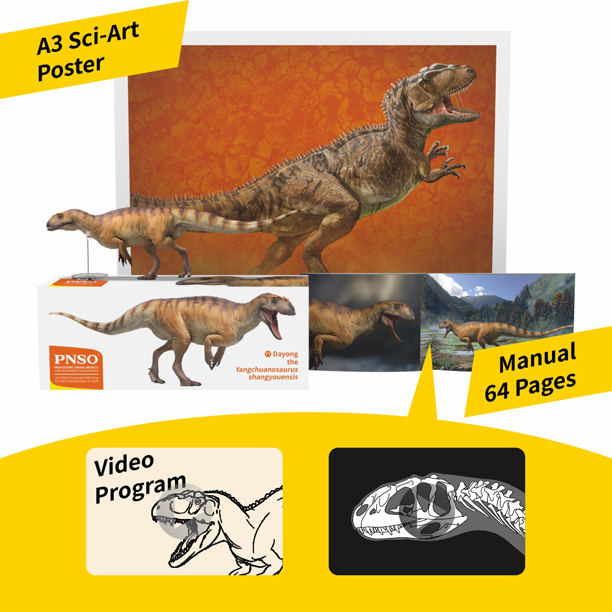
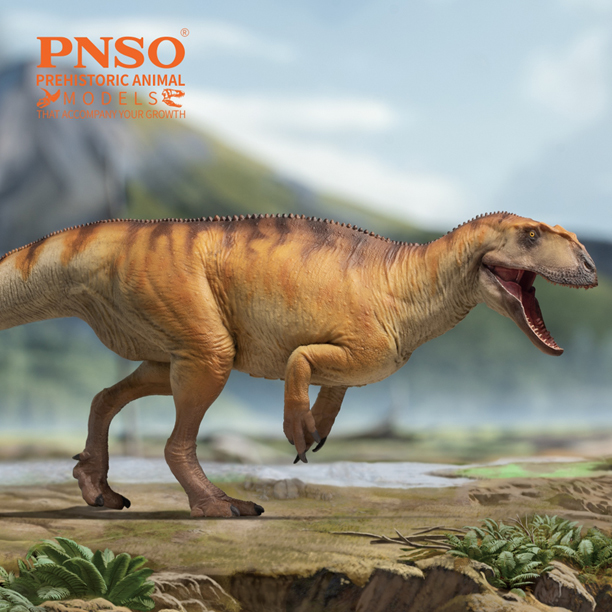
The new for late 2023 PNSO Dayong the Yangchuanosaurus, a replica of a metriacanthosaurid theropod is coming into stock at Everything Dinosaur. The Yangchuanosaurus figure will be in stock in a few weeks. The Yangchuanosaurus is the latest theropod to be announced in PNSO’s mid-size model range.
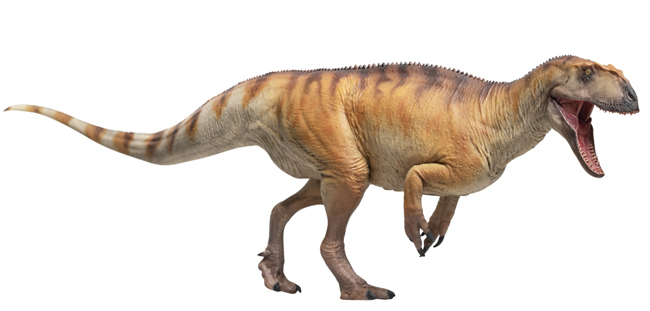
The new for late 2023 Dayong the Yangchuanosaurus from PNSO. Yangchuanosaurus has been classified as a metriacanthosaurid theropod dinosaur.
PNSO Dayong the Yangchuanosaurus
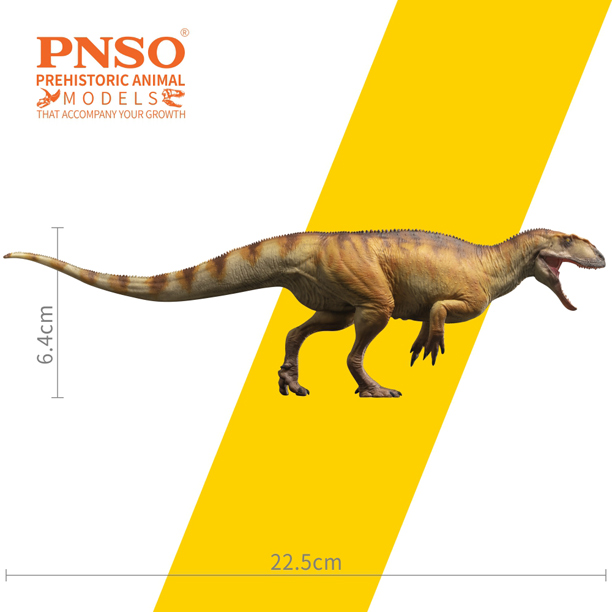
Named and described in 1978 (Dong et al), Yangchuanosaurus was a member of the Allosauroidea superfamily. It was an apex predator, with some palaeontologists estimating that this dinosaur reached lengths in excess of ten metres. The new for 2023 Yangchuanosaurus is more sensibly proportioned. The model measures 22.5 cm in length.
The metriacanthosaurid theropod dinosaur model measures 22.5 cm long and stands 6.4 cm tall.
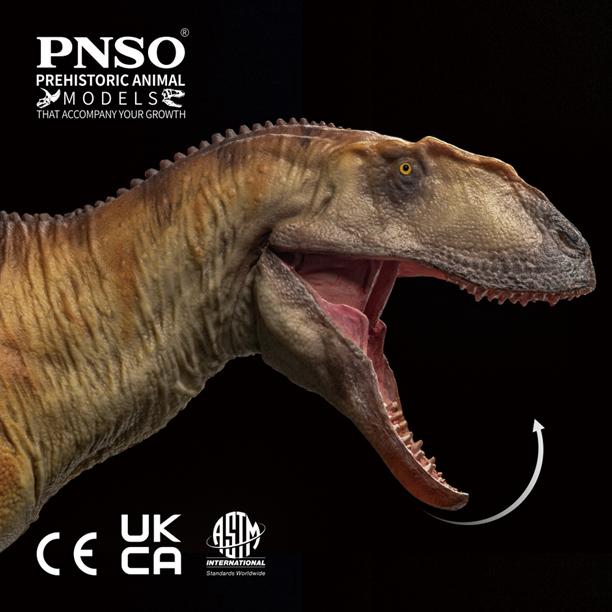
PNSO has already introduced models of Yangchuanosaurus. There is a small figure of Yangchuanosaurus, and it features in a 1:35 scale diorama with the stegosaur Chungkingosaurus. This is the first Yangchuanosaurus figure made by PNSO that has an articulated lower jaw.
The PNSO Yangchuanosaurus dinosaur model has an articulated jaw.
Yangchuanosaurus Accessories
The model is supplied with an A3-sized Sci-Art poster along with a fully illustrated, 64-page colour booklet. A QR code on the packaging links to a product video. Dayong the Yangchuanosaurus is also supplied with a transparent support stand.
The PNSO Yangchuanosaurus dinosaur figure is supplied with a full-colour, 64-page illustrated booklet, a Sci-Art poster and there is a QR code that links to a product video.
A spokesperson from Everything Dinosaur commented that the Albertosaurus, Megalosaurus and Gorgosaurus PNSO figures were due into stock in a few days. The Yangchuanosaurus would be following in a second shipment along with another new PNSO figure.
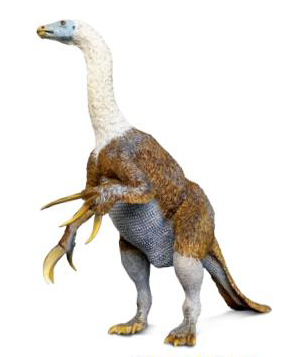
A Wild Safari Prehistoric World Therizinosaurus is to be added to the range of prehistoric animal figures offered by Safari Ltd. An image of this new theropod dinosaur model has been included in documents sent to Everything Dinosaur. A spokesperson for the UK-based mail order company explained that the figure was likely to be in stock early in 2024.
The first official image of the soon to be introduced Wild Safari Prehistoric World Therizinosaurus dinosaur model.
The Wild Safari Prehistoric World Therizinosaurus Model
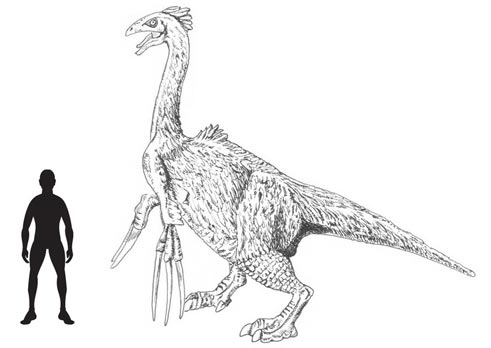
Formally named and scientifically described in 1954 (Maleev), this dinosaur is famous for its huge hand claws. Size estimates vary, but some palaeontologists suggest Therizinosaurus could have reached a length of ten metres and stood around five metres tall. Fossils of Therizinosaurus cheloniformis are rare. This dinosaur’s body shape and size has been inferred by studying more complete specimens of smaller maniraptoran relatives such as Nanshiungosaurus and Erliansaurus.
Huge “scythe lizard”. A scale drawing of Therizinosaurus. Picture credit: Everything Dinosaur.
Picture credit: Everything Dinosaur
Model Measurements
A spokesperson from Everything Dinosaur stated that the model had a length of 16.8 cm (6.6 inches). It stood 16.4 centimetres high (6.4 inches tall).
The spokesperson also confirmed that the Wild Safari Prehistoric World Therizinosaurus dinosaur model was likely to be in stock at Everything Dinosaur early in 2024.
Everything Dinosaur has received a whopping 647 Feefo product reviews over the last few months. Feefo, the independent ratings agency records comments from customers and feedback on products. As well as receiving hundreds of comments about customer service, nearly 650 product reviews have been received.
Over the last few months Everything Dinosaur has received a colossal 647 feedback comments about products from customers. The average product rating from customers was an amazing 4.9 out of 5 stars. Picture credit: Everything Dinosaur.
Picture credit: Everything Dinosaur
Feefo Product Reviews
Feefo is one of the world’s largest verified buyer reviews platforms.
Feefo helps to empower businesses like Everything Dinosaur by collecting genuine, verified customer reviews and insights. This feedback provides visitors to our website with extra assurance and allows Everything Dinosaur to relate real customer purchasing experiences.
Over 93% of the product reviews received are 5-star reviews. An amazing 642 out of 647 product reviews from customers are either 4-star or 5-star (99.2%).
A spokesperson from Everything Dinosaur commented:
“We would like to thank all our reviewers who have submitted feedback to Feefo about us. The comments we have received help us to improve our business. Everything Dinosaur has received an amazing 647 reviews over the last few months. We are immensely proud to have earned such an astonishing number of 5-star reviews.”
Customer Service Reviews
In addition to the product reviews, Everything Dinosaur has received hundreds of customer service reviews. Of the 324 customer service reviews received over this period, 320 of them are 5-star reviews. The other four reviews are 4-star reviews.
With this level of independently verified customer reviews, Everything Dinosaur has one of the best business ratings for customer service in worldwide retail.
Team members at Everything Dinosaur spotted some colourful dinosaur eggs in a carefully constructed nest on a visit to a Cheshire primary school. Whilst reviewing some teaching work from early 2018, we found a picture of the beautiful dinosaur eggs.
Some beautiful and very colour dinosaur eggs spotted at Little Leigh primary school (Cheshire). Picture credit: Everything Dinosaur.
Picture credit: Everything Dinosaur
Dinosaur Eggs
The photograph of the dinosaur nest was taken on a visit to Little Leigh primary in Cheshire. Everything Dinosaur had been invited into the school to deliver a workshop to Year 1 children who were learning about dinosaurs. The dedicated teaching team created the eggs, and the children were asked about what materials could go into the nest to keep the eggs safe. This exercise was a great way for the pupils to explore the properties of materials. In addition, to learning about dinosaur eggs, the pupils had the opportunity to examine different nesting materials.
A spokesperson from the UK-based mail order company commented that they remembered the school visit. The spacious Year 1 classrooms were filled with lots of examples of the children’s work. One of the teachers had constructed a small dinosaur museum in a corner of the room.
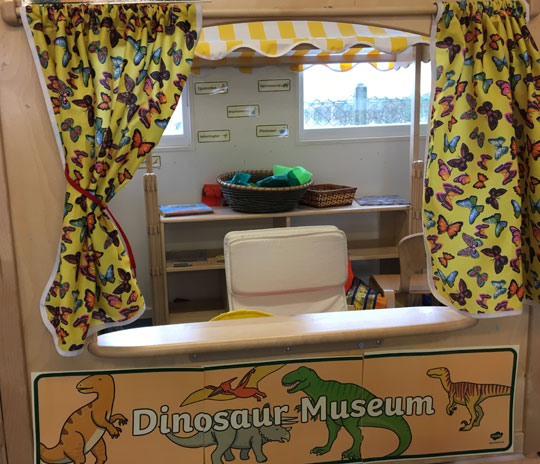
A dinosaur museum spotted at a school. Picture credit: Little Leigh Primary/Everything Dinosaur.
Picture credit: Little Leigh Primary/Everything Dinosaur
The spokesperson added:
“The children were very enthusiastic, and they wanted to give us a tour of their classroom. We enjoyed visiting the dinosaur museum. However, we had to cut our visit short, we had a dinosaur and fossil workshop to deliver.”
Afterwards we chatted to the teaching team. They thanked us for the visit, and we congratulated them on their excellent scheme of work.
A new species of Japanese dinosaur has been announced. The dinosaur, classified as a deinocheirid and therefore distantly related to the bizarre Deinocheirus has been named Tyrannomimus fukuiensis.
Fragmentary fossils representing a type of ornithomimosaur had been excavated from the Kitadani Dinosaur Quarry (Fukui Prefecture, Japan) since 1998. The remains represent several individuals, but the fossil bones show identical anatomical traits leading palaeontologists to conclude that a single, new taxon was present.
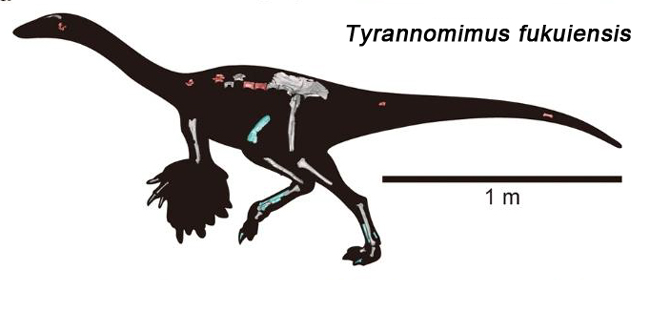
Fossil material associated with T. fukuiensis. The holotype (FPDM-V-11333) shown in red and the paratype shown in blue. The right femur in the diagram is a mirror image of the left femur (FPDM-V-11338). Picture credit: Hattori et al with additional annotation by Everything Dinosaur.
Tyrannomimus fukuiensis
Phylogenetic analysis indicates that T. fukuiensis is the earliest definitive deinocheirid described to date. Its discovery will help scientists to better understand the evolution and dispersal of early ornithomimosaurs. Tyrannomimus is estimated to have had a body length of around 2.5 metres. It was probably feathered.
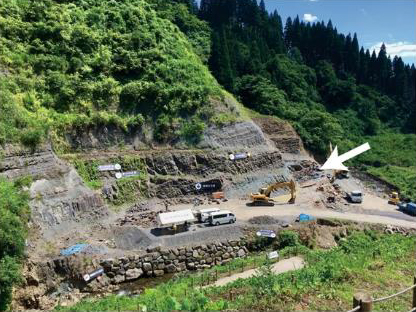
The Kitadani Dinosaur Quarry in 2019 with an arrowhead indicating where the studied specimens were found. Picture credit: Hattori et al.
The bonebed from which the fossil material was excavated is thought to be around 120 million years old (Aptian faunal stage of the Cretaceous). The Kitadani Dinosaur Quarry has yielded several different types of dinosaur. The stratum from where the Tyrannomimus was excavated is associated with two other dinosaurs – Fukuiraptor (possible megaraptoran) and the herbivorous Fukuisaurus (hadrosauriform).
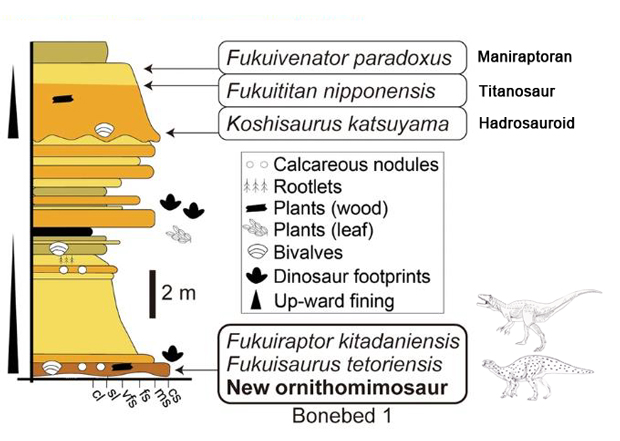
Stratigraphic section of the part of the Kitadani Formation in the Kitadani Dinosaur Quarry showing the approximate location of key fossils including dinosaurs such as Tyrannomimus fukuiensis. Picture credit: Hattori et al with additional annotation by Everything Dinosaur.
Kitadani Dinosaur Quarry Bonebed 1 Biota
Both Fukuiraptor (F. kitadaniensis) and Fukuisaurus (F. tetoriensis) are found at the same level as Tyrannomimus fossil material. This suggests these dinosaurs were coeval. The palaeoclimate of the lower portion of the Kitadani Formation is believed to have been a humid, tropical ecosystem. Slightly younger geological deposits, yield abundant conifer fossils indicating that the climate may have become drier.
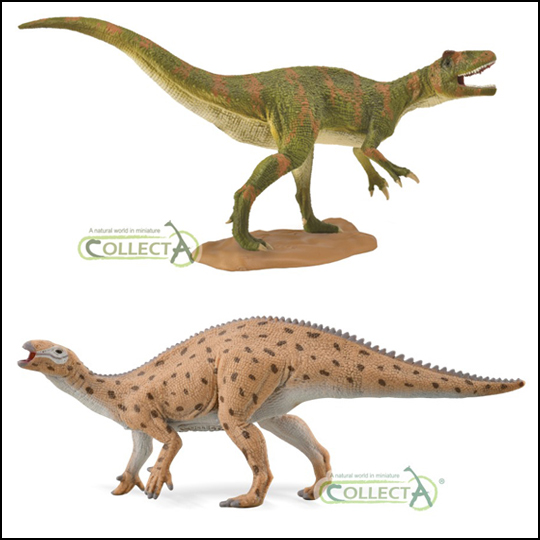
The CollectA Fukuiraptor (top) and the CollectA Deluxe Fukuisaurus (bottom). These dinosaurs may have been contemporaries of the newly described deinocheirid Tyrannomimus.
The picture (above) shows Fukuiraptor and Fukuisaurus figures. These replicas are part of the CollectA range of prehistoric animal figures. Fukuiraptor is in the CollectA Age of Dinosaurs range, whilst the 1:40 scale Fukuisaurus is found within the CollectA Deluxe range.
The genus name translates as “tyrant mimic”. The ilium shows similarities to the hip bones of tyrannosauroids. Indeed, prior to its formal scientific description this dinosaur was thought to be a member of the Tyrannosauroidea.
The identification of Tyrannomimus fukuiensis as an ornithomimosaur has implications for a dinosaur found in Portugal. Aviatyrannis jurassica was named and described in 2003 (Rauhut). It is estimated to have lived around 155 million years ago (Late Jurassic). Aviatyrannis was thought to represent a tyrannosauroid. However, analysis of the bones of Tyrannomimus with Aviatyrannis revealed similar characteristics. As such, Aviatyrannis may represent an ornithomimid too. If this is the case, then Aviatyrannis jurassica, may represent the earliest ornithomimosaur described to date.
If Aviatyrannis is confirmed to be a member of the Ornithomimosauria, then it significantly expands the temporal and biogeographic range of these theropod dinosaurs.
Everything Dinosaur acknowledges the assistance of the open-access scientific paper in the compilation of this article.
The scientific paper: “New theropod dinosaur from the Lower Cretaceous of Japan provides critical implications for the early evolution of ornithomimosaurs” by Soki Hattori, Masateru Shibata, Soichiro Kawabe, Takuya Imai, Hiroshi Nishi and Yoichi Azuma published in Scientific Reports.
Everything Dinosaur has produced a short YouTube video review of the recently introduced Papo Kronosaurus marine reptile figure. In this brief video, team members take a detailed look at the Papo Kronosaurus and explain why this figure has a tail fin.
The Everything Dinosaur review of the recently introduced Papo Kronosaurus model. Video credit: Everything Dinosaur.
Video credit: Everything Dinosaur
Reviewing the Papo Kronosaurus
Our YouTube video lasts a little over three minutes. We wanted to give model collectors the opportunity to take a closer look at the Papo Kronosaurus replica. The official image released by Papo does not highlight the excellent quality of this model. Everything Dinosaur wanted to create a video and publish photographs to assist collectors with purchase decisions.
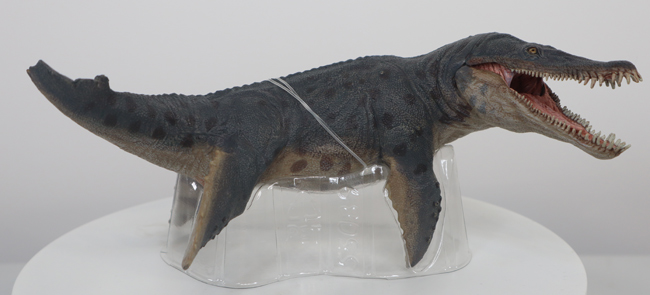
The Papo Kronosaurus marine reptile photographed in lateral view. Picture credit: Everything Dinosaur.
Picture credit: Everything Dinosaur
To view the extensive range of Papo prehistoric animal figures and models in stock at Everything Dinosaur: Papo Prehistoric Animal Models.
Kronosaurus Markings and the Tail Fin
The video begins with the Kronosaurus model being introduced. Comments are made about the figure having a typical Papo appearance. The head and the teeth are examined in detail. The narrator moves on to discuss the flippers and the presence of skin parasites, probably barnacles on the marine reptile figure. This Kronosaurus model has a cloaca.
The video format (chapters):
00:00 – Papo Kronosaurus! 00:48 – Typically Papo! 01:00 – Head and Teeth. 01:22 – Kronosaurus Flippers. 01:51 – Cloaca Watch! 02:08 – Tail Fin Shape! 02:52 – Congratulations Papo.
A section of the Everything Dinosaur video is dedicated to explaining why the figure has been given a tail fin. Tail fins/flukes in the Plesiosauria remains a controversial area. There is some evidence within the fossil record. However, the Plesiosauria is such a diverse clade that there may have been many different shapes and sizes of tail appendage. Most palaeontologists agree, that if a tail fin or fluke was present on Kronosaurus, it probably did not play a huge role in locomotion. The tail fin or fluke would have probably helped to stabilise the predator as it manoeuvred.
The video concluded with the narrator praising the Papo prehistoric animal model range and congratulating the company for producing an excellent Kronosaurus.
Fossils of an ancient ape that lived in Turkey around 8.7 million years ago is challenging accepted ideas about human origins. The fossils include skull bones, jaws and teeth of both males and females. This new ape has been named Anadoluvius turkae. The material was excavated from the Çorakyerler fossil locality near Çankırı in northern Turkey, about 60 miles (100 km) northeast of the country’s capital, Ankara. Assigned to the subfamily Homininae, the genus name is from “Anadolu” the modern Turkish word for the Anatolia region.
The discovery of A. turkae lends support to the hypothesis that the Homininae first evolved in Europe before migrating to Africa 7–9 million years ago.
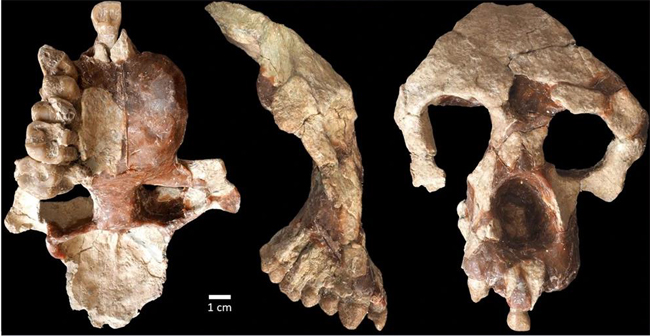
A female Anadoluvius turkae partial cranium. From left to right, palatal, right lateral and anterior views. Picture credit: Sevim-Erol et al.
The subfamily Homininae consists of two tribes. The Hominini which includes modern humans and their extinct relatives along with the subtribe Panina which consists of bonobos and chimpanzees. In addition, there is the Gorillini tribe (gorillas).
Anadoluvius turkae
The researchers suggest that hominines (members of the Homininae tribe), not only evolved in western and central Europe but spent over five million years evolving there and spreading to the eastern Mediterranean. These apes eventually dispersed into Africa, probably as a result of a drying climate reducing the amount of forest habitat in the eastern Mediterranean.
The well-preserved fossils including an Anadoluvius cranium permitted the scientists to conduct a detailed analysis of character attributes in the fossil record. This new study supports the hypothesis that hominines originated in Europe and dispersed into Africa along with many other mammals between 9 and 7 million years ago (Tortonian stage of the Miocene Epoch).
Anadoluvius turkae was about the size of a modern chimpanzee. Anadoluvius probably weighed around 50-60 kilograms. It inhabited dry forested habitats and probably spent a lot of time on the ground rather than in the trees.
More Miocene Homininae Fossils
The researchers consisting of scientists from Ankara University, Pamukkale University and the Ege University Faculty of Science (Turkey), along with colleagues from the Naturalis Biodiversity Centre (Holland) and the University of Toronto (Canada) hope to find more fossils.
A spokesperson from Everything Dinosaur commented:
“Further fossil discoveries will help to clarify the evolutionary origins of the Homininae. More fossils from Africa and Europe will help palaeontologists to outline the geographical distribution of our ancient ancestors.”
Everything Dinosaur acknowledges the assistance of the Media Relations team at the University of Toronto (Canada) in the compilation of this article.
The scientific paper: “A new ape from Türkiye and the radiation of late Miocene hominines” by Ayla Sevim-Erol, D. R. Begun, Ç. Sönmez Sözer, S. Mayda, L. W. van den Hoek Ostende, R. M. G. Martin and M. Cihat Alçiçek published in Communications Biology.