All about dinosaurs, fossils and prehistoric animals by Everything Dinosaur team members.

About Mike

Mike runs Everything Dinosaur, a UK-based mail order company specialising in the sale of dinosaur and prehistoric animal models, He works alongside Sue, and between them they have become the "go to guys" for museum quality prehistoric animal models and figures. An avid fossil collector and reader of dinosaur books, Mike researchers and writes articles about palaeontology, fossil discoveries, research and of course, dinosaur and prehistoric animal models.
25 07, 2022

New Research Identifies Earliest Known Animal Predator

By |2024-03-09T14:34:55+00:00July 25th, 2022|Categories: Adobe CS5, Dinosaur and Prehistoric Animal News Stories, Main Page, Palaeontological articles, Photos/Pictures of Fossils|0 Comments

Scientists have announced the discovery of what might possibly be the earliest known animal predator. The fossils discovered in Charnwood Forest (Leicester, England), are estimated to be around 560 million years old and the animal has been named Auroralumina attenboroughii in honour of Sir David Attenborough.

A life reconstruction of Auroralumina attenboroughii
A life reconstruction of Auroralumina attenboroughii superimposed on the fossil material. Picture credit: BGS @ UKRI.

Attenborough’s Dawn Lantern

As a boy, Sir David Attenborough used to collect fossils from various locations close to his Leicestershire home. However, he never went to Charnwood Forest to hunt for fossils as the rocks exposed in that area were thought to be too old to contain signs of life.

In the late 1950s, another young boy, Roger Mason found a strange frond-like impression in a rock. Researchers identified this as the fossilised remains of a bizarre organism, later named Charnia masoni, which forms part of an ancient ecosystem that existed prior to the Cambrian.

This newly described organism Auroralumina attenboroughii honours Sir David Attenborough. The first part of its name is Latin for “dawn lantern”, in recognition of its great age and the organism’s resemblance to a burning torch.

Auroralumina attenboroughii fossil.
Auroralumina attenboroughii fossil imprint preserved in the rock. Picture credit: BGS @ UKRI.

Related to Corals, Jellyfish and Anemones

The geological period known as the Ediacaran precedes the Cambrian. The Ediacaran spans an immense amount of deep time, from approximately 635 million years ago, to the beginning of the Cambrian around 540 million years ago. In some parts of the world, notably the Mistaken Point Ecological Reserve on the south-eastern coast of Newfoundland, Namibia, Guizhou Province (China), Charnwood Forest and the Flinders Ranges of South Australia, ancient sedimentary rocks preserve the remains of the oldest, complex multi-cellular organisms known to science.

Most of the Ediacaran biota bears little resemblance to fossils associated with younger Cambrian-aged strata, A. attenboroughii is an exception, the research team postulate that the fossils represent an ancestor of today’s corals, jellyfish and anemones – the Cnidaria phylum.

Auroralumina attenboroughii line drawing.
The fossil imprint of the newly described Auroralumina attenboroughii with a line drawing on the matrix to show features. Picture credit: BGS @ UKRI.

“Truly Delighted”

Naturalist, campaigner and broadcaster Sir David Attenborough stated that he was “truly delighted” with his ancient namesake.

He added:

“When I was at school in Leicester, I was an ardent fossil hunter. The rocks in which Auroralumina has now been discovered were then considered to be so ancient that they dated from long before life began on the planet. So, I never looked for fossils there.

A few years later a boy from my school found one [Roger Mason] and proved the experts wrong. He was rewarded by his name being given to his discovery. Now I have – almost – caught up with him and I am truly delighted.”

The scientific paper has been published in the journal “Nature Ecology & Evolution”. This discovery challenges perceptions as to when modern groups of animals, or their direct ancestors first evolved.

Commenting on the significance of this fossil find, one of the authors of the paper, Dr Phil Wilby (palaeontology leader at the British Geological Survey), explained:

“It’s generally held that modern animal groups like jellyfish appeared 540 million years ago in the Cambrian explosion. But this predator predates that by 20 million years. It’s the earliest creature we know of to have a skeleton. So far we’ve only found one, but it’s massively exciting to know there must be others out there, holding the key to when complex life began on Earth.”

A Geological Spring Clean

In 2007, Dr Wilby and his colleagues spent over a week carefully cleaning a 100 square metres of a rock surface exposed in the Forest. A variety of tools including pressure hoses and toothbrushes were used to spring clean deposits that were laid down at the bottom of a deep sea more than half a billion years ago.

A rubber mould of the whole surface was then taken, capturing the preserved impressions of more than a thousand fossils.

Geologists at work.
Geologists cleaning and mapping the rockface in the Charnwood Forest (Leicester, England). Picture credit: BGS @ UKRI.

One Fossil Specimen Stood Out

Co-author of the scientific paper, Dr Frankie Dunn (Oxford University Museum of Natural History), explained that one fossil impression stood out from the rest, commenting that it looked very different from the other Ediacaran fossils (Charnia masoni and Bradgatia linfordensis) preserved on the same bedding plane.

Dr Dunn commented that Auroralumina:

“Is very different to the other fossils in Charnwood Forest and around the world. Most other fossils from this time have extinct body plans and it’s not clear how they are related to living animals. This one clearly has a skeleton, with densely-packed tentacles that would have waved around in the water capturing passing food, much like corals and sea anemones do today. It’s nothing like anything else we’ve found in the fossil record at the time.”

Dr Wilby scans the fossil.
Palaeontologist Dr Phil Wilby using a 3D laser scanner to create a detailed record of the fossil. Picture credit: BGS @ UKRI.

A Lonely Fossil

Dr Dunn calls the single Auroralumina specimen a “lonely little fossil” and suggest it probably inhabited much shallower marine environments compared to rest of the Charnwood Forest biota.

She added:

“The ancient rocks in Charnwood closely resemble ones deposited in the deep ocean on the flanks of volcanic islands, much like at the base of Montserrat in the Caribbean today. All of the fossils on the cleaned rock surface were anchored to the seafloor and were knocked over in the same direction by a deluge of volcanic ash sweeping down the submerged foot of the volcano, except one, A. attenboroughii. It lies at an odd angle and has lost its base, so appears to have been swept down the slope in the deluge.”

Zircon minerals associated with the volcanic deposits permitted the researchers to accurately age the fossil based on radioactive decay measurements relating to uranium/lead ratios.

Potentially the Earliest Known Animal Predator

Dr Frankie Dunn said:

“The Cambrian Explosion was remarkable. It’s known as the time when the anatomy of living animal groups was fixed for the next half a billion years. Our discovery shows that the body plan of the cnidarians was fixed at least 20 million years before this, so it’s hugely exciting and raises many more questions.”

Nonagenarian Sir David Attenborough has been honoured on numerous occasions by having newly described extinct creatures named after him. However, arguably the lonely, little Auroralumina attenboroughii may represent the most significant, as it challenges existing perceptions about when animal body plans still found today, first evolved.

Everything Dinosaur acknowledges the assistance of a media release received via email on 26th July in the compilation of this article.

Visit Everything Dinosaur’s website: Everything Dinosaur.

The scientific paper: “A crown-group cnidarian from the Ediacaran of Charnwood Forest, UK” by F. S. Dunn, C. G. Kenchington, L. A. Parry, J. W. Clark, R. S. Kendall and P. R. Wilby published in Nature Ecology & Evolution.

24 07, 2022

More Environmentally Friendly Bubble Wrap

By |2022-10-20T12:26:17+01:00July 24th, 2022|Categories: Adobe CS5, Everything Dinosaur News and Updates, Main Page, Press Releases|0 Comments

Everything Dinosaur is switching to more environmentally friendly bubble wrap as part of the company’s continuing commitment to more sustainable working practices. The UK-based company has already committed to using 100% recycled cardboard for its product packaging and fully compostable potato starch chips. The bubble wrap used to help protect prehistoric animal models and other items sent out in the post, will now consist of a minimum of 30% recycled material.

Everything Dinosaur users more environmentally friendly bubblewrap
Bubble packaging being used by Everything Dinosaur contains a minimum of 30% recycled material. Picture credit: Everything Dinosaur.

A spokesperson from Everything Dinosaur commented:

“We are committed to lowering our carbon footprint, minimising waste and to reducing our impact on the planet. As part of our environmental policy, we have been able to source bubble wrap that uses at least 30% recycled material. We are doing our best to cut down on the use of plastics in our business, but when plastic packaging can’t be avoided, we are using more environmentally friendly packaging.”

Increased Packaging Costs Not Being Passed onto Customers

The new air-pocket-based packaging material is more expensive than standard bubble wrap. It offers the same level of protection but rather than use cheaper materials Everything Dinosaur is committed to taking measures to help minimise single use plastics and protect the environment.

The considerable extra costs for sourcing this new packaging material are not being passed onto customers.

Everything Dinosaur sourcing more environmentally friendly bubblewrap
The new bubble wrap being used by Everything Dinosaur contains a minimum 30% of recycled content. Everything Dinosaur working hard to ensure that the company is environmentally responsible. Picture credit: Everything Dinosaur.

Reducing Waste – Increasing Recycling

The company has introduced numerous measures to reduce waste. Virtually all the wastepaper and cardboard are recycled and Everything Dinosaur has entered into an agreement with a local print company to return wooden pallets, so they can be used over and over again.

The spokesperson added:

“Whilst our cost base has increased as a result of the steps we have undertaken, we believe that this is the right thing to do. We have even introduced electricity and water saving measures. The non-avian dinosaurs might be extinct and we need to ensure that our own species does not go the same way.”

To view the range of dinosaur and prehistoric animal themed toys and gifts available from Everything Dinosaur: Visit Everything Dinosaur.

23 07, 2022

When did Sixty-Five Million Years Ago Become Sixty-Six Million Years Ago? That’s a Great Question!

By |2024-05-07T13:49:49+01:00July 23rd, 2022|Categories: Dinosaur Fans, Everything Dinosaur News and Updates, Main Page|0 Comments

Twenty years ago, references to the end-Cretaceous mass extinction event confidently stated that this occurred around 65 million years ago, the date of the extinction of the Dinosauria et al seems to have been pushed back to a million years earlier. When did this change in chronology happen?

Sixty-five Million Years or Sixty-six Million Years?

Team members at Everything Dinosaur have been reviewing the huge inventory of blog posts that have been built up over the last fifteen years or so. It has been noted that the extinction of the dinosaurs, pterosaurs and a large portion of other types of life on Earth at the end of the Cretaceous in the numerous early blog articles that reference this event, is estimated to have occurred around sixty-five million years ago. In later articles, the date given is approximately sixty-six million years ago.

Visit Everything Dinosaur’s award-winning website: Everything Dinosaur.

In 2013, Everything Dinosaur reported upon the work of an international team of scientists that had calculated the most accurate date for the extraterrestrial impact that created the Chicxulub crater. Researchers from the Berkeley Geochronology Centre (University of California), in co-operation with colleagues from Glasgow University and Vrije University (Amsterdam, Holland), have concluded that a meteorite, asteroid or possibly even an object such as a comet collided with the Earth approximately 66.038 million years ago (plus or minus 11,000 years).

Everything Dinosaur is an award-winning and highly respected supplier of prehistoric animal models and toys. To view the extensive range of dinosaur models and other replicas available: Dinosaur and Prehistoric Animal Models and Figures.

Could this scientific paper have marked the point in time, when the point in time marking the end of the non-avian dinosaurs was changed in popular culture?

Here is a link to our 2013 blog post: Most Accurate Date to Date for the end-Cretaceous Mass Extinction Event.

22 07, 2022

Australia’s First Vulture – Hiding in Plain Sight

By |2023-02-07T12:55:44+00:00July 22nd, 2022|Categories: Adobe CS5, Dinosaur and Prehistoric Animal News Stories, Main Page, Palaeontological articles, Photos/Pictures of Fossils|0 Comments

Today, Australia has no vultures, but in the Pleistocene Epoch it did. Researchers have reclassified fossil remains and identified Australia’s first fossil vulture. The bird, which probably stood around one metre tall, has been named Cryptogyps lacertosus. The scientific name translates as “powerful hidden vulture”, reflecting the fact that its fossils had been hiding in plain sight for more than a hundred years.

Vulture Cryptogyps compared to Aquila audax.
A silhouette of the newly described Australian vulture Cryptogyps lacertosus which lived in Australia until around 50,000 years ago. C. lacertosus (right) is compared to Aquila audax, the Wedge-tailed eagle which is Australia’s largest extant bird of prey. Wedge-tailed eagles often scavenge carcasses and are frequently observed feeding on kangaroo corpses and other animals killed in roadside collisions. The Wedge-tailed eagle is filling the ecological niche once filled by the extinct C. lacertosus. Picture credit: Ellen Mather, Flinders University Palaeontology Lab with additional annotation by Everything Dinosaur.

Fossil Vulture Hiding in Plain Sight

Researchers from Flinders University and the South Australian Museum writing in the academic journal “Zootaxa” have reassessed fossil material first described by the English ornithologist Charles Walter de Vis in 1905 and named as “Taphaetus lacertosus”. The ornithologist thought the partial humerus and fragmentary skull bones found in north-eastern South Australia represented an ancient eagle and he named the bird “powerful grave eagle”.

The scientists were able to study fossils from the Wellington Caves of New South Wales and material recovered from the Nullarbor Plain of Western Australia including a lower leg bone (tarsometatarsus), which when compared to the lower leg bones of living birds of prey, it became clear that the fossil tarsometatarsus did not support the musculature required to despatch prey.

Eagle lower leg bone compared to fossil vulture.
Comparisons of the tarsometatarsi of wedge-tailed eagle (lower right) and Cryptogyps (lower left), with position of tarsometatarsi shown in the leg (centre, based on illustration by Jollie, 1977). Picture credit: Dr Ellen Mather (Flinders University Palaeontology Lab.

Lead author of the paper, Dr Ellen Mather (Flinders University) commented:

“We compared the fossil material to birds of prey from around the world, and it became clear right away that this bird was not adapted to being a hunter, and so it was not a hawk or an eagle.”

A Phylogenetic Analysis

A phylogenetic analysis placed C. lacertosus within the subfamily Aegypiinae, making it an Old World Vulture related to extant birds found in Africa, Asia and Europe. The identification of Cryptogyps lacertosus as an Old World Vulture significantly expands the palaeogeographical range of the Old World vultures, previously unknown in Australia and indeed, there are no vultures in Australia today.

Given the megafauna that existed on the continent until very recently, giant kangaroos, flightless thunder birds, huge wombats such as Diprotodon and the enormous monitor lizard Megalania, the presence of vultures in the Pleistocene ecosystem had been predicted.

Everything Dinosaur acknowledges the assistance of a media release from Flinders University in the compilation of this article.

The scientific paper: “A new look at an old Australian raptor places “Taphaetus” lacertosus de Vis 1905 in the Old World vultures (Accipitridae: Aegypiinae)” by Ellen K. Mather, Michael S. Y. Lee and Trevor H. Worthy published in Zootaxa.

21 07, 2022

Maintenance on the Everything Dinosaur Blog

By |2022-10-20T12:30:58+01:00July 21st, 2022|Categories: Adobe CS5, Dinosaur Fans, Everything Dinosaur News and Updates, Main Page, Press Releases|0 Comments

The Everything Dinosaur blog consists of over 6,000 posts. The articles, features and news stories on the blog provide a valuable resource for teachers, academics and dinosaur fans. First started back in late May 2007, team members have built up an extensive library of dinosaur and prehistoric animal themed posts. The site, like all websites, needs to be occasionally modified and updated to help maintain and improve the customer experience. Over the next few weeks, the Everything Dinosaur blog will be undergoing some maintenance.

The Everything Dinosaur blog is undergoing routine maintenance and new updates are being added. These changes are being made to improve the efficiency and function of the site.

An Enormous Weblog

A review of each and every article posted on the blog is being undertaken. This is an immense amount of work, as there are thousands of articles and millions of words on the site. This maintenance work has been structured to ensure that visitors can access the blog posts with the minimum of disruption. Viewers will not notice the work going on, but behind the scenes our trained Velociraptors will be working hard to ensure that the weblog is in tip-top condition.

A spokesperson from Everything Dinosaur commented:

“We understand that our blog is very important to people, we will continue to post up articles and features whilst this work is going on. It will be business as usual for all the blog site visitors, but in the background we will be implementing changes to ensure our site is secure and provides the very best customer visitor experience. Around 3% of the site has been reviewed and checked over so far, but we intend to make rapid progress over the next few days.”

Everything Dinosaur Dodo model.
One of the first blog posts published by Everything Dinosaur fifteen years ago featured a model of Dodo that we had sourced for a customer. Team members still trace prehistoric animal models and figures requested by customers. Our commitment to customer service continues to be maintained.

The spokesperson for Everything Dinosaur commented that by the end of this year, team members would have posted up another 150 articles on the Everything Dinosaur blog and that the landmark of 7,000 blog posts was expected to be reached by the middle of 2025.

20 07, 2022

Unique Dinosaur Fossil to be Returned to Brazil

By |2023-04-18T08:15:50+01:00July 20th, 2022|Categories: Adobe CS5, Dinosaur and Prehistoric Animal News Stories, Dinosaur Fans, Main Page|0 Comments

A unique, chicken-sized dinosaur fossil excavated from the Lower Cretaceous deposits of the Araripe Basin (Brazil) and currently residing at the State Museum of Natural History Karlsruhe (Baden-Württemberg, Germany) will be returned to Brazil. The specimen (Ubirajara jubatus), lacks properly documented paperwork detailing its acquisition and it may have been obtained without legitimate export permits.

Holotype of Ubirajara jubatus preserved as slab and counter slab.
The holotype of Ubirajara jubatus preserved as slab and counter slab. The fossil material is to be returned to Brazil after evidence emerged that the specimen may not have been obtained legally. Picture credit: Smyth et al/Cretaceous Research.

Conflicting Accounts about Fossil Acquisition

Conflicting accounts regarding the fossil’s acquisition emerged prompting the Baden-Württemberg science ministry to launch an internal investigation.

In the scientific paper (now withdrawn) published in the journal “Cretaceous Research” it was stated that the fossil specimen was brought to Germany in 1995. However, this statement was contradicted by researchers at the State Museum of Natural History Karlsruhe claiming the fossil was imported in 2006 by a private company and then acquired by the Museum in 2009.

Unique Dinosaur Fossil

As the documentation providing an audit trail for the obtaining of this specimen has not been supplied nor any evidence given to confirm the fossil material was imported before a German cultural protection law took effect in 2007, it has been decided to return the fossil to its country of origin.

Ubirajara jubatus life reconstruction.
Ubirajara jubatus life reconstruction by the very talented palaeoartist Bob Nicholls.

“Parachute Science”

In the days of empire and colonialism, many western powers took fossils from their colonies. These precious artefacts were then put on display. What we see today is another form of colonialism, whereby scientists from the more prosperous countries go to poorer countries to collect fossils. Scientists are “parachuted in” and there is a limited exchange of knowledge with local researchers.

There is a considerable movement to “kick back” against such practices.

To read an article from 2008 about calls from the Government of Tanzania to return fossils in German institutions: Return our Fossils.

Palaeontologists and other researchers are being accused of taking advantage of the natural resources of countries without leaving anything behind in return.

To read Everything Dinosaur’s original blog post about the formal naming and scientific description of this bizarre dinosaur: One Very Flashy New Dinosaur.

Visit Everything Dinosaur’s award-winning website: Everything Dinosaur.

19 07, 2022

Titus the T. rex Exhibition Unveils an Amazing Microscopic T. rex Model

By |2024-03-09T14:35:32+00:00July 19th, 2022|Categories: Adobe CS5, Dinosaur and Prehistoric Animal News Stories, Dinosaur Fans, Main Page, Photos|0 Comments

Fans of dinosaurs like to collect scale models, and there is one scale model on show at the Titus T. rex is King exhibition at Wollaton Hall Nottinghamshire, which puts any model collection into perspective.

Internationally renowned micro-sculpturist, Dr Willard Wigan MBE, has created and installed a new extraordinary micro-sculpture of a perfectly formed Tyrannosaurus rex, measuring just 0.5 mm in length.

This amazing figure is so small, it sits comfortably within the eye of a needle.

Microscopic T. rex Model
The remarkable microscopic Titus the T. rex sculpted by Dr Willard Wigan MBE. The T. rex model measures 0.5 mm in length and it sits within the eye of a needle. Picture credit: Wollaton Hall/Dr Willard Wigan.

Celebrating the First-year Anniversary of this World-exclusive Event

The “microsaur” has been installed to mark the first-year anniversary of the opening of the Titus T. rex is King exhibition. Based on the estimated size for an adult T. rex at around 13 metres, the tiny “tyrant lizard king”, complete with fearsome teeth and sharp claws is approximately in 1/26,000th scale.

Now the very tiniest micro-depiction, and, Titus, the first real Tyrannosaurus rex to be exhibited in England for over a century, stand side by side. Titus the T. rex, demonstrates the immense power and impact of this king of the dinosaurs, while Willard Wigan’s creation presents the smallest, but no less powerful.

Dr Willard Wigan commented:

“It is a real honour to be exhibiting one of my sculptures alongside the breath-taking Titus T. rex exhibition. Wollaton Hall Natural History Museum is renowned for being home to rare specimens from across the globe, including Titus himself, which made it the perfect home for my T. rex sculpture.”

Titus T. rex is King has a new attraction.
Titus the T. rex and the Willard Wigan miniature masterpieces exhibit at Wollaton Hall. Everything Dinosaur team members estimate that the 0.5 mm long T. rex sculpture is in approximately 1:26,000 scale! Picture credit: Wollaton Hall.

A Message to Humanity

Through his incredible sculptures, Dr Wigan is sending a message to humanity – just because you cannot see something does not mean that it does not exist. In palaeontology, including the study of the Dinosauria, a similar metaphor can be demonstrated in the concept of “ghost lineages”. A hypothesis that an animal would have existed in the past, but no fossils to prove its existence have been found, but fossils of related genera imply that it did exist.

Titus the T. rex is King Exhibition

Titus the T. rex is King opened in July 2021, to international acclaim. Over 70,000 visitors have already met Titus and engaged with the bespoke interactive exhibition designed around the remarkable skeletal mount.

Rachael Evans (Museums Development Manager at Nottingham City Museums and Galleries at Wollaton Hall), one of the UK’s most important Natural History Museums, added:

“It is an astonishing moment for us. We will have one the largest dinosaurs ever exhibited in the UK on display alongside one of the smallest. The T. rex that has been introduced to the exhibition is 0.5mm in size, with miniscule teeth made from glass. Since new information about the T. rex has been researched and made available, Willard has remodelled the sculpture to be as accurate as possible in his depiction. We can’t wait to see our visitors’ reaction to this new addition.”

Titus the T. rex Skull and Jaws
The skull of the T. rex exhibit on display at Wollaton Hall until August 2022.

Exhibition Details

Tickets for TITUS T. REX IS KING are on sale now, set at £13.00 for an adult, £8.75 for a child (under 16 years), students and concessions, £34.00 for a family ticket (2 adults and 2 children under 16 years) and under 3s and carers have no entry fees to pay. Car parking charges apply.

Everything Dinosaur acknowledges the assistance of a press release from Wollaton Hall in the compilation of this article.

For further information: Wollaton Hall Titus T. rex is King Exhibition.

18 07, 2022

The Eotyrannus Monograph – A New Scientific Paper

By |2024-04-13T08:05:18+01:00July 18th, 2022|Categories: Adobe CS5, Dinosaur and Prehistoric Animal News Stories, Dinosaur Fans, Main Page, Palaeontological articles, Photos/Pictures of Fossils|0 Comments

A new scientific paper on the Early Cretaceous tyrannosauroid Eotyrannus lengi has been published. It is confirmed as a valid genus and the phylogenetic assessment places the enigmatic Megaraptora clade within the Tyrannosauroidea superfamily.

First named and scientifically described back in 2001 (Hutt et al), Eotyrannus is helping to provide significant insights into the early evolution of tyrannosauroids as well as potentially redefining how enigmatic “megaraptors” such as Australovenator, Megaraptor and the recently described Maip macrothorax fit within the Theropoda.

Eotyrannus scale drawing.
Isle of Wight tyrannosauroid (E. lengi). The recently published monograph (Naish and Cau) supports the earlier hypothesis that this dinosaur had proportionately long arms and a rectangular snout. The holotype specimen (IWCMS: 1997.550) indicates an animal around 4.5 metres in length. However, these fossils represent a sub-adult and the fully-grown, adult size of this Early Cretaceous predator remains undetermined.

The Carnivorous Dinosaurs of the Wessex Formation

Since the first fossils of Eotyrannus were found (1997), this theropod has attracted a lot of scientific interest. It is one of numerous carnivorous dinosaurs associated with the Wessex Formation (part of the Wealden Supergroup), indeed, back in 2021 we blogged about two new members of the Baryonychinae named and described from fossil remains found on the Isle of Wight (Wessex Formation). Last month, we wrote about an even bigger predator, an as yet, unnamed spinosaurid known as the “White Rock spinosaurid”.

For the article on the recently described baryonychids Ceratosuchops inferodios and Riparovenator milnerae: Two New Spinosaurids from the Isle of Wight.

To read about the Isle of Wight “White Rock spinosaurid”: Super-sized Isle of Wight Carnivorous Dinosaur.

The newly published paper provides further information on Eotyrannus autapomorphies (characteristic traits) that help to distinguish it from the often, fragmentary remains of other theropods associated with the Wessex Formation.

Eotyrannus teeth.
Isolated Eotyrannus teeth from the Wessex Formation.

Deciphering the Fossil Evidence

Many of the fossil bones associated with the Eotyrannus genus remain entombed in their concrete-like matrix. Anatomical traits helping to define and classify this dinosaur are only beginning to emerge and there is a substantial amount of further preparation work required to permit a comprehensive analysis.

However, by combining all the new data since the formal description, the authors (Darren Naish and Andrea Cau) were able to produce a new skeletal reconstruction. The maxilla is confirmed as being quite rectangular in shape. Eotyrannus did not have the long, narrow snout (longirostrine) as seen in other early tyrannosauroids such as Dilong and Xiongguanlong from the Early Cretaceous of China. This suggests that longirostry evolved several times within the Tyrannosauroidea, perhaps in response to adaptations to permit these theropods to exploit a particular predatory niche.

Longirostry in Early Members of the Superfamily Tyrannosauroidea
Longirostry (having a long, narrow snout) in early members of the Tyrannosauroidea. Eotyrannus is confirmed as not exhibiting longirostry.

Where do the Megaraptora Fit?

The scientific paper also incorporated a revised phylogenetic analysis of Eotyrannus. No significant support was found for Eotyrannus having a close evolutionary relationship to Juratyrant (J. langhami), known from the Late Jurassic of Dorset or indeed to the Late Jurassic early tyrannosauroid Stokesosaurus (S. clevelandi) from the western United States.

Instead, it is grouped with gracile, mid-sized tyrannosauroids that represent a more derived state than proceratosaurids, stokesosaurs and Juratyrant.

If megaraptoran dinosaurs are tyrannosauroids and therefore coelurosaurs, then this challenges long-held views on Theropoda classification and suggests that after the Early Cretaceous most of the hypercarnivore niches within dinosaur dominated ecosystems were increasingly occupied by coelurosaurs. It also suggests that tyrannosauroids were much more diverse and widespread during the Cretaceous than previously thought.

Eotyrannus remains a fascinating dinosaur, a genus that has led to new insights into the evolution and radiation of the Theropoda. It offers a tantalising glimpse into the ecology represented by the Wessex Formation deposits and how a mid-sized theropod co-existed with other, larger members of the ever-widening collection of Wessex Formation meat-eating dinosaurs.

Everything Dinosaur Helping to Fund Research

The authors wanted to make their paper available to everyone. To do this they set up a GoFundMe campaign to cover publishing costs. Everything Dinosaur assisted with the funding.

A spokesperson from Everything Dinosaur stated:

“We were happy to support this excellent paper and we helped to make such studies possible. Your purchases from Everything Dinosaur genuinely help science”.

Everything Dinosaur helping to fund research.
Team members at Everything Dinosaur were happy to assist with funding a newly published paper on the early tyrannosauroid Eotyrannus lengi.

The scientific paper: “The osteology and affinities of Eotyrannus lengi, a tyrannosauroid theropod from the Wealden Supergroup of southern England” by Darren Naish and Andrea Cau published in PeerJ.

17 07, 2022

A Consequence of Extreme Heat – Landslides

By |2022-10-20T12:34:10+01:00July 17th, 2022|Categories: Geology, Main Page, Palaeontological articles, Photos, Press Releases|0 Comments

Hot weather can increase the risk of landslides and rockfalls, visitors to the seaside trying to avoid the extreme heat are advised to stay away from the cliffs.

For many parts of England, Monday and Tuesday (18th and 19th of July 2022), red extreme heat warnings have been issued. Such alerts have never been issued for the UK before. Temperatures could reach as high as 40 degrees Celsius (104 Fahrenheit), although this system of alerts was only introduced last year (2021). The risk of a landslide can increase in hot weather, visitors to the beach should take care to avoid areas where there are cliffs.

Rock fall at Stonebarrow Hill (Dorset).
A significant rock fall at Stonebarrow Hill (Dorset). Extreme heat can cause cliffs to become unstable and collapse. Visitors to the seaside in search of relief from the hot weather are advised to avoid cliffs due to the increased risk of landslides and rock falls. Picture credit: Brandon Lennon.

Rock Fall and Landslide Risk

In very hot weather, the risk of landslides and rock falls increases. The heating up and then cooling of rocks can increase the instability of the rock face and this can lead to a collapse. The risk of landslides after heavy rain has been widely documented. Saturated, unstable ground can collapse, however, extreme daytime temperatures can also increase the risk of landslides and rock falls.

A spokesperson from Everything Dinosaur commented:

“We do advise visitors to places such as the “Jurassic Coast” and the north coast of Yorkshire to heed the warnings about unstable cliffs. The very hot weather is likely to lead to packed beaches and we urge everyone to stay away from dangerous areas.”

Landslides are common around some parts of the British coastline. Tragically, some incidents cause fatalities. In 2012, a woman was killed when she was caught in a massive landslide at Bridport (Dorset).

We urge seaside visitors to follow local advice and to avoid straying too close to the cliffs and the cliff edge when walking above the beach area.

16 07, 2022

The New for 2022 Papo Protoceratops

By |2023-04-18T08:17:49+01:00July 16th, 2022|Categories: Adobe CS5, Dinosaur Fans, Everything Dinosaur Products, Main Page, Photos of Everything Dinosaur Products, Product Reviews|2 Comments

The new for 2022 Papo Protoceratops dinosaur model is in stock at Everything Dinosaur. This long-awaited replica of “first horned face”, the first of the new for 2022 prehistoric animal models from Papo is now available.

Papo Protoceratops in left lateral.
The Papo Protoceratops in left lateral view. This model of an early horned dinosaur has an articulated lower jaw.

Papo Protoceratops Dinosaur Model

The Papo Protoceratops dinosaur model is around sixteen centimetres long. The model stands about eight centimetres high when measured from the top of that impressive head shield. Everything Dinosaur announced that this figure would be produced and made available this year (2022), back in the late autumn of 2021.

The Papo Protoceratops in anterior view
Papo Protoceratops in anterior view. A close-up view of the impressive head shield of the Protoceratops. There are two eyespots painted on the headshield.

Papo Protoceratops with an Articulated Jaw

The Papo Protoceratops has been provided with a prominent beak for cropping tough vegetation and the model has an articulated lower jaw. The inside of the mouth has been well painted, and the Papo design team have provided the Protoceratops with rows of small white teeth in both the upper and lower jaw.

Papo Protoceratops dinosaur model.
A close-up view of the head of the Papo Protoceratops dinosaur model. The figure has been given a prominent beak and, in the mouth, the Papo design team have added some teeth to their model.
Papo Protoceratops model
Papo Protoceratops model in lateral view. In this image the mouth is open and some of the small, white teeth can be seen.

The Protoceratops Genus

The Protoceratops genus was erected in 1923 when the first species (P. andrewsi), was formally named and described (Granger and Gregory). The first fossils of this dinosaur were collected during the famous American Museum of Natural History expedition to the Gobi Desert. Protoceratops andrewsi is associated with the Mongolian Djadokhta Formation (Upper Cretaceous), a second species, the slightly larger Protoceratops hellenikorhinus was named and described in 2001 (Lambert et al). Fossils of P. hellenikorhinus are associated with the Bayan Mandahu Formation of Inner Mongolia (China).

Visit Everything Dinosaur’s website: Everything Dinosaur.

Both the Djadokhta Formation and the potentially contemporaneous Bayan Mandahu Formation represent arid, desert-like palaeoenvironments.

Papo Protoceratops dinosaur model.
Papo Protoceratops dinosaur model. This dinosaur model is one of three new Papo prehistoric animal models expected in stock in 2022.

Three Papo Prehistoric Animal Models Expected in 2022

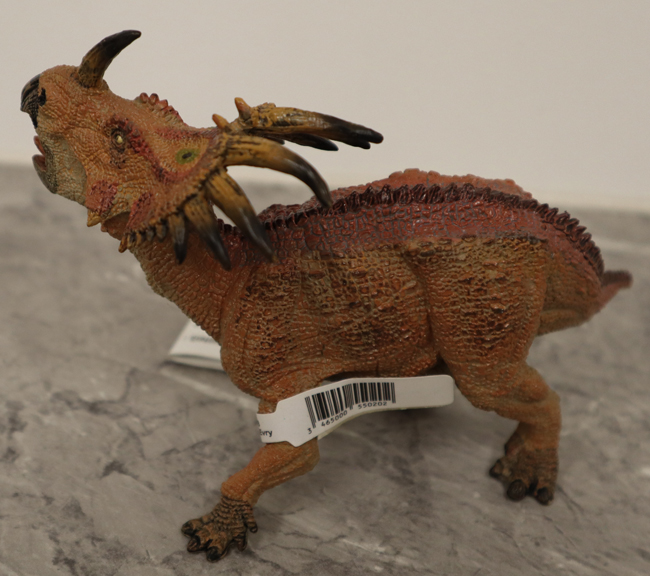
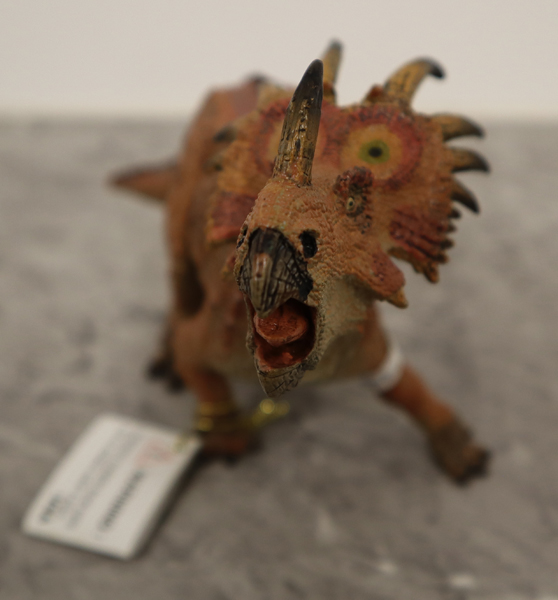
The Papo Protoceratops dinosaur model is one of three Papo prehistoric animal models expected in 2022. A new colour variant of the Styracosaurus is expected in stock and, towards the end of the year (quarter 4), Papo are expected to introduce a model of a Mosasaurus.

Papo Protoceratops model
The new for 2022 Papo Protoceratops dinosaur model in posterior view.

To view the Papo Protoceratops dinosaur model and the rest of the Papo prehistoric animal figures in stock at Everything Dinosaur: Papo Dinosaurs and Prehistoric Animal Models.

Go to Top