All about dinosaurs, fossils and prehistoric animals by Everything Dinosaur team members.
About Mike
Mike runs Everything Dinosaur, a UK-based mail order company specialising in the sale of dinosaur and prehistoric animal models, He works alongside Sue, and between them they have become the "go to guys" for museum quality prehistoric animal models and figures. An avid fossil collector and reader of dinosaur books, Mike researchers and writes articles about palaeontology, fossil discoveries, research and of course, dinosaur and prehistoric animal models.
Everything Dinosaur’s customer newsletter for September features the latest Rebor replicas to arrive, a chance to purchase rare Rebor museum quality Titanoboas and two CollectA deluxe dinosaurs including the recently introduced CollectA deluxe Triceratops horridus dinosaur model.
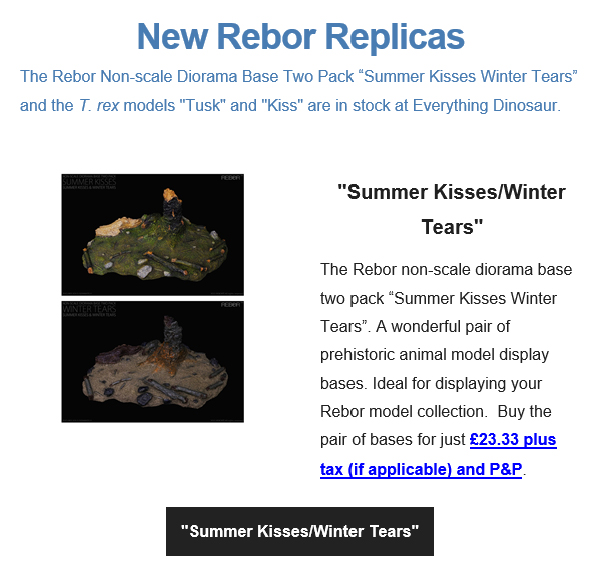
The new Rebor non-scale, diorama display bases “Summer Kisses and “Winter Tears” provide the headlines for our latest customer communication.
The Rebor “Summer Kisses” and “Winter Tears” display bases feature in Everything Dinosaur’s September newsletter. Picture credit: Everything Dinosaur.
“Summer Kisses” and “Winter Tears” are the first, bespoke diorama bases to be introduced into Rebor’s extensive model range. They contain amazing detail and the tree stump featured on the bases provides extra support and stability for Rebor replicas. To read about these exciting new additions: Looking at “Winter Tears” and “Summer Kisses”.
Please note, the outer packaging for these figures has been damaged in transit to our warehouse. Whilst we have opened, inspected and checked all the display bases, unfortunately the outer packaging for the Rebor Non-scale Diorama bases is below the standard one would normally expect.
Rebor T. rex Models “Kiss” and “Tusk”
Also prominent in Everything Dinosaur’s customer newsletter are the two new Rebor Tyrannosaurus rex models “Kiss” and “Tusk”. The “Kiss” T. rex figure has been given lips, whilst “Tusk” reflects a more conventional view with T. rex being lipless and having an overbite.
Both newly introduced theropod replicas have proved to be extremely popular with model collectors.
The two new for 2022 Rebor Tyrannosaurus rex models feature in Everything Dinosaur’s September customer newsletter. The Rebor “Tusk” a dinosaur model without lips and an overbite is left, whilst the lipped Rebor “Kiss is “right”. Picture credit: Everything Dinosaur.
Rebor Titanoboa Museum Class Maquettes
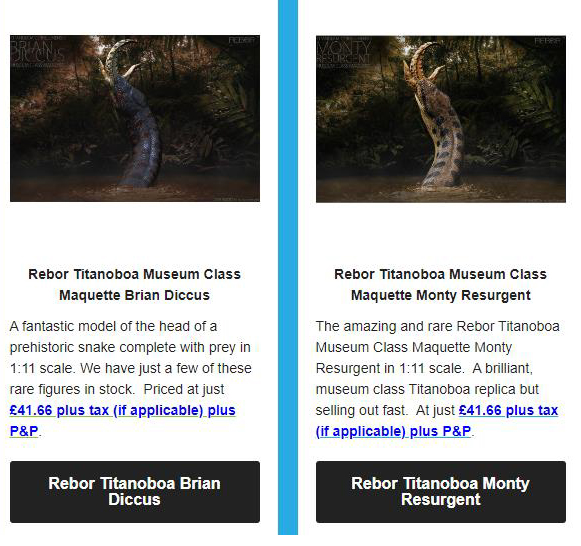
Customers who have subscribed to Everything Dinosaur’s free newsletter have also been given an update on the availability of the two special-edition Rebor Titanoboa maquettes “Brian Diccus” and “Monty Resurgent”. These 1:11 scale replicas were originally introduced in 2021 but are now becoming increasingly rare and difficult to obtain. Fortunately, for model collectors Everything Dinosaur does still have these figures in stock.
The two, special-edition Rebor Titanoboa Museum Class maquettes feature in the latest Everything Dinosaur customer newsletter. Picture credit: Everything Dinosaur.
CollectA Deluxe Prehistoric World Figures
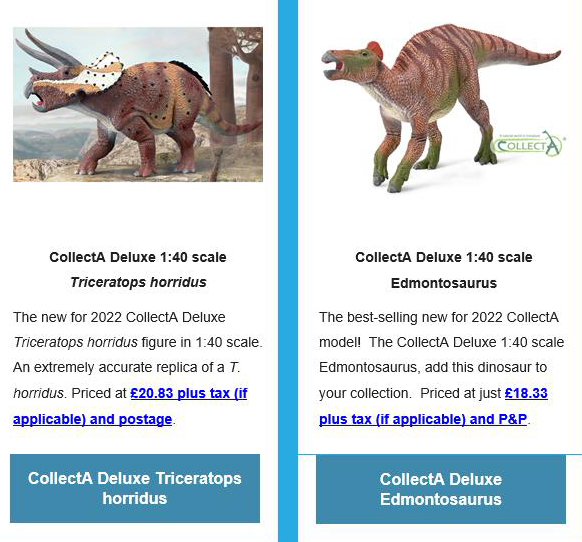
The latest edition of the Everything Dinosaur customer newsletter also features the recently arrived CollectA Deluxe Triceratops horridus model and highlights the best-selling CollectA Deluxe Edmontosaurus. These ornithischian models demonstrate the quality of workmanship associated with the CollectA ranges.
The Everything Dinosaur September newsletter features the recently arrived CollectA Deluxe Triceratops horridus and the best-selling CollectA Deluxe Edmontosaurus. Picture credit: Everything Dinosaur.
A spokesperson from Everything Dinosaur explained that the company sends out informative and helpful product updates from time to time and recommended that model collectors subscribe.
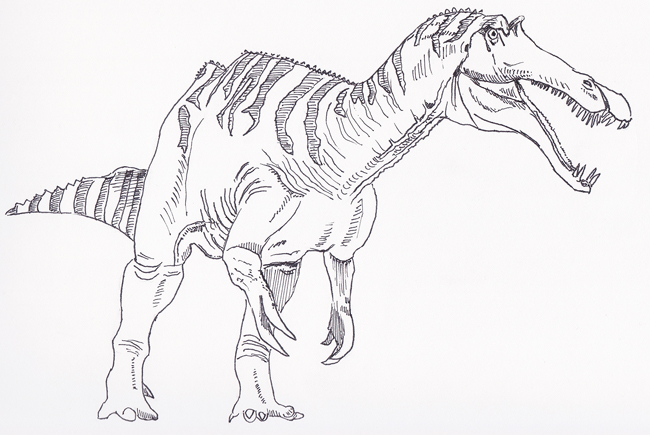
Everything Dinosaur has commissioned a Sinopliosaurus drawing as they prepare for the arrival of the PNSO Sinopliosaurus dinosaur model later in the autumn. The Sinopliosaurus illustration will be used in a free fact sheet that team members intend to send out with product sales.
Everything Dinosaur’s commissioned Sinopliosaurus illustration. This drawing will feature on the Sinopliosaurus fact sheet that the company is producing. Picture credit: Everything Dinosaur
Resolving Taxonomy and Size Issues
It is our intention to produce a scale drawing of this putative spinosaurid. This in itself is quite a challenge as the fossils ascribed to this theropod have had a long and complicated taxonomic history. In addition, the size of this Chinese member of the Spinosauridae remains unknown, such is the fragmentary nature of the fossil material. If Sinopliosaurus (S. fusuiensis) is a synonym for Siamosaurus, the first reported and formally scientifically described spinosaurid from Asia* then size estimates would range between five and in excess of nine metres in length.
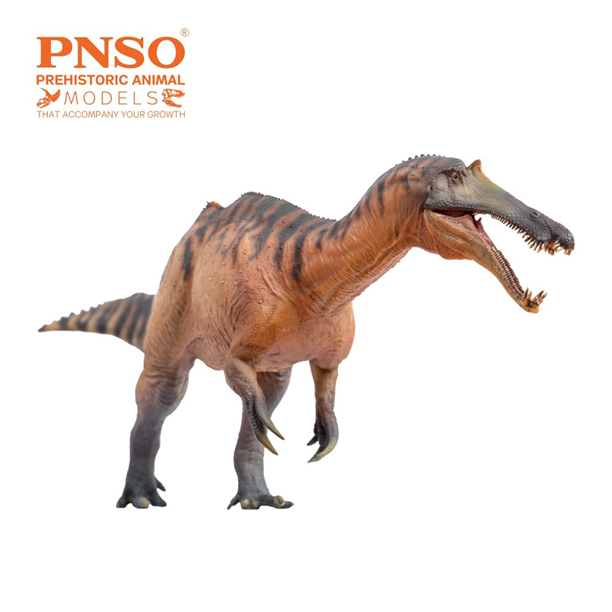
PNSO are adding a second member of the Spinosauridae family to their mid-size model range. Joining Essien the Spinosaurus is Chongzuo the Sinopliosaurus. This figure is due to be in stock at Everything Dinosaur in the late autumn (2022). Team members are researching and writing a fact sheet for this theropod dinosaur.
Siamosaurus suteethorni was named and described in 1986 (Éric Buffetaut and Rucha Ingavat), the absence of more substantial and complete fossil material, especially skull material has made estimating the potential size of these Early Cretaceous theropod dinosaurs extremely difficult.
Sinopliosaurus Drawing
A spokesperson from Everything Dinosaur commented:
“We congratulate PNSO for adding a replica of such an enigmatic Chinese fossil specimen to their Age of Dinosaurs mid-size model range. Whilst we welcome the introduction of some of the less well-known theropods, the addition of the Sinopliosaurus has given us a headache when it comes to researching and producing the free fact sheet on this dinosaur. However, we are confident that we will be able to rise to the challenge and anyway, we could always consult our customers and get their input on this matter.”
The PNSO Chongzuo the Sinopliosaurus is expected in stock at Everything Dinosaur later in the autumn, perhaps early to mid-November (2022).
To view the range of PNSO prehistoric animal models and figures in stock at Everything Dinosaur: PNSO Prehistoric Animal Figures.
We received an email earlier this week with an enquiry about the term allometric growth which had been found in a scientific paper the emailer had been reading. Our emailer wrote to ask what did this term mean?
Allometric growth is a term used to describe the growth of an organism whereby different parts develop at different rates. The appearance of the organism will change as it grows and matures.
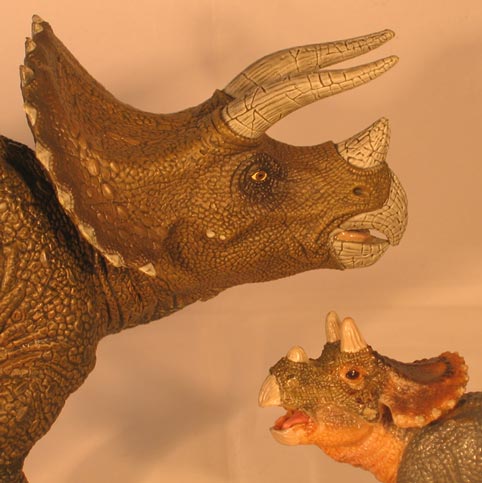
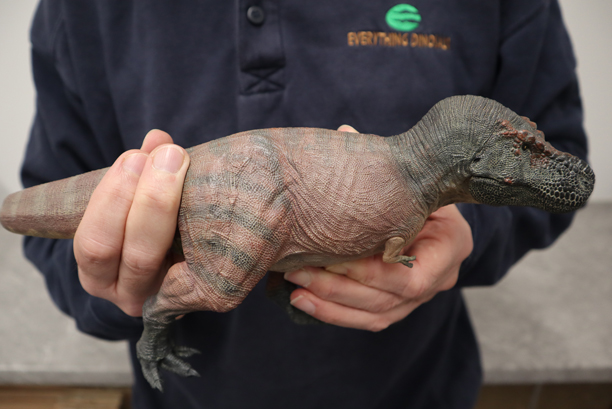
The Papo baby Triceratops figure next to the adult Papo Triceratops. Picture credit: Everything Dinosaur.
Triceratops Allometric Growth
In the picture (above) a model of a juvenile Triceratops is compared with a model of a fully-grown, mature Triceratops. In the juvenile the head is proportionately larger and the skull frill and horns are very different in their morphology compared to the adult. This is an example of allometric growth. Allometry is the study of body size relative to body shape, it is often partnered in scientific papers with ontogeny which is the term used to describe how organisms develop and grow.
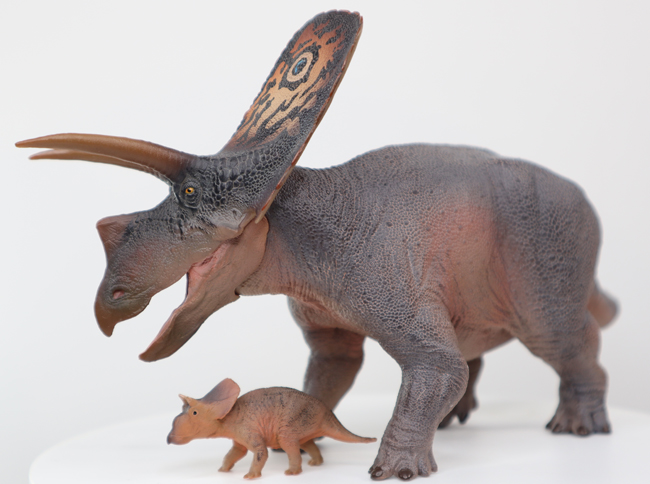
The Chinese model-making company PNSO have recently introduced some replicas that demonstrate how dinosaurs changed as they grew and matured. For example, the company recently introduced (2022), a 1:35 scale replica of an adult chasmosaurine ceratopsian (Torosaurus latus) and a juvenile. The models, entitled Aubrey and Dabei were supplied with posters and a full-colour, illustrated booklet.
The 1:35 scale PNSO Torosaurus models (Aubrey and Dabei). The adult Torosaurus figure has an articulated lower jaw. Aubrey is the name of the adult Torosaurus in this model set, it towers over the juvenile (Dabei). The pair of models illustrate the biological concept of allometric growth – how organisms often change shape as they develop as different parts of the animal grow at different rates. Picture credit: Everything Dinosaur.
To view the range of PNSO models and figures available from Everything Dinosaur: PNSO Age of Dinosaurs.
Back in 2019, Everything Dinosaur received an almost identical enquiry about how to define allometric growth. At the time, we wrote a short blog post highlighting our explanation.
The University of Manchester has launched a campaign to bring back “April” the Tenontosaurus. Manchester Museum is asking for public support to install a stunning Tenontosaurus fossilised skeleton, one of the most complete specimens of this Early Cretaceous ornithopod ever found.
The Museum is hoping to raise £10,000 GBP ($11,280.00 USD), to enable the Tenontosaurus to be restored and installed in the Dinosaurs and Fossils gallery as an exhibit with the 110-million-year-old fossil bones in their correct anatomical positions.
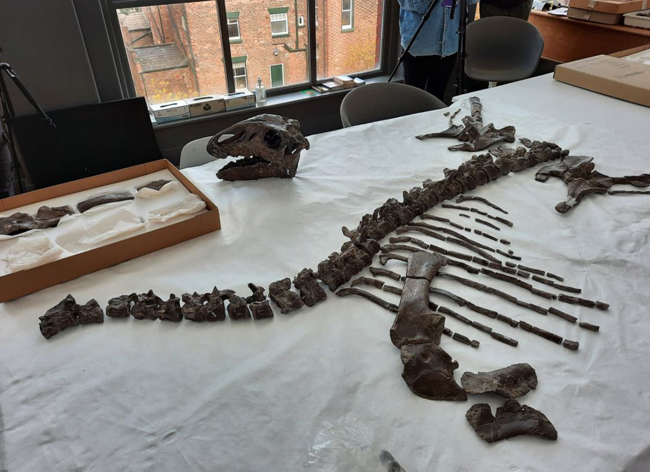
The fossilised remains of “April” the Tenontosaurus partially laid out in anatomical position. Picture credit: The University of Manchester.
The Tenontosaurus specimen (MANCH LL.12275) was purchased by the University of Manchester in 1999. It has been the subject of a recent scientific paper which confirmed the presence of gastroliths (stomach stones), the first evidence of gastroliths to be identified in a derived member of the Ornithopoda.
The stunning fossil specimen comes from Montana, and it is affectionately named “April” after the wife of Barry James who originally prepared the fossil for display. When first put on show to the public it was portrayed in an upright position, like a super-sized kangaroo with its tail resting on the ground. However, research from Earth Sciences students from the University of Manchester has shed light on how the skeleton would have walked and posed in life.
The original mount of “April” the Tenontosaurus. The skeleton was dismantled and put into storage when a replica of a T. rex skeleton made its debut at the museum. Picture credit: The University of Manchester.
Thousands of Hours of Restoration Work is Required
The Curator of the Earth Science Collections at the Manchester Museum David Gelsthorpe outlined the aims of the fund-raising effort and explained some of the problems that this restoration project will pose.
He commented:
“April is a Tenontosaurus purchased by Manchester Museum in 1999 and was previously displayed standing upright. Over the past few years, we have been working with a team of Earth Sciences students from the University of Manchester to carefully study April’s bones and find out more about her. Using their palaeontology skills and computer modelling, their research has helped us to better understand how she would have moved on all fours. As well as changing the way the skeleton stands, over 10,000 hours of careful conservation work is required to restore its bones.”
The Museum is requesting donations to help bring “April” back to her best and to permit her to be once again an integral part of the Museum’s Dinosaurs and Fossils Gallery.
Tenontosaurus skull in left lateral view. The stunning and beautifully restored “April” the Tenontosaurus skull. Picture credit: The University of Manchester.
A New Dinosaur Display
If the fund raising succeeds than the Tenontosaurus specimen will form the focal point of a brand-new exhibition devoted entirely to the Dinosauria, planned for April 2023. Visitors will have the opportunity to view prehistoric giants, such as “Stan” the Tyrannosaurus rex cast and to learn about British dinosaur fossil discoveries. The demise of the Dinosauria and many other types of animals and plants as a result of a mass extinction event, some sixty-six million years ago, will be linked to today’s problems of climate change and the current rate of extinction.
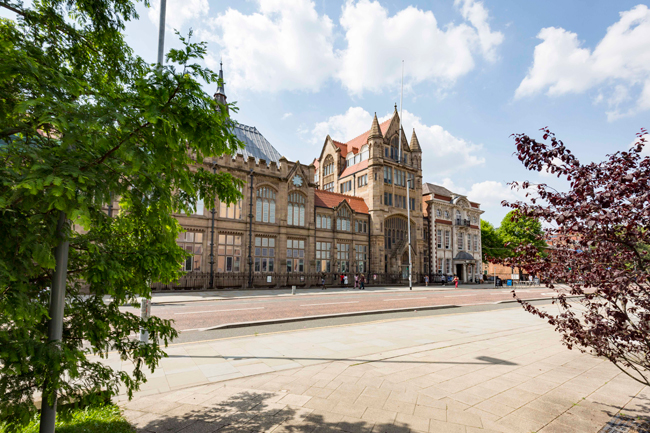
The front entrance of the Manchester Museum, a neo-Gothic building that houses approximately 4.5 million artefacts from the natural sciences and human history. A new dinosaur exhibit is scheduled to open in February 2023. Picture credit: The University of Manchester.
Plans for the new dinosaur exhibit are part of a larger scheme of improvements planned for Manchester Museum which has been entitled “Hello Future”.
To play your part and contribute to “April’s” restoration, please visit: Support Manchester Museum. Every donation will go towards helping to put “April” back on display.
Everything Dinosaur acknowledges the assistance of a media release from Manchester Museum in the compilation of this article.
The Rebor Summer Kisses Winter Tears diorama bases are in stock at Everything Dinosaur. Two fantastic prehistoric animal display bases. These are the first, bespoke diorama bases to have been made by Rebor and as their names suggest each base depicts the same landscape but in a different season. The Winter Tears base depicts an arid environment typical of the dry season, whilst Summer Kisses is verdant and lush, illustrating a landscape after recent rains.
The Rebor diorama display bases Summer Kisses (top) and Winter Tears (bottom). Picture credit: Everything Dinosaur.
Suitable for Lots of Different Dinosaurs
The two beautifully painted diorama display bases can be used with a huge range of dinosaur and prehistoric animal figures. For example, team members posed a Rebor Vanilla Ice tyrannosaur figure on a base. This theropod model, one that was introduced by Rebor in 2018, looks very much at home on both Winter Tears and Summer Kisses.
The Rebor tyrannosaur figure Vanilla Ice Mountain on the “Winter Tears” display base. Picture credit: Everything Dinosaur.
Lots of Details on the Bases
Each base has lots of detail, including stones and plenty of small sticks. A large tree stump towards the rear of each base provides additional support for any prehistoric figure that is to be displayed. Both Summer Kisses and Winter Tears are made from durable polystone and there is plenty of space amongst the debris to position a prehistoric animal figure securely.
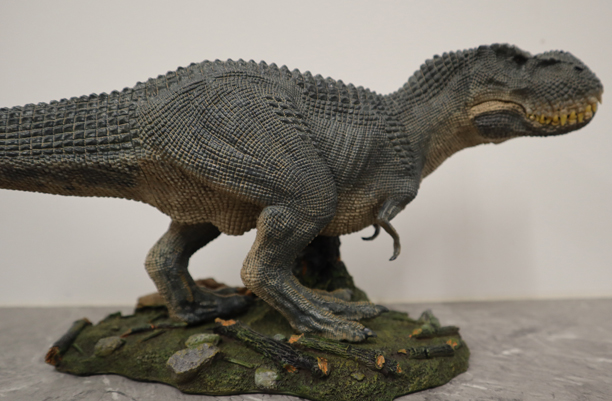
A close-up view of the Rebor tyrannosaur model Vanilla Ice Mountain on the “Summer Kisses” display base. Picture credit: Everything Dinosaur.
A spokesperson from Everything Dinosaur commented:
“We congratulate the manufacturer for producing such detailed display bases. The Rebor Summer Kisses Winter Tears diorama bases represent the same piece of landscape, but in different seasons – a dry season and a wet season.”
Note: The outer packaging for these figures has been damaged in transit to our warehouse. Whilst we have opened, inspected and checked all the display bases, unfortunately the outer packaging for the Rebor Non-scale Diorama bases is below the standard one would normally expect.
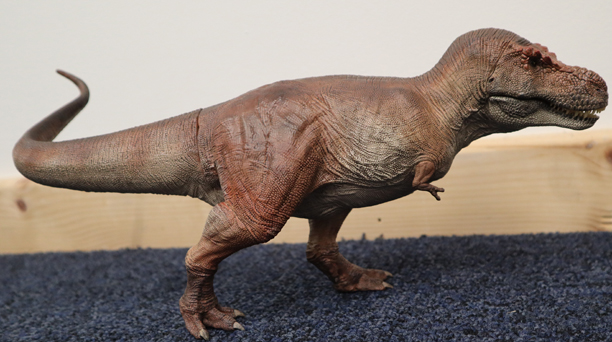
New for 2022 Rebor Tyrannosaurus rex figures in stock at Everything Dinosaur. The Rebor T. rex Kiss Mountain and the Rebor T. rex Tusk King T. rex Requiem figures have arrived at Everything Dinosaur’s warehouse. The “Kiss” figure has been given lips, whilst the “Tusk” replica has a more typical overbite as seen in earlier Rebor tyrannosaurs.
The Rebor Kiss T. rex figure (Mountain), this tyrannosaur model has been given lips. Picture credit: Everything Dinosaur.
The Rebor T. rex Kiss Mountain Model
The Rebor T. rex Kiss Mountain model measures a little over 40 cm in length and that impressive head stands around 14 cm off the ground. Like its counterpart figure T. rex Tusk, this figure has a declared scale of 1:35.
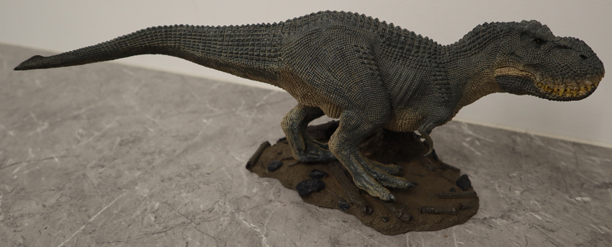
A dinosaur model with lips. The new for 2022 Rebor T. rex Kiss Mountain model in 1:35 scale. A wonderful model of a Tyrannosaurus rex. Picture credit: Everything Dinosaur.
Rebor T. rex Tusk King T. rex Requiem Model
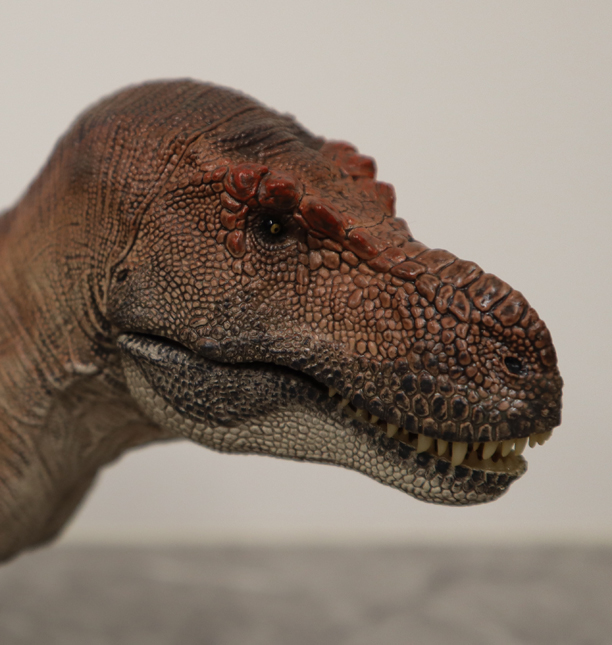
The Rebor T. rex figure called Tusk (T. rex Tusk King T. rex Requiem) has a colouration superficially similar to the original Rebor King T. rex, which was the second tyrannosauroid model to be made by Rebor. It has an articulated jaw and moveable arms, but depicts this iconic tyrannosaur without lips. Tusk is the same size and scale as the Kiss figure.
Such is the stability of these excellent theropods, that they were able to be placed on the office carpet without the need of the clear, plastic support that is supplied with these figures.
The Rebor T. rex Tusk King T. rex Requiem model is supplied with a transparent plastic support base, but our models appear quite stable even standing on our office carpet without the need for the support stand. Picture credit: Everything Dinosaur.
Both models have been beautifully painted and show some stunning details. A spokesperson from Everything Dinosaur commented on the impressive lacrimal crests of these models, particularly the crimson-coloured crests of Tusk.
A close-up view of the detail on the head of the Rebor T. rex Tusk dinosaur model. The Rebor figure has most impressive lacrimal crests. Picture credit: Everything Dinosaur.
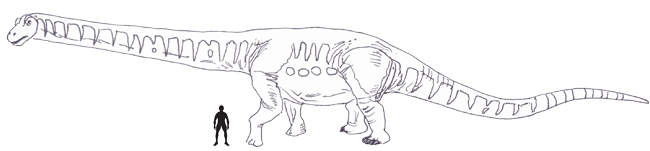
Everything Dinosaur has commissioned a Patagotitan scale drawing as the company prepares for the arrive of a Patagotitan model from Safari Ltd. The Wild Safari Prehistoric World Patagotitan replica is due to arrive in stock at Everything Dinosaur in just a few days. This titanosaur figure is a new for 2022 Safari Ltd dinosaur model.
A Scale Drawing of the Huge Titanosaur Patagotitan mayorum
A scale drawing of the giant titanosaur Patagotitan mayorum commissioned by Everything Dinosaur. This huge dinosaur was estimated to have measured around 35 metres when its fossil bones were initially examined. When Patagotitan was formally named and scientifically described its body size and weight was reduced slightly. However, a reconstructed, life-size skeleton was built measuring 37.2 metres in length. Picture credit: Everything Dinosaur.
Wild Safari Prehistoric World Patagotitan Model
Fortunately for Everything Dinosaur’s packing team, the Wild Safari Prehistoric World Patagotitan model is not a life-size replica. At more than thirty metres in length, this dinosaur could just about fit inside our warehouse, but it would be a tight squeeze.
The model is quite sizeable it measures a fraction over 38 cm in length, which if you consider the replica as a scale model, it would have a scale ratio of around 1:100.
Giant Dinosaur Fossils
Giant fossils of at least seven individual titanosaurs were discovered in southern Argentina in 2014. After an extensive study, this dinosaur was finally named in 2017. Perhaps one of the largest land animals to have ever lived, the binomial scientific name is Patagotitan mayorum. The name translates as “the Mayo family’s Patagonian titan”, as the fossils were found on the Mayo ranch in Patagonia.
The new for 2022 Wild Safari Prehistoric World Patagotitan model. This titanosaur model measures over 38 cm long which effectively makes this figure a 1:100 scale model.
A spokesperson from Everything Dinosaur confirmed that the new for 2022 Patagotitan model should be in stock at Everything Dinosaur in a few days.
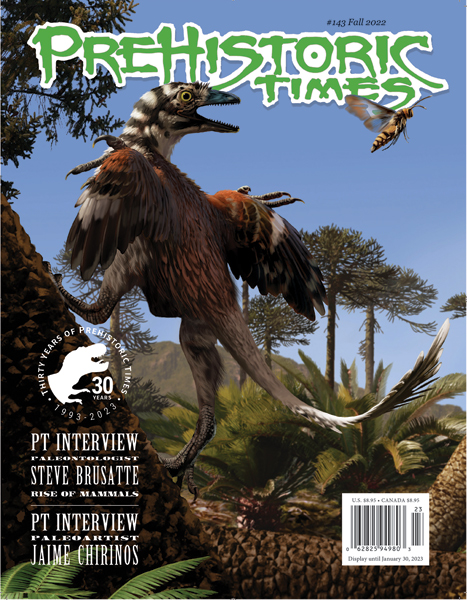
The editor of “Prehistoric Times” magazine sent Everything Dinosaur a preview of the front cover of the next edition (issue 143). The stunning illustration is by Jaime Chirinos, a celebrated palaeoartist who has provided artwork for numerous media releases associated with scientific papers.
The front cover of “Prehistoric Times” issue 143 (fall/autumn) 2022. The front cover illustration depicts an Auriornis – a controversial Chinese, crow-sized theropod. The superb illustration is by Jaime Chirinos.
Auriornis xui
The small, feathered animal attempting to catch an insect on the cover of the magazine is the controversial Auriornis (A. xui). This theropod measured around fifty centimetres in length and it was formally named and scientifically described in 2013 (Godefroit et al).
The fossil material was acquired from a local dealer who claimed that the specimen came from exposures of the Tiaojishan Formation. This geological formation has been dated to the Late Jurassic (Oxfordian faunal stage) and it was proposed that Auriornis lived approximately 160 million years ago. This would make Auriornis one of the earliest avialans known to science, pre-dating the famous Archaeopteryx by around 10 million years.
Unfortunately, the provenance of the fossil material is difficult to prove. It has been suggested that this fossil is much younger than previously thought. The holotype may have come from exposures of the Yixian Formation which would suggest that this little hunter lived in the Early Cretaceous around 130 to 112 million years ago.
Perhaps issue 143 of “Prehistoric Times” magazine or a future edition will examine in detail the evidence relating to the dating of the Auriornis fossil material.
“Prehistoric Times” Magazine
We do know that the next edition of this popular quarterly magazine will include an in-depth interview with Steve Brusatte. Following on from Steve’s highly acclaimed book “The Rise and Fall of the Dinosaurs”, he has produced a follow-up looking at the success of the Mammalia. The new book is entitled “The Rise and Reign of the Mammals” and in the latest edition of the magazine Steve talks about what inspired him to produce this new book and his work as a vertebrate palaeontologist.
Researchers have discovered a 380-million-year-old fossilised heart, along with other internal organs of prehistoric fish. This exciting discovery is not only helping palaeontologists to understand the internal organs of placoderms, these fossils are also providing a fresh perspective on our own evolution.
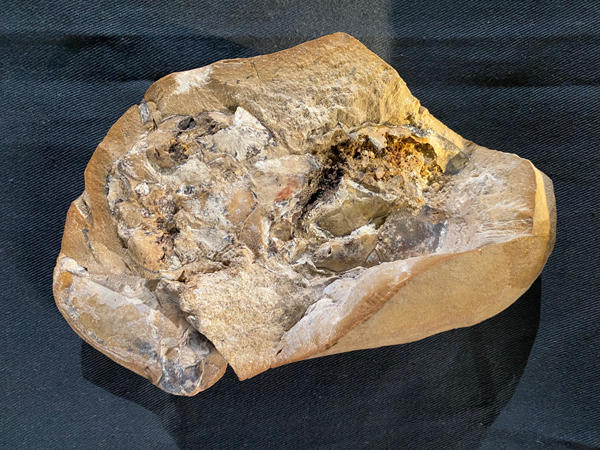
The Gogo fish fossil where the 380-million-year-old, 3-D preserved heart was discovered by the research team. Picture credit: Curtin University.
Fossilised Internal Organs in Ancient Armoured, Jawed Fish
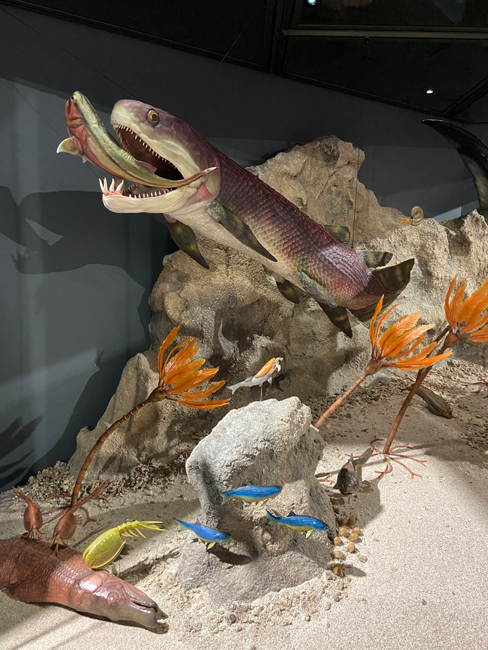
The remarkably well-preserved fossils representing the Devonian placoderm Compagopiscis, come from the famous Gogo Formation, in the Kimberley region of Western Australia. The Gogo Lagerstätte preserves the fauna that once thrived on an ancient, shallow water reef. The fossils are thought to be around 380 million years old (Frasnian faunal stage of the Late Devonian).
Gogo fish diorama at the West Australia Museum Boola Bardip depicting the typical fauna associated with the Gogo Lagerstätte. Typical inhabitants of a tropical reef that existed approximately 380 million years ago. Picture credit: Curtin University.
Soft Tissues Including Liver and Intestines but No Evidence of Lungs
The international research team led by scientists from Curtin University and the Western Australia Museum have published their findings in the academic journal “Science”. They have identified a number of internal organs preserved in three-dimensions including the liver and intestines. Additionally, the fossils show that the lungs are absent, refuting the hypothesis that lungs are ancestral in jawed vertebrates.
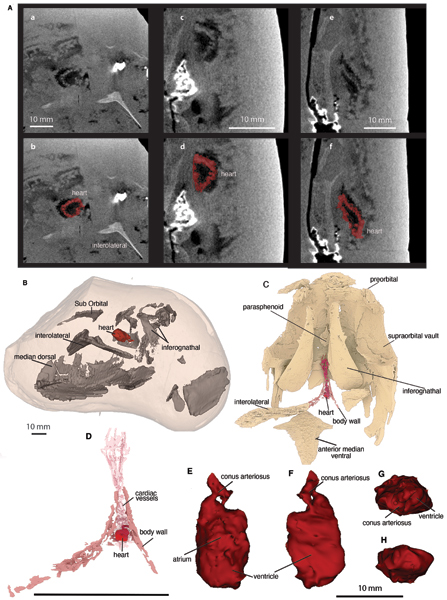
CT scans and interpretive models showing the heart of the placoderm Compagopiscis. Picture credit: Curtin University.
Details Revealed by Computerised Tomography
In collaboration with scientists at the Australian Nuclear Science and Technology Organisation in Sydney and the European Synchrotron Radiation Facility in Grenoble, France, researchers used neutron beams and synchrotron x-rays to scan the specimens, still embedded in limestone concretions. They constructed three-dimensional, computer-generated images of the soft tissues inside them based on the different densities of minerals deposited by the bacteria and the surrounding rock matrix.
Lead researcher and John Curtin Distinguished Professor Kate Trinajstic (Curtin’s School of Molecular and Life Sciences and the Western Australian Museum), commented that to find three-dimensionally preserved tissues in Devonian fossils was an extremely rare event.
Professor Trinajstic explained:
“As a palaeontologist who has studied fossils for more than 20 years, I was truly amazed to find a 3-D and beautifully preserved heart in a 380-million-year-old ancestor. Evolution is often thought of as a series of small steps, but these ancient fossils suggest there was a larger leap between jawless and jawed vertebrates. These fish literally have their hearts in their mouths and under their gills – just like sharks today.”
The Complex Heart of an Arthrodiran
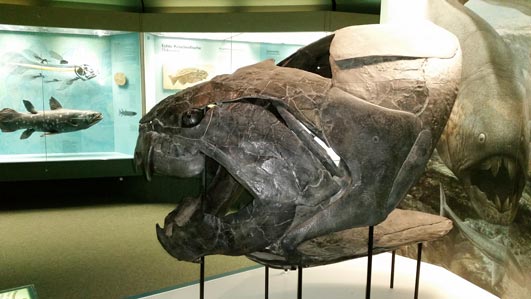
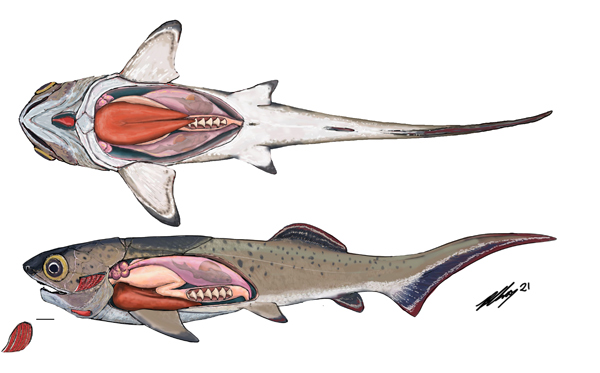
This is the first time a 3-D representation of the heart of a member of the Arthrodira has been found. The Arthrodira are an extinct Order of jawed, armoured fish within the Class Placodermi. They thrived in the Devonian and some arthrodirans evolved into apex predators such as the huge Dunkleosteus.
The spectacular Dunkleosteus exhibit. A giant apex predator of the Devonian. Picture credit: Everything Dinosaur.
The surprising complex heart is s-shaped and consists of two chambers with the smaller chamber sitting on top. Professor Trinajstic stated that these features were advanced in such early vertebrates, offering scientists a unique perspective on how the head and neck region began to change to accommodate jaws, a critical stage in the evolution of animals with backbones.
Reconstruction of arthrodire internal anatomy. Picture credit: Curtin University.
Learning About the Anatomy of a Primitive Jawed Fish
The discovery and subsequent detailed analysis of these mineralised soft tissues, in combination with earlier studies looking at muscle structure, placoderm embryos and evidence of viviparity makes the Gogo Lagerstätte an exceptionally important fossil resource as researchers strive to improve their knowledge of early vertebrates.
Professor Trinajstic added:
“For the first time, we can see all the organs together in a primitive jawed fish, and we were especially surprised to learn that they were not so different from us. However, there was one critical difference – the liver was large and enabled the fish to remain buoyant, just like sharks today. Some of today’s bony fish such as lungfish and bichirs have lungs that evolved from swim bladders, but it was significant that we found no evidence of lungs in any of the extinct armoured fishes we examined, which suggests that they evolved independently in the bony fishes at a later date.”
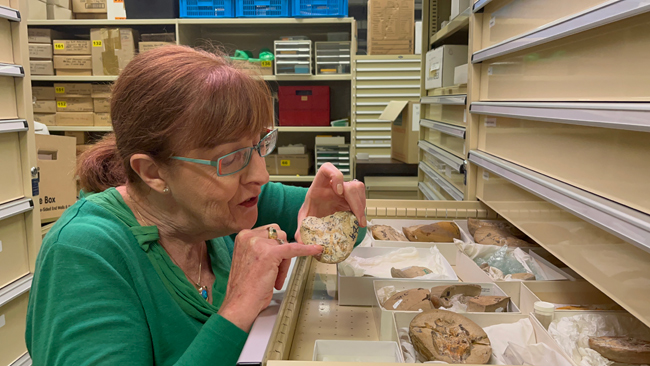
Professor Kate Trinajstic inspects the ancient fossils at the Western Australia Museum Boola Bardip. Picture credit: Curtin University.
The Stuff of Palaeontologists’ Dreams
Co-author of the scientific paper, Professor John Long (Flinders University, Adelaide, South Australia) commented:
“These new discoveries of soft organs in these ancient fishes are truly the stuff of palaeontologists’ dreams, for without doubt these fossils are the best preserved in the world for this age. They show the value of the Gogo fossils for understanding the big steps in our distant evolution. Gogo has given us world firsts, from the origins of sex to the oldest vertebrate heart, and is now one of the most significant fossil sites in the world. It’s time the site was seriously considered for world heritage status.”
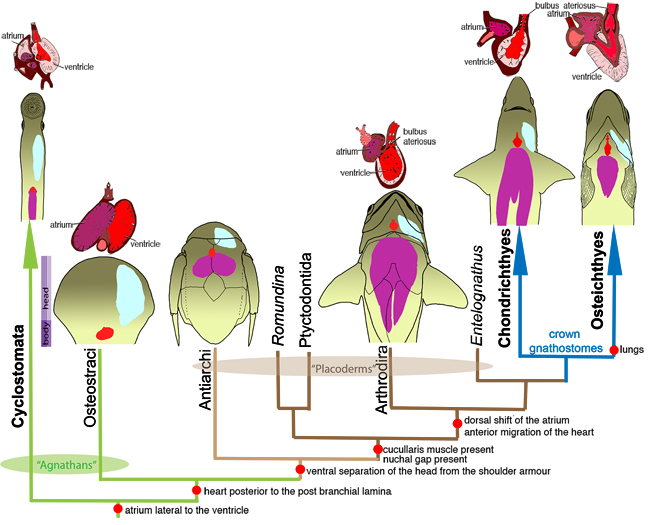
A cladogram depicting the evolution of the heart in early vertebrates. Picture credit: Curtin University.
Co-author of the paper Professor Per Ahlberg (Uppsala University, Sweden) explained that access to state-of-the-art, non-destructive scanning technology enabled scientists to make such exceptional discoveries.
Professor Ahlberg explained:
“What’s really exceptional about the Gogo fishes is that their soft tissues are preserved in three dimensions. Most cases of soft-tissue preservation are found in flattened fossils, where the soft anatomy is little more than a stain on the rock. We are also very fortunate in that modern scanning techniques allow us to study these fragile soft tissues without destroying them. A couple of decades ago, the project would have been impossible.”
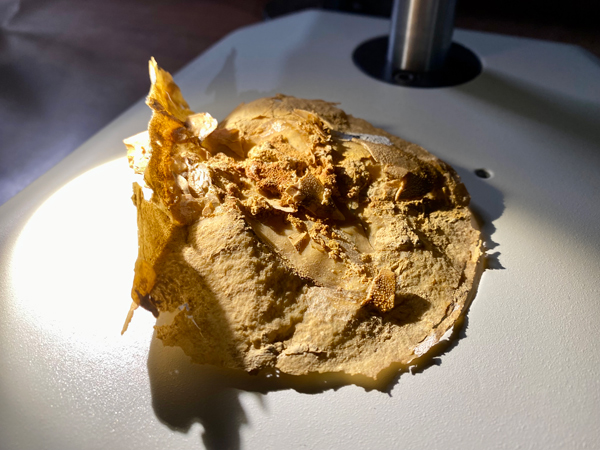
The preserved stomach of a Gogo fish fossil under the microscope. Picture credit: Curtin University.
A Collaborative Effort
The research was truly a collaborative effort not only involving the Australian Nuclear Science and Technology Organisation and the European Synchrotron Radiation Facility, but also scientists from Flinders University, the Western Australian Museum, Uppsala University, South Australia Museum and Monash University’s Australian Regenerative Medicine Institute.
Everything Dinosaur acknowledges the assistance of a media release from Curtin University in the compilation of this article.
The scientific paper: “Exceptional preservation of organs in Devonian placoderms from the Gogo lagerstätte” by Kate Trinajstic, John A. Long, Sophie Sanchez, Catherine A. Boisvert, Daniel Snitting, Paul Tafforeau, Vincent Dupret, Alice M. Clement, Peter D. Currie, Brett Roelofs, Joseph J. Bevitt, Michael S. Y. Lee and Per E. Ahlberg published in the journal Science.