All about dinosaurs, fossils and prehistoric animals by Everything Dinosaur team members.
6 08, 2024

New Diprotodon Scale Drawing

By |2024-08-12T15:44:36+01:00August 6th, 2024|Categories: Everything Dinosaur News and Updates|0 Comments

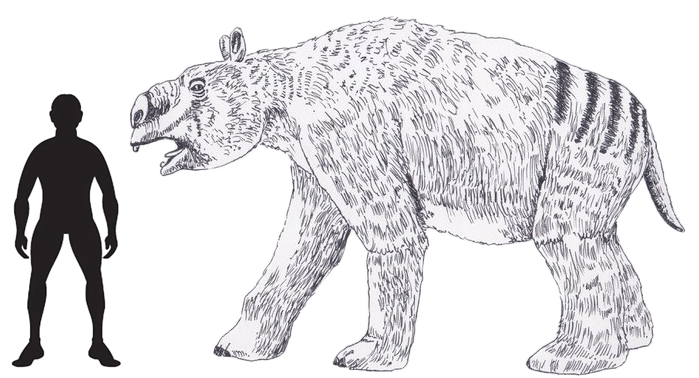
Team members at Everything Dinosaur have produced a Diprotodon scale drawing.  The scale drawing has been prepared for a fact sheet on the largest marsupial known to science.  The fact sheet will be sent out with sales of the new CollectA Deluxe Diprotodon figure.

Diprotodon scale drawing in preparation for the arrival of the CollectA Deluxe Diprotodon model.

Diprotodon was the largest marsupial known. Males may have weighed as much as 3,500 kilograms and stood around 1.8 metres high at the shoulder. Picture credit: Everything Dinosaur.

Picture credit: Everything Dinosaur

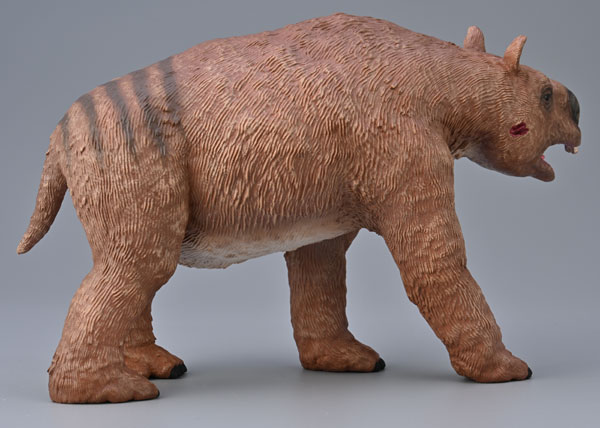
The CollectA Deluxe Diprotodon Model

The CollectA Deluxe Diprotodon model is due to arrive later this week.  Collectors have been eagerly awaiting the arrival of this male Diprotodon figure.  The model measures a fraction under twenty-one centimetres in length.  It is around twelve centimetres tall, and it has a declared scale of 1:20.

To view the CollectA Deluxe range of prehistoric animal figures: CollectA Deluxe Prehistoric Animal Models.

CollectA Deluxe 1:20 scale Diprotodon.

The CollectA Deluxe 1:20 scale Diprotodon model.

The CollectA figure probably represents the type species Diprotodon optatum which was the first Australian fossil mammal to be scientifically described and named (Owen 1838).

Numerous species have been erected, essentially due to the great size differences observed in fossil specimens of adults.  In addition, Diprotodon was the most widespread of the Australian megafauna.  Fossils remains have been found all over Australia and this led to the assumption (probably incorrect), that several different species evolved.  Unlike its probable closest living relative the wombat, Diprotodon was sexually dimorphic.  Males were considerably bigger than females.  It had been assumed that the different sized adult fossils represented separate species.  However, it is now thought that the largest specimens represent male Diprotodon optatum.

Did Diprotodon Live in Extensive Herds or Small Family Groups?

Large numbers of Diprotodon fossils have been found in sediments representing lakebeds and river deposits. At one time, Diprotodon was thought to have been aquatic. However, the fossil accumulations probably represent groups that died together during a severe drought or were drowned when trying to cross a swollen river.

Diprotodon is thought to be the only marsupial that seasonally migrated. These animals probably had to roam extensively in order to find enough food. There is some fossil evidence to indicate that these animals moved around in large herds. These large herds mostly consisted of females. This suggests that Diprotodon was a polygynous species. That is, a male controlled a harem of females. Juvenile males moved around in bachelor groups.

The jaws are extremely powerful. It has been suggested that the males engaged in intraspecific combat, perhaps fighting over mates or social status. The incisors were probably used to deliver deep bites onto the face and body of the opponent.

The CollectA Deluxe Diprotodon figure will be in stock at Everything Dinosaur.

Visit the user friendly Everything Dinosaur website: Prehistoric Animal Models and Toys.

5 08, 2024

Naming the PNSO Figures on the New Image

By |2024-07-16T13:53:46+01:00August 5th, 2024|Categories: Everything Dinosaur News and Updates|0 Comments

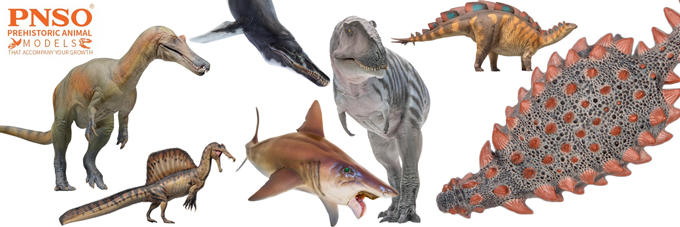
A few days ago, team members created a new image of PNSO figures for use on the Everything Dinosaur website.  This new image was to be used on the homepage as part of a revolving slide presentation.  The presentation would help to highlight the extensive range of dinosaur and prehistoric animal figures stocked by the company.  In addition, link buttons on the images could signpost visitors to specific model ranges and categories.

The new PNSO picture featured seven prehistoric animal models.  In an earlier post, we set a challenge, could you name all the figures?

The new PNSO prehistoric animal slider for the updated Everything Dinosaur website.

The new PNSO prehistoric animal slider for the updated Everything Dinosaur website. In total, seven PNSO prehistoric animal figures are featured. Can you name them all? Picture credit: Everything Dinosaur.

Picture credit: Everything Dinosaur

To view the range of PNSO models available from Everything Dinosaur: PNSO Dinosaur Models.

Naming the PNSO Figures

We are often impressed by the product knowledge of collectors.  When Everything Dinosaur pose questions about dinosaur models, we always get lots of correct answers.  We were most impressed by the PNSO product knowledge demonstrated.

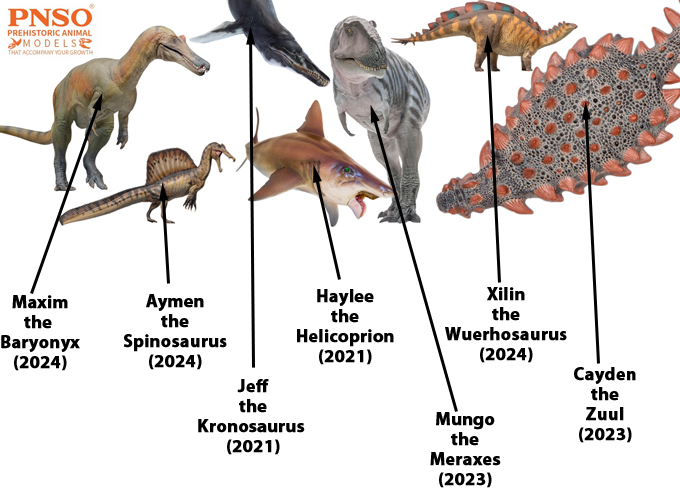
However, for the record here is the information about the PNSO figures included in the image.

Identifying PNSO figures.

A helpful guide from Everything Dinosaur to assist with the identification of PNSO figures. Picture credit: Everything Dinosaur.

Picture credit: Everything Dinosaur

The picture (above) identifies the seven PNSO figures in the image.  Here is the list:

  • Maxim the Baryonyx (introduced late 2024).
  • Aymen the Spinosaurus (introduced early 2024).
  • Jeff the Kronosaurus (introduced 2021).
  • Haylee the Helicoprion (2021).
  • Mungo the Meraxes (2023).
  • Xilin the Wuerhosaurus (introduced late 2024).
  • Cayden the Zuul (introduced 2023).

A spokesperson from Everything Dinosaur commented:

“The PNSO range consists of over one hundred prehistoric animal figures.  The company has built a strong reputation amongst model collectors and dinosaur fans.  We are looking forward to announcing more PNSO figure introductions in the near future.”

The award-winning Everything Dinosaur website: Visit Everything Dinosaur.

4 08, 2024

New “Prehistoric Times” Magazine Reviewed

By |2024-12-08T05:27:54+00:00August 4th, 2024|Categories: Magazine Reviews, Prehistoric Times|2 Comments

Time to review the sesquicentennial* edition of “Prehistoric Times” magazine.  This is a special 150th issue of the quarterly magazine for prehistoric animal enthusiasts and palaeoartists. Sesquicentennial* is the term used to describe a 150th anniversary or its celebration, and there is plenty to celebrate about this latest edition.  For example, readers can marvel at the stunning artwork created by the eminent Norwegian wildlife artist Esther Van Hulsen.  The artwork was commissioned by the Nevada State Park.  A series of information boards were being constructed and the artist was selected to provide illustrations of some of the amazing creatures that roamed this region during the last Ice Age.  Dire wolves, Columbian mammoths, prehistoric horses, cave lions and the American camel are featured.

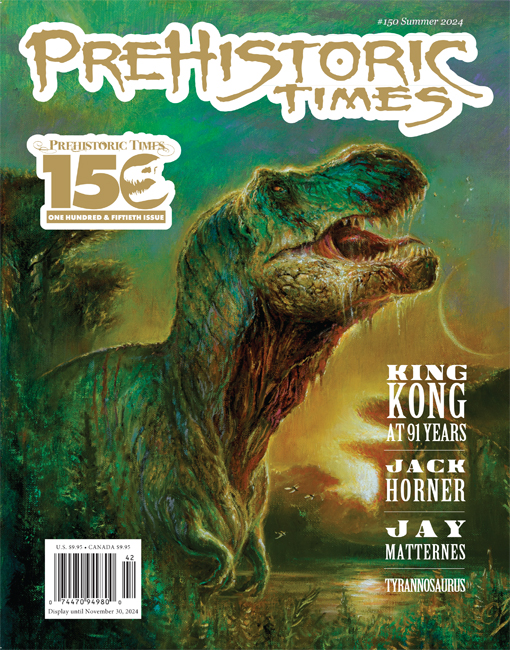
The front cover artwork was provided by renowned science fiction artist Bob Eggleton.  T. rex features prominently in this issue, and Bob’s composition depicts a battle-hardened predator.

"Prehistoric Times" Issue 150 front cover.

The front cover of issue 150 (summer 2024) of “Prehistoric Times” magazine. The Tyrannosaurus rex artwork was created by Bob Eggleton.  Inside the magazine, there is a special feature on this iconic dinosaur.  An Everything Dinosaur team member gets a mention too.  Picture credit: Mike Fredericks.

Picture credit: Mike Fredericks

“Prehistoric Times” Featuring Mosasaurus and Tyrannosaurus rex

Our thanks to Phil Hore for his excellent article on the “beast of Maastricht” – Mosasaurus.  It is extremely informative, and we congratulate the author for squeezing in references to Napoleon Bonaparte and the Rosetta stone.  There are some wonderful Mosasaurus illustrations.  Wade Cameron chose to illustrate an articulated skeleton.  In contrast, Fabio Pastori contributed a mosasaur scavenging a titanosaur scene.  Pedro Salas took a more reflective approach with a subtle illustration of a Mosasaurus just breaking the water surface.  Our congratulations to all the artists for their work.

The magazine features an in-depth interview with the famous American palaeontologist Jack Horner.  He reminisces on his life-long fascination with the Dinosauria. Furthermore, he sheds light on why he controversially argued that T. rex was a scavenger.  In his long and distinguished career, Jack Horner has made a huge contribution to vertebrate palaeontology.  The article provides an insight into his thinking when he proposed that the “King of the Tyrant Lizards” was an obligate scavenger.

Tracy Lee Ford continues the Tyrannosaurus rex theme with an excellent article that looks at the challenges of drawing tyrannosaurs when the skull morphology of T. rex is so varied.  Award-winning model maker Sean Kotz demonstrates how to create a replica of a tyrannosaur head. Furthermore, we learn about the first references of feathered dinosaurs in popular culture in an intriguing article penned by Gray Stanback.

Compiling Thoughts

Phil Hore wanted to collate thoughts and impressions about T. rex.  The article features contributions by Phil Currie, Kenneth Carpenter and Jim Kirkland.  Polymath James Gurney, perhaps, most famous for the “Dinotopia” series comments as does renowned palaeoartist Luis Rey.  Yours truly was asked to provide input as well.  We are honoured to have Everything Dinosaur featured in this special edition.

Commenting in "Prehistoric Times".

Mike from Everything Dinosaur recalling fond memories of encounters with T. rex fossils and models. Picture credit: Everything Dinosaur.

Picture credit: Everything Dinosaur

There is some amazing T. rex artwork too. A skeletal drawing by John Sibbick is included.   Mark Hallett provided an illustration of a trio of tyrannosaurs complete with perching birds, whilst Mark Wheatley submitted illustrations of somewhat foolhardy T. rex hunting!  Our congratulations to Mark Massion, Tim Bollinger, Dale Novak and John F. Davies and also to Samuel Pickens for his illustration of a T. rex quenching its thirst.

Look out for an imaginative and topical article written by Robert Telleria.  Robert envisions a prehistoric Olympics, complete with larger-than-life competitors and intense competition.  Telleria’s talents for crafting an intriguing and compelling narrative are on full display in this piece.

Famous Apes and Famous Artists

John M. Navroth had provided a most informative piece documenting the film “The Lost World” in an earlier edition of the magazine.  He repeats the feat in this issue, this time focusing on the “King Kong” movie premiered in 1933.  He provides a fascinating insight into one of the most influential monster movies of all time.

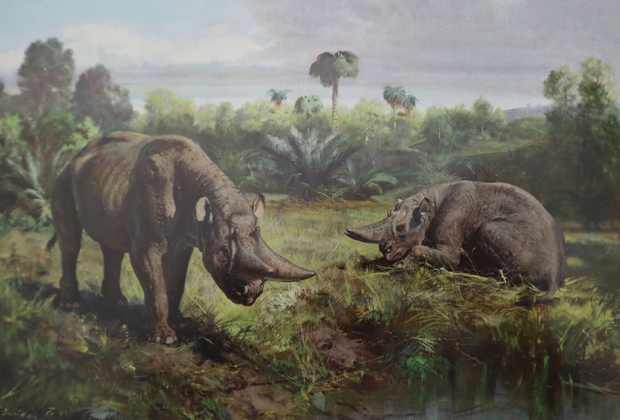
John Lavas continues to document the contribution of the highly influential Czech artist Zdeněk Burian.  In this edition, Burian’s illustrations of ancient horned mammals are discussed.  This excellent article contains some beautiful examples of Burian’s work.  Giant beasts such as Brontotheres, Uintatherium and Arsinoitherium all feature.

Zdeněk Burian's reconstruction of Arsinoitherium for "Prehistoric Times" magazine.

Zdeněk Burian’s reconstruction of Arsinoitherium which appeared in Josef Augusta’s “The Age of Monsters”. The artwork is featured in an article outlining how the renowned Czech artist depicted ancient horned mammals.

Picture credit: Zdeněk Burian

Randy Knol chips in with updates on recently introduced prehistoric animal models whilst Pat Schaefer highlights MPC plastic dinosaur figures from the late 1950s.  Editor Mike Fredericks reviews new books and finds time in his busy schedule to interview author Richard Milner and artist Jay Matternes on their new collaboration.

With its captivating articles, stunning illustrations, and wealth of knowledge about models and model collecting, there is certainly plenty to celebrate when it comes to the sesquicentennial edition of “Prehistoric Times”.

Visit the magazine’s website: “Prehistoric Times”.

3 08, 2024

New Eofauna Tyrannosaurus rex Figure Reviewed

By |2024-08-02T10:50:54+01:00August 3rd, 2024|Categories: Eofauna Scientific Research Models|0 Comments

Dinosaur fan and model collector William sent to Everything Dinosaur a model review.  The review focused on the new for 2024 Eofauna Tyrannosaurus rex figure.  We created a short blog post summarising the reviewer’s comments.  This dinosaur model is based on the T. rex specimen housed at the Field Museum in Chicago.  The specimen is nicknamed “Sue” after Sue Hendrickson, who discovered the dinosaur in 1990 during a commercial excavation trip in South Dakota.

You can read William’s review of the Eofauna T. rex model here: Eofauna “Sue” Model is Reviewed.

This tyrannosaur model is supplied with a display base.  In addition, the figure has an articulated jaw.  William congratulated the design team. He stated that in his opinion, this was the most accurate Tyrannosaurus rex model to date.

Eofauna Tyrannosaurus rex model.

The Eofauna Tyrannosaurus rex dinosaur model photographed in the studio. Dinosaur model fan and collector William reviewed this figure.  Picture credit: Everything Dinosaur.

Picture credit: Everything Dinosaur

To view the Eofauna Scientific Research range of prehistoric animal figures: Eofauna Scientific Research Figures.

Eofauna Tyrannosaurus rex

Everything Dinosaur team members have posted up a summary of William’s comprehensive view on the Eofauna Tyrannosaurus rex product page.

Here is the review as it appears on the Eofauna T. rex product page:

“Simple! It’s an Eofauna figure. Two years in development but well worth the wait for a model of ‘Sue’, not some fantasy beast but a replica of a once living animal. Eofauna Tyrannosaurus rex “Sue’. It is a banquet for the eyes. Congratulations! We all now own the most accurate scientific Tyrannosaurus rex figures to exist.”

The reviewer went onto praise Everything Dinosaur stating:

“Customer service from Everything Dinosaur is of the highest level. A prime example was last week whilst I was ordering two PNSO Megalosaurus I received an email from Sue to confirm that it was not a mistake and that I did want two figures. Thank you Everything Dinosaur for your care and consideration.”

Mike from Everything Dinosaur thanked William for his model review and for his kind words about the company.

Visit the award-winning Everything Dinosaur website: Dinosaur Toys and Models.

2 08, 2024

Awesome Dinosaur Drawing Submitted by Aspiring Young Palaeontologist

By |2024-08-02T10:37:12+01:00August 2nd, 2024|Categories: Dinosaur and Prehistoric Animal Drawings|0 Comments

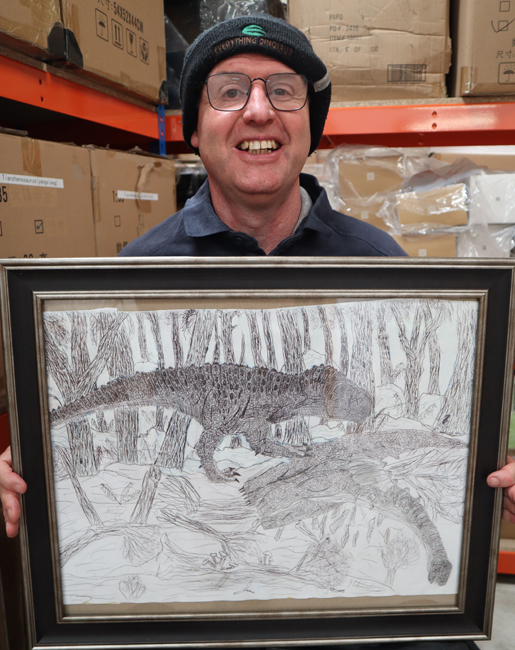
Our thanks to Dominic a young and very knowledgeable dinosaur fan who along with his family visited Everything Dinosaur and presented us with a super dinosaur illustration.  Dominic decided to give us his Koleken dinosaur drawing.  We had met Dominic back in the late spring at a film premiere that Everything Dinosaur had sponsored (Why Dinosaurs?).  He impressed us with his fantastic dinosaur knowledge, so much so that he knew more about a recently described dinosaur (Koleken inakayali), than anyone else at the event.

Dominic’s mum explained that he had been working on a drawing of this new dinosaur and, as it was his birthday, he wanted to come and present us with his Koleken dinosaur drawing. It is a wonderful piece of prehistoric art, and we really appreciate the great care and attention to detail shown by this young artist. We were thrilled to receive Dominic’s drawing and we plan to display it prominently at our offices.

The Koleken dinosaur drawing by young Dominic

Mike from Everything Dinosaur holding the Koleken dinosaur drawing presented to team members by Dominic and his family. Picture credit: Everything Dinosaur.

Picture credit: Everything Dinosaur

The Koleken Dinosaur Drawing

Koleken (K. inakayali) was formally described earlier this year (Pol et al). it is an abelisaurid and it shared its Late Cretaceous environment with the much bigger, related Carnotaurus (C. sastrei). The fossil material is associated with the La Colonia Formation of Chubut Province (Argentina). The discovery of Koleken inakayali reinforces the view that abelisaurids were the dominant predatory dinosaurs in Gondwana during the Maastrichtian faunal stage of the Cretaceous.

To read Everything Dinosaur’s recent blog post about Koleken inakayaliA New Abelisaurid from Southern Argentina.

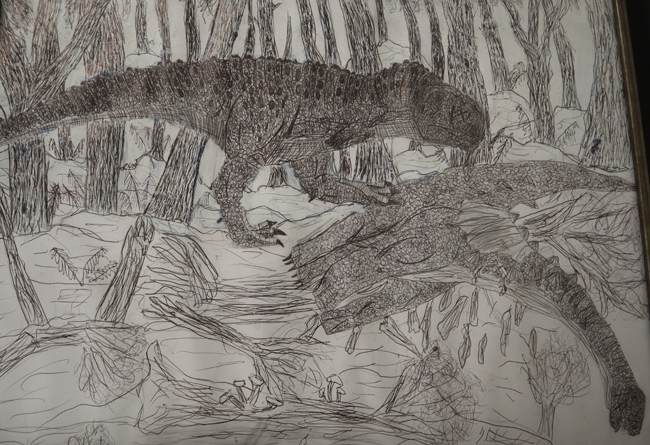
The Koleken is feeding on a saltasauroid titanosaur.  We suspect that this is a representation of Titanomachya.  Titanomachya (T. gimenezi) is also associated with the Colonia Formation. This dinosaur was also described this year (Pérez-Moreno et al). It was relatively small for a titanosaur. Titanomachya is thought to have measured around six metres in length. Fragmentary remains of another titanosaur have been found in the same area. As yet, these fossils have not been scientifically described or formally studied.

The dinosaur drawing by young Dominic.

The dinosaur drawing from Dominic. A Koleken feasts on a saltasauroid titanosaur (Titanomachya). Picture credit: Dominic.

Picture credit: Dominic

Mike from Everything Dinosaur commented:

“We are honoured to receive this artwork, from a gifted illustrator. It is lovely to see the passion and creativity of dinosaur fans, young and old, come to life through art.”

Helping to Inspire the Next Generation of Palaeoartists

Team members hope that Dominic’s inspiring illustration will encourage more young artists. The company remains committed to fostering the next generation of palaeontologists, palaeontology enthusiasts, and dinosaur fans like Dominic.

At Everything Dinosaur, our team is dedicated to nurturing the passions of young aspiring palaeontologists and palaeoartists.  We believe that encouraging creativity is key to inspiring the next generation of scientific pioneers. Through educational resources, hands-on activities, and personalised feedback, we strive to provide a supportive environment.  An environment in which young dinosaur fans can explore their interests and cultivate the skills needed to turn their dreams of becoming a palaeontologist into reality.

The award-winning Everything Dinosaur website: Dinosaur Toys and Gifts.

1 08, 2024

A New PNSO Prehistoric Animal Slider Image for Everything Dinosaur

By |2024-07-16T12:37:56+01:00August 1st, 2024|Categories: Everything Dinosaur News and Updates|0 Comments

Everything Dinosaur team members have been busy preparing a new PNSO prehistoric animal model image for use on the company’s updated website.  The PNSO range has grown significantly over the last few years.  They continue to impress with the introduction of dinosaur and prehistoric animal models.  For example, new figures for this year (2024) include Lufengosaurus, Baryonyx, Tyrannotitan and an updated Spinosaurus.  In addition, a spectacular Edmontosaurus (Zabad) and a beautiful Wuerhosaurus (Xilin) have been added.

A new image has been created to help highlight the extensive PNSO prehistoric animal model range.  The image (below) features seven different PNSO figures.  A spokesperson from Everything Dinosaur commented that they wanted the picture to include a marine reptile as well as a prehistoric shark.

The new PNSO prehistoric animal slider for the updated Everything Dinosaur website.

The new PNSO prehistoric animal slider for the updated Everything Dinosaur website. In total, seven PNSO prehistoric animal figures are featured. Can you name them all? Picture credit: Everything Dinosaur.

Picture credit: Everything Dinosaur

Can you name them all?

To view the PNSO models and figures available from Everything Dinosaur: PNSO Age of Dinosaurs.

The Extensive PNSO Prehistoric Animal Range

PNSO prehistoric animal models have proved to be extremely popular with fans of dinosaurs.  Model collectors have been able to build up quite a collection. The PNSO range features popular prehistoric animals but also, some of the more obscure creatures from the fossil record too.

Mike from Everything Dinosaur stated:

“The artwork and posters supplied with the PNSO figures are superb.  Furthermore, it is wonderful to see figures of Chinese prehistoric animals coming into production.  Dinosaurs such as Lufengosaurus, Tsintaosaurus and of course Wuerhosaurus.  We really do appreciate the design team’s efforts.”

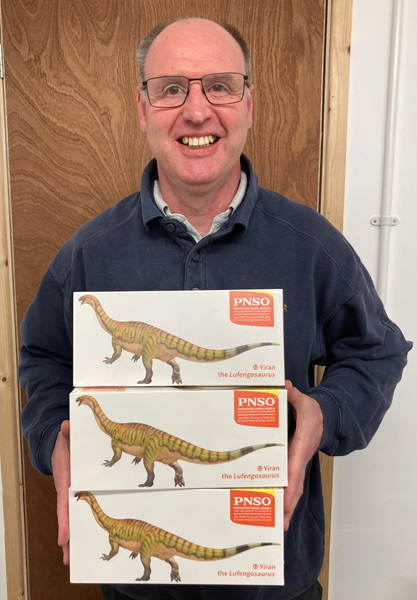
A trio of PNSO Lufengosaurus models.

Mike of Everything Dinosaur with three Lufengosaurus dinosaur models. Picture credit: Everything Dinosaur.

Picture credit: Everything Dinosaur

Collectors and dinosaur fans can expect more new model announcements from PNSO.

To visit the award-winning Everything Dinosaur website: Everything Dinosaur – Dinosaur Toys.

31 07, 2024

A New Deep-snouted Tyrannosaur from Asia

By |2024-08-01T16:58:12+01:00July 31st, 2024|Categories: Palaeontological articles|0 Comments

Another week, and another new dinosaur.  This time, it is a tyrannosaur, and it has been named Asiatyrannus xui.  The fossils consist of a nearly complete skull and postcranial material. The postcranial material comprises leg bones and caudal vertebrae. A cross-sectional analysis of the right fibula has permitted the researchers to estimate the age of this tyrannosaur. It was at least thirteen years old when it met its demise.

Asiatyrannus co-existed with the much larger, Qianzhousaurus sinensis. Qianzhousaurus had a long, narrow snout.  When it was formally described in 2014 it was nicknamed “Pinocchio rex”.  The different skull morphologies and their different body sizes suggest that Asiatyrannus xui and Qianzhousaurus sinensis likely had different feeding strategies and occupied different ecological niches.  Asiatyrannus is the first deep-snouted tyrannosaurid to have been described from the Late Cretaceous of south-eastern China.
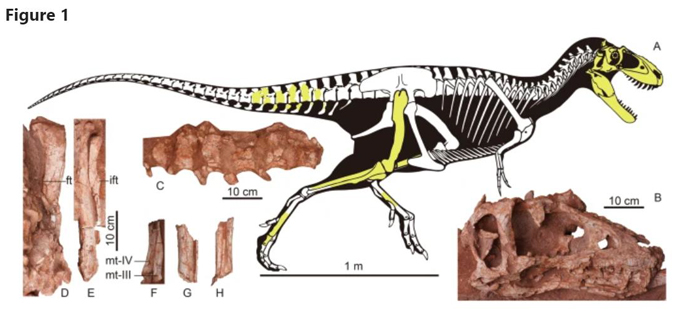
Asiatyrannus xui skeletal reconstruction.

A skeletal reconstruction of the newly described (2024) deep-snouted Asian tyrannosaur (Asiatyrannus xui). Known fossil material in (A) shown in yellow. Photographs of the fossils (B-H). Picture credit: Zheng et al.

Picture credit: Zheng et al

Asiatyrannus xui

The fossil material was unearthed in September 2017 at a construction site in Shahe Town, Nankang District, Ganzhou City (Jiangxi Province).  The fossils were taken to the Zhejiang Museum of Natural History, Hangzhou, China for cleaning and preparation.  The genus name translates as “Asian tyrant king”, whilst the species name honours Dr Xing Xu (Institute of Vertebrate Paleontology and Paleoanthropology, Chinese Academy of Sciences).  Dr Xing Xu has made a huge contribution to the study of Chinese dinosaurs including research into and the naming of other tyrannosaurs (Dilong, Guanlong and Yutyrannus).

The discovery of Asiatyrannus highlights the diversification of deep-snouted tyrannosaurids towards the end of the Cretaceous.  It demonstrates that during the Late Cretaceous (Maastrichtian), different types of tyrannosaurs co-existed in south-eastern China.  Numerous dinosaurs are known from the strata in this area (Nanxiong Formation).  Ornithischians and sauropods have been described, but the majority of dinosaurs discovered are theropods, overwhelmingly oviraptorosaurs.

To read a blog post from 2016 about another oviraptorosaur from the Nanxiong Formation: Tongtianlong – A New Oviraptorosaur.

For an article describing a new oviraptorosaur (Corythoraptor) named in 2017: Another New Oviraptorosaur from Jiangxi Province.

Isolated teeth and other fragmentary elements suggest that there could have been other tyrannosaurid taxa present in this area at the very end of the Cretaceous.

Asiatyrannus xui skull and line drawing.

Photograph (A) and line drawing (B) of the skull of Asiatyrannus xui (ZMNH M30360) in right lateral view. Picture credit: Zheng et al.

Picture credit: Zheng et al

Tyrannosaurid Growth Spurts

The open-access study published in “Scientific Reports”, includes details of bone histology.  This analysis revealed that this dinosaur died when it was a least thirteen years of age.  This is significant as the research team conclude that whilst this individual was not fully-grown, it had already passed through its most rapid growth phase.  Early tyrannosauroids such as Guanlong and Moros reached their adult size at around six to seven years of age.  In contrast, large-bodied tyrannosaurs from the Late Cretaceous (Campanian/Maastrichtian) such as Daspletosaurus, Tyrannosaurus rex and Albertosaurus had rapid growth spurts in their teenage years.  These theropods did not reach their full adult size until at least twenty years old.

Qianzhousaurus and Asiatyrannus xui

The skull of Asiatyrannus measures 47.5 cm in length.  Based on this, and the limb sizes, the research team estimate that Asiatyrannus had a body length of around 3.5 to 4 metres.  Qianzhousaurus (Q. sinensis) was over twice as big.  It had an estimated body length of around 9 metres.

These two carnivores very probably co-existed.  The long-snouted Qianzhousaurus was likely to have been the apex predator, with the smaller Asiatyrannus having the role of a secondary predator in the ecosystem.  Their different body sizes, and different shaped skulls suggest that these two dinosaurs may have had different hunting behaviours and perhaps, preyed on different animals.  They may not have directly competed, each tyrannosaur becoming adapted to a different ecological niche.  This could be an example of niche partitioning within coeval tyrannosaurids.
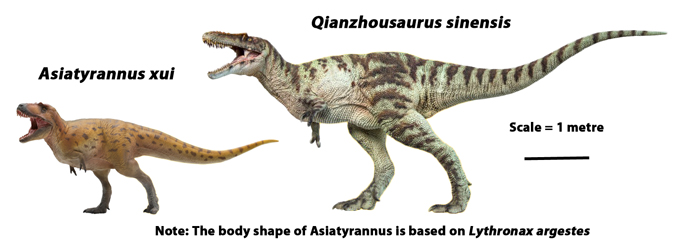
Asiatyrannus xui and Qianzhousaurus sinensis size comparison.

A size comparison between the probable, coeval tyrannosaurids Qianzhousaurus and Asiatyrannus. Picture credit: Everything Dinosaur.

Picture credit: Everything Dinosaur

The image above shows an approximate size comparison between the newly described Asiatyrannus xui and the probably coeval Qianzhousaurus sinensis.

Note: the models used to show the comparison are the PNSO Lythronax and Qianzhousaurus figures.

To view the PNSO range of prehistoric animal models: PNSO Dinosaur Models.

Implications for Mid-sized Theropod Carnivores

The paper’s authors comment that the discovery of Asiatyrannus might have implications for the way in which Mesozoic ecosystems are perceived.  Medium-sized carnivorous dinosaurs are relatively rare in the fossil record.  For example, in the Late Cretaceous carnivore guilds are monopolised by tyrannosaurids.  Adult, medium-sized predators are exceptionally rare.  Scientists have postulated that the “missing mid-sized” niches in the theropod guilds of Late Cretaceous Laramidia and Asia could be a consequence of these types of carnivores being outcompeted by juveniles and sub-adults of much larger taxa.

To read an article about a scientific paper that postulates the juveniles of apex predators out-competed mid-sized theropod carnivores: Why Are There So Few Medium-sized Carnivorous Dinosaurs?

The polar tyrannosaur Nanuqsaurus (N. hoglundi) was thought to be a mid-sized Late Cretaceous carnivore.  However, new fossil material from the Prince Creek Formation of Alaska suggests that it was comparable in size to the likes of Gorgosaurus and Daspletosaurus.  In the light of the continuing speculation as to the taxonomic validity of Nanotyrannus, the paper’s authors propose that Asiatyrannus xui currently represents the only definitive small to medium-sized member of the tyrannosaur family.

Everything Dinosaur acknowledges the assistance of the scientific paper in the compilation of this article. The paper is licensed under a Creative Commons Attribution 4.0 International License: The Creative Commons License.

The scientific paper: “The first deep-snouted tyrannosaur from Upper Cretaceous Ganzhou City of southeastern China” by Wenjie Zheng, Xingsheng Jin, Junfang Xie and Tianming Du published in Scientific Reports.


30 07, 2024

A New Limited-edition Category for Everything Dinosaur

By |2024-07-25T14:22:35+01:00July 30th, 2024|Categories: Everything Dinosaur News and Updates|0 Comments

Team members at Everything Dinosaur have added a new limited-edition category to the company’s award-winning and user-friendly website.  This new category is a destination for dinosaur fans and model collectors looking for limited-edition prehistoric animal models.  Limited-edition figures have become an increasing part of many manufacturer’s product offerings. There is a growing demand for rare and exclusive collectables, and prehistoric animal figures are no exception.

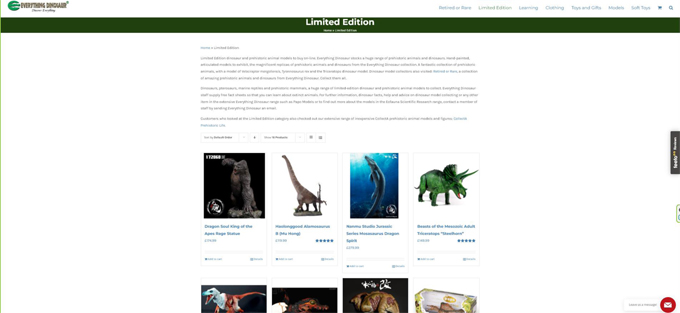
The new limited-edition category at the Everything Dinosaur website.

The new limited-edition category at the Everything Dinosaur website. We added this section in July 2024. Picture credit: Everything Dinosaur.

Picture credit: Everything Dinosaur

To view the new limited-edition category at Everything Dinosaur: Limited-edition Prehistoric Animal Figures.

The Limited-edition Category

This is a new category for Everything Dinosaur.  It has gone live on the company website at the same time as another new category entitled “Retired or Rare”.  Limited-edition figures have become an increasing part of many manufacturer’s product offerings. There is a growing demand for rare and exclusive collectables, and prehistoric animal figures are no exception.  Limited-edition figures have been introduced by the likes of Rebor, Nanmu Studio and Beasts of the Mesozoic.

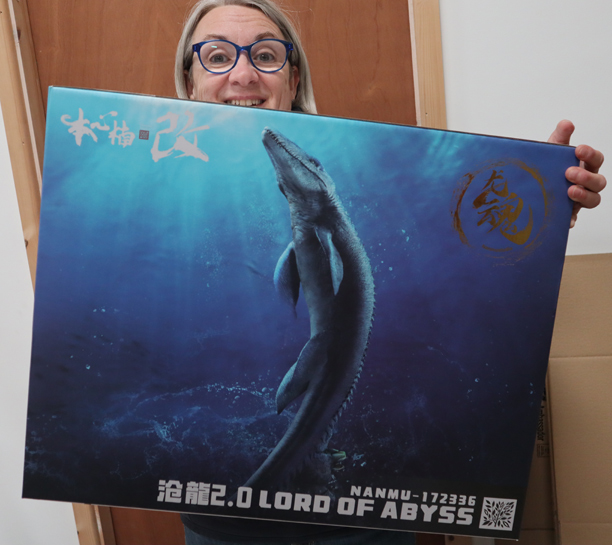
Mosasaurus Dragon Spirit

The spectacular limited-edition Nanmu Studio Jurassic Series Mosasaurus Dragon Spirit model. This marine reptile collectable can be found (whilst stocks last), in the new product category on the company website.  Picture credit: Everything Dinosaur.

Picture credit: Everything Dinosaur

The picture (above) shows Sue from Everything Dinosaur holding the limited-edition Nanmu Studio Jurassic Series Mosasaurus Dragon Spirit.  This collectable figure is huge! Our new limited-edition category currently contains it (whilst stocks last).

Mike from Everything Dinosaur declared:

“Attention, collectors and enthusiasts! Our website is thrilled to announce the launch of a brand-new category dedicated to limited-edition prehistoric animal models.  This exciting addition caters to the growing demand for rare and exclusive collectables in the world of palaeontology.”

Visit the Everything Dinosaur website: Dinosaur Toys and Figures.

29 07, 2024

New Research Indicates Size Does Not Matter for Mammals with Complex Brains

By |2024-07-27T11:53:30+01:00July 29th, 2024|Categories: Animal News Stories|0 Comments

Size doesn’t matter for mammals with more complex brains, according to new research led by the University of Bath.  Mammals that have developed more sophisticated brains tend to have a smaller size difference between males and females of that species.  The research paper has been published in the academic journal “Nature Communications”.  The study can provide new insights into mammal evolution and the role of sexual selection.

In many mammal species, the males can be bigger than the females.  In some species, the females can be bigger on average than the males. This is a trait called sexual size dimorphism (SSD). For instance, male southern elephant seals (Mirounga leonina), are around three times larger than females. African elephants (Loxodonta) show SSD.  Males can weigh several thousand kilograms more than mature females.

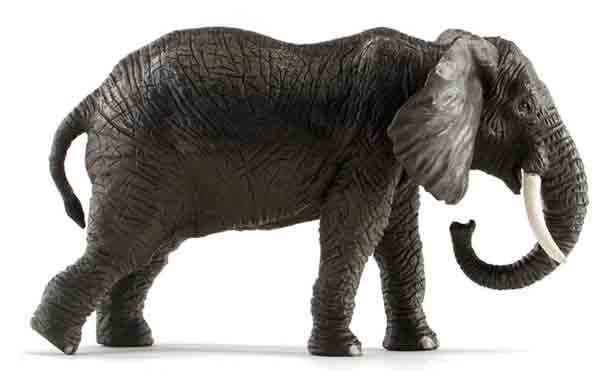
An African elephant model.

A male African elephant (Loxodonta).  Male elephants tend to be much larger than the females.

In contrast, dolphins have no difference in sizes between the sexes. Humans are somewhere in between, with the average male being larger than the average female, but across the population there is an overlap.

Analysing the Genomes of 124 Species of Extant Mammal

The study involved researchers from the Universities of Bath and Sheffield, along with Cardiff University and UNAM (Mexico).  The team examined the genomes of 124 extant species of mammals. The genes were grouped into families of similar attributes and functions.  The size of these gene families was then calculated.  The researchers discovered that those species with a big difference in size between the sexes had bigger gene families linked to olfactory functions (sense of smell) and smaller gene families associated with brain development.

Therefore, this could also mean that those species with very little difference in sizes between males and females (termed monomorphic) had larger gene families associated with brain development. The authors suggest that in species with a large SSD, traits such as the sense of smell could be important for identifying mates and territories. In contrast, mammals with a smaller SSD are potentially investing in their brain development and tend to have more complex social structures. This means they compete for mates using other means than simply using size to select who to mate with.

Corresponding author for the research, Dr Benjamin Padilla-Morales (University of Bath), commented:

We were surprised to see such a strong statistical link between a large SSD and expanded gene families for olfactory function. Even more interestingly, the gene families under contraction were linked with brain development. This could mean that those species with a small SSD have bigger gene families associated with brain function and tend to show more complex behaviours such as biparental care and monogamous breeding systems.”

Size is Important in Some Mammal Species

The research team concluded that whilst body size in some mammal species is significant, for others it does not matter so much.  If size plays a role in sexual selection, then it leads on to considering how traits like SSD are shaping mammalian evolution.  Is SSD in some species influencing brain and genome development?

This new research helps to illustrate the complex interplay between sexual dimorphism, gene family size evolution, and their roles in mammalian brain development and function. It provides a valuable perspective in understanding mammalian genome evolution.

The research team hope to develop this line of enquiry further.  They want to investigate how testes size impacts the evolution of the mammalian genome.

Being small insectivores with fewer skull bones led to mammalian evolutionary success: Reduction in Skull Bones Led to Success for the Mammals.

The Implications for Mammalian Evolution

This research highlights the importance of considering the multifaceted nature of sexual selection and its diverse effects on different aspects of mammalian evolution and biology. The finding that body size plays a role in sexual selection for some species but not others suggests that the evolutionary pressures shaping sexual dimorphism can vary considerably across the mammalian lineage.

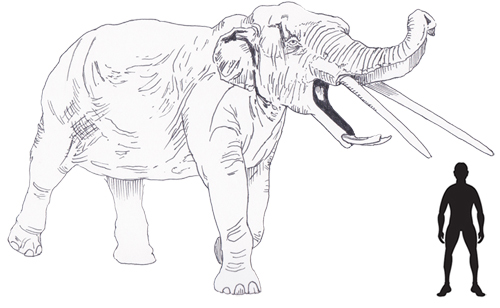
Understanding these nuanced relationships is crucial for piecing together the complex tapestry of mammalian evolution. Perhaps, a study of the fossilised remains of a particular group of mammals with descendants still living today could shed new light on when these relationships established. Could the Proboscidea Order (elephants and their relatives) provide a starting for this research? By examining the fossil records of such groups, scientists could gain a better understanding into the evolutionary processes that have given rise to the incredible adaptations found in the Mammalia.

Konobelodon atticus scale drawing.

A scale drawing of the Late Miocene prehistoric elephant Konobelodon atticus.  Could a study of ancient elephants provide a fresh perspective on the evolution of sexual size dimorphism (SSD).  Picture credit: Everything Dinosaur.

Picture credit: Everything Dinosaur

Everything Dinosaur acknowledges the assistance of a media release from the University of Bath in the compilation of this article.

The scientific paper: “Sexual size dimorphism in mammals is associated with changes in the size of gene families related to brain development” by Benjamin Padilla-Morales, Alin P. Acuña-Alonzo, Huseyin Kilili, Atahualpa Castillo-Morales, Karina Díaz-Barba, Kathryn H. Maher, Laurie Fabian, Evangelos Mourkas, Tamás Székely, Martin-Alejandro Serrano-Meneses, Diego Cortez, Sergio Ancona and Araxi O. Urrutia published in the journal Nature Communications.

The award-winning Everything Dinosaur website: Prehistoric Animal Models and Toys.

28 07, 2024

A New Everything Dinosaur About Us Website Page

By |2024-07-24T11:35:28+01:00July 28th, 2024|Categories: Everything Dinosaur News and Updates|0 Comments

As part of on-going site improvements team members have developed a new Everything Dinosaur about us page for the company website.  The “About Us” page is an essential component of a website.  When a potential customer visits: Everything Dinosaur one of the first things they are likely to look for is the “About Us” page.  This page plays a crucial role in a company’s on-line presence.  It gives visitors an overview of the business.  Furthermore, it can help to set the company apart from its competitors.

The new Everything Dinosaur about us website page.

The new Everything Dinosaur “About Us” website page. This page was updated in July 2024. Picture credit: Everything Dinosaur.

Picture credit: Everything Dinosaur

The Everything Dinosaur About Us Page

We are very fortunate at Everything Dinosaur.  Over the years, we have built up a strong rapport with our customers and suppliers.  The business has an amazing record of customer service.  We are an award-winning company with one of the best ratings for customer satisfaction on record.  For example, Everything Dinosaur has been awarded the Feefo Platinum Trusted Service award, ever since this prestigious accolade was introduced.

To read more about our latest customer service award: Platinum Trusted Service Award 2024.

However, the Everything Dinosaur about us page should provide more than just dry facts about our accomplishments.  This page might contain information about the company, its history and what it does.  In truth, this page should say more.  This is an opportunity to tell Everything Dinosaur’s unique story and to share our brand’s unique personality.  Moreover, it should outline what makes us tick!

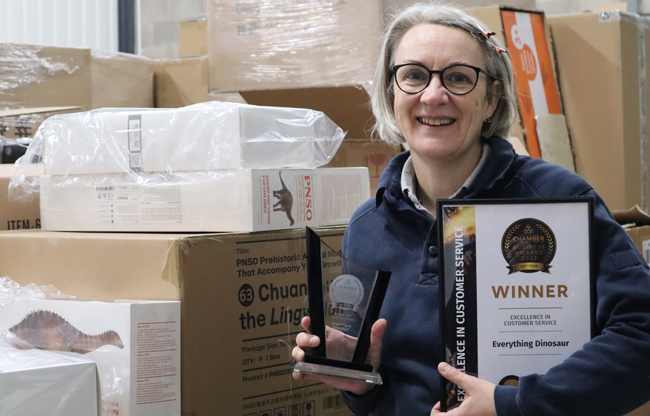
Sue of Everything Dinosaur with the trophy and certificate

Sue with the trophy and the certificate from the South Cheshire Chamber of Commerce. Everything Dinosaur is an award-winning company and whilst an “About Us” page might include details of your company’s history and achievements, it is an opportunity to tell your unique story. Picture credit: Everything Dinosaur.

Picture credit: Everything Dinosaur

Your Brand’s Personality

This part of our website should give visitors an impression of our brand’s personality.  It can highlight core values and explain what we do and how we do it. Furthermore, it helps to inspire and encourage.  A brand personality refers to the set of human characteristics that are associated with a particular business. It is the personality that a brand projects to its target audience and consumers.  The objective of developing a distinct brand personality is to make the brand relatable, memorable, and appealing to the audience.  Carefully incorporating a unique brand personality is a vital part of creating an impressive “About Us” page.

Some key pointers about information on an “About Us” page:

  • The company story, its values and principles.
  • Details about team members and core values.
  • It should reflect the company culture.
  • What is our mission?  What problems do you solve for customers?
  • Listing relevant awards and business milestones.
  • A clear call-to-action!  Make it easy for customers/visitors to contact you.

We hope that the Everything Dinosaur about us page comes up to the mark!

A compelling “About Us” page can give website visitors a reason to engage with us and our brand.  Having visited this page, visitors should feel more confident about doing business.  It remains an important part of any website.

The Everything Dinosaur “About Us” page: About Everything Dinosaur.

For further information about us: Contact Everything Dinosaur.

Go to Top