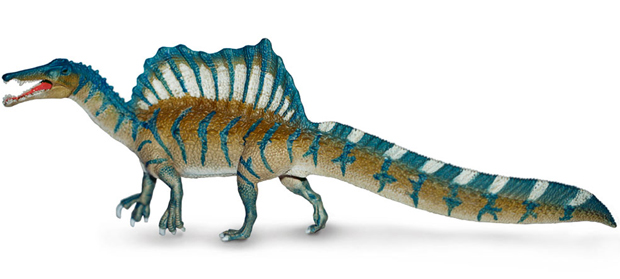
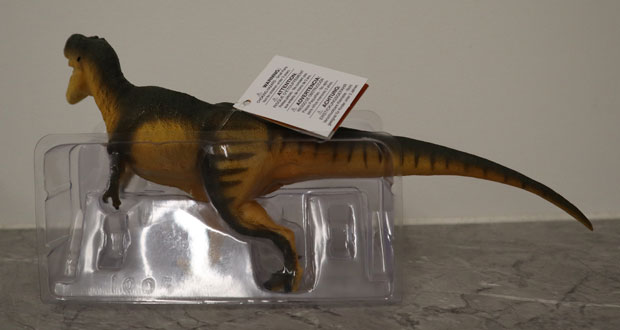
The new for 2021 Wild Safari Prehistoric World Spinosaurus and Daspletosaurus dinosaur models are in stock at Everything Dinosaur. These are the last of five new prehistoric animal models that were introduced by Safari Ltd this year, after the armoured T. rex and Triceratops and the Baryonyx figures that came into stock at Everything Dinosaur earlier in 2021.
The new for 2021 Wild Safari Prehistoric World Daspletosaurus dinosaur model. This figure is now available from Everything Dinosaur (May 2021).
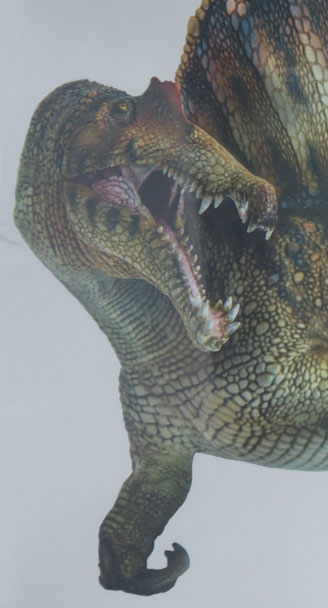
The 2021 Wild Safari Prehistoric World Spinosaurus dinosaur model available from Everything Dinosaur.
Two New Dinosaur Figures
Safari Ltd may have reduced the number of new prehistoric animal models they have introduced this year compared to 2020, (nine prehistoric animal models were introduced in 2020), but there is no denying the quality of these new additions. Each model is beautifully painted and reflect the very latest scientific thinking. It is wonderful to see a new model of a tyrannosaur introduced into a product range, a refreshing change from the ubiquitous T. rex models.
The new for 2021 Wild Safari Prehistoric World Daspletosaurus dinosaur model. The Daspletosaurus figure measures approximately 23 cm in length and that impressive head with jaws wide open stands around 11 cm high. Picture credit: Everything Dinosaur.
Picture credit: Everything Dinosaur
The Spinosaurus Tail
Last year (2020), a team of international scientists including researchers from the University of Portsmouth, the University of Detroit Mercy and Leicester University published a paper in the journal “Nature” that concluded that Spinosaurus was indeed an aquatic dinosaur. A review of fossil tail bones (caudal vertebrae), revealed that it had a wide and flexible tail which was very fin-like. The tail of Spinosaurus was well adapted to propelling this huge predator through the water.
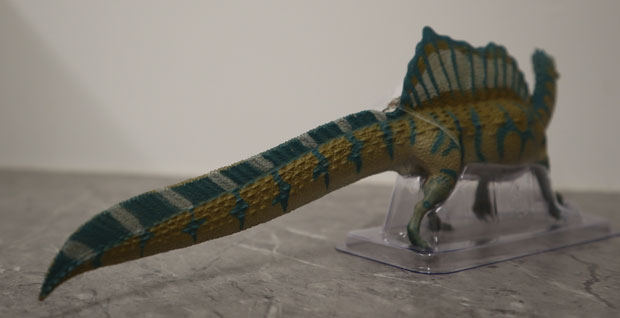
The design team at Safari Ltd have worked hard to incorporate this research into their model. The tail of the Wild Safari Prehistoric World Spinosaurus, is broad and accounts for around half the model’s entire length. It seems ideally suited to propelling this dinosaur through the rivers and lakes of early Late Cretaceous North Africa.
The deep and powerful tail of the Wild Safari Prehistoric World Spinosaurus. Picture credit: Everything Dinosaur.
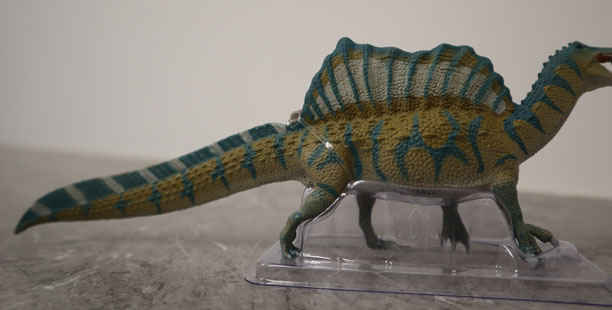
Collectors have contacted Everything Dinosaur and commented on the beautiful markings and colouration. The Spinosaurus figure has attracted praise for its striking paintwork.
The beautiful markings on the Wild Safari Prehistoric World Spinosaurus dinosaur model.Collectors and fans of dinosaur models have praised the colour scheme. Picture credit: Everything Dinosaur.
Picture credit: Everything Dinosaur
The new for 2021 Wild Safari Prehistoric World Daspletosaurus and Spinosaurus figures along with the rest of the prehistoric animal models in this range can be found here: Wild Safari Prehistoric World.
A team of scientists have interpreted a remarkable fossil from southern Germany as a rare example of predation in the fossil record. A belemnite (a squid-like animal), has been preserved with the remains of a crustacean still held in its arms. However, the belemnite (a cephalopod), never had a chance to finish its meal, its fossilised remains display damage that indicate that it too was predated upon.
The belemnite was attacking the crustacean, when it too was attacked, presumably by a vertebrate predator which the researchers postulate was a type of prehistoric shark.
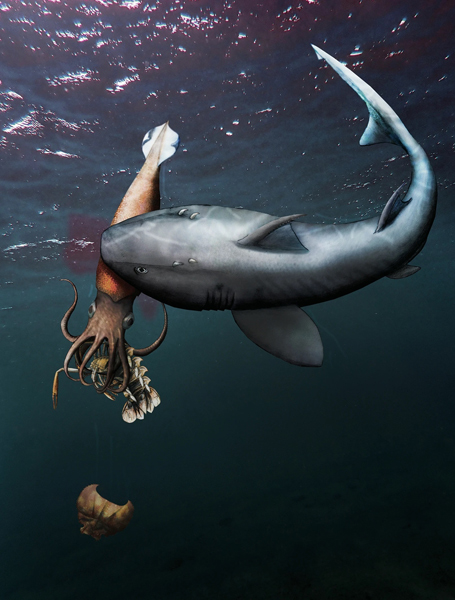
Possible scenario explaining the taphonomy of the belemnite. Hybodus hauffianus (prehistoric shark), is known to have fed on belemnites, although it is unclear whether some individuals learned how to avoid the swallowing of the calcitic rostrum. The belemnite Passaloteuthis laevigata holds remains of the exuvia of Proeryon in its arms. Picture credit: Klug et al.
Discovered in 1970
The specimen was discovered in 1970 by amateur fossil collector Dieter Weber. The fossils come from the famous Lower Jurassic, Posidonia Shale from near Holzmaden (Germany). These marine shales which are exposed in Switzerland, Luxembourg, Austria and Holland as well as Germany, are famous for their beautifully preserved but crushed fossil specimens including many types of Early Jurassic marine reptile and fish.
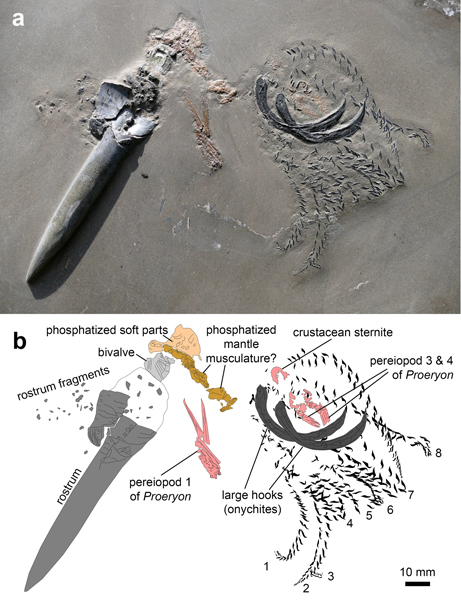
In Germany, these shales are known as the Posidonienschiefer Formation. The name of the formation is derived from the extensive and abundant fossils of the bivalve Posidonia bronni. Günter Schweigert (Natural History Museum Stuttgart), had been invited to view Herr Weber’s extensive private collection when he noted the fossilised remains of a belemnite (Passaloteuthis bisulcata) in close proximity to a crustacean. The remains of the crustacean, identified as an example of the decapod Proeryon, were still held in the arms of the belemnite and some soft tissue of the cephalopod had been preserved.
Taphocoenosis of a Passaloteuthis bisulcata with preserved arm crown and remains of its prey, SMNS 70514, Early Toarcian, Tenuicostatum Zone, Semicelatum Subzone, Ohmden, Germany. Photo of the specimen and its prey (a) Line drawing of fossil. Picture credit: Klug et al.
Damage to the Belemnite
When examined closely, the soft parts of the belemnite were far from complete and the scientists, which included researchers from the University of Zurich (Switzerland), Friedrich-Alexander-University (Erlangen, Germany), the Luxembourg National Museum of Natural History and the Ruhr-University Bochum (Germany), proposed that this was possible evidence of the belemnite having been attacked whilst in the process of subduing its prey.
Fossilised “Leftovers” – Pabulite
The specimen is interpreted as evidence of incomplete predation. The belemnite was attacked but not all of it was eaten. The assailant dropped the belemnite, which was still clutching the decapod, the remains settled on the seabed to be covered over in sediment and eventually turned to stone.
For this kind of fossil, one that provides circumstantial evidence to indicate these are the preserved remains of a dropped meal, the researchers coined the term “pabulite”. This word is derived from the Latin word “pabulum” for food and the Greek word “lithos” for stone.
What Sort of Animal Attacked the Belemnite?
As most of the belemnite soft parts between the arm crown and the calcitic rostrum are missing, the scientists postulate that this represents remains of a meal of a vertebrate predator, possibly of the Early Jurassic shark Hybodus hauffianus which is known to have eaten belemnites.
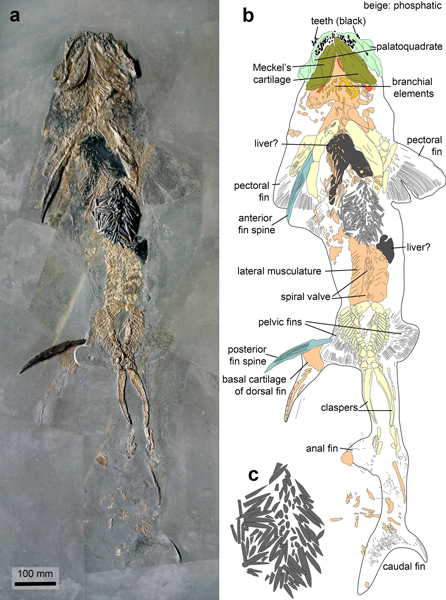
One remarkable fossil (SMNS 10062), in the collection of the Natural History Museum Stuttgart, depicts one of these small sharks which had at least 93 part or complete belemnite rostra wedged in its stomach. It has been suggested that this indigestible material probably killed the shark.
The Early Jurassic elasmobranch Hybodus hauffianus with its stomach clogged by belemnite rostra; SMNS 10062, Posidonia Shale, Toarcian, Holzmaden (Germany). Picture credit R. Böttcher.
Evidence of Behaviour Preserved in the Fossil Record
These fossilised leftovers provide a glimpse into a marine food web that existed 180 million years ago. In the recently published scientific paper, the researchers speculate that vertebrate predators of belemnites, animals such as ichthyosaurs, sharks and metriorhynchid crocodiles learned to avoid the hard, indigestible rostra of these cephalopods. Instead, they bit off the soft parts and consumed them leaving the rostrum of their victim to descend to the seafloor.
The researchers suggest that the association of the complete belemnite arm crown with a complete rostrum and some soft parts represent the remains of the meal of a vertebrate predator, which had learned enough about belemnite anatomy to avoid the rostrum. This idea lends further credibility to the hypothesis that belemnite predation might contribute to belemnite accumulations (so-called battlefields, where huge numbers of fossilised belemnite guards are found together) under certain circumstances.
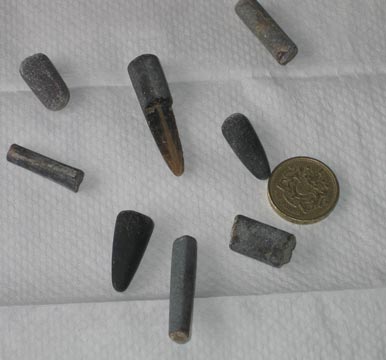
Belemnite guard fossils from the “Jurassic Coast”. Picture credit: Everything Dinosaur.
Picture credit: Everything Dinosaur
The scientific paper: “Fossilized leftover falls as sources of palaeoecological data: a ‘pabulite’ comprising a crustacean, a belemnite and a vertebrate from the Early Jurassic Posidonia Shale” by Christian Klug, Günter Schweigert, René Hoffmann, Robert Weis and Kenneth De Baets published in the Swiss Journal of Palaeontology.
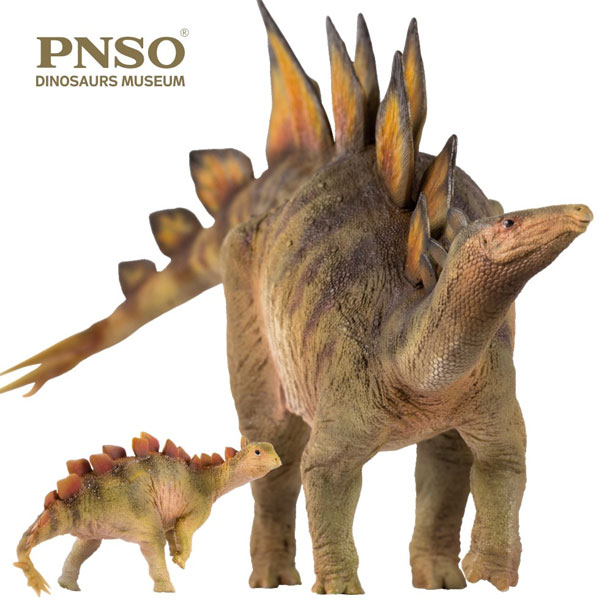
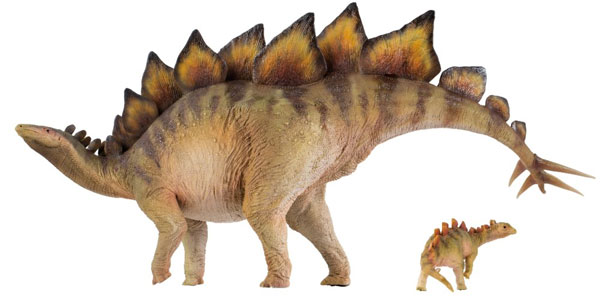
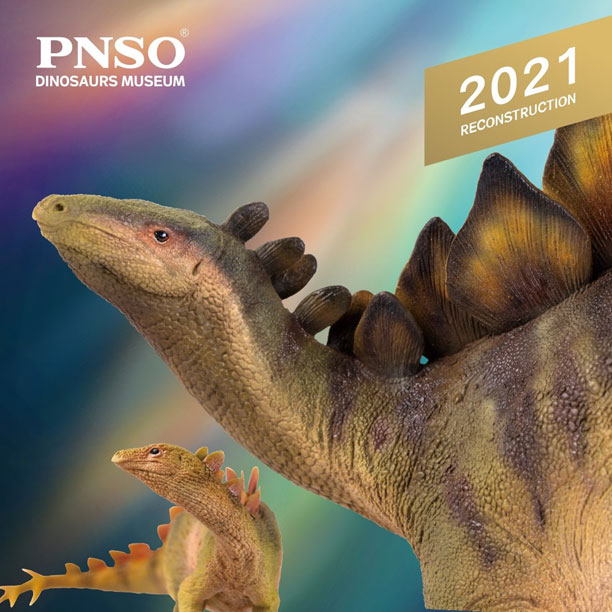
In the summer of 2021, Everything Dinosaur will be stocking the new Biber and Rook 1:35 scale scientific art dinosaur models from PNSO. These new dinosaur figures were announced yesterday and the box set will feature an adult Stegosaurus with a juvenile.
The PNSO Stegosaurus dinosaur models (Biber and Rook) in anterior view, these two figures are due to be in stock at Everything Dinosaur in the summer (2021).
PNSO Biber and Rook Stegosaurus Models
Biber is the name of the adult Stegosaurus figure and Rook is the epithet given to the baby armoured dinosaur. It is not certain whether the adult Stegosaurus in this set is a male or a female. The figures join an earlier PNSO Stegosaurus replica that was introduced in 2019. The adult Stegosaurus in this new set is a different figure to the 2019 Stegosaurus.
The mother Stegosaurus is protecting her baby. Whether it is a male or female Stegosaurus is immaterial, this pair of stegosaurs joins Bieber the Stegosaurus that was introduced in 2019.
Biber and Rook the Stegosaurus models are the latest editions to a wide range of armoured dinosaur models offered by Everything Dinosaur and PNSO. The PNSO portfolio includes Rosana the Miragaia, Qichuan the Tuojiangosaurus in the mid-size model range that were introduced in 2020 along with several smaller armoured dinosaur figures such as a Wuerhosaurus and a Kentrosaurus in the “Prehistoric Animal Toys that Accompany Your Growth” series.
The adult Stegosaurus (Biber) measures around 21.5 cm in length and those beautiful plates stand 11 cm high. Everything Dinosaur estimates that on this scale, the baby stegosaur (Rook) is about 5 cm long.
The adult PNSO Stegosaurus figure is 21.5 cm long and those magnificent plates are 11 cm tall. We estimate the baby stegosaur to be around 5 cm in length.
Representing Dinosaurs from the Famous Morrison Formation
PNSO have expressed a desire to introduce models that represent prehistoric animals from famous geological formations. These two new figures represent animals from the famous Morrison Formation of western North America. They join the likes of the recently announced Allosaurus figure (PNSO Paul the Allosaurus), as representatives of the dinosaur biota from the Upper Jurassic Morrison Formation.
PNSO are keen to highlight prehistoric animals known from the famous Morrison Formation of the western United States. Biber and Rook join Paul the Allosaurus in the PNSO model range.
PNSO Stegosaurus dinosaur models (Biber and Rook).
Biber and Rook are expected in stock at Everything Dinosaur in the summer (2021). To view the PNSO figures available from Everything Dinosaur: PNSO Age of Dinosaurs.
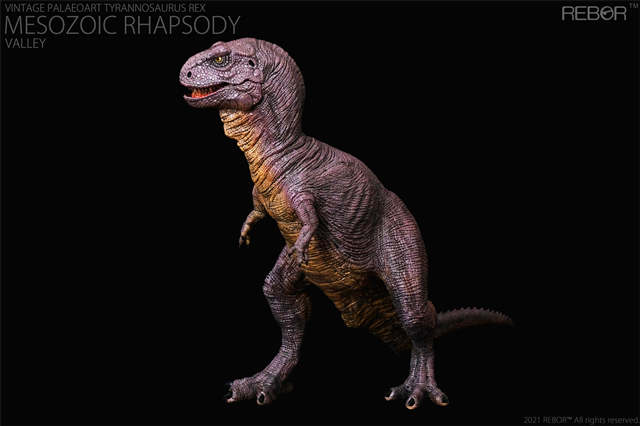
Rebor has announced that the first wave of Retrosaurus dinosaur models is in production and due to be dispatched around the middle of June (2021). The first two models making up wave 1 are the Rebor 1:35 Vintage Palaeoart Tyrannosaurus rex “Mesozoic Rhapsody” Valley colour variant and the green-coloured Rebor 1:35 scale 80s T-REX Toy HD Remastered “Californiacation” VHS variant.
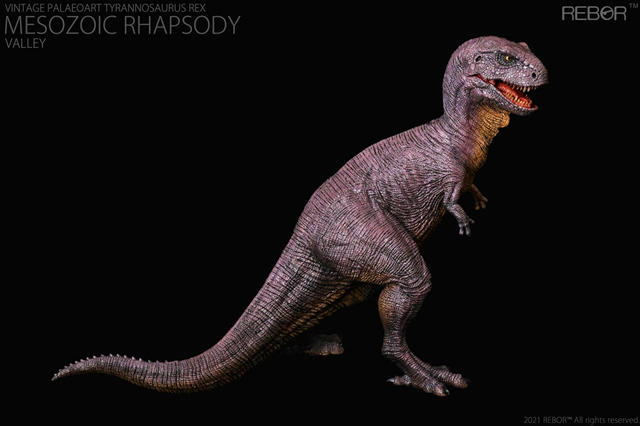
Rebor 1:35 Vintage Palaeoart Tyrannosaurus rex “Mesozoic Rhapsody” Valley colour variant. One of two “Retrosaurus” models from Rebor that make up wave 1 of this series.
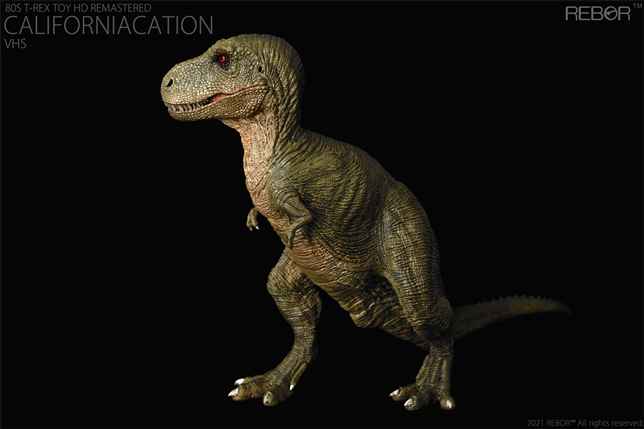
The Rebor 1:35 80s T-REX Toy HD Remastered “Californiacation” VHS in a left lateral view. The model is a retrospective demonstrating how our views regarding the Dinosauria have changed.
Changing Perceptions About the Dinosauria
These beautifully sculpted 1:35 scale figures represent dinosaurs as depicted in films that were made in the 1930s through to the late 1960s. Films such as King Kong (1933), One Million Years B.C. (1966) and the Valley of the Gwangi (1969), that inspired generations of Earth scientists.
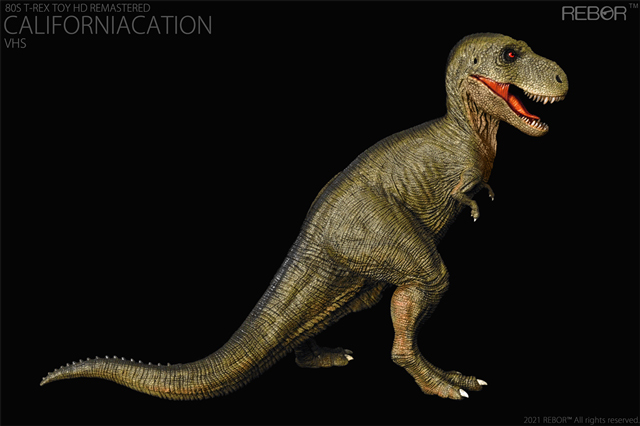
The vintage Rebor 1:35 Palaeoart Tyrannosaurus rex “Mesozoic Rhapsody” Valley Colour Variant. Each model shows a theropod and depicts the dinosaur in the outdated tripodal posture with the tail dragging on the floor.
The Rebor 1:35 80s T-REX Toy HD Remastered “Californiacation” VHS in a right lateral view. This shows the “classic” dinosaur tripodal pose with the tail dragging on the ground so reminiscent of movie dinosaurs up until recent times.
Model Measurements
The models entitled Rebor 1:35 Vintage Palaeoart Tyrannosaurus rex “Mesozoic Rhapsody” Valley and Rebor 1:35 80s T-REX Toy HD Remastered “Californiacation” VHS measure 28 cm in length, are approximately 20 cm tall and about 14 cm wide. They give dinosaurs a retrospective look, that is, they reflect how dinosaurs such as Tyrannosaurus rex and Allosaurus were depicted in the past.
Rebor 1:35 Vintage Palaeoart Tyrannosaurus rex “Mesozoic Rhapsody” Valley dinosaur figure.
The Rebor 1:35 80s T-REX Toy HD Remastered “Californiacation” VHS (anterior view).
A spokesperson from Everything Dinosaur commented:
“Rebor have been keen to introduce a range of prehistoric animal figures that pay homage to the model designers and sculptors who animated dinosaurs and other long extinct creatures in iconic feature films that helped inspire a generation of palaeontologists. When compared to other figures that are available today, they demonstrate just how much our perceptions regarding the Dinosauria have changed.”
The figures show the fine detailing that Rebor is famous for and given that their tails rest on the ground, these tail-dragging models will be very stable allowing them to be displayed on a variety of media. Perhaps dinosaur model fans could have a go at building their own dioramas reproducing scenes made famous by stop motion pioneers such as Ray Harryhausen and Willis O’Brien.
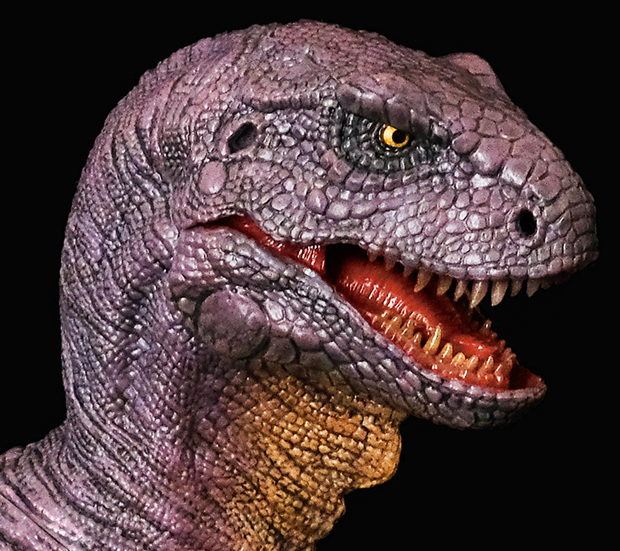
The Rebor 1:35 Vintage Palaeoart Tyrannosaurus rex “Mesozoic Rhapsody” Valley colour variant.
The Rebor 1:35 80s T-REX Toy HD Remastered “Californiacation” VHS has an articulated lower jaw.
Available for Pre-order
Both models are available for pre-order from Everything Dinosaur from today (May 21st 2021) and a spokesperson from Everything Dinosaur commented that these models are expected to be in stock in late July (2021). They might come into stock sooner, but at this stage the spokesperson could not confirm a specific date.
The Rebor 1:35 80s T-REX Toy HD Remastered “Californiacation” VHS and the Rebor 1:35 Vintage Palaeoart Tyrannosaurus rex “Mesozoic Rhapsody” Valley colour variant are available to pre-order here: Rebor Models and Figures.
Specimens of a strange, recently extinct crocodile housed at the American Museum of Natural History (New York), have helped unravel a mystery surrounding the evolutionary relationships of crocodilians. The skulls belong to the horned crocodile of Madagascar (Voay robustus) and a research team has demonstrated that it was closely related to “true crocodiles” – Crocodylus, making it the closest species to the common ancestor of the crocodile genus.
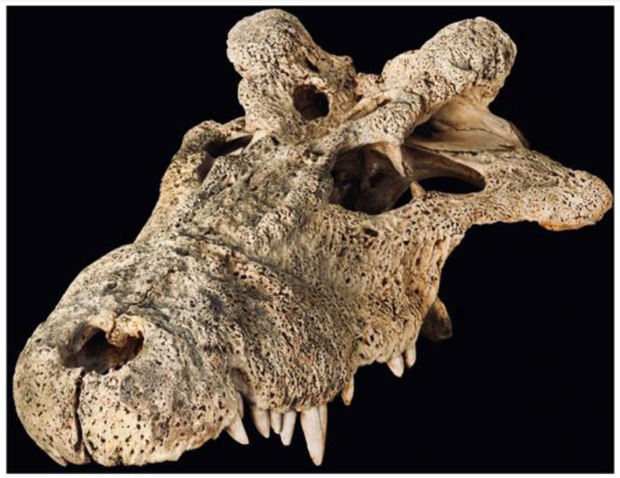
A skull of Voay robustus collected at Ampoza during the joint mission Franco-Anglo-American expedition from 1927–1930 (White, 1930). Picture credit: Hekkala et al.
Recently Extinct
When the first Europeans came to Madagascar the native Malagasy people told them about two distinct types of crocodiles that lived on their island. There was a gracile form that preferred rivers, this was identified as a population of Nile crocodiles (Crocodylus niloticus), but the swamps and lakes were home to a crocodile that the early explorers had never seen before. This second type was a much more heavy-set and powerful animal with two, bony bumps at the top of its skull.
When first named and described in 1872 (Grandidier and Vaillant), it was thought to be a species of true crocodile – a member of the Crocodylus genus. More recent studies have suggested affinities with the dwarf crocodiles (Osteolaeminae), however, with an estimated length of around 5 metres V. robustus was much larger than any other species assigned to this group.
New research published in the academic journal Communications Biology, which used DNA extracted from the American Museum of Natural History specimens, has resolved the phylogeny of this enigmatic reptile. Carbon dating of the material used in the study confirms that the horned crocodile probably survived until just a few hundred years ago.
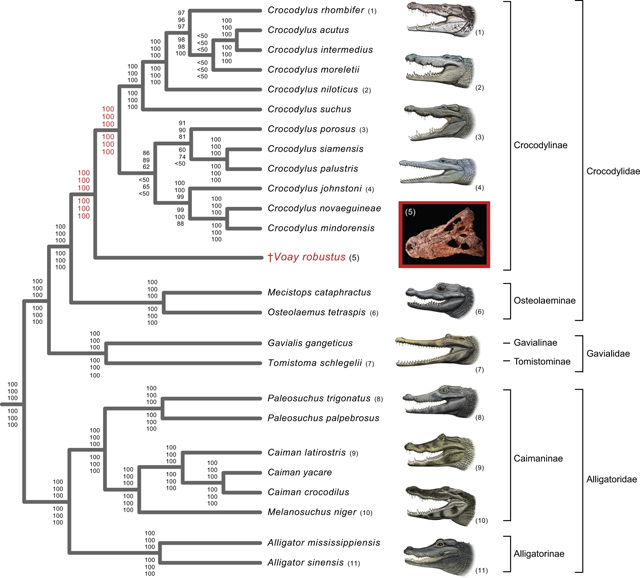
The DNA study places the horned crocodile right next to the true crocodile branch of the evolutionary tree, making it the closest species to the common ancestor of the crocodiles alive today.
One of the authors of the scientific paper, Evon Hekkala, a research associate at the American Museum of Natural History stated:
“This crocodile was hiding out on the island of Madagascar during the time when people were building the pyramids and was probably still there when pirates were getting stranded on the island. They blinked out just before we had the modern genomic tools available to make sense of the relationships of living things. And yet, they were the key to understanding the story of all the crocodiles alive today.”
Mitochondrial DNA extracted from sub-fossil specimens found during a Franco-Anglo-American expedition to south-western Madagascar (1927 to 1930), demonstrates that V. robustus was not a true crocodile but very closely related to that lineage that led to them. Being placed next to the true crocodiles on an evolutionary tree suggests that it was the closest species to the common ancestor of extant members of the Crocodylus genus.
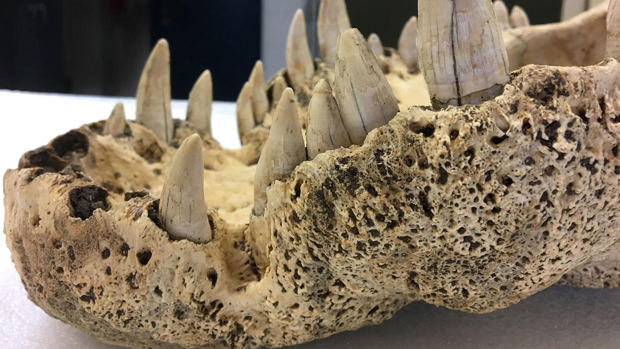
The tip of the lower jaw (dentary) of the horned crocodile from Madagascar (Voay robustus). Carbon dating of the subfossils suggests that they are less than 1,400 years old. Picture credit: The American Museum of Natural History.
Co-author George Amato, (American Museum of Natural History), explained:
“This is a project we’ve tried to do on and off for many years, but the technology just hadn’t advanced enough, so it always failed. But in time, we had both the computational setup and the paleogenomic protocols that could actually fish out this DNA from the fossil and finally find a home for this species.”
“Teasing apart the relationships of modern crocodiles is really difficult because of the physical similarities,” Hekkala added. “Many people don’t even realise that there are multiple species of crocodiles, and they see them as this animal that’s unchanging through time. But we’ve been trying to get to the bottom of the great diversity that exists among them.”
Surprising Results
The close affinity of Voay to Crocodylus lends weight to the idea that Crocodylus originated in Africa and then dispersed into the Americas and Asia/Australia. Competing theories have proposed an Asian origin for Crocodylus but as Voay was restricted to Madagascar and has been cited as the closest species to the true crocodiles, this DNA analysis lends weight to the “African origins” idea.
The scientific paper: “Paleogenomics illuminates the evolutionary history of the extinct Holocene “horned” crocodile of Madagascar, Voay robustus” by E. Hekkala, J. Gatesy, A. Narechania, R. Meredith, M. Russello, M. L. Aardema, E. Jensen, S. Montanari, C. Brochu, M. Norell and G. Amato published in Communications Biology.
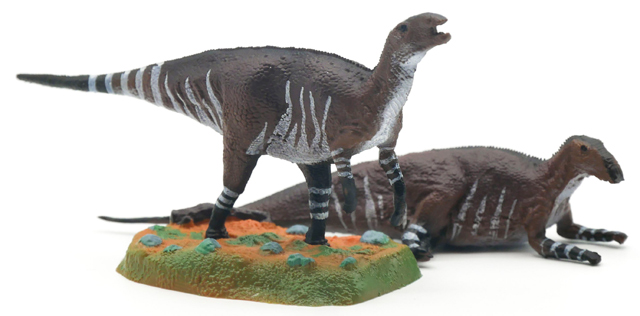
The Wild Past Tethyshadros pair are in stock at Everything Dinosaur. Two stunning Tethyshadros figures, one standing, one resting and a display base. This is the second model introduction from Wild Past and it is great to see such an important dinosaur represented in model form.
The Wild Past Tethyshadros dinosaur models.
Tethyshadros insularis
Formally named and scientifically described in 2009, Tethyshadros (T. insularis) is one of only a handful of dinosaurs known from Italy, although numerous trace fossils have been identified with many dinosaur trackways reported. It was once thought that the chances of finding dinosaur bones in Italy were remote, much of the landmass was covered by the Tethys Ocean for a considerable portion of the Mesozoic. However, carbonate platforms were built up and an archipelago of islands (some of them substantial in size), were formed. Tethyshadros occupied one such island, located in the western Tethys. Its relative diminutive size (around 4.2 metres in length), may be a reflection of insular dwarfism when limited resources leads to dwarf forms evolving.
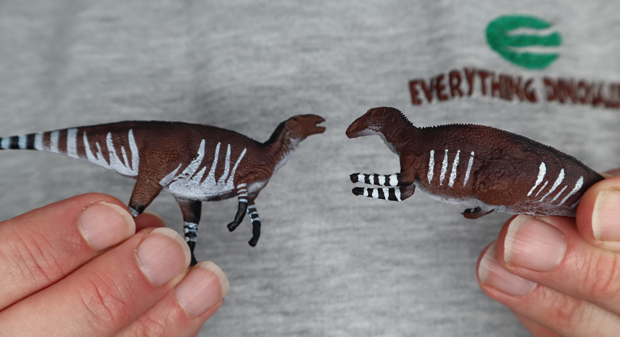
The two hand-painted Tethyshadros figures (Wild Past). The figures represent a dinosaur that lived on a large island in the Tethys Ocean that had formed from the deposition of carbonate from sessile organisms such as scleractinian corals. Picture credit: Everything Dinosaur.
Picture credit: Everything Dinosaur
Approximately 1:35 Scale
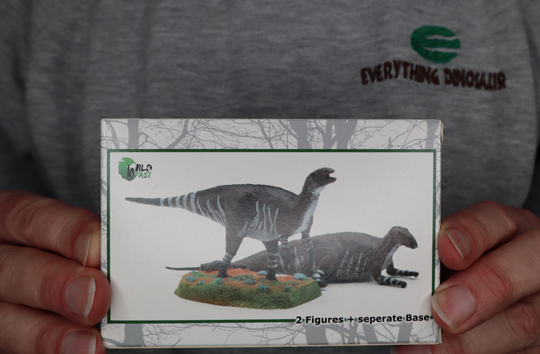
The standing figure measures a fraction under 11 cm in length and stands around 4.5 cm high, whilst its counterpart, the Tethyshadros in the resting pose measures a little under 10.5 cm long. They have been beautifully painted and are sold in a presentation box which features an illustration by the talented artist Joseph Fells. The figures are reported to be in 1:35 scale.
Wild Past Tethyshadros dinosaur models (box contents) with the illustration by Joseph Fells.
In order to get the Tethyshadros model to stand securely in the footprints on the display base we added a small piece of blu tack to the base of each hind foot. The figure can always be glued into place if required, but we found the additional support from the adhesive helped to stabilise the figure. The display base has been well painted and the figures make a welcome addition to the range of hadrosauroid models that are available to collectors.
The front of the Wild Past Tethyshadros box. The set includes two figures (one resting, one standing) and a display base. The models are approximately in 1:35 scale. Picture credit: Everything Dinosaur.
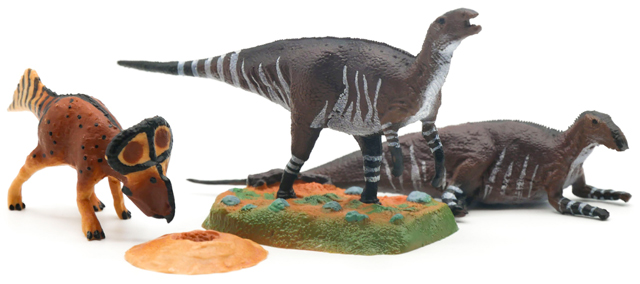
The pair of Tethyshadros dinosaurs are the second model introduction in the Wild Past range after the initial introduction of the Protoceratops with nest model that came out in 2020.
The Tethyshadros models are the second dinosaur figures to be introduced by Wild Past after the introduction of the Protoceratops model in 2020.
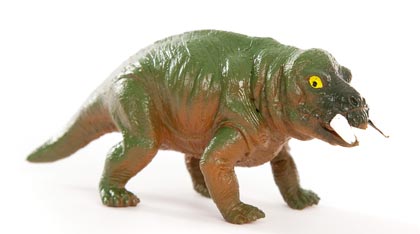
Everything Dinosaur has received lots of requests for a Placerias model, so our dedicated team members responded by making sure customers could pick up a Placerias if they wanted to. This large, Late Triassic dicynodont has remained popular ever since it appeared in the very first episode of the ground-breaking BBC television documentary “Walking with Dinosaurs” back in 1999. We have brought in a special batch of prehistoric animal figures to ensure that there are plenty of Placerias to go around. We have tried our best to ensure collectors can pick up a Placerias prehistoric animal model.
The Placerias figure available from Everything Dinosaur whilst stocks last. Team members have brought in a special batch of prehistoric animal figures to ensure that there are plenty of Placerias. Picture credit: Everything Dinosaur.
Picture credit: Everything Dinosaur
An Inexpensive Prehistoric Animal Figure
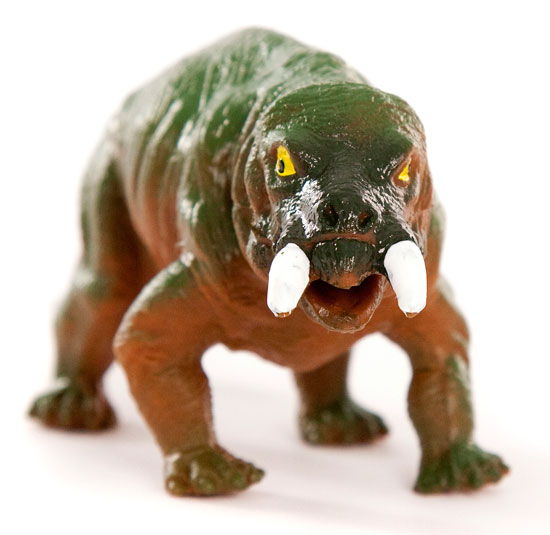
The Placerias is available as part of a set of inexpensive prehistoric animal figures that we stock. However, we were receiving so many requests for this particular figure that stocks soon ran out. Team members have arranged to bring in a special production run of these prehistoric animals and this has permitted the model to be made available for sale as an individual item.
Placerias model in anterior view. Making Late Triassic dioramas is now a lot easier as dinosaur fans and model collectors can pick up a Placerias. Picture credit: Everything Dinosaur.
Picture credit: Everything Dinosaur
A spokesperson from Everything Dinosaur commented:
“This Placerias model is very similar to the dicynodonts that featured in the first ever episode of the BBC series “Walking with Dinosaurs”. The episode was called “New Blood” and depicted the faunal turnover that was taking place in the Late Triassic as the dinosaurs were beginning to be dominate terrestrial ecosystems. A herd of green-coloured Placerias, very similar to our Placerias model were slowly dying out as they could not adapt to dramatic climate change.”
At the time it was made the award-winning “Walking with Dinosaurs” television series was the most expensive project undertaken by the BBC in terms of the cost per minute of screen time. Placerias was depicted as a member of the Ghost Ranch biota of New Mexico. Terrestrial environments during the Late Permian had been dominated by the herbivorous Dicynodontia. Although severely depleted as a result of the End-Permian mass extinction, these therapsids survived throughout the Triassic before finally becoming extinct as more arid conditions favoured the emerging dinosauromorphs that were to take over the role as megaherbivores in Late Triassic ecosystems.
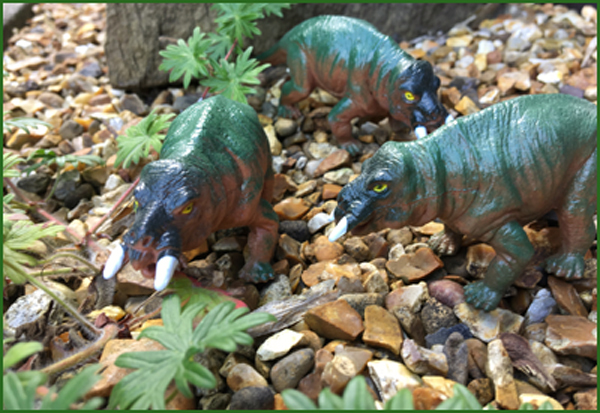
A trio of Placerias models. The Placerias replica is great for creating Triassic dioramas. This Placerias model is available from Everything Dinosaur. Picture credit: Everything Dinosaur.
Picture credit: Everything Dinosaur
The Placerias prehistoric animal model can be found (whilst stocks last), on this section of the Everything Dinosaur website: Dinosaur Toys and Gifts.
Update: CollectA have added a 1:20 scale replica of Placerias to their Deluxe model range.
A team of scientists writing in the journal Current Biology have applied new statistical methods to assess how constrained different types of mammals were before and after the K-Pg extinction event that saw the demise of the non-avian dinosaurs. The researchers conclude that dinosaurs were probably not the main competitors of mammals during the Mesozoic. In addition, this study indicates that the ancestors of modern mammals during the age of the dinosaurs remained less diverse because of competition from other mammal groups.
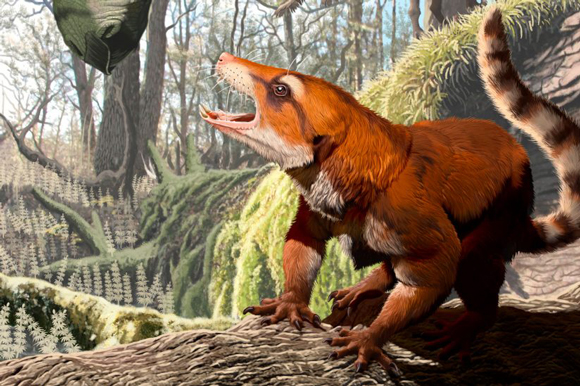
A life reconstruction of the stem mammal C. wahkarmoosuch. Mammals during the Mesozoic were thought to have been limited in their ecological niches due to the dominance of the Dinosauria. New research suggests that the dinosaurs were probably not the main competitors of mammaliaforms. Picture credit: Jorge A. Gonzalez.
Analysing the Variability of Mammal Fossils from the Mesozoic
The research involved scientists from the Oxford University Museum of Natural History, the University of Birmingham and Oxford University and its aim was to challenge the long held belief that it was the non-avian dinosaurs dominating terrestrial environments that in effect, held back and stunted the evolution of mammals. Their conclusions such as the extinction of other mammal groups was more beneficial to modern mammals than the extinction of non-bird dinosaurs, highlights the importance of testing established ideas about evolution with new, modern methods.
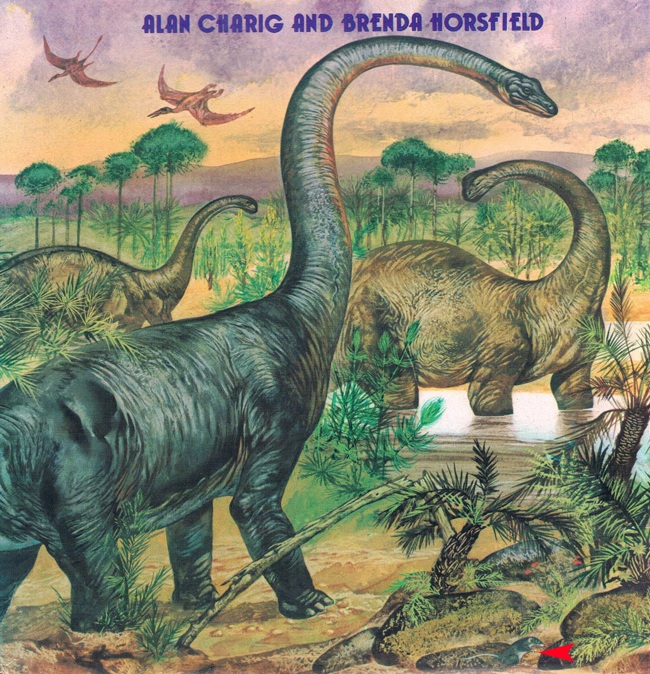
The 1975 BBC book “Before the Ark” depicts a small mammal (arrowed) in a world dominated by dinosaurs and other reptiles. This new study challenged the old and established idea that it was the dinosaurs that outcompeted early mammals restricting them to small size and non-specialised roles with terrestrial ecosystems.
Earlier Branches of the Mammal Evolutionary Tree Dominated
Co-author of the study Dr Elsa Panciroli (Oxford University Museum of Natural History), commented:
“There were lots of exciting types of mammals in the time of dinosaurs that included gliding, swimming and burrowing species, but none of these mammals belonged to modern groups, they all come from earlier branches in the mammal tree. These other kinds of mammals mostly became extinct at the same time as the non-avian dinosaurs, at which point modern mammals start to become larger, explore new diets and ways of life. From our research it looks like before the extinction it was the earlier radiations of mammals that kept the modern mammals out of these exciting ecological roles by outcompeting them”.
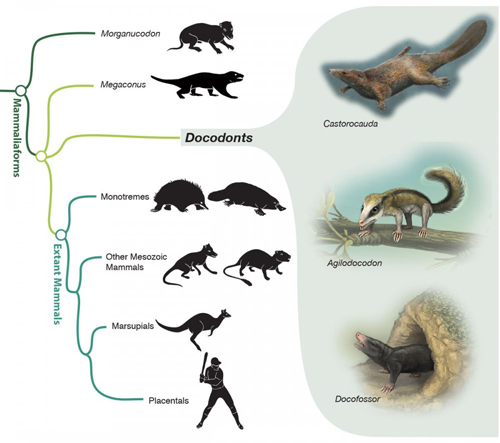
Examining the phylogeny of early mammaliaforms. The diversity of early mammaliaforms such as the docodonts may have prevented the Metatheria (marsupials) and the Eutheria (placental mammals) which are collectively known as the Theria, from becoming more diverse in the Mesozoic. Picture credit: University of Chicago (illustration by April Neander).
The Therians Kept in Check by Other Types of Mammaliaforms
Most of the mammal species alive today trace their origins to groups that expanded explosively 66 million years ago, when a mass extinction killed all non-avian dinosaurs. It was traditionally thought that, before the extinction, mammals lived in the shadow of the dinosaurs. They were supposedly prevented from occupying the niches that were already occupied by the giant reptiles, keeping the mammals relatively small and unspecialised in terms of diet and lifestyle. It appeared that they were only able to flourish after the dinosaurs’ disappearance left these niches vacant.
However, new statistical methods were used to analyse how constrained different groups of mammals were in their evolution before and after the mass extinction. These methods identified the point where evolution stopped producing new traits and started producing features that had already evolved in other lineages. This allowed the researchers to identify the evolutionary “limits” placed on different groups of mammals, showing where they were being excluded from different niches by competition with other animals. The results suggest that it may not have been the dinosaurs that were placing the biggest constraints on the ancestors of modern mammals, but their closest relatives.
The study looked at the anatomy of all the different kinds of mammals living alongside dinosaurs, including the ancestors of modern groups, also known as therians (placentals and marsupials).
By measuring how frequently new features appeared, such as changes in the size and shape of their teeth and bones, and the pattern and timing of their appearance before and after the mass extinction, the researchers determined that the modern mammals were more constrained during the time of the dinosaurs than their close relatives. This meant that while their relatives were exploring larger body sizes, different diets, and novel ways of life such as climbing and gliding, they were excluding modern mammals from these lifestyles, keeping them small and generalist in their habits.
Everything Dinosaur acknowledges the assistance of a press release from the University of Oxford in the compilation of this article.
The scientific paper: “Mammaliaform extinctions as a driver of the morphological radiation of Cenozoic mammals” by Neil Brocklehurst, Elsa Panciroli, Gemma Louise Benevento and Roger B.J. Benson published in Current Biology.
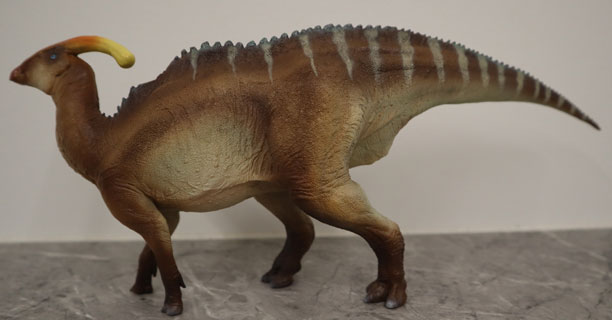
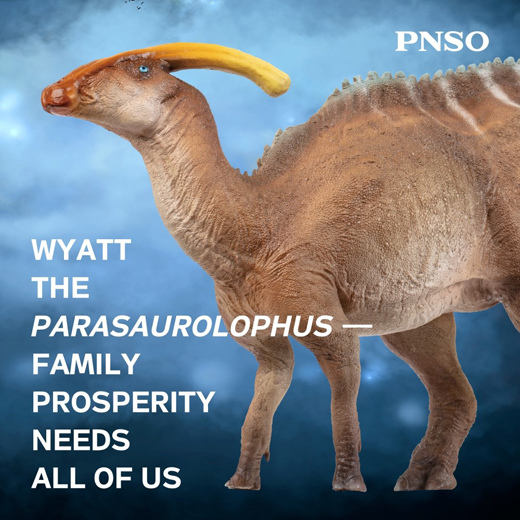
Whilst working in one of Everything Dinosaur’s packing rooms a PNSO Parasaurolophus model was spotted. This gave team members the opportunity to take some photographs of this superb, duck-billed dinosaur model. The Parasaurolophus figure (Wyatt the Parasaurolophus), is a recent introduction into the PNSO mid-size model range and it is the third hadrosaur to be added after the Corythosaurus and Lambeosaurus that came out last year.
PNSO Wyatt the Parasaurolophus dinosaur model in lateral view, a stunning replica of a Late Cretaceous duck-billed dinosaur. Picture credit: Everything Dinosaur.
Picture credit: Everything Dinosaur
A Blue-eyed Ornithopod
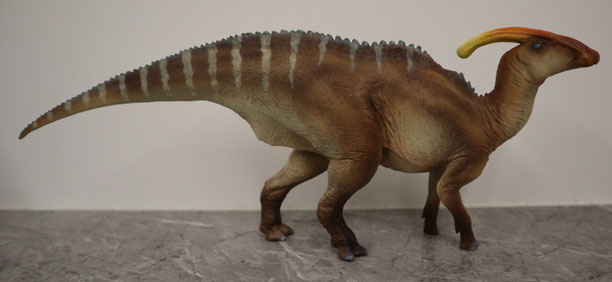
PNSO have built up a strong reputation in the last few years or so for the quality of their dinosaur models and figures. The Parasaurolophus has been beautifully painted with fantastic countershading, a spectacular, brightly coloured head crest and this ornithopod has been given a blue eye. The details on the skin are praiseworthy with lots of skin folds and texture giving the impression of bulk and movement. Stripes descending down the flanks and running along to the end of the tail would have helped to break-up the outline of this large herbivore and helped to camouflage it from marauding tyrannosaurs.
A PNSO Wyatt the Parasaurolophus spotted going for a wander in one of Everything Dinosaur’s packing rooms. Picture credit: Everything Dinosaur.
Rave Reviews from Dinosaur Fans and Model Collectors
Although this dinosaur model has not been out for long, it has already received rave reviews from dinosaur fans and model collectors.
For example, in a 5-star Feefo review posted on Everything Dinosaur’s website the reviewer described Wyatt the Parasaurolophus as “Perfect!”
Another reviewer who commented on their purchase on our website referred to this Parasaurolophus model as:
“very scientifically accurate, beautiful colour scheme and natural relaxed pose”.
The Parasaurolophus model measures a fraction under 28 centimetres in length and that magnificent head crest is around 11 cm off the ground.
PNSO Wyatt the Parasaurolophus dinosaur model. Part of a range of beautifully designed prehistoric animal figures made by PNSO. It joins a Corythosaurus (Caroline the Corythosaurus) and a Lambeosaurus (Audrey the Lambeosaurus) that were introduced into this range in 2020.
To purchase the PNSO Wyatt the Parasaurolophus and to see the rest of the amazing PNSO prehistoric animals available from Everything Dinosaur: PNSO Age of Dinosaurs.
Our thanks to model collector and dinosaur fan William who sent us at Everything Dinosaur a comprehensive review of his recently purchased PNSO Essien Spinosaurus figure (mid-size model range). Not only did William review the figure, he also provided some information about the science behind Spinosaurus.
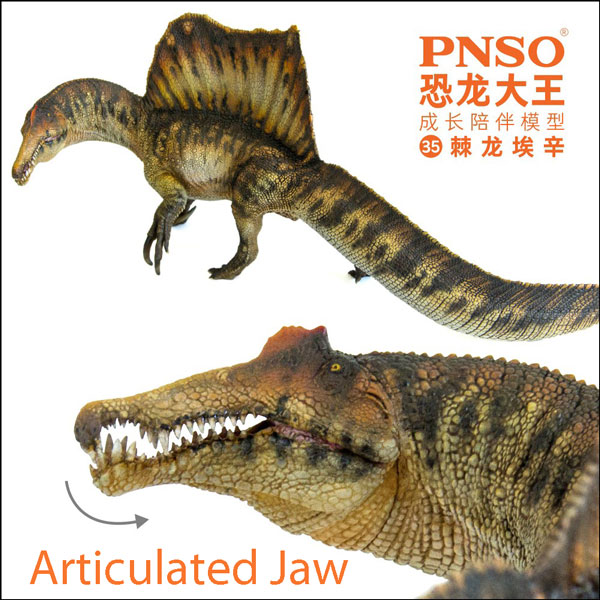
PNSO Essien the Spinosaurus dinosaur model. This Spinosaurus figure has an articulated lower jaw.
The Spinosaurus Review
Starting with the head there is a fully articulated jaw. A perfect blend within the skull ending in the classical Spinosauridae notched upper rostrum which aids with holding slippery prey items. Essien’s teeth are carefully reproduced from the fossil specimen with slender and crocodile-like dentition. The eyes are correctly situated high on the skull, as are the nostrils to aid breathing while hunting with his rostrum dipped under the surface. An elongated crest completes the head sculpt.
PNSO have given Essien some very finely detailed and varied skin scaling, in addition, the model has a crocodilian-like dewlapped pouch. One could see a female Spinosaurus transporting her wriggling brood down to a safe nursery stream. The neck is muscular and powerful and there is only the slightest hint of a shrink-wrap effect around the eye socket.
The packaging for the PNSO Spinosaurus dinosaur model.
Powerful Forelimbs
The figure has strong, powerful forearms with three long claws on each hand. The right hand (manus), is set in a knuckle walking pose but looks very natural. The hindlimbs are on the money with correct toe placement and webbing between the toes. Essien has the signature body plan which denotes the pinnacle of Spinosauridae evolution. The model has a cloaca and it is correctly placed.
The beautiful artwork on the PNSO Essien the Spinosaurus box. Picture credit: Everything Dinosaur.
Picture credit: Everything Dinosaur
The Spinosaurus Sail
William describes this Spinosaurus figure as:
“The finest model on the market and one that will be rather hard to beat”.
He goes on to highlight the details of the sail which reflects the latest scientific interpretation. The sail is described as curving upwards into a rounded peak which then dips but then rises again forming a second peak over the hips.
The function of this feature is discussed and various suggestions proposed:
Heat dissipation
Showing maturity and fitness for breeding
A warning or threat display
An aid to propulsion through water
William adds:
“Essien has been given beautiful, finely detailed vertebrae/ribs. Each section of the sail vertebrae is covered in large thick scales with smaller ones in the skin between them all anchored at the base of the sail with robust scute-like scales. One feature not found in any other model is if you hold him up to sun light the sail becomes translucent”.
PNSO Essien the Spinosaurus (dorsal view). William suggests that this figure is in approximately 1:50 scale and refers to the tail as being capable of producing “muscular thrust”.
Spinosaurus Colouration
William suggests that the figure has been posed as if it has spotted a rival and is about to bellow out a challenge. His comprehensive review also included commentary on the paint scheme stating that the main base colours are a combination of rich red and yellow ochres, with darker stripes running from the back of the neck to the end of the tail. The white teeth are set within a pink palate and tongue the head has a prominent nasal ridge. He comments that the wash coat given to the mouth area is a great finishing touch providing a natural wet look.
The review concludes with William providing some details on Spinosaurus aegyptiacus.
Time Period: 99-93.5 million years (Late Cretaceous).
William goes on to state that the debate continues with regards to how much time this dinosaur spent in water and how it hunted. Potential prey such as Onchopristis is mentioned.
The review concludes with William commenting:
“We Your Customers/Friends wish to thank you all for being a company owned and run by folks who we hold in the highest regard. Thank you for being our friends and thank you for being Everything Dinosaur. If you need accurate models to aid with school project diorama or information packs to aid with learning of the Wee Future Palaeontologists all you have to do is contact the team at Everything Dinosaur for prompt advice and assistance.”
Our thanks to William, we hope our synopsis of his comprehensive review in some small way does justice to the considerable time and effort put in producing it.
To purchase Essien the Spinosaurus and the other figures in the PNSO model range: PNSO Age of Dinosaurs.