All about dinosaurs, fossils and prehistoric animals by Everything Dinosaur team members.

Articles, features and information which have slightly more scientific content with an emphasis on palaeontology, such as updates on academic papers, published papers etc.

9 06, 2015

Annual Queensland Dinosaur Dig Yields Rare Fossils

By |2024-05-05T13:42:59+01:00June 9th, 2015|Categories: Dinosaur and Prehistoric Animal News Stories, Dinosaur Fans, Main Page, Palaeontological articles|0 Comments

Queensland Dinosaur Dig Unearthing Bones

At the beginning of the month we reported on the annual Australian dinosaur excavations that were opening up once again in Queensland.  As the digs continue to progress, scientists from the Australian Age of Dinosaurs Museum (Winton), have stated that a number of new dinosaur fossils have been found.

At the start of the dig season, palaeontologists had expressed the wish to discover a new species of Cretaceous dinosaur, given the wealth of material recovered so far it seems that there is a strong possibility that the fossil specimens, once fully prepared might lead to the identification of a new genus of Australian dinosaur.

To read Everything Dinosaur’s earlier article about the annual excavations: Time for Some More Aussie Dinosaurs.

Queensland Dinosaur Dig

The exposed strata around Winton dates from the Late Cretaceous (98 to 95 million years ago).  During this time, (Late Albian faunal stage of the Lower Cretaceous), Australia was beginning to separate from Antarctica as the super-continent of Gondwana continued to break up, most of the dinosaur’s described from Queensland rocks are unique to Australia, although they are related to other types of dinosaur found elsewhere in the Southern Hemisphere.

Dr Stephen Poropat (Australian Age of Dinosaurs), commented that a number of intriguing specimens had already been found including some large dinosaur bones.

He added:

“We are looking for a sauropod dinosaur, so a long-necked dinosaur with four elephant-like legs and then a long tail – and we know that because we have found some of its back bone and some of its ribs.”

A number of locations are currently being explored, some of them have not been studied and mapped before.   It is hoped that these excavations and the dinosaur discoveries will help to provide a boost to the local economy as tourists visit the area to view Australia’s very own “Jurassic Park”, or to be more correct and with the age of the strata considered it would be more appropriate to refer to this location as “Cretaceous Park”.

Discovery of a Scapula

The Australian Age of Dinosaurs Executive Chairman, David Elliott explained that the work carried out so far, it had been hard going but some significant finds had been unearthed.

Mr Elliott stated:

“We found one really nice scapula [shoulder bone], like a big shoulder blade and it is beautiful, it is quite a large bone.”

Dinosaur bones had been found at several locations, the Executive Chairman added:

“We’re just starting to really hit on the bones now, we have found this big row of boulders, and we are talking massive boulders, like the size of a ute [utility vehicle].”

Once identified as fossil bearing rock, these large boulders will have to be carefully jacketed and then loaded onto either large pick-up trucks (utes to use the local vernacular), or onto a low loader.  Once safely back at the laboratory, the careful job of preparing and cleaning the fossilised bones can begin.

Although, Everything Dinosaur team members have no additional information at this stage and we have not received details of the measurements of any fossil material, but if the fossils are as large as predicted, then the palaeontologists will probably be looking at another sizeable Australian titanosaur, perhaps something in excess of twenty metres in length.

Australian Titanosaurs

A number of titanosaurs are already known from this part of the world, dinosaurs such as Wintonotitan (W. wattsi), which may have reached a length of around fifteen metres or so when fully grown and the slightly smaller Diamantinasaurus (Diamantinasaurus matildae).  The palaeoenvironment must have been particularly rich and diversified to be able to sustain a number of different types of Titanosaurs within the same habitat.

We look forward to hearing more about these new fossil discoveries from Queensland.

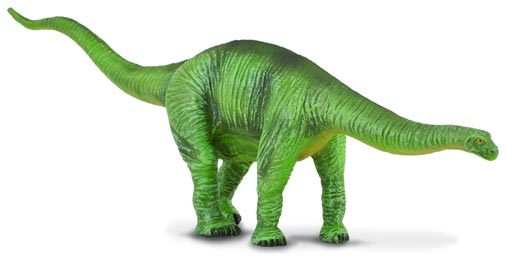
For dinosaur models and figures including replicas of Australian dinosaurs: CollectA Prehistoric Life Models.

2 06, 2015

Britain’s Oldest Sauropod as Rare Fossils Found

By |2024-05-05T14:14:26+01:00June 2nd, 2015|Categories: Dinosaur and Prehistoric Animal News Stories, Dinosaur Fans, Palaeontological articles|0 Comments

A New Sauropod Dinosaur from the Middle Jurassic

Here is a tale of a tail bone from the United Kingdom, one that once formed part of the skeleton of a primitive sauropod that lived in Yorkshire some 176 million years ago.  It fell out of a cliff and was found on the beach close to the north Yorkshire coastal town of Whitby, not too far away from the famous Abbey.  The fossil was sent to the University of Manchester for further study and detailed X-ray computer tomography analysis was undertaken at the nearby Manchester Royal Infirmary (Dept. of Radiology) in a bid to learn more about the specimen.

The fossil represents a caudal vertebra (a tail bone) one that would have been located in the long tail but near to the hips.

Britain’s Oldest Sauropod

Team members at Everything Dinosaur have seen this specimen up close.  We were shown the fossil on a visit to Manchester University some years ago by Professor Phil Manning.  A paper detailing this discovery has been published in the journal PLOS One, Professor Phil Manning co-authored this paper along with colleague Victoria Egerton (School of Earth, Atmospheric and Environmental Sciences) with the help of Mike Romano, an independent researcher based in Sheffield (South Yorkshire).

The Sauropod Dinosaur Tail Bone

The specimen is currently housed at the Yorkshire Museum (York).

The specimen is currently housed at the Yorkshire Museum (York).

Picture credit: Manchester University

An Indeterminate Sauropod Caudal Vertebra

The picture above shows the indeterminate sauropod caudal vertebra, the face of the centrum can clearly be seen as can the hole in the bone which represents the neural canal where the spinal cord passed through.  The specimen is significant as it comes from the Saltwick Formation which forms one of the oldest sequences of rock from the Ravenscar Group of largely terrestrial deposits laid down in an estuarine environment.

Very few body fossils have been found in these rocks, but a number of dinosaur trackways have been described.  These tracks represent a number of different types of dinosaur, theropods, stegosaurs, ornithopods and long-necked dinosaurs – sauropods.  The strata was formed around 176 million years ago (Aalenian faunal stage ) of the Middle Jurassic.  This fossilised bone is therefore the oldest sauropod fossil scientifically described from the British Isles.  It is some 4 million  years older than the Cetiosaurus spp. material which has been described from strata laid down during the Bajocian and Bathonian faunal stages of the Jurassic.

A New Species

It most certainly represents a new species and the specimen had been nick-named “Hildasaurus” after St Hilda, the abbess who founded Whitby Abbey on the East Cliff overlooking the town.  However, due to the very low number of sauropod caudal vertebrae that have been described from the Middle Jurassic, it is not possible to assign this fossil to a new species and to give the dinosaur bone a binomial scientific name.

A Typical Cetiosaurid Sauropod Dinosaur

Cetiosaurus early Sauropod

Cetiosaurus model – an early sauropod.

Picture credit: Everything Dinosaur

Professor Manning explained:

“It was a splendid surprise to come face-to-face with a fossil vertebra from the Jurassic rocks of Yorkshire that was clearly from a sauropod dinosaur.  This fossil offers the earliest “body fossil” evidence for this important group of dinosaurs but it’s impossible to define a new species based on this single bone.”

 Views of the Caudal Vertebra (Specimen Number: YORYM: 2001.9337)

Not possible to determine a species for this important fossil.

Not possible to determine a species for this important fossil.

Picture credit: PLOS One

“Hildasaurus”

The picture above shows two further views of the fossil material (A) oblique view (photograph taken at an angle, not quite an anterior view), which shows a distinct keel on the bottom of the bone and a partial caudal rib (CR) that can be seen on the left of the bone.

Key (Picture A)

PRZ = prezygapophysis – a peg of bone located on the neural arch which articulates with the next tail bone in the caudal vertebrae sequence.

SPRF = spinoprezygapophyseal fossa – a channel in the reinforcing ridge of bone commonly associated with sauropod vertebrae that strengthens the connection between the bones

CPRL = centroprezygapophyseal lamina – the ridge of bone the connects the centrum with the prezygapohysis at the top of the vertebra

CR = caudal rib – one of a pair of thin, struts of bone that point out at roughly ninety degrees to the face of the centrum.  These small bones support tail muscle attachments.

KEEL = keel – describes the shape of the bone at the base of the centrum.

Not an Example of Cetiosaurus

Although the fossil bone is not complete, these features have helped the scientists to determine that this specimen, most probably does not represent a Cetiosaurus.  Caudal tail bones located relatively close to the hips, such as those fossils assigned to the “Rutland Cetiosaurus” lack the keel shaped portion of bone on the ventral face of the vertebra.  In addition, the fragment of caudal rib present in the specimen is located at a different position in relation to the centrum when compared to the caudal ribs found on cetiosaurid fossil material.

Picture B shows a lateral view (a view of the right side of the fossil).  The shape of the neural spine (NS) can be clearly seen in this view.

Key (Picture B)

NS = neural spine, a blade shaped bone projection that sits on top the neural arch.

SPRL =  spinoprezygapophyseal laminae – a ridge of bone that strengthens the connection between the neural  with one of the prezygapophyses.

FOSSAE = recessed areas or depressed areas of bone (single = fossa).

In both picture A and B, the scale bar is 5 cm.

Although, the caudal vertebra is similar to that found in Cetiosaurus spp. and has some potential affinity with another sauropod called Haplocanthosaurus (Upper Jurassic Morrison Formation of the United States), the morphological differences described indicate that this fossil bone does represent a new, as yet undescribed species of long-necked, Middle Jurassic dinosaur.

A Close up View of the Sauropod Fossil showing the Distinctive Keel

Ventral view (view from underneath)

Ventral view (view from underneath).

Picture credit: PLOS One with additional annotation from Everything Dinosaur

Pointed Keel Representing Britain’s Oldest Sauropod

The pointed keel shape can be made out in this ventral view (photograph above).  The density of the surrounding matrix made CT interpretation difficult but enough of the fossil bone has been prepared to confirm the sauropod diagnosis but genus level or even family level identification is not possible.  Fossilised fragments of plant rootlets and other material has helped the palaeontologists to identify the origins of this fossil, even though it was found on the beach having eroded out of the cliff face.

The lack of abrasion (erosion) on any of the exposed faces suggests that this fossil was not transported far prior to burial, or indeed, that the fossil material had not been exposed on the shore for very long prior to its discovery.

This discovery gives team members at Everything Dinosaur the opportunity to applaud the hard-working team of scientists (both amateur and professional) that so conscientiously dedicate so much time to the exploration and study of the many important geological sites in the British Isles.  It was Alan Gurr who actually found this proximal caudal vertebrae on a field trip led by Professor Phil Manning.

The specimen (YORYM:2001.9337), may not be able to be assigned to a species, but the fossil was nick-named “Alan” in honour of the finder.  The very talented Mike Marshall of Yorkshire Coast Fossils was responsible for preparing the vertebrae and such careful preparation permits a rare insight into the ancient fauna of the Jurassic.

30 05, 2015

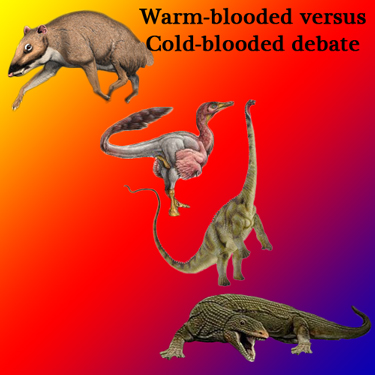
Dinosaurs were Warm-blooded? Debate Hots Up with New Research

By |2024-05-05T14:16:43+01:00May 30th, 2015|Categories: Dinosaur and Prehistoric Animal News Stories, Main Page, Palaeontological articles|0 Comments

New Study Suggests Dinosaurs were Warm-blooded (Endothermic)

A scientist from Stony Brook University has reassessed a study into whether dinosaurs were cold or warm-blooded.  Dr Michael D’Emic, a palaeontologist at the New York based university, has re-examined the research in a report published last summer which proposed that dinosaur metabolism was a kind of “half-way house” between a cold-blooded reptile and that of a warm-blooded mammal.  Palaeontologist Dr D’Emic suggests that dinosaurs were not mesotherms (half-way between cold and warm-blooded), but instead their growth rates suggest that the Dinosauria are indistinguishable from the Mammalia in terms of their metabolism.

The Debate Over Dinosaur Metabolism Heats Up

Where on the spectrum between endothermic and ectothermic are the Dinosauria?

Where on the spectrum between endothermic and ectothermic are the Dinosauria?

Picture credit: Everything Dinosaur

Published a Technical Comment

Yesterday, (May 29th), Dr D’Emic’s study was published as a technical comment in the academic journal “Science” in response to the 2014 research.  In the absence of a living, non-avian dinosaur to study, the debate boils down to interpretation of the evidence and statistical analysis. But why the fuss over what kind of metabolism the dinosaurs had?

Ectothermic versus Endothermic – It is Rather Important

We at Everything Dinosaur doubt very much that members of the public are going to be whopping and hollering about ectotherms (cold-blooded animals) or endotherms (warm-blooded) as they leave cinemas in a few weeks time having just watched “Jurassic World”, but understanding the metabolism of the Dinosauria is essential if scientists are really going to be able to learn how these animals lived and behaved.  Let’s kick off with some simple explanations.

What does it mean to be Cold-blooded or Warm-blooded?

These terms are frequently used, but they are themselves a little misleading.  These two distinct states do not define all vertebrates, things are a little more complicated than that, but in essence a creature that is regarded as cold-blooded relies on external sources to help regulate its body temperature.  Typical examples are lizards and snakes basking in the sun to warm up in the morning, but then seeking much cooler shade to avoid over-heating in the middle of the day.

Warm-blooded animals (mammals and birds), are able to maintain a body temperature that is higher than the temperature of the environment.  In simple terms, they can generate their own body heat. This heat comes from the animal’s metabolism, the chemical reactions that take place in the body (although there are other methods of keeping cool and warming up).

Applying this to the Dinosauria

If the dinosaurs had the same body chemistry as a crocodile (a reptile, regarded as an ectotherm), then they would have been relatively inactive compared to large mammals.  Nocturnal activity could have been reduced along with geographical distribution, very cold environments would have been extremely hostile to cold-blooded dinosaurs.  This is why today, we see the majority of reptile species confined to the tropics.  If the dinosaurs had the same metabolism as birds and mammals, then they would have been much more active and not reliant on external sources to help maintain a body temperature that enabled them to function.

Body Chemistry

The type of body chemistry employed would impact on every aspect of their lives – migration, breeding, food intake, social interactions, growth rates, intra-specific and inter-specific competition and so forth.

Take food as an example.  Whether herbivore, omnivore or carnivore, an ectotherm requires a lot less food in order to survive than an equivalent sized endotherm.  Lions (warm-blooded),  have to feed every three to five days on average.  They have high metabolisms and high food demands as a result.  Nile crocodiles that live in the same environment need much less food.  One substantial meal can last a Nile crocodile several months, crocs are much less expensive to run.  Sunlight can provide their bodies with all the heat they need, they don’t need to create it themselves, so their bodies need less food.

Dinosaurs were Warm-blooded

Over the years, team members at Everything Dinosaur have posted up articles on the ectotherm versus endotherm debate.  In June 2014, we published a feature on the research carried out by student John Grady (University of New Mexico) in association with colleagues from the University of Arizona and the Sante Fe Institute.  It is the results of this research that Dr D’Emic has reassessed.

To read about the June 2014 study: Goldilocks and Dinosaurs – The Warm-blooded/Cold-blooded Debate.

Dr D’Emic proposes that further analysis of microscopic growth rings preserved in dinosaur fossil bone, suggests that dinosaurs grew as quickly as mammals.  This suggests fast metabolisms and therefore that the Dinosauria were endothermic.  The earlier study had undertaken a detailed analysis on the growth rates of a wide variety of extinct and extant organisms.  The research team led by John Grady concluded that dinosaurs were mostly like mesotherms.

Dr D’Emic stated:

“Upon re-analysis, it was apparent that dinosaurs weren’t just somewhat like living mammals in their physiology – they fit right within our understanding of what it means to be a “warm-blooded” mammal.”

Examining Bone Structure

As a Research Instructor in the Dept. of Anatomical Sciences, Dr D’Emic specialises in the study of the structure of bone.  Using microscopic slices of fossil bone that has been carefully cut and polished, the doctor read growth rings preserved in the bone just as a dendrochronologist examines tree rings.  He looked at the 2014 study from two specific view points, firstly the research had scaled down yearly growth rates to daily ones in order to standardise  the data.

Commenting on this aspect of the earlier study, he explained:

“This is problematic, because many animals do not grow continuously throughout the year, generally slowing or pausing growth during colder, drier, or otherwise more stressful seasons.”

He concluded that the 2014 study may have underestimated the growth rate of the different types of dinosaur included in the dataset, by failing to account for their uneven growth.  Like many extant animals, dinosaurs slowed or paused their growth.  This is marked by the growth rings that can be made out in micro-anatomical bone studies.  The doctor added that growth rates were especially underestimated for larger animals and animals that live in very stressful or seasonal environments – both of which characterise the Dinosauria.

Microscopic studies of Dinosaur Bone Reveal Growth Rings

The bands mark periods of arrested or stopped growth.

The bands mark periods of arrested or stopped growth.

Picture credit: Stony Brook University

Secondly, in the paper entitled “Evidence for Mesothermy in Dinosaurs”, birds in the sample studied were treated separately from the twenty-one dinosaurs that were included,  In this reassessment, birds and dinosaur data was included as one homogeneous group.  Birds are warm-blooded and they are direct descendants of dromaeosaur dinosaurs.

The doctor explained:

“Separating what we commonly think of as “dinosaurs” from birds in a statistical analysis is generally inappropriate, because birds are dinosaurs – they’re just the dinosaurs that haven’t gone extinct.”

Were Dinosaurs Mesotherms?

Under these new conditions for examining the statistics, the birds being included in the dinosaur assessment data, lends more weight to the idea that the Dinosauria were endothermic and not the “half-way house” as mesotherms.

It seems that as with virtually all studies of this nature, the way that the data is handled and the terms of reference will influence the conclusions that can be drawn.

Microscopic Analysis of Fossilised Bones Helps Identify Growth Patterns

A microscopic image of the thigh bone (femur) of a dinosaur shows concentric rings. The rings represent unrecorded time, so an annual growth rate (dashed line in graph) is an underestimate relative to the true growth rate during the favourable growing season.

A microscopic image of the thigh bone (femur) of a dinosaur shows concentric rings. The rings represent unrecorded time, so an annual growth rate (dashed line in graph) is an underestimate relative to the true growth rate during the favourable growing season.

Picture credit: Scott Hartman

Comments regarding this new assessment of the earlier research have already been made.  For example, the team behind the 2014 study have responded to this analysis by commenting that the new study raises a number of important statistical and methodological questions, however, the proposals made lack biological and statistical justification.

All scientists who step bravely into this area of academic endeavour deserve our admiration, both papers are part of the rich and extremely diverse range of research that has gone into tackling this very thorny problem, it seems that the warm-blooded versus cold-blooded debate is likely to rumble on.

29 05, 2015

A New Face to the Human Family Tree

By |2023-03-30T13:49:27+01:00May 29th, 2015|Categories: Dinosaur and Prehistoric Animal News Stories, Main Page, Palaeontological articles|0 Comments

Australopithecus afarensis Had Neighbours!  Say Hello to Australopithecus deyiremeda 

Had you and I been able to travel back in time to the Afar region of northern Ethiopia some 3.4 million years ago in a bid to meet our ancient ancestors, we might have been spoilt for choice when it comes to trying to work out from which species we are descended from.  Lucy* the most famous example of Australopithecus afarensis had company, she had neighbours, a newly described species of Australopithecine has just been announced.

Two fragmentary upper jaws along with two fragments of lower jaws, representing fossil material from three individuals were found in March 2011 in the Woranso-Mille area of the Afar region.  These fossils have been assigned to an entirely new genus of Australopithecine, say hello to Australopithecus deyiremeda. 

Casts of the Four Fossil Jaws are Displayed

A new Australopithecus species has been described.

A new Australopithecus species has been described.

Picture credit: Laura Dempsey

Australopithecus deyiremeda

The fossil material assigned to Australopithecus deyiremeda (pronounced ost-tral-oh-pith-e-kus day-ihremy-dah) was described by a team of international palaeoanthropologists led by Dr Yohannes Haile-Selassie, the Curator of Physical Anthropology at the Cleveland Museum of Natural History (Cleveland, Ohio).  The fossils are estimated to between 3.3 million and 3.5 million years old, which means that this species overlapped and lived in the same region as Australopithecus afarensis, the species that the famous fossils called “Lucy” have been assigned to.

However, although A. deyiremeda and A. afarensis lived at the same time and shared the same habitat, the “Lucy” fossil material has been dated to 3.2 million years ago, meaning that the most famous representative of the Australopithecus afarensis species – “Lucy” lived more recently and could never have met the individuals whose jawbones have been preserved.

A Field Photograph Showing the First Jaw Fragment Found

The upper jaw (holotype) found on March 4th 2011.

The upper jaw (holotype) found on March 4th 2011.

Picture credit: Yohannes Haile-Selassie/Cleveland Museum of Natural History

The picture above shows a field photograph of the holotype (upper jaw), five teeth can be clearly seen.

A Significant Fossil Discovery

 The discovery of this new species is significant for a number of reasons.

  1. This is the first irrefutable evidence of two species of Australopithecine co-existing.  These two species lived at the same time in the Middle Pliocene and in the same part of the world.
  2. These fossils suggest that the Australopithecus genus was more diverse than previously thought, it had been thought that the Homo genus evolved from A. afarensis but this may not have been the case, a number of candidate species are emerging.
  3. The morphology of the jaws, the size and shape of the teeth and their enamel thickness suggest characteristics not found in A. afarensis but more akin to later genera, the Paranthropus and the Homo genus, for example.  These traits go back much further in time than previously thought.

The Left Half of a Lower Jaw Found on March 4th 2011

A lower jaw fragment  of A. deyiremeda.

A lower jaw fragment of A. deyiremeda.

Picture credit: Yohannes Haile-Selassie/Cleveland Museum of Natural History

Published in the Journal “Nature”

The academic paper that details this discovery has just been published in the journal “Nature”.  In recent years, the hypothesis of a relatively simple, linear progression from Australopithecus to the Homo genus and ultimately the origin of our own species has become less popular amongst researchers.  It seems the hominin family tree is much more complicated than previously thought.

To read an article written by Everything Dinosaur back in 2011, about other Australopithecus discoveries, but this time from southern Africa: The Human Family Tree Just Got More Complicated.

A Close Up of the Left Lower Jaw Prior to Cleaning

The left portion of the lower jaw, prior to cleaning.

The left portion of the lower jaw, prior to cleaning.

Picture credit: Yohannes Haile-Selassie/Cleveland Museum of Natural History

A. afarensis Not the Only Potential Human Ancestor

Commenting on the importance of this fossil discovery Dr Yohannes Haile-Selassie stated:

“The new species is yet another confirmation that Lucy’s species, Australopithecus afarensis, was not the only potential human ancestor species that roamed in what is now the Afar region of Ethiopia during the Middle Pliocene.  Current fossil evidence from the Woranso-Mille study area clearly shows that there were at least two, if not three, early human species living at the same time and in close geographic proximity.”

Dr Yohannes Haile-Selassie added:

“This new species from Ethiopia takes the ongoing debate on early hominin diversity to another level.  Some of our colleagues are going to be sceptical about this new species, which is not unusual.  However, I think it is time that we look into the earlier phases of our evolution with an open mind and carefully examine the currently available fossil evidence rather than immediately dismissing the fossils that do not fit our long-held hypotheses”.

The Very Near Complete Lower Jaw (Field Photograph)

A field photograph of a nearly complete lower jaw fossil with teeth.

A field photograph of a nearly complete lower jaw fossil with teeth.

Picture credit: Yohannes Haile-Selassie/Cleveland Museum of Natural History

Early Hominins Co-existing

This discovery raises the question of how multiple types of early hominins may have been able to co-exist in the same environment.  For those readers unfamiliar with the term hominin, a hominin is defined as a species more closely related to humans than to our closest extant ape relative the chimpanzee.  Clues can be found in the fossilised jaws and teeth.  The jaws of A. deyiremeda are very deep and robust, but the teeth are proportionately smaller than seen in other Australopithecines.

The canine teeth are particularly small, smaller than all known hominins that have been described previously.  The jaws and teeth may reflect adaptations to a different type of diet.

A member of the Everything Dinosaur team explained:

“Teeth are relatively common in the hominin fossil record, as the extreme hardness of the enamel means that, compared to bones for example, they have a greater fossilisation potential.  If patterns of wear can be discerned then it might be possible to hypothesis on the diet of this new species.  As the jaws and teeth are different from A. afarensis, it could be assumed that these two hominins did not compete directly with each other for food resources, in short, each species ate different types of food.”

Significant Canine Teeth

The size of the canine teeth may also be very significant.  We have four canine teeth, two in the top jaw and two in the lower  jaw. They sit between the first premolar and the last incisor and the size of the canine teeth can provide evidence about social behaviours associated with a species.

In primates, where males compete with each other over females, the canine teeth of the males are usually much larger than the canines of females.  Canine teeth can be used as weapons as the males fight each other to establish social hierarchies and dominance.

A Close Up of the Upper Jaw Fragment with the Canine Tooth Highlighted

Teeth can tell us a lot about an extinct creature.

Teeth can tell us a lot about an extinct creature.

Picture credit: Laura Dempsey, with additional annotation by Everything Dinosaur

If more teeth ascribed to A. deyiremeda can be found, then more research can be undertaken on the potential dietary differences between different hominins and some exciting inferences about social behaviours and social structures could be made.

Everything Dinosaur, acknowledges the contribution of the Cleveland Museum of Natural History in the compilation of this article.

For models and replicas of early hominins and other prehistoric creatures: Wild Safari Prehistoric World Figures and Replicas.

24 05, 2015

Prehistoric Parasites from the Silurian

By |2023-03-30T10:44:06+01:00May 24th, 2015|Categories: Dinosaur and Prehistoric Animal News Stories, Main Page, Palaeontological articles|0 Comments

 Rare Discovery Provides Insight into Ancient Parasite

A team of international researchers have got up close to a prehistoric parasite, one that is perfectly preserved along with its 425-million-year-old host.  The ancient parasite, known as a “tongue worm” provides scientists with a glimpse of life and the interactions between species in a warm tropical sea that existed in Britain back in the Middle Silurian.

Fossils of tongue worms are extremely rare, examples have been recovered from Ordovician as well as older Cambrian deposits, the Silurian fossils are exceptionally well preserved, we at Everything Dinosaur believe the fossils to be part of the Wenlock Epoch biota.  The actual location of the fossil find has not been disclosed in order to protect the site from amateur fossil hunters and those keen to exploit the fossil deposits commercially.

Silurian Fossils

The fossils come from a deposit in Herefordshire, close to the border with Wales, scientists from the University of Leicester, who took part in the study stated that the tongue worm represents a new species and they range in size from 1 mm to 4 mm in length.  Tongue worms have tongue shaped bodies, a distinct head and two pairs of limbs.  At least 140 species are known to exist today, most are respiratory or gut parasites of vertebrates (usually reptiles), these fossils provide scientists with information on how these creatures evolved before they made the move onto land to become parasites of terrestrial vertebrates.

The Computer Model Showing the Ostracod Shell (grey) with the Tongue Worm attached (orange)

Looking at the micro-fauna of the Silurian.

Looking at the micro-fauna of the Silurian.

Picture credit: Siveter, Briggs, Siveter and Sutton

The picture above shows the pentastomid Invavita piratica and its host, the ostracod Nymphatelina gravida.

Prehistoric Parasites

The newly described fossils show the tongue worm species in association with its host, in this case a species of ostracod (an arthropod).  It was professor David Siveter, (Department of Geology) at Leicester University, who  made the discovery.  An academic paper describing the new species, named as Invavita piratica, (the name translates as ancient, pirate intruder) has been published in the journal “Current Biology”.  As well as academics from the University of Leicester, the research team included scientists from Imperial College (London), Oxford University and Yale.

Tongue worms belong to the Pentastomida family, part of the subphylum Crustacea, although for many years the taxonomic relationship between this group of obligate parasites and other parts of the Arthropoda was disputed.

Tongue Worms are not Worms at all

Professor Siveter, explained that the tongue worms were not “worms” at all, they got their name because one genus resembles the tongue of an animal.  They are an unusual and widespread group of mainly obligate parasites.  An obligate parasite is an organism that cannot complete its life-cycle without finding a suitable host.

The professor stated:

“This discovery affirms that tongue worms were “external” parasites on marine invertebrates animals at least 425 million years ago.  It also suggests that tongue worms likely found their way into land-based environments and associated hosts in parallel with the movement of vertebrates onto the land by some 125 million years later.”

The Computer Model with the Ostracod Shell Removed to Reveal the Internal Parasites

Internal parasites identified by high powered scans and computer modelling.

Internal parasites identified by high powered scans and computer modelling.

Picture credit: Siveter, Briggs, Siveter and Sutton

Computer Generated Images

The computer image above shows the ostracod with its shell removed, showing the external pentastomids and a pentastomid near the eggs of the ostracod (parasites in orange).  The picture shows how this group of parasites got their name.  “Penta” refers to the number five and these parasites have five anterior appendages.  One is the simple mouth, the others are two pairs of hooks which they use to attach themselves to their host.  The large pentastomid  (top left) is a highly magnified image of a single parasite, not to scale with the rest of the image.

To view models and replicas of Palaeozoic creatures including many invertebrates: Prehistoric Animal Models.

Using sophisticated microscopic scanning techniques and three-dimensional computer modelling, the scientists were able to reconstruct the ostracod and its parasites.  Some of the tongue worms were found inside the ostracod’s shell , near its eggs, on which they probably fed.  Other tongue worms are attached to the external surface of the ostracod’s shell, a unique position for any fossil or living tongue worm.  These tiny fossilised creatures are helping the scientists to understand a little more about inter-relationships between parasites and potential hosts in ancient marine environments.

Back in 2012, Everything Dinosaur reported on the discovery of another ancient ostracod from the same location.  The fossil had been identified using the same techniques to discover the parasites.  Professor Siveter, named this new genus of ostracod after his wife.

To read more about this: Ostracod from Herefordshire, reconstructing the Silurian.

22 05, 2015

Rare Fossil Site Threatened (Hall Dale Quarry)

By |2024-05-05T13:41:31+01:00May 22nd, 2015|Categories: Geology, Main Page, Palaeontological articles, Photos/Pictures of Fossils|0 Comments

Former Quarry Could be Transformed into Housing and Commercial Development

The huge Hall Dale Quarry near Matlock, Derbyshire, could be transformed, with the potential loss of an amazing fossil location, if the local authority grants permission for a mixed residential and commercial development on the site.  Hall Dale Quarry is a disused limestone quarry.  We at Everything Dinosaur, don’t know when the quarrying of limestone blocks ceased, what we do know is that the rocks exposed at this location contain a huge diversity of Carboniferous invertebrate fossils.

Fossil Finds are Extremely Common

Fossils are extremely common at the quarry, whilst many amateur collectors split the boulders with heavy-duty chisels to access the fossil material, just a few minutes exploring the scree on the quarry floor will yield plenty of specimens.  Fossils of a variety of Brachiopods, Crinoid stems and large Corals litter the site and with careful searching some nice examples of marine Gastropods (mainly internal moulds), can be discovered too.

The strata represents a shallow, marine environment and the rocks at the quarry are part of the Eyam limestone formation.  They date from the Early Carboniferous (Visean faunal stage of the Middle Mississippian Epoch [345-328 mya]).  The site is hidden from the road and is approached via a small path leading through a wooded area, although it is just a few minutes’ drive from the bustling centre of the Derbyshire market town of Matlock, once at the quarry face, it’s a different world.  On the day Everything Dinosaur visited, the quarry was deserted, we did not see a single person for the best part of three hours.

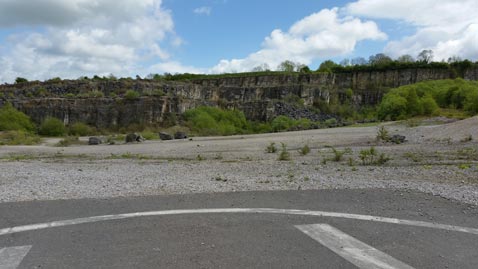
A View from the Helicopter Pad at Hall Dale Quarry

Hall Dale Quarry (Derbyshire)

Hall Dale Quarry (Derbyshire).

Picture credit: Everything Dinosaur

Hall Dale Quarry

The rock strata forms a series of platforms (three in total), Hall Dale Quarry is a popular location with climbing clubs, the sheer rock faces and huge piles of stone provide plenty of different climbing routes to explore.  We would advise that fossil collectors stay on the ground level, there are plenty of fossils to be found and there is no need to climb the boulders.

Enormous Boulders at Hall Dale Quarry

Huge boulders - can you see our rucksack?

Huge boulders – can you see our rucksack?

Picture credit: Everything Dinosaur

During our research, prior to our fossil hunting trip, we visited the excellent website of UK Fossils: UK Fossils.  As we prepared for our visit, we came across a news article from November 2014 that outlined plans for the development of this rural space, what is termed a brownfield site.  4M Property Partners had submitted plans to convert the quarry into a development consisting of mixed residential and commercial properties.

Plans to Develop the Quarry Site

Plans had been submitted to the council to build some 220 houses, and to convert 400 square metres into a restaurant and a café.  In addition, the planning proposal contained details of some 6400 square metres of office space.  We at Everything Dinosaur are not sure exactly how fossil collecting would be affected by these developments, we are also unsure as to how the planning application has progressed.  However, we would like to express our concern that such an amazing place might be lost forever.

Whilst we can appreciate that Matlock, like many towns in the UK, may have a need for more houses and that such a development might boost the local economy, as we stood in the quarry, totally in awe of the spectacular scenery and surrounded by evidence of a tropical, marine environment that existed some 340 million years ago, it seemed such a shame that this location might soon be unrecognisable.

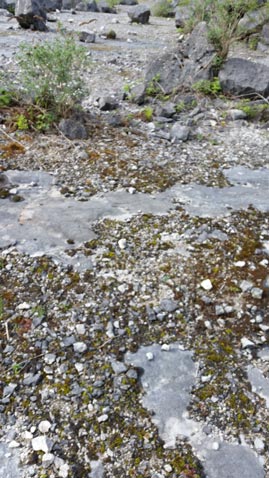
Many Different Types of Invertebrate Fossil can Be Found in the Scree

Fossils can be found in the scree.

Fossils can be found in the scree.

Picture credit: Everything Dinosaur

A Remarkable Fossil Heritage

There may be an urgent need for more local housing.  The town of Matlock might desperately require additional commercial properties.  We feel that we are unable to comment with regards to these development plans, but we sincerely hope that the developers have at least considered the need to preserve some part of this remarkable location’s fossil heritage.  There are fewer and fewer places in this country, where people can simply stop and stare and admire rock formations and the fossil treasures they contain within.  These special sites demonstrate the rich geology of our landscape and allow visitors to explore life in the past.  We hope that any development is undertaken in sympathy with the astonishing geology of this location.

A Few Minutes Collecting and So Many Fossils

A multitude of fossils can be picked out from the scree.

A multitude of fossils can be picked out from the scree.

Picture credit: Everything Dinosaur

For models and replicas of Palaeozoic creatures and other prehistoric animals: CollectA Age of Dinosaurs Popular Figures.

Wishing to express our concerns, the team member who visited the site contacted the planning department of Derbyshire Dales District Council.  A very helpful person in the department explained that the planning team could be emailed, allowing concerns about the need to develop the location in sympathy with the geology of the area to be put on record.  Everything Dinosaur subsequently did this and in addition, emailed Natural England to raise awareness of the development of this brownfield site with that organisation.

Raising Awareness About the Potential Loss of the Quarry

If you have collected fossils at Hall Dale Quarry and wish to make a point with reference to the re-development of this site and the potential loss of this fossil collecting location, then we would urge you to do so.

Planning application reference: 14/00541/OUT (please quote this reference when emailing the planning department or Natural England).

Email: [email protected] to contact Derbyshire Dales District Council (we would advise that you include a contact telephone number in your email, so that a planning team member can get in touch)

Email: [email protected] (again quoting planning reference: 14/00541/OUT) to get in contact with Natural England

Whilst we do understand the difficult and often challenging job of district councils and we aware of the potential economic benefits to the local community this project may bring.  We at Everything Dinosaur feel that it is important, to at least place on record a desire to consider the development of Hall Dale Quarry which takes into account the remarkable fossil bearing strata to be found at this location.

Please share.

Visit Everything Dinosaur’s award-winning website: Everything Dinosaur.

13 05, 2015

Retracing the Beak of Birds to the Snout of Dinosaurs

By |2023-03-28T08:12:21+01:00May 13th, 2015|Categories: Dinosaur and Prehistoric Animal News Stories, Dinosaur Fans, Educational Activities, Main Page, Palaeontological articles, Teaching|0 Comments

Reverse Genetic Engineering to Produce a Dinosaur Snout

A team of scientists based in the United States have tweaked the developmental processes that take place in chicken embryos to re-engineer the snouts of their dinosaur ancestors.  The research team led by University of Yale palaeontologist, Bhart-Anjan S. Bhullar and developmental biologist Arhat Abzhanov (Harvard University), have produced the first bird embryos that possess a snout similar to a dinosaur’s nose rather than a beak.  The chicken embryos developed palatial bones and a jaw configuration that resembles that seen in the fossil record, specifically in the Dromaeosauridae, a group of dinosaurs that are closely related to modern Aves.

Bird Embryos Possess a Snout Similar to a Dinosaur Snout

The dromaeosaurs, sometimes referred to as the “raptors” belong to the Suborder Theropoda.  They are part of a clade of agile dinosaurs that reduced their tails, lost their teeth and evolved into Aves (birds).  Typical dromaeosaurids are Velociraptor, Deinonychus and the recently named Saurornitholestes sullivani.

To read an article about the newly described Saurornitholestes sullivani: Sniffing Out a New Dinosaur Species.

As the Yale University press release states: “Just don’t call them Dino-chickens!”

Tweaking the Beak from Dromaeosaurs to Modern Birds

From the Dinosauria (left) to the beaks of modern Aves (right).

From the Dinosauria (left) to the beaks of modern Aves (right).

Picture credit: John Conway

Manipulating Chicken Embryos

The scientists were not in the business of trying to create a living dinosaur.  Manipulation of chicken embryos has taken place for several years, all part of research to help the understanding of how molecular processes affect the development of organisms.

Commenting on this research, which has just been published in the journal “Evolution”, lead author Dr Bhart-Anjan S. Bhullar (Department of Organismic and Evolutionary Biology, Yale) stated:

“Our goal here was to understand the molecular underpinnings of an important evolutionary transition, not to create a “dino-chicken” simply for the sake of it.”

Researching Cranial Development

For the young doctor, this is all part of his on-going research into cranial development in very young animals.  It is not part of a concerted effort to bring back the Dinosauria, a sort of “Jurassic Park from the embryo upwards”, as explained by a spokesperson from Everything Dinosaur.

There are a huge variety of bird beaks, from the curved, tearing and cutting beaks of eagles, to the sophisticated sieves of flamingos.  The beak is an essential component of avian anatomy and the researchers are trying to unravel how the beak evolved from its reptilian ancestry.  A quantitative analysis of fossils closely associated with the origins of birds was undertaken along with a study of extant animals including lizards, crocodiles and birds.

How the Beak of Birds Evolved

This examination allowed the scientists to develop a hypothesis as to how the bird beak may have evolved from the Dinosauria and the developmental stages that were involved.

The team identified that both major living lineages of birds, the abundant Neognathae (which includes virtually all species of extant birds) and the much rarer  Palaeognathae (which comprises the Tinamou family of birds from South and Central America plus the flightless ratites – cassowary, ostrich, kiwi, rhea, for example), differ from reptiles that are not closely related to birds and from mammals in that they have a unique, median gene expression zone of two different facial development genes early in embryonic development.  This median gene expression had previously only been identified in chicken embryos.

Turning Back the Evolutionary Clock

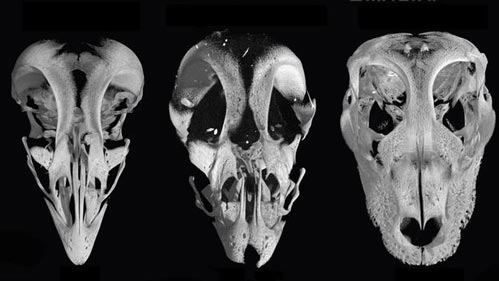
In order to have an embryo revert to its ancestral state, before the beak as it were, the gene expression for beak formation in the young chicken had to be turned off.  Microscopic beads coated in a molecule inhibiting substance were used to inhibit the activity of the proteins produced by the bird specific, median signalling zone in the chicken embryos.  This led the embryo to revert back to its reptilian ancestry with a more dinosaur-like snout forming and surprisingly, the palatine bone in the root of the mouth was also altered.

Changing the Faces of Embryos (Modified Chicken Embryo with Snout)

Normal chick (left), modified chicken embryo (centre), alligator embryo (right)

Normal chick (left), modified chicken embryo (centre), alligator embryo (right)

Picture credit: Evolution

Unexpected Changes

Dr Bhullar was surprised by the additional changes seen in the palatine bone, he stated:

“This was unexpected and demonstrates the way in which a single, simple developmental mechanism can have wide-ranging and unexpected effects.”

Commenting on the research, Professor Michael Benton (Bristol University), someone who knows a great deal about bird evolution, explained that this new study shows that the beak of birds develops very different from the snouts, noses and jaws of reptiles.  A different set of genes are involved.

He stated:

“That’s what proves the beak is a real adaptation or “thing”, not just a slightly different nose shape”

Why Dinosaur Snouts and Bird Beaks?

Intriguingly, although the fossil record for bird evolution is far from complete, the fantastically well preserved bird fossils of Lower Cretaceous deposits from China, specimens of Confuciusornis for instance, show that by around 125 million years ago the toothless beak had evolved.

Why the beak came about remains a point of significant debate, however, one of the most often cited reasons for a lighter, toothless structure is that as birds became more efficient fliers and spent more time in the air, the loss of a heavy, bony jaw lined with teeth was just one of a number of anatomical adaptations that occurred to help improve powered flight.

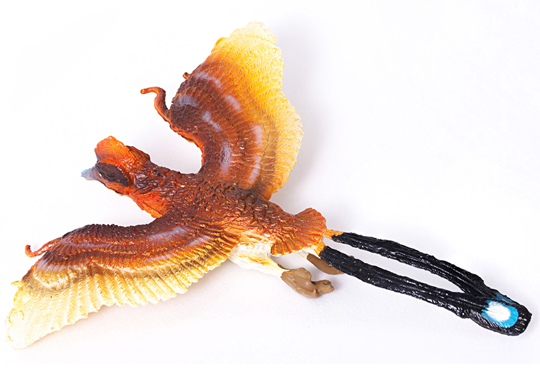
A Model of the “Early Bird” Confuciusornis sanctus from China

PNSO Age of Dinosaurs Confuciusornis model.

Confuciusornis model (PNSO Age of Dinosaurs).

Picture credit: Everything Dinosaur

The picture (above), depicts the PNSO Confuciusornis replica. There are a number of feathered prehistoric animal models in the PNSO range: PNSO Age of Dinosaurs.

Important Implications

The American based researchers are confident that their work has important implications for other geneticists and for palaeontologists.  For example, if a single molecular mechanism was responsible for this transformation, there should be a corresponding, linked transformation in the fossil record.  The flightless, man-sized Hesperornis, a genus of prehistoric bird known from the Late Cretaceous of North America could demonstrate that link.

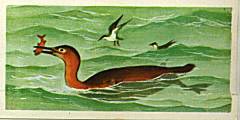
An Illustration of Hesperornis (Traditional View)

Hesperornis catching a fish.

Hesperornis catching a fish.

Picture credit: Everything Dinosaur/Brooke Bond

Dr Bhullar said:

“This is borne out by the fact that Hesperornis, discovered by Othniel Charles Marsh of the Yale Peabody Museum of Natural History, which is a near relative of modern birds that still retains teeth and the most primitive stem avian with a modern-looking beak in the form of a fused, elongate premaxillae, also possesses a modern bird palatine bone.”

The premaxillae are the bones that form the tip of the upper jaw (anterior portion) of most animals, but are enlarged and fused to form the beak of birds.

Finding a Hypothetical Developmental Path

Moving forward, the quantitative analysis to establish a proposed hypothetical developmental path of a lineage of animals which could be tested by inhibiting the behaviour of proteins in embryos can be probably be used to investigate a wide range of underlying developmental mechanisms in organisms.

The dinosaur/bird link is now well established, a theory once proposed by the likes of Henry Govier Seeley back in the 1880’s is widely accepted.  Back in 2013, Everything Dinosaur reported on research from an international team of scientists, including researchers from the Royal Veterinary College (London), that looked at how the posture of birds was derived from the gait of small, cursorial dinosaurs.

To read more about this study: The Birds Have the Dinosaurs to Thank for their Crouching Gait.

Everything Dinosaur notes the support of Yale University in the compilation of this article.

9 05, 2015

It was a Worm’s World Back in the Cambrian

By |2023-03-27T07:48:07+01:00May 9th, 2015|Categories: Dinosaur and Prehistoric Animal News Stories, Main Page, Palaeontological articles|0 Comments

Palaeontologists Name New Species of Ottoia Worm – Burgess Shale Creatures

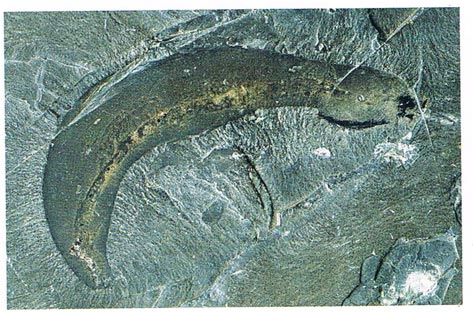
Whilst many a television documentary or published article on the fauna of the Burgess Shale focuses on the nektonic predators (actively swimming creatures above the sea floor), such as the formidable Anomalocaris, lurking in the soft mud of the sea floor itself was another very nasty hunter, one that left an extremely rich fossil record.  The most abundant type of creature preserved in the Burgess Shale is a type of worm, a member of the Phylum Priapulidae and now thanks to a detailed study of the teeth, hooks and spines on this tubular predator, scientists have discovered a method of identifying new species and also of determining just how abundant these creatures actually may have been.

An Ottoia Fossil (Burgess Shale)

An Ottoia fossil (Burgess Shale).

An Ottoia fossil (Burgess Shale).

Burgess Shale Creatures

Ottoia fossils from the Burgess Shale of British Columbia (Canada), measure just a few centimetres in length and they are one of the few types of creature preserved in those 505 million year old sediments that can be associated with a living animal group, the entirely marine priapulids.  At least fifteen hundred specimens have been excavated from the Burgess Shale deposits.  These creatures may have lived in “U” shaped burrows and ambushed other creatures that wandered or swam to close to the burrow’s entrance.  It could grab food with a proboscis, an extendible mouth which was equipped with tiny hooks and lined with teeth and spines.

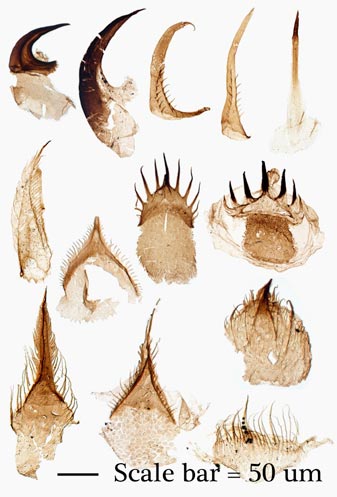
The team of scientists from Cambridge University and the University of Leicester, writing in the on line Journal “Palaeontology” used a variety of techniques to examine micro-fossils to identify different types of teeth from Ottoia  It is from this analysis that the team discovered that the most common type of priapulid associated with the Burgess Shale, Ottoia prolifica, actually represented two species.

Prehistoric Worms

As a result of this research, a new species of Ottoia worm has been identified in the Burgess Shale deposits – Ottoia tricuspida.  O. tricuspida has been so named as it has distinctive, three-pronged teeth.  Using various microscopy techniques to examine the tiny teeth recovered from drill cores and from other samples, the scientists propose that subtle variations in the teeth could help to identify more species in Cambrian biota and in addition, as the teeth are more likely to be preserved than the soft bodies of these creatures, the teeth could help to establish how widespread such worms were in the Cambrian geological period.

The Ottoia Genus

Ottoia prolifica was named by Charles Doolittle Walcott in 1911.  Walcott,  an American invertebrate palaeontologist, discovered the Burgess Shale deposits in the Canadian Rockies back in 1909.  These bands of mudstone and shale are very rich in fossils.  The frequency of Ottoia fossil material might not be anything to do with the abundance of these types of animals in the biota, the numbers found could reflect the fact that these animals lived in soft sediment.  If one of these worms died in their burrow, then they could set in motion the fossilisation process.  The soft mud would act as an excellent medium to promote the preservation of creatures that lived in the sediment.

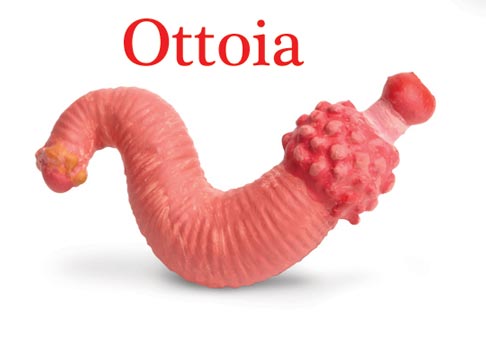
A Model of Ottoia (Safari Ltd Cambrian Life Toob)

A model of Ottoia (Safari Ltd Cambrian Life Toob).

A model of Ottoia (Safari Ltd Cambrian Life Toob).

Safari Ltd have a wonderful model of Ottoia in the Cambrian Life Toob.  This Toob contains a set of eight prehistoric animals that represent the bizarre fauna of the Cambrian explosion.

To view this Toob and other prehistoric animal model sets: Wild Safari Prehistoric World Models.
A Teeth, Hooks and Spines Associated with Ottoia spp.

The variety of fossil teeth, spines and hooks associated with Ottoia spp.

The variety of fossil teeth, spines and hooks associated with Ottoia spp.

Picture credit: Palaeontology Journal

2 05, 2015

How to Clone a Mammoth (Book Review)

By |2023-03-26T12:17:44+01:00May 2nd, 2015|Categories: Book Reviews, Main Page, Palaeontological articles|0 Comments

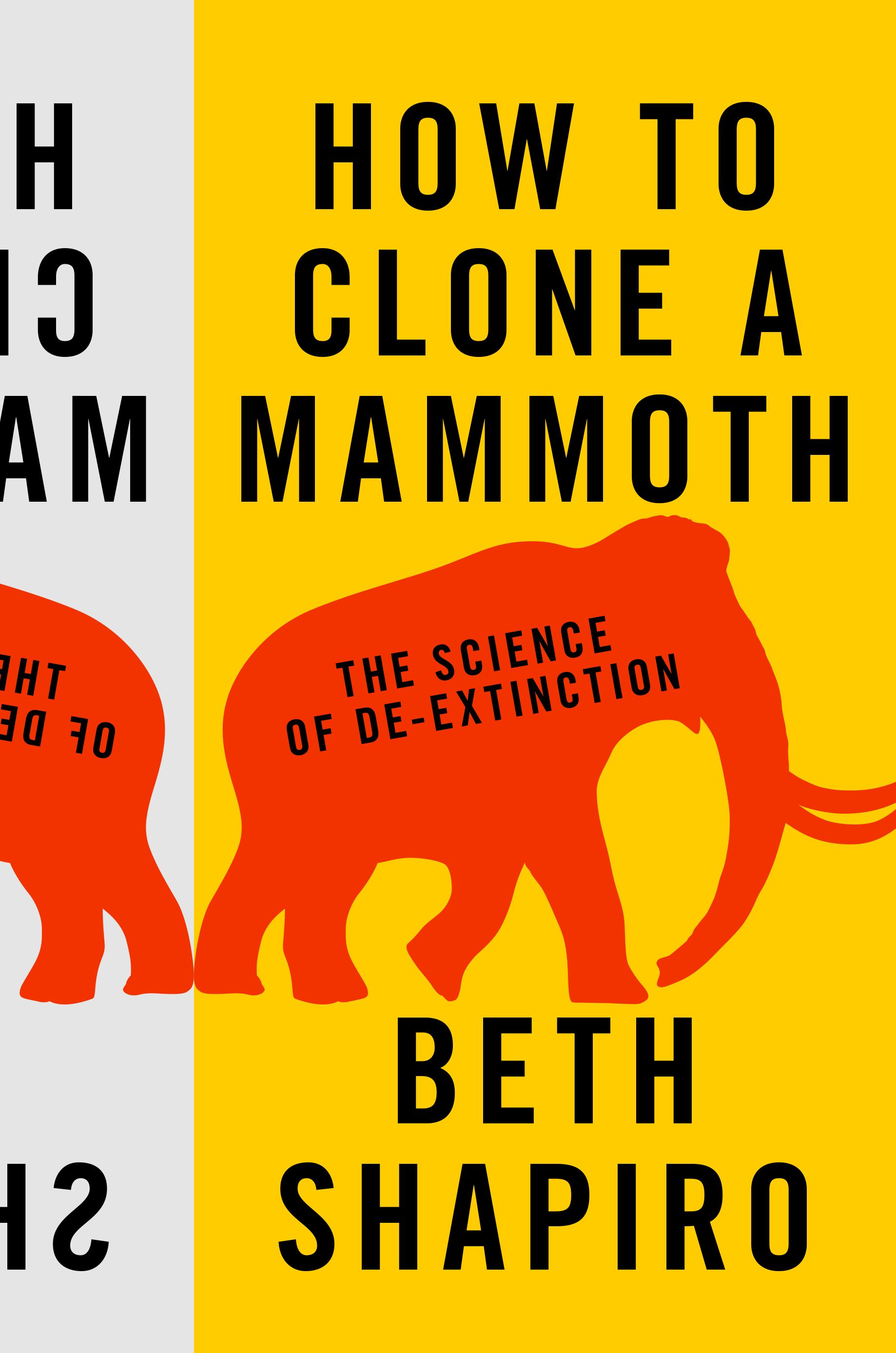
How to Clone a Mammoth by Beth Shapiro – Book Review

There is a saying “may you live in interesting times”, thought by many to be an ancient Chinese proverb.  We may not be too sure as to the derivation of this phrase, but for a geneticist, the early years of the 21st century are most certainly “interesting times”.  Our understanding of DNA, that double helix shaped set of building blocks for life itself has come on in leaps and bounds over the last two decades.

Our species is on the brink of some startling developments in genetics, one of which is the ability, through the manipulation of an organism’s genome, to bring back once extinct creatures, or at least to produce a population of closely related living things that have characteristics of organisms that existed in the past.

Clone a Mammoth

Evolutionary biologist and ecologist Beth Shapiro, neatly summarises the current research and sets out some of the hurdles – scientific, moral and ethical, that mankind will have to overcome if the likes of a Woolly Mammoth will ever roam the Earth again.  Her book “How to Clone a Woolly Mammoth”, published by Princeton Press sets out to explain how state-of-the-art science can lead to genetic modification, consequences of which, include the possibility of the return of the Passenger Pigeon to North America or the Mammoth to the tundra of Russia.

How to Clone a Woolly Mammoth by Beth Shapiro

The science of de-extinction by Beth Shapiro.

The science of de-extinction by Beth Shapiro.

Picture credit: Princeton Press

An Associate Professor at the University of California

Written in an informative but never patronising style, Beth an Associate Professor at the University of California, Santa Cruz, takes the reader on a journey beginning with the tricky subject of which species to consider for “de-extinction” and then how to go about finding a suitable specimen for the all important donation of genetic material.  Her frank and knowledgeable account of Pleistocene fossil hunting expeditions in the Yukon and on the Taimyr Peninsula in the far north of Russia provides a fresh perspective on the difficulties involved in hunting for long extinct Ice Age creatures and the potentially game-changing genetic treasure that they may contain.

For further information and to purchase this book visit: Princeton Press.

“How to Clone a Mammoth”

“How to Clone a Mammoth” provides a comprehensive account of the current research and sets out the role that genetically modified organisms will play in conservation.  Beth has skilfully blended cutting edge science with an overview of the ramifications that resurrecting lost fauna might have for the restoration of declining ecosystems.  This book will be of interest to a very broad audience, from academics and students, to the general reader with a lay person’s curiosity for the ways in which genetic engineering is shaping life on Earth.

The Author Associate Professor Beth Shapiro

A well-written and comprehensive account.

A well-written and comprehensive account.

Picture credit: Kris Krug

Rapid Pace

This field of scientific endeavour is moving at a rapid pace.  Recently, an international team of scientists, including Dr Love Dalén, from the Swedish Museum of Natural History (Stockholm), successfully sequenced the Woolly Mammoth genome.  In a separate study, researchers have highlighted the alarming decline globally of large herbivores, that might lead to “empty landscapes”.  Associate Professor Shapiro argues that elephants which have been genetically modified so that they are able to tolerate cold conditions could well play a significant role in habitat and ecosystem preservation in the near future.

“How to Clone a Mammoth” may soon date as the science of “de-extinction” progresses, but it provides the reader with a road map for understanding the path that genetic research developments may take us down.

Everything Dinosaur Comments

A spokesperson from Everything Dinosaur commented:

“This is a skilfully and conscientiously crafted book that explains the challenges and potential pit falls that lie ahead.  The author has done much to de-bunk the myths and misleading information that surrounds this topic and “How to Clone a Mammoth” provides the reader with a comprehensive account of the state of current research as well as tantalising glimpses with regards to what risks and potential rewards “de-extinction” might facilitate.”

Highly recommended.

For further information on “How to Clone a Mammoth” or to purchase a copy: Princeton Press.

Everything Dinosaur stocks a range of scale models of prehistoric mammals including prehistoric elephants in the Eofauna model range: Eofauna Scientific Research Models.

30 04, 2015

Yi qi – The Remarkable Dinosaur That Thought it was a Bat

By |2024-05-05T13:38:22+01:00April 30th, 2015|Categories: Dinosaur and Prehistoric Animal News Stories, Main Page, Palaeontological articles|0 Comments

Chinese Dinosaur Unveil Yi qi Another Weird and Wonderful Theropod

Hot on the heels of Chilesaurus* comes the second bizarre theropod dinosaur to be named this week, the wonderful and weird Yi qi (pronounced ee-chee) from the Hebei Province of northern China.  A single specimen is known, this was discovered by a local farmer and subsequently sold to a museum in Shandong Province, careful preparation of the specimen, which although fractured, does reveal most of the anatomical details of this little dinosaur.

Yi qi

Remarkably Y. qi possessed a long, rod-like bone on each wrist that extended backwards.  No other theropod dinosaur (or any dinosaur for that matter), had a bone quite like this.  Comparative analysis with extant animals suggests that this bone helped to support a flap of skin that could be stretched out to form a structure like a bat’s wing.  The absence of evidence for large muscles around the chest probably rules out any form of active, powered flight, but it is likely that this pigeon-sized dinosaur could have been a glider.

Not the dinosaur equivalent of Batman, more like a dinosaur equivalent of a flying squirrel.

The Second Bizarre Theropod Announced this Week – Yi qi

Mid Jurassic flier.

Middle Jurassic flapping flier no but glider yes (probably).

Picture credit: Dinostar/Chinese Academy of Sciences

To read Everything Dinosaur’s earlier article about the research into Chilesaurus: Chilesaurus – A Dinosaur Designed by a Committee.

Examining the Fossil Material

The fossil material has been studied (and fully prepared) by scientists at the Chinese Academy of Sciences (Institute of Vertebrate Palaeontology and Palaeoanthropology – IVPP) and researchers from Linyi University (Shandong Province).  Unlike a number of other feathered dinosaur specimens from China, the palaeontologists are confident that this specimen (STM 31-2) currently housed at the Tianyu Museum of Nature in Pingyi County, (Shangdong Province), had not be tampered with or augmented by unscrupulous fossil dealers hoping to inflate any purchase price.

The Holotype Fossil Specimen (STM 31-2) Yi qi

The only known specimen of Qi yi (holotype).

The only known specimen of Yi qi (holotype).

Picture credit: Zheng Xiaoting

This little dinosaur probably weighed less than 400 grammes and that bat-like wingspan was around sixty centimetres across  The short, deep skull was less than four centimetres long.  It forms part of an amazing fauna that thrived in a forested environment some 160 million years ago.  Over the last ten years or so, Chinese scientists have built up a very detailed picture of the palaeoenvironment in this part of northern China during the Middle to Late Jurassic.

An Ancient Forest

The forests consisted of ancient ferns, ginkgos and conifers and breaking up the sub-tropical woodlands were large, shallow lakes.  Nearby volcanoes occasionally erupted and buried the surrounding area with a huge layer of very fine dust trapping and killing everything that got buried.  It is thanks to these frequent eruptions that such a wealth of ancient material has been so exquisitely preserved.

The Yi qi fossil shows evidence of long, filamentous feathers on the limbs as well as signs of a membrane of skin attached to that rod-like wrist bone and between the three digits.

The tiny claws on those digits suggest that this dinosaur could have climbed up trees, certainly an arboreal existence has been proposed.  Yi qi probably hunted insects up in the branches, climbing up the trunks of trees and gliding from tree to tree.

A Close up of the Skull of Yi qi

The large eye (orbit) and the peg-like teeth at the front of the jaws can be clearly made out.

The large eye (orbit) and the peg-like teeth at the front of the jaws can be clearly made out.

Picture credit: Zheng Xiaoting

A Little Dinosaur with Big Eyes

The large orbit (eye socket) seen in the picture above suggests that this little dinosaur had big eyes providing stereoscopic vision, all the better to judge distances and to spot its insect prey amongst the dark, leafy canopy,  Those short, peg-like teeth would have been more than a match for any insect that this gliding dinosaur encountered.  It probably was not agile enough to catch prey in mid flight but probably scurried along branches looking for insects and spiders.

It would have had plenty of company in its forest home.  There were lots of pterosaurs around, along with numerous feathered dinosaurs and a large number of bizarre mammals including some recently described docodonts.  To read an article about the remarkable fauna from the  Daohugou Beds of the Tiaojishan Formation: Unravelling the Sequence of Deposition in North-eastern China.

To read about the peculiar mammals from this part of China (Middle to Late Jurassic): Widespread Ecological Diversity Amongst Early Mammals from China.

An Example of Convergent Evolution

This anatomy is not found in other Theropods.

This anatomy is not found in other theropods.

Picture credit: Zheng Xiaoting

Strange Rod-like Bone Extensions

The rod-like bone extending from each wrist is not found in any other known member of the Dinosauria, but similar features are found in a number of gliding and flying tetrapods.  At first the scientists were stumped by this strange anatomy, Xu Xing, one of the authors of the academic paper stated:

“We spent quite some time to identify the body structure of Yi qi, because the specimen is so different.  At first we did not have the slightest idea about what was the rod-like bone.”

It was only after a researcher undertook a study on extant flying vertebrates that the connection was made.

Zheng Xiaoting (Linyi University), another co-author of the study explained:

“Living in the mid period of the Jurassic, the dinosaur Yi qi could be a pioneer in the evolution of flying ability.”

The rod-like wrist bones are an example of convergent evolution, that is, when unrelated organisms evolve the same adaptations, such as tail flukes in dolphins and ichthyosaurs.  Not only is this one of the most remarkable theropod fossils discovered to date, Yi qi is one of the smallest dinosaurs so far described.

It also has several other claims to fame, for example, with a binomial, formal scientific name of just four letters, it has the shortest name for any member of the Dinosauria that we at Everything Dinosaur can think of.  In addition, as the fossil material is part of the Tianyu Museum of Nature’s Collection, it is part of the largest dinosaur fossil collection housed in a single museum anywhere in the world.

A Huge Number of Dinosaur Specimens

Back in 2010, the Guinness Book of Records announced that this museum had the greatest number of dinosaur specimens on exhibit at any one time.  The museum has over 28,000 square metres of exhibition space, a large proportion of which is dedicated to the Dinosauria.  The museum claims to possess over 1,100 different dinosaur specimens and tens of thousands of other vertebrate fossils in its collection.

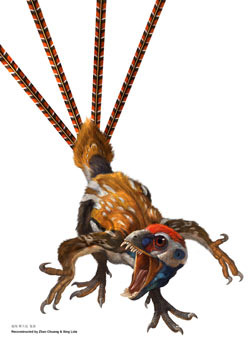
Yi qi has been phylogenetically assigned to the clade Maniraptora, specifically being placed in the Family Scansoriopterygidae, a very odd group of dinosaurs, known for their small size, assumed arboreal habits, long arms and elongated third fingers.  In all other members of the theropoda it is the second digit that is the longest. The Scansoriopterygidae contains a number of genera, with Epidexipteryx (E. hui) being perhaps the best known since it appeared in an episode of the BBC documentary series “Planet Dinosaur” back in 2011.  Epidexipteryx hui was named and described in 2008.

An Illustration of Epidexipteryx

Epidexipteryx hui

Epidexipteryx hui

Picture credit: Nature

To view models and replicas of bizarre Chinese dinosaurs including Yi qi (whilst stocks last): PNSO Age of Dinosaurs Models and Replicas.

Go to Top