All about dinosaurs, fossils and prehistoric animals by Everything Dinosaur team members.

Everything Dinosaur’s work with schools and other educational bodies. Articles, features and stories about dinosaurs and their role in education and educating young people.

19 12, 2013

The United Kingdom’s Important Contribution to Palaeontology in the 19th and 20th Centuries

By |2024-05-02T06:52:36+01:00December 19th, 2013|Categories: Dinosaur and Prehistoric Animal News Stories, Dinosaur Fans, Educational Activities, Press Releases|1 Comment

What Significant Contributions to Palaeontology has the United Kingdom Made Throughout the 19th and 20th Centuries?

This is not an easy question to answer.  After all, to provide a comprehensive overview of the contribution made in the course of two hundred years by the scientists, academics and indeed laypeople of the British Isles is no easy task.  In short, when the sciences of palaeontology and geology are considered, it could be argued that this little part of western Europe has punched well above its weight in the 19th and 20th centuries and it continues to do so.

Let’s focus our attention on just a few key, pivotal moments in a bid to shed more light on the prehistoric animals depicted in the recently released Royal Mail stamps that aimed to highlight the UK’s contribution to palaeontology.  All the prehistoric animals featured are vertebrates and from the Mesozoic era, so we will restrict ourselves for the time being, to animals with backbones that lived during the “Age of Dinosaurs” as it is often referred to.

Palaeontology

This means that we have to disregard, on this occasion, the work of the likes of Sir Roderick Murchison (1792-1871), a remarkable Scotsman, one who fought in the Napoleonic Wars and later in life, working alongside the Yorkshire born Reverend Adam Sedgwick (1785-1873), helped map, classify and date geological strata in one of the first studies of its kind.  Many of the geological periods before the “Age of Dinosaurs” were named and described by British scientists.  Not surprising really, after all, the age of the rocks that make up the British Isles are extremely varied and we have had a long history of higher education and scientific study.

The Geological Society of London is the oldest geological society in the world, formed in 1807.  In contrast, the Geological Society of America was not founded until 1888 and the Geological Society of China did not come about until 1922.

Confining ourselves to vertebrates of the Mesozoic also prevents us from detailing the contribution of Marie Stopes (1880-1958), perhaps better known as a campaigner for women’s rights and family planning, but also an expert in ancient flora who did much to unravel the mysteries of the evolution of flowering plants (angiosperms), or indeed the work of Professor Jenny Clack who in the last year’s of the 20th century helped to re-write the evolution of the first back-boned animals that evolved adaptations for living on land.  Her analysis of the primitive tetrapod  known as Acanthostega (Ah-can-tho-stay-ga) offered dramatic new insights into how fish made the transition to a life on Terra Firma.

Incidentally, Acanthostega lived during the Devonian, a period of geological time named after that county in south-west England, perhaps better known for its cream teas and sandy beaches.

British Women in the Earth Sciences

Let us continue to highlight the role of British women in the Earth sciences by focusing on the work of Mary Anning (1799-1847).  Mary was a pioneering, fossil collector born just a few miles to the east of the county of Devon, in the small, seaside town of Lyme Regis (Dorset).  Although lacking any formal scientific training and as a woman, sadly not given full credit for her work until long after her death, a consequence of, thankfully, now outdated Georgian and Victorian attitudes to the role of women in science.  Mary explored the fossil rich, Jurassic aged strata of her Dorset home, she is accredited for finding the first plesiosaur fossils and the first ichthyosaur skeleton to be correctly identified as an ancient, marine reptile.

“Jurassic Coast”

An Ichthyosaurus and a Plesiosaurus both feature in the recent  Royal Mail stamps issue, however, Mary Anning’s links with this stamp set is not restricted to the marine reptiles.  It was Mary who discovered the first Dimorphodon specimens in the Lower Lias of southern England’s famous “Jurassic Coast”.  This flying reptile also features in the Royal Mail series and the first fossils of Dimorphodon link to two other giants of nineteenth century British palaeontology, as Mary passed her pterosaur fossil to the Reverend William Buckland to study.  It was Buckland, who  wrote the first full, scientific description of a dinosaur (Megalosaurus – also featured in the stamp set) and Sir Richard Owen, a Lancastrian, who first coined the term Dinosauria, was responsible for erecting the Dimorphodon genus in 1870.

The Gravestone of Mary Anning and Joseph Anning (brother)
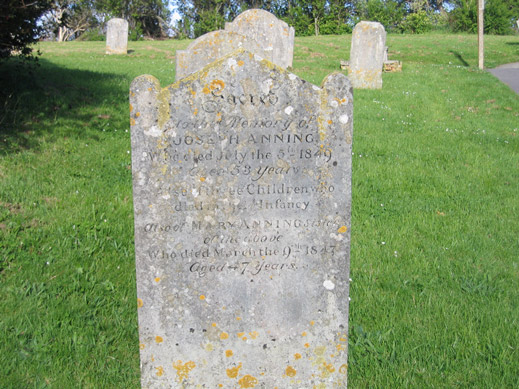
Mary Anning's grave at St Michael's Church on the hill overlooking Lyme Regis

Mary Anning’s grave at St Michael’s Church on the hill overlooking Lyme Regis

Picture credit: Everything Dinosaur

Dinosaurs from Britain

The pair of Iguanodons, beautifully illustrated by John Sibbick on one of the stamps is a reminder of the role played by this country in fundamentally changing scientific thinking about prehistoric life and the history of our planet.  Gideon Mantell, a medical man by training but with a passion for geology and palaeontology, did much to broaden our understanding regarding the prehistoric animals of the Cretaceous.  It was Mantell who first scientifically described Iguanodon and this dinosaur was one of the first to be reconstructed both as a mounted skeleton and as a representation of a living animal.

The United Kingdom has made a significant contribution to the popularising of science, especially the study of prehistoric animals.  Scotsman Bill Swinton (1900-1994) is credited with writing one of the first ever textbooks on dinosaurs.  The book, first published in 1934 with the catchy title “The Dinosaurs: A Short History of the Great Group of Extinct Reptiles”, became a standard text for students of palaeontology all over the world for the next forty years or so.

The Iguanodons that Feature on the Royal Mail Stamps
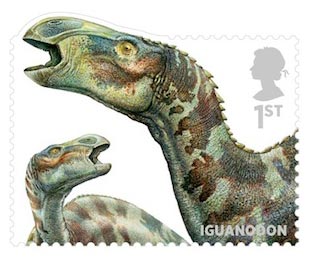
The Ornithopod Iguanodon on a stamp.

The ornithopod Iguanodon on a stamp.

Life-size replicas of prehistoric animals built by London born Benjamin Waterhouse Hawkins and first put on display in 1854 can still be seen today in south London’s Crystal Palace Park.  These concrete replicas, the first of their kind to be exhibited anywhere in the world now have Grade 1 listed status (the same status as Windsor Castle and Buckingham Palace).  The general public’s fascination for everything dinosaur seems to have continued non-stop and many British academics have been in the vanguard of popularising the study of ancient life and prehistoric ecosystems.

To end our very brief foray into the contribution made to palaeontology and geology in the 19th and 20th centuries by the United Kingdom, it seems fitting to end our short discourse by paying tribute to  Alan Charig (1927-1997), a research scientist who rose to become Curator of Fossil Amphibians, Reptiles and Birds at the Natural History Museum.  Dr Charig did much to popularise the subject of palaeontology in the 1970’s, with the BBC television series “Before the Ark”, the success of which, according to many commentators, paved the way for Sir David Attenborough to make the first of his ground-breaking  natural history programmes (Life on Earth).

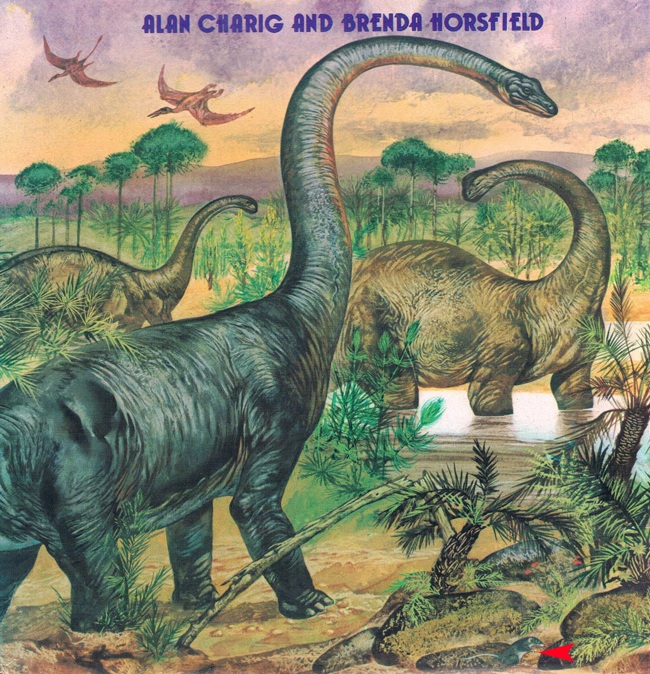
The Front Cover of “Before the Ark”
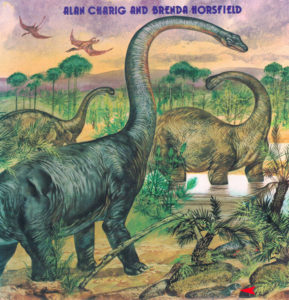
The front cover of "Before the Ark" features a small mammal.

The 1975 BBC book “Before the Ark” depicts a small mammal (arrowed) in a world dominated by dinosaurs and other reptiles.

Picture credit: Everything Dinosaur

Alan Charig in conjunction with Angela Milner was given the responsibility of studying and scientifically describing a new type of predatory dinosaur unearthed by an amateur fossil hunter whilst exploring a Surrey clay pit in 1983.  Almost seventy percent of the fossilised skeleton was excavated.  This ten-metre-long leviathan was named Baryonyx (Bar-ree-on-niks) and the head and neck of this theropod dinosaur are depicted on one of the stamps in the Royal Mail set, a fitting tribute to the immense contribution made by the people of this country to the study of ancient life and in particular to the Dinosauria.

A Model of Baryonyx (B. walkeri)
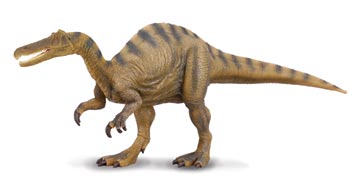
Baryonyx "Heavy Claw"

Baryonyx – the name means “heavy claw”

Picture Credit: Everything Dinosaur

It is also worth noting the immense contribution paid to the prehistoric animal model industry by British designers and artists. For example, Anthony Beeson the creative force behind the much admired CollectA prehistoric animal model range.

To view the CollectA model range: CollectA Prehistoric World and Prehistoric Life Models.

28 11, 2013

A Wonderful Camarasaurus for Cameron

By |2024-05-02T06:25:58+01:00November 28th, 2013|Categories: Educational Activities, Teaching|0 Comments

Cameron’s Camarasaurus (Dinosaur Workshops in School)

Whilst working with a class of school children during one of Everything Dinosaur’s frequent school visits to undertake dinosaur themed workshops we explored how scientists go about naming organisms.  Inevitably, how dinosaurs got their names became the focus of this part of the lesson topic.

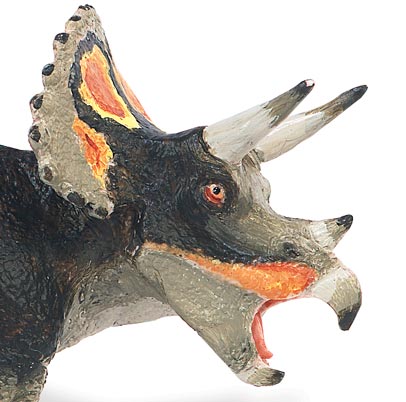
The children were able to demonstrate what they had learned during the term by correctly identifying various prehistoric animals and stating what the name of the animal actually means.  For example, Triceratops means “three horned face” and anyone who has seen a picture of this ceratopsian’s skull can see for themselves the three-horns that adorn it.  The two large, brow horns over the eyes and the smaller nose horn.

Triceratops means “Three Horned Face”

Three-horned face.

Three-horned face.

Picture credit: Everything Dinosaur

The children learned that it is often the job of the person who discovers the dinosaur’s fossil bones to come up with a name for that animal.  Cameron asked, if he had to name a dinosaur could he call it Cameronsaurus?  Our team member explained that there was already a dinosaur that had a very similar name – Camarasaurus (C. supremus).

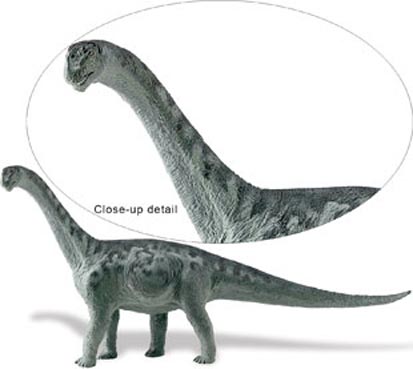
Camarasaurus

Camarasaurus was a long-necked, herbivore, a member of the Sauropoda that lived in the western United States during the Late Jurassic (155-145 million years ago).  It was a large animal, perhaps measuring in excess of twenty metres when fully grown.

An Illustration of the Sauropod Camarasaurus

Camarasaurus

Camarasaurus dinosaur model.

Picture credit: Everything Dinosaur/Safari Ltd

Dinosaur Names

Everything Dinosaur then challenged the class to design their own dinosaur and to come up with a name that describes the prehistoric animal, one that could be used to name their very own dinosaur.

To view models of sauropods, ceratopsids and other herbivorous dinosaurs, take a look at the extensive range of Safari Ltd models in stock at Everything Dinosaur: Wild Safari Prehistoric World Models and Figures.

26 11, 2013

Special “Dinovember” at Barton Moss Community Primary School

By |2024-04-22T14:36:03+01:00November 26th, 2013|Categories: Educational Activities, Teaching|0 Comments

Pupils Learn All About Dinosaurs at Barton Moss Community Primary

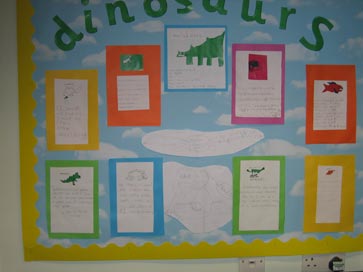
Year 3 pupils at Barton Moss Community Primary have been turning this month into “Dinovember” with a whole range of dinosaur and fossil themed activities as the children learn all about prehistoric animals.   Under the tutelage of Mr Sagar and Miss Wardle both classes of Year 3 pupils have been studying dinosaurs and the classrooms have on display some lovely examples of the children’s drawings and creative writing.  A team member from Everything Dinosaur was invited along to show the children some fossils and to illustrate the size and scale of dinosaurs.  The pupils were quick to demonstrate their knowledge and to point out which dinosaurs were carnivores and which were herbivores.

“Dinovember”

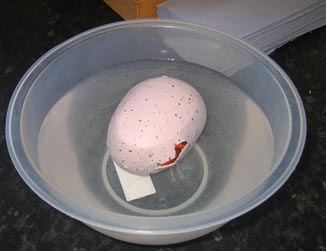
Helped by the enthusiastic Teaching Assistants, Miss Marsh and Miss Thomas, each class have been looking after their very own dinosaur egg and the children are waiting to see what will happen next.

One of the Dinosaur Eggs in the Classroom is Getting Ready to Hatch

Can you see the crack in the egg?

Picture credit: Everything Dinosaur

Dinosaur Eggshell

Some of the pupils got to examine pieces of real dinosaur egg shell and they learned the reasons why dinosaur eggs were not as big as you might imagine.  Lots of questions were asked and our dinosaur expert was able to answer most of them, taking time out to explain using some of the fossils and to check the children’s understanding, we really enjoyed looking at some of the children’s dinosaur drawings including Kamila and her “Kamila-oh-saurus”.

The Second Dinosaur Egg in Mr Sagar’s Class

Could be a T. rex about to hatch?

Picture credit: Everything Dinosaur

Tyler and Tylosaurus

Young Tyler was told all about a huge marine reptile that has a similar name to his (Tylosaurus).  Our dinosaur expert explained that Tylosaurus ate ammonites and other sea creatures and there were some ammonite fossils on hand so that the children learn a little bit more about these sea creatures, which Cain correctly guessed were related to today’s squid.  Caprice even produced a wonderful mime of an ammonite, swimming, bobbing up and down in the water and shooting out its tentacles to catch a fish.

Young Denver, in Mr Sagar’s class learned that he too, shares a name with a prehistoric animal, this time it’s a dinosaur – Denversaurus.  Scale drawings of both the Tylosaurus and the Denversaurus have been sent over to the school so that the children can see how big these extinct animals actually were.  Special thanks to Ethan and his chums for explaining what extinct meant and to Cole for remembering what omnivores ate.

Some of the Examples of the Children’s Artwork 

Creative, inventive dinosaurs.

Picture credit: Everything Dinosaur

Dinosaur Drawings

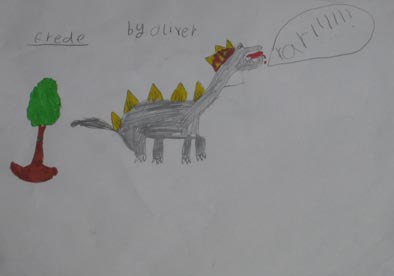
Oliver had produced a most impressive drawing of a dinosaur, he had decided to call his dinosaur Fred.  It’s a dinosaur with spikes on his back and a very loud roar.

Examples of the Children’s Work Posted up on the Classes Working Wall

A spiky dinosaur crated by Oliver.

Picture credit: Everything Dinosaur

With a new dinosaur being named and described on average every two to three weeks, there are a lot of dinosaur discoveries going on around the world at the moment, Michael and Anthony, both from Poland, got to hold a piece of a backbone from a marine reptile that had been recently excavated in the country whilst Jack learned that prehistoric animal bones can be found in this country too.  Our thanks to Courtney-May and Amy for taking notes.  Charlie and his chums correctly identified how closely related to dinosaur’s birds are, whilst Lucy helped with the experiments and Aidan got to help guess the fossil.

For further information about Everything Dinosaur’s huge range of dinosaur themed learning materials, gifts and toys: Dinosaur Themed Gifts and Toys.

Some of the questions posed by the children were very thought provoking and demonstrated a clear understanding of the term topic and there were a number of budding palaeontologists in each class. All in all, a rewarding term topic for both teachers and pupils and as a final challenge the children were asked to compose a thank you letter to Everything Dinosaur, a test of their recall plus an ability to show off their creative writing skills.

18 11, 2013

Dinosaurs Fight the Bullies with New Posters

By |2024-05-02T06:28:08+01:00November 18th, 2013|Categories: Educational Activities, Everything Dinosaur News and Updates, Press Releases, Teaching|1 Comment

Anti-Bullying Week November 18th-22nd 2013

Everything Dinosaur team members have spent a busy few days preparing posters and sending them out to schools  in readiness for anti-bullying week which starts today.  Many of the educational establishments that we visit have got a robust policy towards bullying prevention and awareness.  A school’s anti-bullying strategy is in operation throughout the year and we salute the dedication of those teachers, higher learning teaching assistants, learning support staff and all those other stakeholders in the school community who work so hard to develop and implement an anti-bullying programme.

There are many organisations delivering a creative anti-bullying message throughout this week and Everything Dinosaur is pleased to play a small role in helping to raise awareness of this important issue.

Everything Dinosaur

Team members have designed three anti-bullying posters using dinosaurs as a theme. They have been inspired to do so after seeing all the very colourful and creative anti-bullying posters designed by children during school visits by Everything Dinosaur.

One of the Dinosaur Inspired, Free Anti-Bullying Posters Available

Stop the Bullies!

Picture credit: Everything Dinosaur

Anti-Bullying Posters Feature Dinosaurs

As many children love dinosaurs, we thought it appropriate if we could utilise some of our prehistoric animal drawing materials to create posters with an anti-bullying message.  The dinosaur depicted in the poster above is a fearsome meat-eating dinosaur, we could not think of a better way to get the message across.

Picture credit: Everything Dinosaur

In total three posters were created.  They are designed to be printed off onto A4 sized paper and can be laminated if required.  Hopefully, with a few of these posters pinned up around the school and any bullies will soon get the message.

Dinosaurs Fighting the Bullies

Stop bullies in their tracks!

Picture credit: Everything Dinosaur

Three Posters Designed

These posters have already been circulated to a large number of schools.  Everything Dinosaur has been proactive and through its links with the National Autistic Society (N.A.S) in the UK, these posters have been made available free of charge to the head teachers of all the schools registered with the N.A.S.

If you would like to get one of these posters for yourself, or indeed all three, it could not be more simple.  Just email us (see link below), and one of our team members will email you back with the posters available as downloadable attachments.

Contact us: Email Everything Dinosaur.

A spokes person from Everything Dinosaur commented:

“With our vast library of dinosaur pictures, drawings and images we thought it a good idea if we used some prehistoric animals to help get the anti-bullying message across.  Let’s hope that we can all work together to help make bullying extinct.”

It is important that bullying prevention and awareness is taught throughout the school year, but during this week, Everything Dinosaur is proud to be involved and hopefully helping to make a difference.

To view the range of prehistoric animal themed toys, models and games available from Everything Dinosaur: Visit Everything Dinosaur’s Website.

15 11, 2013

Palaeontology at Painsley Catholic College

By |2023-03-01T09:36:35+00:00November 15th, 2013|Categories: Educational Activities, Teaching|0 Comments

Primary School Children Track Down Dinosaurs at Painsley Catholic College

Year four and five students attending local primary schools in Staffordshire had the opportunity to visit the well-appointed science labs at Painsley Catholic College and to take part in some dinosaur themed studies.  The pupils all from Federation Primary schools which are feeder schools for the College, were invited to join an expert from Everything Dinosaur as part of the College’s outreach programme as teaching staff help to prepare children for the challenges and opportunities of secondary education.

Dinosaur Workshop

The morning’s activities focused around teaching the fundamentals of scientific methodology with the pupils given the opportunity to examine fossils, look at evidence and to come up with their own ideas and theories.  As a warm up exercise, the school children were challenged to come up with an explanation as to why there are so few fossils of Triceratops limb bones available for scientists to study.

Toby from St Mary’s (Leek) suggested that the size of the bones could affect the way that some of them might get turned into fossils, whilst Georgina, who was attending from St. Filumena’s (Caverswall, Stoke), thought that the limbs of Triceratops might have been eaten (you might be onto something, Georgina).

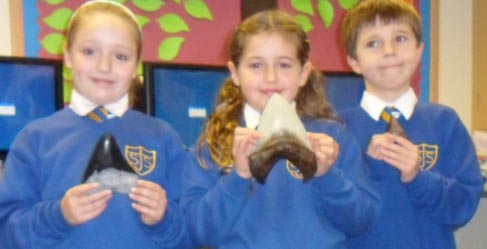
Pupils Puzzle over Fossil Teeth

Children holding fossils.

Getting their Teeth into Science.

Picture credit: Everything Dinosaur

Triceratops horridus

The children learned that the dinosaur that they had just been studying was called Triceratops horridus, the name means “horrible three horned face” and young Max (St Giles Catholic Primary), demonstrated his considerable knowledge about dinosaurs by explaining the reasons for Triceratop’s name.

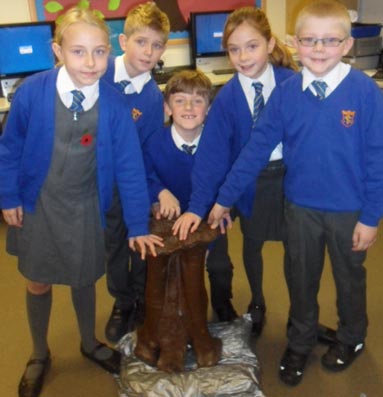
Next up came a quick comparison of brain sizes with a cast of part of the skull of an ankylosaurid (armoured dinosaur) used to explain a little about the size of dinosaurs and their brains.  Early arrivals, John, Elliot and Holly had looked at the fossilised teeth of a giant marine reptile and they were amazed to learn that if they all laid down head to toe, the length of all three of them would be roughly equivalent to the size of one of this animal’s enormous flippers.

Using such examples can help young scientists understand the sheer scale of some of these prehistoric animals, helping to bring to life what they may have read about dinosaurs or learned at school.

Palaeontology

By way of a quick exploration of ammonite specimens, the school children were provided with a brief guide as to how most fossils are formed and what fossils can tell us about extinct creatures.  Rebecca and Ben were able to work out why palaeontologists think that female ammonites were generally bigger than the males.  A great example of using knowledge to explore a new concept, to relate what they already knew to a fresh challenge.

The Size and Scale of the Dinosauria

The next generation of scientists!

Picture credit: Painsley Catholic College

Studying Dinosaur Tracks

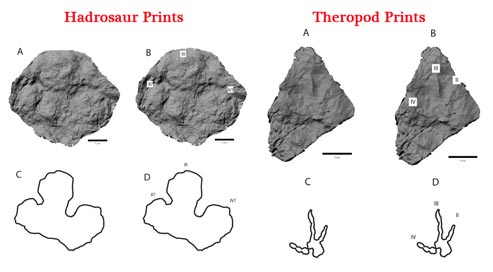
Next came the opportunity to study a set of dinosaur tracks that date from the Early Jurassic.  Scientists have uncovered a number of fossilised footprints of animals that congregated around a lake that was drying up. The fossils date from around 190 million years ago and the teacher visiting the school from Everything Dinosaur challenged the pupils to look at the evidence and to come up with a theory as to what a section of tracks might show.

Each of the budding young palaeontologists was given a worksheet, could they work out what the strange set of 190-million-year-old tracks might be revealing?  This was a real example of “Walking with Dinosaurs”.

Tasha and Leia (St Josephs Primary School, Uttoxeter) worked out the direction of travel by identifying the marks left by the toes.  Isabel calculated that the animal that made the tracks in the mud by the lake, must have had at least three toes.  Ellie (St Mary’s) came up with a theory the proposed either a three-toed or four-toed animal had walked that way.

The Importance of Scale Bars

When asked to explain why scientists put a scale bar on their drawings, Niall, Edward  and Chris (St. Thomas’ Catholic Primary School), correctly pointed out that scale bars helped scientists to measure the actual size of the prints.

Students Learn About Scale and Scale Bars in Dinosaur Study

The importance of scale bars.

The black lines next to the photograph help scientists to appreciate the actual size of the prehistoric tracks.

To learn more about Everything Dinosaur’s outreach work in the community: Email Everything Dinosaur.

Examining the Evidence Formulating Theories

Having examined the evidence and worked through the information the children were then challenged to come up with a theory to explain the unusual prints preserved in the Lower Jurassic sediments.  Lots of different ideas were put forward, Joshua and Millie thought that the animal, probably a dinosaur was scratching around in the mud, perhaps it had got stuck and it was trying to free itself.

Peter from St Marys suggested that the tracks might have been made by a wounded dinosaur and perhaps it was limping and staggering – interesting theory Peter.  Harriet and her chums from St Giles Catholic Primary School proposed that this dinosaur must have been quite lazy and the tracks represent the places in the mud where it dragged its feet – another intriguing interpretation.  Having looked long and hard at the evidence, Ben and Roman came up with the theory that these were the tracks of a dinosaur that had gone for a swim.

Fascinating Theories

All in all, some fascinating theories put forward and a great introduction to some of the methods involved in scientific enquiry.  There was even time for Mrs Johnson to organise a set of school photographs of the children holding some of the fossils of prehistoric fish that Everything Dinosaur had brought in.  Not too bad for a morning’s work, exploring Late Cretaceous herbivorous dinosaurs, marine reptiles, prehistoric invertebrates and examining strange tracks made in the mud as a Jurassic lake dried up, with the chance to get up close to the teeth of primeval sharks.

A typical day working with the science teaching team at Painsley Catholic College helping to enthuse and inspire the next generation of scientists with a dinosaur workshop.

Visit Everything Dinosaur’s child-friendly and award-winning website: Everything Dinosaur.

14 11, 2013

Otodus megalodon and Maths (Free Resources for Schools)

By |2024-05-01T15:21:41+01:00November 14th, 2013|Categories: Adobe CS5, Educational Activities, Press Releases, Teaching|0 Comments

Using Shark Fossils to Help Primary School Children with Maths

Another day and another free download for teachers and educationalists.   Everything Dinosaur team members had been approached by a number of primary school teachers and HLTAs (Higher Learning Teaching Assistants), to help key stage 1 pupils get to grips with some of the symbols used in mathematics that they will encounter as they progress to key stage 2.  In particular, we were asked to come up with novel ways of helping young children from five years of age to recognise and remember what certain symbols used in mathematics stand for.

Megalodon Shark Fossils

Much of the emphasis of the mathematics part of the national curriculum in the United Kingdom is based around young learners making connections between numbers, shapes and symbols.  During key stage 1, pupils develop their knowledge and understanding of mathematics through practical activity, exploration and discussion.  Many children are keen on dinosaurs and other prehistoric creatures so if team members at Everything Dinosaur could build in a prehistoric theme, then all the better to help with the learning.  Children at key stage 1 learn to count, read, write and order numbers to 100 and beyond.   They develop a range of mental calculation skills and should be able to use these skills confidently in different settings.

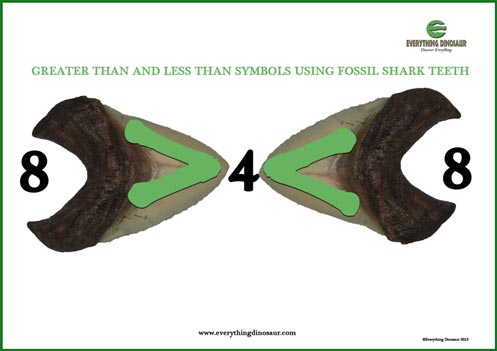
Greater Than and Less Than Symbols

Children learn about shape and space through practical activity which builds on their understanding of their immediate environment.  They begin to grasp mathematical language, using it to talk about their methods and explain their reasoning when solving problems.  It is developing a familiarity with mathematical symbols where Everything Dinosaur comes in, why not use some images of fossilised shark teeth to help children learn about the “greater than” > and the “less than” < signs.

Using Fossils to Help Children Learn About Mathematics

Greater than and less than thanks to C. megalodon.

Picture credit: Everything Dinosaur

Everything Dinosaur Helps Out

Everything Dinosaur team members used pictures of the huge, fossilised teeth of a giant prehistoric shark called Carcharodon megalodon to create the mathematical symbols.  As children move onto key stage 2, they are expected to be able to recognise that the position of a digit gives its value and to use correctly the <> symbols.

The teeth are part of Everything Dinosaur’s fossil collection.  Some of these fossils are brought into schools to help pupils learn about animals that lived in the past.  The shark teeth are particularly spectacular and these specimens are bigger than the typical hand of an nine year old child.  Such objects always intrigue and fascinate the children and they get a great deal out of the dinosaur workshops in schools that the staff conduct, so why not use some of the fossils to help children with other aspects of their education.

Note

This prehistoric shark has been reclassified and is now referred to as Otodus megalodon.

A Replica of the Prehistoirc Shark Known as Megalodon (O. megalodon)

PNSO Megalodon model "Patton".

The PNSO large Megalodon model “Patton” being held by an Everything Dinosaur team member.

Picture credit: Everything Dinosaur

To view the range of PNSO prehistoric animal models and figures including replicas of prehistoric sharks: PNSO Prehistoric Animal Figures (Age of Dinosaurs).

8 11, 2013

Thank You Note After School Visit From Everything Dinosaur

By |2023-03-01T08:41:00+00:00November 8th, 2013|Categories: Educational Activities, Teaching|0 Comments

Dinosaur Toys and Games

Team members at Everything Dinosaur are busy working with lots of schools this term, helping pupils to learn about dinosaurs and fossils.  Over the last few days, staff have been travelling all over the country delivering dinosaur themed workshops in support of national curriculum teaching aims and objectives.

The pace has been quite hectic but all the nice comments from the teachers, LTAs, and children make the hard work really worthwhile.  For example, after working with children from Nessfield Primary, the students sent thank you letters and all of them were greatly appreciated.  This is also a fantastic way to get the children to develop their creative writing skills, use of punctuation and of course, to test their recall.

Everything Dinosaur

Teacher Appreciates the Work of Everything Dinosaur

Thanks from Teacher

Picture Credit: Nessfield Primary

The teacher included this personal note in with the children’s letters, it was addressed to Mike one of our teachers/dinosaur experts who led the dinosaur workshop.  Seems like the visit was a big success with the children still referring to contribution to the topic that the visit from Everything Dinosaur made.

Glad to be of service.

To view the extensive selection of educational dinosaur themed toys and gifts available from Everything Dinosaur’s award-winning website: Educational Dinosaur Themed Toys and Gifts.

2 11, 2013

Dinosaurs Help Inspire Special Anti-bullying Posters for Schools

By |2024-05-01T15:16:10+01:00November 2nd, 2013|Categories: Adobe CS5, Educational Activities, Teaching|0 Comments

Everything Dinosaur Team Members Provide Anti-Bullying Posters for Primary Schools

Week commencing November 18th is the official anti-bullying week in the United Kingdom.  A number of nationwide events and activities are planned to help raise awareness over the issues of bullying and the consequences of having been bullied and Everything Dinosaur team members have been doing their bit to help primary school teachers get the anti-bullying message across.

Anti-Bullying Posters

With all the dinosaur illustrations and other resources available, staff were challenged to create an anti-bullying poster for use in schools.  A number of designs were suggested and three have been prepared and made available as downloads that can be emailed to schools and other organisations to help support their anti-bullying strategy.

One of the Anti-Bullying Posters Created by Everything Dinosaur

Stop the Bullies!

Stop the Bullies!

Picture credit: Everything Dinosaur

Each of the posters can be printed onto an A4 sized (297 mm x 210 mm) piece of paper and the posters can be laminated so that they can become a permanent part of the anti-bullying message within any school.  As children seem fascinated with dinosaurs and other prehistoric animals, it seems sensible to utilise these long extinct creatures to help make bullies extinct too.

Everything Dinosaur

A spokes person from Everything Dinosaur commented:

“It is important to get the message across to school children that bullying is not to be tolerated.  We see the concerted efforts of teachers, teaching assistants and other support staff  with regards to anti-bullying strategies when we visit schools and we wanted to do our bit to help stop the bullies.”

To request an anti-bullying poster for your school, simply email the staff at Everything Dinosaur and they will ensure that a poster is emailed out.

Contact Everything Dinosaur: Email Everything Dinosaur.

26 10, 2013

Dinosaur Extinction – Providing Helpful Information Sheets for Schools

By |2024-04-22T14:35:23+01:00October 26th, 2013|Categories: Educational Activities|2 Comments

Helping Primary School Children with Their Dinosaur Studies

Team members at Everything Dinosaur visit lots of school to undertake dinosaur workshops to help with teaching science as part of the UK’s national curriculum.  During our sessions with children aged from 4 years and upwards we get asked some amazing questions by the eager, budding palaeontologists.  We answer the questions as best we can but sometimes we are unable to deal with a specific enquiry during the teaching session itself, but we always follow up and send out further information and other resources to help the teaching staff with extension activities.

After all, taking dinosaurs into a school means that the school children are very excited and keen to learn all about these prehistoric animals as well as to demonstrate applied knowledge.

One of the questions we do get asked a lot concerns the extinction of the Dinosauria, typically we get asked “How and why did the dinosaurs go extinct”.

Everything Dinosaur

To help teachers, Everything Dinosaur has prepared a number of useful information sheets covering different aspects of palaeontology and the study of dinosaurs.

How and why did the Dinosaurs go Extinct?  Typical information sheet prepared for Key Stage 1/2 

The dinosaurs went extinct 65 million years ago, at what we call the end of the Cretaceous (CREE-TAY-SHOUS); this marked the end of the Age of Reptiles and the start of the Age of Mammals.  Not only did the dinosaurs die out but also all the flying reptiles and the large marine reptiles went extinct as well.  Many different types of fish, shelled animals such as the ammonites (AM-MON-NIGHTS) became extinct along with many small animals such as certain kinds of plankton that lived in the sea and a large number of plants.

Something like sixty percent of all life on Earth died out, this type of event is called a mass extinction and these have happened from time to time throughout the history of our planet.

Extinction Events

Scientists cannot be certain as to what exactly happened to the dinosaurs, there have been a lot of theories put forward to explain why the dinosaurs, other animals and plants went extinct.  Each theory has its own set of supporters, scientists that have looked at the evidence in fossils and rocks and come to a conclusion as to what might have happened.

We have listed some of the theories put forward, presenting evidence to support each theory and provided some other information presented by scientists who oppose this point of view.

In your class, weigh up the evidence look at the information presented and see if you can decide what wiped out the dinosaurs.

Your turn to be scientists…

Theory 1 – Death from Outer Space

If you look at a picture of the moon in a book you will see that it is covered in craters.  These have been caused by asteroids and meteorites crashing into the moon over millions and millions of years.  The moon has no weather, no atmosphere, so these craters are not eroded away, they are a permanent reminder that there are lots of chunks of rock and ice whizzing around in space.

Our planet has an atmosphere, it has weather, if an asteroid crashed into Earth, depending on the size of the rock, it could cause a lot of damage, but the crater would eventually get weathered away and any evidence of the impact would be eroded.  The Earth gets hit by lots of debris from space all the time, most of these rocks are very small and burn up in our atmosphere, they form shooting stars that sometimes you can see on a clear night.

However, every once in a while a huge lump of rock crashes into our planet and some scientists think that at least one huge meteorite or asteroid crashed into the Earth around sixty-five million years ago and this led to the demise of the dinosaurs.

Asteroid Impact Theory – Extinction of the Dinosaurs

An asteroid hits Earth

An artist’s impression of the impact event which helped to wipe out the non-avian dinosaurs. Picture credit: SwRI and Don Davis.

Space Rock

If a big enough piece of space rock crashed into the Earth then shock waves would be sent around the world, earthquakes would be caused and if the rock hit the sea, massive tidal waves would flood the surrounding land.  The impact would vaporise much of the rock and the ground where it hit.  Huge clouds of smoke, dust and rock would be thrown up into the atmosphere.  The rock would be molten and it would fall down to earth, as showers of red-hot material, causing forest fires that would add even more smoke to the atmosphere.

The fine particles thrown up and the smoke could spread across the whole planet, disrupting weather patterns and ocean currents, the sun could be blocked out and the Earth could enter into a period of world-wide winter, killing off what vegetation remained.  A big enough impact would have resulted in an environmental disaster and this could have led to the death of many different animals and plants.

Acid Rain

Depending on where the meteorite or asteroid hit, the damage done to the Earth could be made much worse if the place where the impact occurred had lots of rock with sulphur in them.  If the impact caused lots of sulphur to get thrown up into the atmosphere then this would have combined with other materials in the air and formed acid rain (sulphuric acid).

Acid rain would have destroyed much of the vegetation and damaged the delicate communities of plankton in the sea which in turn would have led to the collapse of food chains and the demise of lots of animals and plants.

Death from Outer Space – The Evidence

1.  The K-T Boundary (Rare Elements found in sixty-five million year old rocks)

In some parts of the world, the rocks that were laid down at the end of the Cretaceous are separated from the rocks that make up the first deposits of the Tertiary (TER-SHERRY), the Age of Mammals, by a thin layer of red-grey clay.  Scientists have tested the clay deposits (it is called the K-T boundary) and they have discovered that it contains high levels of rare Earth elements such as Iridium.  This element is scarce on Earth but is found in meteorites, could this be evidence of a meteorite impact sixty-five million years ago?

A Clay Deposit Marks the End of the Age of Dinosaurs

Marking the end of the Cretaceous.

Marking the end of the Cretaceous.

Picture credit: Open University/Everything Dinosaur

2.  The Crater

In 1990, evidence of a huge crater 200 kilometres wide was found off the coast of Mexico.  The asteroid or meteorite that caused this crater must have been at least 10 kilometres wide.  Little evidence of the impact can be found on land but a study of the seabed in the Gulf of Mexico and the rock layers in the area indicates that at around sixty-five million years ago a huge body from outer space crashed into the Earth.

A Disaster for Life on Earth

Such an event would have been disastrous for life on Earth but not all scientists agree with this theory.  Why did the turtles in the sea survive but no other marine reptiles?  How did birds survive and most mammal species?  Some scientists state that only the very smallest land animals were able to survive, a lot of dinosaurs were small, they do not seem to have made it through to the Age of Mammals.  Crocodiles did not go extinct, they have armour on their bodies like turtles and tortoises perhaps this is how they survived, but many dinosaurs like Anklylosaurus (AN-KIE-LOW-SORE-US) had armour as well but these animals went extinct.

Theory 2 – Global Climate Change

Although the age of dinosaurs ended suddenly, in geological timescales suddenly can mean as long as 100,000 years or more.  It is not possible to tell from rocks whether the events that caused the death of the dinosaurs took place over a few years or over a much longer time period.

Could gradual global climate change have caused the extinction of the dinosaurs?

When scientists look at the fossils found in rocks aged between 70-75 million years ago, they find lots of different types of dinosaur.  When scientists examine rocks from some parts of the world that are dated between 70-65 million years ago they find fewer types of dinosaur.  This might indicate that the dinosaurs were slowly dying out.  Scientists studying dinosaur fossils in rocks from 74 million years ago have found the fossils of over thirty different types of dinosaur, in studies of rocks from 67 million years ago, only about nineteen different types of dinosaur are found.

Extinction of the Dinosaurs

Between 70-65 million years ago a rising current of hot, molten rock began bubbling up from the Earth under western India.  This led to huge volcanic eruptions in the region.  These eruptions lasted for millions of years.  So much lava and molten rock was thrown out in volcanic explosions and lava flows that scientists estimate that enough material was ejected to cover 1.5 million square kilometres.

Huge amounts of carbon dioxide gas would have been sent up into the atmosphere.  Lots of carbon dioxide in the atmosphere affects the climate and weather patterns just as we are seeing today.

Climate change could have resulted in the deaths of many different kinds of plants and animals; they were unable to cope with their changing environment.

Global Climate Change – The Evidence

1.  The Gradual Decline in the Number of Certain Types of Fossil Found

Studies of tiny fossils in rocks close to the South Pole indicate that at the end of the Cretaceous period there was a gradual but steady decline in marine life.  Survival was getting difficult for animals and plants living in the polar regions, this indicates that slowly and surely the environment was changing and plants and animals were struggling to cope.

2.  The Deccan Traps

Much of India today is covered in layers of lava now turned into basalt rock.  These are the remains of the huge volcanic eruptions that occurred at the end of the Cretaceous.  In some parts, these volcanic layers of rock are nearly 5,000 metres deep.  This is volcanic activity on a huge scale.

So much carbon dioxide was pumped into the atmosphere it led to global climate change.  Even life in the sea would have been badly affected.  More carbon dioxide in the atmosphere would have become dissolved in the seas this would lead to an increase in acidity levels in oceans.  Many types of plankton cannot survive in water that is slightly acidic; this would have caused the death of the plankton and the collapse of whole marine food chains.

The amount of carbon dioxide pumped out into the atmosphere would have been many times what we are experiencing today.  We know that many animals and plants are endangered by global warming at present, so the animals and plants around at the end of the Cretaceous would also have been threatened with extinction.

Other Theories

There are lots of other theories around; did aliens hunt the dinosaurs to extinction?  Did biting insects spread diseases amongst the dinosaurs and this led to their demise?  Were all the plant-eating dinosaurs killed off by the spread of poisonous flowering plants and this also led to the death of the meat-eaters too?

Everything Dinosaur has put two of the most likely theories to your class; you must weigh up the evidence and decide what you think happened?

1).  Did the mass extinction event take place very suddenly caused by the impact and consequences of a huge meteorite or asteroid hitting the Earth?

2).  Did the mass extinction event take place gradually as a result of global climate change?

3).  Perhaps the extinction of the dinosaurs was caused by a combination of factors.  Global climate change had caused many types of plant and animal to decline and a big impact from outer space finally saw many of them go extinct.

Over to you and your classmates…

Although we have over simplified this subject area, the idea behind the information we have provided is for teachers to use this as part of their lesson plans and scheme of work preparation for a dinosaur themed term topic.

To learn more about the range of dinosaur themed toys and gifts stocked by Everything Dinosaur: Dinosaur Themed Gifts and Toys.

23 10, 2013

Back to the Age of Dinosaurs with Year 1

By |2023-02-28T08:12:31+00:00October 23rd, 2013|Categories: Educational Activities|0 Comments

Children Investigate Dinosaurs and Prehistoric Animals as Part of Their Autumn Term Studies

For Year 1 children (ages 5-6) at Pennyhill Primary, the autumn term topic has been all about dinosaurs, fossils and other prehistoric animals.   Under the enthusiastic tutelage of the school’s teaching team the children have been learning about when dinosaurs lived, what sorts of dinosaurs were there and what dinosaurs ate.

Age of Dinosaurs

The classrooms were beautifully decorated with lots of examples of artwork, posters and creative writing.  Miss Shuker’s class had been looking at different types of dinosaur and flying reptiles (pterosaurs).  The children had been busy doing lots of independent research and gathering facts about prehistoric animals.

Artwork on Display in Miss Shuker’s Classroom

Colourful dinosaurs and other prehistoric animals on display.

Colourful dinosaurs and other prehistoric animals on display.

Everything Dinosaur

The eager pupils had prepared lots of amazing questions, such as why did some dinosaurs eat meat?  What colour were dinosaurs?  Why were the dinosaurs able to grow so big?  Mr Hayes had converted part of his classroom into a palaeontology laboratory, complete with skeleton models and an assortment of dinosaur facts that the children had collated.  The pupils had even carried out an investigation into why some prehistoric animals had fins and sails on their backs.

One of the prehistoric creatures that the children studied was an animal called Ctenospondylus, not a dinosaur but a sail-backed reptile from a group known as the pelycosaurs.  Under the guidance of Mr Hayes and the teaching assistants the young palaeontologists had produced a series of colourful prehistoric animal drawings with a figure of a Ctenospondylus also included in the exhibit for good measure.

The Palaeontology Laboratory with Ctenospondylus taking Centre Stage

Pupils learn about the shapes and sizes of different prehistoric animals.

Pupils learn about the shapes and sizes of different prehistoric animals.

Dinosaur Workshop

Mrs Heffernan’s class had also been busy preparing questions as well as creating some very decorative dinosaur illustrations using paper plates.  A paper plate folded in half makes a super template for a dinosaur’s body, the children had come up with all sorts of designs.  Ironically, there is a dinosaur genus called Plateosaurus.  This particular dinosaur lived during the Late Triassic geological period, it was a herbivore.

A number of children were eager to explain the differences between herbivores and carnivores as well as to name one or two examples.  One pupil even explained what omnivores ate, fortunately there was a cast of a pachycephalosaur jaw bone on hand to show the children the teeth and beak of a dinosaur that is thought by palaeontologists to have been omnivorous.  Looks like this was a very successful dinosaur workshop in school.

With so many enthusiastic and knowledgeable pupils, it seems that dinosaur research in the future is likely to be in robust health.

To view the range of dinosaur and prehistoric animal themed toys and gifts available from Everything Dinosaur: Dinosaur Themed Toys and Gifts.

Go to Top