All about dinosaurs, fossils and prehistoric animals by Everything Dinosaur team members.

Everything Dinosaur’s work with schools and other educational bodies. Articles, features and stories about dinosaurs and their role in education and educating young people.

28 09, 2015

Year Six Look at Animal Adaptations and Extinction

By |2023-04-05T17:33:34+01:00September 28th, 2015|Categories: Educational Activities, Main Page, Teaching|0 Comments

Fossils Help Explain about Extinction

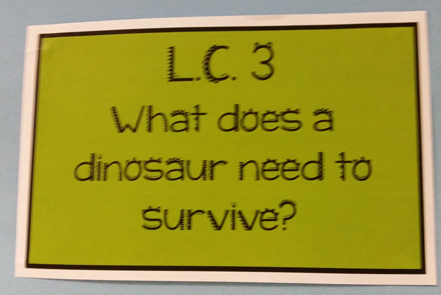
For children in Year six at Lomeshaye Junior School, Monday saw a change in their classroom routines.  One of the rooms used by the three classes was taken over for the day by a fossil expert from Everything Dinosaur.  Hopefully, the reshuffle was worth it as Ash, Rowan and Elder were able to examine fossils from animals that lived many millions of years ago and learn about extinction events.  The budding young palaeontologists have been learning about what animals need in order to survive and how animals can adapt to live in different environments.

Creating Dinosaurs – A School Activity

Helped by Yousuf and Conain, the schools resident dinosaur experts, the children explored how fossils form and examined a mystery that concerns one of the most famous dinosaurs of all, the plant-eating dinosaur Triceratops.  Time for the children to become “dinosaur detectives” to use scientific working to look at evidence and to decide upon a theory that supports the fossil record.

Looking at Fossils and Extinction Events

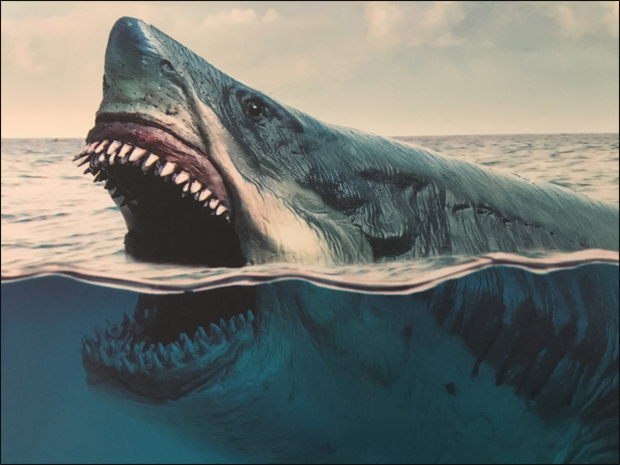
We looked at fossils and learned how scientists interpret fossils to help them understand creatures that lived in the past.  Using fossils the children looked at how animals are adapted to suit their environment and when the environment changes then extinctions can occur.  Time to introduce information on the bizarre Coelacanth as well as the awesome “teacher swallowing in one bite” Carcharodon megalodon or to use its other name Otodus megalodon*.

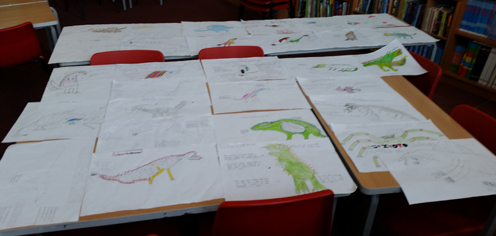
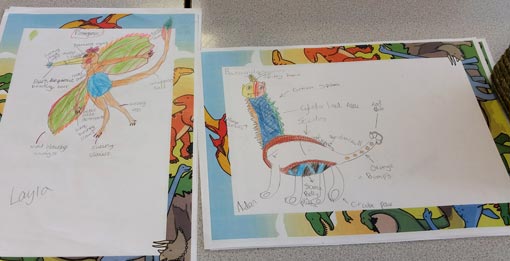
The children in Mr Smith’s class were challenged to design their own dinosaur.  Our expert wanted to see what adaptations the children would give their creation to help it survive.  We had some amazing designs and the children demonstrated how they could apply their knowledge to the task.

Year Six Children Create Their Very Own Prehistoric Monsters

Creating Dinosaurs.

Colourful dinosaur designs by Year 6.

Picture credit: Everything Dinosaur

Creating Dinosaurs

One of the animals designed was very round and fat.  Our fossil expert listened carefully as it was explained to him, that the fat layers that this dinosaur had helped to it keep warm – very clever.

The Colourful Dinosaurs Helped Demonstrate How Animals Adapt

Creating dinosaurs with Year Six.

Year 6 look at adaptations.

Picture credit: Everything Dinosaur

One little boy described his dinosaur and outlined how it was venomous, with one bite from its teeth able to paralyse prey.  What a fascinating idea!  One that has been backed up by some scientists who have been studying the fossilised bones and teeth of a predatory dinosaur from China.  The dinosaur called Sinornithosaurus (sigh-no-orn-nith-oh-sore-us), the name translates as “Chinese Bird Lizard”, may have had a venomous bite.

A Venomous Dinosaur

To read about a potentially venomous dinosaur discovery: Dinosaur with a Venomous Bite?

Laid out on the Tables the Drawings Made a Very Colourful Display

Getting creative as children learn about prehistoric animals.

Picture credit: Everything Dinosaur

Even Mr Lawless, one of the dedicated learning support team members, had a go.  His spider influenced design showed great imagination and our dinosaur expert loved the blue and yellow head crest.

Dinosaur and Fossil Workshop

It looks like the dinosaur and fossil workshop has helped inspire and enthuse teachers as well as pupils as Year six examines how environments change and animals adapt in order to survive.

* Carcharodon megalodon or Carcharocles megalodon, there is still some debate as to how this giant shark should be classified.  Please note, this prehistoric shark is classified as Otodus megalodon.

The PNSO Megalodon Model – A Prehistoric Shark that Faced Extinction

Megalodon a shark that faced extinction.

The PNSO large Megalodon model. A prehistoric shark that faced extinction.

PNSO have introduced a variety of prehistoric fish figures including Megalodon, Helicoprion, Dunkleosteus and Cretoxyrhina: PNSO Age of Dinosaurs Models and Figures.

22 09, 2015

Special Dinosaurs for Homework

By |2024-05-05T17:07:16+01:00September 22nd, 2015|Categories: Educational Activities, Main Page, Teaching|0 Comments

Dinosaur Topic at Bradley Green Community Primary School

Year 2 children at Bradley Green Community Primary have been busy this term learning all about dinosaurs and other prehistoric animals.  As part of their studies, the eager, budding young palaeontologists have been researching which dinosaurs were herbivores, which were carnivores and there has even been some discussion as to which dinosaurs were omnivores as they prepare for a dinosaur workshop.  Under the tutelage of Mr Stone and Miss Wood, the children have written down lots of facts about life in the past in their exercise books and they have made a geological timeline to see just how long ago the dinosaurs roamed the Earth.

A Dinosaur Workshop

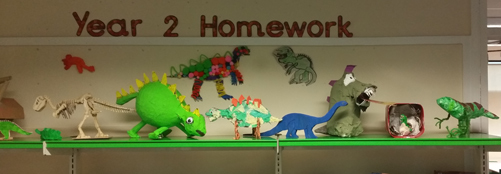
In addition, as part of the homework that had been set, some of the pupils made fabulous models of prehistoric animals and what a colourful collection of dinosaur replicas they are.

Year 2 Homework – Make a Model of a Dinosaur

A dinosaur display.

Colourful, creative dinosaurs.

Picture credit: Everything Dinosaur

Can you spot a green Stegosaurus with yellow plates on its back?  This was Nathan’s model and he explained that the body of his dinosaur had been made from a balloon.  Perhaps we should call Nathan’s dinosaur a “Balloonosaurus”

Our dinosaur expert did his best to answer the children’s questions.  They wanted to know how the dinosaurs became extinct and asked why did some dinosaurs have armour?

Asking Lots of Questions about Prehistoric Animals

Lots of questions about dinosaurs on display.

Picture credit: Everything Dinosaur

Lots of Questions about Dinosaurs

There were lots of examples of questions for the children to research pinned up around the well organised and tidy classroom.  Indeed, the focus of this term topic is around answering the question how do we know dinosaurs really existed?  The fossils Everything Dinosaur brought in to show the children certainly helped and Year 2 enjoyed handling the various fossils, even if some were very cold!

To see the variety of dinosaur themed, educational learning resources available from Everything Dinosaur, which help support dinosaur workshops: Dinosaur Themed Learning Resources.

Amongst the various extension resources that were emailed over after the dinosaur workshop, we included more information on a dinosaur measuring and scaling exercise that involves calculating just how big some dinosaurs actually were.  Good luck with measuring the Tyrannosaurus rex and the Diplodocus.  Some of the pictures taken by Miss Wood and Mr Stone might end up in the children’s books, that’s after, of course, the recall and re-counting exercise, we suspect the children will be able to remember lots of facts about dinosaurs.

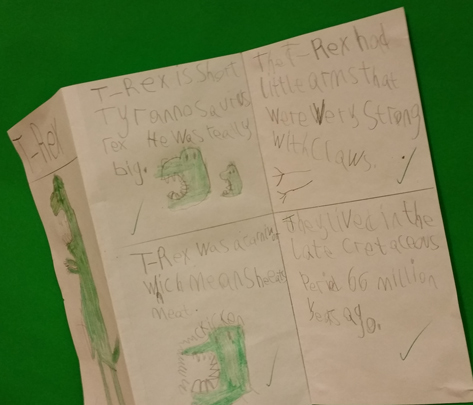
Year 2 Made Fact Sheets on Dinosaurs

Dinosaur workshop.

Lots of facts about dinosaurs on display.

Picture credit: Everything Dinosaur

Colourful Classroom Displays

The walls of the classroom will soon be covered in examples of the children’s work, pupil led research as the young scientists learn about a favourite dinosaur.  During his visit, our dinosaur expert examined some super dinosaur themed fact sheets.  Will the drawing of the horned dinosaur called Avaceratops we emailed inspire Ava and her friends to design their very own prehistoric animal?

It certainly was fun undertaking a dinosaur themed workshop with Year 2 and we are confident that our visit has helped to inspire and motivate the children to learn even more about dinosaurs.

21 09, 2015

Unique Dinosaur Workshops Get Five Star Rating

By |2024-05-05T15:12:33+01:00September 21st, 2015|Categories: Educational Activities, Main Page, Press Releases, Teaching|0 Comments

Dinosaur Workshops Get Top Marks from Teachers

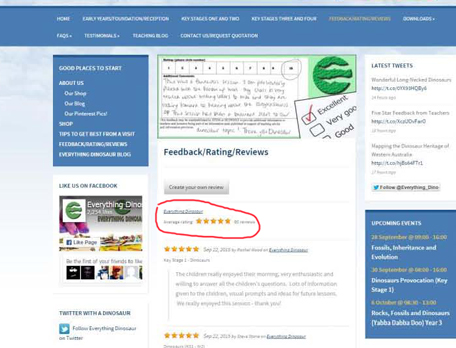
Everything Dinosaur’s teaching work in schools continues to impress teachers and teaching assistants and the company has achieved a top rating of five stars for its school visits.  Feedback forms received average five stars, the highest mark available on Everything Dinosaur’s rating system.  After a dinosaur workshop we ask the teaching team to provide feedback on our performance, how we engaged the children, the way in which we adjusted our work to meet the learning needs of the class and how we were able to assist the teachers in helping them to achieve their lesson outcomes.

Everything Dinosaur Visiting Schools

Our efforts in these areas have resulted in Everything Dinosaur’s workshops in schools getting a top rating.

Five Stars for Everything Dinosaur

Top marks for dinosaur company.

Top marks for dinosaur company.

Picture credit: Everything Dinosaur

Feedback after Dinosaur Workshops

The average rating is calculated by software embedded in the company’s specialist teaching website.  This information is then displayed on the front of Everything Dinosaur’s feedback/rating page.  In this way, any prospective customer can see instantly how our workshops are rated.  There are also pages and pages of teaching reviews available, all written by teaching professions, senior leadership team (SLT) members or teaching assistants who have experienced one of our workshops first hand.

The Rating System on the Everything Dinosaur Teaching Feedback Form

Great feedback for Everything Dinosaur's teaching work in schools.

Great feedback for Everything Dinosaur’s teaching work in schools.

Picture credit: Everything Dinosaur

Rating Everything Dinosaur

We ask the teacher to rate our work and to write comments regarding our performance.  Sometimes, as in the picture above we even get a smiley face from the feedback provider.

Five out of Five for our Dinosaur Workshops in Schools

Top marks from teachers from Everything Dinosaur.

Top marks from teachers from Everything Dinosaur.

Picture credit: Everything Dinosaur

It seems that smiley faces are a common currency in the teaching profession.  However, we also ask teaching professionals to provide reviews and comments with regards to our dinosaur and fossil workshops.  This information is used to help us to improve what we offer to schools and other educational establishments.  We are grateful for all the feedback we receive, for example Kim, a Year 4 teacher at Bispham Endowed Primary School wrote:

“Fabulous!  Very interesting!  The children really engaged and focused, they thoroughly enjoyed it.  Thank you.”

This is very typical of the sort of feedback that our team members receive.  Simone, working with Foundation Stage children at Withinfields Primary provided Everything Dinosaur with the following review:

“Thank you!  We all really enjoyed the session.  It was very interesting and has given us a fantastic start to our new topic.  We are looking forward to developing our knowledge of dinosaurs further.”

Dinosaur Workshops

Such feedback is very important to us, it allows our team members to consider and take on advice and constructive comments so that they can make their teaching work in schools even more effective.

With the roll out of the new curriculum in England, with its emphasis on scientific enquiry and scientific working our visits to schools are becoming increasingly popular, especially when you consider that rocks and fossils are teaching elements in the science curriculum for Lower Key Stage 2 and the Year six students are expected to know something about adaptation, extinction, inheritance and natural selection.

To read more feedback visit the Everything Dinosaur testimonials page: Everything Dinosaur Testimonials.

For Everything Dinosaur, our teaching about dinosaurs in schools continues to attract top marks from teachers. Visit the Everything Dinosaur website: Everything Dinosaur.

18 09, 2015

Notes on Lyme Regis Fossil Walks Provide Excellent Value

By |2024-05-05T17:08:15+01:00September 18th, 2015|Categories: Educational Activities, Geology, Main Page, Photos/Pictures of Fossils|0 Comments

A Private Fossil Walk Represents Good Value

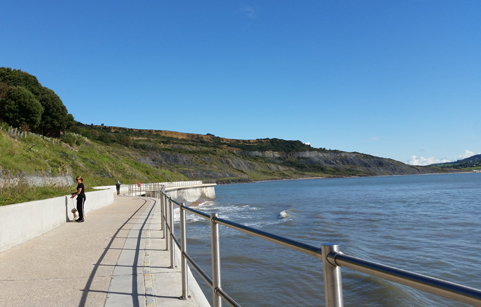
With the completion of the eastern sea wall at Lyme Regis last year the access to the beach between the town and Charmouth has certainly got easier.  No more climbing over the slippery rocks and the groynes that laid between the end of the beach front and the Church Cliffs.  That might sound like good news and it certainly is, especially for families trying to access the beach.  There is a downside to the new sea defences though, greater access has meant that over the summer months there have been more people than ever scouring the beach between Charmouth and Lyme Regis looking for fossils.  Pickings can be somewhat slim as a result.

Charmouth and Lyme Regis

The Newly Completed Magnificent Sea Wall at Lyme Regis

Part of the coastal defences at Lyme Regis

Part of the coastal defences at Lyme Regis.

Picture credit: Everything Dinosaur

Visit Everything Dinosaur’s website: Everything Dinosaur.

Sea Defences

The sea wall is part of an extensive array of features to help secure the cliffs and the land immediately behind them in a bid to protect the area from further land slips.  Eventually, these defences will give way but the engineering works has probably given the many houses on the cliffs another fifty years of life or so.

Whether or not the sea wall and other defences such as the remodelled beach area close to the famous Cobb has had an impact on the way in which the waves scour the beaches remains uncertain, time will tell, although we have heard from one reliable source that there seems to be a greater amount of sediment deposited out into Lyme Bay.  To help stabilise the cliffs, the slopes have been planted with thousands of small bushes and other plants to help anchor the soil.

The Cliffs have been Planted to Help Prevent Further Land Slides

Stonebarrow and Golden Cap can be seen in the background.

Stonebarrow and Golden Cap can be seen in the background.

Picture credit: Everything Dinosaur

What Do the Changes Mean for Fossil Hunters?

Lyme Regis has always been a popular destination for would-be fossil hunters. With easier access to the beaches to the east of the town, there is a feeling amongst locals that finding fossils along the shoreline is getting harder.

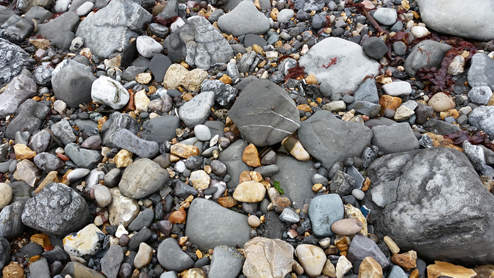
There are certainly lots of fossils to be found, but large pieces of ammonite and any ichthyosaur vertebrae are increasingly rare.  For example, during a recent trip to Lyme Regis, we spent a morning on the beach walking slowly up to Charmouth and we were surprised by the lack of fossils.  Belemnite guards were still plentiful, especially as we approached the “Belemnite Beds” but we found no fossils of Promicroceras, which surprised us somewhat.

This small ammonite used to be a relatively common fossil find, there was also a lack of nodules on the beach, although from the scattered shards of split rock there was plenty of evidence of previous visitors having hammered away quite happily at any stone bigger than a house brick, whether or not it was likely to contain a specimen inside.

Not a Very Successful Fossil Hunt

Fossils are becoming more difficult to find at Lyme Regis.

Fossils are becoming more difficult to find at Lyme Regis.

Picture credit: Everything Dinosaur

Advice for Visitors to Lyme Regis

With the popularity of fossil collecting on the increase and with the easier access to the beach, visitors to Lyme Regis might be disappointed by their lack of fossil discoveries.  One way of helping to get the most out of a visit is to book yourself onto an organised public walk.  There are a number of professional fossil hunters and guides who offer public walks.  These are a very good idea, especially when one considers the risk of getting cut off by an incoming tide or the hazards of rocks falling from the cliffs.

On a public walk your knowledgeable guide should be able to provide you with a very informative tour of the geology and help you to find a few fossils along the way.

Private Fossil Walks are Best

However, if you really want to make the best use of your time, try booking a private walk.  On some public walks that we have observed there can be as many as fifty people in the party.  Simply, getting a question answered amongst a throng of eager fossil hunters that size can be quite an ordeal, even the most dedicated guide can struggle to accommodate everybody’s needs.  Public walks tend to take place on the weekend, a time when the beaches are likely to be congested.  Private walks can be booked at a time to suit you (tides permitting) and you can be assured that your party will be very well looked after by the guide.

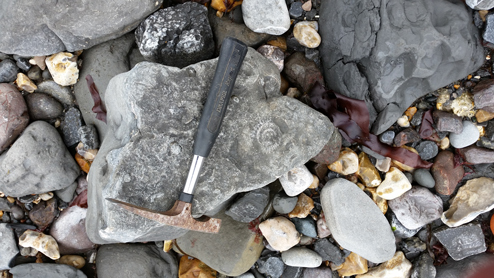
You are also more likely to be directed to the best fossil hunting locations, local knowledge wins out every time.  For example, for that beautiful Promicroceras ammonite, your best chance might be to sieve for fossils.  On a private walk, the guide can provide suitable sieves and show you the best technique to help you make your very own fossil discovery.  Knowing exactly where to start sieving on the beach is half the battle.

Still Fossils to be Found but Local Knowledge is Key

Fossils can still be found on the shore.

Fossils can still be found on the shore.

Picture credit: Everything Dinosaur

Private walks book up very quickly in advance, if you are thinking of visiting the Dorset coast next year, now is an ideal time to get yourself and your family booked on one.  Fossil walks are arranged around safe tide times so be aware that some preferred days may not be suitable.  Most organisers of private fossil walks ask for children to be at least five years old.

Guided Fossil Walks

Walks take around three to four hours, advice can be provided on where to park any vehicles and as for what you should bring here is a quick check list:

  • Suitable clothing, wellington boots or other stout footwear.  Warm clothing especially in the winter and early spring, having  a waterproof jacket on hand is very sensible, gloves in cold weather too.
  • Bring a snack and a drink although remember to take your rubbish home with you.
  • Bathroom breaks – there are no toilet facilities on the beaches, although most walks commence from the town centre and there are toilet facilities here at the start of the walk.
  • Tools to bring – most guides will be happy to break any nodules open for you, hammers are not usually supplied.  If you do bring your own hammer (please make sure it is a geological hammer), then remember the safety specs and tough gardening gloves.  For advice on the difference between geological hammers and tool box hammers: Geological Hammers What’s So Special About Them?

Finding Fossils

The fossil walk guide will be able to provide you with the very best chance of finding a top quality fossil and also be able to point out the best places to look.  You will learn a lot more about the history of the local area as well as having the opportunity to get one to one assistance and support.  Private fossil walks really do offer excellent value and they usually cost less than a family three-course meal in a pub.

For further information on private walks (public walks as well), Everything Dinosaur recommends: Lyme Regis Fossil Walks.

Private fossil hunting walks at Lyme Regis can prove to be a very worthwhile investment and provide visitors to the Jurassic Coast with an excellent opportunity to learn more about this fascinating area of Britain.

16 09, 2015

Primary School Children Ready for Special Dinosaur Studies

By |2024-05-05T14:45:37+01:00September 16th, 2015|Categories: Educational Activities, Main Page, Teaching|0 Comments

Year 1 at The Oaks Primary School Study Dinosaurs

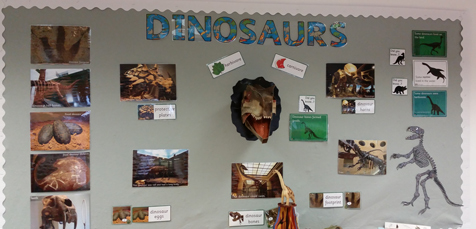
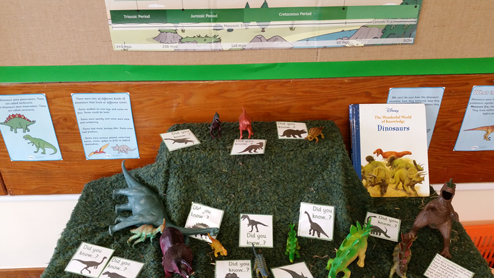
A bright and well-laid out classroom environment can really make a difference when it comes to helping Reception aged children used to free flowing activities, settle into the first term of Year 1 when more structured work will be required.  This was certainly evident during Everything Dinosaur’s visit to the two classes of Year 1 pupils at The Oaks Primary School.  The classrooms were bright, spacious and a lot of care and attention had been given to helping to create inspiring wall displays to enthuse the children as they learned all about dinosaurs and life in the past.

Studying Dinosaurs

Year 1 Classrooms with Lots of Prehistoric Animal Information

Lots of dinosaur and prehistoric animal information on hand to help inspire the children.

Lots of dinosaur and prehistoric animal information on hand to help inspire the children.

Picture credit: Everything Dinosaur

During the visit from one of our dinosaur experts the children demonstrated lots of knowledge, confidently naming and describing a number of dinosaurs.  One of the children’s mums also commented that her little boy had been so excited to get to school to learn all about T. rex that he insisted on reading his dinosaur book in the car!

Casting Fossils and Craft Activities

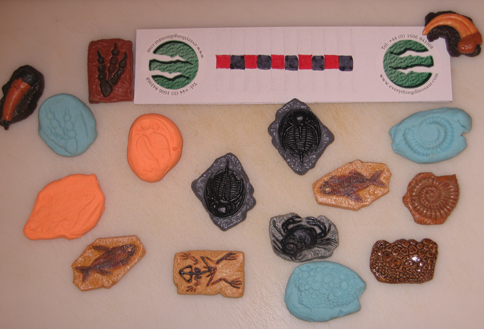
One of the resources the teaching team were using was the set of ten fossil models, appropriately supplied by Everything Dinosaur.  These sturdy, plastic models are replicas of famous fossils and they are great for use in craft activities.  The set contains replica dinosaur skin, a dinosaur tooth model, an ammonite, trilobites, even a fossil frog!  They are really useful for helping to explain about different types of fossil and which parts of animals are likely to become preserved.

Modelling Clay Can be Used with the Ancient Fossil Set to Make Excellent Fossil Casts

Great for making casts of fossils.

Great for making casts of fossils.

Picture credit: Everything Dinosaur

To view more fossil themed learning resources: Dinosaur Themed Educational Learning Resources.

 Dinosaur Workshop

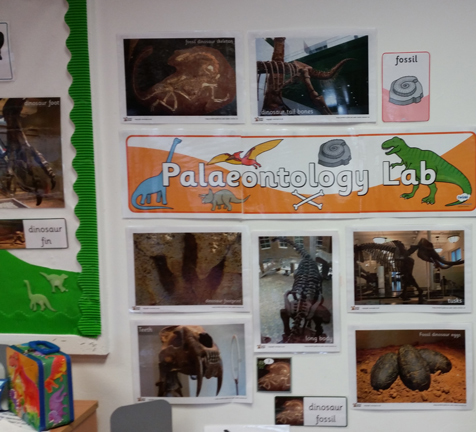
The enthusiastic teaching team discussed their scheme of work and they certainly have lots of hands-on activities planned for their young palaeontologists.  Class 1H even had a palaeontology laboratory in part of their classroom.  Preparing fossils can take a long time.  How long depends on the particular fossils involved, but if one of the Year 1 children was to uncover a complete Tyrannosaurus rex skeleton on their sixth birthday and work on it five days a week in the preparation laboratory, they might have finished cleaning, preparing and mounting the skeleton by the time they got to their early thirties!

The School Palaeontology Laboratory Ready for Action

Inspiring the next generation of palaeontologists.

Inspiring the next generation of palaeontologists.

Picture credit: Everything Dinosaur

A Dinosaur Museum for Studying Dinosaurs

To help bring the term topic to an exciting conclusion, the teachers, with the aid of the dedicated teaching assistants, intend to devote a small portion of each of the classrooms to a “dinosaur museum”. They plan to present samples of the children’s work in these museums and parents, guardians and other grown-ups will be invited along to have a look at the children’s discoveries and to see examples of creative writing and how the children have gained confidence with their numeracy.

All Sorts of Prehistoric Animal Information on Display

Bite-sized facts and information.

Bite-sized facts and information.

Picture credit: Everything Dinosaur

The classes certainly enjoyed their dinosaur workshops and they loved learning about (and handling) fossils.  Once back in the office, our dinosaur expert emailed over some more prehistoric animal themed resources to help support the school’s scheme of work, we even sent over a picture of the formidable and ferocious Tarascosaurus, for Tara, one of the teachers.  This seemed only fair as we had provided Lily and Tyler with pictures of Liliensternus and Tylosaurus respectively, all to help inspire the children to design their own dinosaur.

We look forward to seeing the results.

To view our FAQs page on the Everything Dinosaur website: Frequently Asked Questons – Everything Dinosaur.

13 09, 2015

Five Star Feedback from Teachers

By |2023-04-05T14:55:19+01:00September 13th, 2015|Categories: Educational Activities, Main Page, Teaching|0 Comments

Everything Dinosaur Workshops in Schools Receive Top Marks

September has started with a bang for team members at Everything Dinosaur.  Team members have been out on four consecutive days delivering dinosaur and fossil themed workshops in schools.  Although the Autumn Term has only just begun, it seems that lots of schools around England and Wales have kicked things off with a term topic all about prehistoric animals and fossils.  Our teaching team have worked with Reception classes, Year 1, Year 2 and delivered a workshop on adaptation and inheritance in support of the national science curriculum aimed at Year 6.  It seems we are going to have a very busy academic year.

Dinosaur Workshops

Everything Dinosaur Helps Prepare Dinosaur Themed Teaching Resources for Year 2

Dinosaur themed resources for Year 2.

Dinosaur themed resources for Year 2.

Picture credit: Everything Dinosaur

To contact Everything Dinosaur to learn more about our outreach work: Email Everything Dinosaur.

Five-star Feedback from Teachers

In addition to the work already carried out, our staff have been busy preparing for October’s school visits and arranging bookings for the Spring Term.  It is pleasing to note that despite our very busy schedule our high teaching standards are being maintained and we are receiving lots of lovely five star feedback from teachers and teaching assistants.

Top Marks from Teachers for Everything Dinosaur’s Workshops in Schools

Five stars for Everything Dinosaur!

Five stars for Everything Dinosaur!

Picture credit: Everything Dinosaur

Genuine Feedback

The picture above shows genuine feedback after one of our dinosaur workshops with Key Stage 2 children at a school in the East Midlands.  The company is currently averaging five stars out of five for its dinosaur workshops in schools.

To learn more about ho Everything Dinosaur looks after its customers: Our Customer Service Policy.

Favourable Feedback after Dinosaur Workshop

Moreover, our knowledgeable dinosaur experts are able to help teachers by providing lots of ideas for extensions and other activities in support of the scheme of work.  For example, in the last few days we have supplied information on a theropod dinosaur called Tarascosaurus to a teacher called Tara (the children loved learning about the dinosaur that had a similar name to their teacher).  Young Avie (Year 1) wanted to know all about Gorgosaurus, good job we had some pictures of Gorgosaurus fossils in our extensive photo archive and we delighted him with a download of some Gorgosaurus drawing materials.

Visit Everything Dinosaur’s website: Everything Dinosaur.

Sending Out Information About Specific Dinosaurs to Schools

Providing information on Gorgosaurus to schools.

Providing information on Gorgosaurus to schools.

Picture credit: Everything Dinosaur

Thank You Letters and Questions after Dinosaur Workshops

We are expecting to receive our first batch of thank you letters and questions from school children in the next few days, all part of extension activities agreed with teachers to help encourage pupils to practice their writing, sentence composition and so forth.  Our team members read all the letters that we receive and we do our best to email over answers to questions submitted. We also strive to blog about our work with schools helping to support the teaching team with the ICT (information communication and technology) part of the new curriculum.

Time to check the fossils and other items we have prepared in readiness for teaching assignments planned for next week.

7 09, 2015

Helping to Inspire Young People to Study Earth Sciences

By |2023-04-05T14:16:26+01:00September 7th, 2015|Categories: Educational Activities, Famous Figures, Main Page, Teaching|0 Comments

A Role Model for Young People – Dr Victoria Arbour

With the changes to the England’s national curriculum for schools and the greater emphasis on scientific working, team members at Everything Dinosaur often get asked to provide information about inspirational scientists to help enthuse and motivate young people.  With many schools adopting dinosaurs or the “Jurassic Forest” as a term topic and with rocks and fossils part of the curriculum at Key Stage 2, the number of requests for advice is on the increase.

The Pioneer Mary Anning

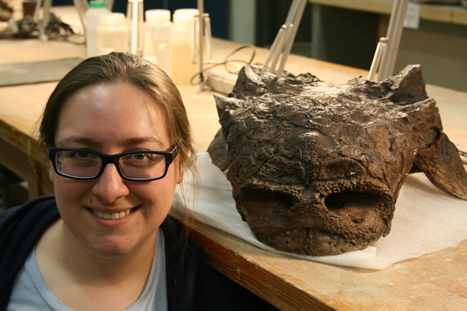
The story of Mary Anning (1799-1847), the Dorset woman of “she sells sea shells on the seashore” fame is highly appropriate.  Mary’s contribution to palaeontology and geology is well-documented, as is sadly, her shabby treatment by the male dominated academia of the 19th century.  For those teachers, homeschoolers and educationalists who want to inspire their pupils looking at the role of a scientist working today, then the work of Dr Victoria Arbour and her research on armoured dinosaurs is worth exploring.

Dr Victoria Arbour  (Vertebrate Palaeontologist)

Victoria next to a skull of a Euoplocephalus tutus (University of Alberta)

Victoria next to a skull of a Euoplocephalus tutus (University of Alberta)

Picture credit: Angelica Torices

Studying Ankylosaurs

Here is a short biography of Dr Arbour, in her own words (mostly):

I’m one of those kids that never grew out of their “dinosaur phase”.  I have been interested in palaeontology as far back as I can remember.  I knew that I wanted to pursue palaeontology as a career, or find an interesting field of science related to palaeontology.  So far, so good: I’m currently working as a postdoctoral researcher at the North Carolina Museum of Natural Sciences and North Carolina State University in Raleigh, North Carolina (United States).  Prior to this, I did my MSc and PhD degrees at the University of Alberta in Edmonton, Alberta, (Canada).

My home town is Halifax, (Nova Scotia, Canada) and I studied for my BSc degree in Earth Sciences and Biology at Dalhousie University (Halifax, Nova Scotia).

Nannofossils Studied

Taking a break from her studies in the summer, Victoria spent some time identifying calcareous nannofossils (coccoliths and coccospheres et al) from the Scotian Slope, an area off the coast of the Canadian province.  However, whilst at university, Victoria helped to study the first dinosaur fossils that had ever been collected in British Columbia.  These were from a small plant-eating dinosaur, but unfortunately the remains were too fragmentary to figure out exactly what species it was.

Now based in North Carolina, Dr Arbour focuses on the Dinosauria and her office is situated in a very inspiring location.  She continues:

Every day I walk past a Tyrannosaurus skeleton to get to my office, and my office is part of the exhibits at the museum, which means I get to see people enjoying that same Tyrannosaurus as much as I do.  In the summers I head out to the field to dig up dinosaurs in places like Utah, Alberta, and even sometimes Mongolia!  The rest of the time, I’m thinking about ankylosaurs, the armoured dinosaurs with lots of spikes.

Why the Ankylosauridae?

I’ve always liked ankylosaurs (well, I’ve always liked all dinosaurs!), but I became particularly interested in them when I started to think about what kind of project I wanted to do for my MSc thesis.  I kept seeing pictures in books of armoured dinosaurs using their tail clubs to defend themselves from predators, and I wondered if there was a way we could figure out if they could have done that.  So, some of the first projects I worked on looked at how fast and hard these dinosaurs could swing their tail into something, and what would happen to the tail when they smashed it into another object.

Teachers have no need to worry about whether or not all that can be discovered about dinosaurs will have been documented by the time their young charges are ready to choose further education options.

New Dinosaurs and Perhaps New Ankylosaurs Too

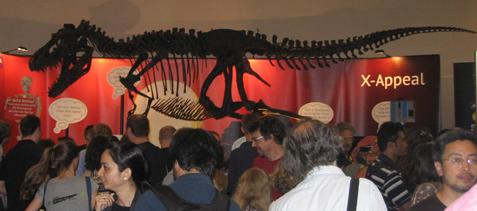
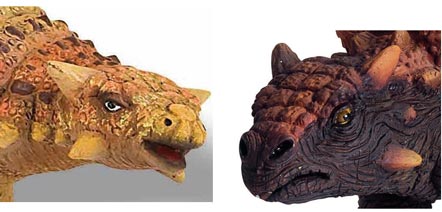
New dinosaurs are being named and described all the time.  For example, in a few days, Everything Dinosaur will be writing a short article on the very latest armoured dinosaur to be described – Horshamosaurus a member of the Ankylosauria clade, but a polacanthid, an armoured dinosaur that once roamed around West Sussex (southern England).

The Ankylosauria is Turning Out to be a Very Diverse Clade

Close inspection of the dinosaur models

Lots of armoured dinosaurs to study.

Picture credit: Everything Dinosaur

When asked why she specialises in studying the armoured dinosaurs, Victoria replied:

“The sneaky thing about science is that as you try to answer one question, you end up with more than you started with!  One thing led to another, and I’ve been studying lots of different aspects of ankylosaur biology – like how many species there were, how they moved between continents, and how their tail clubs evolved – and I still have lots of questions left to answer about these cool dinosaurs.”

For further information about Everything Dinosaur’s outreach work: Email Everything Dinosaur.

17 08, 2015

Dinosaur and Prehistoric Animal Drawings

By |2023-04-05T07:49:37+01:00August 17th, 2015|Categories: Educational Activities, Teaching|0 Comments

Pictures of Prehistoric Animals

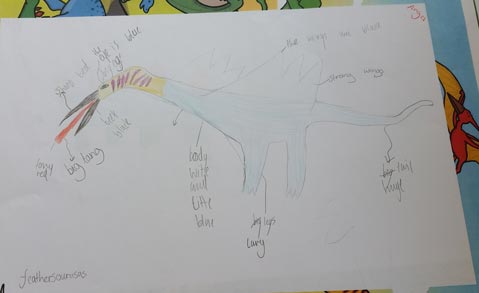
As part of Everything Dinosaur’s outreach activities supporting summer schools we challenged one group of Key Stage Two children to have a go at designing their very own dinosaur.  We explained how diverse the Dinosauria were and the various ecological niches occupied by this group of ancient reptiles then we set the children to work.  Everything Dinosaur team members wanted to help encourage their creativity as well as to get them considering such aspects as adaptation, diet and habitat.  We received some very colourful and indeed, very creative illustrations.

Dinosaur Drawings

Children Design Their Own Prehistoric Animals

Dinosaur drawings.

Colourful and carefully thought out dinosaur designs.

Picture credit: Everything Dinosaur

Dinosaur and Prehistoric Animal Drawings

This assignment was part of a wider project which Everything Dinosaur team members were involved in.  The focus was on literacy and coming up with imaginative and fun ways in which we could help the children with their writing.  The dinosaur topic and related scheme of work certainly proved very popular with the children.  The teaching team and volunteers were extremely enthusiastic too.

Lots of Different Prehistoric Animals were Created

dinosaur drawings.

We explained the link between dinosaurs and birds.

Picture credit: Everything Dinosaur

The Link Between Dinosaurs and Birds

With our dinosaur expert having explained the link between birds and dinosaurs and shown examples of feathered dinosaurs such as Microraptor, Beipiaosaurus, Therizinosaurus and Caudipteryx, naturally we got a lot of feathers in the children’s dinosaur designs.

Meat-eating dinosaur creations proved the most popular, especially with the boys, but there were also plenty of plant-eating dinosaurs created as well.  Lots of long-necked dinosaurs, dinosaurs with horns, even armoured ones.  It certainly was a very creative exercise.

Contact Everything Dinosaur

To request further information about Everything Dinosaur: Contact Us.

Commenting on the work undertaken by company, a teacher praised Everything Dinosaur for the provision of some inspiring resources.

A spokesperson for Everything Dinosaur stated:

“It has been fun to examine the wonderful and very imaginative dinosaur creations and we were really impressed with the amount of labelling that had also been going on.  Lots of colourful dinosaurs on display along with numerous adjectives.”

To view the extensive range of dinosaur toys and gifts available from Everything Dinosaur: Dinosaur Toys and Gifts.

10 08, 2015

Get Ready for School with Everything Dinosaur

By |2023-04-03T15:54:32+01:00August 10th, 2015|Categories: Educational Activities, Everything Dinosaur News and Updates, Everything Dinosaur Products, Main Page, Photos of Everything Dinosaur Products, Press Releases|0 Comments

Get Ready for School with Everything Dinosaur

A little under four weeks and then it will be the start of the new school year for much of the United Kingdom.  Summer holidays will be a thing of the past and school children will be preparing themselves for the rigours of the autumn term.  It does not seem that long ago since team members at Everything Dinosaur were safely and securely packing away all their fossils and other resources after completing their last teaching assignments of the summer term 2015.  Our dinosaur workshops and tactile sessions which involve the exploration of fossils are as popular as ever, but now we can look forward to the new school year.

Back to School

For mums and dads and other grown-ups looking to inspire and enthuse the next generation of scientists, look no further than Everything Dinosaur’s “Back to School Dinosaur Themed Range”.  We stock a huge range of prehistoric animal and dinosaur themed school kits, pens, pencils and stationery.  Whether it’s a dinosaur lunch box, dinosaur drinks bottle or dinosaur school bag Everything Dinosaur has it covered.

Back to School With Everything Dinosaur

Everything Dinosaur stocks an amazing range of dinosaur themed back to school items.

Everything Dinosaur stocks an amazing range of dinosaur themed back to school items.

Picture credit: Everything Dinosaur

See Everything Dinosaur’s back to school range by clicking on the image above.

Everything Dinosaur stocks a wide range of back to school items, all supported by our much admired customer service.  Send your budding young palaeontologists off to school with this brilliant range of dinosaur themed school stationery, lunch boxes, kit bags, pens, pencils and other dinosaur themed school items.  Take a dinosaur to school or out on your own prehistoric adventures with Everything Dinosaur’s inexpensive range of back to school supplies and back to school stationery.

We even have a beautiful dinosaur alarm clock to help you get your little monsters up in the morning.

Dinosaur Themed Alarm Clock

Rise and shine with dinosaurs.

Rise and shine with dinosaurs.

Picture credit: Everything Dinosaur

The Everything Dinosaur Website

Buy dinosaur themed back to school items on-line. Everything Dinosaur stocks a very wide range of back to school items, which are ideal for primary school children.

To visit Everything Dinosaur’s award-winning website: Everything Dinosaur.

In the meantime, Everything Dinosaur team members are busy preparing a whole new set of dinosaur workshops and other school activities as our autumn term teaching schedule is being finalised.  Staff are already working on a number of new palaeontology themed teaching assignments, including creating suitable lesson plans for key stages one through to four.

To read an article about Key Stage 1 children developing writing skills: Writing Skills with Key Stage 1.

In the meantime, check out Everything Dinosaur’s comprehensive range of back to school items by clicking on the “Back 2 School” image above, or simply visit our website.

Back to School Merchandise from Everything Dinosaur: Back to School Dinosaur Themed Gifts.

7 08, 2015

Preparing for a Trip to the Jurassic

By |2023-04-03T07:59:36+01:00August 7th, 2015|Categories: Dinosaur and Prehistoric Animal Drawings, Educational Activities, Teaching|0 Comments

Going on a Trip to the Jurassic

As part of Everything Dinosaur’s summer school commitments team members have spent the day preparing for trip into the east Midlands to help a group of Key Stage two children explore fossils.  Our plan is to set up in the school an artificial beach and to populate it with various fossils from our recent digs and field work.  Most of the fossils we will be using come from marine sediments and consist of lots of invertebrates, although there is some fossilised wood and even shark teeth.

Lots of Field Trips

Over the last year or so, we have been involved in a number of trips to explore highly fossiliferous sediments and as a result we have plenty of fossils to use in this fossils and dinosaur workshop session.

Lots of Fossils “on hand”

A successful fossil hunt.

A successful fossil hunt.

Picture credit: Everything Dinosaur

Trip to the Jurassic

It is going to be a dinosaur workshop with a difference.  Having populated the beach with various fossils, we are going to challenge the children to find them.  What they find they can keep, so long as the mums, dads and teachers present are OK with this.  In addition, we will be challenging the children to help us with some fossil identification.  This will involve lots of tactile fossil handling and helping them with their reading and writing.

We have also created a range of drawing materials so that the children can take home a drawing to colour in depicting what life was like in their part of the world during the Middle Jurassic.

A “Jurassic World”

Life in the Jurassic Seas.

Life in the Jurassic Seas.

Picture credit: Everything Dinosaur

Life in the Jurassic Seas

The picture we have created is a composition consisting of many of the illustrations of Jurassic marine fauna we have stored in our database.  The drawing materials reflect the sort of fossils that the children will be able to discover on our artificial beach. There will be fragments of coral, bivalve shells, including some nice examples of “devil’s toenails” – Gryphaea.  As well as the various bivalves, there are belemnite guards to find and pieces of fossilised ammonite shell.  We have gastropods, fish scales, crinoids (sea lilies) and lots of lovely brachiopods, especially those that superficially resemble old lamps (often referred to as lampshells).

It should be a fun dinosaur workshop with lots of fossils to collect and to identify.

If you want your own trip to the Jurassic, take a look at the huge range of Jurassic prehistoric animal models and figures available from Everything Dinosaur: Everything Dinosaur Models and Figures.

Go to Top