All about dinosaurs, fossils and prehistoric animals by Everything Dinosaur team members.

Fossil finds, new dinosaur discoveries, news and views from the world of palaeontology and other Earth sciences.

15 12, 2016

Studying the Growth Stages of Parareptiles

By |2023-05-13T06:41:43+01:00December 15th, 2016|Categories: Dinosaur and Prehistoric Animal News Stories, Dinosaur Fans, Main Page, Photos/Pictures of Fossils|0 Comments

Juvenile Skull Specimen of Delorhynchus cifellii Helps in Growth Study

A team of scientists from the University of Toronto Mississauga (Canada), have analysed a total of seven different skulls of the parareptile Delorhynchus cifellii collected from the Early Permian fissure-fill deposits of Richard Spur, Oklahoma.   This research, looking at the skulls which represent different growth stages of this primitive reptile, is helping palaeontologists to learn more about how the skulls of early tetrapods changed as they grew.  It may also provide a valuable insight into how temporal fenestrae (holes in the skull), of other types of vertebrate evolved.

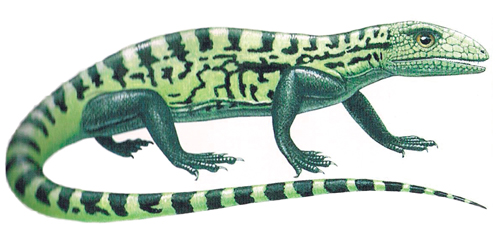
Delorhynchus cifellii

An Illustration of a Typical Early Reptile

The parareptile Delorhynchus.

Everything Dinosaur’s illustration of the Early Permian parareptile Delorhynchus.

Picture credit: Everything Dinosaur

For models and replicas of ancient Palaeozoic creatures: Prehistoric Animal Models.

Detailed Study of Cranial Ontogeny

Two species have been assigned to the genus Delorhynchu.  The first D. priscus was named and described in 1962.  In 2014, a second species was described D. cifellii, from a series of fossilised remains, including cranial (skull) material excavated from strata estimated to be around 275 million-years-old.

The researchers, which included Yara Haridy (Dept. of Biology, University of Toronto Mississauga), examined the partially articulated skull and jaw of a Delorhynchus cifellii believed to represent a juvenile (based on the size of the skull compared to other specimens and the lack of fully fused skull bones).  This specimen probably represents an earlier growth stage (ontogenetic stage) of all the other known Delorhynchus skull material and as such, it helps provide a basis for a better understanding of how these ancient reptiles changed as they matured.

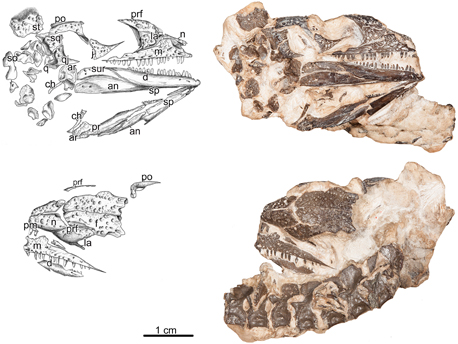
Views of the Delorhynchus cifellii Juvenile Skull Material Used in the Study

Delorhynchus fossil.

The cranial fossil material of a juvenile Delorhynchus.

Picture credit: University of Toronto Mississauga

Analysing the Fossil Material

The photograph shows (above) a line drawing and image of the fossil material (right lateral view) and (below), a line drawing and image of the fossil material seen from above (dorsal view).  The line of articulated vertebrae shown in the dorsal view do not belong to this individual.  Scale bar = 1 centimetre.

Key

an, angular; ar, articular; ch, ceratohyal; d, dentary; f, frontal; j, jugal; la, lacrimal; m, maxilla; n, nasal; pal, palatine; pf, postfrontal; pm, premaxilla; po, postorbital; prf, prefrontal; q, quadrate; qj, quadratojugal; so, supraorbital; sp, splenial; sq, squamosal; st, supratemporal.

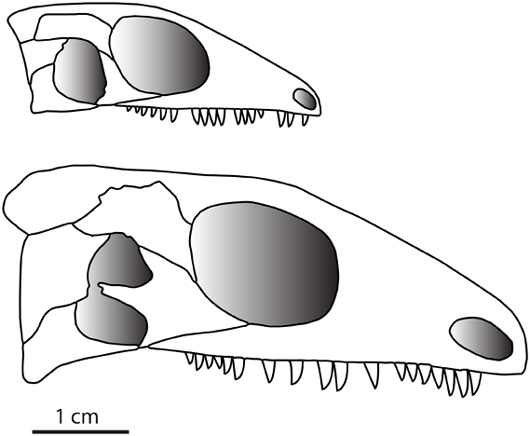
Comparisons between this juvenile and previously described specimens indicate that the size and shape of the temporal fenestra in Delorhynchus vary as the animal ages.  These changes occur as the skull bones bordering the fenestra change shape.  The growth series available for study, show that the jugal (cheek bone) becomes more robust as the reptile gets older and the proportionate size of the temporal fenestra is reduced.  The scientists discovered that as Delorhynchus grew, the single, large fenestra seen in the skull of juveniles was gradually sub-divided into two smaller holes in more mature individuals.

Line Drawings Showing a Comparison between a Juvenile Delorhynchus Skull (Top) with a Mature Adult Delorhynchus (Bottom)

Delorhynchus skull comparisons.

A comparison between the composite reconstructions of the youngest and most mature individuals in the Delorhynchus growth series.

Picture credit: University of Toronto Mississauga

The Fossil Record of Delorhynchus

The research team highlight the fact that the fossil record showing the growth of Delorhynchus is far from complete.  They also point out that the largest specimen is not a fully mature individual.  However, the data suggests that as the skull changed so the fenestra became much smaller and it would eventually be split into two small holes, due to the extension of the jugal bone.

The complete closure of the temporal fenestra may have occurred in very old animals, this cannot be ruled out, but the available skulls have provided a valuable insight into the possible growth trajectory of the fenestra of parareptiles.   The scientists also speculate that the research on this anapsid (likely to have no fenestra in the skull when an adult), may help them to better understand the evolution of skulls in other anapsids, as well as diapsids (one pair of holes) and the synapsids (two pairs of holes).

The scientific paper: “Ontogenetic Change in the Temporal Region of the Early Permian Parareptile Delorhynchus cifellii and the Implications for Closure of the Temporal Fenestra in Amniotes” published in the on line academic journal PLoS One.

Visit Everything Dinosaur’s website: Everything Dinosaur.

14 12, 2016

Tumour Discovered in 255 Million-Year-Old Monster as New Research is Published

By |2024-05-06T15:39:02+01:00December 14th, 2016|Categories: Dinosaur and Prehistoric Animal News Stories, Dinosaur Fans, Main Page|0 Comments

Gorgonopsid with Compound Odontoma

Researchers at the University of Washington have discovered evidence of a benign tumour in the fossilised lower jaw of a Late Permian predator, a gorgonopsid.  Thin sections of bone examined under the microscope reveal that this distant relative of modern mammals was suffering from a compound odontoma.  Scientists are studying the fossils of “mammal-like reptiles”, in a bid to learn more about how common diseases in mammals first evolved.

Fragment of Jaw

The fragment of jawbone was found by Professor Christian Sidor (University of Washington and curator of vertebrate palaeontology at the Burke Museum of Natural History and Culture), whilst on a field trip to the Late Permian beds of Tanzania.  The fossil was identified as belonging to a member of the Gorgonopsidae, a diverse group of Permian therapsids that evolved around 260 million years ago and ranged widely across the super-continent of Pangaea.

Although early gorgonopsids were small, some no bigger than a terrier, later gorgonopsids evolved into apex predators.  As members of the Therapsidae, they belong on the same branch as the vertebrate family tree as the mammals, although there is still much debate as to how closely related gorgonopsids are to extant mammals.

A Typical Late Permian Gorgonopsid – Inostranvecia alexandri

A scale drawing of the Late Permian gorgonopsid Inostrancevia

Scary monster from the Permian.

Picture credit: Everything Dinosaur

Models and replicas of gorgonopsids are quite rare, but collectors and fans of prehistoric animals can pick one up from Everything Dinosaur.  Safari Ltd added a model of the gorgonopsid Inostrancevia to their Wild Safari Prehistoric Life range in 2011, to view this product range: Wild Safari Prehistoric World Models.

A Compound Odontoma

In a letter published in the Journal of the American Medical Association Oncology, the research team report on the evidence that an animal that lived in Africa some 255 million years ago, had a small, benign tumour within its lower jaw.

The tumour has been identified as a compound odontoma, essentially, an abnormal growth in the jaw in which clusters of tooth-like structures complete with enamel, dentine and cementum form.  They are quite common in mammals and can affect our own species.  Although benign, most people have them removed as their growth and encroachment into other tissues and bone can cause considerable pain.

Senior author Professor Sidor stated:

“We think this is by far the oldest known instance of a compound odontoma.  It would indicate that this is an ancient type of tumour.”

Other odontomas have been found in the fossilised remains of mammals before, but as far as Everything Dinosaur team members are aware, all these fossils are associated with Quaternary deposits and thus, the fossils come from mammals that lived much more recently.

A Lateral View of the Skull of a Typical Gorgonopsid

Gorgonopsid skull.

Lateral view of a gorgonopsid skull.

Picture credit: Professor Sidor/University of Washington

Tracing the Origins of Pathology within the Mammalia

Finding evidence in an ancient jawbone suggests that the causes of odontoma in the Mammalia are nested deep within the ancestral roots of this Class of vertebrates.  The fragment of lower jaw was found in isolation, this single fossil was not found in association with other material, so its scientific value was minimal.  As such, it was selected to undergo thin slicing and subsequent microscopic analysis and CT scanning, a process that would destroy it.  Although the outside of the fossil showed no signs of pathology (disease or injury), when thin sections were viewed under high magnification evidence of the compound odontoma was revealed.

A Typical Fragment of Fossil Jaw Similar to the Specimen Used in the Study

Anterior portion of gorgonopsid lower jaw.

A partial dentary of a gorgonopsid.

Picture credit: Professor Sidor/University of Washington

The Gorgonopsidae are synapsids, tetrapods that possess a single pair of openings low down in the skull behind the eyes.  Modern mammals are synapsids, and studying the pathology of extinct synapsids such as the “mammal-like reptiles”* can provide scientists with information on how diseases and other problems such as tumours first came about.

Lead author, University of Washington biology graduate student, Megan Whitney explained:

“Most synapsids are extinct, and we, that is, mammals, are their only living descendants.  To understand when and how our mammalian features evolved, we have to study fossils of synapsids like the gorgonopsians.”

Gorgonopsids have several mammalian characteristics.  Many species walked with an upright gait and like us, they have heterogeneous teeth (differentiated teeth with differing morphology designed for specialised purposes).  The jawbone of a gorgonopsid was studied to see if these ancient creatures had other mammalian characteristics too.

Megan added:

“Most reptiles alive today fuse their teeth directly to the jawbone, but mammals do not.  We use tough, but flexible, string-like tissues to hold teeth in their sockets and I wanted to know if the same was true for gorgonopsians.”

The multiple thin slices of jaw, each slice no thicker than a piece of note paper, were polished so that their internal structure could be revealed.  When viewed under the microscope these slices revealed evidence of the compound odontoma embedded in the bone adjacent to the root of a canine tooth.  At higher magnification, the components of the tumour could be made out, tiny teeth, each with distinct layers of dentine, enamel and cementum.

A Highly-Magnified Image of the Compound Odontoma

Histological section of jaw showing compound odontoma.

Thin section of gorgonopsid lower jaw showing a cluster of tooth-like structures – a compound odontoma.

Picture credit: Professor Sidor/University of Washington

The picture above shows the “U” shaped structure of the canine tooth root with a cluster of tooth-like structures erupting around it and penetrating the adjacent bone.

Professor Sidor concluded by stating that this odontoma was possibly the first case found in a non-mammal, to have been reported.  Such an ancient tumour suggests that this mammalian condition existed tens of millions of years before the first true mammals evolved.

The professor summarised the research by stating:

“This discovery demonstrates how the fossil record can tell us a lot about our present-day lives, even the diseases or pathologies that are part of our mammalian heritage and you could never tell that this creature had it from the outside.”

“mammal-like reptiles”* a term falling out of favour with modern cladistics, groups like the pelycosaurs and the Gorgonopsidae are referred to as “stem mammals” or sometimes “proto mammals”.

For a video review of the Wild Safari Prehistoric Life Inostrancevia model: Inostrancevia Model Video Review.

13 12, 2016

Redefining the Horned Dinosaurs as Two, New Ceratopsian Clades are Established

By |2024-05-06T15:39:47+01:00December 13th, 2016|Categories: Dinosaur and Prehistoric Animal News Stories, Dinosaur Fans, Main Page|0 Comments

Two New Ceratopsian Clades – Nasutoceratopsini and the Centrosaurini

Over the last few years, the number of horned dinosaurs described from fossils found in North America has risen at a rapid rate.  Today, we discuss two new clades the Nasutoceratopsini and the Centrosaurini.

New additions to the Ceratopsidae include Machairoceratops and Spiclypeus (2016), Wendiceratops along with Regaliceratops (2015), Pentaceratops aquilonius and Mercuriceratops (2014) Judiceratops, Nasutoceratops and Bravoceratops (2013), Medusaceratops, Utahceratops, Kosmoceratops and Mojoceratops (2010) and Albertaceratops (2007).  We did say that the number of identified North American genera had gone up rapidly!

All these new horned dinosaurs has led to an inevitable revision of the Ceratopsidae family tree.  Writing in the academic journal “The Canadian Journal of Earth Sciences”, researchers have erected two new clades, otherwise referred to as “tribes” – namely the Nasutoceratopsini and the Centrosaurini.

A New Tribe Helping to Sort Out Horned Dinosaurs – Nasutoceratopsini

Nasutoceratopsini clade erected.

A new type of horned dinosaur based on the fragmentary skull CMN-8804.

Picture credit: Canadian Museum of Natural History/Andrey Atuchin

International Rules of Taxonomic Classification

There are international rules laid out to help ensure that scientists are consistent in their use of appropriate terminology when it comes to classifying organisms.  Admittedly, we at Everything Dinosaur don’t always follow those rules on this blog, but when it comes to classification, the ending given to a word helps to define the rank within taxonomy of that word.  Here’s an example

Order: Ornithischia (bird-hipped dinosaurs)

Clade: Marginocephalia (bony shelf at the back of the skull)

Family: Ceratopsidae (note – all zoological families end in the letters “idae”)

Sub-Family or Clade: Centrosaurinae (a sub-family is written with the suffix “inae” to help denote the status in taxonomy)

Clade or Tribe: Nasutoceratopsini (a division of the family, above the rank of genus but below sub-family or family.  It is a rank always denoted by the ending letters “ini”)

Genus: Nasutoceratops (a taxonomic rank just above species that groups together very closely related species)

Species: Nasutoceratops titusi (the lowest of the major taxonomic classifications, denoting an individual species with the species name usually written in italics or underlined if the name is hand-written)

Nasutoceratopsini and the Centrosaurini

The scientists, which include lead author Dr Michael Ryan (Cleveland Museum of Natural History), have erected these two tribes, or clades within the sub-family Centrosaurinae based on an assessment of anatomical characteristics following extensive comparative analysis of the fossilised bones of these large, herbivorous dinosaurs.

A fragmentary skull which includes parts of the snout and beak of a ceratopsian, collected nearly eighty years ago in southern Alberta, has led to the establishment of the Nasutoceratopsini.  The fossil skull (pictured below), was collected by the famous palaeontologist Charles Sternberg from southern Alberta in 1937.  Although it is too fragmentary to allow the identification of autapomorphies (unique characteristics) that would allow a new species to be named, it has helped the research team to identify the Nasutoceratopsini based on several features such as the large, broad neck frill and the shape of the beak.

Specimen Number CMN-8804 Helping to Define the Nasutoceratopsini 

Fragmentary Ceratopsian skull from southern Alberta.

Highly fragmentary Ceratopsian skull collected by Charles Sternberg in 1937.

Picture credit: Canadian Natural History Museum/The Canadian Journal of Earth Sciences

The new Nasutoceratopsini grouping includes Avaceratops from Montana as well as the recently described Nasutoceratops from Utah), along with an as yet undescribed skull specimen from Malta, Montana (specimen number GPDM-63).  Unlike, their ostentatious contemporaries within the Centrosaurinae, the Nasutoceratopsini had prominent frills that lacked well-developed ornamentation.  In a press release, the scientists state that the Nasutoceratopsini were not dinosaur show-offs, choosing instead to blend into their environments.

A Close View of the Head of the Dinosaur (Specimen CMN-8804)

 Nasutoceratopsini head.

The broad frill lacking excessive ornamentation of a Nasutoceratopsini.

Picture credit: Canadian Museum of Natural History/Andrey Atuchin

Lacking Shield Ornamentation

Although all nasutoceratopsins lack shield ornamentation, they had two long brow horns above their eyes.

Dr Ryan explained:

“Nasutoceratopsins took a different evolutionary path from their centrosaurine cousins, which typically have highly ornamented skulls.  We believe that the skull ornamentation was important for attracting mates.  If nasutoceratopsins lacked bony ornamentation, it’s possible that they may have used distinctive coloration patterns, social behaviours or vocalisations, like modern birds do in their courtship behaviours.  But we’ll never know for sure since those latter features don’t fossilise.”

The second new tribe described by the scientists, Centrosaurini, formally acknowledges its members (such as Centrosaurus) as being a natural grouping of horned dinosaurs with highly ornamented frills and short brow horns.

The Nasutoceratopsini and the Centrosaurini dinosaurs are represented in the Beasts of the Mesozoic modle range.

To view the Beasts of the Mesozoic figures: Beasts of the Mesozoic Figures and Models.

The Phylogeny of the Centrosaurinae

A Reassessment of the Centrosaurinae (Phylogeny)

Centrosaurinae phylogeny (2016).

Looking at the phylogeny of the Centrosaurinae.

Picture credit: The Canadian Journal of Earth Sciences with additional annotation from Everything Dinosaur

In the consensus tree diagram above, the phylogenetic relationship between members of the tribe Nasutoceratopsini are shown within the sub-family Centrosaurinae.  The new clades Nasutoceratopsini and Centrosaurini are underlined in red.

The fact that the two tribes are found together over a great distance in rocks of the same age indicates that they would have overlapped in the same regions at the same time.  Nasutoceratopsins and centrosaurins co-existed.  The research team examined the strata in the Belly River Group (southern Alberta) and compared it to the roughly same-aged rocks that comprise the Judith River Formation of north-central Montana.  They then mapped the Ceraptosidae fossils so that they could estimate which types of ceratopsids were contemporaneous.

Which Types of Horned Dinosaur Lived When?

Nasutoceratopsini and Centrosaurini species were contemporaries.

Nasutoceratopsini and Centrosaurini species were contemporaries in Laramidia.

Picture credit: The Canadian Journal of Earth Sciences with additional annotation from Everything Dinosaur

In the sequential strata diagrams above different members of clades that comprise the Ceratopsidae have been identified.

Key

B C = Basal ceratopsid

C = Centrosaurini

N = Nasutoceratopsini

P =Pachyrhinosaurini

Co-author of the paper, Dr Jordan Mallon (Canadian Museum of Nature), compared the ceratopsids of North America in the Campanian stage of the Late Cretaceous to extant populations of African rhinos, Dr Mallon stated:

“It’s probably similar to how two species of rhinoceros can broadly overlap in their geographic ranges, but do not actually compete with each other for resources.  Black rhinos will feed on woody browse, while white rhinos are primarily grass grazers.  Thus, the two species tend to utilise different parts of the same environments.  The assumption that centrosaurins and nasutoceratopsins may have had different feeding strategies is supported by the fact that the two tribes had different types of jaws, with the lower jaws of nasutoceratopsins being shorter and deeper.”

The scientific paper: “A Basal Ceratopsid (Centrosaurinae: Nasutoceratopsini) from the Oldman Formation (Campanian) of Alberta, Canada” published in The Canadian Journal of Earth Sciences.

Visit the Everything Dinosaur website: Everything Dinosaur.

11 12, 2016

Guess Who’s Coming to Dinner? That is a Super Question!

By |2024-05-06T15:42:24+01:00December 11th, 2016|Categories: Dinosaur and Prehistoric Animal News Stories, Dinosaur Fans, Main Page|0 Comments

The Rebor Deinonychus Trio “Cerberus Clan” is Coming to Everything Dinosaur

The Rebor “Cerberus Clan”, the third part of the Acrocanthosaurus/Tenontosaurus diorama is due to arrive at Everything Dinosaur’s warehouse in the next ten days or so.  The trio of raptors “Deinonychus antirrhopus“, nick-named Shoot, Tooth and Thrill (we think), completes the “Hercules and the Ceryneian Hind” model set, all the bases are designed to interlock to provide a seamless prehistoric scene that features a total of five dinosaurs.

Guess Who’s Coming to Dinner?

Cerberus Clan from Rebor

The trio of three “raptors” from Rebor.

Picture credit: Rebor/Everything Dinosaur

Deinonychus antirrhopus – Changing Perceptions

It could be argued that the scientific description of Deinonychus antirrhopus by the American palaeontologist John Ostrom in 1969, helped change the perception of the Dinosauria.  Ostrom, portrayed this predatory dinosaur as a very active, bird-like animal, helping to revolutionise thinking with the view that many dinosaurs had similar metabolic rates to mammals and birds gradually displacing the idea that dinosaurs were sluggish, dim-witted and slow-moving.

The new Rebor trio certainly echo much of Ostrom’s work, these dinosaurs are depicted as fast-running, pack hunters capable of challenging a larger meat-eating dinosaur over dining rights.

Around a dozen near complete specimens have been discovered, including remains of Deinonychus individuals next to Tenontosaurus (a large, herbivorous dinosaur), a rare example of predator and prey being found together.  It was these fossils that helped to inspire this particular Rebor sculpt.

Deinonychus and Acrocanthosaurus

At Everything Dinosaur, we are not aware of any Deinonychus fossil material being found in the same strata as Acrocanthosaurus (A. atokensis) fossil remains.  However, both these theropods lived in North America during the middle Albian , although D. antirrhopus fossil material is associated with the Upper Cloverly Formation and the much rarer Acrocanthosaurus fossils, are associated with the Antlers Formation of Oklahoma and the Twin Mountains Formation of Texas.

The Trio of Rebor Models (Hercules, Ceryneian Hind and the Cerberus Clan)

A trio of Rebor replicas.

The Rebor Acrocanthosaurus, Tenontosaurus and Deinonychus diorama.

Picture credit: Rebor/Everything Dinosaur

Each item is sold separately, to see the complete range of Rebor models available at Everything Dinosaur: Rebor Dinosaur Figures and Models.

The Rebor Deinonychus Figures

With individuals measuring more than three metres in length, a pack of Deinonychus would have made a formidable and frightening sight, even a giant, eleven-metre-long, fully-grown Acrocanthosaurus might have been well advised to steer well clear of them.

Fine Details on the Rebor “Raptor” Models

Rebor Cerberus Clan "Raptors".

The Rebor “Cerberus Clan”.

Picture credit: Rebor/Everything Dinosaur

The picture above shows the three Deinonychus dinosaur models in the Rebor “Cerberus Clan” set.  Each one is in a different pose and has different colouration.

Everything Dinosaur Comments

A spokesperson from Everything Dinosaur commented:

“We are very excited to hear that the Rebor trio of Deinonychus models are ready for shipping.  The first of these model sets should arrive before Christmas, but it is unlikely, that given the delays in post at this time of year, that we will be able to get out orders to customers in time for the big day.  However, what a fantastic way to welcome in the New Year!”

An Early Concept Illustration of the Rebor “Cerberus Clan” Models

Concept design - Rebor "Cerberus Clan".

The Rebor “Cerberus Clan” – concept illustration.

Picture credit: Rebor

Stock is expected in about ten days or so.

If you would like to see the range of dinosaur and prehistoric animal figures in stock at Everything Dinosaur: Dinosaur Models and Prehistoric Animal Figures.

10 12, 2016

Badger-sized Didelphodon Had a Bite More Powerful than a Hyena

By |2023-05-12T17:44:54+01:00December 10th, 2016|Categories: Dinosaur and Prehistoric Animal News Stories, Dinosaur Fans, Main Page|0 Comments

Didelphodon Study Suggests a Powerful Bite

Research published in the academic journal “Nature Communications” suggests that dinosaurs in the Late Cretaceous, did not have it all their own way when it came strong teeth and powerful jaws.

This new study, conducted by scientists from the Burke Museum and the University of Washington, indicates that the stem metatherian Didelphodon vorax may have had the strongest bite relative to its body size of any known mammal.  The team estimate that D. vorax could have weighed in excess of five kilogrammes and probably would have attacked and consumed small dinosaurs.

However, microscopic analysis of the wear patterns on fossil teeth suggest that Didelphodon was not entirely carnivorous, it seems to have consumed a wide variety of food items including plants, but those robust jaws and specialised teeth were capable of crushing hard body parts such as the shells of snails and the bones of small dinosaurs.

Didelphodon with Durophagous Jaws

The research team suggest that Didelphodon may well have been durophagous (jaws and teeth adapted for crushing and coping with bones and other tough body parts, such as mollusc shells, bones and the exoskeletons of arthropods).

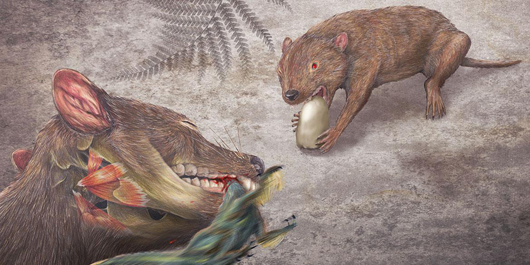
Didelphodon vorax Probably Ate Dinosaurs

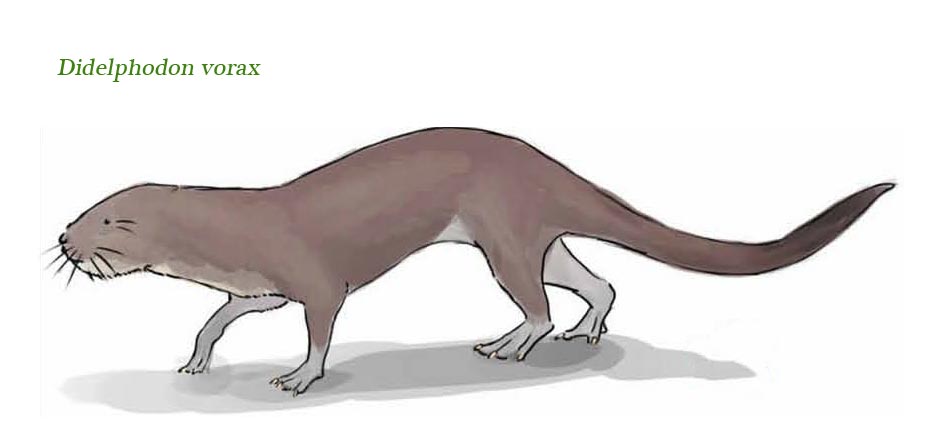
Didelphodon vorax illustrated.

Ancient marsupial ancestor may have attacked and eaten small dinosaurs.

Picture credit: Misaki Ouchida

Metatherians

Metatherians are the pouched mammals, the marsupials.  Didelphodon is believed to be distantly related to extant marsupials such as kangaroos, koalas and opossums.  Three genera have been named, all from fragmentary fossils found in North America.  The Didelphodon genus was erected in 1889 by the distinguished American palaeontologist Othniel C. Marsh.

Ironically, it is very likely that small isolated bones and teeth representing many different types of Late Cretaceous mammal may have been overlooked by field teams working for Marsh as they strove to uncover large dinosaur bones in a bid to overshadow the exploits of Marsh’s bitter rival, Edward Drinker Cope.

Described as being roughly the size of a badger, but with the skull reminiscent of the extant marsupial the Tasmanian Devil (Sarcophilus harrisii), very little post-cranial Didelphodon material has been formally described.  A specimen has been recently recovered from the Hell Creek Formation, it is likely that a more accurate picture of, what would have been one of the largest mammals of the Late Mesozoic, will emerge.

For the moment, there is a debate amongst palaeontologists as to whether Didelphodon was a semi-aquatic mammal with a lean, otter-like body or whether it was entirely terrestrial.

An Illustration of Didelphodon vorax

Didlephodon - depicted as a semi-aquatic mammal.

An illustration of Didelphodon vorax.

A Predator/Scavenger of the Hell Creek Formation

The research team, which included lead author, Dr Gregory Wilson (Burke Museum), examined four specimens from the Hell Creek Formation, namely a near complete skull, the most complete fossil skull of Didelphodon found to date, a partial snout and two upper jaw bones (maxillae).

All four specimens had been assigned to D. vorax based on an analysis of the cheek teeth that were present.  These fossils enabled the team to estimate the strength of this mammal’s bite and the results, coupled with a study of teeth morphology, suggest that Didelphodon occupied a durophagous predator/scavenger niche in the Hell Creek ecosystem.  Pound for pound, Didelphodon had a stronger bite than a Hyena!

For models and replicas of prehistoric animals from the Hell Creek Formation: PNSO Dinosaurs and Extinct Prehistoric Creatures.

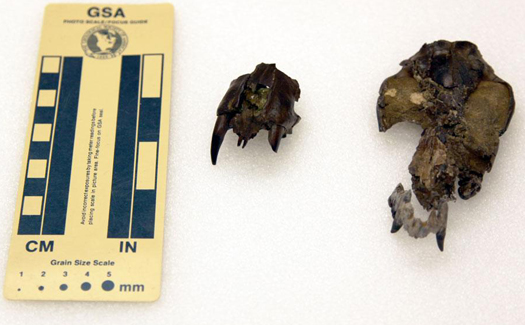
Some of the Fossil Specimens Used in the Study

Skull and jaw fossils of Didelphodon.

The partial snout (UWBM 94084) and the near complete skull (NDGS 431) of Didelphodon used in the bite force study.

Picture credit: Burke Museum

Didelphodon vorax

Dr Wilson stated:

“What I love about Didelphodon vorax is that it crushes the classic mould of Mesozoic mammals.  Instead of a shrew-like mammal meekly scurrying into the shadows of dinosaurs, this badger-sized mammal would have been a fearsome predator on the Late Cretaceous landscape – even for some dinosaurs.”

Most Cretaceous mammals are known from only isolated teeth and fragments of jaw.  However, with a nearly complete skull, part of the North Dakota Geological Survey State fossil collection, the scientists were able to examine in more detail the phylogenetic relationship between Didelphodon and modern-day marsupials.

The team concluded that marsupials most probably evolved in North America, as part of a Late Cretaceous diversification of the Mammalia and later dispersed to South America.  The Cretaceous extinction event that saw the demise of the Dinosauria and pterosaurs also resulted in the near extinction of the metatherian mammals.

These stem marsupials became larger and evolved to take advantage of different ecological niches before a decline in the North American metatherian diversity from the Late Campanian through to the Maastrichtian faunal stages of the Late Cretaceous, before these types of mammals died out almost entirely in North America at the end of the Mesozoic.

Marsupials survived in South America and marsupial diversity and evolution shifted to this part of the Americas.

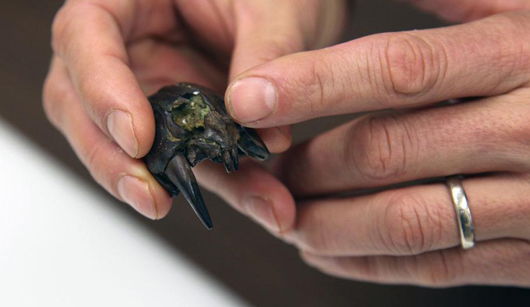
A Closer View of the Snout of Didelphodon

Fossilsed snout of Didelphodon.

A close up view of the snout of Didelphodon, one of four fossils used in a new study into Late Cretaceous metatherians.

Picture credit: Burke Museum

Marsupials from Hell Creek Formation

Marsupials seem to be the dominant types of mammal in the Hell Creek Formation, approximately sixty species have been described, Didelphodon being the largest.  An analysis of the snout bones including the premaxilla suggests that this mammal had a highly mobile snout, a feature lost in most later metatherians.

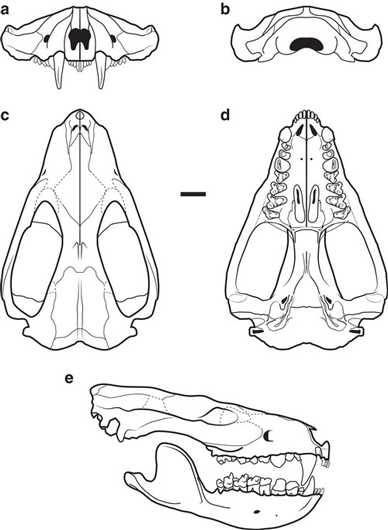
Fearsome Jaws and a Strong Skull (D. vorax)

Drawings of the skull and jaws of Didelphodon vorax.

Line drawings (various views) of the skull of Didelphodon vorax.

Picture credit: Wilson et al (Nature Communications)

The picture above shows the reconstructed jaws and skull of D. vorax (scale bar = 1 cm).  Picture (a) shows the anterior view (view from the front), whilst (b) shows the posterior view (view from the rear).  A view from the top down (dorsal) is (c), whilst (d) is a drawing viewed from underneath (ventral view).  Drawing (e), shows the skull and jaws as viewed from the right (right lateral view).

Although, these four specimens involved in the study have done much to improve our understanding of the skull morphology of Didelphodon, the areas not preserved in the actual fossils include the lower incisors, some upper incisors and parts of the back of the skull.  Some suture lines remain unclear, these are shown in the above illustrations as dashed lines.

Commenting on the significance of this new insight into Late Cretaceous mammal evolution, Dr Wilson said:

“Our study highlights how, despite decades of palaeontology research, new fossil discoveries and new ways of analysing those fossils can still fundamentally impact how we view something as central to us as the evolution of our own clade, mammals.”

The scientific paper: “A Large Carnivorous Mammal from the Late Cretaceous and the North American Origin of Marsupials”, published in Nature Communications.

Visit Everything Dinosaur’s award-winning website: Everything Dinosaur.

8 12, 2016

The Remarkable Tale of a Dinosaur Tail

By |2024-05-05T10:19:12+01:00December 8th, 2016|Categories: Dinosaur and Prehistoric Animal News Stories, Dinosaur Fans, Main Page|0 Comments

Dinosaur Tail Preserved in Mid-Cretaceous Amber

A team of international scientists including Lida Xing (University of Geosciences, Beijing), Phil Currie (University of Alberta), Michael Benton (University of Bristol), Ryan McKellar (Royal Saskatchewan Museum) and Xing Xu (Institute of Vertebrate Palaeontology and Palaeoanthropology) have published a paper describing the discovery of a partial dinosaur tail preserved in amber.

The Dinosaur Tail Segment Preserved in Burmite (Amber from Myanmar)

A tiny dinosaur tail preserved in amber.

The exquisitely preserved dinosaur tail in amber.

Picture credit: R. McKellar/Royal Saskatchewan Museum

 It is the first time that non-avian theropod remains have been found preserved in amber and this remarkable fossil find may help scientists to uncover more information about dinosaur biology and the evolution of plumage.

Views of the Preserved Dinosaur Tail

Preserved in amber, a dinosaur tail.

Dinosaur tail preserved in amber.

Picture credit: Elsevier Ltd (Current Biology)

The picture above shows various photomicrographs of the plumage of the fossilised tail (specimen number DIP-V-15103).  The exquisite details of the individual feathers and the barbs and barbules that help to “zip” the feather together can be made out.  This fossil find confirms the theory long held by evolutionary biologists that the branching structures of feathers evolved before a modern-looking rachis (central shaft).

Photomicrographs of DIP-V-15103 Plumage

(A) Pale ventral feather in transmitted light (arrow indicates rachis apex) – scale bar = 1 mm.

(B) Dark-field image of (A), highlighting structure and visible colour – scale bar = 0.5 mm.

(C) Dark dorsal feather in transmitted light, apex toward bottom of image – scale bar = 0.5 mm.

(D) Base of ventral feather (arrow) with weakly developed rachis, scale bar = 0.5 mm.

(E) Pigment distribution and microstructure of barbules in (C), with white lines pointing to pigmented regions of barbules, scale bar 0.5 mm.

(F–H) Barbule structure variation and pigmentation, among barbs, and ‘rachis’ with rachidial barbules (near arrows); images from apical, mid-feather, and basal positions respectively, scale bars 0.25 mm.

An analysis of the preserved pigmentation signatures suggests that this little dinosaur’s tail was a light chestnut colour with a paler, or possibly white underside.

Definitely a Dinosaur

Lida Xing, the lead author of the study, discovered the remarkable fossil at an amber market in Myitkina (Kachin State, northern Myanmar).  The 99-million-year-old amber had already been polished for jewellery and the retailer had thought that the “furry looking” object visible inside the polished piece was plant remains.

However, on closer inspection, it turned out to be the tail of a feathered dinosaur about the size of a sparrow.  It was then a case of detective work, with Lida Xing eventually tracking down the amber miner who had originally found the specimen.  Once the team had an idea of the location of the fossil find, they could begin the process of analysing the remains, knowing that what was inside had lived during the Middle Cretaceous.

Scanning electron microscopy permitted the team to view the skeletal structure of the tail.  The caudal vertebrae (tail bones) are not fused into a stiff rod, nor are the vertebrae compressed into a pygostyle (the last five tail bones much reduced and fused into a plate of bone, the pygostyle, birds more advanced than Archaeopteryx of the Late Jurassic had a pygostyle), as in extant birds and their close relatives.  This tail was long and flexible with keels of feathers running down each side – the tail of a small dinosaur.

Treasures Preserved in Burmite

Earlier this year, Everything Dinosaur reported upon the discovery of bird wings preserved in burmite (the term used to describe amber from Myanmar, which was formerly called Burma), the researchers, many of whom collaborated on the study of the dinosaur tail, identified the tiny wings of a hatchling bird that had become trapped in sticky tree resin.

The wing fossil came from a bird that was a member of the Enantiornithes group of birds.  Enantiornithes are the most widespread, diverse and abundant type of bird known from the Mesozoic.  Like the more primitive Confuciusornithids, these birds had pygostyles, the long sinewy tail preserved in this piece of amber strongly suggests that this is a piece of a dinosaur, albeit a small piece the tail measures just 36.73 mm long.

Views of the Dinosaur Tail Preserved in Amber

Views of the dinosaur tail preserved in amber.

Photomicrographs and SR X-Ray μCT reconstructions of the specimen (DIP-V-15103).

Picture credit:  Elsevier Ltd (Current Biology)

To read Everything Dinosaur’s earlier article (June 2016), about the bird wings preserved in amber: Bird Wings Preserved in Amber from Myanmar.

The picture above shows photomicrographs and synchrotron radiation X-ray images of the tail.

(A) Dorsolateral overview (view from the top) – note the insect remains also found within the amber nodule, burmite has provided palaeontologists with a large number of insect specimens to study.  Scale bar = 5 mm.

(B) Ventrolateral overview (view from underneath) with decay products (bubbles in foreground, staining to lower right).  Scale bar = 5 mm.

(C) Caudal exposure of tail showing darker dorsal plumage (top), milky amber, and exposed carbon film around vertebrae (centre).  Scale bar = 2 mm.

(D–H) Reconstructions focusing on dorsolateral, detailed dorsal, ventrolateral, detailed ventral, and detailed lateral aspects of tail, respectively, showing layout of the vertebrae and the orientation of feathers.  Scale bar in (D) and (F) = 5 mm.  Scale bar in (E), (G) and (H) = 2 mm.

Asterisks in (A) and (C) indicate carbonised film (soft tissue) exposure.  Arrows in (B) and (E)–(G) indicate shared landmark, plus bubbles exaggerating rachis dimensions; brackets in (G) and (H) delineate two vertebrae with clear transverse expansion and curvature of tail at articulation.  Abbreviations for feather rachises: d, dorsal; dl, dorsalmost lateral; vl, ventralmost lateral; v, ventral.

Vestiges of Organic Remains from a Dinosaur Tail

Chemical analysis of the carbonised soft tissues where the tail was exposed at the surface of the amber nodule indicate traces of ferrous iron Fe+2, this suggests that the specimen may contain vestiges of haemoglobin, a relic of the blood of a dinosaur.  It had been rumoured that other remains of vertebrates had been found in burmite, but these pieces quickly found their way into the hands of private collectors and they were lost to science.  This piece remains unique in that preserved dinosaur remains in amber have come to the attention of the scientific community and a study has been undertaken.

How Did it Get There?

Dr Ryan McKellar (Royal Saskatchewan Museum), stated that the dinosaur tail was not dried out or desiccated when it was trapped in the tree resin.  This suggests that a little dinosaur became stuck in the resin when it was still alive.  Co-author, Professor Mike Benton (Bristol University) commented:

 “It’s amazing to see all the details of a dinosaur tail – the bones, flesh, skin, and feathers – and to imagine how this little fellow got his tail caught in the resin, and then presumably died because he could not wrestle free.”

The resin was presumably coming out of a wound in a coniferous tree, either running down the truck or lodging in a branch.  This suggests that this little dinosaur may have been arboreal, a tree dweller.  It has long been thought that there were a large number of small types of theropod dinosaur, but the fossil record for such small, forest dwelling reptiles is virtually non-existent.

A spokesperson from Everything Dinosaur stated:

“It is likely that there were many different types of insectivorous theropod dinosaur, inhabiting woodland habitats, but their delicate bones and the fact that forest corpses have a very limited fossil preservation potential, greatly reduces the chances of palaeontologists being able to study their remains.  These types of dinosaurs are likely to be severely underrepresented in the fossil record.”

What Sort of Dinosaur?

Although feathers have been found preserved in amber before, the lack of skeletal remains associated with them frustrated scientists when it came to identifying what sort of creature the feathers belonged to.  However, in this case, with the tail segment and its preserved caudal vertebrae, the researchers can confidently assign this specimen to the Dinosauria, but what type of dinosaur was it?

An Artist’s Reconstruction of the Little Feathered Dinosaur

Feathered dinosaur illustration.

An illustration of the feathered dinosaur, about to become stuck in amber.

Picture credit: Cheung Chung-Tat

Arboreal Dinosaurs

In the artist’s reconstruction, the dinosaur is depicted as a ground dwelling animal, however, team members at Everything Dinosaur don’t rule out the idea of an arboreal dinosaur becoming stuck in the tree resin. A spokesman for the Cheshire based company explained:

“A number of dinosaurs show adaptations for climbing indicating that they were at least, partially arboreal.  You would have been more likely to have encountered tree resin on a resin producing tree such as a conifer and whilst we can’t completely rule out the idea that a ground dwelling dinosaur was unlucky enough to become trapped in amber, the context of this fossil raises the possibility that indeed, a number of dinosaurs lived in trees, after all, that would be one way of keeping out of the way of terrestrial predators.”

The spokesperson added:

“It is tantalising given what the amber fossil shows, but it could be speculated that this little dinosaur, if arboreal, could have been a glider or may be even capable of powered flight.”

As for honing the specimen down to a specific genus or even a family, that is quite a challenging task.

Examining the Feathers on the Dinosaur Tail

The shape of the feathers are different from a number of known feathered dinosaurs.  For example, the dromaeosaurid Sinornithosaurus has a reduced rachis and long, naked, filamentous feather barbs.  The plumage on specimen DIP-V-15103 also contrasts with the therizinosaurid Beipiaosaurus.  The researchers conclude that it was probably bipedal and this dinosaur has been assigned to the Coelurosauria clade, a sub-group of the Theropoda that includes the tyrannosaurids, compsognathids, the ornithomimids and the “raptors”.

The scientific paper: “A Feathered Dinosaur Tail with Primitive Plumage Trapped in Mid-Cretaceous Amber” published in the journal “Current Biology”.

Visit Everything Dinosaur’s website: Everything Dinosaur.

7 12, 2016

Sizing Up Early Dinosaurs – Variation an Evolutionary Advantage?

By |2023-05-12T06:22:16+01:00December 7th, 2016|Categories: Dinosaur and Prehistoric Animal News Stories, Dinosaur Fans, Main Page|0 Comments

For Coelophysis Variety Might Have Been the Spice of Life

Scientists from Virginia Tech University have concluded that early dinosaurs had a wide variety of growth patterns, a trait that may have helped species survive extinction events ultimately assisting the Dinosauria to establish themselves as the dominant, large terrestrial fauna.  The study, published in the academic journal “The Proceedings of the National Academy of Sciences”, focuses on one early theropod, Coelophysis (pronounced: See-low-fy-sis), and the scientists conclude that a single dinosaur species contained a huge amount of diversity in terms of the size that the animals grew to.

Studying Coelophysis

This sets dinosaurs apart from birds, which tend to be much more uniform in terms of their growth rates and sizes within a single species.  A species that contained a broad range of different sized individuals may have had an advantage during hard times or when a sudden catastrophe occurred.  This ontogenetic variation may have helped dinosaurs like Coelophysis survive the harsh environment at the end of the Triassic some 210 to 201 million years ago, a time when a large number of other terrestrial reptile species became extinct.

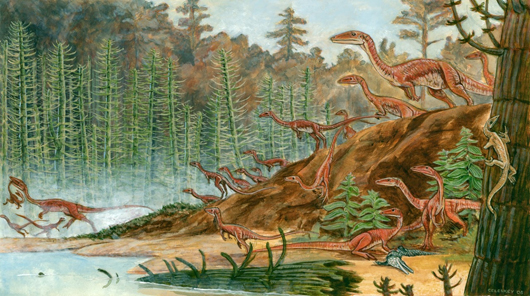
Study of the Theropod Coelophysis May Provide a Clue to the Success of Dinosaurs

Coelophysis flock.

A flock of Coelophysis descend on a waterhole (Ghost Ranch).

Picture credit: Matt Celeskey

A Race for Supremacy Across Pangaea

The end Permian extinction event devastated terrestrial ecosystems and the early dinosaurs rapidly evolved and radiated to take advantage of vacated ecological niches.  During the Triassic, a wide variety of land animals competed with each other – cynodonts, dicynodonts, rauisuchids, phytosaurs and dinosaurs.  Scientists have put forward several theories as to why the Dinosauria eventually rose to become the dominant megafauna.  This new research, conducted by Christopher Griffin and Sterling Nesbitt (Department of Geosciences, Virginia Tech), looked at the variation in growth patterns in a mass death fossil assemblage of Coelophysis, a flock of fast-running, carnivorous dinosaurs that died together in a flood some 208 million years ago, in present-day New Mexico (Ghost Ranch).

Hundreds of individuals were buried together, ranging from youngsters, to sub-adults to fully grown animals.  In total, the researchers examined the fossilised remains of 174 specimens, housed in museums across America.

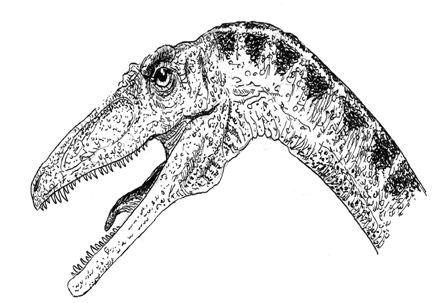
An Illustration of the Head of Coelophysis

Coelophysis (Hollow Form).

Coelophysis of the Late Triassic.

Picture credit: Everything Dinosaur

Explaining their results, lead author, Christopher Griffin stated:

“We found that the earliest dinosaurs had a far higher level of variation in growth patterns between individuals than crocodiles and birds, their closest living relatives.  Not only were there many different pathways to grow from hatchling to adult, but there was an incredible amount of variation in body size, with some small individuals far more mature than some larger individuals, and some large individuals more immature than we would guess based on size alone.”

Ontogenetic Sequence Analysis

A technique called ontogenetic sequence analysis was used to assess the growth of the Coelophysis fossil assemblage, this data set was compared to two extant birds and one crocodile species, animals alive today that are closely related to extinct dinosaurs.  The birds (Aves) are the fastest growing terrestrial vertebrates, anyone who has observed nesting garden birds can see how, within a few weeks, the hatchlings are almost the same size as their parents.

Birds develop unlike all other living archosaurs.  As part of this postnatal development, birds possess a low amount of intraspecific variation, put simply, one bird such as a blackbird (Turdus merula) grows at much the same rate as other members of its species and there is little size variation in populations.  The Coelophysis flock shows a very different growth rate with a wide variety of adult sizes.  When did this low variation in body size amongst archosaurs evolve?  By studying the extensive fossil collection of one species of non-avian, extinct animal (Coelophysis), scientists hope to pinpoint this transition in Mesozoic theropods.

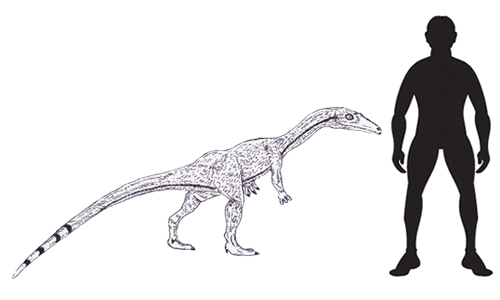
Coelophysis Study Sheds Light on the Evolution of Growth Rates Amongst the Theropoda

Coelophysis illustrated. Remembering Edward Drinker Cope.

A scale drawing of the Triassic dinosaur Coelophysis.

Picture credit: Everything Dinosaur

To view models of Coelophysis and other prehistoric animals: Wild Safari Prehistoric World Models and Figures.

Analysing the Fossil Bones of Coelophysis

Geosciences Master’s student Christopher Griffin went onto state:

“As these animals grew, muscle attachment scars formed on the limb bones, and the bones of the ankle, hips, and shoulder fused together, similar to how the skull bones of a human baby fuse together during growth.  Fossils of even a single partial skeleton of an early dinosaur are exceptionally rare, so to have an entire group of a single species that lived and died together provided an unparalleled opportunity to study early dinosaur growth like never before.”

Variation Lost in More Derived Theropods

The team concluded that this high variation in early dinosaurs as demonstrated by the Coelophysidae was lost in more derived theropod dinosaurs such as Allosaurus of the Late Jurassic and Late Cretaceous tyrannosaurids.  This intraspecific high variance could have contributed to the rise of the Dinosauria during the Triassic-Jurassic extinction event.

Assistant professor Sterling Nesbitt added:

“Large variation in early dinosaurs may have allowed them to survive harsh environmental challenges like dry climate and high levels of carbon dioxide.  Understanding why dinosaurs were so successful has been a great mystery, and high variation may be one of the characteristics of dinosaurs that led to their success. However, it’s difficult to determine whether this trait evolved in response to the environment or was simply a stroke of luck that allowed these dinosaurs to survive and thrive and become the most dominate vertebrates on Earth for 150 million years.”

Not Down to Differences in Size Between Males and Females

Variation in those species of early dinosaurs which have a more substantial fossil record had been put down to sexual dimorphism in the past.  However, this new study, which focused on growth rate analysis as conferred by the degree of bone fusion and muscle scar evidence on the fossilised bones, did not find data to support that the fossil assemblage growth rates were solely down to differences in the adult size of males and females.

Steve Brusatte, a palaeontologist from the University of Edinburgh, who has undertaken research into the growth rates of other types of theropods, such as tyrannosaurs, commented:

“Studies like this are a perfect demonstration of how fossils can help us understand the evolution of peculiar features and behaviours of modern animals.  How dinosaurs grew may have been both the key to their early success and the reason that one particular unique subgroup, the birds, survives today.”

The scientific paper: “Anomalously High Variation in Postnatal Development is Ancestral for Dinosaurs but Lost in Birds”.

Visit Everything Dinosaur’s award-winning website: Everything Dinosaur.

5 12, 2016

Bridging Romer’s Gap – Early Scottish Tetrapods Described in New Scientific Paper

By |2024-05-06T15:34:12+01:00December 5th, 2016|Categories: Dinosaur and Prehistoric Animal News Stories, Main Page, Photos/Pictures of Fossils|0 Comments

New Tetrapods from the Lower Carboniferous

Last spring Everything Dinosaur team members had the opportunity to travel to Edinburgh (Scotland), to view several early tetrapod fossils that had been excavated from a number of remarkable fossil sites located in the Scottish Borders.  This week sees the publication of a scientific paper that describes five new tetrapods, helping to greater enrich our understanding with regards to the evolution and diversity of some of the very first vertebrates to adapt to terrestrial environments.

Scotland 355 Million Years Ago

Scotland 355 million years ago.

Scotland in the Early Carboniferous.

Picture credit: Mark Witton/National Museums of Scotland

Scotland and Romer’s Gap

During the Late Devonian and into the Carboniferous, the area of land that makes up much of Scotland today was part of a giant super-continent called Laurentia.  The Scottish Borders were located almost on the equator and the low-lying land was covered with some of the first large forests to evolve on Earth.

The climate was hot, humid and steamy, with seasonal flooding and also periods of intense drought.  A team of scientists, that includes leading early tetrapod specialist Professor Jennifer Clack (Cambridge University), reporting in the academic journal “Nature Ecology & Evolution” describe five new Early Carboniferous tetrapods, helping to narrow a fifteen-million-year hole in the fossil record known as Romer’s Gap.

Fossils of Late Devonian tetrapods have been found, an example of which is Acanthostega, a stem tetrapod, fossils of Acanthostega have been found in Greenland, including fossil material found by Jennifer Clack.  Acanthostega dates from around 365 million-years-ago, however, the next type of fossils found, date from rocks approximately 350 million-years-old and reveal animals with strong rib cages to support lungs and long, slender limbs – adaptations for a life on land.  Harvard professor Alfred Sherwood Romer, was one of the first scientists to research early tetrapods and to identify this hole in the fossil record.

This fifteen-million-year interval became known as “Romer’s Gap”.

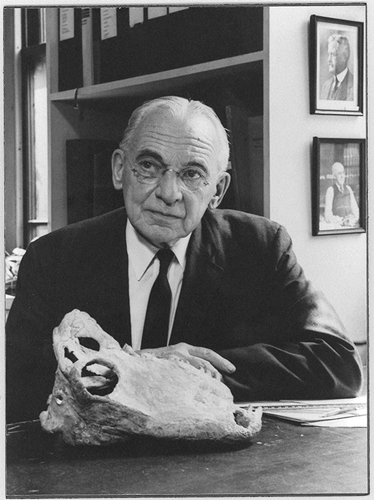
Professor Alfred Sherwood Romer (1894-1973)

Alfred Romer (courtesy of Harvard University archives)

Harvard Professor Alfred Sherwood Romer.

Picture credit: Harvard University Archives

Five Almost Complete Fossils Plus Many Fragments of Bone

Building upon the early work of renowned Scottish palaeontologist Stan Wood and his co-worker Tim Smithson (Cambridge University), who, coincidentally, is also an author of this new paper, these researchers have identified a total of five new tetrapods from rocks laid down in the very Early Carboniferous (Tournaisian stage).

Although, isolated tetrapod limb bones dating from the Tournaisian faunal stage have been found outside of Scotland, most notably from the Horton Bluff Formation at Blue Beach, Nova Scotia (Canada), collecting from five Scottish locations has identified five new animals with at least seven other new taxa, that have yet to be fully studied.

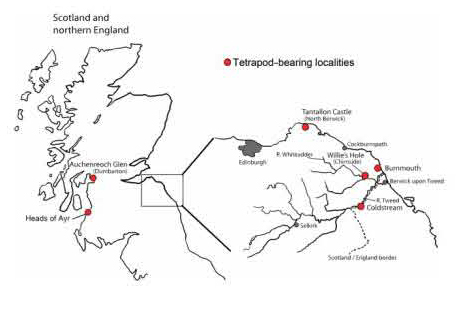
Tournaisian Tetrapod Fossil Collecting Locations (Scotland)

Fossil locations (early Tetrapods) Scotland.

Scottish tetrapod fossil locations.

Picture credit: Nature Ecology & Evolution

This new research, which included exploring strata that today forms the bed of the River Whiteadder, a tributary of the River Tweed, has provided scientists with much more information about the diversity of early tetrapods and given them an insight into the fauna and flora that existed in some of the world’s first forests.

Bridging Romer’s Gap

The five new Tournaisian tetrapods named are:

  1. Perittodus apsconditus “concealed odd tooth”, known from the cheek region of the skull, lower jaw bones and postcranial elements found at Willie’s Hole on the River Whiteadder (Chirnside).  The lower jaw measures a fraction under seven centimetres in length.
  2. Koilops herma “hollow-faced boundary marker”, the fossils consist of a natural mould of an isolated skull found at Willie’s Hole (River Whiteadder, Chirnside).  The skull measures 8 centimetres long.

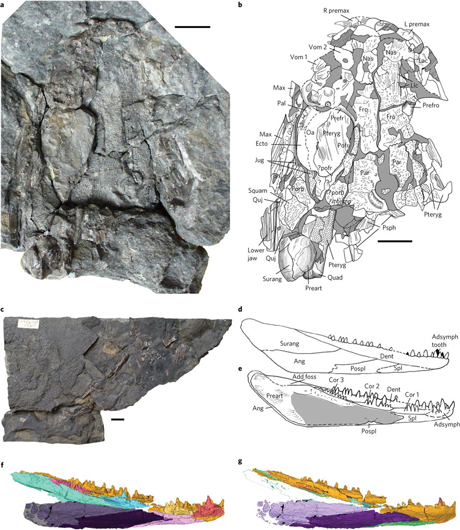
Two of the New Early Carboniferous Tetrapods (Perittodus apsconditus and Koilops herma)

Tetrapod fossils helping to close "Romer's Gap".

New tetrapod tax identified from fossils found on the Scottish borders – Perittodus apsconditus and Koilops herma.

Picture credit: Nature Evolution & Ecology

The photograph above shows (a) a photograph of the natural mould of the skull of K. herma with interpretative line drawing (b).  Photograph of the main specimen block of Perittodus apsconditus (c), with reconstructions of the lower jaw (d-g).

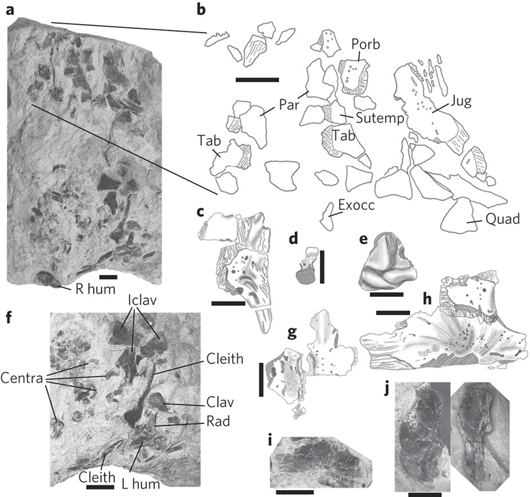
Fossils and Line Drawings of Ossirarus kierani

Ossirarus fossils and illustrations.

Photographs of Ossirarus fossils with accompanying line drawings.

Picture credit: Nature Evolution & Ecology

Professor Clack et al Bridging Romer’s Gap

3.  Ossirarus kierani “Kieran’s scattered bones” from Burnmouth Ross end cliffs (see picture above which shows photographs of the fossil material and line drawings).  The species name honours the Kieran family who have done much to protect the natural habitat on this part of the Scottish coast.  The taxon has been described from a single block of stone with preserved skull elements and postcranial bones.  Ossirarus may have been a basal amniote, whilst the other four taxa named are classed as basal tetrapods.

4.  Diploradus austiumensis “double row of teeth from the mouth of the river”, a reference to the strange configuration of the teeth in the lower jaw and the fact that the specimen, consisting of a single block of bones, was found at Burnmouth Ross end cliffs.

5.  Aytonerpeton microps “small faced crawler from Ayton”, in reference to the size of the skull and the fossil find location (foreshore of Burnmouth Ross end cliffs heading towards the small village of Ayton).

Commenting on the significance of these new Scottish fossils, Professor Clack stated:

“We’re lifting the lid on a key part of the evolutionary story of life on land.  What happened then affects everything that happens subsequently, so it affects the fact that we are here and which other animals live with us today.”

Charcoal Analysis

Sedimentary evidence analysis indicates that these early land animals lived on the low-lying land that was heavily forested, a sort of primeval, prehistoric swamp.  This region was subject to frequent flooding, the fossils of various plants and invertebrates in conjunction with these exceedingly rare vertebrae specimens from locations such as Willie’s Hole are helping scientists to build up a picture of an Early Carboniferous palaeoenvironment – one of Scotland’s first wetlands.

It had been thought that atmospheric oxygen levels crashed during the Late Devonian/Early Carboniferous that inhibited the evolution of land-based vertebrates.  A study of fusinite (fossil charcoal) collected from Willie’s Hole and the Burnmouth locations not only indicated that wildfires did occur, devastating local habitats, but chemical analysis revealed that oxygen levels did not drop below a level of around 16% in the atmosphere during the Tournaisian.

The scientists compared these results to fusinite samples taken from both younger and slightly older strata and they concluded that atmospheric oxygen levels were stable across the Devonian/Carboniferous boundary and therefore, probably did not inhibit the evolution of terrestrial vertebrates.

Everything Dinosaur Comments

A spokesperson from Everything Dinosaur commented:

“It’s great to see more research being carried out in these Scottish locations, building on the work of field palaeontologists such as Stan Wood and we recognise the important role of the Natural Environment and Research Council for funding the study.  The number of potential new taxa identified from the Scottish Borders raises the tantalising possibility that there are a lot more discoveries likely to be made in sedimentary rocks of a similar age.”

The scientific paper: “Phylogenetic and Environmental Context of a Tournaisian Tetrapod Fauna” published in the journal “Nature Ecology & Evolution”.

Visit the Everything Dinosaur website: Everything Dinosaur.

28 11, 2016

On the Hunt for Troodon

By |2023-05-09T14:14:30+01:00November 28th, 2016|Categories: Dinosaur and Prehistoric Animal News Stories, Dinosaur Fans, Main Page|6 Comments

Famous Canadian Palaeontologist Plans to Track Down Troodon

Professor Phil Currie (University of Alberta) is making plans for next summer, they include an expedition to hunt for a complete skeleton of the fast-running member of the dinosaur clade Deinonychosauria.  Phil Currie is hoping to hunt down Troodon.

Professor Phil Currie – Next Year Hunting for Troodon

Palaeontologist Phil Currie.

With “the best-preserved baby horned dinosaur ever found”, but will Phil Currie find a Troodon?

Picture credit: Bruce Edwards (from a video interview)

Troodon Dinosaur Fossil

Troodontids are a group of small theropod dinosaurs that seem to fall somewhere in the phylogeny of the Dinosauria between the ornithomimids and the fearsome dromaeosaurids.  Troodon, may have been typical of this group, being fast-running, between two to three metres long (mostly tail), having a small skull with a long snout, large eyes and a big brain.  Relative to its body size, the species Troodon inequalis has the largest brain of any mature dinosaur yet described.  However, this genus is only known from a few specimens, and no complete skeleton of this dinosaur has ever been discovered.

An Illustration of a Troodontid (Troodon formosus)

Troodon illustrated.

An illustration of the feathered dinosaur Troodon.

Picture credit: Everything Dinosaur

A Typical Member of the Troodon Family of Dinosaurs (Scale Drawing)

Troodontidae scale drawing.

A scale drawing of a typical member of the Troodontidae dinosaur family.

Picture credit: Everything Dinosaur

For articulated replicas of troodontids and other members of the Maniraptora: Beasts of the Mesozoic Articulated Prehistoric Animal Figures.

Professor Phil Currie

Phil Currie, hopes to change all that and by doing so, help to assign with greater confidence, the various dinosaur genera associated with the Troodontidae family.  The family tree certainly needs some revision, after all the Troodon genus was originally set up on the basis of the description of a single fossil tooth (albeit a very distinctive tooth).

The famous Canadian palaeontologist, will lead a field team to the County of Grande Prairie (north-western Alberta, Canada) setting up a major dig in the Pipestone Creek area.  The rocks in this area were laid down in the Late Cretaceous and a number of bedding planes contain extensive bonebeds.  There have already been several important theropod dinosaur discoveries made in this area, for example, earlier this year Everything Dinosaur published an article on the newly described, dog-sized, meat-eating dinosaur Boreonykus, which has been assigned to the Velociraptorinae sub-family of the Dromaeosaur family.

To read more about this new dinosaur discovery: Boreonykus certekorum A Polar Dinosaur Related to Velociraptor.

Searching the Grande Prairie Area

The teeth, which are relatively small, are easily identified thanks to their very large, hook-like serrations.  Isolated broken teeth are quite frequently found in the Grande Prairie area, but articulated bones and a fully intact skeleton are what the research team will be hoping to find.

Phil Currie explained:

“We find its teeth [Troodon] all the time up in the Grande Prairie region, yet in the rest of Alberta, it’s a pretty rare dinosaur.”

The Hunt for a Complete Troodon Fossil Specimen

Bones and teeth that have been assigned to the Troodontidae family have been found across North America and also in Asia, but despite the wealth of fossil material (mainly teeth), Professor Currie estimates that 90% of the bones in a Troodon skeleton remain unknown to science.

The Grande Prairie region could be just the spot to find the rest of the skeleton.  Many of the bedding planes where fossils are found represent low energy environments, which can aid the preservation of tiny bones such as those from a small, fast-running troodontid.  If lizards and mammals are preserved in these sediments then a three-metre-long, light and fragile Troodon might have been preserved too.

The Professor commented:

“It’s a big deal, because the more fragile skeletons tend to break apart, especially if there is a river nearby with a powerful current.  If you are an animal that’s falling apart because you’re rotten your big bones are not going to be washed very far by a river, but your small bones will be washed a long way.  Because small animals are being preserved there, we hope to find small dinosaurs as well.”

In the summer of 2017, a field team will descend on the Pipestone Creek bonebeds with the aim of identifying small fauna.  A team of Chinese palaeontologists, who have studied Asian troodontids are expected to join the researchers.

North-western Alberta in the Late Cretaceous – A Cretaceous Cross Roads

The northern part of Alberta has proved to be a happy hunting ground for vertebrate palaeontologists with a number of significant dinosaur discoveries having been made in the area.  The Upper Cretaceous rocks record important aspects of the region’s Late Cretaceous biota.  It seems that during this time in Earth’s history, North America was connected to Asia and a faunal interchange probably took place.

Several families of Asian dinosaurs have never been found in Canada, but Professor Currie is confident that one day, palaeontologists will uncover further evidence of this faunal interchange between the linked continents of Asia and North America.

Phil Currie, optimistically concluded:

“One of these days, I think we are going to find some, the potential is definitely there.”

Team members at Everything Dinosaur look forward to reporting on the research team’s progress.

Visit the Everything Dinosaur website: Visit Everything Dinosaur.

24 11, 2016

Fossil Footprints Hint at Decline of Amphibians

By |2023-05-09T13:34:18+01:00November 24th, 2016|Categories: Dinosaur and Prehistoric Animal News Stories, Dinosaur Fans, Main Page, Palaeontological articles|0 Comments

The Rise of Reptiles as the World Dried Up

Places like the “Jurassic Coast” of Dorset, or the beaches that surround Whitby (North Yorkshire), might be synonymous with fossil hunting, but surprisingly, even some of our great cities can lay claim to be at the centre of palaeontological research.  Take the city of Birmingham (West Midlands), for example, not the sort of place that one would immediately associate with fossils (the exception being the amazing Wren’s Nest site to the north-west of Birmingham, Britain’s first national nature reserve for geology).

Fossil Footprints Studied

However, the study of a series of sandstone slabs, excavated from a quarry a few miles to the north of the centre of Birmingham is helping palaeontologists to plot global climate change some 310 million years ago, that led to the demise of amphibians and provided ideal conditions for the evolution and radiation of reptiles.

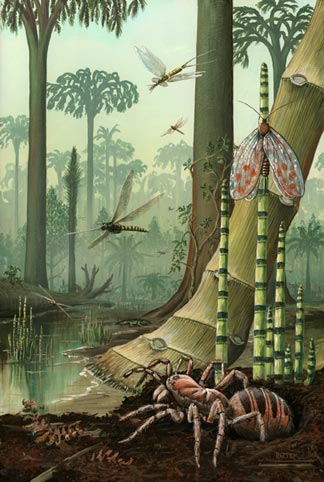
Birmingham, Like Most of the British Isles was once Covered in a Lush Tropical Carboniferous Rainforest

A carboniferous scene.

By the Carboniferous the insects were already highly diversified and the lush forests and swamps were dominated by Temnospondyls (primitive amphibians).

Picture credit: Richard Bizley (Bizley Art) for more of Richard Bizley’s artwork visit: Bizley Art.

In 1912, schoolteacher and amateur botanist Walter Henry Hardaker presented a paper to the Geological Society of London detailing the discovery of a series of tetrapod footprints and trackways that he had discovered in a quarry located in the village of Hamstead.  Hamstead, itself has long since been swallowed up in the urbanisation of the area as the city of Birmingham expanded.  The quarry too, has gone covered up as houses, shops and offices were built, after all, the quarry was located just a stone’s throw from Hamstead railway station.

The sandstones became part of the Lapworth Museum of Geology’s fossil collection at the University of Birmingham.  Hardaker, an alumnus of Birmingham University, probably would have been fascinated by the recent research work undertaken by third-year Palaeobiology and Palaeoenvironments MSci student Luke Meade (University of Birmingham) and colleagues as they applied 21st century analytical techniques to reveal a glimpse of the world when reptiles were beginning to take over from the amphibians as the dominant tetrapods.

Funded by the Palaeontological Association

Using funding provided by the Palaeontological Association, the students scanned the twenty or so red sandstone slabs using state-of-the-art photogrammetric technology to provide a three-dimensional analysis of each track.  Colour coding of the images permitted the research team to produce topographic maps showing the individual contours of each specimen.  These three-dimensional images were then compared to other ichnofossils (trace fossils) to identify the types of animals which produced the footprints.

The footprints and tracks provide a remarkable insight into vertebrate life during the Pennsylvanian Epoch of the Late Carboniferous.  These trace fossils were formed as animals crawled over soft mud next to river channels.  A subsequent flood event covered these tracks with sand and helped to preserve snapshots in deep time.  The red sandstone slabs preserve amazing details, not only of the footprints and tracks but also raindrops and cracks in the mud that were formed as the area dried out.

To read an article on Carboniferous fossils from North Wales: Tropical North Wales 300 Million Years Ago.

The research on these trace fossils indicates that the most common tracks were formed by amphibians, ranging from just a few centimetres in length (Batrachichnus salamandroides) to more than a metre long Limnopus ichnospecies).

Different Creatures Left Trace Fossils

Other types of creature traversed the mud, leaving their tracks, animals such as large pelycosaurs (synapsids distantly related to modern mammals).  Although the tracks are much less common, their presence indicates that monitor lizard-sized Reptiliomorphs also roamed the swamps and low lying forest that was eventually to become the West Midlands of England.

The three-dimensional models of the footprints that the team were able to recreate, led to the identification of these tracks having been made by the ichnogenus Dimetropus.  Smaller reptilian tracks were identified as having been made by sauropsid reptiles, (Dromopus lacertoides), whose descendants gave rise to the crocodiles, marine reptiles, pterosaurs, dinosaurs and birds.

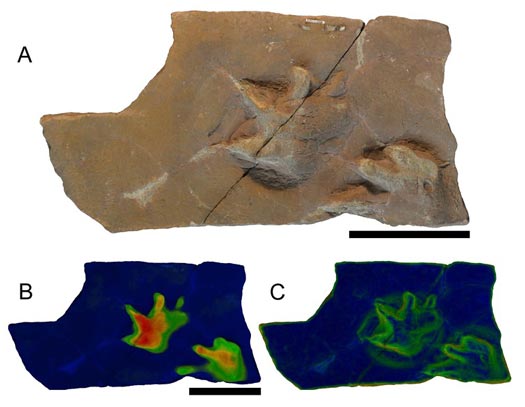
Limnopus Trace Fossils Used in the Study

Limnopus trace fossils (West Midlands).

Carboniferous footprints from the West Midlands (England) indicate the rise of amniotes.

Picture credit: University of Birmingham/PeerJ

The photograph above shows a well-defined example of Limnopus isp tracks from the Hamstead quarry.  The top photograph shows a dorsal view of the fossil material, (B) tracks rendered to show relief with an arbitrary scale, whereas, (C) shows tracks rendered to highlight areas of steep gradient, digitally isolating the outline of the tracks to aid genus recognition and cross comparison.

Scale bar = 10 cm.

For replicas and models of Palaeozoic creatures: Prehistoric Life Models from CollectA.

The Hamstead Trace Fossils

This ichnofauna associated with the Hamstead trace fossils contrasts with the slightly stratigraphically older, more extensive and better-studied assemblage from Alveley (Shropshire), which is dominated by small amphibians with relatively rare Reptiliomorphs and Dromopus tracks are absent. The presence of Dromopus lacertoides at Hamstead, identified from this new study supports the theory that the world was gradually becoming more arid through the Late Carboniferous and different types of reptile were beginning to flourish.

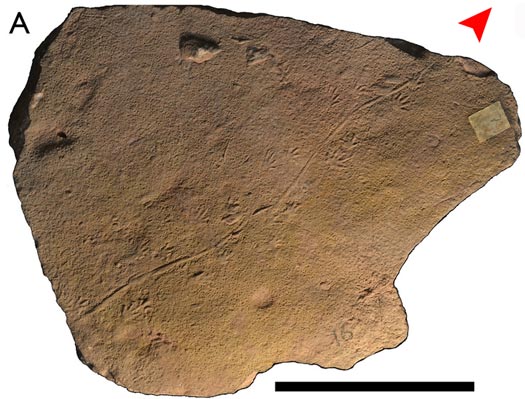
Batrachichnus salamandroides Tracks Preserved in the Red Sandstone of Hamstead Quarry

Batrachichnus fossil trackway.

Hamstead quarry red sandstone showing trace fossils of the Carboniferous amphibian Batrachichnus.

Picture credit: University of Birmingham/PeerJ with additional annotation by Everything Dinosaur

In the picture above, tracks made by the amphibian Batrachichnus salamandroides are shown, the red line indicates the direction of travel, the long thin lines are tail drag marks.

As the world become drier, so those animals that did not have such a reliance on water compared to the amphibians would have had a distinct advantage.  The synapsids and the diapsids being amniotes (they lay eggs on land or retain a fertilised egg within the female), would have had a significant evolutionary advantage over the amphibians that relied on returning to water to reproduce.

The scientific paper: “A Revision of Tetrapod Footprints from the Late Carboniferous of the West Midlands, UK” (PeerJ).

The Everything Dinosaur website: Everything Dinosaur.

Go to Top