All about dinosaurs, fossils and prehistoric animals by Everything Dinosaur team members.

Fossil finds, new dinosaur discoveries, news and views from the world of palaeontology and other Earth sciences.

12 04, 2020

Homo erectus Originated in Africa

By |2024-02-17T06:42:21+00:00April 12th, 2020|Categories: Dinosaur and Prehistoric Animal News Stories, Main Page, Photos/Pictures of Fossils|0 Comments

Homo erectus Evolved Earlier Than Previously Thought

A partial skull, painstakingly reconstructed from more than 150 fragments has revealed that Homo erectus existed at least 100,000 years earlier than previously thought.  In addition, the fossil remains, excavated from the Drimolen Fossil Hominin site in the Cradle of Humankind, northwest of Johannesburg (South Africa), suggest that this hominin evolved in Africa and not in Asia.

The Reconstructed Partial Skull of the Homo erectus Infant from the Drimolen Fossil Hominin Site
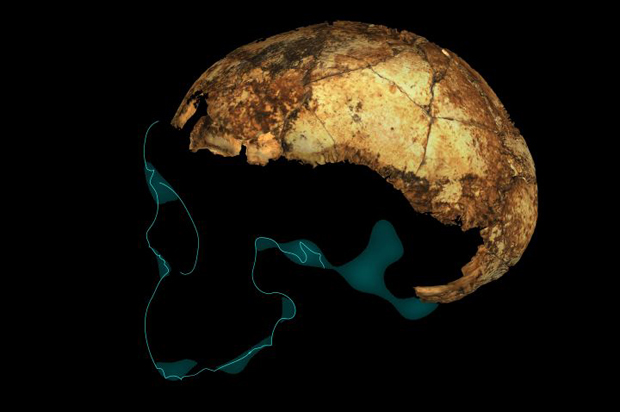
Partial H. erectus cranium from the Drimolen Fossil Hominin site.
The partial H. erectus cranium (specimen number DNH 134),  from the Drimolen Fossil Hominin site.  The skull pieces have been carefully reconstructed and superimposed on the outline of a Homo erectus skull.

Picture credit: La Trobe University (Australia)

The African Origins of Homo erectus

This week, an academic paper has been published in “Science” detailing the research into a fragmented hominin skull representing a toddler that was approximately 2-3 years old.  The Drimolen Fossil Hominin site was discovered in 1992 by geologist André Keyser.  The sediments represent cave deposits but as the rocks that made up the caves have been eroded away, the breccias in which the fossils are located are exposed.  The site is one of the most important in the world for early hominin remains, with more than a hundred individual fossil specimens described to date.

Lead author of the study and project director Professor Andy Herries (La Trobe University), explained that it had taken five years to excavate the specific fossil site and retrieve all the skull fragments.

He stated:

“The Homo erectus skull we found, likely aged between two and three years old when it died, shows its brain was only slightly smaller than other examples of adult Homo erectus.  It samples a part of human evolutionary history when our ancestors were walking fully upright, making stone tools, starting to emigrate out of Africa, but before they had developed large brains.”

Dating the Fossil Skull Fragments

The fossilised fragments, first spotted by student Richard Curtis during field work five years ago, were subjected to a variety of dating techniques including uranium-lead dating of associated flowstones, palaeomagnetism of sediments and uranium-series electron spin resonance using fossil teeth found in the same strata.  Each of these different dating methods produced a constrained dating range for the site.

The fossils from the Drimolen Fossil Hominin Main Quarry were between 2.04-1.95 million years of age.  This indicates that the skull fragments are around two million years old, suggesting that Homo erectus existed some 100,000 to 200,000 years earlier than previously thought.  In addition, prior to the publication of this paper, the oldest H. erectus fossil specimen known had been found in Georgia (Dmanisi).  It had been dated to between 1.85 and 1.78 million years ago and consequently scientists had argued that Homo erectus evolved in Asia, but this newly described, much older fossil skull supports the theory, that like most other types of hominid, H. erectus originated in Africa.

Professor Herries explained that unlike the world today, where our species (Homo sapiens), is the only hominin in existence, in southern Africa around two million years ago, our direct ancestors shared the environment with other hominins and closely related species.

A Model of H. erectus (Bullyland Figure)
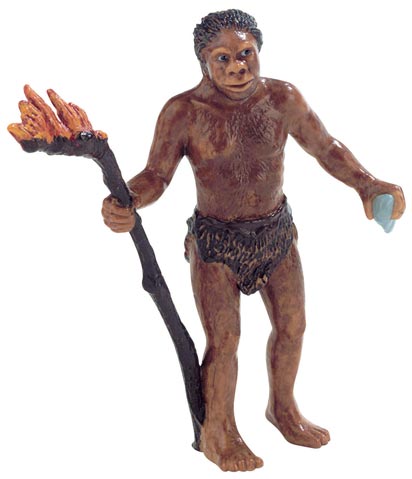
H. erectus illustration.
The dating of the Drimolen skull fragments suggest that this hominin lived 2 million years ago.  Homo erectus mastered fire and made stone tools.

The picture (above) shows a hominin figure from the Bullyland model range.

To view this range of figures: Bullyland Figures.

The professor stated:

“We can now say Homo erectus shared the landscape with two other types of humans in South Africa, Paranthropus and Australopithecus.  This suggests that one of these other human species, Australopithecus sediba, may not have been the direct ancestor of Homo erectus, or us, as previously hypothesised.”

Different Hominins with Different Adaptations Sharing the Same Environment

The paper, is one of a number published recently that leads to the conclusion that several early types of human shared the same environment.  Palaeoanthropologists now have an intriguing question to answer – how did these different species, with quite different adaptations co-exist?

Co-author of the scientific paper, Dr Justin Adams (Monash University, Melbourne, Australia), suggested that the new date for the Drimolen skull raised fascinating questions about how different species survived in the same landscape, but eventually as habitats changed, what role did Homo erectus play, if any in the extinction of the other species.  Furthermore, how did Homo erectus survive and yet australopithecines and Paranthropus did not?

Similar Trends in Mammal Species from the Pleistocene

The authors of the paper, note a similar trend in other mammal species in southern Africa during the Pleistocene Epoch.  For instance, more than one species of prehistoric felid from the genus Dinofelis has been recorded from this area.  South African fauna during the Early to Middle Pleistocene comprised a mixture of different evolutionary lineages, a mixed community of ancient and more modern mammalian species.

An Illustration of a Prehistoric Cat – Dinofelis
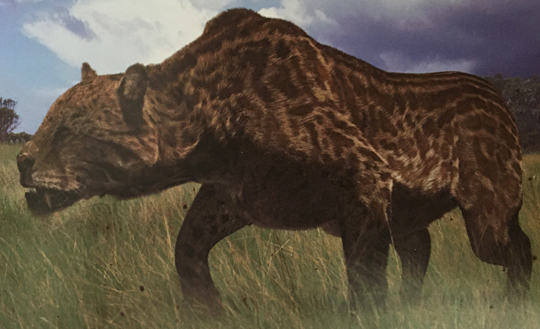
Prehistoric cat Dinofelis.
The prehistoric cat Dinofelis.  These agile predators probably hunted hominins.

Picture credit: BBC

The publication of this paper and the study into Homo heidelbergensis reported upon by Everything Dinosaur earlier this week, suggests that we still have a lot to learn about our origins.

The H. heidelbergensis article: Homo heidelbergensis Younger Than Previously Thought.

The Everything Dinosaur website: Everything Dinosaur.
9 04, 2020

Massospondylus Eggs Give Up Their Secrets

By |2024-02-16T17:15:06+00:00April 9th, 2020|Categories: Dinosaur and Prehistoric Animal News Stories, Dinosaur Fans, Main Page, Photos/Pictures of Fossils|0 Comments

Dinosaur Eggs from the Late Triassic Reveal Their Contents

Researchers from the University of Witwatersrand (Johannesburg, South Africa), have utilised the high-powered and intense energy of the European Synchrotron Radiation Facility (ESRF), located at Grenoble in France to unscramble the embryonic development of dinosaurs.  The study, published in the journal “Scientific Reports”, demonstrates that dinosaur embryos show many similarities to the embryonic development of their living archosaurian relatives – birds and crocodiles.  In addition, the scientists found that in the dinosaur studied (the Sauropodomorpha Massospondylus carinatus), a set of simple teeth developed, in addition to the teeth the animal would have when it hatched.

Massospondylus carinatus

These simple teeth (null-generation teeth), were either reabsorbed into the jawbone or shed prior to the animal breaking out of the egg.  This anatomical trait is found in crocodiles and lizards such as geckos (Order Squamata).

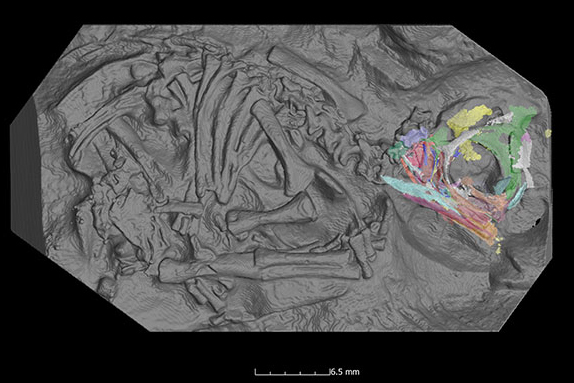
A Computer Generated Image of a Massospondylus Embryo Showing the Skull Bones

Synchrotron analysis to reconstruct dinosaur embryos.
Identifying the skull bones of Massospondylus carinatus using synchrotron analysis.  The individual bones of the tiny skull have been highlighted in different colours.

Picture credit: Dr Kimberley Chapelle (University of Witwatersrand)

Lizards are not members of the Archosauria, they are not closely related to dinosaurs (nor to birds or crocodiles for that matter), this suggests that the production of null-generation teeth that are lost prior to hatching is an embryonic trait which is basal within the Class Reptilia and that, in essence, the embryonic developmental pattern in reptiles was established early in their evolutionary history.

Digitally Reconstructing the Skulls of Baby Dinosaurs

In the study, led by Dr Kimberley Chapelle and Professor Jonah Choiniere of the Evolutionary Studies Institute, based at the University of Witwatersrand, three-dimensional, computer generated images were created of the less than 2 cm long skulls of the embryonic dinosaurs.  The clutch of eggs was discovered in 1976 at a location within the Golden Gate Highlands National Park (Free State Province), the fossil specimens represent some of the oldest dinosaur eggs known to science.

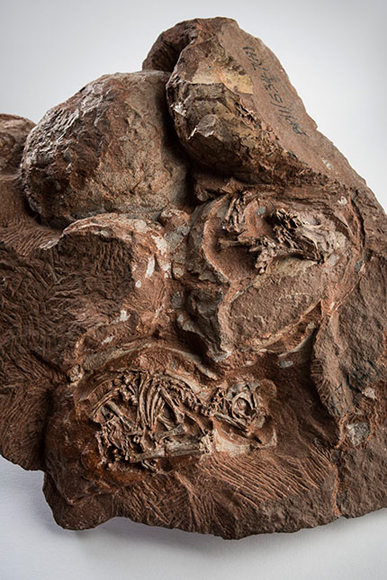
The Clutch of Massospondylus Eggs Discovered in 1976 (Free State Province)

Clutch of Massospondylus carinatus eggs discovered in 1976
The clutch of Massospondylus carinatus eggs discovered in 1976 and the subject of the new scientific paper.

Picture credit: Brett Eloff

Amongst the Rarest of Dinosaur Fossils

The fossilised remains of dinosaur embryos are among the rarest of all vertebrate fossils.  However, if palaeontologists can study them, then they can provide unique insights into the development of baby dinosaurs and permit comparison with the development of living archosaurs such as birds and crocodiles.

The powerful X-rays generated by the synchrotron allowed the researchers to obtain extremely detailed images of the fragile contents of the eggs, in what is a non-destructive technique.  The study commenced in 2015, when the fossils were transported to the ESRF at Grenoble.  It took nearly three years to process all the data generated back at the University, but the work was worth it as the scientists were able to reconstruct the delicate, tiny skulls of the dinosaurs in exquisite detail.

The fossil specimens were scanned at an unprecedented level of detail, the team were able to define and map individual cells within the fossilised bone.

Views from Various Angles of the Tiny Skull of a Massospondylus Embryo

The skull of a Massospondylus embryo.
Views of the skull of an embryonic Massospondylus.  It took 3 years to process all the data generated from the synchrotron X-ray scans.

Picture credit: University of Witwatersrand/Scientific Reports

Working Out the Developmental Age of the Dinosaur Embryos

It had been thought that the fossilised Massospondylus eggs represented a clutch that had perished just prior to hatching.  An analysis of the state of the skull bones and direct comparison with the development stages of crocodile, chicken, turtle and lizard embryos revealed that the Massospondylus embryos were much younger than previously thought.  These dinosaur babies were only 60% of the way through their incubation.  This makes them some of the ontogenetically youngest dinosaur embryos known.  All other dinosaur embryos in the literature with ontogenetic age estimates are believed to represent dinosaurs in the last third of their development in the egg or close to hatching.

Hatching Massospondylus Dinosaurs in the Late Triassic of South Africa

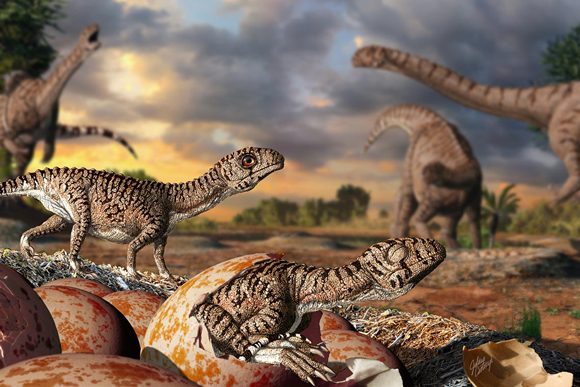
Massospondylus nesting site - life reconstruction.
Massospondylus (basal Sauropodomorpha) nesting site.  The study provided new information on  how to estimate the ontogenetic age of dinosaur embryos.

Picture credit: Julius Csotonyi

The Discovery of Null-generation Teeth in Dinosaur Embryos

Furthermore, the researchers discovered that each tiny embryo had two types of teeth preserved in its developing jaws.  One set was very similar to the teeth associated with Massospondylus adults, the second set consisted of tiny, very simple triangular teeth that were either reabsorbed into the jaw or shed prior to hatching.  These types of teeth are referred to as null-generation teeth and they are found in crocodilians and some types of extant lizard embryos such as geckos.

An Illustration of the Tooth Crowns of an Adult Massospondylus

Adult Massospondylus dinosaur teeth.
The teeth of an adult Massospondylus dinosaur.  The teeth of Massospondylus are proportionately quite long and the crowns end in a broad, leaf-shaped structure with distinctive ridges on their tips and sides.

Picture credit: Everything Dinosaur from Gow et al (University of Witwatersrand)

Commenting on the discovery of null-generation teeth in the jaws of the dinosaur embryos, lead author, Dr Chapelle stated:

“I was really surprised to find that these embryos not only had teeth, but had two types of teeth.  The teeth are so tiny, they range from 0.4 to 0.7 mm wide.  That’s smaller than the tip of a toothpick!”

The scientists conclude that dinosaurs developed in their eggs in very similar ways as extant archosaurs, so what we know about the development of birds and crocodiles in the egg can be confidently applied to extinct archosaurs such as dinosaurs and pterosaurs too.  The development traits shared with members of the Squamata Order (lizards and snakes) would permit these findings to be applied generally to a much wider variety of extinct reptiles, such as those assigned to the Lepidosauria clade, the sister clade to the Archosauria, reptiles on a different branch of the Reptilia family tree.

Synchrotron Analysis Likely to Lead to Further Insights into Dinosaur Development

The research team hope to utilise the thousands of scans they have amassed to better understand the post-cranial development of sauropod dinosaurs.  They will be examining the rest of the skeleton of the Massospondylus embryos to see if this dinosaur shares similarities in development with extant archosaurs.  The scientists hope to shed further light on how these dinosaurs moved about when they first emerged from the nest.  Palaeontologists think that these types of dinosaurs hatched as bipeds before adopting a quadrupedal stance as these animals grew and matured.

Everything Dinosaur acknowledges the assistance of a media release from the University of Witwatersrand in the compilation of this article.

The scientific paper: “Conserved in-ovo cranial ossification sequences of extant saurians allow estimation of embryonic dinosaur developmental stages” by Kimberley E. J. Chapelle, Vincent Fernandez and Jonah N. Choiniere published in Scientific Reports.

Visit the Everything Dinosaur website: Everything Dinosaur.
8 04, 2020

Lower Triassic Fossil from Brazil – The Origins of the Tanystropheidae

By |2024-02-16T17:07:19+00:00April 8th, 2020|Categories: Dinosaur and Prehistoric Animal News Stories, Dinosaur Fans, Main Page, Palaeontological articles|0 Comments

Elessaurus gondwanoccidens – Unlocking the Origins of the Bizarre Tanystropheidae

After the mass extinction event that marked the end of the Permian many new types of terrestrial vertebrate evolved.  The archosaurs radiated and developed into a variety of forms, one of the most bizarre groups to emerge were the Tanystropheidae, epitomised by the amazing Middle Triassic Tanystropheus with its hugely elongated neck.

The origin of the tanystropheids remains shrouded in mystery.  The paucity of the fossil record has hindered palaeontologists in their research.  However, a team of scientists have reported the discovery of fossils in southern Brazil that may shed light on the ancestry of these incredible reptiles.

Elessaurus gondwanoccidens

Writing in the academic journal PLOS One, the researchers which include Tiane De-Oliviera of the Federal University of Santa Maria, Brazil, describe and name Elessaurus gondwanoccidens.  It had long legs and very probably a long tail.  The genus name being inspired by the Elvish name (Elessar), a character from Lord of the Rings also known as Aragorn played by Viggo Mortensen in the trilogy of films directed by Peter Jackson.

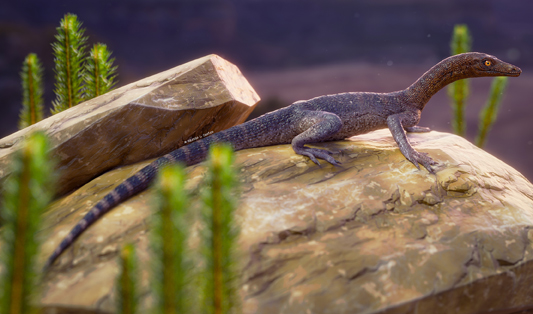
A Life Reconstruction of the Newly Described Archosauromorph Elessaurus gondwanoccidens

Elessaurus life reconstruction.
A life reconstruction of the newly described Elessaurus from the Lower Triassic of Brazil.

Picture credit: Márcio L. Castro

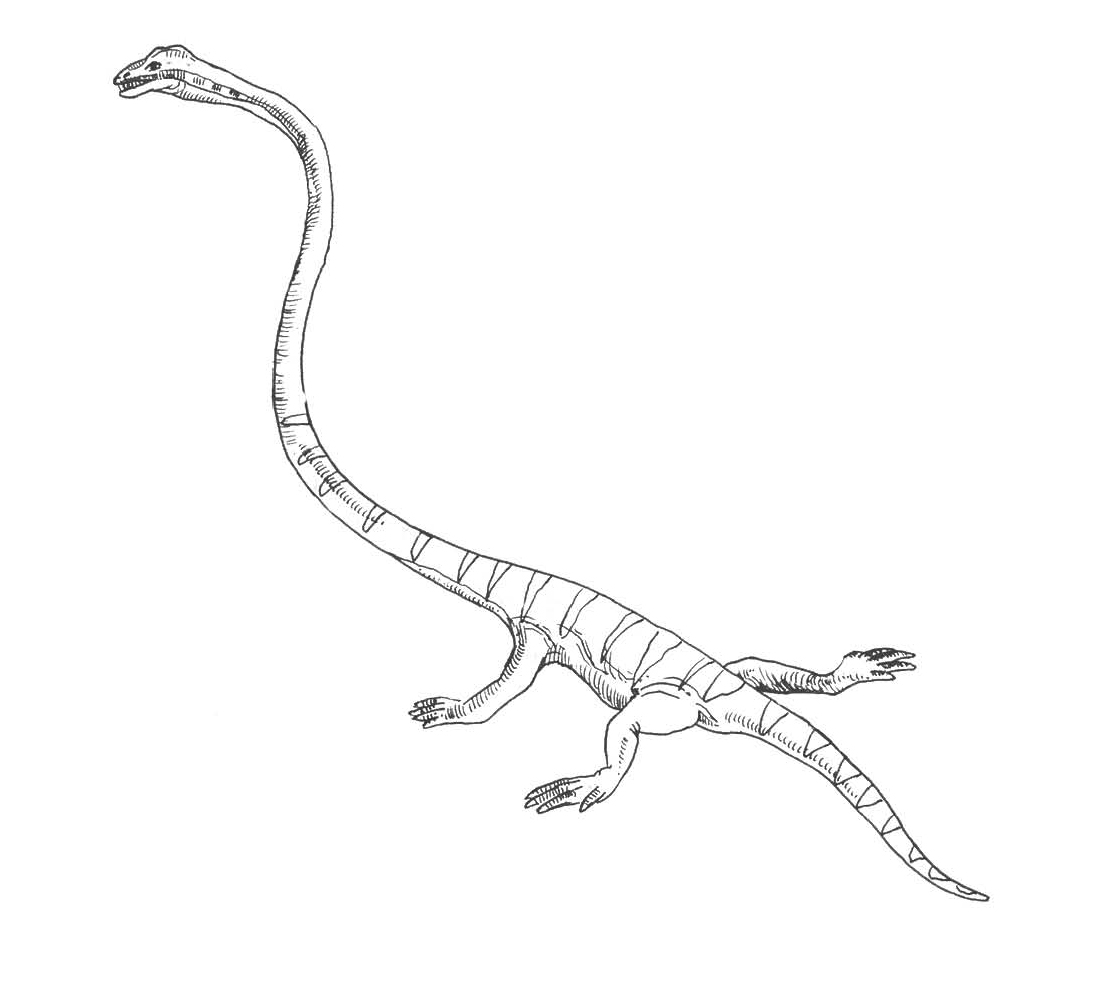
An Illustration of the Bizarre Tanystropheus with its Greatly Elongated Neck

A drawing of Tanystropheus.
A drawing of the bizarre Triassic reptile Tanystropheus.  Elessaurus has been described as the sister taxon to the Tanystropheidae. Picture credit: Everything Dinosaur.

Picture credit: Everything Dinosaur

Fragmentary Fossil Material – The Posterior of an Early Triassic Archosauromorph

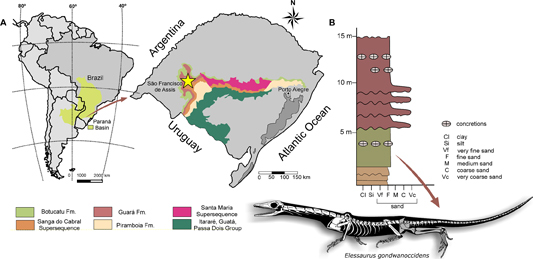
The fossil material used to describe this new species consists of a partially articulated hind limb and associated fossil elements including parts of the pelvis and caudal vertebrae.  The specimen was collected at the locality Bica São Tomé, Sanga do Cabral Formation (Sanga do Cabral Supersequence, Paraná Basin of southern Brazil).

Based on other fragmentary vertebrate fossils known from this area, the rocks that contained Elessaurus are believed to date from the Lower Triassic.  Although the Elessaurus fossil material represents just a portion of the skeleton and no bones from the anterior part of the animal are known, these fossils represent the most complete post-cranial fossil material obtained to date from the Sanga do Cabral Formation.

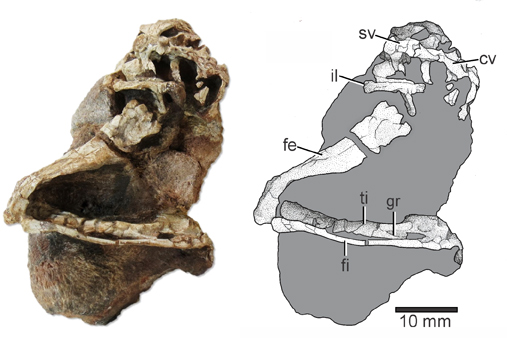
Elessaurus Fossil Material (UFSM 11471) and an Accompanying Line Drawing

E. gondwanoccidens fossil material and accompanying line drawing.
Elessaurus gondwanoccidens fossil material and accompanying line drawing showing limb, pelvis and tail elements.  Abbreviations fi = fibula, ti = tibia, gr = groove, fe = femur, il = ilium, sv = sacral vertebra, cv = caudal vertebra.  Note scale bar equals 10 mm.

Picture credit: De-Oliveira et al (PLOS One)

A Phylogenetic Assessment

A phylogenetic assessment of Elessaurus places this genus as a sister taxon to the Tanystropheidae.  The analysis suggests that E. gondwanoccidens was closely related to the tanystropheids and as such it can provide information into the origins of these bizarre reptiles.  Most tanystropheid fossils are found in Middle to Late Triassic rocks of North America, Europe and Asia.  These fossils tend to be strongly associated with marine deposits, indicating that most later tanystropheids adapted to an aquatic or semi-aquatic lifestyle.

The discovery of the closely related but earlier Elessaurus in continental deposits from the Lower Triassic of Brazil, indicates that the origin of this group may lie in the southern continents, the landmass known as Gondwana.  The location of the fossil was the inspiration for the trivial (specific), name of this reptile.  The specific name is derived from the super-continent Gondwana and the Latin adjective “occidens” which means western.

Map (A) Showing the Location of the Fossil Find (B) Stratigraphic Diagram and a Skeletal Reconstruction of Elessaurus

Elessaurus map, stratigraphic profile and skeletal reconstruction.
A map showing the location of the fossil find, along with a stratigraphic profile of the outcrop and a skeletal reconstruction of Elessaurus (known fossil material in grey).

Picture credit: De-Oliveira et al (PLOS One)

A Terrestrial Animal

The long legs of Elessaurus seem to be suited to a terrestrial existence.  This suggests that the ancestral tanystropheids may have been entirely terrestrial before later species adapted to a more aquatic life.  The discovery of Elessaurus provides a clearer view of the origins of the Tanystropheidae, the scientists hope that further fossil finds will shed more light on the ancestry and evolution of these very unusual tetrapods.

The scientific paper: “A new archosauromorph from South America provides insights on the early diversification of tanystropheids” by Tiane M. De-Oliveira, Felipe L. Pinheiro, Átila Augusto Stock Da-Rosa, Sérgio Dias-Da-Silva and Leonardo Kerber published in PLOS One.

The Everything Dinosaur website: Everything Dinosaur.
6 04, 2020

New Study Suggests Homo heidelbergensis Younger Than Previously Thought

By |2024-02-09T08:19:47+00:00April 6th, 2020|Categories: Dinosaur and Prehistoric Animal News Stories, Main Page, Palaeontological articles, Photos/Pictures of Fossils|0 Comments

Dating the Broken Hill Skull – H. heidelbergensis Younger than Previously Thought

Palaeoanthropologists have long recognised that the evolution of the hominins and our own species (Homo sapiens), was complicated and not simply a linear transgression from one species to another.  Human fossil remains are exceptionally rare and sometimes, a new study can upend previously assumed concepts and ideas.  For example, a team of scientists including researchers from the Natural History Museum (London), Australian National University (Canberra), University College Dublin, Muséum national d’Histoire naturelle (Paris), University of the Free State (South Africa), University of Wollongong (Queensland), University of Southampton and Griffith University (Queensland), have published new dating information for a hominin skull discovered in 1921.

The skull representing Homo heidelbergensis turns out to be much younger than previously thought.

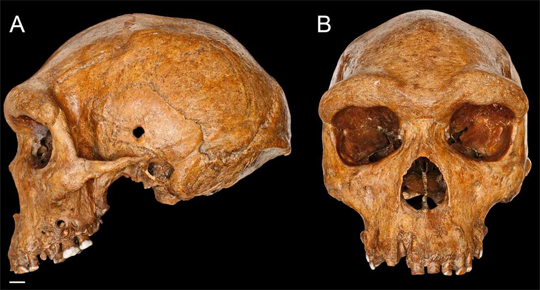
The Famous Broken Hill Skull (Kabwe 1) Homo heidelbergensis

The famous H. heidelbergensis skull (Kabwe 1).
Views of the Broken Hill Skull (Kabwe 1).  Left lateral view (A) and anterior view (B).

Picture credit: The Trustees of the Natural History Museum

Studying Homo heidelbergensis

Writing in the academic journal “Nature”, the researchers conclude that this skull, previously thought to be around half a million years old, was much younger with an estimated date of between 274,000 and 324,000 years of age.  This result suggests that in the later stages of the Middle Pleistocene of Africa (Chibanian stage), there were many different types of hominin living at the same time.  Homo sapiens, H. heidelbergensis/H. rhodesiensis and Homo naledi were all contemporaneous.

The Broken Hill Skull

The skull studied, referred to as the Broken Hill specimen, currently resides in the collection of the Natural History Museum (London) and is on display in the Human Evolution gallery, but there are ongoing discussions about the return of this fossil to Africa.

The skull was discovered in 1921 by an African miner and his Swiss co-worker Tom Zwigelaar at the lead and zinc mine located at Broken Hill, which at the time was in northern Rhodesia but is now Kabwe in Zambia, hence the reference to the fossil skull as Kabwe 1.  Other fragmentary human remains were also found at the mine (partial upper jaw, tibia, sacrum and two elements from a femur from another individual).  The fossils were donated by the mining company to the then British Museum (Natural History Museum), at the time of their discovery anthropologists regarded these fossils as the most significant hominin fossils found on the African continent.

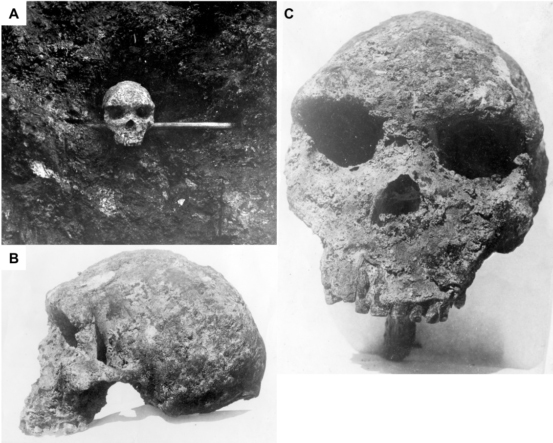
Early Photographs of Kabwe 1 (Broken Hill Skull)

Original photographs of the Broken Hill skull (Homo heidelbergensis).
Original photographs of the Broken Hill skull (H. heidelbergensis).

Picture credit: Griffith University (Queensland)

Problems Dating the Skull and Fossil Bones

Nearly a hundred years ago, data recording surrounding such an important fossil discovery was nowhere near as thorough at it is today.  Mining work continued in the area where the skull and other bones had been found so any evidence to help accurately date the fossils was subsequently lost.  Assigned to Homo heidelbergensis, the skull was originally dated to around 500,000 years ago.  However, these researchers, led by Professor Rainer Grün (Environmental Futures Research Institute at Griffith University), subjected the skull and the other hominin fragments from the site to radiometric dating and determined that these people lived between 274,000 and 324,000 years ago.

Commenting on the importance of this research, Professor Grün stated:

“The new best age estimate of the fossil impacts our understanding of the tempo and mode of modern human origins”.

One of the co-authors of the scientific paper, Professor Chris Stringer (Natural History Museum), added:

“Previously, the Broken Hill skull was viewed as part of a gradual and widespread evolutionary sequence in Africa from archaic humans to modern humans.  But now it looks like the primitive species Homo naledi survived in southern Africa, H. heidelbergensis was in Central Africa, and early forms of our species existed in regions like Morocco and Ethiopia.”

Homo rhodesiensis and Piltdown Man

It was Sir Arthur Smith Woodward, the curator of the Geology Department at the British Museum who proposed the new species Homo rhodesiensis to describe the Kabwe 1 skull as “Rhodesian Man”.  However, most scientists now consider H. rhodesiensis to be junior synonym of H. heidelbergensis or possibly an African sub-species of it.  Despite a prestigious academic career, Sir Arthur is best remembered for his association with the Piltdown Man hoax of 1912.  Even on his deathbed, he still believed that the fossil remains found in a Sussex gravel bed at Barkham Manor, near to Piltdown Common, represented a species of archaic human, unlike any other species of early hominin known to science.

Unfortunately, for Sir Arthur, five years after he died, new dating techniques proved the human skull bones from the site to be less than 500 years old.

The new, younger date for the Kabwe 1 skull also casts a cloud over the provenance of stone tools associated with hominin fossils from the late Middle Pleistocene.  As scientists have evidence to indicate Homo heidelbergensis present in Africa as recently as 300,000 years ago, stone tools from this date may not have been crafted by our species.

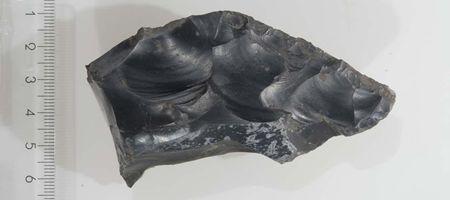
Not All the African Stone Tools Around 300,000 Years of Age Can be Ascribed to our own Species

Heidelbergensis flint spear.
Crafted with considerable skill – a flint spear point associated with Homo heidelbergensis.  The much younger age of the Kabwe 1 specimen casts doubts about which species made the stone tools associated with Middle Pleistocene hominin fossils.

Picture credit: Dr Nicholas Conrad/University of Tubingen

The new age estimate for Kabwe 1 raises questions about our own evolution.  It casts doubts on the presumption that H. heidelbergensis/H. rhodesiensis was a direct ancestor of our species Homo sapiens.  This research suggests that there were multiple contemporaneous hominin lineages in Africa during the later stages of the Middle Pleistocene, reflecting a similar model found in Eurasia.

  • African hominins (late Middle Pleistocene) – H. sapiens, H. nalediH. heidelbergensis/H. rhodesiensis
  • European/Asia hominins (late Middle Pleistocene) – H. neanderthalensis, H. luzonensis, H. floresiensis, the Denisovans and perhaps also H. heidelbergensis and H. erectus

Everything Dinosaur acknowledges the assistance of a media release from Griffith University in the compilation of this article.

The scientific paper: “Dating the skull from Broken Hill, Zambia, and its position in human evolution” by Rainer Grün, Alistair Pike, Frank McDermott, Stephen Eggins, Graham Mortimer, Maxime Aubert, Lesley Kinsley, Renaud Joannes-Boyau, Michael Rumsey, Christiane Denys, James Brink, Tara Clark and Chris Stringer published in Nature.

To read an article about the presence of H. heidelbergensis in Kent: Giant Prehistoric Straight-tusked Elephant Butchered by H. heidelbergensis.

The Everything Dinosaur website: Everything Dinosaur.
4 04, 2020

That Fourth New Moroccan Pterosaur – Afrotapejara

By |2024-02-09T08:10:27+00:00April 4th, 2020|Categories: Dinosaur and Prehistoric Animal Drawings, Dinosaur and Prehistoric Animal News Stories, Dinosaur Fans, Main Page|0 Comments

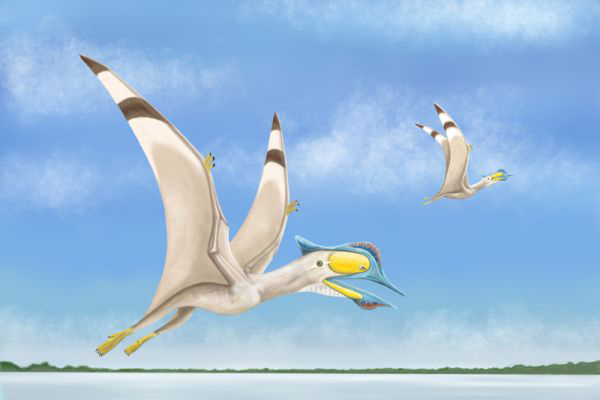
Afrotapejara zouhrii – Illustrated

Back at the end of March (2020), Everything Dinosaur team members published news of the discovery of four new taxa of flying reptile from the remarkable Kem Kem beds of south-eastern Morocco.  Three of the pterosaurs (all members of the Ornithocheiridae), were dealt with in one scientific paper, which was published in the academic journal “Cretaceous Research”, whilst the fourth, a tapejarid named Afrotapejara zouhrii, was described in a subsequent paper also published in Cretaceous Research.

Afrotapejara zouhrii

Aware of the publication of these scientific papers, Everything Dinosaur was able to put up a blog post, prior to illustrations of the newest member of the Tapejaridae being released.  However, thanks to a media release from the University of Portsmouth, we can show a life illustration of Afrotapejara zouhrii in all its glory.

An Illustration of the Recently Described North African Pterosaur Afrotapejara zouhrii 

Afrotapejara zouhrii life reconstruction.
A life reconstruction of the newly described Moroccan pterosaur Afrotapejara zouhrii.

Picture credit: University of Portsmouth

The colours chosen by the artist are speculative, but tapejarids, characterised by their oversized and elaborate head crests, are regarded as some of the “flashiest” and flamboyant of all the Pterosauria, their crests probably played a role in visual communication, so why not make their crests bright and colourful.

The First Tapejarid Known from Africa

Tapejarids were geographically widespread in the Lower Cretaceous.  Fossils are known from China, Brazil and Europe.  It had long been suspected that these types of pterosaurs would be found in the famous Kem Kem beds, but the fragmentary remains associated with these strata delayed positive identification.

Professor David Martill (School of the Environment, Geography and Geosciences, University of Portsmouth), a co-author on the ornithocheirid paper and lead order on the Afrotapejara study, commented:

“The study of Moroccan material shows that we are still far from having found all the paleontological treasures of North Africa.  Even fragmentary fossils, like the jaw piece of the new pterosaur, can give us important information about the biodiversity of the past.”

Honouring Professor Samir Zouhri

In our earlier blog post, we stated that the specific or trivial name chosen for this flying reptile honoured Moroccan palaeontologist Professor Samir Zouhri.  We can now confirm that this is correct, the professor is being honoured for his contribution to field work over many years and for helping to develop the science of palaeontology in Morocco.  Pleasingly, the fragmentary remains of the newest member of the Tapejaridae family are staying in Morocco, they are now part of the collection of the Faculty of Sciences Aïn Chock, Casablanca Hassan II University.

Everything Dinosaur acknowledges the assistance of a media release from the University of Portsmouth in the compilation of this article.

To read Everything Dinosaur’s earlier post about the four pterosaurs: Pterosaurs, Pterosaurs, and even more Pterosaurs.

The scientific paper: “A new tapejarid (Pterosauria, Azhdarchoidea) from the mid-Cretaceous Kem Kem beds of Takmout, southern Morocco” by David M. Martill, Roy Smith, David M. Unwin, Alexander Kao, James McPhee and Nizar Ibrahim published in Cretaceous Research.

Visit the Everything Dinosaur website: Everything Dinosaur.

30 03, 2020

Pterosaurs, Pterosaurs and Even More Pterosaurs

By |2024-01-20T14:27:39+00:00March 30th, 2020|Categories: Dinosaur and Prehistoric Animal Drawings, Dinosaur and Prehistoric Animal News Stories, Dinosaur Fans, Main Page, Palaeontological articles|0 Comments

The “Golden Age” of Pterosauria Research

In the last few weeks, a number of scientific papers have been published detailing new pterosaur discoveries and fossil finds.  We really do seem to be living in a “golden age” of flying reptile research.  For example, researchers have identified the fragmentary fossil remains of three types of pterosaur from the famous Cretaceous Kem Kem beds of Morocco (Anhanguera, Coloborhynchus and Ornithocheirus).  Even before the dust had settled on that publication, another scientific paper, published this week, describes Afrotapejara zouhrii, the newest member of the Tapejaridae, fossils of which also come from the enigmatic Kem Kem beds.

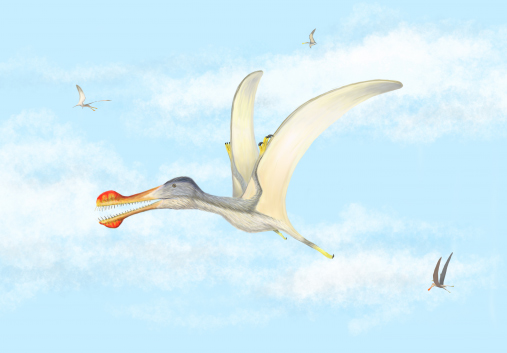
The “Golden Age” of Pterosaur Research – Illustration of Three of the New Pterosaur Types Described

New pterosaur genera described from the Kem Kem Beds of Morocco.
The pterosaur Anhanguera soars over the skies of North Africa with Coloborhynchus and Ornithocheirus to keep it company.

Picture credit: Megan Jacobs (Baylor University, Texas)

Cretaceous Fossils Mixed Up in a Blender

The Kem Kem Formation is exposed in south-eastern Morocco and neighbouring Algeria.  The extensive deposits represent an inter-tidal, estuarine environment with large, wide lagoons and a broad floodplain criss-crossed by numerous rivers.  These sediments were laid down in the Albian to Cenomanian faunal stages of the Cretaceous, approximately 100 to 95 million years ago.

The terrestrial landscape was dominated by dinosaurs, surprisingly, there seems to have been an overabundance of big theropods present – Spinosaurus, Rugops (other abelisaurs), Sauroniops, Deltadromeus, Carcharodontosaurus, potential dromaeosaurids and a wealth of other fossil bones and isolated teeth that represent indeterminate species.

Trouble is, the transport of material due to river and tidal action has resulted in a mixing up of fossil material.  Fossil beds contain a vast array of jumbled up, disarticulated material, much of which may also have been re-deposited from its original stratigraphic layer.  These deposits have been colourfully described as representing fossils that have been put in a blender, such is their mixing and depositional status.

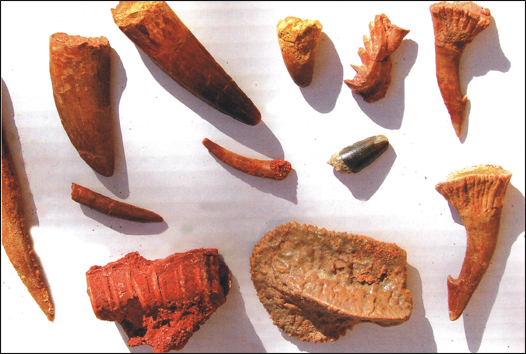
Typical Isolated and Fragmentary Vertebrate Fossil Remains from the Kem Kem Beds

Fossil remains (Kem Kem beds).
Assorted vertebrate fossil remains from the Kem Kem beds of Morocco.

Pterosaurs as Piscivores

In the first scientific paper, researchers from the University of Portsmouth, Baylor University (Waco, Texas), the University of Detroit Mercy (Detroit), Leicester University, the Laboratoire Santé et Environnement (Morocco) and the University of Bath report on the discovery of fragmentary jaws and associated teeth that led to the identification of three new types of pterosaur.

The remains suggest three ornithocheirid pterosaurs, a second species of Coloborhynchus and an Ornithocheirus reminiscent of Ornithocheirus fossil material known from the Cambridge Greensand deposits of southern England.  In addition, a portion of a lower jaw (mandibular symphysis), closely resembles that of the South American ornithocheirid Anhanguera piscator, fossils of which are known from the roughly contemporaneous Romualdo Member of the Santana Formation (Brazil).

An Illustration of Anhanguera (Ornithocheiridae Family)

An illustration of Anhanguera.
A typical member of the Anhanguera genus.  Note the large and very prominent, conical teeth in the jaw.  All three newly described genera are believed to have been primarily fish-eating (piscivores).

Fossils from Morocco

As well as representing a turbulent depositional environment, the fossiliferous beds of south-eastern Morocco provide an additional challenge for scientists.  Local residents mine the sedimentary rocks, often using only rudimentary tools and materials, so that they can sell their fossil finds to dealers and collectors.  Fortunately, in this case, the fragments of jaw were acquired by scientists enabling a proper academic investigation to be carried out.  The teeth of these pterosaurs suggest that they were probably piscivores, the largest of which probably had a wingspan in excess of four metres.

In the paper, the researchers conclude that the Kem Kem fossil assemblage includes at least nine species of pterosaur, of which the majority (five), are members of the Ornithocheiridae.  These strata help to support the theory that toothed pterosaurs remained diverse throughout the late Early Cretaceous, before going into decline and eventually disappearing after the Cenomanian faunal stage.

And There’s More – Another Moroccan Pterosaur This Time a Tapejarid

New pterosaur discoveries are behaving a bit like buses at the moment (prior to the coronavirus pandemic), three come along and then shortly afterwards another one turns up.  Many of the same scientists from the first academic paper, have published, albeit a little earlier than expected, another paper, this time naming a new species tapejarid pterosaur.  Unlike the other three, this flying reptile was edentulous (no teeth in the jaws).  The newly described tapejarid has been named Afrotapejara zouhrii, based on yet more fragmentary material including jaw elements.

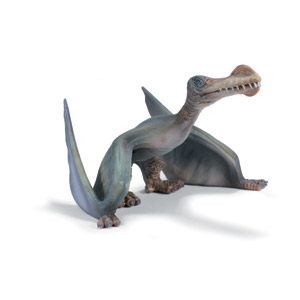
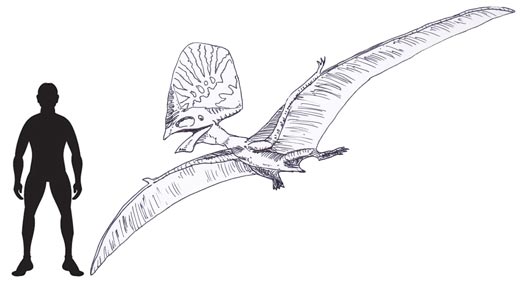
A Typical Illustration of a Tapejarid Pterosaur

Tupandactylus illustration.
A scale drawing of the tapejarid Pterosaur Tupandactylus imperator.  A typical tapejarid – a family of pterosaurs famed for their striking and often over-sized head crests. Picture credit: Everything Dinosaur.

Picture credit: Everything Dinosaur

Fossils of Pterosaurs from the Kem Kem Beds

Fossil jaws seem to be taphonomically selected for in the Kem Kem beds.  Other pterosaur remains have been frequently reported from these deposits, but rarely are the fossils diagnostic.  Isolated mandibular material had hinted at the present of tapejarids in northern Africa in the Early Cretaceous, but Afrotapejara is the first genus to be erected.  It represents the fourth example of a toothless pterosaur taxon to have been described from the Kem Kem beds and it provides the first unambiguous evidence to support the presence of the Tapejaridae in Africa.  The genus name translates as “African tapejarid”, whilst we suspect that the specific name honours Samir Zouhri, one of the authors of the first pterosaur paper reported upon in this blog post.

Based on this evidence, it seems that we really are living in a “golden age” of pterosaur research.

The first scientific paper: “New toothed pterosaurs (Pterosauria: Ornithocheiridae) from the middle Cretaceous Kem Kem beds of Morocco and implications for pterosaur palaeobiogeography and diversity” by Megan L. Jacobs, David M. Martill, David M. Unwin, Nizar Ibrahim, Samir Zouhri and Nicholas R. Longrich published in Cretaceous Research.

The second scientific paper: “A new tapejarid (Pterosauria, Azhdarchoidea) from the mid-Cretaceous Kem Kem beds of Takmout, southern Morocco” by David M. Martill, Roy Smith, David M. Unwin, Alexander Kao, James McPhee and Nizar Ibrahim published in Cretaceous Research.

The Everything Dinosaur website: Everything Dinosaur.
26 03, 2020

New Study Suggests Late Cretaceous Southern United States Had “Raptors” Too

By |2024-01-20T12:46:34+00:00March 26th, 2020|Categories: Dinosaur and Prehistoric Animal News Stories, Dinosaur Fans, Main Page, Palaeontological articles, Photos/Pictures of Fossils|0 Comments

Dineobellator notohesperus – A Velociraptorine with Extra Attitude!

Scientists have described a new species of “raptor” from the Late Cretaceous of New Mexico.  Described from fragmentary remains, this two-metre-long carnivore was related to Velociraptor.  It may have been roughly the same size as the Mongolian genus, but it probably was even more agile with a stronger grip.  Its discovery suggests that the dromaeosaurids were diversifying right up to the end of the Age of Dinosaurs.

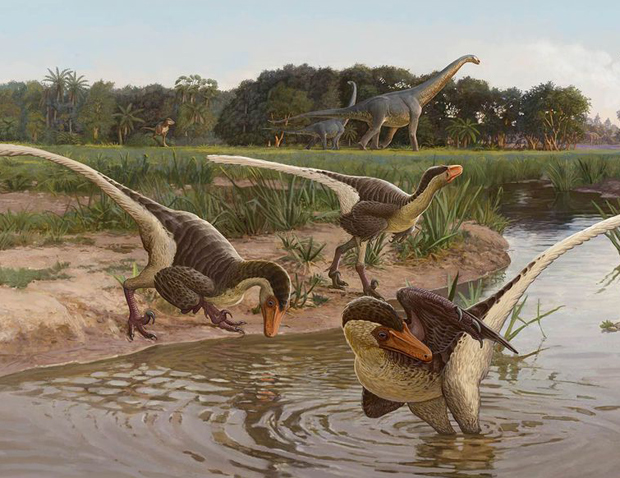
Life Reconstruction Dineobellator notohesperus (Maastrichtian of New Mexico)

Dineobellator Life Reconstruction
A trio of the newly described dromaeosaurid from the Late Cretaceous of New Mexico (Dineobellator) gather at a waterhole.  The titanosaur Alamosaurus passes by in the background and in the distance a tyrannosaur is approaching.

Picture credit: Sergey Krasovskiy

Dineobellator notohesperus

Writing in the academic journal “Scientific Reports”, the researchers from The University of Pennsylvania and the New Mexico Museum of Natural History and Science, describe a partial, skeleton excavated from the Bisti/De-na-zin Wilderness of New Mexico, found within a few metres above the base of the Naashoibito Member.  The coarse sandstone deposits are notoriously difficult to date, these sediments were deposited towards the end of the Cretaceous between 70 and 66.3 million years ago (Maastrichtian faunal stage).

Fossil material includes parts of the skull, elements from the jaws, fragments of vertebrae, tail bones (caudal vertebrae), one rib with other pieces of rib and limb bones including a nearly complete right upper arm bone (humerus) and a nearly complete right ulna (bone from the forearm).  The first fossilised remains were found in 2008, subsequent field work carried out in 2009, 2015 and 2016 yielded more fossil material, mostly very fragmentary in nature.  It is believed all the fossil material, including a claw from the right hand, represents the remains of a single dinosaur.

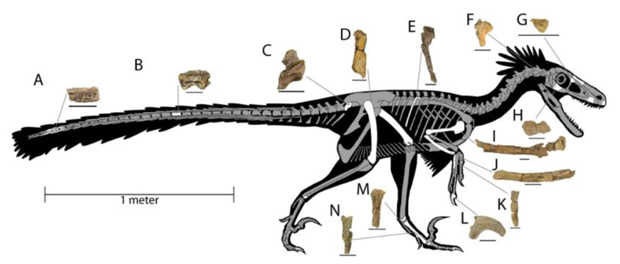
A Skeletal Reconstruction of Dineobellator notohesperus

Known fossil material and skeletal reconstruction of Dineobellator.
A silhouette and postulated skeleton of Dineobellator (known fossil material in white).

Picture credit: Jasinski et al/Scientific Reports

A Small but Dangerous Dinosaur

Dineobellator notohesperus is the first dromaeosaurid to be described from the southern United States.  It would have lived in the south of the Cretaceous landmass of Laramidia.  Although no evidence of feathers has been found, the ulna shows evidence of a row of small rounded pits in the bone, interpreted as anchor points for large feathers on the arm (ulna papillae).  Analysis of the forelimbs suggest that Dineobellator had stronger arms with a more powerful grip.  A study of the tail bones suggest that the tail had greater movement which would have made this dinosaur adept at making sharp turns and agile changes of direction.

The researchers suggest these anatomical traits provide an insight into how this small theropod hunted and behaved.

The researchers, which include Dr Steven Jasinski (Department of Earth and Environmental Science, University of Pennsylvania), postulate that Dineobellator was an active predator that occupied a discrete ecological niche in the food chain whilst living in the shadow of Tyrannosaurus rex.

The newest North American “raptor” Dineobellator notohesperus is pronounced dih-nay-oh-bell-ah-tor noh-toh-hes-per-us and the genus name comes from the native Navajo word “Diné”, a reference to the Navajo Nation and the Latin word “bellator” which means warrior.  The trivial name has been erected to acknowledge the location of the fossil find.  The word “noto” is from the Greek meaning southern and “hesper” the Greek for western.  This is an acknowledgement that Dineobellator roamed the south-western part of the United States.  In addition, Hesperus is a reference to a Greek god, the personification of the evening star (Venus) and by extension “western”.

Dr Jasinski has already had a considerable impact on the Dromaeosauridae family.  Back in 2015, Everything Dinosaur reported on the formal description of Saurornitholestes sullivani, a dinosaur named by Steven Jasinski whilst a PhD student at the University of Pennsylvania.  To read more about S. sullivaniSniffing Out a New Dinosaur Species.

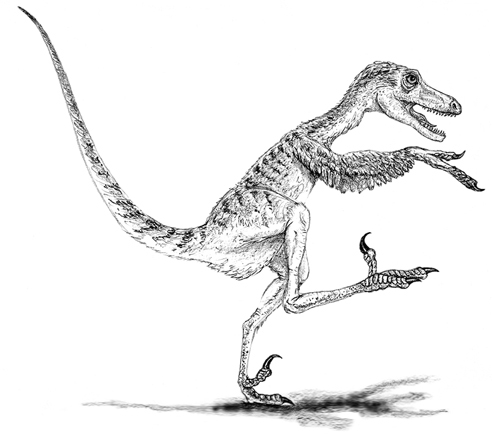
An Illustration of Saurornitholestes sullivani

Saurornitholestes sullivani illustrated
An agile dinosaur, an illustration of Saurornitholestes sullivani.  Although the fossil material associated with this species was found in New Mexico, S. sullivani lived several million years earlier than Dineobellator notohesperus. Picture credit: Everything Dinosaur.

Picture credit: Everything Dinosaur

A Tough Life for a Tough Dinosaur

A phylogenetic analysis undertaken by the research team places Dineobellator within the Velociraptorinae subfamily of the Dromaeosauridae.  Other Maastrichtian “raptors” known from North America are few and far between (Acheroraptor and Dakotaraptor – both from the Hell Creek Formation).  The discovery of Dineobellator suggests that dromaeosaurids were still diversifying at the end of the Cretaceous and as an velociraptorine, its fossils lend further weight to the idea that faunal interchange between Asian and North American dinosaurs took place sometime during the Campanian/Maastrichtian.

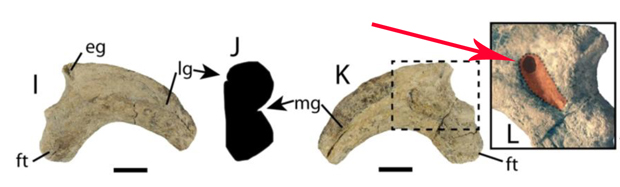
It is not known whether Dineobellator notohesperus was a pack hunter.  The fossilised remains do indicate that this was one very tough dinosaur but it did not have everything its own way.  A rib shows a deformity, suggesting that this bone was broken, but the animal suffered this trauma a while before it died as the break is healed.  Intriguingly, the scientists identified a prominent gouge mark preserved on the hand claw (manual ungual).  This gouge mark, which measures nearly a centimetre long, terminates in a small depression.

The scientists suggest that this damage was not caused by disease or by any process associated with the preservation of the fossil bones.  The team suggest that this was an injury that occurred close to, or at the time of this dinosaur’s demise.

Injured in a Fight?

The researchers speculate that this Dineobellator received an injury in a fight with another Dineobellator or perhaps this damage to its hand claw was inflicted upon it by another type of predatory theropod.

Views of the Hand Claw of  Dineobellator notohesperus Showing Damage Interpreted as a Wound Inflicted by Another Theropod Dinosaur

The manual ungual of Dineobellator.
Views of the hand claw of Dineobellator.  The right manual ungual of Dineobellator notohesperus (I) lateral view, with (J) a silhouette of the transverse plane of the right manual ungual near the distal end.  Image (K) shows the claw in media view with the dashed area highlighted in (K) showing the gouge mark (L).  The red arrow indicates the pathology.  Scale bars equal 1 mm, please note (L) is not to scale.

Picture credit: Jasinski et al/Scientific Reports with additional annotation by Everything Dinosaur

The scientific paper: “New Dromaeosaurid Dinosaur (Theropoda, Dromaeosauridae) from New Mexico and Biodiversity of Dromaeosaurids at the end of the Cretaceous” by Steven E. Jasinski, Robert M. Sullivan and Peter Dodson published in Scientific Reports.

The Everything Dinosaur website: The Everything Dinosaur Website.

23 03, 2020

Discovery of the Oldest Bilaterian – Ikaria wariootia

By |2024-01-20T09:56:28+00:00March 23rd, 2020|Categories: Dinosaur and Prehistoric Animal News Stories, Main Page, Palaeontological articles, Photos/Pictures of Fossils|0 Comments

Meet Your Oldest Ancestor – Ikaria wariootia 

A team of international scientists have identified the first ancestor of animals that show bilateral symmetry, in ancient marine sediment around 555 million years old.  Palaeontologists had predicted that such an organism would be identified in Ediacaran sediments, essentially a creature with a body plan that has been adopted by the majority of the Kingdom Animalia, now thanks to the use of sophisticated three-dimensional laser scans funded by NASA, the “smoking gun” evidence has been found.

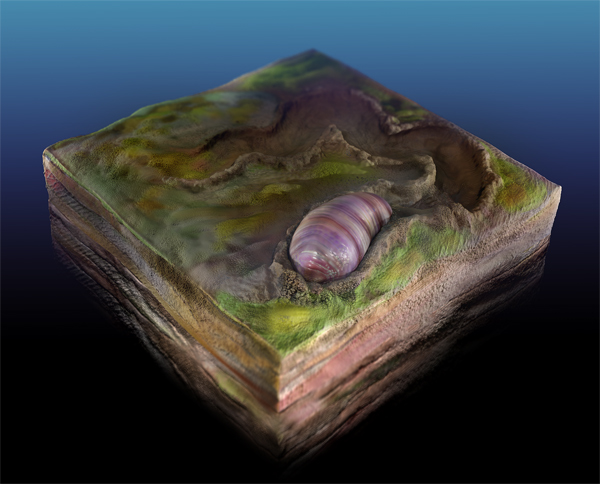
A Life Reconstruction of the Earliest Bilaterian Known to Date (I. wariootia)

Ikaria wariootia the earliest known bilaterian.
Ikaria wariootia life reconstruction.

Picture credit: Sohail Wasif/University California Riverside

Ikaria wariootia – The Size of a Rice Grain but a Big Discovery!

Writing in the journal “Proceedings of the National Academy of Sciences of the United States of America”, the researchers, which included scientists from University California Riverside and the South Australian Museum, examined tiny trace fossils, essentially burrows and borings into an ancient Ediacaran seabed (Ediacara Member, South Australia).

Proximal to some of these traces were very small oval impressions.  Thanks to funding from a NASA exobiology grant, the team were able to employ a sophisticated three-dimensional laser scanner to map these depressions in the ancient rock.  Computer-generated images revealed a worm-like organism with a cylindrical body and faintly grooved musculature.  A distinct head and tail were also identified.  This little animal represents the earliest bilaterian, a hugely significant step in the evolution of life on Earth.

The transition from simple, microscopic forms of life to the abundance and variety of complex creatures in the Cambrian remains quite poorly understood.  However, the beautifully preserved remains of soft-bodied organisms, many of which look like nothing alive today, associated with the ancient strata of the Ediacara Hills of South Australia have permitted palaeontologists the opportunity to learn about life on our planet prior to the evolution of hard body parts such as shells and exoskeletons.

Bizarre Body Forms

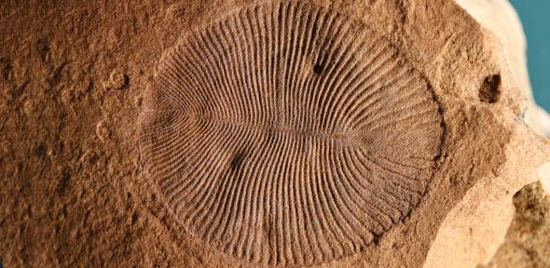
Many of the creatures identified from their fossils had bizarre body forms such as the circular Dickinsonia (below), but scientists had predicted that animals with bilateral symmetry would be present in this ecosystem, it was just a question of finding them.

A Circular Impression of an Organism from the Ediacara Hills (South Australia) – Dickinsonia costata Fossil

Dickinsonia costata fossil.
The Ediacaran fossil Dickinsonia costata, specimen P40135 from the collections of the South Australia Museum.

Picture credit: Dr Alex Liu (Cambridge University)

The Development of Bilateral Symmetry

The development of bilateral symmetry was a critical step in the evolution of animal life, giving organisms the ability to move purposefully and a common, yet successful way to organise their bodies.  In the scientific paper, the research team describe Ikaria wariootia as ranging in size between 2 and 7 millimetres in length and being around 1 to 2.5 millimetres wide.   The largest specimens were about the size of a grain of rice, just the right size to have made the burrows and borings (trace fossils).

The discovery of Ikaria wariootia is consistent with predictions based on modern animal phylogenetics, that the last ancestor of all bilaterians was simple and small and represents a rare link between the Ediacaran and the subsequent record of animal life.  Put simply, I. wariootia is on the same part of the animal family tree as the majority of animals alive today and that includes us (Homo sapiens).

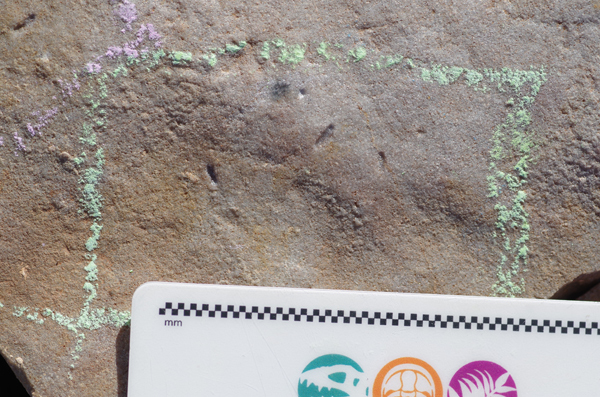
Ikaria wariootia Impressions Preserved in Ancient Marine Sediment

Ikaria wariootia impressions.
Ikaria wariootia impressions preserved in ancient marine sediments.

Picture credit: Droser Laboratory/University of California Riverside

Commenting on the significance of the discovery, one of the authors of the scientific paper, Scott Evans (University of California Riverside), stated:

“We thought these animals should have existed during this interval [Ediacaran], but always understood they would be difficult to recognise.  Once we had the 3-D scans, we knew that we had made an important discovery.”

Examining Ediacaran Trace Fossils

Analysis of modern animals and Ediacaran trace fossils predicted that the oldest bilaterians would be very small with simple body plans.  The research team found that the size and shape of Ikaria matched the predictions that had been made with regards to the maker of the trace fossil Helminthoidichnites, indicating sediment displacement and purposeful animal movement.

Importantly, in the Ediacara Member, Helminthoidichnites occurs stratigraphically below classic Ediacara body fossils such as Dickinsonia.  Together, these suggest that Ikaria represents one of the oldest total group bilaterians identified to date, with very little deviation from the characters and traits predicted for their last common ancestor.

In addition, these trace fossils persist into the Phanerozoic Eon (from the Cambrian Period onwards),  providing a critical link between the Ediacaran and Cambrian biota.

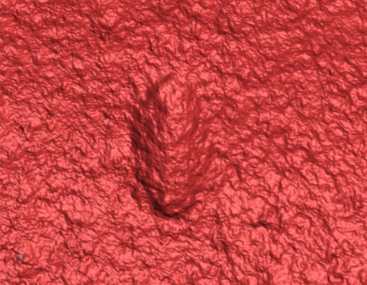
A Three-Dimensional Laser Image of a Scan of a Rock Depression Revealing the Body Plan of Ikaria wariootia

Three-dimensional laser scan of an Ikaria wariootia impression.
A three-dimensional laser scan of an Ikaria wariootia impression.

Picture credit: Droser Laboratory/University of California Riverside

What’s in a Name?

The genus name comes from Ikara, which means “meeting place” in the local Adnyamathanha dialect.  It is the Adnyamathanha term for a grouping of mountains known as Wilpena Pound.  The trivial name comes from Warioota Creek, which runs from the Flinders Ranges to Nilpena Station in the Ediacara Hills.  It may look a fairly simple animal to us, but back in the Ediacaran Ikaria was one of the most complex organisms around.  It burrowed in thin layers of well-oxygenated sand on the ocean floor in search of organic matter, indicating rudimentary sensory abilities.

The depth and curvature of Ikaria represent clearly distinct front and rear ends, supporting the directed movement found in the burrows.  The walls of the burrows preserve evidence of “v-shaped” ridges, which indicate that Ikaria moved by contracting muscles across its body like an earthworm.  This is known as peristaltic locomotion.

Everything Dinosaur acknowledges the assistance of a media release from the University of California Riverside in the compilation of this article.

The scientific paper: “Discovery of the oldest bilaterian from the Ediacaran of South Australia” by Scott D. Evans, Ian V. Hughes, James G. Gehling and Mary L. Droser published in the Proceedings of the National Academy of Sciences of the United States of America.

The Everything Dinosaur website: Everything Dinosaur.
20 03, 2020

Everything Dinosaur Continuing to Support Schools and Home Educators

By |2024-01-19T07:31:37+00:00March 20th, 2020|Categories: Adobe CS5, Dinosaur and Prehistoric Animal News Stories, Dinosaur Fans, Educational Activities, Everything Dinosaur News and Updates, Main Page, Press Releases, Teaching|0 Comments

Everything Dinosaur Continuing to Support Schools and Home Educators

At this time of uncertainty due to the coronavirus outbreak, Everything Dinosaur team members want to let you know how we are responding to the recent announcement about school closures. Our hearts go out to all those affected globally by the coronavirus (COVID-19) crisis.  We are doing all we can to assist the education sector.  Everything Dinosaur is currently operating as normal and we intend to provide regular updates in what is a very fluid situation.  We are working very hard to limit the disruption to schools, nurseries and other academic bodies.

Everything Dinosaur Helpinig to Support the Education Sector

Everything Dinosaur has released the following statement:

Everything Dinosaur Team Members Helping to Support the Education Sector and Home Schooling

Everything Dinosaur supporting schools and home educators.
Team members working hard to support the educational sector and home schooling at this difficult time (coronavirus outbreak 2020). Picture credit: Everything Dinosaur.

Picture credit: Everything Dinosaur

The website links to gain access to our free teaching resources and other educational materials:

Information About Dinosaurs and Fossils

In addition, this blog site has posted up news stories, information about fossils, features about dinosaurs, evolution, natural selection, new theories and articles on other science related subject areas, every day since May 2007.  This is a resource that has over 4,750 articles, which are all free to access, helping to provide additional materials for teachers, teaching assistants, academics and home schoolers.

Furthermore, our hard-working and enthusiastic staff handle numerous email enquiries each day, providing advice, free prehistoric animal fact sheets and other resources.

Team members are working extremely hard to help support universities, colleges, nurseries, other academic bodies and home educators.  We continue to provide free of charge, a wide range of fossil and dinosaur themed teaching resources and learning materials.

19 03, 2020

Amazing Canadian Fish Fossil Lends Palaeontologists a Helping Hand

By |2024-01-19T07:25:44+00:00March 19th, 2020|Categories: Dinosaur and Prehistoric Animal News Stories, Main Page, Photos/Pictures of Fossils|0 Comments

Fish Fossil Helps to Demonstrate How Fins Turned into Hands

A team of international scientists including researchers from Flinders University in Adelaide (South Australia) and the Université du Québec à Rimouski (Canada), have scanned the fossilised remains of an ancient fish with tetrapod tendencies to reveal evidence of how the limbs of fish evolved into the terrestrial appendages of land animals.

Elpistostege watsoni

The fossilised remains date from the Late Devonian and are approximately 380 million years old.  The fossil is a specimen of Elpistostege (E. watsoni), the discovery of a much more complete skeleton of this strange animal gave the researchers the opportunity to analyse the body plan of this predator in much greater detail than previously.

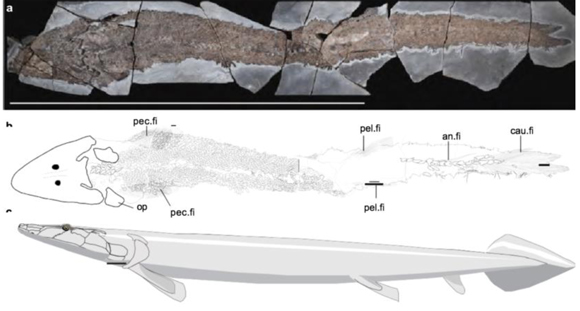
A Near Complete Specimen of Elpistostege watsoni with Accompanying Line Drawing

Elpistostege watsoni fossil with interpretive drawing and life reconstruction.
The near complete Elpistostege specimen with line drawing showing the outline of the skeleton and a life reconstruction.  The research was conducted on a fossil specimen that had been discovered in 2010.

Picture credit: South Australia Leads/Flinders University

Strategic Professor in Palaeontology (Finders University), Professor John Long, announced the discovery of the near complete fossil specimen in the journal “Nature”.  Commenting on the significance of the fossil find, he stated that the specimen “reveals extraordinary new information about the evolution of the vertebrate hand.”

High Energy X-Rays to Assess Fin Structure

The research team bombarded the fossil specimen with high energy X-rays to reveal the presence of limb and wrist bones hidden in the fins.  Evidence of finger-like bones could also be made out.

The Professor added:

“This is the first time that we have unequivocally discovered fingers locked in a fin with fin-rays in any known fish.  The articulating digits in the fin are like the finger bones found in the hands of most animals.  This finding pushes back the origin of digits in vertebrates to the fish level and tells us that the patterning for the vertebrate hand was first developed deep in evolution, just before fishes left the water.”

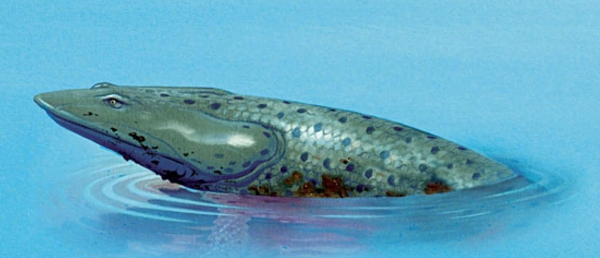
A Life Reconstruction of the Late Devonian Elpistostege

Elpistostege life reconstruction.
A life reconstruction of Elpistostege.

Picture credit: Miguasha National Park/Johanne Kerr and François Miville-Deschênes

Studying the “Limb Bones” of a Fish

The high resolution scans revealed the presence of a humerus (upper arm bone), the radius and ulna (the two bones from the forearm), carpal bones from the wrist and the presence of bones that resembled digits.  The fossil specimen measures 1.57 metres in length.  It comes from exposures of the Escuminac Formation located in the Canadian province of Quebec.

The strata represent a brackish water, estuarine environment and palaeontologists have long speculated that such a habitat may have been one of the driving forces behind the evolution of limbs capable of terrestrial locomotion in certain types of ancient fish.  The teeth in the broad jaw suggest that Elpistostege was an apex hypercarnivore, but whether it fed on other fish or ventured out onto land to grab insects and arthropods on the shore (as indicated by the position of the eyes at the top of the head suggesting an ambush predator), remains unknown.

Co-author of the scientific paper Richard Cloutier (Université du Québec à Rimouski), commented that over the last ten years or so, fossils representing the fish-to-tetrapod transition had helped palaeontologists to gain a better understanding about this important stage in vertebrate evolution.

He added:

“The origin of digits relates to developing the capability for the fish to support its weight in shallow water and for short trips out on land.  The increased number of small bones in the fin allows more planes of flexibility to spread out the weight through the fin.”

A Primitive Tetrapod

In previous studies, Dr Cloutier had postulated that Elpistostege might represent the most primitive tetrapod known to science, an accolade currently held by the closely related Tiktaalik, fossils of which come from northern Canada (Ellesmere Island).

Australian Professor John Long has dedicated much of his academic career to studying Devonian fish and the early stages of the evolution of the modern tetrapod body plan.

Here are some blog articles that provide more details of his research: The Early Evolutionary History of Sharks.

A Placoderm “Platypus”: Ancient Placoderm from Australia.

The Everything Dinosaur website: Everything Dinosaur.
Go to Top