All about dinosaurs, fossils and prehistoric animals by Everything Dinosaur team members.

Fossil finds, new dinosaur discoveries, news and views from the world of palaeontology and other Earth sciences.

4 05, 2020

A New Dinosaur Called Stellasaurus – “Star Lizard”

By |2024-02-19T07:34:10+00:00May 4th, 2020|Categories: Adobe CS5, Dinosaur and Prehistoric Animal News Stories, Dinosaur Fans, Main Page, Palaeontological articles, Photos/Pictures of Fossils|0 Comments

Stellasaurus ancellae – Missing Link from the Two Medicine Formation of Montana

A new species of horned dinosaur has been described based on fossil material from the famous Two Medicine Formation of north-western Montana.  The new species named Stellasaurus ancellae is a possible missing link in the evolutionary transition of Centrosaurinae dinosaurs from Styracosaurus to one of the last of the horned dinosaurs known to science – Pachyrhinosaurus.

Stellasaurus means “star lizard”, reflecting the ornate star-shaped head crest and in honour of British rock/pop star David Bowie, famous for his flamboyant appearance and his hit single “Starman” which was released on April 28th 1972, almost 48 years to the day that the Stellasaurus scientific paper was published in Royal Society Open Science.

United by a Flamboyant Appearance David Jones AKA David Bowie and “Star Lizard” AKA Stellasaurus
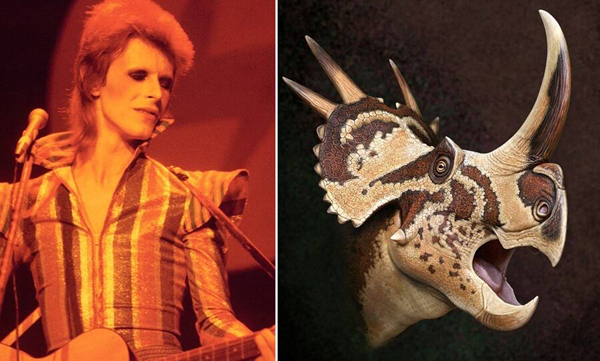
Two flamboyant characters David Bowie and Stellasaurus.
David Bowie (left) and Stellasaurus ancellae (right).

Picture credit: Getty Images and Andrey Atuchin

Stellasaurus ancellae

Just like the career of David Bowie, Stellasaurus has had to wait a while before becoming famous.  The fossil material now assigned to Stellasaurus was discovered in 1986, near the town of Cut Bank in Montana, close to the USA/Canadian border.  The discovery was made by Carrie Ancell.  It remained catalogued but not studied in the Museum of the Rockies (Montana), vertebrate fossil collection.

The contribution of Carrie Ancell, now a senior preparator at the Museum of the Rockies, has been recognised as the species name honours her.  Carrie Ancell has played a significant role in developing our understanding of northern Laramidian centrosaurines.  She discovered and prepared MOR 492, the holotype specimen of Stellasaurus ancellae, as well as the holotype of Achelousaurus horneri, and co-discovered the holotype of Einiosaurus procurvicornis.

Views of the Holotype Fossil Material of Stellasaurus ancellae
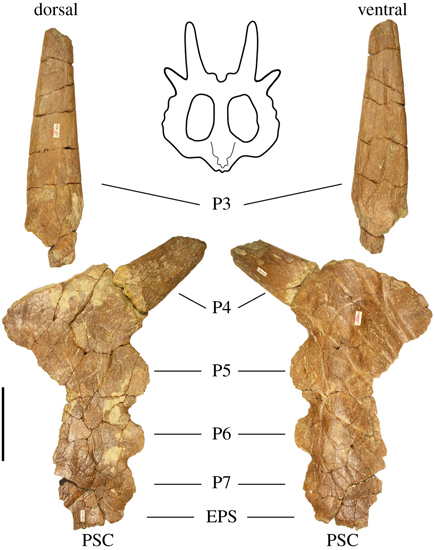
Holotype fossil material for Stellasaurus ancellae
Left lateral parietal bar of Stellasaurus ancellae holotype MOR 492 in dorsal and ventral views.   The line drawing has been reproduced from a PLOS One article (Evans and Ryan).  Note scale bar on left equals 10 cm.

Picture credit: Wilson et al/Royal Society Open Science

Reviewing the Centrosaurinae Fossil Material from the Two Medicine Formation

A review of cranial material, specifically the ornamentation associated with the neck frill (parietal processes), previously assigned to the centrosaurine Rubeosaurus ovatus resulted in the identification of this new taxon.  However, this assessment could mark the demise of R. ovatus as the researchers, which include John Wilson of Montana State University, conclude that only what was the holotype fossil, a partial parietal specimen number USNM 11869, can be attributed Rubeosaurus.  This could spell the end for Rubeosaurus.  When USNM 11869 was first described it was assigned to a new species of Styracosaurus (S. ovatus).

Thus, this new paper proposes that the genus Rubeosaurus is now no longer valid and that Styracosaurus ovatus is the sister taxon to Styracosaurus albertensis and Stellasaurus marks a missing link in centrosaurine evolution between Styracosaurus and Einiosaurus procurvicornis.

A Stratigraphical and Temporal Assessment of Late Cretaceous Centrosaurines Based on Two Medicine Formation Fossil Material *
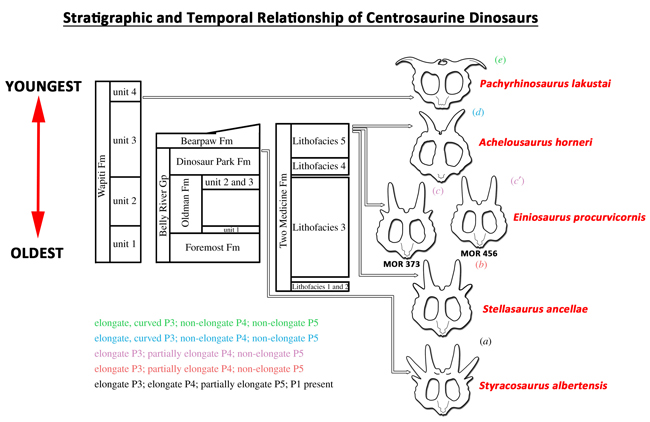
The centrosaurine lineage from Styracosaurus to Pachyrhinosaurus.
Stratigraphic and temporal relationship between Two Medicine Formation centrosaurine taxa. * Pachyrhinosaurus lakustai fossil material is not from the Two Medicine Formation but from the younger unit 4 sediments of the Wapiti Formation of Canada.

Picture credit: Wilson et al/Royal Society Open Science

A Missing Link Amongst the Centrosaurinae

The researchers postulate that Stellasaurus represents a missing link in the centrosaurine family tree.  The fossils of Stellasaurus are believed to be around 75 million years old.  From a stratigraphical perspective, they are younger than Styracosaurus albertensis fossils, but older than fossils assigned to Einiosaurus.  That flamboyant head shield with its various lumps and bumps could reflect a transitional stage between the headshield morphology of Styracosaurus and that of Einiosaurus.  It is suggested that Stellasaurus was preceded by Styracosaurus and that Styracosaurus evolved into Stellasaurus.  In addition, Einiosaurus evolved from Stellasaurus.

A Transitional Process – One Horned Dinosaur Leading Directly to Another Species of Horned Dinosaur
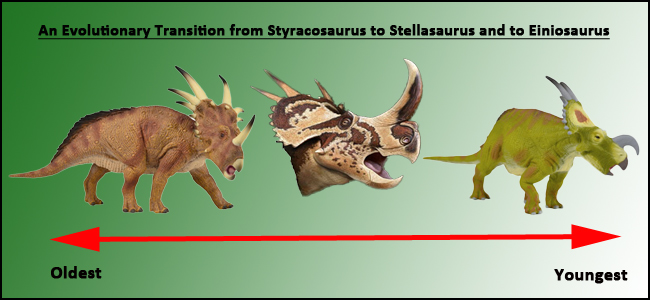
Anagenesis amongst centrosaurines.
Anagenesis within centrosaurine dinosaurs.  Stellasaurus evolved from Styracosaurus and Einiosaurus evolved from Stellasaurus.

Picture credit: Everything Dinosaur/Andrey Atuchin

Anagenesis in the Centrosaurinae

Commenting upon the importance of this new research, lead author John Wilson stated:

“The ornamental horns and spiky frills on the skulls of these animals are what changed the most through evolution.  The new species has skull ornamentation which is intermediate.  This gives us evidence these species are members of a single, evolving lineage – this type of evolution is called anagenesis.”

The Phylogeny of the Centrosaurinae from Statistical Analysis Undertaken by the Research Team

Phylogeny of the Centrosaurinae based on Bayesian analysis.
Phylogeny of the Centrosaurinae clade of the Ceratopsidae based on Bayesian statistical analysis mapped against a temporal range.  Styracosaurus ovatus (formerly Rubeosaurus ovatus), is placed as the sister taxon to Styracosaurus albertensis, whilst Stellasaurus is mapped between S. albertensis and Einiosaurus procurvicornis.

Picture credit: Wilson et al/Royal Society Open Science

The scientific paper: “A new, transitional centrosaurine ceratopsid from the Upper Cretaceous Two Medicine Formation of Montana and the evolution of the ‘Styracosaurus-line’ dinosaurs” by John P. Wilson, Michael J. Ryan and David C. Evans published in Royal Society Open Science.

The Everything Dinosaur website: Everything Dinosaur.
2 05, 2020

Spinosaurus – An Enormous River Monster

By |2024-02-18T15:58:37+00:00May 2nd, 2020|Categories: Dinosaur and Prehistoric Animal News Stories, Dinosaur Fans, Main Page, Palaeontological articles, Photos/Pictures of Fossils|0 Comments

Spinosaurus an Aquatic Dinosaur

A team of international researchers including scientists from Leicester University, the University of Portsmouth and the University of Detroit Mercy, have published a paper in the academic journal “Nature” that concludes that the giant theropod Spinosaurus was indeed an aquatic animal.

Studying Spinosaurus

In the autumn of 2014, a paper was published in the journal “Science” entitled “Semiaquatic adaptations in a giant predatory dinosaur”.  Spinosaurus was depicted as an obligate quadruped very much at home in the water.  In this latest publication, three of the authors involved in the earlier study, Nizar Ibrahim of the University of Detroit Mercy, Cristiano Dal Sasso and Simone Maganuco from the Natural History Museum of Milan (Italy), have collaborated with numerous other researchers in the analysis of Spinosaurus aegyptiacus tail bones.

The tail of Spinosaurus was unlike any other known theropod.  The fossil tail bones, indicate that the tail was wide, flexible and fin-like.  It seems very well adapted to propelling this huge dinosaur through water.  The researchers conclude that this is unambiguous evidence for an aquatic propulsive structure in a member of the Dinosauria.  In other words, Spinosaurus was very much at home in the rivers, swamps and lakes of the Cretaceous of northern Africa.  Here is one dinosaur that took to the water.

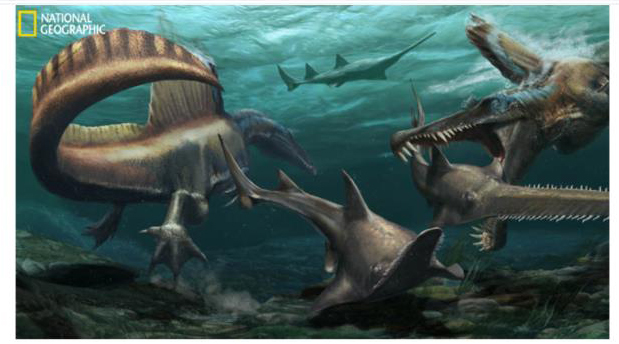
Life Reconstruction of Spinosaurus (S. aegyptiacus) 2020

Swimming Spinosaurus 2020
A pair of spinosaurids hunting the giant, prehistoric sawfish Onchopristis.

Picture credit: Davide Bonadonna/National Geographic

The beautiful illustration (above), depicts Spinosaurus hunting the 8-metre-long sawfish (Onchopristis).  A partial fossil jaw found in 1975 (MSNM V4047), attributed to Spinosaurus had a vertebra thought to have come from an Onchopristis embedded within it.  Although, the vertebra is thought to have become lodged after the Spinosaurus died, it demonstrated that Spinosaurus and this giant prehistoric fish were contemporaneous.

Not All Dinosaurs were Entirely Terrestrial

Unlike a lot of Kem Kem fossil material from Morocco, the Spinosaurus specimen, which was discovered in 2015, with the tail section found in 2018, consists of numerous associated bones.  Most of the vertebrate fossils found within these deposits are isolated, but these caudal vertebrae with their tall neural spines and elongated chevrons, have permitted the researchers to reconstruct the tail and to test its swimming capabilities using robotic flapping apparatus that was built to model the tail’s morphology and motion. 

The researchers conclude that the tail of Spinosaurus was long, strong, flexible and ideal for propelling this monster through water.  It is likely that these fossils will provide much more information on the enigmatic Spinosaurus, as the material represents the most complete theropod dinosaur found to date in northern Africa.

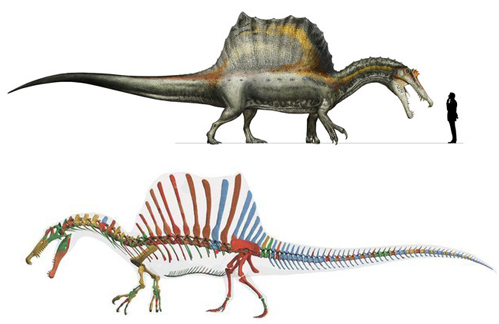
The Reconstructed Spinosaurus – Obligate Quadruped with a Typical Theropod Tail (circa 2014)

Life-size reconstruction and supplemental figure from the autumn 2014 scientific paper.

Picture credit: Davide Bonadonna (top) Ibrahim et al (bottom)

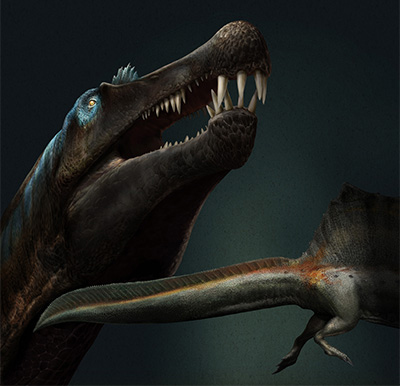
A Reconstruction of Spinosaurus aegyptiacus 2020

Swimming Spinosaurus (2020)
View of the crocodile-like snout of Spinosaurus and the new interpretation of the tail.

Picture credit: Davide Bonadonna/National Geographic

The Tail of a Tail

Note the differences in the shape of the tail between the 2014 reconstruction and the very much more fin-like 2020 reconstruction.  The tail of Spinosaurus aegyptiacus has been described as resembling that of a giant crested newt.

Co-author of the scientific paper, Dr David Unwin (University of Leicester), commented:

“The Spinosaurus’ fin-like tail is a game changing discovery for us that fundamentally alters our understanding of how this dinosaur lived and hunted – it was actually a ‘river-monster’.  As well as its tail, many other features of this dinosaur, such as the high position of the nostrils, heavy bones, short legs and paddle-like feet point to a life spent in the water rather than on land.   Not only did dinosaurs dominate the land and take to the air as birds, they even went back into the water and became the top predators there as well.”

The Papo Limited-edition Spinosaurus Model (2019)

Historically, some types of dinosaurs were associated with aquatic environments, for example, Jurassic sauropods and duck-billed dinosaurs such as Corythosaurus and Lambeosaurus.  However, these ideas have now been abandoned by most scientists and the Dinosauria is regarded as almost entirely terrestrial.  Recent studies have suggested that the enigmatic spinosaurids, dinosaurs such as Oxalaia, Irritator, Siamosaurus and Ichthyovenator along with Suchomimus, Baryonyx et al, may have been semi-aquatic.  This newly published paper demonstrates that Spinosaurus aegyptiacus possessed a number of anatomical adaptations indicating an aquatic habit.  In 2019, Papo introduced a new, limited-edition figure of Spinosaurus, depicting this animal as a semi-aquatic, obligate quadruped.

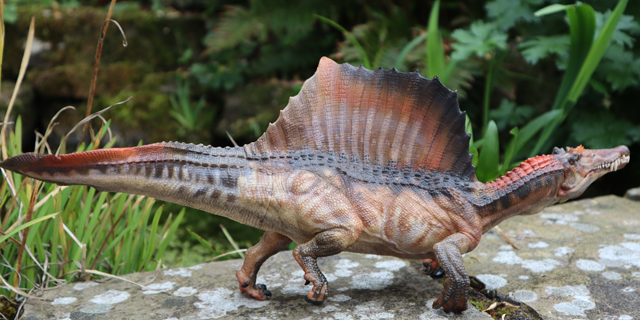
The Papo Limited-edition Spinosaurus Figure (2019)

Papo Limited Edition Spinosaurus Model.
The Papo limited-edition Spinosaurus dinosaur model (2019).  This Papo replica depicted Spinosaurus with a fin-like tail, ironically, this shape of tail has now been proposed by vertebrate palaeontologists. Picture credit: Everything Dinosaur.

Picture credit: Everything Dinosaur

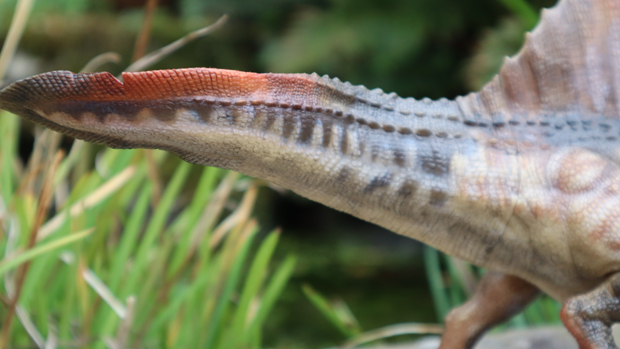
A Close-up View of the Thick Tail Adapted for Swimming of the Papo Spinosaurus

Papo Limited Edition Spinosaurus tail.
The tail of the Papo limited-edition Spinosaurus dinosaur model (2019). Picture credit: Everything Dinosaur.

Picture credit: Everything Dinosaur

Implications for Other Members of the Spinosauridae

Spinosaurus aegyptiacus was one of the last of the spinosaurids.  The authors of the scientific paper postulate that other members of the Spinosauridae are thought to have had aquatic adaptations which suggests a substantial invasion of aquatic environments by this clade of theropods.

Our congratulations to the scientists for their research into this fascinating theropod, we look forward to further papers being published as the Spinosaurus material from the Moroccan site continues to be excavated.  Our congratulations to Papo, for producing a fantastic replica, that although might not depict the dinosaur as exactly as some palaeontologists might, but they do seem to have produced a tail that reflects the newly published scientific data.

A review of the 2014 paper: Spinosaurus 2014 Scientific Paper Review.

To see the Papo range of prehistoric animal models including the limited edition Spinosaurus: Papo Dinosaurs and Prehistoric Animal Models.

The scientific paper: “Tail-propelled aquatic locomotion in a theropod dinosaur” by Nizar Ibrahim, Simone Maganuco, Cristiano Dal Sasso, Matteo Fabbri, Marco Auditore, Gabriele Bindellini, David M. Martill, Samir Zouhri, Diego A. Mattarelli, David M. Unwin, Jasmina Wiemann, Davide Bonadonna, Ayoub Amane, Juliana Jakubczak, Ulrich Joger, George V. Lauder and Stephanie E. Pierce published in the journal Nature.

Visit the Everything Dinosaur website: Everything Dinosaur.
1 05, 2020

The First Fossil Frog from Antarctica

By |2024-02-18T15:48:33+00:00May 1st, 2020|Categories: Animal News Stories, Dinosaur and Prehistoric Animal News Stories, Main Page, Photos/Pictures of Fossils|0 Comments

The First Fossil Frog from Antarctica

A researcher from the Swedish Museum of Natural History in collaboration with colleagues from the University of Fribourg (Switzerland) and the Instituto Antártico Argentino based in Buenos Aires (Argentina), has published a scientific paper which provides details of the first fossil frog to have been found on the continent of Antarctica.

A Fossil Frog from Seymour Island

The fossils, consisting of a partial ilium and a bone from the skull which were found in Eocene-aged deposits on Seymour Island, resemble an extant lineage of frogs known as helmeted frogs (family Calyptocephalellidae). Until this discovery, no Cenozoic ectothermic continental tetrapods (amphibians and reptiles), had been documented from Antarctica.  The tiny frog fossils suggest that around 40 million years ago, climatic conditions at high latitudes in the southern hemisphere were still mild enough to support “cold-blooded” amphibians.

A Life Reconstruction of the Helmeted Frog Found on the Antarctic Peninsula (Seymour Island)

Fossil frog described from Antarctica.
Life reconstruction of the frog genus described from the Eocene of Antarctica.

Picture credit: Pollyanna von Knorring / Swedish Museum of Natural History

Studying Eocene Freshwater Habitats

Writing in the academic, on-line journal “Scientific Reports”, the researchers conclude that some Eocene freshwater habitats in Antarctica provided habitats that were favourable for cold-blooded (ectothermic) vertebrates such as frogs.  Antarctica was much milder than it is today, the warmest months of the year averaging around 13 degrees Celsius whilst temperatures in the winter would have dropped to below an average of 4 degrees Celsius.  Frogs were present in freshwater ecosystems at a time in the history of Antarctica where ice sheets had formed in upland areas towards the interior of the continent.

Views of the Fragmentary Ilium from Seymour Island

Frog ilium from the Antarctic.
Ilium (NRM-PZ B282) of Calyptocephalella sp. from Seymour Island, Antarctica.  Ilium in lateral (a), medial (b), ventral (c) and dorsal (d) views.  Scale bar equals 1 mm.

Picture credit: Swedish Museum of Natural History

The Discovery of Fossil Frog Remains

The fossil frog remains were collected during three joint Argentinian-Swedish expeditions to Seymour Island in the southern hemisphere summers 2011–13.  The bone fragments were concentrated from dry-sieved sediment samples. The closest living relatives of the Eocene specimen are limited to the Chilean Andes (Calyptocephalellidae).  With the discovery of the fossils on Seymour Island, the researchers conclude that these types of helmeted frog were much more widespread across what remained of Gondwana during the Eocene.

The material is housed in the palaeozoological collection of the Swedish Museum of Natural History, Stockholm.

The scientific paper: “First fossil frog from Antarctica: implications for Eocene high latitude climate conditions and Gondwanan cosmopolitanism of Australobatrachia” by Thomas Mörs, Marcelo Reguero and Davit Vasilyan published in Scientific Reports.

The Everything Dinosaur website: Everything Dinosaur.
30 04, 2020

What Makes “Crazy Beast” So Crazy

By |2024-02-18T13:37:38+00:00April 30th, 2020|Categories: Dinosaur and Prehistoric Animal News Stories, Dinosaur Fans, Main Page, Photos/Pictures of Fossils|0 Comments

The Very Strange Adalatherium hui

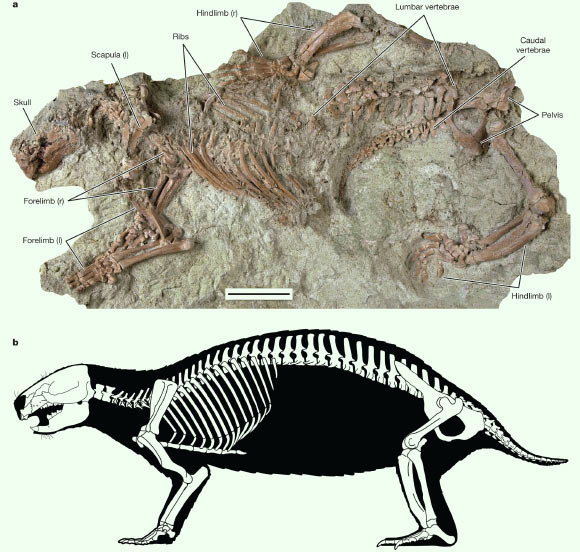
This week, has seen the publication in the journal “Nature” of a scientific paper describing a new species of bizarre mammal from the Late Cretaceous of Madagascar.  Named Adalatherium (A. hui), this cat-sized animal shared its island home with a variety of predators such as abelisaurid dinosaurs, crocodilians and snakes.  At an estimated three kilograms, Adalatherium was no giant, but the fossilised remains, which represent a near complete skeleton of an individual, indicate that this mammal was not yet fully mature when it died and as such, it is one of the largest members of the crown group of mammals described from Upper Cretaceous material.

Adalatherium hui

A Life Reconstruction of Adalatherium (A. hui)

Adalatherium life reconstruction.
A life reconstruction of Adalatherium hui.

Picture credit: Reuters

Madagascar became isolated from the rest of Gondwana around 88 million years ago.  Animals on the island were effectively marooned and many pursued a different evolutionary route compared to related forms on the rest of the super-continent.  Classified as a member of the Gondwanatheria, an extinct group of mammaliaforms confined to the southern hemisphere and up until now, only known from isolated teeth and fragmentary bones, the Adalatherium lineage developed an unusual and unique set of characteristics never seen before in a tetrapod.

“Crazy Beast”

The backbone has more vertebrae than any other Mesozoic mammal and one of its rear leg bones (tibia) was bowed.  How this animal moved around is a bit of a mystery, but the authors of the scientific paper suggest that this animal lived in burrows (fossorial).  The snout shows a mixture of primitive and very advanced anatomical traits.  Adalatherium had more foraminia, small holes in the nasal cavity that served as passageways for nerves and blood vessels, than any other mammal extinct or living today.

The snout was probably extremely sensitive and covered in whiskers, they may have helped it find its way about underground.  One foramen (hole for nerves or blood vessels), at the top of the snout has no know parallel with any other mammal.

These strange characteristics inspired the researchers to name this animal “crazy beast” from the local Malagasy and from the Greek.

The Preserved Skeleton of Adalatherium and Accompanying Line Drawing

Adalatherium fossil material and interpretative line drawing.
The articulated remains of Adalatherium hui and an accompanying line drawing.  Note scale bar in (a) equals 5 cm.

Picture credit: Krause et al.

Adalatherium hui – Bending and Breaking a Lot of Rules

Corresponding author, Dr David Krause (Denver Museum of Nature and Science), commented:

“Knowing what we know about the skeletal anatomy of all living and extinct mammals, it is difficult to imagine that a mammal like Adalatherium hui could have evolved, it bends and even breaks a lot of rules.”

Dr Krause is no stranger to bizarre prehistoric animals from Madagascar.  In 2008, Everything Dinosaur wrote a blog post about the “frog from Hell”, a research team led by Dr Krause had discovered the fossilised remains of a giant frog that inhabited the Late Cretaceous of Madagascar.

To read more about this: Beelzebufo ampinga – a frog that could jump continents!

The scientific paper: “Skeleton of a Cretaceous mammal from Madagascar reflects long-term insularity” by David W. Krause, Simone Hoffmann, Yaoming Hu, John R. Wible, Guillermo W. Rougier, E. Christopher Kirk, Joseph R. Groenke, Raymond R. Rogers, James B. Rossie, Julia A. Schultz, Alistair R. Evans, Wighart von Koenigswald and Lydia J. Rahantarisoa published in the journal Nature.

Visit Everything Dinosaur’s website: Everything Dinosaur.

29 04, 2020

Let’s Ear It for Thalattosuchians (Evolution of Cetaceans)

By |2024-02-18T13:28:32+00:00April 29th, 2020|Categories: Adobe CS5, Dinosaur and Prehistoric Animal News Stories, Dinosaur Fans, Main Page|0 Comments

Prehistoric Crocodiles and Whales  – Convergent Evolution

The evolution of the cetaceans from terrestrial ancestors to the fully adapted pelagic forms we see today has been well documented.  However, a group of archosaurs, specifically a clade of crocodyliformes – the thalattosuchians, underwent the transition from terrestrial animals to become fast swimming predators over a hundred million years earlier.

Two very different types of tetrapod became adapted to marine environments by developing flippers from limbs, streamlining their bodies and evolving tail flukes to aid propulsion in water.  New research from a team of scientists led by Julia Schwab of the University of Edinburgh, also reveals that part of the inner ear changed to and that both thalattosuchians and the later synapsids that became modern whales ended up with very similar inner ear anatomy – an example of convergent evolution.

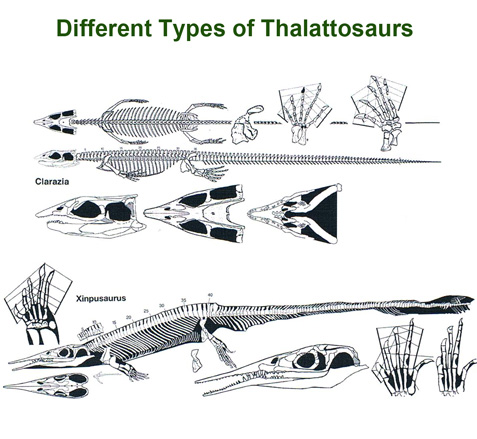
Thalattosaurs Evolved into Fully Pelagic Marine Reptiles from Terrestrial Ancestors

Illustrating thalattosaurs.
Thalattosaurs illustrated.  The Thalattosuchia is a specious and both temporally and geographically widespread clade of marine crocodylomorphs that originated in the Early Jurassic.  This clade is regarded by most palaeontologists as comprising two families (Teleosauridae and Metriorhynchidae).  A new scientific paper suggests that these diapsids evolved an inner ear structure that was mimicked by later synapsids that evolved into modern whales and dolphins.

Picture credit: David Peters

Computerised Tomography of Thalattosaur Skulls

Writing in the academic journal PNAS (Proceedings of the National Academy of Sciences of the United States of America), the researchers report on the use of CAT scans to examine the fossil skulls of a dozen different types of marine crocodile to examine the vestibular system of the inner ear.  This system consists of three looping semi-circular canals and helps with spatial awareness and balance.  As thalattosuchians evolved into fully marine forms, during a long semi-aquatic phase, the morphology of their ear canals changed.  The ear canals became smaller and fatter – a shape that made their sensory system less sensitive, an ear canal morphology shared with today’s extant cetaceans.

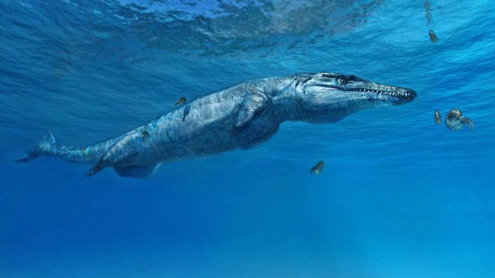
A Seven-metre-long Late Jurassic Marine Predator (Plesiosuchus manselii)

Marine crocodile (Plesiosuchus).
Plesiosuchus manselii illustrated.

Picture credit: Fabio Manucci/University of Edinburgh

Adapting to a Marine Existence

The inner ear canal shape that is common to both thalattosaurs and cetaceans is an adaptation to a marine existence, whereby the buoyancy of the water supports the animal in what tends to be a more uniform medium such as the the Epipelagic and the Mesopelagic zones of the ocean.  This contrasts to the environment encountered by a terrestrial animal which has to cope with the full effect of gravity on its body and a more complex landscape.

The researchers conclude that the adaptations to the thalattosaurs sensory capabilities evolved in response to their marine existence, rather than driving them into it.

Commenting on the significance of this study, co-author Steve Brusatte (University of Edinburgh), stated:

“The ancient aquatic crocs developed unusual inner ears after modifying their skeletons to become better swimmers.  Whales also changed their ears in a similar way, but did it soon after entering the water.  It seems like the crocs and whales took similar, but different, evolutionary routes from land to water.”

The scientific paper: “Inner ear sensory system changes as extinct crocodylomorphs transitioned from land to water” by Julia A. Schwab, Mark T. Young, James M. Neenan, Stig A. Walsh, Lawrence M. Witmer, Yanina Herrera, Ronan Allain, Christopher A. Brochu, Jonah N. Choiniere, James M. Clark, Kathleen N. Dollman, Steve Etches, Guido Fritsch, Paul M. Gignac, Alexander Ruebenstahl, Sven Sachs, Alan H. Turner, Patrick Vignaud, Eric W. Wilberg, Xing Xu, Lindsay E. Zanno and Stephen L. Brusatte published in the Proceedings of the National Academy of Sciences of the United States of America.

The Everything Dinosaur website: Everything Dinosaur’s Website.

27 04, 2020

New Late Cretaceous Giant Shark from Spain

By |2024-02-18T12:52:47+00:00April 27th, 2020|Categories: Dinosaur and Prehistoric Animal News Stories, Dinosaur Fans, Main Page, Photos/Pictures of Fossils|0 Comments

Ptychodontid Sharks Grew Big and Lived for a Long Time

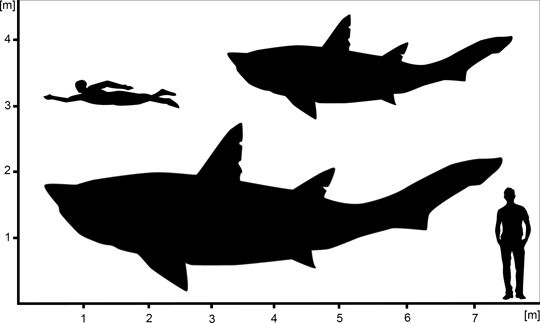
Scientists from the University of Vienna have been able to determine the approximate age and to estimate the rate of growth of an extinct species of shark that lived around 85 million years ago.  In addition, the researchers, writing in the open access on-line journal PLOS One, have estimated that this ammonite crunching fish could have been in excess of seven metres in length, but even though it was a giant, this shark was not yet fully mature and still had some growing to do.

Much of what we know about prehistoric sharks comes from studies of their fossilised teeth.  However, apart from providing indications on size, taxonomy and potential diet, these teeth do not provide a great deal of information about the life and the age of the individual.  In contrast, the calcified vertebrae of elasmobranchs (sharks, skates and rays), specifically the centra, yield important information about ecological and biological traits.  Two fossil shark vertebrae assigned to the genus Ptychodus found in northern Spain, have enabled researchers to gain valuable information on the life of a single individual animal that lived during the Late Cretaceous.

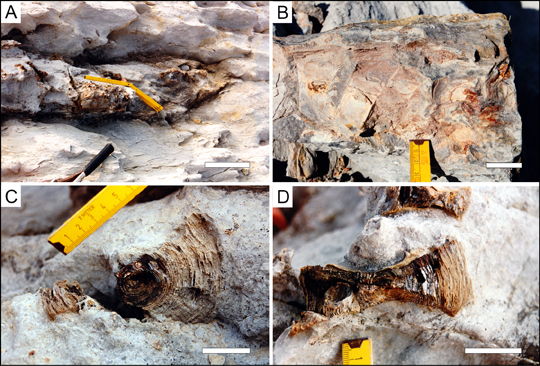
Site Photographs of the Shark Vertebrae

The shark vertebrae (articulated and disarticulated specimens).
Additional articulated (A, B) and disarticulated shark vertebrae (C,D) found in situ.  Scale bar (A) = 20 cm and scale bar = 3 cm in B, C and D).

Picture credit:  K. Oppermann

A Shark from Northern Spain

The fossil material consists of a portion of the spine representing five articulated and several disarticulated vertebral centra from a single animal.  The fossils were found in Upper Cretaceous strata around six miles west of the town of Santander in northern Spain, from a limestone exposure close to the village of Soto de la Marina.

The extensive marine sediments document much of the Late Cretaceous – ranging from early Santonian through to Maastrichtian-aged deposits.  The shark fossils come a bedding plane representing the earliest Santonian (circa 85 million years ago).  Although no teeth were found in association with the fossil material, the scientists have referred this material to the Ptychodus genus.  A relatively common and widespread genus that specialised in eating hard-shelled animals such as shellfish and ammonites (duraphagous diet).

Calculating the Size of the Prehistoric Shark

Previous research had shown a link between the total length attained for several living shark species and the diameter of the vertebral centra.  The linear regression used to calculate potential length was applied to these fossils and the scientists concluded that the shark was between 4.3 to 7.07 metres in length.

Estimating the Size of the Ptychodus spp.

Scale drawing of Ptychodus specimen based on size estimates.
Estimated size of between 4.3 and 7.07 metres for the Ptychodus spp. from the Santonian of Spain.

Picture credit: Patrick L. Jambura (University of Vienna)

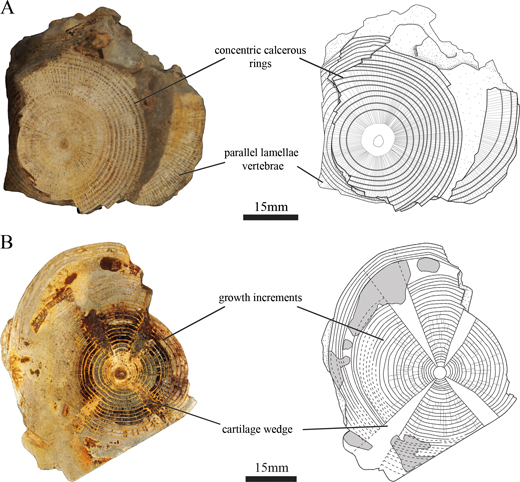
Intriguingly, the centra of sharks also preserve evidence of growth rate, from which an age range can be deduced, just as the rings on a tree stump can provide an indication of the tree’s age.  An analysis of the centra from two fossils indicated that this shark was around thirty years old when it died, quite an age for a shark, although what age some sharks species alive today can live to remains unknown.  Based on this study, the researchers propose that ptychodontid sharks grew very slowly, matured very late, but also showed high longevity and had the potential to reach huge body sizes.

Calcification Pattern on the Centra Can Provide an Indication of Growth Rate and Age

Calculating the age of a prehistoric shark.
Close view and line drawing of the vertebral centra EMRG-Chond-SK-1a (A), whilst (B) shows a close view and accompanying line drawing of  EMRG-Chond-SK-1b, the second centra examined in this study.  Note scale = 1.5 cm.

Picture credit: PLOS One (Jambura and Kriwet)

The scientific paper: “Articulated remains of the extinct shark Ptychodus (Elasmobranchii, Ptychodontidae) from the Upper Cretaceous of Spain provide insights into gigantism, growth rate and life history of ptychodontid sharks” by Patrick L. Jambura and Jürgen Kriwet published in PLOS One.

The Everything Dinosaur website: Everything Dinosaur.
19 04, 2020

Wood You Believe It? Mahogany Dates Back to the Dinosaurs

By |2024-02-17T18:43:09+00:00April 19th, 2020|Categories: Dinosaur and Prehistoric Animal News Stories, Dinosaur Fans, Main Page, Photos/Pictures of Fossils|0 Comments

Canadian Fossil Proves Origins of Mahogany Earlier Than Previously Thought

A fossilised fruit found on a beach in Canada has been identified as having come from a member of the mahogany tree family (Meliaceae).  This suggests that this commercially important hardwood evolved in the Cretaceous.   The fossil is some 15-20 million years older than any other fossil found that has been ascribed to the Meliaceae.  This type of tree would have been familiar to the dinosaurs.  Indigenous to the tropics of the Americas, the discovery of this fossil which dates between 79-72 million years ago (Campanian stage of the Late Cretaceous), will support palaeoclimate studies of high latitudes and permit palaeobotanists to better understand how modern tropical, angiosperm dominated ecosystems developed.

Manchestercarpa vancouverensis

The new species of Cretaceous-aged tree has been named Manchestercarpa vancouverensis.

Views of the Fossilised Mahogany Fruit (Manchestercarpa vancouverensis)

Fossil maghogany fruit - holotype material.
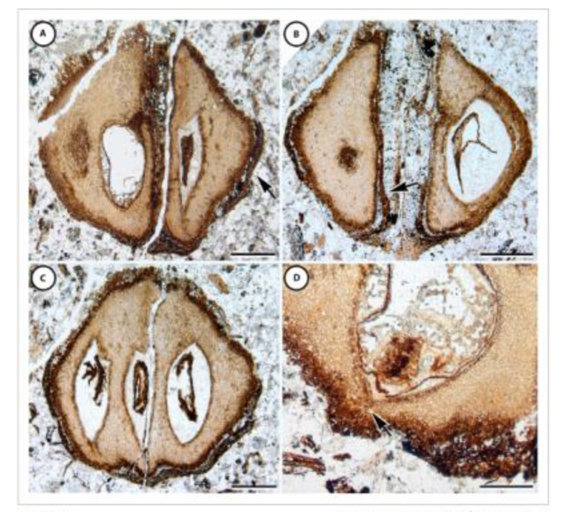
Fossil mahogany fruit (Manchestercarpa vancouverensis).  Holotype SH790 scale bars A-C equal 1 cm, scale bar in D equals 0.5 cm.

Picture credit: Brian Atkinson (University of Kansas)

The picture (above), shows cross-sectional views of the fruit and seeds of the newly described species of Cretaceous mahogany (Manchestercarpa vancouverensis).   The thick-walled outer skin of the fruit (endocarp) is identified along with the middle portion, the flesh of the fruit (mesocarp).  Evidence of seeds inside the fruit has also been found.

A Significant Fossil Discovery

Today, mahogany is a commercially very important hardwood, valued for its strength and beauty.  It is used in cabinet making, furniture and for creating musical instruments.  In the days of sailing ships, mahogany was much prized as this tough wood did not splinter as much as European timber when struck by a cannonball.  The UK is the world’s second largest importer of mahogany, after the United States.  To a palaeobotanist, finding a fossil that is reminiscent of fruit associated with these trees, lets them know that tropical forests similar to the ones we know today were in existence at the time of the dinosaurs.

Prior to this discovery, the oldest fossils attributed to the Meliaceae family date from the Palaeogene and Eocene such as those specimens found in the Green River Formation of Colorado.  However, the earliest previously recorded fossils associated with Melia are leaves and scientists have been reluctant to assign these fossils taxonomically.  The most diagnostic material are fossil fruits and these fossils have been found in several, geographically dispersed Eocene-aged deposits such as the London Clay and the Nanjemoy Formation of North America.

Geographically Widespread

It seems that in the past, these types of trees and therefore tropical forests were much more widespread than they are today.

Author of the scientific paper, published in the American Journal of Botany, University of Kansas researcher Brian Atkinson stated:

“For understanding when many of the different branches of the tree of life evolved, we’re primarily dependent on the fossil record.  In this case, Meliaceae, the mahogany family, is an ecologically and economically important group of trees.  A lot of researchers have used this group as a study system to better understand the evolution of tropical rainforests.  This work is the first definitive evidence that the tropically important trees were around during the Cretaceous period, when we first start to see the modernisation of ecosystems and modern groups of plants.”

The rock containing the fossilised fruit was found on a beach at Shelter Point, Vancouver (British Columbia), by fossil collector Graham Beard, the director of the Qualicum Beach Museum of Natural History.  The matrix in which the fossil was found is associated with the Spray Formation (Campanian faunal stage).   The genus name honours palaeobotanist Steve Manchester (University of Florida Museum of Natural History).  The species name honours the location of the fossil find.

Fossil Confirms a Cretaceous Origin for the Meliaceae

This paper clearly confirms a Cretaceous origin for Meliaceae and that important tropical families were present prior to the development of modern tropical ecosystems in the Cenozoic.

Graham Beard’s fossil hunting exploits have been featured in this blog before.  In 2011, Everything Dinosaur reported upon a paper that had been published naming a new species of Canadian pterosaur (Gwawinapterus beardi), that had been named in his honour.  A subsequent study published a year later, confirmed that the fossilised remains attributed to a late-surviving istiodactylid pterosaur actually represented the remains of a fish.  To the consternation of the academics associated with this study, it also turned out the Graham had been wrongly accredited with finding the fossil specimen.

To read more: Flying Reptile with “Piranha-like” Jaws the original article.

A second piece correcting the identity of the discoverer:  Mistake in Naming Pterosaur Fossil Discoverer.

The scientific paper: “Fossil evidence for a Cretaceous rise of the mahogany family” by Brian A. Atkinson published in the American Journal of Botany.

The Everything Dinosaur website: Everything Dinosaur.
17 04, 2020

New Research Explains Why Some Insects are Iridescent

By |2024-02-17T18:34:00+00:00April 17th, 2020|Categories: Dinosaur and Prehistoric Animal News Stories, Main Page, Photos/Pictures of Fossils|0 Comments

Researchers Study Weevils from the Pleistocene

Scientists have been studying the preserved wing cases of ancient weevils to help them to better understand how the huge colour palette associated with insects evolved.  Writing in the academic, open-access journal “Biology Letters”, the researchers from University College Cork (Ireland), in collaboration with colleagues from Yale-NUS College in Singapore, subjected the preserved elytra of weevils found in Switzerland to powerful electron microscopy to analyse miniscule photonic nanostructures housed within the cuticular scales of the wing case.

Studying Weevil Fossils

The researchers conclude that the vibrant colours produced may have evolved as a form of crypsis (camouflage).

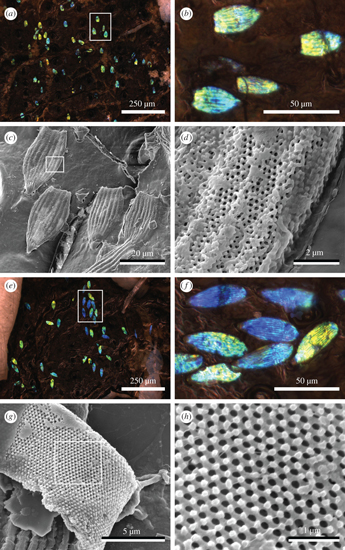
Pleistocene Weevil Scales Reveal Three-dimensional Photonic Nanostructures

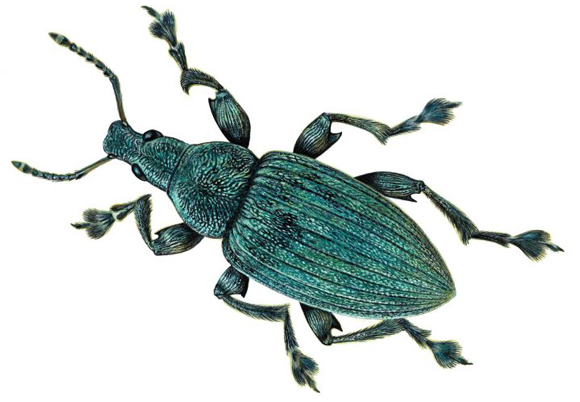
Weevil scales from the Pleistocene reveal their secrets.
Pleistocene subfossil weevil scales from specimens L150D-L (a–d) and L150D-N (e–h) imaged using light microscopy (a, b, e, f) and SEM (c, d, g, h).  Light micrographs show the preservation of scales preserving bright blue, green and yellow hues, while electron micrographs reveal three-dimensional photonic nanostructures (b, d, f, h).  Regions bounded by white boxes in (a, c, e, g; a, e rotated 90° clockwise), respectively.

Picture credit: McDonald et al published in Biology Letters

Three-dimensional Photonic Nanostructures Housed within Scales

With only the preserved elytra (wing cases), to study the researchers could not pin down the exact genus, but the vibrant greens, yellows and blues produced by the light reflecting structures (photonic nanostructures), identified in the cuticular scales are reminiscent of the living weevil genera Polydrusus or Phyllobius.  Although the optical properties of these miniscule structures are well understood, their evolutionary history remains somewhat opaque.

The specimens, believed to be around ten to sixteen thousand years old, were subjected to scanning electron microscopy and small-angle X-ray scattering techniques that revealed that the elytra possess a single-diamond photonic crystal nanostructure.  These “diamonds” are one of numerous types of crystal-like nanostructure found in nature that interacts with light to produce vivid colours, often with an iridescent, metallic hue.

A Life Reconstruction of One of the Pleistocene Weevils

Ancient weevil life reconstruction.
A life reconstruction based on the Swiss Pleistocene subfossil.

Picture credit: James Mckay

Rarely Preserved in the Fossil Record

The preservation of three-dimensional nanostructures within the fossil record of the Insecta is extremely rare.  This study represents the second time such nanostructures have been found, the only other instance of such structures being recorded was discovered in another fossil weevil by two of the authors of this scientific paper Dr McNamara (University College Cork) and Assistant Professor Vinodkumar Saranathan (Yale-NUS College).

The team suggest that these hues evolved to allow the insects to blend into their background.  These substrate-matching green colours have been maintained over hundreds of thousands of generations suggesting that the same selective pressures for camouflage have been acting on these weevils over millennia.  This supports the idea that this type of colouration originally evolved to provide crypsis to prevent these small creatures being seen by potential predators.

The researchers suggest that the fossil record of insects, although sparse, could provide further evidence regarding the evolutionary history of colouration within the Insecta.

The scientific paper: “Brilliant angle-independent structural colours preserved in weevil scales from the Swiss Pleistocene” by Luke T. McDonald, Suresh Narayanan, Alec Sandy, Vinodkumar Saranathan and Maria E. McNamara published in Biology Letters.

Visit the Everything Dinosaur website: Everything Dinosaur.
16 04, 2020

Amazing Fossils Inspire Aeronautical Engineers

By |2024-02-17T18:28:23+00:00April 16th, 2020|Categories: Dinosaur and Prehistoric Animal News Stories, Dinosaur Fans, Main Page, Photos/Pictures of Fossils|0 Comments

Fossils Influence Mechanical Designs in the Aeronautical Industry

In vertebrates, powered flight has evolved independently in several groups, within the mammals there are the bats and within the Archosauria clade, other types of animal have evolved the ability to take to the air and to keep themselves airborne.  We have the birds, but also their close cousins the non-avian dinosaurs, as palaeontologists have discovered numerous examples of volant dinosaurs (Microraptor, Ambopteryx and Yi qi for instance).

There are also the pterosaurs, some of which were the largest flying animals to have ever existed with wingspans measuring more than ten metres across.  Engineers are now taking a serious look at some of the different types of wing morphology that have evolved.  The fossil record is helping to inspire new thinking in mechanical design.

The Recently Described Giant Azhdarchid Pterosaur Cryodrakon boreas Helping to Inspire New Ideas in Mechanical Design

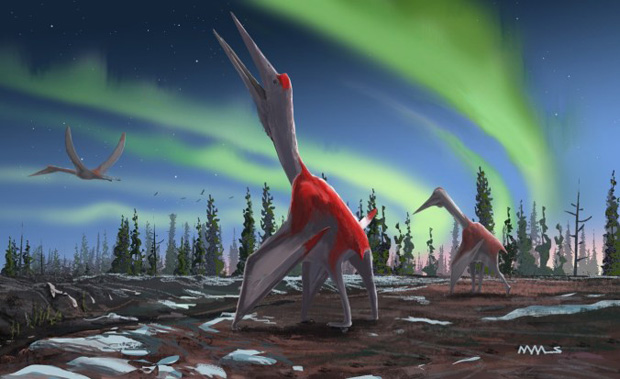
The Canadian azhdarchid pterosaur C. boreas.
A life reconstruction of the Canadian pterosaur Cryodrakon boreas.  A giant Late Cretaceous pterosaur with a wingspan in excess of ten metres.

Picture credit: David Maas

The Evolution of Different Solutions to the Problem of Sustained Powered Flight

Living birds and insects have been studied to help find solutions to aeronautical problems encountered when designing new planes, helicopters and unmanned aircraft such as drones.  However, a team of scientists including researchers from Bristol University, the Natural History Museum of Los Angeles County and Queen Mary University (London), have examined what the fossil record can teach us about powered flight.

Lead author of a recently published paper in “Trends in Ecology & Evolution”, Dr Elizabeth Martin-Silverstone, explained that there were a select few pterosaur fossils that provide dramatic insights into the anatomy and morphology of wing membranes, which could influence the thinking of aeronautical engineers as they contemplate concepts such as vertical take-off and landing capabilities in drones.

The post-doctoral researcher commented:

“There are two or three absolutely amazingly preserved pterosaur fossils that let you see the different layers within the wing membrane, giving us insight into its fibrous components.  Also, some fossils are preserved enough to show the wing attachments beneath the hip.  While you don’t know exactly the shape of the wing, by knowing the membrane attachments you can model the effectiveness of different wing shapes and determine which would have performed best in natural conditions.”

Beautifully Preserved Pterosaur Fossil Remains Helping to Inspire Engineers

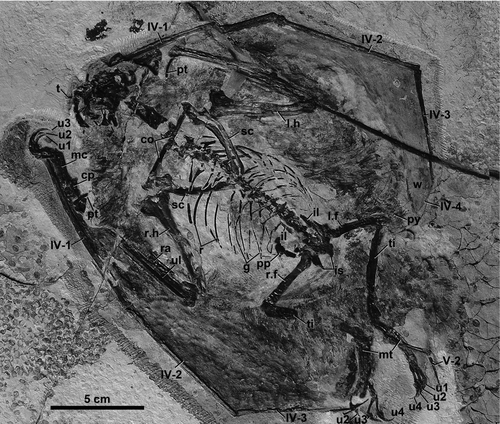
Jeholopterus pterosaur fossil.
Pterosaur fossil material.  This is a fossil specimen of the anurognathid pterosaur Jeholopterus ninchengensis.  Some exquisitely preserved pterosaur fossils are helping to inspire the design ideas of aeronautical engineers.

Picture credit: Chinese Academy of Sciences/Journal of Vertebrate Palaeontology

Taking to the Air – A Big Leap Upwards

Taking to the air is a challenge in itself.  In the natural world, leaping or jumping to launch yourself into the air, using what is termed a ballistic launch is very common.  For larger birds, they require a running start in order to build up enough momentum before lift-off.

Pterosaurs, some of which weighed more than 250 kilograms and stood taller than a giraffe, may have developed a unique method of taking to the air from a stationary position.  For example, co-author Mike Habib (Natural History Museum of Los Angeles County), postulates that the wing membrane and powerful, robust associated muscle attachment within the wings allowed these flying reptiles to generate a high-powered leap off their elbows and wrists – providing the drive to enable them to become airborne.

Studying Pterosaur Fossils

The unique physiology of the Pterosauria, exquisitely laid out in some beautifully preserved fossil specimens might help engineers to overcome some of the launch problems associated with drones.  In essence, future biomechanical studies of long extinct creatures may influence the next generation of manned and unmanned aeronautical vehicles.

A number of different types of maniraptoran dinosaur came up with novel solutions when it came to flight. Whether or not animals such as the bizarre scansoriopterygid Yi qi were gliders or were capable of powered flight remains open to debate, but these bizarre evolutionary dead ends (extinct leaving no modern descendants), could help to drive innovative solutions to some of today’s aeronautical conundrums.

A Model of the Bizarre Scansoriopterygid Yi qi

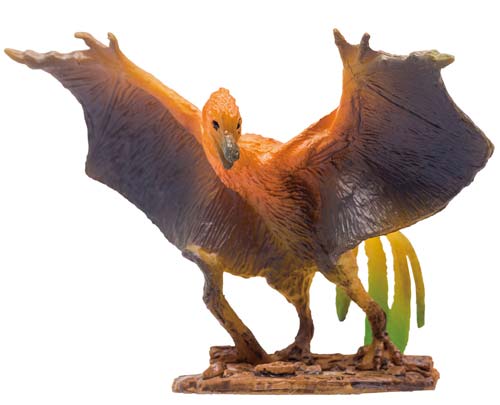
Yi qi dinosaur model (PNSO).
A model of the bizarre scansoriopterygid Yi qi, the name of this bizarre dinosaur translates as “strange wing”.

The picture (above) shows a scansoriopterygid from the PNSO model range.

To view this range: PNSO Age of Dinosaurs.

Everything Dinosaur acknowledges the assistance of a media release from the University of Bristol in the compilation of this article.

The scientific paper: “Volant Fossil Vertebrates: Potential for Bioinspired Flight Technology” by Elizabeth Martin-Silverstone, Michael B. Habib and David W.E. Hone published in Trends in Ecology & Evolution.

The Everything Dinosaur website: Everything Dinosaur.
13 04, 2020

Chirping Caribbean Coquí Frogs from the Oligocene

By |2024-02-17T15:52:48+00:00April 13th, 2020|Categories: Animal News Stories, Dinosaur and Prehistoric Animal News Stories, Main Page, Photos/Pictures of Fossils|0 Comments

The Oldest Record of a Frog from the Caribbean

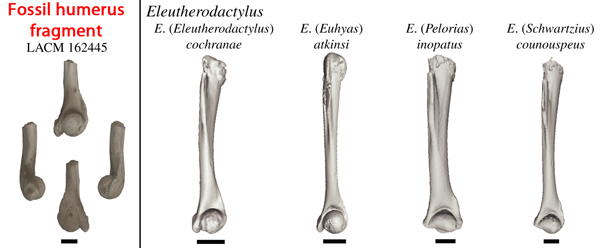
Researchers from the Florida Museum of Natural History (Florida University) and the Natural History Museum of Los Angeles County have published a scientific paper describing a portion of a left humerus (upper arm bone), discovered in north-western Puerto Rico that represents the oldest fossil remains of a frog ever found in the Caribbean.  The tiny bone, it measures less than one centimetre in length, has been assigned to the genus Eleutherodactylus, colloquially called coquí frogs in reference to the distinctive “coe-kee” call made by the males of some species as they seek to attract a mate.

The Fossilised Humerus is Compared to the Humeri of Extant Genera

Comparing the fossil material to extant genera.
Comparisons of the fossil specimen to representatives of each extant Caribbean frog genus as well as each Caribbean subgenus of Eleutherodactylus (Eleutherodactylus, Euhyas, Pelorias and Schwartzius).  Note various views LACM 162445 anterior, medial, posterior and lateral views.  Scale bar = 1 mm.

Picture credit: Blackburn et al (Biology Letters) with additional annotation by Everything Dinosaur

The authors of the scientific paper comment that it is fitting to have discovered this fossil bone in Puerto Rico, as the coquí is one of the national symbols associated with this tropical island.

From the San Sebastian Formation and Estimated to be 29 Million Years Old

The tiny bone was found by co-author Jorge Velez-Juarbe (Natural History Museum of Los Angeles County), in a mudstone layer of the San Sebastian Formation, exposed by a river (Rio Guatemala), in the north-western portion of the island, close to the town of San Sebastián.  The mudstone layer has been dated to 29.47 million years ago (+/- 300,000 years) and it represents an estuarine environment.  Other vertebrate fossils associated from this location include turtles, gharials and rodents.

Commenting on the discovery, lead author David Blackburn (Florida Museum of Natural History), stated:

“It’s a national treasure.  Not only is this the oldest evidence for a frog in the Caribbean, it also happens to be one of the frogs that are the pride of Puerto Rico and related to the large family Eleutherodactylidae, which includes Florida’s invasive greenhouse frogs.”

A Life Reconstruction of the Prehistoric Frog

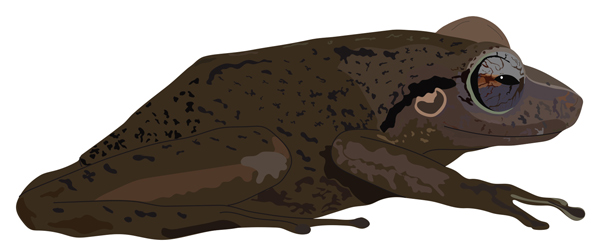
Ancient frog from the Oligocene of Puerto Rico.
The 29-million-year-old Eleutherodactylus frog life reconstruction. Based on measurements of the partial humerus, the scientists estimate the extinct frog to have measured around 4 centimetres in length.

Picture credit: Jorge Velez-Juarbe (Natural History Museum of Los Angeles County)

Looking for Evidence of Oligocene Frogs

Scientists studying data from phylogenetic assessments had postulated that these types of frogs had established themselves in the Caribbean during the Oligocene but until now there was no fossil evidence to support this line of research.  The bones of frogs tend to have a poor preservation potential.   They are small, light and any corpse would very likely, quickly decompose in the hot, humid tropical conditions.

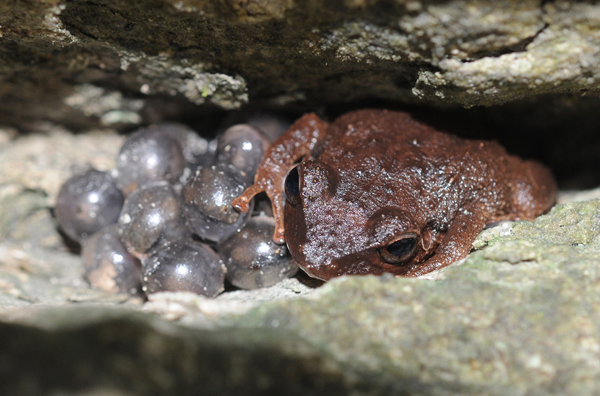
Possibly first arriving in the Caribbean by rafts of vegetation displaced from South America, these small tree frogs in the genus Eleutherodactylus, which encompasses some 200 species, dominate the Caribbean today.  Coquís differ from most other frogs as they usually do not lay their eggs in water.  They do not have a hatching tadpole stage, instead the tadpole stage takes place within the egg, the male carefully tending the nest and ensuring that the eggs remain moist.  When the eggs hatch, the young emerge as fully formed froglets.

A Male Coquí Frog Protecting a Clutch of Eggs

Male coquí frog protecting a clutch of eggs.
A male coquí frog protecting a clutch of eggs.

Picture credit: Jorge Velez-Juarbe (Natural History Museum of Los Angeles County)

Everything Dinosaur acknowledges the assistance of a media release from the University of Florida in the compilation of this article.

The scientific paper: “The earliest record of Caribbean frogs: a fossil coquí from Puerto Rico” by David C. Blackburn, Rachel M. Keeffe, María C. Vallejo-Pareja and Jorge Vélez-Juarbe published in Biology Letters.

The Everything Dinosaur website: Everything Dinosaur.
Go to Top