All about dinosaurs, fossils and prehistoric animals by Everything Dinosaur team members.

Fossil finds, new dinosaur discoveries, news and views from the world of palaeontology and other Earth sciences.

7 06, 2020

Two New Transitional Ceratopsids – Knitting Together Horned Dinosaurs

By |2024-02-21T10:09:08+00:00June 7th, 2020|Categories: Adobe CS5, Dinosaur and Prehistoric Animal News Stories, Dinosaur Fans, Main Page, Palaeontological articles|0 Comments

Two New Transitional Horned Dinosaurs – Navajoceratops sullivani and Terminocavus sealeyi

In the last few days, a scientific paper has been published that proposes a direct evolutionary link between Pentaceratops and the younger chasmosaurine Anchiceratops.  The idea that there was a link between Pentaceratops (P. sternbergii) which roamed the New Mexico portion of Laramidia around 75.3 million years ago and Anchiceratops (A. ornatus) which lived much further north (Alberta, Canada), between 72 and 71 million years ago, had been proposed for more than two decades.

This newly published paper names two transitional species – Navajoceratops sullivani and Terminocavus sealeyi, plus describes another new ceratopsid, simply named taxon C.  Between them, these new horned dinosaurs help to fill the gap (literally) in chasmosaurine evolution.

Forming Links in an Evolutionary Chain – From Pentaceratops to Anchiceratops
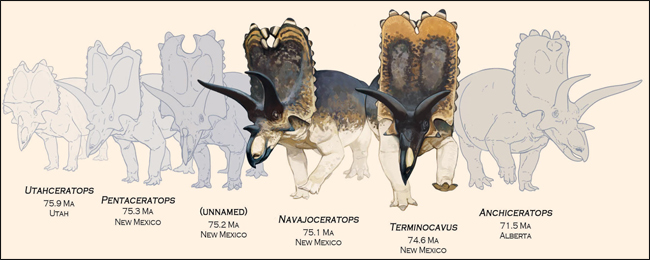
An evolutionary lineage linking chasmosaurines
The two new  horned dinosaurs together with an undescribed taxon form a vital link in the transition of chasmosaurine ceratopsids linking Utahceratops, Pentaceratops and Anchiceratops into an evolutionary lineage.

Picture credit: Ville Sinkkonen & Denver Fowler

It’s All About the Embayment

The Ceratopsidae in North America during the Late Cretaceous (Campanian and Maastrichtian faunal stages), diversified and evolved into many different forms.  Two great subfamilies emerged the Centrosaurinae and the Chasmosaurinae.  The evolutionary links between these two subfamilies and between the genera associated within each subfamily, has generated a great deal of discussion.  These dinosaurs are famous for their large skulls with their elaborate, extravagant head shields and horns.  Palaeontologists use the differences in the shape, orientation and size of these frills and adornments to determine one species from another.

Although, using the symmetry of the frill of a horned dinosaur to determine a new species can be controversial: Styracosaurus Provides a Head’s up When it Comes to Naming New Ceratopsids.

Navajoceratops sullivani and Terminocavus sealeyi Plus Taxon C

The problems recently highlighted with the discovery of a Styracosaurus with an asymmetrical skull notwithstanding, authors Dr Denver Fowler of the Badlands Dinosaur Museum and Dr Elizabeth Freedman Fowler (Dickinson State University, North Dakota), propose that these three new chasmosaurines, all from the Kirtland Formation of New Mexico, form a morphological succession between Pentaceratops from the older Fruitland Formation of New Mexico and Anchiceratops from the geologically much younger Horseshoe Canyon Formation of Alberta.

The Closing of the Notch in the Frill of Pentaceratops 
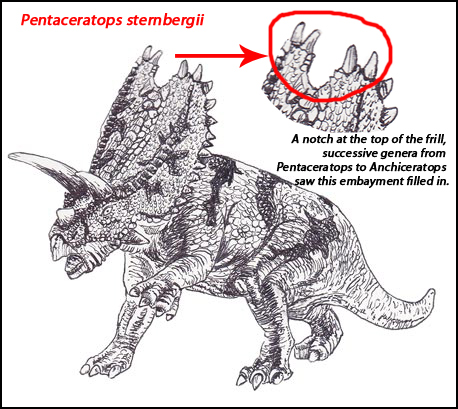
New study links Pentaceratops to Anchiceratops
A newly published scientific paper plots step changes in frill shape that suggests a line of evolutionary descent from Pentaceratops to Anchiceratops via several “transitional genera”. Picture credit: Everything Dinosaur.

Picture credit: Everything Dinosaur

Transitional Ceratopsids – The Shape of the Frills Backed by the Stratigraphy

Significantly, the scientists were able to plot a gradual change in the shape of the horned dinosaurs frills, essentially the gradual and successive filling in of a deep notch at the top of the frill (the embayment).  Anchiceratops did not have a notch at the top of its frill and the researchers demonstrate that two new partial skull specimens found in rocks intermediate in age between Pentaceratops and Anchiceratops were also intermediate in shape, showing how the notch in the frill became even deeper through time and eventually closed in on itself, explaining the lack of a notch in Anchiceratops.

Writing in the open access journal PeerJ, the researchers note that this step change in frill shape is observed in chasmosaurines that do not overlap stratigraphically.  This suggests that over hundreds of thousands of years, species evolved from a direct line of descent.  In biology, this is termed anagenesis – the slow and steady evolution of species in a sequence that forms a direct line of evolutionary descent without any obvious branching.

Two New Chasmosaurine Dinosaurs from the Kirtland Formation of New Mexico
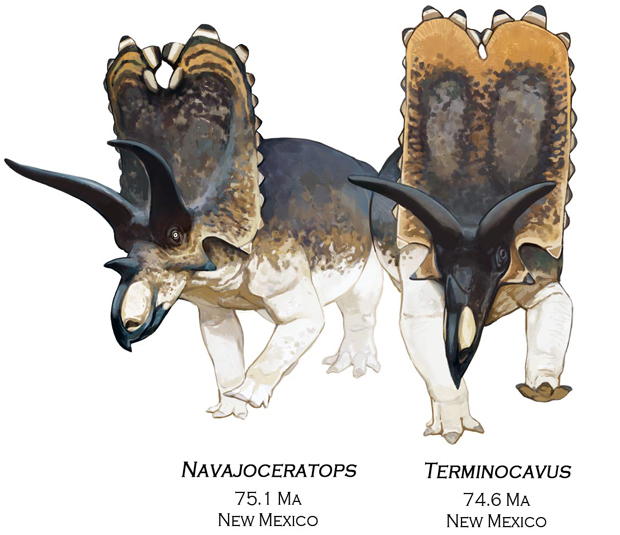
Navajoceratops and Terminocavus life reconstructions.
Two new chasmosaurine dinosaurs from the Hunter Wash member of the Kirtland Formation of New Mexico.

Picture credit: Ville Sinkkonen & Denver Fowler

A Five Million Year Evolutionary Line

The two newly named horned dinosaurs Terminocavus sealeyi and Navajoceratops sullivani along with other chasmosaurine specimens from the Farmington and De-na-zin Members of the Kirtland Formation (taxon C), form a sequence of horned dinosaur evolution, stretching over five million years from Utahceratops to Pentaceratops and on to Anchiceratops.

Navajoceratops sullivani is named in honour of the Navajo people who are synonymous with New Mexico.  The species name honours the now retired, Dr Robert Sullivan who led the field expedition that resulted in the discovery of the Navajoceratops fossil material.  The name translates as “Sullivan’s Navajo horned face”.

Terminocavus sealeyi translates as “Sealey’s closing cavity”, after fossil collector Paul Sealey who found the holotype and due to the fact that the notch in the skull frill is fully closed.

Holotype Parietal Frills of Terminocavus and Navajoceratops
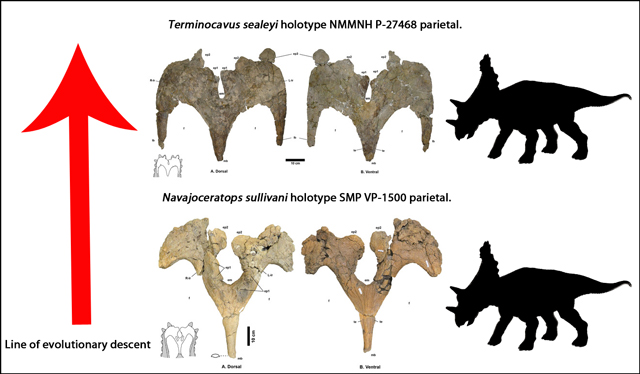
The parietal frills of Navajoceratops and Terminoscavus.
Holotype specimens (parietal frills) of the two new genera, showing line of evolutionary descent and a not to scale silhouette to represent the actual dinosaur.  Although the specimens are fragmentary, both include the diagnostic posterior border of the parietal which permitted evolutionary comparisons to be made.

Picture credit: Ville Sinkkonen & Denver Fowler with additional annotation by Everything Dinosaur

An Evolutionary Split

The researchers conclude that fossil material previously assigned to Pentaceratops should be examined once more as it may not represent this taxon.  Furthermore, they suggest that there was a splitting event deep in the evolutionary history of the Chasmosaurinae subfamily, after which the Pentaceratops lineage evolved a progressively deepening of the parietal notch in the frill, in contrast to a sister group, the Chasmosaurus lineage which evolved a progressively shallower notch.

The authors propose that encroachment by the Western Interior Seaway around 85-83 million years ago, effectively cut-off dinosaur populations, with a northern and southern population isolated from each other.  This permitted two distinct lineages of chasmosaurines to evolve.  When the sea retreated around 83 million years ago the two populations were able to mix again.

The Isolation of Dinosaur Populations

The isolation of northern and southern dinosaur populations during the Santonian faunal stage as a result of rising sea levels provides an explanatory mechanism.  This mechanism in which high sea level isolated northern and southern dinosaur populations for a period of 1 to 4 million years, lays the foundation for an evolutionary splitting event and provides an explanatory mechanism for the apparent differences between northern and southern dinosaur faunas in the Late Cretaceous of western North America.

Everything Dinosaur acknowledges the assistance of a press release from Dickinson Museum Centre (North Dakota) in the compilation of this article.

The scientific paper: “Transitional evolutionary forms in chasmosaurine ceratopsid dinosaurs: evidence from the Campanian of New Mexico” by Denver W. Fowler and Elizabeth A. Freedman Fowler in PeerJ.

The Everything Dinosaur website: Everything Dinosaur.
4 06, 2020

Borealopelta was a Fussy Eater

By |2024-02-21T09:20:40+00:00June 4th, 2020|Categories: Dinosaur and Prehistoric Animal News Stories, Dinosaur Fans, Main Page, Photos/Pictures of Fossils|0 Comments

Borealopelta markmitchelli Stomach Contents Analysed

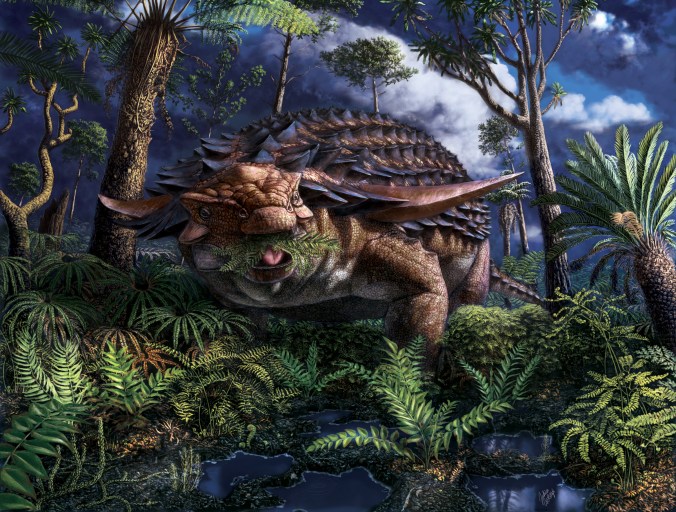
The stomach contents of a giant armoured dinosaur which was named and described in 2017, have revealed what this herbivore ate just hours before it died.  The incredibly rare fossilised stomach contents indicate that the 5.5 metre-long Borealopelta markmitchelli was a fussy eater, selecting one type of fern but ignoring others.  The charcoal preserved with the stomach remains also reveals that this dinosaur was probably picking over the fresh growth following a recent forest fire, a behaviour seen amongst many large extant herbivores.  Growth rings identified in a small twig inside the dinosaur’s body cavity suggest that this dinosaur died in the late spring/mid-summer.

Borealopelta markmitchelli Life Reconstruction – The Last Day of a Nodosaur

Borealopelta markmitchelli life reconstruction.
The last day of a nodosaur. Borealopelta markmitchelli life reconstruction.  Stomach contents reveal that the dinosaur selectively grazed ferns in an area that was recovering from a recent wildfire.

Picture credit: Julius Csotonyi

The Cololite Reveals All

Writing on the open-access, The Royal Society publishing platform, the scientists which include Caleb Brown and Donald Henderson from the Royal Tyrrell Museum of Palaeontology (Alberta), along with colleagues from Brandon University (Manitoba) and the University of Saskatchewan, provide a detailed analysis of the stomach contents of Borealopelta markmitchelli, the most comprehensive direct evidence of diet in an herbivorous Mesozoic dinosaur, helping palaeontologists to better understand the palaeoecology of armoured dinosaurs.

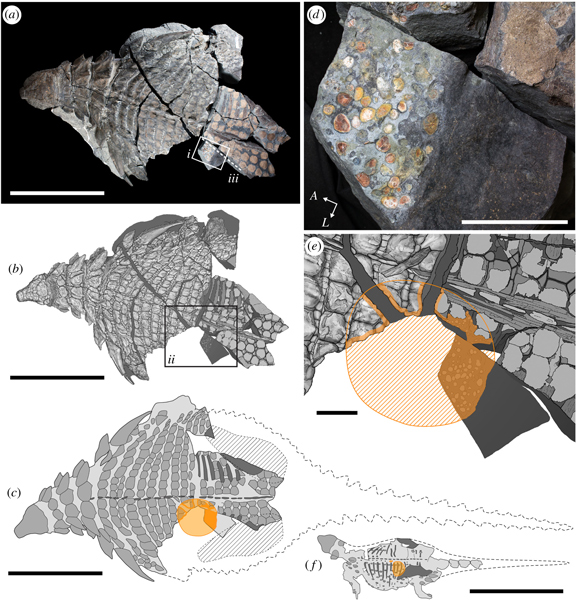
Direct evidence of diet in herbivorous dinosaurs is exceptionally rare in the fossil record, but with this beautifully preserved Borealopelta specimen, the presence of a cololite (fossil stomach or intestinal contents), permitted the team to conduct a forensic examination of the dinosaur’s last meal.

The small ankylosaur Kunbarrasaurus ieversi from the Early Cretaceous of Australia, which was named in 2015, is described as preserving a cololite within the abdominal cavity (specimen number QMF18101).  Whilst the Kunbarrasaurus material has proved not to be as diagnostic as the cololite associated with Borealopelta, its location in relation to the body, does help to support the idea that the football-sized mass found with Borealopelta does indeed represent stomach contents.

The Stomach Contents of Borealopelta and Kunbarrasaurus

The stomach contents (cololite location and analysis).
Borealopelta stomach contents.  Photograph (a) and line drawing (b) in dorsal view, with (c) showing location of cololite and body outline.  Photograph (d) shows a close view of the abdominal mass, whilst (e) shows comparable line drawing.  Kunbarrasaurus line drawing scaled to Borealopelta showing relative size and cololite position.  Note solid orange, observed cololite; hatched orange, inferred cololite. A, anterior; L, lateral. Scale bars in (a,b,c,f) are 1 m, and in (d,e) are 10 cm.

Picture credit: Brown et al (Royal Society Open Science)

Analysing the Cololite

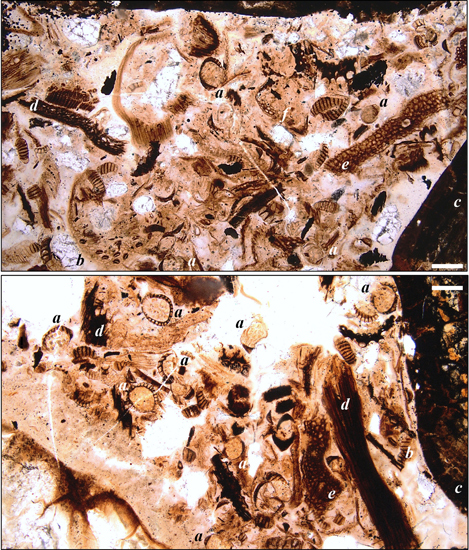
Seven thin sections of the cololite were prepared which permitted the scientists to examine the cololite at a microscopic level.

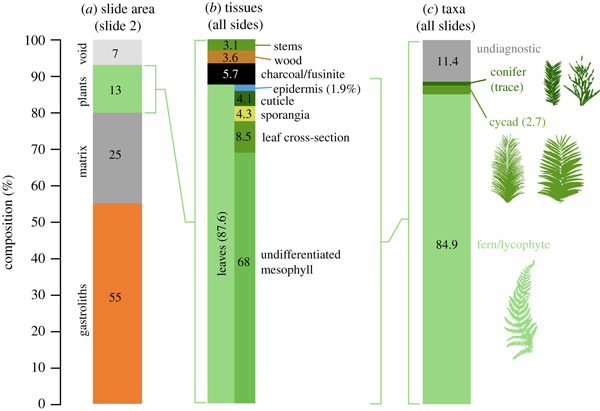
The last meal of Borealopelta consisted of 88% leaf material, with a 7% minor stem/twigs component.  Ferns dominated the leaf section and the bits of twigs showed distinct growth rings.  In one of the twigs studied, the outermost ring is incomplete, this provides evidence for the time of year when the dinosaur died.  Based on the incomplete growth ring, the researchers conclude that Borealopelta met its death in the late spring to mid-summer.

Carefully Prepared Slides Reveal the Dinosaur’s Last Meal at the Microscopic Level

Slide showing Borealopelta stomach contents.
Wide views (top and bottom panels) showing abundance of plant material found in the histology slides of the cololite sample.  In both, (a) sporangia, (b) leaf cuticle with stomata present, (c) gastroliths, (d) woody material, (e) leaf cross-sections and (f) sclerenchyma.  Top, slide 3; bottom, slide 6. Scale bars = 200 µm.

Picture credit: Brown et al (Royal Society Open Science)

Borealopelta markmitchelli was a Fussy Eater

The leaf fraction of the cololite is dominated (85%) by leptosporangiate ferns (subclass Polypodiidae), the largest group of ferns alive today.  Although cycad remains were also found, they only represented 3% of the total amount.  Trace amounts of foliage associated with conifers was also discovered.  The researchers conclude that Borealopelta was selectively feeding on ferns, preferring to consume leptosporangiate ferns to the exclusion of Osmundaceae and eusporangiate ferns such as Marattiaceae with incidental consumption of cycad–cycadophyte and conifer leaves.

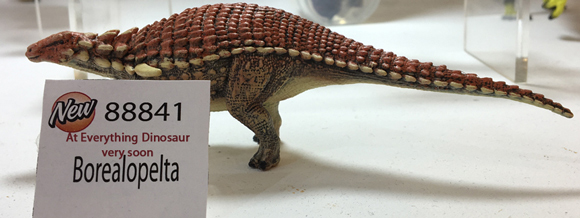
A Model of the Nodosaurid Borealopelta markmitchelli

A model of Borealopelta markmitchelli.
CollectA Borealopelta markmitchelli dinosaur model. Picture credit: Everything Dinosaur.

Picture credit: Everything Dinosaur

The picture (above) shows the CollectA Prehistoric Life Borealopelta model.

To view this range of prehistoric animal figures: CollectA Age of Dinosaurs and Prehistoric Life Models.

To gain an understanding of the ancient flora in Borealopelta’s habitat, the researchers were able to determine what food plants were available to Borealopelta by studying the fossil leaves found in the contemporaneous Gates Formation, a rock unit exposed in coal mines in the Rocky Mountain foothills.  This rock unit also preserves trackways left by armoured dinosaurs and is approximately the same age as the sediments that preserved Borealopelta.

In addition, the fossils of a small mollusc Murraia naiadiformis has been recorded from both the upper McMurray Formation (B. markmitchelli is known from the marine Wabiskaw Member of the fully marine Clearwater Formation which overlies the McMurray Formation) and the Gates Formation, supporting the idea that there is a link between these two depositional environments.

Some charcoal fragments were found as well, indicating that this nodosaur was feeding in an environment that had recently been burned.  This aligns with growing evidence that forest fires were very common in the conifer and cycad-dominated forests around the world during the Early Cretaceous.  This may also suggest the animal’s feeding ecology is linked to forest regrowth after a wildfire, such feeding behaviour is commonly observed in large herbivores alive today.

Comparison of the Cololite following Thin Section Microscopic Analysis

Composition of the Borealopelta cololite.
Composition of the cololite following microscopic analysis.

An Armoured Dinosaur with an Exceptional State of Preservation

The scientists are confident that given the exceptional state of preservation of Borealopelta, the fossil will yield further information helping palaeontologists to learn more about the Early Cretaceous environment of Alberta and the behaviour of armoured dinosaurs.

To read an Everything Dinosaur blog post about countershading identified in B. markmitchelliAmazing Armoured Dinosaur Fossil Reveals Countershading.

Although, Borealopelta weighed around 1.3 tonnes, this nodosaurid was bristling with defensive armour.  It was big, but in North America 110 million years ago there must have been a super-sized dinosaur predator capable of taking down such a monster.  Scientists remain puzzled, here is an article that examines the beautifully preserved armour of Borealopelta and speculates on the theropods that shared its environment: The Armour of Borealopelta markmitchelli.

Everything Dinosaur acknowledges the assistance of a media release from the Royal Tyrrell Museum in the compilation of this article.

The scientific paper: “Dietary palaeoecology of an Early Cretaceous armoured dinosaur (Ornithischia; Nodosauridae) based on floral analysis of stomach contents” by Caleb M. Brown, David R. Greenwood, Jessica E. Kalyniuk, Dennis R. Braman, Donald M. Henderson, Cathy L. Greenwood and James F. Basinger published by Royal Society Open Science.

Visit the Everything Dinosaur website: Everything Dinosaur.
30 05, 2020

Doomsday Scenario for the Non-avian Dinosaurs

By |2024-02-21T06:00:49+00:00May 30th, 2020|Categories: Dinosaur and Prehistoric Animal News Stories, Dinosaur Fans, Geology, Main Page|0 Comments

Dinosaur-dooming Bolide Struck Earth at Worst Possible Angle

The extra-terrestrial object, whether it was a comet or an asteroid, that devastated our planet some sixty-six million years ago, struck Earth at the “deadliest possible” angle according to new research published this week in the journal Nature Communications.  Computer simulations created by researchers based at Imperial College London indicate that the huge object struck Earth at an angle of 45 to 60 degrees to the horizontal.  This maximised the amount of climate-changing gases that were thrust into the upper atmosphere.

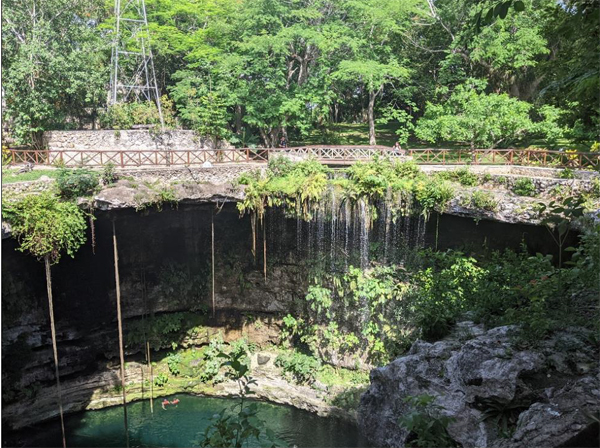
A Sinkhole Near the Chicxulub Crater in Mexico

Angiosperms are great survivors.
Plant diversity at a cenote (sinkhole) near the Chicxulub crater caused by the bolide hit 66 Million years ago. Picture credit: Jamie Thompson.

Picture credit: Jamie Thompson

The Significance of the Impact Trajectory

The severity of an extra-terrestrial impact is influenced by a number of factors.  For example, the size and the mass of the bolide, the speed of the impact and the trajectory and direction of impact.  The impact direction and the angle of the collision affect the amount of ejector that is thrown up into the atmosphere.  For the non-avian dinosaurs, it was a question of a number of factors that exacerbated the mass extinction event.  Although there has been a considerable amount of research carried out on Chicxulub crater the impact trajectory remains controversial.

The use of three-dimensional computer simulations along with geophysical observations suggests that the crater was formed by a steeply-inclined impact from the northeast.  Such a strike likely unleashed billions of tonnes of sulphur.  The sulphur would have reacted with the oxygen and other elements to form acid rain which would then have fallen to Earth and further devastated the environment.  The debris in the atmosphere would have blocked out the sun and triggered a nuclear winter effect.  This catastrophe led to the extinction of 75% of life on Earth.

The simulations were performed on the Science and Technology Facilities Council (STFC) DiRAC High Performance Computing Facility.

Plotting a Momentous Few Minutes in the History of Planet Earth

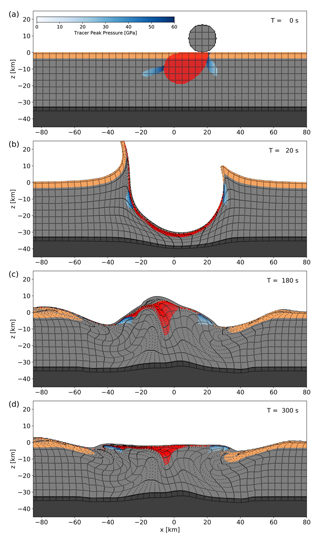
Plotting the Chicxulub Impact Event
The team used computer simulations and geophysical data to recreate the Chicxulub impact event.  The computer simulations permitted the researchers to map the entire crater formation event in unprecedented detail.

Picture credit: Imperial College London/Nature Communications

Lead author of the scientific paper, Professor Gareth Collins of the College’s Department of Earth Science and Engineering stated:

“For the dinosaurs, the worst-case scenario is exactly what happened.  The asteroid strike unleashed an incredible amount of climate-changing gases into the atmosphere, triggering a chain of events that led to the extinction of the dinosaurs.  This was likely worsened by the fact that it struck at one of the deadliest possible angles.”

The Crater Creation

The top layers of rock around the Chicxulub crater in the Yucatan peninsula contain high amounts of water as well as porous carbonate and evaporite material.  When disturbed and greatly heated by the energy of the impact, these rocks would have been vaporised flinging huge amounts of the greenhouse gas carbon dioxide, sulphur and water vapour into the atmosphere.  The sulphur and other particles would have formed aerosols as well as acidifying the atmosphere.  These aerosols would have blocked out sunlight stopping photosynthesis and leading to the collapse of food chains.  The world would have been plunged into a nuclear winter.

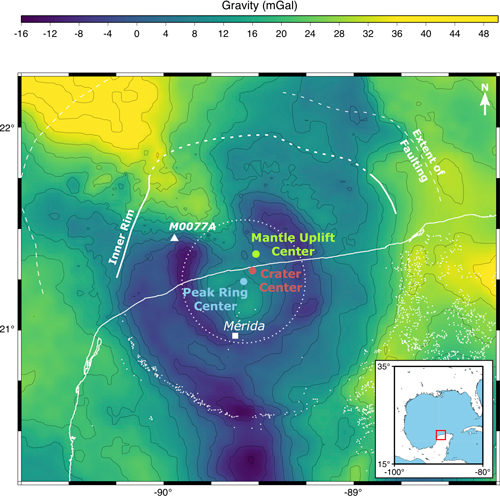
A Geophysical Map of the Impact Crater

Gravity map of the Chicxulub crater.
A geophysical gravity map showing the outline of the Chicxulub crater and its surrounding environment.

Picture credit: Imperial College London/Nature Communications

Studying the Dinosaur Extinction

Working in collaboration with colleagues from the University of Freiburg (Germany) and the University of Texas at Austin the impact event was re-created in extensive detail, which will help scientists to better understand impact craters on our own planet as well as those found elsewhere within the solar system.  Crucial to determining the angle and direction of the impact was the relationship between the centre of the crater, the centre of the peak ring (a circle of mountains made of heavily fractured rock inside the crater rim) and the centre of dense, uplifted mantle rocks.

Co-author of the scientific paper, Dr Auriol Rae (University of Freiburg) added:

“Despite being buried beneath nearly a kilometre of sedimentary rocks, it is remarkable that geophysical data reveals so much about the crater structure, enough to describe the direction and angle of the impact.”

Everything Dinosaur acknowledges the help and assistance of a media release from Imperial College London in the compilation of this article.

The scientific paper: “A steeply-inclined trajectory for the Chicxulub impact” by G. S. Collins, N. Patel, T. M. Davison, A. S. P. Rae, J. V. Morgan, S. P. S. Gulick, IODP-ICDP Expedition 364 Science Party and Third-Party Scientists published in Nature Communications.

Visit the Everything Dinosaur website: Everything Dinosaur.
29 05, 2020

Wightia declivirostris – A Terrific Tapejarid Pterosaur

By |2024-02-21T05:53:02+00:00May 29th, 2020|Categories: Adobe CS5, Dinosaur and Prehistoric Animal News Stories, Dinosaur Fans, Main Page, Palaeontological articles, Photos/Pictures of Fossils|0 Comments

Jawbone Leads to an Isle of Wight Tapejarid Pterosaur

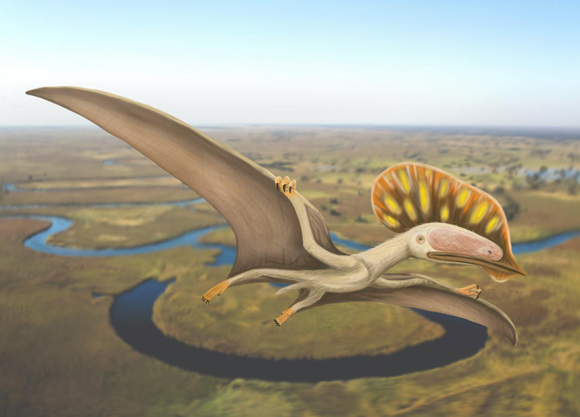
A single, fragmentary jawbone from the upper jaw of a pterosaur found on the Isle of Wight has demonstrated just how diverse and widespread the Tapejaridae family of pterosaurs were.  The fossil bone, a partial premaxilla from the Lower Cretaceous (Barremian) Wessex Formation of Yaverland (Isle of Wight), represents a new species, the first record of a tapejarid pterosaur from the Wessex Formation and one of the oldest examples of this pterosaur family to have been found outside of China.  The flying reptile has been named Wightia declivirostris.

Wightia declivirostris

A Life Reconstruction of Wightia declivirostris (Wessex Formation)

Wightia declivirostris from the Isle of Wight
A life reconstruction of the newly described tapejarid from the Lower Cretaceous of the Isle of Wight (Wightia declivirostris).

Picture credit: Megan Jacobs (University of Portsmouth)

Terrific Toothless Tapejarids

The terrific toothless tapejarids with their reputation for taking head crest development to the extreme, are known from relatively abundant fossil material associated with the Santana and Crato Formations of Brazil.  In addition, several members of the Tapejaridae family are associated with the Jiufotang Formation of China.  However, fragmentary fossils are known from elsewhere in the world such as Spain (Europejara olcadesorum) and a toothless, rather deep lower jaw tip along with other partial bones from the Kem Kem beds of Morocco suggests that these types of flying reptile may have persisted into the early Late Cretaceous.

Two of the authors associated with this scientific paper, Professor David Martill and Roy Smith (both from the University of Portsmouth), recently published a report on the discovery of a north African tapejarid which was named Afrotapejara zouhrii, one of a spate of recent Moroccan pterosaur discoveries.  To read Everything Dinosaur’s article about this: That Fourth Moroccan Pterosaur.  It seems that these fancy-crested, edentulous flying reptiles were much more geographically and temporally diverse than previously thought.

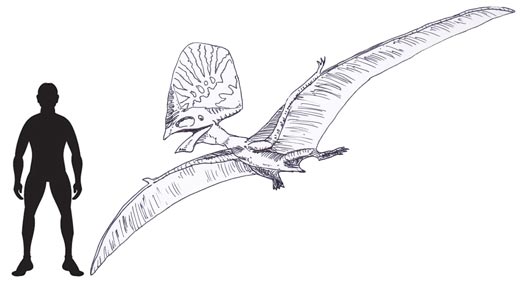
A Typical Illustration of a Tapejarid Pterosaur (Tupandactylus imperator)

Tupandactylus illustration.
A scale drawing of the tapejarid Pterosaur Tupandactylus imperator.  The Tapejaridae are thought to have all sported flamboyant head crests. Picture credit: Everything Dinosaur.

Picture credit: Everything Dinosaur

The Isle of Wight Pterosaur is More Closely Related to Chinese Tapejarids

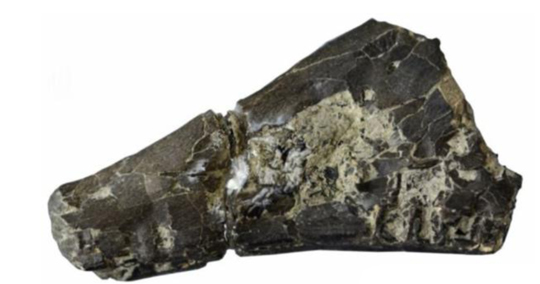
Amateur fossil hunter John Winch discovered a pterosaur snout near the cliff at Yaverland Point in Sandown Bay, in a fossil plant debris layer.  The unusual shape and thin bone walls suggested that it was from a pterosaur.  The fragment of jaw, although eroded, demonstrates the characteristic downturned tip, with numerous tiny holes (foramina), on the occulsal surface which indicate the presence of minute sensory organs for detecting food.

The Holotype Material Wightia declivirostris

premaxilla of Wightia declivirostris.
The isolated, partial premaxilla of Wightia declivirostris.

Picture credit: University of Portsmouth

The jaw fragment was passed to palaeontology student at Portsmouth University, Megan Jacobs, who confirmed it was a rare find and definitely pterosaurian.  Analysis of the specimen suggests that Wightia is more closely related to the older and more primitive tapejarid Sinopterus from Liaoning (Jiufotang Formation), than it is to Brazilian tapejarids.  The genus name of this newly described flying reptile honours the Isle of Wight, whilst the species (trivial) name means “slanting beak”, a reference to the typically tapejarid morphology of the partial premaxilla.

Both the Wealden Formation and the geologically younger Vectis Formation on the Isle of Wight have yielded pterosaur specimens, although they tend to consist of highly fragmentary remains.  The discovery of Wightia declivirostris demonstrates how significant the Lower Cretaceous Isle of Wight sediments are to palaeontologists as they try to plot the radiation of different types of flying reptile during the Early Cretaceous.

The scientific paper: “First tapejarid pterosaur from the Wessex Formation (Wealden Group: Lower Cretaceous, Barremian) of the United Kingdom” by David M. Martill,  Mick Green, Roy E. Smith,  Megan L. Jacobs and John Winch published in the journal Cretaceous Research.

The Everything Dinosaur website: Everything Dinosaur.
24 05, 2020

The Most Dangerous Place and Time in the Cretaceous

By |2024-02-21T05:23:45+00:00May 24th, 2020|Categories: Dinosaur and Prehistoric Animal News Stories, Dinosaur Fans, Geology, Main Page, Palaeontological articles, Photos/Pictures of Fossils|0 Comments

A Comprehensive Guide to the Fossils from the Kem Kem Beds of Eastern Morocco

A team of international researchers have documented the fossil vertebrates associated with the early Late Cretaceous (Cenomanian-Turonian) of the famous Kem Kem beds of eastern Morocco.  They conclude that with the abundance of hypercarnivores such as Spinosaurus, abelisaurids, Carcharodontosaurus and Deltadromeus, several large pterosaurs and a multitude of giant fish and crocodyliforms, no comparable modern terrestrial ecosystem exists with a similar bias toward large-bodied carnivores.

Arguably, the sediments that make up the Kem Kem Group, which is composed of the lower Gara Sbaa and upper Douira formations, represent the most dangerous place and time in the whole of the Cretaceous.

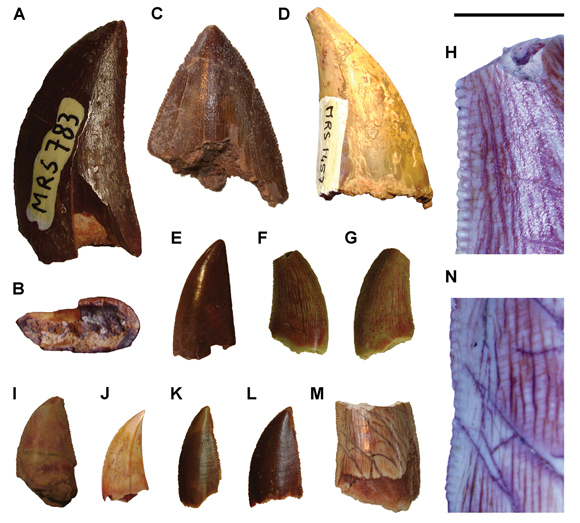
Examples of Theropod Teeth Associated with the Kem Kem Group of Eastern Morocco

Indeterminate theropod teeth from the Kem Kem Group.
Indeterminate theropod teeth from the Kem Kem Group with (H) showing the denticles of (F) and (N) close up view of denticles in (M).  Scale bar equals 2 cm in A-C and I-M whilst 3 cm in D and 5 mm in H and N.

Picture credit: Ibrahim et al (ZooKeys)

An Ambitious Target

The researchers which included Nizar Ibrahim and Paul Sereno (University of Chicago), David Unwin (University of Leicester), Samir Zouhri (Université Hassan II, Casablanca, Morocco) and David Martill (University of Portsmouth), had an ambitious objective.  The scientists set out to document and summarise the taxonomic status of the fauna that had been described based on the major collections of Kem Kem fossils, as well as to report on the geological age of the various strata and to plot the palaeoenvironment of this part of north Africa during the early stages of the Late Cretaceous.

The team’s comprehensive report has been published with free access in the journal ZooKeys.

The Changing Palaeoenvironment Represented by the Kem Kem Group Sediments

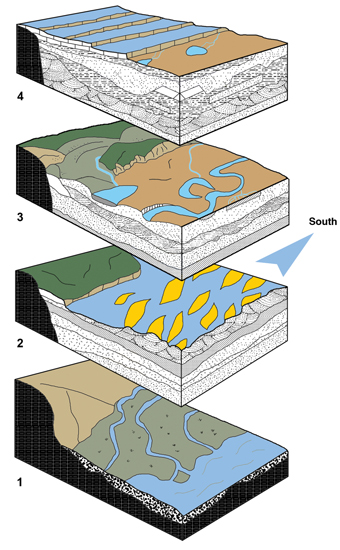
The palaeoenvironment of the Kem Kem Beds.
Schematic paleoenvironmental stages depicting the Kem Kem region during the Cretaceous.  Stages: (1) wide rivers, (2) large river systems with substantial sandbanks, (3) deltaic conditions and (4) rise of the limestone platform.

Picture credit: Ibrahim et al (ZooKeys)

A Very Dangerous Place to Be (Large Crocodyliforms and Pterosaurs)

The strata have provided evidence of large number of crocodyliforms from one-metre-long insectivores, herbivorous forms to giant predators such as Sarcosuchus imperator.  Several different types of pterosaur are also associated with these deposits.  The first pterosaur remains recovered consisted of isolated teeth collected in the late 1940s and early 1950s but at the time their affinity with the Pterosauria was not recognised.  For an article from Everything Dinosaur about recent pterosaur discoveries from Morocco: Pterosaurs, Pterosaurs and Even More Pterosaurs.

Cervical Vertebra (Bone from the Neck) Ascribed to an Azhdarchid Pterosaur

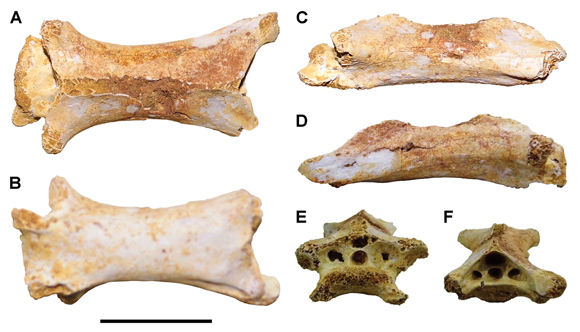
Third cervical? attributed to an azhdarchid pterosaur.
Near complete third cervical? of an azhdarchid pterosaur from the Kem Kem Group.  FSAC-KK 3088 in (A) ventral, (B) dorsal, (C) right lateral, (D) left lateral, (E) anterior and (F) posterior view.  Scale bar equals 5 cm.

Picture credit: Ibrahim et al (ZooKeys)

In addition, the first tapejarid pterosaur from Africa was reported recently (Afrotapejara zouhrii), the trivial name honours Professor Samir Zouhri, one of the authors of the extensive review.  To read an article about Afrotapejara: The Fourth New Moroccan Pterosaur – Afrotapejara.

Lots and Lots of Dinosaurs – A Bias Towards the Theropoda

Dinosaurs are strongly associated with these strata, but there is only very fragmentary evidence of ornithischians including a single, large footprint.  This suggests that bird-hipped dinosaurs were present but, in contrast to most other Cretaceous biotas, they seem very much underrepresented by the fossil material.  Sauropods such as the rebbachisaurid Rebbachisaurus garasbae and titanosaurs are known from both the Douira and Gara Sbaa formations, however, it is theropod specimens that dominate the Dinosauria associated with the Kem Kem Group.  There is evidence to support one medium-sized to large Kem Kem abelisaurid and the discovery of single neck bone (cervical vertebra) indicates a Noasauridae presence.

Huge hypercarnivores such as Carcharodontosaurus saharicus and Spinosaurus aegyptiacus have been reported.  The habitat seemed to have an overabundance of large, carnivorous dinosaurs, although extensive niche partitioning is proposed by several authors.

Perhaps the Most Famous African Dinosaur of them all – Spinosaurus aegyptiacus

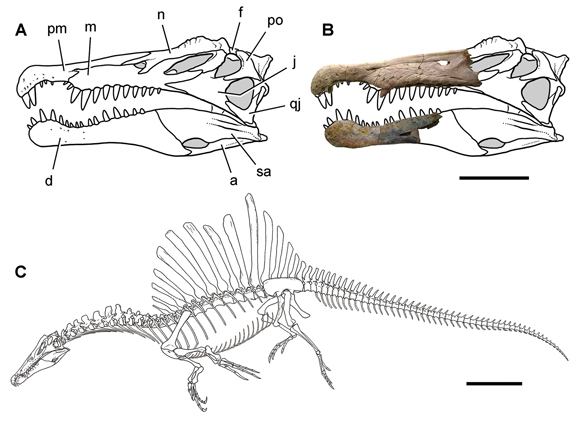
Spinosaurus aegyptiacus skull and skeleton.
Skull and skeletal reconstruction of Spinosaurus aegyptiacus.  Scale bars equal 40 cm in A and B, whilst in C the scale bar is 1 metre.

Picture credit: Ibrahim et al (ZooKeys)

Deltadromeus agilis

One of the most mysterious of all the theropods from Morocco is Deltadromeus agilis.  The taxonomic position of this meat-eater remains controversial.  A partial skeleton (UCRC PV11), was discovered in a coarse sandstone layer in the upper portions of the Gara Sbaa Formation.  The bones were found in association with teeth of the huge sawfish Onchopristis as well as teeth from crocodyliforms.  Fossils associated with D. agilis from eastern Morocco show a resemblance to isolated material recovered from the roughly contemporaneous Bahariya oasis in the Western Desert of Egypt by the German palaeontologist Ernst Stromer.

The Egyptian fossils were assigned to the taxon Bahariasaurus ingens, but the Moroccan and Egyptian material could represent the same genus.  If this is the case, then D. agilis would become a senior synonym of B. ingens.  A single thigh bone from the Bahariya oasis measures 144 cm long.  This suggests that whatever sort of carnivore Deltadromeus/Bahariasaurus was, it was huge.  Some commentators have suggested that based on femur proportions Deltadromeus could have been only slightly shorter (but more lightly built), than Tyrannosaurus rex.

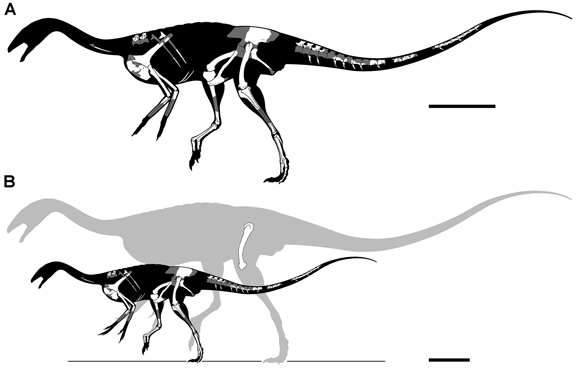
Holotype of D. agilis (A)  and Compared in Size to the Egyptian Femur Specimen (B)

Deltadromeus agilis skeleton reconstruction.
Deltadromeus agilis from Morocco and Egypt.  A (A) revised reconstruction based on UCRC PV11 (B) holotype compared to a large femur (now lost) referred to the genus and species from the Bahariya Formation, Egypt.  Known elements in white.  Scale bars: 1 m.

Picture credit: Ibrahim et al (ZooKeys)

Sadly, like much of Stromer’s material from the Egyptian expeditions, the femur has been lost.

It is very likely that there were lots of smaller predatory dinosaurs too. Dromaeosaurid teeth have been reported from several localities but bones are exceptionally rare and the only positively identified dromaeosaurid skeletal elements are some foot bones found in Sudan and recovered from Cenomanian-age rocks.

A Predominance of Aquatic Predators

The authors state that the Kem Kem assemblage is dominated by aquatic and subaquatic invertebrates and vertebrates, the majority of which are predators. They suggest that as most of the taxa are exploiting aquatic food resources, then like modern marine food chains, the habitat is predator dominated.  As to the overabundance of carnivorous dinosaurs compared to plant-eating ones, the researchers conclude that this is not due to sampling bias or preservation factors.  Large theropods in the food web were supported primarily in the case of Spinosaurus or secondarily in the case of the terrestrial carnivores by the huge amount of aquatic protein sources.

For models of Carcharodontosaurus, Spinosaurus and other theropod dinosaurs: PNSO Age of Dinosaurs Models and Figures.

The dissected deltaic plain and nearshore environments may have enhanced aquatic resources while limiting, or rendering patchy areas of available vegetation for large-bodied dinosaurian herbivores. Hence the bias towards carnivores when it comes to assessing the fossilised remains of dinosaurs from the Kem Kem beds.

The Presence of So Many Carnivores could be Explained by the Abundance of Aquatic Food Sources such as Small Fish

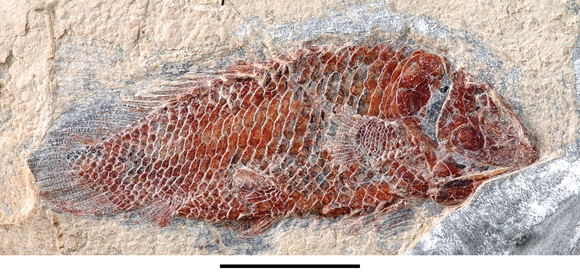
Serenoichthys kemkemensis from the Douira Formation.
Serenoichthys kemkemensis from the Douira Formation.  Scale bar equals 1 cm.  The abundance of predators could be explained by the large amount of aquatic protein sources present in the environment.

Picture credit: Ibrahim et al (ZooKeys)

The scientific paper: “Geology and paleontology of the Upper Cretaceous Kem Kem Group of eastern Morocco” by Nizar Ibrahim, Paul C. Sereno, David J. Varricchio, David M. Martill, Didier B. Dutheil, David M. Unwin, Lahssen Baidder, Hans C. E. Larsson, Samir Zouhri and Abdelhadi Kaoukaya published in ZooKeys.

Visit the Everything Dinosaur website: Everything Dinosaur.
22 05, 2020

13,000 Edmontosaurus an Astonishing Dinosaur Bonebed

By |2024-02-18T13:47:44+00:00May 22nd, 2020|Categories: Adobe CS5, Dinosaur and Prehistoric Animal News Stories, Dinosaur Fans, Geology, Main Page, Palaeontological articles, Photos/Pictures of Fossils|0 Comments

Massive Edmontosaurus Bonebed Provides Data on Dinosaur Decomposition

A team of scientists have produced a study mapping an astonishing dinosaur bonebed that has so far yielded a staggering total of 13,000 individual fossil elements.  In truth, the bonebed contains many more fossils, but individual dinosaur teeth, ossified tendons and other fragmentary elements under five centimetres in length have not been counted.

Edmontosaurus annectens

The site is located in eastern Wyoming and consists almost entirely of the preserved remains of a single type of dinosaur, a hadrosaur (Edmontosaurus annectens).  The bonebed study has not only provided a great deal of information about this duck-billed dinosaur but shed light on how death assemblages consisting of a large number of corpses are formed and how various bones of differing sizes might be transported before final deposition.

Dinosaur Bonebeds such as the Danek Edmontosaurus regalis Bonebed in Edmonton Have Yielded Thousands of Fossil Bones

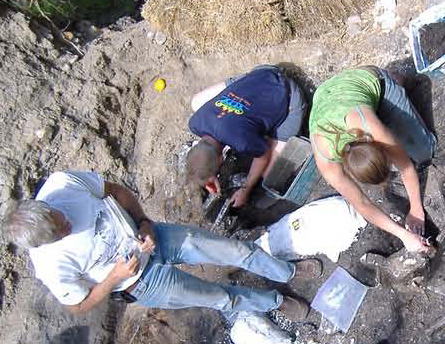
Excavating an Edmontosaurus.
The Danek Edmontosaurus bonebed is typical of an Edmontosaurus-dominated bonebed which are widespread in the Upper Cretaceous (Campanian to Maastrichtian) of western North America).

Picture credit: Victoria Arbour

The Hanson Ranch Bonebed (Lance Formation)

Writing in the on-line, open access journal PLOS One, the scientists which include Keith Synder of the Biology Dept. of the Southern Adventist University, Tennessee, document the taphonomy and depositional history of an extensive E. annectens bonebed known as Hanson Ranch, in the Lance Formation of eastern Wyoming.  The bonebed includes five main quarries and three exploratory quarries.  Approximately 13,000 elements including around 8,400 identifiable bones, have been recovered in 506 square metres of excavated area in twenty years (1996-2016).

Virtually all the fossils are located within a fine-grained (claystone to siltstone) bed that has a maximum depth of two metres.

Mapping the Stratigraphy of the Main Bonebeds at the Hanson Research Station (Wyoming)

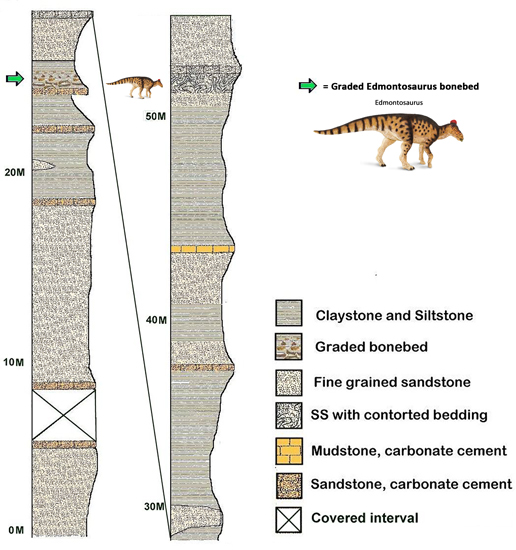
The Stratigraphy of the Hanson Research station.
Local stratigraphy associated with the main bonebeds at the Hanson Research station.  The green arrow indicates position of main bonebed.

Picture credit: Synder et al (PLOS One) with additional annotation by Everything Dinosaur

Edmontosaurus annectens Fossils in an Excellent State of Preservation

Almost all the fossils recovered from the site exhibit exquisite preservation with little or no abrasion, breakages or signs of weathering prior to deposition.  All the material is disarticulated and scattered although over a relatively confined area.  This evidence in conjunction with analysis of the sediments associated with the fossils indicates that the bones were moved and buried after a period of initial decay and decomposition of the Edmontosaurus carcasses.

Mapping the Distribution of Fossil Bones in a Bonebed

A map showing the distribution of fossil material in an Edmontosaurus bonebed.
A map showing typical disarticulated fossil bone distribution in a bonebed.

Picture credit: Synder et al (PLOS One)

Gaining a Better Understanding of Edmontosaurus Biostratigraphy

The thousands of fossil bones represent mainly adult or sub-adult specimens.  Due to the huge number of fossils associated with the Hanson Research site, the scientists have been able to gain a deeper understanding of Edmontosaurus biostratigraphy including how elements from the skeleton can be transported over distances prior to deposition.  The most abundant fossil bones are ischia, pubes, scapulae, ribs and limb bones.  In contrast, vertebrae, ilia and chevrons are rare.

Explaining the Composition of the Bonebed

When it comes to cranial material lower jaw bones (dentaries), nasals, quadrates and jugals are prevalent whilst premaxillae (upper jaw bones), predentaries and bones associated with the braincase are seldom found.  The researchers suggest that following decay and break-up of the carcase, water action sorted and removed the articulated sections such as the backbone and the smaller bones such as the digits and toes, before, or at the same time, the remaining material was swept up in a subaqueous debris flow that created the final deposit.

The scientists suggest that similar processes may have been at work that created the other hadrosaurid-dominated Upper Cretaceous bonebeds associated with such geological formations as Hell Creek, Two Medicine, Horseshoe Canyon, Prince Creek as well as the Lance Formations of western North America.  It is noted that there is a remarkably similar skeletal composition among the fossil bonebeds studied.  It is also noted that there is a significant correlation between the hadrosaurid bonebeds and fluvial assemblages representing thanatocoenosis* events seen with modern-day vertebrate death assemblages.

Thanatocoenosis* Explained

Thanatocoenosis refers to a site where a collection of fossils representing a variety of organisms are found together.  Such sites are often referred to as death assemblages.  The organisms represented at the location may not have been associated in life, but their remains have been transported and deposited together thus forming a fossil bed composed of an extensive amount of fossilised material.

Not All of the Dinosaur Fossils are Edmontosaurus

The bonebed can be described as monodominant as the vast majority of the fossil material found can be assigned to just one species Edmontosaurus annectens.  Non-dinosaurian terrestrial taxa identified include mammals and squamates along with the remains of many aquatic creatures such as crocodiles, turtles, gar and other fishes and numerous molluscs.  Some other types of plant-eating dinosaur are represented notably, ceratopsids, pachycephalosaurs, nodosaurs and members of the family Thescelosauridae.  Numerous shed theropod teeth are also associated with this location.

Everything Dinosaur will post up a separate article detailing one rather special theropod fossil associated with a quarry close to the Hanson Research station in the near future.

A Life Reconstruction of the Hadrosaurid Edmontosaurus

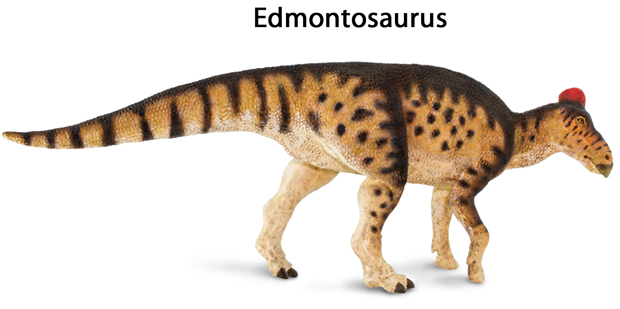
Wild Safari Prehistoric World Emontosaurus model.
The new for 2020 Wild Safari Prehistoric World Edmontosaurus dinosaur model.

The picture (above) highlights the 2020 Wild Safari Prehistoric World Edmontosaurus dinosaur model.

To view this range: Wild Safari Prehistoric World Models.

The scientific paper: “Over 13,000 elements from a single bonebed help elucidate disarticulation and transport of an Edmontosaurus thanatocoenosis” by Keith Snyder, Matthew McLain, Jared Wood and Arthur Chadwick published in PLOS One.

Visit the Everything Dinosaur website: Everything Dinosaur.
21 05, 2020

Scientists Discover New Giant Megaraptor

By |2024-02-20T20:56:11+00:00May 21st, 2020|Categories: Adobe CS5, Dinosaur and Prehistoric Animal News Stories, Dinosaur Fans, Main Page, Photos/Pictures of Fossils|0 Comments

Ten-metre-long Giant from Patagonia

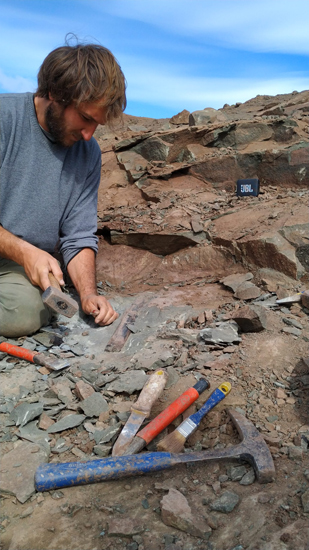
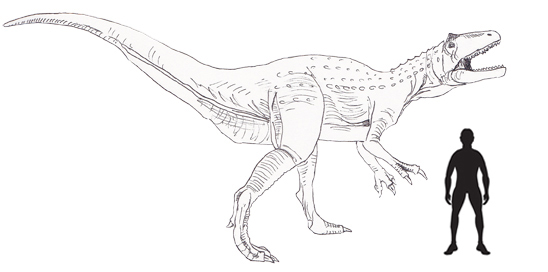
A team of international scientists led by Dr Fernando Novas of the Museo Argentino de Ciencias Naturales (Buenos Aires, Argentina), have been exploring the Upper Cretaceous, fossil rich beds at Estancia La Anita in the Province of Santa Cruz, Patagonia.  In a media release, circulated this week, the researchers from the Museo de Ciencias Naturales report the discovery of the fossilised remains of a giant megaraptorid dinosaur.  At an estimated ten metres in length, it potentially represents the largest confirmed member of the Megaraptora clade discovered to date.

A Field Team Member Carefully Removing Overburden Close to a Fossil Bone

Excavating the remains of a megaptor.
A field team member works close to a fossil bone.

Picture credit: Museo Argentino de Ciencias Naturales

Upper Cretaceous Sediments

The research team, which includes scientists from a number of Argentinian universities as well as colleagues from the National Museum of Tokyo (Japan), have spent much of the early part of the Southern Hemisphere autumn, working in the remote and mountainous Estancia La Anita which is some 1,750 miles (2,800 km), south of Buenos Aires.  Many different vertebrate fossils were found, including those of the basal iguanodontid Isasicursor.  The palaeontologists speculate that rather than attack the titanosaurs that lived in this region during the Late Cretaceous, megaraptors may have specialised in catching smaller, more agile prey such as the five-metre-long Isasicursor.

Members of the Megaraptora were quite lightly-built, long-armed carnivores.  Very little is known about these dinosaurs, although they do seem to have been both geographically and temporally widely dispersed.  They were not closely related to the dromaeosaurids, a family of dinosaurs that includes the “raptors” such as Velociraptor.

A Speculative Life Reconstruction of the Giant Megaraptor from Argentina

Scale drawing of giant megaraptor from Argentina.
A speculative life reconstruction of the giant megaraptor from Patagonia. Picture credit: Everything Dinosaur.

Picture credit: Everything Dinosaur

Everything Dinosaur’s website: Everything Dinosaur.

Elements from the rib cage and vertebrae have been found, but sadly no skull material has been reported.  It is likely that a new genus will be erected as a result of these discoveries, the scientific paper is likely to be published next year.

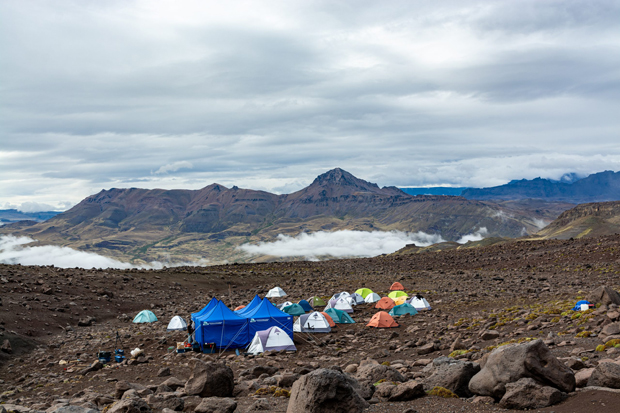
The Field Team’s Campsite at the Remote Location

Remote Patagonian fossil dig.
The remote campsite at Estancia La Anita in Patagonia.

Picture credit: Museo Argentino de Ciencias Naturales

One of the Last of its Kind

The fossils represent the youngest material discovered to date that have been assigned to the Megaraptora.  It is therefore quite likely that these types of theropod persisted until the extinction of the non-avian dinosaurs.  Fernando Novas has been instrumental in the development of our understanding of this type of carnivorous dinosaur.  It was Dr Novas who co-authored the review of theropod dinosaurs from Argentina in 2013, that led to the establishment of the Megaraptor clade.

To read a related article from Everything Dinosaur that looks at the ancient biota from this part of the Late Cretaceous of Argentina: Dinosaurs from the End of the World.

Recently Haolonggood introduced a megaraptor dinosaur model.

To view the Haolonggood model range: Haolonggoodd Prehistoric Animal Models.

20 05, 2020

The First Elaphrosaurine Theropod Reported from Australia

By |2024-02-20T20:45:27+00:00May 20th, 2020|Categories: Adobe CS5, Dinosaur and Prehistoric Animal News Stories, Dinosaur Fans, Main Page, Palaeontological articles, Photos/Pictures of Fossils|0 Comments

Curious Cervical Leads to Startling Conclusion

Think of a theropod dinosaur and a ferocious carnivore with a large head and big teeth probably comes to mind.  However, the Theropoda is an extremely diverse clade within the Dinosauria, not all of them were big, particularly ferocious or even had teeth.   One group the elaphrosaurines, were very bizarre indeed and the discovery of a single neck bone in Victoria has led to the conclusion that these strange, light-weight dinosaurs distantly related to Carnotaurus, roamed Australia in the Early Cretaceous.

A Life Reconstruction of the Australian Elaphrosaurine

Life reconstruction of the elaphrosaur from Victoria.
A life reconstruction of the first elaphrosaur from Australia.

Picture credit: Ruairdh Duncan (Swinburne University of Technology, Victoria)

From the Lower Cretaceous of Australia

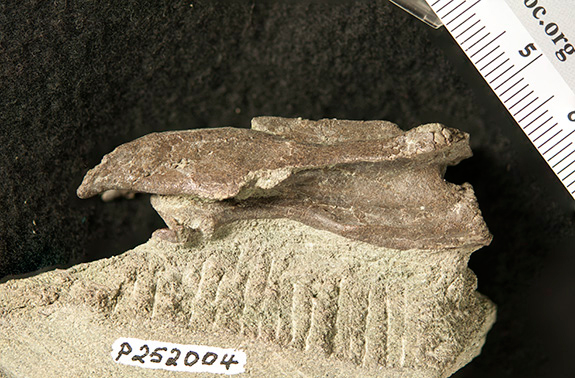
Volunteer Jessica Parker discovered a 5-centimetre-long bone whilst helping out at the annual Dinosaur Dreaming excavation near Cape Otway, Victoria (2015).  The sediments at the site, known as Eric the Red West, date from the late Albian faunal stage of the Lower Cretaceous and are part of the Eumeralla Formation.  At first, the bone identified as a cervical vertebra (neck bone), was thought to have come from a pterosaur.

Intriguingly for Swinburne University palaeontologist Dr Stephen Poropat and PhD student Adele Pentland, once the fossil specimen had been prepared it became clear that this was not a bone from the middle portion of the neck of a flying reptile.

Dr Poropat explained:

“Pterosaur neck vertebrae are very distinctive.  In all known pterosaurs, the body of the vertebra has a socket at the head end, and a ball or condyle at the body end.  This vertebra had sockets at both ends, so it could not have been from a pterosaur.”

The Cervical Vertebra – Evidence of Australia’s First Elaphrosaur

The cervical vertebra (elaphrosaur0.
The five-centimetre-long bone identified as a middle cervical from an elaphrosaur.

Picture credit: Dr Stephen Poropat

Geologically Much Younger Than Most Elaphrosaurines

The taxonomic affinity of the subfamily Elaphrosaurinae within the Theropoda remains controversial.  A number of authors have placed this little-known group, characterised by their small, light, graceful bodies, tiny heads, long necks and reduced forelimbs within the Noasauridae family, which means that they are distantly related to abelisaurids such as Ekrixinatosaurus, Majungasaurus and Carnotaurus.

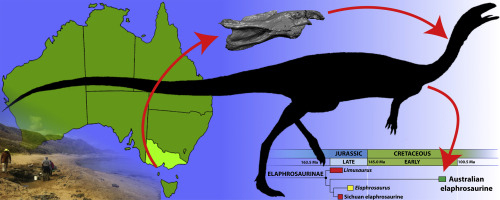
Most elaphrosaurs are known from the Late Jurassic, but this new elaphrosaur from Australia, lived some forty million years later. Only Huinculsaurus (H. montesi), from the Cenomanian/Turonian (early Late Cretaceous), of Argentina is geologically younger, than the Australian fossil remains.

The Fossil Find Location, Typical Elaphrosaurine Body Plan and Placing the Fossil Find in a Chronological Context

Elaphosaur timeline and typical body plan.
A silhouette of the elaphrosaur with a map showing fossil location and a timeline showing elaphrosaurine chronology.  The newly described elaphrosaurine from Victoria is geologically the second youngest member of this group known.

Picture credit: Poropat et al (Gondwana Research)

A Dinosaur of the Polar Region

The discovery of this single, fossilised neckbone adds support to the idea that the elaphrosaurines were geographically and temporally much more widespread than previously thought.  The similarity of these dinosaurs to the much better-known ornithomimosaur theropods (bird mimics), could help to explain why few other Cretaceous elaphrosaur specimens have come to light. Fossil material may have been found but misidentified as representing ornithomimids.

As the Cape Otway location would have been situated much further south during the Early Cretaceous (110-107 million years ago), at around a latitude of 76 degrees south, this implies that elaphrosaurines were capable of tolerating near-polar palaeoenvironments.

Elaphrosaurines were Related to Noasaurids

Recently, Everything Dinosaur wrote a post about the discovery of noasaurid from an opal mine close to Lightning Ridge (New South Wales).  Noasaurids and elaphrosaurines were related, most scientists classifying them as different branches within the Abelisauroidea.  Coincidentally, the New South Wales noasaurid was identified from a single cervical vertebra too.  Both it and the Cape Otway elaphrosaurine dinosaur have not been assigned to any genus, but both fossils are likely to represent new species.

To read Everything Dinosaur’s article about the recently discovered noasaurid from New South Wales: Noasaurids from Australia.

The scientific paper: “First elaphrosaurine theropod dinosaur (Ceratosauria: Noasauridae) from Australia — A cervical vertebra from the Early Cretaceous of Victoria” by Stephen F. Poropat, Adele H. Pentland, Ruairidh J. Duncan, Joseph J. Bevitt, Patricia Vickers-Rich and Thomas H. Rich published in Gondwana Research.

For models and replicas of dinosaurs and other prehistoric animals: Dinosaur and Prehistoric Animal Models.

The Everything Dinosaur website: The Everything Dinosaur Website.

9 05, 2020

Reconstructing a Late Cretaceous Ecosystem

By |2024-02-19T09:17:37+00:00May 9th, 2020|Categories: Dinosaur and Prehistoric Animal News Stories, Dinosaur Fans, Main Page|0 Comments

Reconstructing a Dinosaur Dominated Ecosystem

A team of international researchers including scientists from the Royal Ontario Museum (Toronto, Canada), have provided a new perspective on the palaeoenvironment of western North America during the Late Cretaceous.  An extensive study mapping stable isotopes identified in fossilised teeth has provided the research team with detailed information on how some dinosaurs co-existed in a floodplain environment on the landmass of Laramidia around 75 million years ago.

Many Different Types of Dinosaur are Associated with the Late Cretaceous of Laramidia

Dinosaur dominated ecosystem of Laramidia.
A large variety of different types of dinosaur co-existed on Laramidia.  Ornithischian dinosaurs such as ankylosaurs, ceratopsians, hadrosaurs as well as saurischian dinosaurs such as dromaeosaurs, ornithomimids and tyrannosaurs.  They shared their tropical environment with turtles and numerous types of crocodilian. Scientists reconstruct a Late Cretaceous ecosystem.

Picture credit: Danielle Dufault (Royal Ontario Museum)

Niche Partitioning in the Dinosauria

Palaeontologists had puzzled over how so many different types of large tetrapod could co-exist together and it had been thought that extensive niche partitioning between species must have been taking place.  Niche partitioning describes the natural selection process whereby different species reduce competition amongst themselves by becoming more specialised and adopting specific roles within an ecosystem.  They become adapted to a particular niche and by doing this competition between species is reduced.

Niche Partitioning Between Ceratopsids and Hadrosaurids

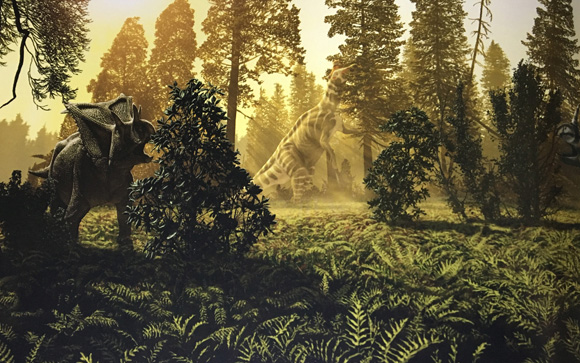
The fauna and flora of Alberta 75 million years ago
Alberta around 75 million years ago (Dinosaur Park Formation).  This part of the western North American landmass (Laramidia), was home to a large number of different types of dinosaur including a number of ceratopsians and duck-billed dinosaurs.  It had been suggested that niche partitioning permitted these mega-herbivores to co-exist with each type of plant-eating dinosaur specialising on feeding upon different types of vegetation.

Picture credit: Julius Csotonyi

Stable Isotope Analysis Used to Reconstruct a Late Cretaceous Ecosystem

Researchers from the Royal Ontario Museum in collaboration with colleagues from the Field Museum in Chicago (USA), compared the compositions of stable isotopes identified in the fossilised teeth of different dinosaur taxa.  Stable isotopes are naturally occurring varieties of chemical elements such as oxygen and carbon that don’t alter and change into other elements over time. When water and food is consumed the stable isotopes of the elements that make up these resources (for example, nitrogen, carbon and oxygen), are passed on to the animal’s tissues including their teeth enamel.

Lead author of the research paper, published by the Geological Society of America, Dr Thomas Cullen (University of Toronto/Royal Ontario Museum), stated:

“Differences in the sources of water and types of food being consumed, as well as the physiology of the animal itself and the habitats they live in, will all result in small differences in the relative amounts of the stable isotopes of a given element, for example, carbon-13 versus carbon-12, present in their body tissues.  Measuring the ratios of the different isotopes of elements such as carbon or oxygen in tissues like tooth enamel gives us a unique window into the diet and habitat of an animal which has been extinct for millions of years.”

One of the Largest Studies of its Type Conducted

This research is one of the largest studies of its kind conducted on a dinosaur dominated ecosystem.  Over 350 isotopic measurements from 17 different taxa from fossils representing the Campanian fauna of Alberta.  Uniquely, this ancient data set was then compared and contrasted with measurements from 16 living species sampled from a modern coastal wetland in Louisiana, which closely resembles the climate conditions with northern Laramidia during the Late Cretaceous.

One of the co-authors of the study, Dr David Evans (Royal Ontario Museum), commented:

“Most of the time when these types of studies are done, the size of the dataset is much smaller and doesn’t take into consideration how dinosaur ecosystems compared to modern ones.  Louisiana was the perfect place to use as a comparison with the dinosaur communities we studied.  The environmental conditions were probably quite similar, and a number of the animals there probably had similar lifestyles to those found in dinosaur ecosystems.  That gives us a great deal of control when exploring our data.”

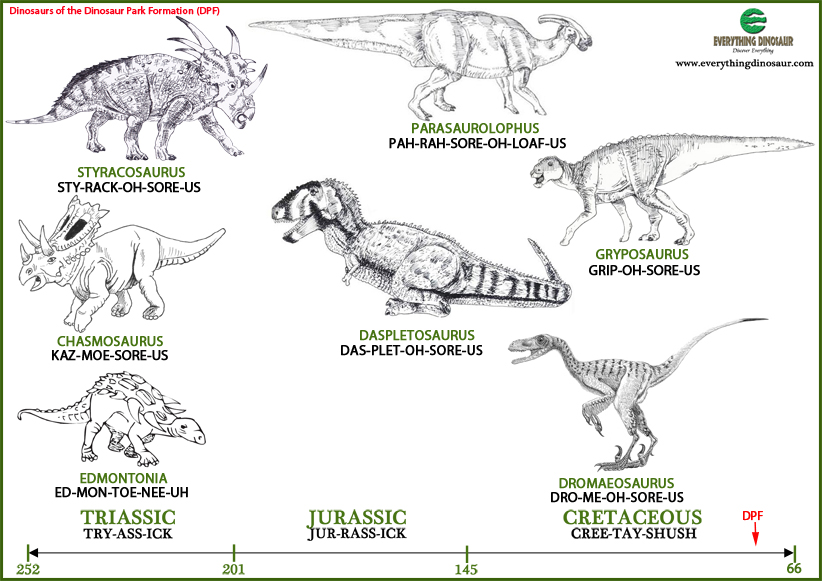
Typical Dinosaur Biota from the Campanian Faunal Stage of Northern Laramidia

Dinosaur Park Formation dinosaurs.
Typical dinosaur fauna of the Dinosaur Park Formation (Alberta, Canada).  A typical dinosaur dominated fauna associated with the study. Picture credit: Everything Dinosaur.

Picture credit: Everything Dinosaur

For models and replicas of Late Cretaceous dinosaurs and other prehistoric creatures: PNSO Age of Dinosaurs Models and Figures.

Challenging Existing Theories

The team’s results challenge existing theories about niche partitioning and habitat exploitation.  For example, it had been suggested that the horned dinosaurs tended to congregate in coastal areas, whereas hadrosaurids preferred inland habitats.  The stable carbon and oxygen isotope ranges for these large herbivores were found to strongly overlap, providing direct evidence against different types of mega-herbivore segregating.

Large herbivores did not appear to be separating across different habitats.  The researchers conclude that these animals may have been doing something different to avoid interspecific competition.  Perhaps herds of horned dinosaurs moved around the region in a different pattern compared to the herds of duck-billed dinosaurs.  In this way, they may have avoided being in the same part of the habitat at the same time, or perhaps they were feeding on different parts of the same plants.

With the high levels of carbon dioxide in the atmosphere, the high average temperatures of 16-20 degrees Celsius and the extended daylength at certain times of the year due to the high latitude, competition for food might have been somewhat less intense than it is in modern ecosystems.

Extensive Vertebrate Fossil Deposits Have Helped to Inform Scientists About Ancient Ecosystems

Excavating an Edmontosaurus.
Extensive bonebeds and other fossil deposits have helped to inform scientists about the ancient ecosystem.

Picture credit: Victoria Arbour

Results Helping to Understand the Implications of Global Warming

The isotope analysis enabled the scientists to accurately estimate the climate in this northern Laramidian palaeoenvironment.  By using an approach that combined average oxygen isotope compositions from the sampled species, new estimates of mean annual temperatures for the region could be made.  The team found that 75-million years ago, this area of southern Alberta to northern Montana had a mean annual temperature of about 16-20 °Celsius, a stark contrast to the current range of about 5-7 °Celsius that is experienced today.

Dr Cullen explained:

“Dinosaurs lived in a weird world: broad-leafed and flowering plants were much less common, it was warm enough in high latitudes to support crocodilians, CO2 in the atmosphere was higher than it is today, and there was little to no ice at the poles.  It’s not like anything we as humans have any direct experience with, but it may be the direction we are headed, so it’s critical that we understand how ecosystems and environments function under those sorts of conditions so we can better prepare ourselves for the future.”

Gaining a Better Understanding of a Late Cretaceous Ecosystem

The scientists conclude that that this approach is a simple and effective method that enables accurate palaeoenvironmental reconstruction.  These results indicate that dinosaur niche partitioning was much more complex than previously thought.  This study can provide a framework for future research on dinosaur-dominated Mesozoic floodplain communities.

The scientific paper: “Large-scale stable isotope characterization of a Late Cretaceous dinosaur-dominated ecosystem” by T.M. Cullen, F.J. Longstaffe, U.G. Wortmann, L. Huang, F. Fanti, M.B. Goodwin, M.J. Ryan and D.C. Evans published by the Geological Society of America.

The Everything Dinosaur website: Everything Dinosaur.
6 05, 2020

“Raptors” Did Not Hunt in Packs According to New Study

By |2024-02-18T14:12:58+00:00May 6th, 2020|Categories: Adobe CS5, Dinosaur and Prehistoric Animal News Stories, Dinosaur Fans, Main Page|3 Comments

New Study Challenges Dromaeosaurids Hunting in Packs

The “Jurassic Park/Jurassic World” movie franchise certainly spawned new generations of dinosaur fans.  It could be argued that these extremely successful films, may have influenced the career choices of would-be scientists.  All very well and good, but one of the problems associated with the films and with the original book “Jurassic Park” written by Michael Crichton, concerns the “raptors”, those fast running, social pack hunters the size of Deinonychus but in this franchise referred to as Velociraptors.

Popular media has depicted these “raptors” as highly social, intelligent animals capable of working together to attack and bring down prey, but what scientific evidence is there to back-up the on-screen abilities of these dinosaurs?

Studying Isotopes in Dinosaur Teeth

Since it is very rare for the fossil record to preserve behaviour, scientists have had to employ some ingenious lines of research in order to gain an insight into the behaviour of dinosaurs.  For example, researchers from the University of Wisconsin, the University of Oklahoma and the Sam Noble Museum (Oklahoma), set about analysing differences in stable carbon isotopes within Deinonychus teeth.  Differences in the composition of these stable isotopes in teeth from young dinosaurs when compared to the isotopes found in the teeth of adults, would indicate a different diet.

If the adults had a different diet compared to the younger animals then this would contradict the idea of these dinosaurs being social and hunting in packs.

They conclude that Deinonychus probably did not hunt in a co-operative, co-ordinated manner.  These “raptors” were probably not complex, social hunters.

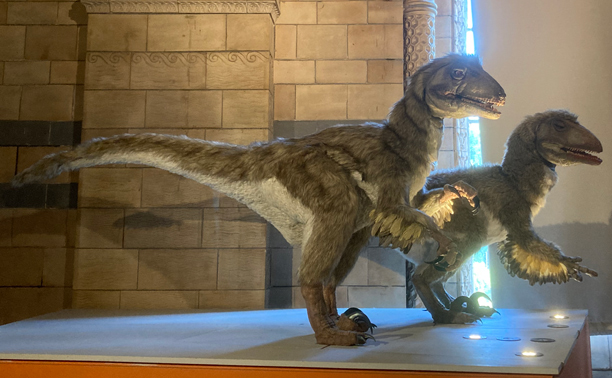
Life-size Deinonychus Replicas on Display

Life-size Deinonychus replicas on display.
Life-size Deinonychus replicas on display at the London Natural History Museum. Picture credit: Everything Dinosaur.

Picture credit: Everything Dinosaur

Laying a Ghost – Highly Intelligent, Pack Hunting “Raptors”

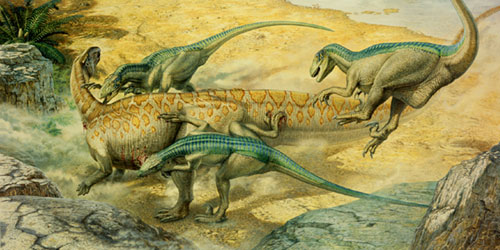
The idea of pack hunting in dromaeosaurids pre-dates “Jurassic Park”, it was first proposed to explain the co-occurrence of Deinonychus (D. antirrhopus) and the iguanodontian Tenontosaurus (T. tilletti).  Around a fifth of all Tenontosaurus remains are found in association with D. antirrhopus.  It has been proposed that Deinonychus hunted the larger Tenontosaurus and as numerous fossil specimens of Deinonychus have been found with Tenontosaurus remains it was suggested that this was evidence of pack hunting behaviour amongst members of the Dromaeosauridae.

A Pack of “Raptors” (Deinonychus) Attack a Tenontosaurus

Deinonychus attacking Tenontosaurus.
A pack of Deinonychus attacking the herbivore Tenontosaurus.  Pack hunting behaviour inferred from fossil evidence.

Picture credit: John Sibbick

Dromaeosaurs Probably Not Pack Hunters

The depiction of dromaeosaurs as pack hunters is problematic as sophisticated hunting strategies are rarely observed in living archosaurs such as crocodiles and birds.   Palaeontologists have considered that perhaps Deinonychus was more analogous to extant reptilian predators such as the Komodo dragon (V. komodoensis), where there seems to be no co-ordinated attack strategy, instead an attack by an individual may instigate mobbing behaviour which would bring down the prey.

Lead author of the study, published in Palaeogeography, Palaeoclimatology, Palaeoecology, Dr Joseph Frederickson (University of Wisconsin), explained:

“The evidence for this behaviour [pack hunting], however, is not altogether convincing.  Since we can’t watch these dinosaurs hunt in person, we must use indirect methods to determine their behaviour in life.  Though widely accepted, evidence for the pack-hunting dinosaur proposed by Yale University palaeontologist John Ostrom is relatively weak.  The problem with this idea is that living dinosaurs (birds) and their relatives (crocodilians) do not usually hunt in groups and rarely ever hunt prey larger than themselves.  Further, behaviour like pack hunting does not fossilise so we can’t directly test whether the animals actually worked together to hunt prey.”

Social Pack Hunters versus Mob Hunters

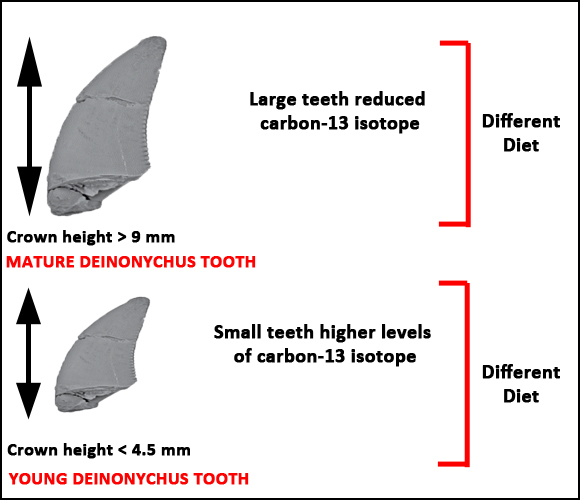
In order to test the likelihood of Deinonychus being a social pack hunter or whether these dinosaurs simply mobbed victims in an uncoordinated manner, the researchers looked at evidence for dietary changes preserved in the stable carbon isotopes found in fossilised Deinonychus teeth of various sizes.  The team analysed tooth carbonate from teeth less than 4.5 mm tall (crown height less than 4.5 mm) and compared the carbon isotopes found to those from much larger teeth (crown height greater than 9 mm). 

The smallest teeth studied were the relatively most enriched with carbon-13 isotope, whilst the largest teeth used in the study had depleted levels.  These results suggest that juvenile Deinonychus consumed different prey than older members of this species.

Analysis of Stable Isotope Carbon-13 in the Teeth of Deinonychus Sheds Doubt on the Social Hunter Hypothesis

Isotope analysis of dinosaur teeth.
Deinonychus teeth – carbon-13 isotope analysis.  Tooth samples collected from the Lower Cretaceous Cloverly (Montana) and Antlers (Oklahoma) formations when analysed for carbon-13 levels suggest a dietary shift as Deinonychus matured.  This challenges the social, pack hunter hypothesis. Picture credit: Everything Dinosaur.

Picture credit: Everything Dinosaur

Testing the Teeth of Other Prehistoric Animals as Well as Deinonychus

Teeth from goniopholidid crocodilians as well as the teeth of Tenontosaurus tilletti were also tested.  The crocodilian results mirrored those found for Deinonychus.  If goniopholidid had the same behaviours of extant crocodilians then, just like their modern counterparts, these reptiles went through a distinct dietary transition as they grew.  If the teeth of Deinonychus show very similar results to the crocodilians, then, the implication is that just like crocodiles today, this “raptor” was probably not a complex social hunter it is unlikely that its hunting behaviour was comparable to the pack hunting behaviour of wolves or lions.

Still, the prospect of being mobbed by a gang of agile, three-metre-long, predatory dinosaurs remains unappealing.

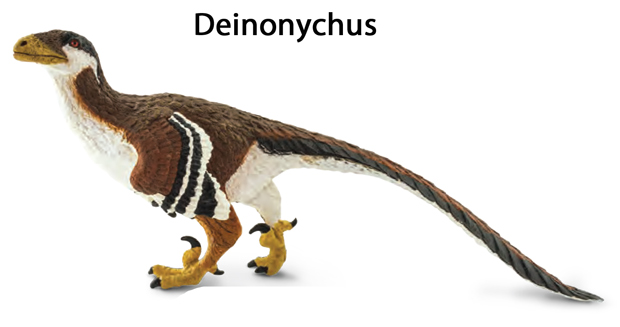
A Model of a Deinonychus Dinosaur (D. antirrhopus)

The new for 2020 the Wild Safari Prehistoric World Deinonychus dinosaur model.
New for 2020 the Wild Safari Prehistoric World Deinonychus dinosaur model.  Evidence suggests that Deinonychus was not a social, sophisticated pack hunter.

The picture (above) depicts the recently introduced Wild Safari Prehistoric World Deinonychus model.

To view this model range: Wild Safari Prehistoric World Figures and Models.

The scientific paper: “Ontogenetic dietary shifts in Deinonychus antirrhopus (Theropoda; Dromaeosauridae): Insights into the ecology and social behavior of raptorial dinosaurs through stable isotope analysis” by J.A. Frederickson, M. H. Engel, R.L. Cifelli published in Palaeogeography, Palaeoclimatology, Palaeoecology.

The Everything Dinosaur website: Everything Dinosaur.
Go to Top