All about dinosaurs, fossils and prehistoric animals by Everything Dinosaur team members.

Fossil finds, new dinosaur discoveries, news and views from the world of palaeontology and other Earth sciences.

23 06, 2022

The New “Jurassic World Dominion” is Reviewed

By |2025-01-06T21:50:49+00:00June 23rd, 2022|Categories: Dinosaur and Prehistoric Animal News Stories, Dinosaur Fans, Main Page, Movie Reviews and Movie News, Photos|0 Comments

“Jurassic World Dominion” was released in UK cinemas on June 10th (2022), Everything Dinosaur team members were able to take time away from their busy schedule to watch the film yesterday (June 22nd). The film reunites many of the characters from the original “Jurassic Park” movie and there are several new prehistoric animals, recreated by a combination of animatronics and computer-generated images (CGI).

The film’s release had been delayed due to the global pandemic, but dinosaur aficionados and fans of the earlier movies have had the chance to see, what has been billed as the final instalment of the franchise.

The Tyrannosaurus rex icon from "Jurassic World Dominion"

Ultimately, T. rex is the star of the latest instalment in the “Jurassic Park/Jurassic World” franchise despite the appearance of numerous theropods including for the first time, Therizinosaurus and Giganotosaurus. Picture credit: Universal Studios.

Picture credit: Universal Studios

Pyroraptor, Giganotosaurus, Quetzalcoatlus and Therizinosaurus

Lots of new prehistoric animals are featured, dinosaurs such as Giganotosaurus, Dreadnoughtus, Therizinosaurus, Atrociraptor and Pyroraptor. Some of these dinosaurs have been given feathers, perhaps a nod to criticisms of the integuments of the “raptors” seen in early incarnations of the franchise.

Jurassic World Dominion Pyroraptor

The feathered Pyroraptor from film “Jurassic World Dominion”. Picture credit: Universal Studios.

Picture credit: Universal Studios

Without giving away too many spoilers, the giant pterosaur Quetzalcoatlus and the sail-finned synapsid Dimetrodon also appear.

The film has garnered mix reviews from the critics, but movie-goes have been more generous with their praise. The film is currently showing a rating of 77% on the Rotten Tomatoes website. “Jurassic World Dominion” has certainly done very well at the box office. Earlier this week, global ticket sales passed the $600 million USD mark.

Paying Tribute to Earlier Films

“Jurassic World Dominion” might be a bit of chimera of a movie (reminiscent of the prehistoric animals with their genomes sourced from a variety of creatures). There are scenes that parody James Bond, Indiana Jones and “Taken” and whilst regarded by many as a “light, enjoyable romp”, fans of the franchise will have noted the numerous tributes paid to earlier films in this series.

Our particular favourite was when the character Ellie Sattler, played by Laura Dern, takes off her sunglasses in astonishment at what she is seeing, reflecting a similar scene from “Jurassic Park” that marks the first time the scientists see a dinosaur.

Is the Film Franchise Extinct?

With a running time of 2 hours and 27 minutes, this is the longest film in the “Jurassic Park/Jurassic World” franchise. Despite being billed as the final instalment and supposed to bring closure, team members at Everything Dinosaur suspect that, with it having made four times its estimated budget in ticket sales thus far, the commercial appeal of dinosaurs might result in a resurrection.

Just like the avian dinosaurs, this film franchise might not be extinct…

Three days since a Tyrannosaurus rex attack.

A site safety notice at our local cinema spotted at the entrance as team members went to see “Jurassic World Dominion”. Picture credit: Everything Dinosaur.

Picture credit: Everything Dinosaur

Team members who saw the film were amused by the “T. rex” signage.

Visit the award-winning Everything Dinosaur website: Dinosaur Toys.

22 06, 2022

A Fossil Emblem for New Zealand?

By |2025-01-06T21:39:37+00:00June 22nd, 2022|Categories: Adobe CS5, Dinosaur and Prehistoric Animal News Stories, Dinosaur Fans, Main Page, Palaeontological articles, Photos/Pictures of Fossils|0 Comments

Palaeontologists in New Zealand have started a consultation process in a bid to appoint a fossil emblem for New Zealand. Everything Dinosaur has come across media reports that palaeontologists at the University of Otago (South Island, New Zealand), are beginning a project to identify a fossil emblem for the country. Once a shortlist of candidate fossils has been compiled, the winner will be decided by a public vote.

Many Australian states, have fossil emblems, for example, back in January (2022), team members at Everything Dinosaur covered the announcement that the giant amphibian Koolasuchus (K. cleelandi) had been appointed the fossil emblem of Victoria. Now it seems that New Zealand wants to have a fossil emblem too.

To read the Koolasuchus story: Koolasuchus Becomes the State Fossil of Victoria.

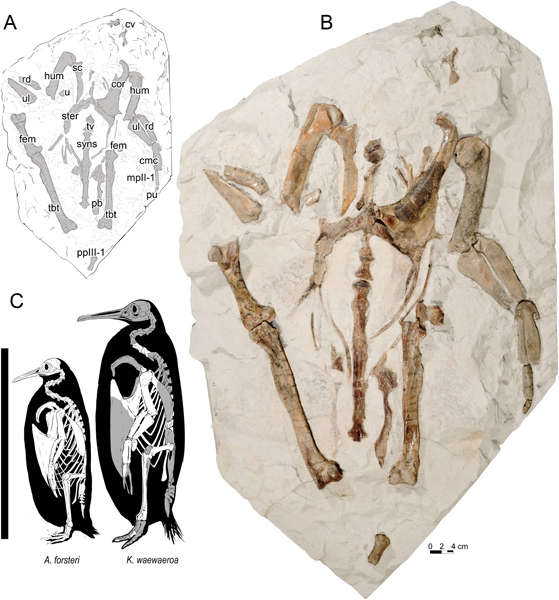
Kairuku waewaeroa line drawing, holotype fossil and scale comparison with an Emperor penguin.

The holotype specimen of Kairuku waewaeroa (WM 2006/1/1). Line drawing of specimen (A), photograph of the holotype in ventral view (B) and (C) scale comparison with the largest extant penguin species the Emperor Penguin (Aptenodytes forsteri. Note scale bar for (B) equals 4 cm. Picture credit: Giovanardi et al.

Picture credit: Giovanardi et al

Penguins, Plesiosaurs, Trilobites, Dolphins and Giant Prehistoric Birds

New Zealand might not be the first country one thinks about when considering the fossil record. However, several important and unique fossil discoveries have been made on Aotearoa (the Māori name for the country).

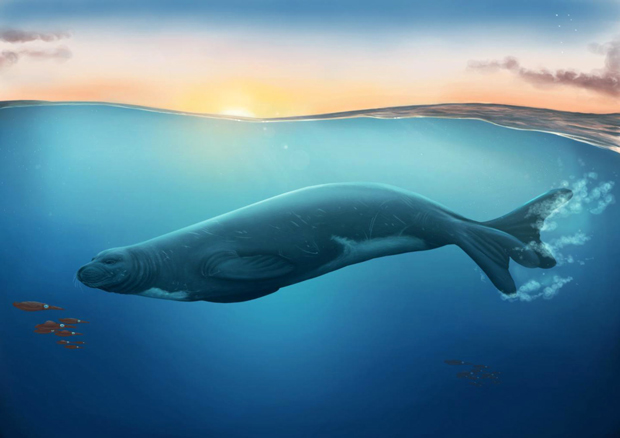
The campaign is being led by Dr Nic Rawlence (University of Otago palaeogenetics laboratory), he has suggested some of the country’s giant penguins (Kairuku waewaeroa, Kumimanu biceae, Crossvallia waiparensis), or perhaps one of the early cetaceans or an example of a primitive pinniped (Eomonachus belegaerensis), fossils of which come from the western side of North Island (Taranaki area).

Eomonachus belegaerensis life reconstrustion.

Eomonachus belegaerensis an ancient seal from New Zealand. Picture credit: Jaime Bran/ Te Papa Museum.

Picture credit: Picture credit: Jaime Bran/Te Papa Museum

In 2002, the Late Cretaceous plesiosaur Kaiwhekea katiki was formally named and described. The seven-metre-long specimen was excavated from a single, large concretion found at Shag Point, Otago (Katiki Formation). It is one of the most complete plesiosaur specimens known from the Southern Hemisphere.

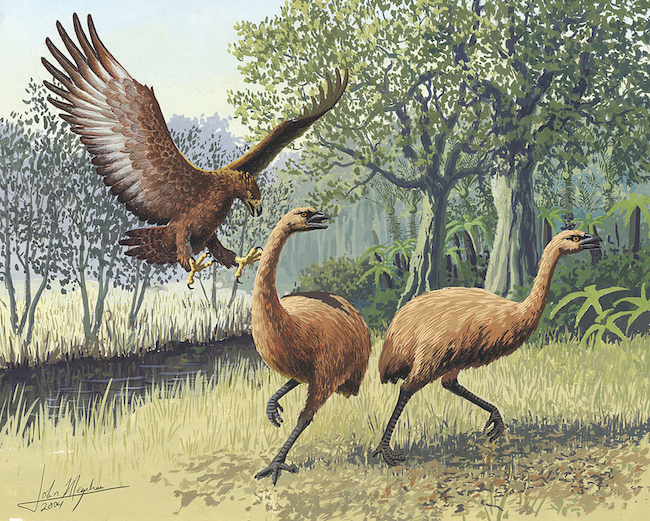
There are also more recent inhabitants of New Zealand to consider, such as the giant South Island Moa Dinornis robustus, as well as many important invertebrate fossils that date from the Palaeozoic but, our personal choice would be the enormous Haast’s eagle (Hieraaetus moorei), the largest eagle known to science. This huge predator occupied the niche filled by mammalian carnivores in other ecosystems. With a body weight in excess of 15 kilograms and a wingspan of around 3 metres, Haast’s eagle was a formidable and terrifying predator.

Haarst's eagle attacks moas.

Haast’s eagle attacks a moa. This eagle is the largest eagle known to science and it only recently went extinct (500-600 years ago). Picture credit: University of Otago/John Megahan.

Picture credit: University of Otago/John Megahan

Only Recently Extinct

Unlike the trilobites, plesiosaurs, penguins and ancient marine mammals, Haast’s eagle died out relatively recently, not long after the first Māori settlers came to New Zealand.

It has not been decided yet whether a single fossil specimen should become the national emblem, or whether there would be two emblems designated, one for South Island and one for North Island.

A shortlist is due to be announced in the near future and then a public vote will decide on the winner(s).

If New Zealand appoints a fossil emblem, then perhaps the UK or the countries that make up the United Kingdom could consider having fossil emblems too.

Any suggestions?

If you have any suggestions about fossil emblems, feel free to email Everything Dinosaur: Contact Everything Dinosaur.

20 06, 2022

New Analysis of Pterosaur Wing Suggests Jehol Biota Represents Migratory Area

By |2025-01-06T19:54:05+00:00June 20th, 2022|Categories: Adobe CS5, Dinosaur and Prehistoric Animal News Stories, Dinosaur Fans, Main Page, Palaeontological articles, Photos/Pictures of Fossils|0 Comments

A cross-sectional analysis of a pterosaur wing bone has helped palaeontologists to work out the ages and growth stages of flying reptiles from the Early Cretaceous Jiufotang Formation of China. This research suggests that the Jehol tapejarid biota represents a migratory area for these pterosaurs.

Writing in the academic journal “Scientific Reports”, researchers from Shandong University of Science and Technology (China) in collaboration with the University of Birmingham, took a tiny cross section of bone from the left forelimb of a pterosaur specimen assigned to the genus Sinopterus. Detailed analysis of the bone structure revealed that the fossil came from an immature individual at a late juvenile stage prior to reaching sexual maturity. This is the first time that histological data about the growth stages of Jehol tapejarids has been undertaken and based on this study, the largest skeletally immature tapejarid individuals recorded from the Jiufotang Formation might have reached sexual maturity.

The Jehol tapejarid Sinopterus left wing fossil.

The Jehol tapejarid Sinopterus (specimen number SDUST-V1014). Photograph (a) and line drawing (b) of the wing skeleton as well as enlarged images of the deltopectoral crest (c) and pneumatic foramen on the distal end of the wing metacarpal (d). Arrow points to the thin-section sample position on the first wing phalanx. Note scale bar for a and b = 20 mm. Picture credit: Zhou et al.

Picture credit: Zhou et al

At Least a Year Old

Microscopic analysis of the internal structure of the bone revealed the presence of one line of arrested growth (LAG) suggesting that this specimen was over a year old when it died. Palaeontologists have proposed that pterosaurs had a remarkably fast growth rate in their first three years and the postulated size of the pterosaur based on SDUST-V1014 fits with this hypothesis.

The Jehol biota relating to the Pterosauria is dominated by immature individuals and skeletally mature adults are exceptionally rare. The researchers postulate that this ecosystem was not home to the adults, that they may have lived apart from juveniles and immature animals. Perhaps this part of northern China was on a migratory route for these types of flying reptiles.

The Early Cretaceous Jehol biota with emphasis on mammaliamorphs.

The Early Cretaceous Jehol biota with emphasis on mammaliamorphs. Picture credit: Chuang Zhao.

Picture credit: Chuang Zhao

Improving Our Knowledge of Tapejarid Anatomy

Although crushed, the forelimb bones reveal helpful morphological information clarifying the anatomy of Jehol tapejarids and the researchers suggest that this improved understanding could lead to a revision of the taxa associated with the Jiufotang Formation.

In addition, this histological analysis permits comparison with other pterosaur growth rates and the researchers conclude that the size gap between sexual and skeletal maturity in tapejarids was very similar to that observed in the not very closely related Pteranodon genus (Ornithocheiroidea).

To read a related article published in 2021 that examines the significance of a headless Sinopterus specimen (S. dongi) and its role in helping to define juvenile tapejarids: Headless Pterosaur Helps to Define an Entire Genus.

The scientific paper: “A new wing skeleton of the Jehol tapejarid Sinopterus and its implications for ontogeny and paleoecology of the Tapejaridae” by Chang-Fu Zhou, Dongxiang Yu, Ziheng Zhu and Brian Andres published in scientific reports.

The Everything Dinosaur website: Dinosaur Toys.

17 06, 2022

Rare Titanosaur Egg Suggests Close Links to Bird Reproductive Strategy

By |2025-01-06T15:58:29+00:00June 17th, 2022|Categories: Adobe CS5, Dinosaur and Prehistoric Animal News Stories, Dinosaur Fans, Main Page, Palaeontological articles, Photos/Pictures of Fossils|0 Comments

The discovery of a titanosaurid egg, preserved inside another titanosaur egg (ovum-in-ovo) adds weight to the theory that dinosaurs had a reproduction strategy very similar to birds. This discovery opens up the possibility that dinosaurs laid their eggs sequentially like birds, whereas other reptiles tend to lay eggs simultaneously as a clutch.

The researchers from the University of Delhi in collaboration with a colleague from the Higher Secondary School (Dhar District, Madhya Pradesh), documented the contents of a titanosaur nest discovered in Upper Cretaceous deposits (Maastrichtian stage) from the Lameta Formation exposed in the lower Narmada valley. The Lameta Formation is famous for its titanosaur nest fossils, hundreds of individual nests have been recorded. The titanosaur nest which records a rare example of an abnormal egg is known as P7, it is one of fifty-two titanosaur nests that have been mapped around the village of Padlya.

Photograph of titanosaur next P7 and explanatory diagram.

In-situ field photograph and explanatory drawing of the outcrop showing the titanosaur nest P7 and its eggs and eggshell fragments. Captions A to O indicate eggs and eggshell locations. Picture credit: Dhiman et al.

Picture credit: Dhiman et al

Titanosaur Nest P7

The titanosaur nest P7 preserves eleven large, round eggs which are placed in a circular arrangement entombed within a block of sandy limestone. Not all the eggs are entire, some of the eggshell is missing. They could represent broken shells after the eggs hatched or the missing shell elements may have been eroded away.

One egg (egg C) records unusual pathology. Two partially broken, circular eggshell outlines are preserved, with a prominent crescent-shaped gap between the two eggshells present in the top right corner (see line drawing). Egg C has been interpreted as an example of an abnormal egg, one egg containing another egg within it. This type of egg pathology is termed ovum-in-ovo and this is the first time this has been reported in a dinosaur. Ovum-in-ovo eggs are found in birds but no such egg pathology has been reported in a reptile (living or extinct). This discovery suggests that titanosaurids had a reproductive system similar to that of birds.

Ovum-in-ovo fossilised titanosaur egg

In-situ field photograph (a) of the ovum-in-ovo egg (egg number C) from the Upper Cretaceous Lameta Formation (Dhar District, India) with explanatory line drawing (b). Two partially broken, circular eggshell outlines can be seen with broken eggshell fragments also preserved. With ovum-in-ovo egg pathology a crescent-shaped gap is characteristically present in the upper right part of the egg. Picture credit: Dhiman et al

Picture credit: Dhiman et al

Different Types of Egg Pathology

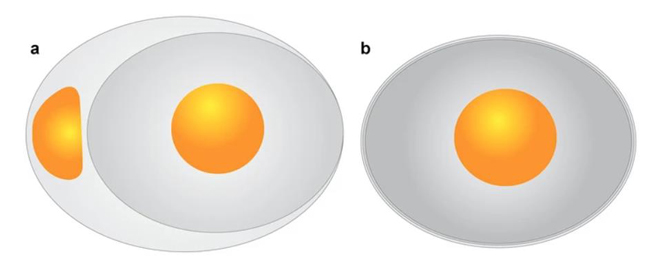
Abnormal egg formation has been documented in many types of amniote (undergoing foetal or embryonic development within a protective membrane, the amnion), such as turtles, dinosaurs and birds. Two main examples of egg pathology are known. There is a condition where one egg forms within another egg (ovum-in-ovo) and a second condition in which multi-shelled eggs are formed, essentially the formation of a second eggshell layer beside the primary eggshell.

Unusual pathologies in amniote eggs.

Unusual pathologies in amniote eggs. Ovum-in-ovo (a) an egg within an egg, characterised by the presence of two yolks. Multi-shelled egg (b) with two or more eggshell layers surrounding a single yolk. Picture credit: Dhiman et al (after Carpenter).

Picture credit: Dhiman et al (after Carpenter)

If Egg C represents an example of ovum-in-ovo egg laying in a dinosaur, then this egg deformity will only have been recorded in the Dinosauria and birds, suggesting similar reproductive biology. In birds, when an egg is fully formed it is pushed into the cloaca to be laid one-by-one.

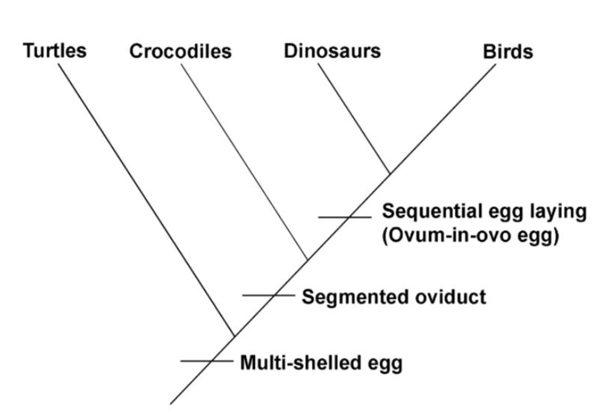
Eggs are not laid as clutch, but egg laying can take place sequentially over several days. In birds such as hens (Galliformes), egg laying can be suspended if conditions are unfavourable. However, crocodiles and turtles tend to lay all their eggs at the same time, as a single clutch. Both turtles and crocodiles have two oviducts, but crocodiles are more derived than turtles possessing a segmented oviduct and share this derived trait with the birds.

The structure of the oviduct dictates the sort of egg abnormalities that can occur. The ovum-in-ovo pathology as observed in the titanosaur eggs has led the researchers to hypothesise that titanosaurs possessed a segmented oviduct similar to birds and crocodiles, but unlike crocodilians they were capable of laying eggs sequentially.

Titanosaur sequential egg laying.

Inferred cladogram showing divergence of dinosaurs from crocodiles on the basis of sequential egg laying. Picture credit: Dhiman et al.

Picture credit: Dhiman et al.

Building up a Picture of Titanosaurid Reproductive Strategy

Turtles, crocodiles, dinosaurs and birds all share the common trait of having multi-shelled eggs. Both turtles and crocodiles have two oviducts, but crocodiles are more derived than turtles in that they possess a segmented oviduct, a characteristic that they share with birds.

This new study suggests that at least one type of dinosaur (titanosaurids) had an oviduct anatomy and biology similar to modern birds. Titanosaurs may have been capable of laying eggs sequentially, just like birds.

Palaeontologists are building up a detailed picture of titanosaur reproductive behaviour. These sauropods had favoured nesting sites, which they returned to, they nested in colonies, excavated nests and covered the nests to incubate the eggs and they may have laid their eggs not as a single clutch but sequentially over several days.

Brazilian titanosaur nesting site

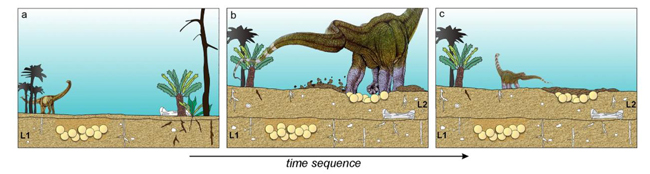
The titanosaur egg fossils were found in two distinct layers (L1 and L2) approximately two metres apart. This suggests that this area was a preferred nesting site for titanosaurs. This is the first confirmed dinosaur nesting area found in Brazil. The eggs attributed to titanosaurs also represent the most northerly titanosaurian nesting site known from South America. The discovery of nests located at different levels indicates that titanosaurs returned regularly to preferred nesting areas. Picture credit: Fiorelli et al.

Picture credit: Fiorelli et al

Safari Ltd recently introduced a model of a titanosaur (Patagotitan). To view this figure and the other models in the Wild Safari Prehistoric World range: Wild Safari Prehistoric World.

The scientific report: “First ovum-in-ovo pathological titanosaurid egg throws light on the reproductive biology of sauropod dinosaurs” by Harsha Dhiman, Vishal Verma & Guntupalli V. R. Prasad published in Scientific Reports.

The award-winning Everything Dinosaur website: Dinosaur Figures.

13 06, 2022

Abelisaurids Lived Alongside Spinosaurus According to New Study

By |2025-01-06T09:41:01+00:00June 13th, 2022|Categories: Adobe CS5, Dinosaur and Prehistoric Animal News Stories, Dinosaur Fans, Main Page, Palaeontological articles, Photos/Pictures of Fossils|0 Comments

Last week, the discovery of the fossilised bones of a huge spinosaurid from the Isle of Wight was reported*. This giant theropod, with an estimated length of around ten metres, could be the biggest meat-eating dinosaur described from European fossils, but the largest theropod known to science is thought to be Spinosaurus aegyptiacus, which was first reported from the Bahariya Formation of Egypt.

Spinosaurus had plenty of company, several large theropods have been named and described from fossils from the Upper Cretaceous (Cenomanian), Bahariya Oasis, Western Desert of Egypt and a newly published paper confirms the presence of abelisaurids in this ancient ecosystem too.

Theropod dominated Bahariya Formation palaeoecosystem.

Reconstruction of the palaeoecosystem of the Upper Cretaceous (Cenomanian) Bahariya Formation of the Bahariya Oasis, Western Desert of Egypt. A single neck bone proves the presence of abelisaurids in the ecosystem. Picture credit: Andrew McAfee, Carnegie Museum of Natural History.

Picture credit: Andrew McAfee, Carnegie Museum of Natural History

Cervical Vertebra Fossil Discovery

A 2016 expedition led by researchers from the Mansoura University Vertebrate Palaeontology Centre, (Mansoura, Egypt), unearthed a single neck bone (10th cervical vertebra), a formal description of this specimen (MUVP 477) has been published in Royal Society Open Science.

Neck bone of an abelisaurid (Bahariya Formation)

Tenth cervical vertebra of Abelisauridae indet. (MUVP 477) in cranial (a), caudal (b), left lateral (c), right dorsolateral (d), ventral (e) and dorsal (f) views. Note scale bar = 5 cm. Picture credit: Salem et al.

Picture credit: Salem et al

Similar to the Cervical Vertebrae of Majungasaurus and Carnotaurus (Abelisaurids)

The neckbone is strikingly similar to the cervical vertebrae of Majungasaurus from the Late Cretaceous of Madagascar and the cervical vertebrae of Carnotaurus, fossils of which are associated with Upper Cretaceous deposits of Argentina. Phylogenetic analysis places the Bahariya Formation specimen within the Abelisauridae, but the absence of any further fossil material has restricted the taxonomic classification to the family level (a similar taxonomic position to that of the “White Rock spinosaurid” described from fragmentary bones found on the Isle of Wight).

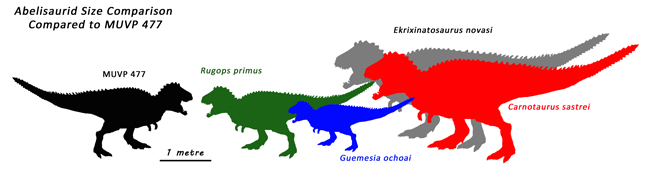
Based on measurements of the cervical vertebra the Bahariya Formation abelisaurid is estimated to have had a body length of between 5.3 and 6.3 metres, indicating that this fossil represents a mid-sized member of the Abelisauridae with a body size similar to Rugops, Majungasaurus, Viavenator and Xenotarsosaurus bonapartei.

Abelisaurid size Comparison

Abelisaurid size comparison. The Bahariya Formation abelisaurid is described as mid-sized member of the Abelisauridae with a body length estimated to be 5.3 to 6.3 metres long. Picture credit: Everything Dinosaur.

Picture credit: Everything Dinosaur

The First Definitive Proof of Abelisaurids and the Oldest from North-eastern Africa

Specimen number MUVP 477 is not only the first definitive proof of the presence of abelisaurids with the Bahariya Formation biota, but with an estimated age of approximately 98 million years, this fossil is also the oldest record of the Abelisauria clade in Egypt and north-eastern Africa generally.

Providing a Key for the Carnegie Museum of Natural History Life Reconstruction

Theropod dominated Bahariya Formation palaeoecosystem.

Reconstruction of the palaeoecosystem of the Upper Cretaceous (Cenomanian) Bahariya Formation of the Bahariya Oasis, Western Desert of Egypt. The early Late Cretaceous of north-eastern Africa was a dangerous place with several different types of predatory dinosaur present in the ecosystem. Picture credit: Andrew McAfee, Carnegie Museum of Natural History.

Picture credit: Andrew McAfee, Carnegie Museum of Natural History

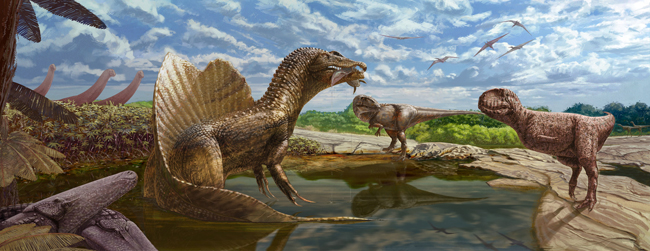
The stunning prehistoric scene (Andrew McAfee/Carnegie Museum of Natural History) shows, the mid-sized abelisaurid (far right) confronting the giant theropod Spinosaurus aegyptiacus which is holding a dipnoan (lungfish) Retodus tuberculatus in its jaws.

The large carcharodontosaurid Carcharodontosaurus saharicus can be seen in the centre background. Two stomatosuchid crocodyliforms (Stomatosuchus inermis) can be seen on the far left, whilst in the background a trio of Paralititan stromeri walk by. A pair of bahariasaurids are located just behind the tail of the abelisaurid whilst a flock of pterosaurs soar overhead. The vegetation is dominated by the mangrove-like tree fern Weichselia reticulata.

Niche Partitioning

The presence of so many large predators in the biota suggests that the Bahariya Formation ecosystem was extremely rich, even so, it is likely that the different types of theropod exhibited niche-partitioning, with coeval genera exploiting different resources.

*To read our article on the “White Rock spinosaurid”: Super-sized Carnivorous Dinosaur from the Isle of Wight.

The scientific paper: “First definitive record of Abelisauridae (Theropoda: Ceratosauria) from the Cretaceous Bahariya Formation, Bahariya Oasis, Western Desert of Egypt” by Belal S. Salem, Matthew C. Lamanna, Patrick M. O’Connor, Gamal M. El-Qot, Fatma Shaker, Wael A. Thabet, Sanaa El-Sayed and Hesham M. Sallam published by Royal Society Open Science.

The award-winning Everything Dinosaur website: Dinosaur Models and Toys.

10 06, 2022

Super-sized Carnivorous Dinosaur from the Isle of Wight

By |2025-01-05T21:42:50+00:00June 10th, 2022|Categories: Adobe CS5, Dinosaur and Prehistoric Animal News Stories, Dinosaur Fans, Main Page, Palaeontological articles|0 Comments

A newly published scientific paper has described the fragmentary remains of a super-sized theropod dinosaur unearthed on the Isle of Wight. With an estimated length exceeding 10 metres, the fossils could represent the largest carnivorous dinosaur found in Europe.

The fragmentary nature of the fossilised bones means that a more precise identification and the establishment of a new genus is not currently possible, although the fossils do probably represent a new taxon.

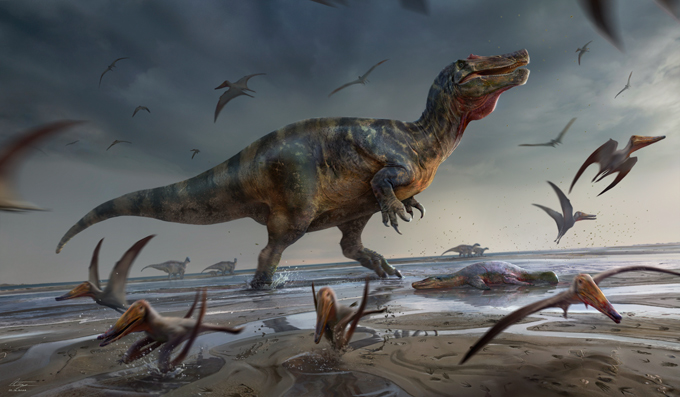
Illustration of White Rock spinosaurid.

Illustration of White Rock spinosaurid. Picture credit: University of Southampton/Anthony Hutchings.

Picture credit: University of Southampton/Anthony Hutchings

Europe’s Largest Land Predator – A Member of the Spinosauridae

Based on anatomical traits identified from these weathered and damaged bones (they may have been trampled by other dinosaurs), the researchers are not able at this time to assign this specimen to a specific branch of the spinosaurid family tree, instead the material is classified at the family level of taxonomy and assigned to the Spinosauridae.

Commenting on the significance of this discovery, PhD student and lead author of the scientific paper Chris Barker (University of Southampton) stated:

“This was a huge animal, exceeding ten metres in length and probably several tonnes in weight. Judging from some of the dimensions, it appears to represent one of the largest predatory dinosaur ever found in Europe – maybe even the biggest yet known. It’s a shame it’s only known from a small amount of material, but these are enough to show it was an immense creature.”

Not “Europe’s Largest Ever Land Dinosaur”

Although massive and the largest theropod currently known from the Wealden Supergroup and based on bone measurements, potentially the largest theropod dinosaur found in Europe to date, Everything Dinosaur team members have noted inaccuracies in news articles. Some media outlets have declared that these fossils represent “Europe’s largest ever land dinosaur”. This is not true, fossils assigned to the Sauropoda, including several specimens from the Isle of Wight indicate, that there were many, much larger dinosaurs present in the Early Cretaceous of Europe when spinosaurids roamed.

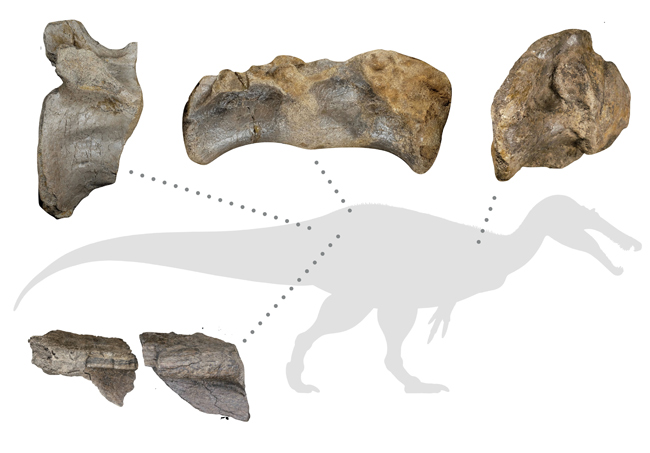
The skeletal position of the best-preserved spinosaurid bones.

Position of the best preserved bones. Although the material was collected from the foreshore over a period of several months, their large size suggest they all originated from a single skeleton. Picture credit: Chris Barker and Dan Folkes.

Picture credit: Chris Barker and Dan Folkes

The “White Rock Spinosaurid”

Nicknamed the “White Rock spinosaurid” after the geological layer in which it was found (the basal unit [the White Rock Sandstone equivalent] of the Vectis Formation near Compton Chine, on the southwest coast of the Isle of Wight), the fossils are around 125 million years of age (Barremian stage of the Lower Cretaceous).

It represents the first documented spinosaurid from the Vectis Formation of the Isle of Wight, extending the temporal span of the clade in the British fossil record to the late Barremian.

Dr Neil Gostling (University of Southampton), commented:

“Unusually, this specimen eroded out of the Vectis Formation, which is notoriously poor in dinosaur fossils. It’s likely to be the youngest spinosaur material yet known from the UK.”

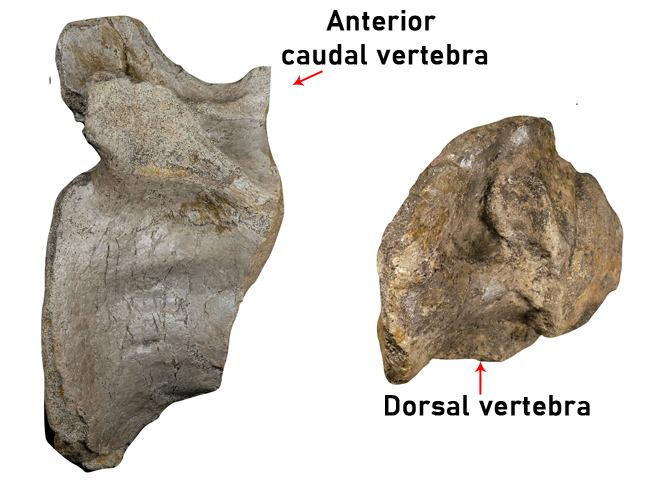
Vertebrae from the Isle of Wight Spinosaurid

Close views of the fragmentary spinosaurid fossil material. Anterior caudal vertebra (left) and a partial dorsal vertebra (right). Picture credit: Chris Barker with additional annotation by Everything Dinosaur.

Picture credit: Chris Barker with additional annotation by Everything Dinosaur

Dinosaur remains are generally very rarely found in the Vectis Formation, although these deposits represent sandflats and lagoonal environments where dinosaurs roamed and spinosaurid fossils have been found in other strata laid down in similar palaeoenvironments.

Vertebrate palaeontologist and co-author of the scientific paper Darren Naish commented:

“Because it’s only known from fragments at the moment, we haven’t given it a formal scientific name. We hope that additional remains will turn up in time. This new animal bolsters our previous argument – published last year – that spinosaurid dinosaurs originated and diversified in western Europe before becoming more widespread.”

The researchers hope to cut thin sections in some of the fossil remains to look at the microscopic internal properties of the bones. This may provide information about the growth rate of this dinosaur, its age and maturity.

Marks on the bone also showed how, even after death, the body of this giant probably supported a range of scavengers and decomposers.

Co-author and PhD student Jeremy Lockwood (University of Portsmouth and the London Natural History Museum), added:

“Most of these amazing fossils were found by Nick Chase, one of Britain’s most skilled dinosaur hunters, who sadly died just before the Covid epidemic. I was searching for remains of this dinosaur with Nick and found a lump of pelvis with tunnels bored into it, each about the size of my index finger. We think they were caused by bone eating larvae of a type of scavenging beetle. It’s an interesting thought that this giant killer wound up becoming a meal for a host of insects.”

The Youngest Spinosaurid Known from the UK

The fossils also represent the youngest spinosaurid known from the UK and it is most likely a new taxon but a lack of convincing autapomorphies in the fossil material found to date has prevented a more precise taxonomic classification.

Southampton University researchers were prominent in a 2021 study that described two other spinosaurs Riparovenator milnerae and Ceratosuchops inferodios, from the Isle of Wight. Both these dinosaurs come from the older Wessex Formation that underlies the Vectis Formation, so they would have been alive several million years before the “White Rock spinosaurid” evolved.

To read about R. milnerae and C. inferodios: Two New Spinosaurids from the Isle of Wight.

Everything Dinosaur acknowledges the assistance of a media release from the University of Southampton in the compilation of this article.

The scientific paper: “A European giant: a large spinosaurid (Dinosauria: Theropoda) from the Vectis Formation (Wealden Group, Early Cretaceous)” by Chris T. Barker, Jeremy A. F. Lockwood, Darren Naish, Sophie Brown, Amy Hart, Ethan Tulloch and Neil J. Gostling published in PeerJ.

The Everything Dinosaur website: Prehistoric Animal Figures.

9 06, 2022

New Study Suggests Quetzalcoatlus Could Not Soar for Hundreds of Miles

By |2025-01-05T21:36:20+00:00June 9th, 2022|Categories: Adobe CS5, Dinosaur and Prehistoric Animal News Stories, Dinosaur Fans, Main Page, Palaeontological articles|0 Comments

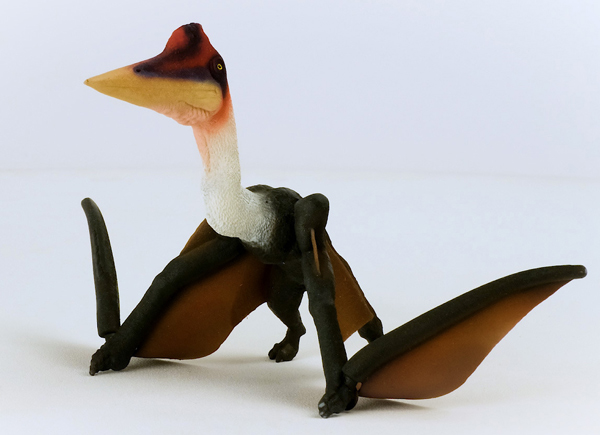
The recently aired television documentary series “Prehistoric Planet” depicted giant azhdarchid pterosaurs such as Quetzalcoatlus and Hatzegopteryx as competent aeronauts extremely proficient at flight and capable of travelling huge distances without ever having the need to land. This idea has been challenged in newly published research that suggests Quetzalcoatlus was more suited to short-range flights.

Schleich Quetzalcoatlus video short explains the function of the jointed wings.

The Schleich Quetzalcoatulus figure in resting pose. Quetzalcoatlus takes to the air. A new study suggests that Quetzalcoatlus and other super-sized azhdarchid pterosaurs were probably short-range fliers. Picture credit: Everything Dinosaur.

Picture credit: Everything Dinosaur

The picture (above) shows a Schleich Quetzalcoatlus figure.

To view the Schleich range of models in stock at Everything Dinosaur: Schleich Prehistoric Animal Figures.

The Largest Known Flying Animals

A number of vertebrates are volant (capable of powered flight). Amongst this diverse and eclectic group consisting of bats, birds and pterosaurs are some giants. For example, Pelagornis sandersi*, a pelagornithid bird from the Late Oligocene of Southern Carolina had an estimated wingspan of about 7 metres. Argentavis magnificens was an enormous condor from the Late Miocene of Argentina. It had a wingspan in excess of 6 metres and it was very much larger than its extant, distant relative the California condor (Gymnogyps californianus).

During the Late Cretaceous enormous pterosaurs dominated the skies. Pteranodon was thought to be one of the biggest, but over the last fifty years or so, evidence has emerged of the Azhdarchidae – a family of Late Cretaceous flying reptiles, some members of which such as Hatzegopteryx, Quetzalcoatlus, Arambourgiania and the recently described Thanatosdrakon* were the largest flying animals known to science.

Comparing Today’s Large Birds with Ancient Flyers

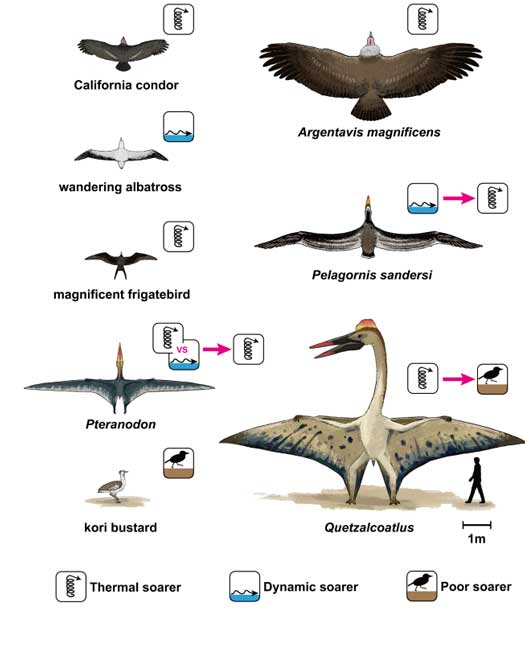
A new study, led by Dr Yusuke Goto from Nagoya University (Japan), along with researchers from the Centre d’Etudes Biologiques de Chizé (France) and the University of Tokyo (Japan), calculated and compared the ability of some of these ancient flyers to the capabilities of large, extant birds such as the Wandering albatross (Diomedea exulans), the California condor, the Magnificent frigatebird (Fregata magnificens) and the Kori bustard (Ardeotis kori). The Kori bustard has a bodyweight in the region of 10-18 kilograms, it is the heaviest flying bird alive today.

The team set out to quantify the soaring performance of these animals using a combination of potential speed of flight, soaring efficiency and the wind speed and conditions required to sustain aerial activity.

They analysed two types of soaring behaviour:

  • Thermal soaring – which uses updrafts arising from the land or ocean to ascend and glide. A method of flight observed in eagles and frigatebirds.
  • Dynamic soaring – which uses wind gradients over the ocean, as demonstrated by albatrosses and petrels.
Comparing the soaring capabilities of giant birds and pterosaurs.

Scientists set out to examine the soaring abilities of extinct giant birds and giant pterosaurs including the taxa Pteranodon and Quetzalcoatlus. The giant Argentavis magnificens was a thermal soarer like the extant California condor, whilst Pelagornis sandersi, thought to have used wind currents over bodies of water to stay aloft was found to be better suited to thermal soaring. Analysis of the wings of Pteranodon suggest thermal soaring capacities whilst in this study the giant azhdarchid Quetzalcoatlus was thought to be more adapted to a terrestrial existence and flew short distances with a similar flight habit to the Kori Bustard, the heaviest, living volant bird.The icons indicate dynamic soarer, thermal soarer, and poor soarer, and summarize the main results of this study. The pink arrows indicate the transition from a previous expectation or hypothesis to the knowledge updated in the study. Image credit: Goto et al.

Image credit: Goto et al

The Soaring Abilities of Pteranodon

The scientists concluded that Pteranodon, fossils of which are associated with marine environments, was probably an ocean dweller, excelling at soaring flight using updrafts over the sea. The predicted flying style of Pteranodon was similar to that seen in extant, ocean-going frigatebirds.

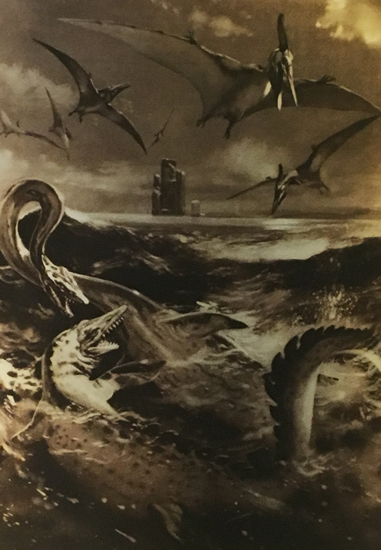
The Western Interior Seaway (Late Cretaceous)

Dramatic scene from the Western Interior Seaway painted by Burian. Picture credit: Zdeněk Burian.

Picture credit: Zdeněk Burian

Challenging Perceptions About Quetzalcoatlus

This analysis challenges perceptions about the flight capabilities of Quetzalcoatlus. The team concluded that this azhdarchid was not well adapted for soaring flight, even when wind speeds and atmospheric conditions were favourable.

Previous studies had proposed that Quetzalcoatlus was capable of travelling hundreds if not thousands of miles without having the need to land, this study showed that its thermal soaring abilities were much lower than that seen in living birds.

The idea that large azhdarchids were terrestrial hunters has been proposed previously, but the research team go further suggesting that Quetzalcoatlus and other giants were short-range flyers and did spend most of their time on land. The Kori bustard is proposed as a modern-day analogue for the biggest members of the Azhdarchidae. It is largely terrestrial and only flies relatively short distances.

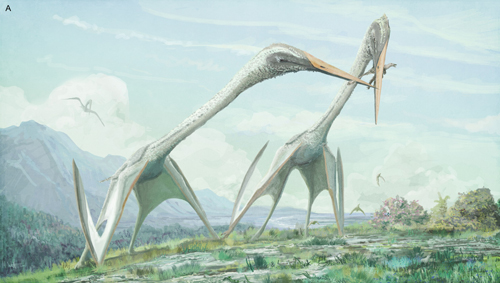
Azhdarchid pterosaurs feeding on dinosaurs.

Arambourgiania philadelphia (giant Pterosaurs) squabble over a small theropod dinosaur. Picture credit: Mark Witton.

Picture credit: Mark Witton

The research team’s results corroborated the findings of previous studies examining the flying abilities of Argentavis magnificens. They found that it was well suited to thermal soaring. In contrast, the team found that Pelagornis sandersi was better suited to thermal soaring, although earlier studies had proposed dynamic soaring.

To read Everything Dinosaur’s article from 2014 about the discovery of P. sandersi: The Largest Ever Flying Bird Pelagornis sandersi.

Everything Dinosaur’s recent article (May 2022), on Thanatosdrakon: The Dragon of Death.

The scientific paper: “How did extinct giant birds and pterosaurs fly? A comprehensive modeling approach to evaluate soaring performance” by Yusuke Goto, Ken Yoda, Henri Weimerskirch and Katsufumi Sato published in the PNAS Nexus.

The award-winning Everything Dinosaur website: Pterosaur Models.

8 06, 2022

Remarkable Australian Pterosaur Fossils Reveal Crocodiles Dined on Flying Reptiles

By |2025-01-05T21:24:40+00:00June 8th, 2022|Categories: Adobe CS5, Dinosaur and Prehistoric Animal News Stories, Dinosaur Fans, Main Page, Palaeontological articles, Photos/Pictures of Fossils|0 Comments

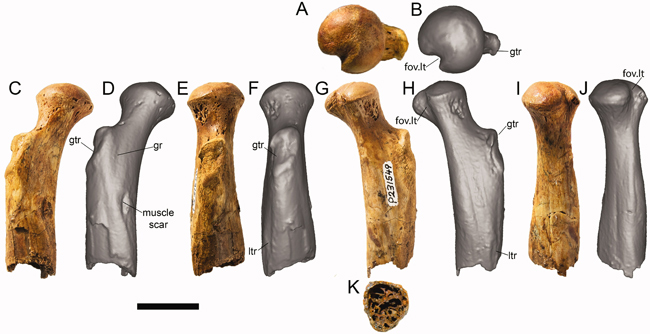
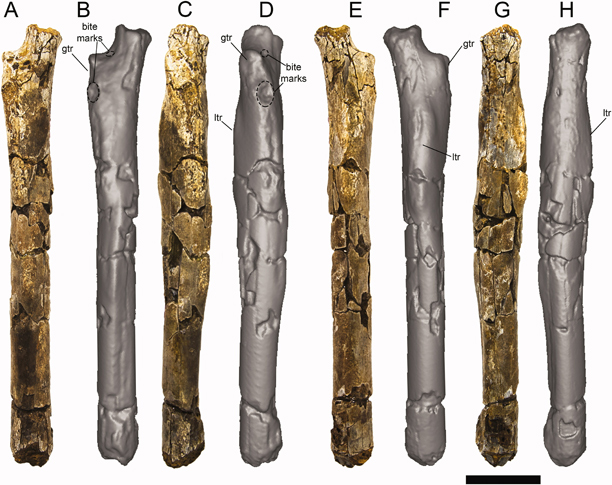
Scientists have identified two partial pterosaur thigh bones that despite one being at least ten million years older than the other, have been identified as belonging to the same type of flying reptile (Anhangueria). Furthermore, one of the bones preserves a potential bite mark tentatively attributed to a crocodilian.

Pterosaur femur

Anhangueria indet. partial right femur from the Toolebuc Formation (NMV P231549): A, B, proximal; C, D, posterior; E, F, dorsal; G, H, anterior; I, J, ventral and K, distal views. A, C, E, G, I and K are photographs; B, D, F, H and J are 3D renders derived from surface scan data. Scale bar = 2 cm. Picture credit: Pentland et al.

Picture credit: Pentland et al

Two Rare Australian Pterosaur Fossils

The researchers who include famous Australian vertebrate palaeontologists Patricia Vickers-Rich and Thomas Rich report that the two bones although found over 200 miles apart, both come from pterosaurs from the same pterosaur clade (Anhangueria).

Specimen number NMV P231549 was collected in 1991 at Slashers Creek Station, southeast of the small town of Boulia (Queensland), from Toolebuc Formation deposits (middle to upper Albian) and is believed to be at least 100 million years old.

Specimen number AODF 2297 was found in 2004 at Belmont Station, around 35 miles northeast of the town of Winton in Queensland. It came from deposits associated with the “upper” Winton Formation (Cenomanian-lowermost Turonian stage of the Late Cretaceous). It is estimated to be around 10 million years younger.

Anhangueria femor from the Winton Formation.

Anhangueria indet. partial left femur from the Winton Formation (AODF 2297): A, B, posterior; C, D, dorsal; E, F, anterior; and G, H, ventral views. A, C, E and G are photographs; B, D, F and H are 3D renders derived from surface scan data. Scale bar = 2 cm. Picture credit: Pentland et al.

Picture credit: Pentland et al

Although pterosaur fossils are exceptionally rare in Australia and most specimens are extremely fragmentary, their three-dimensional preservation has enabled palaeontologists to learn a great deal about the type of pterosaurs that ranged over this part of Gondwana during the Cretaceous.

Lead author of the scientific paper describing these pterosaur bones, Adele Pentland (PhD student at Swinburne University, Melbourne, Victoria), was also the lead author of another scientific paper published in 2019 which described another anhanguerid pterosaur Ferrodraco lentoni.

To read more about F. lentoni: The Most Complete Pterosaur Specimen Found in Australia to Date.

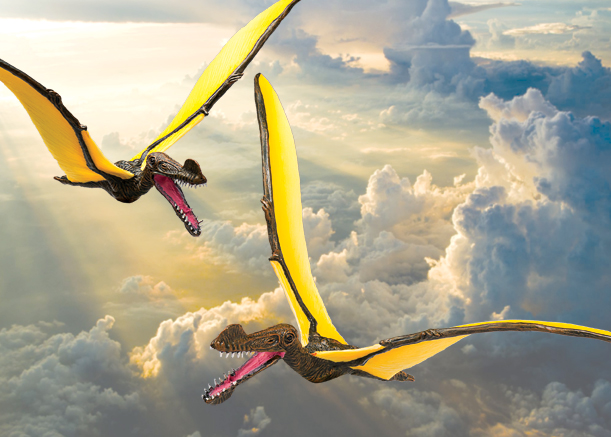
Mojo Fun Tropeognathus.

A pair of Mojo Fun Tropeognathus pterosaurs.

The picture (above) shows two Tropeognathus pterosaurs, soaring high in the sky.  These pterosaurs are typical of the Anhangueridae. The models are from the Mojo Fun series.

To view the range of Mojo Fun figures available from Everything Dinosaur: Mojo Fun Prehistoric Animal Figures.

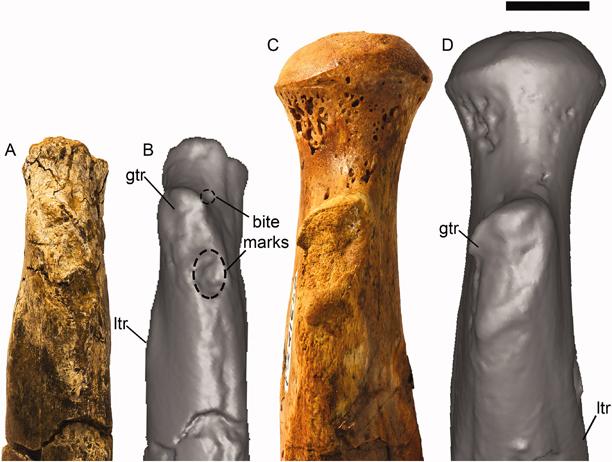
The Winton Formation fossil preserves a potential bite mark, that the researchers have tentatively proposed was made by a crocodylomorph. It is not known whether this feeding trace represents predation or post-mortem scavenging.

Comparing the two pterosaur femori.

Comparisons between greater trochanters of the Toolebuc Formation (NMV P231549) and Winton Formation (AODF 2297) pterosaur femora. AODF 2297 in A, B, dorsal view. NMV P231549 in C, D, dorsal view. A and C are photographs; B and D are 3D renders derived from surface scan data. Picture credit: Pentland et al.

Picture credit: Pentland et al

The scientists conclude that these new pterosaur fossils are a valuable addition to the meagre list of pterosaur specimens found in Australia and attest to the cosmopolitan distribution of anhanguerians during the Early and early Late Cretaceous.

The scientific paper: “New anhanguerian pterosaur remains from the Lower Cretaceous of Queensland, Australia” by Adele H. Pentland, Stephen F. Poropat, Matt A. White, Samantha L. Rigby, Patricia Vickers-Rich, Thomas H. Rich and David A. Elliott published in Alcheringa: An Australian Journal of Palaeontology.

5 06, 2022

A New Short-snouted Troodontid – Papiliovenator

By |2023-08-30T20:25:05+01:00June 5th, 2022|Categories: Adobe CS5, Dinosaur and Prehistoric Animal News Stories, Dinosaur Fans, Main Page, Palaeontological articles, Photos/Pictures of Fossils|0 Comments

A new species of short-snouted troodontid has been named and described based on fossils found in the Upper Cretaceous Wulansuhai Formation at Bayan Manduhu, Inner Mongolia. This little dinosaur has been named Papiliovenator neimengguensis.

Everything Dinosaur team members have been busy updating readers about new dinosaurs named and described this year (see below*), the formal scientific paper announcing this new troodontid was published earlier in the spring, but information about the fossils attributed as the holotype material had been circulating for some time.

Papiliovenator neimengguensis Skull
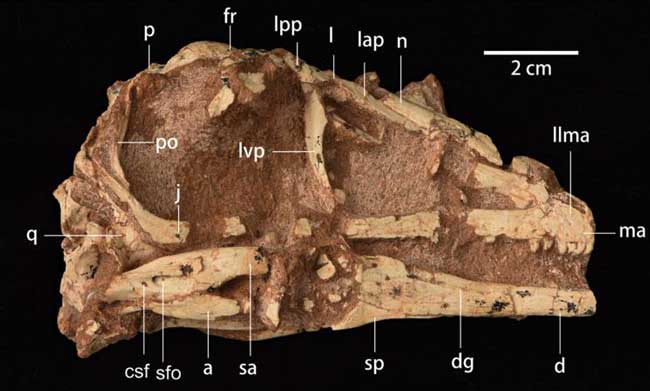
The short-snouted skull of Papiliovenator neimengguensis in lateral view. Picture credit: Pei et al.

Named From Strangely Shaped Dorsal Vertebrae

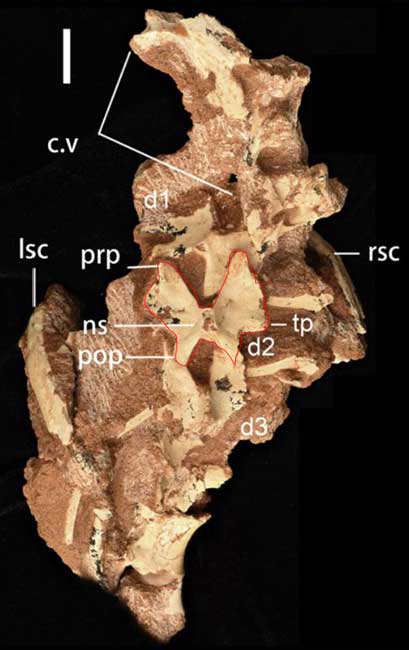
Known from a nearly complete skull and fragmentary, semi-articulated postcranial material thought to represent a single, individual animal, Papiliovenator means “butterfly hunter”. This little carnivore, which was less than a metre long, might well have hunted butterflies and other members of the Lepidoptera, but the derivation of the genus name does not reflect this dinosaur’s diet. Instead, it was the unusual shape of the neural arches associated with the two dorsal vertebrae closest to the neck of this dinosaur that inspired the genus name. When viewed from above (dorsal view), these neural arches are butterfly-shaped.

Papiliovenator neimengguensis fossil bones.
Papiliovenator neimengguensis fossil bones. A view of the articulated dorsal vertebrae with the distinctive butterfly-shaped, broad neural arches of the anteriormost dorsal vertebrae when viewed from the top down (dorsal view). The neural arch has been outlined in red. Picture credit: Pei et al with additional annotation by Everything Dinosaur.

Unusual for a Late Cretaceous Troodontid

The researchers report that Papiliovenator was unusual among Late Cretaceous troodontids in having a fairly deep, short-snouted skull. This skull shape is seen in geologically older troodontids known from the Early Cretaceous. Most other Late Cretaceous troodontids have long, low snouts, except for the smaller Almas ukhaa from the Campanian-aged Djadochta Formation of Mongolia. Coincidently, Rui Pei of the Chinese Academy of Sciences was the lead author of the scientific paper naming and describing A. ukhaa (Pei et al, 2017). Rui Pei is the lead author of the paper describing Papiliovenator.

*To read about a new basal iguanodontian from southern China: Napaisaurus guangxiensis.

*A new alvarezsaurid taxon from Uzbekistan: Dzharaonyx eski Old Dzharakuduk Claw.

*A new therizinosaur from the Japanese island of Hokkaido: Paralitherizinosaurus japonicus.

The fossils are thought to represent a sub-adult animal. The discovery of Papiliovenator neimengguensis allows for an improved understanding of troodontid anatomy, as well as helping to highlight the regional variation of troodontids from the Upper Cretaceous of the Gobi Basin.

The scientific paper: “A new troodontid from the Upper Cretaceous Gobi Basin of inner Mongolia, China” by Rui Pei, Yuying Qin, Aishu Wen, Qi Zhao, Zhe Wang, Zhanmin Liu, Weilesi Guo, Po Liu, Weiming Ye, Lanyun Wang, Zhigang Yin, Ruiming Dai and Xing Xu published in Cretaceous Research.

Visit the Everything Dinosaur website: Everything Dinosaur.

3 06, 2022

What Drove the Giraffes to Evolve Long Necks?

By |2025-01-05T20:53:51+00:00June 3rd, 2022|Categories: Adobe CS5, Animal News Stories, Dinosaur and Prehistoric Animal News Stories, Main Page, Palaeontological articles|0 Comments

The long neck of the giraffe has often been cited as a classic example of adaptive evolution. Long necks evolved to permit them to access food that other animals could not reach. However, a newly described early giraffe with a toughened skull adapted for head-butting contests suggests that intensive sexual competition may have led to the extremely long neck found in modern giraffes.

Intra-specific combat in giraffoids.
Intraspecific combat in giraffoids. Foreground two male Discokeryx xiezhi indulge in a head-butting context whilst in the background two male extant giraffes (Giraffa camelopardalis) fight each other by banging necks. Picture credit: Wang Yu and Guo Xiaocong.

Discokeryx xiezhi from the Early Miocene (Junggar Basin)

Scientists led by researchers from the Chinese Academy of Sciences have described a new species of ancient giraffe from the northern margins of the Junggar Basin in north-western China (Xinjiang Uygur Autonomous Region). The early giraffoid named Discokeryx xiezhi did not have a very long neck, instead, based on the analysis of an almost complete skull and four cervical vertebrae, this herbivore had a neck and head adapted to absorbing the immense stresses of head-butting combat.

Writing in the academic journal “Science”, the researchers conclude that the neck bones of Discokeryx xiezhi were extremely stout and had the most complex joints between the head and the neck and between the cervical vertebrae of any mammal. The team demonstrated that the complex articulations between the skull and cervical vertebrae of Discokeryx xiezhi were particularly adapted to high-speed head-to-head impact. They found this structure was far more effective than that of extant animals, such as musk oxen, that are adapted for head butting intraspecific combat. The scientists postulate that D. xiezhi may have been the vertebrate best adapted to head impact known to science.

Lead author of the study, Shi-qi Wang of the Chinese Academy of Sciences explained:

“Both living giraffes and Discokeryx xiezhi belong to the Giraffoidea, a superfamily. Although their skull and neck morphologies differ greatly, both are associated with male courtship struggles and both have evolved in an extreme direction.”

Climate Change Driving Morphological Changes

Tooth isotope analysis of fossil teeth indicate that Discokeryx lived in a dry, grassland environment. The habitat was more barren and less rich than forest environments and this may have resulted in increased stress on animal populations and greater competition within species for limited resources. Around 7 million years ago, the environment on the East African Plateau was broadly similar with forests being replaced by savannah. The direct ancestors of extant giraffes had to adapt and it is possible that during this period mating males developed a way of attacking their competitors by swinging their necks and heads. This extreme struggle, supported by sexual selection, thus led to the rapid elongation of the giraffe’s neck over a period of two million years to become the extant genus, Giraffa.

Mammalian Fauna of the Junggar Basin (Miocene)
Typical large vertebrate fauna associated with the early Miocene of the Junggar Basin approximately 17 mya. Forests were replaced by barren, open grasslands and this may have been a driver for intraspecific competition amongst early giraffes which led to the evolution of a range of specialist heads and necks and resulted in the extremely long neck associated with extant species. Picture credit: Guo Xiaocong.

Comparing Horn Morphology

The research team compared the horn morphology of several groups of ruminants, including giraffoids, cattle, sheep, deer and pronghorns. They found that horn diversity in giraffes is much greater than in other groups, with a tendency toward extreme differences in morphology. This suggests that courtship struggles (intraspecific combat) are more intense and diverse in giraffes than in other ruminants.

The evolution of complex head ornamentation in giraffomorphs.
The accumulative number of headgears in various pecoran groups during their evolution. Note that giraffomorphs had evolved more types of headgear than other pecoran groups, which may be partly attributable to their various combat styles. Picture credit: Wang Yu and Guo Xiaocong.

The research team conclude that the primary driving force for extreme body shape in giraffes was not the benefit of being able to browse on parts of the canopy other herbivores could not reach, but it was the intensive sexual competition that fostered extreme morphologies.

Everything Dinosaur acknowledges the assistance of a media release from the Chinese Academy of Sciences in the compilation of this article.

The scientific paper: “Sexual selection promotes giraffoid head-neck evolution and ecological adaptation” by Shi-qi Wang, Jie Ye, Jin Meng, Chunxiao Li, Loic Costeur, Bastien Mennecart, Chi Zhang, Ji Zhang, Manuela Aiglstorfer, Yang Wang, Yan Wu, Wen-yu Wu and Tao Deng published in the journal Science.

The award-winning Everything Dinosaur website: Prehistoric Animal Models.

Go to Top