All about dinosaurs, fossils and prehistoric animals by Everything Dinosaur team members.

Fossil finds, new dinosaur discoveries, news and views from the world of palaeontology and other Earth sciences.

20 07, 2022

Unique Dinosaur Fossil to be Returned to Brazil

By |2023-04-18T08:15:50+01:00July 20th, 2022|Categories: Adobe CS5, Dinosaur and Prehistoric Animal News Stories, Dinosaur Fans, Main Page|0 Comments

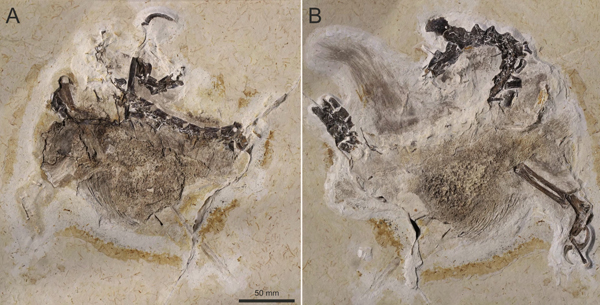
A unique, chicken-sized dinosaur fossil excavated from the Lower Cretaceous deposits of the Araripe Basin (Brazil) and currently residing at the State Museum of Natural History Karlsruhe (Baden-Württemberg, Germany) will be returned to Brazil. The specimen (Ubirajara jubatus), lacks properly documented paperwork detailing its acquisition and it may have been obtained without legitimate export permits.

Holotype of Ubirajara jubatus preserved as slab and counter slab.
The holotype of Ubirajara jubatus preserved as slab and counter slab. The fossil material is to be returned to Brazil after evidence emerged that the specimen may not have been obtained legally. Picture credit: Smyth et al/Cretaceous Research.

Conflicting Accounts about Fossil Acquisition

Conflicting accounts regarding the fossil’s acquisition emerged prompting the Baden-Württemberg science ministry to launch an internal investigation.

In the scientific paper (now withdrawn) published in the journal “Cretaceous Research” it was stated that the fossil specimen was brought to Germany in 1995. However, this statement was contradicted by researchers at the State Museum of Natural History Karlsruhe claiming the fossil was imported in 2006 by a private company and then acquired by the Museum in 2009.

Unique Dinosaur Fossil

As the documentation providing an audit trail for the obtaining of this specimen has not been supplied nor any evidence given to confirm the fossil material was imported before a German cultural protection law took effect in 2007, it has been decided to return the fossil to its country of origin.

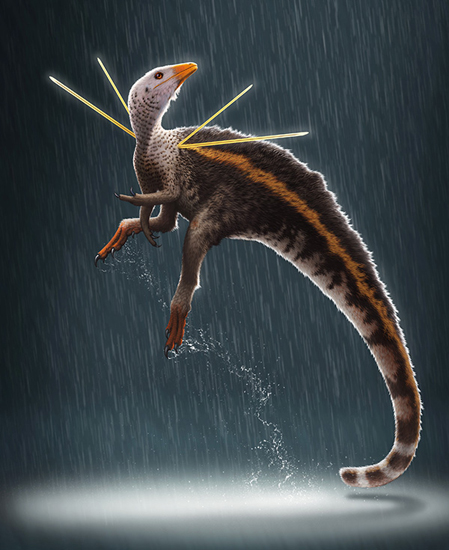
Ubirajara jubatus life reconstruction.
Ubirajara jubatus life reconstruction by the very talented palaeoartist Bob Nicholls.

“Parachute Science”

In the days of empire and colonialism, many western powers took fossils from their colonies. These precious artefacts were then put on display. What we see today is another form of colonialism, whereby scientists from the more prosperous countries go to poorer countries to collect fossils. Scientists are “parachuted in” and there is a limited exchange of knowledge with local researchers.

There is a considerable movement to “kick back” against such practices.

To read an article from 2008 about calls from the Government of Tanzania to return fossils in German institutions: Return our Fossils.

Palaeontologists and other researchers are being accused of taking advantage of the natural resources of countries without leaving anything behind in return.

To read Everything Dinosaur’s original blog post about the formal naming and scientific description of this bizarre dinosaur: One Very Flashy New Dinosaur.

Visit Everything Dinosaur’s award-winning website: Everything Dinosaur.

19 07, 2022

Titus the T. rex Exhibition Unveils an Amazing Microscopic T. rex Model

By |2024-03-09T14:35:32+00:00July 19th, 2022|Categories: Adobe CS5, Dinosaur and Prehistoric Animal News Stories, Dinosaur Fans, Main Page, Photos|0 Comments

Fans of dinosaurs like to collect scale models, and there is one scale model on show at the Titus T. rex is King exhibition at Wollaton Hall Nottinghamshire, which puts any model collection into perspective.

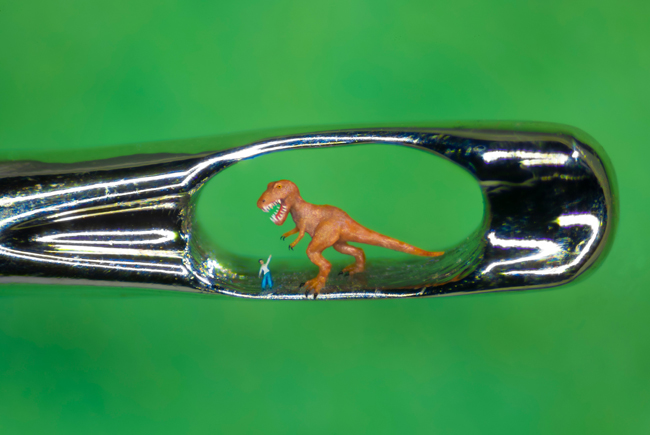
Internationally renowned micro-sculpturist, Dr Willard Wigan MBE, has created and installed a new extraordinary micro-sculpture of a perfectly formed Tyrannosaurus rex, measuring just 0.5 mm in length.

This amazing figure is so small, it sits comfortably within the eye of a needle.

Microscopic T. rex Model
The remarkable microscopic Titus the T. rex sculpted by Dr Willard Wigan MBE. The T. rex model measures 0.5 mm in length and it sits within the eye of a needle. Picture credit: Wollaton Hall/Dr Willard Wigan.

Celebrating the First-year Anniversary of this World-exclusive Event

The “microsaur” has been installed to mark the first-year anniversary of the opening of the Titus T. rex is King exhibition. Based on the estimated size for an adult T. rex at around 13 metres, the tiny “tyrant lizard king”, complete with fearsome teeth and sharp claws is approximately in 1/26,000th scale.

Now the very tiniest micro-depiction, and, Titus, the first real Tyrannosaurus rex to be exhibited in England for over a century, stand side by side. Titus the T. rex, demonstrates the immense power and impact of this king of the dinosaurs, while Willard Wigan’s creation presents the smallest, but no less powerful.

Dr Willard Wigan commented:

“It is a real honour to be exhibiting one of my sculptures alongside the breath-taking Titus T. rex exhibition. Wollaton Hall Natural History Museum is renowned for being home to rare specimens from across the globe, including Titus himself, which made it the perfect home for my T. rex sculpture.”

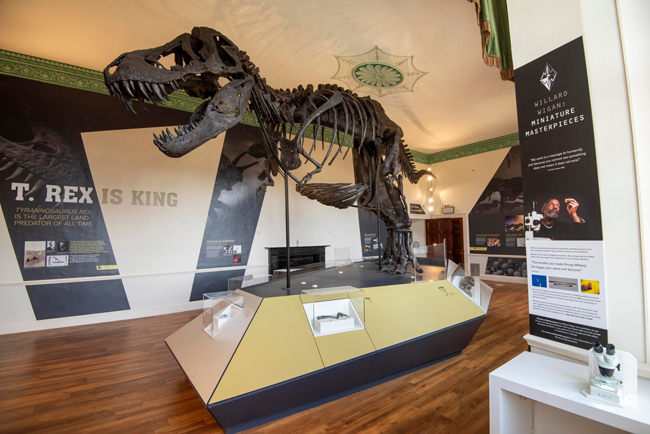
Titus T. rex is King has a new attraction.
Titus the T. rex and the Willard Wigan miniature masterpieces exhibit at Wollaton Hall. Everything Dinosaur team members estimate that the 0.5 mm long T. rex sculpture is in approximately 1:26,000 scale! Picture credit: Wollaton Hall.

A Message to Humanity

Through his incredible sculptures, Dr Wigan is sending a message to humanity – just because you cannot see something does not mean that it does not exist. In palaeontology, including the study of the Dinosauria, a similar metaphor can be demonstrated in the concept of “ghost lineages”. A hypothesis that an animal would have existed in the past, but no fossils to prove its existence have been found, but fossils of related genera imply that it did exist.

Titus the T. rex is King Exhibition

Titus the T. rex is King opened in July 2021, to international acclaim. Over 70,000 visitors have already met Titus and engaged with the bespoke interactive exhibition designed around the remarkable skeletal mount.

Rachael Evans (Museums Development Manager at Nottingham City Museums and Galleries at Wollaton Hall), one of the UK’s most important Natural History Museums, added:

“It is an astonishing moment for us. We will have one the largest dinosaurs ever exhibited in the UK on display alongside one of the smallest. The T. rex that has been introduced to the exhibition is 0.5mm in size, with miniscule teeth made from glass. Since new information about the T. rex has been researched and made available, Willard has remodelled the sculpture to be as accurate as possible in his depiction. We can’t wait to see our visitors’ reaction to this new addition.”

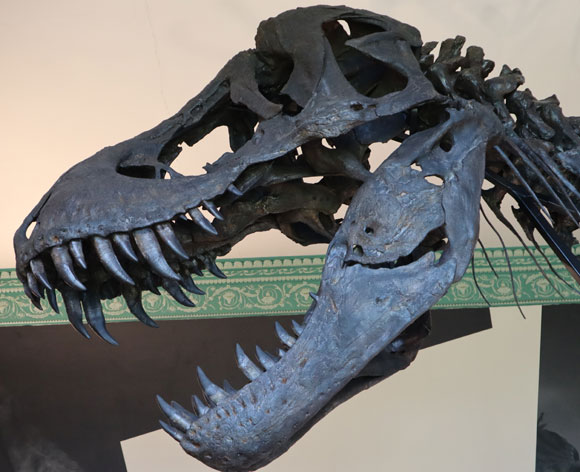
Titus the T. rex Skull and Jaws
The skull of the T. rex exhibit on display at Wollaton Hall until August 2022.

Exhibition Details

Tickets for TITUS T. REX IS KING are on sale now, set at £13.00 for an adult, £8.75 for a child (under 16 years), students and concessions, £34.00 for a family ticket (2 adults and 2 children under 16 years) and under 3s and carers have no entry fees to pay. Car parking charges apply.

Everything Dinosaur acknowledges the assistance of a press release from Wollaton Hall in the compilation of this article.

For further information: Wollaton Hall Titus T. rex is King Exhibition.

18 07, 2022

The Eotyrannus Monograph – A New Scientific Paper

By |2024-04-13T08:05:18+01:00July 18th, 2022|Categories: Adobe CS5, Dinosaur and Prehistoric Animal News Stories, Dinosaur Fans, Main Page, Palaeontological articles, Photos/Pictures of Fossils|0 Comments

A new scientific paper on the Early Cretaceous tyrannosauroid Eotyrannus lengi has been published. It is confirmed as a valid genus and the phylogenetic assessment places the enigmatic Megaraptora clade within the Tyrannosauroidea superfamily.

First named and scientifically described back in 2001 (Hutt et al), Eotyrannus is helping to provide significant insights into the early evolution of tyrannosauroids as well as potentially redefining how enigmatic “megaraptors” such as Australovenator, Megaraptor and the recently described Maip macrothorax fit within the Theropoda.

Eotyrannus scale drawing.
Isle of Wight tyrannosauroid (E. lengi). The recently published monograph (Naish and Cau) supports the earlier hypothesis that this dinosaur had proportionately long arms and a rectangular snout. The holotype specimen (IWCMS: 1997.550) indicates an animal around 4.5 metres in length. However, these fossils represent a sub-adult and the fully-grown, adult size of this Early Cretaceous predator remains undetermined.

The Carnivorous Dinosaurs of the Wessex Formation

Since the first fossils of Eotyrannus were found (1997), this theropod has attracted a lot of scientific interest. It is one of numerous carnivorous dinosaurs associated with the Wessex Formation (part of the Wealden Supergroup), indeed, back in 2021 we blogged about two new members of the Baryonychinae named and described from fossil remains found on the Isle of Wight (Wessex Formation). Last month, we wrote about an even bigger predator, an as yet, unnamed spinosaurid known as the “White Rock spinosaurid”.

For the article on the recently described baryonychids Ceratosuchops inferodios and Riparovenator milnerae: Two New Spinosaurids from the Isle of Wight.

To read about the Isle of Wight “White Rock spinosaurid”: Super-sized Isle of Wight Carnivorous Dinosaur.

The newly published paper provides further information on Eotyrannus autapomorphies (characteristic traits) that help to distinguish it from the often, fragmentary remains of other theropods associated with the Wessex Formation.

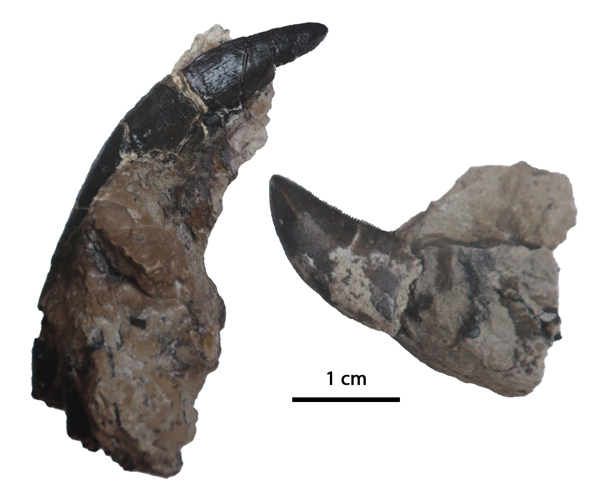
Eotyrannus teeth.
Isolated Eotyrannus teeth from the Wessex Formation.

Deciphering the Fossil Evidence

Many of the fossil bones associated with the Eotyrannus genus remain entombed in their concrete-like matrix. Anatomical traits helping to define and classify this dinosaur are only beginning to emerge and there is a substantial amount of further preparation work required to permit a comprehensive analysis.

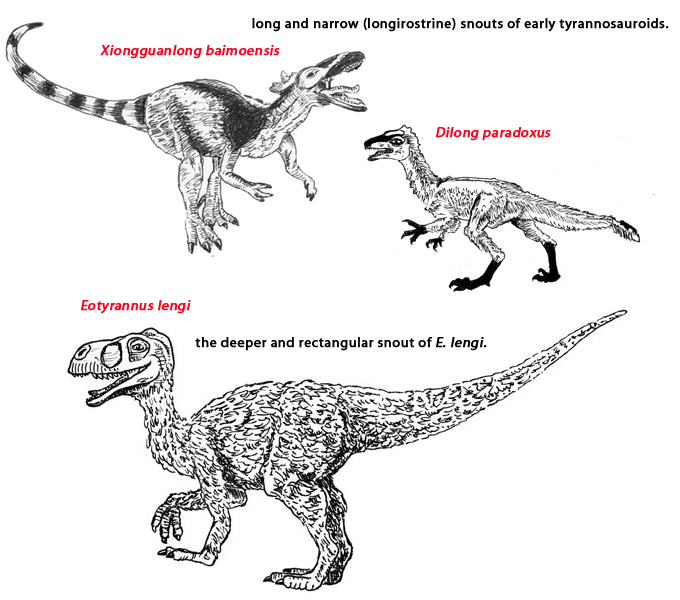
However, by combining all the new data since the formal description, the authors (Darren Naish and Andrea Cau) were able to produce a new skeletal reconstruction. The maxilla is confirmed as being quite rectangular in shape. Eotyrannus did not have the long, narrow snout (longirostrine) as seen in other early tyrannosauroids such as Dilong and Xiongguanlong from the Early Cretaceous of China. This suggests that longirostry evolved several times within the Tyrannosauroidea, perhaps in response to adaptations to permit these theropods to exploit a particular predatory niche.

Longirostry in Early Members of the Superfamily Tyrannosauroidea
Longirostry (having a long, narrow snout) in early members of the Tyrannosauroidea. Eotyrannus is confirmed as not exhibiting longirostry.

Where do the Megaraptora Fit?

The scientific paper also incorporated a revised phylogenetic analysis of Eotyrannus. No significant support was found for Eotyrannus having a close evolutionary relationship to Juratyrant (J. langhami), known from the Late Jurassic of Dorset or indeed to the Late Jurassic early tyrannosauroid Stokesosaurus (S. clevelandi) from the western United States.

Instead, it is grouped with gracile, mid-sized tyrannosauroids that represent a more derived state than proceratosaurids, stokesosaurs and Juratyrant.

If megaraptoran dinosaurs are tyrannosauroids and therefore coelurosaurs, then this challenges long-held views on Theropoda classification and suggests that after the Early Cretaceous most of the hypercarnivore niches within dinosaur dominated ecosystems were increasingly occupied by coelurosaurs. It also suggests that tyrannosauroids were much more diverse and widespread during the Cretaceous than previously thought.

Eotyrannus remains a fascinating dinosaur, a genus that has led to new insights into the evolution and radiation of the Theropoda. It offers a tantalising glimpse into the ecology represented by the Wessex Formation deposits and how a mid-sized theropod co-existed with other, larger members of the ever-widening collection of Wessex Formation meat-eating dinosaurs.

Everything Dinosaur Helping to Fund Research

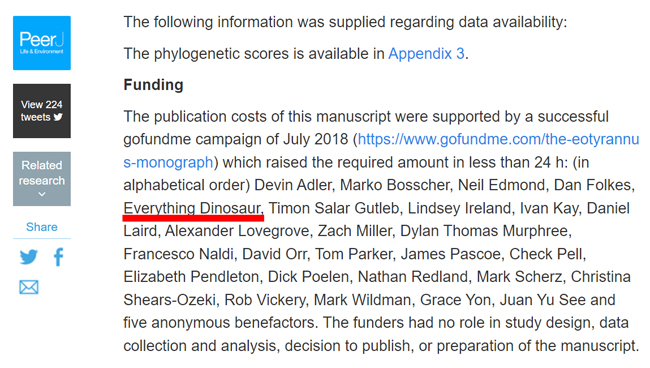
The authors wanted to make their paper available to everyone. To do this they set up a GoFundMe campaign to cover publishing costs. Everything Dinosaur assisted with the funding.

A spokesperson from Everything Dinosaur stated:

“We were happy to support this excellent paper and we helped to make such studies possible. Your purchases from Everything Dinosaur genuinely help science”.

Everything Dinosaur helping to fund research.
Team members at Everything Dinosaur were happy to assist with funding a newly published paper on the early tyrannosauroid Eotyrannus lengi.

The scientific paper: “The osteology and affinities of Eotyrannus lengi, a tyrannosauroid theropod from the Wealden Supergroup of southern England” by Darren Naish and Andrea Cau published in PeerJ.

13 07, 2022

A Scottish Stem Salamander Revealed by New Research

By |2024-05-07T13:50:19+01:00July 13th, 2022|Categories: Adobe CS5, Dinosaur and Prehistoric Animal News Stories, Main Page, Palaeontological articles, Photos|0 Comments

The fossils of an ancient amphibian found on the Isle of Skye (Scotland), are helping scientists to better understand the evolutionary development of salamanders. Writing in the academic journal “The Proceedings of the National Academy of Sciences” (PNAS), the researchers suggest that the fossils represent the oldest salamander fossil found to date in Europe.

A Scottish Stem Salamander

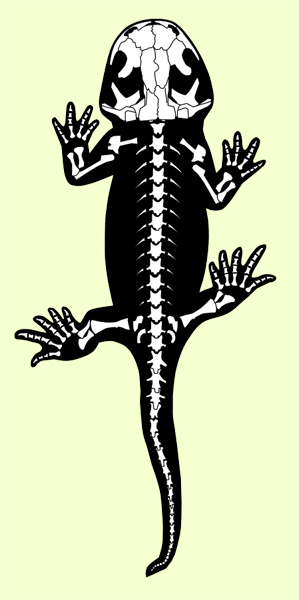
A skeletal reconstruction of the stem salamander Marmorerpeton wakei.
A skeletal reconstruction of the stem salamander Marmorerpeton wakei (dorsal view). Picture credit: Jones et al.

Marmorerpeton wakei

The stem Salamander genus Marmorerpeton was named and described in 1988, but detailed analysis of the Isle of Skye fossil material, including CT scans demonstrated that this was a new species, which has been named Marmorerpeton wakei. The species name honours the late Professor David Wake, who was a world-renowned authority on early salamander evolution.

Lead author of the study, Dr Marc Jones (University College London, Cell and Developmental Biology), commented:

“The fossil is definitely a salamander but unlike anything alive today. It highlights the importance of the fossil record for preserving combinations of anatomical features that do not exist in any living animal.”

The anatomical features of the new Scottish fossils of Marmorerpeton wakei were only revealed thanks to the detailed CT scans and subsequent computer-generated models. This scanning technology provides a powerful and non-destructive tool for revealing fine details on fossil bones. One specimen, collected in 2016, was found to be part of a specimen collected in 1971 but left undescribed until now.

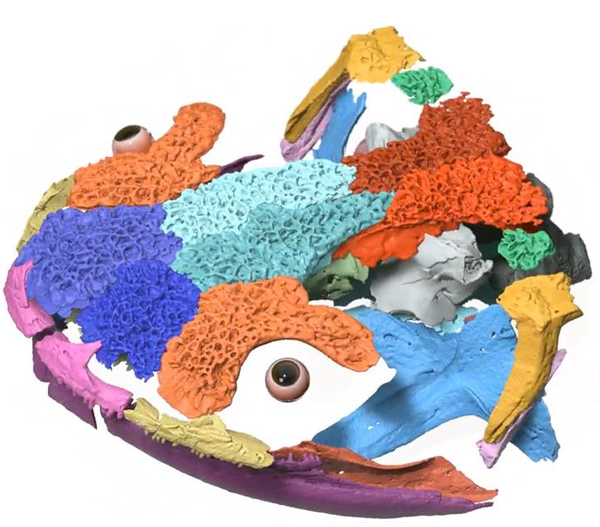
Marmorerpeton wakei skull reconstruction.
A three-dimensional image showing the skull bones of Marmorerpeton wakei. Following detailed CT scans of the fossil material a computer programme was used to interpret the data and reconstruct the skull. Picture credit: Jones et al.

Middle Jurassic Salamander

The fossils are thought to be around 166 million years old (Middle Jurassic) and although the Marmorerpeton genus was first described over 30 years ago, the material analysed in this new paper has permitted the researchers to build up a more complete picture of this 20-centimetre-long amphibian.

Marmorerpeton wakei had a wide but shallow frog-like head with powerful jaws and distinctive, prominent, bony projections behind its eyes. The skull roof bones show that it was ornamented like that of a crocodile or a temnospondyl, distinguishing it from extant salamanders. The limb bones and deep tail of Marmorerpeton wakei suggest this animal was aquatic, perhaps using its wide jaws to catch prey by suction feeding, similar to the lifestyle seen in the modern Hellbender salamander (Cryptobranchus alleganiensis) of North America.

The bony bumps behind the orbit are unusual and Dr Jones commented:

“The big bony projections behind the eye were a bit unexpected but smaller projections do exist in fossil salamanders from slightly younger rocks. Their purpose remains unknown.”

The early evolution of salamanders is poorly understood, their small and delicate bones are rarely preserved as fossils. This research also included a detailed survey of modern salamander anatomy which informed the subsequent analyses.

The Karaurus Genus

Several previous studies of Mesozoic salamanders have relied on fossils from the Late Jurassic, found in Kazakhstan, assigned to the genus Karaurus. As the Marmorerpeton fossils are older, they help to provide an improved understanding of how early salamanders evolved.

Daohugou salamander
Even the fine gills have been preserved, a delicate salamander fossil from China. Picture credit: Chinese Academy of Sciences/Journal of Vertebrate Palaeontology.

Senior-author Professor Susan Evans (University College London Cell and Developmental Biology), who first described Marmorerpeton in 1988 explained:

“The origin and early history of modern amphibian groups remains mysterious and new fossils like this one are key to developing a better understanding of amphibian evolution. In theory, the Skye salamander should give us a clue as to what the ancestors of modern salamanders looked like. However, it could be that they are a highly specialised off-shoot.”

To read an article from 2008 about a transitional fossil from the Early Permian that helped to define the evolutionary origins of modern amphibians: Amphibian Ancestry a Little Clearer Thanks to New Discovery.

Everything Dinosaur acknowledges the assistance of a media release from University College London in the compilation of this article.

Visit Everything Dinosaur’s award-winning website: Everything Dinosaur.

The scientific paper: “Middle Jurassic fossils document an early stage in salamander evolution” by Marc E. H. Jones, Roger B. J. Benson, Pavel Skutschas, Lucy Hill, Elsa Panciroli, Armin D. Schmitt, Stig A. Walsh and Susan E. Evans published in The Proceedings of the National Academy of Sciences (PNAS).

For models and replicas of prehistoric animals: Models and Replicas of Prehistoric Animals.

11 07, 2022

Everything Dinosaur Helping to Fund New Research

By |2024-04-13T08:06:25+01:00July 11th, 2022|Categories: Adobe CS5, Dinosaur and Prehistoric Animal News Stories, Dinosaur Fans, Educational Activities, Everything Dinosaur News and Updates, Main Page, Press Releases|0 Comments

On July 7th (2022), a new scientific paper providing a review of the Early Cretaceous Eotyrannus lengi was published. Everything Dinosaur helped to fund the publication of this research. The authors, Dr Darren Naish (School of Biological Sciences, Faculty of Environment and Life Sciences, University of Southampton) and Andrea Cau (Parma, Italy) concluded that E. lengi was a valid tyrannosauroid taxon from the Barremian Wessex Formation of the Isle of Wight.

In order to make a new study into the dinosaur Eotyrannus open access, so that everyone could view this research, the authors set up a GoFundMe campaign. Everything Dinosaur helped to fund this study. We are happy to support this excellent paper and we are helping to make such studies possible. Your purchases from Everything Dinosaur genuinely help science.

Everything Dinosaur helping to fund research.
Team members at Everything Dinosaur were happy to assist with funding a newly published paper on the early tyrannosauroid Eotyrannus lengi.

The publication costs of this manuscript were supported by a successful gofundme campaign (July 2018). The fund target was reached in less than 24-hours and Everything Dinosaur was happy to make a substantial contribution to ensure that this research could be published allowing free access.

Our congratulations to all the other funders, who helped make this possible.

We hope to produce an article on this excellent scientific paper in the very near future, after all, it sheds light on an amazing dinosaur dominated ecosystem. The researchers conclude that Eotyrannus was a mid-size predator with much larger megalosauroid or allosauroid apex predators present. There were certainly many different types of theropod in the environment including carcharodontosaurian allosauroids, baryonychine spinosaurids as well as probable compsognathids and members of the Maniraptora.

To read a recent Everything Dinosaur article about two, newly described spinosaurids from the Isle of Wight: Two New Spinosaurids from the Isle of Wight.

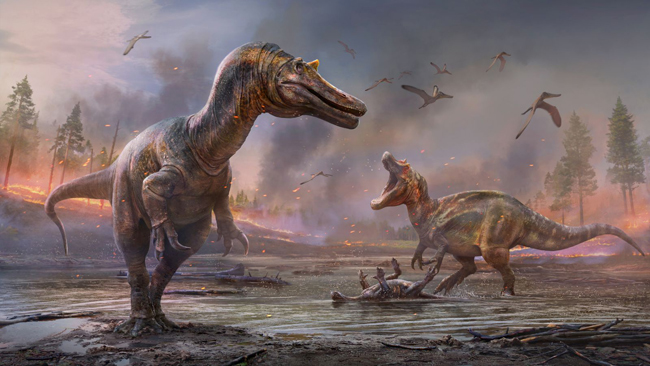
Two new Isle of Wight spinosaurs
Two new species of spinosaurids described from the Isle of Wight Ceratosuchops inferodios (foreground) challenges a Riparovenator milnerae (background) over the carcase of an iguanodont. Picture credit: Anthony Hutchings

To read a related article about the discovery of an even bigger spinosaurid on the island: Super-sized Carnivorous Dinosaur from the Isle of Wight.

Customers purchasing dinosaur models and dinosaur toys from Everything Dinosaur are helping to support research.

To visit Everything Dinosaur’s website: Everything Dinosaur.

The scientific paper: “The osteology and affinities of Eotyrannus lengi, a tyrannosauroid theropod from the Wealden Supergroup of southern England” by Darren Naish and Andrea Cau published in PeerJ.

8 07, 2022

Meraxes gigas – New Giant Carcharodontosaurid from Argentina

By |2022-10-20T12:45:06+01:00July 8th, 2022|Categories: Adobe CS5, Dinosaur and Prehistoric Animal News Stories, Dinosaur Fans, Main Page, Palaeontological articles, Photos/Pictures of Fossils|0 Comments

A new giant, Late Cretaceous predatory dinosaur has been named based on fossils found in Argentina. The dinosaur, assigned to the Carcharodontosauridae has been named Meraxes gigas and its fossilised remains represent the most complete carcharodontosaurid specimen found to date in the Southern Hemisphere.

The giant, South American predatory dinosaur Giganotosaurus which featured in the latest instalment of the “Jurassic Park/Jurassic World” movie franchise is just one of a poorly known group of theropod dinosaurs that were the apex predators in many terrestrial environments during the Cretaceous. Although, most dinosaur fans can name many carcharodontosaurids, these meat-eaters remain enigmatic and most genera have been described based on fragmentary remains. All that has changed with the publication of a scientific paper describing Meraxes gigas from the Upper Cretaceous Huincul Formation of northern Patagonia (Argentina).

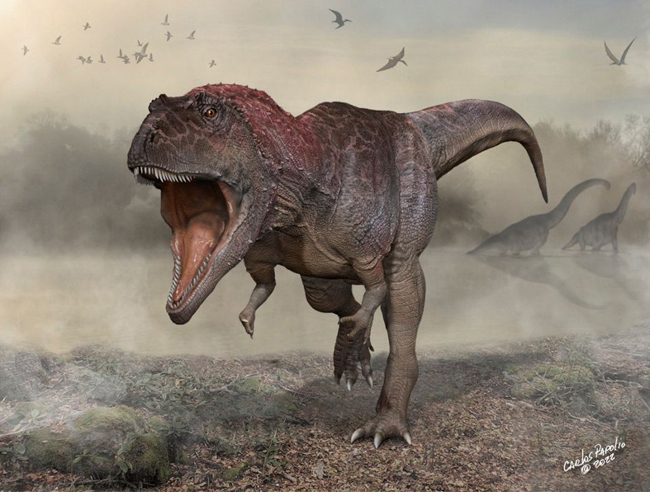
Meraxes gigas life reconstruction.
A life reconstruction of the giant carcharodontosaurid from Patagonia Meraxes gigas. Picture credit: Carlos Papolio.

A Giant Predator with Short Arms

Writing in the scientific journal “Current Biology” the researchers who include Juan Canale (Universidad Nacional de Río Negro, Argentina), suggest that M. gigas was around eleven metres long and weighed around four tonnes (estimated 4.26 tonnes). The skull bones, which represent one of the most complete large theropod skulls ever found, indicate a skull length of 1.27 metres, but its arms were disproportionately small. Like other Cretaceous apex predators, the tyrannosaurs and the abelisaurids, this dinosaur had very short arms. Arms so short that they could not reach its own mouth.

Lead author Juan Canale commented:

“I’m convinced that those proportionally tiny arms had some sort of function. The skeleton shows large muscle insertions and fully developed pectoral girdles, so the arm had strong muscles. They may have used the arms for reproductive behaviour such as holding the female during mating or support themselves to stand back up after a break or a fall.”

Meraxes gigas fossil bones and skeleton.
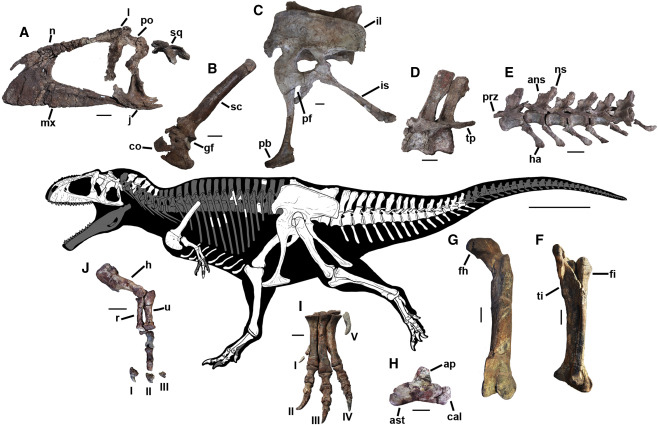
Meraxes gigas MMCh-PV 65 and skeleton reconstruction. The white materials represent known bones. Meraxes is the most complete carcharodontosaurid yet from the Southern Hemisphere. Picture credit: Canale et al.

The fossils found in Huincul Formation exposures (late Cenomanian to Turonian) in Las Campanas Canyon some 14 miles southwest of Villa El Chocón, (Neuquén Province, Argentina), also include an almost complete right arm (j, in the image above). This limb, one of the most complete of any derived carcharodontosaurid described to date, is comparatively short and provides evidence to support the idea that many carcharodontosaurids had reduced forelimbs similar to those observed in abelisaurids such as Carnotaurus and most famously in Tyrannosaurus rex.

The researchers propose that forelimb reduction among three lineages of large-bodied predators is an example of convergent evolution, whereby not closely related organisms evolve the same traits. The fossils of Meraxes gigas show a remarkable degree of parallelism between latest-diverging tyrannosaurids and carcharodontosaurids.

Meraxes gigas limb bones.
Articulated right arm in medial view (I to III, hand digits first to third) top right and left foot in medial view (I to IV, pedal digits first to fourth) bottom Scale bars = 10 cm. Picture credit: Canale et al.

Helping to Define the Size of Giganotosaurus (G. carolinii)

Meraxes has the most complete cranium of any Carcharodontosaurinae, with a total skull length estimated at 1.27 metres which is comparable to the most complete specimen of Acrocanthosaurus (A. atokensis) with a skull size of 1.23 metres. Giganotosaurus has the next most complete skull among carcharodontosaurids, but it is missing part of the maxilla and several other bones, so estimating its total length has been problematical. Although the head of Meraxes was not as wide as the head of Giganotosaurus, the cranium of Meraxes is sufficiently similar to G. carolinii to permit an estimate for the length of the Giganotosaurus skull to be made. Based on this comparison, the skull of the largest Giganotosaurus specimen would have been around 1.62 metres long, making it one of the longest theropod skulls known to science.

Meraxes gigas Timeline
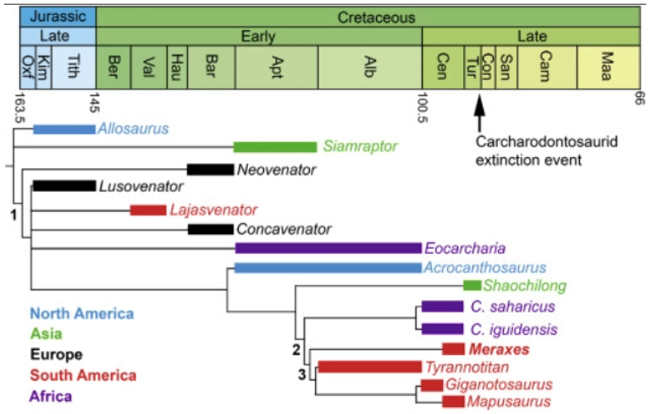
Cladogram depicting the temporal and geographical distribution of the Carcharodontosauridae family of theropod dinosaurs. At the time of their extinction these meat-eating dinosaurs seem to have been at their peak diversity. Picture credit: Canale et al.

The discovery of yet another super-sized carcharodontosaurid from Argentina demonstrates the high diversity of these theropods shortly before their extinction. Parallels can be drawn between the diversity of South American carcharodontosaurids and tyrannosaurs known from the Campanian faunal stage in western North America.

There are no reliable records of carcharodontosaurids in South America beyond the end of the Turonian stage of the Late Cretaceous, this great clade of theropods are believed to have become extinct around 90 million years ago.

To read a related article about another South American theropod with reduced forelimbs and fingers like a T. rex: Gualicho Sticks Two Fingers up at T. rex.

What’s in a Name

The genus name (Meraxes) is named after a female dragon from the Song of Ice and Fire series of books by George R. R. Martin, upon which the hugely successful television series “Game of Thrones” was based. The species name (gigas) comes from the Greek meaning giant.

The scientific paper: “New giant carnivorous dinosaur reveals convergent evolutionary trends in theropod arm reduction” by Juan I. Canale, Sebastián Apesteguía, Pablo A. Gallina, Jonathan Mitchell, Nathan D. Smith, Thomas M. Cullen, Akiko Shinya, Alejandro Haluza, Federico A. Gianechini and Peter J. Makovicky published in Current Biology.

6 07, 2022

Cold Climate Allowed the Dinosaurs and Pterosaurs to Thrive

By |2023-02-07T09:46:59+00:00July 6th, 2022|Categories: Adobe CS5, Dinosaur and Prehistoric Animal News Stories, Dinosaur Fans, Geology, Main Page, Palaeontological articles|0 Comments

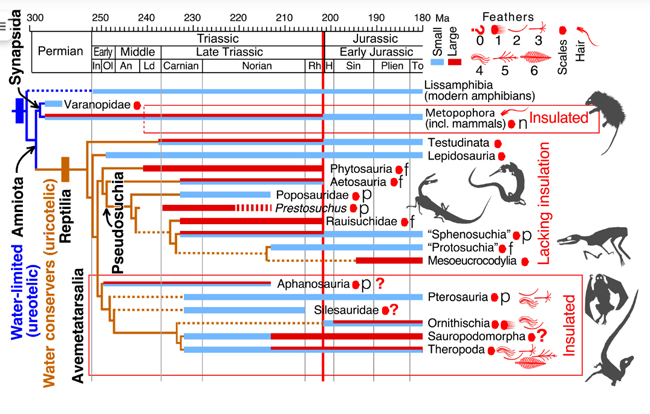
Scientists propose that cold snaps killed off the competitors of the dinosaurs and pterosaurs at the end of the Triassic opening the door for a dinosaur dominated Jurassic. The researchers propose that dinosaurs and pterosaurs with their integumentary coverings including primitive feathers, were insulated from the cold, whereas many other types of reptile co-existing with them just had scales. It was the body coverings that permitted the Dinosauria and the Pterosauria to thrive in cold conditions, whereas many of the other reptiles became extinct.

Compsognathus illustration by Chuang Zhao.
A beautiful feathered Compsognathus catches its lunch (artwork by Chuang Zhao). Fossil evidence suggests that many types of dinosaur were feathered, there is also growing evidence to suggest that pterosaurs too had insulating coats. A new theory proposes that these insulating coverings helped the Dinosauria and the Pterosauria to endure cold climates the onset of which led to a mass extinction event.

Ice-rafted Debris Discovered in Lakebed Deposits

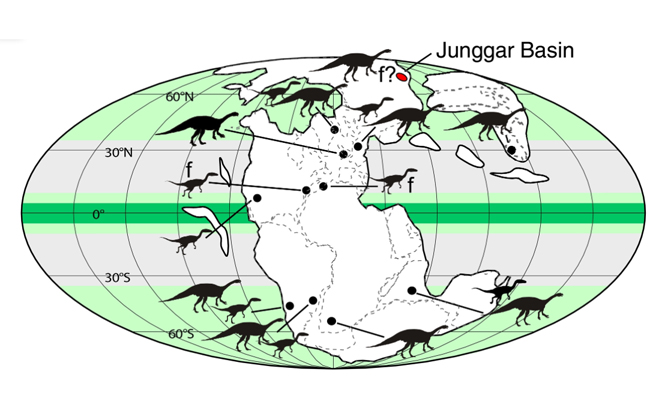
The research team which included Paul Olsen, lead author of the study (Lamont-Doherty Earth Observatory at Columbia University), examined sandstone and siltstone formations formed in lakebeds in China’s Junggar Basin. These deposits are Upper Triassic in age and at this time this part of China had a palaeolatitude of around 71 degrees north. It was well above the Arctic Circle. Footprints found by the researchers indicate the presence of dinosaurs. In addition, the lake sediments contained abundant small pebbles, and it was concluded that these pebbles represent ice-rafted debris deposits.

Late Triassic Pangaea and location of known dinosaur fossils.
Map of Pangaea in the Late Triassic. The Junggar Basin is highlighted in red. Silhouettes show location and type of dinosaur known. Most dinosaurs were confined to higher latitudes and f signifies the presence of dinosaur tracks indicating their presence in the palaeoenvironment of the Junggar Basin. Picture credit: Olsen et al.

The Small Pebbles are Significant

The numerous small pebbles found amongst the fine siltstones and sandstones were probably deposited by melting blocks of ice. The research team, who included scientists from the Chinese Academy of Sciences, suggest that in the winter when the lake waters froze over, pebbles were picked up by the ice from the rocky lake shores. As the warm weather returned, the ice sheets would melt and chunks of ice would float away over the lake, gradually melting and as they did, they would drop the pebbles and other material.

Survival of the Fluffiest

The ice-rafted debris suggest freezing winters endured by dinosaurs. Around 201.6 million years ago, extensive volcanism which ejected millions of tonnes of debris into the Earth’s atmosphere lowered light levels and led to global climate change. Our planet endured a prolonged period of cold.

The cold decimated all medium-to large-sized non-dinosaurian, non-insulated continental reptiles. As they were adapted to cold climates, the Dinosauria and their cousins the Pterosauria were well placed to dominate terrestrial habitats as world temperatures plummeted.

Dinosaurs and pterosaurs had an advantage in the End-Triassic extinction event.
The scientists concluded that many large reptiles that lacked thermal insulation that would have been provided by an integumentary covering died out during the End-Triassic extinction event. In contrast, pterosaurs and dinosaurs with their insulating coats were able to cope much better and survived this extinction event. The unoccupied niches in the ecosystem were soon filled as these archosaurs diversified in the Early Jurassic. Picture credit: Olsen et al.

Cold Climate

Lead author of the study Paul Olsen commented:

They were [dinosaurs and pterosaurs] fundamentally cold-adapted animals. When it got cold everywhere, they were ready, and other animals were not.”

To read an article about integumentary coverings in the Pterosauria: Branching Feathers and Melanosomes Identified in a Pterosaur Fossil.

The scientific paper: “Arctic ice and the ecological rise of the dinosaurs” by Paul Olsen, Jingeng Sha, Yanan Fang, Clara Chang, Jessica H. Whiteside, Sean Kinney, Hans-Dieter Sues, Dennis Kent, Morgan Schaller and Vivi Vajda published in Science Advances.

3 07, 2022

Robust Roo from Papua New Guinea

By |2023-04-25T06:39:05+01:00July 3rd, 2022|Categories: Adobe CS5, Dinosaur and Prehistoric Animal News Stories, Main Page, Palaeontological articles, Photos/Pictures of Fossils|0 Comments

Scientists have described a new genus of robust kangaroo from fossils found in late Pleistocene deposits in Papua New Guinea. Analysis suggests that it was not closely related to kangaroos found today in Australia.

Protemnodon nombe

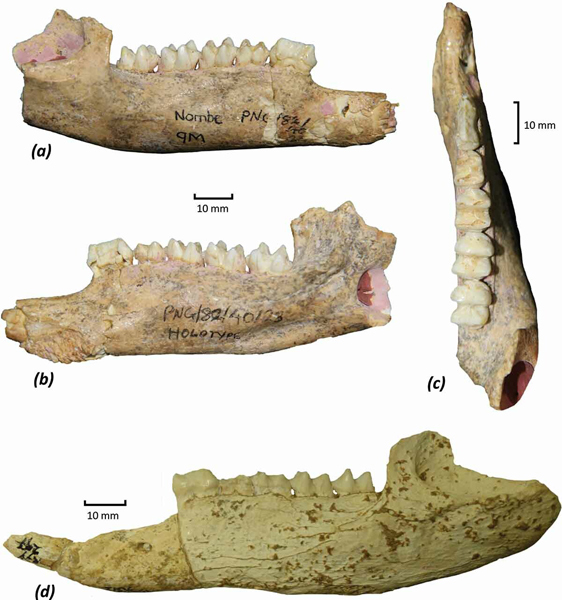
Researchers from Flinders University examined two partial dentaries (lower jaw bones) that had been previously assigned to the Protemnodon genus and named P. nombe. They identified unique characteristics in the teeth and the shape of the bones that led them to conclude that the fossils were sufficiently different from other Protemnodon material to be assigned their own genus. The ancient kangaroo has been named Nombe nombe honouring the Nombe Rockshelter where the fossils were discovered.

Nombe nombe life reconstruction.
A life reconstruction of the prehistoric kangaroo Nombe nombe. Standing around 1.5 metres tall and weighing up to 60 kilograms, the thick dentary and strong teeth indicate Nombe evolved to eat tough leaves in the dense jungle landscape. Picture credit: Peter Schouten.

A New Guinea/Australia Land Bridge

During the Miocene Epoch, around 5-8 million years ago, lower global sea levels permitted a land bridge between Australia and Papua New Guinea to form. This led to a faunal interchange between the two regions. An ancient form of Australian kangaroo migrated northwards and entered the territory now known as Papua New Guinea. When sea levels rose and the Torres Strait was formed, these ancient kangaroos were able to evolve in isolation away from their Australian ancestors.

Nombe nombe dentaries.
Nombe nombe lower jaw bones. Holotype and referred specimen of Nombe nombe: holotype (PNG/82/40/23) partial right dentary in (a) buccal/lateral view, (b) lingual/medial view and (c) lower dentition in occlusal/dorsal view; (d) referred specimen (PM/82/40/19) partial left dentary in buccal/lateral view. Picture credit: Kerr and Prideaux.

A Robust Kangaroo

Co-author of the scientific paper published in the Transactions of the Royal Society of South Australia, PhD student Isaac Kerr commented:

“The New Guinean fauna is fascinating, but very few Australians have much of an idea of what’s actually there.”

Co-author of the paper, Professor Gavin Prideaux (Flinders University), explained that excavations at the Nombe Rockshelter and elsewhere in central Papua New Guinea are providing palaeontologists with evidence of a unique ecosystem on the island, a biota dominated by prehistoric marsupials that were adapted to their mountainous, tropical environment. Flinders University hopes to be able to undertake more extensive fieldwork over the next three years and they are confident that these excavations will unearth new species.

Prehistoric Papua New Guinea
Life in the late Pleistocene on Papua New Guinea. The megafauna was dominated by extinct species of kangaroo and giant four-legged marsupials called diprotodontids, which in turn were hunted by Thylacines. Picture credit: Peter Schouten.

Everything Dinosaur acknowledges the assistance of a media release from Flinders University in the compilation of this article.

The scientific paper: “A new genus of fossil kangaroo from late Pleistocene New Guinea” by Isaac A. R. Kerr and Gavin J. Prideaux published in the Transactions of the Royal Society of South Australia.

Visit Everything Dinosaur’s award-winning website: Everything Dinosaur.

30 06, 2022

Tetrapodophis Revised – It’s Not a Snake

By |2025-01-07T20:23:55+00:00June 30th, 2022|Categories: Adobe CS5, Dinosaur and Prehistoric Animal News Stories, Dinosaur Fans, Main Page, Palaeontological articles|0 Comments

The Early Cretaceous Tetrapodophis amplectus, once thought to represent an early limbed snake, was not a snake after all, but a member of the Dolichosauridae. The fossil is not a missing link between lizards and snakes but an aquatic lizard. That was the conclusion in a paper published late last year (2021) and today we take a look at this remarkable and highly controversial fossil specimen.

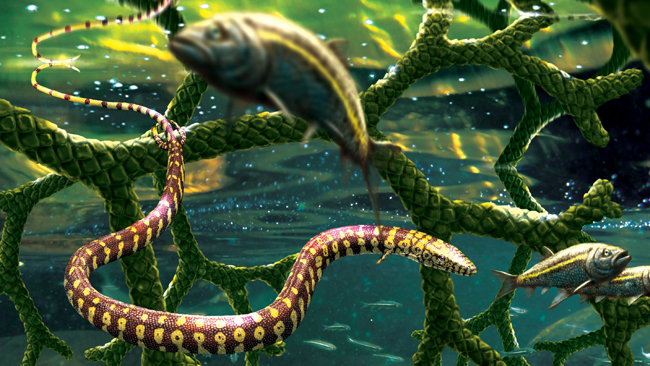
Tetrapodophis life reconstruction.

A life reconstruction of Tetrapodophis amplectus gliding through cover as it stalks fish close to the shore. New research suggests that this Early Cretaceous reptile is not a transitional form between a lizard and a snake, but instead it is a dolichosaurid. Picture credit: Julius Csotonyi.

Picture credit: Julius Csotonyi

A Transitional Fossil

Palaeontologists had long hoped to find a transitional fossil showing a lizard-like animal with vestigial limbs, an evolutionary link in the evolution of snakes from a limbed ancestor. Tetrapodophis was named in 2015, when a scientific paper was published describing a remarkable fossil from Brazil that had been spotted quite by chance by scientists on a visit to a German museum.

To read Everything Dinosaur’s 2015 article about the T. amplectus scientific paper: Fossil Snake with Four Limbs Described.

Had Tetrapodophis been revealed to be an ancestral snake then this would have had very significant implications for our understanding of the evolution of the Squamata. However, in November 2021 a scientific paper was published in the “Journal of Systematic Palaeontology” which concluded that the fossil had been misidentified. The research team from the University of Alberta, Harvard University, Flinders University (South Australia), the University of Toronto, Midwestern University and the Universidad Maimónides (Buenos Aires, Argentina), examined the counter slab and concluded that the fossil skull impression did not demonstrate characteristics typically seen in snake skulls.

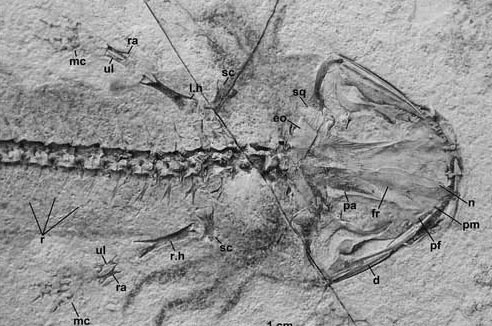
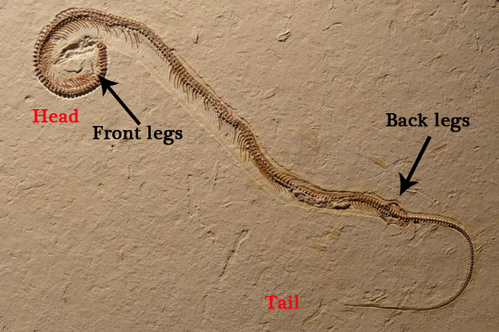
Tetrapodophis fossil.

A beautifully preserved specimen once thought to represent an early, limbed snake but now thought to be a marine lizard related to snakes and modern lizards. Picture credit: Dr Dave Martill/University of Portsmouth with additional annotation by Everything Dinosaur.

Picture credit: Dr Dave Martill/University of Portsmouth with additional annotation by Everything Dinosaur

University of Alberta palaeontologist Michael Caldwell, who led the study commented:

“When the rock containing the specimen was split and it was discovered, the skeleton and skull ended up on opposite sides of the slab, with a natural mould preserving the shape of each on the opposite side. The original study only described the skull and overlooked the natural mould, which preserved several features that make it clear that Tetrapodophis did not have the skull of a snake — not even of a primitive one.”

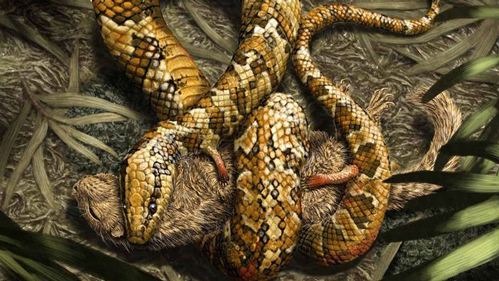
Tetrapodophis Illustrated

In the original 2015 scientific description, Tetrapodophis was thought to be an ancestral snake. The tiny limbs were thought to have been used to hold prey. Scientists were uncertain whether this animal was a burrower or adapted to a marine environment. It has now been assigned to the Dolichosauridae. Picture credit: Julius Csotonyi.

Picture credit: Julius Csotonyi

Squamata Evolution Remains Ambiguous

The evolution of the Order Squamata remains ambiguous. It is thought that the first, basal squamates evolved during the Middle Triassic, but when the first true snakes evolved is uncertain. The 2021 paper examining the skull impression in the counter slab confirmed that Tetrapodophis lacked typical snake skull characteristics. The spine was also shown to lack typical snake-like anatomical traits.

The fossil record for the Squamata is particularly sparse. Primitive snake and lizard skeletons are usually small with delicate bones that are easily dispersed post-mortem. Palaeontologists hope that more fossils will be found that help to clarify the evolutionary origins of snakes.

A Controversial Fossil

Tetrapodophis amplectus may not represent a snake with four legs, transitional fossils remain elusive, it still has immense scientific value. Co-author of the 2021 paper, Tiago Simões (Harvard University) explained:

“One of the greatest challenges of studying Tetrapodophis is that it is one of the smallest fossil squamates ever found. It is comparable to the smallest squamates alive today that also have reduced limbs.”

The fossil specimen remains controversial. The fossil, originally from Brazil may have been exported without the appropriate permits. It was part of a private collection and the authorities in Brazil only became aware of the fossil’s existence when the 2015 paper was published.

Tetrapodophis

To read an article about the legal dispute: Fossil Slithers into Legal Dispute.

Everything Dinosaur acknowledges the assistance of media releases from Flinders University and the University of Alberta in the compilation of this article.

The scientific paper: “Tetrapodophis amplectus is not a snake: Reassessment of the osteology, phylogeny and functional morphology of an Early Cretaceous dolichosaurid lizard” by M. W. Caldwell, T. R. Simões, A. Palcid, F. F. Garberoglio, R. R. Reisz, M. S. Y. Lee and R. L. Nydam published in the Journal of Systematic Palaeontology (November 2021).

The Everything Dinosaur website: Dinosaur Toys.

27 06, 2022

Frozen Baby Mammoth Discovered in the Klondike

By |2025-01-07T18:19:37+00:00June 27th, 2022|Categories: Adobe CS5, Animal News Stories, Dinosaur and Prehistoric Animal News Stories, Main Page, Palaeontological articles, Photos/Pictures of Fossils|0 Comments

Gold miners working at Eureka Creek in the Klondike Region of Yukon Province in Canada have discovered the frozen remains of a baby woolly mammoth. The calf, which is female is estimated to have lived around 30,000 years ago and it represents the best-preserved woolly mammoth specimen ever found in North America.

Baby mammoth from the Klondike of Yukon

The baby mammoth identified as a female, is the best preserved Woolly Mammoth (Mammuthus primigenius) found to date in North America. It is thought to be around 30,000 years old. Picture credit: Yukon Government.

Picture credit: Yukon Government

“Big Baby Animal”

The discovery was made on June 21st, the Northern Hemisphere solstice and also appropriately, Canada’s National Indigenous Peoples Day. The Klondike gold fields lie within the Trʼondëk Hwëchʼin Traditional Territory. Trʼondëk Hwëchʼin elders have named the mammoth calf Nun cho ga, meaning “big baby animal” in the indigenous people’s (Hän) language.

Ice Age animal remains are quite commonly found in the Yukon area as they erode out of thawing permafrost, however, mummified remains complete with skin and hair are exceptionally rare.

Minister for Tourism and Culture, Ranj Pillai of the Yukon Territory Administration commented:

“The Yukon has always been an internationally renowned leader for ice age and Beringia research. We are thrilled about this significant discovery of a mummified woolly mammoth calf: Nun cho ga. Without strong partnerships between placer miners, Trʼondëk Hwëchʼin, and the Yukon government, discoveries like this could not happen.”

Woolly Mammoths. An Ice Age scene. What caused the extinction of the mammalian megafauna?

Woolly Mammoths (M. primigenius) an iconic animal of the Ice Age.

Vertebrate palaeontologist Dr Grant Zazula added:

“As an ice age palaeontologist, it has been one of my lifelong dreams to come face to face with a real woolly mammoth. That dream came true today. Nun cho ga is beautiful and one of the most incredible mummified ice age animals ever discovered in the world. I am excited to get to know her more.”

Comparisons with Lyuba

The discovery of the superbly preserved corpse will provide scientists with an opportunity to compare Nun cho ga with Lyuba, a mammoth calf discovered in Siberia back in 2007. Lyuba lived a few thousand years earlier than the Yukon mammoth (circa 41,800 years), researchers will have the opportunity to compare the genetic health of the mammoth population and plot any changes between the older Lyuba and Nun cho ga which lived, around 12,000 years later.

The baby Woolly Mammoth known as Lyuba.

The 40,000-year-old baby mammoth Lyuba. Picture credit: Uppa/Photoshot (Daily Telegraph News).

Picture credit: Uppa/Photoshot (Daily Telegraph News)

The discovery of Nun cho ga is not the first woolly mammoth calf found in North America. In 1948, a partial mammoth calf, nicknamed Effie, was found at a gold mine in Alaska.

CollectA Woolly Mammoth models.

The CollectA Deluxe Woolly Mammoth model in 1:20 scale and the CollectA Prehistoric Life Woolly Mammoth calf. Picture credit: Everything Dinosaur.

Picture credit: Everything Dinosaur

The picture (above) shows a CollectA Deluxe Woolly Mammoth model and a CollectA Woolly Mammoth calf.  This is a popular pair of prehistoric mammal models.

To view the range of CollectA scale models: CollectA Deluxe Prehistoric Life.

The CollectA Age of Dinosaurs Popular range: CollectA Age of Dinosaurs Popular Range.

Go to Top