All about dinosaurs, fossils and prehistoric animals by Everything Dinosaur team members.

Fossil finds, new dinosaur discoveries, news and views from the world of palaeontology and other Earth sciences.

1 06, 2022

Have we Got Evolutionary Trees All Wrong?

By |2025-01-05T20:44:54+00:00June 1st, 2022|Categories: Adobe CS5, Animal News Stories, Dinosaur and Prehistoric Animal News Stories, Main Page|0 Comments

A study led by scientists at the Milner Centre for Evolution at the University of Bath suggests that a fundamental cornerstone of evolutionary biology could be misrepresenting taxonomic relationships.

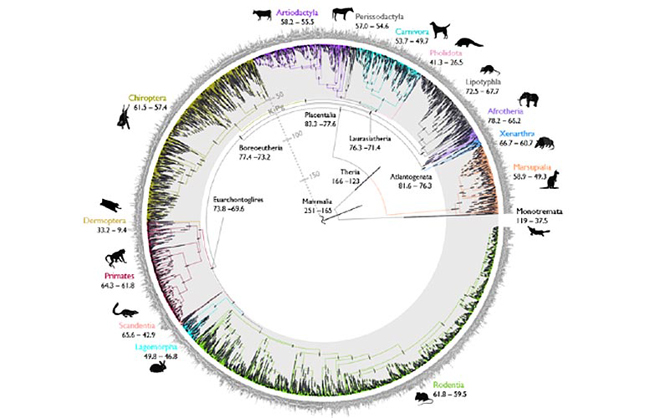
It is usual practice for biologists to establish evolutionary trees that set out the relationships between organisms. New research published in the academic journal “Communications Biology”, suggests that most of the evolutionary trees that have been constructed could be inaccurate and that convergent evolution is much more common than previously thought.

Mammal tree of life.
The mammalian tree of life. New research indicates that trees constructed using genetic data (where available) will be more accurate than trees built using anatomical comparisons. Picture credit: Mario dos Reis Barros and Sandra Alvarez-Carretero.

These trees are constructed by comparing anatomical characteristics, but this research suggests evolutionary trees based on the analysis of genetic sequences may be more reliable.

Overturning Centuries of Scholarly Work

Since Charles Darwin erected a “tree of life” in the 19th century, biologists have been trying to develop “family trees” of organisms by carefully examining differences in their anatomy and morphology.

With the development of rapid genetic sequencing techniques, scientists are now able to use genetic (molecular) data to compile evolutionary relationships very quickly and cheaply.

This genetic approach has led to substantial revisions in our understanding. Organisms once thought to be closely related have been demonstrated to belong to very different branches of the evolutionary tree.

Comparing the Two Methods of Building Evolutionary Trees

Scientists at the University of Bath compared evolutionary trees based on a traditional analysis of anatomy/morphology with those created using molecular data. The researchers discovered that the animals grouped together by molecular trees lived more closely together geographically than the animals grouped using the morphological trees, which implies that genetic themed evolutionary trees are more accurate.

Commenting on the significance of this study, one of the co-authors, Matthew Wills, Professor of Evolutionary Paleobiology at the Milner Centre for Evolution (University of Bath) explained:

“It turns out that we’ve got lots of our evolutionary trees wrong. For over a hundred years, we’ve been classifying organisms according to how they look and are put together anatomically, but molecular data often tells us a rather different story. Our study proves statistically that if you build an evolutionary tree of animals based on their molecular data, it often fits much better with their geographical distribution.”

Biogeography – A Reliable Guide to Evolutionary Relationships

Where organisms live, their biogeography, is regarded as an important source of evolutionary evidence that was familiar to 19th century scientists such as Darwin, Owen and Huxley. Genetic studies of animals that bear little similarity to each other such as aardvarks, elephants, golden moles, manatees and elephant shrews demonstrate that they originated from the same branch of the mammalian family tree. Molecular studies place these mammals into a single group called the Afrotheria, so-named because these animals seem to have originated from Africa, so the molecular data matches the biogeography.

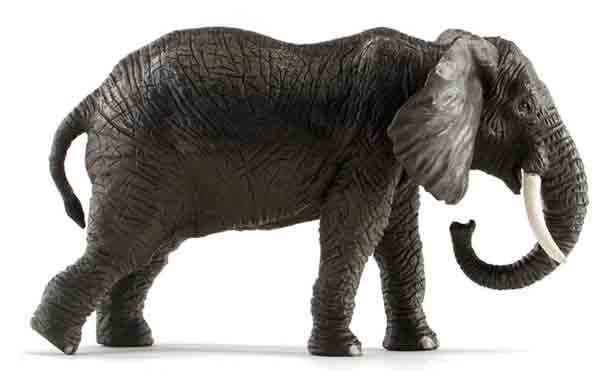
An African elephant model.
An African elephant (Loxodonta). Molecular analysis has constructed trees showing that elephants, golden moles, elephant shrews and swimming manatees have all originated from the same branch of the mammalian family tree, although they look very different to each other and occupy different roles in the ecosystem.

Convergent Evolution More Prevalent

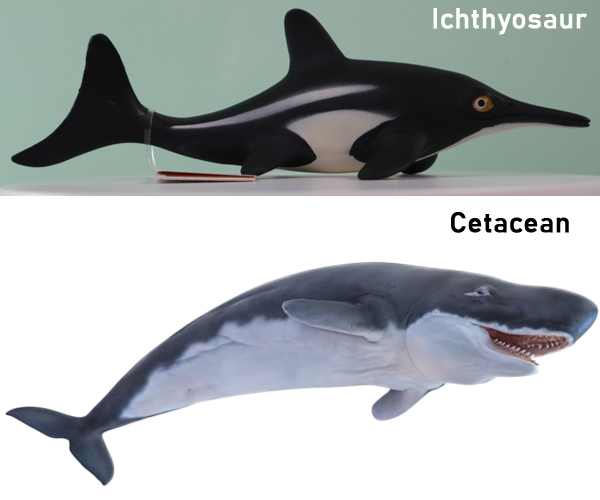
The study also found that convergent evolution was more prevalent than previously thought. Convergent evolution occurs when a trait or characteristic evolves separately in two genetically unrelated groups of organisms such as the evolution of tail flukes in cetaceans and the entirely unrelated ichthyosaurs.

Professor Wills added:

“We already have lots of famous examples of convergent evolution, such as flight evolving separately in birds, bats and insects, or complex camera eyes evolving separately in squid and humans. But now with molecular data, we can see that convergent evolution happens all the time, things we thought were closely related often turn out to be far apart on the tree of life.”

Ichthyosaur compared to a cetacean.
An example of convergent evolution. Although unrelated, ichthyosaurs and cetaceans are similar in their appearance.

The ichthyosaur figure shown in the image above is from the Wild Safari Prehistoric World series.

To view this range of prehistoric animal models: Wild Safari Prehistoric World Figures.

The Professor explained that people who make a living as celebrity doubles or lookalikes are not usually related to the person that they are impersonating. Individuals in a family do not always look the same, it is the same for evolutionary trees.

Professor Wills stated:

“It proves that evolution just keeps on re-inventing things, coming up with a similar solution each time the problem is encountered in a different branch of the evolutionary tree. It means that convergent evolution has been fooling us, even the cleverest evolutionary biologists and anatomists for over a hundred years!”

Everything Dinosaur acknowledges the assistance of a media release from the University of Bath in the compilation of this article.

The scientific paper: “Molecular phylogenies map to biogeography better than morphological ones” by Jack W. Oyston, Mark Wilkinson, Marcello Ruta and Matthew A. Wills published in Communications Biology.

Visit the Everything Dinosaur website: Everything Dinosaur.

31 05, 2022

Scientists are Fascinated with the Extinction of Megalodon

By |2024-12-31T11:46:32+00:00May 31st, 2022|Categories: Adobe CS5, Dinosaur and Prehistoric Animal News Stories, Main Page, Photos/Pictures of Fossils|0 Comments

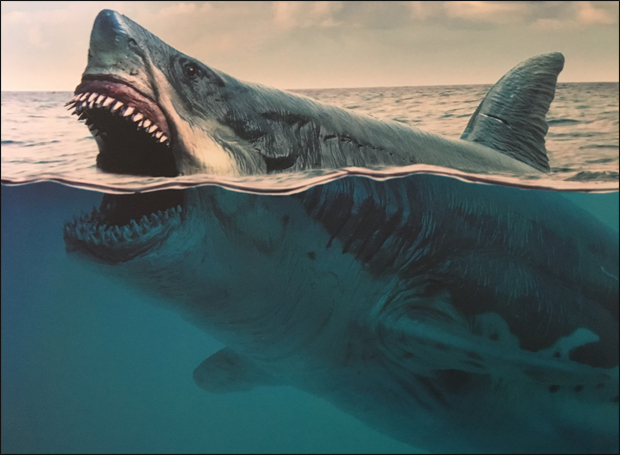
The extinction of Megalodon more appropriately termed Otodus megalodon, regarded as the largest hypercarnivorous shark that has ever existed has been the subject of numerous scientific papers. Newly published research suggests that competition for food and space with the Great White Shark (C. carcharias) and possibly other large taxa such as hypercarnivorous toothed whales could have played a role in the giant fish’s extinction.

Brilliant artwork on the PNSO Megalodon model cover sleeve.

The amazing, colourful sleeve artwork on the PNSO Megalodon figure. Several scientific papers have explored the potential reasons for the demise and extinction of Otodus megalodon – regarded as the largest hypercarnivorous shark known to science.

Zinc Isotope Analysis from Teeth

The diet of extinct animals can hold clues to their lifestyle, behaviour, evolution and ultimately their extinction. However, studying an animal’s diet after millions of years is difficult due to the poor preservation of chemical dietary indicators in organic material. An international team of scientists led by the Max Planck Institute for Evolutionary Anthropology (Leipzig, Germany), used a new technique, analysing zinc isotopes preserved in the mineralised tooth enamel to assess how far up the food chain Otodus megalodon was placed in comparison to the extant Great White Shark.

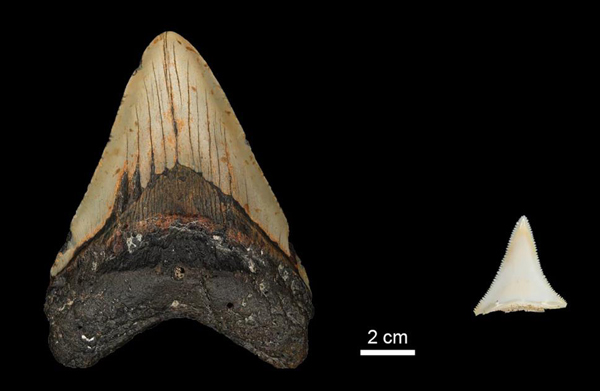
Tooth comparison Megalodon and Great White Shark

A tooth from extinct early Pliocene Otodus megalodon (left) compared with a tooth (right) from a modern Great White Shark (C. carcharias). Picture credit: Max Planck Institute for Evolutionary Anthropology.

Picture credit: Max Planck Institute for Evolutionary Anthropology

More Reliable than Nitrogen Isotope Analysis of Tooth Collagen

Nitrogen analysis of tooth collagen, a protein-based component of tooth dentine, has been used to establish the degree of animal matter consumed in a diet. However, in fossils collagen is generally not preserved so an analysis of zinc isotopes associated with the highly mineralised tooth enameloid may prove to be a more reliable indicator of the diet of long extinct animals.

Lead author of the study, published in “Nature Communications”, Dr Jeremy McCormack (Max Planck Institute for Evolutionary Anthropology) stated:

“On the timescales we investigate, collagen is not preserved, and traditional nitrogen isotope analysis is therefore not possible.”

The isotope ratios in O. megalodon teeth from the Pliocene were studied along with earlier Miocene “megatooth” taxa such as Otodus chubutensis. Modern contemporaneous shark species such as C. carcharias were analysed to provide a comparison. The researchers identified similar zinc isotope signatures in extinct as well as their modern analogous taxa.

Megalodon Occupied the Same Niche as Great White Sharks

The researchers concluded that super-sized sharks such as Otodus megalodon occupied the same niche in the ecosystem as the extant Great White Shark (Carcharodon carcharias). This suggests that when these two taxa were contemporaneous, they would have competed for the same resources.

This competition may have played a role in the demise and eventual extinction of Megalodon.

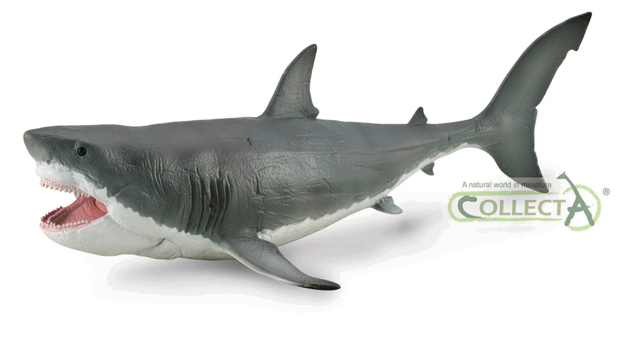
CollectA Deluxe Megalodon shark model.

The CollectA 1:60 scale Megalodon shark model. The extinction of Otodus megalodon could have been caused by multiple, compounding environmental and ecological factors including climate change and thermal limitations, the collapse of prey populations and resource competition with Carcharodon carcharias.

The picture (above) shows a CollectA Deluxe Otodus megalodon shark model.  It is a detailed prehistoric animal figure.

To view the range of CollectA Deluxe scale models: CollectA Deluxe Scale Models.

The extinction of Otodus megalodon could have had multiple causes. For example, environmental and ecological factors including climate change and dramatic cooling of the seas resulting in a restriction of the habitat of O. megalodon. In addition, the collapse of prey populations along with resource competition from Carcharodon carcharias could have put the prehistoric sharks under increasing pressure.

This study did not examine the potential impact on O. megalodon through competition from toothed whales (carnivorous odontocetes). If zinc isotope analysis proves to be a reliable methodology for analysing the diets of long extinct creatures, then this technique could be used to examine the impact of toothed whales on Megalodon populations.

Everything Dinosaur acknowledges the assistance of a media release from the Max Planck Institute for Evolutionary Anthropology in the compilation of this article.

The scientific paper: “Trophic position of Otodus megalodon and great white sharks through time revealed by zinc isotopes” by Jeremy McCormack, Michael L. Griffiths, Sora L. Kim, Kenshu Shimada, Molly Karnes, Harry Maisch, Sarah Pederzani, Nicolas Bourgon, Klervia Jaouen, Martin A. Becker, Niels Jöns, Guy Sisma-Ventura, Nicolas Straube, Jürgen Pollerspöck, Jean-Jacques Hublin, Robert A. Eagle and Thomas Tütken published in Nature Communications.

The award-winning Everything Dinosaur website: Prehistoric Animal Models and Toys.

27 05, 2022

A Basal Iguanodontian from Southern China

By |2024-12-31T10:46:40+00:00May 27th, 2022|Categories: Adobe CS5, Dinosaur and Prehistoric Animal News Stories, Dinosaur Fans, Main Page, Photos/Pictures of Fossils|0 Comments

Scientists have named and described a new genus of basal iguanodontian from the Xinlong Formation of southern China. The dinosaur has been named Napaisaurus guangxiensis. It is the first, basal iguanodontian taxa described from southern China.

Napaisaurus guangxiensis fossil material.

Holotype fossil material of Napaisaurus (N. guangxiensis) is a right ilium and ischium found in 2020. It is the first, basal iguanodontian taxa from southern China. Picture credit: Ji and Zhang.

Picture credit: Ji and Zhang

Fossils Found in 2020

Partial hip bones (a right ilium and a right ischium) from a single individual animal were discovered in 2020 from excavations undertaken in strata associated with the Aptian-aged, Xinlong Formation of Napai Basin, Fusui County, Guangxi Zhuang Autonomous Region, South China. The dinosaur’s name translates as Napai Basin lizard from Guangxi and its discovery adds to the dinosaur biota (sauropods, spinosaurids and carcharodontosaurids) associated with the Xinlong Formation.

Team members at Everything Dinosaur, estimate that based on the partial hip bones, the Napaisaurus specimen would have been around four metres in length.

Scale drawing of Napaisaurus

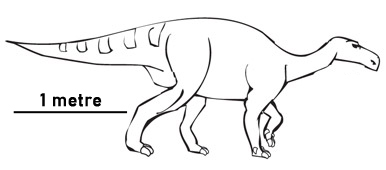
A scale drawing of Napaisaurus guangxiensis. This basal iguanodontian is estimated to be around four metres in length. Picture credit: Everything Dinosaur.

Picture credit: Everything Dinosaur

Comparing Dinosaur Biotas from China and North-eastern Thailand

The official journal publication announcing the discovery of this new Early Cretaceous herbivore was published earlier this year, but it was made available on-line in 2021.

The fossils permit an iguanodontian to be added to the dinosaur biota associated with the Xinlong Formation and it provides important evidence helping palaeontologists to better understand the relationship between the Lower Cretaceous fossils of the Napai Basin (Xinlong Formation) and those associated with contemporaneous deposits from northern China and the Khorat Group of north-eastern Thailand. Specifically, the naming of Napaisaurus adds a definitive iguanodontian to the Xinlong Formation biota, thus permitting a more detailed comparison with the ornithischian dinosaurs associated with the Aptian-aged Khok Kruat Formation (the uppermost member of the Khorat Group), from which several iguanodontian ornithopods have been described (Ratchasimasaurus, Siamodon, Sirindhorna).

The scientific paper: “First new genus and species of basal iguanodontian dinosaur (Ornithischia: Ornithopoda) from southern China” by S. Ji and P. Zhang published in Acta Geoscientica Sinica.

The award-winning Everything Dinosaur website: Dinosaur and Prehistoric Animal Models.

25 05, 2022

Argentina’s Amazing “Dragon of Death” is Described

By |2024-12-31T10:19:52+00:00May 25th, 2022|Categories: Adobe CS5, Dinosaur and Prehistoric Animal News Stories, Dinosaur Fans, Main Page, Palaeontological articles, Photos/Pictures of Fossils|0 Comments

Researchers have named the largest pterosaur found to date in South America. The giant Thanatosdrakon (T. amaru) is estimated to have had a wingspan of around nine metres and it would have stood as tall as a giraffe.

Writing in the academic journal “Cretaceous Research”, the scientists, have assigned Thanatosdrakon to the Azhdarchidae family of pterosaurs and postulate that it was closely related to the slightly larger and geologically younger Quetzalcoatlus, fossils of which are known from North America.

Left humerus of Thanatosdrakon

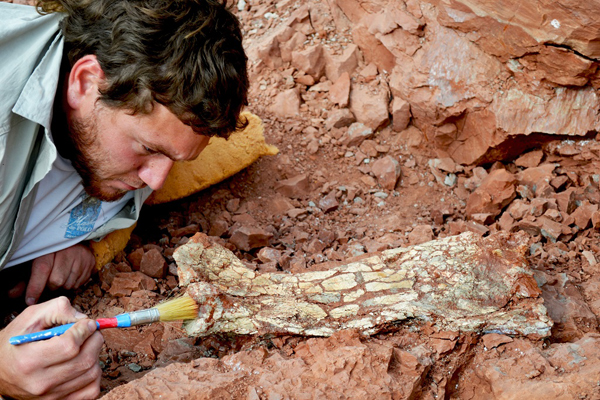
The paratype fossil a giant left humerus (UNCUYO-LD 350) is carefully cleaned at the dig site. Picture credit: Reuters/ICB-CONICET/UNCUYO.

Picture credit: Reuters/ICB-CONICET/UNCUYO

One of the Largest Flying Vertebrates Known

The fossil material, thought to represent two individual pterosaurs was found in the upper-most levels of the Plottier Formation (upper Coniacian–lower Santonian, Neuquén Basin), Mendoza, western Argentina. The researchers, who include CONICET* researcher Dr Leonardo Ortiz David, Dr Bernardo González Riga, director of the Laboratory and Museum of Dinosaurs of the Faculty of Exact and Natural Sciences and world-renowned pterosaur expert Dr Alexander Kellner (Director of the National Museum of Rio de Janeiro, Brazil), estimate that Thanatosdrakon lived around 86 million years ago. Based on the single, huge left humerus of the paratype (UNCUYO-LD 350), a wingspan of around 9 metres is proposed, making Thanatosdrakon amaru one of the largest flying vertebrates known to science.

Thanatosdrakon Size Comparison

Comparing the estimated wingspans of the paratype and holotype fossil material associated with Thanatosdrakon amaru with large, extant birds. Picture credit: ICB-CONICET/UNCUYO.

Picture credit: Reuters/ICB-CONICET/UNCUYO

Exceptionally Preserved Fossils

A civil construction project had uncovered some of the fossils. A field team was despatched to map the site and to recover the exceptionally well-preserved bones. The fossil material consists of vertebrae and bones from the limbs. As the larger humerus was found in close proximity to the other fossils, the scientists have speculated that this huge animal was social and probably lived in flocks.

Thanatosdrakon is the oldest taxon of the clade Quetzalcoatlinae so far described. As the strata containing the fossil bones represent deposition in a floodplain environment with ephemeral meandering streams and rivers, the researchers conclude that like the much later Quetzalcoatlus, Thanatosdrakon inhabited continental, inland areas.

Thanatosdrakon skeletal material.

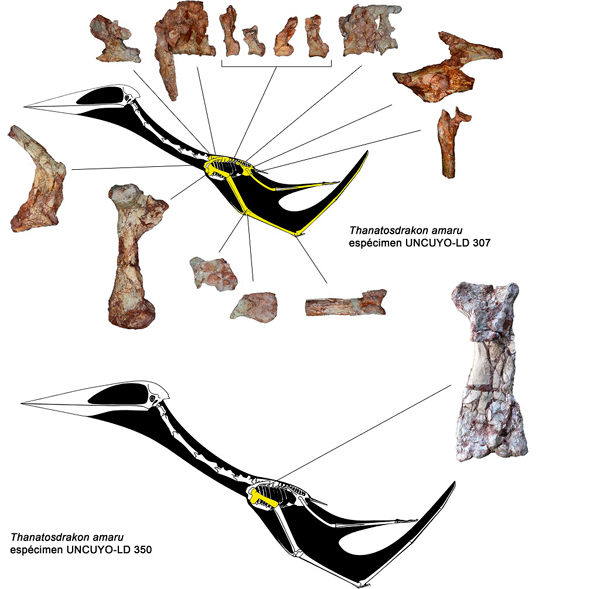
Skeletal reconstructions of Thanatosdrakon amaru. The holotype fossil material (UNCUYO-LD 307) and the left humerus paratype (UNCUYO-LD 350). Picture credit: ICB-CONICET/UNCUYO.

Picture credit: Reuters/ICB-CONICET/UNCUYO

Important Information on Azhdarchid Anatomy

The fossils are not distorted or flattened to any great degree. Their three-dimensional preservation will help the researchers to learn more about the anatomy of giant pterosaurs. In addition, some of the fossil bones such as the dorsosacral vertebrae and caudal vertebra along with the notarium (the structure formed by fusion of the dorsal vertebrae, seen in pterosaurs and birds), have never been described in giant azhdarchids. The researchers expect that further study of these bones will provide important information on azhdarchid anatomy.  Hopefully, new fossil finds will provide more information on the Azhdarchidae.

The “Dragon of Death”

This large pterosaur probably hunted on the ground, perhaps stalking prey in a similar manner to the marabou stork (Leptoptilos crumenifer) which is found in sub-Saharan Africa. The genus name is derived from the Greek words thanatos which means death and drakon (dragon). The species name honours the Inca winged serpent (Amaru).

CONICET* (Consejo Nacional de Investigaciones Científicas y Técnicas [National Council for Scientific and Technical Research of Argentina]).

The scientific paper: “Thanatosdrakon amaru, gen. et sp. nov., a giant azhdarchid pterosaur from the Upper Cretaceous of Argentina” by Leonardo D. Ortiz David, Bernardo J. González Riga and Alexander W. A. Kellner published in the journal Cretaceous Research.

22 05, 2022

The Remarkable Dzharaonyx eski – “Old Dzharakuduk Claw”

By |2024-12-31T09:51:14+00:00May 22nd, 2022|Categories: Dinosaur and Prehistoric Animal News Stories, Dinosaur Fans, Main Page, Palaeontological articles, Photos/Pictures of Fossils|0 Comments

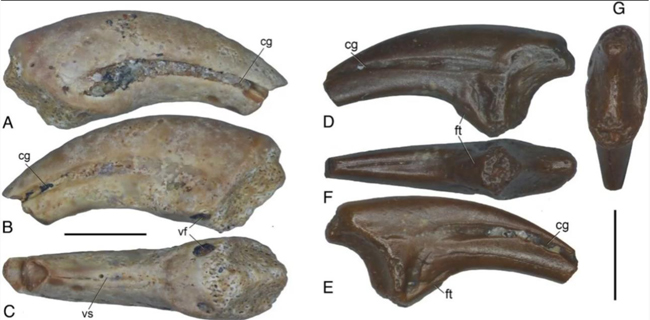
Earlier this spring, a new taxon of alvarezsaurid theropod was described from well-preserved, postcranial remains found in Uzbekistan. The little dinosaur, measuring less than half a metre long, has been named Dzharaonyx eski, which translates as “old Dzharakuduk claw”.

Dzharaonyx eski scale drawing.

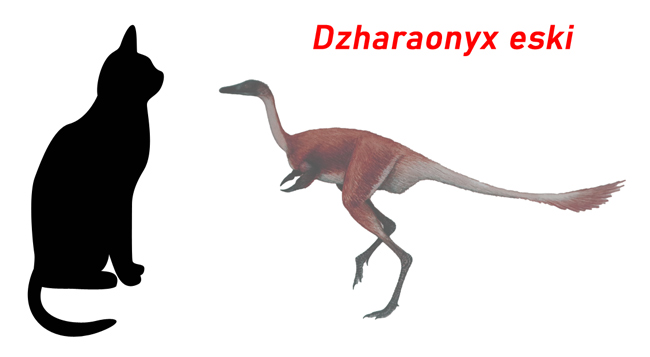
The cat-sized alvarezsaurid theropod Dzharaonyx eski from the Late Cretaceous of Uzbekistan. It is regarded as the geologically oldest member of the Parvicursorinae.

From the Bissekty Formation

Writing in the academic “Journal of Vertebrate Paleontology”, the researchers, including Hans-Dieter Sues (Department of Paleobiology, National Museum of Natural History, Smithsonian Institution, Washington, D.C.), describe this cat-sized theropod based on bones from the spine including dorsal and caudal vertebrae, limb bones, parts of the pelvis and bones from the hand including the iconic, robust alvarezsaurid claws.

Dzharaonyx claw fossils.

Dzharaonyx eski a new taxon of alvarezsaurid from the Late Cretaceous of Uzbekistan. Picture credit: Averianov and Sues.

Picture credit: Averianov and Sues

The fossils come from the Bissekty Formation (Upper Cretaceous, Turonian faunal stage) and D. eski is estimated to have lived around 91-92 million years ago. The dinosaur was named after the type locality (Dzharakuduk in south-central Uzbekistan). The species name “eski” is derived from the Uzbek word for “old”.

Pronounced Zar-ah-ra-on-niks es-key, a phylogenetic analysis of this newly described taxon places it within the alvarezsaurid subfamily the Parvicursorinae alongside other Asian members of the Alvarezsauridae such as Parvicursor (P. remotus) and Qiupanykus (Q. zhangi). Dzharaonyx eski is the oldest member of the Parvicursorinae known to science, it having lived at least 10 million years earlier than related species, fossils of which are confined to the Campanian and Maastrichtian faunal stages of the Late Cretaceous.

Remarkable Alvarezsaurids

Alvarezsaurids were highly specialised theropods, with a single, powerful hand claw adapted for tearing and digging. It is thought that these small maniraptoran dinosaurs fed on colonial insects such as termites.

The Alvarezsauridae family was erected in 1991 (Bonaparte). These long-legged theropods were once thought to be a lineage of flightless birds. Most palaeontologists consider them to be an early diverging branch of the Maniraptora. These dinosaurs tend to be both geographically and temporally widespread.

To read a blog post from 2021 about research into the evolution of the Alvarezsauridae: Miniature Alvarezsauroids Under the Spotlight.

Recently, another Asian member of the Parvicursorinae was described from partial, postcranial material from the Upper Cretaceous (Campanian) Barungoyot Formation in Mongolia. The alvarezsaurid has been named Ondogurvel alifanovi.

Mike from Everything Dinosaur commented:

“Dzharaonyx is a remarkable fossil discovery. It lived during the Turonian faunal stage of the Cretaceous. We look forward to more dinosaur discoveries from the famous Bissekty Formation.”

The scientific paper: “New material and diagnosis of a new taxon of alvarezsaurid (Dinosauria, Theropoda) from the Upper Cretaceous Bissekty Formation of Uzbekistan” by Alexander O. Averianov and Hans-Dieter Sues published in the Journal of Vertebrate Paleontology.

The award-wining Everything Dinosaur website: Prehistoric Animal Models and Toys.

21 05, 2022

New Mary Anning Statue Unveiled at Lyme Regis

By |2024-12-31T09:34:46+00:00May 21st, 2022|Categories: Adobe CS5, Dinosaur and Prehistoric Animal News Stories, Dinosaur Fans, Educational Activities, Famous Figures, Main Page, Photos|1 Comment

A statue commemorating the life and work of the pioneering palaeontologist Mary Anning has been unveiled in her hometown of Lyme Regis. Mary Anning (1799 – 1847), made some remarkable fossil discoveries along Dorset’s “Jurassic Coast”, although during her lifetime, her contribution to the nascent sciences of geology and palaeontology was not fully recognised.

The statue, created by artist and sculptress Denise Dutton, is placed on the seafront close to the sea defences, permitting Mary a view of Lyme Bay and the cliffs and shoreline that she explored with her brother Joseph as a child. During her lifetime she made several highly significant fossil discoveries in the Lower Jurassic marine beds, including the first ichthyosaur specimens to be scientifically studied, plesiosaurs and the first pterosaur fossil to be found outside Germany.

The unveiling of the Mary Anning statue at Lyme Regis (Dorset)

The statue commemorating the life and work of Mary Anning is unveiled. Picture credit: Mary Anning Rocks.

Picture credit: Mary Anning Rocks

Mary Anning Rocks

Young Evie Swire was the inspiration behind the charity Mary Anning Rocks, when she enquired on returning from a fossil hunting trip at Lyme Regis “why isn’t there a statue to Mary?” A fund-raising campaign was organised and on what would have been Mary’s 223rd birthday, Evie, now a teenager and her fellow campaigners unveiled the beautiful statue commemorating a key figure in the history of the Earth Sciences.

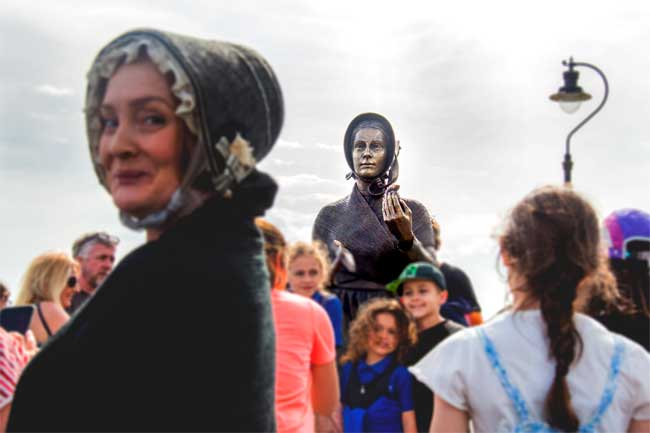
Mary Anning statue unveiled at Lyme Regis

Crowds flocked to see the unveiling of the new statue of Mary Anning unveiled, some people even dressed up like Mary. Picture credit: Mary Anning Rocks.

Picture credit: Mary Anning Rocks

Supporting and Celebrating the Role of Women in the Sciences

Everything Dinosaur was one of the first organisations from outside Lyme Regis to back the campaign and to help raise awareness. Since the charity’s inception, Everything Dinosaur has helped to promote and support the fundraising.

Mary Anning’s discoveries in the 19th Century helped shape scientific understanding of prehistoric life, but her work was never properly credited due to the fact that she was a woman and because of her lowly social status. A large crowd turned out for the unveiling, and team members at Everything Dinosaur are looking forward to one day soon returning to Lyme Regis and paying our respects to Mary Anning and her statue.

A spokesperson from Everything Dinosaur commented:

“We did so want to be there at the unveiling. The statue of Mary is not only a tribute to her, but it also helps to raise awareness of and celebrate the role of women in the sciences.”

Mary Anning Statue Unveiled

A close-view of the Mary Anning statue which was created by leading artist and sculptress Denise Dutton. Mary is holding an ammonite fossil in her left hand. Picture credit: Mary Anning Rocks.

Picture credit: Mary Anning Rocks

Anya Pearson one of the hard-working trustees of the Mary Anning Rocks charity exclaimed:

“It was a monumental day for a monumental Woman – At last!!!”

Our congratulations to all those people who have worked so hard to ensure that Mary Anning can be honoured in this way.

Commemorating the Life and Work of Mary Anning

Mike from Everything Dinosaur commented:

“The statue is wonderful way to commemorate the life and work of Mary Anning.  We congratulate all those people who helped to bring this about.  It will do a lot to boost the profile of Lyme Regis and the Dorset coast. The Mary Anning statue will attract a lot of visitors to the area.”

The Everything Dinosaur website: Prehistoric Animal Figures.

18 05, 2022

Cheltenham Science Festival – “Here be Sea Dragons”

By |2024-12-30T18:44:37+00:00May 18th, 2022|Categories: Dinosaur and Prehistoric Animal News Stories, Dinosaur Fans, Educational Activities, Main Page, Press Releases|0 Comments

The 2022 Cheltenham Science Festival starts next month (7th – 12th June) and as always, this festival is jam-packed with amazing events, presentations and activities covering just about every aspect of the sciences. The Earth sciences are strongly represented once again this year and award-winning palaeontologist Dr Dean Lomax will be delivering a talk entitled “Mary Anning and the Sea Dragons” at the centrally located Helix Theatre on the evening of the 8th June.

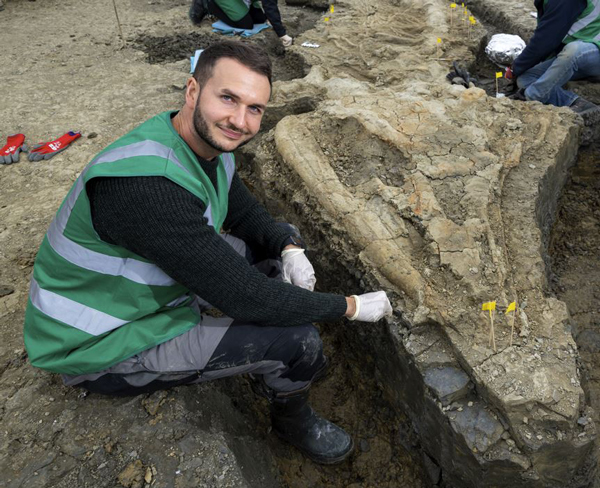
Dr Dean Lomax working on the skull of the Rutland ichthyosaur.

Dr Dean Lomax working on the skull of the Rutland ichthyosaur, the largest and most complete ichthyosaur fossil ever found in the UK. Picture credit: Matthew Power.

Picture credit: Matthew Power

Hic Sunt Dracones – “Here be Dragons”

The Latin expression “hic sunt dracones” which translates as “here be dragons”, was used by Medieval cartographers to highlight unexplored territories on maps or regions where monsters were thought to roam. Join Dr Lomax on a guided tour through 200 years of fossil discoveries, shedding light on the ichthyosaurs, those enigmatic “sea dragons” that thrived during the time of the dinosaurs.

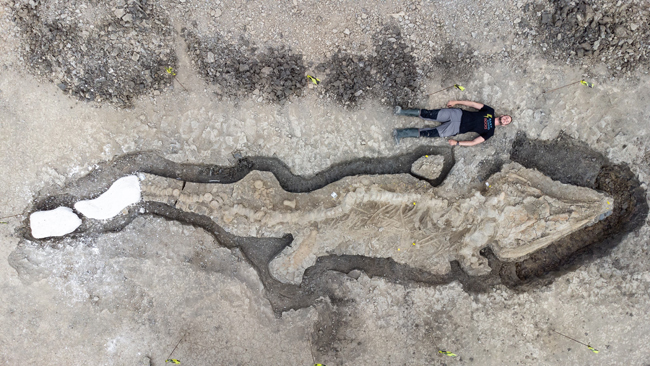
In “Mary Anning and the Sea Dragons”, Dr Lomax, a recent recipient of the prestigious Halstead Award from the Geologists’ Association, tells the amazing story of these marvellous marine reptiles, from the first fossil discoveries and the work of Mary Anning right up to the latest research including the excavation of the monstrous “Rutland Sea Dragon”, led by Dr Dean. Described as one of the most important finds in British palaeontological history, this huge ten-metre-long specimen is the biggest and most complete ichthyosaur fossil ever found in the UK.

Aerial view of the Rutland ichthyosaur excavation site.

An aerial view of the Rutland ichthyosaur excavation site. Dr Dean Lomax provides the scale. Picture credit: Matthew Power.

Picture credit: Matthew Power

Following in the Footsteps of Mary Anning

Mary Anning was an extraordinary pioneering palaeontologist from Lyme Regis in Dorset. She discovered the first ichthyosaurs (or “sea dragons”) brought to the attention of science and helped to put the science of palaeontology firmly on the map. Palaeontologist, author and renowned expert on ichthyosaurs Dr Lomax has spent much of his illustrious career following in the footsteps of Mary Anning, even acting as a consultant for a short film about her exploits fittingly entitled “Sea Dragon” which will be shown as part of Dean’s presentation at the Helix Theatre (Wednesday, June 8th 5pm-6pm).

Dr Dean Lomax and ichthyosaur fossils.

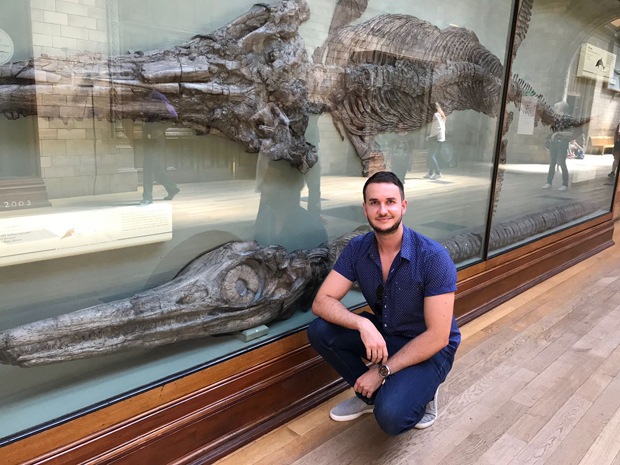
Dr Dean Lomax with ichthyosaur fossils on display at the Natural History Museum London. Picture credit: Dr Dean Lomax.

Picture credit: Dr Dean Lomax

Mary Anning and the “Sea Dragons”

Dean’s presentation – “Mary Anning and the Sea Dragons” is ideal for families and for children from seven years plus. Plot a course to the Helix Theatre for 5pm on June 8th to catch up with one of the UK’s leading scientists in the field of palaeontology.

The website of Dr Dean Lomax: Dr Dean Lomax – Palaeontologist.

A 21st Century Palaeontologist

Dr Lomax is currently involved with several important research programmes as well as media projects, and although he spends his working hours looking back into time, he is very much a 21st century palaeontologist with a passion for outreach work and science communication. Dean has recently written three books, reflecting his wide-ranging interests and engaging communication style.

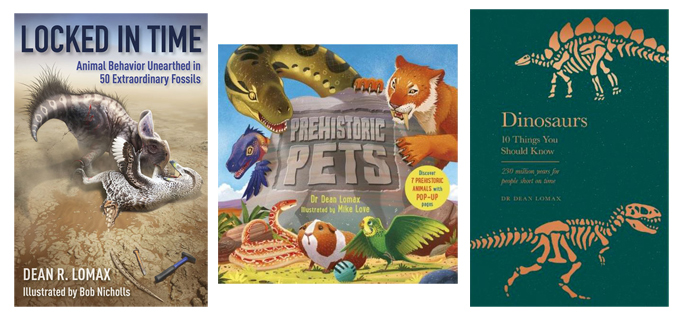
As always, Dean will be happy to answer questions and to chat to any budding young palaeontologists, their parents and any fossil enthusiasts and he will be signing copies of his latest books – “Locked in Time”, “Prehistoric Pets” and “Dinosaurs Ten Things You Should Know”.

Three books written by Dr Dean Lomax.

Dean has recently completed three books – “Locked in Time” (left) which is illustrated by Bob Nicholls. “Prehistoric Pets” (centre) and (right) “Dinosaurs 10 Things You Should Know”. Dr Lomax will be signing copies at this Cheltenham Festival Event.

Event Details

  • Event: Cheltenham Science Festival.
  • Presentation: Mary Anning and the “Sea Dragons” by Dr Dean Lomax.
  • Venue: Helix Theatre (located on the Cheltenham Science Festival site at Imperial Square, directly behind Cheltenham Town Hall).
  • Date: Wednesday June 8th.
  • Time: 5pm to 6pm (Ticket price £7.00)

Please note this event has taken place.

The Everything Dinosaur website: Everything Dinosaur.

10 05, 2022

Pregnant Ichthyosaur Airlifted to Safety

By |2024-12-30T14:55:15+00:00May 10th, 2022|Categories: Adobe CS5, Dinosaur and Prehistoric Animal News Stories, Dinosaur Fans, Main Page, Photos/Pictures of Fossils|0 Comments

As the glaciers that comprise the Southern Patagonian Ice Field in Chile retreat, some of the rocks exposed have revealed an astonishing array of ichthyosaur fossils. A resilient and dedicated team of scientists have been working to map this hugely significant site and to extract the marine reptile fossil material so that these remarkable specimens can be studied in more detail.

Exposed ichthyosaur specimen revealed by a retreating glacier.
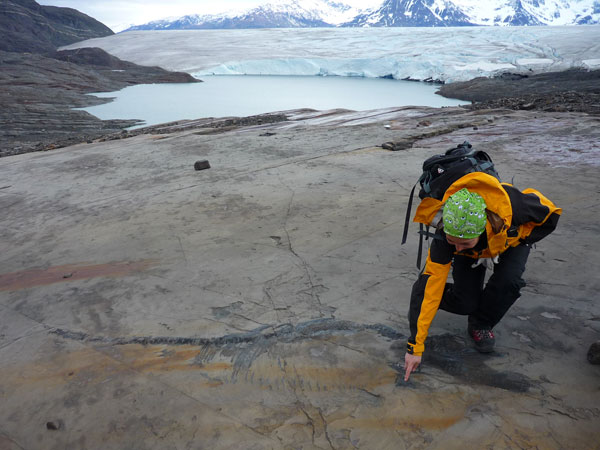
Dr Judith Pardo-Pérez (University of Magallanes), shows the ichthyosaur specimen exposed by the retreating Tyndall Glacier. Picture credit: Alejandra Zúñiga.

Picture credit: Alejandra Zúñiga

Finding and Rescuing “Fiona” the Pregnant Ichthyosaur

An expedition to the remote Tyndall Glacier located in the Torres del Paine National Park, led by Dr Judith Pardo-Pérez from the University of Magallanes (Punta Arenas, southern Chile), has recovered the country’s first complete ichthyosaur fossil. Nicknamed “Fiona” the four-metre-long specimen represents the remains of a pregnant female, complete with several ichthyosaur embryos.

“Fiona” was discovered in 2009, during an earlier expedition to this remote area of Chilean Patagonia. A team of dedicated researchers which included Jonatan Kaluza from Fundación de Historia Natural Félix de Azara and CONICET (Argentina), biologist and palaeontological excavator Héctor Ortiz from the Chilean Antarctic Institute and the University of Chile and renowned ichthyosaur expert Dr Dean Lomax (Visiting Scientist at The University of Manchester), braved the harsh conditions in March and April to ensure the safe removal of the specimen. The intact female ichthyosaur remains were airlifted using a helicopter. It is hoped that further analysis of this remarkable specimen will confirm it as a new ichthyosaur genus.

Airlifting an ichthyosaur fossil.
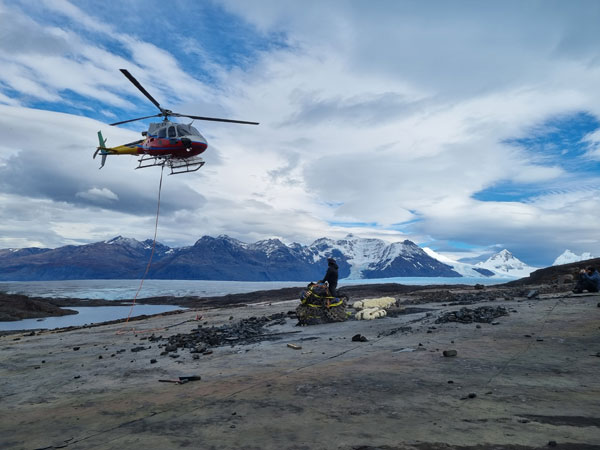
A helicopter prepares to airlift the pregnant ichthyosaur specimen. Picture credit: The University of Manchester.

Picture credit: The University of Manchester

The First Female Palaeontologist to Lead a Major Expedition to Patagonia

Dr Judith Pardo-Pérez has visited the Tyndall fossil site more than ten times since the initial discovery in 1997 and completed her PhD on the ichthyosaurs found in the area. Thanks to funding from the Chilean National Agency for Research and Development (ANID), a team of top scientists could be put together to allow the fossils preserved in an ancient Cretaceous seabed to be studied in detail.

Dr Pardo-Pérez, is the first female palaeontologist to lead a major expedition in Patagonia.

Team members at the Tyndall Glacier Site (Chile)
Part of the Tyndall Ichthyosaur Team discuss excavating a section of a fossil specimen. Picture credit: The University of Manchester.

Picture credit: The University of Manchester

Collecting these hugely important marine reptile fossils, was no easy task. The Tyndall Glacier site could only be reached by a 10-hour hike or horse ride and the team had to endure difficult weather conditions including high winds and snowstorms whilst excavating the fossils from the extremely hard sediment.

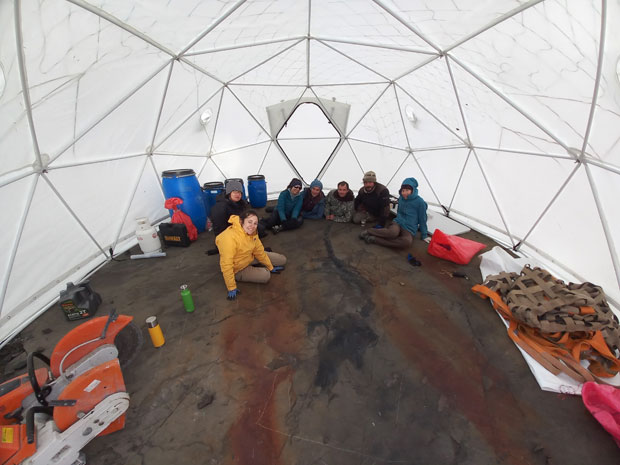
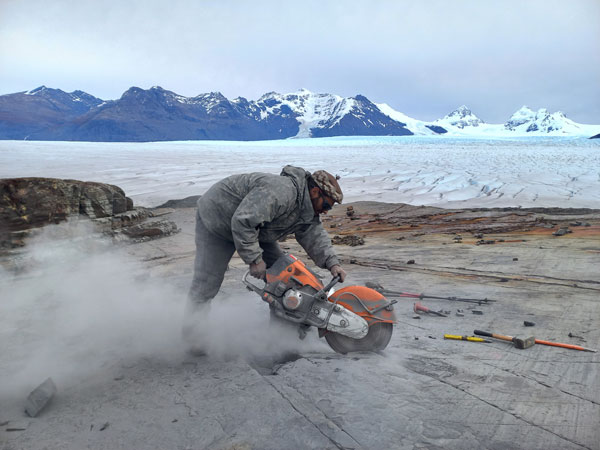
To combat the 90 kph winds, heavy rain and snow, a hangar was built over “Fiona” so that the team could continue to work despite the harsh weather. Circular saws and heavy-duty excavation tools were used to free the fossils from the bedrock.

A hanger erected over the ichthyosaur specimen.
A hanger was erected over the 4-metre-long ichthyosaur fossil so the scientists could continue working on the specimen despite the extreme weather conditions. Picture credit: The University of Manchester.

Picture credit: The University of Manchester

The Most Abundant and Best-preserved Cretaceous Ichthyosaur Deposit Known

Despite the constant threat of pumas, the team have ensured that this exceptional female specimen has been made available for further analysis and study. It is the only known specimen of a pregnant female of Valanginian-Hauterivian age (between 129 and 139 million years old from the Early Cretaceous).

Commenting on the importance of the specimen, Dr Pardo-Perez Pérez stated:

“At four metres long, complete, and with embryos in gestation, the excavation will help to provide information on its species, on the palaeobiology of embryonic development, and on a disease that affected it during its lifetime.”

In addition to “Fiona” a further twenty-three new ichthyosaur specimens were discovered by the expedition team, making the Tyndall Glacier site perhaps the most abundant and best-preserved early Cretaceous ichthyosaur deposit in the world.

Examining an Ichthyosaur Skull
Dr Judith Pardo-Pérez and Dr Dean Lomax examining the best-preserved skull of an ichthyosaur found at the Tyndall Glacier site. Whilst assisting on-site, Dr Lomax found new specimens including the skull of a juvenile ichthyosaur. Picture credit: The University of Manchester.

Picture credit: The University of Manchester

An Ichthyosaur Graveyard

The fossils consist of adults, juveniles and very young ichthyosaurs, they can provide scientists with information on breeding behaviour as well as helping to plot the radiation of new ichthyosaur genera following the end-Jurassic extinction event.

Dr Lomax explained:

“The fact that these incredible ichthyosaurs are so well preserved in an extreme environment, revealed by a retreating glacier, is unlike anywhere else in the world. The considerable number of ichthyosaurs found in the area, including complete skeletons of adults, juveniles, and new-borns provides a unique window into the past. The international collaboration helps to share this exceptional ichthyosaur graveyard with the world and, to a large extent, to promote science.”

Cutting out an ichthyosaur specimen
Jonatan Kuluza, palaeontological technician at the Fundación de Historia Natural Félix de Azara and CONICET (Argentina), uses a circular saw to cut out an ichthyosaur specimen. Picture credit: The University of Manchester.

Picture credit: The University of Manchester

Dr Lomax added:

“The weather was so extreme that we could not get to the ichthyosaur site every day and had to remain in camp. On those days when the team could reach the site, they documented the ichthyosaurs and other fossils and discovered new specimens. Amazingly, on average, two ichthyosaurs were found every day.”

Protecting and Preserving the Remaining Specimens

The female ichthyosaur nicknamed “Fiona”, will be prepared and studied at the Río Seco Natural History Museum in Punta Arenas. It is hoped that the beautifully preserved specimen will go on public display.

The priority for Dr Pardo-Pérez and her collaborators is to try to preserve as many specimens as possible. The remoteness of the site and the difficult working conditions will hamper any attempts to preserve and protect these remarkable specimens.

Outlining some of the problems facing the team, the doctor stated:

“We have almost a hundred ichthyosaurs in the Tyndall Glacier fossil deposit and many of them, unfortunately, will never be excavated, due to the difficulty of access, being in risk areas [cliff edge], and lack of funds. The ichthyosaurs that will not be excavated need protection and consolidation in situ, as the erosion to which they are being subjected on a daily basis is destroying them.”

Everything Dinosaur acknowledges the assistance of media release from The University of Manchester in the compilation of this article.

The award-winning Everything Dinosaur website: Prehistoric Animal Models.
6 05, 2022

New Species of Long-tailed Marine Reptile Described

By |2024-12-30T14:30:27+00:00May 6th, 2022|Categories: Adobe CS5, Dinosaur and Prehistoric Animal News Stories, Main Page, Palaeontological articles, Photos/Pictures of Fossils|0 Comments

A new species of Triassic marine reptile has been described following the discovery of superbly preserved fossils in Yunnan Province (south-western China). Named Honghesaurus longicaudalis it is a member of the Pachypleurosauroidea and it possessed the longest tail of any known pachypleurosaur.

Honghesaurus longicaudalis

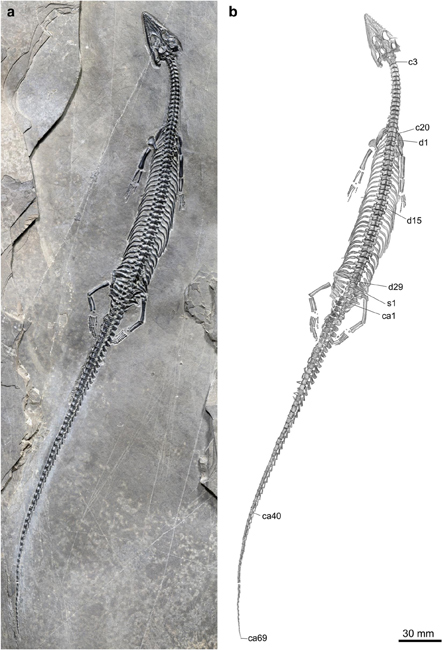
The holotype fossil (IVPP V30380) of the newly described Honghesaurus longicaudalis. Photo (a) and line-drawing (b) of whole specimen. c, cervical vertebra; ca, caudal vertebra; d, dorsal vertebra; s, sacral vertebra. Picture credit: Xu et al.

Picture credit: Xu et al

Writing in the academic journal “Scientific Reports”, the researchers from the Chinese Academy of Sciences, in collaboration with colleagues from the Zhejiang Museum of Natural History and Guizhou University, describe a complete skeleton in the collection of the Institute of Vertebrate Palaeontology and Palaeoanthropology, Chinese Academy of Sciences (specimen number IVPP V30380). The stunning fossil material comes from marine deposits associated with the Guanling Formation and it is estimated to be around 244 million years of age (Anisian stage of the Middle Triassic).

The Tale of a Very Long Tail

Remarkably, the tail of H. longicaudalis contains 69 caudal vertebrae, far more than any other known pachypleurosaur, other pachypleurosaurs commonly have no more than 58 caudal vertebrae. Humans in comparison have just 33 vertebrae in their skeleton. The researchers conclude that this extremely long tail (making up more than fifty percent of the entire body length), in combination with the animal’s long trunk made Honghesaurus extremely manoeuvrable in water. The scientists also speculate that the exceptionally long tail and body helped this marine reptile to conserve energy as it swam.

Skull and mandible of Honghesaurus longicaudalis.

Skull and mandible of Honghesaurus longicaudalis (IVPP V30380). Photo before (a) and after (b) dusted with ammonium chloride. (c) Line- drawing. (d) Reconstruction in dorsal view. an, angular; ar, articular; at, atlas; ax, axis; c, cervical vertebra; den, dentary; en, external naris; eo, exoccipital; f, frontal; j, jugal; m, maxilla; n, nasal; op, opisthotic; p, parietal; pat, proatlas; pm, premaxilla; po, postorbital; pof, postfrontal; prf, prefrontal; pt, pterygoid; q, quadrate; sa, surangular; so, supraoccipital; sq, squamosal; stf, supratemporal fossa. Picture credit: Xu et al.

Picture credit: Xu et al

The Dispersal of the Pachypleurosaurs

The holotype and currently only known specimen of H. longicaudalis (IVPP V30380) measures 47.1 cm in length. Most pachypleurosaurs were of a similar size although phylogenetic analysis suggests that Honghesaurus was closely related to the much larger Wumengosaurus delicatomandibularis, which had an estimated body length of 1.3 metres.

Pachypleurosaurs are regarded as basal members of the Superorder Sauropterygia, which includes placodonts and the plesiosaurs. The research team postulate that the discovery of Honghesaurus demonstrates the diverse morphology of the Pachypleurosauridae and lends weight to the idea that these marine reptiles originated in Europe and dispersed along the Tethys Ocean in a westerly direction giving rise to new forms in the eastern Tethys Ocean.

Keichousaurus life reconstruction.

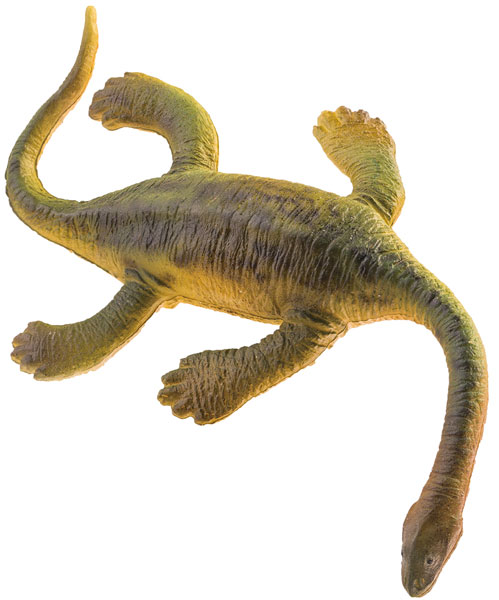
The best-known of all the pachypleurosaurs is Keichousaurus.  It is also known from south-western China although from geologically younger deposits than the strata that yielded the single specimen of Honghesaurus.

The picture (above) shows a PNSO Keichousaurus model.  To view the range of PNSO prehistoric animal models: PNSO Age of Dinosaurs Figures.

The scientific paper: “A long-tailed marine reptile from China provides new insights into the Middle Triassic pachypleurosaur radiation” by Guang-Hui Xu, Yi Ren, Li-Jun Zhao, Jun-Ling Liao and Dong-Hao Feng published in Scientific Reports.

3 05, 2022

Getting your Claws into Therizinosaurs

By |2023-03-07T21:59:30+00:00May 3rd, 2022|Categories: Adobe CS5, Dinosaur and Prehistoric Animal News Stories, Dinosaur Fans, Main Page, Palaeontological articles, Photos/Pictures of Fossils|0 Comments

Scientists have named a new species of therizinosaur based on fragmentary remains found on the Japanese island of Hokkaido. The dinosaur has been named Paralitherizinosaurus japonicus, it is the first recovered from Asian marine deposits and the third example of a therizinosaur to be found in Japan.

The fossil material, recovered from the lower Campanian Osoushinai Formation near to the town of Nakagawa in the Hokkaido Prefecture, was previously identified as a maniraptoran theropod dinosaur, possibly therizinosaur, but its taxonomic status remained uncertain. A group of scientists including Yoshitsugu Kobayashi and Anthony R. Fiorillo from the Hokkaido University Museum re-examined the fossils and erected a new taxon confirming the fossil material did represent a Late Cretaceous member of the Therizinosauridae.

Paralitherizinosaurus japonicus life reconstruction
A life reconstruction of the Late Cretaceous, Japanese therizinosaur Paralitherizinosaurus japonicus. Picture credit: Masato Hattori.

Evolution of Claw Shape in the Therizinosauridae

Writing in the academic journal “Scientific Reports”, the researchers reassessed the fossil material consisting of a single vertebra plus bones and claws (unguals) from the right hand. As well as concluding that the fossils represent a therizinosaur, they confirmed that it is the geologically youngest therizinosaur known from Japan described to date.

Paralitherizinosaurus silhouette
Paralitherizinosaurus japonicus silhouette showing estimate of body size and position of known skeletal elements. The fossilised claw elements shown in close view with known material in white. Picture credit: Genya Masukawa.

Important Implications for Claw (Ungual) Evolution in the Therizinosauridae

The scientists compared the shape of the hand claws from Paralitherizinosaurus japonicus with the claws from geologically older therizinosaurs and they postulated that that primitive therizinosaurs had claws with generalist functionalities and that the claws of more derived, later therizinosaurs such as P. japonicus were more suited to the hook-and-pull feeding function. Hook-and-pull feeding involves the use of the claws to help gather vegetation and bring it closer to the mouth.

What’s in a Name?

The fossils were found in a concretion associated with the Campanian-aged Osoushinai Formation of the Yezo Group on Hokkaido Island. The Yezo Group mostly consists of marine deposits and many vertebrate fossils such as plesiosaurs, sharks, mosasaurs and turtles have been discovered. Fragmentary dinosaur fossils are also associated with these strata including hadrosaurids, an armoured dinosaur (nodosaurid) and a potential tyrannosaur. A therizinosaur taxon can now be added to this Late Cretaceous dinosaur biota.

PNSO Qingge the Therizinosaurus
A typical therizinosaur dinosaur model (PNSO).

To view replicas of feathered theropods including therizinosaurus (whilst stocks last): PNSO Age of Dinosaurs Figures.

The discovery of the bones and claw elements in marine deposits helped to inspire this dinosaur’s scientific name. The genus name translates as “scythe reptile by the sea”, whilst the species name honours Japan.

Paralitherizinosaurus japonicus fossils.
The concretion that contained the fragmentary therizinosaur fossil material prior to preparation. Picture credit: Kobayashi et al.

The scientific paper: “New therizinosaurid dinosaur from the marine Osoushinai Formation (Upper Cretaceous, Japan) provides insight for function and evolution of therizinosaur claws” by Yoshitsugu Kobayashi, Ryuji Takasaki, Anthony R. Fiorillo, Tsogtbaatar Chinzorig and Yoshinori Hikida published in Scientific Reports.

Go to Top