All about dinosaurs, fossils and prehistoric animals by Everything Dinosaur team members.

Fossil finds, new dinosaur discoveries, news and views from the world of palaeontology and other Earth sciences.

30 03, 2016

Origins of Malaria Traced Back 100 Million Years

By |2023-04-16T18:14:07+01:00March 30th, 2016|Categories: Dinosaur and Prehistoric Animal News Stories, Dinosaur Fans, Main Page|0 Comments

Malaria Dates Back to the Cretaceous

The disease malaria which is a mosquito-borne infectious disease of humans and other animals caused by parasitic protozoans belonging to the Plasmodium type, killed an estimated 438,000 people in 2015.  The World Health Organisation (WHO) reports that there were some 214 million cases last year and currently, this debilitating and often fatal disease accounts for 40% of all public health spending in Africa.  Although, our understanding of the parasite and its life cycle has greatly improved over the last five decades or so, fundamental questions still remain.  For example, when did the malaria vectors first evolve?  Was malaria a disease of insects that transferred to vertebrates or did this disease originate in some prehistoric land vertebrate, a dinosaur perhaps?

Studying Malaria

Writing in the scientific journal the “American Entomologist”, researcher George Poinar Junior, a specialist in palaeo-entomology, sets out new research that seeks to establish for how long malaria has been plaguing our planet.  He concludes that the origins of the disease can be traced back to the Cretaceous, a time when the Dinosauria dominated terrestrial ecosystems.  The research suggests that dinosaurs would have probably been amongst the Plasmodium parasites first vertebrate hosts.

Fossil Evidence (Biting Midge) with Evidence of Malaria Parasite Infection Preserved in Amber

One hundred million-year-old Protoculicoides biting midge containing numerous oocysts (arrow) of the malarial parasite Paleohaemoproteus burmacis in Myanmar amber.

One hundred million-year-old Protoculicoides biting midge containing numerous oocysts (arrow) of the malarial parasite preserved in amber.

Picture credit: Oregon State University

Fossils Preserved in Amber

The picture above shows a 100-million-year-old biting midge, preserved in amber from Myanmar (Burma).  The black arrow indicates numerous oocysts of the malarial parasite Paleohaemoproteus burmacis.

Zoologist George Poinar has specialised in studying ancient insects and other members of the Order Arthropoda.  Much of his work has focused on the study of micro-organisms preserved in fossilised tree resin (amber).  Everything Dinosaur has written a number of articles highlighting his research over the years, back in 2008 we wrote about a book co-authored by Professor Poinar that proposed the dinosaur extinction event was brought about, in part, due to disease transmission from biting ticks, mites and insects.

To read more about this: Biting Bugs Brought About the Demise of the Dinosaurs.

The Origins of Malaria

Understanding how malaria evolved and its long-term relationship with hosts can help scientists when it comes to searching for vaccines and other measures to eradicate the disease.  The fossil record such as biting insects preserved in amber can help researchers to establish a better understanding.

Professor Poinar explained:

“Scientists have argued and disagreed for a long time about how malaria evolved and how old it is.  I think the fossil evidence shows that modern malaria vectored by mosquitoes is at least 20 million years old, and earlier forms of the disease, carried by biting midges, are at least 100 million years old and probably much older.”

The modern strains of malaria are thought to have evolved much more recently, sometime between 15,000 years ago to perhaps as far back as 8 million years ago, before hominins evolved.  The modern form of malaria is carried by Anopheles mosquitoes, but Professor Poinar suggests that the ancestral forms may have been spread by other types of biting insect.

A Tertiary Mosquito Preserved in Amber with a Malarial Parasite Infection

Evidence of malaria parasite in a mosquito preserved in Dominican amber.

Evidence of malaria parasite in a mosquito preserved in Dominican amber.

Picture credit: Oregon State University

The photograph above shows the preserved remains of the mid-Tertiary mosquito Culex malariager preserved in Dominican amber. Professor Poinar identified gametes inside the mosquitoes body and oocysts of the malaria parasite Plasmodium dominicana in various stages of development.  This research, conducted in 2005, provided the first fossil record of Plasmodium malaria, demonstrating that the genus was established in the Americas at least fifteen million years ago.

Implications for this Research

If Poinar and his research team have hit the nail on the head, then ancestral malaria could have been influencing terrestrial vertebrate evolution from the Cretaceous onwards.  Poinar proposes that other ancient insects such as sand flies, ticks as well as mosquitoes could have been malarial vectors.  Of all these arthropods, the biting midges are the most ancient with a fossil record dating back to the Early Cretaceous, some 140 million years ago.  This means that malaria could have had insect vectors this far back in geological time.

The professor is keen to point out that he is not claiming an ancient malaria pathogen caused the extinction of the dinosaurs, but he does suggest that diseases passed on via biting and sucking insects could have had an effect on populations that were already under considerable environmental stress.

The Professor added:

“There were catastrophic events known to have happened around that time, such as asteroid impacts and lava flows, but it’s still clear that dinosaurs declined and slowly became extinct over thousands of years, which suggests other issues must also have been at work.  Insects, microbial pathogens and vertebrate diseases were just emerging around that same time, including malaria.”

Next time you see a mosquito, consider the evolutionary history of this winged creature and the evolutionary history of the deadly vector that some of its kind carries…
27 03, 2016

Climate Change and an Inability to Evolve Led to Ichthyosaur Extinction

By |2023-04-16T18:07:56+01:00March 27th, 2016|Categories: Dinosaur and Prehistoric Animal News Stories, Dinosaur Fans, Main Page|0 Comments

New Study Suggests Reasons for the Extinction of the Ichthyosaurs

A study undertaken by an international team of scientists and published in the open access journal “Nature Communications”, concludes that the extinction of the ichthyosaurs was probably due to an inability to evolve quickly enough in combination with intense climate change.

Superbly Adapted to a Marine Environment – The Ichthyosauria

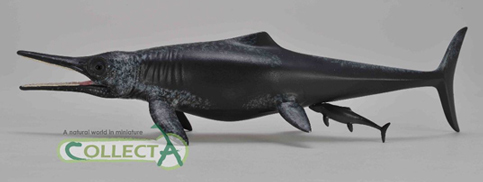
Detailed Ichthyosaur figure.

Evolving live birth (viviparity) just one adaptation to an entirely marine existence.

Picture credit: Everything Dinosaur

Studying Ichthyosaur Extinction

Widely regarded as perhaps, the best adapted of all the marine reptiles of the Mesozoic, the ichthyosaurs with their stream-lined bodies, well developed fins varied diets and their viviparity (live birth as evidenced in a number of fossil specimens), died out some twenty-eight million years or so before the end Cretaceous mass extinction that saw the end of the dinosaurs and other types of marine reptile such as the mosasaurs and the long-necked plesiosaurs.

The reason(s) for this demise have long been debated.  During the mid part of the 20th century it had been suggested that the ichthyosaurs had persisted until the end of the Cretaceous, however, most palaeontologists now agree that the very last of these “fish lizards” died out at the end of the Cenomanian faunal stage, some 93 million years ago, a time when the world was undergoing a period of dramatic climate change.

The Rise of the Mosasaurs Not to Blame

The rapid evolution and radiation of the mosasaurs during the Late Cretaceous had been proposed as a possible factor in the extinction of the ichthyosaurs.  Many academics had argued that these lizards, (Squamata), competed with the ichthyosaurs for food and other resources such as breeding grounds.  However, recent studies have indicated that the earliest large-bodied mosasauroids, animals which could have competed with the ichthyosaurs, first appear in strata laid down in the Middle Turonian stage of the Late Cretaceous some three million years after the last appearance in the fossil record of the Ichthyopterygia Order (also called the Ichthyosauria).

It is likely that the mosasaurs benefited from the absence of the ichthyosaurs and rapidly radiated to fill some of the niches once occupied by them.

The Evolution of the Mosasaurs Not Likely to be the Cause for Ichthyosaur Extinction

Mosasaurus with a "sharks tail"

Ancestral Mosasaurs during the Cenomanian faunal stage were small, the first large bodied Mosasaurs did not evolve until around 90 million years ago

Picture credit: Stephanie Abramowicz (The Dinosaur Institute, Natural History Museum of Los Angeles County)

Explaining the Extinction

Lead author of the research paper, Dr Valentin Fischer (Oxford University and the University of Liège, Belgium), explained that the research team carried out an extensive analysis of the geological record of the Ichthyosaurs, combing through data that represented the last 120 million years of this Order’s evolutionary history.

He stated:

“We analysed the extinction of this crucial marine group thoroughly for the first time.  We compared the diversity of the ichthyosaurs with the geological record of global change, emphasising the dynamics of these datasets.  Ichthyosaurs were actually well diversified during the last chapter of their reign, with several species, body shapes and ecological niches present.  However, their evolution was much slower than earlier in their history.  Additionally, they were seemingly negatively affected by the profound global changes going on during the Cretaceous, as their extinction rate correlates with environmental volatility.”

Everything Dinosaur stocks a variety of marine reptile models including several replicas of ichthyosaurs: Marine Reptiles, Ichthyosaurs and Sea Monster Models.

A Perfect Storm for the Ichthyosauria

It seems that the Ichthyosauria endured a severe decline in the number of species at the beginning of the Cenomanian.  Many specialist predators of soft-bodied creatures, died out along with several “generalist” ichthyosaurs, but those ichthyosaur species that filled apex predator roles seem to have persisted until the end of this faunal stage.

A two-pronged event is suggested to have added up to the “perfect storm” for the Ichthyosauria.  At this time, the Earth’s poles were free of ice and sea levels were much higher than today.  The analysis revealed that this two-phase extinction event (Early Cenomanian and Late Cenomanian), can be associated both with reduced evolutionary rates (a failure to evolve novel body plans for a prolonged period of geological time) and dramatic climate change (strong fluctuations in sea surface temperatures and sea levels).

The International Research Team Plotted the Demise of the Ichthyosauria

Marking the demise of the Ichthyosauria.

Marking the demise of the Ichthyosauria.

Picture credit: Nature Communications

The two graphs above were compiled by the international research team.  The top graph shows the number of marine reptile-bearing formations recorded throughout the whole of the Cretaceous (black line), plotted against the proportion of these formations that contain ichthyosaur fossils (beige line).  The proportion of marine reptile-bearing formations yielding ichthyosaurs decreased from 84% in the Albian to 19% in the Cenomanian and to 0% in the Turonian.  The bottom graph, plots the proportion of marine reptile-bearing formations containing ichthyosaurs throughout the Cretaceous, with calculation of a 95% confidence interval.

Ichthyosauria Did Become Rarer

These graphs indicate that the extinction is not biased by a lack of fossils of ichthyosaurs, it seems that the Ichthyosauria did indeed become rarer and rarer and then disappeared from the oceans of the world, at a time when other marine reptile populations were recovering from any extinction pressures.

Dr Fischer added:

“Although the rising temperatures and sea levels evidenced in rock records throughout the world may not directly have affected ichthyosaurs, related factors such as changes in food availability, migratory routes, competitors and birthing places are all potential drivers, probably occurring in conjunction to drive ichthyosaurs to extinction.”

For models and replicas of ichthyosaurs and other prehistoric animals: CollectA Age of Dinosaurs Prehistoric Animal Models.

This new work supports a growing body of evidence suggesting that a major, global, change-driven turnover profoundly reorganised marine ecosystems at the beginning of the Late Cretaceous (Cenomanian faunal stage), giving rise to the highly peculiar and geologically brief Late Cretaceous marine world.  Ichthyosaurs disappeared in the course of this turnover, while numerous lineages of bony fishes and sharks evolved.

It is also suspected that surface levels of oxygen were depleted during the Cenomanian.  This may have impacted on the strength and vigour within food chains, with the apex predators such as those remaining types of ichthyosaur, at the top of the food chain, affected more than most.   The extinction of ichthyosaurs thus appears to be one aspect of a larger event, something the team, which includes scientists from England, Russia, Belgium and France is currently investigating.

To read a related article written by Everything Dinosaur in 2013, that looked at how fossil finds from Iraq were changing views on the evolution of the Ichthyosauria: Fossilised “Fish Lizard” Changing Views of Ichthyosaur Evolution.

25 03, 2016

One of Britain’s Largest Ichthyosaurs Goes on Display

By |2023-04-16T18:00:05+01:00March 25th, 2016|Categories: Dinosaur and Prehistoric Animal News Stories, Dinosaur Fans, Main Page|0 Comments

Manchester University Palaeontologist Helps Build an Ichthyosaur

The fossilised remains of a large Ichthyosaurus, one of the biggest specimens of a “fish lizard” found in the British Isles, goes on display today as a new gallery opens at the Birmingham Thinktank Museum.  Providing an exciting centrepiece to the new Marine Worlds Gallery, the fossils may represent an entirely new species of ichthyosaur.

The Skull of the Warwickshire Ichthyosaurus

A wonderful conservation example, the rebuilt Ichthyosaurus skull.

A wonderful conservation example, the rebuilt Ichthyosaurus skull.

Picture credit: Birmingham Thinktank

A Manchester Palaeontologist

Dean Lomax, a palaeontologist from Manchester University has been involved in the project to rebuild and put on display the 200 million-year-old predator.  The fossils were originally found in 1955 when a farmer unearthed the first evidence of this sea monster and a field team from the Birmingham Museum and Art Gallery was despatched to investigate.  The location was Fell Mill Farm, near to the small Warwickshire town of Shipston-on-Stour in the far south of the county.  There are a number of sites in Warwickshire that yield fossils from the Early Jurassic.

Extensive quarrying of clays and limestone for the cement industry has exposed Jurassic-aged sediments and very occasionally the remains of ancient marine vertebrates are found.  Unlike most of the Ichthyosaurus fossils found in Europe, the Fell Mill Farm skull specimen has been preserved in three-dimensions (most Ichthyosaur specimens, especially the skulls, are flattened and crushed during the fossilisation process).

Rebuilding the Skull Specimen

Working with expert conservator Nigel Larkin and Luanne Meehitiya (Natural Science Curator for Birmingham Museums), Dean has been able to rebuild the skull specimen and unite it with post cranial elements from the same animal that were stored within the Birmingham Museum vertebrate fossil collection.  The restored skull measures some eighty centimetres long and is thirty-three centimetres wide (at the widest part, the rear of the skull).

It is difficult to estimate just how big this Ichthyosaur was when it patrolled the shallow seas of an archipelago of islands, that were one day to become the British Isles, but it could have measured up to six metres in length.  This would have made this animal, one of the largest types of marine reptile known from Europe excavated from Lower Jurassic strata.  It may have filled an apex predator niche, feeding on cephalopods, fish and probably, smaller marine reptiles.

The Reconstructed Skeleton Ready for Display

Nigel Larkin (left), Luanne Meehitiya (centre) and Dean Lomax (right) with the Warwickshire Ichthyosaurus specimen (scale bar 10 cm)

Nigel Larkin (left), Luanne Meehitiya (centre) and Dean Lomax (right) with the Warwickshire Ichthyosaurus specimen (scale bar 10 cm)

Picture credit: Birmingham Thinktank

An Ichthyosaurus Specimen

Rebuilding the skull and the rest of the fossil material was an exceptionally tricky task.  The skull had been constructed sometime in the late 1950s and excessive amounts of glue and filler had been used to stick the bones together.  In addition, plaster and wood had been employed to help support the fossilised bones as well as to fill in the missing bone pieces.  A number of bones had been positioned in the wrong place, the orientation was inaccurate and the whole of the jaw had been set further back.

The coat of varnish, added more than six decades ago had become discoloured and was hiding a lot of the detail, so this too had to be removed.  It was Nigel’s job to carefully take the skull to pieces and, under the expert guidance of Dean, to clean and prepare the individual fragments so that they could be put together in a more anatomically correct arrangement.

Everything Dinosaur Comments

A spokesperson from Everything Dinosaur commented:

“When the skull was first put together, the scientists at the time had not got the benefit of three-dimensional CT scans, or access to a global digital database of ichthyosaur skull fossils to help in the construction process.  We tend to take technologies like email, high resolution images, on line journals and data sharing for granted these days, but back in the late fifties the fragments of bone that make up the skull were most probably pieced together using some of the 19th century line drawings of the very first ichthyosaur fossils to be described. “

For prehistoric animal models including marine reptiles: CollectA Prehistoric Life Figures.

Once the skull had been fully restored, the project team set about conserving the rest of the skeleton creating a most impressive centrepiece for the new gallery at the Birmingham Thinktank museum.  More accurate casts of missing fossils could be used to help to fill out the exhibit and the three-dimensional nature of the skull permitted the team to gain some valuable insight into the true shape of the Ichthyosaurus skull, the basioccipital bone, for example, had been preserved.

Studying the Skull of the Ichthyosaurus

This is one of four bones at the very base of the skull that surrounds the foramen magnum, the hole in the skull through which the spinal cord passes.  This bone could provide valuable information on the shape of the ichthyosaur brain.

Commenting on the research work and the way in which this fearsome reptile is being displayed at the museum, Luanne Meehitiya stated:

“One of the most fun parts of this project has been working with palaeo-artist Robert Nicholls to produce a new artistic reconstruction of the ichthyosaur, which gives us a much better impression of what the massive marine reptile must have looked like and this is displayed life-sized above the skeleton.”

The Wonderful Illustration of the Ichthyosaur in the Marine Worlds Gallery

Large teeth in the jaws indicate predation, most probably of fish and other small marine organisms.

Large teeth in the jaws indicate predation, most probably of fish and other small marine organisms.

Picture credit: Bob Nicholls @Paleocreations

Palaeontologist Dean Lomax added:

“This is a very important specimen.  It comes from a location previously unrecorded for ichthyosaurs, so this adds to our understanding of the geographical distribution of ichthyosaurs during the Early Jurassic, a time when the UK was a series of islands.”

Ichthyosaur Research

Back in February 2015, Everything Dinosaur reported on some other ichthyosaur research undertaken by Dean Lomax.  Thanks to his efforts, the first “new” species of Ichthyosaurus for 127 years was identified.

To read about this research: New Ichthyosaurus Species Honours Mary Anning.

For those wishing to learn more about the types of dinosaur that roamed the land whilst this ichthyosaur patrolled the sea, Everything Dinosaur recommends “Dinosaurs of the British Isles” by Dean Lomax and Nobumichi Tamura: Dinosaurs of the British Isles is available here.

Note

Originally thought to represent an example of Ichthyosaurus communis a study published in 2019, classified the specimen as an example of the much rarer marine reptile Protoichthyosaurus prostaxalis.

18 03, 2016

Boreonykus certekorum – A Polar Dinosaur Related to Velociraptor

By |2023-04-16T17:14:33+01:00March 18th, 2016|Categories: Dinosaur and Prehistoric Animal News Stories, Dinosaur Fans, Main Page|0 Comments

A Polar Dromaeosaurid – Boreonykus certekorum

Picking over the carcases of the remnants of a herd of pachyrhinosaurs some seventy-two and a half million years ago was a small, theropod dinosaur named Boreonykus (B. certekorum), the scene, taking place in the high latitudes of northern Canada has been pieced together after painstaking research by two famous palaeontologists who have collaborated on a number of projects helping to increase our understanding of the lives and behaviours of dinosaurs that lived in high latitudes, the so called “polar dinosaurs”.

Polar Dromaeosaur

Publishing in the open access on line journal “The Journal of Vertebrate Paleontology”, please excuse the American spelling of palaeontology, scientists Philip Currie and Phil Bell report on the new dromaeosaurid material described from an extensive horned dinosaur bonebed located at Pipestone Creek, near the city of Grande Prairie (Alberta, Canada).  This dog-sized little theropod has been tentatively assigned to the Velociraptorinae “wing” of the Dromaeosauridae (no pun intended), thus making Boreonykus potentially a close relative of the famous Velociraptor from Asia.

A Pair of Boreonykus Dinosaurs Feast on the Carcase of a Pachyrhinosaurus (P. lakustai)

A pair Boreonykus feeding on the corpse of a Pachyrhinosaurs lakustai.

A pair Boreonykus feeding on the corpse of a Pachyrhinosaurs lakustai.

Picture credit: Canadian Press

Polar Dinosaurs

Australian Phil Bell (School of Environment and Rural Science at the University of New England), has worked on a number of polar dinosaurs, including several known from Australia, which, for much of the Cretaceous would have been part of high latitude environments in the Southern Hemisphere, so it could be said that Dr Bell has researched dinosaurs at the opposite ends of the Earth.  Isolated teeth had been found in association with the fossilised bones of the horned dinosaur Pachyrhinosaurus lakustai back in 1988, but they were thought to have been shed by other feeding, small-bodied theropods that had already been scientifically described.

Previous studies had concluded that these small theropod fossils found in the extensive Pipestone Creek bonebed belonged to Saurornitholestes langstoni or possibly Dromaeosaurus albertensis.  However, when more fossil material was found in 2012 including a portion of the skull (the frontal), scientists began to realise that the teeth and isolated bone fragments caught up in the huge plaster jackets of the giant Pachyrhinosaurus excavations, might just be something entirely new.

Comparison of Three Frontal Bones of Members of the Dromaeosauridae

The angle of the frontals bone in relation to the asupratemporal ridges led to a new dinosaur.

The angle of the frontal bone in relation to the supratemporal ridges led to a new dinosaur.

Picture credit: The Journal of Vertebrate Paleontology with additional annotation by Everything Dinosaur

Skull Bone Provides Vital Clue

It was when the frontal bone from the Pipestone Creek bonebed was compared to the frontal bones of Saurornitholestes and Dromaeosaurus that the researchers noticed a vital difference.  The angle between the frontal and the supratemporal ridges on the skull was much more acute.  This suggested that the theropod material found did represent a new genus of small, agile hunter.

The picture above shows a comparison of dromaeosaurid frontal bones (dorsal view).  The angles between the supratemporal ridges are given.  The fifty-five degree angle for the frontal assigned to B. certekorum is noticeably smaller.

Phil Bell and the Polar Dromaeosaur

Commenting on the study, Phil Bell explained that the frontal was the most important bone, that helped to clinch what type of animal it was and led to the erection of a new genus.

Dr Bell added:

“Its [Boreonykus] closest ancestors were from Mongolia, so this species probably crossed the land bridge from northern Asia to North America.  The first bones were discovered in 1988 and laid unstudied in a museum in Alberta for 25 years.  We then started to turn up a few more bones from the very same spot in 2012, so that reinvigorated interest.  Although we don’t have the whole skeleton, we know, based on parts of the skeleton, that it belonged to this type of dinosaur.  The raptors’ skin was probably feathered to keep them warm in the cold dark winters in north Canada.”

The Sickle-Claw from the Second Toe of the Left Hind Foot

The killing toe claw of the "raptor"Boreonykus.   Scale bar = 1 centimetre.

The killing toe claw of the “raptor” Boreonykus. Scale bar = 1 centimetre.

Picture credit: The Journal of Vertebrate Paleontology

Boreonykus certekorum

The genus name Boreonykus is a reference to the modern day boreal forest where the type specimen was found and “onychos” is from the Greek meaning claw.  The species name honours Certek Heating Solutions and the Barendregt family of Wembley, Alberta, who have sponsored the field work and supported efforts to record and preserve the fossil fauna of this part of Alberta.

More than 99% of all the fossil material recovered from the Pipestone Creek bonebed has been assigned to the centrosaurine Pachyrhinosaurus (P.  lakustai), some fragmentary Edmontosaurus fossils may have also been found (we think) along with evidence of other theropods.  The bonebed is very dense and there are up to two hundred bones per square metre, the other theropod material found to date consists of shed teeth assigned to Troodon and indeterminate tyrannosaurids.

Two Shed Tooth Crowns from the Pipestone Creek Site Assigned to B. certekorum

Two shed teeth from the Pipestone Creek bonebed assigned to Boreonykus.

Two shed teeth from the Pipestone Creek bonebed assigned to Boreonykus.

Picture credit: The Journal of Vertebrate Paleontology

Examining Fossil Teeth

The picture above shows two shed teeth from the bonebed which have been assigned to the new Velociraptorinae genus.  The dating of the bonebed is not precise, however, a volcanic ash layer approximately one metre above the site has been dated to 73.27 million years ago +/- 250,000 years.

The researchers comment that all the material assigned to Boreonykus probably came from a single individual and the identification of a new dromaeosaurid, classified as a eudromaeosaur (a sub-group of the Dromaeosauridae family) and possibly a member of the Velociraptorinae, a sub-family of the Dromaeosauridae, if this is the case, it extends the known palaeofauna of the polar dinosaurs in northern latitudes to include Velociraptorinae and extends the known record of North American theropods which are closely related to the predominately Asian Velociraptors and their close relatives.

For articulated models of dromaeosaurids and other dinosaurs: Beasts of the Mesozoic Articulated Models.

17 03, 2016

A Damaged Dilophosaurus! Remarkable Fossil Provides a Fresh Perspective on Dinosaurs

By |2024-05-05T21:30:46+01:00March 17th, 2016|Categories: Dinosaur and Prehistoric Animal News Stories, Dinosaur Fans, Main Page|0 Comments

Scientists Examine the Pathology Preserved on the Dilophosaurus wetherilli Holotype

Life was tough for the Dinosauria, the Mesozoic was no “walk in the Jurassic Park”, that’s for sure.  However, detailed analysis of injuries or disease preserved in the fossilised bones of dinosaurs does not take place that often.  Here we report on a paper published in the on line, academic journal PLOS One that provides a comprehensive account of the pathology on the holotype specimen of the theropod dinosaur Dilophosaurus (D. wetherilli).

The Pathology of a Dilophosaurus Specimen (UCMP 37302)

A total of eight damaged bones on the pectoral girdle and forelimbs.

A total of eight damaged bones on the pectoral girdle and forelimbs.  Scale bar = 5 centimetres.

Picture credit: PLOS One (L. Walters)

Dilophosaurus – Lithe Early Jurassic Carnivore

At around six metres in length, Dilophosaurus was one of the largest carnivorous dinosaurs known from the Early Jurassic.  A number of species have been described, fossils of D. wetherilli are associated with the Kayenta Formation of Arizona.  Both jaws were relatively light and slender and the upper jaw had a distinctive kink.  Studies of the dentition (teeth) and analysis of skull stresses indicates that this dinosaur probably specialised in hunting relatively small prey.  It may also have scavenged the kills of other dinosaurs.

Dilophosaurus a Light and Agile Theropod

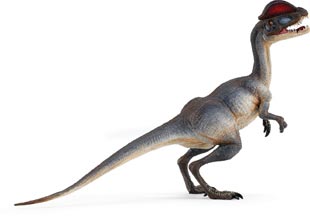
Wild Safari Prehistoric World Dilophosaurus.

Wild Safari Prehistoric World Dilophosaurus.

Picture credit: Everything Dinosaur

Safari Ltd have introduced two Dilophosaurus models into their model range: Safari Ltd. Wild Safari Prehistoric World Models.

A Damaged Dilophosaurus

The holotype specimen shows eight substantial injuries, signs of healing indicate that this unfortunate meat-eater survived the traumas, but it probably spent a considerable portion of its adult life in quite a lot of pain.  On the left side of the dinosaur, the shoulder blade (scapula) is fractured (c in the pathology illustration above), the left radius shows a severe fracture that has healed (h).  The ulna shows signs of infection and the left thumb (digit I) had been dislocated, highlighted as (f) in the diagram at the top of the article.  On the right side of the holotype, more pathology can be found.

Abnormal torsion of the right humerus (b), three bony tumours on the radius (a), along with damage to metacarpal III (e). The right finger was so badly damaged (i), that it could not flex properly.  Some of the deformities, the researchers conclude, are the result of osteodysplasia, a condition that causes bone growth defects.  This is known in modern birds but has not been reported before in non-avian dinosaurs.

 The Badly Damaged Right Hand of the Holotype Specimen (UCMP 37302)

The damaged hand of the Dilophosaurus holotype.

The damaged hand of the Dilophosaurus holotype.

Picture credit: PLOS One (L. Walters)

Damaged Digits

The damage to the digits would have meant that this dinosaur would have been severely hampered as it tried to grasp prey.  How the injuries were caused remains the subject of speculation.  The authors of the paper, Phil Senter (Department of Biological Sciences, Fayetteville State University, North Carolina) and Sara Juengst (Department of Anthropology, Appalachian State University, North Carolina) state that it is not possible to determine the number of traumatic events that all these pathological features preserved in the skeleton represent.

All the injuries and damage could have been sustained in one catastrophic event, perhaps in a fight with a rival or in an attempt to subdue prey.  The authors can at least be certain that this Dilophosaurus survived for some considerable time as the injuries show signs of extensive healing, although it would have been in a great deal of discomfort.  The fact that this dinosaur survived is a testament to how hardy these reptiles were.  It is also intriguing to speculate how this dinosaur fed whilst recovering from its various debilitating injuries.  It may have subsisted on very small prey, small enough to be subdued by the mouth and or feet.

Pathology in Dinosaurs

Injuries, trauma and general pathology in the Dinosauria is underreported.  When describing a new dinosaur species, researchers often fail to mention any pathological features that have been found.  For example, in the scientific description of the holotype specimen of Dilophosaurus wetherilli only one of the pathological features reported by the authors of this paper was described.  This Dilophosaurus specimen is a record breaker for broken bones reported in the Dinosauria portion of the fossil record, even beating the famous Allosaurus (A. fragilis) called “Big Al”.

16 03, 2016

“Tully Monster” Riddle Solved by New Research

By |2024-05-05T21:31:24+01:00March 16th, 2016|Categories: Dinosaur and Prehistoric Animal News Stories, Main Page, Photos/Pictures of Fossils|0 Comments

Bizarre “Tully Monster” Finds a Place on the Tree of Life

The bizarre “Tully Monster” a very peculiar sea creature that swam in the tropical waters that once covered Illinois (United States), has finally been allocated a position on the tree of life.  So weird was “Tully” or to give this thirty centimetre oddity its formal, binomial scientific name – Tullimonstrum gregarium, that palaeontologists could not classify it even to a Phylum.  However, a new study published in the journal “Nature” has finally solved this riddle.  It is a soft-bodied vertebrate, one that is related to extant jawless fish such as Hagfish and the Lamprey.

The Riddle of the “Tully Monster” Solved

Fossils found in 1958, described in 1966 but not classified until 2016.

Fossils found in 1958, described in 1966 but not classified until 2016.

Picture credit: Sean McMahon (Yale University)

Thousands of Fossils but Just One Location

The story of this strange creature begins in 1958 when amateur fossil collector Francis Tully stumbled across a specimen whilst exploring the silt and mudstone beds of the Mazon Creek Formation that are exposed in Grundy County Illinois.  The fossil was studied by palaeontologists at the Chicago Field Museum and, with more specimens having been recovered from the same location, the first formal description of this marine animal was published in 1966.  Since then, it has been described as a nektonic mollusc, an arthropod, a marine worm and even a conodont (a jawless chordate, possibly related to primitive, jawless fish).

Thousands of specimens have been collected from the Mazon Creek beds, but this fossil has not been recorded anywhere else in the world.

Tullimonstrum gregarium – Described

This animal had no bones or hard parts, but seemed to have been an active swimmer, due to the fact that there is some evidence of streamlining of the body and fins to provide thrust and manoeuvring in open water.   The long body had a thin bar crossing the top (or could that be the bottom)?  This bar showed that at each end there was some sort of organ, this has been interpreted as an eye.  Reaching forward was a long, delicate proboscis which seemed to end in a mouth with up to eight primitive teeth in the jaws.

This appendage must have been quite delicate, as despite the exceptional preservation conditions associated with the Mazon Creek Formation, less than 5% of all fossil specimens preserve this proboscis in its entirety within the fossil.

A Typical Hard to Decipher “Tully Monster” Fossil

A "Tully Monster" fossil.

A “Tully Monster” fossil.

Picture credit: Paul Mayer (Chicago Field Museum)

This enigmatic marine animal, probably lived in open water, but storms washed these creatures into the shore and they ended up stranded on the mud and silts of a river estuary.  The high levels of iron found in these sediments helped preserve these and other soft-bodied animals, providing a unique faunal record of life 300 million years ago (Late Carboniferous).

The “Tully Monster”

Scientists from Yale University, along with collaborators from The Field Museum, The American Museum of Natural History, Argonne National Laboratory (Illinois) and Yale Peabody Museum examined some two thousand fossil specimens and conducted an array of tests and assessments including sophisticated synchrotron elemental mapping techniques (thanks to Argonne National Laboratory).

The synchrotron study permitted the team to identify the anatomy and physical features of the creature by plotting the chemical signatures left behind by organic material preserved in the matrix.  The scientists were able to confirm that T. gregarium had gills and a rudimentary notochord, which functioned as a backbone.  Neither of these two features had been recognised before.

Victoria McCoy, lead author of the research commented:

“I was first intrigued by the mystery of the Tully Monster.  With all the exceptional fossils, we had a very clear picture of what it looked like, but no clear picture of what it was.”

The “Tully Monster” a Vertebrate Related to Jawless Fish

e

Tullimonstrum gregarium

Picture credit: Sean McMahon (Yale University)

With its formal classification now assured, the celebrity status of this foot-long oddity is unlikely to diminish.  In 1989, Tullimonstrum gregarium became the official fossil of the State of Illinois.

Dr McCoy said:

“It’s so different from its modern relatives that we don’t know much about how it lived.  It has big eyes and lots of teeth, so it was probably a predator.”

Some intriguing questions remain.  The fossils of this animal are confined to one location, no one knows when these animals evolved, or even when they became extinct, perhaps somewhere out there on the immense abyssal plain a “Tully Monster” still lurks.  Now that’s an interesting thought.

15 03, 2016

Fossil Study Suggests how Tyrannosaurs Got Big

By |2023-04-15T10:29:12+01:00March 15th, 2016|Categories: Dinosaur and Prehistoric Animal News Stories, Dinosaur Fans, Main Page|0 Comments

Timurlengia – Important Addition to the Tyrannosaur Family Tree

Timurlengia, or to give the newest member of the tyrannosaur family tree its full, binomial scientific name Timurlengia euotica (pronounced Tee-mur-leng-gear-ah oo-ot-tick-ah) has been introduced to the world.  Lots of media coverage for this, the latest member of the tyrannosaur super-family, the Tyrannosauroidea and in this article, rather than go over old ground, we shall instead focus on some of the more significant aspects of this particular piece of fascinating research.

Tyrannosaur Fossil

Timurlengia Roaming a Late Cretaceous Flood Plain

The tyrannosaurid Timurlengia wandering its flood plain home.

The tyrannosaurid Timurlengia wandering its flood plain home.

Picture credit: Todd Marshall

The illustration of Timurlengia above, depicts this tyrannosaur as a light and agile animal, weight estimates vary (170 to 250 kilogrammes), but note also that this dinosaur has been given a shaggy coat.  There is evidence to suggest that at least some tyrannosaurids may have been feathered, these days, depicting a feathery theropod is becoming the norm.  Soaring overhead are two pterosaurs, the species is Azhdarcho longicollis and those white objects in the background that can be seen just below and just above the long tail of Timurlengia are primitive birds.

Uzbekistan might not spring to mind when asked to name a famous fossil-rich part of the world that represents life in the Late Cretaceous, but strata in the Kyzyl Kum Desert represent one of the few places in the world where an insight into life on our planet some ninety million years ago can be obtained.

The Significance of the Bissekty Formation

The fossil material, representing less than five percent of the entire skeleton, comes from exposed strata dating from the early Late Cretaceous.  These rocks are part of the Bissekty Formation of the Kyzyl Kum Desert (Uzbekistan).  The Formation dates from 90 to 85 million years ago, a number of vertebrate fossils including many different types of dinosaur have been found in these rocks.  The sediments indicate a low-lying coastal environment that was crossed by a number of large and highly braided river channels.  The Timurlengia fossil material is believed to date from approximately 90 million years ago (Turonian faunal stage of the Late Cretaceous).

The Fossil Material T. euotica

Timurlengia fossils.

Timurlengia fossils.

Picture credit: Proceedings of the National Academy of Sciences

The picture above shows the amount of fossil material collected, crucially the pieces of jaw and the isolated teeth are typical of a tyrannosaurid.  Described as being “the size of a horse”, Timurlengia is very typical in terms of its build and its size with regards to Late Jurassic and Early/Middle to early Late Cretaceous tyrannosaurids.  However, what has puzzled palaeontologists is this, throughout the majority of the long lineage of the tyrannosaurs these animals probably filled secondary predatory niches in food chains.

Despite their wide geographical distribution, it was only towards the end of the Cretaceous that these types of theropod dinosaur started to evolve into the myriad of apex predators we know today.  Could Timurlengia provide evidence to support how and why the likes of Tyrannosaurus rex, became so huge and dominant?

Filling a Twenty Million Year Gap

Significantly, the rocks that contained the Timurlengia fossils have been dated to, what might have been a key point in tyrannosaurid evolution.  These fossils come from a time just about ten million years or so before the tyrannosaurs began to evolve great size.  Tyrannosaurus rex, that most famous of all dinosaurs, was something like thirty times heavier for example, studying the Timurlengia fossils could provide clues as to why after tens of millions of years of being relatively small, did these particular meat-eaters become super-sized.

 The Authors of the Scientific Paper Plotted the Position of Timurlengia in the Tyrannosaur Family Tree

Timurlengia placed into context with other tyrannosaurids.

Timurlengia placed into context with other tyrannosaurids.

Picture credit: Proceedings of the National Academy of Sciences

The picture above shows a tyrannosaur family tree, the position of Timurlengia euotica is outlined in red.  This dinosaur’s phylogenetic relationship with earlier and the later much larger tyrannosaurids is outlined, along with the location of fossil discoveries and a geological time scale.

Key to Tyrannosaur Fossil Locations

Red = Asia (including Uzbekistan)

Blue = Western North America (Laramidia)

Yellow = Eastern North America (Appalachia)

Pink = Europe

Studying the Braincase – Obtaining Information about Tyrannosaur Senses

The fossils used in the study were collected by Dr Hans Dieter Sues (Chair, Department of Palaeobiology, National Museum of Natural History, Smithsonian Institution ) and his colleague Alexander Averianov from the Russian Academy of Sciences over a ten year period. It was when the partial braincase was identified and analysed using a CT scanner that the link between this tyrannosaur and its more illustrious and later relatives became established.

CT Scans

The detailed CT scans revealed that although Timurlengia was not that big, about the size of other Cretaceous tyrannosaurids, it did possess a highly sophisticated brain and its inner ear was very reminiscent to the features of the inner ear found in Late Cretaceous tyrannosaur giants.    This suggests that Timurlengia had very sharp senses including great hearing, particularly at low frequencies, could this have give this predator a competitive advantage?

The Partial Braincase (top) and the CT Scan Evidence (bottom)

The braincase of Timurlengia and data from the CT scan showing brain and inner ear shape.

The braincase of Timurlengia and data from the CT scan showing brain and inner ear shape.

Picture credit: Proceedings of the National Academy of Sciences

A Partial Braincase

The partial braincase was actually discovered back in 2004, but it has remained unexamined and in storage at the Zoological Institute of the Russian Academy of Sciences until palaeontologist Steve Brusatte (Edinburgh University) was given the chance to study the fossil.  He realised the importance of this specimen, the CT scans showed that Timurlengia had long inner ear canals, ideal for hearing a range of sounds especially low frequency noises and this research has led to the subsequent paper being published in the Proceedings of the National Academy of Sciences.

The picture above shows three views of the partial braincase of Timurlengia euotica (posterior view, ventral view and right lateral view).  The bottom row of images are composite pictures from the various CT scans.  The brain is stained dark blue, the inner ear is pink, nerves highlighted in yellow and major blood vessels are coloured red.  This study suggests that the tyrannosauroids apparently developed huge size rapidly during the latest Cretaceous, and their success in the top predator role may have been enabled by their brain and keen senses that first evolved at smaller body size.

Dr Sues commented:

“This fossil shows that tyrannosaurs developed their advanced head first.  Timurlengia’s skull, though much smaller than that of T. rex, shows a sophisticated brain that would have led to keen eyesight, smell and hearing.”

The genus name honours the Asian warlord Timur (also known as Tamerlane), the trivial name means “well-eared” a direct reference to this dinosaur’s hearing capabilities.

Not the Entire Story

Having very well developed senses would have greatly assisted the tyrannosaurids, but this in itself does not explain how these theropods rose to dominance towards the end of the Mesozoic.  There were, in all likelihood, a number of other factors involved.  For example, bigger predatory dinosaurs would have had to have gone into decline and probably become extinct to permit the tyrannosaurids to exploit the vacuum left in the food chain.

The reason for the decline of other predators remains unclear.  As far as we aware, despite the abundance of vertebrate fossil material associated with the Bissekty Formation, no very large theropod fossils have been found to date.  If there was an apex predator or predators sharing this environment, then the identity of these dinosaurs remains unknown.

Carcharodontosauridae Decline

World-wide many of the apex dinosaur predators known to have existed around 100 to 90 million years ago are representatives of the Carcharodontosauridae.  This family of theropods, which includes such iconic giants such as Acrocanthosaurus (United States), Sauroniops (Morocco) and Carcharodontosaurus (North Africa), did decline and did eventually become extinct, but studies have shown that these predators too, also possessed sophisticated senses.  Perhaps the evolution of different types of prey triggered this “changing of the guard”, this in turn, could have been influenced by the rise of the angiosperms (flowering plants).

Tyrannosaurs may be iconic dinosaurs but there is much about their long history that we still do not understand.  Timurlengia along with future fossil finds will help to shed more light on this palaeontological puzzle.

A Close up View of a Tooth Assigned to Timurlengia

View of the left and right side of Timurlengia tooth.

View of the left and right side of a Timurlengia tooth.

Picture credit: James Di Loreto, Smithsonian Institution

Last month, Everything Dinosaur reported on a new study into the tyrannosaur family tree by Steve Brusatte and colleagues.  This was a re-assessment of an earlier piece of research (2010), the phylogeny of tyrannosaurids being updated as a result of recent fossil finds.

To read this article: An Update on the Evolution of Tyrannosaurs.

12 03, 2016

Oldest Pine Fossils Reveal Link with Firestorms as New Paper is Published

By |2024-05-05T21:32:32+01:00March 12th, 2016|Categories: Dinosaur and Prehistoric Animal News Stories, Main Page, Photos/Pictures of Fossils|0 Comments

Oldest Pine Tree Fossils Described

A pine tree is such a familiar object that it hardly deserves a second glance.  Walking in the park, driving into work, many people will pass these ubiquitous trees without giving them a thought.  Pine trees are also found in gardens, if you are mowing the lawn this weekend, stop for a moment and nod your head towards your pine as these types of tree originated at least 140 million years ago.  In addition, pine trees that dominate much of the Northern Hemisphere today might owe their success, if not their very existence to a fiery past.

Oldest Pine Fossils

Pine Trees Once Overlooked Dinosaurs

Dinosaurs once roamed Surrey (England).

Pine trees part of the faunal landscape of the Cretaceous.

Picture credit: Natural History Museum (London)

The pine trees (Pinaceae) are a very diverse conifer genus these days, there are something like 115 species known today.  They are renowned for their ability to retain water thanks to their tough needles and their adaptations that help them withstand forest fires.  They contain highly flammable deadwood that burns very easily.

Pine Trees are Inflammable

Conifers produce terpenes, which are highly combustible organic compounds, it is these compounds that make pine trees so inflammable.  They also produce cones that will only germinate in many cases after being scorched by fire.  A new generation of pine trees can then emerge, using the nutrient rich ash left by a forest fire to sustain them and without much competition from other plants as these would have been destroyed by the conflagration.

A team of scientists from the Department of Earth Sciences at Royal Holloway (University of London), have found the oldest fossil evidence of pine trees.  The discovery was due to serendipity almost as much as hard work and dedicated research.  Dr  Howard Falcon-Lang discovered the fossils preserved as charcoal in a rock layer dated to the Valanginian faunal stage of the Cretaceous, approximately 133 to 140 million years ago.  The tiny fragments of pine tree suggest that conifers co-evolved with fire at a time when atmospheric oxygen levels were much higher than today, making forest fires much more likely and intense.

A False Colour Image of a Pine Tree Fragment Preserved as Charcoal

Fossilised pine tree fragment preserved as charcoal.

Fossilised pine tree fragment preserved as charcoal.

Picture credit: Royal Holloway, University of London.

A Significant Discovery

Commenting on the significance of the fossil find, Dr Falcon-Lang stated:

“Pines are well adapted to fire today.  The fossils show that wildfires raged through the earliest pine forests and probably shaped the evolution of this important tree.  Modern pines store flammable resin-rich deadwood on the tree making them prone to lethal fires.  However, they also produce huge numbers of cones that will only germinate after a fire, ensuring a new cohort of trees is seeded after the fire has passed by.”

A paper detailing the research has been published in the journal of the Geological Society of America.  The fossils had been gathered several years ago and lay unexamined in a cupboard.  It was only when the rock samples were subjected to acidification to digest the matrix material that the tiny fragments of tell-tale pine tree were revealed.  Although each specimen is only a few millimetres in length they have been interpreted as being the remains of an evergreen two-needle pine.

The research is published in the journal Geological Society of America.

11 03, 2016

Fossil Reptile Discovery “Extraordinary”! A New Reptile Species is Described

By |2024-05-05T21:33:09+01:00March 11th, 2016|Categories: Dinosaur and Prehistoric Animal News Stories, Dinosaur Fans, Main Page|0 Comments

New Reptile Species “Just before the Dinosaurs”

The academic journal “Scientific Reports” published today contains a paper detailing the discovery of a remarkably well preserved fossil reptile, one that existed not long after the End Permian mass extinction event.  The fossil, an amazing and nearly complete skull described by the scientists as “extraordinary” plus some cervical vertebrae (neck bones) provides an important link between primitive reptiles and the Archosauriforms that gave rise to modern crocodiles, the Pterosauria, Aves and of course the dinosaurs.

Fossil Reptile Discovery

The 1.5-metre-long reptile, probably filled an ecological niche similar to today’s smaller crocodile species.  Ambushing smaller vertebrates as they came down to the water’s edge to drink.  It may also have hunted amphibians and fish in the shallows.  Named Teyujagua paradoxa the fossil material comes from the Sanga do Cabral Formation located in the Brazilian State of Rio Grande do Sul in the far south of the country.

The Skull of Teyujagua paradoxa

Scale bar = 5 centimetres.

Scale bar = 5 centimetres.

Picture credit: Scientific Reports

The picture above shows three views of the “extraordinary” skull right lateral view (top), dorsal view (middle) and left lateral view (bottom).  Scale bar equals five centimetres.

“Fierce Lizard”

The fossil material was discovered early last year by a field team from the Paleobiology Laboratory of the Universidade Federal do Pampa (Brazil), the genus name means “fierce lizard” in the local dialect of the  Guarani, a name inspired by a mythological and magical beast called Teyú Yaguá.  The species name “paradoxa”, from the Greek for paradox or unexpected, denotes the fact that the fossils show an unusual combination of primitive and more advanced, derived characteristics.

An Illustration of Skull of “Fierce Lizard” Teyujagua paradoxa

Teyujagua skull drawing (right lateral view).

Teyujagua skull drawing (right lateral view).

Picture credit: Scientific Reports

The teeth particularly those of the maxilla are large, serrated and curved, the teeth of a carnivore.  The large orbit (eye socket) and the position of the nostrils suggest that this animal could lie in wait for prey under water with only its nostrils above the surface of the water, a typical predatory strategy adopted by many crocodiles today.

Living After the Permian-Triassic Extinction Event

The authors of the report state that this fossil find is significant as Teyujagua lived just after the Permian-Triassic extinction event, a mass extinction event that wiped out 90% of all terrestrial vertebrates.  Teyujagua provides new insights into how ecosystems on land recovered and developed following this extinction.  After the extinction, terrestrial ecosystems were sparsely populated, providing opportunities for some groups of survivors to expand in number and diversity.  Archosauriforms and their close kin like Teyujagua became the dominant animals in terrestrial habitats, eventually giving rise to the Dinosauria.

An Artist’s Reconstruction of Teyujagua

A 250 million-year-old reptile.

A 250-million-year-old reptile.

Picture credit: Voltaire Neto

An Exciting Discovery

Dr Felipe Pinheiro, from Universidade Federal do Pampa, São Gabriel, Rio Grande do Sul and the corresponding author for the scientific paper stated:

‘The discovery of Teyujagua was really exciting.  Ever since we saw that beautiful skull for the first time in the field, still mostly covered by rock, we knew we had something extraordinary in our hands.  Back in the lab, after slowly exposing the bones, the fossil exceeded our expectations.  It had a combination of features never seen before, indicating the unique position of Teyujagua in the evolutionary tree of an important group of vertebrates.’

Although, it is difficult to precisely date the Sanga do Cabral Formation, the fossils have been dated based on faunal comparisons with the Karoo Basin deposits of South Africa.  The scientists infer that Teyujagua dates from the Induan to the early Olenekian faunal stage of the Early Triassic (around 251-249 million years ago).

More Tetrapod Fossils Found

Along with the skull and cervical vertebrae of T. paradoxa, the field team excavated fossil material associated with the parareptile Procolophon trigoniceps along with temnospondyl amphibians and a number of as yet unidentified tetrapod bones.

Dr Richard Butler, from the University of Birmingham’s School of Geography, Earth and Environmental Sciences, who also co-authored the scientific paper commented:

‘Teyujagua is a really important discovery because it helps us understand the origins of a group of vertebrates called archosauriforms.  Archosauriforms are spectacularly diverse and include everything from hummingbirds and crocodiles to giant dinosaurs like Tyrannosaurus rex and Brachiosaurus.  Teyujagua fills an evolutionary gap between archosauriforms and more primitive reptiles and helps us understand how the archosauriform skull first evolved.”

The Teyujagua quarry is still being excavated and the researchers are confident that they will find more Teyujagua fossil material along with some more, and perhaps equally “extraordinary” tetrapods.


10 03, 2016

How to Tell a Girl T. rex from a Boy T. rex

By |2023-04-15T08:43:20+01:00March 10th, 2016|Categories: Dinosaur and Prehistoric Animal News Stories, Dinosaur Fans, Main Page|0 Comments

Chemical Analysis to Identify Medullary Bone in the Dinosauria

Chemical analysis to help identify medullary bone preserved in the femur of a Tyrannosaurus rex from the Museum of the Rockies may help scientists to probe deeper into the evolutionary relationship between living archosaurs (birds and crocodiles) and their extinct near relatives the Dinosauria.  Using a chemical test to identify the tell-tale traces of keratan sulphate (a long-chain, complex molecule), a component unique to medullary bone, scientists may be able to shed more light on the evolution of egg laying in extant Aves (birds) as well as having the handy side-effect of being able to tell the girl dinosaurs from the boys.

An Illustration of a Gravid Tyrannosaurus rex

An illustration of a gravid T. rex.  Medullary bone chemical analysis provides new data on egg laying evolution.

An illustration of a gravid T. rex. Medullary bone chemical analysis provides new data on egg laying evolution.

Picture credit: Mark Hallett

Dinosaur Thigh Bone Studied

Researchers from North Carolina State University and the North Carolina Museum of Natural Sciences have confirmed the presence of medullary bone in the thigh bone of a Tyrannosaurus rex from Montana.  Amongst the scientists who authored a paper on this study, is Dr Mary Schweitzer (Department of Biological Sciences, North Carolina State University), who has caused much scientific controversy over her research into the possibility of recovering organic remains from long extinct creatures.

For example, last December Everything Dinosaur reported on a remarkable piece of research that provided evidence of the preservation of blood vessels within the fossilised bones of a duck-billed dinosaur.  To read about this fascinating study: Duck-billed Dinosaur Blood.

The Importance of Medullary Bone

Medullary bone is laid down within the bones of female birds immediate prior to or during the egg laying period.  Medullary bone has been detected in virtually all extant bird species (with the possible exception of some passerines).  The bone is produced quickly and provides a mobile source of calcium for the building of egg shells.  The easy to identify bone (it has a very different internal structure compared to other bone types and tends to be less dense), has a high preservation potential within the fossil record due to the high levels of the mineral calcium within the bone tissue.

Medullary bone has not been detected in those other near dinosaur relatives the crocodilians.  This suggests that the ability build up a reserve of calcium for egg-laying and to rapidly reabsorb the minerals once the reproductive need had been met, evolved in the Avemetatarsalia, one of two clades into which all archosaurs are classified.  The Avemetatarsalia include modern birds and dinosaurs, the other archosaur clade (Crurotarsi) includes the crocodilians, it can be suggested that in the Crurotarsi medullary bone did not evolve.

As dinosaurs also laid eggs, then if medullary bone-like material is preserved in the fossil record then it can be deduced that those bone fossils that contain physical evidence of this specialised bone must represent females.

Chemical Analysis Supports Earlier Findings

Back in 2005, Dr Schweitzer published a paper describing the research into medullary bone found in a 68- million-year-old partial T. rex femur (MOR 1125).  However, her findings were not entirely accepted by the majority of the scientific community.

Dr Schweitzer explained:

“All the evidence we had at the time pointed to this tissue being medullary bone, but there are some bone diseases that occur in birds, like osteopetrosis, that can mimic the appearance of medullary bone under the microscope. So to be sure we needed to do chemical analysis of the tissue.”

If the physical evidence could be backed up by further testing to identify without doubt medullary bone then that would be a great step forward.  These researchers have taken up this challenge and using monoclonal antibodies they have identified a chemical signature that relates to the presence of keratan sulphate within the fossil material.

Comparative Tests Using Extant Archosaurs (Birds)

It had been previously thought that none of the original chemistry of dinosaur bone would survive millions of years.  However, comparative tests using known medullary tissue from ostriches and chickens confirmed their analysis.  The team conclude that the tissue from the femur of a Tyrannosaurus rex is indeed medullary bone.

CT Scan Images of Femur (MOR 1125) Showing Differences Between Medullary (MB) and Cortical Bone (CB)

Medullary bone identified in Tyrannosaurus rex femur.

Medullary bone identified in Tyrannosaurus rex femur.

Picture credit: Scientific Reports

The picture above shows various CT scans of the femur bone from the study.  Medullary bone is identified as MB, the denser cortical bone (CB) is also shown.  A-D are volumetric readings, whilst E-G show cross sections.  In pictures A and B, the high density cortical bone is rendered transparent to show the lower density medullary bone material.  Picture E shows the density as a spectrum from high density (black) to low density (white).  The bone fragment is (C, D and G) colour mapped and (F) heat mapped.  Colour mapping key: (C, D, G)  medullary bone equals orange/red and cortical bone is beige/yellow.  Heat mapping key (F) highest density is red, lowest density blue.  The sample shown in A, C, E-G is shown in cross sectional view, whereas B and D are medial views.

A Window into the Evolution of Egg Laying

Dr Schweitzer added:

“This analysis allows us to determine the gender of this fossil, and gives us a window into the evolution of egg laying in modern birds.”

It might be very difficult to find further examples of medullary bone for this type of chemical analysis in the tyrannosaurid fossil record as the transitional nature of medullary bone means that animals would only possess this type of bone within their bodies for very short periods.  However, Everything Dinosaur has reported on the finding of physical evidence to support gender identification in the Dinosauria before.

For example, in 2011 Everything Dinosaur reported on a study led by British scientists using the fossilised bones of a stegosaur (Kentrosaurus) to establish dinosaur genders.

To read more about this research: Telling the Girl Dinosaurs from the Boys.

The femur was already broken when the team from North Carolina State University and the North Carolina Museum of Natural Sciences set about their study and most palaeontologists would not want to cut open or demineralise fossils to search for rare medullary bone, however, the ability to conduct CT scans to examine internal fossil structures would greatly improve the chances of success without having to damage the fossil material.

This new chemical detection method may help to split the girl dinosaurs from the boys.

For models of Tyrannosaurus rex and other archosaurs: Wild Safari Dinosaur and Prehistoric Animal Figures.

Go to Top