All about dinosaurs, fossils and prehistoric animals by Everything Dinosaur team members.

Fossil finds, new dinosaur discoveries, news and views from the world of palaeontology and other Earth sciences.

17 04, 2016

Canadian Dinosaur Proves Dinosaurs were Show Offs a Remarkable Fossil Discovery

By |2024-05-05T21:53:48+01:00April 17th, 2016|Categories: Dinosaur and Prehistoric Animal News Stories, Dinosaur Fans, Main Page|1 Comment

Apatoraptor pennatus – Helps to Tie Together the Caenagnathidae

A University of Alberta PhD student working in collaboration with one of the world’s most respected palaeontologists has helped to unravel the connections between a bizarre toothless dinosaur from Alberta and its relatives from Asia.  In doing, so student Greg Funston was able to identify a new species of dinosaur, one that would have been at home in the steamy Late Cretaceous swamps that once covered southern Canada.  The new dinosaur has been named Apatoraptor pennatus, the genus name means “deceptive speedy thief”, as it was originally mistaken for another, more common dinosaur.

An Illustration of the New Feathered Dinosaur Apatoraptor pennatus

The presence of ulnar papillae on the ulna (bone of the forelimb) indicates the presence of long feathers on the arm.

The presence of ulnar papillae on the ulna (bone of the forelimb) indicates the presence of long feathers on the arm.

Picture credit: Sydney Mohr

A near complete and partially articulated dinosaur specimen was discovered in 1993 by a field team exploring strata that makes up the Horseshoe Canyon Formation of southern Alberta.  The fossil material consisted of part of the lower jaw (mandible), articulated neck and back bones (cervical and dorsal vertebrae), elements from the forelimbs, a partial ilium (bone from the hip) and parts of the back legs.  Gastralia (stomach stones) were also found in association with the fossilised bones.  Although no traces of feathers were found with this specimen, marks on the ulna (a bone in the forearm), indicated that this 1.8 metre long dinosaur probably had feathers on its arms.

Misidentified as an Ornithomimidae Member

The fossil was originally thought to represent an ornithomimid (bird-mimic) dinosaur, as several genera of ornithomimid had been reported before (Ornithomimus, Struthiomimus and Dromiceiomimus).  As a result, the material was not studied extensively but stored at the Royal Tyrrell Museum (Drumheller, Alberta).  Much later the fossil was identified as a member of the Oviraptorosauria, a clade of very bird-like dinosaurs but ones that were not closely related to the ornithomimids – the bird-mimics.  Specifically, the fossil was assigned to the  Epichirostenotes genus (pronounced Ep-ee-ky-row-sten-oh-tees), a member of the enigmatic Caenagnathidae family.

Student Greg Funston, had the opportunity to conduct research on the bones as part of his PhD thesis and he began to realise that this specimen did not resemble other fossil material assigned to Epichirostenotes that he had examined previously.  Greg, with the support and collaboration of his PhD supervisor (Professor Phil Currie), concluded that this was indeed an example of a dinosaur more closely related to Oviraptor than to Ornithomimus,  but it was sufficiently different from Epichirostenotes to have a new genus – Apatoraptor erected.

Introducing the Caenagnathidae

The Oviraptorosauria are a clade of dinosaurs very closely related to modern birds.  They are part of a much larger group of dinosaurs the Maniraptora, which includes the sickle-toed, clawed “raptors” such as Deinonychus and Velociraptor.  The different dinosaur families that make up the Oviraptorosauria are usually split into two groups*:

  1. Caenagnathidae
  2. Oviraptoridae

*The classification of the Oviraptorosauria is controversial, most genera are only known from fragmentary remains and exact phylogenetic relationships are difficult to determine.

Caenagnathids (pronounced see-nag-na-fids) differ from oviraptorids in a number of ways.  There are differences in the jaws, the skulls tend not to be so deep and the finger proportions are different.  These and other subtle anatomical help to distinguish the two families.

A Simplified Cladogram Showing the Phylogenetic Relationship between the Caenagnathidae and the Oviraptoridae

A simplified cladogram of the Oviraptorosauria.

A simplified cladogram of the Oviraptorosauria.

Picture credit: Everything Dinosaur

A Feathered Dinosaur that Probably Liked to Display

A study of the arm bones of Apatoraptor revealed large muscle scars indicating that the relatively short arms were strong.  Prominent notches on the ulna (ulnar papillae) suggest that the arms possessed long, quill feathers.  Greg concluded that this dinosaur moved its arms quite vigorously, probably some form of display with its long feathered arms, perhaps these displays were used in mate selection or to intimidate potential predators.

Apatoraptor pennatus

As Apatoraptor pennatus fossil material represents the first articulated caenagnathid skeleton from anywhere in the world (meaning the bones are still in the same position as when the animal died) and is by far the most complete caenagnathid skeleton from Alberta.  Apatoraptor has helped palaeontologists to understand more about the taxonomic relationships within the Caenagnathidae.  It turns out that A. pennatus (the name means deceptive, winged speedy thief), may be more closely related to Asian dinosaurs than to other caenagnathids from North America.

Commenting upon the significance of this research, Greg stated:

“This is my first time naming a new dinosaur.  It’s really exciting on a personal level, but what I am most excited about is what it means for this field of palaeontology.  In future studies, it will help us to better understand these dinosaurs.  It’s a really important specimen, because it is a relatively complete skeleton. it helps resolve the relationships of caenagnathids, which have always been problematic.  Most caenagnathids are represented by isolated material or single bones, which means that we can’t tell if they came from the same animal.  Apatoraptor gives us a better idea of what these animals looked like, which tells us if the features we have been using to separate species are significant or not.”

Greg Funston with a Model of the Jawbone

Greg with a model of the Apatoraptor jawbone.

Greg with a model of the Apatoraptor jawbone.

Picture credit: University of Alberta

Apatoraptor pennatus – A Prehistoric Heron?

Dating from around 70 million years ago (Maastrichtian faunal stage of the Late Cretaceous), Apatoraptor roamed the swamplands of southern Alberta.  The climate was sub-tropical and the region resembled the Florida Everglades of today.  It may have waded through shallow water feeding on crustaceans, fish and amphibians as well as grazing on water weeds.  It may have resembled a heron as it carefully picked its way through the water.  It was likely covered in a coat of shaggy feathers, although it was far to big to be able to fly.

Greg added:

“Oviraptorosaurs, the bigger group to which Apatoraptor and other caenagnathids belong, were probably some of the flashiest dinosaurs.  We know of three separate ways—head crests, tail feathers and now arm feathers—that they would display to their mates.”

For models and replicas of feathered dinosaurs: CollectA Age of Dinosaurs Popular Figures.

15 04, 2016

All Eyes on Ancient Arachnid Thanks to New Technology

By |2024-05-05T21:53:17+01:00April 15th, 2016|Categories: Dinosaur and Prehistoric Animal News Stories, Dinosaur Fans, Main Page|0 Comments

Ancient “Spider” Reveals “Eye-opening” Secrets

Amazing three-dimensional images resulting from the interpretation of CT scans of a 305 million-year-old fossil have revealed that the forerunners of today’s arachnids had two sets of eyes rather than one.

Researchers from the University of Manchester, in collaboration with colleagues from the American Museum of Natural History (New York), say the highly magnified images reveal exquisite anatomical details not often found in invertebrate fossils.  Writing in the journal “Current Biology”, the scientists report that this research will add a great deal to the evolutionary story of the diverse and very successful group of Arthropods, the group that includes spiders, mites, scorpions, harvestmen and ticks.

Ancient Arachnid

A False Colour Image of the Prehistoric Arachnid H. argus

Hastocularis argus - an ancient harvestmen (arachnid) that had lateral eyes unlike modern harvestmen.

Hastocularis argus – an ancient harvestmen (arachnid) that had lateral eyes unlike modern harvestmen.

Picture credit: Manchester University

Hastocularis argus

The specimen represents the primitive harvestman called Hastocularis argus.  The specimen is part of a collection of Late Carboniferous (Pennsylvanian Epoch), fossils from eastern France.  The CT scans and resulting computer generated images reveal that this tiny creature not only had median eyes (eyes found near the centre of the body), but eyes located on the side of the body as well (lateral eyes).

Commenting on the research, one of the co-authors of the scientific paper, Dr. Russell Garwood (University of Manchester) stated:

“Although they have eight legs, harvestmen are not spiders; they are more closely related to another arachnid, the scorpion.  Arachnids can have both median and lateral eyes, but modern harvestmen only possess a single set of median eyes – and no lateral ones.  These findings represent a significant leap in our understanding of the evolution of this group.”

Fossil Evidence Supported by Genetic Data

In order to confirm their analysis, the scientists examined the genes for the expression of eye stalks in extant harvestmen.  They found that modern harvestmen embryos had evidence of a “switched off” part of the genetic code that hinted at lateral eye formation.  Modern harvestmen have lost their lateral eyes, but the genetic evidence suggests that way back in the evolutionary history of these creepy-crawlies, lateral eyes were present.

Postdoctoral researcher, Prashant Sharma (American Museum of Natural History) commented:

“Terrestrial Arthropods like harvestmen have a sparse fossil record because their exoskeletons don’t preserve well.  As a result, some fundamental questions in the evolutionary history of these organisms remain unsolved.  This exceptional fossil has given us a rare and detailed look at the anatomy of harvestmen that lived hundreds of millions of years ago.  What we were also able to establish is that developing modern harvestmen embryos retain vestiges of eye-growth structures seen only in the fossil.”

Dr Garwood added:

“Harvestmen fossils preserved in three dimensions are quite rare and our X-ray techniques have allowed us to reveal this exceptional fossil in more detail than we would have dreamed possible just a couple of decades ago.”

Everything Dinosaur acknowledges the help of a University of Manchester press release in the compilation of this article.

Visit Everything Dinosaur’s website: Visit Everything Dinosaur.

14 04, 2016

Heard the One About An Ancient Dolphin Ear Scan?

By |2023-04-17T10:44:11+01:00April 14th, 2016|Categories: Dinosaur and Prehistoric Animal News Stories, Dinosaur Fans, Main Page|0 Comments

CT Scan of Ancient Whale Reveals Evolution of Echolocation

There are many different types of dolphins, porpoises and toothed whales around today.  These sleek, marine mammals are characterised by their superb adaptations to their environment, social behaviours, their intelligence and also their ability to use a complex sensory system to make sense of their underwater world.

Echolocation in Whales

Modern toothed whales (Odontocetes), use sonar frequencies (echolocation) to communicate with each other, for navigation and to locate and capture prey.  These are the only marine mammals to have evolved the ability to hear and make sense of such high frequency sounds.  But how did this super sensitive system evolve?  This is a question that we are part way to solving thanks to a remarkable piece of research carried out by scientists at Monash University and  Museum Victoria (Australia).

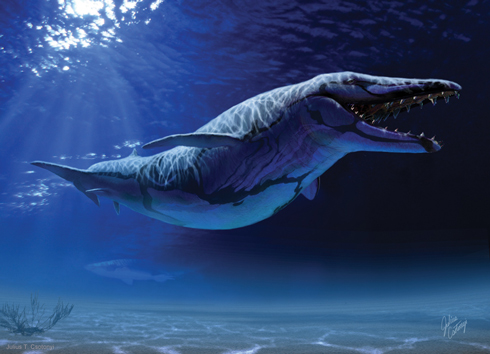
An Illustration of a Prehistoric Whale – Dorudon

Digital painting and photographic composite showing Dorudon.

Fossils of ancient whales trace their evolution, but when did echolocation evolve?

Picture credit:  Julius Csotonyi.

CT Scan of Ancient Whale Inner Ear Bone

In a paper published in the Royal Society’s journal “Biology Letters”, the researchers which included PhD student Travis Park (School of Biological Sciences, Monash University and Geosciences, Museum Victoria, both in Melbourne, Australia) explain how they borrowed a fossilised inner ear (cochlea) from the vertebrate fossil collection of the Smithsonian Institute and subjected the object to a CT scan (computerised tomography) to see inside and reveal the intricate structures that made up the hearing mechanism.

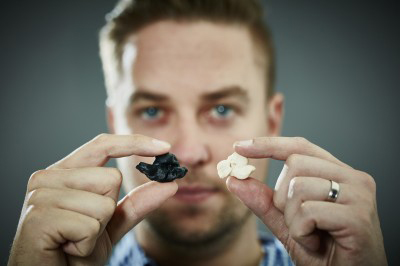
Student Travis Park Compares the Fossil Bone to the Inner Ear of an Extant Dolphin

The fossil cochlea (left) compared to the cochlea of a modern dolphin (right). Study suggests ancient toothed whales had echolocation.

The fossil cochlea (left) compared to the cochlea of a modern dolphin (right). Study suggests ancient toothed whales had echolocation.

Picture credit: Ben Healley

Comparing Extant with Extinct

Today’s dolphins and toothed whales produce high frequency sounds in their nasal passages.  These are transmitted through air sinuses and a specialised organ, the melon, which consists of a mass of fatty tissue.  It is the melon that propagates these sounds into the surrounding environment.  These sounds “bounce” of objects in the animal’s surroundings and the reflected signals reach the inner ear (cochlea) via acoustic fat pads that are located at the end of the lower jaw bone and the middle ear.

The CT scan produced a three-dimensional image of the cochlea and an assessment of the ancient creature’s hearing abilities could then be made using the cochlea of modern, extant dolphin as a benchmark.

Ancient Whale Fossil Ear Bone

The 26-million-year-old fossil ear bone from a xenorophid (one of the earliest Odontocetes known) revealed internal structures that were remarkably similar to those found in extant toothed whales.  The team concluded that ancient Oligocene whales had ears tuned for hearing high frequency sounds and therefore the ability to use echolocation.

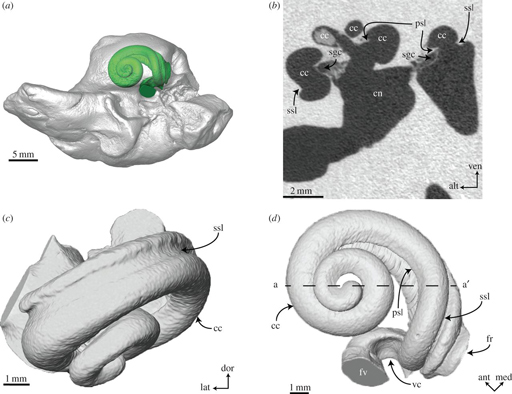
A Computer Model Generated from the CT Scan Reveals the Intricate Structure

CT scan shows sophisticated cochlea of Oligocene fossil whale.

CT scan shows sophisticated cochlea of Oligocene fossil whale.

Picture credit: Biology Letters

The picture above shows (a) the fossil bone with the inner ear structure superimposed on the transparent image, (b) a cross-sectional element from the CT scan showing key features of the inner ear.  Images (c) and (d) are computer models created from the CT scan that shows the shape and structure of the ancient cochlea.  From an assessment of the morphology and the structure of this cochlea, scientists have been able to determine the likely hearing abilities of the long extinct animal.

Commenting on the outcomes of the research, Travis Park stated:

“When I first looked at the inner ear of the xenorophid, I was blown away by just how similar this incredibly old toothed whale was to a modern echolocating dolphin.”

Intriguing Questions Remain

This means that even the most ancient ancestors of today’s toothed whales and dolphins had ears tuned for hearing high frequency sound, and therefore the ability to echolocate like their living relatives.  It is likely that echolocation evolved in the ancestral Odontocetes but the fossil record is incomplete and a number of tantalising questions remain, as explained by co-author of the study Dr. Erich Fitzgerald (Museum Victoria):

“Our paper shows even the earliest known fossil Odontocetes have all the tools for echolocation seen in living dolphins.  But they must have evolved from something that didn’t quite have all the tricks of the Odontocete trade.  What were those animals like and how did they start down the path to sonic super senses?  The quest for the origins of this extraordinary group of creatures continues.”

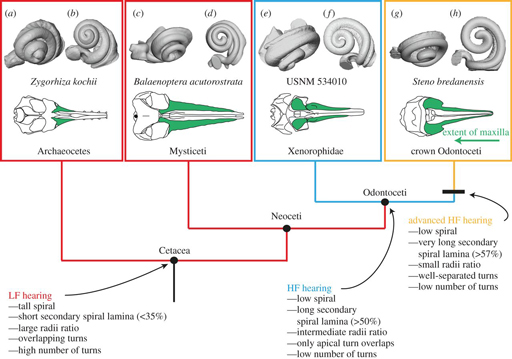
Plotting the Evolution of Echolocation in the Toothed Whales

Plotting the evolution of whale echolocation using a 26 million-year-old fossil inner ear bone.

Plotting the evolution of whale echolocation using a 26 million-year-old fossil inner ear bone.

Picture credit: Biology Letters

Charting the Evolution of the Inner Ear of Cetaceans

The diagram above charts the evolution of the inner ear in cetaceans (whales).  The fossil bone used in the study has been assigned to the Xenorophidae family (fossil specimen used in the study is USNM-534010).  The researchers suggest that over millions of years, the inner ear of these creatures evolved into organs more capable of hearing high frequency sounds.

Everything Dinosaur has written a number of articles that feature the research of Dr Fitzgerald (Senior Curator of Vertebrate Palaeontology at the Museum Victoria), he has certainly been involved in an eclectic range of studies including mapping Australia’s dinosaur diversity, looking at the origins of seals and examining the fossilised bones of a bird with “pseudo teeth” in its beak.

Australia’s diverse dinosaurs: Australia – A Dinosaur Melting Pot

The first seals of Australia: Australia’s First Seal – A Pliocene Pinniped

Giant bird with a toothy grin: Giant “Toothed” Birds Once Soared Over Australia

11 04, 2016

Triassic Fossils Shed Light on Dinosaur Growth Rates

By |2023-04-17T10:15:57+01:00April 11th, 2016|Categories: Dinosaur and Prehistoric Animal News Stories, Dinosaur Fans, Main Page|0 Comments

Triassic Fossil Study Suggests Fossil Size a Poor Predictor of Maturity in Ancient Reptiles

Scientists at the Department of Geosciences at Virginia Tech (Blacksburg, Virginia, USA), have published a paper in the “Journal of Vertebrate Palaeontology”, that challenges some of the long-held assumptions about the growth of ancient reptiles.  Using an analysis of muscle tissue scars preserved on limb bones of Triassic fossils combined with cross-sectional bone studies to examine growth and the age of individuals, the researchers conclude that dinosaurs and their close relatives within the Archosauria had much more variation in growth patterns than expected.  The growth variation does not seem to be linked to gender.

Triassic Fossils

Size of the Fossil Bone May Not be Directly Linked to the Maturity of the Animal

A study of the bones of the Triassic reptile Asilisaurus.

A study of the bones of the Triassic reptile Asilisaurus.

Picture credit: Virginia Tech

Lead author of the scientific paper Christopher Griffin is pictured above holding two differently sized leg bones (femora) of Asilisaurus kongwe the study suggests that bone size is not a good indicator of animal maturity.

Asilisaurus kongwe – On the Road to the Dinosaurs

Fossils of the silesaurid Asilisaurus kongwe were used in the study.  Sufficient fossil material had been excavated over the course of nearly ten years of field trips to the Middle Triassic sediments of Tanzania to provide a suitable sample set and this little carnivore was, most likely an ancestor of the Dinosauria.  It has been assigned to the Dinosauriforms, a clade of archosaurs that gave rise to the dinosaurs and the birds.

The researchers found that when they examined the large number of bones associated with this species, they found that mature, adult bone size did not uniformly split into two distinct groups (male and female).  Instead, they found much more variation in bone size.  It might be difficult to apply this research to the whole of the Dinosauria, but as co-author Professor Sterling Nesbitt states:

“The earliest dinosaurs grew just like their closest relatives, and there are very few features that make dinosaurs unique from their closest relatives.”

If this is the case, then the Asilisaurus study could shed light on the growth habits (ontogeny), of the dinosaurs, at least the first types of dinosaur that evolved a few million years after Asilisaurus roamed Africa.

An Illustration of Asilisaurus kongwe

Depicted as a lithe, agile, active animal.

Depicted as a lithe, agile, active animal.

Picture credit: Andrey Atuchin

The large sample size (most silesaurids and early dinosaurs for that matter are known from highly fragmentary fossil material), permitted the scientists to study several individual specimens that appeared to be more mature than larger specimens and individuals of the same approximate size that appeared to be a different stages of growth.

Analysis of Muscle Scars

Analysis of the scars found on the surface of the bones where tendons and muscles once attached and cross-sectional studies showing the internal structure of the bone itself, allowed the scientists to plot changes in the anatomy and bone tissue.  The researchers found that although the sample set lived roughly at the same time and in the same location, they grew differently from each other.

Think of the analogy of a modern family with siblings and cousins of different heights and weights.

The more mature an individual was at death, the larger its bone scars appeared.  As with any animal or person, an individual skeleton goes from possessing few scars to possessing many during life, with scars appearing in a particular order as the age of the individual increases.

Size is Probably a Poor Predictor of Skeletal Maturity in Silesaurids

The researchers conclude that except for the smallest and largest individuals in the study (the least and most mature respectively), size of bones is probably a poor predictor of skeletal maturity in Asilisaurus and therefore, probably in other silesaurids and ultimately the early members of the Dinosauria as well.

Commenting on the implications for this research, Master’s student Christopher Griffin explained:

“Our study includes more individuals and more bone scars and with this increase in sample size we found that individuals fall on a trajectory that is more similar to maturity difference.  This suggests that similar variation in bone scars in early dinosaurs is variation in growth not male and female difference.  Because this variation appears to be widespread among early dinosaurs and their closest relatives, it is likely that high variation in growth between individuals characterised the most recent common ancestor of Asilisaurus and all dinosaurs.”

Articulating the Fossils of an Individual (Asilisaurus kongwe)

Fossil material laid out to represent Asilisaurus (femora labelled).

Fossil material laid out to represent Asilisaurus (femora labelled).

Picture credit: Virginia Tech with additional annotation by Everything Dinosaur (note the skull to the left of the picture is a model)

Growth Rates Not Well Understood

The growth rates of early, rapidly diverging ancestral dinosaurs is very poorly understood.  This study that assessed the thigh bones (femora) of Asilisaurus kongwe provides an opportunity to examine in detail the ontogeny of one of the closest known relatives of the Dinosauria.

Everything Dinosaur has written about the discovery of Asilisaurus, to read the article: Dinosaurs Around Ten Million Years Earlier than Previously Thought

Everything Dinosaur recognises the help of Virginia Tech in the compilation of this article.

10 04, 2016

Spectroscopic Studies on Organic Matter from Triassic Reptile Bones

By |2023-04-17T09:16:19+01:00April 10th, 2016|Categories: Dinosaur and Prehistoric Animal News Stories, Dinosaur Fans, Main Page, Palaeontological articles|0 Comments

More Evidence of Organic Matter Preserved in the Mesozoic Fossil Record

Over the last few years, Everything Dinosaur has reported on a number of fascinating research projects from around the world that suggest that there may be more to the fossil record than first meets the eye. In this article, we will examine a recently published paper that proposed that traces of organic compounds had been identified in Triassic reptile bones.

As more and more sophisticated research methodologies are employed, so there has been an exponential increase in our understanding of ancient life.  One of the most controversial areas of research are those studies concerning the finding and identification of traces of organic material preserved in the fossilised bones of long-dead animals.  A team of Polish scientists have recently published in the on-line academic journal “PLOS One” a paper detailing the discovery of blood vessels and traces in protein in the bones of Triassic reptiles.

Triassic Reptile Bones

As far as we are aware at Everything Dinosaur, this is the oldest organic material identified to date.

One of the Fossil Limb Bones Used in the Study

One of the limb bones used in the study of Triassic vertebrates from Poland.

One of the limb bones used in the study of Triassic vertebrates from Poland.

The scientists, which include researchers from the University of Silesia (Faculty of Earth Science), Jagiellonian University and the Polish Academy of Sciences report on the finding of preserved blood-vessel-like structures enclosing organic molecules that could be amino acids and fragments of other proteins including fibrils of collagen.   It is thought that the organic material had been preserved in the 247-million-year-old specimens as the bones were rapidly mineralised.

The Shores of the Ancient Tethys Ocean

For much of the Early and Middle Triassic, the central northern portions of Europe, including the countries of Poland and Germany were submerged under a shallow sea (the western edge of the mighty Tethys Ocean).  The limestone strata that was formed during this time preserve evidence of a rich and varied vertebrate fauna as a number of different types of diapsid reptile lived on the shoreline.  The most common large vertebrate fossils are Nothosaurs and the evidence of organic material preservation came from a study of Nothosaur limb bones.  In addition, the fossilised vertebrae (specifically a centrum) of an as yet unidentified Protanystropheus species was also studied.

A Model of a Triassic Marine Reptile a Nothosaurus

One of the models in the Safari Prehistoric Sealife Toob.

One of the models in the Safari Prehistoric Sealife Toob.

Picture credit: Everything Dinosaur

Studying Protanystropheus

Protanystropheus is a member of the Tanystropheidae family of Archosauromorphs, a strange group of reptiles characterised by extremely long and stiff necks that in some species represent more than half their entire body length.  It is likely that both Nothosaurs and Protanystropheus were fish-eaters (piscivores).

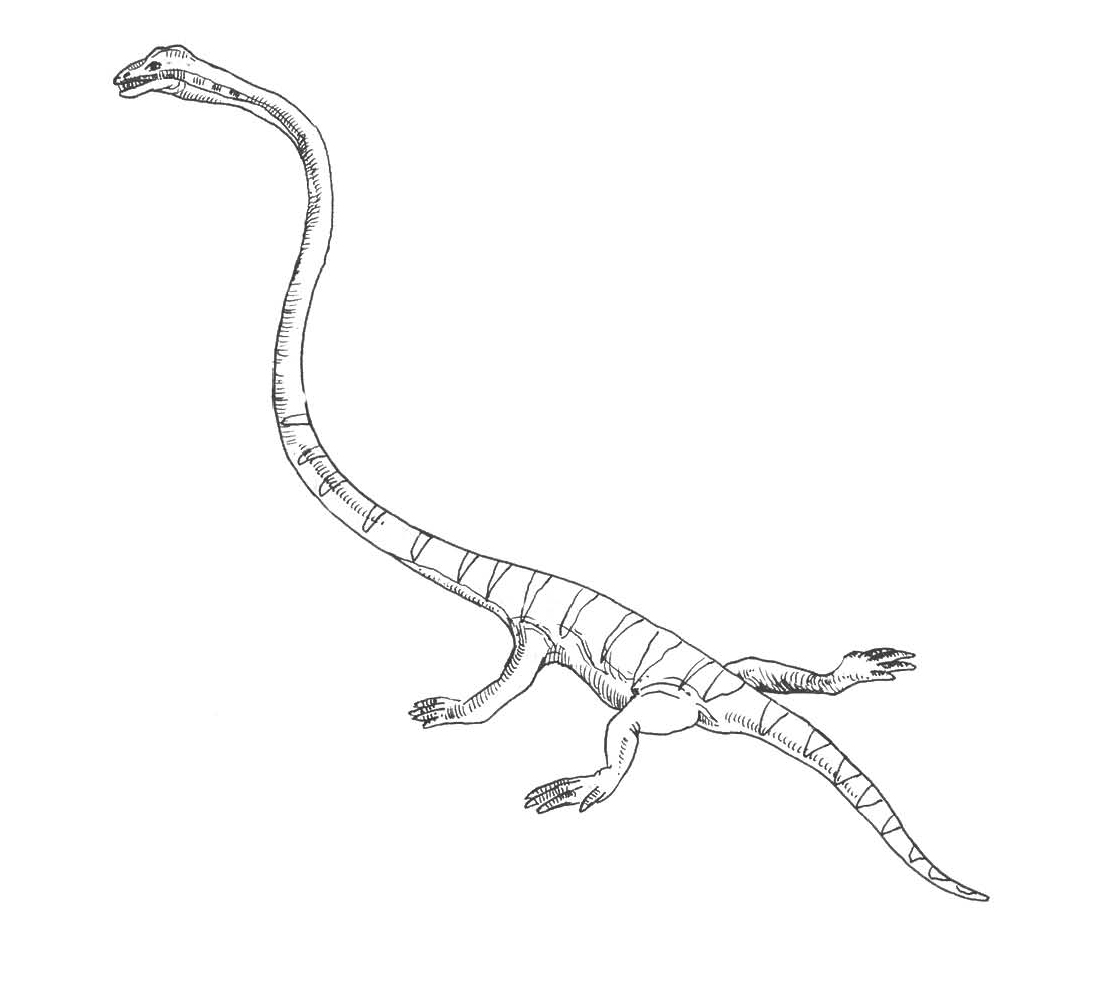
An Illustration of a Typical Member of the Tanystropheidae (T. longobardicus)

A drawing of the bizarre Triassic reptile Tanystropheus.

A drawing of the bizarre Triassic reptile Tanystropheus.

Picture credit: Everything Dinosaur

Finding Fossil Biomolecules

The team, some of which had identified potential organic material in the fossilised remains of dinosaurs from the Gobi Desert, used an array of advanced and highly sophisticated research methods to identify the biomolecules.  The team used several analysis methods including X-ray photo-electron spectroscopy (XPS), an environmental scanning electron microscope (ESEM) and fourier transform infrared spectroscopy (FTIR).  Amino acids including hydroxyproline and hydroxylysine were found.  This discovery provides the oldest evidence yet of preservation of complex organic molecules in vertebrate remains from a marine environment.

Commenting on the team’s findings researcher Dr. Andrzej Boczarowski (Faculty of Earth Science, University of Silesia) stated:

“Among other proteins, we managed to find collagen, one of the most important proteins in the bodies of animals in general and vertebrates in particular.”

Highly Magnified Images Showing Demineralised Blood Vessels from the Fossil Material

Organic matter potentially identified in Triassic vertebrae fossils.

Organic matter potentially identified in Triassic vertebrae fossils.

Picture credit: PLOS One

The pictures above show some of the images of demineralised blood vessels identified from the fossil samples.

  • Picture (a) – parallel-orientated fossilised blood vessels from the Protanystropheus centrum.
  • Photo (b) – fossilised “floating” blood vessels from the Protanystropheus centrum revealed during the demineralisation process (removing the calcium in a EDTA solution).
  • Picture (c) – and ESEM image of branching (bifurcated) blood vessels mounted on a carbon conductive tab – this organic material was identified from a Nothosaurus femur.
  • Pictures (d, e and f) – stereoscopic microscopic images of isolated branch-like blood vessels from the Nothosaurus femur.

Highly Magnified Fragment of Mineralised Blood Vessel with Tubular Morphology Preserved

Highly magnified image of a blood vessel-like object showing preservation of tube shape.

Highly magnified image of a blood vessel-like object showing preservation of tube shape.

Picture credit: PLOS One

ESEM Images

The picture above shows three ESEM images (g) a potential blood vessel mounted on a carbon conductive tab, (h) mineralised blood vessel showing preservation of a tubular shape from the Nothosaurus femur and (i) an image of a mineralised, damaged wall of a blood vessel from the Protanystropheus centrum.

Complex Molecular Analysis

Complex molecular analysis using highly sophisticated research techniques has yielded evidence of organic material in a number of Pleistocene specimens.  Some organic material including the remnants of blood vessels and collagen has been reported in studies of Cretaceous aged fossil material, but such findings have been questioned and contamination or an infiltration of bacteria have been put forward as more likely sources of organic material.  However, this new study further extends the age range of such potential organic material discoveries and may provide palaeontologists with further insight with regards to the biology of Early Triassic diapsid reptiles.

8 04, 2016

New Model to Help Find Fossils

By |2023-04-17T07:55:31+01:00April 8th, 2016|Categories: Dinosaur and Prehistoric Animal News Stories, Dinosaur Fans, Geology, Main Page, Palaeontological articles|0 Comments

Serendipity Taken Out of Fossil Finding

Very often a major fossil find is attributed to serendipity, someone being in the right place at the right time.  Even the most experienced palaeontologist needs a little bit of luck, take for example the discovery of the ancient hominin Homo floresiensis on the Indonesian island of Flores.  Had the research team excavated an area just one metre either side of that part of the cave they did excavate they would never have found the beautifully preserved skull and partial skeleton of an individual (the holotype LB-1).  Yes, “lady luck” does play a part in many new scientific discoveries.  Palaeontologists are all too aware of serendipity.

However, an international team of scientists, including researchers from the University of Adelaide, have created a mathematical model to help palaeontologists find the remains of long-extinct animals.

Combining Scientific Disciplines to Predict Where Fossils Can be Found

The international team, that included researchers from Kiel University (Germany), as well as Australia, looked at the estimated ages of the fossils from a number of extinct Australian megafauna and plotted known fossil find locations for these creatures against data for the prehistoric climate of Australia.  This provided a guide to the maximum likely ranges of the animals in the study.  This information was then mapped against the geology of Australia to provide an indication of what suitably aged, likely fossil bearing strata was exposed.

Weighting for the erosion potential of the rocks was built into the mathematical model and this data set could then be used to help determine the best areas in the country to look for the animal’s fossil remains.

Scientific Paper Published

A paper detailing the research has been published in the on line journal PLOS One, the research team confidently state that their model can provide fossil hunters with guidelines on how to find fossils elsewhere in the world too.

Determining the Best Places to Hunt for Fossils

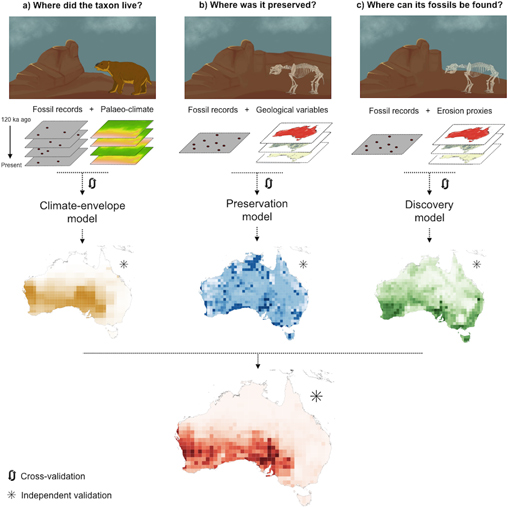
Combining palaeoclimate data with erosion studies and known fossil finds to predict where fossils can be found.

Combining palaeo-climate data with erosion studies and known fossil finds to predict where fossils can be found.

Picture credit: Sebastián Block, Frédérik Saltré,  Marta Rodríguez-Rey, Damien A. Fordham, Ingmar Unkel, Corey J. A. Bradshaw

The picture above provides an illustration of how the mathematical model was constructed and how to implement it.  For any given type of extinct animal (in this example, the giant marsupial Diprotodon), the red map at the bottom shows the likely places to hunt for fossils of that animal.  The darker the red shading the more likely that location is to be a “fossil finding hot spot”.   The red map has been created by looking at certain variables, namely:

  • Where the animal used to live – a map created by assessing ancient climate data and known fossil finds (the brown map).
  • Where the fossils could be preserved – using an assessment of the geology of the local area (blue map).
  • The location where it is now possible to find the fossils of that particular animal, building in an assessment of erosion profiles of the likely fossil bearing strata (green map).

A Systematic Approach for Palaeontologists

The scientists are confident that this systematic approach to fossil finding is more likely to be successful than random approaches to fossil hunts, even out-doing sophisticated approaches such as using satellite data to identify likely fossil bearing outcrops and exposures.

Five genera of Late Pleistocene megafauna were selected for this study.  All had an extensive and relatively widely distributed fossil record on the continent and since all had become extinct relatively recently there was plenty of evidence to support an assessment of the ancient climate.  The creatures studied were Thylacoleo (the marsupial lion), Protemnodon (a giant wallaby), the cow-sized, giant marsupial  Zygomaturus, the flightless bird Genyornis and Diprotodon, the largest marsupial known to science.

Diprotodon Played a Role in the Study

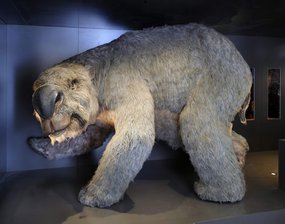
Diprotodonts - Giant Marsupials

Diprotodon – A giant marsupial.

Picture credit: Australian Museum/James King

Although all these five genera are unique to Australia, the scientists had sufficient fossils to create an accurate map of the creatures prehistoric distribution.

The Reasoning Behind the Model

Commenting on the reasoning behind their model, project leader, Professor Corey Bradshaw, (Sir Hubert Wilkins Chair of Climate Change at the University of Adelaide) stated:

“A chain of ideal conditions must occur for fossils to form, which means they are extremely rare, so finding as many as possible can tell us more of what the past was like, and why certain species went extinct.  Typically, however, we use haphazard ways to find fossils.  Mostly people just go to excavation sites and surrounding areas where fossils have been found before.  We hope our models will make it easier for palaeontologists and archaeologists to identify new fossil sites that could yield vast treasures of prehistoric information.”

Lead author of the scientific paper Sebastián Block explained that the team made use of modelling techniques already used widely in ecology.  They looked at the past distribution of these prehistoric genera, where fossils were likely to have formed and the probability of making field discoveries.  The model may not make the back-breaking work of excavating fossils any easier, but at least palaeontologists will be looking in the most likely places.

The Probability of Finding Fossils

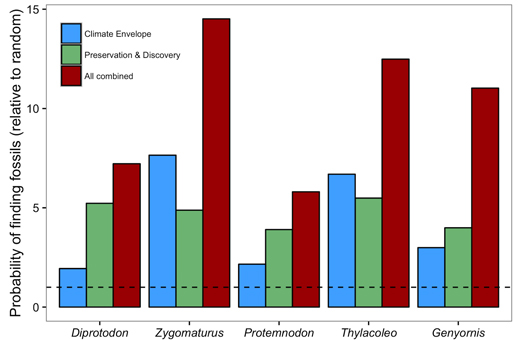
Combining disciplines increases the probability of finding fossils.

Combining disciplines increases the probability of finding fossils.

Graph credit: Sebastián Block, Frédérik Saltré,  Marta Rodríguez-Rey, Damien A. Fordham, Ingmar Unkel, Corey J. A. Bradshaw

Assisting Palaeontologists and Fossil Hunters

The bar chart above shows how the model increases the likelihood of fossil discovery for the five genera studied.

The chances of finding a fossil of that particular genus compared to a random search is plotted on the vertical (Y axis).  The blue bars represent the probability of finding a fossil based on an assessment of ancient climate.  The green bars show the probability of a successful fossil hunt using just geological data and erosion assessments.  The red bars show the increased likelihood of success after the application of the variables used in this assessment (ancient climate, preservation potential and known discoveries).  The dashed line outlines the probability of finding a fossil using a random search in a known fossil bearing locality.

Likely Fossil Preservation Sites Accounted For

The team added into their data relevant predictors for the likelihood of fossil discoveries.  For example, many Late Pleistocene fossils are found in caves so the number of caves in the areas studied were also plotted.  In addition, as Australian megafauna (indeed most terrestrial animal fossils), are found in association with ancient lakes and rivers, areas where sedimentary material can be built up were given greater weighting as indeed were areas that tended to be more open and devoid of extensive plant cover as this would make fossil finding easier.

Using the model, likely fossil “hot spots” identified include the area south of Lake Eyre (South Australia), the land to the west of Lake Torrens (also South Australia) and the Shark Bay locality in Western Australia.

Kiel University’s Professor Ingmar Unkel added:

“Our methods predict potential fossil locations across an entire continent, which is useful to identify potential fossil areas far from already known sites.  It’s a good “exploration filter”; after which remote-sensing approaches and fine-scale expert knowledge could compliment the search.”

Luck will still play a role in fossil discoveries but at least this mathematical model helps to swing the odds in the scientists favour.

7 04, 2016

Stolen Dinosaur Fossils Returned to a Grateful Mongolia

By |2024-05-05T21:50:30+01:00April 7th, 2016|Categories: Dinosaur and Prehistoric Animal News Stories, Dinosaur Fans, Main Page|0 Comments

Looted Dinosaur Fossils Returned Home to Mongolia

This week saw another success in the fight against illegal fossil smuggling and the black market in rare artefacts such as prehistoric animal fossils.  Officials from the U.S. Immigration and Customs returned a number of dinosaur skeletons and other fossils to the Mongolian government.  In a ceremony held in New York, investigators from the U.S. Immigration and Customs Enforcement’s (ICE) Homeland Security Investigations (HSI) handed over fossils that had been recovered from Wyoming and the “big apple”.

Dinosaur Fossils

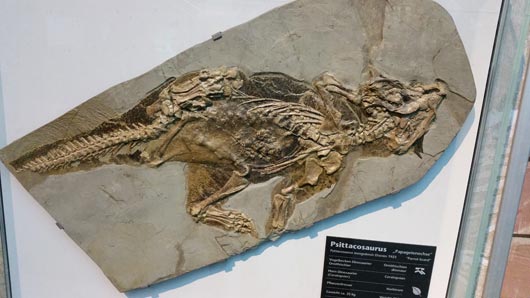
An Articulated Psittacosaurus Dinosaur Skeleton on Display

A Psittacosaurus fossil.

Psittacosaurus fossils on display at the Senckenberg Naturmuseum (Frankfurt).

Picture credit: Everything Dinosaur

The Removal of Fossils from Mongolia

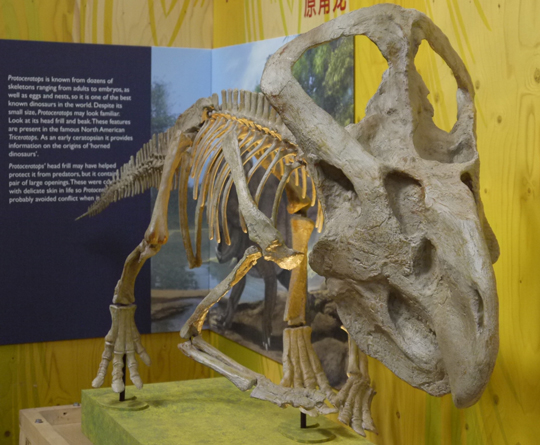
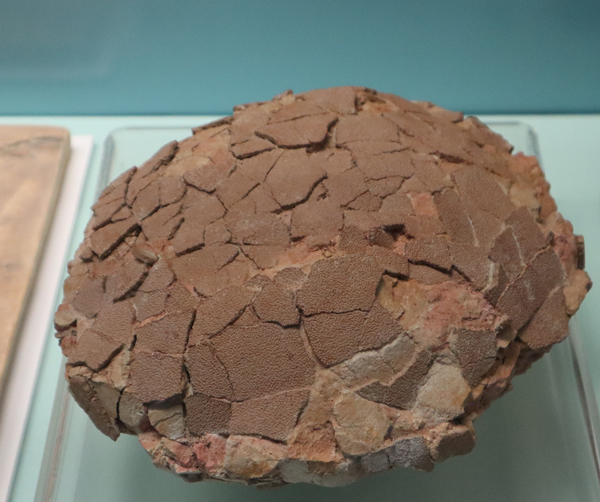
A law passed in the 1920s forbids the removal of artefacts deemed to be of significant cultural value from Mongolia, the returned items include nearly complete skeletons of the basal horned dinosaurs Protoceratops and Psittacosaurus, along with a beautifully preserved nest of Protoceratops eggs.  In addition, the fossils of the duck-billed dinosaur Bactrosaurus and the skull of a tyrannosaurid Alioramus as well as the skull of Psittacosaurus were returned.

Commenting on the significance of the returns, Peter Edge, (HSI’s Executive Associate Director) stated:

“Today’s ceremony is an excellent demonstration of the co-operation between HSI, our colleagues at the Department of Justice and our foreign counterparts with the Government of Mongolia.  A successful repatriation requires extensive co-operation among all parties involved, which is rewarded by the knowledge that we’ve returned what rightfully belongs to the people of Mongolia.”

Building on the Success of the Tarbosaurus bataar Repatriation

U.S. customs most noteworthy success came in 2013 with the high profile repatriation of a mounted Tarbosaurus bataar skeleton that had originally been put up for auction in New York the year before.  Tarbosaurus, like Alioramus was a member of the Tyrannosauridae family, this case resulted in the prosecution and eventual jailing of Florida fossil dealer Eric Prokopi.

To read more about this:  American Fossil Dealer Jailed for Dinosaur Smuggling

The Tarbosaurus case brought to the world’s attention the problem of illegal fossil dealing, it laid the foundation for much greater co-operation between governments and other federal bodies and sent a very clear message to the unscrupulous dealers and their middle men.  In this latest ceremony, a total of twenty-three dinosaur fossils were handed over to the Mongolian government.

A spokesperson from Everything Dinosaur commented:

“We would like to take this opportunity to congratulate all the parties involved in achieving such a successful conclusion.  These efforts will further strengthen cross-border co-operation and bilateral ties between nations as authorities attempt to reduce the level of fossil smuggling and the illegal removal and export of rare artefacts from Asia.”

An Almost Complete Protoceratops Skeleton

Protoceratops skeleton on display.

Picture credit: Everything Dinosaur

For models and replicas of Protoceratops and other horned dinosaurs (whilst stocks last): Beasts of the Mesozoic Figures.

Trained Investigators

HSI’s specially trained investigators, assigned to both domestic and international offices, partner with governments, agencies and experts to protect cultural antiquities.  They also train investigators from other nations and agencies to investigate crimes involving stolen property and art, and how to best enforce the law to recover these items when they emerge in the marketplace.  Those involved in the illicit trafficking of cultural property, art and antiquities can face prison terms of up to twenty years, fines and possible restitution to the purchasers of the items.

This is just the latest success for the HSI, since 2007 this American organisation has repatriated more than 8,000 items to more than thirty countries.

Everything Dinosaur acknowledges the help of the U.S. Immigration and Customs Enforcement media team for the compilation of this article.

Visit Everything Dinosaur’s website: Everything Dinosaur.

6 04, 2016

Sensational Dinosaur Egg Discovery from China

By |2024-05-05T21:50:57+01:00April 6th, 2016|Categories: Dinosaur and Prehistoric Animal News Stories, Dinosaur Fans, Main Page|0 Comments

Dinosaur Eggs from the Early Cretaceous

Parts of China have provided palaeontologists with ample evidence of dinosaur nesting behaviour, fossils of nests, eggshells and complete eggs themselves have been excavated from a number of locations.  Guandong Province (southern China) in particular is famous for the relative abundance of dinosaur egg fossils that have been found.

Dinosaur Eggs

However, the vast majority of these egg fossils from China come from Upper Cretaceous deposits, indeed from a global perspective, dinosaur eggs that date from the Lower Cretaceous are much rarer than their Upper Cretaceous counterparts.  Up until now, the only confirmed dinosaur egg fossils from Lower Cretaceous age deposits from China have been excavated from sites in Liaoning Province in the north-east of the country.

A Dinosaur Egg Fossil

Dinosaur eggs studied by palaeontologists.

A dinosaur egg fossil. Picture credit: Everything Dinosaur.

Picture credit: Everything Dinosaur

Scientific Paper Published

A press release from the Chinese Academy of Sciences which provides information on a new paper published in the academic journal “Vertebrata PalAsiatica” changes all that.  A new type of dinosaur egg is described, although the fossils are fragmentary, the largest piece of eggshell found to date in only a few centimetres in diameter, a microscopic analysis of the eggshells structure has revealed new characteristics indicating that this is a new type of dinosaur egg, but as to which dinosaur laid the eggs, that remains a bit of a mystery.

A Fragment of the Dinosaur Egg Fossil (Eggshell)

The scale bar = 1cm

(A) scale bar = 1 cm and (B) scale bar = 1 mm

Picture credit: Chinese Academy of Sciences

The picture above shows the largest eggshell fragment discovered to date (A), the second picture (B) is a close up of the highly weathered surface of another piece of dinosaur eggshell from the same location.

From Lower Cretaceous Deposits

The fossils come from the uppermost siltstone layer of exposed Lower Cretaceous sediments in Gansu Province.  These rocks make up the Lower Cretaceous Hekou Group in the Lanzhou-Minhe Basin, north-western China.  Exposed Lower Cretaceous strata in Gansu Province has yielded extensive dinosaur and bird tracks, but these are the first dinosaur egg fossils to have been found in this part of China.

To read an article about some intriguing sauropod tracks found in the same area as these egg fossils: Swimming or Walking Sauropods

Important Implications for the Study of Dinosaur Eggs

The eggs have been assigned to a new oogenus, a new oospecies has been erected.  Just like fossilised animal tracks, palaeontologists can establish a scientific name for egg fossils, such names have the prefix “oo”, from the ancient Greek for egg, placed in front of them to indicate these names refer to an egg.  With trace fossils the prefix “ichnos” is used, this too comes from ancient Greek, (ichnos means track).

The oogenus is Polyclonoolithus and the oospecies is Polyclonoolithus yangjiagouensis, the dinosaur eggs can be distinguished from other Chinese dinosaur eggs as under the microscope the eggshell  showed unique features such as highly branched eggshell units not having a compacted layer near the outer surface of the shell and very irregular pore canals.

Microscopic Study of the Eggshell Revealed Unique Features

Microscopic analysis of the eggshell structure revealed unique features in this Lower Cretaceous dinosaur egg.

Microscopic analysis of the eggshell structure revealed unique features in this Lower Cretaceous dinosaur egg.

Picture credit: Chinese Academy of Sciences

The authors of the scientific paper conclude that the eggshell fossils represent a more basic type of dinosaur egg, especially when compared to the highly diverse forms of dinosaur egg found in Upper Cretaceous deposits.  Its taxonomic relationship to other oogenera is not known, but these fossils might represent an early form of egg that led onto the evolution of more rounded, spherical eggshell shapes (spheroolithid eggs).

Polyclonoolithus yangjiagouensis

As for the name Polyclonoolithus yangjiagouensis (pronounced Pol-ee-klon-ooh-lith-us yang-gee-ah-gou-en-sis), the oogenus name is derived from the Greek for “egg stone with many small branches”, the oospecies name honours the town of Yangjiagou, in the border region of Lintao and Yongjing counties, Gansu Province, which is close to where the fossils were found.

By honouring the local town in this way the scientists hope to deter pilfering of fossil material, unfortunately, there is an extensive illegal trade in fossils in China and although the authorities have worked hard to stamp out the black market, many hundreds, if not thousands of rare artefacts such as dinosaur fossils are smuggled out of China each year.

Trade in unlawfully gained fossil material is significant, dinosaur eggs are particular favourite of unscrupulous traders as they are relatively small , portable but retain a high resale value.  Last year Everything Dinosaur reported on the seizure of huge haul of stolen dinosaur eggs from Guandong Province, to read more about this: Chinese Authorities Seize Hundreds of Dinosaur Eggs in Raid

Which Animal Laide These Dinosaur Eggs?

The eggs were probably little more than ten centimetres in diameter, not huge when compared to the eggs of sauropods for example.  However, the palaeontologists cannot be certain as to which type of dinosaur laid the eggs.

Only a handful of dinosaurs are known from the siltstone strata (late Early Cretaceous).  Evidence of basal titanosaurs have been found along with the fossils of an iguanodontid Lanzhousaurus magnidens.  The eggshell fragments come from the same locality where fossils of an armoured dinosaur, a nodosaurid (Taohelong jinchengensis) have been discovered.  It is not possible at this time to identify which type of dinosaur produced these intriguing eggs.

For dinosaur models and replicas: Dinosaur and Prehistoric Animal Models.

4 04, 2016

The “Kite Runner” from the Silurian of England

By |2023-04-17T07:21:08+01:00April 4th, 2016|Categories: Dinosaur and Prehistoric Animal News Stories, Main Page, Photos/Pictures of Fossils|0 Comments

Aquilonifer spinosus – Meet the “Kite Runner” from the Silurian

A team of international researchers including scientists from Leicester University, Oxford University, Imperial College London and Yale have published a paper on a two centimetre long, ancient Arthropod that once scuttled around an ancient Silurian sea floor.  The fossil, preserved in almost three-dimensions has slowly emerged from its volcanic ash matrix and the specimen is not only a new species but it reveals a novel way of brooding its young.

The new species is named in honour of the best selling 2003 novel “The Kite Runner” by Khalid Hosseini, as the young are tethered to the adult’s body in capsules or pouches that reminded the research team of kites.

A Computer Generated Three-dimensional Image of A. spinosus

The capsules or pouches to carry young look like squashed lemons in this image.

The capsules or pouches to carry young look like squashed lemons in this image.

Picture credit: D Briggs/D Siveter/M Sutton/D Legg

A Remarkable Fossil  Site

The fossil comes from a remarkable site in Herefordshire (England), close to the Welsh borders.  The limestone strata is interrupted by a finely grained bedding plane that represents the ash from a volcanic eruption that settled on the seabed some 430 million years ago.  This ash choked, buried and killed a lot of the Arthropods and other creatures that lived on or around the sea floor, and the Silurian Herefordshire Lagerstätte has provided palaeontologists with an unique opportunity to study microfossils in exquisite detail.

The genus name Aquilonifer comes from the Latin “aquila” for eagle or kite and the suffix “fer” which means to carry.  The paper describing the study has been published in the academic journal “Proceedings of the National Academy of Sciences”.

Lead author, Professor Derek Briggs (Yale University and Royal Society Fellow), commented:

“Modern crustaceans employ a variety of strategies to protect their eggs and embryos from predators, attaching them to the limbs, holding them under the carapace or enclosing them within a special pouch until they are old enough to be released, but this example is unique.”

Strategy for Raising Young

No member of the Arthropoda, alive today (as far as we at Everything Dinosaur are aware), adopts such a strategy towards raising the next generation.  As only one fossil specimen has been found and since no Arthropod known to science has evolved this behaviour, the fossil may record one reproduction strategy that ultimately proved to be unsuccessful, or at least less successful than other strategies employed by competing organisms.

Revealing the Tiny Fossil of Aquilonifer spinosus

The scientists were able to identify A. spinosus using a process whereby high intensity scanning photographs are taken, in a virtual slice by slice of the specimen.  The results are then fed into a powerful computer programme that generates a three-dimensional image of the animal, including soft body parts such as, in this case, the pouches or capsules that held juveniles.  The picture in this blog article is therefore an image of the “virtual fossil” that has been generated by this process.

The “Kite Runner” shows ten juveniles attached at various stages of development, all connected to the adult.  The researchers suggest that the adult delayed its moult until the juveniles were old enough to hatch, otherwise, the juveniles would have been cast adrift as the exoskeleton was shed.  It had been considered that the strange capsules/pouches with their tethers were some form of parasite, but the attachment seemed too uniform and the attachment position was not very favourable when it came to trying to access nutrients from the host.

Aquilonifer spinosus

Aquilonifer spinosus shared its marine environment with a host of other invertebrates including ostracods, brachiopods, worms, gastropods (snails), sea stars, and various shrimp-like creatures.  The scientists suggest that this animal was a mandibulate, belonging to a clade of the Arthropoda that includes crustaceans, and modern insects.  It lacked eyes and probably relied upon its long, robust antenna to find its way about, the trunk had eleven body segments which all had tiny jointed limbs to help it scuttle along the seabed.

Co-author, Dr. Legg of Oxford University stated that this bizarre creature that seems to have kept its babies close to it by thin threads may have had a segmented body and an exoskeleton but deciding where in the Order Arthropoda it fitted proved a tricky task.

Over the last few years, Everything Dinosaur has covered a number of fossil discoveries from the Silurian Herefordshire Lagerstätte made using the same techniques employed in this study.

To visit Everything Dinosaur’s website: Everything Dinosaur.

To read about the discovery of a strange ostracod fossil: Ancient Ostracod from Herefordshire

To read about a rather nasty surprise revealed by this fossil preparation process: Prehistoric Parasites from the Silurian

31 03, 2016

Did Modern Humans Drive the Hobbit to Extinction?

By |2023-04-16T18:16:25+01:00March 31st, 2016|Categories: Dinosaur and Prehistoric Animal News Stories, Main Page|0 Comments

Age of Homo floresiensis Revised

The Indonesian island of Flores, provided anthropologists with quite a surprise back in 2003, scientists uncovered evidence of a diminutive species of human, quite unlike anything seen before.  This new species was named Homo floresiensis and since these people were about the size of a five-year-old child (about a metre tall), they were nicknamed “hobbits”.  The Peter Jackson trilogy of films “Lord of the Rings” had been hugely successful and the archaeologists, anthropologists and palaeontologists involved in the excavations at Liang Bua cave, where the fossils representing nine individuals were found, nicknamed these little people in deference to the characters within the Tolkien novels.

Homo floresiensis

The fossilised bones and stone tools were originally dated to relatively recent times, perhaps as recently as 12,000 to 11,000 years ago, this meant that these small people had probably co-existed with modern humans (H. sapiens) for thousands of  years.  There was even folklore in the region of tiny people living in the forest and occasionally stealing from local villages – could the “hobbits” have survived up until just a few hundred years ago?

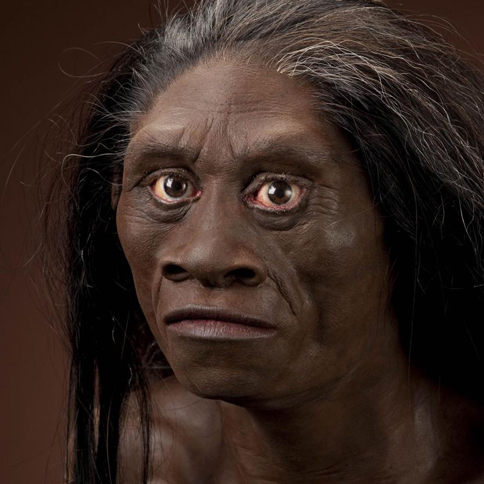
The “Hobbit” Homo floresiensis – Older Than Previously Thought

Homo floresiensis female based on skeletal remains LB1.

Homo floresiensis female based on skeletal remains LB-1.

Picture credit: Reconstruction of female H. floresiensis based on LB-1 fossil material by John Gurche

In a twist in the tale, worthy of Tolkien himself, as the limestone cave deposits have been studied so their complex sedimentation has been revealed.  It seems that the strata yielding Homo floresiensis remains are much older than previously thought.  In a new study, published this week in the journal “Nature” scientists conclude that these little people had become extinct in the Liang Bua cave region by 50,000 years ago.

In short, (no pun intended given that these people rarely measured more than a metre tall), the fossilised bones and stone tools associated with H. floresiensis are tens of thousands of years older than previously thought.  One of the burning questions yet to be resolved is not how could these diminutive people co-exist alongside modern humans for thousands of years?  The unresolved question is this, around 50 – 60,000 years ago modern humans were migrating throughout south-east Asia, could the “hobbits” have been driven to extinction by the arrival of modern mankind?

A Lot Older than Initially Thought

Lead author of the new research, Thomas Sutikna (University of Wollongong, New South Wales, Australia and National Research Centre for Archaeology, Indonesia), explained that the research published in the journal “Nature” in 2004 was the culmination of three years of excavations.  The scientists concluded that a skeleton found in the eastern part of the cave (LB1), representing a 30-year-old female was about 18,000 years old.  Fragmentary bones and stone tools found in older and younger layers represented a geological distribution of some 95,000 to 12,000 years ago.

Seven Years of Research

Further excavations carried out from 2007 until 2014 by researchers from Indonesia’s National Research Centre for Archaeology, the Smithsonian Institute (USA) and the University of Wollongong, revealed that the stratigraphic sequence in the cave was far more complicated than previously thought.  New dating studies indicated that all the skeletal remains ascribed to Homo floresiensis was far older than originally described.  The fossils are between 100,000 to 60,000 years old.  Some stone tools associated with H. floresiensis are a little younger, approximately 50,000 years old.

Modern humans were migrating across south-east Asia reaching Australia at around this time, but whether or not the two species interacted or even encountered each other is not known.  Could the “hobbits” have also encountered other human species H. erectus or indeed the enigmatic Denisovans for example?

A View of the Liang Bua Cave

A view of the Liang Bua cave showing the various excavations.

A view of the Liang Bua cave showing the various excavations.

Picture credit: Liang Bua excavation team

Thomas Sutikna stated:

“We didn’t realise during our original excavations that the ‘hobbit’ deposits near the eastern wall of the cave were similar in age to those near the cave centre, which we had dated to about 74,000 years ago.  As we extended our original excavations each year, it became increasingly clear that there was a large remnant pedestal of older deposits truncated by an erosional surface that sloped steeply toward the cave mouth.”

Co-author of the academic paper published this week, Wahyu Saptomo, added:

“Unfortunately, the ages of these overlying sediments were originally thought to apply to the ‘hobbit’ remains, but our continuing excavations and analyses revealed that this was not the case.”

Where Would Homo floresiensis Fit In?

Although, Homo floresiensis is much older than previously thought, questions still remain, for example, scientists are not sure where in the hominin family tree these people fit. Could they be an example of island dwarfism and descended from Homo erectus or could they represent an entirely different lineage?  It has also been suggested that the fossils represent a group of people struck down with some form of genetic disorder that led to their diminutive size.  In essence, scientists remain puzzled over how these people fit into our family tree and the reason for their extinction.

The Skull of Homo floresiensis compared to a H. sapiens Skull

The skull of H. floresiensis reveals a brain about the size of a chimps.

The skull of H. floresiensis reveals a brain about the size of a chimps.

Sudden Disappearances from the Liang Bua Strata

H. floresiensis is not the only species that suddenly disappears from the Liang Bua stratigraphic sequence about 50,000 years ago.  The researchers found that much of the endemic fauna of Flores seems to have disappeared at around the same time.  Dr Matt Tocheri, (Canada Research Chair in Human Origins at Lakehead University and Research Associate at the Smithsonian Institution’s Human Origins Programme), another of the scientists involved in the H. floresiensis  date revision.

Giant marabou storks, vultures, pygmy Stegodon (an extinct relative of elephants) and even Komodo dragons vanish from the stratigraphic sequence at the same point that H. floresiensis vanishes.

A spokesperson from Everything Dinosaur commented:

“The new study resolves some of the issues surrounding these ancient residents of Flores, but there are still lots of questions to be answered.  The stratigraphic sequence suggests that there were a number of extinctions at or around 50,000 years ago, including H. floresiensis, perhaps the incoming modern human populations led to added pressure and this caused the extinction of a number of species on this island.”

Go to Top