All about dinosaurs, fossils and prehistoric animals by Everything Dinosaur team members.

Fossil finds, new dinosaur discoveries, news and views from the world of palaeontology and other Earth sciences.

4 05, 2016

Minisauripus – The Smallest Dinosaur Known?

By |2023-04-19T07:57:07+01:00May 4th, 2016|Categories: Dinosaur and Prehistoric Animal News Stories, Dinosaur Fans, Main Page|0 Comments

Ancient Tracks Hint at Tiny-saurus

A team of international scientists including researchers from Bristol University and the China University of Geosciences (based in Beijing), have published a paper reporting on tiny three-toed tracks found in south-western China that might support the idea that some theropod dinosaurs were very small indeed.

Tiny Theropod Tracks

The footprints suggest that a dinosaur no bigger than a house sparrow ran across a mud flat more than 125 million years ago.  The dinosaur is referred to as Minisauripus (pronounced min-nee-sore-ree-pus), it is an ichnogenus, the term applied to an animal that is only known from fossil footprints and trackways.

Although the researchers don’t rule out the possibility that these prints might have been made by juveniles of a larger species, all the described examples assigned to this ichnogenus are small and so it is possible this is evidence of one of the smallest kinds of dinosaur to have existed.

A Minisauripus (Foreground) Chased by a Larger Jialingpus (Background)

Minisauripus, potentially the smallest dinosaur known to science.

Minisauripus, potentially the smallest dinosaur known to science.

Picture credit: Zhang Zongda/China Daily

Minisauripus Chased by Jialingpus

The picture above shows an artist’s impression of Minisauripus which may have been a compsognathid being pursued by a much larger theropod, also known from fossil tracks – Jialingpus.  The tracks are from exposed strata that make up the extensive Lower Cretaceous Feitianshan Formation, these rocks preserve trace fossils made on soft sand and silts that represent a low-energy lake (lacustrine) environment.

Dinosaur Footprints

A number of different types of dinosaur footprints have been identified at this location close to the town of Yangmozu (in Zhaojue County, Sichuan Province), twenty theropod dinosaur tracks have been found, seventeen of these have been assigned to the larger Jialingpus, the remaining three tiny tracks are associated with Minisauripus.  In total around seventy individual footprints have been identified from a 26 square metre section of rock.  A scientific paper detailing this research has been published in the academic journal “Palaeogeography, Palaeoclimatology, Palaeoecology”.

One of the lead authors of the paper, Lida Xing (a PhD student at the China University of Geosciences) commented:

“The discovery of Minisauripus may challenge people’s traditional thinking that all dinosaurs were big guys with scary teeth and claws.  On the contrary, the footprints discovered in Zhaojue County belong to a small, fluffy dinosaur the size of a bird.”

Other fossils assigned to this ichnogenus have been found elsewhere in China, there is also evidence of Minisauripus tracks recorded from Lower Cretaceous rocks in Korea.

Size Comparison Minisauripus versus Oviraptorid and the Hind Foot of Giganotosaurus

The ichnogenus Minisauripus compared to an oviraptorid and the hind foot of a Giganotosaurus.

The ichnogenus Minisauripus compared to an oviraptorid and the hind foot of a Giganotosaurus.

Picture credit: Everything Dinosaur

Estimating the Size of Minisauripus

The picture above shows the minimum size estimated for Minisauripus (around 12 cm long), compared to a typical oviraptorid at around two metres and the hind leg of a giant theropod (Giganotosaurus).  The researchers cannot be certain that the tracks assigned to Minisauripus represent those made by fully grown individuals, however, all known examples of this ichnotaxon are small.  All unequivocally identified Minisauripus tracks fall in the size range of from 1.0–6.1 cm.  Assuming a small adult animal in each case, and based on standard foot length, leg length and body length ratios, all Minisauripus tracks indicate trackmakers with hip heights of less than 5 cm and ranging to 28 cm.  This gives an approximate body size range of between 12 cm and 72 cm.

For models and replicas of theropod dinosaurs and other prehistoric animals: Papo Dinosaur Models and Figures.

Threatened by Mining

Zhaojue County is officially recognised by the Chinese authorities as being one of the poorest parts of south-western China.  There are plans to develop the mining industry in this part of Sichuan Province and scientists are lobbying the Government asking for safeguards to protect the ancient trackways and other fossil sites.

Visit Everything Dinosaur’s website: Everything Dinosaur.
3 05, 2016

Tiny Titanosaur Suggests Rapetosaurus Not Good at “Bringing Up Baby”

By |2023-04-19T07:48:24+01:00May 3rd, 2016|Categories: Dinosaur and Prehistoric Animal News Stories, Dinosaur Fans|0 Comments

Scientists Suggest Rapetosaurus Was Precocial

Titanosaurs are a bit like buses, yes they are.  In fact, these bus-sized members of the Sauropodomorpha were a lot like buses, you wait for ages to write about the Titanosauridae and then two stories come along in quick succession.  First, there was yesterday’s article all about a remarkable study into the skull of a South American titanosaur (Sarmientosaurus musacchioi), that, thanks to CT scans, had provided researchers with an insight into the dinosaur’s senses and now, we write about another titanosaur study which suggests that these herbivores did not require much or perhaps any parental care after hatching.

Titanosaurs Studied

Titanosaurs – The Largest Land Vertebrates Known

Huge dinosaur from southern Patagonia.

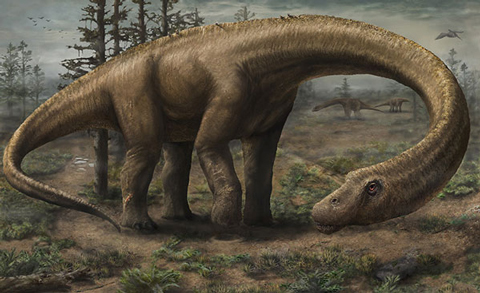
Huge dinosaur from southern Patagonia – Dreadnoughtus schrani.

Picture credit: Jennifer Hall

To read more about the study of the skull of Sarmientosaurus musacchioi: A New Late Cretaceous Titanosaur from Patagonia.

Tiny Titanosaur from Late Cretaceous Madagascar

The fossilised bones of a baby titanosaur have been analysed by a team of scientists supported by funding from the National Science Foundation.  The team found that hatchlings were mini versions of the adults and just like many birds and reptiles today, these sauropodomorphs were relatively independent at birth, capable of leaving the nesting area and fending for themselves just a short time after hatching.  In short, the study suggests that titanosaurs were precocial, the parents having relatively little to do with the raising of the offspring, the youngsters being more than capable of fending for themselves and foraging to find food.

Precocial Behaviour

Precocial behaviour inferred from this study contrasts with different parenting behaviours seen in other types of dinosaur such as ornithopods and the Theropoda.  Dinosaurs such as Maiasaura (ornithopod) and Oviraptor (theropod) may have had different parenting strategies.  Although, dinosaur nests, embryo fossils and fossils of very young dinosaurs are exceptionally rare there is a degree of evidence, most notably from the “Egg Mountain” site in Montana where the majority of Maiasaura fossils have been unearthed that some dinosaurs at least, were altricial, that is, the young were relatively helpless at birth and they relied on their parents to look after them and to bring food to the nest.

Rapetosaurus karusei – Every Fossil Tells a Story

The titanosaur is Rapetosaurus (R. karusei), fossils of which are associated with the Upper Cretaceous Maevarano Formation of north-western Madagascar.  These plant-eaters, roamed the island of Madagascar some 70 million years ago (Maastrichtian faunal stage).  Several bones collected between 1998 and 2003 and stored at the State University of New York at Stony Brook and catalogued as crocodilian fossils caught the eye of palaeontologist Kristina Curry Rogers.  Kristina has seen fossils like these before and she knew that they were not from any crocodile species, in fact, the bones represented a very young Rapetosaurus.  Why was the Associate Professor so confident?  Simple, Kristina was one of the researchers which named and described Rapetosaurus (pronounced Rah-pay-too-sore-us) back in 2001.

Some of the Rapetosaurus Material Used in the Study

The preserved skeleton of the baby Rapetosaurus, including vertebrae from the hip and tail and the femur.

The preserved skeleton of the baby Rapetosaurus, including vertebrae from the hip and tail and limb bones.

Picture credit: Kristi Curry Rogers

Research Funded by the National Science Foundation

The research was funded the National Science Foundation (United States) and Associate Professor Curry Rogers (Macalester College, St Paul, Minnesota), was the lead author, working with colleagues from Adelphi University, (Garden City, New York),  the University of Minnesota and the University of Washington.  Looking at the shape of the femur and comparing it to examples from older animals, the bone shape was very similar, this suggested that hatchlings were very mobile and further study indicated that they were capable of a wider range of movements than the cumbersome adults.

Kristina explained:

“This baby’s limbs at birth were built for its later adult mass; as an infant, however, it weighed just a fraction of its future size.  This is our first opportunity to explore the life of a sauropod just after hatching, at the earliest stage of its life.”

Shinbone (Tibia) Reveals Data

The team studied thin-sections of the tibia (the bones seen on the left of the picture above), using a high-powered CT scanner to get a closer look at the micro-structures preserved inside the fossil limb bones.  The patterns and structures identified were similar to those found in extant animals which made it possible for the scientists to build up a picture of the few short weeks of this dinosaur’s life.

Associate Professor Curry Rogers stated:

“We looked at the preserved patterns of blood supply, growth cartilages at the ends of limb bones, and at bone remodelling.  These features indicate that Rapetosaurus grew as rapidly as a newborn mammal and was only a few weeks old when it died.”

For models and replicas of titanosaurs and other dinosaurs: CollectA Deluxe Prehistoric Life Figures.

A Key Finding

One key finding was the identification of the hatching line, a shift in the internal structure of the bone that in modern lizards and crocodilians indicates when an animal emerged from its egg.  This enabled the research team to calculate the size of the baby dinosaur at hatching (around 3.4 kilogrammes).  The average human baby birth weight in the UK is a fraction heavier at around 3.5 kilogrammes.  However, unlike our babies which are highly altricial (dependent on parental care), Rapetosaurus grew rapidly and in the 39 to 77 days of its life it grew to be more than ten times its hatching weight.

A Baby Rapetosaurus Dinosaur Provides Fresh Insight into Titanosaur Growth and Development

A baby Rapetosaurus provides fresh insight into Titanosaur growth and development (ontogeny).

A baby Rapetosaurus provides fresh insight into titanosaur growth and development (ontogeny).

Picture credit: Everything Dinosaur based on an original diagram by Kristi Curry Rogers

Demise in a Drought

The baby Rapetosaurus did not live very long and the scientists report that this little herbivore may have starved to death.  How did they deduce that?  An analysis of cartilage growth plates preserved on the limb bones bears a strong resemblance to the modified growth of cartilage that occurs in living vertebrates when the animal is under stress due to lack of food.  The Maevarano Formation represents strata laid down in a flat, alluvial plain criss-crossed by a number of rivers which flowed from the central highlands.

Debris such as large boulders preserved in the strata indicates that the flow of water along these rivers varied a great deal.  This suggests a semi-arid environment with prolonged periods of drought, interspersed by periods of heavy rainfall.  The Late Cretaceous of Madagascar was a drought-stressed ecosystem and for this hatchling a lack of food was very probably its downfall.

For dinosaur toys and games, visit: Everything Dinosaur.

Thanks to the work of Kristina Curry Rogers and her collaborators, scientists have been able to piece together some information about the short life of this titanosaur.

As Associate Professor Curry Rogers states:

“Between its hatching and death just a few weeks later, this baby Rapetosaurus fended for itself in a harsh and unforgiving environment.”

To read an article about potential precocial behaviour in the Pterosauria: New Species of Flying Reptile from “Pterosaur Graveyard”.

2 05, 2016

A New Late Cretaceous Titanosaur from Patagonia

By |2023-04-19T07:31:17+01:00May 2nd, 2016|Categories: Dinosaur and Prehistoric Animal News Stories, Dinosaur Fans, Main Page, Palaeontological articles|0 Comments

Sarmientosaurus musacchioi – A “Drop Head” Dinosaur

The beautifully preserved skull of a new type of titanosaur is helping scientists to understand the evolution of these herbivorous dinosaurs.  Titanosaur skull fossils are exceptionally rare, but thanks to the skull of Sarmientosaurus musacchioi, palaeontologists have got a “heads up” on basal titanosaurs, ironically computer modelling and an analysis of the skull morphology suggests that this dinosaur may have specialised in feeding on low growing vegetation.  If that was the case, then this long-necked dinosaur probably spent a lot of its time with its head pointing downwards towards the ground.

An Illustration of Sarmientosaurus musacchioi

New basal Titanosauriform from Argentina (Sarmientosaurus).

New basal titanosauriform from Argentina (Sarmientosaurus).

Picture credit: Everything Dinosaur (background from the artwork of Julius Csotonyi

Rare Titanosaur Skull Fossil Discovery

Reporting in the on line academic journal PLOS One, the team of palaeontologists which includes lead author Dr Rubén D. F. Martínez (National University of Patagonia), describe a beautifully preserved and almost complete skull specimen excavated from strata which makes up the Lower Member of the Upper Cretaceous Bajo Barreal Formation in south, central Chubut Province, Patagonia (southern Argentina).

The fossils, comprising the skull plus elements from the neck are believed to date from around 95 million years ago (Middle Cenomanian stage of the Late Cretaceous).

Scientists Show Off the Beautifully Preserved Dinosaur Skull

Dr. Martinez (right) and Dr. Lamanna (left) with Sarmientosaurus skull.

Dr Martinez (right) and Dr Lamanna (left) with Sarmientosaurus skull.

Picture credit: Carnegie Museum of Natural History

The Titanosaur a Member of the Sauropodomorpha

The skulls of members of the Sauropodomorpha, the suborder of dinosaurs to which the titanosaurs belong, tend to be disproportionately small when compared to the size of the body.  In addition, the skulls of these dinosaurs are at the end of a long neck.  When an animal died and the carcase rotted away, then the skull bones were likely to become detached from the rest of the skeleton.  Skull fossils of sauropods are exceptionally rare.  In titanosauriforms, only three other skull fossils are known:

  • Rapetosaurus (from the Late Cretaceous of Madagascar)
  • Tapuiasaurus (from the Early Cretaceous of Brazil)
  • Nemegtosaurus (from the Late Cretaceous of Mongolia

The discovery of an almost complete titanosaur skull will help scientists to understand more about the anatomy, evolution and behaviour of these dinosaurs.  For example, analysis of the orbit within the skull and the relative position of the eye suggests that this dinosaur had particularly good vision.  Such is the completeness of the fossil material that the scientists, which included Gondwana titanosaur specialist Dr Matthew Lamanna (Carnegie Museum of Natural History), have been able to piece together an endocast of the brain and demonstrate the shape of the inner ear.

Views of the Skull of Sarmientosaurus (Sarmientosaurus musacchioi)

A view of the skull (lateral views)

A view of the skull (lateral views)

Picture credit: PLOS One

The picture above shows the prepared skull seen in right lateral view (photograph A and line drawing B) and left lateral view (C).  The naris slopes gently downwards towards the premaxilla and the orbit (eye-socket) is quite large.  The simple, peg-like teeth (57 teeth associated with the fossil), project forward, an adaptation perhaps to assist with the combing action of feeding.  The scale bar in the picture above represents ten centimetres.

For models and replicas of titanosaurs and other prehistoric animals: Prehistoric Animal Models and Figures.

Dr Lamanna noted:

“Titanosaurs included the biggest land animals ever, so we want to know as much about them as we can.  But to truly understand a creature, you need to have its head and because titanosaur skulls are super-rare, lots of important aspects of how these dinosaurs lived and behaved have really been anybody’s guess.”

CAT Scans Reveal Previously Unseen Features in Titanosaur Fossil Material

The skull fossil has provided palaeontologists with their first really good view of a basal titanosaur and it has provided new information regarding the shape of the brain case and the senses of these dinosaurs.  For example, CAT scans have enabled the researchers to model the structure of the inner ear, from this they have deduced that this dinosaur had good hearing, able to detect a wide range of low frequency airborne sounds.  This perhaps provides a clue to how these herding animals communicated.

The Excavation of the Rare Titanosaur Fossil Material

Sarmientosaurus fossils at the dig site.

Sarmientosaurus fossils at the dig site.

Picture credit: PLOS One

The photographs above show the articulated skull lying upside down partially eroded out of the rock (A), note that the skull is seen in ventral view (viewed from underneath) and that the geological hammer provides an approximate scale.

The black arrow in photograph A shows the position of an ossified cervical tendon lying very close to the back of the skull.  Photographs B and C show two views of the articulated skull and the partial cervical series (neck bones) exposed in the rock (ventral view).  The black arrows indicate the position of cervical tendons.  Photograph D shows a cervical rib (white arrow) and its relationship in the matrix to an ossified cervical tendon (black arrow), the field instruments provide an approximate scale.

Ossified Bony Tendons

When compared to the Tapuiasaurus fossil skull from Brazil which dates from around 115 million years ago, the teeth and skull morphology of Sarmientosaurus are relatively primitive.  The researchers have concluded that radically different titanosauriforms probably co-existed for much of the Cretaceous.  This suggests that different types of titanosaur evolved to fill different ecological niches and perhaps this might help to explain why these types of plant-eaters made up a substantial portion of the herbivorous mega fauna fossils associated with the Southern Hemisphere in the Late Cretaceous.

Views of the Restored Skull of Sarmientosaurus

Views of the prepared skull of Sarmientosaurus (scale bar = 10cm).

Views of the prepared skull of Sarmientosaurus (scale bar = 10 cm).

Picture credit: PLOS One

In the picture above, A, C and E are photographs of the skull in various views.  A frontal view (A), a view of the back (B) and a caudodorsal view (C) which is a view of the back of the skull from the orientation of looking down on it from the top.  The images B, D and F are diagrams that show the individual bones and skull features as preserved in the fossil material.  Sarmientosaurus is the first non-avian dinosaur to show evidence of a very long bony tendon in the neck.  The research team compare the thin ossified tendon with that found in extant Cranes.  The function of this structure is not known.

Superior Senses When Compared to Other Sauropodomorphs

The CAT scans provided a remarkable amount of detailed information regarding the sensory capabilities of this titanosaur.  The large eye-socket indicated good eyesight and the orientation of the balance organ of the inner ear suggests that this dinosaur probably held its head with the snout facing downward.  From this it has been inferred that Sarmientosaurus fed mainly on low-growing plants.

Professor Lawrence Witmer, a specialist in cranial anatomy and one of the co-authors of the scientific paper explained:

“The Sarmientosaurus skull is beautifully-preserved, which meant that we could tease out a ton of information.  It was really exciting for us to work through the CT scan data because it gave us a glimpse into the biology and lifestyle of this animal like we rarely get with dinosaurs.”

What’s in a Name?

The genus name honours the small town of Sarmiento in Chubut Province which is close to the fossil quarry where the skull was found.  The trivial name is in tribute to the late Dr Eduardo Musacchio, a palaeontologist and professor at the National University of Patagonia who was a mentor to Dr Martínez as well as a close friend.

Visit Everything Dinosaur’s award-winning website: Everything Dinosaur.

30 04, 2016

Giant Duck-Billed Dinosaur is a Record Breaker

By |2023-04-18T22:39:37+01:00April 30th, 2016|Categories: Dinosaur and Prehistoric Animal News Stories, Dinosaur Fans, Main Page|0 Comments

Shantungosaurus giganteus Exhibit Recognised by Guinness Book of Records

Everything Dinosaur has received reports from Chinese news agencies that a dinosaur exhibit in the Zhucheng Dinosaur Museum (Shandong Province, China), has been recognised by the Guinness World Records organisation as being the largest hadrosaurid skeleton on display.  The duck-billed dinosaur skeleton is part of an exhibit showing a herd of Shantungosaurus dinosaurs in the entrance area of the huge museum.

In the press release, the dinosaur is referred to as Zhuchengosaurus maximus, but this is regarded as a junior synonym of Shantungosaurus giganteus, the mounted skeleton stands 9.1 metres high and is 16.6 metres long.

Shantungosaurus giganteus

The Giant Shantungosaurus Compared to Edmontosaurus

Edmontosaurus compared to Shantungosaurus.

Comparing hadrosaurs. Shantungosaurus compared to Edmontosaurus.  Picture credit: Everything Dinosaur.

Largest Biped to Have Ever Lived?

With the recent hypothesis that Spinosaurus (S. aegyptiacus) was a quadruped and incapable of walking on its hind legs, Shantungosaurus, is regarded by many palaeontologists as a facultative biped (able to walk on its hind legs if it wished to) and as such, the largest biped known to science.  Body length and body mass estimates are difficult to calculate, but the mounted exhibit examined by the Guinness Book of Records, exceeds fifty-four feet in length, and one of the neighbouring Shantungosaurus mounts at the museum is almost as long.

As for bodyweight, estimates vary, but Gregory Scott Paul has estimated that this dinosaur could reach weights in excess of fifteen tonnes, that’s getting on for being twice as heavy as a T. rex!

For models and replicas of hadrosaurs and other dinosaurs: PNSO Age of Dinosaurs.

An Illustration of the Giant Hadrosaur Shantungosaurus giganteus

Perhaps the largest biped to have ever lived - Shantungosaurus giganteus,

Perhaps the largest biped to have ever lived – Shantungosaurus giganteus,

Picture credit: Mike Fredericks

The Zhucheng Dinosaur Museum

The Zhucheng Dinosaur Museum is one of the largest museums dedicated to the Dinosauria anywhere in the world.  It celebrates the rich fossil heritage of Shandong Province and Shantungosaurus giganteus was named in honour of this coastal province in eastern China.  The record breaking exhibit, does not represent a single, individual animal.

When remains of the giant ornithischian dinosaur that was to be named Shantungosaurus were first found in the mid 1960s, fossils from at least five individuals were found together in an extensive bone bed.  Although, none of these specimens represented a complete skeleton, the bones (and casts of missing fossils) could be assembled into a single mount.

A Scale Drawing of the Duck-Billed Dinosaur S. giganteus 

A scale drawing of Shantungosaurus.

A scale drawing of Shantungosaurus. Picture credit: Everything Dinosaur.

Picture credit: Everything Dinosaur

Giant Ornithischian Dinosaurs

Named in 1973, Shantungosaurus lived during the Late Cretaceous and it is one of a number of ornithischian dinosaurs known from this part of the Wangshi Formation of eastern China.  A second, equally sized hadrosaurid was described in 2007 – Zhuchengosaurus maximus and the Chinese press agency referred to the record breaking exhibit using this nomenclature.  However, Z. maximus, named and described in 2007, is probably a junior synonym of Shantungosaurus giganteus.

Anatomical features used to distinguish the fossils as a separate species when Z. maximus was named in 2007 were later to be found to be related to ontogeny (different aged animals with differences in growth).  A similar fate befell a third giant hadrosaur Huaxiaosaurus (H. aigahtens), it too is now regarded as a junior synonym of Shantungosaurus.

Visit Everything Dinosaur’s award-winning website: Everything Dinosaur.

Whatever the position regarding the validity of these other genera, it is certain that this part of China in the Late Cretaceous was home to some truly huge duck-billed dinosaurs, why these animals grew so big remains a mystery.  Perhaps an abundance of food resources permitted larger and larger generations, or maybe a larger size helped avoid predation?  The naming of a new genus of tyrannosaurid (Zhuchengtyrannus magnus) in 2011 may help explain the reason for the very large size of these particular duck-billed dinosaurs.

To read an article about the discovery of Zhuchengtyrannus: A New Species of Tyrannosaur from China.

28 04, 2016

Digitalised Dinosaur Leads to Remarkable Dorking Museum Discovery

By |2024-05-05T21:57:26+01:00April 28th, 2016|Categories: Dinosaur and Prehistoric Animal News Stories, Dinosaur Fans, Main Page|0 Comments

When is an Iguanodon Not an Iguanodon?

Yesterday, Everything Dinosaur reported on the discovery of a giant whale tooth found in Beaumaris Bay (Victoria).  This significant fossil find, once again highlighted the importance of amateur fossil hunters when it comes to contributing to the Earth Sciences.  You don’t have to travel all the way to Australia to play your part, sometimes the geological collection housed at your local regional museum can provide an opportunity for you to make you mark.

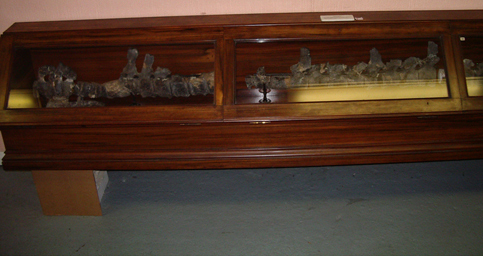
Take for example, the vertebrate fossil collection at Dorking Museum and Heritage Centre.  Student Tom Fedrick has helped re-classify dinosaur tail bones originally described as belonging to an Iguanodon, but keen-eyed Tom, using knowledge gained from four years volunteering at the Museum, concluded that a centrepiece of the collection represented the bones of an entirely different, albeit related dinosaur – Mantellisaurus.

The Caudal Vertebrae on Display (Mantellisaurus atherfieldensis)

On display at the museum.

On display at the museum.

Picture credit: Dorking Museum and Heritage Centre

Digitalising the Dorking Museum Collection

Much of the fossil collection is currently being catalogued digitally.  This will enable the collection to be accessed by other museums, researchers and academics.  A-level student Tom has been working on this substantial project and having completed work on around half of the collection, he turned his attention to the Iguanodon exhibit.

Tom explained:

“Looking at it [the Iguanodon exhibit] in the past I always thought it was odd, thinner than I would expect.  However with the catalogue entry in front of me my suspicions were confirmed: this was not an Iguanodon.  Though it was listed as Iguanodon atherfieldensis my background knowledge meant I knew that this species had been reclassified as a new genus entirely – Mantellisaurus by Gregory Paul in 2007.”

Tom Fedrick and the Re-classified Dinosaur Bones (Mantellisaurus atherfieldensis)

Tom a pupil at Reigate Grammar School oversees the cataloguing of the dinosaur bones.

Tom, a student at Reigate Grammar School oversees the cataloguing of the dinosaur bones.

Picture credit: Dorking Museum and Heritage Centre

The Problem with Iguanodontids

The fragmentary nature of iguanodontid fossils excavated from various locations across the south of England have presented palaeontologists with a number of taxonomic puzzles to solve.  Iguanodon was the second dinosaur species to be named and described (although the genus name was erected before the Order Dinosauria had been established).  Gideon Mantell named Iguanodon, but at the time his paper was published, he failed to establish a holotype or indeed assign a trivial name to his specimen.  From that point on, the Iguanodon genus became a sort of dumping ground for any large Ornithischian dinosaur fossil material excavated from the Weald Clay Formations and the contemporaneous Wessex Formation of the Isle of Wight.

A spokesperson from Everything Dinosaur commented:

“It’s complicated!  Lots of fossils found in Europe, Africa and North America formerly ascribed to Iguanodon, have been re-classified since the turn of the Century.  The holotype material for Iguanodon bernissartensis for instance, a genus synonymous with the term “English dinosaur”, has been reassigned to more complete Belgian fossil material and we congratulate Tom for spotting the incorrectly labelled museum specimen.”

Mantellisaurus

Mantellisaurus atherfieldenis  was established in 2007 by the American Gregory Scott Paul.  It is a more gracile animal than the robust Iguanodon bernissartensis  and considerably smaller, perhaps around seven metres in length.  Analysis of the forelimbs suggest that Mantellisaurus spent the majority of its time as a biped, although it could adopt a four-legged stance when desired (facultative quadruped).

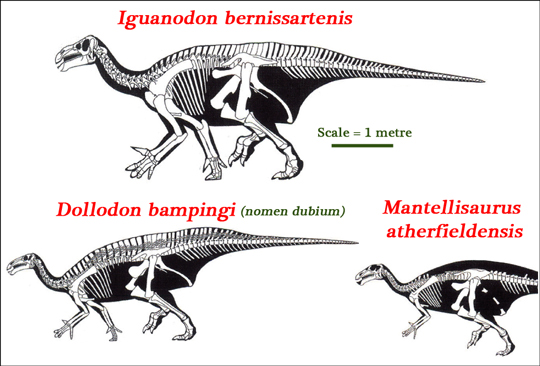
Comparing Iguanodontid Skeletons (after Gregory S. Paul)

Iguanodontid comparisons. D. bampingi is regarded as Nomen dubium.

Iguanodontid comparisons. D. bampingi is regarded as Nomen dubium.

Picture credit: Gregory S. Paul with additional annotation by Everything Dinosaur

The picture above compares the skeletons of three types of iguanodontids.  Although, Gregory S. Paul regarded Dollodon bampingi as a valid genus, more recent research suggests that Dollodon might be a synonym of Mantellisaurus.  The term “Nomen dubium” is given to any organism whose validity is in doubt.

A Model of Mantellisaurus atherfieldenis

CollectA Mantellisaurus dinosaur model.

CollectA Mantellisaurus drinking.

For models and replicas of iguanodontids: CollectA Age of Dinosaurs Popular Models.

Digitised Dinosaur

This is the second time that a fossil specimen has been reclassified after research undertaken at the Dorking Museum and Heritage Centre.  Last year, Everything Dinosaur reported upon the reclassification of a marine reptile specimen, thought to have represented Polyptychodon interruptus.

To read this article: Pliosaur Skull Links Dorking to Kansas.

The programme of digitally logging the collection at the Dorking Museum and Heritage Centre is progressing.  It is thanks to dedicated, hard-working individuals that our country continues to be blessed with a wealth of regional museums which contribute so much to our understanding of the world

Dorking Museum opening times: Thursday, Friday and Saturday, 10am – 4pm.
Admission: Adults £2, Concessions £1, Under-5s free, Family ticket £4.50 (prices correct at time of publication)

For more information on this fascinating regional museum visit: Dorking Museum and Heritage Centre.

27 04, 2016

Giant Aussie Whale – A Terror of Pliocene Seas

By |2023-04-18T21:39:43+01:00April 27th, 2016|Categories: Dinosaur and Prehistoric Animal News Stories, Dinosaur Fans, Main Page|0 Comments

Monster Whale Tooth from Beaumaris Bay (Victoria)

A fossil tooth of a giant, prehistoric whale found on a beach by an amateur fossil hunter has provided scientists with further evidence of monstrous whales that once ruled the oceans of the world.  The tooth, which weighs around three kilogrammes and measures a whopping thirty centimetres in length is not even complete.  The tip of the crown is missing and the base of the root has broken off.  However, it is easily the biggest fossil tooth ever found in Australia. The fossil provides proof of giant Aussie whales.

Palaeontologist Erich Fitzgerald Holds the Giant Fossil Tooth

Palaeontologist Dr. Erich Fitzgerald holds the fossil whale tooth.

Palaeontologist Dr Erich Fitzgerald holds the fossil whale tooth.

Picture credit: Museum Victoria

Beaumaris Bay

The fossil was discovered back in February by Murray Orr as he explored the famous Beaumaris Bay area to the south-east of Melbourne (Victoria).  The sandstone cliffs and foreshore of this bay represent sandstone deposits laid down between ten and five million years ago in an estuarine and marine environment.  The strata preserves fossils of a huge number of invertebrates as well as the fossilised bones of penguins, ancient seals, sharks and other fishes.  The bones of giant birds have also been found along with fossils representing terrestrial marsupials whose bodies must have been washed down the Yarra River and out to sea.

Such is the importance of the Beaumaris Bay area and the Pliocene-aged strata that a lobby group has been formed to help preserve the two mile long beach area by awarding it UNESCO World Heritage status.

Significant Australian Fossil Find

The tooth is estimated to be around five million years old and would have come from a cetacean similar to the giant of Peru – Livyatan melvillei, formerly known as Leviathan melvillei.

To read about the discovery of L. melvillei: The Nightmare Whale from Prehistory.

Giant Aussie Whale

Although the teeth are very similar, it is unlikely that the Australian tooth represents the same genus, as the Peruvian fossil material has been dated to around 12 million years ago, so the Beaumaris Bay specimen is considerably younger.  The tooth is internationally significant, as it represents the first evidence of massive sperm whales present outside the Americas.  The tooth is indeed immense and dwarfs a tooth from the jaw of an extant Sperm Whale (Physeter macrocephalus).  It even makes the teeth of Tyrannosaurus rex look quite dainty in comparison.

Tooth Comparison – T. rex versus the Extinct Sperm Whale and a Modern Sperm Whale Tooth

The fossil whale tooth (centre) compared to a T. rex tooth (left) and an extant Sperm Whale tooth (right).

The fossil whale tooth (centre) compared to a T. rex tooth (left) and an extant Sperm Whale tooth (right).

Picture credit: Museum Victoria

The picture above provides a comparison between the tooth of a Tyrannosaurus rex (left), the extinct fossil whale (centre) and a modern-day Sperm Whale (Physeter macrocephalus) on the right.

A Scale Drawing Providing an Estimate of the Size of the Extinct Toothed Whale

Estimated size of toothed whale based on the fossil tooth - around 18 metres.

Estimated size of toothed whale based on the fossil tooth – around 18 metres.

Picture credit: Everything Dinosaur

How Big was the Giant Aussie Whale?

Although it is difficult to provide an accurate estimate of size based on a single tooth, it has been suggested that this whale could have reached lengths in excess of eighteen metres and it might have weighed some forty tonnes.  Murray Orr has donated his remarkable fossil find to Museum Victoria, thanking Mr Orr for his kind donation, the museum’s senior curator of vertebrate fossils, Dr Erich Fitzgerald stated:

“It’s a first for the entire continent of Australia and it’s a fossil of a whale that has never thought to be here before.”

Dr Fitzgerald is no stranger to the Beaumaris Bay area and he has worked on a number of important fossil discoveries from this area.  For example, back in 2013, Everything Dinosaur reported on the discovery of the first seal bones from this locality: Australia’s First Seal – A Pliocene Pinniped.

Fossils from Beaumaris Bay have even proved that giant, toothed birds once flew Australia’s coastline: Giant Toothed Birds Once Soared Over Australia.

How Old is the Fossil?

As the fossil is believed to be around five million years old, it is the youngest known fossil of a whale-eating Sperm Whale.  Extant Sperm Whale males can reach fifteen metres in length and they are predators but they only have teeth in their narrow, lower jaw.  They specialise on feeding on squid and fish, the fossil tooth indicates that in the Southern Hemisphere giant marine, super-predators were geographically widely dispersed.

A spokesperson from Everything Dinosaur commented:

“It is a truly remarkable find and this discovery once again shows the important contribution that amateur fossil hunters can make to science.  As for naming this beast, it would be hard to erect a new genus from a single fossil tooth but precedence has been set before.  Perhaps we should refer to this simply as “Murray’s Monster”, after all, given the size of the tooth, albeit missing part of the root and the tip of the crown, this toothed whale really was a monster!”

The Beaumaris Bay area of Melbourne provides a remarkable insight into the ancient fauna of Australia.  Giant marsupials roamed the estuary with seals and ancient penguins basking on the beach, whilst flying overhead giant toothed birds soared out to sea, where perhaps a massive toothed whale lurked offshore to pick off any unwary seals.

An Illustration of Beaumaris Bay During the Pliocene

Beaumaris bay, (Victoria, Australia) some five million years ago.

Beaumaris bay, (Victoria, Australia) some five million years ago.

Picture credit: Monash University

For models and replicas of prehistoric animals including Livyatan melvillei (whilst stocks last): PNSO Age of Dinosaurs Replicas.

24 04, 2016

Seed Eating May Have Helped Birds Survive According to New Scientific Paper

By |2024-05-05T21:56:15+01:00April 24th, 2016|Categories: Dinosaur and Prehistoric Animal News Stories, Dinosaur Fans, Main Page, Palaeontological articles|2 Comments

Seed Clue to How Birds Survived the Cretaceous Extinction Event

The birds that are around today, might have the seed-eating habit of an ancestor to thank for enabling their kind to survive the extinction event that saw the demise of the dinosaurs.  A study published in the scientific journal “Current Biology” suggests that whilst the meat-eating and insectivorous feathered Maniraptoran dinosaurs did not survive into the Tertiary, toothless, beaked birds may have coped with the devastation that wiped out 70% of all terrestrial vertebrates, by eating seeds.

Seed Eating a Key to Survival

The study, conducted by scientists from the University of Toronto and the Royal Ontario Museum, involved the analysis of 3,104 Maniraptoran fossil teeth from eighteen different sites in western North America (Montana, USA and Alberta, Canada).

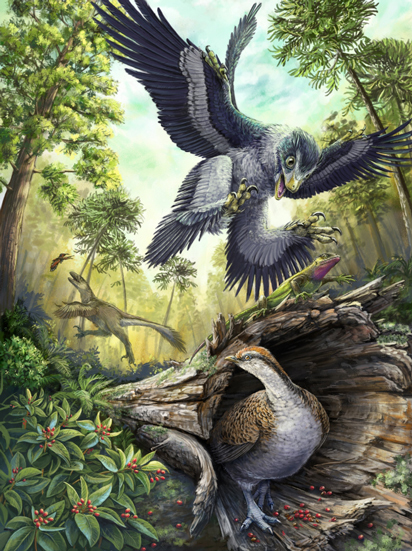
Late Cretaceous North America – Survival of the Seed Eaters?

Study suggests the evolution of a toothless beak ideal for seed eating may have had evolutionary advantages at the end of the Cretaceous.

Study suggests the evolution of a toothless beak ideal for seed eating may have had evolutionary advantages at the end of the Cretaceous.

Picture credit: Danielle Dufault

Seed Eating Birds

The beautiful illustration above, depicts an imaginary scene in the forests of Late Cretaceous North American (Maastrichtian faunal stage).  There were probably large numbers of Maniraptoran dinosaurs represented by numerous families but these types of dinosaur along with the toothed birds did not survive the End Cretaceous mass extinction.  Those members of the Maniraptora clade that had evolved an edentulous (toothless) beak capable of holding, manipulating and cracking seeds may have had an evolutionary advantage.

In the picture above, a large dromaeosaurid dinosaur pursues a toothed bird in the background, whilst a smaller dromaeosaurid pounces on an unsuspecting lizard resting on a log.  Emerging from the hollow log is a hypothetical, toothless bird, closely related to the earliest modern birds.

A Nuclear Winter

Many scientists believe that after the extraterrestrial impact that marked the beginning of the end for the non-avian Dinosauria, the impact threw up huge amounts of dust and debris into the atmosphere.  This would have blocked out sunlight, leading to a nuclear winter with plant populations (reliant on photosynthesis to make food), crashing.  The loss of the plants led to a collapse of the entire food chain.  The plant-eaters would have died out and once there were no carcases left to scavenge, the meat-eaters would have perished too.

This new paper is one of a number of recent studies that attempts to explain why some types of animals survived, whilst other, often closely related species did not.

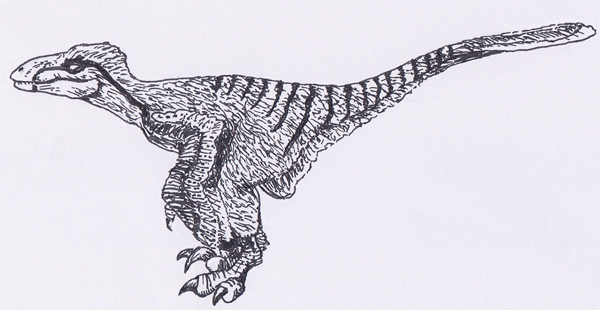
Toothed Dromaeosaurs Faced Extinction

Maniraptor illustration (dromaeosaurid).

Dromaeosaurid drawing for Everything Dinosaur.

Picture credit: Everything Dinosaur

The Maniraptora Fossil Record

The Maniraptora fossil record (dinosaurs and the birds) is very incomplete.  The research team knew that they only had a limited number of fossils of Late Cretaceous Maniraptorans to examine and that in all likelihood there were many more species living towards the end of the Age of Dinosaurs than have been identified to date.  In addition, there was very little direct evidence of fossil species surviving the extinction event.  So to help unravel the puzzle as to why some animals died but their close relatives survived, the scientists examined the fossil record of isolated teeth.

Shed teeth tend to be more robust than the delicate and light bones of Maniraptorans and they are more numerous, so the research team had a more substantial data set to work with.

Seeds – A Readily Available Food Source

The team concluded that seeds would have survived the global devastation that occurred.  Seeds already in the ground would have been available as a food source for anything with a beak capable of eating them.

Commenting on why some animals survived whilst others went extinct, lead researcher, Derek Larson (University of Toronto) explained:

“We came up with a hypothesis that it had something to do with diet.  Looking at the diet of modern birds, we were able to reconstruct a hypothetical ancestral bird and what its likely diet would have been.  What we are envisaging is a seed-eating bird, so you’d have a relatively short and robust, strong beak, which would be able to crush these seeds.”

In August 2014, Everything Dinosaur published a study which had been conducted by an international team of researchers that looked at the rapid evolution and diversification of the  Maniraptora.   These dinosaurs evolved very rapidly and probably made up a significant proportion of the terrestrial vertebrate fauna in a number of Late Cretaceous ecosystems.

The Evolution of the Maniraptora

To read more about the rapid evolution of the Maniraptora: Downsizing Dinosaurs the Key to Survival.

The challenge to palaeontologists is to find fossil evidence of seed-eating birds being prevalent prior to the End Cretaceous extinction event and then evidence of radiation and diversification in strata laid down in younger sediments deposited beyond the famous K-T extinction boundary.

What About the Mammals?

This very interesting piece of research raises a number of other questions.  For example, a number of Cretaceous  small mammals would also have very probably eaten seeds, just like many kinds of small mammals do today.  Could seed-eating also have helped several different types of mammal survive the extinction event?  Given the success of the Maniraptora and their diversity it seems peculiar that no member of the Dinosauria evolved to take advantage of seeds as a source of food.

Many members of the Maniraptora were small, around the size of many seed-eating birds today, why weren’t these dinosaurs also able to take advantage of this food source to help them endure the nuclear winter?

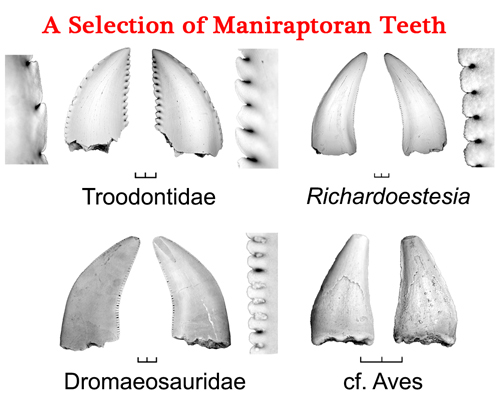
Teeth Representing a Variety of Different Members of the  Maniraptora Were Studied

No evidence of teeth adapted to seed-eating were found in the study.

No evidence of teeth adapted to seed-eating were found in the study.

Picture credit: Royal Ontario Museum/University of Toronto with additional notation by Everything Dinosaur

Shed Teeth

The picture above shows a typical selection of the shed teeth used in the fossil study.  Four different types of maniraptoran were incorporated into the study.  Firstly, there were the Troodontidae, (top left) with their proportionately broader and much more prominent tooth serrations (denticles), an example of a typical Late Cretaceous North American Troodontidae would be Troodon inequalis.  Secondly, there were members of the genus Richardoestesia (top right).

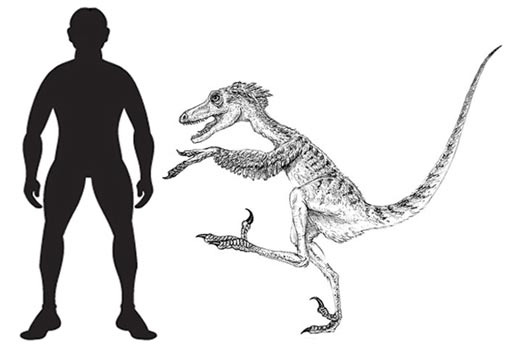
These maniraptoran dinosaurs are known from a pair of jawbones and many shed teeth, two species have been assigned, based on tooth differences.  Then there are the dromaeosaurids (Dromaeosauridae).  The teeth tend to be much more finely serrated than troodontid teeth and a typical North American dromaeosaurid would have been the two-metre-long Saurornitholestes langstoni.

An Illustration of Saurornitholestes langstoni

Saurornitholestes langstoni illustration - scale drawing.

Saurornitholestes langstoni illustration (scale drawing).

Picture credit: Everything Dinosaur

For models and replicas of dromaeosaurids and other dinosaurs: Beasts of the Mesozoic Models.

Dinosaur and Bird Fossils

Even though only a handful of fossil bones ascribed to Aves (birds) have been found in places such as the Dinosaur Provincial Park (southern Alberta), those bones that have been discovered indicate that some volant (flying) birds as big as modern-day raptors existed during the Late Cretaceous.  Many examples of teeth from toothed birds are known from the Dinosaur Provincial Park, and at least three types of Neornithine birds have been described.

This research, that examined maniraptoran teeth across the last 18 million years of the Cretaceous, supports the idea of a sudden extinction event and the survival of Neornithine lineages as a result of some forms having evolved to exploit seeds as a food source.

Visit Everything Dinosaur’s website: Everything Dinosaur.

22 04, 2016

The Gradual Decline of the Dinosaurs – Earth Day Thoughts

By |2023-04-18T16:22:46+01:00April 22nd, 2016|Categories: Animal News Stories, Dinosaur and Prehistoric Animal News Stories, Dinosaur Fans, Educational Activities, Main Page, Press Releases, Teaching|0 Comments

The Gradual Decline of the Dinosaurs – Earth Day Thoughts

Today, the 46th commemoration of Earth Day, some 171 nations signed and ratified the historic Paris Agreement on climate change.  In essence, the Agreement sets out that the global increase in temperature will be limited to no more than around two degrees Celsius as countries work together to cut greenhouse gas emissions, widely believed to be responsible for a rapidly warming Earth. Some fifteen nations had already signed this international accord prior to today, mainly small island states in the Pacific, but with the addition of the 171 signatories, this is a record number for a new treaty.

Decline of the Dinosaurs

Commenting on the importance of this Agreement, United Nations Secretary-General Ban Ki-moon stated:

“Paris will shape the lives of all future generations in a profound way – it is their future that is at stake.”

The Two Degree Limit

The Paris Agreement sets out a global action plan to put the world on track to avoid dangerous climate change by limiting global warming to well below 2°C.  Although, the implementation of the agreement will not be easy and several countries, including a number from Africa and central Asia have not signed, if the Earth continues to warm, then our own species could well be threatened.

UN Secretary-General Ban Ki-moon explained that as the planet experienced record highs in average annual temperatures:

“We are in a race against time.  I urge all countries to join the agreement at the national level.  Today we are signing a new covenant for the future.”

Yesterday, Everything Dinosaur reported on some new research conducted by scientists at Reading and Bristol Universities that looked at the extinction of the dinosaurs.  A statistical study (Bayesian analysis), revealed that the Dinosauria had been in gradual decline for some fifty million years before finally becoming extinct. To read an article on this research: Fifty Million Year Decline of the Dinosauria.

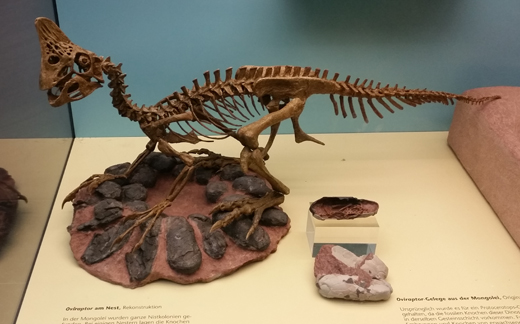
Extinction of the Dinosaurs Will the Human Race Go the Same Way Due to Global Climate Change?

An Oivraptor fossil with nest.

An Oviraptor dinosaur sitting on her nest.  The extinction of the non-avian dinosaurs. Picture credit: Everything Dinosaur.

Picture credit: Everything Dinosaur

Everything Dinosaur Comments

A spokesperson from Everything Dinosaur commented:

“There is already quite a strong body of evidence indicating that our planet is experiencing a mass extinction event.  Many key species are endangered or threatened and as we are top of the food chain it is in all our interests to try to limit greenhouse gas emissions so that a global climate catastrophe can be avoided.”

Visit Everything Dinosaur’s award-winning website: Everything Dinosaur.

One of the authors of the research into the decline of the dinosaurs, that we reported upon yesterday, Dr Sakamoto, pointed out that the research into the demise of the Dinosauria might have a significance with regards to what we are experiencing today.

He stated:

“Our study strongly indicates that if a group of animals is experiencing a fast pace of extinction more so than they can replace, then they are prone to annihilation once a major catastrophe occurs.  This has huge implications for our current and future biodiversity, given the unprecedented speed at which species are going extinct owing to the ongoing human-caused climate change.”

If the UN General-Secretary calls this a “race against time”, then this is one race that the human race cannot afford to lose.

19 04, 2016

Congratulations to Palaeontologist Dean Lomax

By |2023-04-18T12:16:59+01:00April 19th, 2016|Categories: Dinosaur and Prehistoric Animal News Stories, Dinosaur Fans, Famous Figures, Main Page|0 Comments

Honorary Scientist at The University of Manchester Wins Award

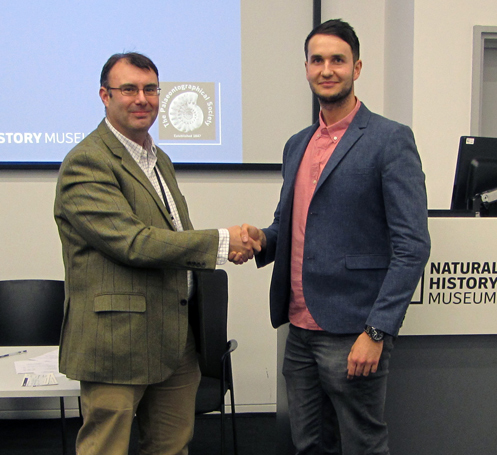
Palaeontologist Dean Lomax, an honorary scientist at Manchester University has been awarded the prestigious Edward Forbes Prize by the Palaeontographical Society.

Palaeontologist Dean Lomax

This annual award aims to encourage young palaeontologists (or those within ten years of completing their doctorate), and it recognises Dean’s contribution to the advancement of our knowledge about life in the past.  Established in 1847, the Palaeontographical Society promotes the publishing of monographs on British fossils as well as supporting taxonomic research into British fossil faunas and floras through its own research fund.

Dr Paul Barrett (President of the Palaeontographical Society) Presents the Award to Dean

Dr. Paul Barrett congratulates Dean Lomax on his award.

Dr. Paul Barrett congratulates Dean Lomax on his award.

Picture: courtesy of Dean Lomax

To visit the website of Dr Dean Lomax: Dr Dean Lomax British Palaeontologist.

It has been a busy twelve months for Dean, at the moment he is in the United States ready to start work on examining the fossils of a new dinosaur, but the Edward Forbes Prize was awarded to Dean principally in recognition for his work on a Jurassic marine vertebrate specimen that once resided in one of those places where one would least expect to make a scientific breakthrough concerning ancient sea creatures – Doncaster, located in the heart of South Yorkshire.

South Yorkshire’s Fossil Heritage

Doncaster may not readily spring to mind when it comes to Mesozoic fossils but a specimen of an Ichthyosaur thought to be replica residing in the collection of the Doncaster Museum and Art Gallery caught Dean’s attention.  The sub-adult, “fish lizard” turned out to be a new species and this led to Dean co-authoring a scientific paper on Ichthyosaurus anningae last year.  The trivial name honours Mary Anning, the 19th century Lyme Regis-based fossil collector, who coincidently died the same year that the the Palaeontographical Society was founded.

To read more about the discovery of Ichthyosaurus anningae: New Ichthyosaurus Species Honours Mary Anning

This is not the first time that talented Dean has had his research recognised by his peers.  Dean has recently received a multitude of awards, including the Marsh Award for Palaeontology (November, 2015), The School of Earth, Atmospheric and Environmental Science (SEAES) Postgraduate Research Student Excellence Award (University of Manchester) – Best Contribution to Society for 2015 (November, 2015) and the Gold Medal (G.J. Mendel Award) – Set for Britain 2015 (March, 2015).

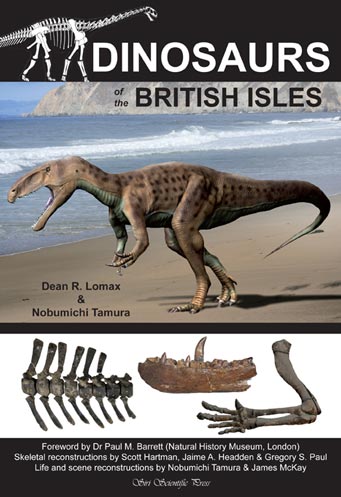
Dinosaurs of the British Isles

Readers of this blog, may already be quite familiar with Dean’s work.  Last August, he appeared in the two-part television documentary “Dinosaur Britain”, that explained the role of these islands in the history of dinosaur research.  The programmes were largely based on the highly acclaimed book “Dinosaurs of the British Isles” by Dean Lomax and Nobumichi Tamura.

If you have missed out on this excellent book all about British dinosaurs, it can be found here: Purchase “Dinosaurs of the British Isles” Courtesy of Siri Scientific Press

Dean Has Written a Book All About British Dinosaurs

A comprehensive guide to British dinosaurs over 400 pages.

A comprehensive guide to British dinosaurs over 400 pages.

Picture credit: Siri Scientific Press

A spokesperson from Everything Dinosaur stated:

“Congratulations to Dean Lomax, it is always a pleasure to see that research is recognised in this way.  Palaeontology is blessed with a myriad of young, dedicated researchers just starting out on their careers and we predict exciting times ahead for Dean and his contemporaries.”

We suspect that Professor Edward Forbes himself, a palaeontologist and ardent supporter of the nascent Palaeontographical Society, would approve of Dean winning the award, after all, Professor Forbes spent much of his life studying the marine biology of the British Isles and he would have been very aware of the Ichthyosaur research undertaken by Conybeare, Georges Cuvier and Richard Owen.

Visit Everything Dinosaur’s award-winning website: Everything Dinosaur.

18 04, 2016

New Dinosaur Track Exhibit Opened at Moab (Utah)

By |2023-04-18T08:02:58+01:00April 18th, 2016|Categories: Dinosaur and Prehistoric Animal News Stories, Dinosaur Fans, Main Page|0 Comments

Dinosaur Tracks and Other Trace Fossils on Display

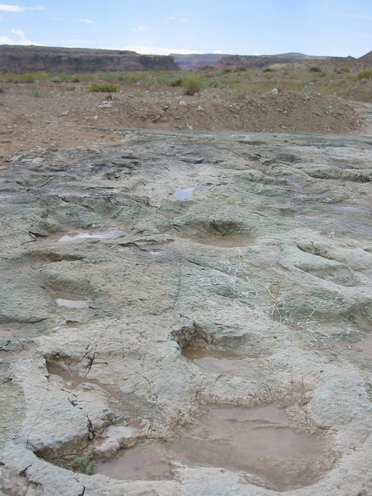
After reporting on fossil thefts, vandalism and other sad incidents from the Moab area (Utah), it is a pleasure to write about the opening this month of a new dinosaur track and trace fossil trail.  In a short presentation, Bureau of Land Management personnel hosted the opening ceremony for the new trace fossil site, one that preserves life on an algae covered mudflat some 112 million years ago or thereabouts.  The new tourist attraction, named the Mill Canyon Dinosaur Tracksite Trail, features more than two hundred individual dinosaur prints, representing eight different types of tracks and some six different types of dinosaur.

Some of the Prehistoric Animal Tracks on the Trail

Trace fossils (dinosaur footprints) preserved at Moab (Utah).

Trace fossils (dinosaur footprints) preserved at Moab (Utah).

Picture credit: Bureau of Land Management

Fossil Thefts and Vandalism

Sadly, over the years this blog has reported on the destruction of a number of the fossils found in this part of Grand County, eastern Utah.  For example, last year Everything Dinosaur reported on an aborted attempt to make copies of three-toed dinosaur tracks in the Moab area, this resulted in extensive damage to these rare dinosaur fossils: Dinosaur Tracks Vandalised, worse still, was the case of a dinosaur footprint theft from the Hell’s Trail location near to Moab, this print (another three-toed, tridactyl footprint) was never recovered, although an arrest was made and local Moab resident Jared Ehlers was sentenced to six months house arrest and one year of probation with a $15,000 USD fine.

To read the story of the dinosaur fossil footprint theft: Dinosaur Fossil Footprint Stolen

The Mudflats Preserve the Footprints and Trace Fossils from a Number of Prehistoric Animals Including Armoured Dinosaurs

An armoured dinosaur crossing the Moab (Utah) mudflats.

An armoured dinosaur crossing the Moab (Utah) mudflats.

Picture credit: Brain Engh

A Unique Insight into Early Cretaceous North America

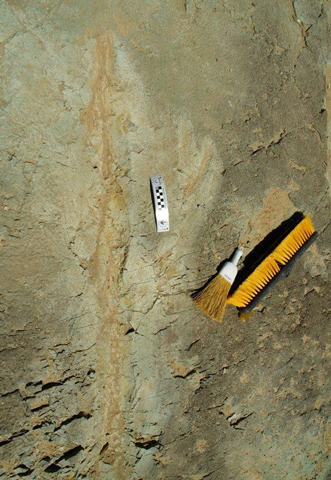
The strata forms part of the Ruby Ranch Member of the Cedar Mountain Formation, the mudstones were laid down in an inland floodplain environment with seasonal extremes of wet and dry.  A film of algae formed over the mudflats and it is thanks to this algal mat that the fine details of the trace fossils have been preserved.  Individual claw marks can be made out and there are other remarkable trace fossils too, such as the gashes in the mudstone, evidence of an ancient crocodile’s tail drag.

Ancient Crocodiles Thrived in this Lacustrine (Lake) Environment

The tail drag made by an ancient crocodile preserved in the Red Ruby mudstones of the Cedar Mountain Formation (Utah).

The tail drag made by an ancient crocodile preserved in the Ruby Ranch mudstones of the Cedar Mountain Formation (Utah).

Picture credit: Bureau of Land Management

In the picture above the brushes and scale marker provide a visual guide to the size of the crocodile tail drag.

Commenting on the importance of the site and the vital role that the algae played in fossil preservation, Bureau of Land Management palaeontologist Rebecca Hunt-Foster stated:

“The algal mat that covered the mud helped to preserve the detail of the tracks when a finer-grained sediment washed over the mudflat.  This preserved the imprints in great detail, the algal covering helped to keep the finer details of the tracks, such as the impact rims made when the animals stepped into the soft mud, along with foot pad impressions, from being eroded away or damaged during this covering event.” 

2009 Discovery

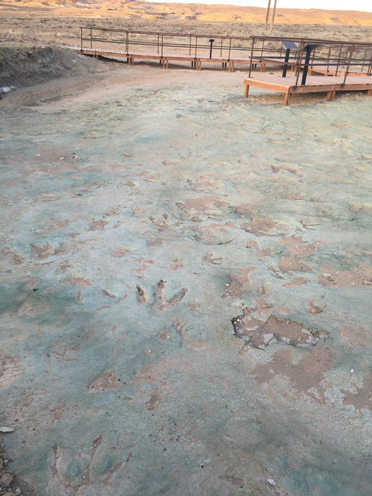
The site was discovered in 2009, when a local person travelling over the area in a jeep noticed strange impressions on the ground.  Since 2013, a team of palaeontologists have been recording and mapping the location and thanks to funding from the Canyonlands Natural History Association, private donations and a contribution from the Bureau of Land Management itself, a tourist trail with dedicated walkways and helpful information boards has been established.

Dinosaur tracks include the large three-toed prints of a substantial theropod, rounded tracks of a sauropod, plus the tell-tale two-toed tracks of a big dromaeosaur, something akin to a Utahraptor (U. ostrummaysorum) fossils of which are found in the older Yellow Cat Member of the Cedar Mountain Formation.

Visitors to the Site Can Use Walkways to Get Close to the Fossils

At least six different dinosaur tracks have been deciphered at Moab (Utah).

At least six different dinosaur tracks have been deciphered at Moab (Utah).

Picture credit: Bureau of Land Management

Dinosaur Track

The site is particularly important as it preserves activity (trace fossils) and very few body fossils of large vertebrates have been found in the Ruby Ranch Member, when compared to other parts of the Cedar Mountain Formation.  The trace fossils provide a guide to the dinosaur fauna that inhabited this part of the world during the latter stages of the Early Cretaceous.

Which Armoured Dinosaur(s)?

Intriguingly, the site preserves the tracks of an armoured dinosaur.  The rounded, five-toed prints are quite distinct and form parallel lines in the mudstone, where the slow moving, plodding dinosaur passed by.  Palaeontologists are not sure what type of armoured dinosaur made the prints, the strata is too old for it to represent the tracks made by a Sauropelta and although fossils of the polacanthid Gastonia have been found in Grand County, Utah, most of the fossil material ascribed to the only species assigned to the Gastonia genus (G. burgei) are associated with the older Yellow Cat Member.  The tracks could have been made by, an as yet, unnamed species of Gastonia or perhaps a different type of polacanthid altogether.

An Illustration of Gastonia (G. burgei)

Gastonia model (Collecta).

Gastonia model (CollectA).

Picture credit: Everything Dinosaur

For models and replicas of armoured dinosuars and other prehistoric animals: CollectA Age of Dinosaurs Popular Figures.

A spokesperson from Everything Dinosaur commented:

“It is wonderful to be able to report on some positive news from Grand County, we wish the site’s management team every success and we hope that this remarkable window into the Early Cretaceous attracts lots of visitors and helps to preserve the amazing fossils to be found in this part of the western United States.”

Go to Top