All about dinosaurs, fossils and prehistoric animals by Everything Dinosaur team members.

Fossil finds, new dinosaur discoveries, news and views from the world of palaeontology and other Earth sciences.

6 09, 2016

Walking with Dinosaurs Down at the Beach

By |2023-05-07T06:21:57+01:00September 6th, 2016|Categories: Dinosaur and Prehistoric Animal News Stories, Dinosaur Fans, Main Page|0 Comments

Surprise Discovery of Dinosaur Tracks At Tourist Hot Spot

Fossilised footprints of a large theropod dinosaur have been discovered at one of Australia’s most popular tourist beaches.  Broome’s Cable Beach is a very popular tourist area and hundreds of people visit this beautiful part of the Western Australian coast every day.  However, the pristine white sands hide a secret, it overlies a series of Cretaceous rock exposures where plant fossils and occasionally dinosaur footprints can be found.

Three-Toed Dinosaur Prints Typical of Dinosaurs
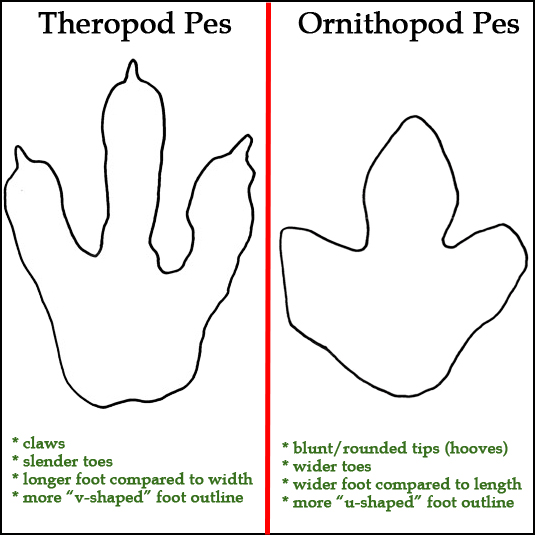
Comparing different types of dinosaur footprint. Studying dinosaur tracks.

Theropod print compared to an ornithopod print.

Picture credit: Everything Dinosaur

Ms Bindi Lee Porth was collecting shells at the beach last Sunday evening, when she literally stumbled across an amazing fossil find.  She noticed a strange shape in the rock and as she puts it herself:

“I just sort of brushed all the sand away and it’s revealed this beautiful, like a bird, foot.”

The Broome Coastline and Dinosaur Tracks

This part of the coast of Western Australia is renowned for its dinosaur tracks, that date from the Early Cretaceous (130 million years ago), a time when Australia was part of a much larger land mass (Gondwana) and it was nearer the South Pole.  Despite the high latitude, the climate was temperate to sub-tropical and many different kinds of dinosaurs roamed the land.

Last year, Everything Dinosaur reported on efforts by University of Queensland researchers to map the extensive trackways using drones.

To read an article about this: Mapping the Dinosaur Heritage of Western Australia.

The three-toed prints were exposed by the shifting sands, to have a set of tracks found so close to such a popular tourist location is quite a surprise and Ms Porth initially doubted what she had found, after all, casts of dinosaur footprints set in concrete have been created elsewhere along the coast in a bid to inform visitors about the ancient heritage of this part of Western Australia.  However, after having the trace fossils examined by Queensland University palaeontologist, Steve Salisbury, it was confirmed that these prints were genuine.

Dr Salisbury commented:

“There have been tracks spotted in the Cable Beach area over the years, most of those are sauropod tracks, but this is the first time we’ve become aware of there being another type of dinosaur track in that area.”

More Than One Type of Three-toed Dinosaur

Dr Salisbury’s trained eyes spotted something else unusual about the tridactyl prints.  Claws marks at the end of the toes can be clearly made out so these tracks were probably made by a meat-eater, but some of the tracks are subtly different, this suggests that more than one type of theropod dinosaur is represented.  The Queensland University based scientist hopes to study the casts and in situ prints in order to determine more information about the dinosaurs that created them.

Using a simple hip to stride length formula, Dr Salisbury has calculated that some of the prints were made by a dinosaur that had a hip height of around two metres.  A spokesperson from Everything Dinosaur commented that although it was not possible to give an accurate size estimate for a dinosaur based on these preliminary findings and more measurements would need to be taken, but as a rough approximation, you could be looking at a dinosaur around six metres in length.  A dinosaur that size would be about as big as Australovenator, a fearsome meat-eating dinosaur that lived some thirty million years or so after these tracks were made.

A Scale Drawing of the Theropod Dinosaur Australovenator

Drawing of Australovenator

Vicious Dinosaur from “Down Under”. A drawing of Australovenator.  Picture credit: Everything Dinosaur.

The picture (above) shows an illustration of Australovenator from the CollectA model range.

To view this range of prehistoric animal models: CollectA Age of Dinosaurs Popular Models.

Amazing Fossils

It may not be the biggest meat-eating dinosaur tracks ever found, the prints don’t represent the biggest theropod known from Australia, but they do indicate that even in the most unlikely places, amazing fossils can be found.

To read an article that calls for more research to be done on the Western Australia dinosaur tracks: More Research Urgently Needed to Help Preserve and Protect Western Australia’s Trace Fossil Heritage.

A spokesperson from Everything Dinosaur commented:

“Let us hope that the footprints are not disturbed. Hopefully, the scientists will be able to produce latex casts of the prints.  These casts should yield much more information about the dinosaurs of Australia.”

Visit Everything Dinosaur’s award-winning website: Visit Everything Dinosaur.

5 09, 2016

Special Update on “Sibirosaurus”

By |2024-05-06T08:49:35+01:00September 5th, 2016|Categories: Dinosaur and Prehistoric Animal News Stories, Dinosaur Fans, Main Page|0 Comments

General Media Picks Up Story of Giant Siberian Dinosaur

A  number of media outlets recently carried the story of the discovery of giant dinosaur fossil bones in Siberia.  There were lurid headlines such as “terrifying newly discovered dinosaur was the size of eight elephants” and claims that the Siberian fossils represented one of the largest animals ever to have walked on Earth.

“Sibirosaurus”

Readers of this blog will note that we at Everything Dinosaur tend to try and avoid hyperbole and the dinosaur in question, most likely a new species of long-necked dinosaur (likely to be a titanosauriform), had already featured in the weblog back in March 2015.  The dinosaur has been given the nickname Sibirosaurus, but it has yet to be formally scientifically described.  The titanosauriforms are the largest single group of dinosaurs within the Macronaria, a clade of sauropods united by their very large naris  (nasal openings) in their skulls, which in a number of genera are actually much larger than the eye socket (orbit).

Media Outlets Getting Excited by “Sibirosaurus”

Macronarian Titanosauriform dinosaurs.

An artist’s impression of a typical Macronarian dinosaur.

Picture credit: Damir G. Martin

Extremely Hard Sandstone

The fossils of this dinosaur have been slowly but surely extracted from a layer of extremely hard sandstone, located halfway up a cliff.  To read Everything Dinosaur’s 2015 article on the excavation work and to see pictures of the fossil dig site: Sibirosaurus Strides In.

Work is Continuing on the Fossil Bone Preparation

Fossil preparation work in the laboratory.

A member of the lab team works on the fossil bones of a Macronarian dinosaur.

Picture credit: Tomsk State University

The picture above shows one of the lab team members carefully removing the rock-hard matrix from a large bone (looks like a vertebra).   Claims in a number of newspapers that the dinosaur is a heavy as eight elephants (estimated weight up to fifty tonnes) and that these fossils represent one of the largest land animals known are a little premature, although it probably does represent a new species.  Dinosaur fossils have been found before in the sandstone rocks of the Kemerovo region of southern Siberia, but the fossils, in all probability do represent a species new to science.

A Piece of Dinosaur Fossil Bone at the Dig Site

A piece of dinosaur fossil bone.

A photograph of the Siberian dinosaur fossil bone at the dig site.

Picture credit: Tomsk State University

A New Dinosaur Taxon

The research is being conducted by Tomsk State University, St Petersburg State University and the Zoological Institute of the Russian Academy of Sciences.  A spokesperson from Everything Dinosaur commented that a formal research paper on this new dinosaur taxon will, in all likelihood be published next year.

Work has already been completed on the sacrum and it is hoped that these fossils along with foot bones from a titanosauriform found in 1995 and likely to belong to the same species, will go on public display.

Although Fragmentary it is Likely a New Species of Titanosauriform will be Erected

Fossils of a new Titanosaur from Siberia.

Fossils of “Sibirosaurus” ready for cataloguing.

Picture credit: Tomsk State University

Visit Everything Dinosaur’s website: Everything Dinosaur.

4 09, 2016

3.7-Billion-Year-Old Microbial Structures? A Fascinating Question

By |2024-05-06T08:50:03+01:00September 4th, 2016|Categories: Dinosaur and Prehistoric Animal News Stories, Dinosaur Fans, Geology, Main Page|0 Comments

A Rapid Emergence of Life on Earth?

When did life on Earth begin?  That is a very difficult question to answer, however, a team of scientists have published in the journal “Nature” this week suggesting that stromatolites (microbial colonies) existed in shallow marine environments as early as 3.7 billion years ago.  It’s all to do with waves and squiggles preserved in sedimentary strata from south-western Greenland.

Stromatolite Microbial Structures

Do These Wavy Lines and Structures Preserved in Ancient Sedimentary Rocks Indicate the Presence of Colonial Bacteria?

Are these wavy lines stromatolite fossils?

Evidence for ancient stromatolites?

Picture credit: University of Wollongong

In the picture above the white scale bar represents 4 centimetres.

Although the paper is not without its controversy, if these waves and squiggles do turn out to be the ancient signatures left by mats of bacteria, then they would predate the previously oldest known fossils (from Australia) by some 200 million years or more.  Such claims are hotly contested, about as hot as the young Earth when the researchers (from a number of Australian institutions as well as from the UK), claim these stromatolites first existed.

The Isua Supercrustal Belt

The bleak, desolate uplands of south-western Greenland hold a secret.  The rocks here are the oldest surviving piece of the Earth’s surface.  As our planet continues to warm, so ice sheets shrink and slowly and surely, like the advance of geological time itself, new parts of our planet’s ancient crust are exposed.

This geological feature is called the Isua Supercrustal Belt (ISB).  Professor Martin van Kranendonk (University of New South Wales), specialises in the study of ancient life forms, dedicating his career to examining rocks for traces of Archean and Proterozoic life.  He and his colleagues hypothesise that the waves and cones seen in the ancient Greenland rocks are the traces of stromatolite stacks.

Researchers Exploring the ISB of Greenland

The Isua Supracrustal Belt of Greenland

The bleak and deserted part of south-western Greenland – on the hunt for ancient fossils.

Picture credit: Picasa

Ancient Rocks and Ancient Fossils

Professor Kranendonk commented:

“We see the original unaltered sedimentary layers, and we can see how the stromatolite structures grow up through the sedimentary layering.  And we can see the characteristic dome and cone-shaped forms of modern stromatolites.”

If this is evidence of microbial colonies preserved in rocks some 3,700 million years old, then they predate by some 220 million years the previous most convincing and generally accepted evidence for the oldest life on Earth, the stromatolite fossils from the 3,480 million year old Dresser Formation of the Pilbara Craton, Australia.  These ancient rocks located in Western Australia are mostly volcanic in origin but the strata also preserves evidence of hydrothermal locations (hot springs), indicated by the presence of large quantities of the mineral barite.

These areas are associated with wrinkled structures, columns and cone shaped rocks, interpreted as evidence of stromatolite structures having existed within the hot springs and surrounding areas.

Ancient Stromatolites

The ISB fossil material indicates the establishment of shallow marine carbonate production with biotic CO2 sequestration by 3,700 million years ago, close to the start of our planet’s sedimentary record.  If this is the case, then genetic molecular clock studies would push back the origin of life to before the Archaen Eon and into the Hadean Eon.

The Hadean Eon is the very oldest part of the Earth’s geological record.  It covers the period from our planet’s formation some 4.57 billion years ago to around 4 billion years ago (the start of the Archean Eon).  This suggests that life began on our planet when it was still being bombarded by extraterrestrial bodies, remnants from the formation of our solar system (the “Great Cometary Bombardment”).

For models and replicas of ancient prehistoric creatures: Wild Safari Prehistoric World Models.

Shark Bay Western Australia

Stromatolites can still be found today in various parts of the world (freshwater and marine environments).  For example, they can still be seen around the coast of Western Australia in a very saline body of water called Shark Bay.  The mushroom shaped structures found on the floor of the bay are the work of cyanobacterial communities.  Layers of mineral grains are glued together by the sticky, colonial bacteria.

To read an article from Everything Dinosaur published in 2010 about fossil evidence for the earliest animals found: Sponge-like Fossils May Be Earliest Animals.

3 09, 2016

The Importance of Allkaruen a New Early Jurassic Pterosaur

By |2024-05-06T08:51:05+01:00September 3rd, 2016|Categories: Dinosaur and Prehistoric Animal News Stories, Dinosaur Fans, Main Page|0 Comments

The Significance of the Pterosaur Allkaruen

A few days ago, Everything Dinosaur featured an article on this blog about a newly described Early Jurassic pterosaur named Allkaruen koi.  We were subsequently emailed by one young dinosaur fan asking us to explain the significance of this fossil discovery.  Why was the pterosaur Allkaruen important?

Time to Get Excited About Pterosaurs – Learning Lots about Flying Reptiles

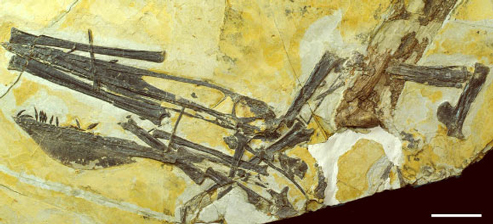
Ikrandraco Pterosaur fossil

White bar shows scale.

Picture credit: Scientific Reports/Xiaolin Wang et al

The photograph above shows the fossilised remains of Ikrandraco avatar, a new species of pterosaur described in 2014.

To read our recent article on the discovery of a new pterosaur (A. koi) from Patagonia (Argentina): New Long-Tailed Pterosaur from Patagonia.

Pterosaur Fossils are Exceedingly Rare

Fossils of flying reptiles are exceedingly rare, of the 130 or so genera described to date, most are known from only a few fragmentary fossils, mere scraps of bone and teeth.  The light, delicate, pneumatic bones of pterosaurs rarely survive the ravages of time and the fossilisation process.  Most corpses, don’t even get buried, the chances are the carcase would have been scavenged long before it settled on a lake bed or the bottom of a shallow sea.

Therefore, the naming of a new flying reptile species is, in itself, a significant event.  For Allkaruen koi, even more so, as the rocks in southern Argentina where the fossilised bones were found indicate that this flying reptile lived around 180 million years ago.

For models and replicas of pterosaurs and other prehistoric creatures: CollectA Deluxe Scale Prehistoric Animal Models.

A Beautiful Braincase

The new pterosaur genus has been erected after careful study of the skeletal elements including an almost perfect, three-dimensionally preserved braincase.  Most pterosaur fossils are crushed, distorted or compacted but not in this case, one of just a handful of very well-preserved flying reptile braincases known in the fossil record.  The braincase of Allkaruen shows a unique combination of characteristics of both the Rhamphorhynchoids (non-monofenestratan breviquartossans) and the Pterodactyloidea – let’s explain what this means.

The Pterosauria – the Order of reptiles that includes all these flying reptiles can be split into to distinct and very different groups.

  1. Formerly referred to as the Rhamphorhynchoids (as the very well known Rhamphorhynchidae family is included in this group), but now known to include a number of other pterosaur families that evolved in the Triassic and the Jurassic, characterised by long-tails and a lengthy fifth digit.
  2. The Pterodactyloidea essentially the vast majority of known pterosaurs, a Jurassic/Cretaceous radiation of flying reptiles with thin bone walls, relatively long metacarpals and much shorter tails.

The Pterosaur Allkaruen

So, in short, the researchers have a braincase from an Early Jurassic pterosaur that shows features of both groups, the basal group and the later, short-tailed, long toed, thin bone walled Pterodactyloidea.  By studying the braincase of Allkaruen the palaeontologists can learn more about how the Pterodactyloidea evolved.  They can see how the brains of flying reptiles changed over time.

A Phylogenetic Assessment of Allkaruen Compared to Rhamphorhynchus and the Later Pterosaur Anhanguera

The phylogenetic position of Allkaruen.

Where within the Pterosauria Order does Allkaruen fit in?

Picture credit: PeerJ

The researchers compared the changing shape and structure of pterosaur brains, comparing Allkaruen with the brain anatomy of Rhamphorhynchus (representing the basal group), with the brain anatomy of a later Cretaceous pterosaur Anhanguera, a representative of the short-tailed Pterodactyloidea.  Allkaruen could be described as a sort of “halfway house” between these two groups, a snapshot in pterosaur evolution permitting scientists to gain “insights into the origin of the Pterodactyloid neurocranium and improve our understanding of the tempo and mode of pterosaur evolution.”

The scientists mapped the various elements of the brain by comparing the braincases of these three pterosaurs, from this information they could plot the evolution of the inner ear, essentially the balance organ, vital if you are going to spend a long time in the air.

A Larger Brain Volume

The brain volume of Allkaruen is much bigger than that of Rhamphorhynchus and from this it can be inferred that Allkaruen was a more advanced animal capable of better co-ordinated flight and faster reactions than the Rhamphorhynchidae.  The cerebellum (show in yellow in the three brain diagrams included in the picture above), is much larger in Allkaruen than it is in Rhamphorhynchus.  The cerebellum in vertebrates is found towards the back of the brain it coordinates and regulates muscular activity.  A bigger cerebellum is another indicator that Allkaruen was a better flyer than the more basal pterosaurs.  This and other evidence is helping palaeontologists to understand more about how the pterosaurs evolved.

That’s why this fossil discovery is so important.

Visit Everything Dinosaur’s award-winning website: Everything Dinosaur.

1 09, 2016

New Long-tailed Pterosaur from Patagonia

By |2023-05-06T21:08:01+01:00September 1st, 2016|Categories: Dinosaur and Prehistoric Animal News Stories, Dinosaur Fans, Main Page|0 Comments

Allkaruen koi – Braincase and All

A team of international scientists including Leicester University’s David Unwin and Oliver Rauhut (conservator at the Bavarian Collection for Palaeontology and Geology), have announced the discovery of a new species of long-tailed pterosaur from Patagonia (Argentina).

A Long-tailed Pterosaur

Writing in the academic journal “PeerJ”, the researchers were able to infer new information about how pterosaurs adapted to an aerial lifestyle thanks to the three-dimensional preservation of the cranial material.  From this skull material, the team were able to gain fresh insights into the braincase and the structure of the inner ear.  The new species of pterosaur will help palaeontologists to better understand differences between the primitive, primarily long-tailed “rhamphorhynchoids”, also known as non-pterodactyloids and the more derived and later, short-tailed pterodactyloids.

An Illustration of the New Pterosaur (Allkaruen koi)

Allkaruen Pterosaru illustration.

An illustration of the newly described Jurassic pterosaur from Argentina called Allkaruen.

Picture credit: Gabriel Lio

For models and replicas of pterosaurs and other creatures: Wild Safari Prehistoric World Models.

The Evolution and Radiation of the Pterosauria

The fossilised remains of this new pterosaur come from the Cañadón Asfalto Formation, exposed in the northern/central Chubut Province of southern Argentina.  The fossil material came from a single bedding plane formed from freshwater limestone deposits, indicating that there was a large, inland body of water present.  The fossils were scattered although elements such as the mandible preserved a degree of articulation.  The rocks of the Cañadón Asfalto Formation had been thought to be about 162 million  years of age (Callovian to Oxfordian faunal stages – latest Middle to earliest Late Jurassic), however recent radiometric and biostratigraphical analysis suggests that these rocks might be much older.

Research published in 2013 (Cúneo et al), indicates an age range for this formation of between 183 and 165 million years (Toarcian to Bathonian faunal stages).

The genus name comes from the local Tehuelche dialect word “all” for “brain” and “karuen” which means “ancient”, in recognition of the superb three-dimensional preservation state of the fossil  skull.  The species name means “lake” in the Tehuelche language, reflecting the fact that the fossils were found in lacustrine deposits,

Fossils and Line Drawings of the Allkaruen koi Material

Fossils of the Jurassic Pterosaur Allkaruen

Fossils of the braincase, line drawings of the braincase along with drawings of the mandible and vertebrae.

Picture credit: PeerJ

Two Main Types of Pterosaur

Pterosaurs have remarkable skeletal adaptations for life in the air and they were the first vertebrates to achieve powered flight.  Two major body plans have traditionally been recognised, rhamphorhynchoids (non-pterodactyloids) and the pterodactyloids.  These two types of flying reptile differ considerably in their general anatomy and also they exhibit very different head postures and neuroanatomy (nervous systems and the study of the brain).  Computerised tomography was employed to scan the uncrushed braincase that enabled the scientists to infer more information regarding the shape of the brain and the inner ear.

This study has provided new information on the origins of the highly derived neuroanatomy of pterodactyloids, as, until this new fossil discovery, only a few three-dimensionally preserved braincases of flying reptiles were known and these demonstrated a large morphological gap between the specimens.

The braincase of Allkaruen has helped fill in a portion of that gap to give scientists a better understanding of how the flying abilities of these reptiles evolved.

Dr Diego Pol (CONICET, Museo Paleontológico Egidio Feruglio, Trelew, Chubut, Argentina) and corresponding author for the published paper stated: 

“Allkaruen shows an intermediate state in the brain evolution of pterosaurs and their adaptations to the aerial environment.  As a result, this research makes an important contribution to the understanding of the evolution of all of pterosaurs.”

A Phylogenetic Analysis

A phylogenetic analysis was undertaken and Allkaruen is nested between monofenestratan breviquartossans (Rhamphorhynchidae) and derived pterodactyloids.  Given the age of the fossil and its phylogenetic affinities to Rhamphorhynchus and the pterosaur known as Darwinopterus it has been suggested that this flying reptile had a long tail with a diamond-shaped rudder on the end of it.  Analysis of the cranium indicates that Allkaruen had two parallel crests on the top of its skull and it appeared to have teeth restricted to the middle and anterior (front) part of its jaws.  Although the exact diet of this pterosaur is not known, given the context of the fossil material and the shape of the teeth, Allkaruen most likely fed on fish.

To read an article on the transitional fossil Darwinopterus: Darwinopterus – A Transitional Pterosaur.

Dr Oliver Rauhut has had a busy couple of weeks, he was also one of the principal authors of the scientific paper on the Early Jurassic meglosaurid Wiehenvenator.  To read about the “Monster of Minden”: Wiehenovenator – The “Monster of Minden”.

Everything Dinosaur is based in the UK.  We produce helpful and informative blog posts including articles about fossil finds.

Visit the Everything Dinosaur website: Everything Dinosaur.

31 08, 2016

Wiehenvenator albati – “The Monster of Minden”

By |2023-05-04T14:55:10+01:00August 31st, 2016|Categories: Dinosaur and Prehistoric Animal News Stories, Dinosaur Fans, Main Page|0 Comments

The “Monster of Minden” – Wiehenvenator albati

A new species of large, Middle Jurassic carnivorous dinosaur has been described.  Writing in the academic journal “Palaeontologica Electronica” the researchers, which include Dr Oliver Rauhut, (conservator at the Bavarian Collection for Palaeontology and Geology), identify this new theropod as a member of the Megalosauroidea.  Named Wiehenvenator albati, it could be a potential sister taxon to Torvosaurus and a dinosaur that might have been about the same size as Torvosaurus gurneyi, reaching an estimated length of around ten metres.

An Illustration of the Newly Described Middle Jurassic Theropod from Germany

New dinosaur from Germany (Wiehenvenator)

Scale bar = 1 m (an illustration of Wiehenvenator).

Picture credit: Palaeontologica Electronica (based on an illustration of Torvosaurus by Scott Hartman

The picture above shows the known fossil bones of Wiehenvenator.

Wiehenvenator albati – A German Dinosaur

Fragmentary fossils including elements from the skull and jaws, caudal vertebrae, ribs and bones from the lower legs and ankle were excavated from a disused quarry located in Northrhine-Westphalia (Germany) back in 1999.  The fossils were found by chance, it was a routine inspection, however, once the first bones had been discovered a field team was brought in to ensure all the fossil material present could be collected.

The strata in which the fossil material was found are Middle Callovian in age (around 163 to 165 million years old) and they represent marine sediments.  During this time, much of the land that was to form western Europe lay under a warm, shallow tropical sea.  A number of small islands existed and it seems that this archipelago was home to this hunter, a dinosaur that is estimated to have weighed more than two tonnes.

Skull and Elements of the Jaws in their Anatomical Position

The skull and jaws of Wiehenvenator.

The skull and jaw fossils located in their anatomical position (Wiehenvenator).

Picture credit: Palaeontologica Electronica

“The Monster of Minden” – Wiehenvenator albati

Nicknamed “The Monster of Minden”, due to the town’s close proximity to the fossil dig site, Wiehenvenator was probably the apex predator on the island archipelago.  The teeth associated with this dinosaur are strongly recurved with the root making up more than two thirds of the tooth length.  The largest teeth identified so far (from the maxilla), measure in excess of 13 centimetres long.

The Teeth of Wiehenvenator albati (Various Views)

The teeth of the "Monster of Minden"

The strongly recurved teeth of Wiehenvenator.

Picture credit: Palaeontologica Electronica

Fossil Teeth

The picture above shows various views of the fossil teeth associated with the jawbones or found as loose items at the dig site.  The scale bar for 1 and 2 is 1 centimetre, the scale bar in the other images represents 5 centimetres (except picture 9).  The dinosaur was named Wiehenvenator for the Wiehengebirge, a chain of hills south of the town of Minden, where the holotype specimen was found and venator, Latin for hunter.  The trivial name honours Friedrich Albat, who found the holotype specimen.

Commenting on the significance of the discovery, Dr Rauhut stated:

“Apparently there was in these islands a wide range of sometimes very large predators mainly from the group of Megalosauroidea as finds from France and England, as well as the new predators from Germany show.  The Megalosauroidea were the first giant predatory dinosaurs of Earth’s history.”

Differences in the Middle and Late Jurassic Theropod Fossil Records

The discovery of Wiehenvenator adds to the number of large theropods known from the Callovian faunal stage of the Jurassic.  The research team comments on the number of large theropods from the Middle Jurassic that are classified as megalosauroids and they suggest that a rapid radiation of megalosaurs is suggested between the Toarcian and the Bathonian faunal stage of the Jurassic (approximately 183 to 166 million years ago).

The scientists postulate that this radiation and increase in the number of megalosaurs was probably triggered by the Pliensbachian-Toarcian extinction event that took place around 183 million years ago.

They comment that this extinction event may have been more significant for theropod evolution than the larger end Triassic mass extinction.  The team then go on to review the changes in theropod genera that took place from the Middle Jurassic onwards.

Two Views of the Right Maxilla (Upper Jaw Bone) of Wiehenvenator

The right maxilla of Wiehenvenator.

Right maxilla of Wiehenvenator albati in lateral (1) and medial (2) views.

Picture credit: Palaeontologica Electronica

The picture above shows two views of the right maxilla of Wiehenvenator albati, top (1) lateral view and bottom (2) medial view.

Less Megalosaurs More Allosaurs

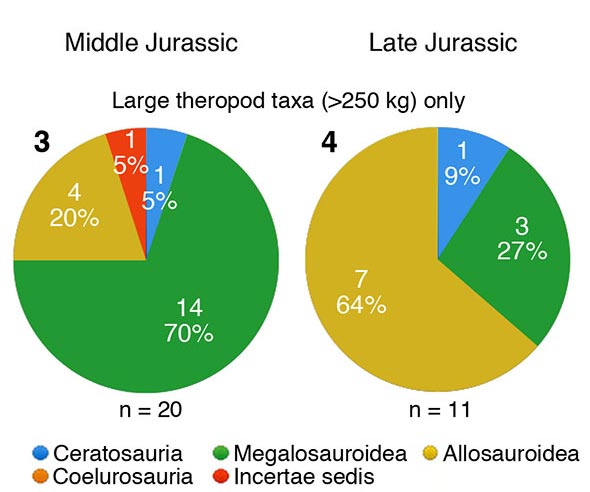
The fossil record indicates a faunal turnover from Megalosauroidea dominated Middle Jurassic to allosauroid/coelurosaur dominated Late Jurassic theropod faunas. The researchers plotted the number of different theropod fossils found globally between the Middle Jurassic to the Late Jurassic.  Although the paucity of the fossil record makes a complete analysis impossible, the team did infer that there was a change in the proportion of different types of theropod dinosaur represented as the Jurassic progressed.

The once dominant megalosaurs were replaced by coelurosaurs and allosaurs.

For models and replicas of a variety of theropod dinosaurs: PNSO Age of Dinosaurs Models.

Middle Jurassic Theropods Compared to Late Jurassic Theropods (Assessed by Clade)

Changing Theropod genera during the Jurassic.

A fossil record comparison of theropods (Middle Jurassic compared to Late Jurassic).

Picture credit: Palaeontologica Electronica

The Impact on Large Taxa (Apex Predators)

Theropod faunal turnover in the Jurassic.

Theropod faunal turnover (taxa estimated to be >250 kgs in size).

Picture credit: Palaeontologica Electronica

Allosaurs Replacing Megalosaurs – Theropod Faunal Turnover

When body mass is considered and theropod dinosaurs estimated to be less than 250 kilogrammes in weight are removed, the impact of the rise in the number of coelurosaurs is lost, suggesting that these dinosaurs did not rise to the apex predator niche during this period.  Large megalosaurids which dominated the apex predator niche globally during the Middle Jurassic had been substantially replaced by allosaurids by the end of the Jurassic.

The scientists are quick to point out that these figures are not conclusive, bias because of the large number of theropods from the Upper Jurassic Morrison Formation is discussed along with the difficulties of undertaking analysis of this sort due to the relatively poor fossil record of large meat-eating dinosaurs over the time period studied.

However, an analysis of environmental preferences of allosauroids and megalosauroids indicates that the former preferred inland environments, whereas the latter are more common in nearshore environments.

From this it could be inferred that megalosaurids preferred to “be beside the seaside”.

The publication: “A new theropod dinosaur megalosaurid from the late Middle Jurassic (Callovian) of north-western Germany: Implications for theropod evolution and faunal turnover in the Jurassic.  By: Oliver WM Rauhut, Tom Huebner, and Klaus-Peter Lanser. In: Palaeontologia Electronica 2016.

Visit Everything Dinosaur’s website: Visit Everything Dinosaur.

29 08, 2016

“Lucy” Died after Tree Fall

By |2023-05-06T18:52:16+01:00August 29th, 2016|Categories: Dinosaur and Prehistoric Animal News Stories, Dinosaur Fans, Main Page|0 Comments

“Lucy” Most Likely Died after a Fall from a Tree

A team of researchers from Ethiopia and the United States have published a remarkable post-mortem on one of the most famous hominin fossils known to science.  It turns out that the 3.2-million-year-old Australopithecus afarensis known as “Lucy”, very probably died from injuries resulting from a fall from height, most likely a fall from a tree.

Computerised Tomography and “Lucy”

Computerised tomography was employed to study the fossilised bones whilst the specimen was on tour of America (Lucy’s Legacy: The Hidden Treasures of Ethiopia).  The high resolution scans helped the scientists to determine which of the many fractures in the bones related to injuries and which ones were as a result of more than three million years preserved in strata.

A Reconstruction of an Australopithecus afarensis Based on Fossil Material

Australopithecus afarensis "Lucy".

A reconstruction of “Lucy” A. afarensis.

Perimortem Fractures

Lead author of the scientific paper, which has just been published in the journal “Nature”, Professor John Kappelman (University of Texas) explained:

“These fractures have been known since she was discovered.  I’ve looked at this fossil for thirty years and I knew that these fractures were there.”

“Lucy” was discovered in the Afar region in 1974, ironically this hominin got her nickname as “Lucy in the Sky with Diamonds”, the Beatles tune from the album “Sgt. Pepper’s Lonely Hearts Club Band”, had been played repeatedly by the research team at the dig site.

“Lucy” Killed in a Fall

It seems that a fall killed her and as since the fossils are associated with a flood plain with trees, it seems highly plausible that “Lucy” fell out of a tree.  This new study supports the idea that Australopithecus afarensis spent at least some of its time in the trees.  However, adaptations to a more terrestrial life, especially bipedal locomotion may have limited this species in terms of their ability to climb trees.  Being better adapted to walking upright meant a trade off between this and tree climbing ability.  In the case of “Lucy” this was to lead to fatal results.

The Fossilised Remains of “Lucy” A. afarensis

"Lucy" A. afarensis discovered in 1974.

The fossilised bones of Lucy (approximately 40% of the skeleton).

Picture credit:  The world’s most famous fossil, known as “Lucy,” went on display for the first time outside of Ethiopia in the world-premiere special exhibition Lucy’s Legacy: The Hidden Treasures of Ethiopia.

A Dramatic “Vertical Deceleration Event”

The scans revealed a number of perimortem injuries (pathology related to death or shortly before death), particularly a crushed shoulder joint, consistent with a person reaching out their arms to try and break their fall.  The scans also revealed traumatic injuries to the ankle, leg bones, the kneecap, pelvis, ribs, skull, jaws and backbone.  When the research team examined these injuries and compared them to orthopaedic literature in relation to fall victims, the team found striking similarities between the fractures.

Commenting on how certain the researchers were with regards to the fall from height (vertical deceleration event), Professor Kappelman stated that the team’s hypothesis:

“It’s tested every day in emergency rooms all around the planet.”

“Greenstick Fractures”

A number of the perimortem fractures identified were “greenstick” breaks.  The bone had bent and snapped like a branch of a tree, something that only happens to healthy, living bones.  The scientists concluded that these traumatic injuries occurred when Lucy was alive, as they show no signs of healing and as the injuries were so catastrophic, they very probably all occurred at the same time, a consequence of a fatal accident.

The fatal fall also fits with the fact that Lucy’s tiny first rib is broken.  This small bone is heavily protected by the chest, if this is broken in an accident, as Professor Kappelman explains: “you’re having a bad day.”

A Shattered Shoulder Joint and Other Injuries

When the shattered shoulder joint was examined the team concluded (after reviewing the evidence with orthopaedic surgeons), that Lucy had tried to break her fall by reaching out her arms, as Professor Kappelman explained: “if our hypothesis stands up… it tells us that Lucy was conscious when she reached out her arms to break her fall.”

The Postulated Demise of “Lucy” – A Fall from a Tree

Lucy (A. afarensis) sudden deceleration event.

A reconstruction explaining the fatal injuries to “Lucy” – A. afarensis after a fall from a tree.

Picture credit: University of Texas

A Severe Impact

In a remarkable analysis the researchers plot the demise of Lucy and comment when each of her injuries was likely to have occurred.  The impact would have been so severe as to cause concomitant fractures usually such a fall would also damage internal organs; together, these injuries are hypothesised to have caused her death.

When fossils of Australopithecines are examined they appear to have been capable of both terrestrial and arboreal locomotion.  The authors suggest that the adaptations that facilitated bipedal, terrestrial locomotion compromised the ability of individuals to climb safely and efficiently in the trees.  This combination of features may have predisposed these hominins to more frequent falls from height.

Looking for Signs of Injury

Close inspection of other fossils for signs of injury has the potential to offer important insights about hominin lifestyle, through an understanding of the trauma that they suffered and the mechanisms by which they died.

With the cooperation of the Ethiopian Government a series of data files have been produced and made freely available to other researchers.  In addition, as a result of the 45,000 scans taken by the team, a number of bones from Lucy have been reconstructed, these too will provide valuable learning resources.

Professor Kappelman in His Anthropology Laboratory with Casts of “Lucy’s” Bones

Professor Kappelman (University of Texax)

Professor Kappelman examines casts of “Lucy” – A. afarensis.

Picture credit: University of Texas

“Lucy” and her kind the Australopithecus afarensis have been at the centre of a vigorous debate amongst palaeoanthropologists.  How much time did these hominins spend in the trees?  It is ironic therefore, to hypothesis that “Lucy” died as a result from a fall, probably out of a tree.  The fractured bones providing evidence of arborealism within this species.  This is one very “cold case” that may have been cracked.

One further question to ask, did “Lucy” fall or was she pushed?

To read an additional article on bipedalism in early hominins: Early Hominins Walked Upright so they could Carry more Food.

27 08, 2016

Not All End Cretaceous Pterosaurs were Giants

By |2023-05-06T18:32:58+01:00August 27th, 2016|Categories: Dinosaur and Prehistoric Animal News Stories, Dinosaur Fans, Main Page|0 Comments

A Small Azhdarchoid Pterosaur from Late Cretaceous British Columbia

As the Cretaceous progressed, so the once diverse and dominant Pterosauria began to be replaced by the rapidly evolving and radiating Aves (birds).  When it came to aeronautics, feathers were better than flaps of skin.  The last of the flying reptiles, those that survived into the very Late Cretaceous were giants, huge animals some as tall as a giraffe, even the smallest of these pterosaurs, creatures like Montanazhdarcho minor and Eurazhdarcho langendorfensis had wingspans comparable to the largest volant birds today.  It seemed that the last of the pterosaurs, most of which belong to a single family, the Azhdarchidae, were all big.

British Columbia Pterosaur Flies Against Conventional Thinking

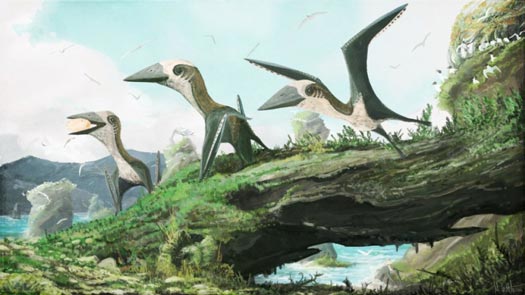
Late Cretaceous small-bodied Pterosaur from British Columbia.

The small azhdarchoid pterosaur from Hornby Island (British Columbia).

Picture credit: Mark Witton

Studying Pterosaurs

The consensus went something like this, smaller pterosaurs were gradually out competed by and replaced by birds.  However, a newly described pterosaur fossil from British Columbia, the first of its kind from western North America has challenged this thinking.  It seems that smaller pterosaurs did survive into the Late Cretaceous and their lack of presence in the fossil record probably has more to do with preservation basis than with an inability to compete with birds.

The fossilised remains of a small-bodied pterosaur, an animal that probably had a wingspan of around 1.5 metres, that’s roughly the size of an adult European Herring Gull wingspan (Larus argentatus), were found on Hornby Island, a small body of land on the east coast of Vancouver Island, British Columbia back in 2009.  The fragmentary fossils, were located in carbonate nodules and date from approximately 77 million years ago (Campanian faunal stage of the Cretaceous), the finder, a volunteer with the Royal British Columbia Museum, donated the specimen to the Museum.

For models and replicas of pterosaurs and other prehistoric animals: CollectA Deluxe Scale Models and Figures.

Studying a Pterosaur Fossil Specimen

At the time, the fossil material was given to Victoria Arbour, a then PhD student and dinosaur expert at the University of Alberta.  Victoria, as a postdoctoral researcher at North Carolina State University and the North Carolina Museum of Natural Sciences, then contacted Elizabeth Martin-Silverstone, a palaeobiology PhD student (University of Southampton) and the Royal British Columbia Museum sent the specimen for analysis in collaboration with Dr Mark Witton, a pterosaur expert at the University of Portsmouth.

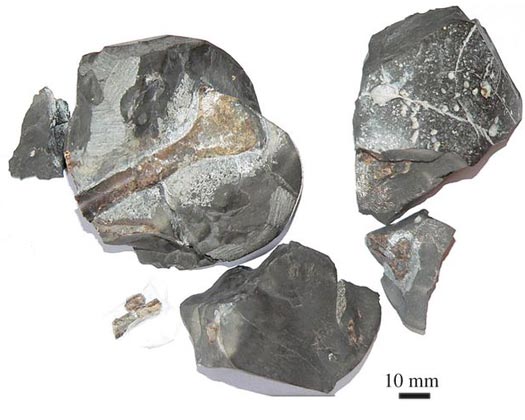
The Pterosaur Fossilised Bones can be Identified in the Carbonate Nodules

Azhdarchoid fossils from British Columbia.

The unprepared fossil material in the carbonate nodules.

Picture credit: Sandy McLachlan

Adding to our Knowledge Base About Late Cretaceous Pterosaurs

The fossils comprising a partial humerus (upper arm bone), vertebrae and other bone fragments show characteristics that led them to be classified as azhdarchoid pterosaur material.  Previous studies suggest that the Late Cretaceous skies were only occupied by much larger pterosaur species and birds, but this new finding, which is reported in the Royal Society journal “Open Science”, provides crucial information about the diversity and success of Late Cretaceous pterosaurs.

Lead author, PhD student Elizabeth Martin-Silverstone, explained the significance of this British Columbian discovery:

“This new pterosaur is exciting because it suggests that small pterosaurs were present all the way until the end of the Cretaceous, and weren’t out competed by birds.  The hollow bones of pterosaurs are notoriously poorly preserved, and larger animals seem to be preferentially preserved in similarly aged Late Cretaceous ecosystems of North America.  This suggests that a small pterosaur would very rarely be preserved, but not necessarily that they didn’t exist.”

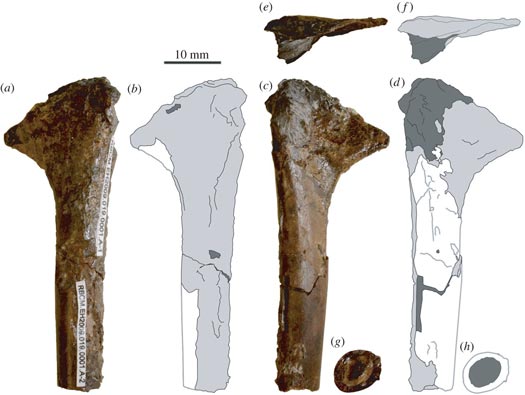
Photographs and Line Drawings of the Azhdarchoid Humerus

Azhdarchoid Humerus Fossil

Line drawings and photographs of the prepared humerus (RBCM.EH.2009.019.0001).

Picture credit: Royal Society Open Science

An Azhdarchoid Humerus

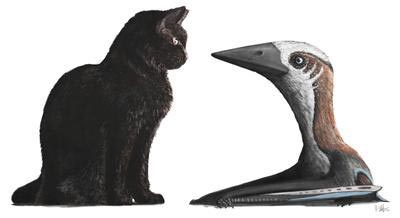
The picture above shows photographs and interpretative line drawings of the fossilised left humerus (a, b) dorsal view, (c, d) ventral view, (e, f) proximal and (g, h) distal view.  The shading denotes preserved bone cortex (white), weathered bone (light grey) and matrix infill (dark grey).  The scale bar in the picture equals ten millimetres, indicating a cat-sized Pterosaur.

Late Cretaceous Pterosaur No Bigger Than a Domestic Cat

Azhdarchoid Pterosaur the size of a cat.

Late Cretaceous pterosaur that was cat-sized.

Picture credit: Mark Witton

Dr Witton commented:

“The specimen is far from the prettiest or most complete  pterosaur fossil you’ll ever see, but it’s still an exciting and significant find.  It’s rare to find pterosaur fossils at all because their skeletons were lightweight and easily damaged once they died, and the small ones are the rarest of all.  But luck was on our side and several bones of this animal survived the preservation process.

Happily, enough of the specimen was recovered to determine the approximate age of the pterosaur at the time of its death.  By examining its internal bone structure and the fusion of its vertebrae we could see that, despite its small size, the animal was almost fully grown.  The specimen thus seems to be a genuinely small species, and not just a baby or juvenile of a larger pterosaur type.”

Small Pterosaurs in the Late Cretaceous

Although the scientists cannot be sure what this pterosaur actually looked like, it has been given the typical skull and toothless beak of an azhdarchid, although in reality little can be deduced from the fragmentary fossil as to the appearance of this Late Cretaceous flying reptile.  However, the British Columbian fossil discovery is extremely important, as Elizabeth Martin-Silverstone added:

“The absence of small juveniles of large species – which must have existed – in the fossil record is evidence of a preservational bias against small pterosaurs in the Late Cretaceous.  It adds to a growing set of evidence that the Late Cretaceous period was not dominated by large or giant species, and that smaller pterosaurs may have been well represented in this time.  As with other evidence of smaller pterosaurs, the fossil specimen is fragmentary and poorly preserved: researchers should check collections more carefully for misidentified or ignored pterosaur material, which may enhance our picture of pterosaur diversity and disparity at this time.”

The study, which also involved researchers from the University of Portsmouth, North Carolina State University, and the University of Alberta, was funded by the Natural Sciences and Engineering Research Council of Canada.

Dr Mark Witton, as well has having a remarkable knowledge of the Pterosauria and fantastic drawing skills, has authored a number of books on the subject of flying reptiles.  In 2013, his marvellous book “Pterosaurs, Natural History, Evolution, Anatomy” was published by Princeton University Press.  We at Everything Dinosaur recommend this book, not only for those with an academic interest but also for the general reader.

To read a review of “Pterosaurs” by Dr Mark Witton: “Pterosaurs” – A Book Review.

Everything Dinosaur acknowledges the help and support of the University of Southampton in the compilation of this article.

Visit Everything Dinosaur’s website: Everything Dinosaur.

26 08, 2016

Attenborough’s New Kitty

By |2023-05-06T18:20:20+01:00August 26th, 2016|Categories: Dinosaur and Prehistoric Animal News Stories, Dinosaur Fans, Main Page|0 Comments

Microleo attenboroughi – Pocket Marsupial Lion Honours Naturalist

Naturalist Sir David Attenborough has had yet another prehistoric critter named in his honour.  This time, it’s a kitten-sized marsupial lion, a member of the fearsome Thylacoleonidae family.  Sir David has been a long time supporter of the Riversleigh World Heritage site of north-western Queensland (Australia), and it is from these freshwater limestone deposits that fossils representing a new type of marsupial lion were excavated.

Microleo attenboroughi – A Fearsome “Kitty”

Newly described species of pygmy Marsupial Lion (Microleo attenboroughi)

Microleo attenboroughi – a tiny, arboreal Marsupial Lion.

Picture credit: Peter Schouten

Microleo attenboroughi

Microleo attenboroughi (Attenborough’s tiny lion) was very probably arboreal and it shared the lush, tropical forests of the Miocene of Australia with a number of other types of marsupial lion.  None of them were anywhere near as big as Thylacoleo carnifex of the Pleistocene and despite the extremely fossiliferous nature of the site, only one specimen, represented by some skull fragments and parts of the jaw, of Microleo has been found to date.  Microleo is the smallest member of the Thylacoleonidae known to science.

Commenting on the discovery, Dr Anna Gillespie of the University of New South Wales stated:

“Microleo attenboroughi would have been more like the cute but still feisty kitten of the family.  It was not lion-size or even bob-cat-size.  Weighing only about 600 grams, it was more like a ringtail possum in size.”

A spokesperson from Everything Dinosaur commented that the newly described marsupial lion would have weighed less than an average pet guinea pig.

University of New South Wales Field Team Members Looking for Fossils

University of New South Wales field team members explore Riversleigh deposits.

The fossil rich part of the Riversleigh deposits where the Marsupial Lion fossil discovery was made.

Picture credit: University of New South Wales

Visiting Neville’s Garden

The fossil was found in a location at Riversleigh known as Neville’s Garden, which has become renowned for its rich diversity of animals.  The new species has been described in the academic journal “Palaeontologia Electronica”.  Although only fragmentary fossils were found, the maxilla contain an enlarged, shearing premolar tooth in front of the other molars, a specialised feature characteristic of the marsupial lion family.  The fossils are believed to be between 18-19 million years old.

The Teeth of M. attenboroughi Compared to Thylacoleo carnifex

Comparing teeth rows in Marsupial Lions.

The relatively tiny tooth row of Microleo attenboroughi (top), compared with the tooth row of its Pleistocene relative, the lion-sized Thylacoleo carnifex.

Picture credit: University of New South Wales

The Famous Riversleigh Site

The diversity of marsupial lion fossils from Riversleigh is unparalleled anywhere else in Australia.  Despite its small size M. attenboroughi was one of the larger mammalian carnivores known from the limestone deposits.  The ancient rainforest environment was certainly extremely rich, although very little evidence regarding the flora has been preserved, the Riversleigh deposits have revealed fossils of tiny koalas, toothed platypuses, possums, kangaroos, reptiles, bats and all sorts of different birds including Australia’s earliest known parrot.

For models and replicas of prehistoric animals: CollectA Deluxe Prehistoric Animal Figures.

Commenting on the diversity of species present, Dr Gillespie said:

“Microleo shared these northern Miocene rainforests with two larger species of marsupial lion, one cat-sized and the other dog-sized.  Although it is possible they competed with one other, the size differences probably means they each specialised on a different size range of prey.  It’s likely that Microleo scampered amongst the tree-tops, gobbling insects as well as small vertebrates such as lizards and birds while simultaneously trying to avoid becoming a prey item for its larger relatives.”

The Holotype Fossils of Microleo attenboroughi

The fossilised teeth and maxilla of Microleo attenboroughi.

The right maxilla and the left maxilla of Microleo attenboroughi with line drawing illustrations (occlusal views).

Picture credit: University of New South Wales

Analysing the Fossil Teeth and Jaws

The picture above shows (1) a dorsal view of the right maxilla and a dorsal view of the left maxilla (2).  When examining dentition the dorsal view is often referred to as the occlusal view (the view from the top looking down at the biting surface of the teeth).  The two line drawings (3) and (4) are illustrations of the right and left maxillas respectively.    Picture (5) is a view of molar 3.

Key: aabc, accessory anterobuccal cusp; ac, anterior cusp; lb, longitudinal blade; mcl, metaconule; mcus, medial cusp; me, metacone; pa, paracone; pc, posterior cusp; pr, protocone.

The researchers hope that more fossil material of Microleo can be found.  This would help them work out more about the anatomy of this tiny predator, such as whether or not Microleo possessed an enlarged “killing thumb claw”, like its relative Thylacoleo.

To read a recently published article examining how Thylacoleo carnifex may have hunted: How the Marsupial Lion Got To Grips With Its Prey.

24 08, 2016

The Oldest Archaeopteryx in Town Identified in New Research

By |2024-05-06T08:52:52+01:00August 24th, 2016|Categories: Dinosaur and Prehistoric Animal News Stories, Dinosaur Fans, Main Page|0 Comments

New Specimen of Archaeopteryx Goes on Display

In February 2014, it was announced that a twelfth specimen of the iconic Late Jurassic “dino-bird” Archaeopteryx had been discovered.  A private fossil collector was exploring a quarry near the Schamhaupten district of southern Germany (Bavaria), when a slab containing the bones of a vertebrate were unearthed.  The specimen was spread over several, fragmented pieces but its significance was quickly realised and experts brought in to prepare the fossil with professionalism and care.  This week, after several years of preparation the specimen has gone on display.

The Newest (and Oldest) Archaeopteryx Fossil

Twelfth Archaeopteryx specimen.

About to go on display the oldest Archaeopteryx specimen known.

Picture credit: Associated Press

The fossil finder did everything correctly, filing the discovery at the district office that manages the quarry.  With the specimen logged, palaeontologists were able to set about preparing the delicate fossils (which were softer than the surrounding finely grained limestone), so that the all the details that had been preserved could be revealed.

The Twelfth Archaeopteryx Specimen

Although all the fossils of this iconic Late Jurassic animal derive from the Solnhofen area of southern Germany, the twelfth specimen, the newest, is also the oldest.  The strata in which this fossil was found is at least 200,000 years, possibly as much as 300,000 years, older than the rocks in which other Archaeopteryx remains have been found.

For much of the Late Jurassic, western Europe was covered by a shallow tropical sea.  Small islands formed an archipelago which stretched from Portugal to France and into Germany and where the land met the water there were extensive lagoons.  Some of these lagoons became cut off from the sea and also from terrestrial runoff.  They remained relatively still bodies of water that gradually became more saline and anoxic (low in oxygen).  These conditions meant that there were few large organisms around to scavenge any carcases should they end up in the water.

The lack of current enabled the bodies of organisms to gently become covered by the soft carbonate mud.  This led to the fantastic degree of preservation seen in many of the Solnhofen fossils found today.

A Closer View of the Archaeopteryx Specimen (Note the Ammonite Fossil)

Archaeopteryx fossil from Bavaria.

Pointing out the details on the Archaeopteryx fossil.

Picture credit: Associated Press

The Oldest Archaeopteryx Specimen

The picture above shows a close up view of the twelfth Archaeopteryx fossil specimen after it has been prepared.  The finger in the photograph is hovering just above the long tail.  Over the skull of the Archaeopteryx, the flattened fossilised remains of an ammonite can be clearly seen.  The ammonite fossil has helped to date the specimen to around 153 million years ago.  Palaeontologists have proposed that the presence of the ammonite suggests that the Archaeopteryx was washed out into the lagoon, perhaps in a storm, after which, it and the corpses of other animals unfortunate to have been caught out in the bad weather came to rest.

An Illustration of Archaeopteryx (A. lithographica)

Wild Safari Dinos Archaeopteryx.

At Everything Dinosaur an Archaeopteryx model.

Picture credit: Everything Dinosaur

The picture above shows an interpretation of Archaeopteryx, a model made by Safari Ltd and introduced in 2015, this replica is part of the Wild Safari Dinos collection, to view the models: Wild Safari Prehistoric World Figures.

The model has been given a coat of black feathers, this reflects some of the latest research into the colouration of Archaeopteryx lithographic published at the time.

To read an article that discusses the potential colour of the feathers of Archaeopteryx: Archaeopteryx “Black in Black”.

This twelfth Archaeopteryx specimen will be put on display at the new Dinosaurier-Freiluftmuseum Altmühltal in Germany.

Everything Dinosaur supplies prehistoric animal and dinosaur toys.  Visit Everything Dinosaur’s user-friendly website: Everything Dinosaur.

Go to Top