All about dinosaurs, fossils and prehistoric animals by Everything Dinosaur team members.

Fossil finds, new dinosaur discoveries, news and views from the world of palaeontology and other Earth sciences.

3 10, 2016

Dinosaurs Copied Triassic Reptiles According to New Research

By |2024-05-06T15:14:29+01:00October 3rd, 2016|Categories: Dinosaur and Prehistoric Animal News Stories, Dinosaur Fans, Main Page|0 Comments

Triassic Reptile Shows Example of Convergent Evolution with Dinosaurs

A team of scientists including researchers from Virginia Tech College of Science and the University of Chicago have identified a new species of Triassic archosaur (potentially), one that shared some remarkable anatomical characteristics with its much later and very distant relatives, the bone-headed dinosaurs.  The little reptile, fossils of which were excavated from Upper Triassic chalk deposits in Howard County (Texas, USA), has been named Triopticus primus, it’s skull shows a similar shape and morphology to the much later, Late Cretaceous pachycephalosaurid dinosaurs, animals that lived more than 100 million years later.

Triopticus primus

A Graphical Representation Showing Convergence Between Triassic Archosaurs and Later Archosaurs (Dinosauria)

Convergent evolution in Archosaurs.

Triassic archosaurs showed striking similarities to later archosaurs.

Picture credit: Current Biology

Similarities in body plan evolution are relatively common place in the history of animal life on our planet.  For example, the wings of pterosaurs, bats and birds are superficially similar as they are all adapted to providing powered flight.  Icththyosaurs and dolphins have very similar shaped, streamlined bodies, adaptations to a nektonic marine existence.  Surprisingly, the researchers identified numerous additional taxa in the fossil deposits of Howard County (Otis Chalk assemblage from the Dockum Group of Texas), that demonstrate the early acquisition of morphological novelties that were later to appear in other members of the Archosauria, most notably the Dinosauria.

Dominating Terrestrial Environments

Developing similar body plans in Triassic archosaurs, comparable to those seen in later members of this extensive reptilian group, for example, the Dinosauria is not all that of a turn up for the books, when you consider it.  Towards the end of the Triassic the Archosauriformes had established themselves as the dominant terrestrial vertebrates, a position that one specialised group of archosaurs, the Dinosauria, were to take up and not relinquish for another 150 million years or so.

For models and replicas of dinosaurs and other archosaurs: Mojo Prehistoric and Extinct Figures.

A number of authors have challenged some of the conclusions from the paper entitled “A Dome-Headed Stem Archosaur Exemplifies Convergence among Dinosaurs and Their Distant Relatives”, nesting Triopticus primus within the basal Archosauriformes as in the paper, is not without its controversy.  The skull is very different from other archosaurs.  It is only until the likes of the pachycephalosaurid Stegoceras appears in the Late Cretaceous, that archosaurs with such expanded craniums that lack an upper temporal fenestra, that a skull shape like Triopticus is seen again.

Corresponding Author of the Scientific Paper Michelle Stocker and a Cast of the Triopticus Skull

The skull of Triopticus primus.

The skull of the bizarre Late Triassic reptile Triopticus.

Picture credit: Virginia Tech College of Science

Controversial Taxonomy

Although the exact taxonomic affinity of Triopticus is controversial, the Otis Chalk deposits may reveal more examples of convergent evolution.  If Triopticus is classified as a member of the archosaur group, then its fossils may demonstrate that some types of dinosaur evolved body plans very similar to their Triassic-aged relatives.  If this is the case, then early evolution of body plans may have constrained later archosaurs in the type of body plans that they could evolve.

Whatever the relationship to archosaurs, Triopticus primus evolved a very thickened skull, quite what for remains a mystery.

It Looks Like Pachycephalosaurs were not the First “Bone Heads”

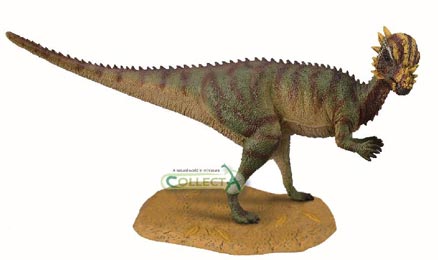
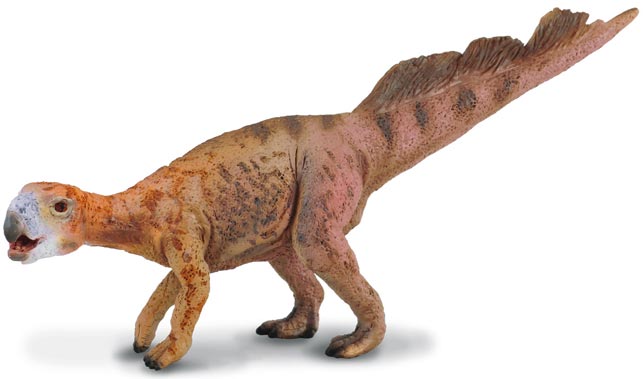
CollectA Pachycephalosaurus model.

A lithe Pachycephalosaurus dinosaur model.

Picture aredit: Everything Dinosaur

Visit Everything Dinosaur’s website: Everything Dinosaur.

2 10, 2016

The Extremes of Tetrapod Forelimb Modification

By |2023-05-07T16:45:39+01:00October 2nd, 2016|Categories: Dinosaur and Prehistoric Animal News Stories, Dinosaur Fans, Main Page|0 Comments

You Have Just Got to Hand it to Drepanosaurus unguicaudatus

A team of international scientists including researchers from a number of eminent American scientific institutions (Stony Brook University, The Dinosaur Institute at the Los Angeles County Natural History Museum and the Natural History Museum of Utah, have published a remarkable description of a Late Triassic, diapsid reptile that overturns the rule book when it comes to tetrapod limbs.

Writing in the journal ” Current Biology”, the small-bodied, possible arboreal, reptile called Drepanosaurus unguicaudatus had the most astonishing forelimbs, the configuration of the bones that make up the forelimb are quite unlike anything previously seen.

Forelimb Specimens of Drepanosaurus unguicaudatus from the Chinle Formation (New Mexico)

Drepanosaurus  forelimb fossils and an illustration.

Forelimb specimens of Drepanosaurus unguicaudatus from the Zorzino Limestone and Chinle Formation.

Picture credit: Current Biology

Upsetting the Tetrapod Blueprint

Tetrapods, in essence all four-limbed vertebrates and that includes us, have shown remarkable consistency in the structure and anatomy of their limbs over the 375 million years or so since the very first tetrapods evolved (Late Devonian).  Tetrapod limbs may have become adapted for all sorts of functions, such as locomotion, climbing, swimming, digging or even manipulation of small objects via being able to pronate the limbs (something that we humans can do very well), but despite this enormous array or functions, the bones of the forelimb have remained largely unchanged.

Most tetrapods have parallel shafts of bone (the radius and ulna), in the forelimb.  The ulna is the medial bone, the radius is the bone furthest away from the centre of the body.  The forelimb bones of D. unguicaudatus are very different.

For replicas and models of prehistoric animals, take a look at the remarkable Rebor range: Rebor Prehistoric Animal Models.

Drepanosaurus unguicaudatus

Examination of a number of specimens excavated from a quarry that forms part of the Petrified Forest Member of the Chinle Formation of northern New Mexico, revealed that this Late Triassic reptile had a flattened, crescent-shaped ulna and shaft-like carpal bones.  The second digit (the index finger if you like), supported an enormous and strongly curved claw somewhat reminiscent of the claw on a Silky Anteater (Cyclopes didactylus).  It has been proposed that the bizarre Drepanosaurus lived in trees and used its long claw and strong arms to rake the bark and to prise insects out of cracks and crevices.

The scientists conclude that the forelimbs of this small reptile (it grew to about sixty centimetres in length, possibly a little more), were adapted to a “hook and pull” niche seen in extant arboreal animals such as the Silky Anteater.  This huge claw gave Drepanosaurus its genus name “sickle lizard”, the claw on the second digit was bigger than the whole of the rest of the hand.

One Very Bizarre Reptile

Named and described in 1979 from a single, badly crushed specimen found in Italy, Drepanosaurus may represent an “experiment” in tetrapod evolution, with this animal adapting to a very specific niche. How specialised Drepanosaurus was has only been revealed following extensive CT scans of more fossils, this time excavated from a site known as Hayden Quarry from northern New Mexico.

An Illustration of Drepanosaurus unguicaudatus

Drepanosaurus Illustrated

An illustration of the strong-limbed, scorpion tailed diapsid Drepanosaurus.

Picture credit: Victor Leshyk

Drepanosaurus has been described as having a bird-like head, on the body of a chameleon with a humped back (possibly to anchor strong back muscles), disproportionately oversized forelimbs and a long tail with a claw on the end (presumably to help the animal gain a grip on a tree branch).  We like to think of Drepanosaurus as a reptilian equivalent of Popeye!

What Would Darwin Think?

Charles Darwin used the similar anatomies found in tetrapod forelimbs to support his idea that all these animals shared a common ancestor.  This biological principle of common, shared traits is called homology. Charles Darwin argued that the consistencies found in the bones and their configuration in four-limbed creatures supported the idea of evolution.  We wonder what the great man would have made of Drepanosaurus?

Visit Everything Dinosaur’s award-winning website: Everything Dinosaur.

30 09, 2016

Giant Dinosaur Footprint from the Gobi Desert

By |2023-05-07T16:27:53+01:00September 30th, 2016|Categories: Dinosaur and Prehistoric Animal News Stories, Dinosaur Fans, Main Page|0 Comments

Giant Dinosaur Footprint from the Gobi Desert

The Upper Cretaceous formations of the Gobi Desert have provided scientists with a treasure trove of dinosaur fossil bones and teeth to study.  Trace fossils such as footprints are much rarer.  However, last month a joint Japanese and Mongolian research team uncovered a beautifully preserved natural cast of a giant plant-eating dinosaur’s foot.  The footprint, which represents the left hind foot of a titanosaur, is estimated to be between ninety to seventy million years of age and it was made by a dinosaur not currently known (most probably), from any bones within a museum’s collection.

Gobi Desert Fossil Discovery

The ancient, fossilised footprint was discovered as a joint research team from the Okayama University of Science (Okayama Prefecture, Japan) and researchers from the Institute of Palaeontology and Geology of the Mongolian Academy of Sciences explored exposed Upper Cretaceous sediments in the Gobi Desert.

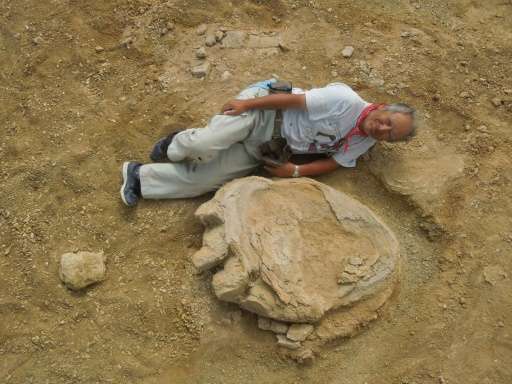
Professors are a Great Way to Show the Size and Scale of Dinosaur Tracks

The fossilised footprint of a Late Cretaceous Titanosaur.

Professor Shinobu Ishigaki (Okayama University of Science) provides the scale for the dinosaur print.

Picture credit: Okayama University of Science

In the picture above Professor  Shinobu Ishigaki (Okayama University of Science),  is lying next to the giant footprint.  His head is towards the rear of the foot and clearly defined claw impressions can be seen on the front of the footprint.  The dinosaur was walking towards the left of the photograph (direction of travel).

The exact location of the fossil find is a closely guarded secret.  Unfortunately, despite strict laws, the illegal export of many dinosaur fossils from the Gobi Desert still occurs and there is a significant black market trade in such ancient artefacts.

Giant Dinosaur Footprint

The print was discovered on August 21st and it measures 106 centimetres long and 77 centimetres wide (maximum diameter).

Commenting on the importance of this discovery, Professor Ishigaki, the leader of the research team from the Okayama University of Science, stated:

“A whole skeleton of a giant dinosaur that left such a massive footprint has yet to be uncovered in Mongolia.  A fossilised skeleton of such a dinosaur is expected to be eventually discovered.”

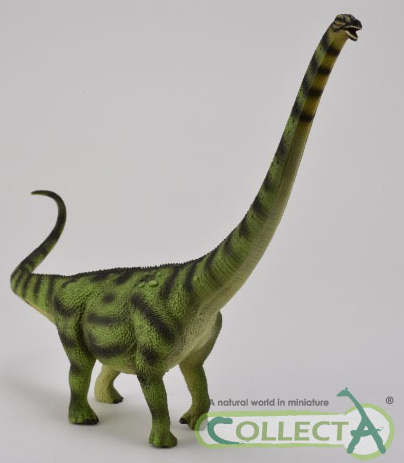
An Illustration of a Typical Titanosauriform (Daxiatitan)

Daxiatitan model by CollectA.

Perhaps up to 30 metres in length?

Picture credit: Everything Dinosaur

The picture (above) shows a titanosaur.  It is the sort of dinosaur that could have produced the giant dinosaur footprint.  The figure is a CollectA titanosaur model.

To view this model collection: CollectA Models (Prehistoric Life).

Estimating the Size of the Maker of the Track

Although it is not possible to give an accurate estimate of the dinosaur’s size, the individual who made this print may have exceeded twenty-five metres in length.  The print is a natural cast created by sandy sediments infilling the impressions in the ground caused by the dinosaur walking over a muddy substrate.

Commenting on this fossil find a spokesperson from Everything Dinosaur added:

“Titanosaurs are wide-bodied sauropods [long-necked, plant-eating dinosaurs] that probably evolved sometime in the Late Jurassic and survived until the Cretaceous mass extinction event.  They are the only sauropods known to have survived into the Late Cretaceous.  The exceptional preservation of this natural cast makes this discovery extremely significant.  The shape of the claws can be made out and even the texture of the bottom of the foot has been preserved.”

Trace Fossils are Important

Trace fossils are important as they preserve evidence of activity, as in this case the footprint of a huge, plant-eating dinosaur.  Not only does this track provide information on the shape of dinosaur’s feet but it also provides valuable information on the ways in which they walked.

To read about some even bigger sauropod tracks discovered in France: 150 million-year-old Sauropod Prints from France.

For an article about a probable new titanosaur from Brazil: A New Brazilian Titanosaur (probably).

To read an article published earlier this year about a new titanosaur from Argentina: New Late Cretaceous Titanosaur from Patagonia.

28 09, 2016

Countdown to the Exclusive TetZooCon 2016

By |2024-05-06T15:46:04+01:00September 28th, 2016|Categories: Dinosaur and Prehistoric Animal News Stories, Dinosaur Fans, Main Page, Palaeontological articles, Press Releases|0 Comments

Countdown to TetZooCon 2016

The countdown has started, tetrapods from all walks of life will be getting ready for the third annual TetZooCon gathering this Saturday (1st October).  The great and the good in the TetZoo-verse will be making their way to the London Wetland Centre (Barnes, London, SW13) to enjoy a series of presentations from illustrious speakers covering topics as wide ranging as British reptiles and amphibians, palaeoart, pterosaurs and sea monsters.

For soft toy dinosaurs and prehistoric plush: Dinosaur Soft Toys.

TetZooCon 2016

Highlights this year include John Hutchinson providing an insight into locomotion and biomechanics, specifically kneecaps, expect some jumbo sized explanations as pachyderms get placed up front and centre!

Look out also for Hannah O’Regan’s (University of Nottingham), talk on the Ursidae in the archaeological record could TetZooCon be turning into a teddy’s bear picnic?  Certainly, organisers Darren Naish, John Conway and friends have ensured that tea and coffee is included in the admission price of £50 and attendees can pick up lunch and other snacks at the London Wetland Centre in between the cornucopia of events, activities and speakers that have been assembled.

Countdown to TetZooCon 2016

TetZooCon 1st October 2016.

TetZooCon banner 2016.

Picture credit: Darren Naish

For further information on this event and for last minute ticket information check out this link: TetZooCon 2016.

Palaeoart, Plushies and Publications

TetZooCon gives fans of biology, zoology, palaeontology, cryptozoology, conservation and how animals (living and extinct) are portrayed in art, literature and fiction the opportunity to meet up once a year and to indulge their interest in all things related to the Tetrapoda and the contents of the world-famous blog Tetrapod Zoology (currently hosted by Scientific American and followed by Everything Dinosaur team members).

On the subject of blog writers followed by Everything Dinosaur, renowned flying reptile expert Mark Witton (he of Mark Witton’s blog), will be attending and conference delegates will be able to purchase signed prints of his artwork as well as copies of his new book “Recreating an Age of Reptiles”.

Over the course of the day visitors will be able to peruse and purchase a range of merchandise including spectacular illustrations and to get their hands on some of the very latest publications.  Rumour has it that the recently refurbished lecture theatre at the London Wetland Centre will see the unveiling of the new dinosaur book “Dinosaurs: How They Lived and Evolved” by Darren Naish, only a limited number of copies of this highly anticipated new volume will be available, doors open promptly at 9am with the first presentation scheduled to start at 9.20am, best to get there early to avoid disappointment.

The TetZooCon Quiz

Just prior to the traditional end of event trip to the local hostelry and bringing down the curtain on the day-long activities there is the quiz and look out for some fantastic prehistoric animal scale replica prizes provided by Everything Dinosaur who are once again proud to be involved in such a worthwhile event.

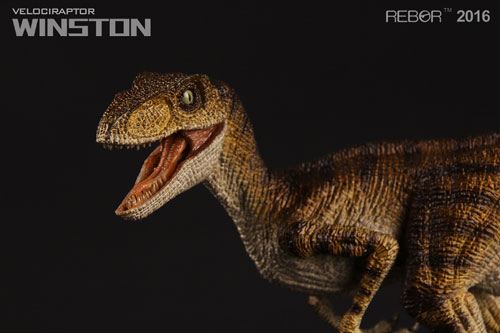
Up for Grabs a “Winston” Rebor Replica and Other Prizes

Rebor Velociraptor "Winston"

Rebor 1:18 scale Velociraptor model

Picture credit: Everything Dinosaur

We wish all the delegates and speakers a wonderful day!  Perhaps next year it will be a two day event, now that’s a thought!

Look Out for Everything Dinosaur at TetZooCon 2016

Everything Dinosaur at TetZooCon

All ready for the TetZooCon 2016.

Picture credit: Everything Dinosaur

The Everything Dinosaur website: Everything Dinosaur.

26 09, 2016

Out of Africa – Earlier Than Thought?

By |2023-05-07T12:04:34+01:00September 26th, 2016|Categories: Dinosaur and Prehistoric Animal News Stories, Dinosaur Fans, Main Page|0 Comments

DNA Analysis Hints at Earlier Exodus of Modern Humans from Africa

A number of scientific papers have been published this week, most notably in the journal “Nature”, which discuss the thorny issue of how our species spread across the world.  Studies of modern human genomes from populations around the globe hint that there may have been an earlier human migration out of Africa, however, the evidence for this earlier migration remains controversial.

Understanding how and when our species migrated out of Africa and spread around the planet, reaching far-flung destinations such as Australasia, is still some way off.  Rather than clarify and unify theories, genetic studies seem to have muddied the waters somewhat.

Out of Africa Human Migration

A Native of Papua New Guinea – New Research Indicates A Very Ancient Human Ancestry
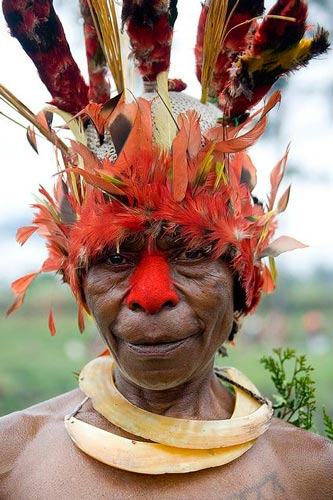
A Papuan tribesman.

A native of Papua New Guinea.

Picture Credit: Eric Lafforgue

Out of Africa

For decades, palaeoanthropologists argued over the origins of our species.  Did Homo sapiens originate from Africa or did we evolve from hominins that had spread across Europe, the Middle East and Asia much earlier?  Whilst most scientist now agree that Africa was the “cradle of mankind”, skeletal remains from various locations and new research into ancient climates, particularly the prehistoric climate of the Arabian peninsula, hinted that modern humans may have migrated out of Africa earlier than 60,000 years ago.

Certainly, the migration of modern hominins (and we include Neanderthals and the enigmatic Denisovans within this group), seems to be much more complicated than previously thought.  Fluctuating global climates allowed a number of migrations to take place with different species of people occupying different areas and indeed mixing at various points in our short history.  Our family tree resembles a very gnarled and twisted sapling.

To read a related article that looks at how changing climates in the Arabian peninsula may have had an impact on human migration: Out of Africa and into Arabia.

Five Hundred Human Genomes Analysed (Almost)

Most non-Africans can trace their heritage back to a group of humans that left Africa around 60,000 years ago.  However, the study of almost five hundred human genomes (483 to be precise, from 148 world-wide populations), undertaken by scientists at the Estonian Biocentre has found traces of a much earlier “Out of Africa” human migration.

Faint traces of an earlier human migration were recorded in the DNA of the people of Papua New Guinea, but this study suggests that these earlier human pioneers all but vanished, so it does not alter drastically the prevailing theories as to the ancestors of the majority of us.  The researchers suggest that a genetic signature representing around 2% of the genome in present-day Papuans originates from an earlier and largely extinct expansion of anatomically modern humans out of Africa.

This data, together with fossil evidence and a recently published paper indicating a genetic mixing of Neanderthals and modern humans predating the main Eurasian expansion* contributes to the growing evidence to support the presence of our species outside Africa earlier than 75,000 years ago.

The paper published in the journal “Nature” and available as a pdf: “Genomic Analyses inform on Migration Events during the Peopling of Eurasia”.

Attempting to Map Human Migration out of Africa – When Did this Take Place?  How Many Times?
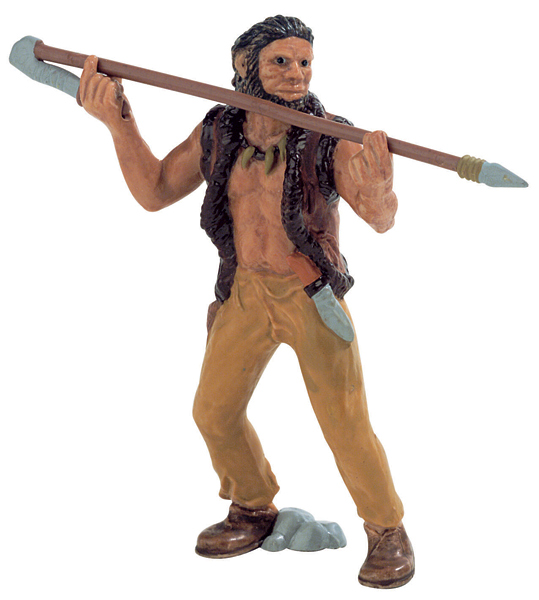
Bullyland H. sapiens

A model of modern human being (H. sapiens).

The figure in the picture is from the Bullyland model range.

To view the range: Bullyland Prehistoric Animal Figures.

Doctor Luca Pagani, lead author of the paper stated:

“All the other Eurasians we had were very homogenous in their split times from Africans.  This suggests most Eurasians diverged from Africans in a single event… about 75,000 years ago, while the [Papua New Guinea] split was more ancient, about 90,000 years ago.  So we thought there must be something going on.”

Same Edition of “Nature” Different Conclusions

In another paper, also published in “Nature” a team of scientists including researchers from the Estonian Biocentre (such as an author of the first paper – Mait Metspalu), as well as scientists from the Harvard Medical School and the New York Genome Centre, along with colleagues from a number of other institutions, came to a slightly different conclusion.

In this study, 300 genomes from 142 different populations were analysed and evidence was found of early splits in the populations within Africa, along with a single migration event that gave rise to non-African humans.

However, in this paper, no substantial evidence of an early (pre-60,000 years ago), African exodus was identified in the genomes of Papuans and other related populations such as of those groups that make up the Aboriginal race of Australia.  This team of scientists conclude that if, the genetic legacy of a more ancient migration survives in these populations, it cannot comprise more than a tiny portion of the entire genome.

The paper: “The Simons Genome Diversity Project: 300 Genomes from 142 Diverse Populations”.

A Third Study – Similar Conclusion

Papers on human ancestry must be a bit like buses.  You wait a while and nothing and then three come along at once.

In a third paper, also published in “Nature”, a study of the genomes of the Aboriginal race of Australia by researchers from the Centre for GeoGenetics, the Denmark Natural History Museum affiliated to the University of Copenhagen, along with colleagues from a number of other institutions including the Max Planck Institute, University College London and (once again), Mait Metspalu of the Estonian Biocentre, a similar conclusion to paper two is reached.  That, if there was an earlier human migration, then it is represented by only a tiny portion of the genome of living people from Oceania and Australia.

The title of this paper: “A Genomic History of Aboriginal Australia”.

Professor David Reich (Harvard Medical School) and a member of the Simons Genome Diversity Project that published the second paper summarised the research as follows:

“In our paper, we exclude more than about 2% ancestry in Australians, Papuans, and New Guineans from an early dispersal population, and our best estimate is 0%.  I am a bit concerned that poorly modelled features of the methods used by Pagani and colleagues [“Genomic Analyses inform on Migration Events during the Peopling of Eurasia”] may have contributed to a false-positive signal of early dispersal ancestry in them.  However, an alternative possibility is that the truth is around 2%, and this might just be consistent with all three studies.”

No Definitive Signature for an Earlier African Migration

Dr Mait Metspalu, the scientist who figured in all three publications stated that although the other papers do not detect a definitive signature for an earlier African migration by anatomically modern humans, this idea is not rejected, so long as it just contributes to a tiny portion of the genome in people alive today.

We leave it to the esteemed Professor Chris Stringer from the London Natural History Museum for the final word (for the moment), on this aspect of human ancestry.

Professor Stringer explained that the analysis undertaken by the Simons Genome Diversity Project and those scientists who studied the genome of the indigenous Australians favour the theory of a single migration event out of Africa less than 80,000 years ago giving rise to all living non-Africans.  In contrast, the paper with Doctor Luca Pagani as lead author, supports the idea of an additional and earlier modern human migration out of Africa more than 100,000 years ago, genetic traces of this earlier exodus can be found in Papuans, et al.

Tying It All in with the Human Fossil Record

There is certainly fossil evidence to indicate that our species (H. sapiens) was living outside Africa in the Near East, the Middle East and indeed elsewhere more than 60,000 years ago.  However, the paucity of the human fossil record, coupled with problems over dating bones and teeth in conjunction with a rather confusing picture involving interbreeding between several species of humans (Neanderthals, Denisovans and potentially yet another species of early human or two), has led to a rather muddled picture.

All three papers, although drawing slightly different conclusions, are helping to contribute to a greater understanding with regards to our own ancestry and we expect this lively debate to continue.  The evidence is likely to ebb and flow between the different scientific viewpoints, ironically, in a very similar pattern of backwards and forwards that most probably occurred with hominin species as they migrated in and out of various regions in response to climate change and other pressures.

Visit Everything Dinosaur’s website: Everything Dinosaur.

A view articulated in a letter entitled “Human migration: Climate and the Peopling of the World”, co-authored by Professor Chris Stringer and coincidently also published in the latest edition of “Nature”.

*For the related article published in February which suggests that modern humans and Neanderthals may have interbreed 100,000 years ago: Mapping the Ancient Gene Flow between Ourselves and Neanderthals.

24 09, 2016

Research Suggests Dogs Helped Early Modern Humans Hunt

By |2023-05-07T11:46:10+01:00September 24th, 2016|Categories: Dinosaur and Prehistoric Animal News Stories, Main Page|0 Comments

Japanese Based Study Suggests Early Modern Humans Used Dogs to Hunt

Most scientists agree that dogs and our own species have had a symbiotic relationship for many thousands of years.  It has been speculated that before dogs became our companions they co-operated with us in hunting.  Here are two diurnal pack animals, in essence, both going after the same game, but archaeological evidence to support this idea has been very difficult to track down.  True, there have been a number of canine burials associated with early, modern humans and we have written about some of these discoveries on this blog site.

Early Modern Human Hunting Strategies

However, new research, a study of over one hundred ancient burial sites in Japan has provided the strongest evidence yet that dogs did indeed assist with hunting.  In fact, our reliance on dogs may have played an extremely significant part in our ability to survive in some parts of the world.

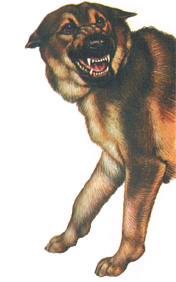
Research Suggests Dogs Played an Important Role in Hunting

A picture of a large dog.

A diurnal hunter like our species but with different colour perception – a useful hunting companion?

Whilst attending Durham University, graduate student Angela Perri had the opportunity to take part in a wild boar hunt in dense forest close to the city of Hiroshima (Honshu Island, Japan).  She wanted to get a sense of the reliance hunters had on the use of dogs, to see how dependent hunters were on their four-legged, canine counterparts.

Dogs Used for Hunting

Angela explained:

“It was terrifying.  The boar sound like a train.  They’re very aggressive and they have big tusks.  At any moment, one could come charging at you.”

The dogs (five bloodhounds and a Shiba Inus, a breed native to Japan, bred to help hunt small game), certainly made a big impression on her.  Their ability to detect, chase and corner a dangerous quarry whilst at the same time offering protection to the humans struck a chord with her and she set off on a quest to try and establish once and for all the role dogs played in early human hunting parties.  This subject area would be the basis for her dissertation whilst at Durham University.

The Jōmon Culture

Keen to understand the hunter/dog relationship in more detail, Angela began to examine the scientific literature.  She focused on the Jōmon culture, a group of hunter-gatherers who inhabited the islands of Japan from the very late Pleistocene to around 2,400 years ago.  The Jōmon culture spread throughout the islands that make up Japan.  In the northernmost part of the archipelago they subsisted on dolphins and whales, whilst those in the tropical south engaged in more traditional fishing.

The Jōmon on Honshu were beachcombers, collecting mussels and other shellfish, but they were also very dependent on the dense forests and hunting was a big part of their lives.  As the Holocene Epoch dawned, the fauna and flora changed and deer and wild boar became commonplace.

As a Postdoctoral Research Fellow at the Department of Human Evolution, (Max Planck Institute for Evolutionary Anthropology, Leipzig, Germany), Angela is very well placed to gain an understanding as to the evolution of our relationship with dogs.  She proposes that dogs would have been highly valued by the Jōmon people, those on Honshu Island in particular.   Her idea is supported by what she found when she scanned the Japanese archaeological record.  Various archaeological digs dating back to around 9,000 years ago on Honshu show that the Jōmon began to bury dogs in shell middens, similar to human graves.

Studying Grave Sites

Like the people, the corpses of dogs were placed singly and appear to have been arranged with care in particular postures, as Angela says: “they looked like they curled up and went to sleep”.

A number of the bones revealed what could have been hunting injuries, broken legs and teeth.  Many of the bones had healed suggesting people had taken care of them. Some dogs were also found with grave goods, like seashell bracelets and deer antlers.

A total of 110 burial records were studied in all, the most recent of which dating from about 2,500 years ago when the Jōmon adopted a more sedentary, farming based culture.  Bones of dogs recovered from archaeological sites dating from after the reliance on hunting ended, show that many dogs were eaten, bones are found as random piles.   It seems that from about 2,500 years ago, dogs lost their high status in Jōmon society.

Japanese Dogs were Revered

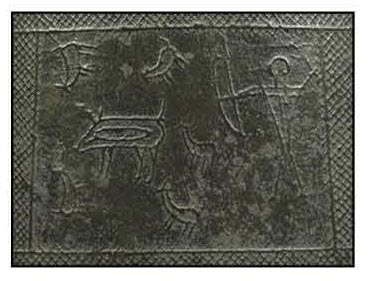
The fact that the Japanese dogs were only revered in a time and place where they would have made ideal hunting companions strongly suggests that they did indeed play this role.  Writing in the journal “Antiquity”, Perri proposes that dogs were indeed central to many early human hunter-gatherer cultures, especially those the relied on hunting game for their survival.  She also points to a 2500-year-old bronze bell found on the east coast of Honshu Island that contains an engraving believed to depict an event from even further in the past, a boar surrounded by a hunter and his pack of dogs, to support her theory.

A View of the Ceremonial Bronze Bell with the Hunting with Dogs Scene

Hunting scene on ancient bronze bell.

A hunting scene depicted on a 2,500-year-old ceremonial bell.

Picture credit: Tokyo National Museum

The picture above shows a relief from a ceremonial bronze bell (dotaku) from the Pacific Honshu region depicting a hunter with a bow and arrow hunting a wild boar, surrounded by a pack of dogs.

Visit Everything Dinosaur’s website: Everything Dinosaur.

19 09, 2016

The Food Chains of Messel Explored in New Study

By |2024-05-06T08:57:23+01:00September 19th, 2016|Categories: Dinosaur and Prehistoric Animal News Stories, Main Page, Photos/Pictures of Fossils|0 Comments

Fossil Preserves Snake ate Lizard, Lizard ate Beetle

Scientists from the Senckenberg Museum of Natural History have published a paper on a spectacular fossil from the famous Messel oil shales that shows evidence of a food chain preserved from the Eocene.  A fossil snake contains the preserved remains of its last meal, a lizard inside its stomach, astonishingly the exquisite fossil has also preserved evidence of the unfortunate lizard’s last supper too – a beetle.  The discovery of a tripartite fossil food chain is unique for this UNESCO World Heritage site and the only other tripartite food chain known in the fossil record dates from the Early Permian*, coincidentally, it also was found in Germany.

Who’s Eating Who?  Remarkable Three Party Trophic Chain (Food Web)

The Messel Tripartite Food Chain fossil.

The snake fossil which contains a lizard fossil which contains a fossilised beetle.

Picture credit: Dr. Krister Smith (Senckenberg Museum of Natural History)

A Remarkable Fossil Specimen

Scientists from the Senckenberg Museum of Natural History in collaboration with colleagues from Argentina were able to study this “Russian Doll” of a fossil, that dates from around 48 million years ago and gain new information about the diets of these ancient creatures.  For example, the twenty-centimetre-long lizard, identified as Geiseltaliellus maarius, is only known from the Messel shales.  Specimens found to date with preserved stomach contents, only had plant remains within the body cavity, this new research indicates that G. maarius was not entirely herbivorous, insects such as beetles were also on the menu.

Commenting on the study, published in the Museum’s scientific journal, Doctor Krister Smith, one of the authors of the paper stated:

“In the year 2009, we were able to recover a plate from the pit that shows an almost fully preserved snake. As if this was not enough, we discovered a fossilised lizard inside the snake, which in turn contained a fossilised beetle in its innards!”

A Magnified View of the Snake Gut with Line Drawings Indicating the Presence of Other Fossil Specimens

Tripartite food chain in Messel fossil.

The orange represents the lizard fossil, the blue the beetle remains.

Picture credit: Dr. Krister Smith (Senckenberg Museum of Natural History)

The picture above shows the bones of the snake outlined with the lizard shown in orange (skull to the left of the picture), the blue shape in the lizard gut indicates the fossilised remains of the lizard’s last meal- a small beetle.  Unfortunately, the scientists were not able to identify the beetle genus.  The way in which the lizard remains were overlapped by the ribs of the snake prove that the body of the little reptile was definitely inside the snake when the snake, identified as a type of early constrictor (Palaeopython fischeri), met its own demise.

Visit Everything Dinosaur’s website: Everything Dinosaur.

There was an Old Lady who Swallowed a Fly…

This beautifully preserved fossil specimen reminds team members at Everything Dinosaur of the song “there was an old lady who swallowed a fly”.  For the scientists, the Palaeopython specimen provides a new insight into the feeding habits of these Eocene snakes.

The snake fossil measures around 89 centimetres in length, but adult Palaeopythons exceeded two metres in size and they were amongst the largest terrestrial predators known from the Messel shale biota.  Just like modern constrictors and pythons, the authors suggest that the diet of these snakes changed as the animals got bigger.  The juvenile Palaeopython represented here (specimen number SMF ME 11332), may have fed on small rodents and lizards, whilst the adult snakes may have taken larger vertebrates such as young Propalaeotherium (an ancestral horse).

Based on an assessment of the degree of preservation of the lizard’s remains when compared to digestive speeds in extant snakes, the researchers conclude that the snake died within 48-hours of consuming the lizard.  That’s a remarkable insight considering the age of the fossil itself (approximately 48 million-years-old).

The scientific paper: “Fossil Snake Preserving Three Trophic Levels and Evidence for an Ontogenetic Dietary Shift”.

Early Permian Trophic Chains

* The first direct evidence of a three-level vertebrate trophic chain was published in the “Proceedings of the Royal Society Biology” in January 2008.  The fossilised remains of a species of Xenacanthiformes freshwater shark (Triodus sessilis) contained the remains of two ancient amphibians (Archegosaurus decheni and Cheliderpeton latirostre) preserved within its gut.  The C. latirostre specimen contained the remains of a small fish, inside its digestive tract.  The small fish was identified as a juvenile Acanthodes bronni.

Xenacanthiform (T. sessilis) with Ingested Prey Items

Xenacanthiform ate amphibians which ate fish.

Three trophic levels in Early Permian fossil.

Picture credit: Proceedings of the Royal Society Biology

Fossil Secrets of a Siderite Concretion

The picture above shows the siderite concretion that preserves the remains of the freshwater shark and evidence of a three-level food chain from the Early Permian of south-western Germany.  Below the fossil specimen photograph is a line drawing that highlights the material representing the shark as well as the fossils of two ingested temnospondyl larvae.  One of the amphibian fossils contains the preserved remains of its last meal, a small fish (acanthodian).

Illustrating an Early Permian Food Chain

Fish east amphibians which ate fish.

Xenacanthiform eats amphibians which in turn consumed fish.

Picture credit: Proceedings of the Royal Society Biology

The illustration above depicts the three level trophic food chain.  Its a question of fish eats amphibian which ate fish!

For models and replicas of Permian creatures as wall as prehistoric animals from the Eocene Epoch: CollectA Age of Dinosaurs Popular Models.

18 09, 2016

Early Humans and their Ancient Fish Hooks

By |2023-05-07T09:49:33+01:00September 18th, 2016|Categories: Dinosaur and Prehistoric Animal News Stories, Main Page|0 Comments

World’s Oldest Fish Hooks Found on Okinawa

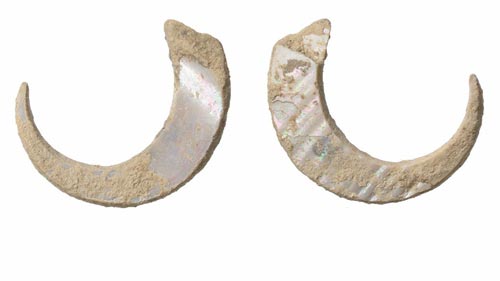
The largely volcanic island of Okinawa, south of the Japanese mainland has provided the earliest known evidence of early humans using fish hooks.  Ancient fish hooks, skilfully carved from snail shells are amongst the artefacts discovered in a limestone cave (Sakitari Cave).  Archaeologists have stated that these fish hooks and other finds demonstrate the importance of adapting to maritime ecosystems as it permitted the spread of our species across the Pacific.

Early Humans were Skilled Hunters

Ancient Fish Hooks Provide Clues to Human Expansion in the Late Pleistocene

Ancient fish hooks.

Ancient fish hooks from a limestone cave on the island of Okinawa.

Picture credit: M. Fujita et al (Proceedings of the National Academy of Sciences)

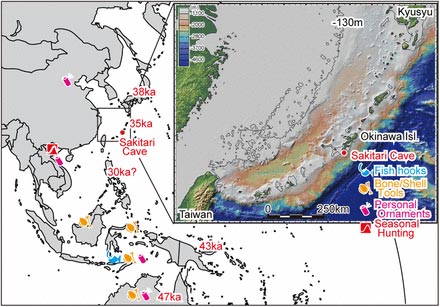
The island of Okinawa lies between the mainland of Japan and Taiwan, at roughly three times the size of the Isle of Wight, it might be thought that this location would have been a very suitable habitat for human habitation, but the researchers, writing in the “Proceedings of the National Academy of Sciences”, suggest that this geographically isolated island may only have been occupied for part of the year, permitting early humans to exploit a seasonal food source.  In truth, Okinawa would have been a relatively inhospitable place for early settlers.

For models and replicas of early hominins and prehistoric animals: Wild Safari Models and Figures.

Studying Palaeolithic People

Fossil finds indicate that there were just a handful of kinds of large, terrestrial mammals on the island that could have acted as a source of meat.  There were two species of dwarf deer and wild boars.  Okinawa has virtually no raw materials that would have suited the technological demands of early humans, as a result, a number of researchers have hypothesised that the islands that make up this Japanese archipelago were too small for sustained occupation by Palaeolithic people.

The discoveries made by Japanese archaeologists including scientists from the Okinawa Prefectural Museum and Art Museum, along with colleagues from the University of Tokyo, have helped to “fill in a gap”, plotting the migration of Late Pleistocene humans across the western Pacific.

Charting the Spread of Humanity in the Western Pacific

A map charting the movement of humans in the Pacific (Pleistocene).

Pleistocene migration of humans across the Pacific.

Picture credit: M. Fujita et al (Proceedings of the National Academy of Sciences)

Sakitari Cave lies more than a mile from the present coastline of south Okinawa, however, when the fish hook makers visited the island, sea levels were lower and the cave would have been located more than two and a half miles from the sea.  The archaeologists were able to successfully carbon date layers in the cave which indicate successive human occupation extending back to 35,000 to 30,000 years ago.  It is thought that maritime adaptation was one of the essential factors that enabled modern humans to spread all over the world.  The lack of clear data provides only a patchy picture of how humans moved into new parts of the world during the Late Pleistocene Epoch.

Early Humans were Highly Adaptable

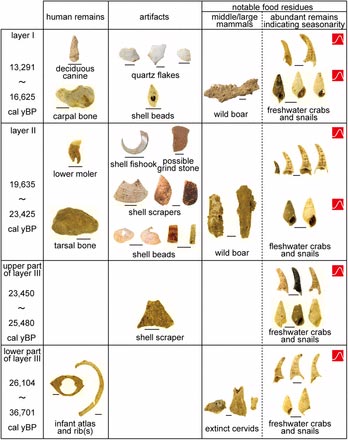
This new study of the well-stratified layers in Sakitari Cave, lends support to the idea that early modern humans were more advanced in their maritime technology than previously thought.  The finished and unfinished fish hooks, which had been carved from snail shells, have been calculated to be between 22,380 and 22,770 years old (radiocarbon dating of the carbon from the charcoal layer in which the fish hooks were found).  Other finds include marine molluscs as well as an abundance of freshwater mollusc shells, a potential grind stone and stone flakes along with a tooth and fragmentary human remains including bones representing an infant.

Finds from Sakitari Cave

Finds including human fossils from Sakitari cave.

Artefacts from the cave on Okinawa.

Picture credit: M. Fujita et al (Proceedings of the National Academy of Sciences)

Dating the Discoveries

Accounting for any margin of error within the dating assessment, these fish hooks are older than similar fishhooks found in East Timor (between 23,000 and 16,000 years old) and New Ireland in Papua New Guinea (20,000 to 18,000 years old).  The findings lend support to the idea that these early modern humans were more advanced with maritime technology than previously thought, and that they were capable of sustaining themselves on relatively small, geographically remote Pacific islands.

The persistent occupation on this relatively small, geographically isolated island, as well as the appearance of Palaeolithic sites on nearby islands by 30,000 years ago, suggest a wider distribution of successful maritime adaptations than previously recognised, spanning the lower to mid-latitude areas in the western Pacific coastal region.  It seems that fishing has been a part of human activity for a very, very long time.

The paper: “Advanced Maritime Adaptation in the Western Pacific Coastal Region extends back to 35,000 to 30,000 Years Before Present”.

To read an article about the East Timor artefacts including ancient fish hooks: Tuna Catching Prehistoric Fishermen (or women).

To read an article published in 2015 about research into human teeth found in Sri Lanka that suggests a highly adapted rainforest technology in Late Pleistocene humans: Those Highly Adaptable Ancestors.

Visit Everything Dinosaur’s award-winning website: Everything Dinosaur’s Website.

15 09, 2016

Calculating the Colour of Psittacosaurus

By |2023-05-07T09:29:18+01:00September 15th, 2016|Categories: Dinosaur and Prehistoric Animal News Stories, Dinosaur Fans, Main Page|0 Comments

Colour, Camouflage and Countershading in Dinosaurs

It turns out that the little dinosaur Psittacosaurus (parrot lizard), was light underneath and darker on its back.  This colour pattern, known as countershading is a common form of camouflage in extant animals.  Scientists including researchers from Bristol University conclude this in a new study of a beautifully preserved Psittacosaurus specimen currently on public display at the Senckenberg Museum of Natural History in Germany.  The study has been published in the academic journal “Current Biology”.

Calculating the Colour of Psittacosaurus

Reconstructing the Colour of Psittacosaurus

Reconstructing countershading in Psittacosaurus.

Physical reconstruction of Psittacosaurus with original colour patterns.

Picture credit: Jakob Vinther and Bob Nicholls

Knowing the potential colour of an animal gives clues to its probable habitat.  The research team postulate that this little herbivore lived in an environment with diffuse light, such as in a forest.  To test this idea, a three-dimensional model of this Early Cretaceous dinosaur was created, step forward the very talented Bob Nicholls who has made a number of prehistoric animal models before for various museums and exhibitions.

A Superb Fossil Specimen

The specimen on display at the Senckenberg Museum of Natural History, most likely originates from the Yixian Formation of Liaoning Province, China.  The fossil was illegally exported from China, in violation of Chinese law, but was purchased by the German museum.

The Fossilised Skeleton of Psittacosaurus (Senckenberg Museum of Natural History)

Psittacosaurus dinosaur fossil.

Psittacosaurus, early Cretaceous (120 million years old), preserving skin with colour patterns, Senckenberg Museum, Frankfurt, Germany.

Picture credit: Jakob Vinther and Robert Nicholls

Evidence of Countershading with Psittacosaurus

One of the authors of the new scientific paper, Dr Jakob Vinther (School of Earth Sciences and Biological Sciences, Bristol University) stated:

“The fossil, preserves clear countershading, which has been shown to function by counter-illuminating shadows on a body, thus making an animal appear optically flat to the eye of the beholder.”

Behavioural ecologist and co-author of the study, Professor Innes Cuthill from the School of Biological Sciences, added:

“By reconstructing a life-size 3D model, we were able to not only see how the patterns of shading changed over the body, but also that it matched the sort of camouflage which would work best in a forested environment.”

Countershading  most likely served to protect Psittacosaurus, a facultative biped and a member of the bird-hipped dinosaur group (ornithischians), against predators that use patterns of shadow on an object to determine shape, just as we humans do.

Dr Vinther realised that structures previously thought to be artefacts or dead bacteria in fossilised feathers were actually “melanosomes,” small structures that carry melanin pigments found in the feathers and skin of many animals.  In some well-preserved specimens, such as the Psittacosaurus the researchers worked on in the new study, it is possible to make out the patterns of preserved melanin without the aid of a microscope.

The Distribution of Countershading

Professor Cuthill and colleagues at Bristol had also been exploring the distribution of countershading in modern animals.  But it was no easy matter to apply the same principles to an extinct animal that had been crushed flat and fossilised.  To explore this idea further they teamed up with local palaeoartist, Bob Nicholls in order to reconstruct the remarkable fossil in to a physical model which, they say, is the most scientifically accurate life-size model of a dinosaur with its real colour patterns.

Days of careful studies of the fossil, taking measurements of the bones, studying the preserved scales and the pigment patterns, with input on muscle structure from Bristol palaeontologists Professor Emily Rayfield and Dr Stephan Lautenschlager, led to months of careful modelling of the dinosaur.
Bob Nicholls explained:

“Our Psittacosaurus was reconstructed from the inside-out.  There are thousands of scales, all different shapes and sizes, and many of them are only partially pigmented.  It was a painstaking process but we now have the best suggestion as to what this dinosaur really looked like.”

Investigating the Environment

In order to investigate what environment the psittacosaur had evolved to live in, Dr Vinther, Bob Nicholls and Professor Cuthill took another cast of the model and painted it all grey.  They then placed it in the Cretaceous plant section of Bristol Botanic Garden and photographed it under an open sky and underneath trees to see how the shadow was cast under those conditions.  By comparing the shadow to the pattern in the fossil they could then predict what environment the psittacosaur lived in.

Psittacosaurus in the Bristol Botanic Garden

Psittacosaurus model in the Bristol Botanic Garden.

Psittacosaurus photographed in the Bristol Botanic Garden.

Picture credit: Jakob Vinther

Living in a Forest Environment

Dr Vinther stated:

“We predicted that the psittacosaur must have lived in a forest.  This demonstrates that fossil colour patterns can provide not only a better picture of what extinct animals looked like, but they can also give new clues about extinct ecosystems and habitats.  We were amazed to see how well these colour patterns actually worked to camouflage this little dinosaur.”

Psittacosaurus, which Professor Cuthill describes as “both weird and cute, with horns on either side of its head and long bristles on its tail”, lived in the Early Cretaceous of China and has been found in the same rock strata where many feathered dinosaurs have been discovered.  A number of species have been assigned to the Psittacosaurus genus, more species assigned to this genus than in any other genus of the Dinosauria.

Congratulating the Researchers

Everything Dinosaur congratulates the researchers for this most insightful study and also acknowledges the efforts of the design team at the model maker CollectA for producing such an accurate representation of Psittacosaurus in the company’s dinosaur model range.

The Accurate CollectA Psittacosaurus Dinosaur Model

A typical psittacosaurid.

A typical psittacosaurid.

Picture credit: Everything Dinosaur

The picture (above) shows a model of Psittacosaurus (CollectA).

To view this model range: CollectA Prehistoric Life Models and Figures.

The deposits that make up the Yixian Formation include evidence for a forest environment (based on wood and plant fossils).  The researchers say that they would now like to explore other types of camouflage in fossils and to use this evidence in understanding how predators could perceive the environment and to understand their role in shaping evolution and biodiversity.

The Scientific Paper: Vinther, J., Nicholls, R., Lautenschlager, S., Pittman, M., Kaye, T. G., Rayfield, E., Mayr, G. and Cuthill, I. C. 2016. “3D Camouflage in an Ornithischian Dinosaur”. Current Biology.

Everything Dinosaur acknowledges the help of Bristol University in the compilation of this article.

Visit Everything Dinosaur: Everything Dinosaur.

8 09, 2016

Spiny Plants, Ungulates and the Savannah Habitat

By |2023-05-07T06:37:21+01:00September 8th, 2016|Categories: Animal News Stories, Dinosaur and Prehistoric Animal News Stories, Main Page|0 Comments

The Evolution of Spiny Plants Holds Key to the Establishment of the Savannah

The continent of Africa contains a wide diversity of habitats, dominating the south, central part of Africa are the grasslands, the extensive savannahs that are home to a great diversity of iconic animals.  A team of international scientists writing in the academic journal “The Proceedings of the National Academy of Sciences United States”, have mapped the origins of the African savannah and concluded that the emergence of this ecosystem is, at least in part, down to the grazing habits of antelopes and their kin.

Ancient Bovids Influenced Habitat Formation in Africa

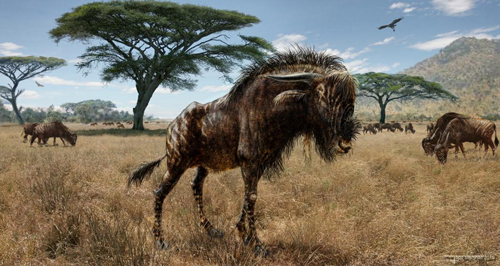
Rusingoryx illustrated

Honking to communicate in the hot savannah.

Picture credit: Todd Marshall

The picture above shows an illustration of Rusingoryx atopocranion a wildebeest from the Pleistocene Epoch.  Grazing bovids and antelopes may have had a remarkable impact on the evolution of plant communities.

Spiny Defences

In a study that plotted flora/faunal relationships on a continental scale, the researchers identified which mammal browsers are most closely associated with spiny communities of trees.  The team were able to show that over the last sixteen million years or so, plants from unrelated taxa developed spiny defences against being eaten a total of fifty-five times.  This pattern of convergent evolution suggests that the arrival and diversification of bovids in Africa changed the rules for persisting in woody communities.

Contrary to current understanding, this new data indicates that browsers predate fire by millions of years as agents driving the origin of the African savannah.

The study was conducted in an unorthodox manner.  The researchers, which included biologists from McGill University (Montreal, Quebec, Canada), started by observing fauna and flora relationships in Africa today and then working backwards in time to the middle of the Miocene Epoch.

For models and replicas of prehistoric mammals and other extinct creatures: Mojo Fun Prehistoric and Extinct Figures.

An Arms Race Between Plants and Animals

Many browsers like gazelles, delicately pick leaves off branches full of wicked-looking spines that are several centimetres long.  The scientists were able to uncover what happened in the past by mapping the distribution and evolution of the spiny plants on which gazelles and their relatives like to feed today.

Research team member, Jonathan Davies, (McGill University) commented:

“It’s been difficult to get a picture of how savannah ecosystems evolved because the conditions needed to preserve animal and plant fossils are very different from one another.  By working with the African Centre for DNA Bar-coding at the University of Johannesburg, we were able to sequence and compare DNA from nearly two thousand trees, and show that African plants only developed spines about fifteen million years ago. That was about the same time that a new type of mammal, antelope and their relatives, spread across the continent following the collision between the continental plates of Africa and Eurasia.”

Prior to this collision, the African continent had been dominated by the large, now extinct, ancestors of browsing elephants and hyrax.  These large herbivores would have bull-dozed trees and trampled vegetation, so spines were an ineffective defence against them according to the lead author of the study, Tristan Charles-Dominique (University of Cape Town).  However, antelopes and their relatives that arrived in Africa after the continental plate collision were highly efficient browsers, often using their delicate lips and prehensile tongue to remove leaves from branches.  It is likely that plants developed spines to defend themselves against these new plant “predators”.

Evolving a Spiny Defence Against Browsers

The study suggests a remarkable “arms race” between the trees and plant-eaters.  The arrival of new and efficient herbivores on the continent of Africa led to the evolution of more and more elaborate defences, including longer and longer spines.  One of the implications of this research is that the loss of large mammals like antelopes today, through human activities such as the bush meat trade, may have a substantial impact on the African landscape, with present day open savannahs being converted into thicket or brush.  Extensive forests may also make a comeback.

The Paper:  “Spiny Plants, Mammal Browsers and the Origin of the African Savannahs”.

Everything Dinosaur acknowledges the support of McGill University in the compilation of this article.

Everything Dinosaur’s award-winning website: Everything Dinosaur.

Go to Top