All about dinosaurs, fossils and prehistoric animals by Everything Dinosaur team members.

Fossil finds, new dinosaur discoveries, news and views from the world of palaeontology and other Earth sciences.

20 08, 2016

Fishing Ankylosaurs? A New Study Asks an Intriguing Question

By |2024-05-06T08:41:02+01:00August 20th, 2016|Categories: Dinosaur and Prehistoric Animal News Stories, Dinosaur Fans, Main Page, Palaeontological articles|0 Comments

Liaoningosaurus paradoxus Lives Up To Its Name

With the description of a new specimen of the armoured dinosaur Liaoningosaurus (Liaoningosaurus paradoxus) having being published, rather than cementing what scientists knew about this Early Cretaceous dinosaur, it seems that palaeontologists are perhaps going to have to re-think this particular member of the bird-hipped dinosaurs, tentatively assigned to the Ankylosauridae.

A number of fish skeletons were preserved in association with the fossilised bones and teeth of this little critter, this has, along with an assessment of the shape of some of these bones and an examination of the very peculiar teeth, led to the authors of the paper speculating that Liaoningosaurus was a fish-eater.  A sort of armoured dinosaur that thought it was a freshwater turtle.

Liaoningosaurus paradoxus

Did Liaoningosaurus Eat Fish?

Liaoningosaurus a fish-eating armoured dinosaur.

A newly discovered specimen of Liaoningosaurus indicates that these small armoured dinosaurs may have eaten fish.

Picture credit: Ji et al

A Paradoxical Dinosaur – Dividing Opinion

The scientists publishing in the “Journal of Geology” postulate that Liaoningosaurus paradoxus is not only one of the smallest bird-hipped dinosaurs (ornithischians) so far described, but it might represent the first carnivorous member of the Ornithischia too.  To understand a little more about this dinosaur we have to return to the beginning, way back to 2001 when this dinosaur was formally named and described after the near complete fossilised remains of an individual armoured dinosaur were found in deposits that form the famous Yixian Formation of Liaoning, north-eastern China.

The fossils were thought to represent a juvenile and as such, with quite a bit of growing to do (it was presumed), the researchers noted its distinct anatomical features but put them down to the fact that many of these traits would be modified as the animal grew into maturity.  After all, the body-plan of an armoured dinosaur was quite well known and why should this 34-centimetre-long specimen deviate from that plan to any great extent?

Typical Late Cretaceous Ankylosaurs – (Saichania and Ankylosaurus)
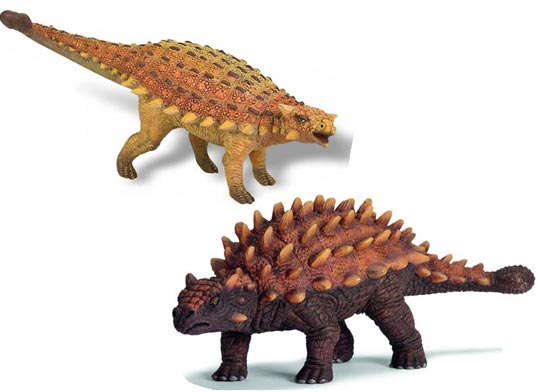
Models of armoured dinosaurs.

Armoured dinosaur models.

Picture credit: Everything Dinosaur

For dinosaur models and figures, try the Mojo Fun range: Mojo Fun Prehistoric and Extinct Figures.

A “Shell-like” Plate

One of the stranger features identified in the original 2001 paper was that Liaoningosaurus seemed to possess a large, bony plate, described at the time as being “somewhat shell-like” that shielded the abdomen.  This “belly-plate” was reminiscent of the plastron found in turtles.  This was the first time that any such structure had been reported on from any member of the Dinosauria.  In 2014, a reassessment of the fossil material led by ankylosaurid specialist Victoria Arbour concluded that these structures were more likely to represent fossilised skin.

A Line Drawing of the Holotype Fossil of Liaoningosaurus and a Close up of the “Belly Plate” (IVPP V12566)

Liaoningosaurus fossil drawing.

A line drawing of the very “turtle-like” holotype of the armoured dinosaur Liaoningosaurus.

Picture credit: Arbour et al (2014)

The picture above shows a line drawing of the first Liaoningosaurus fossil to be described (A) with a close up of the skin which was thought to be some sort of protective plate on the abdomen (B).  The scale bar equals five centimetres and the dinosaur does resemble a turtle in shape to some extent.

Fossilised Fish Inside the Body Cavity

The co-authors of the new scientific paper cite the presence of numerous fish fossils inside the body cavity of the Liaoningosaurus as evidence that suggests that this armoured dinosaur might have been a piscivore (fish-eater).  Up until now, it was thought that armoured dinosaurs such as the ankylosaurids were entirely herbivorous.

The Remains of Freshwater Fish Found in Association with the Body Cavity of Liaoningosaurus

Liaoningosaurus bones with fish remains in the body cavity.

The newly described Liaoningosaurus suggests that these armoured dinosaurs may have eaten fish.

Picture credit: Ji et al

In the photograph above the orange marks indicate the location of fish fossils.

Fish Fossils Preserved with Liaoningosaurus Remains

The scientists are quick to state that this evidence is not conclusive.  Three ways in which the fish could have been preserved with the dinosaur are considered:

  1. Could the fish have been sheltering inside the sunken corpse of the dead dinosaur or perhaps scavenging it when they themselves were overtaken by some catastrophic event and died?
  2. The corpse of the Liaoningosaurus could simply have to come to rest on the bottom of the body of water that coincidentally also had a number of dead fish lying on the sediment where it landed.
  3. Liaoningosaurus was a very specialised form of armoured dinosaur, one that was either fully or semi-aquatic and it fed on fish.

Of the three explanations, it is the latter, the piscivore hypothesis, that is favoured by the authors.  After all, this is not the first case in the Kingdom Animalia of one type of animal adopting a very different lifestyle compared to its near relatives.

The Pangolin

Take the nocturnal and retiring Pangolin (Order Pholidota), for example.  These mammals are the only members of the Mammalia to have evolved large, protective keratin scales over their bodies, ironically superficially similar to the bony osteoderms and scutes of armoured dinosaurs.  Pangolins are insectivores, but their nearest relatives the Carnivora are almost all meat-eaters preying on other vertebrates.

Long Limbs and Forked Teeth

Both scientific papers allude to the fact that this small dinosaur, a little over thirty centimetres in length, had a number of peculiar anatomical features.  The long lower limbs, sharp claws and elongated feet could be traits that reflect the immaturity of the individuals but they also could be adaptations for a swimming habit – could Liaoningosaurus be the first carnivorous ornithischian dinosaur to be described?

Those teeth, oversized for an ankylosaurid and their strange crowns could be adaptations for catching and eating slippery fish.  There are teeth present in the premaxilla, once thought to be a characteristic of a juvenile ankylosaurid that was lost as the animal grew up.  Teeth in the front of the mouth make sense if you are catching fish for a living.  The finger-like, forked crowns are highly modified, they would have made short work of any fish to get within grabbing distance of those powerful jaws.

Photographs of the New Specimen of Liaoningosaurus and Close Up Views of Three Maxillary Teeth (with Line Drawing)

Fossils of a fish-eating armoured dinosaur described.

(a) positive dorsal view, (b) negative counterpart of specimen with (c) three maxilla teeth in lateral view and (d) a line drawing showing the forked crowns – an adaptation for eating fish?

Picture credit: Ji et al

Liaoningosaurus paradoxus – Slab and Counter Slab

The photograph above shows the positive slab and the counter slab (the negative) of the fossil.  In the bottom left corner there is a close up of three teeth, to the right a line drawing showing the peculiar forked pattern of the tooth crowns.

When first described, this little dinosaur was given the trivial name “paradoxus” a reference to the paradox the fossil represented.  It could not be decided where in the Ankylosauria clade Liaoningosaurus should be placed, paradoxically, despite the finding of a second beautifully preserved specimen, scientists still have lots of questions to explore when it comes to the smallest armoured dinosaur described to date.

This is one dinosaur that certainly lives up to its name.

Reference: Ji, Q., Wu, X., Cheng, Y., Ten, F., Wang, X., Ji, Y. “Fish hunting ankylosaurs (Dinosauria, Ornithischia) from the Cretaceous of China”. Journal of Geology. doi: 10.3969 /j.issn.1674-3636.2016.02.183.

Visit Everything Dinosaur’s website: Everything Dinosaur.
19 08, 2016

Rare T. rex Skull Goes on Display

By |2024-05-06T08:41:28+01:00August 19th, 2016|Categories: Dinosaur and Prehistoric Animal News Stories, Dinosaur Fans, Main Page, Photos/Pictures of Fossils|0 Comments

Burke Museum Hopes T. rex Skull Gives New Museum a “Head Start”

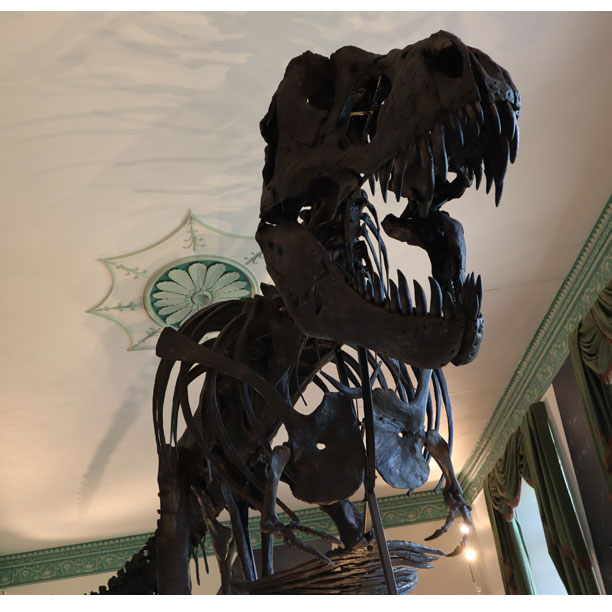
The partially prepared, jacketed skull of an adult Tyrannosaurus rex which wandered the plains of Montana some 66.3 million years ago has gone on public display at the Burke Museum (Seattle, Washington State).  One of only fifteen T. rex skulls known, the Hell Creek Formation specimen is described as “pristine” and is part of the fossilised remains of an individual animal, representing some 20% of the entire skeleton which was discovered on Bureau of Land Management land by two Burke Museum volunteers – Jason Love and Luke Tufts.  As a result, this Tyrannosaurus rex has been nicknamed “Tufts-Love Rex”.

Tyrannosaurus rex Fossils

The Burke Museum Will Erect A Fantastic T. rex Exhibit

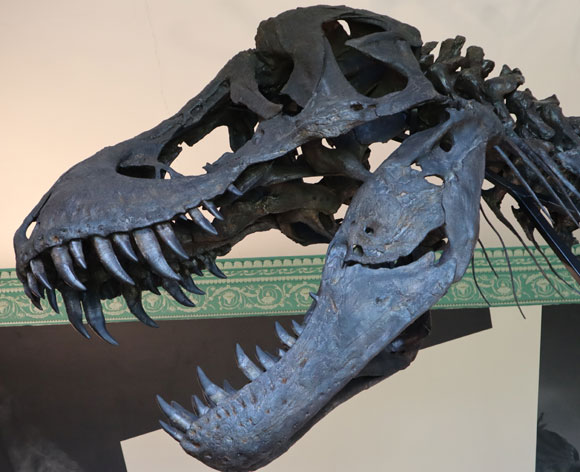
Titus the T. rex Skull and Jaws. Dinosaur extinction.

The skull of the T. rex exhibit on display at Wollaton Hall until August 2022.  The Burke Museum hopes to exhibit a T. rex skull.

Picture credit: Everything Dinosaur

The Fossil Find of a Lifetime

The volunteers were exploring a sandstone ridge in northern Montana when they spotted several fragments of bone on the surface.  They followed the trail of tiny fossil bones until they came across a partly exposed vertebrae.  The size of the fossils and their honeycomb texture indicated to Jason and Luke that they had found the remains of a theropod dinosaur.  The pair alerted their colleagues and what could be the most important excavation in the Museum’s one hundred and seventeen year history, began.

Some twenty tonnes of rock has had to be removed to expose the disarticulated skeleton.  So far, teeth, ribs, vertebrae and that beautifully preserved skull have been identified.  The skull was removed in a single block, which in itself weighed more than a tonne.  A local farmer was called in to help provide the lifting gear to remove the plaster jacketed fossil.  The skull has gone on display at the Burke Museum and it is hoped that the Tyrannosaurus rex specimen will form the centrepiece of a new dinosaur exhibit when the refurbished museum fully opens in 2019.

For scale models of Tyrannosaurus rex and other prehistoric animals: CollectA Deluxe Scale Models of Prehistoric Animals.

Tyrannosaurus rex on Display

Titus the T.rex exhibit. A T. rex skeleton on display.

The spectacular Titus the T. rex exhibit at Wollaton Hall.

Picture credit: Everything Dinosaur

A Partially Prepared Skull

For the time being, visitors will have to content themselves with looking at the partially prepared skull fossil.  Dr Greg Wilson (Burke Museum Adjunct Curator of Vertebrate Palaeontology and University of Washington associate biology professor), helped with the first phase of the excavation and he is very excited about this meat-eating dinosaur fossil discovery.

Dr Wilson stated:

“When we started to see those teeth with the skull, we knew we had a fantastic specimen.  Not only is it a fantastic specimen, it is incredibly rare.  Although arguably the most iconic and well-known species of dinosaur, the T. rex skull is one of only about fifteen reasonably complete ones known to exist in the world.”

An Average-sized Skull for a Tyrannosaurus rex

Although the exact dimensions of the skull have yet to be calculated, this can wait until the rock matrix has been removed, researchers estimate that the skull measures about 1.2 metres long by about a metre wide.  The bones represent an adult animal, one that may have been around fifteen to twenty years of age and with an estimated length of more than ten metres, the fossils represent a sizeable beast.  The strata represent deposits laid down in an ancient riverbed.  The dinosaur might have drowned in the river, or more likely the corpse of the T. rex was washed downstream and buried before it could be scavenged by other predators.

Given the excellent state of preservation of the bones discovered so far, the scientists involved with the “Tufts-Love Rex” are confident that they will be able to learn much more about this particular dinosaur, perhaps even if the fossils represent a male or a female “Tyrant Lizard King”.

Visit Everything Dinosaur’s website: Everything Dinosaur.
18 08, 2016

New Species of Ancient Dolphin Hiding in a Museum Collection

By |2023-05-06T16:35:42+01:00August 18th, 2016|Categories: Dinosaur and Prehistoric Animal News Stories, Main Page|0 Comments

Arktocara yakataga – May Hold Key to Freshwater Dolphin Evolution

Back in the early fifties, when geologist Donald J. Miller (United States Geological Survey), was mapping the area of Alaska that would eventually become Yakutat City, he came across an ancient skull of a whale. The snout had been broken off and lost but the preserved cranium led to the conclusion that the cranial material and associated teeth belonged to an ancient dolphin.  The fossils were despatched to the Smithsonian’s National Museum of Natural History, where they remained until a newly published study revealed their significance.

For models of sea monsters including prehistoric cetaceans: Models of Sea Monsters.

A New Species of Prehistoric Dolphin

The fossils represent a new species of prehistoric dolphin, an animal that lived around twenty-five million years ago and it represents the most northerly specimen of this type of toothed whale ever found.  The genus name translates from the Latin as “Face of the North” a reference to the high latitude location of the fossil discovery and the fact that the skull has been designated the holotype.

A Line Drawing (A) and a View of the Fossil Skull (B)

Arktocara skull.

A dorsal view of the skull of Arktocara (right) and associated line drawing (left)

Picture credit: James Di Loreto, Smithsonian Institute

Ancient Dolphin Fossil

Published in the academic journal “PeerJ”, palaeontologists Nicholas Pyenson and Alexandra Boersma describe the fossils and place it within the toothed-whale group, specifically the Platanistoidea.  Ironically, the only extant members of this group are confined to freshwater river systems, but the fossil record indicates that these types of dolphins evolved in marine environments.  The scientists hope that this new fossil discovery, a specimen that had languished in the Smithsonian fossil collection for more than half a century, will help to shed light on the phylogeny of the Platanistoidea as well as assisting in the research to determine how these particular toothed whales evolved.

Alex Boersma, currently based at the California State University, commented:

“It’s a lovely skull, which is probably the first thing I noticed about it”.

The Skull and Other Fossil Elements

Arktocara Fossil Material


The fossil Arktocara yakataga (resting on an 1875 ethnographic map of Alaska) belonged to a dolphin that swam in subarctic marine waters around 25 million years ago.

Picture credit: James Di Loreto, Smithsonian Institute

The researchers are confident that more strange cetacean skulls may be awaiting discovery in northern latitudes and Alex is sure that this specimen “could answer questions about how this once cosmopolitan group dating back over twenty million years dwindled down to just a few freshwater species.”

The Poul Creek Formation

The fossil comes from the Poul Creek Formation, but the exact location remains unknown, however, the scientists estimate that the fossil dates from between 29 and 24 million years ago, an important period in the history of whale evolution as the two main groups the toothed-whales “Odontoceti” and the baleen whales “Mysticeti” were diversifying and radiating into a number of new genera.

Measuring a little under two and a half metres in length, Arktocara yakataga was about the size of a modern Common Bottlenose Dolphin (Tursiops truncatus).  Although the scientists cannot be absolutely certain where the animal died, after all, bones can be transported considerable distances prior to burial and fossilisation, it seems reasonable to assume that this mammal did live in a marine environment.  The research team stress that many other types of important fossil may be lingering within the collections of museums, their significance having not yet been realised due to incorrect labelling or inaccurate classification.

An Illustration of Arktocara yakataga

Arktocara illustrated.

An illustration of Arktocara.

Picture credit: Linocut print art by Alexandra Boersma

To read a recently published article about the origin of high frequency hearing in whales: How High Frequency Hearing in Whales May Have Evolved.

17 08, 2016

How the Marsupial Lion Got To Grips With Its Prey

By |2023-05-06T16:29:22+01:00August 17th, 2016|Categories: Dinosaur and Prehistoric Animal News Stories, Main Page|1 Comment

Unique Elbows of Thylacoleo Hints at Hunting Strategy

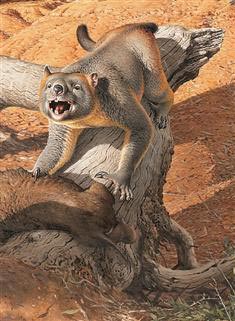
The fearsome Thylacoleo (Thylacoleo carnifex), commonly referred to as the “Marsupial Lion” may have had a unique hunting strategy.  The anatomy of the limbs indicate that this native of Australia up until around 46,000 years or so ago, had very robust front legs, but it was not a fast runner.  It was probably an ambush specialist, but how did this 100-kilogramme-mammal despatch its prey?  After all, it did not have the teeth typical of a carnivore.  For example, Thylacoleo lacked canines in the lower jaw and although they were present in the upper jaw, they were extremely small (a feature no doubt noted by Richard Owen, later Sir Richard Owen, who named and described this genus back in 1859).

The Fearsome Thylacoleo – but How Did it Hunt and Kill?

The fearsome Thylacoleo (Marsupial Lion)

Capable of climbing trees and with strong forelimbs for despatching prey.

Picture credit: Peter Trusler/Australian Post

In a new paper, published in the academic journal “Paleobiology”, scientists from the University of Málaga (Spain), in collaboration with colleagues from Bristol University conclude that Thylacoleo used its big but blunt incisors to grab prey before carrying out the “coup de grâce” with a swipes from its powerful paws which possessed a formidable set of claws including a super-sized claw on its first digit, (the equivalent digit in our species being the thumb).

For models and replicas of prehistoric animals: Prehistoric Animal Models.

Comparing Elbows

How was this conclusion made?  It’s relatively simple really, the scientists studied the fossilised elbows of Thylacoleo and compared them to a number of living mammals (placental as well as marsupial).  It turns out that this pouched predator had a unique elbow joint amongst carnivorous mammals.

One of the authors of the newly published paper, Christine Janis (Marie Curie Research Fellow at the University of Bristol, currently on a leave of absence from a professorship at Brown University, United States), explained that this study indicates that there is a strong association between the anatomy of the humerus where it articulates with the ulna and radius (the elbow) and the way in which animals move about.

Examining Elbow Joints

Specialised runners like canids (dogs) have an elbow joint indicating movement restricted to a back and forwards motion, helping to stabilise their bodies on the ground, great for running, whilst mammals that are confident climbers, monkeys for example, have an elbow joint that allows for rotation of the hand.

Felidae (cats), have an elbow joint of intermediate shape, as they use their forelimbs to wrestle prey and many types of cat are adroit when it comes to climbing.

In contrast, the unique elbow joint of Thylacoleo permitted extensive rotation of the hand but it also possessed features not seen in extant mammals that permitted the elbow to stabilise the limb when the animal was on the ground.  The “Marsupial Lion” has long been thought to have been at home in the trees, an animal capable of an arboreal existence, although ironically a number of the most complete and best preserved Thylacoleo fossils have been found in limestone caves in the Nullabor Plain region of Australia (Nullabor loosely translates as “no trees”).

Christine Janis stated:

“If Thylacoleo had hunted like a lion using its forelimbs to manipulate its prey, then its elbow joint should have been lion-like.  But, surprisingly, it had a unique elbow-joint among living predatory mammals , one that suggested a great deal of rotational capacity of the hand, like an arboreal mammal, but also features not seen in living climbers, that would have stabilised the limb on the ground (suggesting that it was not simply a climber).”

The Marsupial Lion Had an Extreme Amount of Forelimb Manoeuvrability

Christine and her colleagues group Thylacoleo with living animals that have an extreme amount of forelimb manoeuvrability, animals such as primates, sloths and anteaters.  The analysis showed that it had a greater degree of manoeuvrability than any living, meat-eating placental mammal and the team concludes that Thylacoleo was mainly terrestrial but with some climbing abilities and the forelimbs were used to overpower prey.

The African lion (Panthera leo) does not possess such flexible forelimbs and when the unique elbow joint is considered in conjunction with that over sized first digit claw, the researchers hypothesise that the “Marsupial Lion” used its claws to kill.  The big, but blunt incisors in the jaws were probably used to clamp down on prey and then with the large and retractable claw on the semi-opposable thumb (the dew claw), Thylacoleo could have slashed at its victims.

Visit Everything Dinosaur’s website: Everything Dinosaur.

The First Human Inhabitants of Australia Knew All About the Marsupial Lion

However, it hunted, Thylacoleo was one creature that you would not want to have encountered in the outback.   The first Australians, the ancestors of the today’s aboriginal people, would have known Thylacoleo and probably they were wise enough to give it a wide berth.

The scientific paper: “Ecomorphological determinations in the absence of living analogues: the predatory behaviour of the marsupial lion (Thylacoleo carnifex) as revealed by elbow joint morphology”

To read an earlier article which examined the link between scratches made on cave walls and the climbing abilities of the Marsupial Lion: Don’t Climb a Tree to Avoid a Thylacoleo!

16 08, 2016

Getting Excited About Paleo-Creatures

By |2023-05-06T16:17:59+01:00August 16th, 2016|Categories: Dinosaur and Prehistoric Animal News Stories, Dinosaur Fans, Everything Dinosaur Products, Everything Dinosaur videos, Main Page, Press Releases|0 Comments

A Short Video of the Paleo-Creatures Replicas

Team members at Everything Dinosaur are getting very excited at the imminent arrival of the first of the Paleo-Creatures prehistoric animal models.  Stocks of Xenacanthus, Tullimonstrum (Tully’s monster) and Atopodentatus (A. unicus) et al,  will soon be filling our warehouse shelves and we can’t wait for the shipment to arrive.  Everything Dinosaur announced recently that they would be stocking the Paleo-Creatures line of high quality, polyurethane resin replicas.

Everything Dinosaur and Prehistoric Animal Replicas

The Paleo-Creatures range of hand-crafted, scale model prehistoric animals has been created by talented Spanish artist and designer Jesús Toledo.  He very kindly sent Everything Dinosaur a link to a short video showing the models that we had ordered laid out ready for packing before they were despatched to our warehouse.  In this short video (one minute forty-five seconds), viewers get the chance to see up close for themselves just how gorgeous these models are.

A Row of Torvosaurus Models from Paleo-Creatures

Paleo-Creatures Torvosaurus

A row of Paleo-Creatures Torvosaurus.

Picture credit: Jesús Toledo (Jetoar’s Collectables)

For models and replicas of prehistoric animal models: Dinosaur and Prehistoric Animal Models.

A Collection of Prehistoric Animal Models

The picture above is from the short video that was sent to Everything Dinosaur.  The video shows some of the models lined up ready for packing prior to their despatch to our warehouse.   The model in the middle is the beautiful Paleo-Creatures Torvosaurus replica.  What a fantastic dinosaur model this is!  Just behind Torvosaurus some Paleo-Creatures Tullimonstrum (T. gregarium) can be seen.  Lining up in front of the fearsome Torvosaurus are some Kosmoceratops models, perhaps being just in front of a hungry Torvosaurus, especially a model with an articulated lower jaw, is quite a dangerous place for a horned dinosaur model to be.

Aegirocassis and Koolasuchus Replicas (Paleo-Creatures)

Paleo-Creatures models.

The Aegirocassis replicas (foreground), Koolasuchus models (background).

Picture credit: Jesús Toledo (Jetoar’s Collectables)

Aegirocassis et al

The splendid Aegirocassis (anomalocaridids, also referred to as anomalocarids) are lined up ready to be packed, these are wonderful models of the giant Ordovician filter-feeder.  In the background, some of the Koolasuchus replicas are awaiting their turn to be packed.  They too, are very beautiful and highly detailed, hand-crafted models.

To read a press release announcing that Everything Dinosaur would be stocking the Paleo-Creatures model range: Paleo-Creatures Coming to Everything Dinosaur.

A Close Up of the Paleo-Creatures Concavenator

The Paleo-Creatures Concavenator.

A close up view of the Paleo-Creatures Concavenator.

Picture credit: Jesús Toledo (Jetoar’s Collectables)

The fine detailing on these models can really be made out, both in these still pictures and from the video that was kindly sent in to us.

Eotyrannus (E. lengi) Model from Paleo-Creatures

Paleo-Creatures Eotyrannus model.

The Paleo-Creatures Eotyrannus ready for shipping.

Picture credit: Jesús Toledo (Jetoar’s Collectables)

Visit Everything Dinosaur’s website: Everything Dinosaur.

15 08, 2016

A New Brazilian Titanosaur (Most Likely)

By |2023-05-06T16:09:57+01:00August 15th, 2016|Categories: Dinosaur and Prehistoric Animal News Stories, Dinosaur Fans, Main Page|0 Comments

“Sousatitan” from North-eastern Brazil

All eyes might be on the likes of Usain Bolt, Jason Kenny, Nicola Adams et al at the Rio Olympic Games, but today, Everything Dinosaur turns its attention to another part of Brazil, an area some two thousand kilometres (1,200 miles) further north.  The discovery of a single dinosaur leg bone has provided scientists with an insight into the growth and development of the biggest type of land animal to ever have lived – a titanosaur.

Titanosaur Fossil Discovery

An Illustration of a Group of Titanosaurs

Titanosaurs illustrated.

An illustration of a group of titanosaurs.

Picture credit: Marcos Paulo

The Sousa region in Paraiba State is famous for its extensive dinosaur trackways, however, actual bones are few and far between in the so called “Valley of the Dinosaurs”.  Thanks to the sharp eyes of local resident Luiz Carlos Gomes, the fibula (part of the lower leg), of a giant long-necked dinosaur has been excavated and studied by an international team of scientists.  Luis spotted the pieces of bone eroding out of a rock face and posted a photograph of his find on line.  Palaeontologists were soon alerted and the fossil fragments were carefully removed and pieced together.

A New Species of Titanosaur

The bones most likely represent a new species of titanosaur.  For the moment, the animal has been nick-named “Sousatitan”, but sadly, unless more fossils are found, it is likely that this single bone will not lead to a formal scientific description and the erection of a new species of Brazilian dinosaur.

The scientists including palaeontologist Aline Ghilardi (Federal University of Pernambuco), report in the journal “Cretaceous Research”, that the fossil find is the first dinosaur bone to be found in the Rio do Peixe basin complex and that the strata in which the bone was found dates from the Early Cretaceous, indicating that titanosaurs roamed this part of north-eastern Brazil around 136 million years ago.

Extensive, wide- bodied trackways found in this region had been attributed to titanosaurids, but this fragmented lower leg bone is the first body fossil to indicate the presence of dinosaurs in this part of Gondwana.

Various Views of the Titanosaur Fibula

Various views of the lower leg bone of an indeterminate Titanosauriform.

“Sousatitan” fibula images.

The Earliest Stratigraphic Occurence of Titanosauria in Brazil

“Sousatitan” represents the oldest titanosaur bone found in Brazil and the scientists are hopeful that more material can be found to help them discover more about the sort of herbivorous dinosaurs that roamed central Gondwana during the Berriasian to the Valanginian faunal stages of the Early Cretaceous.  With the assistance of other researchers from the University of Cape Town, the team were able to establish that the leg bone came from a juvenile.

Analysis of the bone micro-structure taken from mid point in the fibula revealed that the bone came from a young animal, one that had been through a burst of growth but had not yet reached adult size.  The scientists estimate that this individual was around 5.7 metres in length and around 1.6 metres high at the hip when it died.  It is likely that as an adult, this dinosaur would have been much bigger.  Trace fossils (trackways) in the Sousa area suggest titanosaurs more than sixteen metres long.

Size Comparison of Different South American Titanosaurs

Comparing the size of different Titanosaur.

Titanosaur size comparison chart (scale bar = 2 metres).

For dinosaur and prehistoric animal figures: Dinosaur and Prehistoric Animal Models.

A Juvenile Titanosaur

Picture credit: Everything Dinosaur

Palaeobiologist, Professor Anusuya Chinsamy-Turan (University of Cape Town) analysed the well-preserved, fossilised bone micro-structure of the animal and was able to conclude that the bone was from a juvenile.

She commented: “When I studied the bone micro-structure under the microscope, it was clear that the bone belonged to a juvenile titanosaur.   The bone structure had features that indicated that the animal was still a fast-growing young individual and that it had died before it had reached full body size.”

For the moment “Sousatitan” might not be quite as familiar to Brazilians as Usain Bolt, Mo Farah or even their own gold medal winner from the track, Thiago Braz da Silva, but perhaps one day in the future, more fossils will be found and this part of north-eastern Brazil will have a newly described titanosaur to call their own.

Visit Everything Dinosaur’s website: Everything Dinosaur.

11 08, 2016

Orthacanthus was a Cannibal According to New Research

By |2024-05-06T08:43:01+01:00August 11th, 2016|Categories: Dinosaur and Prehistoric Animal News Stories, Dinosaur Fans, Main Page|1 Comment

Teeth in Coprolites Indicate Cannibalism in Orthacanthus

A study of the coprolites of a prehistoric, freshwater shark suggest that this fish indulged in cannibalism when times were hard.  The shark in question, an Orthacanthus (identified from the typical spiral shape of the fossil poo), probably ate members of its own species when other food resources became scarce.

Carboniferous Sharks

During the Late Carboniferous, much of the Northern Hemisphere was covered by swamps and ancient forests.  Amphibians and primitive reptiles dominated the land, but in the water, the fish reigned supreme and one group of fishes, that have survived through to today, the sharks, were particularly diverse and numerous.

Sharks not only dominated marine environments but they were also present in large numbers in brackish conditions and freshwater.  One group of sharks, the Xenacanthiforms were very common in freshwater environments and Orthacanthus was a member of this group.  Fossil coprolites found in the Minto Coalfield of New Brunswick, Canada, reveal a dark secret.

The 300-million-year-old shark poo is packed with the fossilised remains of juvenile members of its own genus.  This is evidence of cannibalism, specifically fillial cannibalism – when adults of one species deliberately hunt and consume young of their own species, even their immediate offspring.

An Illustration of the Prehistoric Freshwater Shark Orthacanthus

The prehistoric freshwater shark Orthacanthus

An illustration of the prehistoric freshwater shark Orthacanthus, scientists have found evidence of cannibalism.

Picture credit: Alain Beneteau

Orthacanthus – A Freshwater Prehistoric Shark

A number of species of Orthacanthus shark have been described.  These sharks, that possessed a long spine just in front of their sinewy dorsal fin, evolved in the Devonian.  Orthacanthus fossils (especially teeth) are quite common in Carboniferous rocks located in North America and Europe.  Orthacanthus teeth fossils have been found in Cumbria (UK), close to the small port of Whitehaven, a part of the coast we at Everything Dinosaur, know quite well.

The sediments in that part of Cumbria represent a coastal environment and amongst the carbonised remains of ancient plants, occasionally the distinctive tricuspid (three pointed) teeth of Orthacanthus can be found.

Cannibalism in Prehistoric Sharks

PhD student Aodhán Ó Gogáin (School of Natural Sciences, Trinity College Dublin, Ireland), one of the co-authors of the study that has been recently published in the journal of the Palaeontology Association “Palaeontology”, stated:

“Orthacanthus was a three-metre-long xenacanth shark with a dorsal spine, an eel-like body, and tricuspid teeth.  There is already evidence from fossilised stomach contents that ancient sharks like Orthacanthus preyed on amphibians and other fish, but this is the first evidence that these sharks also ate the young of their own species.”

A Typical Shark Coprolite (note the spiralling)

A spiral shaped shark coprolite.

Shark coprolite indicates cannibalism in Orthacanthus.

Picture credit: Journal Palaeontology

For models and replicas of prehistoric animals: Prehistoric Animal Models.

Corkscrew Coprolite

Fossil shark poo (coprolite) is not rare, it can be found in quite plentiful quantities in some bedding planes.  Shark coprolite comes in all shapes and sizes, but it often has a distinctive spiral pattern on it, an impression of the intestinal tract in which it was formed and of the rectum in which it was passed through.  It is this spiral pattern that has permitted the scientists to identify the coprolite down to genus level in this instance.

Another co-author of the report, Dr Howard Falcon-Lang, of the Royal Holloway University of London commented:

“We don’t know why Orthacanthus resorted to eating its own young.  However, the Carboniferous Period was a time when marine fishes were starting to colonise freshwater swamps in large numbers.  It’s possible that Orthacanthus used inland waterways as protected nurseries to rear its babies, but then consumed them as food when other resources became scarce.”

Cannibalism Recorded in Extant Sharks

Fillial cannibalism has been observed in a number of extant shark species, including the Bull Shark (Carcharhinus leucas).  The researchers suggest that Orthacanthus may have filled a similar environmental niche as modern Bull Sharks.  Both types of shark are able to migrate backwards and forwards between salt and freshwater and in the case of Orthacanthus, this unusual adaptation for a fish may have helped it play an important role in the colonisation of inland freshwater environments.

A Polished Section of a Orthacanthus Coprolite with Juvenile Teeth Fragments Highlighted

A polished section of Orthacanthus coprolite reveals evidence of cannibalism.

A cross section of Orthacanthus coprolite with the fossilised teeth of a juvenile Orthacanthus indicated in the box.

Picture credit: Journal Palaeontology

In the picture above a cross section of a Orthacanthus coprolite shows tricuspid teeth of a juvenile preserved within the fossil poo (black box).

The scientific paper: “Fish and tetrapod communities across a marine to brackish salinity gradient in the Pennsylvanian (early Moscovian) Minto Formation of New Brunswick, Canada, and their palaeoecological and palaeogeographical implications”.

Visit Everything Dinosaur’s website: Everything Dinosaur.
8 08, 2016

Sensational Chinese Fossil Primates Unravel Evolutionary Puzzle

By |2024-05-06T08:43:38+01:00August 8th, 2016|Categories: Dinosaur and Prehistoric Animal News Stories, Main Page, Palaeontological articles|0 Comments

Ancient Asian Primates Decimated by Climate Change

The lineage of primates that led to the monkeys, the apes and eventually the hominins (that’s us), originated in Asia.  Palaeoanthropologists and palaeontologists tend to agree on this as the known fossil record suggests a Far Eastern evolutionary heritage for our distant ancestors.  However, there is a conundrum, if the anthropoids (those flat-faced monkeys that led to the apes and ourselves), evolved in Asia, then why didn’t this evolutionary line continue and lead to higher apes and hominins from Asia?

For models and figures of prehistoric animals: Prehistoric Animal Figures and Replicas.

Fossil Primates

The fossil record indicates that the earliest anthropoid fossils date from 45 million years ago (Asian fossil discoveries).  In African strata some seven or eight million years younger, the first fossils of African anthropoids are found.  We can conclude from this fossil evidence that the anthropoids first evolved in Asia, only making their way to Africa around 38 million years ago, with the hominins evolving something like 33 million years later, but only in Africa, so what caused the Asian anthropoids to stall?

Thanks to some remarkable fossil finds from China, scientists have solved this primate puzzle, it seems that dramatic climate change some 34 million years ago, nearly wiped out Asian primates, decimated populations and rendered much of that continent as “no go” areas for our distant cousins.

Ancient Teeth and Bones Provide an Important Breakthrough in Our Understanding of Primate Evolution

Fossil jaws and teeth of ancient Chinese primates.

Different types of ancient primate from southern China identified from their fossilised jaws and teeth.

Picture credit: Chinese Academy of Sciences

Studying Fossil Primate Teeth

The picture above shows the different types of fossil teeth and jawbone used by the scientists to identify new species of Asian Oligocene primates.

In a study published in the journal “Science”, researchers from the University of Kansas in collaboration with colleagues from the Chinese Academy of Sciences, report on the identification of six new species of primates from a site in southern China.  Described as a “mother lode”, these extremely rare and precious fossils shed light on how some Asian primates survived the global cooling event that marked the end of the Eocene Epoch.

Eocene to Oligocene Transition (EOT)

The end of the Eocene Epoch is marked by a significant extinction event.  It may not have been as devastating as the end Cretaceous extinction that led to the demise of something like 70% of all large terrestrial animals, but nonetheless, there was a considerable amount of faunal turnover with many long-established genera (such as the early whales), becoming extinct.  Some 34 million years ago, the Earth cooled dramatically.  Global temperatures fell from an average of around 21 degrees Celsius to around 16 degrees Celsius.

Scientists remain uncertain as to the cause of the cooling, although there was considerable tectonic plate activity, volcanism and a number of extraterrestrial impacts during the Late Eocene.  Some studies have indicated a fall in atmospheric carbon dioxide at this time.  This “greenhouse gas”, so feared today, because of its affect on global warming, may have been reduced in the atmosphere to such an extent that the Earth entered a phase of dramatic cooling.  It is at this time that Antarctica began to change into the frozen wasteland we know today.

The Impact of Global Cooling

As the Earth grew colder so the tropical forests shrank and the available habitat for Asian primates was greatly reduced, the six newly described species were part of an ecosystem that clung on in southern China, an area where a tropical climate still persisted.

Commenting on the significance of this decade long study, co-author of the scientific paper, K. Christopher Beard, (senior curator at the University of Kansas Biodiversity Institute) stated:

“Primates like it warm and wet, so they faced hard times around the world — to the extent that they went extinct in North America and Europe.  Of course, primates somehow survived in Africa and southern Asia, because we’re still around to talk about it.”

The Key to Understanding the Evolution of Primates

As anthropoid primates first appeared in Asia, these new fossil discoveries help scientists to understand the fate of primates on that continent, which is fundamental to understanding early primate and ultimately ape evolution.

Senior curator Beard added:

“This has always been an enigma.  We had a lot of evidence previously that the earliest anthropoids originated in Asia.  At some point, later in the Eocene, these Asian anthropoids got to Africa and started to diversify there.  At some point, the geographic focal point of anthropoid evolution — monkeys, apes and humans — shifted from Asia to Africa.  But we never understood when and why.  Now, we know.  The Eocene-Oligocene climate crisis virtually wiped out Asian anthropoids, so the only place they could evolve to become later monkeys, apes and humans was Africa.”

Working with colleagues from the Chinese Academy of Sciences (Institute of Vertebrate Palaeontology and Palaeoanthropology), specifically Xijun Ni, Qiang Li and Lüzhou Li, the researchers were able to shift through the 34-million-year-old sediments to find teeth and jaw fragments that enabled them to erect six new species.  The fossils were recovered from the upper part of the Caijiachong Formation, Yuezhou Basin, Yunnan Province, through a combination of careful site mapping and scree washing.  It seems that whilst much of Asia became inhospitable for primates, this part of China retained tropical forest so a number of species ended up being crowded into a limited space.

A List of the Six New Species of Primate Named

  1. Yunnanadapis folivorus (pronounced You-nan-ah-dap-is) a member of the Strepsirrhini (lemurs).  In the fossil teeth photograph above Y. folivorus is A.
  2. Yunnanadapis imperator (pronounced You-nan-ah-dap-is) a member of the Strepsirrhini (lemurs).  In the fossil teeth photograph above Y.  imperator is B.
  3. Laomaki yunnanensis (pronounced Lay-oh-ma-key) a lemur-like primate (Strepsirrhini).  In the photograph of the fossil teeth above L. yunnanensis is C.
  4. Gatanthropus micros (pronounced Gat-anthro-pos) another lemur-like primate.  In the fossil teeth picture above G. micros is D.
  5. Oligotarsius rarus (pronounced Olee-go-tar-see-us) the only member of the Tarsiidae (Tarsiers) described from this location.  O. rarus is represented by E in the fossil teeth picture above.
  6. Bahinia banyueae (pronounced Ba-hin-nee-ah), the only anthropoid identified, superficially similar to today’s marmosets, represented by F in the fossil teeth photograph above.

Differences in Oligocene Primate Faunas

The team’s research suggests that the Eocene-Oligocene transition (EOT) led to completely different primate faunas in Asia compared to Africa and the Near East.  In Africa, the anthropoid primates radiated, diversified and became dominant.  However, in Asia, it was the lemur-like primates the Strepsirrhini that seem to have dominated.  The EOT acted as an evolutionary filter dramatically altering the evolution of primates around the world.

The EOT Acted as an Evolutionary Filter Changing Primate Evolution

Global cooling changed primate evolution.

Changing Primate Faunas due to Eocene to Oligocene transition.

Picture credit: Chinese Academy of Sciences

The EOT changed the evolutionary history of the primates, acting as a filter.  When the composition of early Oligocene primate faunas of Asia and Afro-Arabia are compared, we see that in Asia it was the lemur-like primates (Strepsirrhini) that rose to dominance, whereas in Afro-Arabia, the lemurs became much rarer and it was the anthropoid apes that diversified and became prominent.

The Rare Oligotarsius

Tarsier fossils are incredibly rare in the fossil record, and very little is known about the evolution of the Tarsiidae, the trivial name of O. rarus recognises this.  The teeth of Oligotarsius are very similar to modern tarsiers found today in Indonesia and the Philippines.  This suggests that extant tarsiers are little changed from their ancient ancestors.

Dr Beard explained:

“If you look back at the fossil record, we know that tarsiers once lived on mainland Asia, as far north as central China.  The fossil teeth described in this paper are nearly identical to those of modern tarsiers.  Research shows that modern tarsiers are pretty much living fossils, those things have been doing what they do ever since time immemorial, as far as we can tell.”

A Vulnerability of All Primates?

This new study underscores a vulnerability of perhaps, all primates, that is how they cope when there is dramatic climate change.  The global cooling of the EOT altered primate evolution and transformed the primate faunal mixes of both Asia and Africa.  The EOT is an opposite climate effect to what we are experiencing today.  Thirty-four million years ago the world cooled, today people are very concerned about global warming, the key point is this, whether the climate warms or grows cold, primates seem to be more sensitive to a changing world than other mammals.  This could mean very bad news for our own species.

Food for Thought

It is a sobering thought, but what if the Eocene-Oligocene cooling had not taken place?  Asian anthropoids would have continued to evolve and diversify, potentially with far-reaching consequences for all primates, including hominins and our own species.  Homo sapiens (that’s us), evolved in Africa some 220,000 years ago, however, had this ancient cooling not occurred, the outcome in terms of anthropoid and ultimately human evolution could have been very different.

For an article on potentially the oldest primate: The Oldest Primate To Date?

To read about Miocene Tarsiers from Thailand: Miocene Tarsier Fossils from Thailand.

7 08, 2016

“Meg” The New Megalodon Movie

By |2024-05-06T08:44:05+01:00August 7th, 2016|Categories: Dinosaur and Prehistoric Animal News Stories, Dinosaur Fans, Main Page, Movie Reviews and Movie News|0 Comments

Prehistoric Shark Thriller Movie to Feature Megalodon

It may be more than forty years since “Jaws” hit our cinemas screens, but sharks still fascinate and terrify, although statistically you are more likely to be killed by a cow than by a shark.  Sharks may have a reputation for being cold-blooded, merciless killers but in reality, there are on average, about half a dozen or so reported fatalities each year from shark attacks.

Cows More Dangerous Than Sharks

Bovines (cows) tend to be more dangerous.  Cows with young can be very protective and have been known to charge and trample unwary people who venture too close.  According to the Health and Safety Executive (HSE) some seventy-four people have been fatally attacked by cows in the UK since the year 2000.

Globally, cows present a much greater risk than any shark.

Within the shark group (Elasmobranchii), there are around 480 extant species, but only three of these, the Bull shark, Tiger and Great White, represent a significant threat to beach goers.  However, expect a spike in the number of people claiming to have Selachophobia (a morbid fear of sharks), as filming of a new shark-inspired movie gets into full swing.

Megalodon to Feature in a New Horror Film

Based on the series of “Meg” novels by the talented American science-fiction writer Steve Alten, filming is getting underway on the Warner Bros production and a tentative release date of March 2nd 2018 has been proposed.  This is a full three months before Universal Pictures intend to release their Jurassic World sequel, which currently has the working title “Jurassic World II – Ancient Futures”.

Jason Statham (Transporter, The Expendables, Snatch) has been confirmed as the lead actor, he has been joined on the cast list by Jessica McNamee.  Statham plays formal U.S. Navy diver Jonas Taylor who is given the chance to redeem his reputation by leading a rescue mission to save a team of Chinese scientists who have encountered a Megalodon (giant prehistoric shark) in a deep ocean trench.

The Front Cover of the Book “Meg” by Steve Alten

"Meg" front cover image.

Exciting and thrilling adventure story based on Megalodon.

Directed by Jon Turtletaub (National Treasure: Book of Secrets), the film is likely to be a watery gore-fest, although we at Everything Dinosaur doubt whether this feature will have quite the impact of Steven Spielberg’s 1975 film about a killing spree from a Great White.

Megalodon Movie

Of course it’s all hokum, the likelihood of a giant, apex predator shark lurking in the deepest recesses of the ocean is extremely remote.  There are undoubtedly a vast number of marine organisms new to science awaiting discovery.  After all, we know more about the surface of the moon than we do about the deep sea, but there is simply not enough food in the Hadalpelagic Zone (that part of the ocean that comprises the deepest trenches and underwater canyons), to sustain such a large fish, even a single sixty foot long specimen.  Still when did science ever get in the way of a good movie script?

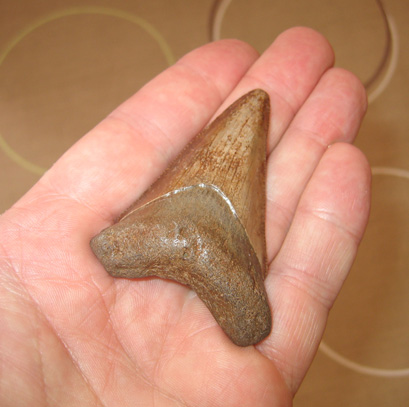
A Megalodon Fossil Tooth

Megalodon fossil tooth

A large fossil tooth from a Otodus megalodon. Picture credit: Everything Dinosaur.

Picture credit: Everything Dinosaur

Safari Ltd produced an excellent replica of the giant prehistoric shark C. megalodon: Wild Safari Prehistoric World Models and Figures.

The Wild Safari Dinos Megalodon Shark Model

The Wild Safari Dinosaurs Megalodon shark model.

Rows and rows of teeth inside the mouth.

Picture credit: Everything Dinosaur

It looks like Megalodon (C. megalodon) is going to join that ever-growing list of prehistoric creatures that have featured in movies.

Please note, following a taxonomic revision the bionomial scientific name is Otodus megalodon.

Visit Everything Dinosaur’s award-winning website: Everything Dinosaur.

5 08, 2016

World’s First Mass Extinction Engineered by Animals

By |2023-05-05T07:55:57+01:00August 5th, 2016|Categories: Dinosaur and Prehistoric Animal News Stories, Main Page, Palaeontological articles|0 Comments

Ediacaran Faunal Out Competed by Newly Evolved Animals

A remote fossil site in Namibia has helped strengthen the theory that the fauna of the Ediacaran was unable to survive the radical “re-engineering of marine ecosystems” that resulted with the evolution of more advanced biological organisms.  Newly evolved metazoans (animals that have three types of tissue layer in the embryo and are multi-cellular), altered the marine environment so much that most of the older, largely immobile, species that had dominated the Ediacaran geological period died out.

Ediacaran Fauna

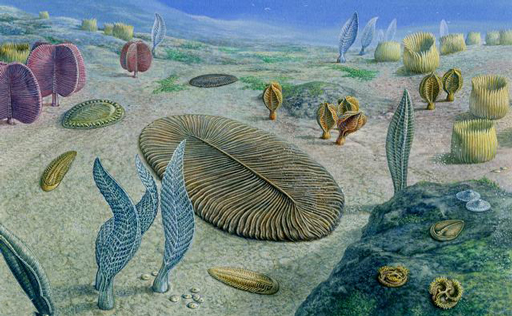
A Late Precambrian (Ediacaran) Marine Environment

Ediacaran marine life.

Life in the Ediacaran.

Picture credit: John Sibbick

For models and replicas of ancient invertebrates and other prehistoric animals: CollectA Prehistoric Animal Figures.

The Ediacaran Geological Period

The Ediacaran geological period is defined as the last geological period of the Proterozoic (early life), it lasted from around 635 million years ago to 542 million years ago and this geological period saw the emergence of a diverse variety of soft-bodied multi-cellular creatures, most of which have no living descendants today.  The ecosystems that existed were very simple with short food chains, multi-cellular life was bizarre with many organisms shaped like discs, tubes or fronds.

Towards the end the Ediacaran more advanced and crucially mobile organisms began to evolve.  Food chains became more complicated with the evolution of active predation amongst organisms.  These new species were “ecological engineers” who changed the environment in ways that made it more and more difficult for Ediacaran organisms to survive.  That is the conclusion of the research team which studied the Namibian fossil remains.

Assistant Professor Simon Darroch Searching the Namibian Site for Fossils

Fossil hunting (Namibia)

Searching for fossils dating from the Ediacaran (southern Namibia).

Picture credit: Sarah Tweedt, Smithsonian Institution

Important Fossil Site

Writing in the journal “Palaeogeography, Palaeoclimatology, Palaeoecology”, the scientists, which include Simon Darroch (Assistant Professor of Earth and Environmental Sciences at Vanderbilt University located at Nashville Tennessee), report that they have found one of the best-preserved examples of a mixed community of Ediacaran and metazoan organisms preserved in strata from the Zaris sub-basin of southern Namibia.

The Biota Replacement Model

Palaeontologists had predicted that evidence would be found in the fossil record to indicate ecosystems dominated by Ediacaran organisms being replaced by ecosystems dominated by organisms whose fossil record persist into the Cambrian and beyond.  The Namibian fossils provide the best evidence yet of a close ecological association between these distinct types of life-form.

Assistant Professor Darroch explained:

“Until this, the evidence for an overlapping ecological association between metazoans and soft-bodied Ediacaran organisms was limited.  Here, we describe new fossil localities from southern Namibia that preserve soft-bodied Ediacara biota, enigmatic tubular organisms thought to represent metazoans and vertically oriented metazoan trace fossils.  Although the precise identity of the trace makers remains elusive, the structures bear several striking similarities with a cone-shaped organism called Conichnus that has been found in the Cambrian period.”

Conichnus Trace Fossils from Namibia – Evidence of Biota Replacement

Conichnus trace fossils (Namibia).

Conichnus burrows are trace fossils. The surface bumps represent vertical tubes that were originally occupied by anemone-like animals that may have fed on Ediacaran larvae.

Picture credit: Vanderbilt University/Darroch

Conichnus is an ichnogenus (known only from trace fossils), that may have been some form of anemone that fed on Ediacaran larvae.  The scientists also report that they have found strands of Ediacaran frond-like organisms with animal fossils preserved in place coiled around their holdfasts.  The Namibian fossil material provides a snapshot of a transitional ecosystem prior to the Cambrian explosion which led to the evolution of much more modern looking food chains.

Assistant Professor Darroch stated:

“Both animal burrows – ‘trace fossils’ – and the remains of animals themselves sharing the same communities, lets us speculate about how these two very different groups of organisms interacted.”

Lessons for Today

Although the research team are studying the remains of organisms preserved in rocks that were laid down more than 540 million years ago, the biota replacement model that these fossils seem to confirm has relevance for our planet today.  Some of the fossil strata shows the preserved body fossils of a bizarre metazoan called Shaanxilithes, these fossils are coiled found the anchoring, trace fossil (a holdfast) of a frond-like organism),

Shaanxilithes Fossils (Ediacaran Strata – Namibia)

Signs of Late Ediacaran biota replacement.

Shaanxilithes are odd, annulated and ribbon-like fossils that start showing up near the end of the Ediacaran period. In this fossil they are wrapped around Aspidella holdfasts.

Picture credit: Vanderbilt University/Darroch

Simon explained:

“There is a powerful analogy between the Earth’s first mass extinction and what is happening today.  The end-Ediacaran extinction shows that the evolution of new behaviours can fundamentally change the entire planet, and today we humans are the most powerful ‘ecosystems engineers’ ever known.”

This research entitled: “A mixed Ediacaran-metazoan assemblage from the Zaris sub-basin, Namibia”, builds on an earlier scientific paper published last year that examined a large number of animal burrows preserved in the Namibia rocks that were interpreted as representing the fossil record of a community under stress.

The Disc-Like Structures Represent the Holdfasts of Ediacaran Organisms

Trace fossils (Aspidella).

The disc-like fossils are the preserved remains of holdfast structures used by the Ediacaran species Aspidella that went extinct about a million years after these individuals died and were preserved.

Picture credit: Vanderbilt University/Darroch

The picture above shows the preserved remains of several disc-like fossils in the Namibian strata.  These have been interpreted as the holdfast, anchoring structures of the fern-like Aspidella.  Once thought to be an ancestral jellyfish, at the time it was first studied, it was the first Precambrian body fossil to have been formally scientifically described.  These disc shapes are now interpreted as trace fossils, examples of the benthic, immobile fauna of the Ediacaran, that was being replaced by more complex and mobile metazoans.

Stirring Up Sediments

Hunting and eating the Ediacaran fauna might not have been the only destructive behaviour of the more complex mobile organisms that represented emerging fauna that would dominate the Cambrian.  The researchers also point out that mobile Cambrian animals would have stirred up nutrients leaving them in suspension above the sea floor, far away from the reach of the benthic Ediacaran life-forms.  In essence, the microbial mats and more complex but ultimately, confined to the sea floor Ediacaran fauna, would have found that nutrients that once always fell to the seabed were now suspended in a new marine ecosystem, effectively placing these nutrients out of reach.

Visit Everything Dinosaur’s award-winning website: Everything Dinosaur.

Go to Top