All about dinosaurs, fossils and prehistoric animals by Everything Dinosaur team members.

Fossil finds, new dinosaur discoveries, news and views from the world of palaeontology and other Earth sciences.

4 08, 2016

The Origin of High Frequency Hearing In Whales

By |2023-05-05T07:46:17+01:00August 4th, 2016|Categories: Dinosaur and Prehistoric Animal News Stories, Main Page, Palaeontological articles|0 Comments

Ancient “Echo Hunter” Provides Insight into Whale Evolution

Scientists from the College of Osteopathic Medicine, New York Institute of Technology (New York), in collaboration with colleagues from a number of other institutions including the Museum of Natural History (Paris), have published a paper on a newly described species of toothed whale, one that suggests that echolocation abilities started early in the cetaceans.

Ancient Toothed Whale Skull

Writing in the journal “Current Biology” the researchers report that they have found evidence of ultrasonic hearing and the use of echolocation as a probable navigation aid in the beautifully preserved inner ear of a 27-million-year-old toothed whale.

An Illustration of Echovenator (E. sandersi) A Newly Described Genus of Toothed Whale
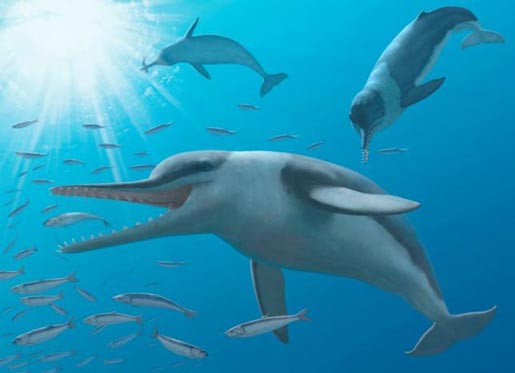
Echovenator sandersi.

A small, early toothed whale (Echovenator sandersi).

Picture credit: A. Gennari

Known from a skull, jaws and an atlas bone (bone from the neck), which are believed to represent a single individual, Echovenator sandersi had features in its inner ear that suggest that this marine mammal could hear a greater range of high-pitched sounds when compared to most other mammals.  Believed to be a basal member of the Odontocetes (toothed whales),  this fossil suggests that sophisticated echolocation evolved very early on in this whale lineage.

From a Ditch in South Carolina

The fossil remains were discovered during work on a drainage ditch in Berkeley County, South Carolina fifteen years ago.  The bones and fossil teeth are associated with a basal bed of the Chandler Bridge Formation (Upper Oligocene).  The rocks of this formation were laid down in a marine environment, close to the shore (nearshore marine or possibly an embayment).

Commenting on the conclusions of the research, lead author Morgan Churchill (New York Institute of Technology), stated:

“We can tell a lot about how well this animal fits within whale evolution based on the cranial features and we can use that cranial anatomy to determine whether or not it could echolcate.”

Dr Churchill, a postdoctoral Fellow at the College of Osteopathic Medicine added:

“The fossil specimen shows several features that we would see in a modern whale with echolocation.”

The Prepared Fossil Skull of the Early Toothed Whale (E. sandersi)
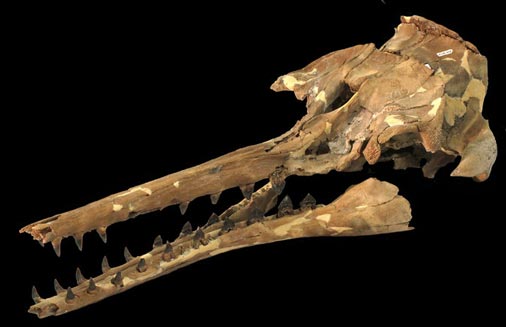
The skull of Echovenator sandersi

The prepared skull of the prehistoric toothed whale Echovenator.

Picture credit: M. Churchill/Journal of Current Biology

A Well-travelled Whale

In order to assess the morphology and likely capabilities of the inner ear of this early whale, a number of X-ray scans were taken of the skull fossils.  The skull was carefully X-rayed at the Nikon Metrology X-ray facilities in Tring, (Buckinghamshire, England) and these results were compared to X-ray studies of living and extinct whales skulls undertaken at the University of Texas Austin and the National Museum of Natural History in Paris

By examining Echo Hunter’s inner ear, the researchers found evidence of its ability to receive ultrasonic frequencies.  A soft tissue structure called the basilar membrane, while not present in the fossil itself, was indicated by other parts of the ear to be of a size and thickness consistent with high-frequency hearing.

Another part of the inner ear, a thin, bony structure within the cochlea, provided further evidence of a likely echolocation ability.  Echolocation is the use of vocalisations to navigate and to find prey underwater, other studies have proposed that the ability to produce very high frequency sounds occurred early on in the evolution of the Cetacea, this new research suggests echolocation evolved in basal members of the toothed whale group.

Jonathan Geisler, a co-author of the study and a professor at the New York Institute of Technology commented:

“We had suspicions that they were echolocating but to really get down to a rough estimate of frequency, you really had to look in the inner ear in more detail and that’s where this project comes in.”

Echovenator sandersi

About the size of a small dolphin, Echovenator hunted fish and other small, nektonic creatures close to the shore.  It used its echolocation to help it forage in the murky, sediment-filled coastal waters.  The genus name is Latin which means “echo hunter”, the species name honours Albert Sanders, a former curator of The Charleston Museum, in recognition of his contribution to the scientific study of Cenozoic whales.

Mark D. Uhen, a professor at George Mason University, who in 2008 erected a new family of ancient whales, the Xenorophidae, the oldest and most primitive of the toothed whales, the whale family to which Echovenator has been ascribed, explained that previous research had suggested that the earliest toothed whales could echolocate, but that the new paper provided a clearer picture.

The Evolution of High Frequency Hearing and Echolocation in Whales
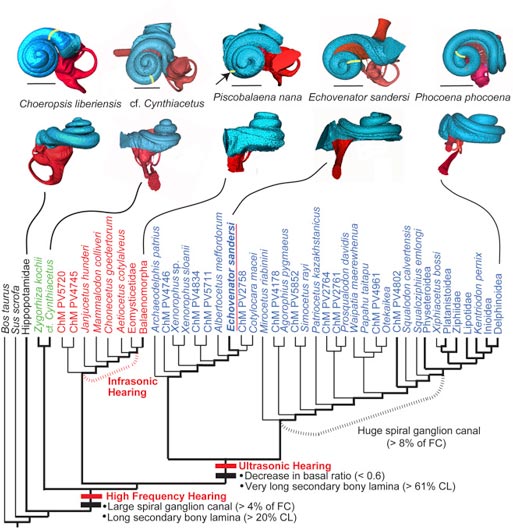
The evolution of echolocation and ultrasonic hearing in whales.

Plotting the evolution of ultrasonic hearing and echolocation in early whales.

Picture credit: College of Charleston

The Evolution of Echolocation

Dr Uhen, who was not involved in this study, said that the development of high-frequency hearing in whales was a nice illustration of natural selection.

Professor Uhen commented:

“I think the way evolution mostly works is that animals adopt a behaviour, and then natural selection changes generation after generation so that they get better and better and better at that behaviour.  Whales started feeding in the water so their feeding apparatus and their ears changed early.”

Heard the one about the origins of echolocation?: The Origins of Echolocation in Dolphins (related article).

To read an article about a potential terrestrial ancestor of whales: Deer-like Fossil Confuses Early Cetacean Evolution.

To read an article about a huge, Pliocene toothed whale that swam in the waters around Australia: Giant Aussie Whale a Terror of the Pliocene Seas.
3 08, 2016

First Case of Septic Arthritis Diagnosed in a Dinosaur

By |2023-05-05T05:25:56+01:00August 3rd, 2016|Categories: Dinosaur and Prehistoric Animal News Stories, Dinosaur Fans, Main Page|2 Comments

Hadrosaur Had Septic Arthritis

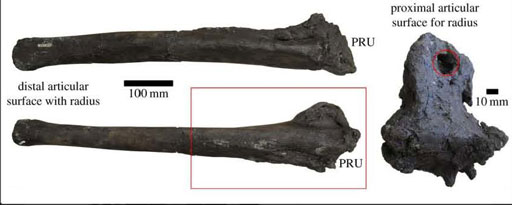
Scientists writing in the Royal Society Open Science journal have identified the first diagnosed case of septic arthritis in a dinosaur.  The unfortunate animal was a type of duck-billed dinosaur that roamed New Jersey (USA), some seventy million years ago.  Identifying disease and injuries preserved in the fossil record (pathologies) permits scientists to gain valuable insights into the lives of long extinct creatures.  The indeterminate duck-billed dinosaur may have suffered for many years with a debilitating injury.

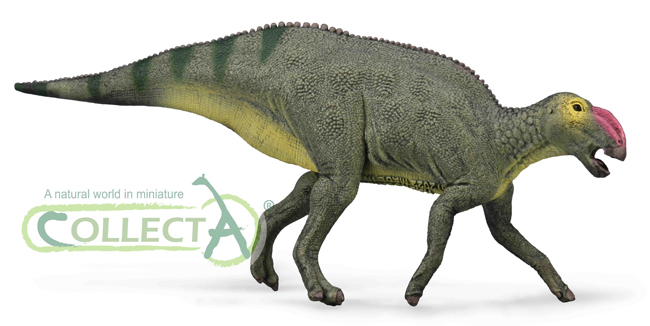
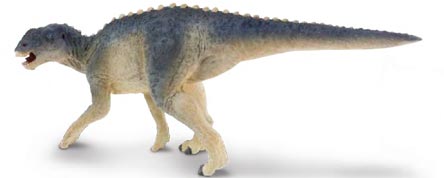
A Typical Hadrosaurid Hadrosaur

Gryposaurus - Hadrosaur Model available from Everything Dinosaur.

Duck-billed dinosaur model.

Picture credit: Everything Dinosaur

A Severely Damaged Elbow

The fossilised lower arm bones (ulna and radius) of a plant-eating, duck-billed dinosaur were excavated from sediments that form a component of the Upper Cretaceous exposures of the Navesink Formation (New Jersey).  Both bones show malformation and deformed bone-growth, the result of some form of pathology.  However, it was only when the team subjected the diseased part of the bones to an examination by a non-invasive technique, X-ray microtomography, could the research team, that included palaeopathologist Jennifer Anné, (University of Manchester), make a diagnosis.

The Diseased Ulna of the Indeterminate Hadrosaurid

The diseased ulna of a hadrosaurid.

The pathology of a Hadrosaur ulna showing a large amount of reactive bone growth.

Picture credit: Royal Society Open Science

A Damaged Dinosaur

The photograph above shows the pathological ulna from an indeterminate species of duck-billed dinosaur.  A substantial amount of bone re-growth can be seen on the end of the bone, the portion that is in articulation with the surface of the radius (PRU).  The researchers describe the diseased bone as having a “cauliflower-like” appearance.  The olecranon process that forms the elbow joint is very misshapen and damaged with large, prominent lesions (circled red).  The red box in the diagram shows the portion of the ulna that was subjected to X-ray microtomography.

The research team conclude that this dinosaur would have been in pain and as a facultative biped it would have found movement difficult.  However, bone re-growth suggests that this dinosaur lived for some time with this injury.

New Jersey and Dinosaurs

Although dinosaur fossils from the eastern coast of the United States are much rarer than those from the western USA, New Jersey is regarded by many scientists as the birthplace of American palaeontology.

The very first, scientifically described dinosaur discovery took place close to the town of Haddonfield in New Jersey.  The bones of a large animal were excavated from a quarry and the eminent American scientist Dr Joseph Leidy (University of Pennsylvania), was given the task of studying them.  He defined them as belonging to a member of the Order Dinosauria and erected the genus Hadrosaurus (H. foulkii).

A Model of a Hadrosaurus (CollectA H. foulkii)

New CollectA Models 2023 Hadrosaurus.

The CollectA Age of Dinosaurs Hadrosaurus dinosaur model.

To view the CollectA range of prehistoric animal models: CollectA Prehistoric Life Models.

A statue of “Haddy” the Hadrosaur can be seen in Haddonfield, commemorating the discovery of “America’s first dinosaur.”

To read more about “Haddy” the Hadrosaur: A Hidden Gem (Dinosaur Statue).

Septic Arthritis

Having analysed the bones, the most likely explanation for the damaged bone is a form of osteoarthritis, a condition affecting movable joints by deterioration of articular cartilage, bone spur formation and this leads to considerable bone re-growth and remodelling.  Such conditions are usually localised in extant reptiles, whereas in humans, these conditions can spread throughout the body.

It is worth noting that osteoarthritis in extant birds and reptiles is usually associated with other, contributory factors such as trauma, disease or infection.  Based on the images generated by the X-ray scans, the researchers began to eliminate the possible causes such as osteomyelitis (the bone itself is infected) and finally concluded that the pathology probably represents septic arthritis (infected cartilage affecting the surrounding bone tissue).

What Caused the Injury?

If the septic arthritis was brought on by an injury then this begs the question, what caused the injury in the first place?  Sadly, the seventy-million-year-old dinosaur arm bones don’t provide any clues.

Jennifer Anné commented:

“It could have started out that it did have arthritis.  It could have gotten a cut, or broken that joint, and then had an infection.  It’s a hard-knock life for any wild animal.”

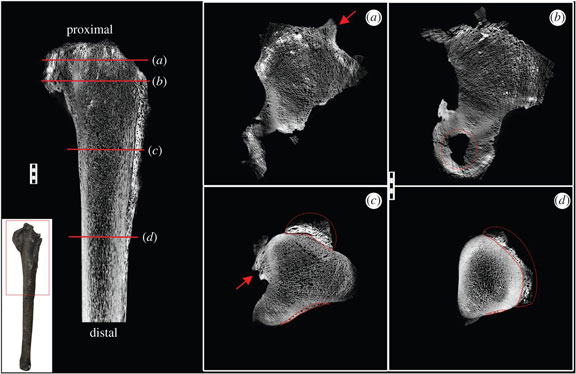
X-ray Microtomography Scans (Longitudinal and Transverse Scans) Showing Disease Presence in the Ulna

Probably septic arthritis in a dinosaur.

Signs of injury and disease in the bones of a dinosaur.

Picture credit: Royal Society Open Science

Scanning the Hadrosaurid Ulna

The picture above shows the scans of the hadrosaurid ulna in various views (a-d).  The area scanned is shown on the picture on the white background in the lower left portion of the image.  Locations for the transverse sections (a-d) are indicated by red lines on the longitudinal section.  Reactive bone growth can be identified and is circled in pictures c and d.  Abnormal bony projections at the attachment sites for ligaments (enthesiophytes) can be seen in a and c (indicated by red arrows).  These abnormal bony growths are a sign of stress.  Dead bone (necrosis) can be seen along the proximal articulation surface and is highlighted by a red circle in picture b.  Scale bar for all images ten mm.

Dr Anné stated that the use of non destructive and non-invasive techniques such as X-ray microtomography is having a big effect on palaeopathology.

She added:

“As a result, how we’re approaching diagnosing is changing, it’s letting us look at more individuals, so we have a higher chance of finding things.”

1 08, 2016

Thirsty Woolly Mammoths of St. Paul Island Identified in New Study

By |2024-05-06T08:35:54+01:00August 1st, 2016|Categories: Dinosaur and Prehistoric Animal News Stories, Dinosaur Fans, Geology, Main Page|0 Comments

St. Paul’s and Wrangel Island Woolly Mammoth Populations

This week has seen the publication of research undertaken by an international team of scientists led by academics from the University of Pennsylvania, that explains the demise of one of the last populations of Woolly Mammoths to have lived on Earth.

Mammoths (Mammuthus primigenius) survived on the remote Alaskan island of St. Paul until around 5,600 years ago (+/- 100 years or so), whilst their mainland cousins were extinct by about 10,500 years ago.  Writing in the “Proceedings of the National Academy of Sciences” (United States), the researchers conclude that a warming climate which led to rising sea levels caused the amount of freshwater available to fall dramatically, in essence the Woolly Mammoths died of thirst.

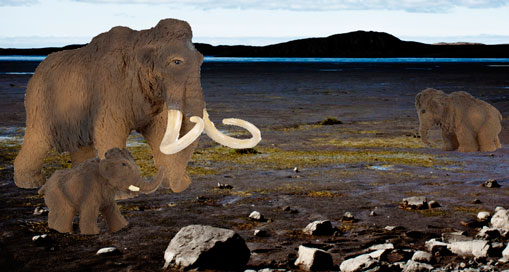
Study Suggests Some of the Last of the Woolly Mammoths were Unable to Quench Their Thirst

Mammoths died of thirst on St. Paul Island.

Lack of freshwater is suspected to have led to the demise of the Woolly Mammoth population on St. Paul Island.

Picture credit: Everything Dinosaur

The picture (above) was created using Papo Woolly Mammoth models.

To view the Papo “Les Dinosaures” range: Papo Prehistoric Animal Models and Figures.

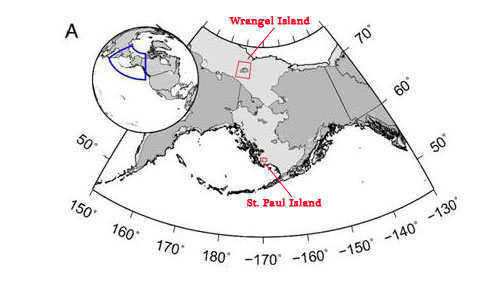
The Island of St. Paul in Relation to Wrangel Island

Readers of this blog will probably know that the very last population of Woolly Mammoths to have existed, survived on Wrangel Island until about 4,300 years ago (although an extinction date of as recently as about 1,700 B.C. has been proposed).

Both St. Paul Island and Wrangel are remote locations deep within the Arctic circle, however, there are considerable differences between these two islands and whilst scientists such as Professor Russell Graham (University of Pennsylvania) and lead author of the St. Paul Island study, propose that a lack of drinking water led to the St. Paul’s Island Mammoth population dying out, debate remains as to the probable cause of the Wrangel Island extinction.

In both cases the presence of humans impacting on the population of Mammoths can be ruled out, these hairy elephants were long gone before the first humans visited these isolated, desolate places (once sea levels rose).

The Location of St. Paul Island in Relation to Wrangel Island

The location of the last of the Woolly Mammoths (St. Paul Island and Wrangel Island).

The dark grey areas represent today’s landmass, the light grey areas show the extent of the Bering Land Bridge (Beringia).

Picture credit: PNAS with additional annotation by Everything Dinosaur

St Paul Island and Wrangel Island

The picture above shows the approximate position of the Bering Land Bridge (Beringia) in light grey compared to the landmasses of Siberia and Alaska today (dark grey).  At its maximum during the Quaternary glacial intervals, the land joining Asia to North America would have been over six hundred miles wide, over the last 20,000 years rising sea levels led to the eventual loss of a land link between the continents of North America and Asia.

St. Paul Island was part of the southern portion of Beringia. Today, it is located in the Bering Sea.  In contrast, the much larger Wrangel Island is found in what was the northern portion of Beringia and it is located today in the Arctic Ocean.

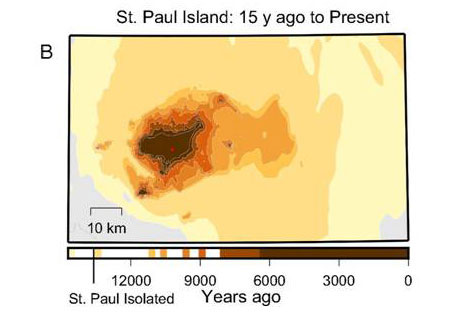
Wrangel Island is over seventy times bigger than St. Paul Island, in the past both these islands were considerably bigger but with a warming climate in the latter stages of the Pleistocene and into the Holocene Epoch, sea levels rose and St. Paul Island in particular began to shrink.  The island is presently, around forty square miles in size, the researchers used a variety of techniques to plot the ingress of sea water and the decline of freshwater on the island over the last fifteen thousand years.

The Reduction of St. Paul Island from the Late Pleistocene to the Present Day

St. Paul Island 15,000 years ago to the present day.

The shrinking of St. Paul Island over the last fifteen thousand years.

Picture credit: PNAS

Shrinking Islands

The picture above shows a palaeogeographical map compiled by the research team that plots the reduction in the size of St. Paul Island over the last 15,000 years or so.  The red dot in the centre of the island (present size is outlined in brown), represents Lake Hill, a small, freshwater lake from which a series of sediment cores were extracted so that the scientists could trace the history of the location and how changes in climate affected the fauna and flora of the island.

The sediment cores (taken in 2013), built on data generated from core samples taken back in the 1960s and they have provided a number of independent indicators to suggest that the Mammoth population survived until around 5,600 years ago.

The flora of St. Paul Island remained relatively unchanged, however, the scientists were able to deduce that St. Paul Island shrank rapidly due to rising sea levels until about 9,000 years ago.  It continued to shrink, albeit more slowly until around 6,000 years ago but declining freshwater sources and a generally drier climate with reduced precipitation from around 7,850 years ago to the time of the Mammoth’s extinction was probably the cause of the demise of this elephant population.

Independent Indicators of Mammoth Extinction

  • Analysis of sedimentary ancient DNA (sedaDNA) to provide an understanding of the ancient flora of the environment and how a drying climate and rising sea levels impacted upon it.
  • The level of fungal spores that are associated with animal dung (coprophilous fungal spore types).  Three types of fungal spore were studied, this fungi would have thrived on Mammoth dung, the sudden elimination of the fungal spores from the core samples indicate a mega fauna extinction.
  • Micro fossils such as those of water fleas (indicating freshwater) and pollen grains along with diatoms (different types of algae some of which are associated with sea water).
  • Magnetic susceptibility, in arbitrary units (AU) of Lake Hill sediments from the cores, this data looks at the differences between different types of sediment and from this an understanding of changes in the palaeoenvironment over time can be mapped.
  • Radiocarbon dating, isotope degradation analysis and analysis of protein remnants from St. Paul Island Mammoth remains.

Given the variety of information sources, the “best fit” for the Mammoth extinction is approximately 5,600 years ago (+/- 100 years).

The Mammoths Contributed to Their Own Downfall

As sources of freshwater dwindled, so the Mammoths would have congregated around the remaining waterholes.  More intensive, localised Woolly Mammoth activity would have accelerated the fall in water levels.  Vegetation would have been consumed therefore exposing sediments that would have been washed into the lakes and ponds thus degrading the water quality, reducing water levels further and exacerbating the already acute water shortage.

A spokesperson from Everything Dinosaur commented:

“Extant Indian elephants can consume as much as two hundred litres a day, sometimes more if it is a lactating female.  We suspect Mammoths too, had a high demand for drinking water.  A concentration of mega fauna around remaining sources of drinking water on St. Paul Island would have probably accelerated the extinction.  It is also likely, that with large animals having to survive on an ever diminishing landmass, the elephant population was already probably under considerable environmental stress.”

Lead author of the PNAS paper, Professor Russell Graham explained a likely extinction scenario:

“They [the Mammoths] were milling around, which would destroy the vegetation, we see this with modern elephants.  This allows for the erosion of sediments to go into the lake, which is creating less and less fresh water.  The Mammoths were contributing to their own demise.”

The scientific paper: “Timing and causes of mid-Holocene Mammoth extinction on St. Paul Island, Alaska”.

30 07, 2016

“Hypercarnivore” Extinct Relative of the Tasmanian Devil

By |2023-05-04T14:17:22+01:00July 30th, 2016|Categories: Dinosaur and Prehistoric Animal News Stories, Dinosaur Fans, Main Page|0 Comments

“Devilish” Riversleigh Marsupial Hyena from Queensland

Scientists including researchers from the University of New South Wales, have named a new species of carnivorous marsupial that would have terrorised Australia’s ancient forests some five million years ago.

The animal would have been roughly the size of a Labrador dog, but closely related to the extant Tasmanian Devil (Sarcophilus harrisii).  The Tasmanian Devil, with its powerful jaws, has a formidable reputation but this newly described meat-eating marsupial would have been two and half times the size of its modern relative.

An Illustration of the New “Devilish” Ancient Marsupial

An illustration of Whollydooleya.

An illustration of the new Riversleigh carnivore Whollydooleya.

Picture credit: University of New South Wales/Phil McKay

Whollydooleya tomnpatrichorum

Named  Whollydooleya tomnpatrichorum, it is the first creature to be formally identified from a remote fossil site located in north-western Queensland that has only recently been mapped.

W. tomnpatrichorum may have been an apex predator, or perhaps it filled the role of a hyena-like animal, hunting but also scavenging the kills of other predators.  Scientists who have studied the single molar tooth, from which the species has been erected, suggest that Whollydooleya could have weighed as much as twenty-five kilogrammes.

Lead author of the scientific paper, published in the Memoirs of Museum Victoria, Professor Mike Archer (University of New South Wales), commented:

“W. tomnpatrichorum had very powerful teeth capable of killing and slicing up the largest animals of its day.  The Late Miocene between twelve and five million years ago, when Australia began to dry out and megafauna began to evolve, is one of the least understood in the vast continent’s past.”

Whollydooleya tomnpatrichorum Size Comparison (Thylacine and Sarcophilus harrisii)

Whollydooleya size comparisons.

Comparing Whollydooleya with the extant Tasmanian Devil and the recently extinct Thylacine.

Picture credit: University of New South Wales

Rare Late Miocene Evidence

Fossils of terrestrial animals from Upper Miocene deposits of Australia are extremely rare, however, the remarkable outcrops located at Riversleigh in north-western Queensland hold the record for the density of fossil finds.  In 1983, a study of two cubic metres of rock from the Riversleigh site yielded an astonishing fifty-eight new species of prehistoric mammal.  The location from where the single tooth (a lower jaw molar), comes from is located outside the Riversleigh World Heritage site, but researchers are confident that this new site will yield a number of new prehistoric marsupial discoveries.

Two Views of the Prehistoric Tooth

Whollydooleya tomnpatrichorum tooth image.

Identified from a single tooth Whollydooleya tomnpatrichorum.  Stereo views of the single tooth (buccal view – viewed from the cheek side).

Picture credit: University of New South Wales

The new, highly fossiliferous site was found in 2012, thanks to aerial support from a local helicopter company that enabled field team members to cover large tracts of the remote outback.  The tooth, was found a year later, it represents the earliest fossil evidence yet of a “Tasmanian Devil-like” animal.

Professor Archer added:

“New Riversleigh is producing the remains of a bevy of strange new small to medium-sized creatures, with Whollydooleya tomnpatrichorum, the first one to be described.”

The Wholly Dooley Site

The genus name refers to the Wholly Dooley site, which was discovered and named by Phil Creaser following analysis of satellite data and Google Earth images.  The trivial name honours husband and wife Tom and Pat Rich, both vertebrate palaeontologists who have contributed significantly to the research into ancient marsupials of Australia.

29 07, 2016

Rare Horned Dinosaur Tooth Discovered in Northern Mississippi

By |2024-05-06T08:37:19+01:00July 29th, 2016|Categories: Dinosaur and Prehistoric Animal News Stories, Dinosaur Fans, Main Page|0 Comments

Horned Dinosaurs Roamed Appalachia

For much of the Cretaceous, North America was split into two landmasses by a huge sea (the Western Interior Seaway), much is known about the variety of dinosaurs that roamed the land to the west of this seaway (Laramidia), we have the Cretaceous rock formations of New Mexico, Utah, Montana and southern Alberta to thank for that.  In comparison, palaeontologists know very little about the dinosaurs that roamed the eastern landmass, a much larger area of land called Appalachia.  Thanks to a lucky fossil find in northern Mississippi, scientists have found further evidence to indicate that horned dinosaurs made up part of the plant-eating dinosaur population on Appalachia.

A single fossil tooth, suggests that a car-sized ceratopsian lived in Mississippi some sixty-seven million years ago.  The tooth represents the first evidence of horned dinosaurs having roamed the “Magnolia State”.

During the Late Cretaceous Many Types of Horned Dinosaur Roamed Laramidia – What about Appalachia?

A mixing of faunas, at least amongst elements of the Ceratopsidae.

Plenty of Ceratopsidae on Laramidia, but what about Appalachia?

Picture credit: University of Bath

The Discovery of a Ceratopsian Tooth

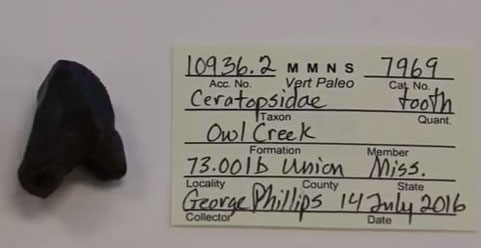
George Phillips, a curator at the Mississippi Museum of Natural Science was exploring a river bed near New Albany when he made the fossil find.  The strata exposed in this part of northern Mississippi make up a geological sequence called the Owl Creek Formation.  These deposits date from the Upper Cretaceous (Maastrichtian faunal stage) and represent marine deposits.  During the Late Cretaceous, the State of Mississippi was largely submerged beneath a shallow arm of the Western Interior Seaway that extended up the Mississippi River Valley to the southern tip of Illinois.  This body of water is referred to as the Mississippi Embayment.

Visit Everything Dinosaur’s website: Everything Dinosaur.

The layers of rock yield a variety of marine fossils, particularly bivalves, gastropods and ammonites, but vertebrate remains are rare.  Mosasaur fossils are associated with northern Mississippi and very occasionally evidence emerges of dinosaurs, animals that inhabited the coastal swamps and low lying inland areas that bordered the Western Interior Seaway.

A Photograph of the Fossil Tooth (Ceratopsidae)

Fossil tooth of a dinosaur from Mississippi.

Horned dinosaur tooth discovered in Mississippi.

Picture credit: Mississippi Museum of Natural Science (MDWFP)

Six Types of Late Cretaceous Dinosaur Known from the State of Mississippi

Very little is known about the dinosaur fauna of the State of Mississippi.  Everything Dinosaur wrote an article about dinosaur discoveries in the American States back in 2015, after we reported on the discovery of a partial dinosaur femur from Washington State, Everything Dinosaur team members attempted to plot which of the fifty U.S. States did not have dinosaur fossils.  In the resulting article we incorrectly discounted a number of dinosaur fossil discoveries from Mississippi, although the fossils are extremely fragmentary the ceratopsid tooth represents the sixth type of dinosaur known to have existed in northern Mississippi.

The five different types of dinosaur from Mississippi:

  1. Tyrannosaurids
  2. Hadrosaurs (duck-billed dinosaurs)
  3. Ornithomimids (ostrich-like dinosaurs)
  4. Dromaeosaurids (raptors)
  5. Nodosaurid (armoured dinosaur)
  6. Indeterminate Ceratopsidae (the fossil tooth found on July 14th 2016 indicates the presence of horned dinosaurs)

To read our article mapping the dinosaur fossil discoveries of America: The Dinosaur Fossil Discoveries of America.

The Importance of the Horned Dinosaur Tooth

George Phillips explained:

“This particular tooth is from a group of dinosaurs that is very poorly documented as to the Mississippi River and is the first of its kind ever found in the south-east.”

The Mississippi Museum of Natural Science curator explained how he felt when he first spotted the fossil:

“Oh, I was very excited.  I knew it was a dinosaur.  I miss-identified it initially but after a social media post my colleagues put me on the right track.  Dinosaurs in general from Mississippi are very rare.”

Handling the Extremely Rare Fossil Find

Mississippi State dinosaur tooth.

The fossil tooth of a horned dinosaur from Mississippi State.

Picture credit: Mississippi Museum of Natural Science (MDWFP)

The tooth has broken roots and looks like it has been subject to a lot erosion, however, it remains a significant find as it is one of only three ceratopsian fossils to have been found in eastern North America.

To read an Everything Dinosaur article about the chance discovery of a fragment of dinosaur jawbone in the Peabody Museum at Yale University that indicates basal ceratopsids inhabited eastern North America: Late Cretaceous Eastern North America and Leptoceratopsids.

At this stage it is not possible to determine whether the horned dinosaur was a member of the centrosaurine group or the chasmosaurine group of horned dinosaurs.  A copy of the specimen is on its way to California for further analysis and study.

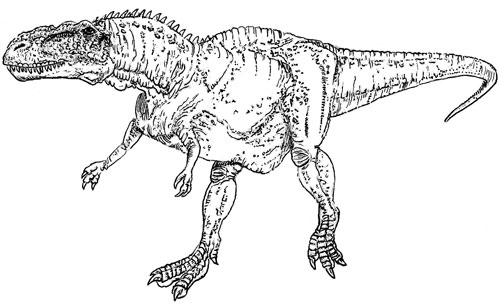
A Picture of a Late Cretaceous Horned Dinosaur

Utahceratops scale drawing.

Late Cretaceous Dinosaur Diversification in North America.

Picture credit: Everything Dinosaur

For articulated replicas of horned dinosaurs and other prehistoric animals: Beasts of the Mesozoic Models.

28 07, 2016

Heterodontosaurus Visits The European Synchrotron

By |2023-05-04T13:59:58+01:00July 28th, 2016|Categories: Dinosaur and Prehistoric Animal News Stories, Dinosaur Fans, Main Page|0 Comments

Scientists Use High Powered X-rays to Explore a Juvenile Heterodontosaurus

The European Synchrotron Radiation Facility (ESRF), located in Grenoble (France), had a very important visitor this week as an exceptionally well-preserved skeleton of a 200-million-year-old dinosaur was analysed using the high-energy, super strong X-rays of the synchrotron to peer inside the fossil’s rocky matrix.  The subsequent images revealed the fossil in almost perfect three-dimensions, providing palaeontologists with new information on Heterodontosaurus.

The Blocks of Fossil Material (Heterodontosaurus tucki)

The blocks showing the Heterodontosaurus fossils from South Africa.

The Heterodontosaurus blocks laid out in approximate anatomical order.

Picture credit: ESRF/P. Jayet

Heterodontosaurus tucki

Heterodontosaurus was a small, plant-eating dinosaur that roamed the very Early Jurassic of South Africa.  Named and described in 1962, the dinosaur’s name means “differently-toothed lizard”, a reference to the different types of teeth found in the jaws of this one metre long reptile.  Typical Heterodontosaurus tooth pattern consists of three pairs of short, but sharp teeth located in the front of the upper jaw.  The rearmost is much larger and proceeds a very large canine tooth located in the lower jaw.  The teeth at the back of the jaws are closely packed and blocky in shape indicating that these teeth evolved to help this animal chew tough vegetation.

Scientists have long debated what this animal ate.  Most palaeontologists believe that the fast-running Heterodontosaurus was vegetarian, however, omnivory cannot be ruled out.  Perhaps microscopic analysis of the tooth surfaces in conjunction with an exploration of the body cavity in this exceptionally well-preserved specimen might provide some clues.

An Illustration of Heterodontosaurus (Early Jurassic Ornithopod)

Heterodontosaurus illustrated.

A family of the little, bird-hipped dinosaur (Heterodontosaurus).

Picture credit: Natural History Museum

A Week to Investigate

The fossil was discovered in South Africa’s Eastern Cape province by palaeontologist Billy de Klerk.  It was found eroding out of extremely hard bedrock that formed part of a river bed on Hannie van Heerden’s farm.  With the help of a crew from the Albany Museum in Grahamstown, Billy de Klerk and John Hepple, (Rhodes University Geology Department), were able to extract the blocks that comprised the skeleton.

Initial analysis identified the fossil as a Heterodontosaurus, the skeleton proved too difficult to study whilst still in its matrix and attempts to remove the bones entombed within the rock would have caused extensive damage.  Thankfully, the team of researchers from the Evolutionary Studies Institute (ESI), at the world famous University of Witwatersrand were able to turn to the ESRF for help.  Professor Jonah Choiniere (University of Witwatersrand), who supervised the study, explained that the high-energy, high brilliance, X-rays generated by the synchrotron could be used to peer inside the rock and to help produce a three-dimensional image of the fossils.

For models and replicas of Jurassic dinosaurs and other prehistoric creatures: CollectA Prehistoric Life Models.

This non-invasive technique would not harm the fossil in anyway and it would allow computer generated images to reconstruct the anatomy of Heterodontosaurus in great detail.  The week-long investigation commenced on the 21st July and the scans were complete by the 26th, generating copious amounts of data for the scientists to study.

The Skull of the Heterodontosaurus

The South African Heterodontosaurus fossil skull.

The Heterodontosaurus skull (right lateral view).

Picture credit: Billy de Klerk

The European Synchrotron Radiation Facility (ESRF)

Over the last twenty years or so, the ESRF has been utilised by palaeontologists on a number of projects to help interpret the fossil record.

To read a 2014 article written by Everything Dinosaur on ESRF research into whether or not Archaeopteryx could fly: Could Archaeopteryx lithographica fly?

Professor Choiniere and Dr Vincent Fernandez Prepare the Skull for “Beamline” Analysis

Preparing the skull of Heterodontosaurus for "beamline" scanning.

Jonah Choiniere (left) and Vincent Fernandez set up the skull on one of the ESRF’s “beamlines” for scanning.

Picture credit: ESRF/P. Jayet

Professor Choiniere commented:

“There’s still a lot we don’t know about early plant-eating dinosaurs and we need new specimens like this one and new technology like the synchrotron to fill in those gaps”.

A Juvenile Heterodontosaurus

One of the first things the team were able to confirm was that the specimen represented a sub-adult.

Working with Dr Vincent Fernandez (ESRF), skull scans showed that the bones were not strongly sutured together.  This confirms the scientist’s suspicions that the animal was not fully grown when it died.  In addition, the first scans revealed the openings in the skull which house the balance organs.  An analysis of these structures will help the team to work out how this dinosaur held its head and how good at running it was.

Delighted with the Heterodontosaurus Results

Commented on the success of the collaborative research with ESRF, Billy de Klerk explained how he and the rest of the team were delighted with the results.  He emphasised that finding the specimen in the first place was very serendipitous, its location in the riverbed would have made it very vulnerable to erosion by the action of the river.

The Location of the Fossil Find

Billy de Klerk (palaeontologist).

Billy de Klerk and the location of the Heterodontosaurus fossil material.

Picture credit: ESRF/P. Jayet

Billy de Klerk explained:

“A few more years on the stream bed and the specimen might have been washed away.  We just happened to be at the right place at the right time.”

Images Generated Shed New Light on Dinosaur Anatomy

Heterodontosaurus fossils scanned by the ESRF.

The first scans from the ESRF revealed lots of information about Heterodontosaurus.

Picture credit: ESRF/P. Jayet

Master’s student at Witwatersrand University and member of the scientific team, Kathleen Dollman, hopes to apply synchrotron technology in her bid to understand the evolution of crocodilians.

She stated:

“X-ray computed tomography (CT) methods have revolutionised palaeontology and we can use these methods to understand so much more about the biology of these extinct animals.”

Learning More About Early Jurassic Dinosaurs

When it comes to understanding more about Early Jurassic plant-eating dinosaurs such as Heterodontosaurus, the collaboration with the ESRF is producing a tremendous amount of data.  For example, according to Kathleen Dollman, the data from the Heterodontosaurus study amounts to 1 terabyte (sixty piles of stacked paper as tall as the Eiffel tower).  That’s an awful lot of “dino data” to process, as the diagram below illustrates.

An Illustration of the Size of the Data from the Heterodontosaurus Study

1 TB of data generated in dinosaur research.

Huge amount of data from the ESRF Heterodontosaurus research.

Picture credit: Everything Dinosaur

Everything Dinosaur acknowledges the European Synchrotron Radiation Facility for their help in the compiling of this article.

Visit Everything Dinosaur’s website: Everything Dinosaur.

26 07, 2016

Amazing Giant Abelisaurid Footprint Discovered in Bolivia

By |2024-05-06T08:38:22+01:00July 26th, 2016|Categories: Dinosaur and Prehistoric Animal News Stories, Dinosaur Fans, Main Page|0 Comments

Huge Dinosaur Footprint Discovered in Bolivia

Everything Dinosaur has received reports of a super-sized, meat-eating dinosaur’s footprint being found in Bolivia.  The footprint, measuring some 1.15 metres wide is the largest tridactyl (three-toed) print ever discovered in Bolivia.  The huge footprint represents a track probably made by an abelisaurid, a type of Cretaceous theropod dinosaur, however, it suggests a carnivorous dinosaur much larger than most of the Abelisauridae.

Probably an Abelisaurid Track

The fossilised footprint was found in the municipality of Sucre in southern Bolivia.  Dinosaur tracks have been recorded from Bolivia before, but the three-toed print indicates that something extremely large and fierce roamed this part of South America sometime between 80 and 78 million years ago.

An Illustration of a Typical Abelisaurid Theropod Dinosaur

Abelisaurid artwork (Eoabelisaurus).

Abelisaurid artwork. An illustration of an abelisaurid theropod dinosaur.  Picture credit: Zhao Chuang.

Picture credit: Zhao Chuang

Omar Medina, a palaeontologist with the Bolivian Palaeontology Network explained that the single footprint could represent one of the largest footprints associated with an abelisaurid dinosaur ever found.

For models and replicas of abelisaurids and other dinosaurs: PNSO Age of Dinosaurs Replicas and Models.

The Geology of Southern Bolivia

The fossil discovery emphasises the significance of the geology in this part of southern Bolivia which has provided ichnologists (scientists who specialise in studying trace fossils such as footprints and tracks), with thousands of dinosaur footprints to study.

To read an article about a Bolivian farmer finding the tracks of an ancient ankylosaurid: Farmer Finds Dinosaur Tracks.

An article highlighting the threats to one of the most remarkable dinosaur fossil tracks found anywhere in the world (The “Huellas de Dinosaurio de Cal Orck”, close to the Bolivian town of Sucre): Dinosaur Tracks in Danger of Becoming Extinct.

Perhaps Twelve Metres in Length

Argentine palaeontologist Sebastian Apestiguia, who verified the find and is in the photograph circulated by media outlets, commented that the carnivorous dinosaur that made this print in soft sediments could have measured more that twelve metres in length, making it much larger than most abelisaurids.  For example, Rugops (R. primus) known from Niger in Africa, measured around nine metres in length, whilst the South American Abelisaurus (A. comahuensis), from which the family derives its name, probably reached a maximum size of about six and half metres.  To put this into context, that is around half the length of an adult Tyrannosaurus rex.

An Illustration of a Typical Abelisaurid Dinosaur

A drawing of a dinosaur (Abelisaurus).

A typical member of the Abelisauridae.

Picture credit: Everything Dinosaur/Mike Fredericks

A Lucky Fossil Find

Tour guide Grover Marquina, literally stumbled over the footprint whilst exploring the area in a bid to identify suitable tourist sites.  The fossil track might represent the largest known member of the Abelisauridae dinosaur family, although a spokesperson from Everything Dinosaur commented that they were aware of an, as yet, not scientifically described Abelisauridae specimen from Turkana in Kenya that might have reached a length of around eleven to twelve metres.

Visit Everything Dinosaur’s website: Everything Dinosaur.

25 07, 2016

The Deccan Traps and the Extraterrestrial Impact Responsible for Dinosaur Demise According to New Study

By |2024-05-06T08:38:47+01:00July 25th, 2016|Categories: Dinosaur and Prehistoric Animal News Stories, Dinosaur Fans, Main Page|0 Comments

Temperature Spikes Point to Two Events Causing End Cretaceous Mass Extinction

A study of the fossilised shells of several species of bivalves that existed towards the end of the Cretaceous suggests two distinct phases of global warming occurred that instigated mass extinctions.

Scientists have debated how much of an impact the eruption of the Deccan Traps in India had on the mass extinction event that caused the extinction of the dinosaurs along with about seventy percent of all terrestrial animals.  Much of the difficulties surrounding this debate concern the separating of the consequences of the extensive volcanism from the devastation caused by the Chicxulub impact event.

Deccan Traps and the Chicxulub Impact Event

Approximately sixty-six million years ago, a massive extra-terrestrial body slammed into our planet in the Gulf of Mexico.  This new research suggests that these two cataclysmic events combined to bring about the mass extinction.

The Location of the Deccan Traps (Flood Basalts)

The Deccan Traps location.

The location of the Deccan Traps (flood basalts).

Picture credit: Everything Dinosaur

Researchers from the University of Florida, in collaboration with colleagues at the University of Michigan examined the fossil record of a series of Upper Cretaceous bivalve shells, representing part of a mollusc biota that lived at depths of around 200 metres in a shallow marine environment that is represented by sequences of Maastrichtian faunal stage strata preserved on the Antarctic Seymour Island.

The Strata of Seymour Island

The Upper Cretaceous/Lower Palaeogene strata is particularly well suited for studying the end Cretaceous extinction event as the rocks here form a continuous sequence covering a time interval dating from around sixty-nine million years ago into the Palaeogene.

The abundant and well-preserved fossils of sea creatures are ideal study material and some understanding of the extinction process and its selectivity can be gained as several genera represented in the fossil record survive across the Cretaceous-Palaeogene boundary (K-Pg).

Cretaceous Extinction Event – Extra-terrestrial Impact

Extraterrestrial impact event.

A contributory factor in the mass extinction?

Using a New Technique to Plot Temperature Spikes

Geochemist Andrea Dutton (University of Florida), working with Sierra Petersen and Kyger Lohmann (University of Michigan), used a new analytical technique to establish sea temperatures in the Antarctic towards the end of the Cretaceous and into the Palaeogene.  Their analysis, published in the journal “Nature Communications”, supports the idea of the combined effects of excessive volcanism on the Indian sub-continent and the  Chicxulub impact brought about the mass extinction event.

A spokesperson from Everything Dinosaur commented:

“It’s a double whammy for the end Cretaceous.  Two distinct ocean temperature spikes as a result of these two events.  Such temperature variations at high latitudes indicate a huge change in global climates, these would have most definitely resulted in extinctions and the stratigraphic record of Seymour Island provides the most conclusive evidence yet.”

Clumping Isotopes of Carbonates

The team used a new analytical technique called carbonate clumped isotope palaeothermometer to study the chemical composition of twenty-nine fossil bivalve shells, from a sampling set of one hundred and sixteen.  A total of five species of bivalve were studied (Lahillia larseni, Cucullaea antarctica, Cucullaea ellioti, Eselaevitrigonia regina and Nordenskjoldia nordenskjoldi).

The analysis shows that ocean temperatures rose approximately 14 degrees Fahrenheit, and links these measurements to two previously documented warming events that occurred near the end of the Cretaceous Period, one related to volcanic eruptions in India (Deccan Traps), the other, related to the Chicxulub impact on the Yucatan Peninsula of Mexico.

Studying Fossilised Shells

The isotopic composition of the fossilised shells provided a map of the ancient temperatures at high latitudes spanning some 3.5 million years, covering the crucial end Cretaceous (Maastrichtian faunal stage and into the Palaeocene (Danian faunal stage).  Whilst a graduate student at the University of Michigan, Andrea Dutton studied the palaeoclimate of Seymour Island

At the time, existing analytical techniques determined combined signals of salinity and temperature fluctuations over geological time but the salt-water effect could not be isolated providing temperature increases/decreases as a single determinant factor.  Clumped isotope palaeothermometery allows the effect of temperature changes to be isolated.

Clumped Isotope Palaeothermometery

Assistant Professor Dutton explained:

“Now, years later, everyone is using this new tool called clumped isotope palaeothermometery, which is a bit different than the traditional method.  This technique is only a function of temperature.  Salinity has nothing to do with it.  We’re looking at the clumping of oxygen isotopes rather than the relative amount of oxygen isotopes in the shell, and this is helping us re-interpret the data.”

Two Significant Temperature Spikes Coinciding with Catastrophic Events

Clumped Carbonate Isotope Analysis Reveals Extinctions.

Sea shells provide clues to Cretaceous extinction event.

Picture credit: Nature Communications

Two Distinct Temperature Spikes

The data show two significant temperature spikes. The first corresponds to the eruption of the Deccan traps flood basalts. The other lines up exactly with the proposed date for the extra-terrestrial impact.  Just to make matters worse for life on Earth at the time, the Chicxulub event may have led to a renewed phase of volcanism on the Indian sub-continent.  Both events are directly linked with extinction events recorded in the fossil record of Seymour Island (decrease in faunal biota).

To read a recently published article on a study of the marine fossils of Seymour Island and the consequences with regards to the mass extinction event: Global Catastrophe Caused End Cretaceous Extinction.

The Cretaceous/Palaeogene (K-Pg) Boundary

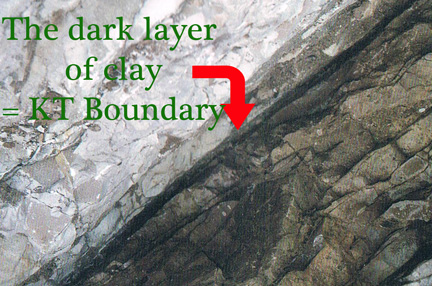
There is a physical boundary preserved in the geological record of our planet known as the Cretaceous/Palaeogene boundary (K-Pg), the “K” represents the Cretaceous, it comes from the German word for chalk “kreide”, “Pg” is the traditional abbreviation for the Palaeogene Period.  It is represented by a thin band of iridium rich rock.  Iridium is a rare Earth element associated with asteroids, meteorites and comets, this suggests an extra-terrestrial impact event contributed to the Cretaceous extinction event.

The Cretaceous/Palaeogene Boundary (K-Pg)

The K-Pg boundary

Marking the end of the Cretaceous.

Picture credit: Open University/Everything Dinosaur

K-T boundary = Cretaceous/Tertiary boundary also referred to as the K-Pg boundary.

Andrea Dutton added:

“We have evidence on this site on Seymour Island in Antarctica that climate change is linked to both of these extinction events, right before the boundary and right at the boundary.  If you look at what types of species that went extinct during the first extinction pulse, they’re different than the types that went extinct during the second pulse.”

Assistant Professor Dutton continued:

“That indicates that it may have been a different kill mechanism for those two different extinction pulses.  It’s quite likely both the volcanism and the asteroid were to blame for the ultimate mass extinction.  The Deccan Traps weakened the ecosystems before the asteroid slammed into the Earth.  It’s consistent with an idea called the press-pulse hypothesis: a ‘one-two punch’ that proved devastating for life on Earth.”

The published paper also refers to variability in shell composition that indicate a potential reduction in seasonality after the Deccan eruptions commenced, continuing through to the Chicxulub event.  Species extinction recorded at Seymour Island occurred in two pulses, these coincide with two observed global warming events, directly linking the end Cretaceous extinction at high latitudes to both the Deccan Traps and the extra-terrestrial impact.

To read an article the suggests the dinosaurs were in decline some fifty million years before they finally became extinct: The Fifty-Million-Year Decline of the Dinosaurs.

An Explanation of Polarity Reversals with the Earth’s Magnetic Field

Assisting the dating of the geological timescale is the science of magnetostratigraphy.  Periodically, the polarity of Earth’s magnetic field is reversed.  Iron rich minerals within strata align themselves with the prevailing magnetic field during formation.  By combining the polarity of these minerals with radiometric dating methods, geologists have produced a timescale of these magnetic reversals – the polarity chron.

The Polarity Chron Helps Chart Geological Deep Time

Plotting deep time using the Earth's polarity.

Magnetostratigraphy helps to chart deep time.

Picture credit: Nature Communications with additional notation by Everything Dinosaur

The Polarity Chron

The polarity chron (sometimes simply referred to as the chron), is the time interval between polarity shifts in the Earth’s magnetic field.  The switching of polarity is highly variable, on average they seem to occur every 200,000 years or so, but the last one took place more than three-quarters of a million years ago.

Why they occur has not been fully explained, but it is believed that the molten nickel and iron core at the centre of the Earth occasionally produces vortexes that persist long enough for a polarity reversal to take place as a result of the electromagnetic fields that they generate.  Polarity chrons are numbered in order starting from today and increasing retrospectively as we go further back in time.  Each number has two phases “N” for normal field and “R” to represent the reversal of that field, hence in the diagram above the ringed area labelled 31R through to 29N.

Visit Everything Dinosaur’s award-winning website: Visit Everything Dinosaur.

21 07, 2016

Reconstructing the Brains of Ancient Lungfish

By |2023-05-03T21:51:18+01:00July 21st, 2016|Categories: Dinosaur and Prehistoric Animal News Stories, Main Page, Palaeontological articles|0 Comments

Comparing the Brains of Extant Lungfish to their Ancient Relatives

The lungfish might be regarded by some as a “living fossil”, a term that we at Everything Dinosaur prefer not to use, as it implies that a species has remained present in the fossil record for a very long time.

However, the six species of lungfish alive today, do represent an extremely long lineage of fishes, that have remained relatively unaltered since they first evolved back in the Devonian.  How similar extant lungfish are to their ancient counterparts has been determined by a team of researchers from South Australia (Flinders University) and Sweden (Uppsala University) who have used a combination of computerised tomography and computer modelling to map and compare the brains of living lungfish species with fossils dating back some 365 million years.

Ancient Vertebrates

Lungfish belong to the Class Sarcopterygii part of the huge bony fish group of vertebrates, that is most closely related to tetrapods and that includes our own species H. sapiens.  Today’s lungfish, all six species, are becoming increasingly rare and scientists still do not know a great deal about them, their behaviours and how they are able to survive in extreme environments.  One thing we do know, is that for a fish, they are relatively big brained.

Of course, brain size does not necessarily reflect cognitive function, but lungfish brains tend to occupy about 80 percent of their cranial cavity.  Compare this to the somewhat more sedentary and a close relative of lungfish, the Coelacanth (Latimeria).  Studies of Latimeria have shown that less than 5% of their cranial cavity is occupied by their brains.

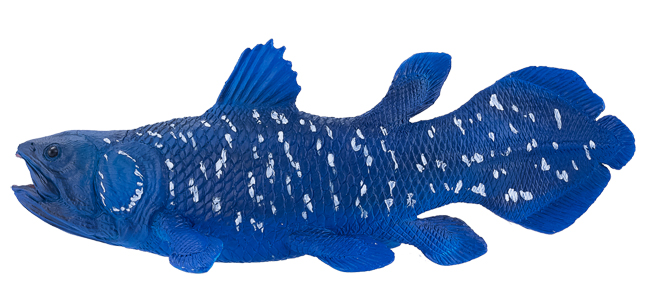
A Replica of a Coelacanth

Mojo Fun Coelacanth model.

The beautifully painted and very blue Mojo Fun Coelacanth replica.

The image (above) shows a Mojo Fun Coelacanth model.

To view the Mojo Fun model range: Mojo Fun Prehistoric and Extinct Models and Replicas.

Using Technology to “Brain-warp” Lungfish Fossils

Having a cranial cavity which is mostly filled by brain tissue is a trait more associated with mammals than with fish.  Knowing this, scientists can use the endocast of lungfish fossils that have been preserved in three-dimensions to map the brains of these ancient creatures.  That is exactly what the Swedish and Australian researchers did and their paper has been published on-line in the open source directory of the Royal Society.

The fossilised remains of a Late Devonian lungfish (Rhinodipterus) excavated from the Gogo Formation of western Australia have been subjected to high resolution computerised tomography and the data has been used to “brain-warp” cranial soft tissues so the brains of long extinct creatures can be constructed.

A Three-dimensional Skull Fossil of the Sarcopterygian Rhinodipterus from the Gogo Formation

A Skull of the Lungfish Rhinodipterus.

A three-dimensional Rhinodipterus skull from the Gogo Formation.

Picture credit: ABC

The picture above shows a right lateral view of the skull of Rhinodipterus excavated from the famous Gogo Formation .  The three-dimensional preservation of fossils has permitted the cranial research to take place.

Biologists Study Lungfish

Flinders University evolutionary biologist and lead author of the scientific paper, Alice Clement commented:

“These fishy cousins of ours offer a great insight into our ancient ancestors who first crawled out of water and onto land some 370 million years ago.”

The research team used the endocast from a fossil lungfish to form a three-dimensional diagram of the brain and surrounding tissue.  From this, the scientists could develop ideas regarding brain function and phylogeny of the lungfish family as a whole.  An ancient lungfish brain reconstructed in virtual reality is one thing, built in conjunction with the team’s own sophisticated and novel distance mapping software, but it is hoped these techniques can be applied elsewhere in the fossil record.

Mapping the Brains of Lungfish

Brain mapping in Lungfish.

The Queensland Lungfish brain compared to an ancient relative (Rhinodipterus).

Picture credit: The Royal Society

The picture above shows brain comparisons between an extant Queensland lungfish (Neoceratodus) and the extinct lungfish Rhinodipterus of the Late Devonian.   Colour coded distance map (a) for the relationship between brain and cranial cavity in Neoceratodus, (b) a three-dimensional endocast of Rhinodipterus.  The reconstructed brain of Rhinodipterus (c) presented as a colour coded brain endocast distance map and (d), a spatial overlap of the reconstructed Rhinodipterus brain (grey) with the endocast (pale red).  The reconstructed brain of Rhinodipterus viewed from the top (dorsal view) is diagram (e).

Brains are Difficult Things to Study

The new “brain-warp” method is important because when it comes to ancient anatomy, brains are extremely difficult to study.  Soft tissue such as brains is highly unlikely to fossilise, although brain shape and structure can be inferred if the bones that surround the brain are preserved.  By examining the hollow, a lot of information about brain morphology can be obtained.

Palaeontologist John Long, an expert on the fossils of the Gogo Formation and co-author of the scientific paper commented:

“Animals’ soft tissue usually breaks down, so discovery of a fossilised brain is very rare.”

The Strategic Professor of Palaeontology at Flinders University went onto explain that lungfishes have a very long evolutionary history, first evolving some 410 million years ago and having a peak diversity of about a hundred species during the latter part of the Silurian and through to the Devonian.

Weird Facts about Lungfishes

  • Molecular studies using living lungfishes and the Latimeria genus of Coelacanth have shown that lungfishes are more closely related to tetrapods than Coelacanths.
  • Six species of lungfish are known, the Queensland lungfish (Neoceratodus forsteri) from Australia, four species from Africa and one species from South America.
  • The South American lungfish (Lepidosiren paradoxa) when first scientifically studied in the mid 1830s was thought to be a reptile due to its close affinity with tetrapods.
  • The West African lungfish (Protopterus annectans) can go without food for more than three years.  When this lungfish was scientifically described by Sir Richard Owen, it was placed at first with the Class Amphibia (amphibians).

Visit Everything Dinosaur’s award-winning website: Everything Dinosaur.

20 07, 2016

Did Humans Evolve Independently in Asia?

By |2023-05-03T21:35:42+01:00July 20th, 2016|Categories: Dinosaur and Prehistoric Animal News Stories, Main Page|0 Comments

Asia’s Role in Human Evolution May Be More Significant

Scientists from the Institute of Vertebrate Palaeontology and Palaeoanthropology (IVPP) have challenged conventional theory by claiming that humans may have evolved independently in Asia as well as Africa.

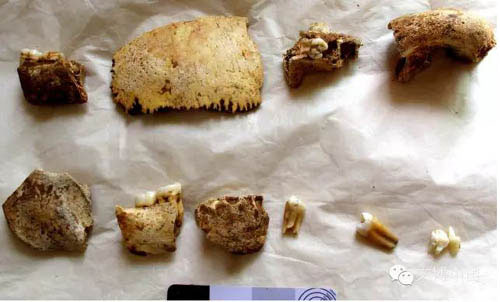
Asia’s role in our own evolution may be underestimated, that is the verdict given by Research Fellow Zhao Lingxia (IVPP) who led a field team exploring the limestone caves of Bijie, in south-west China’s Guizhou Province.  Three hominin teeth the team found in one of the caves were discovered in sediments that have been dated to 178,000 years to 112,000 years ago, some 70,000 years or so earlier than when the first modern humans (H. sapiens) are believed to have entered western Europe.  The study has been published in the Chinese academic journal Acta Anthropologica Sinica.

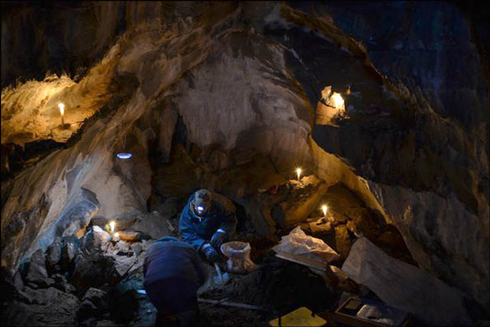
Scientists Study Caves Around the World to Gain a Better Understanding of Human Evolution

Inside Imanai Cave (Urals)

Scientists carefully examining in situ evidence.

Picture credit:  Pavel Kosintsev

Tentative Dates

Before anthropologists re-write human history, more work needs to be done to establish the true age of the ancient teeth.  Re-distribution of the sediments and geological upheaval may have skewed the estimated dates.  However, other recent fossil finds (October 2015), by Zhao’s colleagues, Liu Wu and Wu Xiujie, from Hunan Province (central China), indicate an age of perhaps as old as 120,000 years.  The forty-seven teeth found in Daoxian county (Hunan Province) remain the oldest fossils of modern hominins to have been found in eastern Asia.

Commenting on the significance of these ancient human remains, Liu Wu stated:

“There is overwhelming evidence from the fossil record that China was populated with humans before the arrival of African settlers.”

Homo erectus in China

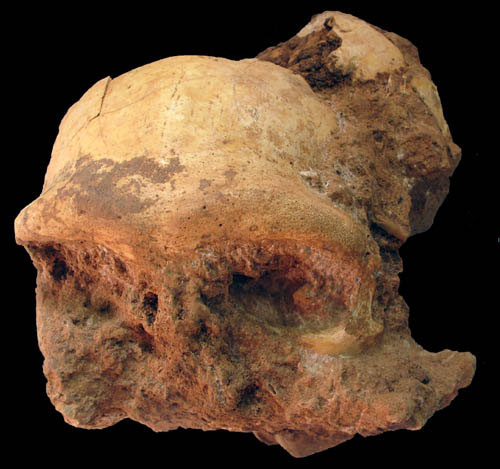
According to a number of Chinese media agencies, the fossilised skull of a Homo erectus was found in Dongzhi county in Anhui Province (eastern China).  The skull has been tentatively dated to 150,000 to 412,000 years ago.  A number of H. erectus sites are known from China (Shaanxi Province, Jiangsu Province as well as Anhui Province) and a spokesperson for the IVPP stated that over the last decade our understanding of human evolution in eastern Asia had been revolutionised.  Human fossils have been discovered across much of southern China.  Many of these fossils date back 100,000 years or more, but share similar anatomical features with modern Chinese people.

Homo erectus Skull found in China

Homo erectus skull fossil.

The skull of a H. erectus found in China.

Picture credit: Chinese Academy of Sciences

Stone tools found in association with a number fossilised bones indicate that there was a thriving stone tool manufacturing culture in this part of the world.  However, it was distinct from what has been identified from African migrants into the Near and Middle East and into Europe.

The stone tool cultures and the large amount of ancient hominin fossils uncovered in China suggested a “seamless evolution” toward the present-day Chinese people.  Even if the arrival of African migrants might have introduced certain new genes, no replacement or mass extinction had happened.  There is a growing consensus that the evolutionary story in Asia is much more interesting than previously considered.

A Forgotten Continent

Renowned palaeoanthropologist Chris Stringer (Natural History Museum – London),  stated that Asia has been a forgotten continent.

Professor Stringer said:

“Its role in human evolution may have been largely under-appreciated.”

A Selection of Homo erectus Fossils from China

H. erectus fossils from China.

Homo erectus fossil material including teeth.

Picture credit: Chinese Academy of Sciences

Homo floresiensis

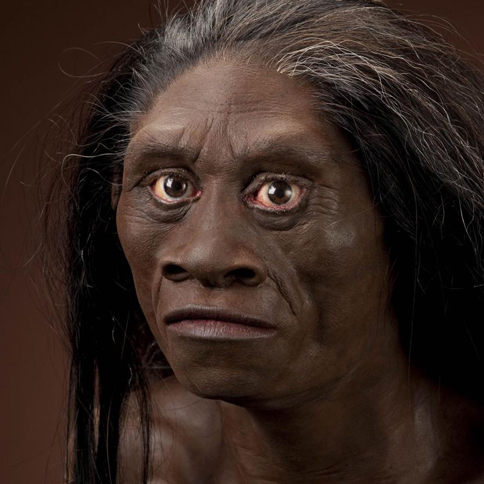
A discovery made in 2003 in a cave on the Indonesian island of Flores led to the establishment of a new type of early human species – Homo floresiensis.  Their diminutive size led this hominin species to be nicknamed “Hobbits”.  The discovery of H. floresiensis demonstrates that our evolutionary history may yet reveal some intriguing surprises.

Homo floresiensis (female based on skeletal remains LB1)

Homo floresiensis female

Homo floresiensis female based on skeletal remains LB1.

Picture credit:  Reconstruction of female H. floresiensis based on LB-1 fossil material by John Gurche

To read an article suggesting that modern humans may have driven H. floresiensis to extinction: Did H. sapiens’s arrival make H. floresiensis extinct?

Go to Top