All about dinosaurs, fossils and prehistoric animals by Everything Dinosaur team members.

Book reviews and information on dinosaur books by Everything Dinosaur team members.

9 03, 2011

Taking Issue with Sir David Attenborough (Helpful Information)

By |2024-04-21T10:08:17+01:00March 9th, 2011|Categories: Book Reviews, Everything Dinosaur News and Updates, Main Page|0 Comments

First Life – Some Factual Errors

Just finished reading the book that accompanies the BBC television series “First Life” narrated by Sir David Attenborough.  First Life updates readers on the remarkable advances in our knowledge of how life first began on planet Earth.  Over the last fifty years or so, new research techniques and fossil discoveries have enabled scientists to gain a better understanding of how first evolved.  The book takes readers on a journey back in time to the key moments in the development of life on Earth, from the first single celled organisms through to the conquest of the land and the dominance of the arthropods in early terrestrial habitats.

The book is generally well written and provides an entertaining and informative read.

To see Everything Dinosaur’s review of this book: Book Review – “First Life”.

However, there are one or two interesting inaccuracies and anomalies that we have found in the text.  These sections of the book have led to more debate amongst our team members than any other part of what is, in general an excellent publication.

Sir David Attenborough

Firstly, in chapter 10, entitled “Landfall: The Worm that Walks”, part of the book dedicated to the conquest of the land by the first land living invertebrates, on pages 252-253 there is a computer generated image of an ancient marine ecosystem.  This seems somewhat out of place when considering the context of the chapter.  The scene shows a number of primitive marine organisms including Opabinia and Wiwaxia, creatures associated more with the Cambrian than with the geological time period when arthropods were first venturing out onto dry land.  At least the fossil evidence does not suggest land fall as early as the Cambrian Period.

Secondly, when discussing the success of the Insecta, the book states that insects have adapted to a whole range of different habitats. We don’t doubt the validity of this particular statement, but the narrative specifically refers to insects in marine environments.  In essence, despite their tremendous diversity very few insect genera have been able to adapt themselves to a truly marine, pelagic way of life (pelagic – living above the sea floor).  This lack of insects in truly, entirely marine environments is a puzzle for scientists.

In addition, in the final chapter – “Taking Wing: End to an Era”, there is a section that contrasts the internal skeleton of vertebrates with the exoskeletons of invertebrates. A rhinoceros is compared to a rhinoceros beetle.  We admit, some important points are made over the advantages and disadvantages of each type of support structure for an animal. However, when concluding this segment the writer states:

“The rhino, however, has an internal skeleton to give it strength and structure.  This skeleton grows with the rhino and is constantly replenished and strengthened throughout the rhino’s lifetime.  The rhino will never need to shed its skin, and so it is able to grow to an enormous size.  At full size, it grows to become the largest terrestrial creature on Earth, a feat that the beetles could never achieve.”

This is a surprising statement, although the several species of rhinoceros alive today are very large, the biggest, heaviest terrestrial vertebrate in our opinion would be the African elephant.  It seems strange that such a well researched and carefully compiled publication would include a number of mistakes.    Although we noted these occurrences it did not stop us enjoying what is an excellent book to accompany the BBC television series.

For models of even larger animals from the fossil record including dinosaurs and giant relatives of modern rhinos like Paraceratherium: Dinosaur and Prehistoric Animal Models.
20 01, 2011

Review of the New Prehistoric Times (Winter 2011)

By |2024-04-21T11:58:57+01:00January 20th, 2011|Categories: Dinosaur Fans, Magazine Reviews, Main Page|0 Comments

Review of Prehistoric Times (Issue 96)

Our copy of Prehistoric Times arrived yesterday, a chance for us to catch up on all things related to prehistoric animal models and palaeontology, plus it reminded us to forward on to the editor some new pictures of the Papo “Dinosaures” releases for 2011.

Prehistoric Times

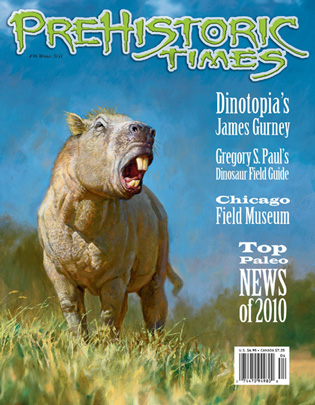
The front cover of the latest edition of Prehistoric Times features the bizarre, gigantic South American extinct rodent Josephoartigasia as painted by James Gurney.   Described as a cross between a “pig and a rhinoceros”, the author and illustrator of the Dinotopia series comments in a brief article, how he went about creating this artwork.  In another section, James outlines how he went about creating a prehistoric scene showing Titanoboa (the largest snake known to science) constricting a large crocodile.

The Front Cover of Prehistoric Times (Winter 2011)

Picture credit: Mike Fredericks

There is a special feature on those cursorial ornithomimosaurs with lots of artwork and illustrations submitted by readers and it is great to see an extensive and highly informative article on that often over looked group of animals the prehistoric giraffes (no pun intended, as if you could literally overlook a giraffe).

A very handy, double page spread written by the excellent Steve Brusatte of the American Museum of Natural History/Columbia University which highlights some of the most important palaeontological news stories of the last year, plus an informative report on the exhibits to be found at the Field Museum (Chicago) can be found in this edition.

Wonderful to read the article about dinosaur colouring books and how they have changed over the last twenty-five years and we were excited to see that there is going to be a re-issue of that amazing Tyrannosaurus rex 1:13 scale model produced originally by Aurora models back in the 1970s.  One of our team members has this kit somewhere, perhaps we should rebuild it, complete with its glow in the dark teeth and set it up in our boardroom.

Once again, a jam-packed edition and a credit to all the writers and illustrators concerned.

To visit Prehistoric Times website: Prehistoric Times.

2 01, 2011

Review – David Attenborough’s “First Life”

By |2023-03-06T14:43:57+00:00January 2nd, 2011|Categories: Book Reviews, Main Page|1 Comment

A Review of the Book – “First Life”

Designed to accompany the two-part television series, “David Attenborough’s First Life” covers the billions of years of time, leading up to the development of advanced forms of life on our planet.  It is a chronological journal, split into eleven chapters that tells the story of the “slow burning fuse” that led to the explosion of life in the Cambrian, the development of the Phyla of organisms that are still with us today.

“First Life”

The text is informative, not too technical and designed for the lay person to follow.  There are many splendid photographs and lots of information on the fossil locations, although it would have been interesting to read more about some of the UK fossil locations such as Crail in Scotland and perhaps there are too few scary creatures for children to enjoy.  Although, it is amazing to see the strange and wonderful creatures known as the Ediacaran fauna (soft-bodied, bizarre organisms).

By the Late Precambrian, around six hundred million years ago, simple food chains had become established with over thirty different genera recognised, this simply ecosystem is known as the Ediacaran fauna after the Ediacara Hills, north of Adelaide in South Australia, where a variety of Late Precambrian fossils were discovered in the late 1940s.

The introduction, written by Sir David Attenborough, really brings out his passion for fossils and fossil collecting.  The highlight of the book, was reading about Sir David’s own connection with Charnwood forest, the site in Leicestershire, the county of Sir David’s childhood, where the important Precambrian fossil Charnia (Charnia masoni) was discovered.

Academic Content and Computer Generated Wonders

At over 285 pages in length, this book provides an appropriate balance between academic content and computer generated wonders.  One of the features of this book, are the extreme close up photographs of important fossils.  The vast majority of fossils from the Precambrian and the Cambrian geological period are extremely small, but the highly magnified and full colour photographs really help to bring the fossil evidence “to life”” as it were.  The reader is treated to some wonderful images, illustrations of the primitive sea landscapes and some excellent computer generated impressions and graphics as to what the fauna and flora of the Burgess Shale site might have looked like (British Columbia, Canada).

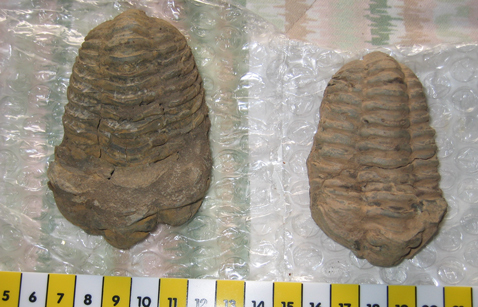
Trilobites Feature in the Television Series “First Life”

The definition of benthic.  A pair of trilobite fossils. Trilobites feature in the televison programme "First Life".

Trilobite fossils (Calymene).  Picture credit: Everything Dinosaur.

Picture credit: Everything Dinosaur

So in summary, a good book, an interesting read, perhaps not ideally suited for children but a fitting tribute to the work of scientists and to Sir David himself.

Prehistoric Animal Replicas

To view models and replicas of trilobites and other ancient creatures: CollectA Prehistoric Life Models.

29 12, 2010

Review of New Horned Dinosaurs Book – “New Perspectives”

By |2023-01-14T15:27:43+00:00December 29th, 2010|Categories: Book Reviews, Main Page|0 Comments

Review of “New Perspectives on Horned Dinosaurs”

New Perspectives”, or to give the book its full title – “New Perspectives on Horned Dinosaurs – The Royal Tyrrell Museum Ceratopsian Symposium” is a comprehensive review of virtually all the recently published papers and journal articles on the ceratopsians.  It is everything and anything to do with that great family of ornithischian dinosaurs, the horned dinos, from Psittacosaurus to the enormous Triceratops.

Horned Dinosaurs

Over the last three years or so, there have been a number of spectacular new discoveries and a lot of exciting research carried out on the ceratopsians and this volume, sets out to update readers on the latest interpretation of their fossil record.  The book is split into thirty-six chapters and it is edited by Dr Michael J. Ryan of the Cleveland Museum of Natural History, Dr Brenda J. Chinnery-Allgeier of the University of Texas and Dr David Eberth of the Royal Tyrrell Museum (Alberta, Canada).

The list of contributors reads like a “who’s who” of modern palaeontology with contributions from the likes of esteemed scientists such as Phil Currie, Peter Dodson, Scott Sampson and Peter Larson.  More than five hundred pages dedicated to all things ceratopsian, including descriptions of ten new types, which have recently been discovered.

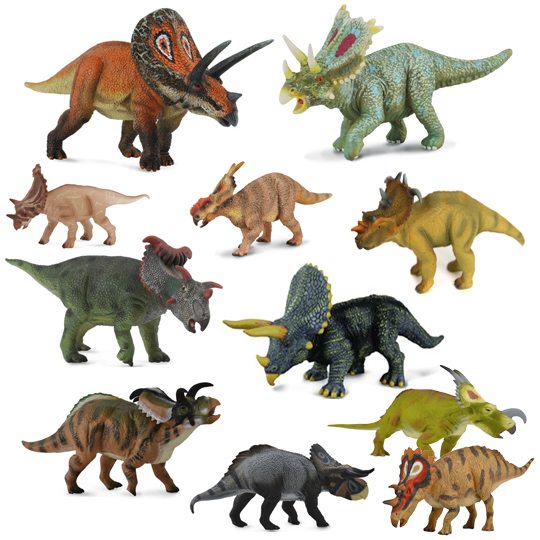
Models of Horned Dinosaurs Highlighting Ceratopid Diversity

Different types of horned dinosaur.

Models demonstrate the diversity and variety of horned dinosaurs.

The picture (above) shows a huge variety of horned dinosaurs, all of which are represented in the CollectA model range: CollectA Age of Dinosaurs Popular Range.

Although, the book focuses mainly on North American discoveries there are some fascinating chapters dedicated to horned dinosaurs from farther afield.   For example, there is a chapter dedicated to the research on Archaeoceratops (China), as well as a new look at Psittacosaurus and a paper on insect trace fossils associated with the rotting remains of Protoceratops.

This really is a comprehensive guide and ideal for the undergraduate student, or enthusiastic amateur.  The book is very technical and is therefore not suitable for children.

26 12, 2010

Review of “New Perspectives on Horned Dinosaurs”

By |2023-03-06T15:02:18+00:00December 26th, 2010|Categories: Book Reviews, Main Page|0 Comments

Book Review – “New Perspectives on Horned Dinosaurs”

“New Perspectives”, or to give the book its full title – “New Perspectives on Horned Dinosaurs – The Royal Tyrrell Museum Ceratopsian Symposium” is a comprehensive review of virtually all the recently published papers and journal articles on the ceratopsians.  It is everything and anything to do with that great family of ornithischian dinosaurs, the horned dinos, from Psittacosaurus to the enormous Triceratops.

Horned Dinosaurs

Over the last three years or so, there have been a number of spectacular new discoveries and a lot of exciting research carried out on the ceratopsians and this volume, sets out to update readers on the latest interpretation of their fossil record.  The book is split into thirty-six chapters and it is edited by Dr Michael J. Ryan of the Cleveland Museum of Natural History, Dr Brenda J. Chinnery-Allgeier of the University of Texas and Dr David Eberth of the Royal Tyrrell Museum (Alberta, Canada).

The list of contributors reads like a “who’s who” of modern palaeontology with contributions from the likes of esteemed scientists such as Phil Currie, Peter Dodson, Scott Sampson and Peter Larson.  More than five hundred pages dedicated to all things ceratopsian, including descriptions of ten new types, which have recently been discovered.

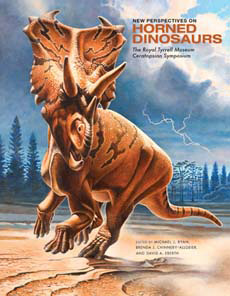
Front Cover of “New Perspectives”

Picture credit: Donna Sloan

The book can be further divided into five distinct sections.  Part one sets the scene and provides an overview of the research carried out on ceratopsids since the 1970s.  Part two, updates the reader on the latest research, highlights new discoveries and introduces the recently discovered new taxa.  The third part of the book, describes the latest research on ceratopsian behaviour, anatomy, ontogeny and functional biology.

“Horned Dinosaurs in Time and Space”

The penultimate part of the book, entitled “Horned Dinosaurs in Time and Space”, sets out to establish how these dinosaurs became so diverse and radiated out into a myriad of different environments and ecosystems.  This section also provides some remarkable insights into ceratopsid trace fossils and bone beds.

The final part of the book provides a history of horned dinosaur fossil collections, and this section works well with the excellent CD-rom that accompanies the volume.  The CD-rom lists ceratopsian discoveries and focuses on the work on ceratopsids in Canada.

The book is very technical and not really suitable for the casual reader and there are very few colour plates (hence the CD-rom), however, it is a “must have” for any budding undergraduate studying related Earth Sciences and for the enthusiastic amateur.

For models and replicas of horned dinosaurs, take a look at the Beasts of the Mesozoic ceratopsian figures: Beasts of the Mesozoic Ceratopsian Figures.

13 10, 2010

Review of the New Prehistoric Times (Autumn Edition)

By |2024-04-20T07:49:42+01:00October 13th, 2010|Categories: Dinosaur Fans, Magazine Reviews, Main Page|1 Comment

Review of Prehistoric Times (Issue 95)

Our copy of Prehistoric Times has just arrived and I have managed to get a quick look before it gets hogged by all the other team members.  Another bumper edition with lots and lots of dinosaur and model making information from the number one magazine for the dinosaur fan and dinosaur model collector.

The first thing to stay about issue 95, the autumn edition, or as our across the Atlantic friends like to say, the fall edition, is the superb artwork on the front cover.

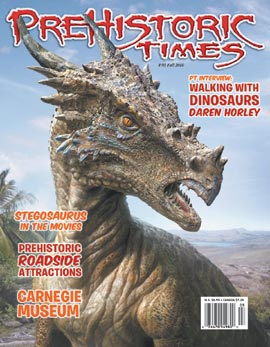
Front Cover Artwork on Prehistoric Times (Issue 95)

Artwork credit: Daren Horley

The front cover features a magnificent picture of that Late Cretaceous bone-headed dinosaur – Dracorex.  It was drawn by Daren Horley, the artist behind the artwork on the “Walking with Dinosaurs” television series and “Primeval”.

Dracorex

A Dracorex featured in series two of Primeval (Impossible Pictures).  In this particular episode time anomolies collide and a English knight from the Middle Ages mistakes a Dracorex for a dragon and evolutionary zoologist Nick Cutter and his team have to break up the ensuing fight and return both parties to their respective time periods.  This issue of Prehistoric Times includes an interview with Daren and displays some of his amazing digital artwork, including some of the animals seen on the television programmes.

There is a special article on Iguanodon and it is great to see one of our many artist chums Richard Bizley, having his artwork displayed (look for it on page 14).  There is lots and lots of artwork to view and as always a summary of the latest dinosaur finds and discoveries.

Best of all, Phil Hore has written a highly informative and entertaining feature on the trilobites, those wonderous arthropods that sadly became extinct at the end of the Permian period.  Lots of really great pictures and information on these amazing creatures from the fossil record.  I look forward to being able to read this article tonight when I finish work.

Another great edition of Prehistoric Times, the magazine for dinosaur fans and model collectors.

Visit Prehistoric Times website: Prehistoric Times.

3 10, 2010

Something Fishy This Way Comes

By |2023-03-06T09:23:52+00:00October 3rd, 2010|Categories: Book Reviews, Main Page|0 Comments

Ray Troll’s New Book – Top Quality Contemporary Art

Alaskan based artist Ray Troll has a new book out.  It features some of his amazing T-shirt illustrations that Ray has created over the years.  We got to hear about Ray and his unique art work through the “palaeontology grapevine”.  Ray, not only creates art based around living creatures today, but he has produced some stunning and unique interpretations of animals in the fossil record.  The book is entitled “Something Fishy This Way Comes”.  The book is published by Sasquatch Books of Seattle (Washington State).

Ray Troll’s Art

The book is a collection of Ray’s T-shirt art over the last three decades.  It features a wide range of subjects, some of them rarities.  They are all created by a highly talented and individual artist with a love of all things fish and fossil.  The book has 128 pages and is produced in full colour so readers and fully appreciate the intricate details of Ray’s creations.

To help promote the book, Ray is leaving his beloved fishing grounds to go on a short book signing tour of the west coast.  We wish him well with his endeavours.  Long may Ray continue to produce stunning works of art depicting the rich and diverse life that exists or has existed on our planet.

For models and replicas of prehistoric fish and other extinct creatures: PNSO Age of Dinosaurs.

20 07, 2010

Review of New Prehistoric Times (Issue 94)

By |2024-04-19T14:58:38+01:00July 20th, 2010|Categories: Dinosaur Fans, Magazine Reviews, Main Page|0 Comments

Review of Prehistoric Times Magazine (Summer edition)

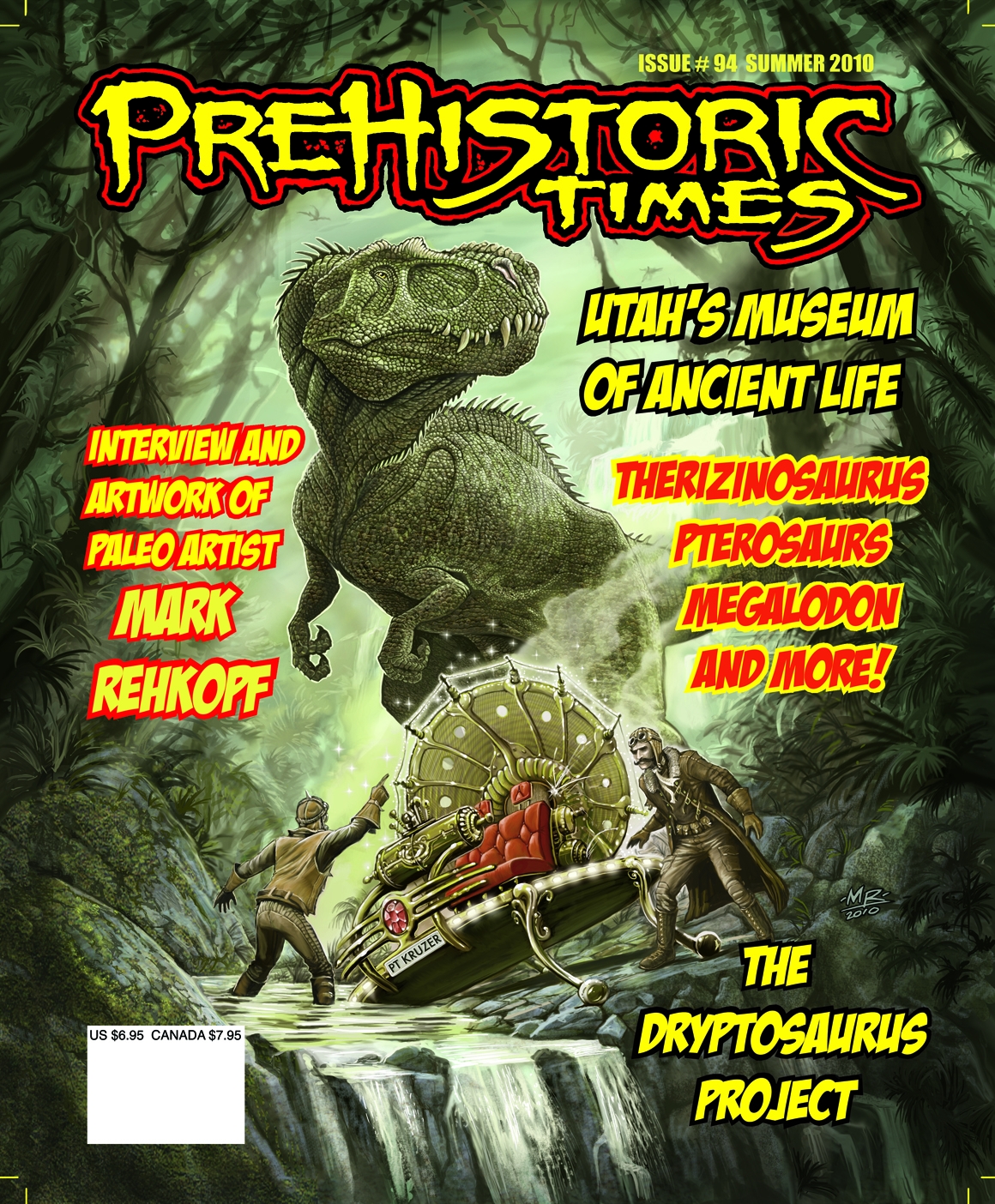
The eagerly awaited next edition of the quarterly magazine Prehistoric Times arrived late last week, sent over from the United States as promptly as ever.  Prehistoric Times is the magazine for dinosaur enthusiasts and model collectors.  Once again this Summer edition does not disappoint, we loved the front cover artwork depicting two time travellers coming face to face with a tyrannosaur in some ancient, primeval jungle.  The artist Mark Rehkopf produced this illustration especially for the magazine and there is an interview with Mark and a showcase of some of his work on the inside pages.

The Specially Commissioned Artwork for Prehistoric Times

Summer edition.

Picture credit: Mark Rehkopf/Mike Fredericks

The featured prehistoric animals this quarter are therizinosaurs (a special on Scythe Lizards) plus an article on amazing pterosaurs and an update on Megalodon facts and fallacies.  Once again there are lots of examples of reader’s artwork featured and a really fascinating article written by the excellent Tracy Lee Ford on swimming psittacosaurs.  Great to see a review and some super pictures of the Museum of Ancient Life in Utah (we really must send in some pics and information on the museums we work with).  Also, in the book review section there is an unbiased and informative review on the new Horned Dinosaurs book – “New Perspectives on Horned Dinosaurs: The Royal Tyrrell Museum Ceratopsian Symposium”, a definitive study of horned dinosaurs (not withstanding the current controversy over T.  latus and T. horridus.

All in all a super magazine and well worth the subscription.

To visit the Prehistoric Times website: Prehistoric Times.

20 06, 2010

Sneak Preview of the New Prehistoric Times (Summer 2010)

By |2024-04-19T13:53:41+01:00June 20th, 2010|Categories: Dinosaur Fans, Everything Dinosaur News and Updates, Magazine Reviews, Main Page|0 Comments

Sneak Preview of Next Edition of Prehistoric Times (edition 94)

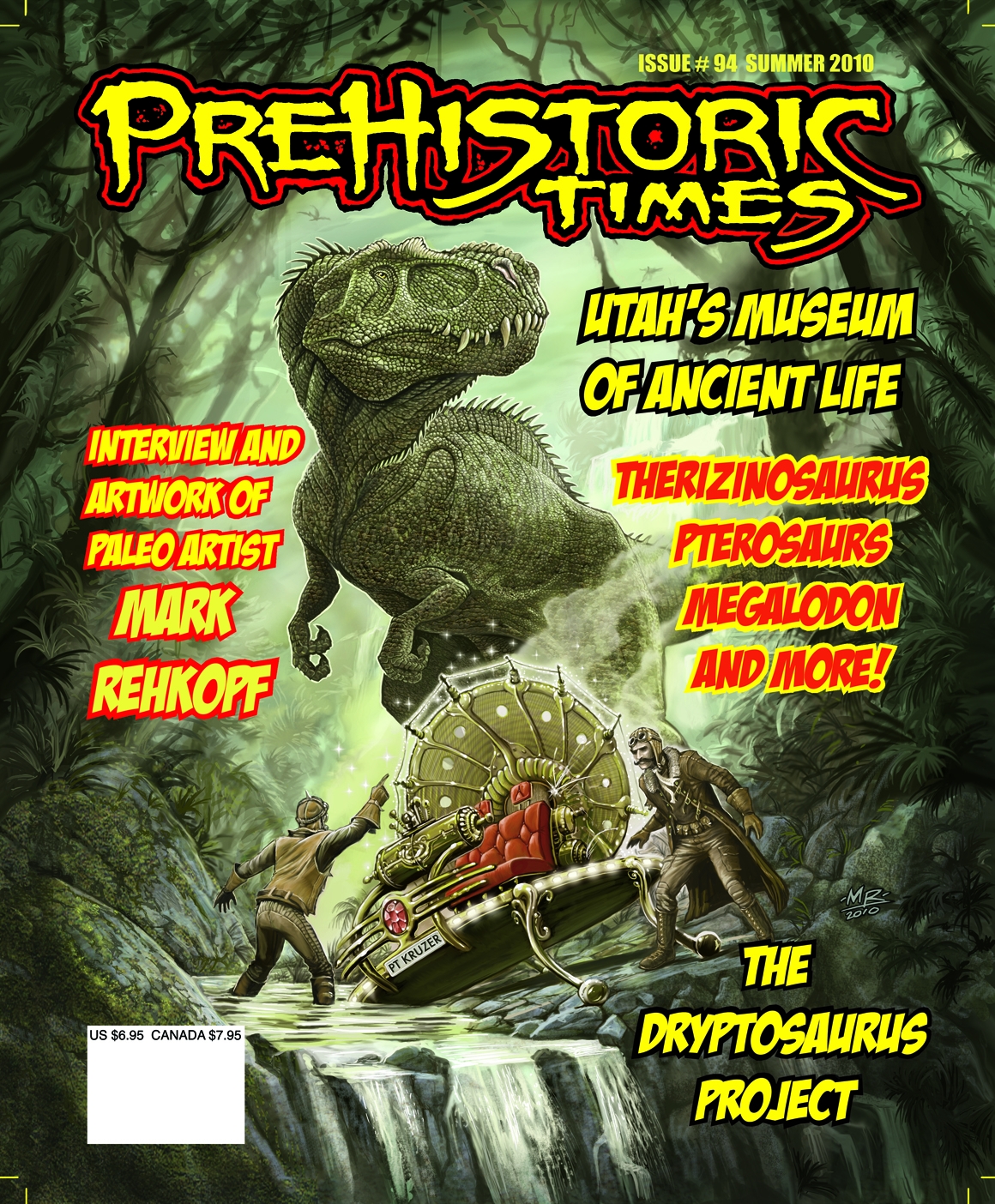
On Friday, we received an email from our good friend Mike Fredericks (editor of Prehistoric Times magazine), in the email was a sneak preview of the next edition of this magazine for dinosaur fans, palaeoartists and model collectors.

Prehistoric Times Magazine

Prehistoric Times, is the magazine for dinosaur enthusiasts and it is packed full of news stories, features, artwork and information about the latest developments in palaeontology as well as lots and lots of information about prehistoric animal models.

Sneak Preview of Prehistoric Times (Issue 94)

Prehistoric Times (issue 94).

Picture credit: Mike Fredericks

As well as featuring cool prehistoric animals such as the amazing therizinosaurs (Scythe lizards), the giant shark Megalodon and pterosaurs it is going to be fun to read all about the Dryptosaurus project – a campaign to publicise and eventually lead to a mounted exhibit of the USA’s second oldest dinosaur (in terms of date described).

To visit the Prehistoric Times website: Prehistoric Times.

26 04, 2010

The Ulitmate Dinosaur Sticker Book for Children

By |2024-04-18T21:42:35+01:00April 26th, 2010|Categories: Book Reviews, Everything Dinosaur News and Updates, Main Page|0 Comments

The Ultimate Dinosaur Sticker Book

A welcome addition to the Everything Dinosaur Reading Activities range is this dinosaur sticker book, packed with lots of prehistoric animal stickers.  Designed for children as young as 3 years of age, this informative and educational sticker book, helps build observation skills and hand to eye co-ordination.

To view the extensive range of dinosaur and prehistoric animal themed toys and gifts available from Everything Dinosaur’s award-winning website: Visit Everything Dinosaur.

Everything Dinosaur

Young dinosaur fans can learn all about dinosaurs and other prehistoric creatures such as pterosaurs (flying reptiles) and marine reptiles with this fun dinosaur themed sticker book.  Simply find the information and the sticker outline that matches the sticker and then place it in the correct position to create your very own dinosaur information book.  The easy peel stickers can be used more than once and they make attractive additions to any school project.

Dinosaur Sticker Book (Ultimate Dinosaur Sticker Book

Dinosaur sticker book.

Dinosaur sticker book.

Picture credit: Everything Dinosaur

Our dinosaur themed publications include reference books about prehistoric animals as well as traditional story books, all approved by our teachers and dinosaur experts.  A dinosaur book is a great way to encourage young children with their reading and it can help them learn more about dinosaurs and other extinct prehistoric animals.

Go to Top