All about dinosaurs, fossils and prehistoric animals by Everything Dinosaur team members.

Book reviews and information on dinosaur books by Everything Dinosaur team members.

18 10, 2011

Guinness World Records 2012 – Book Review

By |2023-01-22T19:41:32+00:00October 18th, 2011|Categories: Book Reviews, Educational Activities|0 Comments

Guinness World Records Book – Reviewed

Team members at Everything Dinosaur have a new pastime, during their breaks they consult the Guinness World Records Book (2012 edition) and test each other on their knowledge on an amazing array of subjects from the moons of Jupiter to the shortest bird migration via trying to guess the country with the largest oil consumption.

Guinness Book of World Records

The Guinness World Records book is absolutely stuffed full of astonishing facts, feats and statistics, if there is an area of human endeavour, an aspect of the natural world – animal, vegetable or mineral it seems that somebody, somewhere, holds a record and the Guinness team have set about compiling a immense compendium cataloguing it all.

The Guinness Book of Records 2012

Super Christmas Present Idea.

Picture credit: Everything Dinosaur

With an eye on the London Olympics there is a special section within that part of the book concerning sports, dedicated to the Olympic movement and London 2012.  The London Olympics Icon launched in June 2007 and designed by Wolff Olins is the most expensive Olympic logo ever costing £400,000 to design.  In Beijing (2008) there were the most participants at an Olympics, these games attracted a record 10,942 athletes from 204 countries.

Feats and Fantastic Voyages

Royalty, juggling feats, fantastic voyages, apex predators, asteroids, peculiar plants, maps, giant spiders, climate, prehistoric whales – just about everything we could think of is featured somewhere in the 288, jam-packed pages.  To read about “Cassius” the largest Saltwater crocodile in captivity turn to page 46 – we wrote a web log article about this particular specimen of Crocodylus porosus in this web log a few weeks ago, to see this article click on the link below:

Saltwater crocodile breaks record: Which was the largest crocodile of all time?

With more than 1,000,00 world record holders and some 4,000 new, updated and classic world records this book makes a super Christmas present and a very enjoyable read for all the family.

For dinosaur themed books and gifts: Everything Dinosaur.

14 10, 2011

The Princeton Field Guide To Dinosaurs – An Excellent Reference Book

By |2023-01-22T08:10:39+00:00October 14th, 2011|Categories: Book Reviews|0 Comments

Book Review – The Princeton Field Guide to Dinosaurs – Gregory S. Paul

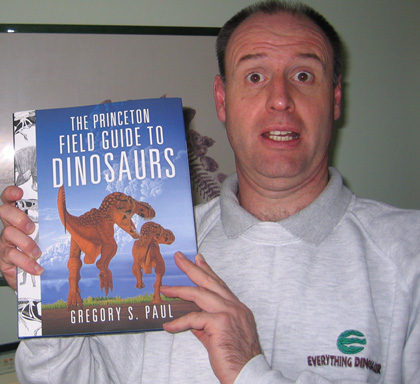
We had known about the launch of this book for sometime, after all, it came out last year and I recall reading the review out of Prehistoric Times magazine to colleagues at one of our Friday afternoon meetings, but nobody took the hint and purchased it.  However, after having contacted the author on a technical issue concerning the anatomy of spinosaurids I decided that enough was enough and I have bought it, using the excuse of an “early Christmas present to myself”.  We review the Princeton Field Guide to Dinosaurs.

Princeton Field Guide to Dinosaurs

For those not yet acquainted with the work and illustrations of Gregory S. Paul, let me quickly put you in the picture before providing a brief review of this offering.  Gregory S. Paul  is a world renowned illustrator of dinosaurs and prehistoric animals.  His enthusiasm for all things Dinosauria is quite remarkable and his research into this subject and deep understanding of these prehistoric animals makes him one of the most respected technical illustrators in the field of Earth Sciences.  He has produced a number of books related to palaeontology as well as being a frequent contributor to Nature and Scientific American as well as numerous other respected science-based journals.

Caught on the Hop when my Field Guide Arrived

I promise I will keep this in the Everything Dinosaur office. The Princeton Field Guide to Dinosaurs. Picture credit: Everything Dinosaur.

Picture credit: Everything Dinosaur

The Princeton Field Guide to Dinosaurs – Reviewed

This publication is aimed at the casual reader as well as the serious academic, it combines beautiful anatomical illustrations and life-pose depictions with concise data on a vast range of the Dinosauria.  I note that the jacket states that more than 735 individual species are covered with over 600 colour and black/white illustrations, I won’t dispute these figures but suffice to say that this book is crammed full of dinosaurs, dinosaur illustrations and dinosaur facts and figures.

The book is laid out like a comprehensive field guide to the subject.  It reminds me of the sort of handy, practical guidebooks produced for enthusiastic ornithologists and bird spotters.  If one was able to travel back to the Mesozoic then this book would be just the thing to help the explorer distinguish between different hadrosaurines should he or she encounter them.  A sort of “spotters” guide to dinosaurs with lavish accompanying notes.  If dinosaur fans have ever tried to unravel the differences between Euoplocephalus and Ankylosaurus then reading pages 233-235 would be a good place to start.

However, this book is not just a dinosaur directory, it starts with a comprehensive outline of dinosaur research, dinosaur discoveries and other information setting the scene for the descriptions that are to follow.  In fact, about one-fifth of the 320 pages or so are dedicated to providing detailed descriptions regarding dinosaur anatomy, physiology, behaviour and reproduction.  Each of these subject areas is broken down into manageable “chunks” before the major dinosaur groups are introduced.

The rest of this highly informative volume is dedicated to describing the various dinosaur families, genera and species.  Although it is not a comprehensive account, a number of “nomen dubium” the author has to be praised for featuring so many members of the Dinosauria.  We have already found it useful, helping to resolve the issue we encountered regarding the spinosaurids.  “The Princeton Field Guide to Dinosaurs” has obviously been a labour of love and the author’s enthusiasm for these prehistoric animals really does come across.  Just a couple of quibbles, being based on this side of the Atlantic, (Britain) we note that this book is written in American English so expect to see words such as paleontology and behavior, rather than the English spellings.  Secondly, the back of the jacket shows a black and white illustration of a herd of mixed sauropods.  The white area of the jacket is going to get quite grubby with all the handling, but these are really only minor points.

The overall layout is easy to follow, we loved the helpful guide to the group and species descriptions which included what we call a “taxonomic timeline” showing the different types of dinosaur families and when they lived.   Also, extremely useful is the well crafted index of taxa and the separate listing of geological formations referred to within the text.

We thoroughly recommend this book, do what I did and treat yourself to an “early Christmas present”.

For dinosaur toys, books, games and prehistoric animal themed gifts, visit Everything Dinosaur’s award-winning website: Everything Dinosaur.

26 09, 2011

The Front Cover of the Book Planet Dinosaur

By |2023-01-21T11:13:22+00:00September 26th, 2011|Categories: Book Reviews, Dinosaur Fans|0 Comments

The Front Cover of the Book Planet Dinosaur

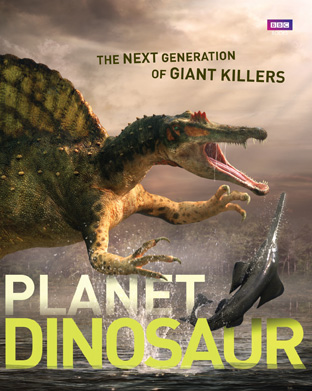
If Spinosaurus is one of your favourite dinosaurs, then read all about this huge, Cretaceous dinosaur in books about dinosaurs.  One of the best illustrations of Spinosaurus that we have seen this year can be found on the front cover of the book called “Planet Dinosaur”, a book that accompanies the television series of the same name.

Planet Dinosaur Book

Planet Dinosaur Spinosaurus Illustrated

The front cover of the book "Planet Dinosaur"

The front cover of the book “Planet Dinosaur”.

Picture credit: Ebury Publishing

To read Everything Dinosaur’s review of the Planet Dinosaur book: Planet Dinosaur Book Reviewed.

The front cover of this book shows the huge prehistoric animal called Spinosaurus fishing.  It is a beautiful illustration on the front cover of a dinosaur book.  If you are looking for dinosaur books for children check out Everything Dinosaur’s book range and other prehistoric animal themed items available from the company’s award-winning website.

Everything Dinosaur – dinosaur toys, models, books, games and clothing: Take a Look at Everything Dinosaur’s Website.

26 09, 2011

A Review of Planet Dinosaur – The Next Generation of Giant Killers in New Television Series

By |2024-04-22T13:38:29+01:00September 26th, 2011|Categories: Book Reviews, Dinosaur Fans, Everything Dinosaur News and Updates, Main Page|10 Comments

Planet Dinosaur – Book Review

The new dinosaur discoveries, the huge, the tiny, the weird and the wonderful are revealed in remarkable detail in this book “Planet Dinosaur – The Next Generation of Giant Killers” that has been produced to accompany the BBC television series.  Team members at Everything Dinosaur, were asked to write a review and true to our word here it is.

Planet Dinosaur

It is more than ten years since the ground-breaking BBC television series “Walking with Dinosaurs” was first broadcast on BBC1.  Now, 2011 brings the much anticipated “Planet Dinosaur” to our screens, an opportunity to highlight some of the amazing dinosaur discoveries that have been made over the last decade or so.  Accompanying the 1999 television series a book entitled “Walking with Dinosaurs – A Natural History” was published, in a continuation of this trend, BBC Books have produced a companion to “Planet Dinosaur” and what a visual feast it proves to be.

It may be just a blink in geological time since 1999, but this new publication is strikingly different from its predecessor.  For example, “Walking with Dinosaurs – A Natural History” followed the format of the television programmes very closely.  Each of the six chapters was dedicated to telling the story and introducing the prehistoric animals and the science behind them from a particular episode of the TV series.  “Planet Dinosaur – The Next Generation of Giant Killers”; in contrast, focuses on the prehistoric animals and the palaeontology, with the use of a graphic novel style layout to highlight elements taken from individual television programmes.

Each of the main protagonists from the television series is given its own double page fact file – a vast array of amazing prehistoric creatures many of whom have been discovered since 1999.  A highly detailed CGI image is surrounded by notes providing information about long extinct animals as diverse as Microraptor – a dinosaur that could glide and predator X a huge, marine reptile so new to science that it has yet to be formally named and described.

In contrast to the “Walking with Dinosaurs” publication,  the majority of the animals featured are described using their binomial scientific name, that is, the genus and species name as if to reaffirm the publisher’s desire to provide a strong scientific undercurrent to the narrative.

The Front Cover of “Planet Dinosaur”

The front cover of the book "Planet Dinosaur"

Dinosaurs help out with BBC research.

Picture credit: Ebury Publishing

A handy pronunciation guide is provided, a boon to parents and grand-parents who will no doubt be persuaded to read alongside their dinosaur obsessed younger family members.

An Excellent Book

One slight criticism we proffer in what is generally an excellent book, towards the end of the 238 pages there is a small section that attempts to place the prehistoric animals featured in the television series into context with geological time.  We could take issue with the dates given for some of the geological periods, indeed there seems to be some discrepancies over the dates given in this section with those stated in the introduction, but our main gripe is that the Triassic has been omitted from the time-line altogether.  This may be expediency on behalf of the publishers, as the television series focuses almost exclusively on the work of palaeontologists studying creatures that lived during the later part of the Mesozoic Era – the Jurassic and the Cretaceous.

Just as certain as planet Earth having been subjected to extraterrestrial impacts, this beautifully illustrated book will prove to be very popular amongst avid dinosaur fans.  Its clever combination of stunning images and scientific detail  will also intrigue and inform the casual reader, keen to see how the science of palaeontology and our understanding of the prehistoric world has moved on. Highly recommended.

For models of many of the prehistoric animals that are featured in this book: Safari Ltd. Dinosaur Figures and Prehistoric Animals.

25 09, 2011

An Exclusive Review of Planet Dinosaur – BBC Books

By |2024-04-22T13:35:19+01:00September 25th, 2011|Categories: Book Reviews, Main Page|0 Comments

Planet Dinosaur – The Next Generation of Giant Killers

A definite requirement for the Christmas stockings of dinosaur fans this book, published to accompany the six-part BBC documentary series “Planet Dinosaur” is packed full of information and facts about the prehistoric creatures featured in the programmes.

Planet Dinosaur

Broken down into six chapters, although not reflecting the format of the television episodes, this 238-page volume updates readers on the progress made by palaeontologists over the last ten years as they uncover new evidence about dinosaurs and other ancient creatures from the past.

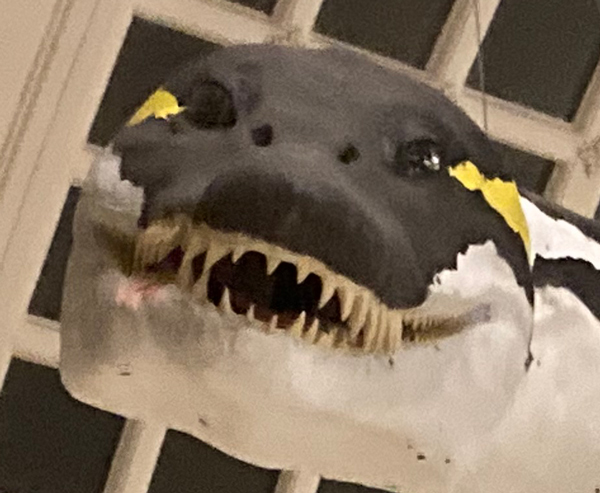
Despite the title, it is not just meat-eaters, or indeed dinosaurs that feature.  For example, there is an in-depth assessment of the fossil evidence to support Argentinosaurus (A. huinculensis), a herbivore, as being the biggest land animal known to science.  This book also features the marine reptiles Kimmerosaurus (k. langhami) and “predator X” – a giant pliosaur, so new it has yet to be formally described.

Pliosaurs Feature in the Book

"Deadly Doris" pliosaur replica.

A close-up view of the pliosaur that is suspended above the ground floor at the Bristol Museum and Art Gallery (Bristol, England). The life-size replica was nicknamed “Deadly Doris”. Picture credit: Everything Dinosaur.

Picture credit: Everything Dinosaur

The almost three-dimensional illustrations and the storyboard layout will appeal to dinosaur fans old and young alike.  This publication will also help to inform the curious reader interested in learning more about these long extinct creatures.  “Planet Dinosaur – The Next Generation of Giant Killers” helps to put the flesh on the bones of the animals featured in the television series.

For prehistoric animal models that represent creatures featured in the book: Age of Dinosaurs Prehistoric Animal Models (PNSO).

21 04, 2011

Review of the New “Prehistoric Times” (Spring 2011)

By |2024-04-21T09:58:55+01:00April 21st, 2011|Categories: Everything Dinosaur News and Updates, Magazine Reviews, Main Page|2 Comments

A Review of “Prehistoric Times” Magazine (Issue 97)

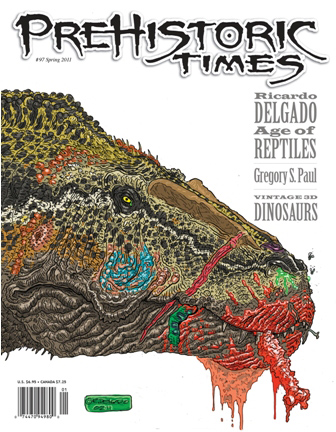
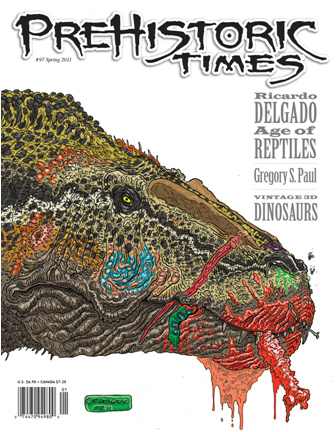
The latest edition of the magazine known as “Prehistoric Times” has just arrived in the office and what a bumper edition it is.  The front cover shows the rather gory features of an Acrocanthosaurus (theropod dinosaur), as drawn by that talented artist Ricardo Delgado, an interview with Ricardo is featured and his work on the “Age of Reptiles” story series is discussed.  Two often neglected but much admired prehistoric animals are in this magazine.

Firstly, there is Plateosaurus, that leviathan from the Triassic, Phil Hore provides an update on the latest research and information on this member of the Sauropodomorpha.  The second prehistoric animal featured, it is really a group rather than a spotlight on a single genus – is the champosaurs (Champosaurus), long lasting members of the Choristodera, with their crocodilian-like appearance.

“Prehistoric Times”

Gregory S. Paul sets out the latest scientific work on the azhdarchids (giant pterosaurs) and asks the question – were these reptiles bigger than giraffes?  The latest palaeontology news is dealt with in depth (anything that we at Everything Dinosaur have not reported on is covered here), and there is a special section on the genus Giraffatitan.

The Front Cover of “Prehistoric Times” (Issue 97)

“PT” for dinosaur fans.

Picture credit: Everything Dinosaur

The magazine includes lots and lots of contributions from readers, the latest dinosaur and prehistoric animal models plus book reviews and a special feature on how to model a Giganotosaurus.

To visit the “Prehistoric Times” website: “Prehistoric Times”.

One article we enjoyed reading in particular, was the spread on the Museu de Paleontologia de Marilla, in Brazil.  Dinosauria are truly a world-wide phenomenon – great pictures and plenty of information about this museum in Sao Paulo state.

6 04, 2011

Prehistoric Times – New Front Cover Issue 97

By |2024-01-01T17:29:39+00:00April 6th, 2011|Categories: Magazine Reviews, Prehistoric Times|0 Comments

Prehistoric Times Front Cover (Issue 97)

Team members at Everything Dinosaur are looking forward to receiving their next copy of the dinosaur and model collectors magazine “Prehistoric Times”

Sneak Peek of the Front Cover of Issue 97

The front cover of the next edition of “Prehistoric Times”.

Picture credit: Mike Fredericks

“Prehistoric Times”

Everything Dinosaur team members would like to thank the magazine’s editor Mike Fredericks for sending an email that highlighted the rather gory, but extremely colourful front cover of issue number ninety-seven.

Visit the “Prehistoric Times” website to subscribe to this quarterly publication: Prehistoric Times Magazine.

9 03, 2011

Taking Issue with Sir David Attenborough (Helpful Information)

By |2024-04-21T10:08:17+01:00March 9th, 2011|Categories: Book Reviews, Everything Dinosaur News and Updates, Main Page|0 Comments

First Life – Some Factual Errors

Just finished reading the book that accompanies the BBC television series “First Life” narrated by Sir David Attenborough.  First Life updates readers on the remarkable advances in our knowledge of how life first began on planet Earth.  Over the last fifty years or so, new research techniques and fossil discoveries have enabled scientists to gain a better understanding of how first evolved.  The book takes readers on a journey back in time to the key moments in the development of life on Earth, from the first single celled organisms through to the conquest of the land and the dominance of the arthropods in early terrestrial habitats.

The book is generally well written and provides an entertaining and informative read.

To see Everything Dinosaur’s review of this book: Book Review – “First Life”.

However, there are one or two interesting inaccuracies and anomalies that we have found in the text.  These sections of the book have led to more debate amongst our team members than any other part of what is, in general an excellent publication.

Sir David Attenborough

Firstly, in chapter 10, entitled “Landfall: The Worm that Walks”, part of the book dedicated to the conquest of the land by the first land living invertebrates, on pages 252-253 there is a computer generated image of an ancient marine ecosystem.  This seems somewhat out of place when considering the context of the chapter.  The scene shows a number of primitive marine organisms including Opabinia and Wiwaxia, creatures associated more with the Cambrian than with the geological time period when arthropods were first venturing out onto dry land.  At least the fossil evidence does not suggest land fall as early as the Cambrian Period.

Secondly, when discussing the success of the Insecta, the book states that insects have adapted to a whole range of different habitats. We don’t doubt the validity of this particular statement, but the narrative specifically refers to insects in marine environments.  In essence, despite their tremendous diversity very few insect genera have been able to adapt themselves to a truly marine, pelagic way of life (pelagic – living above the sea floor).  This lack of insects in truly, entirely marine environments is a puzzle for scientists.

In addition, in the final chapter – “Taking Wing: End to an Era”, there is a section that contrasts the internal skeleton of vertebrates with the exoskeletons of invertebrates. A rhinoceros is compared to a rhinoceros beetle.  We admit, some important points are made over the advantages and disadvantages of each type of support structure for an animal. However, when concluding this segment the writer states:

“The rhino, however, has an internal skeleton to give it strength and structure.  This skeleton grows with the rhino and is constantly replenished and strengthened throughout the rhino’s lifetime.  The rhino will never need to shed its skin, and so it is able to grow to an enormous size.  At full size, it grows to become the largest terrestrial creature on Earth, a feat that the beetles could never achieve.”

This is a surprising statement, although the several species of rhinoceros alive today are very large, the biggest, heaviest terrestrial vertebrate in our opinion would be the African elephant.  It seems strange that such a well researched and carefully compiled publication would include a number of mistakes.    Although we noted these occurrences it did not stop us enjoying what is an excellent book to accompany the BBC television series.

For models of even larger animals from the fossil record including dinosaurs and giant relatives of modern rhinos like Paraceratherium: Dinosaur and Prehistoric Animal Models.

20 01, 2011

Review of the New Prehistoric Times (Winter 2011)

By |2024-04-21T11:58:57+01:00January 20th, 2011|Categories: Dinosaur Fans, Magazine Reviews, Main Page|0 Comments

Review of Prehistoric Times (Issue 96)

Our copy of Prehistoric Times arrived yesterday, a chance for us to catch up on all things related to prehistoric animal models and palaeontology, plus it reminded us to forward on to the editor some new pictures of the Papo “Dinosaures” releases for 2011.

Prehistoric Times

The front cover of the latest edition of Prehistoric Times features the bizarre, gigantic South American extinct rodent Josephoartigasia as painted by James Gurney.   Described as a cross between a “pig and a rhinoceros”, the author and illustrator of the Dinotopia series comments in a brief article, how he went about creating this artwork.  In another section, James outlines how he went about creating a prehistoric scene showing Titanoboa (the largest snake known to science) constricting a large crocodile.

The Front Cover of Prehistoric Times (Winter 2011)

Picture credit: Mike Fredericks

There is a special feature on those cursorial ornithomimosaurs with lots of artwork and illustrations submitted by readers and it is great to see an extensive and highly informative article on that often over looked group of animals the prehistoric giraffes (no pun intended, as if you could literally overlook a giraffe).

A very handy, double page spread written by the excellent Steve Brusatte of the American Museum of Natural History/Columbia University which highlights some of the most important palaeontological news stories of the last year, plus an informative report on the exhibits to be found at the Field Museum (Chicago) can be found in this edition.

Wonderful to read the article about dinosaur colouring books and how they have changed over the last twenty-five years and we were excited to see that there is going to be a re-issue of that amazing Tyrannosaurus rex 1:13 scale model produced originally by Aurora models back in the 1970s.  One of our team members has this kit somewhere, perhaps we should rebuild it, complete with its glow in the dark teeth and set it up in our boardroom.

Once again, a jam-packed edition and a credit to all the writers and illustrators concerned.

To visit Prehistoric Times website: Prehistoric Times.

2 01, 2011

Review – David Attenborough’s “First Life”

By |2023-03-06T14:43:57+00:00January 2nd, 2011|Categories: Book Reviews, Main Page|1 Comment

A Review of the Book – “First Life”

Designed to accompany the two-part television series, “David Attenborough’s First Life” covers the billions of years of time, leading up to the development of advanced forms of life on our planet.  It is a chronological journal, split into eleven chapters that tells the story of the “slow burning fuse” that led to the explosion of life in the Cambrian, the development of the Phyla of organisms that are still with us today.

“First Life”

The text is informative, not too technical and designed for the lay person to follow.  There are many splendid photographs and lots of information on the fossil locations, although it would have been interesting to read more about some of the UK fossil locations such as Crail in Scotland and perhaps there are too few scary creatures for children to enjoy.  Although, it is amazing to see the strange and wonderful creatures known as the Ediacaran fauna (soft-bodied, bizarre organisms).

By the Late Precambrian, around six hundred million years ago, simple food chains had become established with over thirty different genera recognised, this simply ecosystem is known as the Ediacaran fauna after the Ediacara Hills, north of Adelaide in South Australia, where a variety of Late Precambrian fossils were discovered in the late 1940s.

The introduction, written by Sir David Attenborough, really brings out his passion for fossils and fossil collecting.  The highlight of the book, was reading about Sir David’s own connection with Charnwood forest, the site in Leicestershire, the county of Sir David’s childhood, where the important Precambrian fossil Charnia (Charnia masoni) was discovered.

Academic Content and Computer Generated Wonders

At over 285 pages in length, this book provides an appropriate balance between academic content and computer generated wonders.  One of the features of this book, are the extreme close up photographs of important fossils.  The vast majority of fossils from the Precambrian and the Cambrian geological period are extremely small, but the highly magnified and full colour photographs really help to bring the fossil evidence “to life”” as it were.  The reader is treated to some wonderful images, illustrations of the primitive sea landscapes and some excellent computer generated impressions and graphics as to what the fauna and flora of the Burgess Shale site might have looked like (British Columbia, Canada).

Trilobites Feature in the Television Series “First Life”

The definition of benthic.  A pair of trilobite fossils. Trilobites feature in the televison programme "First Life".

Trilobite fossils (Calymene).  Picture credit: Everything Dinosaur.

Picture credit: Everything Dinosaur

So in summary, a good book, an interesting read, perhaps not ideally suited for children but a fitting tribute to the work of scientists and to Sir David himself.

Prehistoric Animal Replicas

To view models and replicas of trilobites and other ancient creatures: CollectA Prehistoric Life Models.

Go to Top