All about dinosaurs, fossils and prehistoric animals by Everything Dinosaur team members.

Book reviews and information on dinosaur books by Everything Dinosaur team members.

26 08, 2013

Pterosaurs by Mark P. Witton – A New Book Review

By |2024-05-01T14:42:02+01:00August 26th, 2013|Categories: Book Reviews|1 Comment

Pterosaurs Reviewed

Amongst the myriad of books published on the subject of long extinct creatures, it is the dinosaurs that seem to have had the lion’s share of the limelight, their Mesozoic contemporaries the pterosaurs, have largely been overlooked.

However, this new publication, written by palaeontologist and science writer Mark Witton entitled “Pterosaurs” goes a long way to redressing this imbalance.  These “winged lizards”, as that is what the term pterosaurs means once translated from Greek, were the first vertebrates to develop powered flight, nothing like them exists today but thanks to Mark’s skilful writing accompanied by a number of his own original paintings and some exquisite close up shots of these enigmatic animal’s beautifully preserved fossil remains, the reader is rapidly brought up to date with developments in flying reptile research.

Pterosaurs by Mark Witton

The book is essentially split into three distinct parts.  The first nine chapters are dedicated to providing a broad understanding of pterosaur evolution, the fossil evidence, their flight abilities and locomotion.  If you have ever wondered how an animal as tall as a giraffe could possibly get off the ground, or where the Pterosauria fit into the Sauropsida (reptiles and birds) family tree, then these pages will go a long way to providing you with the answers.

The bulk of the rest of the book is then dedicated to introducing and discussing the numerous pterosaur groups currently recognised by the majority of “Pterosaurologists” and what a bizarre, eclectic collection the pterosaurs prove to be.  From the stout jawed, long-tailed Dimorphodontidae, through to the flamboyant Tapejaridae culminating in those giraffe-sized azhdarchids, Mark attempts to introduce each group roughly in chronological order, focusing first on the earliest types of pterosaurs and concluding with the very last of their kind.

Flying Reptiles

Most members of the public can recognise one or two types of flying reptile, thanks largely to their role as flying terrors in films, on television and the ubiquitous use of Pteranodon as a flying reptile model included in most dinosaur toy sets.  By the end of chapter twenty-five, the reader has been given a comprehensive run down of the cast of characters that currently make up the Pterosauria Order.

Pterosaurs – Natural History, Evolution, Anatomy by Mark P. Witton

A very well researched and documented publication from an authority on the Pterosauria.

A very well researched and documented publication from an authority on the Pterosauria.

Picture credit: Mark Witton

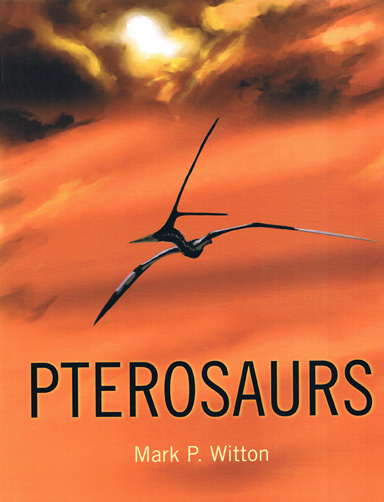
The picture above shows the front jacket illustration, the pterosaur featured is the “antler crested” Nyctosaurus (chapter 18).

Pterosaur Fossils and Discoveries

Some knowledge of biology, anatomy and scientific terminology would be useful, but to Mark’s credit he works hard to simplify and explain the nuances of these bizarre creatures in a language that enables the lay person to follow the points that are being made without necessarily dumbing down the scientific tone of the book.  From our own perspective, with some knowledge of vertebrate palaeontology already, we found some of the details on the latest fossil discoveries, most notably from the Crato Formation (Brazil) and China’s Jiufotang Formation truly enlightening.

In each chapter dedicated to a specific type of pterosaur, Mark provides a skeletal reconstruction and life restoration of a typical member of this part of the pterosaur family tree.  This permits the reader to flick backwards and forwards thus comparing the different anatomical features of each type of pterosaur with relative ease.  A personal bugbear of ours, a fault found in many a technical tome on palaeontology that attempts to reach out to a wider audience, that of having illustrations supporting points made in the text, placed on subsequent pages and not adjacent to the text that the illustration refers to, is largely avoided.

The excellent drawings and diagrams, including a number of Mark’s own paintings help to explain some of the more complex points made.

How Did They Fly?

One diagram that we found ourselves constantly referring to occurs in chapter six, the part of the book that attempts to answer the most fundamental questions regarding the Pterosauria, why did they fly and were they any good at it?

The author has very helpfully reproduced a graphical representation that compares and contrasts pterosaur wing loadings and aspect ratios with modern fliers (birds and bats).  From this single graph, the reader is given the opportunity to view the different morphologies of pterosaurs in terms of their adaptations to certain types of aerial activity.  Thus, one can see at a glance those members of the Pterosauria that most likely filled an ecological niche similar to some of today’s sea-birds as marine soarers as well as those flying reptiles more adapted to inland, arboreal habitats where they filled an ecological niche similar to extant aerial predators.

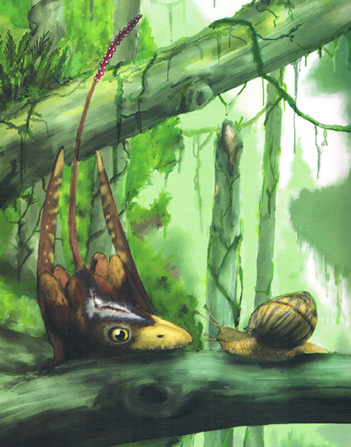
A Curious Sordes pilosus investigates a Late Jurassic land snail

Eyeing up a potential meal?

Eyeing up a potential meal?

Picture credit: Mark Witton

The book has an extensive reference section, inviting the reader to explore the world of the Pterosaurologist further.  A couple of small quibbles on our part, a glossary of terms at the back of the book would have been helpful as would a Pterosauria pronunciation guide but apart from these ever so minor points, Mark is to be congratulated for casting a comprehensive spotlight onto these remarkable reptiles.

The last chapter of “Pterosaurs” deals with the decline and final extinction of these leathery-winged creatures, although a little brief, it does leave the reader with a real sense of loss.  These were not the misfits of vertebrate evolution, not simply a stop-gap before the Aves could step into their flying boots and dominate the skies, the book does much to change attitudes towards the Pterosauria.  Yes, they were bizarre, but as a group they persisted for something like 150 million years, a lot longer than us hominids and that’s a sobering thought.

Highly recommended.

For models and replicas of pterosaurs and other ancient creatures: Wild Safari Prehistoric World Models.

22 07, 2013

New Prehistoric Times Issue 106 Reviewed

By |2024-01-01T17:27:46+00:00July 22nd, 2013|Categories: Magazine Reviews, Prehistoric Times|1 Comment

A Review of the Summer 2013 Edition of Prehistoric Times Magazine

The first prolonged period of hot, summer weather in the UK for quite a while has been made all the more enjoyable with the arrival of the latest edition of “Prehistoric Times”, the magazine for dinosaur model fans and prehistoric animal enthusiasts.  It is ideal reading material for sitting outside the office and soaking up some sunshine, if only the other Everything Dinosaur team members would let go of the magazine for long enough.

“Prehistoric Times”

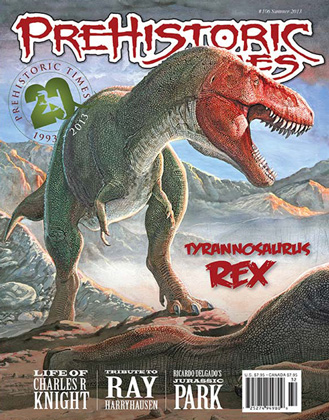
This issue (number 106), marks the first copy to be produced after the twentieth anniversary issue and it sets the standard for the next two decades with some excellent articles and features.  The two prehistoric animals given most prominence are Tyrannosaurus rex and the “T. rex” of its day the fearsome Triassic predator Postosuchus.  We expect that Mike Fredericks, the editor would have been swamped with artwork and indeed, lots of reader’s illustrations are featured, especially of T. rex.  There are some wonderful depictions, even feathered versions of T. rex.

How to Draw Dinosaurs

Tracy Lee Ford’s excellent series, “How to Draw Dinosaurs” focuses on this apex predator.  He compares the arm bones of Tyrannosaurus rex with those of other Tyrannosaurids and sets about building up a picture of a powerful predator with exceptionally strong hind legs, a deeper body and a more massive tail.  He concludes that such a dinosaur was not a particularly fast runner, but still an immensely capable and powerful opportunistic hunter.

Amongst all the collector news and model releases, there is a special tribute to Ray Harryhausen, whose stop motion special effects amazed us all in such fantastic films as  “Jason and the Argonauts”, “The Valley of the Gwangi” and “Clash of the Titans”.  Ray sadly passed away on May 7th, William Stout has produced a super article with artwork in tribute to Ray and there is a model diorama of the monster from the 1953 film “The Beast from 20,000 Fathoms”, it looks like lighthouses were not monster proof!

Front Cover Artwork

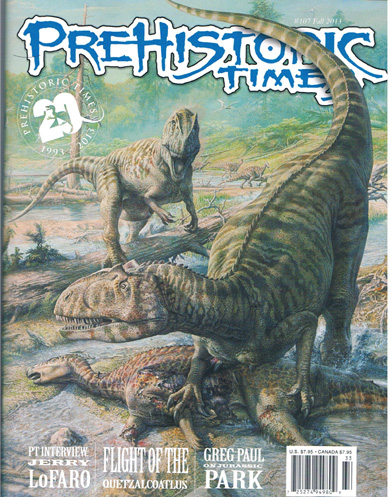
The front cover artwork (featuring T. rex), was created by up and coming Ukrainian artist Sergey Krasovskiy.  Sergey has chosen to depict this fearsome Late Cretaceous carnivore with a conspicuous red head ala theories from Bob Bakker et al.  Sergey also contributes to the feature on Postosuchus with some great drawings of Prestosuchus chiniquensis, Ornithosuchus longidens and Postosuchus kirkpatricki.

The Front Cover of Prehistoric Times – Summer 2013

Marking the 20th anniversary of the magazine.

Marking the 20th anniversary of the magazine.

Picture credit: Prehistoric Times/Everything Dinosaur

Life-size Prehistoric Animal Models

There are also articles on the life-sized prehistoric animal models sculpted by Josef Pallenberg, updates on dinosaur discoveries and a special interview with artist Ricardo Delgado, part of a series the commemorates twenty years since the first Jurassic Park movie.  Team members at Everything Dinosaur even spotted some prehistoric animal drawings that we know very well in this edition and it was particularly interesting to see how clever Steven B. DeMarco “made over” three dinosaur model kits which were manufactured by Pyro many moons ago.

Once again, a great magazine and a great read.

To view the “Prehistoric Times” website: Prehistoric Times.

16 04, 2013

New Prehistoric Times Magazine (Spring 2013) Reviewed

By |2024-04-29T13:36:34+01:00April 16th, 2013|Categories: Magazine Reviews|0 Comments

A Review of “Prehistoric Times” Magazine (Issue 105)

The weather has at last improved, we can say goodbye to the chilly easterly breeze and say a warm welcome to the spring edition of “Prehistoric Times” magazine.  Yes, spring has finally come and it is marked by the arrival of the spring edition of Prehistoric Times, a magazine that provides news and views on anything and everything to do with prehistoric animals.

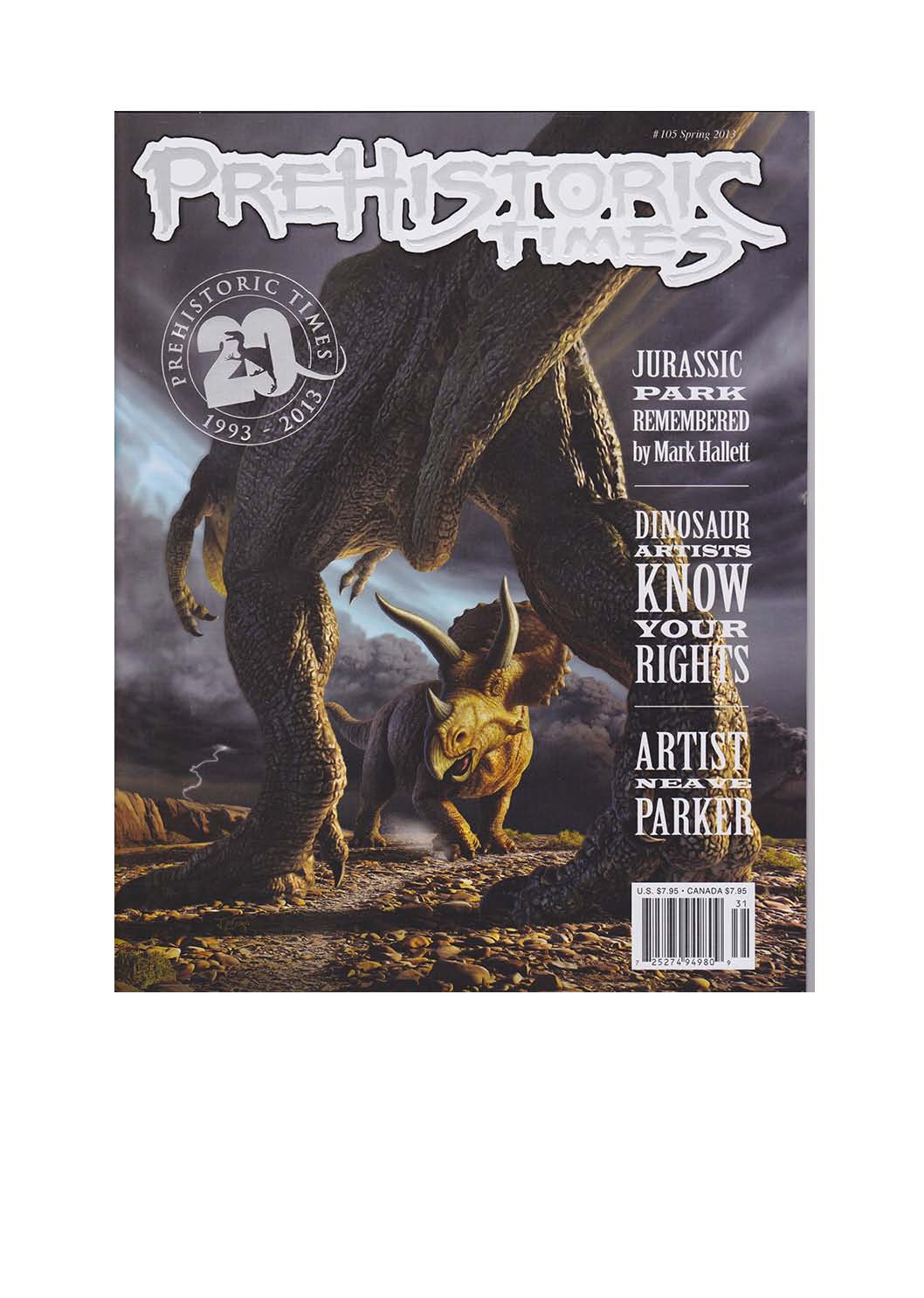
The Front Cover of “Prehistoric Times” (Issue 105)

T. rex faces off against a Triceratops.

T. rex faces off against a Triceratops.

Picture credit: Mike Fredericks

Prehistoric Times Magazine

Issue 105 is the 20th anniversary of the first edition of this quarterly publication.  Coincidently, 2013 is also the 20th anniversary of the premier of the dinosaur film “Jurassic Park” and there are special features on both inside this issue.  Editor Mike Fredericks provides a potted history of the publication, a fascinating insight into what has become an institution for “dino-philes”.  Dotted throughout the article are contributions from other regular writers and it was interesting to read how they met Mike and started to work with him on various projects.  The feature entitled “Sketch me a Spitter”, pays homage to Jurassic Park the movie, and renowned artist Mark Hallett recalls his work on the film working as a concept artist and palaeo consultant.  There are some wonderful illustrations of the theropod dinosaurs that appeared in the first of the Jurassic Park trilogy.  If you have always wanted to know how the venomous dinosaur that killed the character known as Dennis Nedry, came about then read this article and all will be revealed.

Triceratops Featured

The first of the prehistoric animals featured in this issue is Triceratops and the magazine includes lots and lots of artwork sent in by readers. Phil Hore provides a very informative article on this famous horned dinosaur and even Tracy Lee Ford gets in on the act with a superb piece in his long running series “How to Draw Dinosaurs”.  The morphology of the skull and horns changed as ceratopsians got older.  He kindly summarises the main points to remember when it comes to illustrating juveniles, mature adults and very old specimens of Triceratops.  There is also a rare picture of a Triceratops skull in situ, discovered by the famous palaeontologist George Sternberg in 1908.

Amongst the usual items such as correspondence from readers, collectors corner, book reviews and updates on new model introductions, Ron Lemery provides information on a technique known as photoetching, a great way to build detail into dinosaur themed model scenes.  Talking of models, Steven B. DeMarco showcases how to make and paint a fearsome mosasaur, a marine reptile he aptly refers to as “Mosa Jaws”!

The second prehistoric animal to feature prominently in this edition of “PT” is the fearsome, highly resourceful Dire Wolf (Canis dirus).  Phil Hore writes a very entertaining piece explaining the differences between the Dire Wolf and the Grey Wolf and discusses their fossil record including the exquisitely detailed specimens that have been retrieved from the La Brea Tar pits in Los Angeles (California, USA).

To learn more about this excellent publication: Visit Prehistoric Times Website.

For slightly older dinosaur fans there is a very insightful article written by Allen A. Debus on the beautiful post card illustrations of Neave Parker, a real trip down memory lane when looking at the wonderful black and white illustrations of the various prehistoric animals.

Jam packed full of dinosaur themed goodies, issue 105 of Prehistoric Times is definitely a ” must read” and on this form we can expect this publication to keep on going for at least another twenty years.

Well done to all involved.

17 03, 2013

A Review of Deposits Magazine (Spring 2013)

By |2023-02-13T17:36:03+00:00March 17th, 2013|Categories: Magazine Reviews|0 Comments

Deposits Magazine (Issue 33) Reviewed

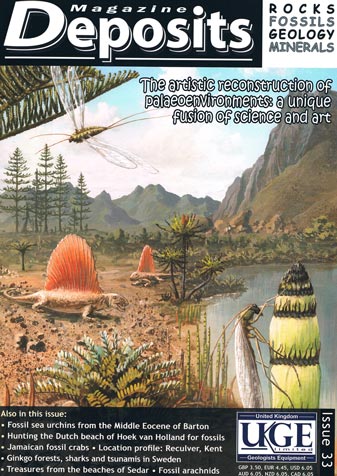
The spring edition of the magazine for geologists, mineralists and fossil fans has duly arrived and this UK produced magazine certainly packs a punch with issue 33.  The front cover shows an artist’s interpretation of the palaeoenvironment of Russia during the Late Permian.  This is an example of the artwork of Lyme Regis based illustrator Richard Bizley and inside there is a highly informative article all about Richard’s work re-creating prehistoric and alien landscapes.

Richard likes to focus on some of the unsung heroes from the fossil record.  His landscapes feature a whole range of prehistoric animals and plants, the fauna and flora depicted all painstakingly researched to ensure accuracy.  The artwork is truly stunning and the detail simply exquisite.

The Front Cover of Deposits Magazine (Spring 2013)

A huge array of topics covered inside.

A huge array of topics covered inside.

Picture credit: Everything Dinosaur

Deposits Magazine

Visitors to Holland can perhaps be inspired about an article about hunting for Ice Age fossils on the Dutch beach of Hoek van Holland. It seems that land reclamation and construction work to prepare sea defences leads to a lot of material being dredged up from the bottom of the North Sea – amongst the sand there are many fossils of prehistoric mammals that get deposited on the beaches of this low-lying country.

Fossil hunters can find teeth of Woolly Mammoths, bones from Woolly Rhinos (Coelodonta) and even Mesolithic spear tips and fishing harpoons.  Further afield, there are very well illustrated articles on fossil hunting for Mesozoic aged fossils including beautiful Ginkgo fossils in southern Sweden and a fascinating article on Jamaican fossil crabs.  Decapod crustaceans (crabs) have got their own army of dedicated fossil collectors who specialise in collecting specimens of these arthropods.  The article outlines the types of fossil crabs that can be found on the Caribbean island of Jamaica.  The handy glossary of terms presented at the end of the article helps the uninitiated to gain an insight into just how fascinating collecting fossils of crabs can be.

Arachnid Article

Arachnids, the likes of spiders, mites, scorpions and their near relatives have a large article dedicated solely to them in this issue of Deposits magazine.  This feature jointly written by Dr David Penney (University of Manchester) and Dr Jason Dunlop, the curator of myriapods and arachnids at the Berlin Natural History Museum is extremely comprehensive and packed with beautiful photographs and computer enhanced images.  As artist Richard Bizley loves to incorporate Arachnids into his artwork it makes perfect sense to include a detailed review of the Arachnid fossil record in the same issue as a feature on the artistic reconstruction of palaeoenvironments –  a unique fusion of science and art.

The magazine provides book reviews, including a couple on the volumes published to help walkers explore the Jurassic coast of southern England, lots of news stories and there is even a feature on fossil amber found in Scotland.  For those prepared to get out and about this spring there are articles on hunting for Middle Eocene sea urchins and a detailed review of the fossils to be found on a visit to Herne Bay in Kent.

Update on Recent Fossil Discoveries

For readers who live in Colorado (United States of America), there is an update on some of the rare, recent fossil discoveries from the famous Morrison Formation of western North America.    A rare fossil of a gastropod (snail) has been discovered, it has been turned to agate over millions of years (shell replaced by the mineral agate).  Dinosaur fossils may make the headlines but this snail fossil provides scientists with valuable evidence to help reconstruct life in freshwater habitats during the Late Jurassic.

All in all, this is an excellent magazine that covers a whole range of subject areas of interest to palaeontologists, geologists, mineralists and fossil fans.  The articles are written in a way that allows the layperson to follow what is being said with scientific terms reduced to a minimum.  Issue 33 of Deposits magazine is well worth reading.

Visit Everything Dinosaur’s award-winning website: Everything Dinosaur.

31 01, 2013

New Mini Dinosaurs Triceratops Book Reviewed

By |2024-04-29T10:28:35+01:00January 31st, 2013|Categories: Book Reviews|0 Comments

A Review of the Mini Triceratops Dinosaur Book

An ideal book for very young dinosaur fans, the Mini Dinosaurs Triceratops pop up book has been cleverly designed and written in such a way as to help children from three years and upwards with their reading.  It even features a big, blue Triceratops, this inclusion alone, will make this publication a firm favourite amongst budding palaeontologists.

Dinosaur Book

This book is part of a series, with each one of these hardback books featuring a different dinosaur.  There is a Tyrannosaurus rex, a Stegosaurus and even one about the long-necked, giant sauropod now known as Apatosaurus.  It is to the publisher’s credit that they have chosen to explain why the dinosaur formerly known as Brontosaurus is now referred to as Apatosaurus, this demonstrates the writer’s commitment to ensuring that even these children’s books contain some factual content.

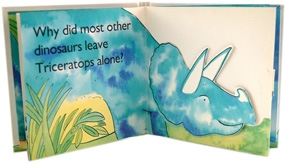
The Mini Dinosaurs Triceratops book, is very colourful and each page shows a picture of at least one, blue Triceratops with questions about this horned dinosaur.  The questions are just the sort of question that a curious three or four year old might ask, an example being “what did Triceratops eat?”   On the page where this question is featured, the reader can then lift the flap which represents the mouth of this Late Cretaceous dinosaur and the answer is revealed.

The Mini Dinosaurs Triceratops Book

A friendly, blue Triceratops

Picture credit: Everything Dinosaur

The Font Helps Children

The words are written in a large, easy to follow black font.  This font will help young children to recognise letters and words and to assist them with their reading.  For the parent or grandparent that reads the book along with the child, the inside of each page flap that is lifted to reveal the answer to a question posed contains more information to help explain the answer given.  So for instance, when the question about the diet of this particular dinosaur is asked the adult can read the additional information about Triceratops on the inside of the page flap and this can be used to help explain the answer to the young child.

To view Everything Dinosaur’s range of dinosaur and prehistoric animal themed gifts and toys: Visit Everything Dinosaur.

Although the book is small, it has been designed so that little hands can grasp it and turn the pages.  The front and back covers have also been laminated, an excellent idea as this enables the book to be kept free from any sticky finger marks with just a wipe from a damp cloth.  At the back of this little publication there is a large, paper Triceratops that can be created, simply unfold the Triceratops by pulling the body portion of the page towards you and folding down the legs.

A Blue Triceratops for Young Readers

The fold out Triceratops model featured in the book.

Have fun learning about dinosaurs.

Picture credit: Everything Dinosaur

This is a very clever little dinosaur book about Triceratops, one of the most popular of all the dinosaurs, especially with very young children.  It is set out in such a way as to help young children with their reading development and the fun questions and answers do have a basis in the knowledge scientists have about this horned dinosaur.

Note

Following a revision of the diplodocids, Brontosaurus is now regarded as a valid genus.

22 01, 2013

New Mini Dinosaurs Stegosaurus Dinosaur Book Reviewed

By |2024-04-29T06:01:01+01:00January 22nd, 2013|Categories: Book Reviews, Educational Activities, Product Reviews|0 Comments

A Review of the Mini Dinosaurs Stegosaurus Dinosaur Book

It is often quite a task to find a suitable dinosaur book for kids, when looking for something to help them with their reading.  Many parents try to encourage young children to develop a love of books by encouraging them to read books about subjects that they have a natural affinity for.  Many children under three years of age develop an interest in and a fascination for dinosaurs and other prehistoric animals, so finding a book about dinosaurs aimed especially at their age group can be a real boon for parents.

Dinosaur Book

The Mini Dinosaurs Stegosaurus book is a delightful little hardback that ticks all the boxes as far as parents and very young dinosaur fans are concerned.  After all, a book that features a purple Stegosaurus is bound to be well received by very young palaeontologists.

The Mini Dinosaurs Stegosaurus Book

A book featuring a purple Stegosaurus.

Picture credit: Everything Dinosaur

This book is part of a set of dinosaur inspired books all aimed at children from approximately three years of age and upwards.   As the pages are turned a question about the dinosaur Stegosaurus is presented.  The text is printed in a very clear, large, black font so very young children can easily make out the words and work out what the sentence is.  Parents and grandparents can read through the book with their young charges, turning the pages to discover what questions are being posed about this particular armoured dinosaur from the Late Jurassic.  The answers can be found by lifting a flap, part of the animal’s body such as the plate covered back, the legs or the famous tail with its set of spikes on its end.

A Book for Very Young Dinosaur Fans

The adult can read through the book with the child, lifting the flap to reveal the answer to the question posed on that page about Stegosaurus.  For instance, one of the questions presented is why did Stegosaurus have big feet?  By lifting up the front leg of the picture of the Stegosaurus on that page, the answer is revealed.  There is even a little more information to be found on the inside face of each answer flap, this helps the grown-up to explain the answer to the child and provides some facts about Stegosaurus to support the information given.

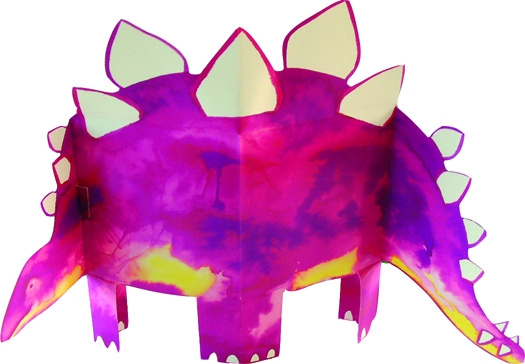
The bright purple, friendly Stegosaurus certainly appeals to very young children, and the tough hardback cover means that the book can be wiped clean should any sticky hands touch it.  The spine of the book is quite thick and this makes it easy to grip, especially helpful when young children try to use the book on their own.  Best of all, in the final section of this book there is a large, purple Stegosaurus cut-out for the children to unfold.  By pulling the middle portion of the Stegosaurus drawing towards them and unfurling the tail a large stand-up drawing of a Stegosaurus is revealed.

Lift and Fold to Reveal the Cut-Out Stegosaurus

The fold out Stegosaurus model featured in the book.

Picture credit: Everything Dinosaur

The book has been carefully thought about by the design team and the publishers and it makes an ideal “my first dinosaur book” for a budding dinosaur enthusiast.  The simple layout and easy to read text will encourage children with their reading and word recognition and the fun questions and answers are based on what scientists think they know about this long extinct member of the Dinosauria.  Recommended for children from three years plus, a very suitable dinosaur book for kids.

To view Everything Dinosaur’s range of dinosaur themed toys and gifts: Dinosaur Themed Gifts and Toys.

19 01, 2013

A Review of Prehistoric Times Magazine (Winter 2013)

By |2023-02-12T06:11:55+00:00January 19th, 2013|Categories: Magazine Reviews, Prehistoric Times|0 Comments

“Prehistoric Times” Issue 104 Reviewed

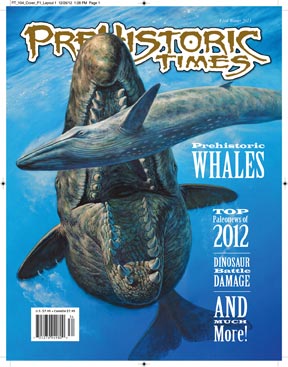
The winter edition of “Prehistoric Times” is certainly a treat for prehistoric animal model collectors and general enthusiasts for all things prehistoric. On the front cover there is a fantastic illustration of Leviathan melvillei, a huge, prehistoric whale which was an apex predator of Miocene seas, preying on other smaller cetaceans.  This was the “whale that ate other whales”  and the artwork that adorns the front cover shows this sea monster attacking a baleen whale.  As the genus name Leviathan has already been assigned to another type of animal (Mastodon), the name Leviathan melvillei has been changed to Livyatan melvillei, the original hebrew spelling of the word.

Issue 104 of “Prehistoric Times” (Winter 2013)

Meet a “Leviathan”!

Picture credit: Mike Fredericks/Everything Dinosaur

Inside the Magazine

Inside the magazine there is a very detailed article by Phil Hore on prehistoric whales, their evolution from land living mammals and their radiation into the many types of large, extant cetacean seen today.  The second prehistoric animal to be featured in this publication is Troodon, the dromaeosaur dinosaur which is regarded by many palaeontologists as being one of the most intelligent of all the known members of the Dinosauria.  Readers are asked to send in their artwork and other illustrations of the prehistoric creatures featured in the magazine.  The editor remarks in his editorial column that much to his surprise a lot more artwork featuring prehistoric whales was sent in than for the troodontids.  This might be because this is the first time in all one hundred plus editions of the magazine that prehistoric whales have been featured.

The pictures sent in, both of the troodontids and the prehistoric whales are really good and some noteworthy illustrations include those by Simon Zoppe (Dorudon) and Wade Carmen (Janjucetus), plus a superb Troodon, full colour print by Raul Martin.

To subscribe to Prehistoric Times Magazine: Prehistoric Times Magazine.

Tracy Lee Ford contributes with the second part of his excellent piece on how to draw dinosaurs with a focus on pathology found in ceratopsian dinosaurs.  In this article, the author discusses the work of Happ et al (published 2008) who describe a Triceratops skull that is  missing about thirty percent of its left brow horn.  There are deep gouges on the skull in the area surrounding the horn and on the remaining horn core material.  It has been suggested that the horn was bitten off by an attacking Tyrannosaurus rex.  To find out more about what such injuries can reveal about the behaviour of dinosaurs, the rest of Tracy’s excellent article is well worth reading.

Early Illustrations of Megalosaurus

Allen A. Debus provides a fascinating article on the early illustrations of Megalosaurus, the very first genus of dinosaur to be scientifically named and described.  This feature evidently took a lot of researching as some of the illustrations shown date from more than 120 years ago.  There is also a section on what new prehistoric animal models are due to be launched this  year plus a review of the big news stories in palaeontology over the last few months or so.

“Prehistoric Times” Magazine

Model maker Steve DeMarco lets us into a few secrets about how to create paint effects like a professional when painting dinosaur models and there is a review of a European dinosaur theme park, plus book reviews and an in depth interview with the highly talented artist Terry McKee.

All in all a highly informative and educational publication which caters for the discerning prehistoric animal model collector.

5 01, 2013

New Mini Dinosaurs Apatosaurus Dinosaur Book Reviewed

By |2024-04-29T06:06:22+01:00January 5th, 2013|Categories: Book Reviews, Educational Activities, Everything Dinosaur Products, Product Reviews, Teaching|0 Comments

Lift the Book Flap and Find an Apatosaurus 

Finding a book that is tactile, just the right size for small hands to hold and helps young children with their reading can be a challenge, but the Mini Dinosaurs – Apatosaurus book fits the bill nicely.  In addition, there is a surprising amount of factual information about the dinosaur known as Apatosaurus within this little hardback book.

Dinosaur Book

Assisting children with their reading skills is an important task.  It can help young children prepare for more formal schooling when they enter the education system and even very young children can soon learn to recognise the letters of the alphabet and the sounds that these letters form, all part of helping to teach reading using phonetics and other cognitive processes.  Starting them off early can help a child to develop a lifelong appreciation of books and the enjoyment of reading.

The Mini Dinosaurs Apatosaurus Dinosaur Book

Mini Dinosaurs Apatosaurus explains about the Dinosaur name change.

Picture credit: Everything Dinosaur

Choosing appropriate reading matter is important.  A book about a dinosaur, one that is designed with young readers in mind, is especially helpful, many children at around three years of age are beginning to show an interest in dinosaurs and other prehistoric creatures.  Reading about dinosaurs will help to engage the child and will help them to develop through their own imaginative, creative play.

Mini Dinosaurs Apatosaurus Book

The Mini Dinosaurs Apatosaurus book is a tough, hardback so it is ideal for use with young children from three years of age.  Both the front and back covers are laminated and can be wiped clean with a damp cloth, very helpful of the book designers to do this as this avoids damage to the book by sticky fingers.  On the front of the book is a bright green Apatosaurus and the book cover explains that this dinosaur was formerly called Brontosaurus.

Why a change in a dinosaur’s name?  The explanation is simple, a dinosaur was named from some fossil bones found in the state of Colorado in the late 1870s.  This dinosaur was called Apatosaurus (the name means “deceptive lizard”).  Brontosaurus was named from fossils found in the same part of the United States a couple of years later.  However, a subsequent re-examination of the fossils led scientists to conclude that their discoveries did not represent two different genera, but just one.  Since Apatosaurus was named first, under the laws laid down for the scientific naming of organisms the Apatosaurus name took precedence.  The book therefore tells a story about Apatosaurus, the dinosaur that was formerly known as Brontosaurus.

The book contains simple sentences laid out in a large, easy to follow font.  All the text is in black and bold to help young children follow the letters more easily.  This miniature dinosaur books poses questions for the child and the adult reader to explore, for instance, Why did Apatosaurus have a long neck?  Why did Apatosaurus have such thick legs?  If you lift up the clever flap on the picture of this dinosaur coinciding with the question page, the answer is revealed.  The answers are given in bold, easy to read text so that the child may read the answers.  For the grown-up, on the flap itself there is some helpful extra dinosaur information provided so that the adult can more fully explain the answer given.

To view Everything Dinosaur’s range of dinosaur themed learning materials: Dinosaur Crafts and Educational Toys.

By unfolding the card inserts to be found at the back of this little book, a picture of large, green, friendly-looking Apatosaurus can be created.  This is a cleverly designed little book about dinosaurs that will help young children with their reading skills as well as delighting them with the dinosaur information that it contains.  An excellent first dinosaur book for a very young, budding palaeontologist.

Please Note

Brontosaurus is now accepted as a valid genus following a taxonomic revision of the diplodocids.

17 11, 2012

New Deposits Magazine Issue 32 Reviewed

By |2024-04-24T17:25:21+01:00November 17th, 2012|Categories: Magazine Reviews|0 Comments

A Review of Deposits Magazine (Issue 32)

Deposits magazine is a quarterly publication dedicated to fossil collecting and geology.  Published in the UK, this colourful magazine covers a wide variety of topics in each edition, and issue thirty-two which arrived at our offices yesterday is no exception.

In memory of Dr David Mayhew

This issue is dedicated to the memory of Dr David Mayhew who sadly passed away in October, after a short illness.  The first article in this edition, provides information on the discovery of a Middle Jurassic trace fossil showing crocodilian footprints and a possible Chelonia (member of the tortoise family) track as well.  The fossil was found in Scalby Bay, north of the seaside resort of Scarborough on the North Yorkshire coast.  This part of the English coastline is famous for its Jurassic fossils.

Moving to slightly warmer climes, although we acknowledge that Yorkshire was a tropical fluvial delta 160 million years ago, there is an article continuing a series of presentations mapping the geology of Jamaica, there is also the second part of a feature explaining the geology of the Giants’ Causeway in Northern Ireland.

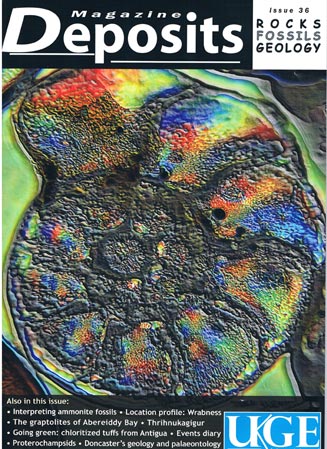
The Front Cover of Deposits (Issue 32)

A magazine for rock fans.

Image credit: Everything Dinosaur

Deposits Magazine

Pictures taken of reader’s fossil finds over the summer months are also included, with a number of successful fossil hunting trips from locations around the British Isles and overseas  being highlighted.  This dovetails nicely with a feature written by one contributor which discusses the invertebrate fossils to be found in the Lower Muschelkalk Formation of the Netherlands.  Brachiopods, bivalves, gastropods and arthropods are all represented by the fossil specimens.

It is hard to believe that around 240 million years ago (Early Triassic), that Germany, the Netherlands, Poland, Denmark and north-eastern France was covered by warm, shallow tropical sea that teamed with ancient life.  Some of these prehistoric creatures have left a fossil record to be explored.

Examining Graptolites

Under the title “The Strangest of the Graptolites” there is a highly informative description of  retiolite graptolites with amazing, high magnification electronic microscope images of the structure of these bizarre colonial creatures that lived in marine environments during the Palaeozoic Era.

Packed with news stories concerning fossil finds, the latest research and events this magazine provides an excellent read for anyone with a passing interest in geology, rocks and the fossils that can be found in some of them.  There is even an article highlighting the controversial research into understanding whether or not significant amounts of DNA could survive the fossilisation process.  Any magazine that includes a piece entitled “Could you Receive a Blood Transfusion from a Neanderthal”, gets a big thumbs up from us.

For replicas of prehistoric animals and scale models of dinosaurs: Prehistoric Animal Figures and Dinosaur Replicas.

16 10, 2012

New Prehistoric Times Issue 103 Reviewed

By |2024-01-01T17:28:23+00:00October 16th, 2012|Categories: Magazine Reviews, Prehistoric Times|0 Comments

A Review of “Prehistoric Times” (Fall 2012)

The autumn 2012 edition of “Prehistoric Times”, the magazine for dinosaur fans and model collectors has arrived and as always there is a scramble amongst as to who gets to read it first.  Inside this quarterly magazine there is an exclusive interview with the grandson of the famous Czechoslovakian artist Zdeněk Burian, a brilliant illustrator of prehistoric animals and a man whose paintings have graced countless books about dinosaurs.

“Prehistoric Times”

For fans of placoderms there is a feature on how a giant Dunkleosteus model was made for use in American museums and Tracy Lee Ford presents a highly informative piece on the pathology found within dinosaur fossil specimens.  The two main prehistoric animals featured in this edition are the diplodocid Amargasaurus, as we tend to call this animal “the dinosaur that thought it was a dragon” – see the pictures and drawings to get what we mean and the voracious Repenomamus – a mammal that fed on dinosaurs.

For models and replicas of Dunkleosteus and other prehistoric animals: Age of Dinosaurs Replicas (PNSO).

The Latest Edition of Prehistoric Times

Prehistoric Times (Autumn 2012) reviewed.

Picture credit: Mike Fredericks

“The Princeton Field Guide to Dinosaurs”

Gregory S Paul’s and his amazing book “The Princeton Field Guide to Dinosaurs” is updated with the author himself providing information on the books content, its layout and introducing some new ideas and illustrations.  “The Princeton Field Guide to Dinosaurs”, is to be found on our office shelves it is regularly read by our team members and it is super book which we highly recommend.  Note to other Everything Dinosaur team members we must include this volume in our blog series about favourite dinosaur books.

Lots of updates about fossil finds in the Palaeo. news section including information on the new feathered dinosaur discovery Sciurumimus, look out for the Tyrannosaurus rex skull drawing done by Mike Fredericks (magazine editor) on page 48, we recognise this drawing as this is the illustration that Mike provided us when we asked him for a motive to help us with a T-shirt design project we have been working on.

As always, “Prehistoric Times” is packed full of model reviews and news stories, congratulations to Mike Landry for his superb, fuzzy Amargasaurus illustration, my nieces particular favourite in this edition.

“Prehistoric Times”, an excellent magazine for the serious dinosaur fan, to visit “Prehistoric Times” website, simply click the link below:

Visit “Prehistoric Times”: “Prehistoric Times” Magazine.

Go to Top