All about dinosaurs, fossils and prehistoric animals by Everything Dinosaur team members.
6 03, 2026

New Haolonggood Acrocanthosaurus Models Coming into Stock

By |2026-03-08T21:21:24+00:00March 6th, 2026|Categories: Haolonggood Prehistoric Animal Models|0 Comments

Everything Dinosaur announces that the two new Haolonggood Acrocanthosaurus models (Dong Ping and Zhang Qing) will be in stock next week.  Both the brown Acrocanthosaurus (Dong Ping) and the green figure (Zhang Qing) are expected to arrive on a shipment due into the warehouse next Monday (9th of March).

Each model measures nearly thirty centimetres in length.  In addition, each figure has an articulated lower jaw.

Haolonggood Acrocanthosaurus models.

The two, new Haolonggood Acrocanthosaurus models. Dong Ping, the brown Acrocanthosaurus figure (top) and Zhang Qing, the green Acrocanthosaurus (bottom).

To view the range of Haolonggood prehistoric animal models in stock at Everything Dinosaur: Haolonggood Prehistoric Animal Figures.

Two Haolonggood Acrocanthosaurus Models

The two figures are essentially the same sculpt.  However, they have different colour schemes.  When they arrive, we will be busy informing customers and theropod model fans.

Mike from Everything Dinosaur commented:

“We have a list of customers who wanted to be emailed when these two models arrived.  Emails will be sent out as quickly as possible. We know how keen our customers are to get their hands on these amazing dinosaur models.”

The award-winning Everything Dinosaur website: Dinosaur Toys and Models.

5 03, 2026

A New Early Permian Tetrapod from Brazil is Described

By |2026-03-05T17:11:44+00:00March 5th, 2026|Categories: Palaeontological articles|0 Comments

An international team of palaeontologists has described a new species of early land vertebrate from Brazil. The species is named Tanyka amnicola. Researchers identified this unusual animal from fossils discovered in north-eastern Brazil. Their findings appear as an open access paper in the journal Proceedings of the Royal Society B. Importantly, the fossils reveal an amphibian with a very unusual jaw. The unique jaw morphology suggests adaptations to either specialised processing of small invertebrates or consumption of plants. This demonstrates that some stem tetrapods were exploring niches in ecosystems in the Southern Hemisphere during the Permian.

Fossils from the Pedra de Fogo Formation

The fossils come from the Pedra de Fogo Formation. This formation lies within the Parnaíba Basin of Brazil. Scientists recovered nine isolated lower jaws, each about fifteen centimetres long. Although researchers have not yet found other bones, these jaws reveal important clues. Professor Jörg Fröbisch from the Museum für Naturkunde Berlin played a key role in this study.

Professor Fröbisch commented that the discovery followed many years of work in the region. In fact, the first jaw was discovered during one of the earliest expeditions. For more than fifteen years, researchers have studied the fossils of the Parnaíba Basin. The project involves scientists from Brazil, Argentina, South Africa, the USA, the UK (London Natural History Museum) and Germany.

Life reconstruction of Tanyka amnicola.

Life reconstruction of Tanyka amnicola grazing on some plants. Picture credit: Vitor Silva.

Picture credit: Vitor Silva

Tanyka amnicola An Ancient “Living Fossil”

Interestingly, Tanyka amnicola belonged to a very old lineage. As a result, the animal could already be considered a “living fossil” in its own time.

Professor Fröbisch explained:

“What is particularly exciting is that even during its lifetime around 275 million years ago, it could have been described as a living fossil, as it belongs to an archaic group that actually lived 30-50 million years earlier.”

During this period in Earth’s history Brazil was part of a supercontinent called Gondwana. This enormous landmass included South America, Africa, Antarctica and Australia.

A Remarkably Twisted Jaw

The lower jaw of Tanyka amnicola shows a very unusual structure. Lead author Jason Pardo explained that the twisted jaw initially puzzled the researchers. However, every fossil jaw shows the same shape. Therefore, the feature represents normal anatomy rather than damage or taphonomy.

The teeth point sideways rather than straight upwards. Meanwhile, the inner surface of the jaw tilts towards the palate. Furthermore, the jaw surface carries many small teeth. These teeth may have formed a rough grinding surface. When the mouth closed, the teeth probably rubbed against each other. Consequently, the animal could crush or shred food. Hence, the theory that this tetrapod may have been herbivorous, or at least plants made up a proportion of its diet.

Professor Juan Cisneros from the Federal University of Piauí, a co-author of the study believes the animal ate plants at least part of the time.

He stated:

“Based on the structure of its teeth, we assume that Tanyka ate plants at least some of the time. This is surprising, as most of its relatives were carnivores.”

Therefore, Tanyka amnicola may represent an early experiment in herbivory among early tetrapods.

A Window into Early Permian Ecosystems

Fossils from the early Permian are relatively rare. Consequently, every discovery provides valuable information. The Pedra de Fogo Formation offers one of the few windows into Gondwana’s ecosystems at that time.

Co-author Dr Kenneth Angielczyk commented:

“The Pedra de Fogo Formation offers one of the few windows into the animal world of Gondwana during the early Permian period. Tanyka shows us which animals lived there and what ecological roles they played.”

Fossils from this Formation also help scientists understand how early tetrapods interacted.

Tanyka amnicola probably lived close to rivers and lakes. The species name reflects its habitat, the word “amnicola” translates as “river dweller”.  The genus name is derived from the local Guaraní language, it translates as “jaw”.

Researchers estimate that Tanyka amnicola may have reached around one metre in length.

More Discoveries May Follow

At present, scientists only know the animal from jawbones. However, future discoveries could change that. For example, researchers hope to find skulls or articulated skeletons. Such fossils would help reconstruct the entire animal.

Nevertheless, even these isolated jaws provide remarkable insight.

For now, Tanyka amnicola offers a fascinating glimpse into early tetrapod evolution. Moreover, it highlights the importance of the Pedra de Fogo Formation in revealing an ancient ecosystem from Gondwana.

Everything Dinosaur acknowledges the assistance of the Museum für Naturkunde Berlin in the compilation of this article.

The scientific paper: “An aberrant stem tetrapod from the early Permian of Brazil” by Jason D. Pardo, Claudia A. Marsicano, Roger Smith, Juan Carlos Cisneros, Kenneth D. Angielczyk, Jörg Fröbisch, Christian F. Kammerer and Martha Richter published in the Royal Society Proceedings B.

The award-winning Everything Dinosaur website: Prehistoric Animal Figures.

4 03, 2026

A Beautiful Acrocanthosaurus Illustration

By |2026-03-10T06:31:31+00:00March 4th, 2026|Categories: Dinosaur and Prehistoric Animal Drawings|0 Comments

Thank you Caldey for sending into Everything Dinosaur a colourful illustration of the theropod dinosaur Acrocanthosaurus.  The vivid artwork is inspired by recently published photographs of the Beasts of the Mesozoic Acrocanthosaurus figure.  The young artist has captured the red tones and contrasting blues of the Acrocanthosaurus prototype.  It is wonderful to see Acrocanthosaurus illustrated in this way.

Acrocanthosaurus illustrated.

A beautiful and extremely colourful Acrocanthosaurus illustration. Caldey has taken inspiration from the Beasts of the Mesozoic articulated Acrocanthosaurus model’s colour scheme. Picture credit: Caldey.

Picture credit: Caldey

Acrocanthosaurus Illustrated

Acrocanthosaurus (A. atokensis) is a carcharodontosaurid taxon named and described in 1950 (Stovall and Langston). It roamed North America during the Cretaceous. Fossils have been found in Oklahoma, Wyoming, Texas and Maryland. Palaeontologists regard Acrocanthosaurus as one of the largest theropods. Size estimates vary but it could have reached lengths in excess of twelve metres and weighed four tonnes.  Caldey has captured the jaw shape and skull of this apex predator.  In addition, the young artist has carefully illustrated the three digits on each hand.

The genus name translates as “high spined lizard”. A reflection of the tall neural spines associated with the vertebrae.  Caldey has skilfully illustrated this anatomical feature, with a high ridge of bone and flesh running from the back of the head down the body.

Mike from Everything Dinosaur commented:

“Thank you Caldey for sending into us your beautiful Acrocanthosaurus drawing.  It is such an impressive illustration.  Moreover, you have captured the vivid colour scheme of the Beasts of the Mesozoic Acrocanthosaurus prototype.”

The Everything Dinosaur website: Dinosaur and Prehistoric Animal Models.

3 03, 2026

First Clear Evidence of Ceratopsians in Late Cretaceous Europe

By |2026-03-08T20:45:38+00:00March 3rd, 2026|Categories: Palaeontological articles|0 Comments

A groundbreaking scientific paper published in January (2026), has confirmed the presence of ceratopsian dinosaurs in Late Cretaceous Europe. The research focuses on the Hungarian dinosaur Ajkaceratops kozmai. The findings challenge long-standing ideas about Europe’s prehistoric ecosystems.

For decades, palaeontologists believed that horned dinosaurs were missing from Europe. Ceratopsians were widespread across Asia and North America during the Late Cretaceous. Famous species include Triceratops and Pachyrhinosaurus. Yet convincing fossils confirming their presence in Europe remained elusive.

The new research suggests these dinosaurs were hiding in plain sight.

The Enigmatic and Highly Significant Ajkaceratops kozmai

Ajkaceratops was first described from fragmentary fossils discovered in Hungary. These remains came from the Csehbánya Formation, rocks dating to approximately eighty-four million years ago (Santonian faunal stage of the Late Cretaceous). The fossils hinted at a small horned dinosaur, about the size of a labrador dog.

However, some researchers questioned this interpretation. The fossils were incomplete and difficult to interpret.

The new study, with corresponding author Professor Susannah Maidment (London Natural History Museum), provides crucial evidence. The research team described a new specimen, catalogue number MTM 2025.1.1. This fossil includes a much more complete skull. Detailed analysis of this fossil confirms that Ajkaceratops kozmai is indeed a true ceratopsian dinosaur.

Professor Maidment explained in a media release that the study indicates that far from being absent from Europe, ceratopsians may have been relatively common.

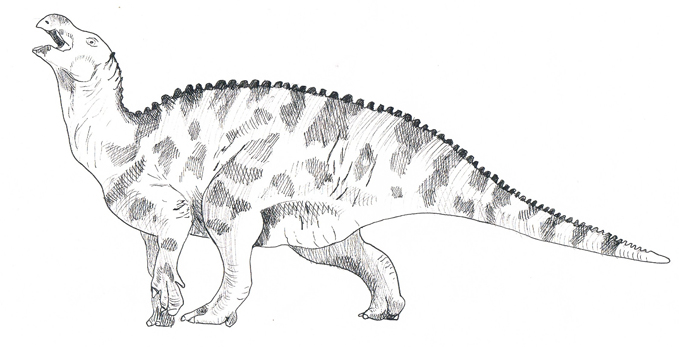
Ajkaceratops kozmai scale drawing.

A scale drawing of the Late Cretaceous European ceratopsian Ajkaceratops (A. kozmai). Picture credit: Generated using AI/Canva with additional annotation by Everything Dinosaur.

Picture credit: Generated using AI/Canva with additional annotation by Everything Dinosaur

Uncovering Another Surprising Discovery About Rhabdodontids

The research uncovered an even more surprising discovery. Several dinosaurs previously classified as rhabdodontids may actually be ceratopsians. Rhabdodontids were thought to be iguanodontians. In addition, these herbivorous dinosaurs were regarded as unique to Europe. However, the new analysis suggests that some fossils attributed to rhabdodontids belong to horned dinosaurs instead. For example, a dinosaur named as Mochlodon vorosi is now considered a junior synonym of Ajkaceratops.

Another dramatic revision involves the Romanian dinosaur Zalmoxes shqiperorum. This species has now been reassigned to a new ceratopsian genus named Ferenceratops (Maidment et al, 2026). The genus honours the pioneering Austro-Hungarian palaeontologist and polymath Baron Franz Nopcsa.

A Hidden Diversity of European Ceratopsians

These revisions suggest that horned dinosaurs may have been far more common in Europe than previously believed. Many fossils may have been misidentified because of incomplete material. The confusion stems partly from evolutionary history. Ceratopsians and iguanodontians share a common ancestor. They are both classified as ornithischian dinosaurs.  These two groups later evolved similar features. For instance, both developed complex chewing mechanisms and large body sizes. Some species also adopted quadrupedal locomotion. These similarities make fragmentary fossils difficult to identify.

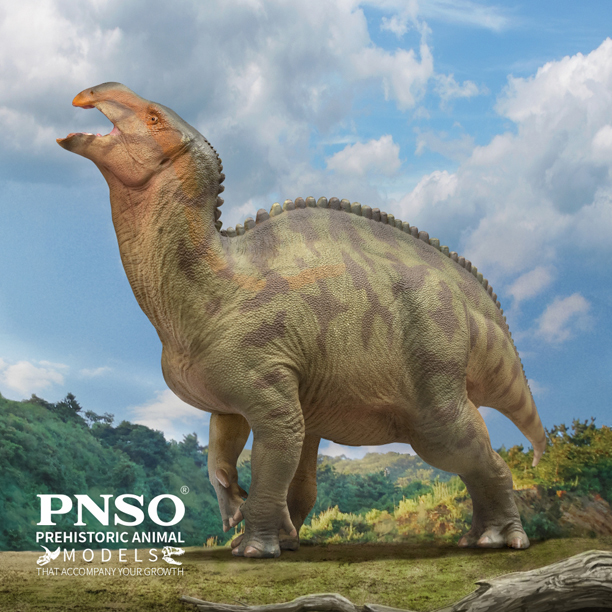
Obelignathus septimanicus life reconstruction.

An example of a typical rhabdodontid dinosaur. Life restoration of newly described rhabdodontid dinosaur Obelignathus septimanicus in the Late Cretaceous environment recorded in the ‘Grès à Reptiles’ Formation in southern France. A pair of dromaeosaurid dinosaurs can be seen lurking in the background. Picture credit: Edyta Felcyn-Kowalska.

Picture credit: Edyta Felcyn-Kowalska

Reassessing the Biota of Late Cretaceous Europe

During the Late Cretaceous, Europe formed a chain of islands scattered across the Tethys Sea. Scientists believed this isolation produced unique dinosaur faunas. Such as the fauna associated with the Hateg Basin. However, the presence of ceratopsians suggests European ecosystems may have been more similar to the fauna found elsewhere in the Northern Hemisphere.

The discovery also fills an important gap in ceratopsian evolution. Early horned dinosaurs originated in Asia and later spread to North America. Europe may have served as an important stepping stone during these dispersals. Furthermore, the study highlights the importance of museum collections. Fossils stored for decades can reveal new secrets when re-examined with modern techniques.

As more discoveries emerge, palaeontologists may uncover an unexpected diversity of European horned dinosaurs. It seems that Europe’s “missing” ceratopsians were there all along hiding in plain sight.

The scientific paper: “A hidden diversity of ceratopsian dinosaurs in Late Cretaceous Europe” by Susannah C. R. Maidment, Richard J. Butler, Stephen L. Brusatte, Luke E. Meade, Felix J. Augustin, Zoltán Csiki-Sava and Attila Ősi published in Nature.

For ceratopsian figures and other dinosaur models: Dinosaur Figures.

2 03, 2026

The Remarkable Spinosaurus Artwork

By |2026-03-08T10:46:21+00:00March 2nd, 2026|Categories: Palaeontological articles|0 Comments

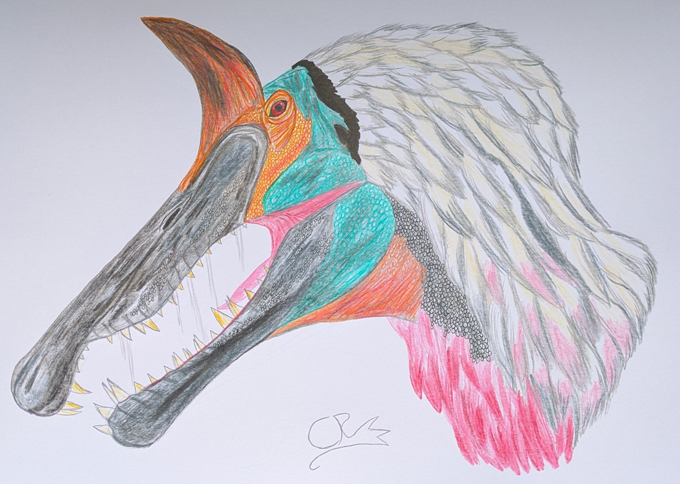
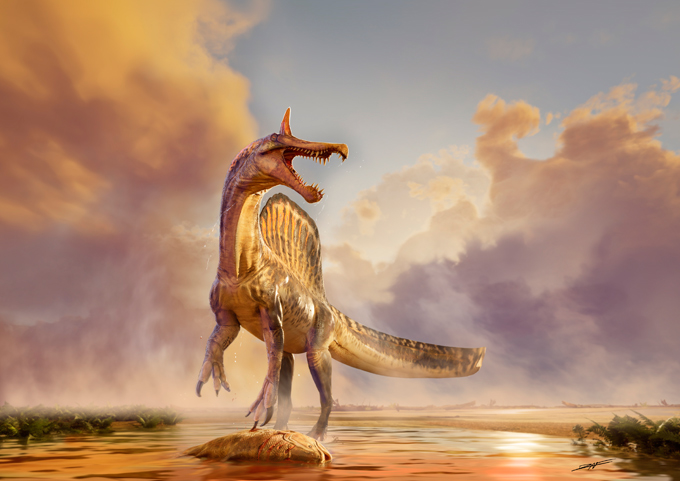
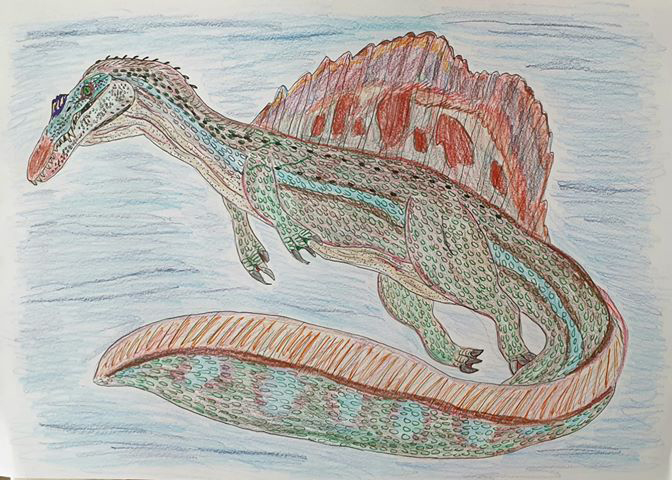
Following our post last month featuring news about the scimitar-crested spinosaurid Spinosaurus mirabilis, today, we publish some more images of this remarkable African theropod.  Our thanks to vertebrate palaeontologist and co-author of the study Daniel Vidal (University of Chicago) for helping team members to access these incredible illustrations.  In addition, we thank the media department at the University for providing these official images and the press release.

The beautiful artwork was created by talented palaeoartist Dani Navarro.

Spinosaurus mirabilis life reconstruction.

A life reconstruction of the recently named new Spinosaurus species Spinosaurus mirabilis. Picture credit: D. Navarro.

Picture credit: D. Navarro

To read Everything Dinosaur’s blog post about the discovery of S. mirabilisA New Spinosaurid Species is Described.

Dani Navarro’s artwork has featured numerous times on this blog.  For example, Dani has provided several illustrations including front cover art for the prestigious magazine “Prehistoric Times”. In addition, he works closely with the Paul Sereno Fossil Lab and the University of Chicago.

An Award-winning Artist Illustrates Spinosaurus mirabilis

This award-winning artist has worked on the study of the Concavenator’s hump and the complete reconstruction of Edmontosaurus from fossil mummies. Furthermore, he has provided stunning artwork reconstructions of Spinosaurus aegyptiacus. Therefore, it is not surprising to find him producing illustrations of the recently described Spinosaurus mirabilis.

Spinosaurus mirabilis head.

A close-up view of the head and neck of the recently described Spinosaurus (S. mirabilis). Picture credit: D. Navarro.

Picture credit: D. Navarro

Mike from Everything Dinosaur states:

“The work of scientific illustrators cannot be underestimated.  They skilfully reconstruct an animal from the fossil evidence.  Their artwork vividly brings to life a long extinct animal and helps to inform and inspire.”

Everything Dinosaur acknowledges the assistance of a media release from the University of Chicago in the compilation of this article.

The scientific paper: “Scimitar-crested Spinosaurus species from the Sahara caps stepwise spinosaurid radiation” by Paul C. Sereno, Daniel Vidal, Nathan P. Myhrvold, Evan Johnson-Ransom, María Ciudad Real, Stephanie L. Baumgart, Noelia Sánchez Fontela, Todd L. Green, Evan T. Saitta, Boubé Adamou, Lauren L. Bop, Tyler M. Keillor, Erin C. Fitzgerald, Didier B. Dutheil, Robert A. S. Laroche, Alexandre V. Demers-Potvin, Álvaro Simarro, Francesc Gascó-Lluna, Ana Lázaro, Arturo Gamonal, Charles V. Beightol, Vincent Reneleau, Rachel Vautrin, Filippo Bertozzo, Alejandro Granados, Grace Kinney-Broderick, Jordan C. Mallon, Rafael M. Lindoso and Jahandar Ramezani. Paper published in the journal Science.

Visit the Everything Dinosaur website: Prehistoric Animal and Dinosaur Toys.

1 03, 2026

Celebrating Dragons and the Dinosauria on St David’s Day

By |2026-03-01T09:35:07+00:00March 1st, 2026|Categories: Palaeontological articles|0 Comments

Today, we join friends and family in Wales to celebrate St David’s Day.  It is an annual Welsh celebration held on the first day of March. This day honours Saint David, the patron saint of Wales, whose life and legacy are remembered with pride and cultural festivities right across the nation. Across the country, people wear daffodils and leeks. They wave the striking Welsh flag, proudly displaying its iconic red dragon. This heraldic dragon symbol, known in Welsh as Y Ddraig Goch, has deep roots in legend, folklore, and national identity.  However, what is the connection between dragons and the Dinosauria? Quite a lot, in fact!

Dragons and the Dinosauria

To vertebrate palaeontologists, the word dragon often conjures images of legendary beasts. Yet, it also has a clear connection to prehistoric life. Many dinosaur names contain the suffix – saurus, a Greek word meaning “lizard”. In China, new dinosaur species often include “long” in their names — a word that translates to dragon. For example, we recently wrote a blog article highlighting the discovery of a remarkable iguanodontid dinosaur from China named Haolong dongi. The genus name translates as “spiny dragon”.

To read our post: “Spiny Dragon” Reveals Secrets of Dinosaur Skin.

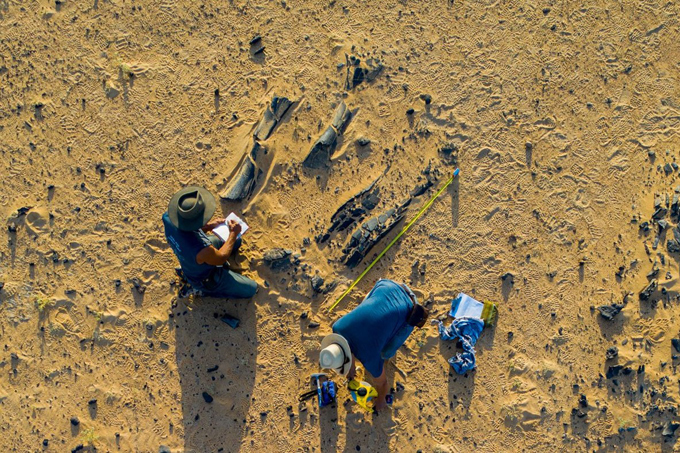
Research team members studying the fossil material (H. dongi).

Researchers examining the Haolong dongi fossil material. Picture credit: Thierry Hubin (Institute of Natural Sciences).

Picture credit: Thierry Hubin (Institute of Natural Sciences)

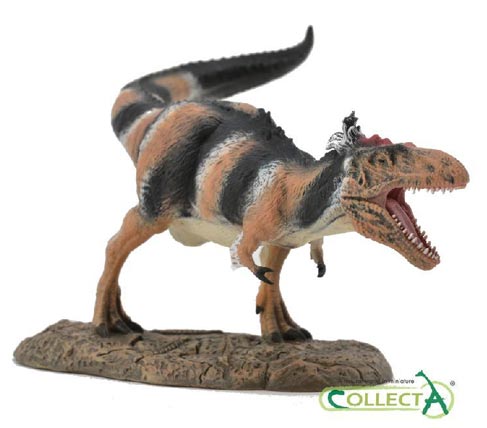
Many dinosaur discoveries spark imaginations just like mythical dragons do. Their enormous sizes, sharp teeth and reptilian skins have fuelled human stories for centuries.  For instance, there are several Chinese dinosaurs represented by CollectA Delxue models. The beautiful CollectA Deluxe Beishanlong model is a favourite.   This theropod’s name translates as “Northern White Mountains Dragon”.

The CollectA Deluxe Beishanlong figure.

The CollectA 1:40 scale Beishanlong dinosaur model shown in lateral view. Picture credit: Everything Dinosaur.

Picture credit: Everything Dinosaur

To view the CollectA range of scale models in stock: CollectA Deluxe Dinosaur Models.

Dragons and Dinosaurs

Both dragons of myth and real prehistoric reptiles remind us how powerful ancient reptiles captured human imagination. They also help us celebrate cultural heritage alongside scientific discovery.

So, on this St David’s Day, let’s give a nod to Wales and its enduring dragon symbol. We acknowledge the cultural significance of this day and that dinosaurs and dragons are entwined.

Mike from Everything Dinosaur commented:

“Happy St David’s Day to all our Welsh readers and dinosaur fans everywhere!”

The Everything Dinosaur website: Dinosaur Toys.

Go to Top