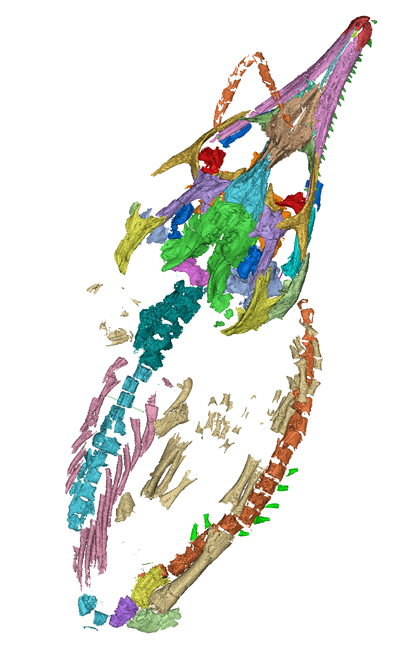
The fossils representing the first, non-avian dinosaur with feather-like structures found in South America has been returned to Brazil. The Ubirajara fossil specimen has been repatriated from Germany. This prized but controversial fossil, was named and described in 2020 (Ubirajara jubatus).
Since the scientific publication, campaigners, including many prominent Brazilian scientists, had requested that this dinosaur be returned home. One of the leading advocates for the repatriation was Professor Aline Ghilardi of the Federal University of Rio Grande do Norte (UFRN).
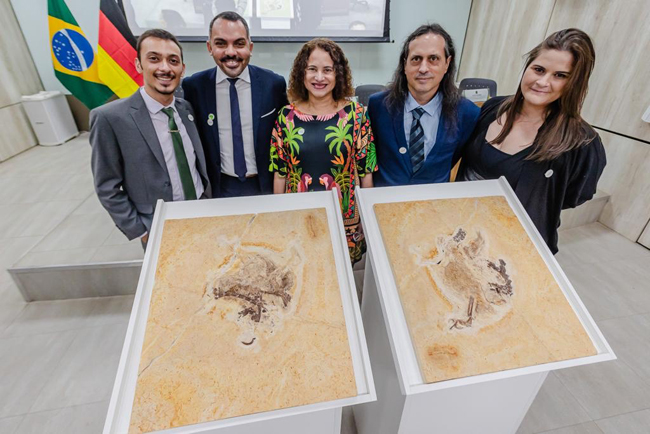
Professor Aline Ghilardi, right, next to Professor Juan Cisnero (UFPI) and the minister of MCTI, Luciana Santos (centre). The Ubirajara fossil specimen is returned to Brazil. Picture credit: Luara Baggi – Ascom/MCTI.
The excitement in Brazil sparked by the scientific publication turned to dismay when it was realised that the fossil had been removed from the country. The materials and methods section of the paper stated that the specimen had been taken out of Brazil in 1995.
The first Brazilian law dealing with the protection of fossils was created in 1942. The legislation permitted fossils to leave the country, but authorisation was required. Subsequently, the law was strengthened, and it outlined how fossils should be collected, exported and insisted that Brazilian scientists should be involved in the study of such artifacts.
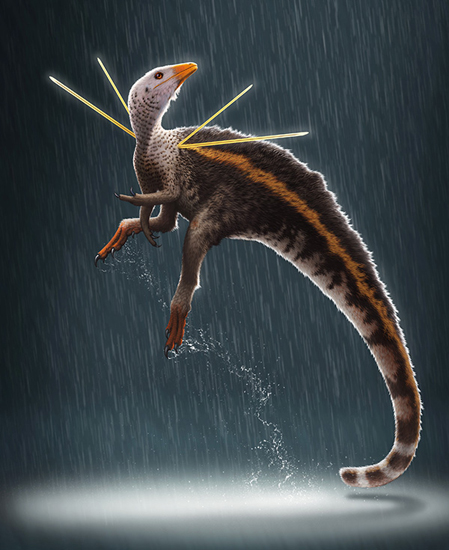
Ubirajara jubatus life reconstruction by the very talented palaeoartist Bob Nicholls.
Following a campaign, the paper describing U. jubatus, the first non-avian dinosaur to be found in the Southern Hemisphere with feather-like filaments was withdrawn.
After the allegations of illegal smuggling, it was agreed to return the specimen to Brazil. The scientific name Ubirajara jubatus was removed from the International Commission on Zoological Nomenclature (ICZN) registry. The dinosaur’s name currently is regarded as invalid. Whether the scientific name for this little theropod is to be retained has yet to be decided.
UbirajaraBelongstoBR
The repatriation was assisted by a highly successful social media campaign using the hashtag UbirajaraBelongstoBR.
An investigation was launched in Germany. This culminated in the recognition of the misconduct and unethical behaviour of the researchers involved. With that, finally, it was decided to return the dinosaur home in July 2022.
The controversy surrounding Ubirajara highlights a growing trend within palaeontology for assessing the impact of colonialism and the removal of fossil material from countries to America and Europe.
Professor Aline explained:
“Colonialist attitudes influence our science and make it a worse science and the results biased.”
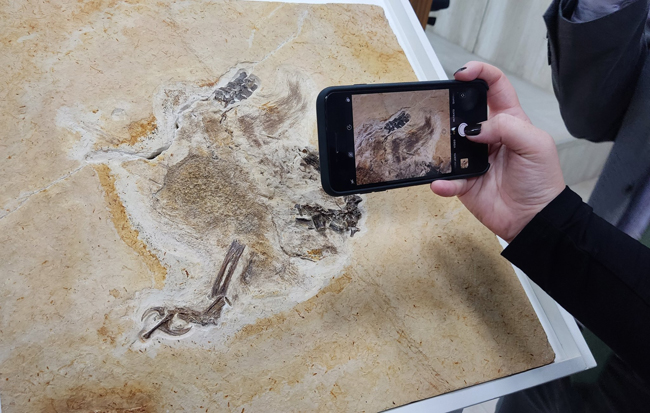
Taking photographs of the Ubirajara fossil (counter slab). Picture credit: Juan Cisneros.
The Return of the Ubirajara Fossil Specimen
The social media campaign played a significant role in the successful repatriation. The return of the Ubirajara fossil specimen was achieved through a collaboration with the public, governments and palaeontologists.
A spokesperson commented that this campaign highlights how the public wants to engage and participate with scientific debate. The return of Ubirajara will hopefully inspire other scientists to engage in such campaigns, helping to improve palaeontology by making it more inclusive, fair and ethical.
Everything Dinosaur acknowledges the assistance of a media release from the Federal University of Rio Grande do Norte in the compilation of this article.
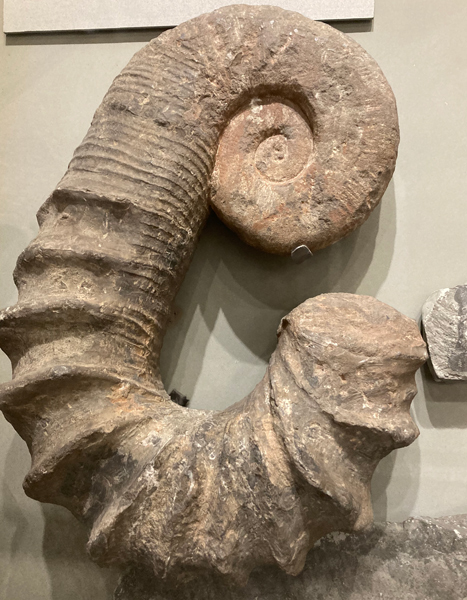
Most ammonites had planispiral shells. However, throughout the course of the long evolutionary history of these remarkable and diverse cephalopods a huge variety of shell forms evolved. Everything Dinosaur team members spotted a stunning example of a heteromorph ammonite on display in the fossils gallery at the Manchester Museum.
A heteromorph ammonite fossil part of an exhibit showing the huge variety of ammonite fossil shells at the Manchester Museum. Most heteromorph ammonites evolved in the Cretaceous. Picture credit: Everything Dinosaur.
Picture credit: Everything Dinosaur
Heteromorph Ammonites
If asked to draw an ammonite shell, most people would sketch a tightly coiled shell, in a single plane with the diameter of each successive whorl getting bigger. This is a description of a typical ammonite planispiral shell. This would be an example of a homomorph shell. During the Late Jurassic, several new types of ammonite began to appear with varying degrees of uncoiled shells.
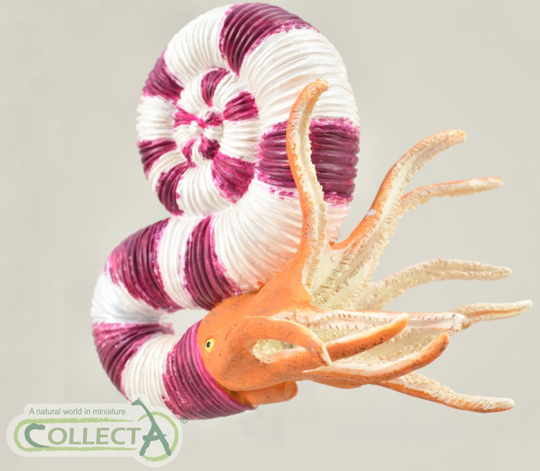
The colourful heteromorph ammonoid model – CollectA Pravitoceras. This model was introduced by CollectA in 2021.
The picture (above) shows the colourful CollectA Pravitoceras ammonite model. This figure was added to the CollectA model range in 2021. The CollectA Age of Dinosaurs series includes numerous extinct invertebrates. Trilobites, nautiloids, belemnites and ammonites are included in this substantial range.
These types of ammonites (heteromorph ammonites), became increasingly abundant during the Cretaceous and by the Late Cretaceous they were widespread and extremely diverse with a myriad of different types occupying marine environments.
Important Zonal Fossils (Heteromorph Ammonite Types)
Heteromorph ammonites were extremely numerous by the end of the Cretaceous. Many genera have become important zonal fossils. Both homomorph and heteromorph ammonites are used extensively by geologists for zoning strata and for relative dating of rock formations.
The first tetrapods (land living animals) were amphibious. It had been thought that the development of an egg with a semi-permeable shell (amniote egg) was a fundamental step in the development of life on land. This adaptation meant that land animals did not have to return to water to breed and spawn. Freed from having to return to the water, early tetrapods could explore new environments and expand into new habitats.
However, a new paper written by researchers from Nanjing University (China) and the University of Bristol challenges this view of evolution.
The researchers conclude that the earliest reptiles, birds and mammals (Amniota), may have borne live young.
What is an Amniote?
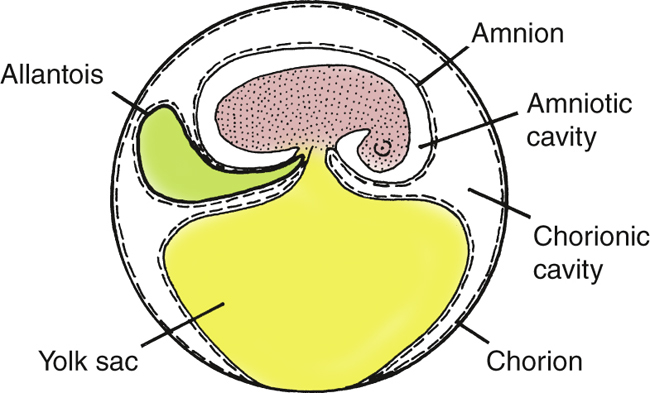
Amniotes lay eggs that have a semi-permeable shell that protects the embryo from drying out. A tough, internal membrane called the amnion surrounds the growing embryo as well as the yolk, the food source. Development of the embryo in a shelled egg meant that for the first time in history, the tetrapods were no longer tied to water to breed. We as mammals are amniotes, along with the birds and reptiles.
The amniotic egg, showing the semipermeable shell and the extraembryonic membranes. Picture credit: M. J. Benton (University of Bristol).
Studying Extinct and Extant Species
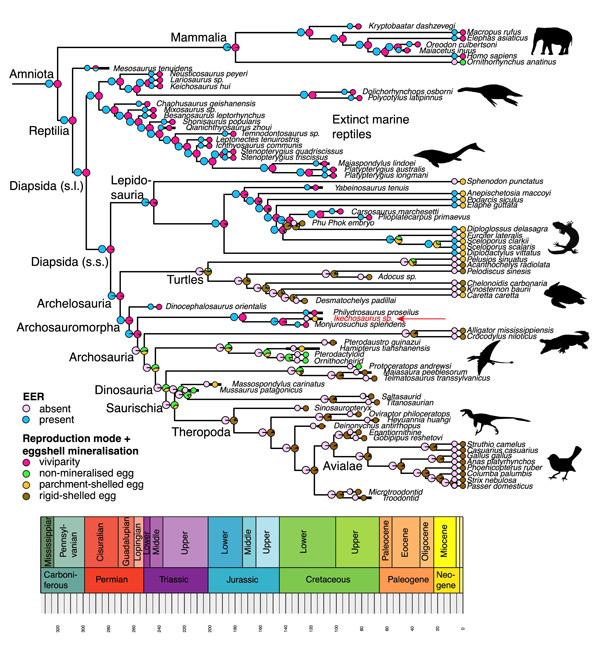
However, a study of 51 fossil species and 29 living species which could be categorised as oviparous (laying hard or soft-shelled eggs) or viviparous (giving birth to live young) suggests that the earliest reptiles, mammals and birds probably were capable of bearing live young.
The findings, published today in the academic journal “Nature Ecology & Evolution”, show that all the great evolutionary branches of the Amniota, the Mammalia, Lepidosauria (lizards and relatives), and the Archosauria (dinosaurs, crocodilians, birds) reveal viviparity and extended embryo retention in their ancestors.
Extended embryo retention (EER) occurs when the young are retained by the mother for a varying amount of time, likely depending on when conditions are best for survival. While the hard-shelled egg (amniote egg), has often been seen as one of the greatest innovations in evolution, this research implies it was extended embryo retention that gave this particular group of animals the ultimate protection.
Professor Michael Benton (School of Earth Sciences at the University of Bristol) explained:
“Before the amniotes, the first tetrapods to evolve limbs from fishy fins were broadly amphibious in habits. They had to live in or near water to feed and breed, as in modern amphibians such as frogs and salamanders.”
Professor Benton added:
“When the amniotes came on the scene 320 million years ago, they were able to break away from the water by evolving waterproof skin and other ways to control water loss. But the amniotic egg was the key. It was said to be a “private pond” in which the developing reptile was protected from drying out in the warm climates and enabled the Amniota to move away from the waterside and dominate terrestrial ecosystems.”
Challenging the Standard View About Amniote Egg Evolution
Project leader and corresponding author Professor Baoyu Jiang (Nanjing University) stated:
“This standard view has been challenged. Biologists had noticed many lizards and snakes display flexible reproductive strategy across oviparity and viviparity. Sometimes, closely related species show both behaviours, and it turns out that live-bearing lizards can flip back to laying eggs much more easily than had been assumed.”
Phylogeny of amniotes, showing known reproduction mode and eggshell mineralization, and EER of 80 modern and extinct species, and the estimated ancestral states for all branching points. The dominant inferred state at the origin of amniotes is viviparity with extended embryo retention (EER). Picture credit: M.J. Benton, University of Bristol.
Many Marine Reptiles were Live-bearers
Co-author Dr Armin Elsler (University of Bristol) commented:
“Also, when we look at fossils, we find that many of them were live-bearers, including the Mesozoic marine reptiles like ichthyosaurs and plesiosaurs. Other fossils, including a choristodere from the Cretaceous of China, described here, show the to-and-fro between oviparity and viviparity happened in other groups, not just in lizards.”
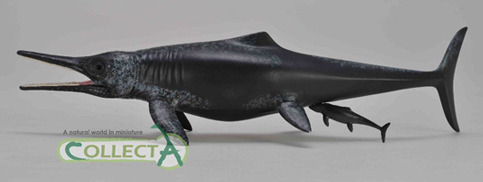
The picture (above) shows the CollectA Age of Dinosaurs Popular Temnodontosaurus model. The ichthyosaur is giving birth, demonstrating viviparity within the Ichthyosauria.
In many types of extant vertebrate extended embryo retention (EER) is quite common. The developing young are retained by the mother for a lesser or greater span of time. The mother delays giving birth until conditions are most favourable to permit the survival of her offspring. The mother deliberately gives birth at the most propitious time.
Co-author of the paper, Dr Joseph Keating commented:
“EER is common and variable in lizards and snakes today. Their young can be released, either inside an egg or as little wrigglers, at different developmental stages, and there appears to be ecological advantages of EER, perhaps allowing the mothers to release their young when temperatures are warm enough and food supplies are rich.”
Skeleton of a baby choristodere, Ikechuosaurus, from the Early Cretaceous of China, found curled up inside the remnants of a parchment-shelled egg. Picture credit: Baoyu Jiang (Nanjing University).
Profound Implications for our Understanding of Tetrapod Evolution
Professor Benton summarised the study:
“Our work, and that of many others in recent years, has consigned the classic ‘reptile egg’ model of the textbooks to the wastebasket. The first amniotes had evolved extended embryo retention rather than a hard-shelled egg to protect the developing embryo for a lesser or greater amount of time inside the mother, so birth could be delayed until environments become favourable.”
The professor implied that this study had profound implications for our understanding of tetrapod evolution. He added:
“Whether the first amniote babies were born in parchment eggs or as live, snapping little insect-eaters is unknown, but this adaptive parental protection gave them the advantage over spawning earlier tetrapods.”
Everything Dinosaur acknowledges the assistance of a media release from the University of Bristol in the compilation of this article.
The scientific paper: “Extended embryo retention and viviparity in the first amniotes” by Baoyu Jiang, Yiming He, Armin Elsler, Shengyu Wang, Joseph N. Keating, Junyi Song, Stuart L. Kearns and Michael J. Benton published in Nature Ecology and Evolution.
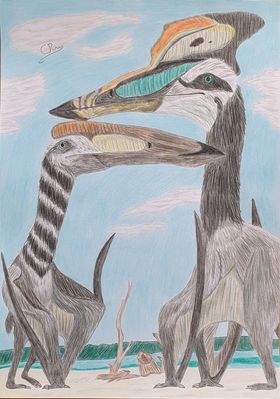
Our thanks to young artist Caldey who sent into Everything Dinosaur her drawing of a pair of azhdarchid pterosaurs. A Hatzegopteryx pair illustrated, a drawing inspired by the recent television series Prehistoric Planet II.
Two Hatzegopteryx pterosaurs illustrated. The drawing inspired by a scene from the recently aired Prehistoric Planet II. Picture credit: Caldey.
A Softer Side to Azhdarchids
Described by the narrator Sir David Attenborough as the apex predator in Europe during the Late Cretaceous, Hatzegopteryx shows a softer side. A male lands on a remote island and builds a display from driftwood in a bid to attract a female. The giant pterosaur is successful and a female lands to inspect his work. The five-metre-tall reptile offers the female a Tethyshadros that he has recently caught.
A second, smaller male arrives and threatens to break up the courtship display. However, the larger male soon deals with the interloper. The female impressed with her partner’s prowess allows herself to be mated. The female leaves and the inference is that the male will play no part in the raising of the young.
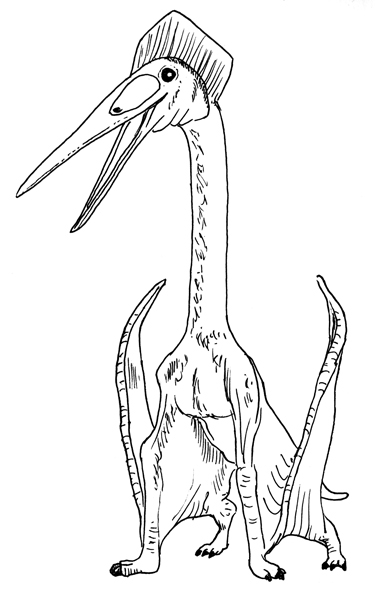
A drawing of the huge pterosaur Hatzegopteryx inspired by the CollectA Prehistoric Life Hatzegopteryx model. Picture credit: Everything Dinosaur.
Picture credit: Everything Dinosaur
The drawing (above) is an illustration of Hatzegopteryx inspired by the CollectA Prehistoric Life Hatzegopteryx figure that was introduced in 2011.
Hatzegopteryx is one of the largest of the Pterosauria. The wingspan of this huge animal is estimated to be in excess of ten metres. The enormous skull was three metres in length.
A spokesperson from Everything Dinosaur thanked Caldey for her drawing and commented:
“Prehistoric Planet has inspired lots of young artists. It is great to see the wonderful drawings. Our thanks to Caldey for sending into us her beautiful and incredibly detailed drawing of the pterosaur pair. We congratulate Caldey on her Hatzegopteryx illustration.”
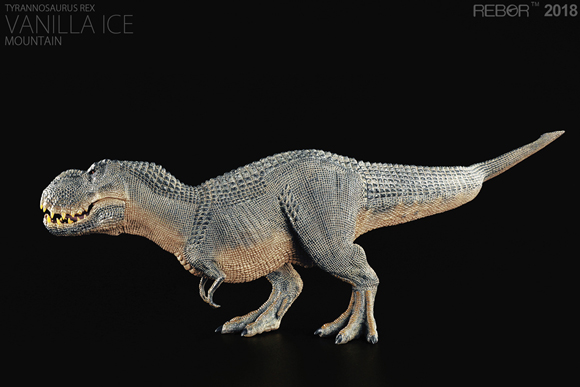
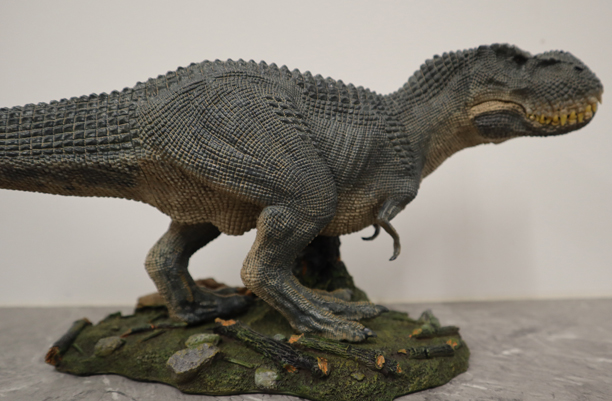
The Rebor “Tyrannosaurus rex Vanilla Ice” Mountain replica has been withdrawn from production. A source close to Everything Dinosaur has confirmed that this Tyrannosaurus rex figure has been retired. The model represented a version of a tyrannosaur popularised by the 2005 King Kong film.
Vanilla Ice T. rex dinosaur model by Rebor – mountain colour scheme. This dinosaur model, launched in 2018 has now been withdrawn from production and retired.
Rebor 1:35 scale ““Tyrannosaurus rex Vanilla Ice”
Originally introduced in the autumn of 2018, the Rebor “Tyrannosaurus rex Vanilla Ice” in the mountain colour scheme proved extremely popular with dinosaur fans and model collectors. It had a counterpart, the “jungle” version. This too, also proved popular amongst fans of prehistoric animal figures.
A close-up view of the Rebor tyrannosaur model Vanilla Ice Mountain on the “Summer Kisses” display base. Picture credit: Everything Dinosaur.
Picture credit: Everything Dinosaur
The picture (above), shows the Rebor 1/35th scale model “Tyrannosaurus rex” Vanilla Ice Mountain displayed on the Rebor “Summer Kisses” display base.
A spokesperson from Everything Dinosaur commented:
“Models do get retired occasionally. When a model is retired it allows the factory time to produce new figures and replicas. As products get retired, it permits new models to be developed and enter the product range.”
Rebor has produced a wide variety of Tyrannosaurus rex models. The company has been creating models that reflect how T. rex is portrayed in films. Other replicas named “Retrosaurs” reflect earlier film depictions of theropod dinosaurs.
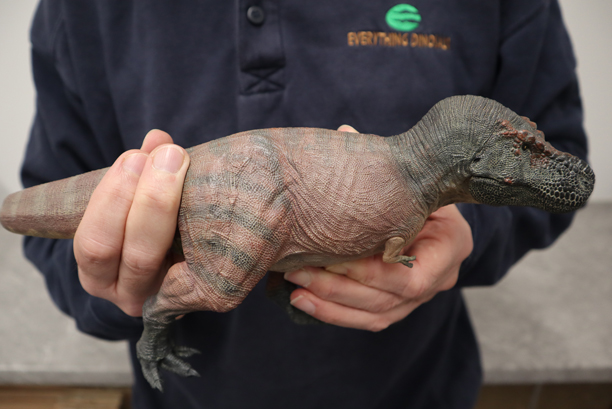
Recently, Rebor introduced the Rebor Tyrannosaurus rex “KISS” Mountain version, a tyrannosaur with lips. This figure also had a counterpart “TUSK” that depicted T. rex as a dinosaur without lips.
The Rebor Kiss T. rex figure (Mountain), this tyrannosaur model has been given lips. Picture credit: Everything Dinosaur.
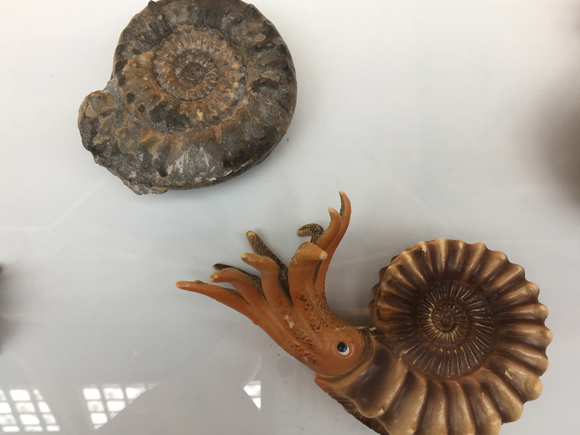
Everything Dinosaur team members have been featured in a blog article posted by a fossil collector and organiser of guided fossil walks at Lyme Regis. Brandon Lennon wrote about the ammonite figures that we supplied him. These models make excellent teaching resources when explaining about the creatures that the Lyme Regis ammonite fossils represent.
A Bullyland ammonite model is used to help illustrate a display of ammonite fossils. Picture credit: Everything Dinosaur.
Picture credit: Everything Dinosaur
Ammonite Models
Ammonite models supplied by Everything Dinosaur can be spotted in museums. Palaeontologists use them in their science outreach work. Fossil collectors like to display the models next to ammonite fossils.
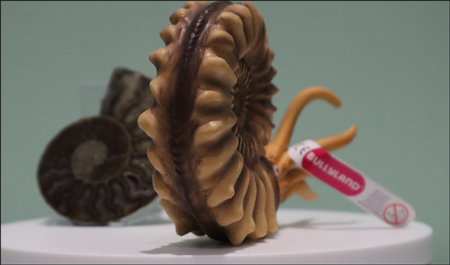
The Bullyland, large ammonite model is a popular choice amongst palaeontologists and fossil collectors.
Brandon Lennon leads guided fossil walks in the Lyme Regis and Charmouth areas. These walks are extremely well attended, and Brandon uses the ammonite figures to help explain a little about these enigmatic cephalopods.
The blog article states:
“Thanks to Mike and Sue at Everything Dinosaur! I received a great parcel from them that will help me no end on the Jurassic Coast fossil walks! They have provided some ammonite models to show the morphology of an ammonite with! The Bullyland ammonite proves helpful when it comes to explaining how fossils are interpreted and a “living” animal reconstructed. See everythingdinosaur1 for its amazing array of educational models they are on Instagram. See the ammonite models on their Instagram page and much, much more!”
To view the website of Brandon Lennon and perhaps, pick up a fantastic fossil or two: Lyme Regis Fossils for Sale.
The strongly ribbed shell and the obvious keel of the ammonite replica. Picture credit: Everything Dinosaur.
Picture credit: Everything Dinosaur
Thanks from Everything Dinosaur
The Everything Dinosaur spokesperson, thanked Brandon for his blog post. We wish Brandon every success with this season’s guided fossil walks. Perhaps, one lucky participant will find some ichthyosaur bones!
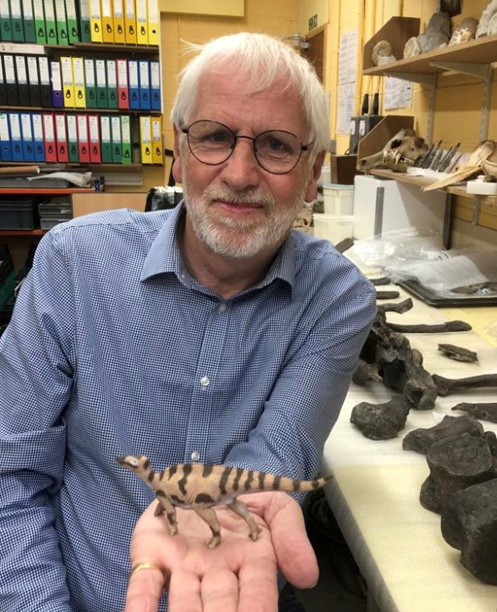
Our thanks to Dr Jeremy Lockwood who sent into Everything Dinosaur a picture of him holding his recently acquired CollectA Brighstoneus model. Dr Lockwood was one of the authors of the scientific paper which named and described this new herbivorous dinosaur from the Isle of Wight.
Dr Jeremy Lockwood holding the CollectA Age of Dinosaurs Brighstoneus figure. What other hadrosauriforms will be described from Isle of Wight fossil material in the future? What other CollectA hadrosauriform figures will be introduced?Picture credit: Dr Jeremy Lockwood.
Picture credit: Dr Jeremy Lockwood
Brighstoneus simmondsi
Formally named and scientifically described in November 2021 (Lockwood, Martill and Maidment), Brighstoneus simmondsi demonstrates that these types of dinosaurs were more diverse than previously thought. Prior to this research, Early Cretaceous hadrosauriform fossils associated with the Wealden Group were placed into either the robust Iguanodon genus or the more lightly built Mantellisaurus taxon.
The fossil material had been thought to represent Mantellisaurus. However, Dr Lockwood identified unique traits within the fossils (autapomorphies), that led to the erection of this new hadrosauriform taxon.
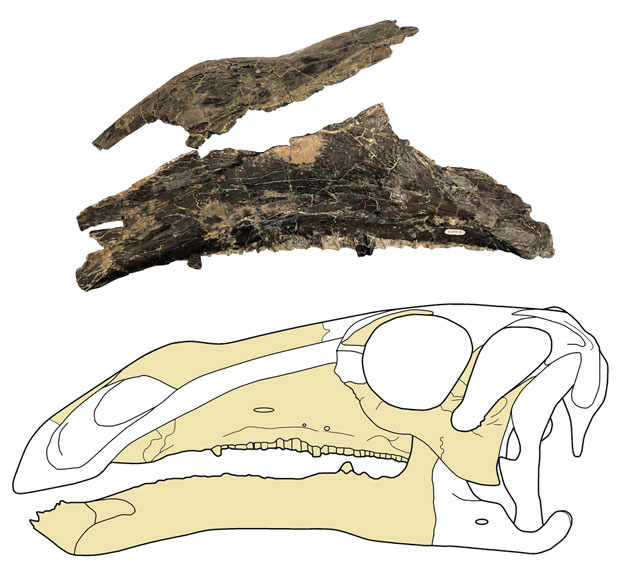
The nasal and maxilla bones of Brighstoneus simmondsi with accompanying line drawings. This ornithopod is believed to have had a bulbous snout. Picture credit: Dr Jeremy Lockwood
Picture credit: Dr Jeremy Lockwood
CollectA were quick to start development work on a Brighstoneus dinosaur model. Under the guidance of Anthony Beeson, the figure was designed and created. Sadly, Anthony passed away before his Brighstoneus model could be launched.
Commenting on the CollectA figure, Dr Lockwood stated:
“Thank you for the models. Attached is a photo of me with the model at Dinosaur Isle Museum.”
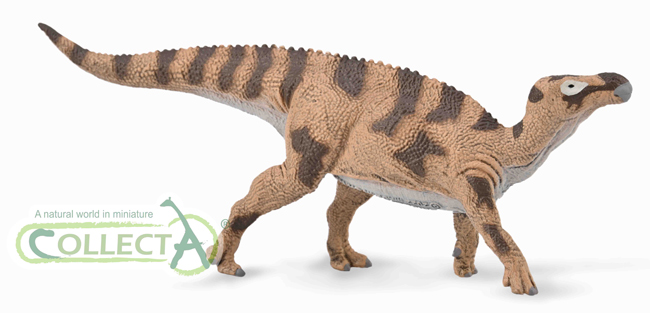
The CollectA Age of Dinosaurs Popular Brighstoneus dinosaur model. This ornithopod figure was introduced in early 2023.
A spokesperson from Everything Dinosaur commented:
“We had been contacted by a relative of Dr Lockwood, prior to the model’s introduction. We were happy to set aside the figures so that Dr Lockwood could receive a replica of a dinosaur he helped name and describe. It is wonderful to be able to supply these figures to scientists so they can use them to help inform the public and explain important scientific discoveries.”
The Rebor Diplodocus models recently arrived at the Everything Dinosaur warehouse. Team members have been busy picking, packing and despatching orders. These Diplodocus carnegii models require assembly. The neck and tail pieces have to be inserted into the body. Here are some helpful tips and advice to help you assemble your Rebor dinosaur model.
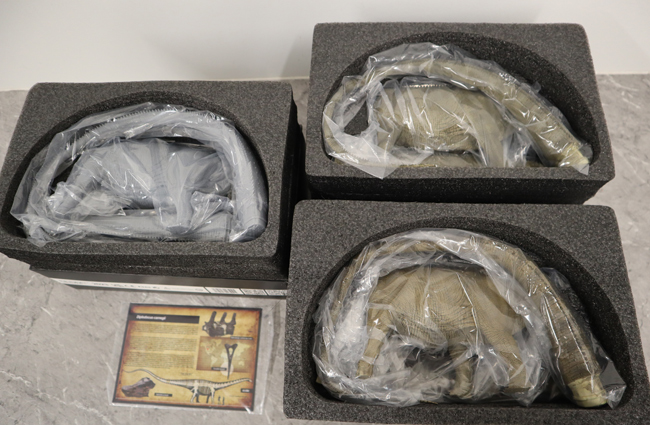
The new for 2023 Rebor Diplodocus carnegii dinosaur models are supplied in three parts. Each figure has a neck, and a tail piece and these need to be inserted into the main body. Picture credit: Everything Dinosaur.
Picture credit: Everything Dinosaur
Use Hot Water/Hair Dryer
The white plugs on the end of the neck piece and tail piece can be heated and this will help them to slot into the main body of the Diplodocus. A hairdryer can be used to gently warm up the plastic plug. Heating the plastic makes it more malleable. It should be easier to slot the neck and tail pieces into position.
Alternatively, the plug can be dipped into a cup of boiling water. Quickly dry the plug and then insert it into the body. Please take care when using hot water.
The plug pieces can be difficult to insert. Please take care when inserting the pieces as you might damage the delicate raised scutes that run along the back of the model.
Try not to force the pieces into place. If the hot water treatment or the hairdryer has not helped, try adding a little oil. Adding a drop of vegetable oil to the white plugs will lubricate them and help them slide into place. Only a little oil is needed, excess squeezed out of the joint can be wiped away.
To help ease the neck and the tail into place add a small amount of oil such as vegetable oil to the plug on each piece. This will help these pieces slide into place. Picture credit: Everything Dinosaur.
A spokesperson from Everything Dinosaur commented:
“Sometimes the Rebor models can be tricky to assemble. Try the heating method first, if this does not work, then add a smear of oil to the plugs. Using vegetable oil, olive oil or something similar should do the trick. These are the types of oil used in cooking. You can find them in most kitchens.”
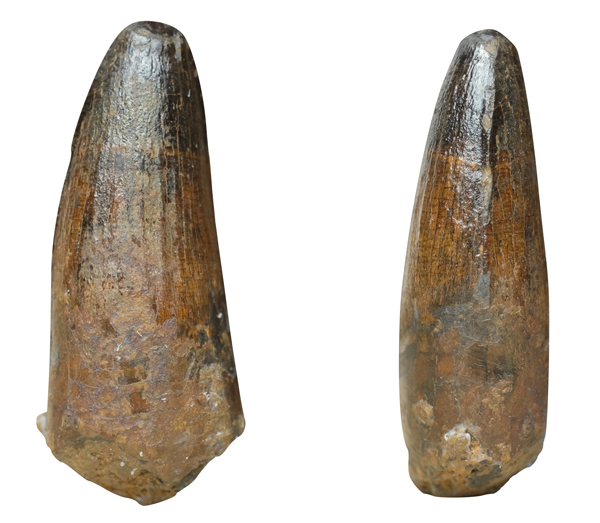
Researchers from the University of Southampton studying a partial spinosaurid tooth have concluded that several different spinosaurs inhabited southern England during the Early Cretaceous. The tooth consisting of a crown with a partial root is reputed to have come from East Sussex, most probably from Lower Cretaceous (Valanginian) exposures of the Hastings Group (part of the Wealden Supergroup). If this is the case, then this tooth is amongst the oldest spinosaurid fossils known from the UK.
The spinosaurid tooth (specimen number HASMG G369a) shown in lingual view (left) and mesial view (right). Picture credit: University of Southampton.
Sorting the Stratigraphy
In common with many other isolated teeth found in strata associated with the Wealden Supergroup, it had been suggested that this tooth represented Baryonyx (B. walkeri). However, The Hastings Group underlies the Weald Clay Group from where the famous Baryonyx walkeri fossil material (NHMUK PV R9951) originates. Therefore, this fossil tooth is much older than the Baryonyx holotype material.
The fossil tooth could be around 138 million years old, much older than Baryonyx walkeri and therefore probably a different spinosaurid genus.
The Southampton University EvoPalaeoLab team carried out a series of tests on the isolated tooth. A statistical analysis confirmed that whilst the tooth was spinosaurid, it did not match any already described spinosaur species.
Project supervisor and co-author of the paper Dr Neil Gostling (University of Southampton explained:
“While we can’t formally identify a new species from one tooth, we can say this spinosaur tooth doesn’t match any of the existing species we know about. Given how many individual teeth exist in collections, this could be just the tip of the iceberg and it’s quite possible that Britain may have once teemed with a diverse range of these semi-aquatic, fish-eating dinosaurs.”
Many Different Spinosaurs
The Wealden Supergroup is famous for its dinosaur fossils. Baryonyx was discovered in a Surrey clay pit in 1983. Since then, isolated teeth from spinosaurids have tended to be assigned to this genus. Spinosaurids are a highly derived group of theropods. They evolved into piscivores and specialised in hunting and eating fish. Their jaws became elongated and crocodile-like and spinosaurids may have had their evolutionary origins in Europe.
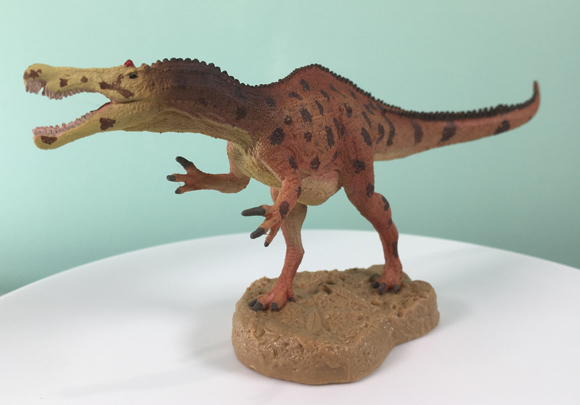
The CollectA new for 2020 Prehistoric Life Baryonyx dinosaur model. Picture credit: Everything Dinosaur.
Picture credit: Everything Dinosaur
The model (above) is a CollectA Prehistoric Life Baryonyx figure.
Palaeontologists had suspected that there were several spinosaurid taxa represented by the Wealden Supergroup material. Spinosaurid teeth are known from formations that span much of the circa 25-million-year depositional history of the Wealden Supergroup, and recent works suggest that British spinosaurids were more taxonomically diverse than previously thought.
“We used a variety of techniques to identify this specimen, in order to test whether isolated spinosaur teeth could be referred to Baryonyx. The tooth did not group with Baryonyx in any of our data runs. It must belong to a different type of spinosaur.”
Distinct and Distantly Related Spinosaurids Lived in Southern England
The results demonstrate that distinct and distantly related spinosaur types lived in the region during the Early Cretaceous. This backs up research by the EvoPalaeoLab team, who argued in previous studies that the spinosaurs of southern England are more diverse than previously thought.
Illustration of White Rock spinosaurid. Picture credit: University of Southampton/Anthony Hutchings.
The Importance of Museum Collections
The study was able to take place as the researchers had access to a wealth of data as well as the fossil specimens themselves. It demonstrates the importance of maintaining access to fossil material for research purposes.
Dr Gostling explained:
“What this work highlights is the importance of keeping collections alive, and developing our understanding of them. Curators are essential to help us navigate the cupboards and displays, helping us to unpick the often-incomplete records – either never fully recorded, or lost to time. The diversity of palaeoenvironments is not always hidden in rocks, it is often waiting in a museum, its importance waiting to be rediscovered!”
Co-author Darren Naish added:
“Dinosaur teeth preserve numerous anatomical details, and we can use various analytical techniques to see how similar, or different, they are to other teeth. Our new study shows that previously unrecognised spinosaur species exist in poorly known sections of the Wealden’s history, and we hope that better remains will be discovered that improves our knowledge. Here’s another reminder that even well-studied places like southern England have the potential to yield new dinosaur species.”
Everything Dinosaur acknowledges the assistance of a media release from the University of Southampton in the compilation of this article.
The scientific paper: “Isolated tooth reveals hidden spinosaurid dinosaur diversity in the British Wealden Supergroup (Lower Cretaceous)” by Chris T. Barker, Darren Naish and Neil J. Gostling published in PeerJ.
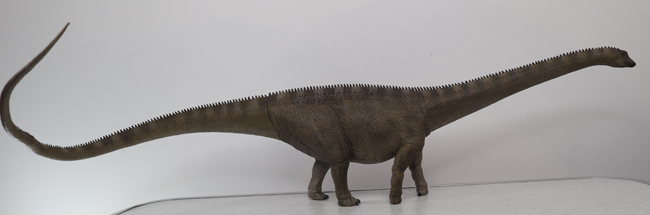
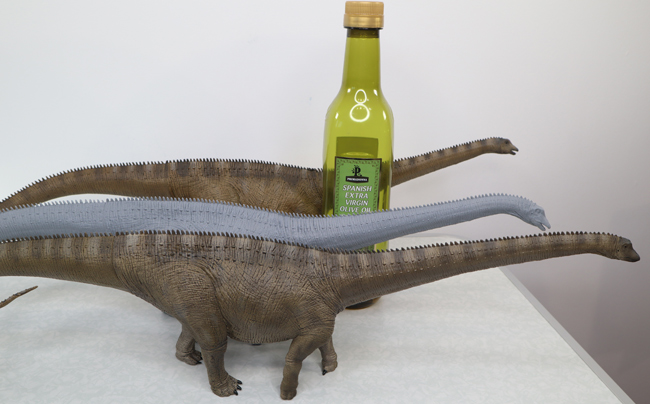
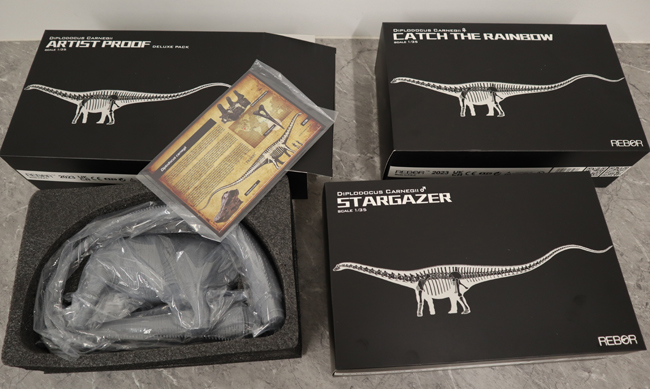
The new for 2023 Rebor Diplodocus carnegii models have arrived at Everything Dinosaur. Three fabulous 1:35 scale sauropod figures. Choose from the male figure “Stargazer”, the female Diplodocus “Catch the Rainbow” or the “Artist Proof” model.
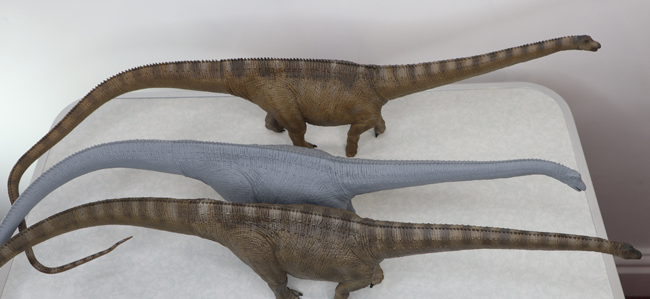
The three, new for 2023 Rebor Diplodocus carnegii dinosaur models. “Stargazer” (top), the “Artist Proof” centre and “Catch the Rainbow” (bottom). Collect them all! Picture credit: Everything Dinosaur.
Picture credit: Everything Dinosaur
Rebor Diplodocus carnegii Models
Each Rebor Diplodocus model measures over 82 cm in length when assembled. The necks are flexible and so are the tails. Three stunning sauropod figures for dinosaur fans to collect.
The three, new for 2023 Rebor Diplodocus dinosaur models. Picture credit: Everything Dinosaur
Picture credit: Everything Dinosaur
“Stargazer”, “Catch the Rainbow” and “Artist Proof”
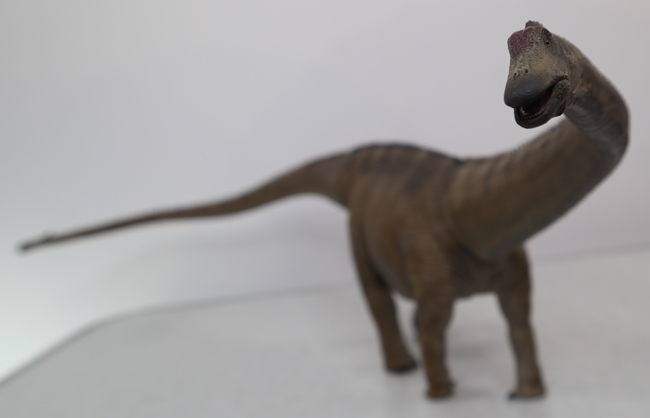
The “Stargazer”, “Catch the Rainbow” and “Artist Proof” replicas have keratinous spines running the length of their long bodies. The figures have been beautifully painted. “Stargazer”, the male has a subtle patch of red on the top of his head. This might indicate his fitness for breeding. Visual signals were probably extremely important in the Dinosauria.
The Rebor Diplodocus “Stargazer” dinosaur model has a patch of red on the top of his head. Picture credit: Everything Dinosaur.
Picture credit: Everything Dinosaur
A spokesperson from Everything Dinosaur commented:
“These are the first sauropod figures to be made by Rebor. “Stargazer” and “Catch the Rainbow” are beautifully painted. Collectors have the opportunity to paint their own figure with the “Artist Proof” model”.
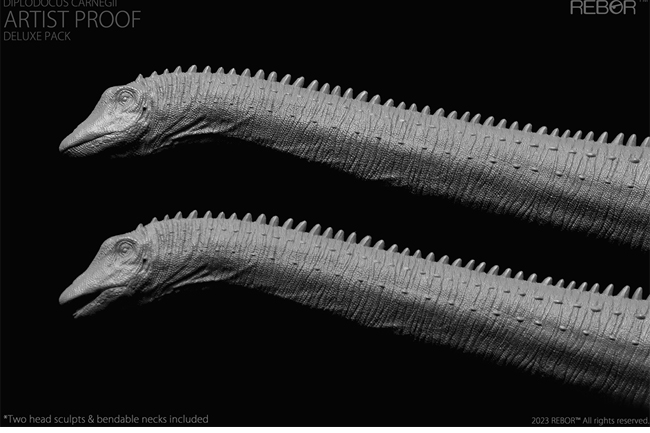
Each of the Diplodocus models has a poseable neck and a poseable tail. The “Artist Proof” Diplodocus is supplied with two sets of head/neck pieces.
The Rebor “Artist Proof” Diplodocus is supplied with two interchangeable necks.One of the heads shows the mouth open, the other shows the mouth closed. Dinosaur model fans can paint these figures to create their own unique Diplodocus carnegii replica.