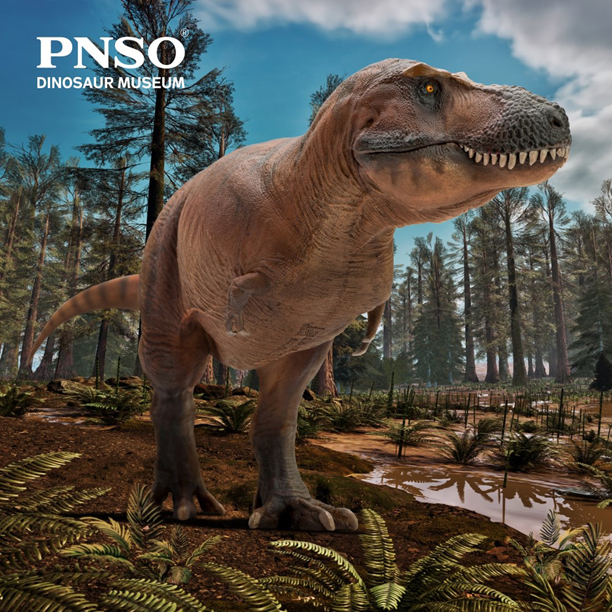
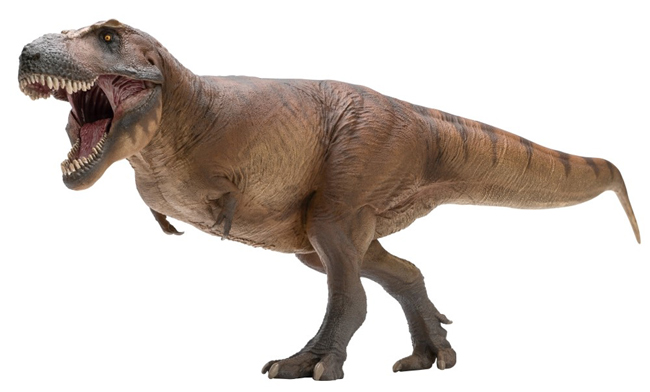
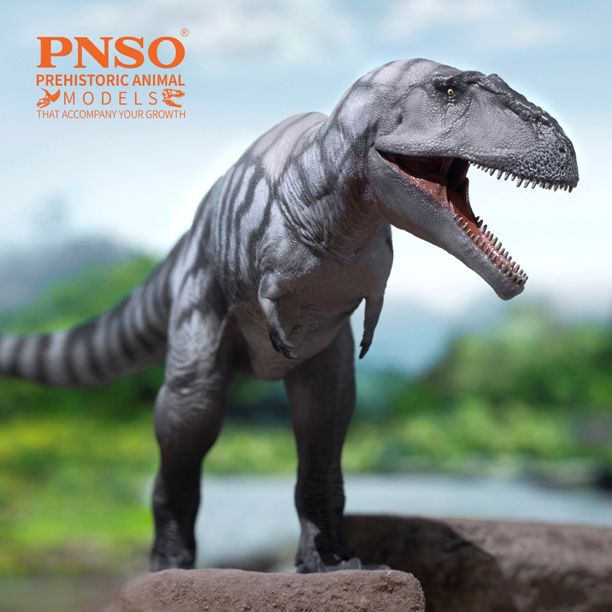
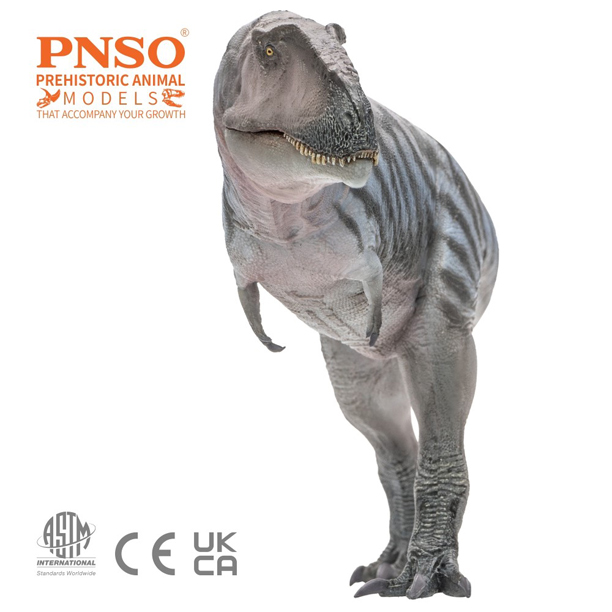
PNSO are to add a replica of a T. rex to their 1:35 scale Scientific Art Museum series. The PNSO Cameron the Tyrannosaurus rex figure will be in stock shortly.
PNSO Cameron the Tyrannosaurus rex dinosaur model.
PNSO Cameron the Tyrannosaurus rex
A spokesperson from Everything Dinosaur confirmed that the PNSO Cameron the Tyrannosaurus rex dinosaur model would be in stock in just a few short weeks. PNSO have continued to impress dinosaur fans and model collectors with their ever-increasing range of prehistoric animal figures. The company has already produced several T. rex dinosaur figures. Cameron the T. rex will be a 1/35th scale figure.
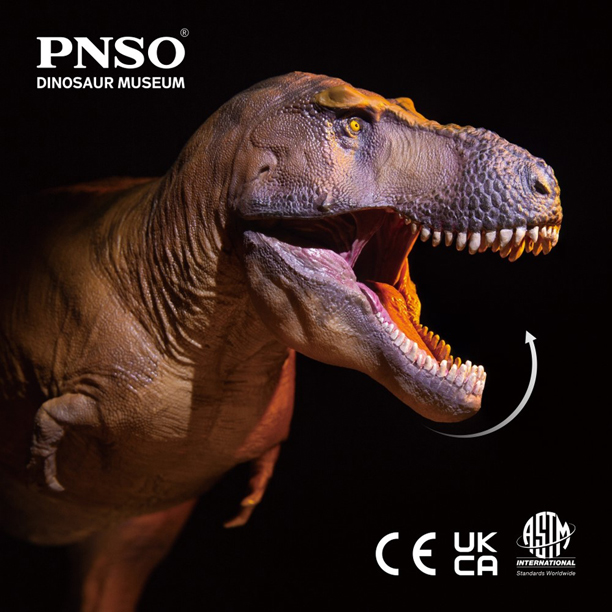
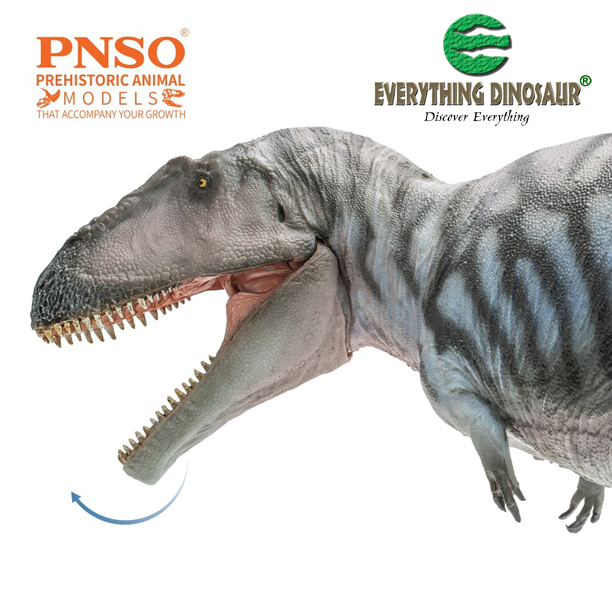
The PNSO Cameron the T. rex figure has an articulated lower jaw.
Model Measurements
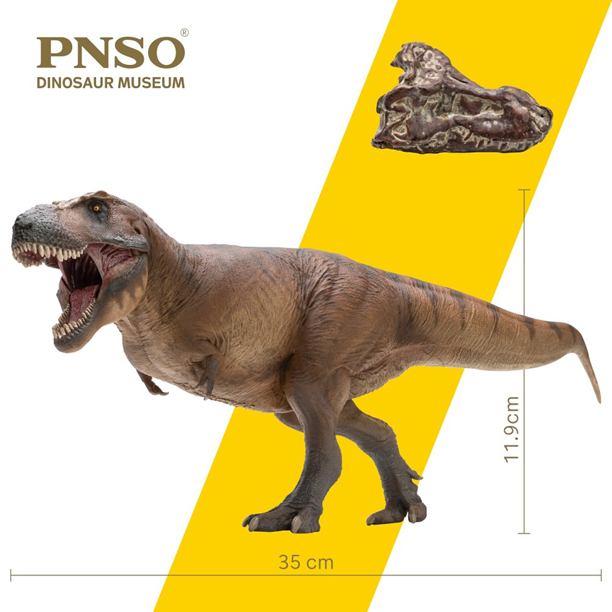
The new for 2023 tyrannosaur figure measures an impressive 35 cm long and the model stands 11.9 cm tall.
The new T. rex figure measures 35 cm in length and stands nearly 12 cm tall.
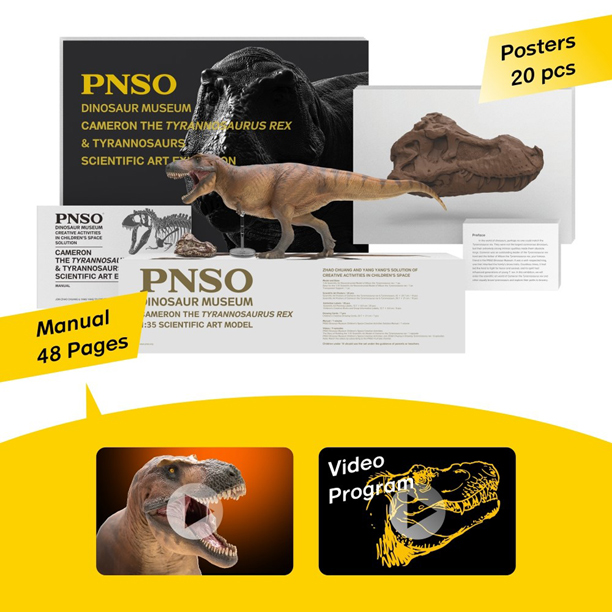
A spokesperson from Everything Dinosaur confirmed that the model will be supplied with twenty scientific art posters, a forty-eight-page colour, fully illustrated booklet and a transparent support stand. The Tyrannosaurus rex model will have an articulated lower jaw.
The new for 2013 T. rex figure is supplied with a transparent support stand, a replica of a T. rex fossil skull, a 48-page, colour booklet and a set of 20 dinosaur posters.
A QR code on the product packaging will provide dinosaur fans with access to a video that explains how the model was created.
The Everything Dinosaur spokesperson added:
“In addition to the posters and the booklet, the new for 2023 T. rex model will be supplied with a replica T. rex skull. The Tyrannosaurus rex model skull that comes supplied with Cameron is based on an actual fossil Tyrannosaurus rex specimen. It will be a 1:35 scale model.”
The PNSO Cameron the Tyrannosaurus rex replica in lateral view.
The PNSO Cameron the Tyrannosaurus rex 1:35 scale dinosaur model is due in stock at Everything Dinosaur in a few weeks.
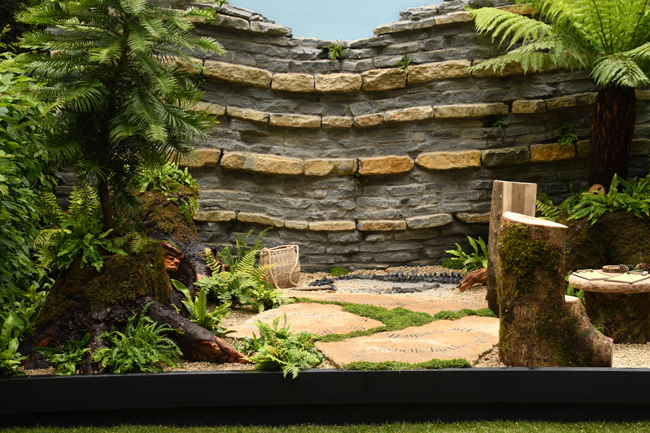
A garden inspired by Mary Anning has won an award at the prestigious Chelsea Flower Show. The Mary Anning Space to Learn Garden created by Sandhurst Garden Design has been awarded a bronze. The award-winning container garden was designed by first-time exhibitors Julie and Andrew Haylock.
The award-winning Mary Anning Space to Learn Garden at the prestigious Chelsea Flower Show. A garden inspired by the pioneering palaeontologist from Lyme Regis. The carefully selected plants including specimens of plants similar to those that existed in the Mesozoic is set against a backdrop that reflects the cliffs of Lyme Regis. Picture credit: Rachel Moffett Photography.
The Mary Anning Space to Learn Garden
The Yeovil-based garden design business wanted to create a container garden that reflected the work of Mary Anning, highlighting her contribution to the science of palaeontology. The theme for the Royal Horticultural Society (RHS) Chelsea Flower Show is encouraging young people to get involved in gardening. The husband-and-wife design team created an outdoor learning space for primary school students to help them explore nature.
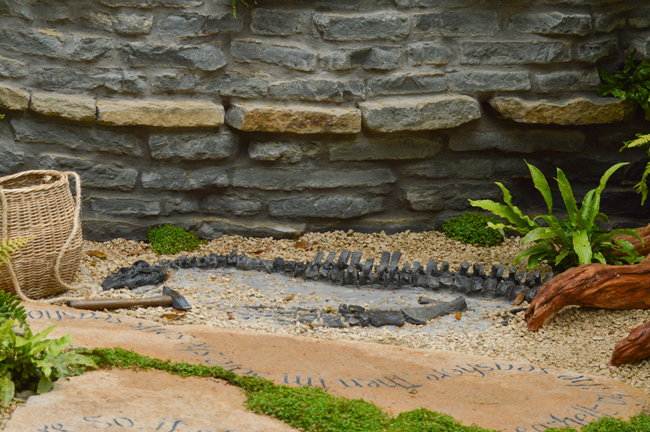
Carved wooden seats for the students and their teacher echo the fern-dominated planting of the garden. Set amongst moss-covered tree stumps planted with Jurassic effect is a replica of a plesiosaur fossil. Mary Anning discovered an almost complete fossil of a plesiosaur in 1823.
A replica of the skeleton of a plesiosaur can be found in the garden along with the “she sells seashells” verse. Picture credit: Rachel Moffett Photography.
Mary and her family members made several significant and highly influential fossil discoveries. Ichthyosaur remains (another type of marine reptile), were uncovered and in December 1828, the first pterosaur fossil discovery in England was made by Mary Anning.
For models and replicas of plesiosaurs, ichthyosaurs and pterosaurs visit Everything Dinosaur’s award-winning website: Everything Dinosaur.
Prehistoric Plants
A variety of plants were incorporated into the outdoor space. Ferns selected include Blechnum spicant, Dryopteris wallichiana “Jurassic Gold”, Asplenium scolopendrium, and Asplenium trichomanes. An example of the evergreen Pseudopanax crassifolius was included along with the tree fern Dicksonia antarctica.
In addition, a Wollemia Pine specimen featured. This ancient tree lineage is thought to date back to the Early Jurassic. It was believed to be extinct, until a small group of trees was discovered in a deep gorge located in a temperate rainforest in New South Wales. Although commonly referred to as a pine, this tree is a member of the Araucariaceae and more closely related to the Araucaria (Monkey Puzzle Tree).
A geology hammer and a wicker basket similar to the one used by Mary Anning can be found in the garden. Picture credit: Rachel Moffett Photography.
Providing a Legacy
Stone replica ammonite shells are dotted around the garden and the large crazy paving stones are engraved by the “She Sells Seashells” tongue-twister, which is thought to have been written in honour of Mary Anning.
Having been part of the world-famous RHS Chelsea Flower Show, the garden will live on. Parts of it are being transplanted to Charmouth Primary School, close to Lyme Regis. Schoolchildren will be able to continue to enjoy elements of the garden and perhaps they may be inspired to follow in Mary’s footsteps.
A spokesperson from Everything Dinosaur commented:
“It is a beautiful garden design. We are delighted to hear that it was awarded a bronze medal. Our congratulations to all the people who helped create this inspirational garden.”
Everything Dinosaur acknowledges the assistance of a press release from the RHS in the compilation of this article.
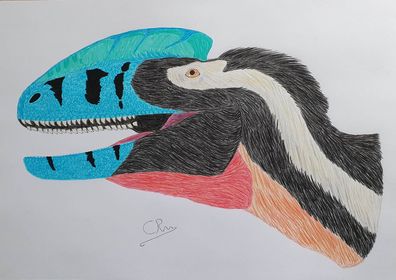
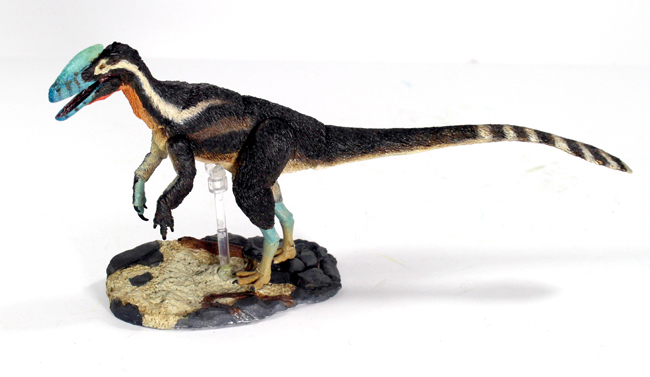
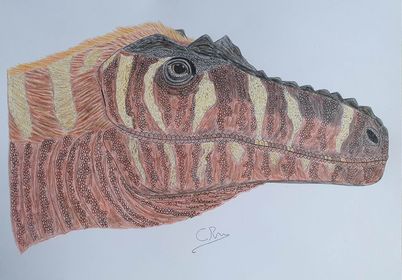
The Late Jurassic tyrannosauroid dinosaur from China Guanlong illustrated by a young fan of dinosaurs and prehistoric animals.
Our thanks to Caldey who sent into Everything Dinosaur a fabulous illustration of Guanlong wucaii inspired by the recently introduced Beasts of the Mesozoic articulated Guanlong figure.
A very colourful Guanlong. A beautiful illustration of the Late Jurassic tyrannosauroid inspired by the recently introduced Beasts of the Mesozoic articulated Guanlong model. Picture credit: Caldey
Picture credit: Caldey
Early Members of the Tyrannosauroidea
Assigned to the Proceratosauridae within the Tyrannosauroidea superfamily, Guanlong demonstrates that the tyrannosaurs are an ancient lineage within the Theropoda. Caldey has chosen to give the pneumatised cranial crest a striking blue colour with hints of green. The jaws too have been carefully coloured blue, but this time with patches of black. This colouration contrasts with the bold black and white stripes and bright red throat patch.
It is thought that these dinosaurs used their impressive crests in displays. Perhaps to demonstrate fitness for breeding or to ward off rivals.
A spokesperson from Everything Dinosaur thanked Caldey for her excellent drawing and commented:
“Guanlong is known from two specimens, found in close proximity to each other. Its discovery helped palaeontologists to better understand the evolutionary changes in theropod dinosaurs leading to the Tyrannosauridae family. In addition, as the two Guanlong specimens represent individuals of different ages, scientists were able to learn more about how dinosaurs changed as they matured.”
The spokesperson praised Caldey’s illustration and added:
“The large, prominent crest may indeed have been brightly coloured and Caldey has carefully observed the Beasts of the Mesozoic model and produced a wonderful illustration.”
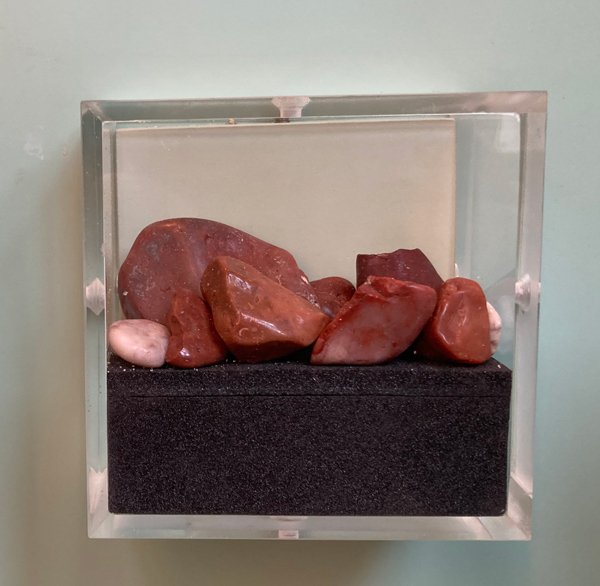
A return visit to the Manchester Museum permitted Everything Dinosaur team members to take a photograph of the Tenontosaurus gastroliths that form part of a new dinosaur exhibit at the Museum. The gastroliths (stomach stones) were found in the body cavity of a Tenontosaurus tilletti specimen discovered in Montana in 1994.
The gastroliths associated with “April” the Tenontosaurus specimen on display at the Manchester Museum. Picture credit: Everything Dinosaur.
Picture credit: Everything Dinosaur
The specimen (MANCH LL.12275) was acquired by the Manchester Museum in 1999 and a recently opened exhibit has permitted the fossil bones of this dinosaur to be displayed. The fossil material represents one of the best-preserved and most complete examples of Tenontosaurus tilletti known to science.
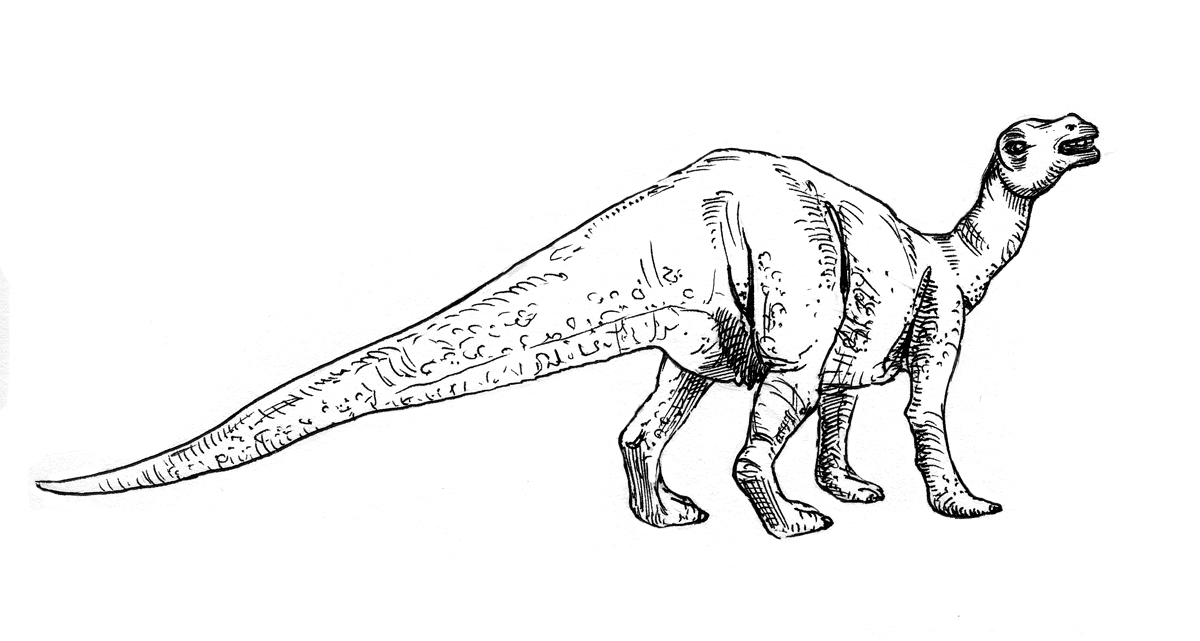
Tenontosaurus drawing. An illustration of the Early Cretaceous iguanodontidTenontosaurus tilletti. Picture credit: Everything Dinosaur
Picture credit: Everything Dinosaur
The Tenontosaurus illustration (above) is based on the CollectA Age of Dinosaurs Popular Tenontosaurus model.
This amazing dinosaur fossil was nicknamed “April” after the wife of Barry James who cleaned and prepared the fossils for exhibition. Gastroliths (stomach stones) were found in the body cavity of this dinosaur. Some dinosaurs swallowed stones to help them grind up tough plants and aid digestion. These stones were held in a gizzard and helped to break down plant-material and assisted in the extraction of nutrients.
Only a handful of examples of stomach stones associated with ornithopods have been recorded. “April” the Tenontosaurus is the largest ornithopod dinosaur known to science associated with gastroliths.
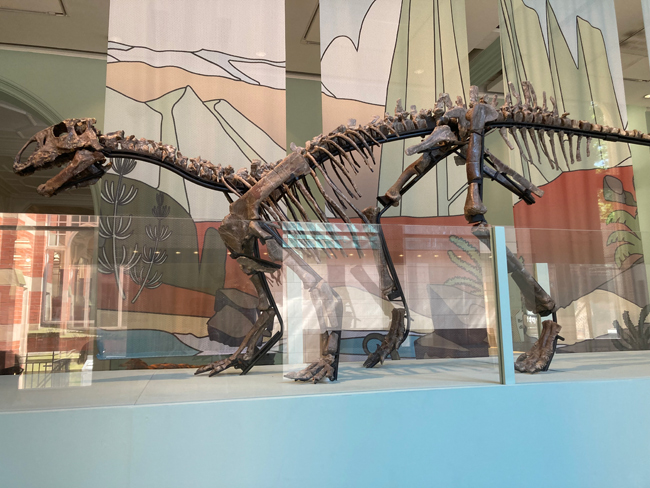
“April” the Tenontosaurus on display at the Manchester Museum. Picture credit: Everything Dinosaur.
Picture credit: Everything Dinosaur
“April” the Tenontosaurus is part of a new, permanent display highlighting research conducted by Manchester University scientists into the Dinosauria.
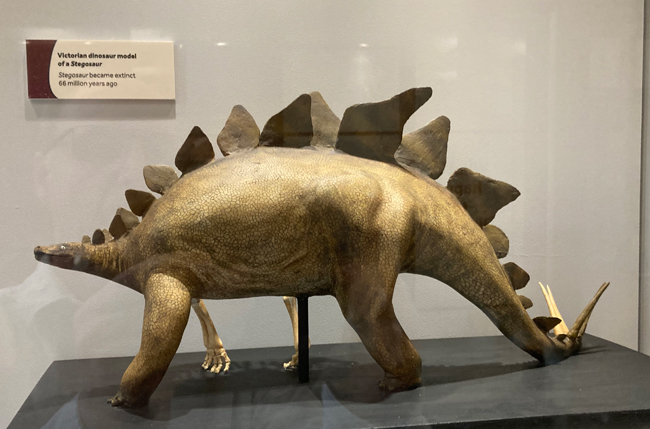
A team member from Everything Dinosaur spotted an unusual stegosaur replica on display at the Manchester Museum. The label next to the armoured dinosaur figure stated that this was a Victorian stegosaur model. The model must indeed be old, as stegosaurs such as Stegosaurus stenops are viewed very differently by palaeontologists today.
A model of a stegosaur in a display cabinet in the fossils and dinosaurs gallery at the Manchester Museum. Picture credit: Everything Dinosaur.
Picture credit: Everything Dinosaur
Stegosaurus stenops
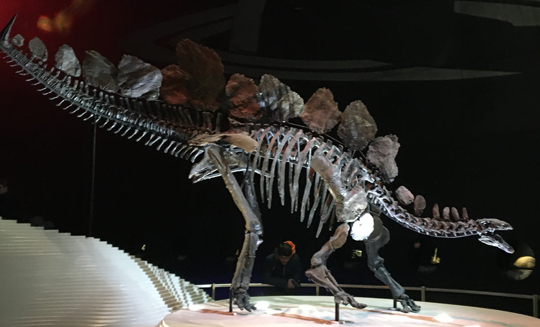
The fossilised remains of an immature Stegosaurus stenops is on display at the Natural History Museum in London. The dinosaur, nicknamed Sophie comes from Wyoming and the fossil material represents one of the most complete stegosaur fossils known to science. The skeleton consists of more than three hundred bones.
The London Natural History Museum exhibit shows a modern interpretation of this iconic herbivorous dinosaur.
Everything Dinosaur stocks a large number of armoured dinosaur figures and models.
Sophie the Stegosaurus (S. stenops), a star exhibit at the London Natural History Museum. This is a modern interpretation of this iconic armoured dinosaur. Picture credit: Everything Dinosaur.
The Victorian Stegosaur Model
The Victorian stegosaur model provides a reminder to visitors about how are views of the Dinosauria have changed. The side of the figure facing the public has been fleshed out, whilst the side which is not visible shows the animal’s skeleton. Note the bones of the lower portions of the limbs on the right side which are visible in the photograph.
A spokesperson from Everything Dinosaur commented:
“This Victorian dinosaur model is not an accurate representation of a Stegosaurus. However, it does remind us how dinosaurs used to be depicted. It acts as bellwether informing visitors about how our views regarding dinosaurs such as Stegosaurus have changed over time.”
The curators at the Museums Victoria confidently predict that their Triceratops exhibition will exceed one million visitors next month. In an email sent to Everything Dinosaur, the Museums Victoria state that “Triceratops: Fate of the Dinosaurs” will have received over a million visitors by the middle of June 2023.
“Triceratops: Fate of the Dinosaurs” is an immersive voyage into a lost world. Visitors will explore the landscapes of the Late Cretaceous and get to know the prehistoric animals that thrived there. The star exhibit is a specimen of Triceratops horridus. The fossils of this dinosaur were discovered in Montana (2014).
The bones found represent about 87% of the entire skeleton. It is one of the most complete, large dinosaur fossils ever found. The skull and neck frill are the most complete of any known Triceratops specimen (greater than 99% complete). The assembled frill measures over 1.48 metres wide.
One Million Visitors
The exhibition has proved to be extremely popular. Museum staff have predicted that the attraction would have received a million visitors by the middle of next month (June 2023).
To celebrate this milestone, staff will be dressing up as dinosaurs for the day. Visitors to Melbourne Museum, the location of the Triceratops exhibit, will also be encouraged to channel their “inner dinosaur”. Visitors will be invited to come to the museum in dinosaur fancy dress. According to the correspondence received by Everything Dinosaur, spot prizes will be offered for the best costumes.
A Triceratops Exhibit
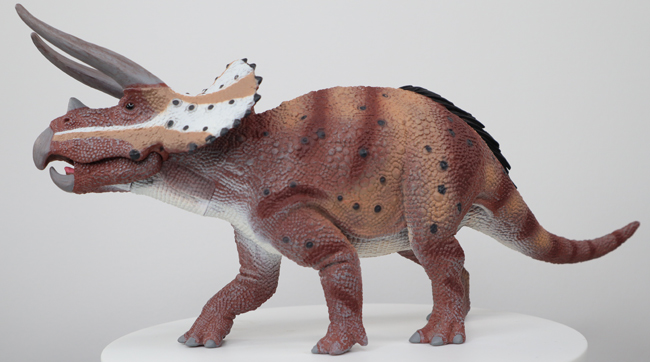
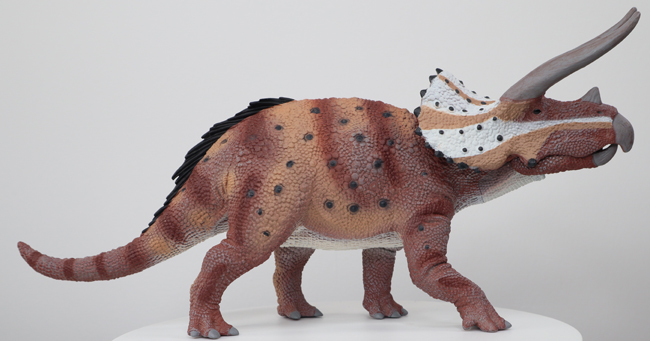
The Triceratops skeleton has been nicknamed “Horridus”. The fossils inspired CollectA to create a 1:40 scale Triceratops horridus figure.
The CollectA Triceratops in right lateral view. Picture credit: Everything Dinosaur.
Picture credit: Everything Dinosaur
A spokesperson from Everything Dinosaur stated:
“We are delighted that the Triceratops exhibit has proved to be so popular. Our customer surveys confirm that Triceratops is a favourite dinosaur. It is pleasing to see this plant-eater taking centre stage.”
Dinosaur fan and model collector William sent into Everything Dinosaur his review of the recently introduced PNSO Meraxes model. William began his review by highlighting how quickly PNSO have produced a replica of Meraxes. This dinosaur was only named and scientifically described last year (2022).
He explained that collectors can never have enough PNSO theropods in their collections. The head sculpt was praised for its scientific accuracy. The well-defined lacrimal crests and the nasal ridge were commented upon. The model has an articulated lower jaw. When the mouth is opened the characteristic “shark-like” teeth of the theropod can be seen.
The carcharodontosaurid from the Late Cretaceous of Argentina Meraxes gigas. The PNSO model is in stock at Everything Dinosaur in the spring (2023).
The reviewer states that the body sculpt is highly accurate and reflects what is known about this predator from the holotype fossil material. The figure has a muscular neck, a strong body and a powerful tail. He comments that members of the Carcharodontosauridae family tended to have very similar body shapes.
William explains:
“From start to finish all areas are detailed to the highest degree. No blank spots on the PNSO Meraxes model, there is even a cloaca.”
When reviewing the dinosaur’s limbs, the reviewer outlines the evolutionary path of these giant theropods. Reference is made to an earlier PNSO model review (Giganotosaurus 2.0). The small, highly detailed muscled forearms and the hands are well armed with the three fingered hand retaining powerful claws.
The reviewer comments that a new unique feature of “Mungo” are the pair of ankle spur claws that may have been used in intraspecific combat.
The new for 2023 PNSO Mungo the Meraxes dinosaur model, which will be available shortly from Everything Dinosaur.
The Dinosaur Model’s Colour Scheme
The main body colour is described as a mixture of stunning silver which phases into a silvery-blue. There is a rose tint added to the face, head, neck and jaw area. The charcoal stripes have been executed with careful consideration. The stripes on the tail are reminiscent of those seen on extant tigers.
William comments that the model measures around 11.9 inches long. The head height is 4.1 inches and the declared scale 1:35.
As with previous model reviews, William confirms that the PNSO Meraxes model is supplied with a transparent support stand, full-colour booklet and a poster.
To view the range of PNSO prehistoric animal figures available from Everything Dinosaur: Age of Dinosaurs PNSO Models.
The Meraxes model will have an articulated lower jaw.
Meraxes gigas
William also sent in some information about this dinosaur’s fossils and their discovery.
Time Period: Late Cretaceous 95–93.9 million years ago (Cenomanian stage).
Location: Argentina Province of Mendoza in the western central of the Cuyo region.
Discovery: Meraxes’s holotype the “Campanas carcharodontosaurid” was found in 2012. It is the most complete carcharodontosaurid skeleton ever unearthed. The skull material permitted scientists to better understand the skull morphology of other carcharodontosaurids including Giganotosaurus and Mapusaurus.
The name Meraxes is derived from the name of a great, grey, female dragon from the fantasy book series, “A Song of Ice and Fire” by George R. R. Martin. William speculated whether the colour scheme chosen for the PNSO figure had been influenced by this book.
Classification:
Order: Theropoda.
Superfamily: Allosauroidea.
Clade: Carcharodontosauria.
Family: Carcharodontosauridae.
Subfamily: Giganotosaurini.
Genus: Meraxes.
Species: M. gigas.
William commented that this dinosaur has been estimated to have been around 33 feet long, with a head height of 9 feet. It weighed approximately 4.26 tonnes.
In concluding his review William declared:
“Meraxes is the second of three recent Carcharodontosauridae releases by PNSO. “Mungo” alone is spectacular by himself from his sculpt to paint application, to the spurs on his heels. No soul can say he is a toy, he is a museum display piece or teaching aid demonstrating what a theropod should be.”
William added:
“Purchasing from Everything Dinosaur is fast, safe and secure with no nonsense.”
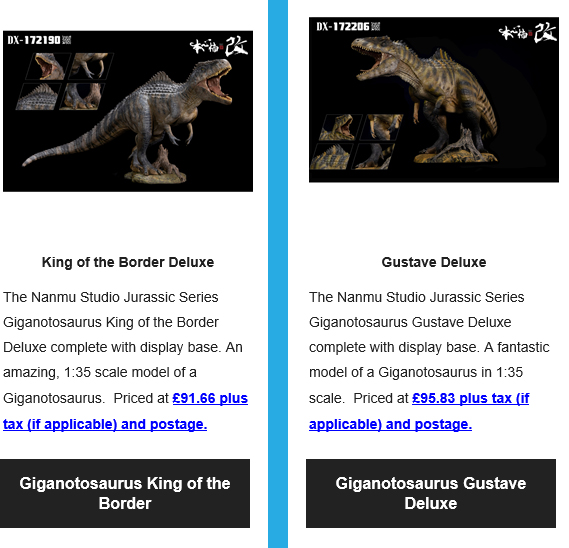
The Nanmu Studio Jurassic Series Giganotosaurus dinosaur models have arrived in stock at Everything Dinosaur. These three exciting dinosaur figures feature in the latest Everything Dinosaur company newsletter. The dinosaur replicas are named “Gustave”, “Typhon” and “King of the Border”. They pay tribute to the Giganotosaurus featured in the film “Jurassic World Dominion”.
The Nanmu Studio Jurassic Series Giganotosaurus Typhon Deluxe model complete with display base. Picture credit: Everything Dinosaur.
Picture credit: Everything Dinosaur
Jurassic Series Giganotosaurus Dinosaur Models
The headline model in the latest Everything Dinosaur newsletter is the Nanmu Studio Jurassic Series Giganotosaurus Typhon Deluxe figure. This beautifully detailed figure comes complete with a display base and an Everything Dinosaur fact sheet.
Each of the Giganotosaurus dinosaur models measures 44 cm in length approximately. When secured to their display base the models have a head height of 18.5 centimetres. The dinosaur model display base (supplied with each figure), measures 14 cm x 8 cm.
Gustave and King of the Border
The latest Everything Dinosaur customer newsletter also features Gustave and King of the Border. Everything Dinosaur offers three new Nanmu Studio Giganotosaurus figures.
The Nanmu Studio Jurassic Series Giganotosaurus King of the Border Deluxe (left). The Nanmu Studio Jurassic Series Giganotosaurus Gustave Deluxe (right). Picture credit: Everything Dinosaur.
Picture credit: Everything Dinosaur
A spokesperson for the UK-based mail order company commented:
“We are delighted to have brought into stock these three figures. Each Giganotosaurus dinosaur model is beautifully painted. We decided to only bring the models that included display bases out of China. These figures are large and heavy, when displayed without the base they might fall over and get damaged.”
The second series of “Prehistoric Planet” has recently concluded, the last episode “North America” having been broadcast yesterday on Apple+TV. The programmes have proved to be immensely popular with dinosaur fans and natural history film viewers. The five episodes in the series have achieved an audience rating of 100% on Rotten Tomatoes.
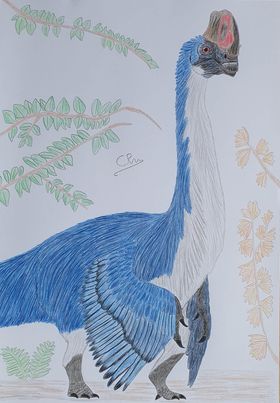
The programmes have also inspired lots of prehistoric animal fans to create drawings of the dinosaurs featured. For example, young artist Caldey sent in a magnificent illustration of a Qianzhousaurus concentrating intently as it hunted prey.
A beautiful illustration of a theropod dinosaur stalking prey. Picture credit: Caldey.
Picture credit: Caldey
“Prehistoric Planet” Qianzhousaurus and Corythoraptor
In a beautifully crafted scene, a female Qianzhousaurus stalks a flock of Corythoraptors in a Late Cretaceous forest. The first hunt is unsuccessful and the Corythoraptors escape. However, with the approach of a storm, the odds turn in the favour of the hunter and this clever theropod is able to catch her quarry.
A beautiful illustration showing the diversity of theropod dinosaurs. Picture credit: Caldey.
Picture credit: Caldey
Qianzhousaurus although a Late Cretaceous tyrannosaur, was not closely related to Tyrannosaurus rex. It has been classified as a member of the Alioramini tribe of long-snouted tyrannosaurs within the Tyrannosauridae. Corythoraptor is an oviraptorid. Oviraptorids seem to have been particularly abundant in the Late Cretaceous of China.
“Prehistoric Planet” has continued to delight, entertain and inform.
A spokesperson from Everything Dinosaur commented:
“Thank you Caldey for sending in your stunning illustrations. We hope you enjoyed watching the five television programmes. We have printed out the drawings and put them on display in our office and warehouse.”
A new study examining diapsid fossil teeth from Lower Triassic sediments in South Africa has provided further evidence of the recovery of terrestrial ecosystems after the end-Permian mass extinction event. The research highlights the growing diversity of archosauromorphs following the extinction of parareptiles and therapsids.
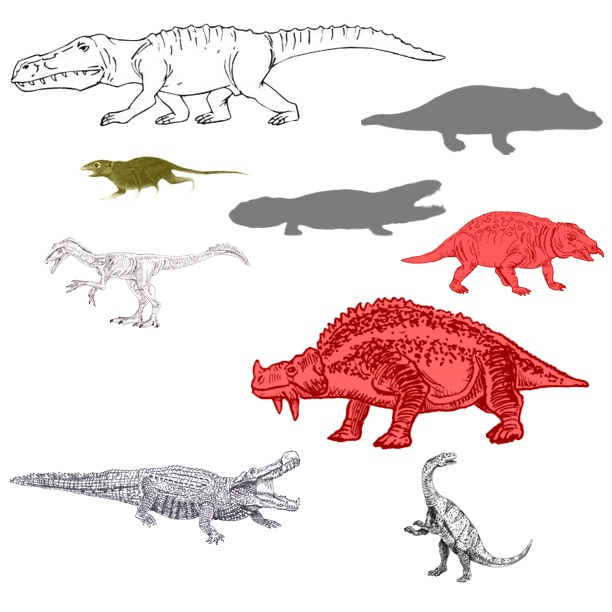
Diapsid fossil teeth study sees rise of the Archosauromorpha in southern Africa. Temnospondyls (grey), archosauromorphs (monochrome), early mammals (yellow) and extinct therapsids (red). Picture credit: Everything Dinosaur.
The research team collected teeth from the Driefontein locality in Free State Province, South Africa. The strata represent Lower Triassic deposits (late Olenekian stage). The rocks are part of the Burgersdorp Formation and form part of the Karoo Basin, which provides an extensive geological record, crucially deposition that occurred before and after the end-Permian extinction event.
A total of 102 teeth were collected. The scientists identified 81 diapsid teeth with the remaining teeth classified as coming from temnospondyls. Analysis of the tooth morphology demonstrated that there was a greater diversity of archosauromorphs and other diapsids.
This research suggests that diapsids, especially archosauromorphs benefitted from the mass extinction event. They played an important role in the recovery of terrestrial ecosystems. Archosauromorphs filled many of the niches left vacant after the extinction of therapsids and anapsid reptiles.
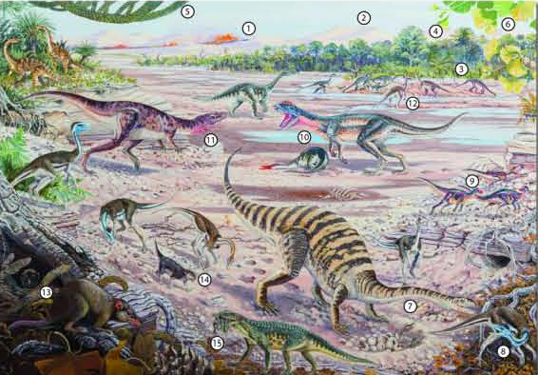
The prehistoric life of South Africa. The image shows the diverse flora and fauna that had evolved in South Africa by the Early Jurassic (Hettangian faunal stage). Archosaurs dominated terrestrial ecosystems but shared these habitats with other diapsids and early mammals. Picture credit: The Evolutionary Studies Institute (The University of Witwatersrand).
The fossil teeth from Driefontein provide palaeontologists with an important window into how terrestrial ecosystems recovered. The largest mass extinction recorded in the Phanerozoic occurred approximately 252 million years ago. The end-Permian mass extinction event devastated both marine and terrestrial ecosystems. The Karoo Basin may yield further evidence to help palaeontologists to better understand how life bounced back from the mass extinction event. It may also help scientists to understand how the Archosauromorpha were able to gain an evolutionary advantage over other tetrapods. This may have ultimately helped the Dinosauria and their close relatives to dominate terrestrial habitats.
The scientific paper: “A diverse diapsid tooth assemblage from the Early Triassic (Driefontein locality, South Africa) records the recovery of diapsids following the end-Permian mass extinction” by Devin K. Hoffman, John P. Hancox and Sterling J. Nesbitt published in Plos One.