All about dinosaurs, fossils and prehistoric animals by Everything Dinosaur team members.
4 07, 2022

Rebor Smilodon Year of the Tiger in Stock

By |2022-10-20T12:47:40+01:00July 4th, 2022|Categories: Adobe CS5, Dinosaur Fans, Everything Dinosaur News and Updates, Everything Dinosaur Products, Main Page, Photos of Everything Dinosaur Products, Press Releases|0 Comments

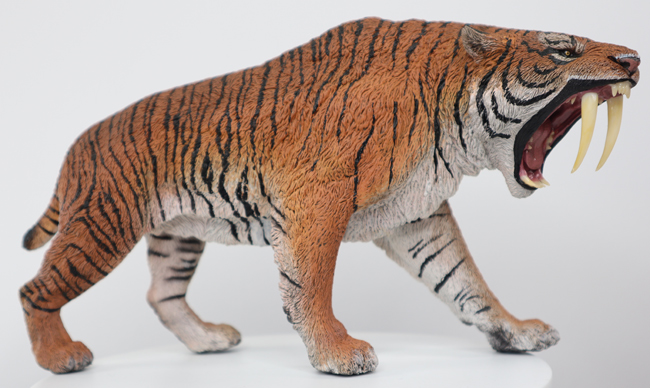
The limited-edition Rebor Smilodon populator in the Year of the Tiger colouration has arrived at Everything Dinosaur and is now in stock. Following the success of earlier versions “Ice Age” and “Plain”, Rebor decided to produce a special edition figure in honour of the Chinese Year of the Tiger.

Rebor Smilodon Year of the Tiger model
The Rebor 1:11 scale Smilodon populator model in the Year of the Tiger colour scheme. A limited-edition Rebor figure.

A Sabre-toothed Tiger?

Most palaeontologists doubt whether Smilodon had a striped coat like extant tigers. Although a member of the Felidae (cat) family, the Smilodon genus was not closely related to modern big cats such as lions and tigers. It was not a creature of jungles and dense forests, but mostly associated with much more open habitats. However, as the Chinese lunar calendar celebrates the Year of the Tiger, the design team at Rebor decided to create a limited-edition Smilodon populator replica.

Rebor Smilodon populator Year of the Tiger
The Rebor Smilodon populator Year of the Tiger colour scheme, a 1:11 scale model of S. populator.

A Single Production Run

As team members at Everything Dinosaur understand the situation, Rebor only intend to have a single production run for these 1:11 scale models.

A spokesperson from Everything Dinosaur commented:

“The Smilodon populator figures have proved to be extremely popular and we suspect that this limited-edition figure will also prove to be an enormous success. We have spent the last few hours contacting all those customers who wanted to be informed when this new model arrived.”

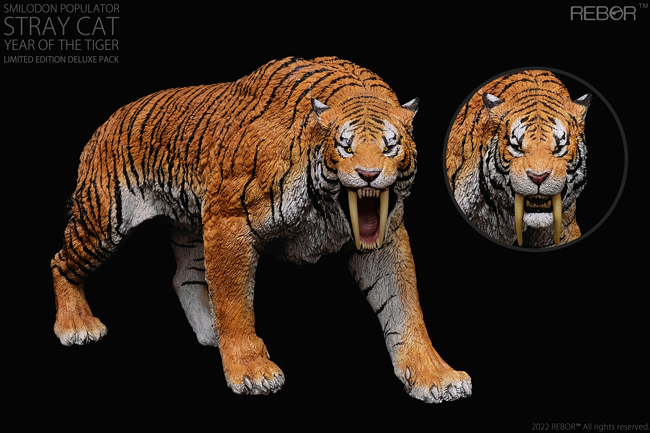
Rebor Smilodon populator Stray Cat Year of the Tiger
The Rebor Smilodon populator Stray Cat Year of the Tiger model. The figure is supplied with two heads, one with a closed mouth, one with an open mouth.

The Eye of the Tiger

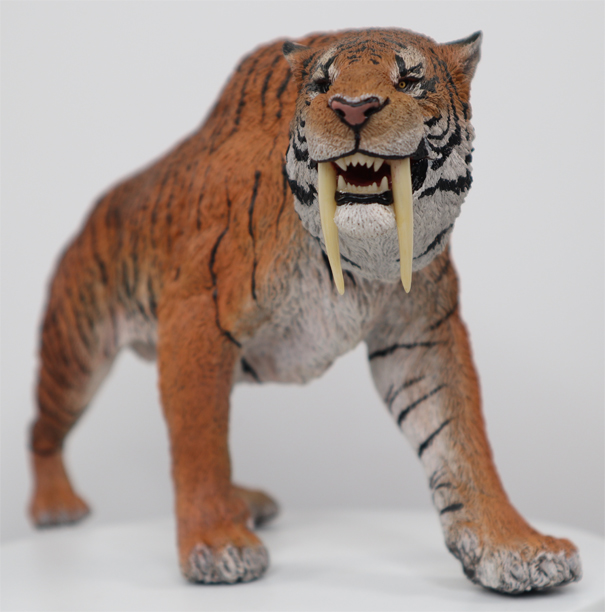
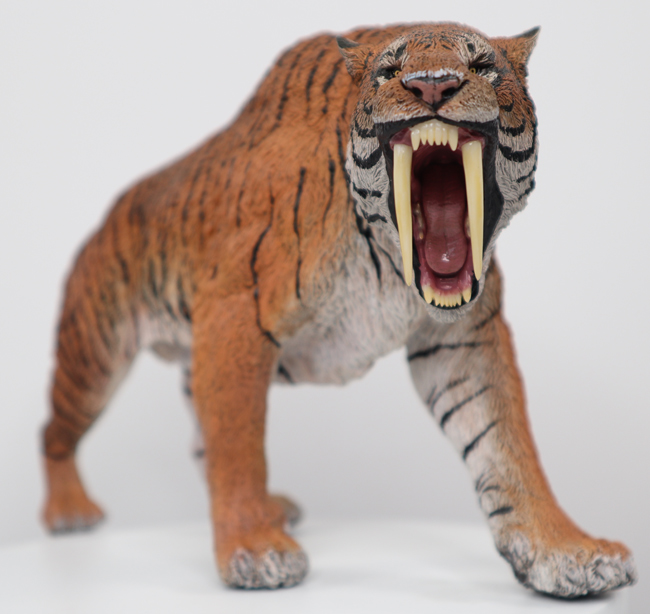
The new Rebor model is beautifully painted and comes complete with two heads, one with a closed mouth and one with the mouth open. Collectors have the choice to display their model with either the mouth open or closed.

Rebor Smilodon Year of the Tiger (eye of the tiger).
The eye of the tiger. A close-up view of the eye on the Rebor Smilodon populator year of the tiger scale model.

The Smilodon populator replica measures just under twenty-seven cm in length and stands a little over 13 cm tall.

Rebor Smilodon populator Stray Cat Year of the Tiger

Rebor Smilodon populator.
The Rebor Smilodon populator with the open-mouth configuration. An anterior view of the Rebor Smilodon Year of the Tiger model.

To view the range of Rebor models and figures in stock at Everything Dinosaur: Rebor Prehistoric Animal Models and Figures.

3 07, 2022

Robust Roo from Papua New Guinea

By |2023-04-25T06:39:05+01:00July 3rd, 2022|Categories: Adobe CS5, Dinosaur and Prehistoric Animal News Stories, Main Page, Palaeontological articles, Photos/Pictures of Fossils|0 Comments

Scientists have described a new genus of robust kangaroo from fossils found in late Pleistocene deposits in Papua New Guinea. Analysis suggests that it was not closely related to kangaroos found today in Australia.

Protemnodon nombe

Researchers from Flinders University examined two partial dentaries (lower jaw bones) that had been previously assigned to the Protemnodon genus and named P. nombe. They identified unique characteristics in the teeth and the shape of the bones that led them to conclude that the fossils were sufficiently different from other Protemnodon material to be assigned their own genus. The ancient kangaroo has been named Nombe nombe honouring the Nombe Rockshelter where the fossils were discovered.

Nombe nombe life reconstruction.
A life reconstruction of the prehistoric kangaroo Nombe nombe. Standing around 1.5 metres tall and weighing up to 60 kilograms, the thick dentary and strong teeth indicate Nombe evolved to eat tough leaves in the dense jungle landscape. Picture credit: Peter Schouten.

A New Guinea/Australia Land Bridge

During the Miocene Epoch, around 5-8 million years ago, lower global sea levels permitted a land bridge between Australia and Papua New Guinea to form. This led to a faunal interchange between the two regions. An ancient form of Australian kangaroo migrated northwards and entered the territory now known as Papua New Guinea. When sea levels rose and the Torres Strait was formed, these ancient kangaroos were able to evolve in isolation away from their Australian ancestors.

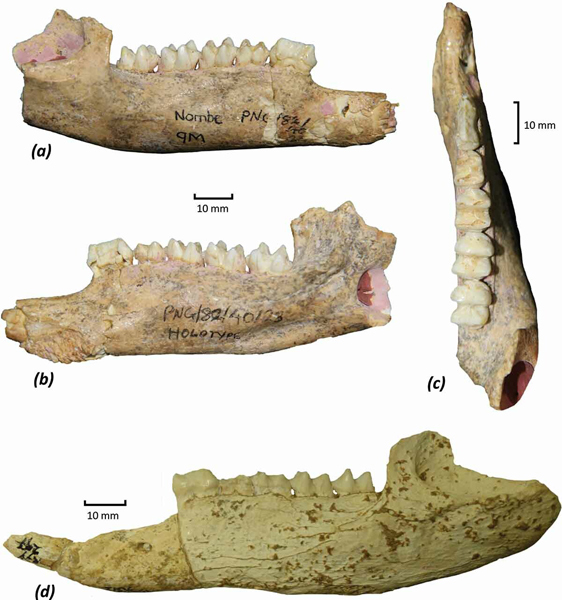
Nombe nombe dentaries.
Nombe nombe lower jaw bones. Holotype and referred specimen of Nombe nombe: holotype (PNG/82/40/23) partial right dentary in (a) buccal/lateral view, (b) lingual/medial view and (c) lower dentition in occlusal/dorsal view; (d) referred specimen (PM/82/40/19) partial left dentary in buccal/lateral view. Picture credit: Kerr and Prideaux.

A Robust Kangaroo

Co-author of the scientific paper published in the Transactions of the Royal Society of South Australia, PhD student Isaac Kerr commented:

“The New Guinean fauna is fascinating, but very few Australians have much of an idea of what’s actually there.”

Co-author of the paper, Professor Gavin Prideaux (Flinders University), explained that excavations at the Nombe Rockshelter and elsewhere in central Papua New Guinea are providing palaeontologists with evidence of a unique ecosystem on the island, a biota dominated by prehistoric marsupials that were adapted to their mountainous, tropical environment. Flinders University hopes to be able to undertake more extensive fieldwork over the next three years and they are confident that these excavations will unearth new species.

Prehistoric Papua New Guinea
Life in the late Pleistocene on Papua New Guinea. The megafauna was dominated by extinct species of kangaroo and giant four-legged marsupials called diprotodontids, which in turn were hunted by Thylacines. Picture credit: Peter Schouten.

Everything Dinosaur acknowledges the assistance of a media release from Flinders University in the compilation of this article.

The scientific paper: “A new genus of fossil kangaroo from late Pleistocene New Guinea” by Isaac A. R. Kerr and Gavin J. Prideaux published in the Transactions of the Royal Society of South Australia.

Visit Everything Dinosaur’s award-winning website: Everything Dinosaur.

2 07, 2022

A New Book “Travels with Trilobites” by Andy Secher

By |2024-04-13T08:07:04+01:00July 2nd, 2022|Categories: Adobe CS5, Book Reviews, Dinosaur Fans, Main Page, Palaeontological articles, Photos/Pictures of Fossils|0 Comments

We got sent a copy of the amazing “Travels with Trilobites” by world-renowned expert on the Trilobita Andy Secher. What a fantastic book! Trilobites are regarded by many scientists as being one of the most successful animals to have ever existed and their fossils are absolutely fascinating as well as stunningly beautiful. We can’t wait to read and then review this superbly illustrated guide to all things Trilobita!

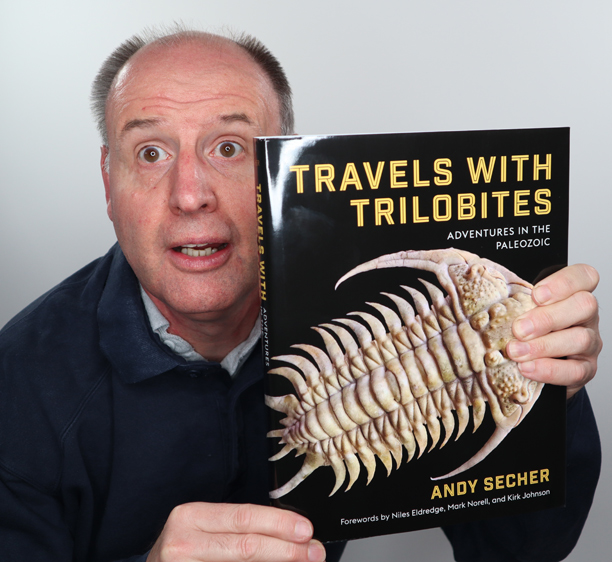
Holding the "Travels with Trilobites" book.
Very excited to receive a copy of “Travels with Trilobites” by Andy Secher (field associate in palaeontology at the American Museum of Natural History – New York).

Published by Columbia University Press

Published by Columbia University Press the book includes forewards by Mark Norell, Kirk Johnson and Niles Eldredge. There are over 25,000 described species of trilobites and although entirely marine (as far as we know), they evolved into a myriad of forms. Many of the beautiful, full-colour photographs in the book show fossils from the author’s own extensive collection.

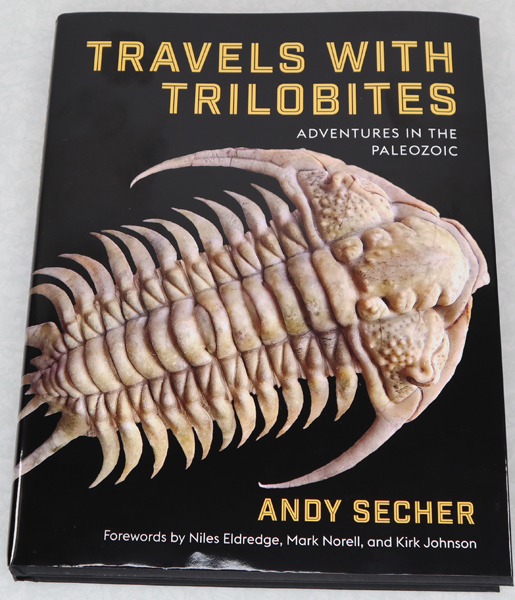
Front cover of "Travels with Trilobites".
The front cover of the beautifully illustrated “Travels with Trilobites” by Andy Secher published by Columbia University Press. It is an adventure in Palaeozoic marine fauna.

Andy Secher is a field associate in palaeontology at the prestigious American Museum of Natural History (New York). His own private collection comprises more than 4,000 trilobite specimens. The book provides the opportunity to explore one of the most enigmatic marine creatures of the Palaeozoic Era.

Team members at Everything Dinosaur are going to enjoy reading and then reviewing this wonderful book.

To purchase “Travels with Trilobites” by Andy Secher, visit the Columbia University Press website and search for Andy Secher: Visit Columbia University Website.

1 07, 2022

A Beautiful Drawing of a Female Velociraptor

By |2024-05-12T07:35:56+01:00July 1st, 2022|Categories: Adobe CS5, Dinosaur and Prehistoric Animal Drawings, Dinosaur Fans, Main Page|0 Comments

The recently aired television documentary series “Prehistoric Planet” has drawn praise for the way it depicted long extinct creatures as real animals and not movie monsters. This five-part series aimed to show animals such as marine reptiles, pterosaurs and of course dinosaurs doing more than just fighting, hunting and killing.

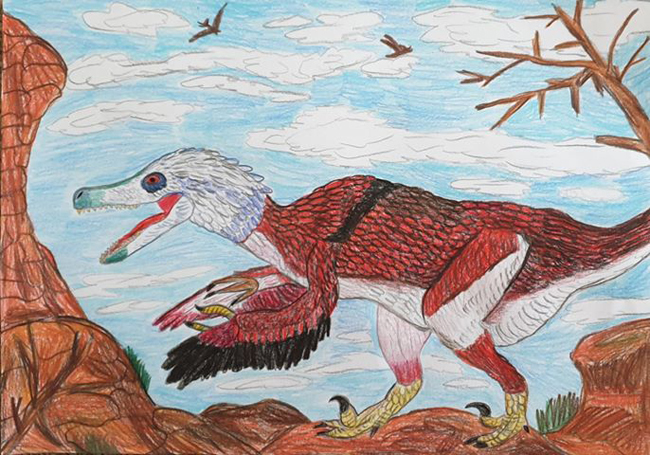
The stunning episodes have inspired a whole new generation of dinosaur fans and we have received an illustration of the female Velociraptor that featured in episode three (Freshwater), from young artist Caldey.

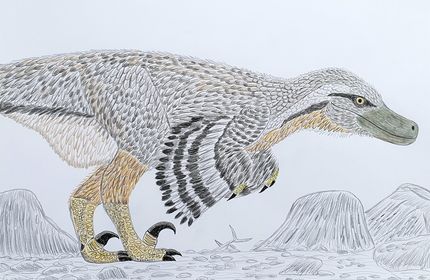
Female Velociraptor drawing from "Prehistoric Planet".
The female Velociraptor from the television documentary series “Prehistoric Planet”. The programmes were praised as they depicted prehistoric animals as living creatures rather than fearsome movie monsters. Picture credit: Caldey.

Hunting Roosting Pterosaurs

Our thanks to Caldey for sending into Everything Dinosaur her wonderful illustration of the female Velociraptor. This dinosaur was one of a trio of Velociraptors (a female and two males), in a segment showing these agile predators hunting roosting pterosaurs. Co-operative hunting behaviour was demonstrated and these clever theropods, after some drama, did manage to get a meal.

Female Velociraptor from the television series "Prehistoric Planet"
The female Velociraptor from episode 3 of the television series “Prehistoric Planet”. In this episode entitled “Freshwater” a trio of Velociraptors were shown co-operating in a successful hunt on a pterosaur nesting colony. Picture credit: Apple TV+.

A spokesperson from Everything Dinosaur commented:

“Caldey has sent into Everything Dinosaur several dromaeosaurid drawings, but the female Velociraptor illustration is the first that was inspired by a television programme. Her inspiration for earlier dromaeosaur illustrations has come from prehistoric animal models, for example, the limited-edition Beasts of the Mesozoic Velociraptor osmolskae figure called Alpha.”

Velociraptor osmolskae illustrated
An illustration of Velociraptor osmolskae inspired by the limited-edition Beasts of the Mesozoic model called “Alpha”. Picture credit: Caldey.

To read an article about the television series “Prehistoric Planet”: “Prehistoric Planet” on TV.

30 06, 2022

Tetrapodophis Revised – It’s Not a Snake

By |2025-01-07T20:23:55+00:00June 30th, 2022|Categories: Adobe CS5, Dinosaur and Prehistoric Animal News Stories, Dinosaur Fans, Main Page, Palaeontological articles|0 Comments

The Early Cretaceous Tetrapodophis amplectus, once thought to represent an early limbed snake, was not a snake after all, but a member of the Dolichosauridae. The fossil is not a missing link between lizards and snakes but an aquatic lizard. That was the conclusion in a paper published late last year (2021) and today we take a look at this remarkable and highly controversial fossil specimen.

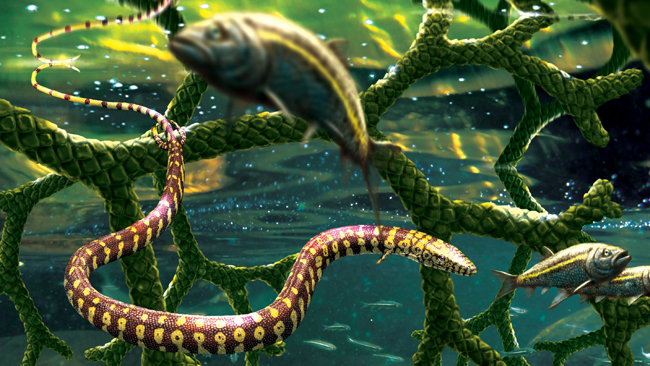
Tetrapodophis life reconstruction.

A life reconstruction of Tetrapodophis amplectus gliding through cover as it stalks fish close to the shore. New research suggests that this Early Cretaceous reptile is not a transitional form between a lizard and a snake, but instead it is a dolichosaurid. Picture credit: Julius Csotonyi.

Picture credit: Julius Csotonyi

A Transitional Fossil

Palaeontologists had long hoped to find a transitional fossil showing a lizard-like animal with vestigial limbs, an evolutionary link in the evolution of snakes from a limbed ancestor. Tetrapodophis was named in 2015, when a scientific paper was published describing a remarkable fossil from Brazil that had been spotted quite by chance by scientists on a visit to a German museum.

To read Everything Dinosaur’s 2015 article about the T. amplectus scientific paper: Fossil Snake with Four Limbs Described.

Had Tetrapodophis been revealed to be an ancestral snake then this would have had very significant implications for our understanding of the evolution of the Squamata. However, in November 2021 a scientific paper was published in the “Journal of Systematic Palaeontology” which concluded that the fossil had been misidentified. The research team from the University of Alberta, Harvard University, Flinders University (South Australia), the University of Toronto, Midwestern University and the Universidad Maimónides (Buenos Aires, Argentina), examined the counter slab and concluded that the fossil skull impression did not demonstrate characteristics typically seen in snake skulls.

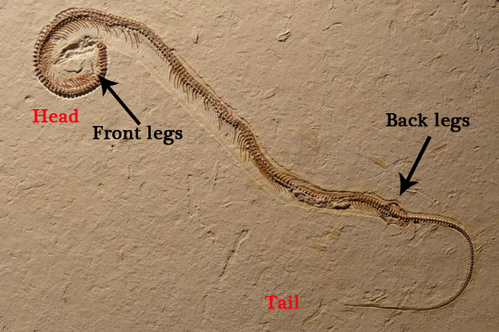
Tetrapodophis fossil.

A beautifully preserved specimen once thought to represent an early, limbed snake but now thought to be a marine lizard related to snakes and modern lizards. Picture credit: Dr Dave Martill/University of Portsmouth with additional annotation by Everything Dinosaur.

Picture credit: Dr Dave Martill/University of Portsmouth with additional annotation by Everything Dinosaur

University of Alberta palaeontologist Michael Caldwell, who led the study commented:

“When the rock containing the specimen was split and it was discovered, the skeleton and skull ended up on opposite sides of the slab, with a natural mould preserving the shape of each on the opposite side. The original study only described the skull and overlooked the natural mould, which preserved several features that make it clear that Tetrapodophis did not have the skull of a snake — not even of a primitive one.”

Tetrapodophis Illustrated

In the original 2015 scientific description, Tetrapodophis was thought to be an ancestral snake. The tiny limbs were thought to have been used to hold prey. Scientists were uncertain whether this animal was a burrower or adapted to a marine environment. It has now been assigned to the Dolichosauridae. Picture credit: Julius Csotonyi.

Picture credit: Julius Csotonyi

Squamata Evolution Remains Ambiguous

The evolution of the Order Squamata remains ambiguous. It is thought that the first, basal squamates evolved during the Middle Triassic, but when the first true snakes evolved is uncertain. The 2021 paper examining the skull impression in the counter slab confirmed that Tetrapodophis lacked typical snake skull characteristics. The spine was also shown to lack typical snake-like anatomical traits.

The fossil record for the Squamata is particularly sparse. Primitive snake and lizard skeletons are usually small with delicate bones that are easily dispersed post-mortem. Palaeontologists hope that more fossils will be found that help to clarify the evolutionary origins of snakes.

A Controversial Fossil

Tetrapodophis amplectus may not represent a snake with four legs, transitional fossils remain elusive, it still has immense scientific value. Co-author of the 2021 paper, Tiago Simões (Harvard University) explained:

“One of the greatest challenges of studying Tetrapodophis is that it is one of the smallest fossil squamates ever found. It is comparable to the smallest squamates alive today that also have reduced limbs.”

The fossil specimen remains controversial. The fossil, originally from Brazil may have been exported without the appropriate permits. It was part of a private collection and the authorities in Brazil only became aware of the fossil’s existence when the 2015 paper was published.

Tetrapodophis

To read an article about the legal dispute: Fossil Slithers into Legal Dispute.

Everything Dinosaur acknowledges the assistance of media releases from Flinders University and the University of Alberta in the compilation of this article.

The scientific paper: “Tetrapodophis amplectus is not a snake: Reassessment of the osteology, phylogeny and functional morphology of an Early Cretaceous dolichosaurid lizard” by M. W. Caldwell, T. R. Simões, A. Palcid, F. F. Garberoglio, R. R. Reisz, M. S. Y. Lee and R. L. Nydam published in the Journal of Systematic Palaeontology (November 2021).

The Everything Dinosaur website: Dinosaur Toys.

29 06, 2022

If You Want to Live for a Long Time be Cold-blooded

By |2025-01-07T19:09:45+00:00June 29th, 2022|Categories: Adobe CS5, Animal News Stories, Main Page|0 Comments

Compared with most birds and mammals, reptiles like turtles and tortoises are extremely long-lived, but how do they achieve such great ages, with little evidence of age-related decline? Recently published research papers examined ageing rates and lifespans across seventy-seven species of reptiles and amphibians and these studies suggest that “cold-blooded” animals could teach us a thing or two about living to a ripe old age.
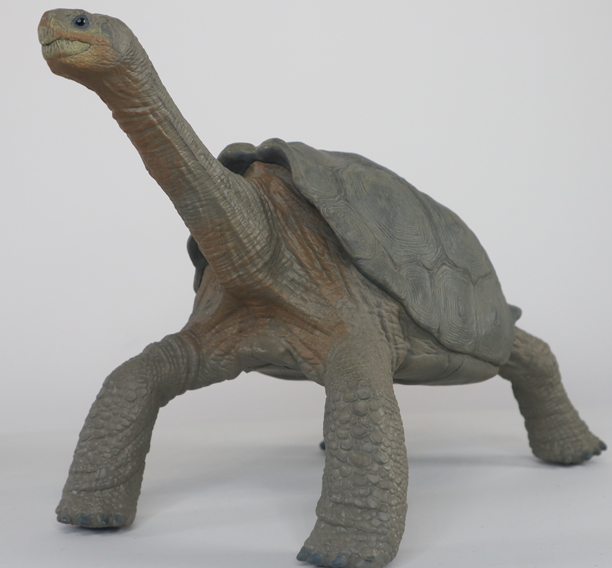
Rebor "Lonesome George.

The Rebor 1:6 scale Pinta Island tortoise “Lonesome George” in oblique lateral view. Animals like giant tortoises are known to live to an extremely old age. Picture credit: Everything Dinosaur.

Picture credit: Everything Dinosaur

The picture (above) shows a 1:6 scale replica of a giant tortoise by the model manufacturer Rebor.

To view the range of Rebor models and figures: Rebor Models.

Life in the Slow Lane

An international team, consisting of over one hundred scientists including researchers from Flinders University (Adelaide, South Australia), Pennsylvania State, Northeastern Illinois University and the University of Kent, have provided the first comprehensive evidence confirming that turtles in the wild age very slowly and have long lifespans. In addition, the team concluded that reptiles and amphibians (ectotherms) have highly variable rates of ageing.

Several cold-blooded (ectothermic) species, essentially, do not age and show very little evidence for age-related decline. Unlike warm-blooded (endothermic) animals, ectotherms rely on external heat sources to help them regulate their body temperature, as a result, they tend to have much lower metabolisms than animals like birds and mammals. They way in which these animals regulate their body temperatures could play a role in ageing and potential lifespan (thermoregulatory mode hypothesis).
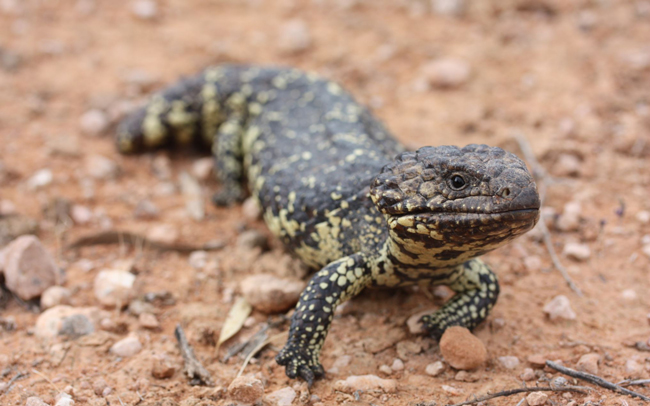
Sleepy lizard (Tiliqua rugosa).

Native to Australia, the Sleepy lizard (Tiliqua rugosa), which is also referred to as the Shingleback, can live for more than 50 years. Scientists from Flinders University have been working on a long-term study of these slow-moving reptiles, their maximum age is not known. Picture credit: Mike Gardner.

Picture credit: Mike Gardner

Having a Shell, Armour, Venom or Spines Might Help You Live Longer

In this extensive study programme, the researchers also noted that animals with physical or chemical traits that provide defence and protection such as spines, armour, shells or venom, tend to age slowly and to live longer.

The scientists documented that these protective traits do, indeed, enable animals to age more slowly and in the case of physical protection, live much longer for their size than those without protective phenotypes (protective phenotypes hypothesis).

Some Cold-blooded Animals Do Not Seem to Age

Discussing the significance of this long-term research programme, Professor Mike Gardner (Flinders University) stated:

“We helped track seventy-seven species for up to sixty years to try to reveal the secrets of long life. Some don’t seem to age at all.”

First author of one of the studies, published in the journal “Science”, Assistant Professor Beth Reinke from Northeastern Illinois University added:

“These various protective mechanisms may reduce animals’ mortality rates within generations. Thus, they are more likely to live longer, and that can change the selection landscape across generations for the evolution of slower ageing. We found the biggest support for the protective phenotype hypothesis in turtles. Again, this demonstrates that turtles, as a group, are unique.”
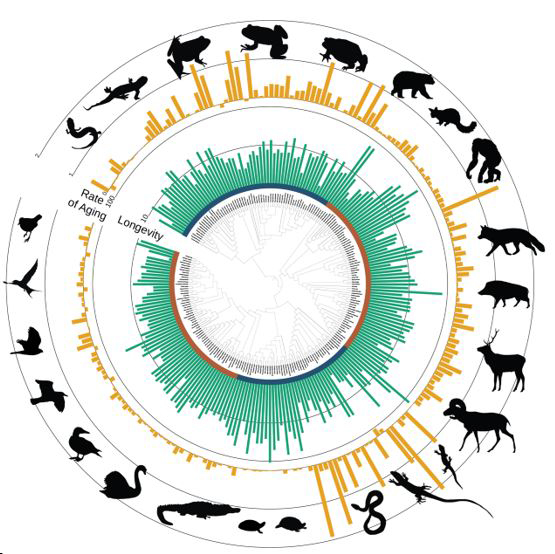
Aging diagram from the study

Ageing Diagram Ectotherms compared to Endotherms. A supertree diagram showing all the endothermic and ectothermic species included in the analysis. Branch lengths are not scaled. The red in the inner circle represents endotherms and blue represents ectotherms. Green bars are longevity estimates and orange bars are the aging rates. Silhouettes from Phylopic.org. Picture credit: Reinke et al.

Picture credit: Reinke et al

Cold-blooded

It might sound a little dramatic to conclude that some cold-blooded animals may show no signs of ageing, but basically their likelihood of dying does not alter to any great extent once they mature. They show “negligible ageing” which means if an animal’s chance of dying in a year when they are ten years old is 1%, if that animal is alive in a hundred years, it still has a 1% chance of dying.

In contrast, a study of American women found that the risk of dying at age twenty is 1 in 2,500, but this risk rises as they get older. For example, in this study group, at the age of eighty, their risk of dying was more than a hundred times higher (1 in 24) than when they were twenty years old.

Everything Dinosaur stocks a range of prehistoric reptile models including crocodilians and other cold-blooded animals as well as feathered dinosaurs and models of endothermic creatures.

To view the range: Models of Ectothermic and Endothermic Prehistoric Animals.

Everything Dinosaur acknowledges the assistance of a media release from Flinders University in the compilation of this article.

The scientific paper: “Diverse aging rates in ectothermic tetrapods provide insights for the evolution of aging and longevity” by Beth A. Reinke, Hugo Cayuela, Fredric J. Janzen et al published in Science.

The Everything Dinosaur website: Everything Dinosaur.

28 06, 2022

New PNSO Dinosaur Models in Stock

By |2025-01-07T18:28:30+00:00June 28th, 2022|Categories: Adobe CS5, Dinosaur Fans, Everything Dinosaur News and Updates, Everything Dinosaur Products, Main Page, Photos of Everything Dinosaur Products, Press Releases|0 Comments

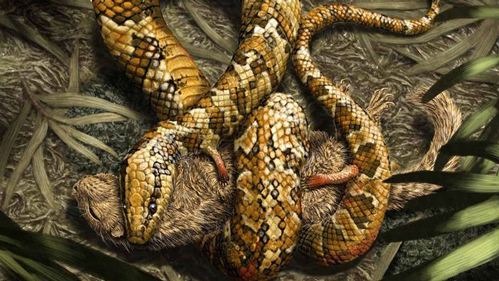
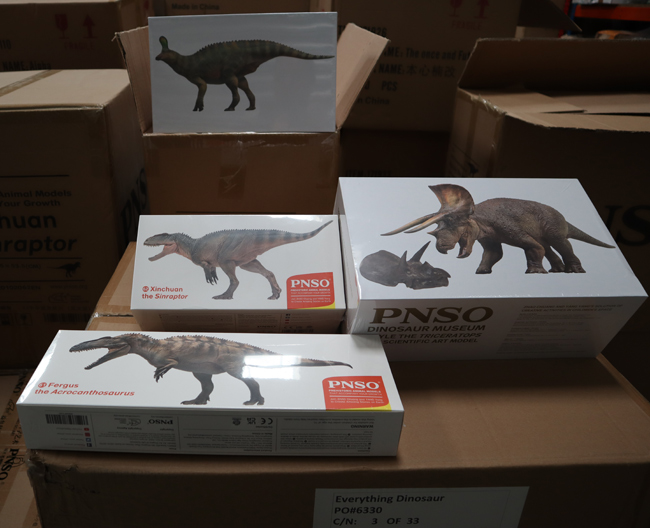
New PNSO dinosaur models are in stock at Everything Dinosaur. Xinchuan the Sinraptor, Fergus the Acrocanthosaurus and Aubrey and Dabei the Torosaurus pair have arrived. Team members have been busy contacting all their customers who requested that they be notified when these exciting prehistoric animal models came into stock.

Unloading PNSO models

Unloading the latest shipment of PNSO prehistoric animal figures at Everything Dinosaur’s warehouse. Tsintaosaurus model and the Torosaurus pair (Aubrey and Dabei) with the Fergus the Acrocanthosaurus model and Xinchuan the Sinraptor (right). Picture credit: Everything Dinosaur.
Picture credit: Everything Dinosaur

PNSO Sinraptor, Acrocanthosaurus and the Torosaurus Pair

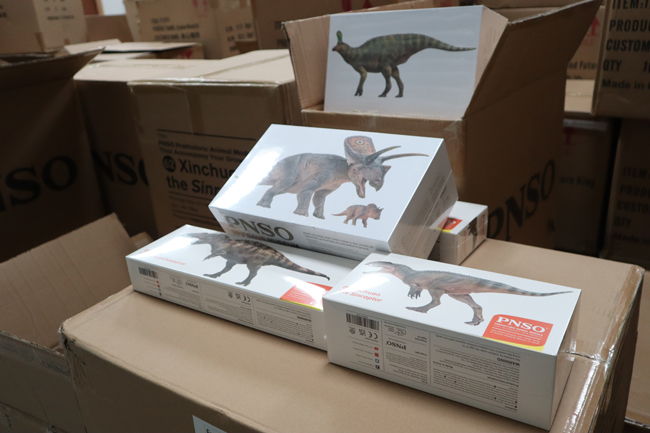
As well as the new figures, the PNSO Xinchuan the Sinraptor, Fergus the Acrocanthosaurus and the 1:35 scale Torosaurus pair (Aubrey and Dabei), replenishment stocks for a number of existing lines have also arrived and staff have been busy checking boxes and getting these items on-line as well.

PNSO 1:35 scale horned dinosaur models

A pair of PNSO 1:35 scale dinosaur models. Doyle the Triceratops (top) and (bottom) Torosaurus Aubrey and Dabei. Picture credit: Everything Dinosaur.
Picture credit: Everything Dinosaur

A spokesperson from Everything Dinosaur commented:

“We are delighted to receive this latest shipment of PNSO prehistoric animal figures, especially as it contains the eagerly awaited, new theropods [Sinraptor and Acrocanthosaurus] as well as the Torosaurus adult and juvenile in 1/35th scale.”

The award-winning Everything Dinosaur website: Prehistoric Animal Models.

No Need to Pre-Order, No Fees, No Deposit to Pay

With Everything Dinosaur, customers do not have to pre-order. There are no additional fees or deposits to pay. If customers let us know that they wish to receive a priority alert when a model arrives, we are happy to arrange this for them.

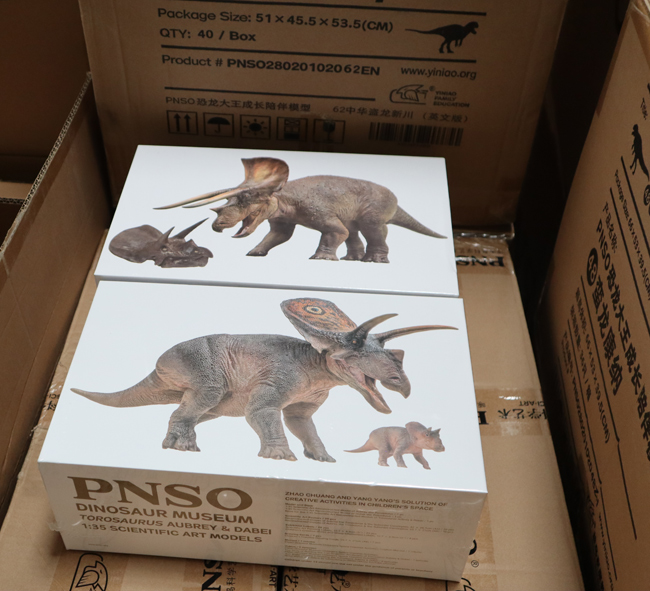
PNSO dinosaur models (Chinese dinosaurs)..

PNSO prehistoric animal models arrive at Everything Dinosaur’s UK warehouse. Picture credit: Everything Dinosaur.
Picture credit: Everything Dinosaur

To view the extensive range of PNSO Age of Dinosaurs figures and models in stock at Everything Dinosaur: PNSO Dinosaur and Prehistoric Animal Models.

27 06, 2022

Frozen Baby Mammoth Discovered in the Klondike

By |2025-01-07T18:19:37+00:00June 27th, 2022|Categories: Adobe CS5, Animal News Stories, Dinosaur and Prehistoric Animal News Stories, Main Page, Palaeontological articles, Photos/Pictures of Fossils|0 Comments

Gold miners working at Eureka Creek in the Klondike Region of Yukon Province in Canada have discovered the frozen remains of a baby woolly mammoth. The calf, which is female is estimated to have lived around 30,000 years ago and it represents the best-preserved woolly mammoth specimen ever found in North America.

Baby mammoth from the Klondike of Yukon

The baby mammoth identified as a female, is the best preserved Woolly Mammoth (Mammuthus primigenius) found to date in North America. It is thought to be around 30,000 years old. Picture credit: Yukon Government.

Picture credit: Yukon Government

“Big Baby Animal”

The discovery was made on June 21st, the Northern Hemisphere solstice and also appropriately, Canada’s National Indigenous Peoples Day. The Klondike gold fields lie within the Trʼondëk Hwëchʼin Traditional Territory. Trʼondëk Hwëchʼin elders have named the mammoth calf Nun cho ga, meaning “big baby animal” in the indigenous people’s (Hän) language.

Ice Age animal remains are quite commonly found in the Yukon area as they erode out of thawing permafrost, however, mummified remains complete with skin and hair are exceptionally rare.

Minister for Tourism and Culture, Ranj Pillai of the Yukon Territory Administration commented:

“The Yukon has always been an internationally renowned leader for ice age and Beringia research. We are thrilled about this significant discovery of a mummified woolly mammoth calf: Nun cho ga. Without strong partnerships between placer miners, Trʼondëk Hwëchʼin, and the Yukon government, discoveries like this could not happen.”

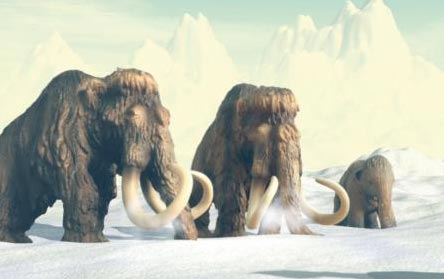
Woolly Mammoths. An Ice Age scene. What caused the extinction of the mammalian megafauna?

Woolly Mammoths (M. primigenius) an iconic animal of the Ice Age.

Vertebrate palaeontologist Dr Grant Zazula added:

“As an ice age palaeontologist, it has been one of my lifelong dreams to come face to face with a real woolly mammoth. That dream came true today. Nun cho ga is beautiful and one of the most incredible mummified ice age animals ever discovered in the world. I am excited to get to know her more.”

Comparisons with Lyuba

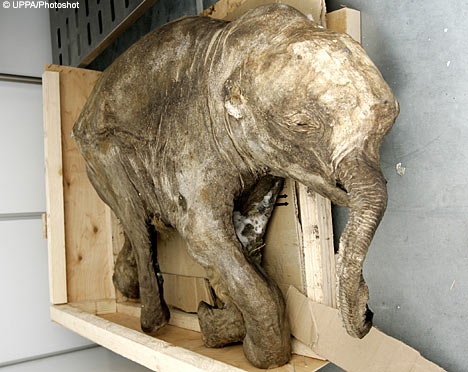
The discovery of the superbly preserved corpse will provide scientists with an opportunity to compare Nun cho ga with Lyuba, a mammoth calf discovered in Siberia back in 2007. Lyuba lived a few thousand years earlier than the Yukon mammoth (circa 41,800 years), researchers will have the opportunity to compare the genetic health of the mammoth population and plot any changes between the older Lyuba and Nun cho ga which lived, around 12,000 years later.

The baby Woolly Mammoth known as Lyuba.

The 40,000-year-old baby mammoth Lyuba. Picture credit: Uppa/Photoshot (Daily Telegraph News).

Picture credit: Uppa/Photoshot (Daily Telegraph News)

The discovery of Nun cho ga is not the first woolly mammoth calf found in North America. In 1948, a partial mammoth calf, nicknamed Effie, was found at a gold mine in Alaska.

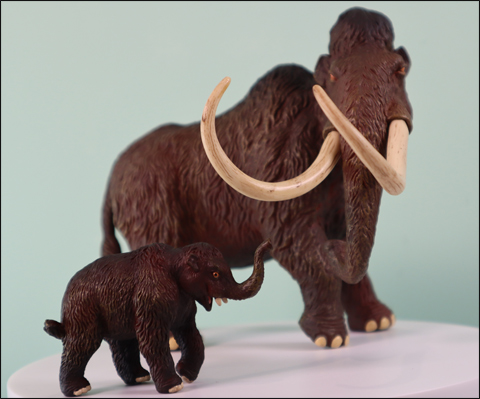
CollectA Woolly Mammoth models.

The CollectA Deluxe Woolly Mammoth model in 1:20 scale and the CollectA Prehistoric Life Woolly Mammoth calf. Picture credit: Everything Dinosaur.
Picture credit: Everything Dinosaur

The picture (above) shows a CollectA Deluxe Woolly Mammoth model and a CollectA Woolly Mammoth calf.  This is a popular pair of prehistoric mammal models.

To view the range of CollectA scale models: CollectA Deluxe Prehistoric Life.

The CollectA Age of Dinosaurs Popular range: CollectA Age of Dinosaurs Popular Range.

26 06, 2022

Jurassic World Dominion Site Safety Sign

By |2025-01-07T18:08:01+00:00June 26th, 2022|Categories: Adobe CS5, Dinosaur and Prehistoric Animal Drawings, Dinosaur Fans, Everything Dinosaur News and Updates, Main Page, Press Releases|0 Comments

In response to requests from dinosaur fans and aficionados of the “Jurassic Park/Jurassic World” movie franchise, team members at Everything Dinosaur have produced a dinosaur site safety sign and it is available absolutely free.

Whilst at our local cinema waiting to watch “Jurassic World Dominion”, team members spotted a joke site safety sign declaring three days since the last Tyrannosaurus rex attack. In response to requests received from our posts on social media we have created our own version of this safety sign and it is available as a pdf.

Everything Dinosaur site safety sign.

Having received requests from dinosaur fans wanting their own site safety sign we have created one especially for them. Picture credit: Everything Dinosaur.
Picture credit: Everything Dinosaur

An A4-sized PDF

The Everything Dinosaur site safety sign is available as a pdf document. It can be requested and emailed. The sign has been designed as an A4-sized document measuring 297 mm x 210 mm, once dinosaur fans have received the email, it can be printed off and if required laminated. A non-permanent marker pen can be used to write into the white box the number of days “without a dinosaur incident”. It is just a bit of fun, but would look good on a bedroom wall or on the door to a room.

To request your free dinosaur sign pdf: Email Everything Dinosaur.
Three days since a Tyrannosaurus rex attack.

A site safety notice at our local cinema spotted at the entrance as team members went to see “Jurassic World Dominion”. Picture credit: Everything Dinosaur.
Picture credit: Everything Dinosaur

A spokesperson from Everything Dinosaur commented:

“We hope fans of this new dinosaur movie like our dinosaur site safety sticker”.

Visit the award-winning Everything Dinosaur website: Dinosaur Models and Toys.

25 06, 2022

The New Rebor male Triceratops “Trident” Models

By |2025-01-07T08:17:17+00:00June 25th, 2022|Categories: Adobe CS5, Dinosaur Fans, Everything Dinosaur News and Updates, Everything Dinosaur Products, Main Page, Photos, Press Releases|0 Comments

Everything Dinosaur will be stocking both the new Rebor male Triceratops “Trident” models. The Rebor male Triceratops “Trident” king and the Rebor male Triceratops “Trident” horn of doom are expected to be in stock towards the end of the year (2022).

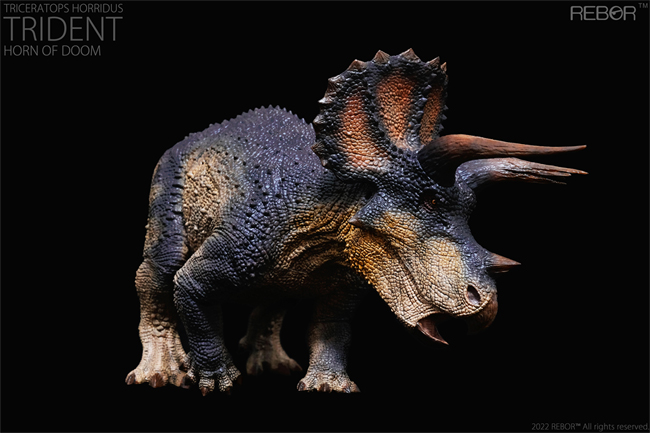
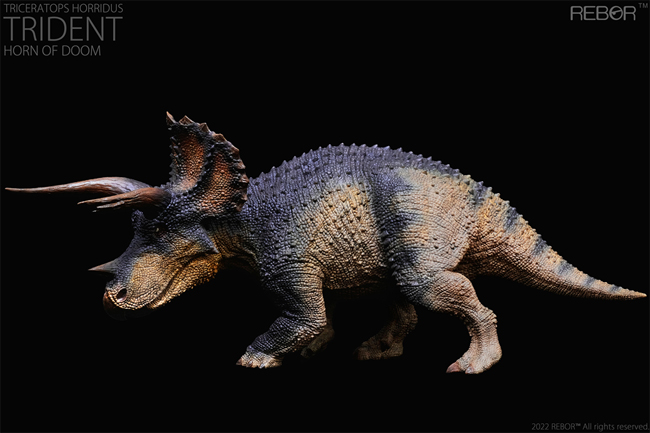
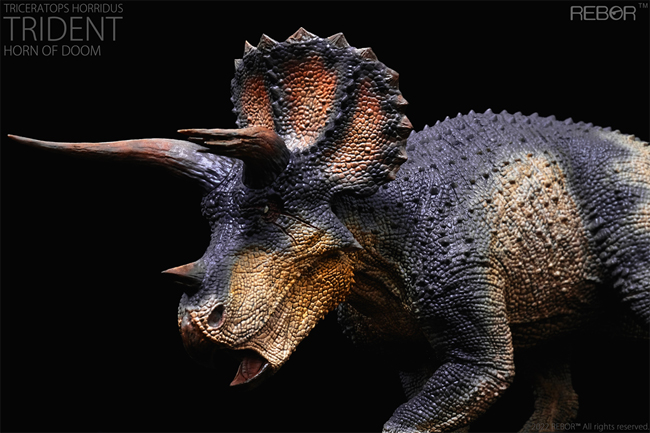
Rebor 1:35 Alpha Male Triceratops horridus "Trident" Horn of Doom version

Rebor male Triceratops horridus “Trident” Horn of Doom.

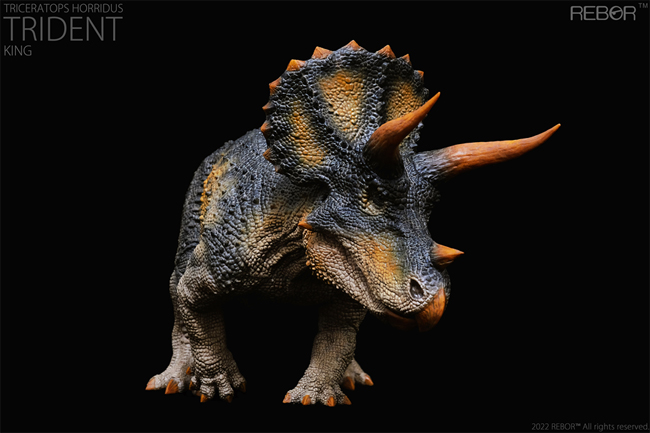
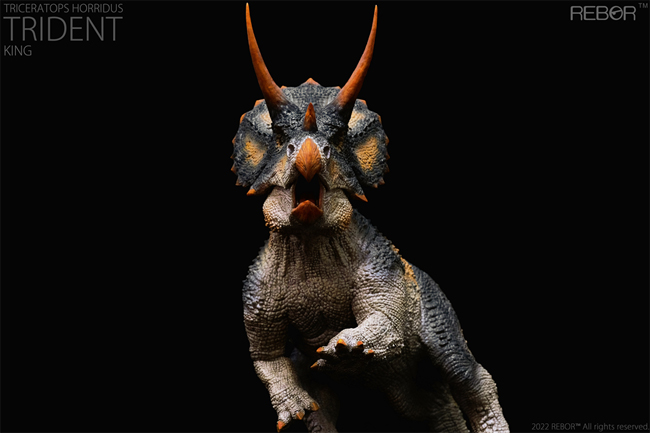
In addition, there is the Rebor “Trident” king Triceratops figure.

Rebor Male Triceratops Trident King

Rebor 1:35 Alpha Male Triceratops horridus “Trident” King version.

Rebor 1:35 Alpha Male Triceratops horridus “Trident” Horn of Doom

There had been rumours circulating that Rebor intended to introduce another Triceratops figure, a replica of a living animal after the company introduced the “Fallen Queen” model which was originally introduced back in 2015.

Rebor Male Triceratops Trident Horn of Doom

Rebor male Triceratops horridus Trident Horn of Doom. The model is shown in lateral view.

Two species of Triceratops are formally recognised, these two figures are based on the geologically older Triceratops horridus. There will be two colour variants of this 1:35 scale Triceratops, namely:

  • The Rebor 1:35 Alpha Male Triceratops horridus “Trident” Horn of Doom version.
  • The Rebor 1:35 Alpha Male Triceratops horridus “Trident” King version.
Rebor Male Triceratops Trident Horn of Doom

A remarkable Triceratops figure. The Rebor male Triceratops horridus Trident Horn of Doom.

Customers can email Everything Dinosaur and request to join the company’s priority notification list so that they can be contacted as soon as these splendid horned dinosaur models come into stock.

The Rebor Male Triceratops Trident Horn of Doom

The Rebor male Triceratops horridus “Trident” Horn of Doom. Picture credit: Everything Dinosaur.

Picture credit: Everything Dinosaur

Rebor 1:35 Alpha Male Triceratops horridus “Trident” King Version

Each figure measures approximately 32 cm long and stands around 12 cm tall. A spokesperson from Everything Dinosaur commented:

“We will be stocking both the Rebor male Triceratops Trident King and the Rebor male Triceratops Trident Horn of Doom. These figures will be made over the summer and shipped sometime in the autumn. We expect to have them in stock at Everything Dinosaur around the end of quarter 3 or perhaps the start of quarter 4.”

For prehistoric animal models and figures, visit the Everything Dinosaur website: Dinosaur Models.

Rebor Male Triceratops Trident King

Rebor male Triceratops horridus.

Rebor Male Triceratops Trident King

Rebor male Triceratops horridus (anterior view).

Join Everything Dinosaur’s Priority Notification Email List

With Everything Dinosaur there is no need to pre-order, there is no deposit to pay. Customers can simply email and request that they join the company’s no obligation priority notification list.

Rebor 1:35 Alpha Male Triceratops horridus "Trident" King version

The Rebor 1:35 Alpha Male Triceratops horridus “Trident” King version. Picture credit: Everything Dinosaur.
Picture credit: Everything Dinosaur

To see the Rebor section of the Everything Dinosaur website: Rebor Models and Figures.

To join the priority notification list for these amazing figures, just email Everything Dinosaur remembering to let us know which dinosaur model(s) you want.

Contact Everything Dinosaur: Email Everything Dinosaur.
Go to Top