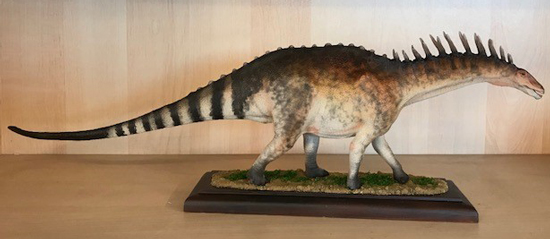
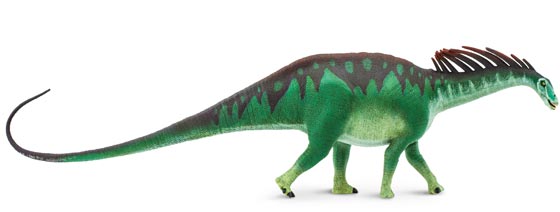
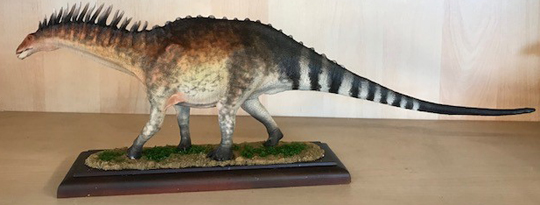
The new for 2018, Wild Safari Prehistoric World Amargasaurus model has been given a makeover by talented model maker Martin Garratt. The “lizard from Amarga Canyon” has had its head raised, alterations have been made to those famous, bizarre spines and the tail has been shortened. The end result is a very impressive dinosaur model indeed!
The Wild Safari Prehistoric World Amargasaurus Model has been “Customised” by Martin Garratt
Wild Safari Prehistoric World Amargasaurus model is customised.
Picture credit: Everything Dinosaur/UMF Models
Re-designing a Diplodocid
This stunning figure looks very different from the Safari Ltd dinosaur model, upon which it is based. However, one of the great benefits of the Safari Ltd range is that model makers are starting with a well-made, detailed figure to begin with. From this solid foundation, talented individuals like Martin can modify and customise the piece to create truly unique and most attractive dinosaur dioramas.
The Wild Safari Prehistoric World Amargasaurus Dinosaur (2018)
The Wild Safari Prehistoric World Amargasaurus dinosaur model.
Picture credit: Everything Dinosaur
The Additional of Scales Running Down the Back
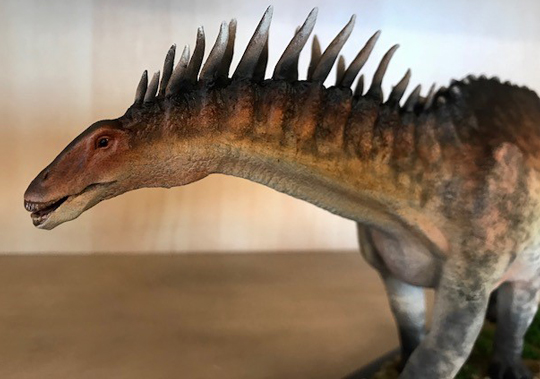
Eagle-eyed readers will note that Martin has added a row of scales running down the back of the plant-eating dinosaur. In addition, the neck has been filled out somewhat and made thicker. The pose remains virtually unaltered and although the colour scheme for the paint job is very different, it still incorporates the concept of counter shading as seen in the original Wild Safari Prehistoric World model.
A Close-up view of the Repainted and Re-modelled Head and Neck
The Wild Safari Prehistoric World Amargasaurus figure gets a makeover.
Picture credit: Everything Dinosaur/UMF Models
An Amazing Amargasaurus Model
This South American dinosaur (fossils come from Argentina), was named and described in 1991 by Leonardo Salgado and José Bonaparte. It has been assigned to the diplodocid group of sauropods, this means that it was related to the better-known, North American members of the Sauropoda, such as Diplodocus, Apatosaurus and Brontosaurus. As the holotype specimen is missing much of the tail, the length of this Early Cretaceous dinosaur is not known. However, most palaeontologists estimate that it was around twelve metres long.
The Amargasaurus Replica Created by Martin Garratt
The Amargasaurus has been mounted onto a bespoke base.
Picture credit: Everything Dinosaur/UMF Models
The animal was named after the river (La Amarga) and the nearby town, plus the rock formation within which the fossils were found is also named La Amarga. This dinosaur was described during a period of research that led to the recognition of South America’s unique dinosaur fauna. The amended figure has been placed on a bespoke base.
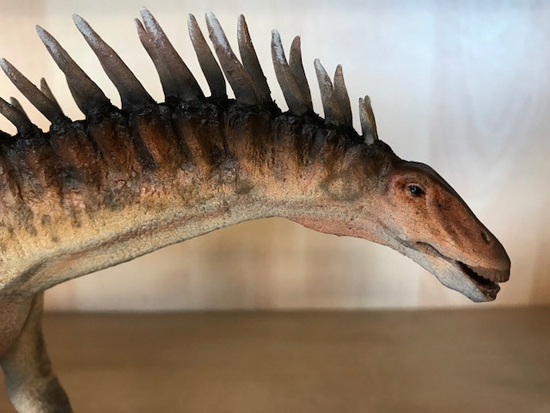
The Beautiful and Detailed Head of the Amargasaurus
A close-up view of the head of the Amargasaurus figure.
Picture credit: Everything Dinosaur/UMF Models
The picture (above) shows a close-up of the head and neck of the dinosaur model. The details in the figure and the care taken with the painting are clearly evident. Our congratulations to Martin for producing such an elegant and beautiful dinosaur figure.
The Customised Wild Safari Prehistoric World Amargasaurus Dinosaur Model
By Mike|2024-05-11T06:00:15+01:00June 4th, 2018|Categories: General Teaching|Comments Off on A Beautiful Linheraptor – Dinosaur Drawing
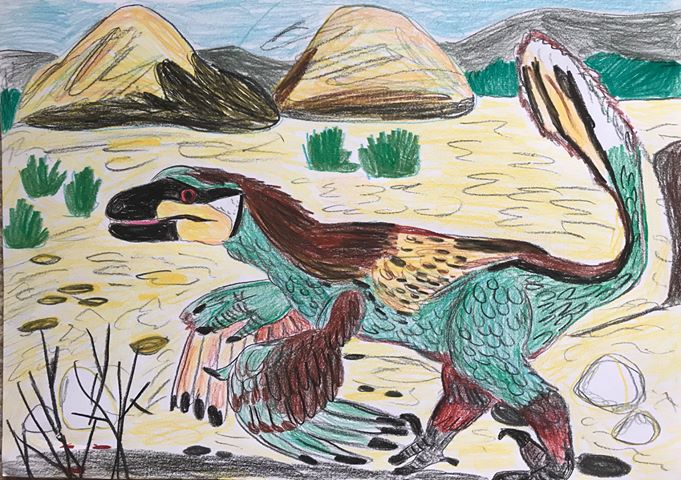
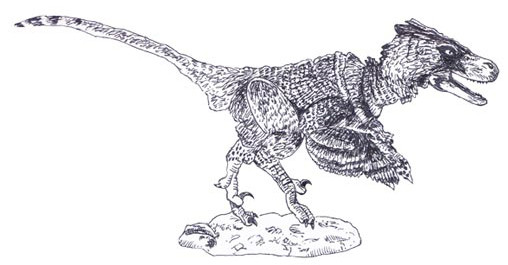
Linheraptor exquisitus by Caldey
Our thanks to young Caldey for sending in her picture of the “raptor” called Linheraptor (Linheraptor exquisitus). Most people might be familiar with dinosaurs such as Velociraptor, made famous from the “Jurassic Park/Jurassic World” film franchise, but in truth, there were a large number of “raptor-like” dinosaurs and they were all (very probably), feathered and potentially quite colourful creatures too.
A Drawing of the “Raptor” Linheraptor (L. exquisitus) by Caldey
Dinosaurs like Velociraptor and Linheraptor are members of the Dromaeosauridae family. The Dromaeosauridae are very geographically diverse, bird-like dinosaurs that were particularly abundant during the Late Cretaceous. Linheraptor was named relatively recently, (2010), the first of dromaeosaurid was named in 1922 (Dromaeosaurus). Like many of its kind, the fossils of Linheraptor come from Asia.
Our thanks to Caldey for sending in her super illustration.
Hominin Ancestors Had to Cope with Climate Change Too
It seems that climate change for hominins is not a new phenomenon, our ancient ancestors living in southern Africa almost two million years ago, had to cope with climate change too. A new study published in the academic journal “Nature Ecology and Evolution”, reveals that the climate of the interior of southern Africa during the Early Pleistocene (Gelasian stage), was like no modern African environment. The hominins around at the time would have had to cope with much wetter conditions.
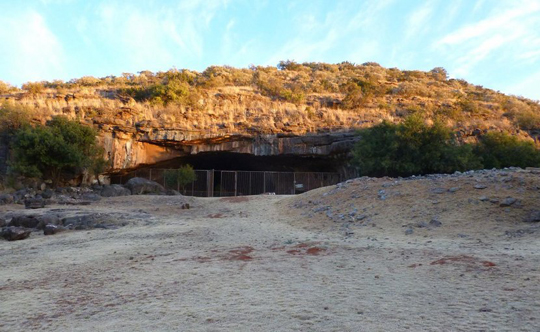
The Entrance to the Wonderwerk Cave (Northern Cape Province)
The entrance to Wonderwerk cave in South Africa.
Picture credit: Michaela Ecker/University of Toronto
The Wonderwerk Cave
That is the conclusion reached by an international team of scientists who conducted an analysis of the fossilised teeth of herbivores found in two-million-year-old sediments in South Africa’s Wonderwerk Cave. Lead author of the study, Michaela Ecker, a postdoctoral researcher in the University of Toronto’s Department of Anthropology, in collaboration with colleagues such as Michael Chazan the director of the University of Toronto’s Archaeology Centre, mapped the environmental change recorded in the sediments and fossils found in the Cave.
Commenting on the significance of the study, Michaela Ecker stated:
“The influence of climatic and environmental change on human evolution is largely understood from East African research. Our research constructed the first extensive palaeoenvironmental sequence for the interior of southern Africa using a combination of methods for environmental reconstruction at Wonderwerk Cave.”
A Different Climate to East Africa
While East African research shows increasing aridity and the spread of savannah (grassland habitats), this new research showed that during the same time period, southern Africa was significantly wetter and housed a plant community unlike any other in the modern African savannah. The scientists conclude that early humans were living in environments other than open, arid grasslands.
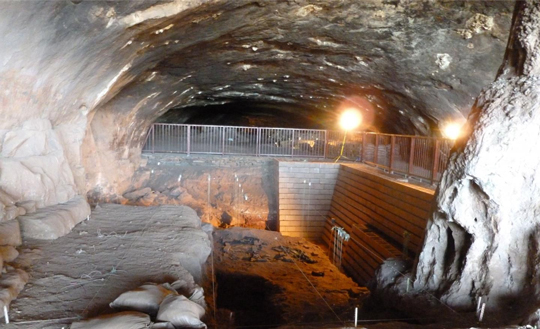
The Interior of Wonderwerk Cave
The interior of Wonderwerk Cave (South Africa), the sediments have been studied for over seventy years.
Picture credit: Michaela Ecker/University of Toronto
The limestone Wonderwerk Cave is located in the Kuruman Hills between Danielskuil and Kuruman in Northern Cape Province, the sediments deposited in the cave provide a palaeoenvironmental record of the climate of southern Africa. These sediments and the artefacts and fossils found within them have been studied since the 1940s.
Analysis of Cave Sediments
Analysis of the cave sediments to date has established a chronology for hominin occupation of the anterior portions of the cave stretching back two million years. In this research, Ecker and her collaborators were able to reconstruct the vegetation by using carbon and oxygen isotope analysis on the fossil teeth of herbivores found at various sediment layers within the cave.
Ecker added:
“Understanding the environment humans evolved in is key to improving our knowledge of our species and its development. Our work at Wonderwerk Cave demonstrates how humankind existed in multiple environmental contexts in the past, contexts which are substantially different from the environments of today.”
The scientists propose that Oldowan and early Acheulean lithic industries (distinctive periods of stone tool making), in this part of Africa took place in a much wetter environment than when compared to sites of showing similar stone tool cultures in eastern Africa.
The scientific paper: “The Palaeoecological Context of the Oldowan-Acheulean in Southern Africa” by Michaela Ecker, James S. Brink, Lloyd Rossouw, Michael Chazan, Liora K. Horwitz and Julia A. Lee-Thorp published in Nature Ecology and Evolution.
Everything Dinosaur acknowledges the help of a press release from the University of Toronto in the compilation of this article.
The amazing Beasts of the Mesozoic model range arrived at Everything Dinosaur’s warehouse last week and over the last few days, team members have been busy sorting out all the orders from customers, including all those dinosaur fans who had Beasts of the Mesozoic figures on reserve. With lots of parcels now safely delivered, Everything Dinosaur is starting to get feedback on these superb, articulated 1/6th scale replicas.
Fans Take Pictures of their Beasts of the Mesozoic Models
A photograph of a Beasts of the Mesozoic Velociraptor mongoliensis from a dinosaur model fan.
Picture credit: Andrea/Everything Dinosaur
The Deluxe Velociraptor mongoliensis
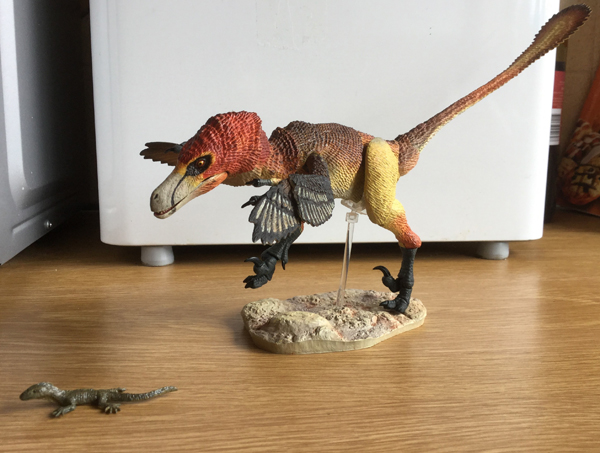
Andrea sent us a picture of her Deluxe Beasts of the Mesozoic Velociraptor mongoliensis model. It was ordered on Friday and it was delivered the next day. It looks like the lizard model from the Rebor Dimorphodon figure (Judy) is in a lot of trouble, if it does not move it is likely to end up as dinner for the Velociraptor. The diet of the two species of Velociraptor (V. mongoliensis named in 1924 and Velociraptor osmolskae, which was described in 2008), remains uncertain, although it is likely they fed on a variety of other creatures including mammals, amphibians and other reptiles.
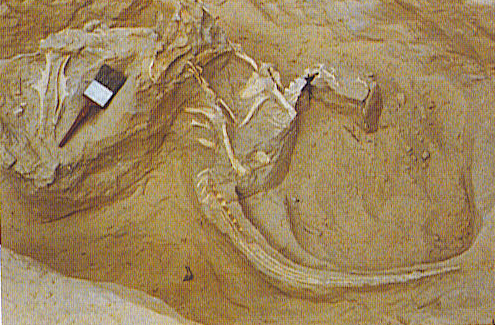
One of the most famous fossils ever found was discovered in 1971. A joint Mongolian/Polish expedition uncovered the fossilised remains of a Velociraptor mongoliensis that had been preserved in combat with another dinosaur (Protoceratops andrewsi). This was evidence that Velociraptor attacked other dinosaurs.
The Famous “Fighting Dinosaurs” Fossil Excavation
“Duelling dinosaurs” – Velociraptor fighting with Protoceratops.
Picture credit: Polish Academy of Sciences
To view the Beasts of the Mesozoic Deluxe Velociraptor mongoliensis figure and the rest of this 1:6 scale model range: Beasts of the Mesozoic.
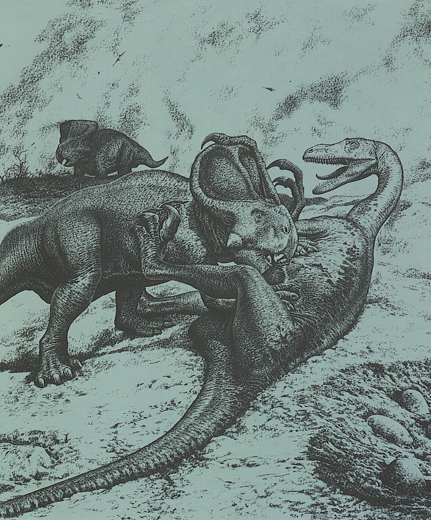
An Illustration Showing the Velociraptor Fighting a Protoceratops
Fighting dinosaurs – a Protoceratops defends itself against Velociraptor.
Beasts of the Mesozoic Dromaeosaurids
When first discovered it was thought that this combat between two dinosaurs had been preserved as both animals had drowned, but subsequent studies showed that these poor, unfortunate creatures had been covered in sand, presumably as a dune had collapsed and buried them both, or they may have been caught in a sudden sandstone. The Protoceratops skeleton shows signs of having been scavenged, so these two dinosaurs could have died locked in combat before being completely covered. It remains one of the most remarkable vertebrate fossil discoveries known to science and provided evidence of predatory behaviour amongst dromaeosaurids.
Velociraptor – A Very Popular Dinosaur
Whether it is due to the over-sized Velociraptors depicted in the “Jurassic Park ” film franchise or due to amazing fossil examples such as the “fighting dinosaurs” fossil from Mongolia, Velociraptor remains a very popular dinosaur and it is great to see an articulated, highly-detailed Velociraptor mongoliensis model on the market.
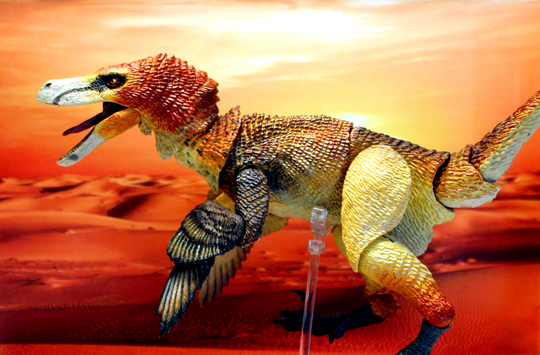
The Beasts of the Mesozoic Velociraptor mongoliensis Figure
The Mother of All Dragons – Megachirella wachtleri
A team of international scientists, including palaeontologists from Bristol University, Midwestern University (Arizona) and the University of Alberta, have identified the world’s oldest lizard fossil (Megachirella wachtleri), permitting fresh insight into the evolution of extant snakes and lizards (Squamata). Writing in the journal “Nature”, the researchers, including co-author Dr Massimo Bernardi from MUSE – Science Museum, Italy and University of Bristol’s School of Earth Sciences, built the largest dataset of reptiles ever assembled in order to assess where in the evolutionary tree of the Reptilia a fossil from the Dolomites of Italy should be placed.
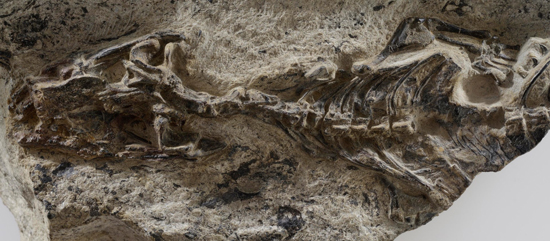
The Holotype Specimen of Megachirella wachtleri
The holotype of Megachirella wachtleri.
Picture credit: MUSE – Science Museum
Megachirella wachtleri
The fossil, consisting of an articulated partial specimen was discovered in marine sediments in the Dolomites of Italy and named Megachirella wachtleri in 2003. Although, found in marine sediment, the fossil, which represented the front portion of the animal, showed no adaptations to an aquatic existence. On the contrary, it had strong legs with claws and although small at around twenty centimetres in length, it was probably a capable climber. It was concluded that the carcass of this reptile had been washed out to sea following a storm.
An analysis in 2013 concluded that Megachirella wachtleri was a member of the Lepidosauromorpha, a group of diapsid reptiles defined as being closer to Squamata than to the Archosauria.
Lepidosaurs include modern snakes and lizards, many extinct forms of reptile and the Order Rhynchocephalia, once very diverse, but now only represented by the tuatara of New Zealand. This new research, which drew upon an enormous database of skeletal and molecular information about 129 different types of reptile, revealed that Megachirella had characteristics that are only found in the Squamata. It was concluded that M. wachtleri was a stem squamate – think of it as being the “the mother of all dragons”.
Co-author Dr Randall Nydam of the Midwestern University in Arizona stated:
“At first I did not think Megachirella was a true lizard, but the empirical evidence uncovered in this study is substantial and can lead to no other conclusion.”
The 240-million-year-old fossil, Megachirella wachtleri, is the most ancient ancestor of all modern lizards and snakes discovered to date. The study also found that geckoes are the earliest crown group squamates not iguanians as previously thought.
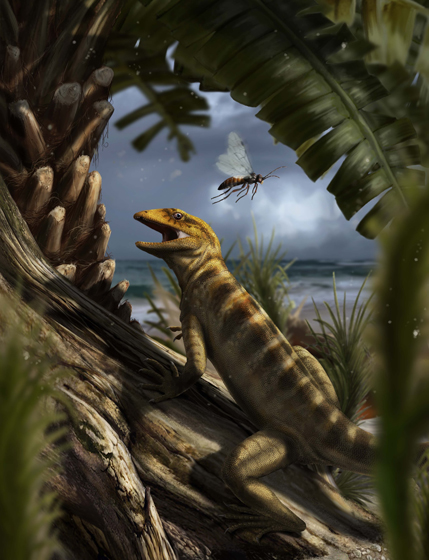
A Life Reconstruction of Megachirella wachtleri
A life reconstruction of Megachirella wachtleri.
Picture credit: Davide Bonadonna
Megachirella wachtleri on the Front Cover of “Nature”
The beautiful illustration of M. wachtleri produced by Davide Bonadonna is featured on the front cover of the journal Nature, which provides details of this scientific study.
The research team conclude that the Squamata probably evolved in the Late Permian and therefore, the ancestors of today’s snakes and lizards survived the most devastating mass extinction event known to science – the end Permian extinction.
Tiago Simões, lead author of the scientific paper and a PhD student at the University of Alberta (Canada), explained:
“The specimen is 75 million years older than what we thought were the oldest fossil lizards in the entire world and provides valuable information for understanding the evolution of both living and extinct squamates.”
10,000 Squamate Species
It has been estimated that there are around 10,000 species of lizards and snakes living today, twice as many different species as mammals. Despite this modern diversity, scientists did not know much about the early stages of their evolution.
Student Tiago Simões added:
“It is extraordinary when you realise you are answering long-standing questions about the origin of one of the largest groups of vertebrates on Earth.”
Co-author of the study, Dr Michael Caldwell from the University of Alberta, explained that fossils represent the only accurate window into the ancient story of life on our planet. The new understanding about Megachirella and its significance is but a point in deep geological time, it does tell us things about the evolution of lizards that we simply cannot learn from any of the extant species today.
Co-author Dr Massimo Bernardi from MUSE – Science Museum, Italy and University of Bristol’s School of Earth Sciences, commented upon the importance of such fossil specimens, stating:
“This is the story of the re-discovery of a specimen and highlights the importance of preserving naturalistic specimens in well maintained, publicly accessible collections.”
The scientific paper:
“The Origin of Squamates Revealed by a Middle Triassic Lizard from the Italian Alps” by T. Simões, M. Caldwell, M. Tałanda, M. Bernardi, A. Palci, O. Vernygora, F. Bernardini, L. Mancini and R. Nydam published in the journal Nature.
Everything Dinosaur acknowledges the help of a press release from Bristol University in the compilation of this article.
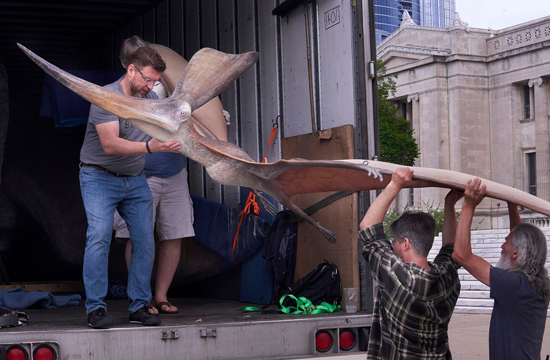
Visitors to the famous Field Museum in Chicago (USA), might get into a bit of flap today, as they will be coming face-to-face with life-size replicas of flying reptiles. The pterosaurs are part of a $16.5 million USD re-fit for the Museum. They will be installed into the enormous Stanley Field Hall, sharing the space with a giant titanosaur exhibit.
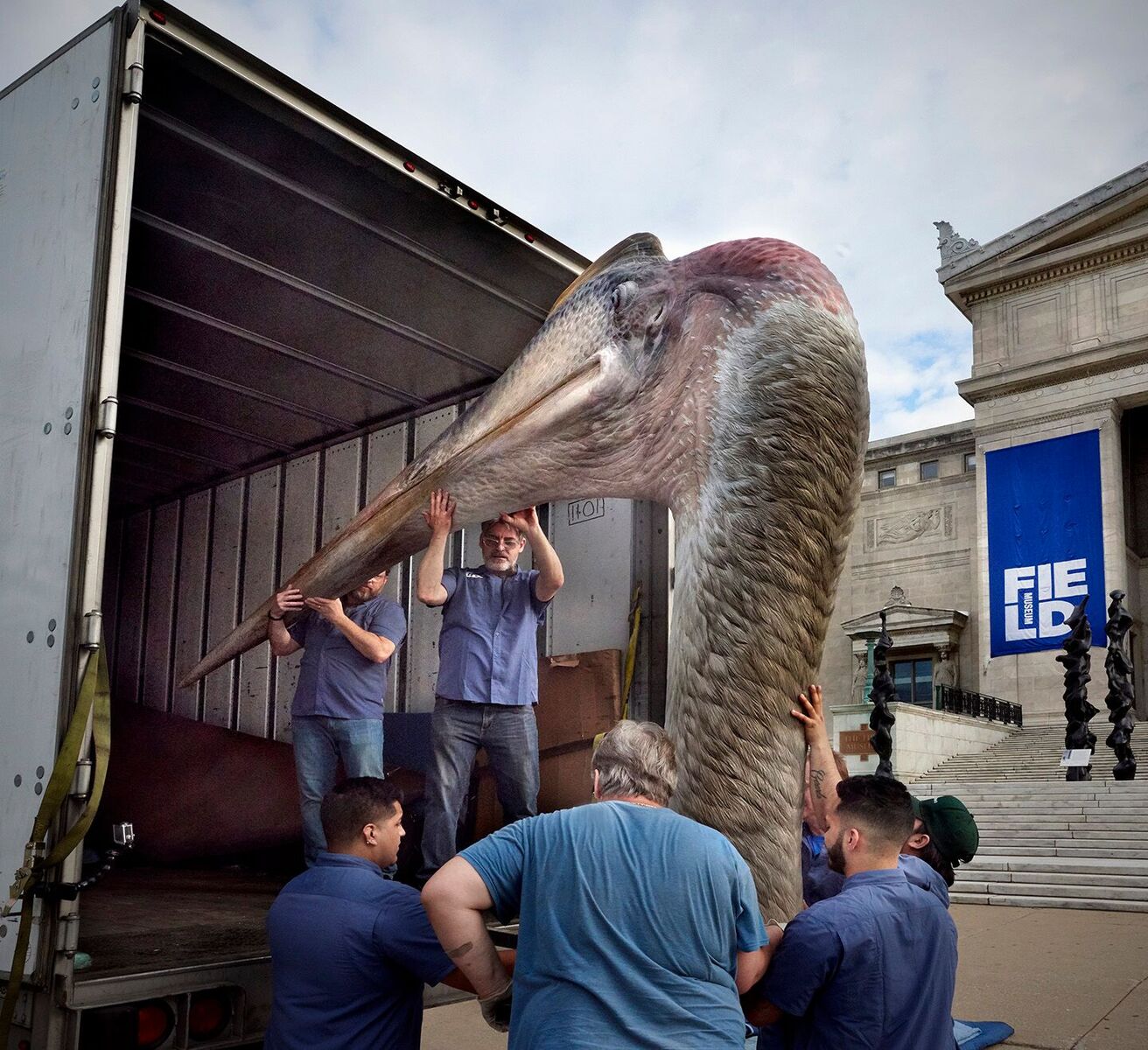
Unloading the Head and Neck of Quetzalcoatlus
The head of a life-size Quetzalcoatlus model being unloaded at the Field Museum (Chicago).
Picture credit: (c) Field Museum, photo by John Weinstein
A Flock of Pterosaurs
The flock of pterosaurs will give visitors a lifelike look at the animals that shared the Mesozoic with the dinosaurs. They’ll also serve as a way-finding tool from Stanley Field Hall up to the rest of the dinosaurs in the permanent exhibition – “The Griffin Halls of Evolving Planet”. The life-size pterosaurs and the thirty-seven-metre-long titanosaur will be displayed amongst a series of hanging gardens, as staff at the Field Museum prepare to commemorate the institution’s 125th anniversary.
Commenting on the new exhibits, Field Museum president Richard Lariviere stated:
“Our goal as an institution is to offer visitors the best possible dinosaur experiences and we want that to start right when visitors first enter Stanley Field Hall. The new hanging gardens and the flock of pterosaurs will take our visitors back to the age of the dinosaurs and will complement the new titanosaur.”
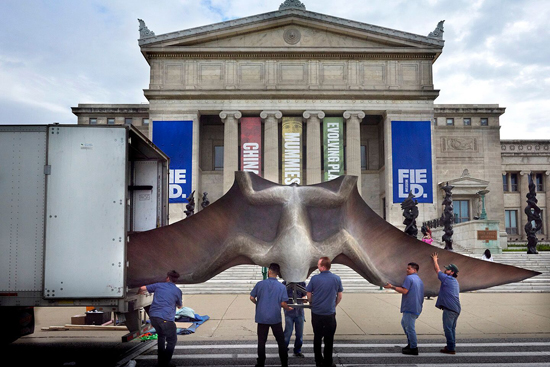
The Body of a Giant Quetzalcoatlus is Unloaded
Unloading a giant pterosaur.
Picture credit: (c) Field Museum, photo by John Weinstein
Rhamphorhynchus, Pteranodon and Quetzalcoatlus
The pterosaur replicas include nine hawk-sized, long-tailed replicas of the Jurassic flying reptile Rhamphorhynchus, two Pteranodon figures and two huge replicas of Quetzalcoatlus. Pteranodon and Quetzalcoatlus are associated with Upper Cretaceous strata. Flying reptiles from the Pteranodon genus were thought to have been the largest flying vertebrates that ever existed, that was until 1975, when the much larger azhdarchid Quetzalcoatlus was scientifically described.
“The pterosaurs are nothing short of amazing. Since Stanley Field Hall is such a massive room, we had the opportunity to add a titanosaur and an entire flock of pterosaurs. It’ll really transform the space.”
The models were created by Blue Rhino, under the supervision of the scientists at the Field Museum, the brief was to create the most up-to-date and scientifically accurate figures possible.
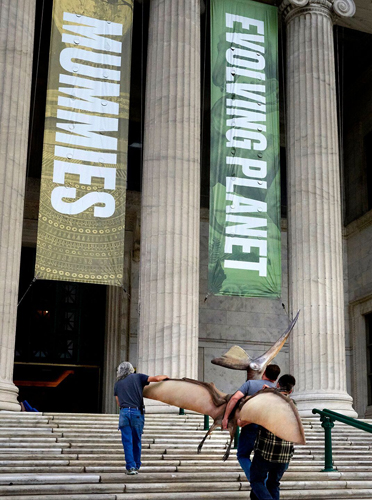
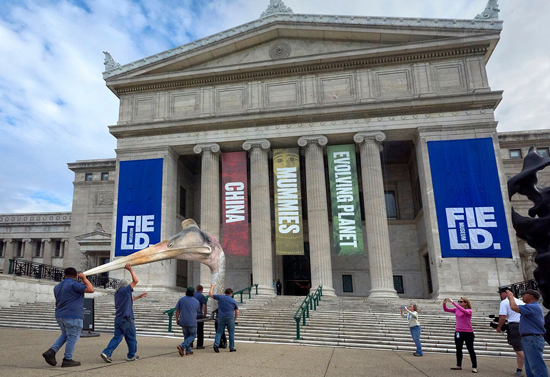
Pteranodon Taken up the Stairs
Carrying Pteranodon up the steps.
Picture credit: (c) Field Museum, photo by John Weinstein
Wingspans the Length of a Bus
The giant Quetzalcoatlus replicas really help to convey the size and scale of these magnificent reptiles. The wingspan of the models is a little under twelve metres, that’s about as long as a school bus! The skulls of these types of pterosaur are immense. Azhdarchid pterosaurs like Quetzalcoatlus had the largest skull of any terrestrial vertebrate.
The Huge Head of a Quetzalcoatlus Replica
Carrying the head of Quetzalcoatlus, it certainly is a team effort.
Picture credit: (c) Field Museum, photo by John Weinstein
Everything Dinosaur acknowledges the assistance of a media release from the Field Museum in the compilation of this article.
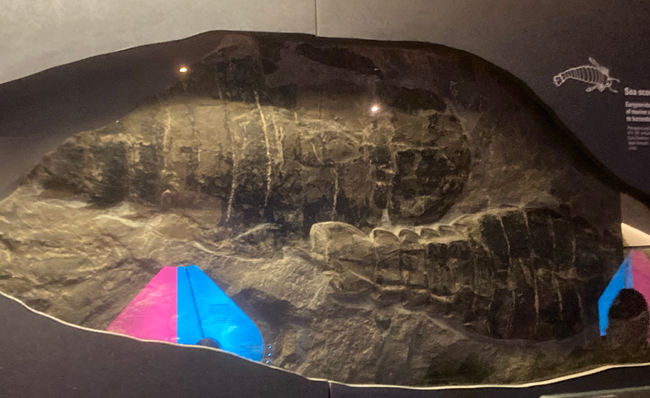
A fabulous pair of eurypterid fossils photographed in the London Natural History Museum.
Spotted in the British Museum (London), two beautifully preserved sea scorpion fossils. The picture (below) shows a wonderful example of what looks like a fossilised, giant woodlice. However, all is not as it seems.
Sea Scorpion Fossil Specimens
A pair of eurypterid fossil specimens on display at the London Natural History Museum. Picture credit: Everything Dinosaur.
Picture credit: Everything Dinosaur
Woodlice are isopods and members of the Arthropoda Phylum. Eurypterids are arthropods too. Both have segmented bodies and share several anatomical characteristics, but they are only distantly related.
Probably originating during the Ordovician, eurypterids persisted until the Permian. Both marine and freshwater forms evolved. Some marine eurypterids represent the largest arthropods known to science. The largest described to date is Jaekelopterus rhenaniae. Based on a forty-six-centimetre claw fossil, palaeontologists have suggested that J. rhenaniae reached a length of 2.5 metres or more.
Although the eurypterid fossils on display are not as large as the biggest species of Jaekelopterus (pronounced Yay-kel-op-ter-us), they are still impressive.
A spokesperson from Everything Dinosaur commented on the details preserved within the fossil specimens and stated:
“When you see up close stunning eurypterid fossils, you gain an appreciation of the diversity and variety of life on Earth. It is hard to believe, but for more than 150 million years these amazing arthropods thrived, outcompeting vertebrates. Many forms evolved to become apex predators.”
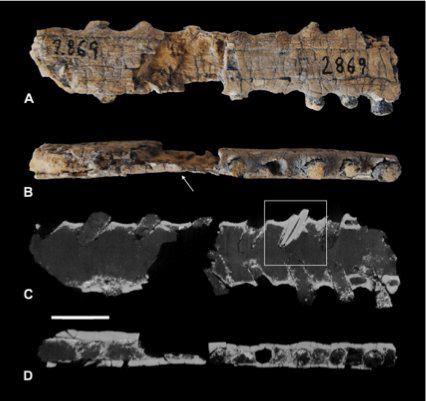
A team of international scientists writing in the academic publication “The Journal of South American Earth Sciences”, have reported the discovery of the first pterosaur fossils known from Uruguay. The fossil material representing a fragment of jaw with associated teeth, is believed to represent a new species of Ctenochasmatidae pterosaur. Ctenochasmatids are geographically widespread with fossils reported from the United States, China, southern Germany, Argentina and England. The fossils ascribed to this family of short-tailed pterosaurs have a large temporal range, from the Late Jurassic transitioning through to the Early Cretaceous.
Views of the Fragmentary Fossil Material (Rostrum)
The first pterosaur fossils from Uruguay.
Picture credit: The Journal of South American Earth Sciences
Buck-Toothed Pterosaur
The fossil comes from the Tacuarembó Formation, which is believed to represent deposits laid down as the early Atlantic Ocean opened up. The strata largely consists of sediments deposited in a terrestrial, near-shore environment. The orientation of the tooth sockets and the preserved tooth base suggests that the conical teeth were pointed out sideways and forwards. This may have been an adaptation for capturing slippery prey such as small fish. This family of small pterosaurs exhibit a variety of different shaped mandibles, although fragmentary, the researchers have identified that the fossil jaw widens towards the tip (anterior portion), the shape of the jaw and its size corresponds to jaws of known ctenochasmatids, specifically the subfamily Gnathosaurinae.
Different Jaw Types within the Ctenochasmatidae
Ctenochasmatid mandibles.
Picture credit: Wellnhofer, Howse et al from Witton
The picture shows mandible variation within the Ctenochasmatidae (A) Ctenochasma elegans seen from below, (B) Plataleorhynchus streptorophodon as viewed from below and (C), the skull of Gnathosaurus subulatus (viewed from underneath). The dentition and the shape of the mandibles suggest adaptations for catching and consuming different types of prey.
Dating the Geological Formation Thanks to a Shark
The Tacuarembó Formation has proved very difficult to date, as the fossils found in the strata were not that easy to compare to fossils found in other rocks. Despite, an abundance of bone fragments representing a range of creatures, including theropod dinosaurs, the Tacuarembó Formation lacked helpful biostratigraphic indicator fossils to assist with relative dating. This changed with the discovery of numerous teeth and a single dorsal spine which was assigned to the Hybodont shark Priohybodus arambourgui.
Fossils of this primitive shark are known from the Arabian Peninsula as well as Africa and the strata associated with these fossils has permitted more accurate dating to occur. Thanks to this shark, the authors of this new paper can state that the pterosaur fossil material comes from a fossiliferous horizon no older than the Late Jurassic. As such, the Uruguayan pterosaur remains represent the oldest ctenochasmatid found in South America known to science.
Team members at Everything Dinosaur, took the opportunity whilst in London last week to pay a visit to the Grant’s Museum of Zoology, this hidden gem of a museum contains around 68,000 specimens and the densely packed cabinets house an absolute treasure trove of zoological wonders. The Grant Museum of Zoology and Comparative Anatomy (to give this establishment its full title), is part of the University College London, it plays an important role in helping to teach students about anatomy. It was founded by Robert Edmond Grant (1793-1874).
The Grant Museum
The Grant Museum of Zoology and Comparative Anatomy was established in 1827 to serve as a teaching collection at the newly founded University of London (later University College London). The influential Grant taught the young Charles Darwin and he was the first Professor of Zoology and Comparative Anatomy in England. A lack of teaching resources did not deter the enthusiastic scientist, he set about amassing an astonishing collection of specimens, diagrams, dissection materials and lecture notes, it is these that form the basis of the Museum today.
Saying Hello to “Proavis”
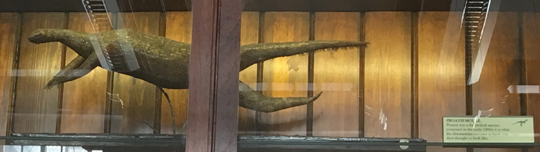
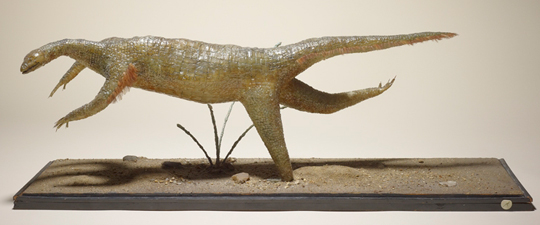
Tucked up high on a shelf, barely given a second glance by the casual visitor, is a rather strange animal. This is “Proavis”, otherwise known as Pro-Aves. It is not an anatomical specimen as such, it is not the preserved remains of a living animal, rather it a model that attempts to depict the ancestor of birds (Aves) and as such, it is extremely significant.
Saying Hello to Proavis – (Pro-Aves)
The “Proavis” model at the Grant Museum of Zoology (London).
Picture credit: Everything Dinosaur
The rather strange looking creature is a little worse for wear, after all, it is over a hundred years old. Proavis consists of a wire armature, which has been covered in wax and real feathers. It represents a theoretical missing link between feathered, maniraptoran dinosaurs and the first birds, such as Archaeopteryx (A. lithographica). During the late 19th century, leading academics began to realise that birds may be closely related to dinosaurs. Such ideas were fuelled by the publication of the seminal work “The Origin of Species” by one of Professor Grant’s former pupils (Charles Darwin) in 1859 and the excavation of the first, very nearly complete fossil of Archaeopteryx in 1861.
A Model of the Hypothetical “Missing Link” Between Reptiles and Birds
A model of the hypothetical animal Proavis.
Picture credit: Grant Museum of Zoology
A Model of a “Missing Link”
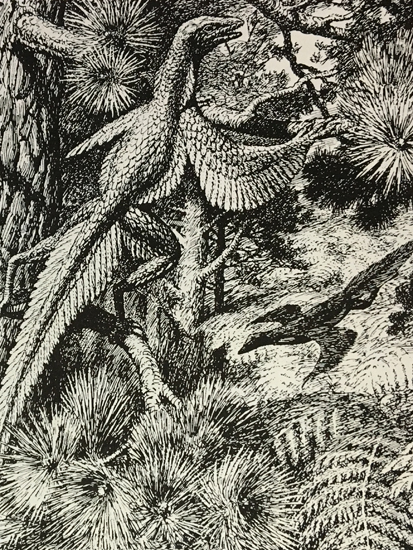
The model is based on an illustration of a “missing link” a hypothetical transitional form between the reptiles and birds. The term “Proavis” was first coined in 1906 by the English zoologist William Plane Pycraft. Pycraft wrote a number of books on evolution and natural history including “The Story of Reptile Life”, that was published in 1905. He believed that flight in early birds developed from ancestral forms that glided between trees, the “tree down” view. However, other academics at the time proposed alternative theories for the evolution of the birds. For example, the Hungarian polymath Franz Nopcsa proposed that flight developed first amongst fast-running terrestrial reptiles, which used their flapping arms to run faster.
The feather and wax model in the Museum originally came from Cambridge. It was probably made by a student and it reflects the “ground up” view as championed by the likes of Nopcsa.
An Illustration of a Transitional Form Between Reptiles and Birds “Tree Down” Concept
From the “Origin of Birds” by Gerhard Heilmann.
Picture credit: Gerhard Heilmann
A Delicate and Fragile Model at the Grant Museum
This delicate and fragile model may look very different from today’s interpretations of the first birds and the maniraptoran dinosaurs from which birds are descended, but it does represent an important milestone in academic thinking. Models like “Proavis” were used to explore evolutionary theories from more than a century ago. As such, it does represent a “transitional form”, epitomising how ideas about tetrapods have changed over time.
A More Modern Interpretation of a Reptile that was Ancestral to Aves (Dromaeosauridae)
An illustration of the dromaeosaurid Adasaurus (A. mongoliensis).
Picture credit: Everything Dinosaur
The image (above) depicts a dromaeosaurid (Adasaurus). It is based on a dromaeosaurid figure from the recently introduced Beasts of the Mesozoic model range: Beasts of the Mesozoic Models.
New Research Challenges Traditional View of Pterosaur Flight
Take a look at a picture of a pterosaur flying and you will see that most illustrations and life-reconstructions of these reptiles depict them travelling through the air with their hind limbs trailing behind them and their back legs wide apart. However, a new study undertaken by scientists from Brown University (Rhode Island) and the University of California (Berkeley), suggests that we have got this all wrong, pterosaur joints did not permit them to fly with their hind limbs splayed far apart.
Pterosaurs in the Air – But Have we got Their Hind Limbs in the Wrong Position?
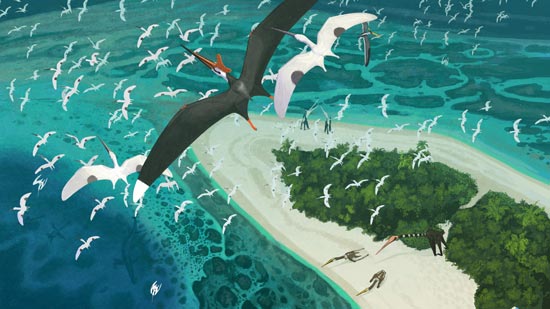
Six new species of pterosaur have been recently identified from Moroccan fossils but if we depict them flying, the convention is to show the hind limbs spread far apart.
Picture credit: John Conway
We Look at the Bones, But What About the Ligaments?
Flying with the hind limbs splayed out, is a posture adopted by most bats when they take to the air. Ever since the first flying reptiles were described and illustrated, these archosaurs have been depicted in the same way. However, this new research, published in the Proceedings of the Royal Society B (biology), suggests that ligaments would restrict joint movement and pterosaurs and the volant dinosaurs such as Microraptor, could not have flown in the same way as bats.
Lead author of this study, Armita Manafzadeh, a PhD student at Brown University commented:
“Most of the work that’s being done right now to understand pterosaur flight relies on the assumption that their hips could get into a bat-like pose. We think future studies should take into account that this pose was likely impossible, which might change our perspective when we consider the evolution of flight in pterosaurs and dinosaurs.”
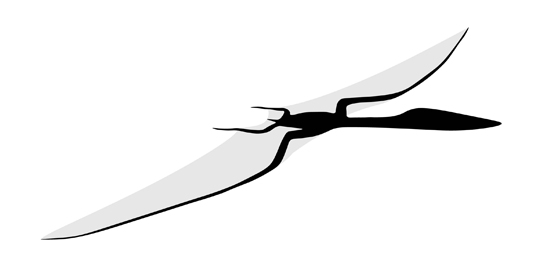
The “Classical” Pterosaur Flying Posture
The “bat-like” posture of the hind limbs of pterosaurs, may not have been anatomically possible.
Picture credit: Armita Manafzadeh
The study undertaken in collaboration with Kevin Padian (University of California), attempted to infer the range of motion of joints in a way that takes into account the soft tissues such as ligaments surrounding the joint. Usually, soft tissue such as ligament and cartilage does not fossilise, so palaeontologists have to work out joint motion from just the bones alone. The pair of scientists set out to examine the joint movement of modern dinosaurs – birds, to test the extent to which ligaments influence joint motion.
Chickens at a Grocery Store
Student Manafzadeh explained that the idea started with grocery store chickens:
“If you pick up a raw chicken at the grocery store and move its joints, you’ll reach a point where you will hear a pop. That’s the ligaments snapping, but if I handed you a chicken skeleton without the ligaments, you might think that its joints could do all kinds of crazy things, So, the question is, if you were to dig up a fossil chicken, how would you think its joints could move and how wrong would you be?”
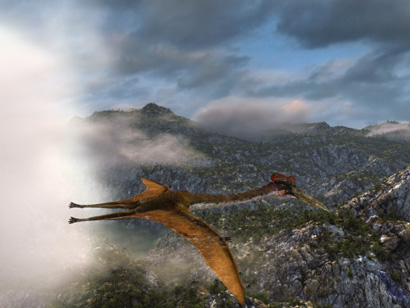
Quetzalcoatlus – A Giant Pterosaur Takes to the Air (Note the Splayed Out Back Legs)
Quetzalcoatlus takes to the air.
Picture credit: Everything Dinosaur
Dead Quails and X-ray Images
Chickens may be easy to acquire, but for this scientific study, dead quails were used in order to assess joint mobility in a three-dimensional way, rather than just referring to the bones. Birds are the closest living relatives to the extinct pterosaurs and the non-avian dinosaurs. Birds (Aves), the Pterosauria and the Dinosauria are members of the Archosauria clade. This clade is usually divided into two distinct branches, on one branch (Crurotarsi), are the crocodilians and their ancestors plus several other extinct lineages such as the phytosaurs. The second branch (Avemetatarsalia) groups all the reptiles more closely related to birds than crocodilians.
A sub-group of the Avemetatarsalia is the Ornithodira, which specifically nests the Pterosauria and their ancestors and the Dinosauria and their ancestors, plus the descendants of dinosaurs – birds, together. Hence, the use of quail limbs to assess the range of movement and joint mobility.
The skin and muscle surrounding the joints was cut away and once the hip joints were exposed, the scientists manipulated them taking X-ray images to assess the likely range of motion. By doing this, they could determine the exact positions of the bones in poses where the ligaments restricted and then prevented further joint movement.
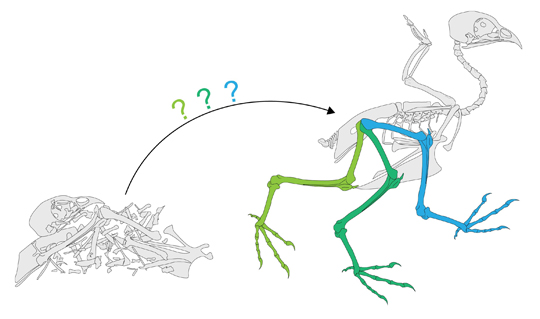
Mapping Out the Joint Movements of Ornithodirans
This technique enabled Manafzadeh to map out the range of motion of the quail hip with ligaments attached. She then compared this range of motion to what was inferred when the bones were considered in isolation. For the bones-only poses, Manafzadeh used traditional criteria that palaeontologists often employ — stopping where the two bones hit each other and when the movement pulled the thigh bone out of its socket.
This experiment revealed that over 95 percent of the joint positions that seemed plausible with bones alone were actually impossible when the ligaments were attached.
Mapping Out the Range of Motion in Quail Hips
Mapping the range of movement in quail hind limbs to assess the movement of ornithodiran limbs.
Picture credit: Armita Manafzadeh
The Implications for Pterosaurs and the Maniraptora
The team’s next move was to calculate how the range of motion in living birds might correlate to the range of motion expected for extinct pterosaurs and those members of the Maniraptora, such as Microraptor that are believed to have been able to fly. The assumption has long been that these creatures flew in a similar way to bats. That is partly because the wings of pterosaurs were made of skin and supported by an elongated fourth finger, which is superficially similar to the wings of bats. Bat wings are also connected to their hind limbs, which they splay out widely during flight.
Many palaeontologists, Manafzadeh says, assume pterosaurs and four-winged dinosaurs did the same. But this new study suggests that pose was impossible.
In quail, a bat-like hip pose seemed possible based on bones alone, but outward motion of the thigh bone was inhibited by one particular ligament, a ligament that’s present in a wide variety of birds and other reptiles related to the Pterosauria. Consequently, in the absence of extraordinary evidence to the contrary, this analysis casts doubt on the “bat-like” hip pose traditionally inferred for pterosaurs and basal maniraptorans and underscores the point that reconstructions of joint mobility based on manipulations of bones alone can be misleading.
To achieve a “bat-like” flying posture, the ligament would have to stretch 63 percent more than the quail ligament can, the implication is that we have been illustrating flying reptiles and flying dinosaurs all wrong.
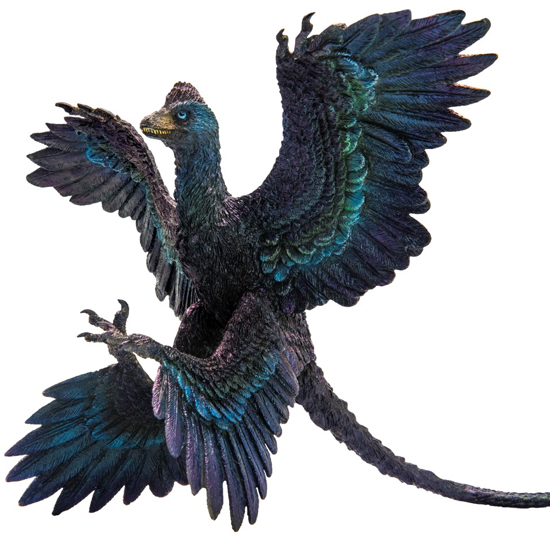
A Model of a Volant Dinosaur (Microraptor)
The PNSO Gaoyuan the Microraptor model.
The image (above) shows a beautiful Microraptor model from PNSO.
In addition to challenging traditional views about flight in pterosaurs and early birds, the research also provides new ways of assessing joint mobility for any joint of any extinct species by looking at its living relatives.
The scientific paper: “ROM Mapping of Ligamentous Constraints on Avian Hip Mobility: Implications for Extinct Ornithodirans” by Armita R. Manafzadeh, Kevin Padian published in the Proceedings of the Royal Society B
Everything Dinosaur acknowledges the assistance of a press release from Brown University in the compilation of this article.