The Pneumatic Bones of Theropods (Living and Extinct)
Air-filled (pneumatic), bones are unique to birds amongst living terrestrial vertebrates. However, it is known that many different types of archosaurs as well as the birds had post-cranial bones with lots of air sacs. Non-avian dinosaurs in the form of the Theropoda had them to. Whilst visiting the Grant Museum of Zoology and Comparative Anatomy in London, this shared anatomical trait was beautifully demonstrated when viewing a number of avian exhibits.
Studying Theropods (Living and Extinct)
An Ostrich Femur (Thigh Bone) Showing Pneumaticity
A cross-section of an ostrich femur showing the extensive air sacs. Picture credit: Everything Dinosaur.
Picture credit: Everything Dinosaur
The caption in the display case reads:
“OSTRICH FEMUR – Birds have honeycomb bones to reduce weight for flight. Flightless ostriches evolved from flying birds and retain this feature”.
The above statement is true, but technically (most probably), pneumatic, post-cranial bones have been inherited from the Dinosauria.
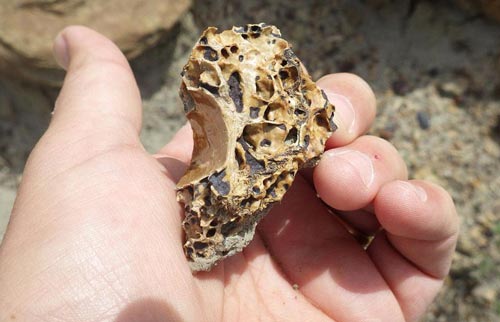
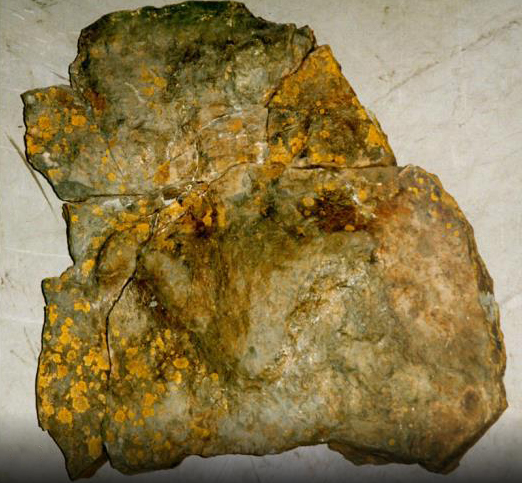
A Fragment of Theropod Bone Showing the Highly Pneumatised Internal Structure
A close up of the fossil bone shows the typical honeycomb structure indicative of a theropod dinosaur.
Picture credit: Jason Love/Burke Museum
Air-filled Bones Evolved Independently in Several Groups Avemetatarsalia
The fossil record has provided evidence of pneumaticity in Late Triassic archosaurs (at least 210 million years ago), it is very likely that air-filled bones evolved much earlier in the branch of the archosaurs (Avemetatarsalia), that includes the dinosaurs, pterosaurs and birds. Bones with air sacs are also associated with derived members of the Sauropodomorpha. It has been postulated that this characteristic evolved independently in several groups and that pneumaticity did not occur amongst these different archosaurs as a result of sharing a common ancestor.
The evolution of light, but strong air-filled bones can be explained for the birds, as such bones would help reduce weight and make flying easier. As for the other, extinct archosaurs, this characteristic evolved in the Pterosauria (flying reptiles) for very probably the same reason – to reduce weight to make flying easier. As for the dinosaurs and other largely non-volant archosaurs that had this feature, pneumatisation might have evolved to reduce energy expenditure as these animals moved about. After all, if you weigh several tonnes, as in the case of a basal sauropod, if you could evolve a more efficient method of locomotion, than this makes a lot of evolutionary sense.
By Mike|2023-10-14T18:40:17+01:00June 12th, 2018|Categories: General Teaching, Key Stage 1/2|Comments Off on The Prehistoric Animals that Feature in “Fallen Kingdom”
“Fallen Kingdom” – Dinosaurs and Other Prehistoric Animals
In response to the numerous requests from young dinosaur fans who have seen the latest instalment in the “Jurassic Park/Jurassic World” film franchise – “Fallen Kingdom”, here is a list of the prehistoric animals that we spotted in the movie. In total, Everything Dinosaur team members spotted seventeen different prehistoric animals, how many did you see?
Hitting our Cinema Screens at Present – “Fallen Kingdom”
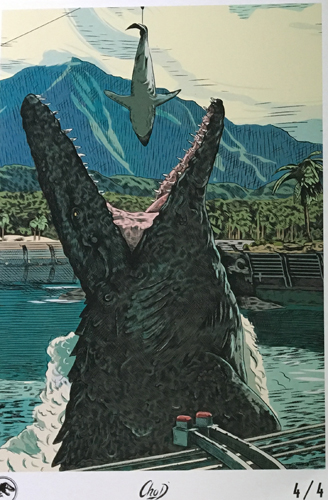
The movie poster features a Mosasaurus.
Everything Dinosaur’s List of the Prehistoric Animals in “Fallen Kingdom”
Allosaurus – a big, carnivorous dinosaur that lived during the Late Jurassic.
Ankylosaurus – an armoured dinosaur, a herbivore from the Late Cretaceous of North America.
Apatosaurus/Brontosaurus – a giant, long-necked plant-eating dinosaur from the Late Jurassic.
Baryonyx – a carnivorous dinosaur that may have specialised in catching fish, the first fossils of which were found in southern England. Baryonyx lived during the Early Cretaceous of Europe.
Brachiosaurus – an enormous, plant-eating, long-necked dinosaur from the Late Jurassic.
Carnotaurus – a predatory dinosaur from the Late Cretaceous of South America.
Compsognathus – at around a metre in length, the smallest non-avian dinosaur inhabitant of Isla Nublar. This little dinosaur lived in Europe during the Late Jurassic.
Gallimimus – a fast-running, “ostrich mimic” dinosaur that lived in Asia during the Late Cretaceous.
Mosasaurus – not a dinosaur, but a marine reptile that belongs to the same group of reptiles as lizards and snakes. These predators lived during the Cretaceous.
Pteranodon – also not a dinosaur, but a flying reptile from the Late Cretaceous, a pterosaur. Pteranodon fossils have been found in North America, England and Asia.
Sinoceratops – a member of the horned dinosaur group, it roamed China towards the end of the “Age of Dinosaurs”.
Stegosaurus – “roof lizard”, a herbivore from the Late Jurassic of America.
Stygimoloch – a “bone-headed” dinosaur from the Late Cretaceous of North America which was good at knocking down walls if the movie is to be believed!
Triceratops – one of the most famous of all the plant-eating dinosaurs. Triceratops lived at the very end of the Cretaceous. Its fossils have been found in North America.
Tyrannosaurus rex – no dinosaur film would be complete without an appearance of T. rex. The “king of the tyrant lizards”, lived in North America and its fossils are associated with Upper Cretaceous sedimentary deposits.
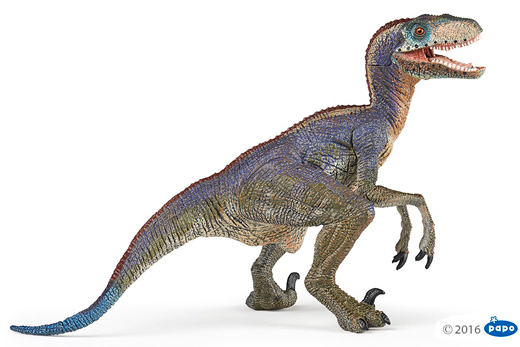
Velociraptor – The “raptor” called Blue which was reared and brought up by animal trainer Owen Grady (played by Chris Pratt). Velociraptor lived during the Late Cretaceous of Asia.
Last but not least, comes Indoraptor, a dinosaur created from the DNA from Indominus rex – the monstrous carnivore from the previous film in the franchise – “Jurassic World” and Velociraptor.
Look out for the sequel which is scheduled for release in June 2021. What dinosaurs do you think should be in this film?
Scientists Calculate the Cost of Powering a Dinosaur Theme Park
This week, twenty-five years ago, saw the release of the film “Jurassic Park”, the Steven Spielberg directed blockbuster that brought to the world’s cinema screens CGI generated and animatronic dinosaurs. As cinema-goers currently enjoy the latest instalment in this multi-billion-dollar franchise – “Fallen Kingdom”, we could reflect on how our perceptions regarding the Dinosauria has changed since the adaptation of Michael Crichton’s 1990 novel first hit our screens.
Celebrating Twenty-Five Years of Jurassic Park
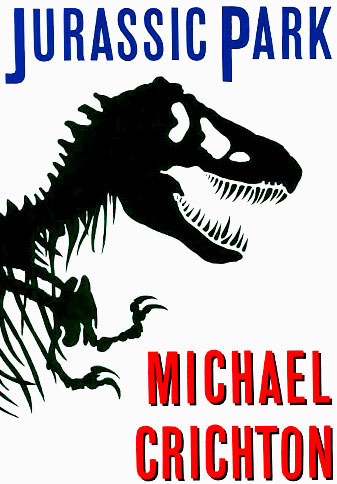
The first edition of Jurassic Park published in 1990, Steven Spielberg’s blockbuster followed three years later.
Powering “Fallen Kingdom”
We could comment on how these movies have enthused a whole generation of new scientists, with many opting for a career in palaeontology, first inspired by the amazing prehistoric animals brought to life on the silver screen. Instead, let’s leave the speculation to others about whether it would ever be possible to resurrect a long extinct group of animals, the last of which roamed the Earth sixty-six million years ago and consider one of the more practical aspects of converting an island into a dinosaur themed tourist attraction – how much power would it take to run Jurassic Park?
Thanks to E.ON and the assistance of some very clever physicists at Imperial College London, we have an answer to this question.
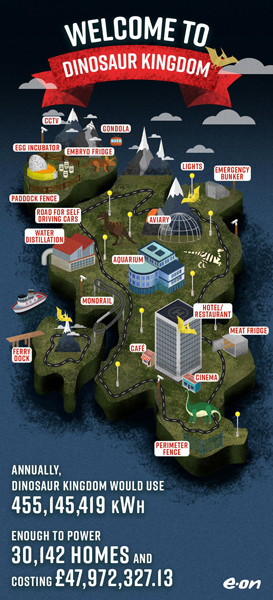
It would take 455 million kWh to power a real-life Dinosaur Kingdom. That’s enough to power half the homes in Harrogate for a year. Furthermore, team members at Everything Dinosaur have calculated, that based on an average UK household’s power consumption of around 5,000 kWh per annum, the annual power consumption of your typical prehistoric animal populated park would permit you to run the average UK home for around 91,000 years! That should be enough gas and electricity to see you comfortably through the next Ice Age.
The Cost of Powering a Prehistoric Animal Theme Park
The energy costs involved in running a “Prehistoric Park”.
Picture credit: E.ON
Running a Real-Life Jurassic Park
From a huge aquarium to house the semi-aquatic Spinosaurus to a dinosaur embryo cooling fridge and egg incubator, the physics experts investigated how much energy each feature would need to keep the park running over twelve months. The final figure calculated was 455,145,418 kWh, costing approximately £131,732 a day. We wonder how much money the owners of the theme park would have saved if they had instructed their geneticists to re-create dinosaurs as they probably were, that is, equipped with their own insulation in the form of downy, feathery coats.
If Feathered Dinosaurs had been Genetically Engineered – This Might Have Reduced the Annual Fuel Bill
If dinosaurs had been genetically engineered so that they retained their feathers, would insulated dinosaurs have reduced the annual fuel bill?
Picture credit: Zhao Chuang PNSO
Modern Energy Solutions to Accommodate Ancient Animals
For any billionaire with aspirations to build a real-life “Jurassic Park”, having an understanding of the running costs would be an important component of the business plan.
Scott Somerville, E.ON’s Head of Advertising, PR and Campaigns, stated:
“With huge 10,000 volt electric fences and an aviary designed to house pterosaurs to name just two of the Dinosaur Kingdom’s unusual features, we suspected the energy needed to power the whole park would be big – possibly equivalent to powering a whole region within the UK. But what our figures show is that it’s actually a massive amount! It’s about the same as powering 30,142 average UK households a year – roughly equivalent to powering half the homes in Harrogate – but by adopting modern solutions, the power requirement and costs could be even less.”
Prehistoric Poo Turned into Power
The operators of any theoretical theme park, in which the main attractions would have quite happy consumed visitors for their breakfast, would need the very latest in safety features. There have been five films in the “Jurassic Park/Jurassic World” franchise to date and we all know what happens when things go wrong – it does not end well for the tourists. However, innovative and environmentally friendly methods of power generation could be adopted to keep those fences charged. The dinosaurs themselves could play a role in helping to keep running costs from mutating into monstrous proportions, as E.ON’s Scott Somerville went onto explain:
“By generating electricity using technology like a biomass fuelled Combined Heat and Power station, park owners could turn dinosaur droppings into electricity. Add on other solutions like solar and battery storage, then the park could ultimately benefit from a cheaper, sustainable and more reliable source of electricity instead having to deal with a ‘raptor rampage’ every time the generators that power the electric fences go down.”
For any would-be entrepreneurs with a few billion burning a hole in their pocket, further information on E.ON’s estimates of the running costs of a real-life dinosaur theme park can be found here: Dinosaur Kingdom Running Costs.
As for the rest of us, read the books, watch the movies, it is likely to be a lot less expensive and a good deal safer too.
If anyone or any organisation did really set out to create a dinosaur themed tourist attraction, populated by living, breathing, albeit genetically engineered prehistoric animals, then we suspect it would “spark” a Tyrannosaurus rex-sized debate. Feathers would be well and truly ruffled!
Yesterday, team members at Everything Dinosaur were able to take a break from their busy schedule and visit the cinema to watch “Fallen Kingdom”, the latest film in the “Jurassic Park/Jurassic World” franchise. We shall leave it to others to provide a review, but we were able to pass a couple of pleasant hours marvelling at how CGI and animatronics can bring about the resurrection of long extinct species.
Prior to the film starting we got talking to the friendly cinema staff. They were most interested in our work and as a result, one of the cinema staff members went into their office and returned with two posters. Free posters are being given out by certain cinema chains to help promote the movie, something that we were not aware of. Our posters feature a giant (somewhat oversized), Mosasaurus marine reptile feeding on a shark, a famous scene from the previous film “Jurassic World”.
The Posters that Team Members at Everything Dinosaur were Given
The Mosasaurus poster from the film “Fallen Kingdom. Picture credit: Everything Dinosaur.
Picture credit: Everything Dinosaur
Donating Mosasaurus Posters to a School
We thanked the staff for their gift of the posters, these will go to a good home. Everything Dinosaur has a school visit arranged for Wednesday of this week, delivering a series of dinosaur workshops to classes in support of their dinosaur and prehistoric animal themed term topic. We shall take these two posters with us and donate them to the school, perhaps the poster will help the children to remember that an animal like a mosasaur is not actually a dinosaur. The poster might even inspire them to have a go at drawing their very own prehistoric animals.
When Everything Dinosaur team members visit a school, we tend to bring extra resources to support the school’s scheme of work and during our dinosaur workshops, the opportunity usually arises to challenge the children to undertake some extension activities in support of the curriculum.
We suspect that these two “Fallen Kingdom” posters will be gratefully received and we are sure that they will help the classes to create their own colourful and informative dinosaur and prehistoric animal displays.
Professor Vince Gaffney, Anniversary Chair in Landscape Archaeology at the University of Bradford, has been honoured with the award of the MBE in the Queen’s 2018 Birthday Honours List. The award is for services to archaeology. Our congratulations to the professor.
Bradford University Professor Awarded MBE
Professor Gaffney is a world-renowned expert in archaeological landscape studies who, over the last four decades, has engaged with young and old, passionately presenting his subject matter as an exciting and thought-provoking study of people and their environments in the present and the past. He continues to attract tremendous international media interest and to inspire the next generation of aspiring archaeologists.
Honoured with the Award of an MBE – Professor Vince Gaffney (Bradford University)
Professor Vincent Gaffney (Bradford University).
Picture credit: University of Bradford
Vince has been the recipient of numerous national and international awards. In 2017, his work in the Stonehenge landscape was awarded the “Research Project of the Year “ and he was recently shortlisted for Archaeologist of the Year by the journal “Current Archaeology”. Five years ago, he received the European Archaeological Heritage Prize and his work also received the prestigious Queen’s Award for Higher Education, for use of novel technology within the Wroxeter Hinterland Project, providing the first comprehensive geophysical survey of a major Roman town in Britain.
A Pioneer of New Research Techniques
Professor Gaffney has pioneered the application of computing in archaeology. His work on the Croatian Adriatic Islands provided the first substantial use of geographical information systems (GIS) in Europe. More recently, he has led the UK team creating three-dimensional and virtual imaging of the “Stonehenge Hidden Landscapes”, from an extensive programme of geophysical surveys of the largely unmapped landscape and which will change our understanding of Stonehenge and shape history as well as inform student teaching and learning.
His work on archaeological landscapes lost to the sea after the last glaciation received the 2007 award for Heritage Presentation at the British Association for the Advancement of Science. This research was also selected by Research Councils UK as one of top hundred ground-breaking UK research projects as part of its “Big Ideas for the Future” publication.
In 2010, Professor Gaffney’s book on this subject, “Europe’s Lost World”, was awarded the “Best Publication” prize at the British Archaeological Awards. Professor Gaffney and his colleagues were also invited to exhibit their work on underwater landscapes in the Royal Society’s Summer Science Exhibition.
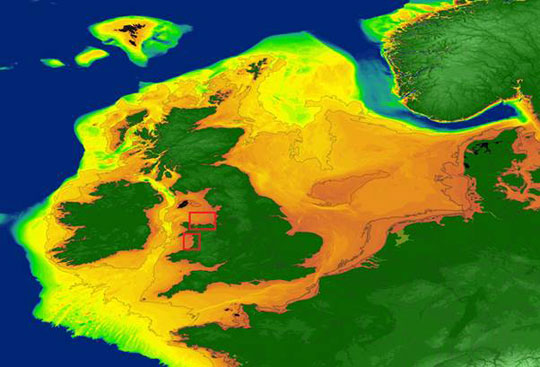
Surveying the Extensive Palaeolandscapes of the North and Irish Seas
Approximate maximum extent of marine palaeolandscapes off the Irish and British coasts (survey areas in red).
Picture credit: University of Bradford
Recently, Everything Dinosaur has featured the research into the hidden landscapes of the southern North Sea basin. This study funded by a European Research Council grant, represents one of the largest, continuous areas to be mapped using geophysical data ever attempted. The aim of this extensive project is to document evidence of human settlement in these hinterlands, prior to the flooding of this part of Europe.
Commenting upon this accolade, professor Gaffney modestly stated:
“It is both a surprise, and a great pleasure, to learn that I have been selected to receive an MBE for services to Archaeology. When receiving such an honour within Higher Education it is, of course, completely appropriate to recognise that an individual’s career is actually a result of the labours of numerous students, researchers and the many colleagues one works with over the years and I would like to think that I am accepting this honour for them all. It is also important to note the value of such awards to universities and their communities.”
Professor Gaffney added:
“Archaeology may be associated with Stonehenge and many glamorous monuments but to us, the archaeology of Bradford Park Avenue is equally important and our work there and elsewhere in Bradford and Yorkshire, links the University and the town and is the basis for future, globally important research.”
Some of the First Land Vertebrates Lived in Antarctica
The fossilised remains of two newly described Late Devonian tetrapods have helped to shed new light on the evolution of land vertebrates. Since most of the known Devonian tetrapod fossils are associated with equatorial palaeoenvironments, it had been thought that the first animals with back bones to adapt to a life on land must have lived in very close to the equator. However, these new specimens lived on the southernmost portion of the giant super-continent Gondwana. These early land pioneers of 360 million years ago were living within the Antarctic circle.
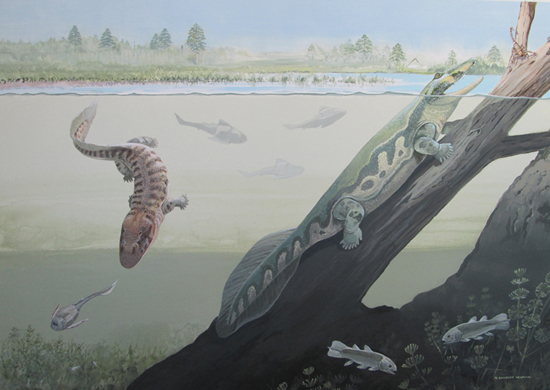
A Life Reconstruction of the Two Newly Described Tetrapod Species from the Waterloo Farm Site
The Waterloo Farm area of South Africa during the Late Devonian (Tutusius and Umzantsia).
Picture credit: Maggie Newman
Devonian Tetrapods
The evolution of the first land animals from fish during the Devonian geological period is regarded as a key event in the history of life on Earth. Newly described fossils from the Waterloo Farm locality near Grahamstown (Easter Cape Province, South Africa), are challenging current perceptions about where in the world the first land vertebrates evolved.
Lead author of the scientific paper, published in the journal “Science”, Dr Robert Gess (Albany Museum, Grahamstown), explained:
“Whereas all previously found Devonian tetrapods came from localities which were in tropical regions during the Devonian, these specimens lived within the Antarctic circle.”
The First African Devonian Tetrapods
The researchers, including co-author Professor Per Ahlberg (Uppsala University, Sweden), name two new species Tutusius umlambo and Umzantsia amazana from fragmentary bones from a road cutting at the Waterloo Farm site, bones from the shoulder girdle related to these new early tetrapods, are helping palaeontologists to gain a better understanding of the development of the shoulder girdle from a fish to that of a tetrapod, adapted to walking around on land.
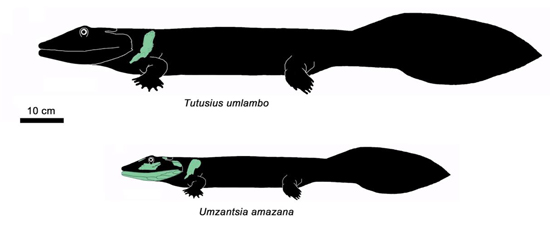
Tutusius and Umzantsia, are Africa’s earliest known four-legged vertebrates by a remarkable 70 million years. The approximately one-metre-long Tutusius umlambo (named in honour of Archbishop Emeritus Desmond Tutu) and the somewhat smaller Umzantsia amazana are both incomplete.
Tutusius is represented by a single bone from the shoulder girdle, whereas Umzantsia is known from a greater number of bones, but they both appear similar to previously known Devonian tetrapods. Alive, they would have resembled a cross between a salamander and a fish, with an amphibian-like head, stubby legs with numerous fingers and a tail that was reminiscent of a tadpole’s.
Scale Drawings of Tutusius and the Smaller Umzantsia
New Late Devonian tetrapods from southern Gondwana. Known bones highlighted in green.
Picture credit: University of Witwatersrand
The Waterloo Farm site, where the fossils were discovered, is a road cutting first exposed two years ago after controlled rock-cutting explosions by the South African National Roads Agency (SANRAL). This very important fossil site is along the N2 highway between Grahamstown and the Fish River. The construction crew exposed dark, grey mudstones of the Witpoort Formation. The strata represent sedimentary deposits laid down in a brackish, tidal river estuary. The rocks preserve numerous fossils, including animals and plants.
The discovery of these fossils is extremely significant not only for what was found, but where they were found. Devonian tetrapod fossils are found in widely scattered localities. However, if the continents are mapped back to their Devonian positions, it emerges that all previous finds are from rocks deposited in the palaeotropics, between 30 degrees north and south of the equator.
Almost all these rare and important fossils come from Laurasia, a super-continent that later fragmented into North America, Europe and Greenland. Umzantsia and Tutusius have certainly bucked this trend. Gondwana, the much larger, southern super-continent (made up of present -day South America, Australia, Madagascar, Australia, India and Africa), has hitherto yielded virtually no evidence of Devonian tetrapods.
Footprints ascribed to early tetrapods have been discovered in Australia and an isolated jawbone was found in New South Wales. When this jawbone fossil was first studied, scientists thought it represented the jaw of a lobe-finned fish. However, subsequent research led to the conclusion that this single bone came from a primitive tetrapod. The species Metaxygnathus denticulus was erected.
During the later stages of the Devonian, this part of Australia was associated with the northern Gondwana. It would have been located in the tropics. As a result, it was assumed that movement of vertebrates from water onto land (terrestrialisation) also occurred in the tropics. Attempts to understand the causes of these major macroevolutionary steps therefore focused on conditions prevalent in tropical water bodies.
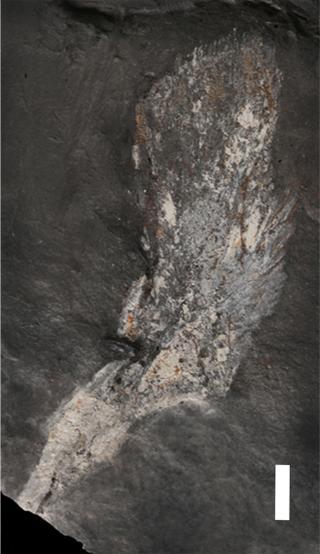
The fossil Cleithrum of T. umlambo
The cleithrum of Tutusius umlambo (part of the shoulder girdle).
Picture credit: University of Witwatersrand
Challenging Current Perceptions and Assumptions About Tetrapod Evolution
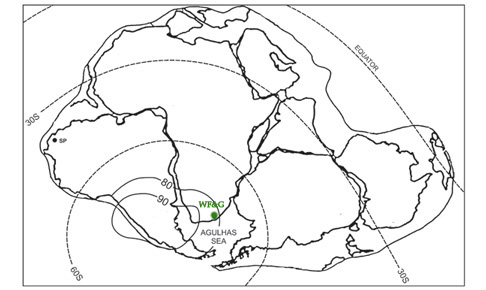
The two early tetrapods named from Waterloo Farm fossils, also come from Gondwana, but from an environment associated with the southernmost part of the super-continent. Waterloo Farm was approximately seventy degrees south, within the Antarctic circle. Many plant and insect fossils recovered from the road side indicate that the climate was much milder than the Antarctic circle today, but it would still have been cold and during the long winter season, this region would have experienced many months when the sun did not appear above the horizon. These amphibians would have had to endure long periods of darkness.
The Location of the Waterloo Farm Site in the Late Devonian
The location of Waterloo Farm and Grahamstown where a substantial number of Devonian fossils have been found. Look for the green label.
Picture credit: University of Witwatersrand with additional annotation by Everything Dinosaur
The researchers conclude that these fossils change our understanding of the distribution of Devonian tetrapods. We now know that tetrapods occurred throughout the world by the Late Devonian and that their evolution and terrestrialisation could realistically have occurred anywhere.
Alberta Reveals New Driver’s Licence with Dinosaur Design
In a bid to help protect residents of the Canadian province of Alberta from counterfeiting and identify theft, driving licences have been redesigned and they will feature a skeleton of an Albertosaurus. This iconic, albeit somewhat extinct resident of southern Canada is honoured and the bones in the tail of the dinosaur image helps to improve the card’s security.
The New Driver’s Licence for the Canadian Province of Alberta
The new design for a driving licence in Alberta features Albertosaurus.
Picture credit: Alberta Government
The provincial government has redesigned driver’s licences and identity cards with updated and improved security features such as clear windows, laser engraving and three-dimensional embossing. These features are designed to deter fraudsters and counterfeiters but the additional of an Albertosaurus skeleton must make this one of the coolest things that a wallet or purse could contain.
Stephanie McLean, (Minister of Service for Alberta) commented:
“Our government takes identity fraud very seriously. We are the first jurisdiction in North America to integrate this combination of design and security to protect Albertans from ID theft and prevent fraud. We are using the latest technology available to safeguard people’s personal information and prevent scams.”
Saving $1,000,000 Canadian Dollars
The new cards are currently in production and although the cards have a suite of security measures incorporated within them, advances in technology mean that they will cost less than the old licences to make. The Alberta treasury expects to save over $1,000,000 Canadian dollars as a result of the new design.
The driver’s licence design depicts famous landmarks such as Castle Mountain and the Bow River in Banff National Park, while the new identity cards will feature a Wild Rose, Alberta’s provincial flower. Both cards also include an image of an Albertosaurus, a dinosaur whose name honours Alberta.
Fossils of a very large predatory dinosaur had been uncovered in southern Canada prior to the turn of the Century and this dinosaur was finally named and scientifically described in 1905, the same year that the province of Alberta was established by an Act of Parliament. Coincidentally, 1905 was also the year that Tyrannosaurus rex, a famous relative of Albertosaurus was named.
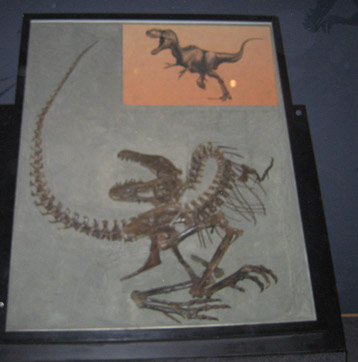
A Museum Exhibit Albertosaurus Skeleton Fossil
The “Death Pose” of a Dinosaur. A fossil exhibit featuring Albertosaurus. Picture credit: Everything Dinosaur.
Picture credit: Everything Dinosaur
Albertosaurus
The last redesign occurred nine years ago and the Alberta government has incorporated advice from law enforcement agencies to ensure the cards have the most up-to-date safeguards against fraudsters and identify thieves. The Albertosaurus image plays an important role in card security. The dinosaur’s image is embossed and has a raised feel to it. This creates a three-dimensional effect, the tail continues on the back of the card and appears to travel through the Alberta-shaped window, which also holds an image of the legitimate card holder.
A spokesperson from Everything Dinosaur commented:
“It is wonderful to see the authorities celebrating the natural beauty of the province of Alberta in such an interesting way. Having an iconic dinosaur on the driver’s licence will remind holders of the rich fossil heritage of this part of Canada.”
A Life Reconstruction of Albertosaurus (A. sarcophagus)
An illustration of Albertosaurus (A. sarcophagus). Picture credit: Everything Dinosaur.
Scientists Discover Dinosaur Footprints in the Tatra Mountains
The beautiful and rugged Tatra mountain range forms a natural border between Poland and Slovakia, but during the Late Triassic, the sediments that formed part of these peaks were sandy shores close to large rivers where many different types of dinosaur wandered. Dinosaurs left their footprints in these soft sands, and remarkably some of these trace fossils have survived more than 200 million years and they are helping palaeontologists to better understand the composition of Late Triassic vertebrate faunas.
Media reports from the Centre of Interdisciplinary Biosciences of Pavol Jozef Šafárik University in Košice, Slovakia, confirm the discovery of yet more three-toed theropod dinosaur footprints, although most are badly eroded, these trace fossils indicate the presence of a sizeable predator, one that may have exceeded five metres in length.
The fossils come from the Tomanová Formation and although dating the strata is challenging, the rocks are thought to have been laid down during the Late Norian to the Rhaetian faunal stage of the Triassic (215 – 202 million years ago approximately).
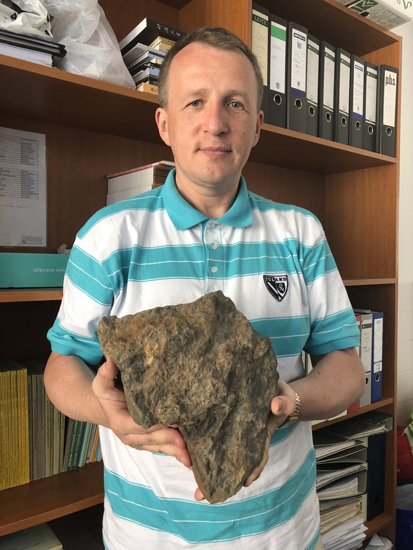
Palaeontologist Martin Kundrát with a Cast of a Dinosaur Footprint
Martin Kundrát holding a cast of the dinosaur trace fossil he discovered in the Tatras.
Picture credit: Jana Otriová
Recording the Activity of Dinosaurs from the Late Triassic
The first dinosaur fossil footprints found in the High Tatras were described in 1976. These fossils and subsequent footprint discoveries led to the establishment of a new ichnospecies – Coelurosaurichnus tatricus. However, these new finds, ten dinosaur trace fossils, have helped shed further light on vertebrate fauna at an important time in our planet’s history. At around this time, a mass extinction event occurred and a number of terrestrial vertebrates (and other types of animal) became extinct, providing the Dinosauria with even greater opportunities to diversify and produce new species.
Commenting on these fossils, one of the palaeontologists who discovered them, Martin Kundrát (Centre of Interdisciplinary Biosciences of Pavol Jozef Šafárik University), stated:
“The locality is extremely rare for Slovak dinosaurology. It is located at high altitude. This does not mean, however, that dinosaurs have been hiking. The truth is that the sediments in which the traces were preserved were created hundreds of kilometres from Slovakia almost at the level of the then advancing sea. The layers of the tracks were later transported to the territory of Slovakia and raised to the stars. This is our modest dinosaur association. Two of them are complete, the rest are only fragments.”
One of the More Complete Footprint Fossils
Coelurosaurichnus tatricus? Footprints previously ascribed to the ichnospecies C. tatricus may have to be redefined in the light of these new fossil discoveries.
Picture credit: Martin Kundrát
Important Fossils Although Fragmentary Fossils
The fossil record for dinosaurs from Europe during the Late Triassic is relatively poor, so even these fragments are very helpful to palaeontologists as they attempt to piece together the biota of Pangaea. The trace fossils, although quite indistinct, help scientists to gain an understanding of the various types of dinosaur that roamed this part of the world more than 200 million years ago. Moreover, these new discoveries allow palaeontologists to revise their knowledge about an ancient ecosystem. Based on studies of similar imprints from South Korea, the United States, Iran and China, scientists have been able to make two important deductions.
First, the researchers have concluded that the former ichnotaxonomy (classification of an animal based on its footprints, burrows, or other traces) of Coelurosaurichnus tatricus is not valid.
Secondly, the number of imprints confined to a small area indicates that it was a very often frequented locality.
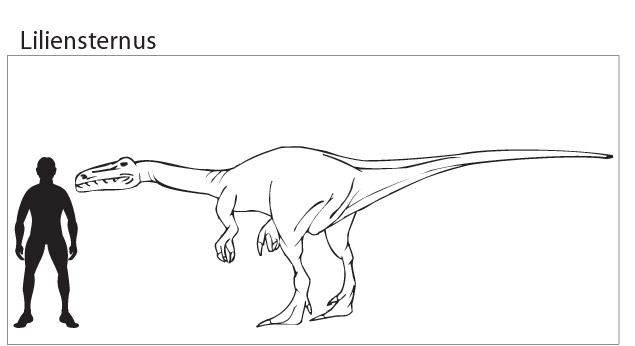
The Dinosaur Footprints Indicate a Theropod Around Five Metres in Length
Liliensternus dinosaur drawing, It is probable that the Slovakian theropod looked like Liliensternus from the Late Triassic of Germany. Picture credit: Everything Dinosaur.
Picture credit: Everything Dinosaur
In total, this part of the High Tatras has yielded several different types of dinosaur footprint. Several papers have been published previously describing ornithischian prints and the large, rounded tracks of what are assumed to be Sauropodomorpha, as well as numerous types of three-toed (tridactyl) prints assigned to the theropoda.
By Mike|2023-10-14T15:42:41+01:00June 6th, 2018|Categories: General Teaching|Comments Off on Giant Ammonites – Potentially Under Your Feet
Giant Ammonites – Potentially Under Your Feet
Ammonites are closely related to extant squids and octopi (cephalopods). Ammonite fossils can be collected from many sites around the world, including numerous locations in the UK. Often, an ammonite fossil shell is the first discovery of a young fossil hunter, a find that can lead to a lifetime of fossil collecting.
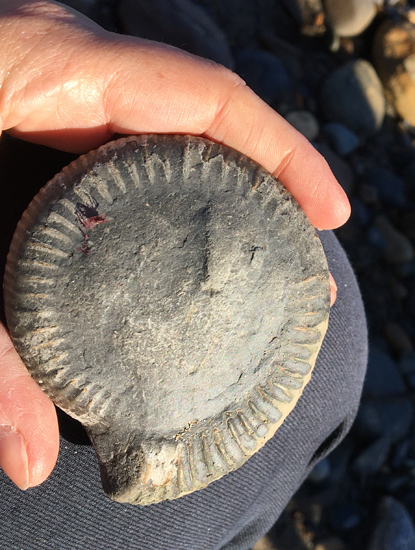
The Simple Pleasure of Finding an Ammonite Fossil
An ammonite partially eroded out of a nodule. We think this is an example of Dactylioceras commune.
Picture credit: Everything Dinosaur
Titanites giganteus
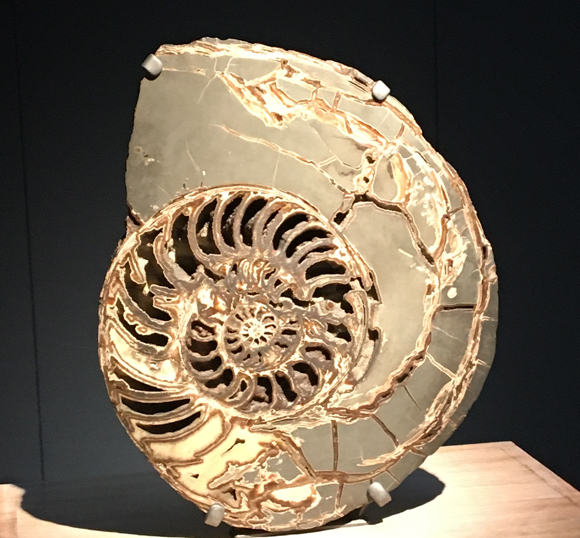
Whilst on a visit to the Grant Museum of Zoology and Comparative Anatomy (London), a team member of Everything Dinosaur took a photograph of a giant ammonite fossil (Titanites giganteus) in one of the glass display cases.
A Giant Ammonite Specimen at the Museum
A stunning fossil of a Jurassic ammonite on display at the London Natural History Museum. Picture credit: Everything Dinosaur.
Picture credit: Everything Dinosaur
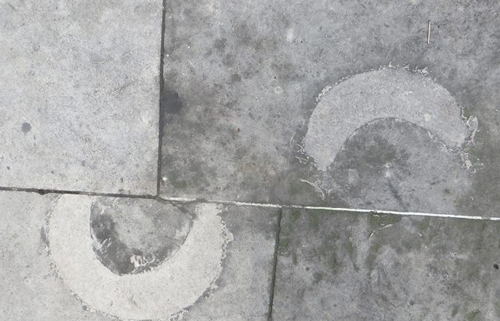
This is a relatively small specimen, measuring around forty centimetres in diameter. The biggest specimens of this ammonite species have shells more than a metre across. University College London is built from Portland Stone, a limestone formed in tropical seas in the Late Jurassic around 146 million years ago. This stone is quarried from the Isle of Portland in Dorset and is used all over the world for building projects. Some of the ammonite specimens that have been collected were huge, with shells much bigger than the one in the Grant Museum.
The one photographed by an Everything Dinosaur team member, could represent a relatively young animal or perhaps a male (female ammonites are believed to have been much larger than males).
Giant Ammonites on Display
The helpful information in the display case explains that visitors to London can see a rare example of a fossil Titanites ammonite in building stones outside the Slade School of Fine Art in the University’s Main Quad. In the paving are slices of preserved whorls, each one is a slice through the same fossil. Hundreds of people walk over this fossil every day, we wonder how many of them notice?
By Mike|2024-05-11T05:59:47+01:00June 5th, 2018|Categories: General Teaching|Comments Off on Acknowledging the Importance of World Environment Day
World Environment Day
Today, June 5th is World Environment Day. This annual event organised by the United Nations aims to raise awareness of the environment and specific issues caused by human activity that are threatening our planet’s ecosystems and habitats. This day, sometimes referred to as “World Eco Day”, was established in principle in 1972 and the first commemorative events took place two years later. We commemorate this important date by posting up an image of giant tortoise model.
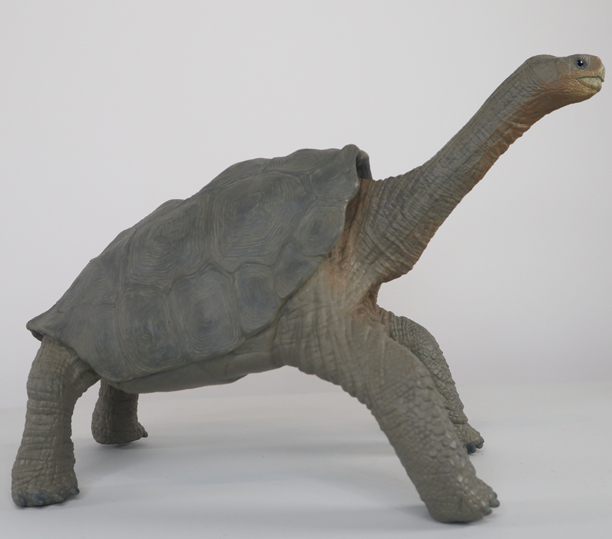
A 1:6 Scale Replica of the Pinta Island Giant Tortoise (Extinct)
The Rebor 1:6 scale Pinta Island tortoise “Lonesome George” in lateral view. The model measures 30 cm long and stands 20 cm high. Picture credit: Everything Dinosaur.
Picture credit: Everything Dinosaur
The picture (above) shows the Rebor Pinta Island tortoise model.
The last Pinta Island giant tortoise (Lonesome George) died on the 24th of June 2012. It was the last known individual of the sub species Chelonoidis niger abingdonii.
So, it seems fitting that today, World Environment Day, we remember the now extinct Pinta Island giant tortoise. The last of the Pinta Island tortoises was named “Lonesome George”. Researchers are hoping to resurrect the lineage using a controlled breeding programme involving other tortoise sub-species.