All about dinosaurs, fossils and prehistoric animals by Everything Dinosaur team members.
19 06, 2018

More Evidence That Eumaniraptoran Dinosaurs Lived in Flocks

By |2023-10-16T12:17:52+01:00June 19th, 2018|Categories: Dinosaur and Prehistoric Animal News Stories, Dinosaur Fans, Main Page, Photos, Photos/Pictures of Fossils|0 Comments

Social Dinosaurs from Shandong Province

Everything Dinosaur has picked up stories circulating from several Asian media outlets reporting on the discovery of around 300 dinosaur footprints and tracks in Shandong Province in north-eastern China.  Some of these prints are believed to represent either dromaeosaurid or troodontid (eumaniraptoran) dinosaurs.  Intriguingly, the researchers have uncovered four sets of distinctive two-toed tracks running in parallel.  This suggests that four eumaniraptoran dinosaurs may have moved together, providing further evidence of possible pack behaviour in “raptors”.  In total, scientists have identified around 70 two-toed tracks that indicate the presence of eumaniraptoran dinosaurs at this locality.  Unfortunately, the absence of any body fossils, such as bones and teeth restricts the palaeontologists in terms of identifying precisely what sort of dinosaurs made these tracks.

Eumaniraptoran Dinosaurs

Scientists Have Identified Four Parallel Dinosaur Trackways

Parallel dinosaur tracks suggests flocking behaviour.
The scientists identified four, two-toed parallel dinosaur trackways.

Picture credit: Lu Yong

Didactyl Tracks – The Second Toe Lifted Off the Ground

Some members of the eumaniraptoran clade of dinosaurs – the Dromaeosauridae and the Troodontidae for example, had an enlarged second toe claw that was held off the ground.  As these types of dinosaurs moved they would have left very distinctive, two-toed prints and tracks.  The finding of sets of prints indicating that the dinosaur track makers were all moving at the same speed and in the same direction suggests that these dinosaurs were social and moving in packs.

A spokesperson from Everything Dinosaur commented:

“Whilst we cannot be certain what type of dinosaur made the parallel prints, it has been speculated, based on the proportions of the toes, that these tracks could have been made by a member of the deinonychosaurian (a dromaeosaurid).  The tracks were made approximately 125 million years ago and we know from the contemporary Jehol Biota of north-eastern China there were lots of “raptors” roaming about.”

The Raised Second Toe (Killing Claw) Results in a Two-toed Track
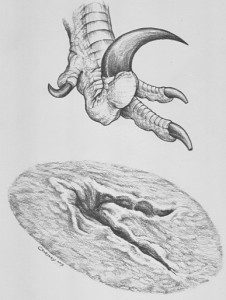
Typical two-toed dinosaur track.
The raised second toe results in a two-toed (didactyl) track.

Picture credit: Matt Celeskey

Didactyl tracks have been referred to as the ichnogenus Dromaeopodus in the past.  Writing in the academic journal “Cretaceous Research”, the scientists have identified two morphotypes, at this fossil site.  The parallel tracks have been tentatively named as an example of the ichnospecies Menglongpus representing a deinonychosaur.  The researchers have also named the tracks of an avian theropod as the ichnospecies Tatarornipes.

One of the Two-toed Tracks Assigned to the Ichnospecies Menglongpus

Didactyl dinosaur track.
One of the two-toed tracks from the Shandong Province location – the track has been outlined in chalk.  It has been assigned to the ichnospecies Menglongpus.

Picture credit: Lu Yong

Discovered in 2015

The fossilised footprints and tracks were discovered three years ago by Tang Yonggang, a visiting professor at Linyi University (Shandong Province).  The strata at the site, in the mountainous county of Tancheng, forms part of the Dasheng Group.  Over the last twelve months or so, a team of scientists led by Xing Lida, from the China University of Geosciences have mapped the hundreds of prints and tracks.

These types of two-toed tracks have been found all over the world, for example, back in 2008, Everything Dinosaur reported on a series of didactyl tracks that had been discovered in South Korea.

To read the article on the South Korean dinosaur tracks: Two-toed dinosaurs stalking South Korea.

Lida Xing commented:

“Three hundred footprints is not a shockingly large number, but the diversity in the species found at one site is extremely rare.”

An Assemblage of Fossilised Dinosaur Tracks and Prints (Shandong Province)

Dinosaur tracks and prints fossil site (China).
Numerous tracks and prints have been exposed at the site representing at least seven dinosaur species.

Picture credit: Lu Yong

An Early Cretaceous Dinosaur Dominated Biota with Eumaniraptoran Dinosaurs

The site preserves an Early Cretaceous dinosaur dominated biota consisting of small bipedal dinosaurs, larger Theropods and several different types of herbivore.

To read an article on the discovery of troodontid tracks in Iran: Feathered Dinosaurs from Iran.

Fans of a certain movie franchise will be delighted to hear that there is a growing body of evidence to suggest that “raptors” were sociable, pack animals.

“Jurassic World/Jurassic Park” Raptors Behaving Like a Pack
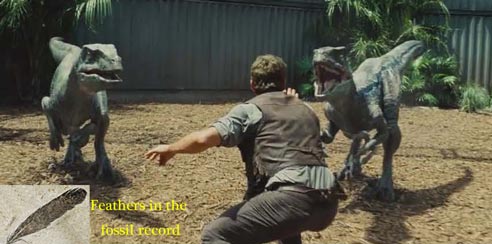
"Jurassic World" raptors.
Not feathered in the movies, but certainly hunting in packs.

Picture credit: Universal Studios

Visit the Everything Dinosaur website: Everything Dinosaur.
18 06, 2018

Megalosaurus bucklandii the First Dinosaur to be Scientifically Described

By |2024-05-11T06:08:19+01:00June 18th, 2018|Categories: Dinosaur Fans, Main Page, Photos, Photos/Pictures of Fossils|0 Comments

Buckland’s Great Lizard

Whilst visiting the Oxford Museum of Natural History, we took the opportunity to take lots of photographs of the dinosaur exhibits.  Naturally, our attention was drawn to that part of the museum that featured Megalosaurus (M. bucklandii).

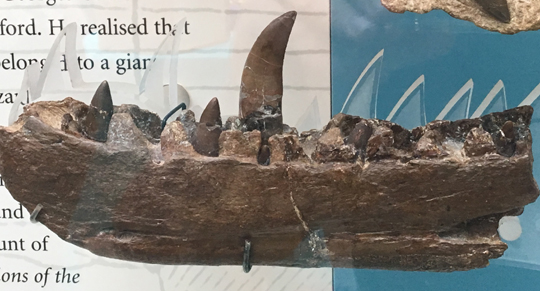
The Iconic Right Dentary (Lower Jaw) of Megalosaurus bucklandii

The lower jaw of Megalosaurus.
The partial dentary with teeth associated with Megalosaurus bucklandii.  Picture credit: Everything Dinosaur.

Picture credit: Everything Dinosaur

Megalosaurus bucklandii

The photograph (above), shows the left side of the right dentary.  Megalosaurus (M. bucklandii) was the first member of the Dinosauria to be officially, scientifically described.  The name was first coined by the English surgeon James Parkinson in 1822 and Buckland published his description in 1824.  The jaw fossil was included in the original description by William Buckland, it has the classification number OUMNH J13505.

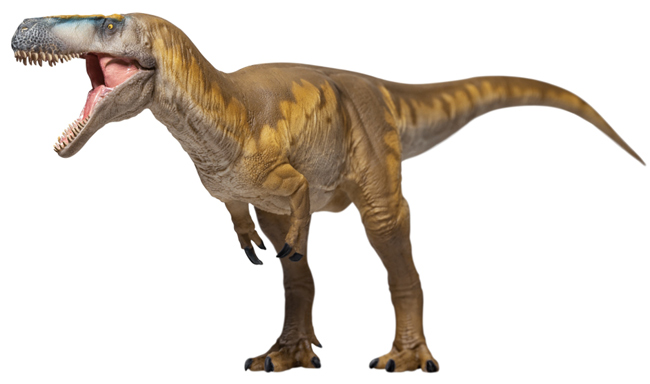
A Model of Megalosaurus (PNSO)

PNSO Edward the Megalosaurus bucklandii
The superb PNSO Megalosaurus dinosaur model. A fantastic replica of the first dinosaur to be formally described.

The picture (above) shows a Megalosaurus bucklandii figure from the PNSO model series.

To view this range: PNSO Age of Dinosaurs Models.

The right dentary is the designated lectotype, Buckland did not establish any holotype for M. bucklandii, instead he used several fossils, including the dentary to constitute the type fossil material for this species.  These fossils consisted of rib bones, bones from the hind limbs, vertebrae and elements from the pelvic girdle, together these fossils (the syntypes), describe the taxon.

Visit the website of Everything Dinosaur: Everything Dinosaur.

18 06, 2018

Praising the Museum of Natural History in Oxford

By |2023-10-16T07:42:39+01:00June 18th, 2018|Categories: General Teaching|Comments Off on Praising the Museum of Natural History in Oxford

In Praise of the Museum of Natural History (Oxford)

Oxford as the county town of Oxfordshire (England), has many attractions.  It is of course, famous for its distinguished and highly respected university.  It is one of the oldest seats of learning (alongside Paris and Bologna), in the western world.  The Victorian poet Matthew Arnold (1822-1888), coined the phrase “the city of dreaming spires”, it is indeed a very awe-inspiring place with its beautiful architecture and stunning university colleges and buildings.

Oxford Museum of Natural History

However, Oxford should not necessarily just be the haunt of academics and students.  For families, there is much to see and do in this historic part of England.  Take for example, the Museum of Natural History, it is free to enter (donations are suggested) and it provides a fantastic day out for young and old alike.

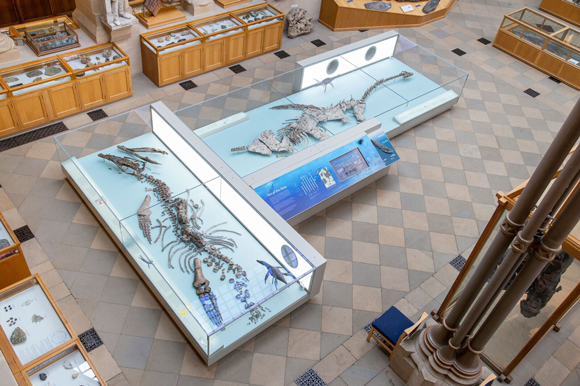
A View of the Ground Floor of the Natural History Museum (Oxford)

Two marine reptile fossils on display.
Plesiosauria fossils on display at the Oxford University Museum of Natural History. Picture credit: Everything Dinosaur.

Picture credit: Everything Dinosaur

The image (above) shows marine reptile fossils on display.

For models and replicas of marine reptiles and other prehistoric creatures: Prehistoric Animal Models and Figures.

Oxford Stunning Architecture

The museum acts as a centre for scientific study for the University of Oxford.  It houses the University’s collection of palaeontological, geological and zoological specimens, including some of the very first dinosaur bones to be scientifically studied.  This collection is housed in a stunning example of neo-Gothic architecture, the ornate columns and use of copious amounts of glass provides a wonderfully spacious and well-lit learning area.  With visitor numbers estimated to be around 700,000 people a year, this well-laid out and beautifully appointed museum can get quite busy at times, but please note, the Natural History Museum (London), attracts approximately 5,000,000 visitors per annum.  The London museum can get extremely congested, in contrast, the Oxford University Museum of Natural History (OUMNH), especially shortly after opening at 10 am tends to be much quieter.

Founded in 1860

Founded in 1860, that’s twenty-one years before the Natural History Museum (London) opened its doors, the OUMNH has maintained its strong tradition to inform and educate and helps to underpin a varied programme of scientific research as well as playing a significant role in teaching.  The Museum provides an extensive array of family orientated activities and if over the course of the summer holidays, you have a few hours to spare this museum is well-worth a visit.

Look out for the cast of a male Tyrannosaurus rex, a life-sized model of a Coelacanth, some amazing fossil specimens, live insects and of course, arguably the OUMNH’s most famous resident – the remains of a Dodo.

In the meantime, visit the award-winning Everything Dinosaur website: Everything Dinosaur.
17 06, 2018

Tiny Frogs Preserved in Cretaceous Amber Described in New Research

By |2024-05-08T20:36:36+01:00June 17th, 2018|Categories: Dinosaur and Prehistoric Animal News Stories, Dinosaur Fans, Main Page, Photos/Pictures of Fossils|0 Comments

Amber Fossils Provide Evidence of Cretaceous Frogs Inhabiting Wet, Tropical Environments

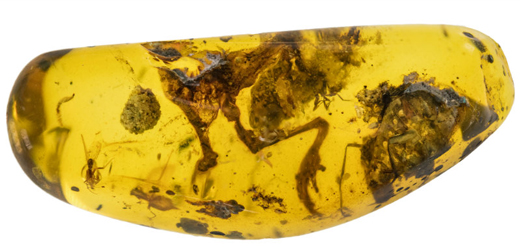
The remains of four tiny frogs preserved in Cretaceous-aged amber from northern Myanmar have provided palaeontologists with the first definitive evidence showing frogs 99 million years ago were inhabiting wet, tropical environments. Cretaceous amber reveals its secrets.

Preserved in Cretaceous Amber – A Window into an Ancient Terrestrial Ecosystem

Prehistoric frog preserved in amber.
A polished amber nodule from Myanmar showing substantial organic remains including the remains of a frog.

Picture credit: University of Florida

Electrorana limoae

The new species of Cretaceous amphibian has been named Electrorana limoae.  It was small, a juvenile, measuring around twenty millimetres in length, but this frog and other amazing fossil finds from Myanmar amber (burmite), some of which have been documented on this blog, provide scientists with an improved understanding of the micro-flora and micro-fauna of a tropical forest ecosystem that existed some ninety-nine million years ago.

The frog fossils provide the earliest irrefutable evidence of these types of amphibian living in wet, tropical forests.  They are the oldest-known examples of frogs preserved in amber.

Co-author of the study, published earlier this week in Nature’s “Scientific Reports”, David Blackburn (Florida Museum of Natural History) stated:

“It’s almost unheard of to get a fossil frog from this time period that is small, has preservation of small bones and is mostly three-dimensional.  This is pretty special, but what’s most exciting about this animal is its context.  These frogs were part of a tropical ecosystem that, in some ways, might not have been that different to what we find today – minus the dinosaurs.”

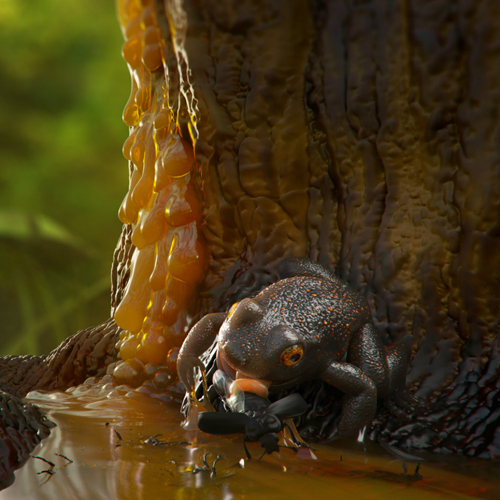
A Life Reconstruction of Electrorana limoae

A life reconstruction of Electrorana limoae.
Electrorana limoae – a life reconstruction.

Picture credit: Damir G Martin

Frogs – Probably Very Numerous But a Shockingly Poor Fossil Record

The fossil record for the Class Amphibia is extremely poor, it is believed that frogs may have evolved during the Triassic, although the fossils of an ancient frog/salamander ancestor discovered in Texas in 1995 might indicate that frogs were around many millions of years earlier.

To read Everything Dinosaur’s article about the discovery of a potential ancestral link between frogs and salamanders: Amphibian Ancestry a Little Clearer Thanks to New Discovery.

Frogs tend to be small, as a result their light, often tiny bones are not likely to preserve well so they are very probably underrepresented in the fossil record.  What fossils we do have of frogs tend to be biased towards more robust species from arid, seasonal environments, although, if we consider today’s frogs, the bulk of frog diversity can be found in tropical rainforests.

Dr Blackburn added:

“Ask any kid what lives in a rainforest and frogs are on the list, but surprisingly, we have almost nothing from the fossil record to say that’s a longstanding association.”

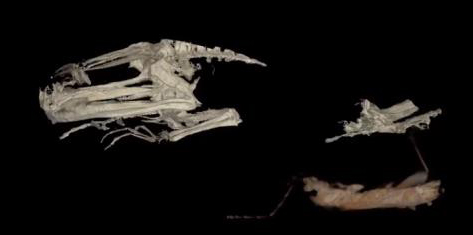
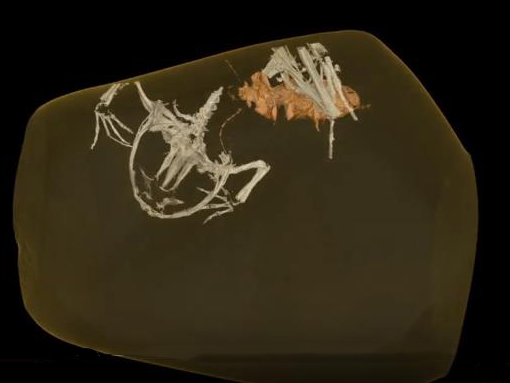
A Computer-generated Model Showing Frog Bones (white) and the Remains of a Beetle (Orange)

Computer generated three-dimensional image of the bones of Electrorana limoae and the yet to be described beetle.
Computer generated three-dimensional image of the bones of Electrorana limoae and the yet to be described beetle in the amber nodule.

Picture credit: University of Florida

The Burmite Deposits of Myanmar

The Cretaceous amber deposits of northern Myanmar (referred to as burmite), have provided palaeontologists with a unique record of an ancient Cretaceous tropical forest ecosystem. with fossil evidence of mosses, bamboo-like plants, aquatic spiders and velvet worms.  The discovery of Electrorana and the other fossils, the first frogs to have been found in burmite, will add to our understanding of frogs in the Cretaceous.  These fossils demonstrate that frogs have inhabited wet, tropical forests for at least 99 million years.  Frog fossils preserved in amber are exceptionally rare, previous examples have come from the Dominican Republic and Mexico and date back only to about 40 million and 25 million years, respectively.

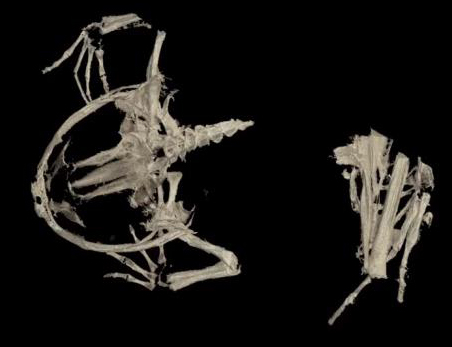
A View of the Skeletal Remains Preserved in the Burmite

Computer generated images of Electrorana limoae.
Three-dimensional images of the skeletal remains of Electrorana limoae.

Picture credit: University of Florida

Electrorana is the most well-preserved of the four frog fossils.  Clearly visible in the amber are the frog’s skull, its forelimbs, part of its backbone, a partial hind limb.  The other amber fossils contain two hands and an imprint of a frog that likely decayed inside the resin.

Answering Some Questions but Raising Many More

Many characteristics herpetologists use to discern details of a frog’s life history and determine how it’s related to other frogs, the wrist bones, the pelvis, hip bones, the inner ear, the top of the backbone, are either missing or were not yet fully developed in the juvenile frog.

The researchers, which include lead author Lida Xing (China University of Geosciences), have postulated that Electrorana limoae had similar features to extant Midwife toads and Fire-bellied toads, Eurasian species associated with temperate ecosystems.  Further CT scans and more fossil discoveries could help illuminate ancient evolutionary relationships, possibly clarifying how Electrorana fits into the frog family.

A Computer-generated Image of the Fossils of Electrorana limoae (note the presence of a beetle)

Computer generated image of Electrorana limoe and undescribed beetle.
Computer generated three-dimensional image of the bones of Electrorana limoae and the yet to be described beetle.

Picture credit: University of Florida

If ecosystems of today are anything to go by, it seems likely that there may be numerous frog fossils awaiting discovery, locked away in burmite.  We do not have a lot of single-species frog communities in tropical forest environments in the modern world, so it does seem likely that more frog fossils will be found in northern Myanmar.

Everything Dinosaur acknowledges the help of a press release from the University of Florida in the compilation of this article.

For further news stories about fossil discoveries from Myanmar burmite:

Evidence of insect mimicry preserved in amber: Those Clever Cretaceous Lacewings.

A blood-sucking story: A Blood-sucking Story – Dinosaur Parasites.

The tale of the spiders with tails: A Tale of the Spiders with Tails.

Enantiornithine bird preserved in amber: Watch the Birdie!

Visit the Everything Dinosaur website: Everything Dinosaur.
16 06, 2018

4D Scanning Technology Helps to Predict Lava Flows

By |2023-10-14T19:58:42+01:00June 16th, 2018|Categories: Geology, Main Page|0 Comments

New Research Helps to Predict Unpredictable Lava Flows

Scientists, including researchers from Manchester University are using the latest 4D technology to predict the behaviour of lava flows after a volcanic eruption.  The results, published in the journal “Scientific Reports” help explain why some lava flows can cover many miles in just a few hours, whilst others travel much more slowly.  Highlighting the hazards posed by fast-moving flows will help to save lives and could lead to better management strategies.

Predicting Lava Flows

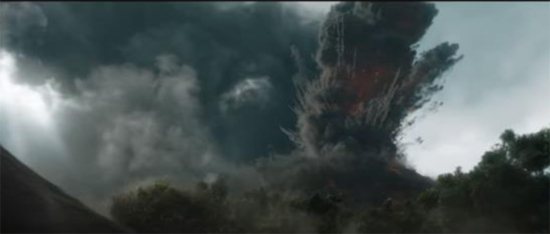
New Technology Helping to Minimise the Threat of Lava Flows following Volcanic Eruptions

Volcanic eruptions in future may not be so deadly.
New technology is helping to predict lava flows.

Picture credit: Universal Pictures

The research involves studying the processes that take place during crystallisation in basaltic magmas, 4D synchrotron X-ray microtomography technology is being utilised to study lava flow.  It is the first time this kind of 4D scanning technology has been used for investigating crystallisation during volcanic eruptions and for simulating the behaviour of these potentially devastating natural events.

The team, led by Professor Mike Burton, (Chair of Volcanology at Manchester University), monitored crystallisation in magmas, a fundamental process that drives eruptions and controls different kinds of volcanic activity.  Using this new and novel approach the team can, for the first time, watch the crystals grow in three dimensions in real-time, simulating the behaviour of lava flows once a volcano has erupted.  The process is similar to scenes recently witnessed at Kilauea in Hawaii.

The professor explained:

“During volcanic eruptions small crystals grow within magma.  These crystals can greatly change the way magma flows.  Simply put, the more crystals there are the slower the eruption will be which also reduces the speed and distance travelled by lava flows.  The fewer crystals present in the lava means the eruption will speed up, potentially becoming more powerful and devastating.  Our research and this new approach open an entirely new frontier in the study of volcanic processes.”

Studying Samples from Real Volcanic Eruptions

To study the rate of crystal growth, the team set up a sample from a real eruption in a high temperature cell, before performing X-ray CAT scans whilst controlling the temperature of the magma. This allowed the researchers to visualise the formation and growth of crystals, and measure how quickly they grew.

Using this method and technology the researchers can collect hundreds of 3D images during a single experiment. This data is then used in complex, numerical models to fully characterise the behaviour of volcanic eruptions more accurately.

Lead author of the recently published paper, Dr Margherita Polacci (University of Manchester’s School of Earth and Environmental Sciences), added:

“Being able to more accurately predict the behaviour of lava flows could also allow us to help relevant safety agencies devise and develop new safety strategies and actions when dealing with eruptions in populated areas.”

Extending this Technology into Other Fields

The researchers are confident that predicting lava flows will not be the only application for this new technology.  The team expect their research to have implications for mineral extraction as well as other geological processes.  For the time being, any advances in the prediction models for the behaviour of lava flows would be welcomed, given the obvious benefits such tools will have to the authorities when it comes to planning evacuations and minimising the risk to life.

The scientific paper: “Crystallisation in Basaltic Magmas Revealed via in situ 4D synchrotron X-ray Microtomography” by M. Polacci, F. Arzilli, G. La Spina, N. Le Gall, B. Cai, D. Di Genova, N. T. Vo, S. Nonni, R. C. Atwood, E. W. Llewellin, P. D. Lee and M. R. Burton published in the journal Scientific Reports.

Everything Dinosaur acknowledges the help of a press release from the University of Manchester in the compilation of this article.

Visit the Everything Dinosaur website: Everything Dinosaur.
16 06, 2018

Wonderful Dinosaur Designs and Drawings

By |2024-05-11T06:08:44+01:00June 16th, 2018|Categories: Key Stage 1/2|Comments Off on Wonderful Dinosaur Designs and Drawings

Dinosaur Designs and Drawings Sent in by Year 2 Children

It is always a pleasure to receive feedback after a dinosaur workshop in school.  Take for example, these amazing dinosaur drawings sent in to our offices by Year 2 children following a visit to their primary school.

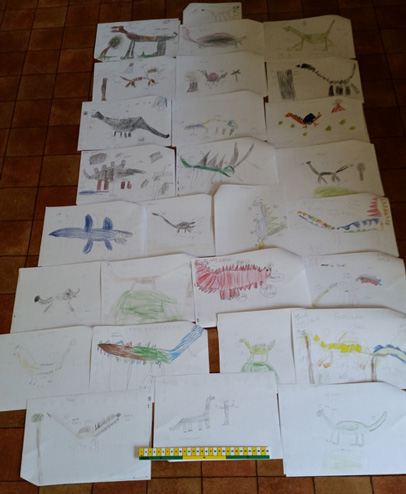
Children in Year 2 Send in Dinosaur Drawings and Designs

dinosaur drawings.
A selection of prehistoric animal designs by a Year 2 class at Great Wood Primary. Picture credit: Everything Dinosaur.

Picture credit: Year 2 (Great Wood Primary/Everything Dinosaur)

For dinosaur themed crafts and activities: Everything Dinosaur Crafts and Dinosaur Themed Activities.

Dinosaur Drawings

During our dinosaur and fossil workshop with the class, we challenged the children to design their very own prehistoric animal.  They had to consider whether it would be a carnivore, herbivore or omnivore and in addition, they were asked to consider where the animal might live (considering habitat) and how it might survive in the age of dinosaurs (thinking about adaptations).

We certainly received some very colourful, imaginative dinosaur drawings.  Our thanks to all the children who took part and to their hardworking, dedicated teaching team.

Visit the Everything Dinosaur website: Everything Dinosaur.
15 06, 2018

Mexico’s Oldest Member of the Ankylosauria

By |2023-10-14T19:49:13+01:00June 15th, 2018|Categories: Dinosaur and Prehistoric Animal News Stories, Dinosaur Fans, Main Page, Photos/Pictures of Fossils|0 Comments

Acantholipan gonzalezi – Coahuila’s Oldest Dinosaur

A new genus of armoured dinosaur has been described.  This dinosaur roamed northern Mexico around 85 million years ago (the Santonian faunal stage of the Late Cretaceous).  Described as a nodosaurid, the dinosaur has been named Acantholipan gonzalezi and it is the oldest dinosaur described to date from the Coahuila region of Mexico.

Acantholipan gonzalezi

Its discovery is no real surprise, some osteoderms (dermal armour), associated with ankylosaurids have been described from the geologically younger (Campanian), Cerro del Pueblo Formation exposed in the Coahuila region.  In addition, a single tooth identified as nodosaurid, has been discovered in the Mexican state of Baja California.  This fossil tooth was found in Campanian-aged deposits.  Palaeontologists had expected that armoured dinosaur fossils would be found elsewhere in Mexico, extending their known range further south.

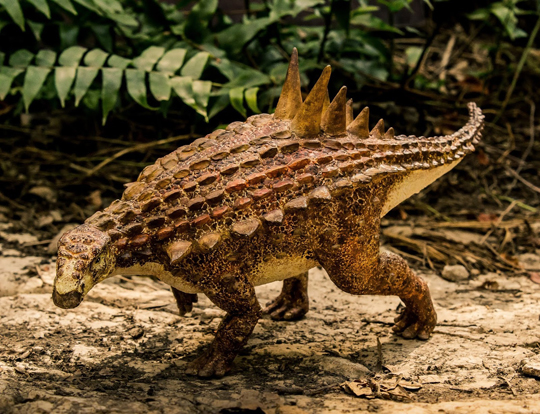
The Southernmost Nodosaurid from North America – Acantholipan gonzalezi

A life reconstruction of Acantholipan gonzalezi.
A model of the Mexican nodosaurid Acantholipan gonzalezi.

Picture credit: Museo del Desierto (Mexico)

Identified from Fragments of Bone

Fragmentary fossils found near to the city of Ocampo in northern Mexico, back in 2011, suggested that nodosaurids roamed this part of North America during the Late Cretaceous, but it was thought that the fossil material was not sufficient to support the establishment of a new species.  The fossils consist of a single dorsal vertebra, a tail bone (caudal vertebra), a partial ulna, a fragment of rib, one large spike (osteodermal spine) along with a portion of an upper arm bone (distal end of a humerus).

The Fragmentary Fossil Material (CPC 272)

Acantholipan fossil material.
Fossil fragments representing a nodosaurid from Coahuila, Mexico (Acantholipan gonzalezi).

Picture credit: Museo del Desierto (Mexico)

The photograph (above), shows the nodosaurid fossil material from Coahuila.  Although very fragmentary, subsequent comparative analysis with younger North American nodosaurids has permitted the establishment of a new species.

Key

Distal end of right humerus in (a) dorsal, (b) ventral, (c) anterior, and (d) posterior views.
Dorsal vertebra in (e) cranial, (f) caudal, and (g-h) lateral views.
Right ulna in (i) dorsal, (j) ventral, and (k-l) lateral views.
Osteodermal spine (m-p).

Note: Scale bar = 5 centimetres

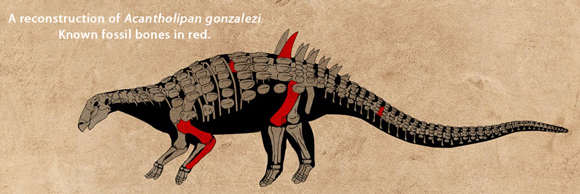
A Skeletal Reconstructioni of Acantholipan gonzalezi

A Skeletal Illustration of A. gonzalezi – Known Fossil Material Outlined in Red

Acantholipan gonzalezi skeletal drawing.
The known bones of A. gonzalezi are shown in red.

Picture credit: Museo del Desierto (Mexico)

An Armoured Dinosaur from Marine Shales

The fossil material was discovered in marine shales associated with the Pen Formation.  The research team studying this material have concluded that the carcass of the dinosaur, a juvenile approximately 3.5 metres long, had been swept out to sea, before sinking to the seafloor and becoming buried by sediment.  If this dinosaur had reached maturity, the scientists estimate that it could have reached a length of about six metres and weighed several thousand kilograms.

With the naming of Acantholipan gonzalezi, this dinosaur becomes the oldest member of the Dinosauria described from the Coahuila region, and the first member of the Ankylosauria clade to have been named from Mexican fossils.

Commenting on the new species of armoured dinosaur, José Rubén Guzmán Gutiérrez of the Museo del Desierto and one of the co-authors of the scientific paper describing the dinosaur in the Swiss Journal of Palaeontology, stated:

“Here in Mexico, we have a significant palaeontological wealth, specifically in the state of Coahuila.  We have this palaeontological richness and it is worthwhile for the population to get involved in getting to know this heritage that belongs to all Mexicans.”

The name of this new species of armoured dinosaur honours its Mexican roots.  The genus name comes from the Greek “akanthos”, which means spine, combined with the name of the native Indians which inhabited this part of northern Mexico.  The species name honours Arturo González-González, the director of the Museo del Desierto.

To read an article from 2017 reporting on the discovery of a new species of horned dinosaur from the Coahuila region of Mexico: Yehuecauhceratops – A New Horned Dinosaur from Northern Mexico.

14 06, 2018

Everything Dinosaur to Conduct Exclusive Dinosaur and Fossil Workshops at The Beacon Museum

By |2024-05-08T20:37:08+01:00June 14th, 2018|Categories: Dinosaur Fans, Everything Dinosaur News and Updates, Main Page, Photos/Pictures of Fossils, Press Releases|0 Comments

Everything Dinosaur at the Beacon Museum

As part of The Beacon Museum’s summer exhibition “Brick Dinos”, team members from Everything Dinosaur will be conducting a weekend of dinosaur and fossil themed workshops.  Join Mike and Sue from Everything Dinosaur from Friday afternoon 27th July and throughout that weekend and help them hunt for fossils including dinosaur bones!

Everything Dinosaur at the Beacon Museum

Team members from Everything Dinosaur will be conducting a series of workshops at the Beacon Museum, giving participants the chance to be a palaeontologist and cast museum quality fossil replicas.  Turn dinosaur detective and get up close to some amazing fossils and learn how to find evidence of ancient life. Best of all, what you find on the fossil dig, you can keep!

Join Everything Dinosaur Team Members over the Weekend of July 27th to July 29th

Everything Dinosaur at the Beacon Museum
Everything Dinosaur will be conducting a series of family friendly dinosaur and fossil themed workshops from July 27th – July 29th.

Picture credit: Everything Dinosaur

Dinosaur Detectives and Perceptive Palaeontologists

The “Brick Dinos” event allows visitors to travel back in time and to interact with a series of prehistoric animal exhibits that have been created by the famous plastic bricks (Lego®).  Everything Dinosaur will be conducting a series of 2-hour-long, family friendly, dinosaur and fossil themed workshops, utilising the ground floor of the Beacon Portal.  Numbers are limited so booking is essential.

Dinosaur and Dino Pro combination tickets available please ring 01946 592302 for details, or alternatively, you can contact the Beacon Museum for tickets and further information.

Mike from Everything Dinosaur commented:

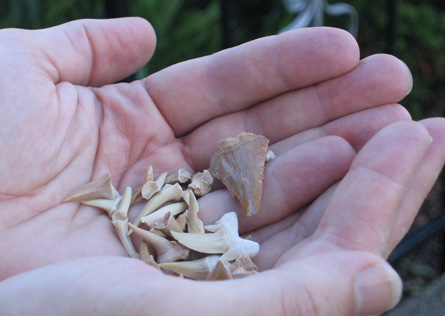
“We are going to be bringing lots of different fossils which have been collected from various dig sites, sharks teeth, corals, ammonites, crocodile armour and of course, real dinosaur bone.  Visitors to the Beacon will have the opportunity to hunt for fossils and you can take home what you find, starting your own fossil collection.”

Everything Dinosaur at the Beacon Museum Friday July 27th to Sunday July 29th

Everything Dinosaur and fossil workshops.
Everything Dinosaur at the Beacon Museum 27th July to 29th July.

Picture credit: Everything Dinosaur

The Proposed Itinerary*

Everything Dinosaur team members are going to be very busy over that weekend.   The team intend to conduct a 2-hour dinosaur and fossil workshop on Friday afternoon (starting 2pm) and to delivery two further workshops on Saturday and Sunday morning.  On Saturday and Sunday afternoon, Everything Dinosaur will be laying out their fossil trays and inviting visitors to join them on a fossil hunt, looking for fossils which will include teeth from prehistoric sharks, belemnite guards and dinosaur bones.

Friday 27th July
• 2pm to 4pm – Dinosaurs and Fossils Workshop

Saturday 28th July
• 9.30am to 11.30am – Dinosaurs and Fossils Workshop

• 1pm – Fossil Trays and Finding Fossils

• 2pm – Fossil Trays and Finding Fossils

• 3pm – Fossil Trays and Finding Fossils

• 4pm – Fossil Trays and Finding Fossils

Sunday 29th July
• 9.30am to 11.30am – Dinosaurs and Fossils Workshop

• 1pm – Fossil Trays and Finding Fossils

• 2pm – Fossil Trays and Finding Fossils

• 3pm – Fossil Trays and Finding Fossils

• 4pm – Fossil Trays and Finding Fossils

Proposed itinerary* potentially subject to change contact The Beacon Museum for further information.

Finding Fossils Including Shark Teeth

fossilised shark teeth.
A successful fossil hunt. Picture credit: Everything Dinosaur.

Picture credit: Everything Dinosaur

Further information about Everything Dinosaur: Everything Dinosaur.

14 06, 2018

Teaching Early Years Foundation Stage

By |2023-10-14T18:57:11+01:00June 14th, 2018|Categories: Early Years Foundation Reception, General Teaching|Comments Off on Teaching Early Years Foundation Stage

Dinosaurs with Early Years Foundation Stage

Another busy day for Everything Dinosaur’s teaching team.  One of our dinosaur and fossil experts had been invited to a school in south Yorkshire to help the Nursery and Reception classes kick-start their term topic learning all about prehistoric animals.  The enthusiastic children enjoyed the workshops and had fun handling the fossils, several of them talked excitedly about it for the rest of the day.

We were given the spacious hall to set up in and we noted that on one of the walls, there was a display of prehistoric animals that had been created by some of the children at the school.

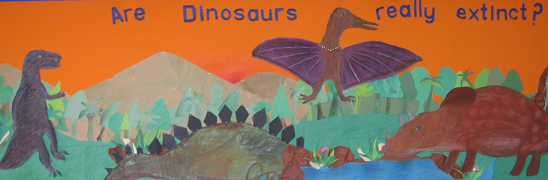
Prehistoric Animals on Display at the Primary School

prehistoric animals on display.
Are dinosaurs really extinct? Prehistoric animals on display. Picture credit: Everything Dinosaur.

Picture credit: Everything Dinosaur

Extension Resources

Prior to the start of our workshops we were briefed on the learning needs of the children by one of the teachers.  The classes had only been studying dinosaurs for a week, but they had prepared some amazing questions for our dinosaur expert to tackle.  As well as delivering four workshops throughout the day, we donated some dinosaur books to the school library and provided some additional teaching resources to help support the scheme of work for the school term.

We are confident that our “dinosaur hokey cokey” will be well received by the eager, young palaeontologists.

We were also able to email over some dinosaur fact sheets and additional drawing materials to help support the Reception classes with a little challenge that we had set them.

Visit the Everything Dinosaur website: Everything Dinosaur.
13 06, 2018

Sooty Owls Send in Fantastic Questions

By |2024-05-11T06:09:06+01:00June 13th, 2018|Categories: Dinosaur Fans, Educational Activities, Main Page, Teaching|0 Comments

Reception Class (Sooty Owls) Send in Questions

Our congratulations to all the budding palaeontologists in Sooty Owls class (Foundation Stage 2), at Laithes Primary in south Yorkshire for compiling such a fascinating set of questions about dinosaurs.  The children in Foundation Stage at this Barnsley school have just started their summer term topic and they are very excited to be learning about dinosaurs and life in the past.

Questions About Dinosaurs

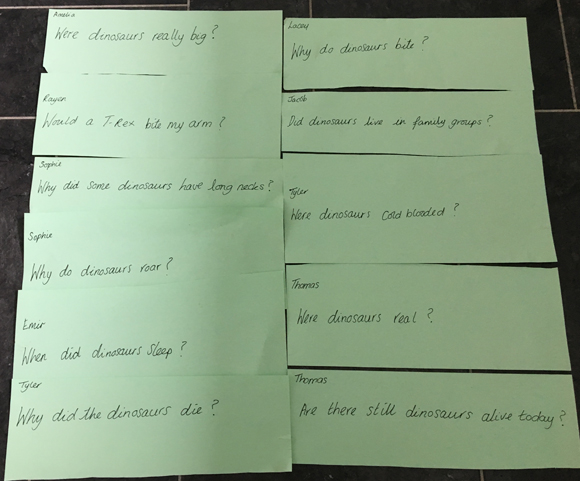
Questions Compiled by Sooty Owls for Everything Dinosaur

Foundation Stage children think up questions about dinosaurs.
The children in the Sooty Owls class have compiled a set of questions about dinosaurs.

Picture credit: Everything Dinosaur/Laithes Primary School

Why do Dinosaurs Roar?

Sophie asked why do dinosaurs roar?  This is a very difficult question to answer as we don’t have a living Tyrannosaurus rex, Stegosaurus or any other non-avian dinosaur to study.  Dinosaurs certainly do a lot of loud roaring in movies like “Jurassic Park”, but it is hard to work out what sort of sounds they made by just studying the fossilised bones alone.  Having said that, the tiny bones of the inner ear that have been found have given palaeontologists some ideas as to the sort of sounds that these animals might have heard.

Dinosaurs seem to have had good hearing so they probably did make some sounds, perhaps some of the smaller dinosaurs might have chirped like their near relatives the birds.  Other dinosaurs might have squawked, twittered or clucked, whilst very big dinosaurs may have made low frequency rumbling sounds, the vibrations of which, could have been detected by their feet (elephants are believed to be able to detect low frequency sounds in this way).

Some Very Big Dinosaurs Could have Picked Up Sounds Using their Feet

Spinophosaurus dinosaur life reconstruction.
Some very big dinosaurs could have picked up sounds using their feet.

When do Dinosaurs Sleep?

Emir wanted to know about dinosaur sleeping habits.  He asked when do dinosaurs sleep?  There are lots and lots of different types of dinosaurs and some of them were probably nocturnal (active at night), so these types of dinosaurs would have slept during the day.  Can the children in Sooty Owls class make a list of animals alive today that are nocturnal?  Most dinosaurs would have slept at night, just like we do, but all dinosaurs would have probably napped from time to time to.

Palaeontologists have found fossils of sleeping dinosaurs.  Some dinosaurs may have slept with one eye open so that they could stay safe.

A Sleeping Dinosaur (Mei long)

Mei long illustration.
Did dinosaurs sleep with one eye open?

The fossils of the dinosaur from China called Mei long, suggest that some dinosaurs slept like birds.  The name Mei long means “sleeping dragon”.

Were Dinosaurs Cold-blooded?

Tyler asked were dinosaurs cold-blooded?  Reptiles that are alive today, animals like snakes, lizards and crocodiles, have to rely on external sources of heat to help them keep warm and active.  Reptiles bask in the sun, using the heat from the sun to warm their bodies.  It is likely that most dinosaurs, which were probably much more active than snakes and crocodiles, were not cold-blooded, that is, they could have maintained a body temperature that was warmer than their surroundings.

Many dinosaurs had feathers and these feathers helped trap body heat to keep these dinosaurs from getting too cold.

Some dinosaurs lived in Antarctica and some dinosaurs lived in the Arctic Circle, so they would have been well-used to chilly conditions.  Mammals and birds are warm-blooded, birds are very closely related to dinosaurs.

Warm-blooded or Cold-blooded Dinosaurs?

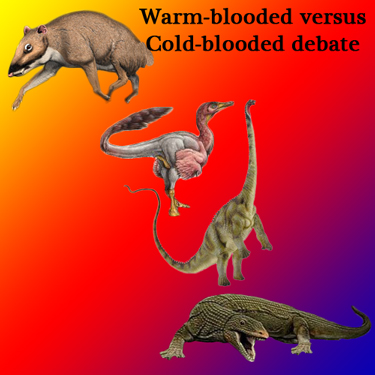
warm-blooded or cold-blooded dinosaurs?
Where on the spectrum between endothermic and ectothermic are the Dinosauria?

Picture credit: Everything Dinosaur

Would a T. rex Bite My Arm?

Rayen wanted to know about Tyrannosaurus rex and asked the following question – would T. rex bite my arm?  Tyrannosaurus rex was a meat-eating dinosaur, if it was around today, then a T. rex might indeed try to eat you.  T. rex was so big that he could have eaten everyone in Sooty Owls class for dinner and eaten the class teacher for dessert.  A fully-grown T. rex would have been capable of swallowing Rayen in one big bite!  It is reassuring to know that these types of dinosaurs, known as the non-avian dinosaurs are extinct!

Our thanks once again to the children in Sooty Owls class for compiling such a wonderful set of dinosaur themed questions.

The award-winning Everything Dinosaur website: Everything Dinosaur.
Go to Top