All about dinosaurs, fossils and prehistoric animals by Everything Dinosaur team members.
28 05, 2018

Rare Fossil Flakes and Dinosaur Dandruff

By |2024-05-11T06:01:59+01:00May 28th, 2018|Categories: Dinosaur and Prehistoric Animal News Stories, Dinosaur Fans, Main Page, Palaeontological articles|0 Comments

Dinosaur and Early Bird Dandruff

A team of international scientists led by researchers from University College Cork (Ireland), have discovered the fossilised remains of skin flakes from feathered dinosaurs and primitive birds that lived during the Early Cretaceous.   The fossil flakes of skin, preserved amongst the plumage of the feathered creatures, has provided evidence on how dinosaurs shed their skin.  Unlike many reptiles alive today, animals such as lizards and snakes, which shed their skin as a single piece or as several large pieces, it seems that basal birds and non-avian dinosaurs shed small epidermal flakes just like modern birds and mammals and that includes us with our dandruff.

Preserved Soft Tissue Evidence – Flakes of Skin in Maniraptoran Dinosaurs and the Basal Bird Confuciusornis
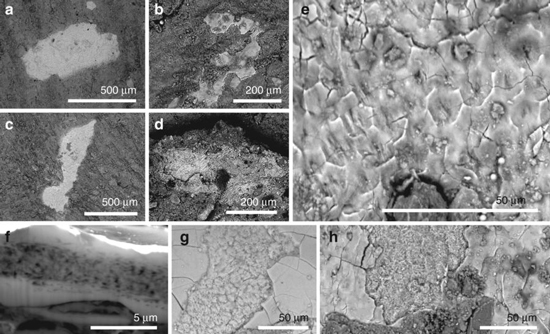
Fossils of shed dinosaur skin and a basal bird (Confuciusornis).
Phosphatised soft tissues in non-avian maniraptoran dinosaurs and a basal bird.

Picture credit: Nature Communications

Fossil Flakes

The photographs above (labelled a to h), show scanning electron microscope generated images of tissue in the Early Cretaceous Aves C. sanctus (a,e and f), the dromaeosaurid Sinornithosaurus (S. millenii) in photographs c and h, along with the therizinosaur Beipiaosaurus (B. inexpectus), photos b and g.  The photograph labelled d, is a view of epidermal flakes preserved in association with the fossilised remains of Microraptor, which along with Sinornithosaurus is believed to have been capable of flight or at least gliding.

Studying the constituents of flakes of dinosaur skin, which come from animals that might have been volant, is very important.  Palaeontologists can compare these flakes to living birds which are capable of powered flight.  These flakes, in turn can be examined in relation to the flakes of terrestrial feathered dinosaurs such as Beipiaosaurus.  Any differences in the composition of these flakes might provide scientists with further information on the aerial abilities of dinosaurs such as Microraptor and Sinornithosaurus.

An International Team

The scientists include researchers from the Chinese Institute of Vertebrate Palaeontology and Palaeoanthropology, Bristol University, Linyi University (China), the Open University as well as Queen Mary University (London) and the University College Dublin (Ireland).   They studied the fossil cells and dandruff from a range of Early Cretaceous Theropods and compared the skin flakes to those of living, extant birds.

Lead author of the research, Dr Maria McNamara (University College Cork), stated:

“The fossil cells are preserved with incredible detail,  right down to the level of nanoscale keratin fibrils.  What’s remarkable is that the fossil dandruff is almost identical to that in modern birds – even the spiral twisting of individual fibres is still visible.”

Getting to Grips with Corneocytes

The scientists used a scanning electron microscope (SEM), to examine the beautifully preserved, but microscopic fossilised fragments of skin associated with three feathered dinosaur specimens (Microraptor, Beipiaosaurus and Sinornithosaurus) and one Early Cretaceous bird Confuciusornis (Confuciusornis sanctus).  All of these fossils are associated with the Jehol biota of north-eastern China.

A Pair of Fossilised Confuciusornis (Liaoning Province) Showing the Two Known Body Plans for these Ancient Birds
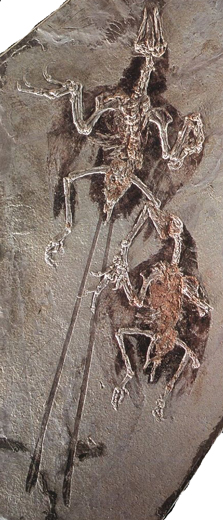
Confuciusornis fossil birds.
A pair of Confuciusornis fossil birds (Liaoning Province).

Just like our own flakes of skin, our dandruff, the fossil flakes consist of tough cells known as corneocytes.  These cells are full of protein fibres (keratin), such was the quality of preservation that the SEM analysis was able to identify bundles of these fibres and even to hone in on single strands.

Scanning Electron Micrographs of Skin Flakes Associated with C. sanctus
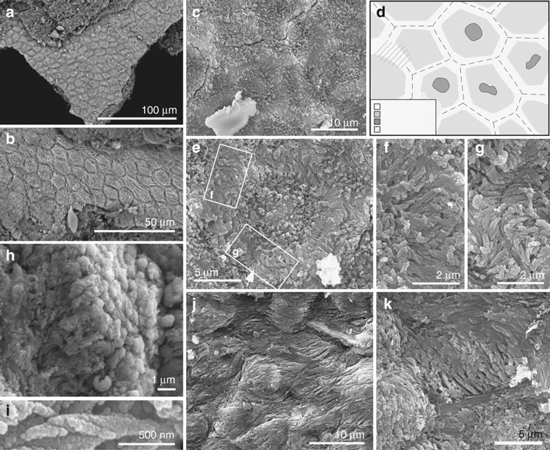
Fossilised skin flakes of Confuciusornis.
Ultrastructure of the soft tissues in Confuciusornis.

Picture credit: Nature Communications

The photographs (above) show highly magnified images of the skin flakes associated with Confuciusornis.  Closely packed polygons can be observed (a and b), whereas (c) shows a detailed view of the polygons and the first signs at this magnification of the bundles of fibrous keratin.  The drawing (d) interprets the bundles as more darkly shaded areas in the central part of each polygon.  Photograph (e) shows the area that was more closely observed (f and g) indicating the presence of fibres, whereas, (h) shows the fibrous bundle associated with a skin flake in an extreme close-up view.

Helical coiling of the tiny fibres is shown (picture i) and photographs j and k show polygons having been deformed by some form of stretching.

These structures were then compared to the flakes of skin associated with living birds, in this case, male specimens of Zebra Finches (Taeniopygia guttata) and the Java Sparrow (Lonchura oryzivora).  In addition, the fossil evidence was compared to the moulted, downy feathers of a male American Pekin Duck (Anas platyrhynchos domestica).

Fossil Flakes Provide Clues About Dinosaur Metabolism

This research suggests that this ability to constantly shed skin evolved sometime in the late Middle Jurassic, around the same time as a host of other skin features evolved.  The feathered epidermis of dinosaurs acquired many, but not all, anatomically modern attributes close to the base of the Maniraptora clade.

Dr McNamara explained:

“There was a burst of evolution of feathered dinosaurs and birds at this time, and it’s exciting to see evidence that the skin of early birds and dinosaurs was evolving rapidly in response to bearing feathers.”

Co-author, Professor Mike Benton (Bristol University), commented:

“It’s unusual to be able to study the skin of a dinosaur, and the fact this is dandruff proves the dinosaur was not shedding its whole skin like a modern lizard or snake but losing skin fragments from between its feathers.”

Corneocytes in Living Birds
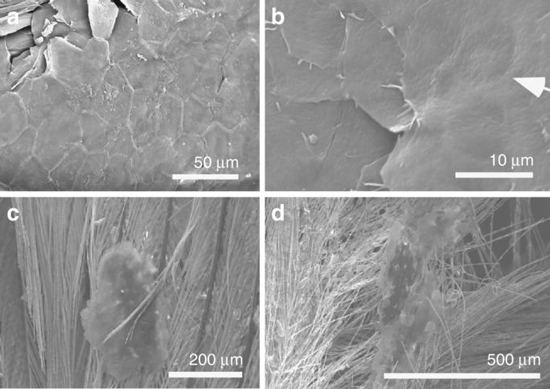
Corneocytes in living birds
Corneocytes in extant birds.

Picture credit: Nature Communications

The four photographs above, show scanning electron micrographs of shed skin flakes in living birds.  Note the polygonal structure (a), which is reminiscent of the shapes seen when the corneocytes of extinct dinosaurs and birds were studied.  Photograph (b) shows a central depression in the cell associated with a pycnotic nucleus, whilst photographs (c and d) show skin flakes stuck to the bird’s feathers.

Modern birds have very fatty corneocytes with loosely packed keratin, which allows them to cool down quickly when they are flying for extended periods.  The corneocytes in the fossil dinosaurs and birds, however, were packed with tightly bundled keratin, suggesting that the extinct creatures didn’t get as warm as modern birds, presumably because they couldn’t fly at all or for as long.

This suggests that Confuciusornis did not fly that well, if probably flew in short bursts, but may not have been capable of making prolonged flights.  The lack of fatty corneocytes in those dinosaurs which are thought to have had some aerial ability (Microraptor and possibly Sinornithosaurus), sheds doubt on whether they were truly volant.

Could Some Dinosaurs Like Microraptor Fly?
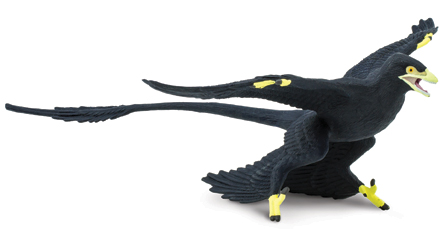
Microraptor dinosaur model.
A member of the Dromaeosauridae sub-family the Microraptorinae, but could these dinosaurs fly?  The absence of fatty corneocytes suggests a lower metabolism than with extant birds..

Picture credit: Everything Dinosaur

The picture (above) shows a Microraptor model from Safari Ltd.

To view this range of models and figures: Wild Safari Prehistoric World.

Everything Dinosaur acknowledges the assistance of a press release from the University College Cork (Ireland) in the compilation of this article.

The scientific paper: “Fossilised Skin Reveals Coevolution with Feathers and Metabolism in Feathered Dinosaurs and Early Birds” by Maria E. McNamara, Fucheng Zhang, Stuart L. Kearns, Patrick J. Orr, André Toulouse, Tara Foley, David W. E. Hone, Chris S. Rogers, Michael J. Benton, Diane Johnson, Xing Xu and Zhonghe Zhou published in Nature Communications.

Visit the website of Everything Dinosaur: Everything Dinosaur.
27 05, 2018

Maisy and her Marvellous Dinosaur

By |2024-05-11T05:52:01+01:00May 27th, 2018|Categories: Adobe CS5, Dinosaur and Prehistoric Animal Drawings, Educational Activities, Main Page, Teaching|0 Comments

Maisy Designs a Dinosaur – Maisyosaurus

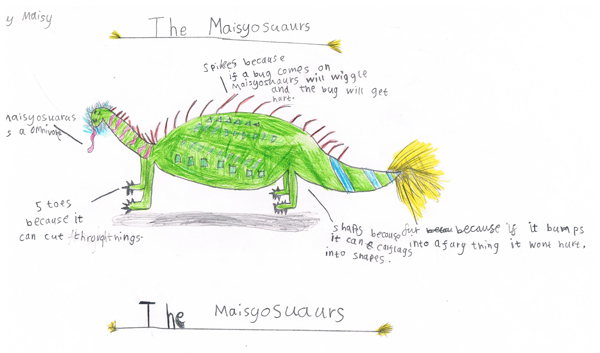
Our thanks to young Maisy and her classmates for sending lots of beautiful dinosaur drawings to our offices.  We had challenged the children (Year 2), to have a go at designing their very own prehistoric animals during a dinosaur workshop at their school.  We received an amazing array of very colourful drawings, with lots of lovely labelling and some fascinating explanations from the children as to why their dinosaur was so special.

Maisy Has Designed a Maisyosaurus

A Maisyosaurus drawn by Maisy.
A very colourful dinosaur design created by Maisy in Year 2.

Picture credit: Maisy/Everything Dinosaur

Maisy and Her Dinosaur

Maisy labelled the various body parts of her dinosaur, explaining that it was an omnivore and that it had five toes to help it cut through things.  Certainly, having four fingers and a thumb makes using scissors very straight forward, I’m sure the dinosaur would have appreciated the comment.  Maisyosaurus also had spikes on its back, as Maisy explained, the spikes helped this dinosaur shake off a bug should one alight on it.  Perhaps it could it have shaken its big, bushy yellow tail in order to scare off flies and other insects.

Our thanks again to Maisy and the other Key Stage 1 pupils at her school for sending in the super dinosaur designs.

Visit the Everything Dinosaur website: Everything Dinosaur.

26 05, 2018

An Exclusive Scale Drawing of Pyroraptor

By |2024-05-11T05:52:30+01:00May 26th, 2018|Categories: Adobe CS5, Dinosaur and Prehistoric Animal Drawings, Dinosaur Fans, Main Page|0 Comments

A Scale Drawing of Pyroraptor olympius

As team members at Everything Dinosaur make plans for the imminent arrival of the Beasts of the Mesozoic range of 1:6 scale dinosaur figures, we have been busy finalising the scale drawings of these extinct animals for use in our fact sheets.  For virtually every named prehistoric animal that we supply from Achelousaurus and Acheroraptor to Zhenyuanlong, we research and write a fact sheet.  In this way, our customers can learn a little about the prehistoric creature the model or soft toy represents.

A Scale Drawing of the Beasts of the Mesozoic Pyroraptor

A scale drawing of the dromaeosaurid dinosaur Pyroraptor olympius.
A scale drawing of the dromaeosaurid Pyroraptor olympius.

Picture credit: Everything Dinosaur

To view the Beasts of the Mesozoic range of articulated dinosaur models: Beasts of the Mesozoic Models.

Estimating the Size of Dinosaurs

Estimating the size of dinosaurs is quite a tricky business.  When it comes to a dromaeosaur like Pyroraptor, we are hampered by the lack of fossil evidence.  This dinosaur is known from a handful of teeth and some fragmentary bones.  However, we estimate that this fast-running dinosaur was around 1.5 metres in size and weighed between eight and ten kilograms.

The poor fossil record of most dinosaurs hampers mass and length estimations, many of the fossils relate to sub-adults or juveniles so the exact size of an adult animal is very difficult to calculate.  A case in point is the recently described Sciurumimus (Sciurumimus albersdoerferi), from Germany.  This dinosaur is known from a single fossil specimen.  It is a spectacular fossil and very nearly complete.  However, the skeleton is that of a baby, a very young animal measuring around seventy centimetres in length.

This baby dinosaur could have grown up to become one of the largest theropod dinosaurs known from the Jurassic of Europe.  Until more fossils of this species are found, the adult size of this carnivorous dinosaur remains entirely speculative.

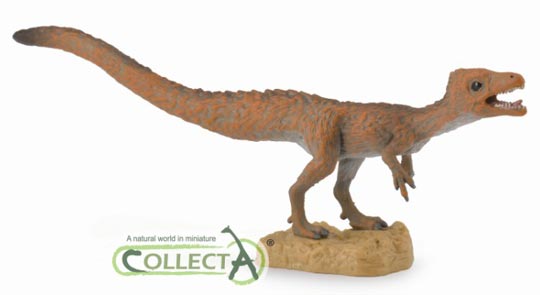
The CollectA  Sciurumimus (Sciurumimus albersdoerferi) Dinosaur Model

CollectA Sciurumimus.
CollectA Sciurumimus dinosaur model.

To view the not-to-scale range of CollectA prehistoric animal models: CollectA Prehistoric Life Models.

To read about the discovery of Sciurumimus (2012): Megalosaurs Join the Tufty Club.

25 05, 2018

How Birds Survived the Cretaceous Mass Extinction Event

By |2023-10-12T08:56:35+01:00May 25th, 2018|Categories: Dinosaur and Prehistoric Animal News Stories, Dinosaur Fans, Main Page, Palaeontological articles|0 Comments

Ground Dwelling Birds Survived Asteroid Strike

One of the fascinating conundrums about the end Cretaceous extinction event is how did the avian dinosaurs (birds) survive, but their very close cousins the non-avian dinosaurs, animals such as Tyrannosaurus rex, Triceratops and Edmontosaurus fail to make it through this calamitous time in Earth’s history?  A team of international researchers, writing in the journal “Current Biology” have put together a fascinating explanation as to why we have birds today, but no other theropods, or indeed any other representatives of the Dinosauria.

With the extra-terrestrial impact event some 66 million and 38 thousand years ago (plus or minus 11,000 years), the ecosystems on our planet were devastated.  Whether this single, huge impact was the sole cause of the mass extinction or whether this was the final “coup de grâce” is debatable, however, life would never be the same again.

Using a variety of data sources, the team, which included scientists from the University of Bath, the Denver Museum of Nature and Science, Yale University and the Field Museum amongst others, have pieced together what the impact event meant for the Aves.  Their scientific paper suggests that the only kinds of birds to survive the Cretaceous-Palaeogene (K-Pg) extinction were ground- dwellers.

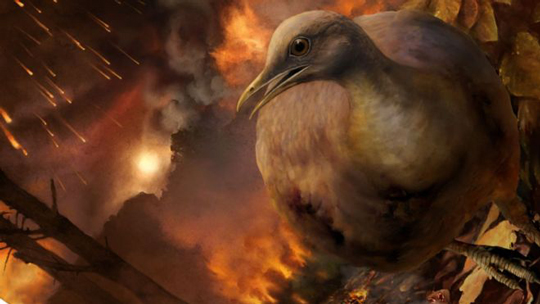
How Our Feathered Friends Survived the Cretaceous-Palaeogene Extinction Event

Ground-dwelling birds survived the extinction event.
Ground-dwelling birds survived the K-Pg extinction event.

Picture credit: Phillip Krzeminski

Why Did the Birds Survive?

A number of ideas and theories have been proposed to help explain why the birds are around today, but the non-avian dinosaurs are not.  Recently, Everything Dinosaur published an article on a piece of research that suggested that seed-eating may have contributed to the survival of birds during this devastating time in the history of our planet.

To read the article: Seed Eating May Have Helped the Birds Survive.

Commenting on the scientific paper, lead author Daniel Field of the Milner Centre for Evolution (University of Bath) stated:

“We drew on a variety of approaches to stitch this story together.  We concluded that the devastation of forests in the aftermath of the asteroid impact explains why tree-dwelling birds failed to survive across this extinction event.  The ancestors of modern tree-dwelling birds did not move into the trees until forests had recovered from the extinction-causing asteroid.”

The Collapse of Forests

The scientists analysed the plant fossil record and identified that the world’s woodlands and forests were virtually wiped out by the extra-terrestrial impact.  Huge forest fires would have raged in the immediate aftermath of the impact and it is likely that much of the world had to endure a period of extensive “acid rain” as a result of the catastrophic event.  In the months, or maybe even tens of years afterwards, our planet could have been blanketed in a cloud of dust and ash.  This would have blocked out the sun and led to the collapse of food chains which relied on photosynthesising plants.

The scientists look at the record of fossil pollen and spores to assess the types of flora present and how quickly, ferns, flowering plants (angiosperms) and other types of flora recovered after the extinction event.

Plotting the Turnover of Different Types of Flora from Pollen and Spore Counts

Flora turnover at the K-Pg boundary.
Floral turnover evidenced by changes in relative abundance of common pollen taxa across the K-Pg boundary.

Picture credit: Current Biology with additional annotation by Everything Dinosaur.

The diagram (above), plots the palynological record of the John’s Nose Section in North Dakota, a series of sequential strata laid down before, during and after the extinction event.  It helps to plot the demise of different types of plant and their recovery (floral turnover), as evidenced by changes in relative abundance of common pollen taxa across the K-Pg boundary.  Note, the “fern spike” recorded not long after the extinction event, ferns are usually the first type of plant to recover from natural disasters today, as evidenced by their ability to re-populate areas destroyed following volcanic activity.

Evolutionary Relationships of Living Birds

The research team examined the evolutionary relationships of extant birds and their ecological habits to map how bird ecology has changed over time.  The data revealed that the most common ancestor of all living birds, all the bird lineages that survived the K-Pg extinction event, most likely were ground-dwellers.  In contrast, many Aves that lived at the end of the age of dinosaurs (and there were lots of them), exhibited tree-dwelling, arboreal habits.  These species did not survive the mass extinction event and therefore they have no direct living descendants around today.

Daniel Field added:

“Today, birds are the most diverse and globally widespread group of terrestrial vertebrates, there are nearly 11,000 living species.  Only a handful of ancestral bird lineages succeeded in surviving the K-PG mass extinction event 66 million years ago and all of today’s amazing living bird diversity can be traced to these ancient survivors.”

The researchers conclude that their findings shed light on the fundamental influence major events in the history of our planet have on the evolution of living things.  The team hope to build on this initial research and to explore the timing of the recovery of the vegetation and to develop a better understanding of the early radiation of the birds.  After all, those lucky survivors inherited a brave new world, devoid of non-avian dinosaurs and many other terrestrial and marine organisms too.

The scientific paper: “Early Evolution of Modern Birds Structured by Global Forest Collapse at the End-Cretaceous Mass Extinction” by Daniel J. Field, Antoine Bercovici, Jacob S. Berv, Regan Dunn, David E. Fastovsky, Tyler R. Lyson, Vivi Vajda and Jacques A. Gauthier published in the journal Current Biology.

Visit the Everything Dinosaur website: Everything Dinosaur.

24 05, 2018

Super Dinosaur Thank You Letters

By |2023-10-12T09:01:42+01:00May 24th, 2018|Categories: Educational Activities, Everything Dinosaur News and Updates, Main Page, Teaching|0 Comments

Great Wood Primary – Dinosaur Letters

Children in Year 2 at Great Wood Primary (Lancashire), sent in some super thank you letters to team members at Everything Dinosaur following a workshop at their school.  The pupils have been learning all about dinosaurs for their summer term topic and last month, an Everything Dinosaur team member was invited into the school to deliver two dinosaur and fossil themed workshops, one for each Year 2 class.

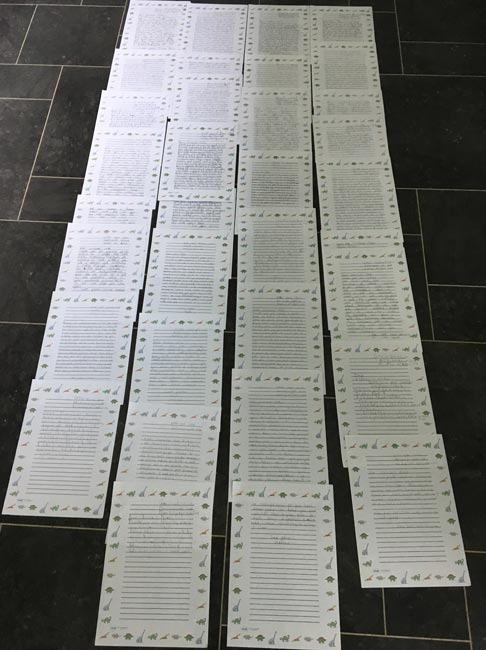
A Set of Thank You Letters Sent to Everything Dinosaur by One Year 2 Class

Pupils send thank you letters to Everything Dinosaur
Pupils at Great Wood Primary sent thank you letters to Everything Dinosaur.  Picture credit: Everything Dinosaur.

Picture credit: Everything Dinosaur

Beautiful Letters from Year 2

During our workshop, lots of extension ideas surfaced and we always try to support the lesson plans and scheme of work of the teaching team.  Challenging the class to write a letter to us gives an opportunity for the children to practice their handwriting and use of grammar.  We received two sets of letters, one from each class and it was great to see such excellent examples of letter writing.  Some of the children produced long letters, using two sheets of A4 paper, that is brilliant!

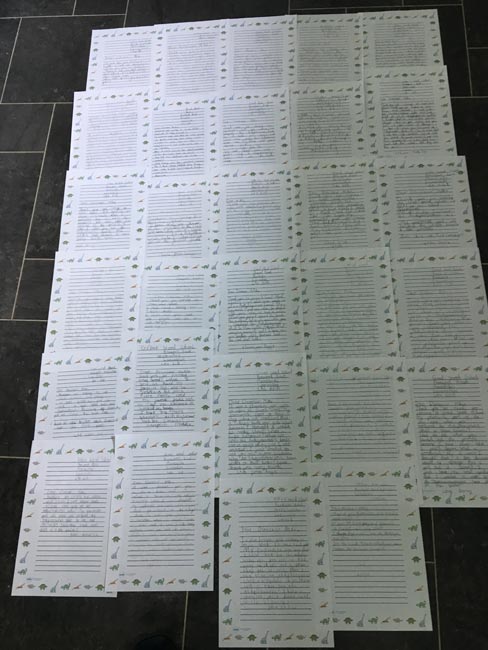
Lots and Lots of Letters for Us to Read – Here are the Letters from the Second Class

Dinosaur thank you letters from Year 2.
Children send in letters about dinosaurs. Picture credit: Everything Dinosaur.

Picture credit: Everything Dinosaur

Dinosaur Mike, who conducted the two workshops with the eager young palaeontologists from Great Wood Primary praised the children, saying:

“It was a great honour to receive the letters from Year 2.  The correspondence was held up in the post and we had to go to the Royal Mail delivery centre to pick them up, but the trip was so worthwhile as we came back with two sets of super thank you letters.  We really appreciate the letters and we have read them all.”

Everything Dinosaur Puts the Letters on Display

The team have read them all and they hope to post up responses to some of the questions the children asked.  After laying the letters out onto the packing room floor in the company’s warehouse so they can be photographed, the letters will shortly be pinned up to the warehouse notice board.  They will make a super display and they will help to remind Dinosaur Mike of his visit to the school.  In the letters, the children inform us about their favourite part of the workshop.  It seems that the children really enjoyed comparing their brain to the brain of a giant armoured dinosaur and handling fossils.  The Tyrannosaurus rex tooth segment was also a favourite.

We wish the children and their hardworking Key Stage 1 teaching team every success with their dinosaur themed term topic and thank you once again for sending into Everything Dinosaur the wonderful correspondence.

Visit the user-friendly Everything Dinosaur website: Everything Dinosaur.

23 05, 2018

Dinosaurs in Ermine! That’s a Great Headline

By |2024-05-11T05:53:04+01:00May 23rd, 2018|Categories: Adobe CS5, Dinosaur and Prehistoric Animal News Stories, Main Page|0 Comments

Dinosaurs in Ermine

An interesting headline featured on the front of a national newspaper here in the UK.  It was spotted as an Everything Dinosaur team member went past a newspaper vendor this morning.

Intriguing Headline – Dinosaurs in Ermine

A dinosaur themed headline.
A headline from an English newspaper.  Don’t worry it is not a report on a new dinosaur fossil discovery!  Picture credit: Everything Dinosaur.

Picture credit: Everything Dinosaur

The headline certainly caught our attention.  However, it was not a report on an amazing pseudo-mammal dinosaur fossil find, after all, palaeontologists have only now got some members of the public to accept the idea of dinosaurs with feathers.

Visit the award-winning and children-friendly website of Everything Dinosaur: Everything Dinosaur.
22 05, 2018

A Feature of the Archosauria – (Part 2)

By |2023-10-12T09:16:26+01:00May 22nd, 2018|Categories: Animal News Stories, Dinosaur and Prehistoric Animal News Stories, Dinosaur Fans, Main Page|0 Comments

Labelling the Fenestrae in a Diapsid Skull

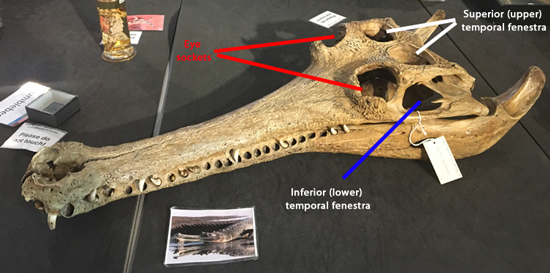
Recently, Everything Dinosaur posted up a picture of the skull of a large gharial and discussed the teeth located in distinct sockets, an anatomical trait characteristic of that great group of reptiles the archosaurs (Archosauria).  Today, we complete this very brief look at the archosaurs by labelling the fenestrae (holes) in the skull that identify the gharial, all crocodiles and their close relatives, including the dinosaurs, that are classified as diapsid reptiles.

The Skull of the Gharial with the Eye Socket (Orbit) and Fenestrae Labelled

A gharial skull with the fenestrae and eye sockets labelled.
Labelling the skull of a diapsid reptile. Picture credit: Everything Dinosaur.

Picture credit: Everything Dinosaur

Studying the Archosaurs

The gharial (a long-snouted, crocodilian), skull is from the Grant Museum of Zoology and Comparative Anatomy (London).  In the photograph (above), we have labelled the holes (fenestrae) in the skull, the left lateral side of the skull is seen and the lower (inferior) temporal fenestra has been labelled.  Behind the large orbits (eye sockets), on the top of the skull, the pair of upper (superior) temporal fenestrae have been labelled.  Please note each of the holes (singular) is termed a fenestra, but the plural is fenestrae.

The diapsid reptiles are an extremely diverse group that contains a number of extinct kinds of reptile as well as snakes, lizards, turtles, the last surviving member of the ancient order Ryhnchocephalia – the tuatara, crocodiles, dinosaurs and birds.  The last three listed, crocodiles, dinosaurs and birds are of course archosaurs, and the Archosauria are characterised by a number of anatomical features including the two pairs of skull fenestrae.

For models and replicas of archosaurs and other prehistoric animals: Prehistoric Animal Models and Figures.

The holes in the skull probably evolved to permit larger muscle attachments for the jaws, giving these animals a stronger bite.  The mouth could also be opened wider, a definite advantage of you are having to bolt down lumps of flesh or to cram into your stomach large amounts of nutritionally poor vegetation.

To read our article about another feature of the Archosauria – tooth sockets: A Feature of the Archosauria (Part 1).

Visit the Everything Dinosaur website: Everything Dinosaur.

21 05, 2018

A Feature of the Archosauria – (Part 1)

By |2023-10-12T09:22:38+01:00May 21st, 2018|Categories: Animal News Stories, Dinosaur and Prehistoric Animal News Stories, Dinosaur Fans, Main Page|0 Comments

Examining Teeth in Sockets – Crocodilians (Archosauria)

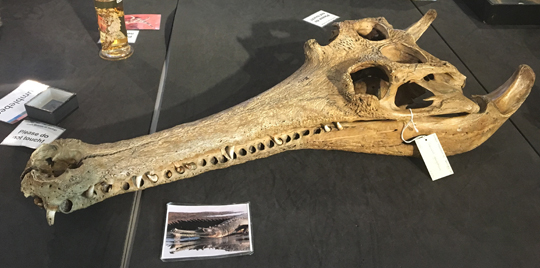
Team members at Everything Dinosaur were given the opportunity to examine the skull of a large gharial recently.  The gharial (Gavialis gangeticus), has evolved a long, elongated snout and specialises in catching fish (piscivore).  These once widespread and diverse members of the Gavialidae are extremely rare in the wild.  They are restricted to a few fragmentary populations scattered amongst the river systems of the northern parts of the Indian sub-continent.  It is a member of the Archosauria clade.

Examining the Skull of a Large Gharial

The skull of a gharial.
The skull of a gharial from the Grant Museum of Zoology (London). Picture credit: Everything Dinosaur.

Picture credit: Everything Dinosaur

Crocodilians are Members of the Archosauria Clade

The skull of this crocodilian portrays several characteristics that identifies it as a member of the Archosauria, the same clade of reptiles that includes dinosaurs, pterosaurs and birds.  The skull has a number of holes in it (fenestrae), these holes establish it as a member of the diapsid, one of three main groups of reptiles that can be distinguished from each other by the presence or absence of such fenestrae and their number.

Establishing shared characteristics between different species (synapomorphies), is the standard model for classifying organisms.   These shared characteristics, came from a shared, common ancestor.  Essentially, taxonomists are looking to identify similarities and differences.  The number of holes in the skull is one of the synapomorphies that establishes this gharial as a member of the archosaurs (ruling reptiles).

Teeth in Sockets

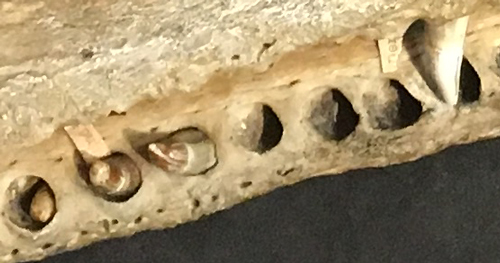
Another synapomorphy shared amongst the Archosauria, (although derived members of this group such as the birds have subsequently lost this trait), can be seen in the jaw.  The teeth of the gharial are set in sockets.  These sockets are termed alveoli (singular alveolus).  Being strongly anchored in a bony socket allows the tooth to withstand greater forces.  It is less likely to be lost during predation and feeding.  This enabled many of the early archosaurs to evolve powerful jaws, capable to tacking struggling prey or coping with tough, fibrous vegetation.  This evolutionary trait may help to explain their success.

For models and replicas of archosaurs and other prehistoric animals: Dinosaurs and Other Prehistoric Animal Models.

On the Skull of the Gharial – the Teeth Sockets can be Easily Seen

Teeth in sockets - characteristic of the Archosaurs.
A defining characteristic of the Archosauria – teeth in sockets. Picture credit: Everything Dinosaur.

Picture credit: Everything Dinosaur

Visit the Everything Dinosaur website: Everything Dinosaur.

20 05, 2018

New Papo, New CollectA and New Rebor Feature in Newsletter

By |2023-10-12T09:31:08+01:00May 20th, 2018|Categories: Adobe CS5, Dinosaur Fans, Everything Dinosaur News and Updates, Everything Dinosaur Newsletters, Everything Dinosaur Products, Main Page, Photos of Everything Dinosaur Products|0 Comments

New Papo, New CollectA, New Rebor Figures all Feature in Newsletter

Subscribers to Everything Dinosaur’s newsletter received their latest bulletin a few days ago.  They were amongst the first to know about the arrival of the latest batch of new for 2018 Papo dinosaur figures as well as the shipment of CollectA models including the 1:40 scale Mapusaurus figure.  In addition, our newsletter featured an update on the latest offerings from Rebor.

Papo Dinosaur Figures

The Papo Therizinosaurus and the Papo Iguanodon Models are in Stock at Everything Dinosaur

The new for 2018 Therizinosaurus and Iguanodon models from Papo.
New for 2018 Papo Therizinosaurus and Papo Iguanodon dinosaur models in stock at Everything Dinosaur. Two new Papo dinosaur figures. Picture credit: Everything Dinosaur.

Picture credit: Everything Dinosaur

Everything Dinosaur customers who had requested a Papo model be put on reserve for them have already been contacted by staff members.

To view the range of Papo prehistoric animal and dinosaur models available from Everything Dinosaur: Papo Prehistoric Figures and Models.

CollectA Deluxe Prehistoric Life

Five new CollectA prehistoric animal figures have arrived.  There are 1:40 scale figures of the fearsome Mapusaurus and a beautiful Iguanodon.  In addition, CollectA have introduced a 1:20 scale replica of the giant Devonian placoderm Dunkleosteus and just like the amazing Mapusaurus, it too has a movable jaw.

Newsletter Readers were Amongst the First to Find Out About the New CollectA Models

New CollectA figures in stock at Everything Dinosaur
New for 2018 CollectA prehistoric animals. Picture credit: Everything Dinosaur.

Picture credit: Everything Dinosaur

A Drinking Mantellisaurus and Sciurumimus

As well as the new scale models from CollectA, our latest bulletin included details of the two new, not-to-scale dinosaur figures that have just come out.  The drinking Mantellisaurus has been eagerly anticipated by model collectors and joining this ornithopod, is a model of the bizarre, carnivore Sciurumimus, that despite being only known from a 70 cm long skeleton, may actually represent one of the largest types of theropod from Jurassic Europe.

To view the scale model series from CollectA: CollectA Deluxe.

To see the Mantellisaurus and the Sciurumimus models and the rest of the huge CollectA Prehistoric Life range: CollectA Prehistoric Life Models.

Rebor “Chickenosaurus” and an Amazing 3D Lenticular Poster

Rebor continue to innovate and have added an amazing dinosaur embryo figure to the company’s “Oddities” range.  This cleverly designed item is a fantastic model of a genetically modified baby dinosaur.  The Rebor Chickenosaurus is supplied with a battery and has a light-up base and it makes a real focal point within a model collection.

Rebor Introduces a “Genetically Modified” Dinosaur and a Poster of “Wind Hunter”

"Chickenosaurus" and the 3-D Utahraptor poster from Rebor.
Rebor “Chickenosaurus” and the 3-D Utahraptor poster. Picture credit: Everything Dinosaur.

Picture credit: Everything Dinosaur

Rebor has introduced a three-dimensional poster of the Utahraptor figure “Wind Hunter” produced by the company.  This poster, the first to be made by Rebor, is also available from Everything Dinosaur.  This colourful and very striking dinosaur poster measures 26.5 cm by 20 cm (including the frame) and it is a limited-edition item.  It makes a smashing backdrop to the 1:35 scale Rebor Utahraptor ostrommaysorum figure.

To view the Rebor range of figures: Rebor Replicas and Models.

A spokesperson from Everything Dinosaur commented:

“Once again the design team at Rebor have produced a pair of innovative carnivorous dinosaur themed items.  The “Chickenosaurus” has a light up base and when lit, the superb detail on the little dinosaur embryo can be clearly seen.  As for the three-dimensional, lenticular poster, it gives the impression that the eyes of a pack of hungry Utahraptors are following you around the room – spooky.”

To request a subscription to Everything Dinosaur’s regular newsletter, simply drop us an email: Email Everything Dinosaur.

20 05, 2018

Dinosaur Food Webs a Helpful Explanation

By |2024-05-11T05:53:35+01:00May 20th, 2018|Categories: General Teaching, Key Stage 1/2|Comments Off on Dinosaur Food Webs a Helpful Explanation

Dinosaur Food Webs

Team members at Everything Dinosaur help school pupils to understand prehistoric animal food webs.

The national curriculum of England science programme outlines the fundamental topics to be taught to various age groups to provide a broad foundation for future scientific study.  Key elements include providing a basis for making sense of our planet (understanding our world) and developing the rational required to examine problems, look for evidence and to test via experimentation (scientific working).

In Key Stage 1, children are expected to be able to distinguish between carnivores, herbivores and omnivores.  In addition, they will be expected to identify that most living things live in habitats to which they are suited and describe how different habitats provide for the basic needs of different kinds of animals and plants, and how they depend on each other.

Prehistoric Animal Food Webs

A term topic on dinosaurs helps to reinforce and support this learning.  At Everything Dinosaur, we have been asked to provide simple food webs to help get some of these fundamental points about ecosystems across.  After all, for most children, learning about what Tyrannosaurus rex ate can enthuse even the most reluctant biologist.

A Simplified Dinosaur Themed Food Web

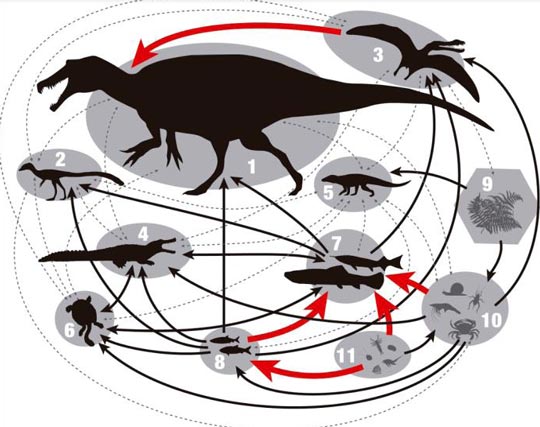
Araripe Basin (lagoon) prehistoric animal food web.
Proposed food chain showing LPP-PV-0042 as apex predator. A diagram showing a prehistoric animal food web.

Picture credit: Cretaceous Research

Basic Food Chain Principles

Children in Year 2 for example, will be required to explain how animals obtain their food from plants and other animals, using the idea of a simple food web.  They will be expected to identify and name different sources of food.

Food chains show the feeding relationships between animals, plants and other organisms.  Whether it is examining the biota of the Upper Cretaceous Hell Creek Formation of Montana, the Savannah of Africa or the school pond, the principles regarding food webs still apply.  Food chains tend to be roughly triangular in shape with the greater amount of biomass to be found at the lower levels.  The amount of material and energy decreases from one level to the next.  Food production is much more efficient if the food chain is short.

Energy is transferred along food chains from one level to the next.  Not all of the energy available to organisms at one level can be absorbed by organisms at the next level up.  Arrows tend to show the direction of energy flows in a food chain.  At the base of most food chains is the sun, as it is sunlight that plays a role in photosynthesis, allowing plants to grow.

Visit the Everything Dinosaur website: Everything Dinosaur.

Go to Top