All about dinosaurs, fossils and prehistoric animals by Everything Dinosaur team members.
17 06, 2017

Sensational Theropod Tracks and Ornithopod Tracks

By |2024-05-09T08:17:14+01:00June 17th, 2017|Categories: Dinosaur and Prehistoric Animal News Stories, Dinosaur Fans, Main Page|6 Comments

Distinguishing Theropod tracks from Ornithopod Tracks

Recently, Everything Dinosaur posted an article about a new study of the Dinosaur Stampede National Monument (Queensland, Australia), in which a three-dimensional Australovenator foot was used to assess what type of dinosaur was responsible for producing a set of eleven, large, three-toed footprints.  In this innovative research, conducted by scientists from the Australian Age of Dinosaurs Museum of Natural History and the University of Newcastle (New South Wales), it was concluded that the tracks could have been made by a meat-eating dinosaur.

Theropod and Ornithopod Tracks

Previous research had challenged the interpretation that the trace fossil site preserves evidence of a dinosaur stampede as a substantial group of smaller plant-eating dinosaurs evaded an attack from a big theropod.

Other interpretations of the Dinosaur Stampede National Monument have suggested that the hundreds of tracks preserved at this location, some seventy miles south of the town of Winton in Queensland, do not represent evidence of a large, meat-eating dinosaur attacking a flock of smaller dinosaurs.  Some scientists have contradicted this analysis and proposed that the bigger, tridactyl tracks were made by a big ornithopod, a herbivorous dinosaur, something like a Muttaburrasaurus.

Could the Larger Tracks at the Dinosaur Stampede National Monument have been made by a Muttaburrasaurus?
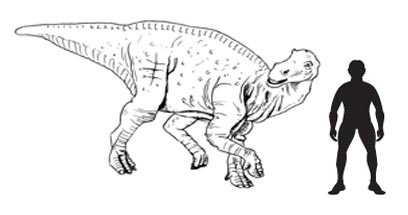
Muttering like a Muttaburrasaurus.

Muttaburrasaurus scale drawing.  Picture credit: Everything Dinosaur

Picture credit: Everything Dinosaur

The picture (above) shows a Muttaburrasaurus scale drawing. The drawing is based upon a dinosaur model from the CollectA range.

To view this range of prehistoric animal models: CollectA Age of Dinosaurs Popular Models.

The Confusion Between Bipedal Plant-eaters and Bipedal Meat-eaters

Having published our article, we were then emailed and asked to explain how it was possible to confuse the footprints of a large bipedal, herbivorous dinosaur with those of an equally sized carnivorous dinosaur.  So, here are some pointers about the differences between the types of tracks, plus an explanation as to why it can be so hard to pin down which type of bipedal dinosaur left prints and tracks.

For those scientists that study dinosaur footprints, being able to distinguish the prints from a meat-eating theropod from those of a large, herbivorous ornithopod is a challenging task.  If the prints are ideally preserved with lots of detail, identification can be relatively straight-forward, if the body fossils of a dinosaur could be found close by, then there would be further evidence to support a diagnosis, but sadly, discovering exquisitely preserved dinosaur tracks – these are very rare events indeed!

It is Not Easy Identifying/Classifying Dinosaur Footprints
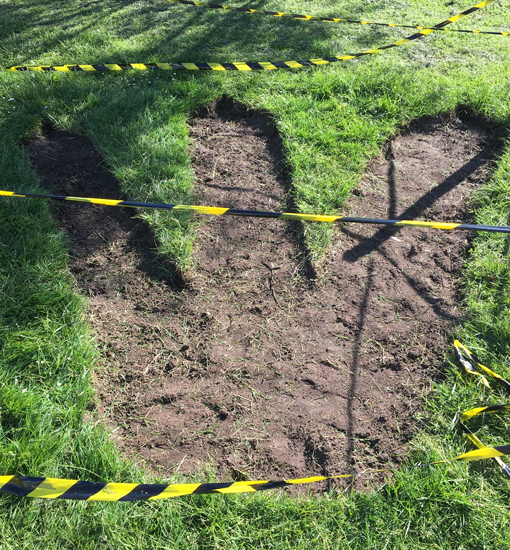
Huge dinosaur footprint spotted at a school.

A huge dinosaur footprint spotted at a school. Picture credit: Everything Dinosaur.

An Identification Guide

The track made by a theropod dinosaur (the pes of a meat-eating dinosaur), if perfectly preserved, should show sizeable claw marks on the end of the toes.  The toes themselves should look quite slender and in general terms the print should look longer than it is wide.  The length of the foot when compared to the width should give the track a characteristic “v shape”.

The well-preserved track of a large ornithopod, a plant-eater should lack distinctive claw marks.  The ends of the toes should be more blunt and rounded in appearance.  The toes tend to be quite wide and the foot proportions are different.  For example, the foot may be much wider.  The wider pes as a proportion of overall foot length gives the track a “u shape”.

Ornithopod versus Theropod Footprint – Identification Guide
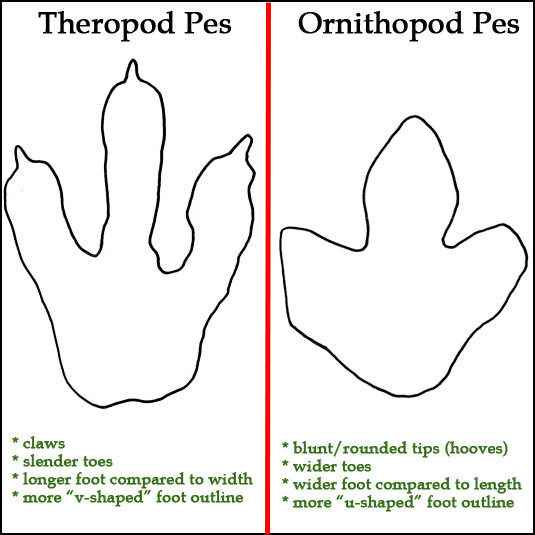
Comparing different types of dinosaur footprint. Studying dinosaur tracks.

Theropod print compared to an ornithopod print. Picture credit: Everything Dinosaur.

Picture credit: Everything Dinosaur

Identifying the Dinosaur from the Footprint – Problems

The fact that something so ephemeral as a single track or a trackway can survive for millions of years is remarkable.  However, over time these trace fossils can become distorted making identification extremely difficult.  Features, once very striking are easily masked by the effect of weathering and erosion.  Any repairs undertaken or attempts to preserve the prints could also lead to the loss of definition, causing further problems when it comes to making an assessment as to what type of animal produced the tracks.

Unauthorised attempts to make casts could also result in considerable damage to the track(s) thus further hampering identification.

It does not matter, whether the track represents a natural cast (created by sediments filling in a track), or whether it is a true track (the impression preserved in the ground made by the foot itself), determining what type of creature made the prints is an extremely difficult process.  Some of the most difficult tracks to interpret of all are undertracks.  An undertrack is formed below the sediment as surface material is compressed downwards as the organism moved across the area.  These undertracks lack many types of marks made only at the surface, scratches, scuffs, clear claw impressions or any evidence of a tail drag.

The thousands of dinosaur tracks at the Lark Quarry site (Dinosaur Stampede National Monument), are truly a remarkable record of the behaviour and activity of a group of dinosaurs.  What exactly those tracks represent is open to different interpretations – but that’s science for you.

Further articles on the Lark Quarry dinosaur tracks:

Could Australovenator have made some of the tracks at Lark Quarry?: Lark Quarry Dinosaur Footprints – Scientists Re-examine the Evidence.

Lark Quarry Tracks Re-examined: A New Interpretation of the Lark Quarry Fossils.

Visit the award-winning Everything Dinosaur website: Everything Dinosaur.
16 06, 2017

Australovenator Steps into the Famous Lark Quarry Dinosaur Debate

By |2024-05-09T08:17:43+01:00June 16th, 2017|Categories: Dinosaur and Prehistoric Animal News Stories, Dinosaur Fans, Main Page|0 Comments

Scientists Reconstruct Dinosaur Foot to Help Interpret Tracksite

The famous dinosaur tracks at Lark Quarry, (Dinosaur Stampede National Monument), near the town of Winton (Queensland, Australia),  have been the subject of research for decades.  Unlike dinosaur bones and teeth that can be transported a huge distance from the place where the dinosaur died, footprints and tracks preserve evidence of activity and behaviour.  The majority of trace fossils provide direct, in situ evidence of the environment at the time and location where the animal was living.

Different Interpretations of the Dinosaur Tracks

At Everything Dinosaur, we think the first, formal attempt to interpret the numerous dinosaur tracks preserved in the finely grained sandstone at the Lark Quarry site took place in 1984.  Eleven, large, three-toed prints were interpreted as having been made by a big meat-eating dinosaur that had lunged at a flock of small ornithopods that it had cornered.

The tracks were interpreted as a “dinosaur stampede” as the smaller plant-eating dinosaurs panicked and tried to avoid the jaws of a ten-metre-long theropod.  The ichno genus (a name given to an animal known only from trace fossils), Tyrannosauropus was erected.  Over the years, a number of other interpretations have been put forward, including the hypothesis that the big tri-dactyl prints don’t represent a predator but were made by a large ornithopod, something akin to a Muttaburrasaurus.  Other interpretations of this famous fossil site include that the tracks were made by dinosaurs as they swam and waded across a body of water.

Swimming Dinosaurs Hypothesis: Dinosaurs Not Stampeding but Swimming.

No Tyrannosauropus at Lark Quarry After All: Lark Quarry Tracks Made by a Big Plant-Eating Dinosaur.

Dinosaur Foot Reconstruction – A New Analysis of the Tracks

Distinguishing between the three-toed prints of meat-eating dinosaurs and those of similar sized plant-eaters, which also walked on three toes is a tricky business.  However, in an innovative piece of research, a team of scientists from from the University of Newcastle (New South Wales) and the Australian Age of Dinosaurs Museum of Natural History in Winton, set about reconstructing the foot of an Australian Theropod dinosaur Australovenator wintonensis in a bid to reproduce the tracks in similar sediment, which could then be compared to the fossil trackway.

Reconstructing the Foot of Australovenator

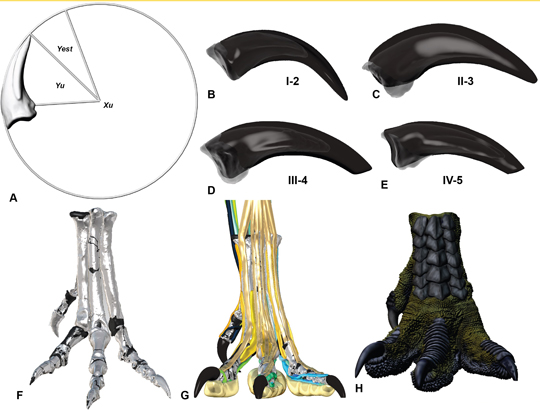
Foot model helping to interpret Lark Quarry tracks.

Reconstructing the left foot of Australovenator.

Picture credit: PeerJ

The picture above shows (A) calculating the claw length of Australovenator and (B-D) the four claws associated with the left foot of the dinosaur with reconstructed sheaths.  The bones of the foot have been reconstructed (F) and using Emu feet for an anatomical comparison, (G) shows the foot reconstructed with tendons added, whilst (H) is the skin covered biologically restored foot (left pes) of Australovenator.

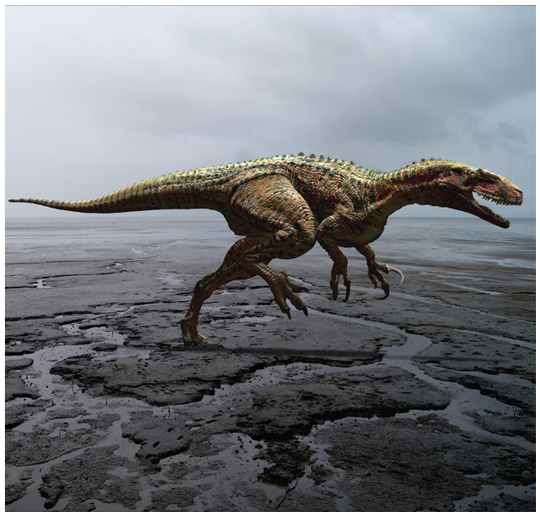
Australovenator wintonensis

A three-dimensional foot of Australovenator was created as fossils of this Megaraptoran theropod are known from similar aged strata as the Lark Quarry tracks.  In addition, Australovenator is the only meat-eating dinosaur from Australia which has had its foot bones discovered.  The researchers used a variety of substrates to test the prints, scuff marks and scratches made by the large dinosaur and they concluded that their recreated impressions were reminiscent of the trace fossils.  This suggests that the eleven, large, three-toed tracks at Lake Quarry (now known as the Dinosaur Stampede National Monument), could have been made by an Australovenator-like carnivorous dinosaur.

An Illustration of Australovenator wintonensis Crossing the Lark Quarry Sediments

Australovenator footprint study.

Australovenator making tracks.

Picture credit: Travis R. Tischler

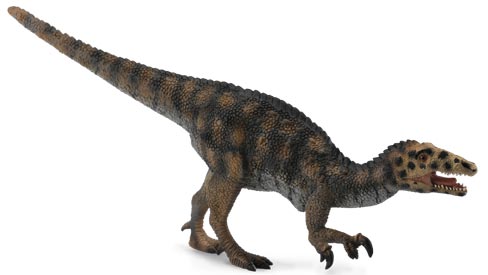
The CollectA Australovenator Dinosaur Model

Australovenator was a member of the Allosauria clade of theropod dinosaurs.  Fossils of this six-metre-long carnivore were discovered in 2006.  Although the fossil material was far from complete, the Australovenator genus was formally erected by Australian palaeontologist Scott Hucknull in 2009.  CollectA introduced a model of Australovenator just three years after the scientific description.  Models of Megaraptoran theropods are quite rare, it is great to see that CollectA have added an Australovenator replica to their “Prehistoric Life” model range.

To visit the Everything Dinosaur website: Everything Dinosaur.
The CollectA Australovenator Dinosaur Model

The CollectA Australovenator dinosaur model.

The CollectA Australovenator replica.

To view the full range of CollectA dinosaur and prehistoric animal models: CollectA Prehistoric Life Models.

16 06, 2017

From Dinosaurs to the Stone Age

By |2023-07-27T08:37:44+01:00June 16th, 2017|Categories: Key Stage 1/2|Comments Off on From Dinosaurs to the Stone Age

Year 3 and Year 4 Explore Fossils

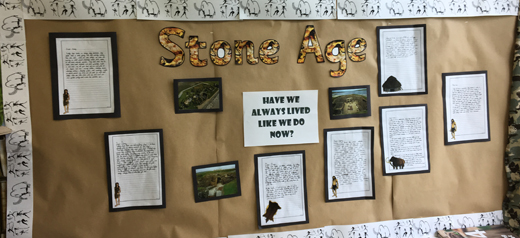
Children in Lower Key Stage 2 at The Acorns Primary and Nursery School have been enjoying learning about the Stone Age and prehistoric life.  Under the enthusiastic tutelage of the teaching team, the three classes that make up Lower Key Stage 2 cohort have been developing their writing skills as well as investigating how fossils form and researching Mary Anning.  We hope that the tongue twister “she sells sea shells on the sea shore” will help to inspire the children with their creative writing.

Examples of Cursive Handwriting Form Part of the Stone Age Display

Everything Dinosaur and exploring the Stone Age.

Examples of cursive writing. Picture credit: Everything Dinosaur.

Picture credit: Everything Dinosaur

Mary Anning and a Broad and Balanced Scheme of Work

The pupils were set lots of exciting challenges during our dinosaur and fossil themed workshops.  Our dinosaur expert ensured that the activities that were proposed fitted in with the learning objectives set by the teachers.  For example, looking at Woolly Mammoth fossils led onto introducing the idea of the class producing a piece of fiction writing imagining what it would have been like to go on a Woolly Mammoth hunt.  One young girl proposed writing her story based on the viewpoint of the Mammoth – what a super idea!

With such an interesting topic, there is plenty of scope to introduce cross-curricular activities.  Class 4ML have been looking at life in the rainforest and threats to existing habitats, the opportunity to learn more about extinction events and climate change certainly resonated with the young audience.  We asked the Year 4 children to undertake independent research on the bizarre Coelacanth, a fish thought to have died out with the dinosaurs but now sadly, seriously threatened due to loss of habitat and the encroachment of human activity.  The children loved the idea of learning about a fish that was the same colour as their school jumpers.

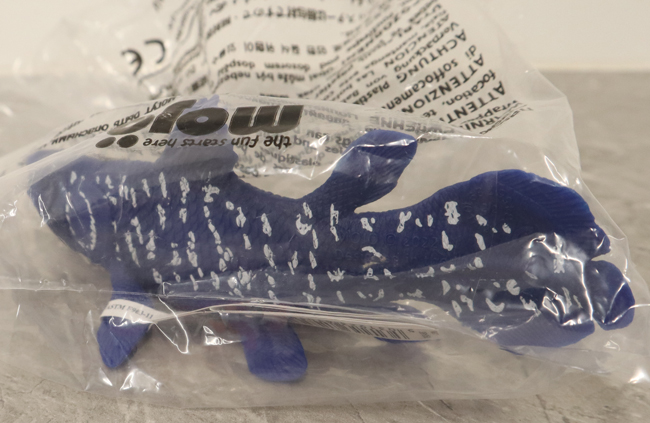
A Coelacanth Model – The Story of the Coelacanth – Helping to Link Topic Areas

Mojo Fun Coelacanth model.

A very bright and colourful Mojo Fun Coelacanth model. Picture credit: Everything Dinosaur.

Picture credit: Everything Dinosaur

The picture (above) shows a Mojo Fun Coelacanth figure.  It is one of their models in the “Prehistoric and Extinct” model series.

To view this range: Mojo Fun Prehistoric and Extinct Models.

Making Fossils

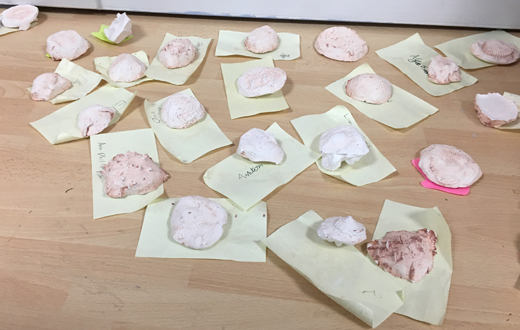
Several very impressive plaster casts of fossils were prominently displayed.  The children were keen to demonstrate their understanding by explaining what fossils are and how they form.  The replica fossils included some amazing bivalves and snail shells.  During the workshop, the children got the chance to handle real fossils including some “gigantic”, “enormous” ammonites.  The ammonite shells reminded the children of snail shells, our fossil expert explained that snails and ammonites are distantly related and in a practical fish catching exercise, illustrated why ammonites, squid and octopi are classified as cephalopods.

Lots of Carefully Crafted Plaster Cast Fossils on Display

Lots of amazing plaster fossils.

Lots of amazing plaster fossils. Picture credit: Everything Dinosaur.

Picture credit: Everything Dinosaur

Once back in the office, we were able to email over some more resources to help the teaching team.

Visit the award-winning Everything Dinosaur website: Everything Dinosaur.
15 06, 2017

Curious African Cynodont Turns up in Brazil

By |2023-07-26T10:43:25+01:00June 15th, 2017|Categories: Dinosaur and Prehistoric Animal News Stories, Main Page, Photos/Pictures of Fossils|0 Comments

Aleodon from Africa Present in Brazilian Triassic Rocks

A team of international researchers have reported the discovery of fossils attributed to the African cynodont Aleodon in Middle-early Late Triassic rocks from several locations in the state of Rio Grande do Sul (southern Brazil).  Prior to these fossil finds, this protomammal (a member of the Probainognathidae family), a distant ancestor of modern mammals, was only known from Africa.

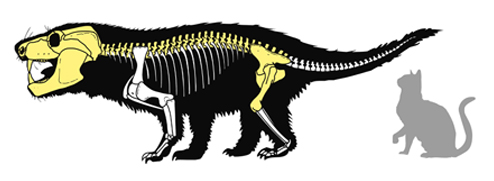
A Scale Drawing of the Skeleton of Aleodon (A. cromptoni)

Aleodon scale drawing. A curious cynodont from Brazil.

The known bones of Aleodon are shown in yellow.

Picture credit: PLOS ONE

In the picture above the known bones attributed to Aleodon (A. cromptoni) are shown in yellow and a cat provides a scale comparison.

A Curious Cynodont Living Alongside Dinosaur Precursors

Writing in the on-line academic journal “PLOS ONE”, the researchers, which include Agustín Martinelli (Universidade Federal of Rio Grande do Sul, Brazil), conclude that fossils previously thought to represent another cynodont – Chiniquodon actually are Aleodon specimens, as such they are the first of this genus to be found outside of Africa.  The carnivorous Aleodon lived alongside basal members of the Dinosauria and other types of archosaur, as well as numerous mammal-like reptiles, including the giant herbivore Dinodontosaurus.  The fossils of Dinodontosaurus are so numerous that they are used to date the relative age of the strata in this part of southern Brazil.  All the fossils ascribed to Aleodon, including cranial material and teeth come from the Dinodontosaurus Assemblage Zone.

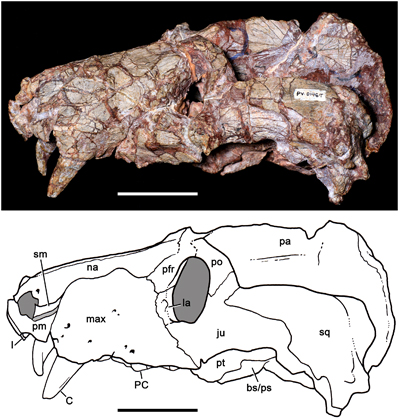
Aleodon Skull Material and Line Drawing (Aleodon cromptoni)

Aleodon skull and line drawing.

Skull in left lateral view with accompanying line drawing. Scale bar = 50 mm.

Picture credit: PLOS ONE

Namibian and Tanzanian Fossils

The Aleodon genus was first erected based on fossil material discovered in Tanzania and Namibia.  The South American material was compared to the African specimens and a new species of Aleodon, a sister taxon to the African species was named.  The new Aleodon species honours Dr Alfred “Fuzz” Crompton, who established the genus in 1955 with the naming of A. brachyrhamphus.

In a reassessment of the African fossil material, a specimen form Namibia which was thought to represent a member of the related family, the Chiniquodontidae or possibly a member of the Traversodontidae may actually be an Aleodon.  The scientists also identified as Aleodon a total of seven specimens from the Rio Grande do Sul region.  Phylogenetic analysis indicated that Aleodon cromptoni may be, as suspected, a species in the Chiniquodontidae family.

Whilst the research work was hampered due to the incomplete and partial specimens, the authors note that the identification of these Late Triassic Aleodon fossils in Brazil strengthens the correlation between probainognathians from this epoch in South America and in Africa.

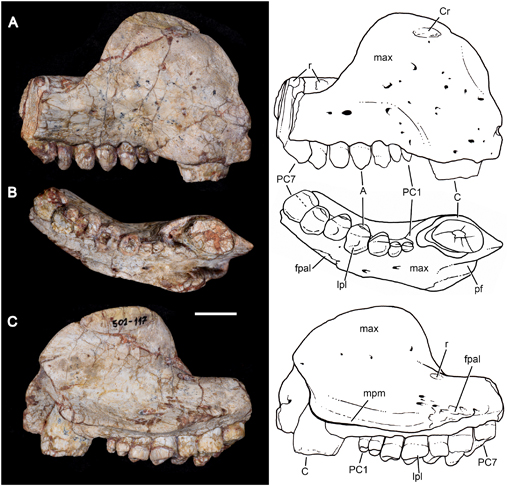
Part of the Upper Jaw of A. cromptoni with Line Drawing

Upper jaw fossil material (Aleodon cromptoni).

Photographs and accompanying drawings of right maxilla MPDC-501-117 in lateral (A), ventral (B), and medial views (C). Scale bar equals 10 mm

Picture credit: PLOS ONE

For Triassic prehistoric animal models and figures: Prehistoric Animal Models and Figures.

14 06, 2017

Win with Everything Dinosaur! A Free to Enter Competition

By |2024-05-09T08:18:14+01:00June 14th, 2017|Categories: Dinosaur Fans, Everything Dinosaur News and Updates, Main Page, Press Releases|0 Comments

Win a Pair of Tickets to the Amazing Dinosaurs of China Exhibition

Win a pair of tickets to the Dinosaurs of China Exhibition in Nottingham (UK).

Please note: this competition is now closed.

Everything Dinosaur has another super prize draw giveaway.   We have a pair of tickets to the amazing Dinosaurs of China Exhibition being held in Nottingham (UK) this summer.  The Dinosaurs of China exhibition features an amazing collection of dinosaurs and prehistoric animals, with many of the specimens travelling outside of Asia for the first time.  From “ground shakers to feathered flyers” – this brilliant dinosaur exhibition is not to be missed!

The main exhibition is being held at Wollaton Hall & Deer Park in Nottingham with a satellite exhibition taking place at the Nottingham Lakeside Arts Centre.  This once in a lifetime event runs from July 1st to October 29th.

Win a Pair of Tickets to the Dinosaurs of China Exhibition

Win tickets in Everything Dinosaur's Prize Draw

Win a pair of tickets to visit the Dinosaurs of China exhibition in Nottingham.

Picture credit: Everything Dinosaur

Everything Dinosaur has a pair of tickets to giveaway in our free to enter prize draw.

Win a Pair of Tickets to the Dinosaurs of China Exhibition

To enter, simply “like” the post on Everything Dinosaur’s FACEBOOK , page and leave a comment.  Or leave a comment on this blog post.  Tell us what you would like us to write about on the Everything Dinosaur blog and that’s it – you are entered into the prize draw to win a pair of tickets!

It would be great if you could also “like” our Facebook page, it’s not mandatory, but “liking” the Everything Dinosaur Facebook page would ensure that you don’t miss out on future competitions and promotions.  Feel free to share our prize draw with your friends!

Everything Dinosaur on FACEBOOK: “LIKE” our Facebook post, comment and enter the competition!

We will draw the lucky winner at random and the ticket prize draw giveaway closes at midnight (BST) on  Friday 30th June.  Good luck and we look forward to reading your comment.

To view Everything Dinosaur’s range of dinosaur toys and models including some “ground shakers and feathered flyers”: Visit Everything Dinosaur’s Website.

Terms and Conditions for the Everything Dinosaur Win a Pair of Tickets Prize Draw

  • Automated entries are not permitted and will be excluded from the draw
  • Only one entry per person
  • The prize (a pair of tickets for the Dinosaurs of China exhibition), is non-transferable and no cash alternative will be offered
  • Open to UK residents, 16 years and upwards (excluding employees and relatives of Everything Dinosaur staff members)
  • To enter you must leave a comment on the Everything Dinosaur Facebook promotional post at: Everything Dinosaur on Facebook and leave a comment about what you would like us to write about in our blog OR leave a comment on this blog post – one comment per person
  • The Everything Dinosaur ticket prize draw runs until midnight (BST) on Friday 30th June 2017
  • The winner will be chosen at random and they will be contacted by a reply to the comment plus a Facebook message with 7 days of the competition closing date.  The winner will need to respond within 28 days or a new winner will be selected.
  • A prize (a pair of tickets) will be despatched by the event organisers, once Everything Dinosaur has confirmed the delivery address.  The winner will have to state a preferred date and time for their visit
  • The prize does not include travelling expenses or any accommodation
  • The promoter is Everything Dinosaur
  • By entering the prize draw giveaway, participants confirm that they have read, understood and agreed the terms and conditions of the competition
  • This promotion is in no way sponsored, endorsed or administered by, or associated with, Facebook

Please note: this competition is now closed.

13 06, 2017

Introducing New Mojo Fun Dinosaur Models

By |2024-05-09T08:18:46+01:00June 13th, 2017|Categories: General Teaching|Comments Off on Introducing New Mojo Fun Dinosaur Models

Everything Dinosaur Adds Mojo “Prehistoric and Extinct” Models

The UK-based, on-line retailer Everything Dinosaur has added the Mojo “Prehistoric and Extinct” model range to its extensive portfolio of prehistoric animal and dinosaur replicas.  Mojo Fun models to be added to the range.  The company, which has been supplying the educational sector with dinosaur and fossil themed teaching resources for more than a decade, has introduced this range because the robust, hand-painted replicas are ideal for creative play and feature a number of animals that can help with coursework related to adaptation, genetics and extinction, all cornerstones of the national science curriculum in England.

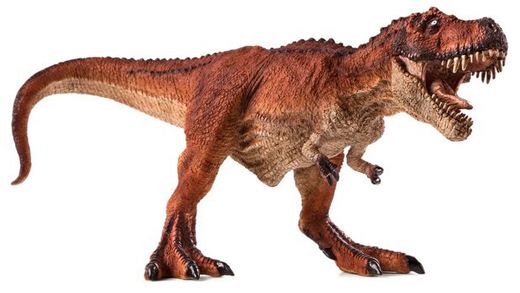
The Mojo Hunting Tyrannosaurus rex Dinosaur Model

Mojo hunting Tyrannosaurus rex.

Mojo hunting T. rex dinosaur model.

To view the range of educational Mojo prehistoric animal models stocked by Everything Dinosaur: Mojo Fun Models – “Prehistoric and Extinct”.

Mojo Fun Models

Mojo was founded in 2009 and the company has grown quickly, becoming a highly respected producer of animal replicas since the very first range of models was introduced in January 2011.  Mojo’s mission is to create the finest quality, educational replicas available on the market.  Product safety is paramount to Mojo.  Every figure in the Mojo range is rigorously tested and fulfils all current worldwide safety standards.  All the replicas in the “Prehistoric and Extinct” range are suitable for children from three years and upwards making them ideal for schools and home education.

Mojo Models Can Be Used to Help Learn About the Stone Age

Prehistoric mammal models from Mojo. Models of early mammals.

A selection of prehistoric animal models from the Mojo “Prehistoric and Extinct” range.

Picture credit: Everything Dinosaur

Stone Age and Ice Age

With many schools introducing a scheme of work that explores life in the Stone Age, the Mojo Woolly Mammoth models can help children to learn more about the kinds of animals that once roamed Britain, Woolly Mammoths and Sabre-toothed Cats for example.

These replicas can be used in the production of classroom dioramas or for motivating students to undertake independent research.  The Mojo Woolly Mammoths also make handy props when exploring such issues as adaptation and extinction.  At Everything Dinosaur, we have come across many examples of models such as these being used to inspire children as they explore the likely causes of the extinction of the Woolly Mammoth, this in turn, leads on to such concepts as climate change and the impact of our species on the environment.

Learning About Extinctions

With a focus on working scientifically, the teaching curriculum provides flexibility in how learning objectives are achieved.  Children in upper Key Stage 2 are expected to learn about Darwinism and evolution, helpful preparation, as in Year 7 the science of genetics is introduced and runs through to Key Stage 4.   The Mojo Fun model range includes replicas of some recently extinct animals, the Quagga for example, an excellent way to illustrate the science of selective breeding to encourage certain characteristics and traits within a population.

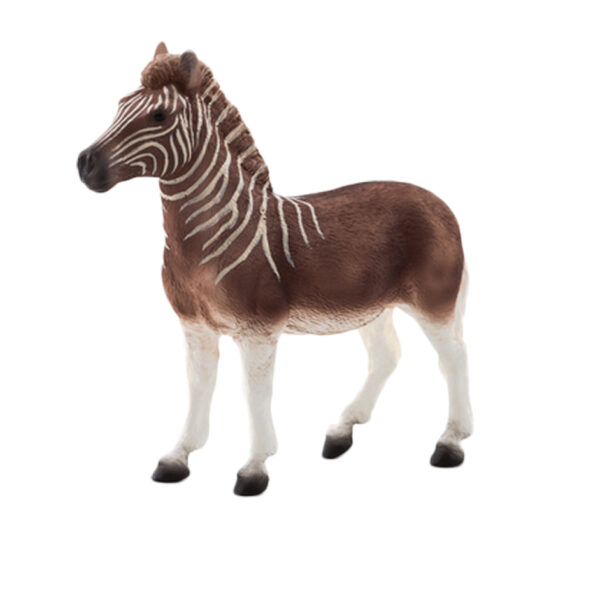
The Mojo Quagga Model

Mojo Quagga replica.

The Mojo Quagga model.

A focus of science teaching in secondary schools that follow the national curriculum (England), is to help pupils develop a deeper understanding of the range of scientific ideas in biology.  Giving pupils the opportunity to learn about the extinction of the Quagga and the on-going attempts to resurrect this sub-species of Plains Zebra, helps to reinforce teaching about genetics and genetic engineering as well as providing important cross-curricular links into history, human population dynamics and the impact of climate change.

Visit the award-winning Everything Dinosaur website: Everything Dinosaur.
13 06, 2017

Watch the Birdie (Enantiornithine in Amber)

By |2023-07-26T10:19:15+01:00June 13th, 2017|Categories: Dinosaur and Prehistoric Animal News Stories, Dinosaur Fans, Main Page, Palaeontological articles|0 Comments

Nearly Complete Baby Bird Preserved in Amber

Researchers from the Chinese Academy of Sciences in collaboration with colleagues from the Royal Saskatchewan Museum (Canada) and the China University of Geosciences have announced the discovery of yet another prehistoric animal preserved entombed within a 99-million-year-old piece of amber from Myanmar.  The animal is a baby bird, perhaps only a few days old when it was engulfed in sticky tree resin back in the Cretaceous.  It is an astonishing discovery, an enantiornithine in amber.  It is one of a number of remarkable fossil finds made in recent years from the amber deposits of northern Myanmar.

Enantiornithine in Amber

Most of the skull and neck is preserved along with part of a wing, a hindlimb, complete with claws and some soft tissue surrounding the tail.  Some of the plumage has also been encased within the amber nodule.  Described as representing a specimen of the Enantiornithes clade, it is the most complete bird preserved in amber found to date.

Enantiornithine Hatchling Preserved in Burmese Amber

Baby Enantiornithine bird trapped in amber.

Baby bird preserved in amber.

Picture credit: Ryan McKellar (Royal Saskatchewan Museum) et al.

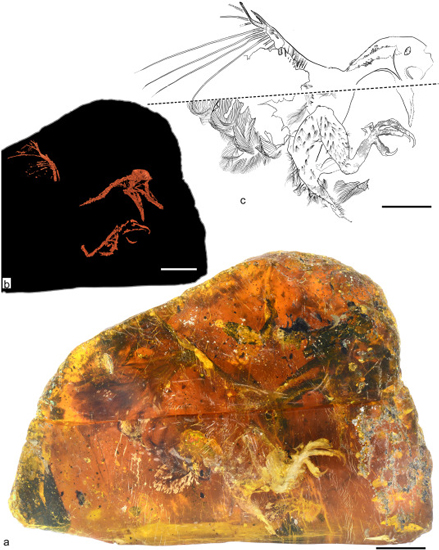
The picture above shows the amber nodule (a).  The nodule measures approximately 86 mm × 30 mm × 57 mm it has been assigned the specimen number HPG-15-1 and it has been cut in half.  The cut-mark is represented in (c) which shows the cut as a dotted line against a line drawing of the bird’s remains preserved in the nodule.  An interpretation of the high-resolution scans showing the skeletal components is shown in (b).  The disarticulated remains of this individual has led the research team to speculate that the corpse of this young bird might have been scavenged prior to its entombing in the tree resin.

A Very Young Bird

Writing in the academic journal “Gondwana Research”, the scientists conclude that the shape of the skeleton and the plumage indicates a very young bird, the well-developed wings, claws and the presence of some filamentous body feathers suggests that enantiornithines were hatched in a relatively advanced state, being perhaps able to feed itself almost immediately.

Being born nearly fully developed and independent of the parents is termed precocial.  Many modern birds are precocial, examples include ostrich chicks and ducklings.  These birds are able to keep themselves warm and move about, often leaving the nest in just a few hours.  The scarcity of body feathers on the Cretaceous bird represents a distinct departure from the feather coverings found in today’s precocial birds.  Perhaps the enantiornithines relied on their parents to brood them to keep them warm, or perhaps these birds hatched during the hottest part of the year, when insulation was not as necessary.

A Three-Dimensional Model Created from the High-Resolution Scans

Fossil bird trapped in amber.

Using 3-D scans the researchers were able to create a model of the death pose of the bird.

Picture credit: Ryan McKellar (Royal Saskatchewan Museum)

Commenting on the importance of this fossil discovery, Ryan McKellar (Royal Saskatchewan Museum) stated:

“We’ve had more complete specimens, where you get more of the skeleton preserved, from compression fossils, but never with this level of detail.  It’s like a little diorama.”

Nicknamed “Belone”

The amber nodule also contains insect remains, plant material and mites, providing an insight into the fauna and flora of a conifer forest that existed around 99 to 100 million years ago.  The amber was found by a miner back in 2014, at first the claw was thought to have come from a lizard but once the piece had been purchased by the Hupoge Amber Museum in Tengchong City, China, a correct identification was made.  The specimen was nicknamed “Belone” a local term for an amber-coloured bird called the Oriental skylark.

Researchers including palaeontologist Lida Xing (China University of Geosciences), used CT scans to examine fossil elements hidden from view.  These scans revealed the skull and part of the spine, although the cutting of the nodule damaged the anterior portion of the head and the tiny jaws.

As for its feathers, the bird had different kinds: some that palaeontologists have seen on dinosaurs, but others that are closer to modern-day birds.  This, the research team commented, was one of the most surprising and rewarding finds.

The Enantiornithine Hind Leg

Enantiornithine hindlimb

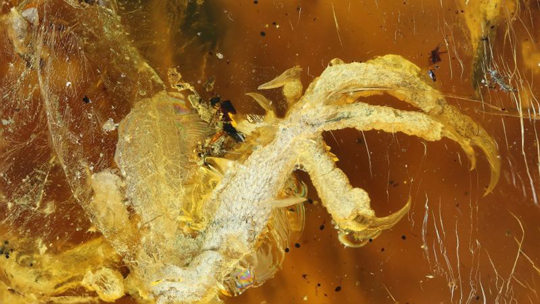
A closer view of the hind limb of the enantiornithine bird.

Picture credit: Ming Bai

A Precocial Bird

The presence of strong toes equipped with sharp claws suggests that this bird could clamber around in the trees shortly after hatching, yet more evidence of just how independent this young bird was.  Precociality is thought to be ancestral in birds.  Thus, altricial birds tend to be found in the most derived families within the Aves (birds) Order.   There is some evidence for precociality in the Dinosauria.  It seems that being independent at birth is a characteristic that is basal to the birds.

A Close View of One of the Claws

Enantiornithine claw.

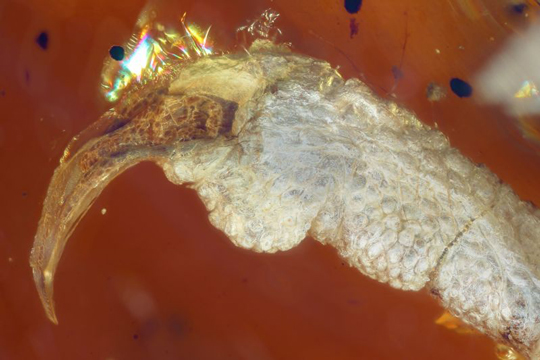
A close view of the claw, even individual scales have been preserved in the amber.

Picture credit: Ming Bai

The amber mines of Kachin Province (northern Myanmar) are renowned for their remarkable fossils, back in 2016, Everything Dinosaur wrote an article about the remnants of a bird’s wing that had been preserved trapped in amber.

To read more: Bird Wing Trapped In Amber.

Later that year, Everything Dinosaur reported on discovery of a fragment of a dinosaur’s tail that had been found preserved inside amber.  That remarkable specimen was studied by a number of the researchers who contributed to the study of this baby bird fossil.

To read more about the dinosaur tail discovery: The Tale of a Dinosaur Tail.

The scientific paper: “A mid-Cretaceous Enantiornithine (Aves) Hatchling Preserved in Burmese Amber with Unusual Plumage” by Lida Xing, Jingmai K. O’Connor, Ryan C. McKellar, Luis M. Chiappe, Kuowei Tseng, Gang Li, Ming Bai published in Gondwana Research.

12 06, 2017

Dinosaurs of China – Exhibits Arrive and Excitement Builds

By |2024-05-09T08:19:27+01:00June 12th, 2017|Categories: Dinosaur and Prehistoric Animal News Stories, Dinosaur Fans, Main Page|0 Comments

Chinese Takeaway Delivered Safe and Sound

The amazing dinosaur exhibits that form this summer’s world exclusive Dinosaurs of China exhibition have arrived safe and sound at their Nottinghamshire venues.  This exciting exhibition, which features a number of specimens that have not been seen outside of Asia before, opens on Saturday, July 1st and the dedicated staff at Wollaton Hall and the Nottingham Lakeside Arts Centre with the collaboration of technicians from the Institute of Vertebrate Palaeontology and Palaeoanthropology in Beijing, have just three weeks to put all the exhibits together.

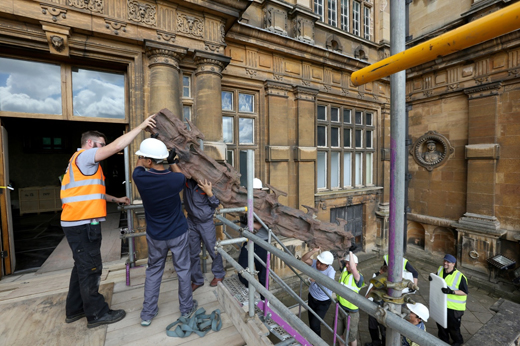
Unloading Giant Dinosaur Vertebrae

Unloading an exhibit (Dinosaurs of China).

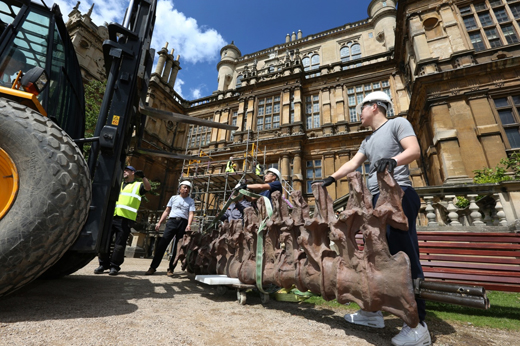
Dorsal vertebrae from the giant Mamenchisaurus exhibit are carefully unloaded.

Picture credit: Dinosaurs of China

Jumbo-sized Jigsaw Puzzles

Before the exhibits can tell the fascinating story of how the dinosaurs evolved into birds, all the individual parts of the various dinosaurs have to be put together.  This is no mean feat, as Wollaton Hall will be home to a massive Mamenchisaurus dinosaur skeleton for the next five months.  The neck of Mamenchisaurus is a fraction under ten metres in length and it contains nineteen giant bones (cervical vertebrae).  The finished Mamenchisaurus exhibit will stand the same height as three double decker buses!

Unloading a Dinosaur at Wollaton Hall

Mamenchisaurus cervical vertebrae

Unloading Mamenchisaurus cervical vertebrae.

Picture credit: Dinosaurs of China

After a fifty-day, five-thousand-mile trip from China to the UK, this is one Chinese takeaway that will take a lot of careful handling.

Dinosaurs of China

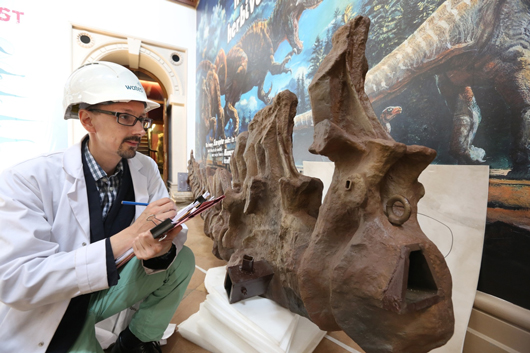
The main exhibition at Wollaton Hall will feature twenty-six prehistoric animal skeletons and fossils that include some of the best-preserved specimens in the world.  Dr Adam Smith, Exhibition Curator, commented:

“It’s absolutely incredible to have the Dinosaurs of China here, having completed their two-month long, inter-continental journey.  Seeing such important finds up close is really thrilling and we can’t wait to start the installation process so we can share them with the rest of the country this summer!”

Dr Adam Smith Checks Over a Specimen

Checking over an exhibit.

Counting the bones – all present and correct.

Picture credit: Dinosaurs of China

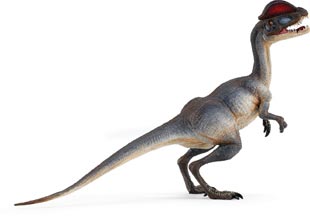
Visitors to the complementary exhibition at Nottingham Lakeside Arts will be greeted by two fascinating dinosaur skeletons – the Alxasaurus, which when it was alive, was probably covered in a coat of shaggy feathers and the fearsome Early Jurassic Dilophosaurus.   Dilophosaurus has two, thin, bony crests that ran from the top of its nose to the back of its head, hence this dinosaur’s name which means “double-crested lizard”.

Dilophosaurus “Double Crested Lizard”

Dilophosaurus dinosaur model.

Wild Safari Prehistoric World Dilophosaurus.

The Dilophosaurus Puzzle

The Dilophosaurus fossils found in China, may not be Dilophosaurus at all!  Some palaeontologists think that these fossils belong to a different, but related dinosaur called Sinosaurus (Sinosaurus triassicus).  That’s the great thing about palaeontology, new theories about these long extinct creatures are being put forward all the time, as more fossils are found.

A spokesperson from Everything Dinosaur explained:

“We are finding out new things about dinosaurs all the time!  That’s why this exhibition is so very special.  It will give visitors the chance to learn about some of the most important dinosaur discoveries ever made.”

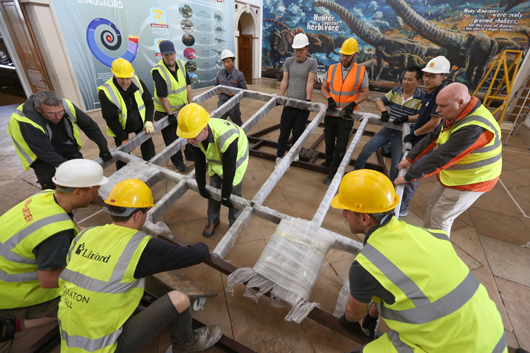
Preparing for the Dinosaur Exhibits

Preparing for the dinosaur exhibit.

Placing a steel frame to help support a dinosaur exhibit.

Picture Credit: Dinosaurs of China

Lots of Family-friendly Activities

Nottingham Lakeside Arts have lots of exciting family-friendly activities planned including an interactive exhibition that will explore how palaeo-art and science helps palaeontologists to work out what dinosaurs looked like.  Check out Nottingham University’s Life Science collection that will also be on display.

There will also be plenty of exciting activities and workshops to keep families entertained at Wollaton Hall too.  A free “Dino Explorer Zone” is being installed to provide families with a range of themed activities and puzzles.

All in all, there’s enough going on to make every young dinosaur fan roar with excitement and for the mums, dads, grandparents and guardians, you can expect to learn something new about these amazing prehistoric monsters.

Tickets for the exhibition are now on sale.  Prices are £7.70 for an adult and £5.50 for a child.  Family tickets are £22 for two adults and two children.  Children under five go free, so there really is no excuse – catch up with the dinosaurs from July 1st until October 29th!

For more information, please visit the Wollaton Hall website.

Please note this exhibition has now closed.

Visit the award-winning Everything Dinosaur website: Everything Dinosaur.
11 06, 2017

How Did the Cleveland-Lloyd Dinosaur Quarry Get Its Name?

By |2023-07-26T09:59:06+01:00June 11th, 2017|Categories: Dinosaur Fans, Geology, Main Page, Photos/Pictures of Fossils|0 Comments

How Did the Cleveland-Lloyd Dinosaur Quarry Get Its Name?

After having published an article on a new theory explaining the mass death dinosaur assemblage preserved at the Cleveland-Lloyd fossil site in the Morrison Formation (Brushy Basin Member), we were sent an email asking how the Cleveland-Lloyd Dinosaur Quarry got its name if the site is a long way from Cleveland, Ohio?

The Cleveland-Lloyd Dinosaur Quarry

It is true, the fossil site, which represents the greatest concentration of Jurassic dinosaur fossils known to science, is a very long way from the city of Cleveland, but it is near the small town of Cleveland, Emery County, in Utah.  This famous fossil site was named in part, as it was close to the town of Cleveland.  The second part of the hyphenated name “Lloyd” is all to do with funding,

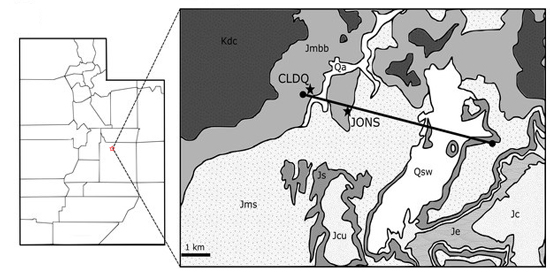
Map Showing Sites, Stratigraphic Section Line, and Regional Stratigraphy in Context of the San Rafael Swell

Location of the Cleveland-Lloyd Dinosaur Quarry.

Map showing sites, stratigraphic section line, and regional stratigraphy in context of the San Rafael Swell.

Picture credit: PeerJ

In the picture above CLDQ marks the location of the Cleveland-Lloyd Dinosaur Quarry and JONS indicates the location of the nearby Johnsonville fossil site in Utah.  The inset map shows the location of the Cleveland-Lloyd Dinosaur Quarry in relation to the rest of the state of Utah.

To read the article: The Mystery of the Cleveland-Lloyd Dinosaur Quarry.

Where Did the Lloyd Part of the Name Come From?

The site was first discovered in 1927, the first extensive excavations commenced in 1929, (University of Utah).  The siltstones were deposited in the Late Jurassic and the strata makes up part of the Brushy Basin Member at the northern end of the San Rafael Swell.  For the next decade, regular expeditions to the site were undertaken and these were funded, in the most part, by a lawyer from Philadelphia called Malcolm Lloyd.  This is how the famous dinosaur dig site came to be named.

The quarry is world-famous for its very high concentration of dinosaur bones.  The scattered remains of over seventy dinosaurs are believed to be present, representing nine dinosaur genera.  However, around two-thirds of all the bones are attributable to a single dinosaur taxon Allosaurus fragilis.  Most of the other bonebeds associated with the Morrison Formation contain a higher proportion of herbivorous dinosaurs. Furthermore, when the A. fragilis material is assessed over 85% of the fossils represent juveniles or sub-adults of the species.

Further exploration of this extremely fossil rich location is planned.

So, the site with the greatest concentration of Jurassic dinosaur bones known to science was named after a lawyer from Philadelphia and the nearest township.

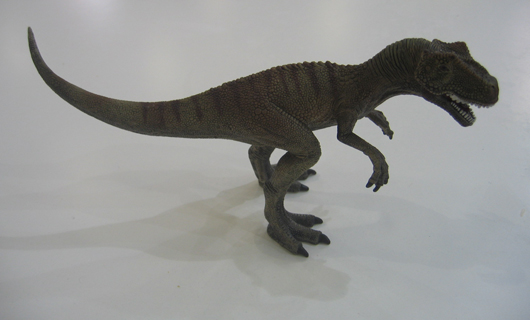
Allosaurus

A Model of Allosaurus a Dinosaur Associated with the Cleveland Lloyd Dinosaur Quarry

Schleich Allosaurus (2017).

The new for 2017 Schleich Allosaurus dinosaur model.  Picture credit: Everything Dinosaur.

Picture credit: Everything Dinosaur

Visit the Schleich section of the Everything Dinosaur website: Schleich Dinosaur Toys.

The picture shows a Schleich Allosaurus model (2017).

To visit the award-winning Everything Dinosaur website: Everything Dinosaur.
10 06, 2017

Fossils Rewrite the History of our Species

By |2023-07-26T09:15:06+01:00June 10th, 2017|Categories: General Teaching, Key Stage 3/4|Comments Off on Fossils Rewrite the History of our Species

Pushing Back the Origin of our Species by 100,000 Years

Fossil hominin remains from the Atlantic coast of Morocco indicate that our species Homo sapiens originated at least 100,000 years earlier than previously thought.  In addition, this north African discovery challenges the idea of eastern Africa as being the “cradle of humankind” – at least in terms of the evolution of our species.

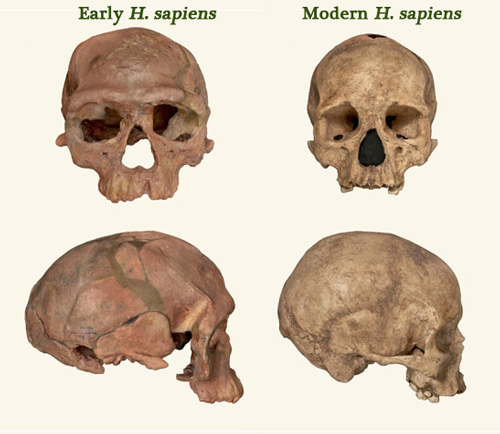
An Early Human Skull Compared to a Modern Human Skull (Homo sapiens)

Comparing Homo sapiens skull material.

Comparing Homo sapiens skull material.

Picture Credit: Natural History Museum (London) with additional annotation by Everything Dinosaur

Writing in the academic journal “Nature”, scientists that include lead author professor Jean-Jacques Hublin (Department of Human Evolution at the Max Planck Institute for Evolutionary Anthropology in Leipzig, Germany), have studied the fragmentary fossilised remains of five early humans and dated these remains to approximately 315,000 years ago.  Previous studies, had suggested that our species originated some 200,000 to 220,000 years ago.

Rewriting the Textbooks

Sixty miles west of the Moroccan city of Marrakesh, the remote cave site of Jebel Irhoud can be found.  The cave roof may have collapsed long ago, but this location has provided extremely important evidence about life in the Pleistocene Epoch.  This notable anthropological site was discovered in 1960, with the first extensive field work being undertaken a year later.  The limestone cave site has yielded a number of fossils of prehistoric mammals as well as bones and stone tools associated with both Neanderthals and our own species.  According to scientists, this new study indicates that the idea that our species evolved in eastern Africa is no longer tenable.  It is more likely that H. sapiens evolved all across the continent.

Professor Hublin stated:

“It is not the story of it happening in a rapid way in a “Garden of Eden” somewhere in Africa.  Our view is that it was a more gradual development and it involved the whole continent.  So, if there was a Garden of Eden, it was all of Africa.”

A Beautifully Preserved Human Jaw

The more than twenty human bones (from five individuals), include a nearly complete lower jaw, plus skull fragments. The material has been dated using several methods and the range of dates produced is between 280,000 to 350,000 years, with the most probable date around 315,000 years.

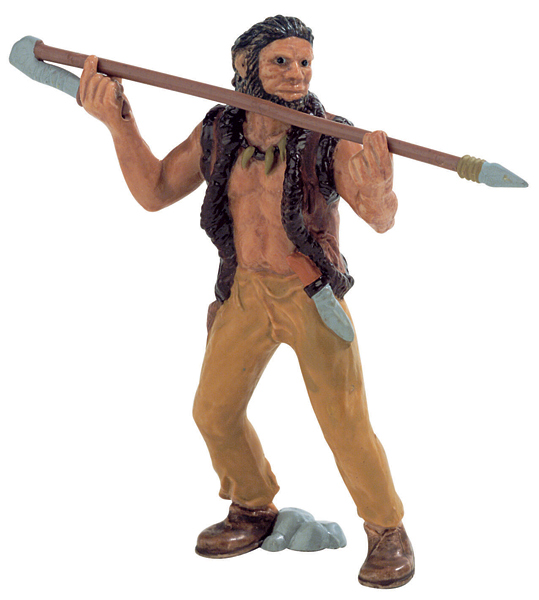
A Model of a Modern Human (H. sapiens)

Bullyland H. sapiens

A model of modern human being (H. sapiens).

The model (above) is from the Bullyland range of prehistoric animal figures.

To view this range: Bullyland Prehistoric Models and Figures.

Homo sapiens Fossils

The re-dating and the human remains from Jebel Irhoud convinced the research team that early H. sapiens once lived at this location.  The teeth, somewhat bigger when compared with those of modern humans, are a better match to H. sapiens than they are to Neanderthals or other known archaic humans.

The Jebel Irhoud skulls are elongated compared with those of modern people.  This suggests that these individuals’ brains were organised differently when compared to our own.

A spokesperson from Everything Dinosaur commented:

“These fossils overturn our ideas regarding the evolution of our species.  In addition, by comparing the skulls, jaws and teeth we can gain a better understanding of how our species Homo sapiens has evolved over the last 300,000 years.  We are not separate from the laws of natural selection, but very much shaped by them.”

Visit the award-winning Everything Dinosaur website: Everything Dinosaur.
Go to Top