All about dinosaurs, fossils and prehistoric animals by Everything Dinosaur team members.
10 06, 2017

New Mojo Fun Models Feature in Newsletter

By |2024-05-09T08:19:53+01:00June 10th, 2017|Categories: Dinosaur Fans, Everything Dinosaur News and Updates, Everything Dinosaur Newsletters, Main Page, Photos of Everything Dinosaur Products|1 Comment

Everything Dinosaur Newsletter Features Mojo Models

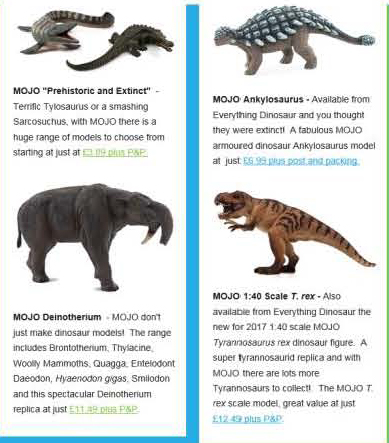
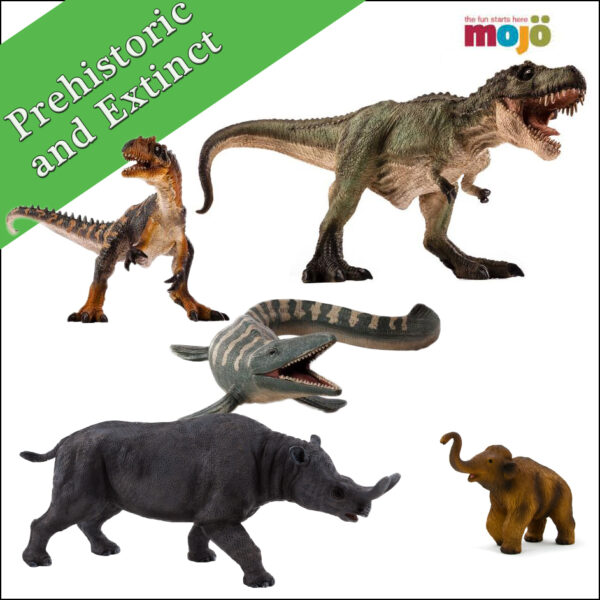
Mojo “Prehistoric and Extinct” models feature in the latest edition of the Everything Dinosaur newsletter.  To celebrate Mojo Fun models coming into stock at Everything Dinosaur, the latest company newsletter was dedicated to these excellent prehistoric animal models.

Mojo Fun Prehistoric Animal Figures Feature in the Everything Dinosaur Newsletter

Mojo prehistoric animal models.

Everything Dinosaur features Mojo “Prehistoric and Extinct” models in the latest newsletter.

Picture credit: Everything Dinosaur

Mojo Fun Models

Everything Dinosaur has introduced all thirty-one of the current figures made by Mojo in their “Prehistoric and Extinct” model range.  Unlike most other figure manufacturers, the Mojo range includes some recently extinct (or at least currently regarded as extinct), animals – creatures such as the Thylacine and the Quagga (a sub-species of Plains Zebra)*.  Naturally, the first model to be featured in the newsletter is the T. rex, specifically the green hunting Tyrannosaurus rex.  Mojo has a total of six “Tyrant Lizard King” replicas in its range, including a spectacular 1:40 scale model, which can be seen in the picture below (bottom right), as well as a model of a juvenile T. rex.

Marine Reptiles and Prehistoric Mammals in the Mojo “Prehistoric and Extinct” Range

Mojo Fun models.

Mojo “Prehistoric and Extinct” animal figures.

Picture credit: Everything Dinosaur

Mojo Fun – Animal Planet

Mojo was founded eight years ago (2009), the company focuses on the design and production of high quality models.  Better known as “Mojofun”, the first model range was introduced in 2011 and the company’s product portfolio has grown steadily since.  The enthusiastic Mojo team members have plenty of ambition, they intend to continue to create the finest quality models that they can and to increase the range of animals featured.

The thirty-one models in the “Prehistoric & Extinct” range represent a total of nineteen different creatures, all of them are either reptiles or mammals and they lived during the Mesozoic or the Cenozoic Eras.  The breakdown is as follows:

  • Dinosaurs = nine dinosaurs represented (4 carnivores and 5 herbivores).
  • Prehistoric Mammals = six animals are represented.
  • Recently Extinct* = two models (Thylacine – Tasmanian Tiger and the Quagga)
  • Marine Reptiles = one model (Tylosaurus)
  • Prehistoric Crocodile = one model (Sarcosuchus)

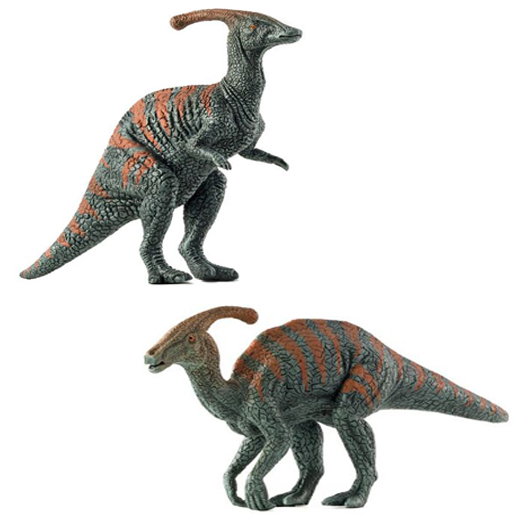
Several of the Mojo “Prehistoric and Extinct” models have recently been re-painted, allowing a number of new colour variants to be introduced.  The Mojo Parasaurolophus models are a case in point (see picture below).

Mojo Parasaurolophus Models (Biped and Quadruped)

Mojo Parasaurolophus dinosaurs.

The Mojo Parasaurolophus dinosaur models (biped and quadruped).

Picture credit: Everything Dinosaur

Studies of the fossilised bones of the duck-billed dinosaur Parasaurolophus indicate that this large, Late Cretaceous dinosaur was a facultative biped.  It probably spent most of its time on all fours, but when the need arose, for example, to flee an attacking tyrannosaur, this dinosaur could run using just its hind legs.  We congratulate Mojo for including two versions of Parasaurolophus in its model range – one in a bipedal pose, the other representing Parasaurolophus as a quadruped.

Mojo “Prehistoric and Extinct” Models

Almost as many mammal models are included in the ” Prehistoric and Extinct” range as dinosaurs.  Model collectors have seen the number of prehistoric animal models in production decline in recent years, the addition of figures such as the Mojo Smilodon, Deinotherium and the Entelodont Daeodon, to Everything Dinosaur’s inventory is very welcome.

A spokesperson from Everything Dinosaur commented:

“Mojo produces Velociraptor, Triceratops and Stegosaurus models and of course, this range offers a variety of tyrannosaurs, but one of the attractions for us is that Mojo also offers some of the less common prehistoric animals such as a Hyaenodon replica and a Brontotherium.  We know that these types of replicas are greatly appreciated by model collectors.”

To view the range of Mojo “Prehistoric and Extinct” models available from Everything Dinosaur: Mojo Prehistoric and Extinct Models.

Extinction*

The last known Thylacine (Tasmanian Tiger), died in captivity in 1936.  It is officially recognised as extinct, but a genetic research programme has been established for nearly twenty years with the aim of ultimately re-introducing these animals via cloning.  In addition, periodic sightings and reports of living Thylacines both from Tasmania and the Australian mainland have prompted a team of scientists to set camera traps in a remote part of northern Queensland to see if they can obtain evidence of a living population.  To read more about this: The Hunt for Tasmanian Tigers.

The Quagga Project was established in 1987 to reintroduce Quagga-like phenotypes via a selective breeding programme.

Visit the Everything Dinosaur website: Everything Dinosaur.

To subscribe to the Everything Dinosaur newsletter, email us: Contact Everything Dinosaur.

9 06, 2017

The Mystery of the Cleveland-Lloyd Dinosaur Quarry

By |2023-07-26T07:24:24+01:00June 9th, 2017|Categories: Dinosaur and Prehistoric Animal News Stories, Dinosaur Fans, Main Page|2 Comments

Has the Cleveland-Lloyd Dinosaur Quarry Mystery Been Solved?

One of the most prolific dinosaur fossil sites to be found anywhere in the world lies thirty miles to the south of the town of Price in Utah.  The site is close to the small community of Cleveland (Emery County) and some 15,000 dinosaur bones have been collected from this site to date.  The strata represent Upper Jurassic siltstone (Brushy Basin member of the Morrison Formation) and this location is the densest collection of Jurassic dinosaur fossils known to science.

Jurassic Dinosaur Fossils

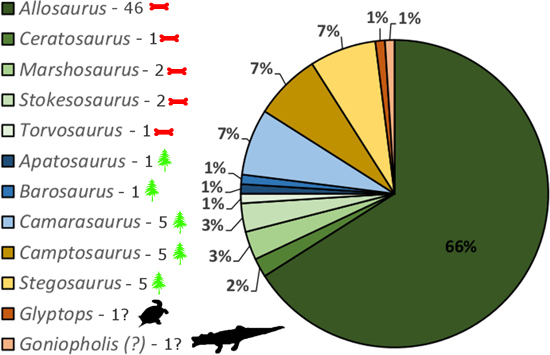
Since the first excavations were carried out in the late 1920s, palaeontologists have been puzzled by the assemblage of vertebrate fossils they found.  Although, carnivorous dinosaurs were probably less common in the palaeoenvironment than the plant-eaters, at this site, the fossils of theropods (carnivores) outnumbers the fossils of herbivorous dinosaurs by almost three to one.  In addition, the most common dinosaur fossil material is Allosaurus, the bones of this large dinosaur are extremely numerous at least forty-six individuals (based on femur bone counts) are recorded.

A Mounted Skeleton of the Late Jurassic Carnivore Allosaurus

Papo Allosaurus new colour scheme (2019).

The Papo Allosaurus new colour scheme.  Picture credit: Everything Dinosaur.

Picture credit: Everything Dinosaur

The picture (above) shows a Papo Allosaurus model.

To view the Papo model range: Papo Dinosaur and Prehistoric Animal Figures.

For nearly one hundred years, palaeontologists have puzzled over this unique fossil assemblage.  Why is this particular location so full of the bones of carnivorous dinosaurs?  Why are the vast majority of these bones from a single genus – Allosaurus?

A Pie Chart Showing the Proportion of Different Dinosaur Fossils from the Cleveland-Lloyd Quarry

Cleveland-Ohio fossil assemblage.

A pie chart showing the proportion of dinosaur fossils by genus.

Picture credit: PeerJ with additional annotation by Everything Dinosaur

The pie chart above lists dinosaur fauna plus one turtle (Glyptops) and a crocodyliform (Goniopholis) from the Cleveland-Lloyd Dinosaur Quarry.  The bone symbol identifies meat-eating dinosaurs and the fir tree, plant-eating dinosaurs.  The fossils of Allosaurus dominate the bonebed.

Theories Explaining the Cleveland-Lloyd Dinosaur Quarry Bonebed

Several theories have been suggested as to what caused the build-up of dinosaur fossils at this location and why the majority of them represent one carnivorous genus.

  • This was a predator trap.  A pond attracted dinosaurs to the site as it was a source of water in the dry season.  These animals got stuck in the mud and they died, this in turn attracted scavengers who also become stuck and perished.
  • This site could mark a mass death assemblage of a lot of dinosaurs which died in a drought.
  • Was the water source toxic and this poisoned a lot of dinosaurs?  The rotting corpses attracted scavengers and these too were poisoned.

Writing in the academic journal “PeerJ” a team of researchers have put forward a new theory to explain the unusual taphonomy (the process of fossilisation).  The use of modern data techniques suggests that the quarry represents a series of catastrophic events that occurred at the same place over time, rather than a single mass death assemblage.

A New Theory

The research team, which included lead author Joseph Peterson (University of Wisconsin-Oshkosh), conclude that the myriad of small bone fragments found at the site, were created during periods of drought as bones which were not buried were weathered and eroded away on the surface.  Dinosaur carcasses were washed into the site which represented a temporary (seasonal or ephemeral pond) during frequent flood events.  As the corpses decayed, they led to very high levels of minerals and organic material in the water (hypereutrophic conditions).  This discouraged scavenging (which explains the lack of gnaw marks and other evidence of scavenging by predators at the site).

As more flood events took place, so more corpses were washed into the area and the existing skeletons were re-deposited.  Hence the jumble of bones.  The hypereutrophic water created an environment in which fish, turtles and crocodiles could survive and carnivorous dinosaurs were dissuaded from eating the carcasses.  Only a handful of crocodyliform teeth have been found at the Cleveland-Lloyd site, along with some turtle shell fragments, whereas, elsewhere in the Morrison Formation, turtle and crocodyliform teeth are much more numerous.

Explaining the Unusual Bonebed at the Cleveland-Lloyd Quarry Site

How did the Cleveland-Lloyd fossil site form?

Explaining how the Cleveland-Lloyd fossil site came into being.

Picture credit: PeerJ

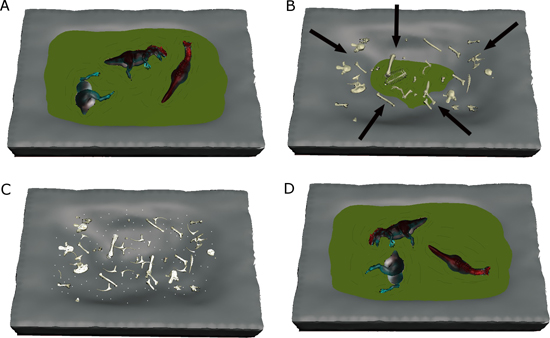
The image above reflects the newly proposed theory as to how the Cleveland-Lloyd Dinosaur Quarry formed.

(A) A flood causes the carcasses of dinosaurs to be deposited in the quarry area.  High levels of organic matter decaying leads to hypereutrophy (an excess of minerals in the water source).  This discourages predators from scavenging and deters freshwater fauna such as fish, turtles and crocodile-like creatures.

(B) As water levels fall during the dry season, bones that were not buried during the flood stage remain exposed on the surface.

(C) In arid conditions the surface bones are subjected to weathering and erosion.

(D) A subsequent flood event leads to more carcasses being incorporated and the reworking of existing bones within the deposit.

The scientists conclude that this cycle was repeated until the deposit maintained a higher water table, producing the limestone layers above the bone-bearing silts and muds.

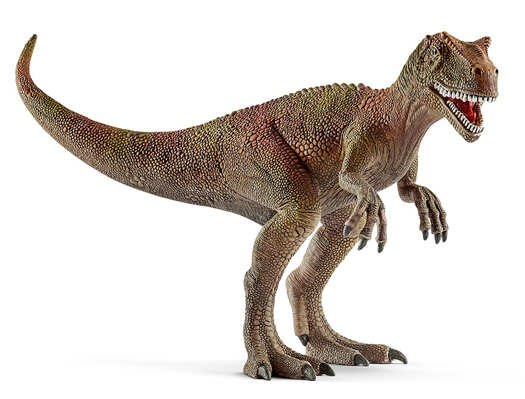
A Model of the Fearsome Late Jurassic Predator Allosaurus (A. fragilis)

Schleich dinosaur model (Allosaurus).

The new for 2017 Schleich Allosaurus dinosaur model.

To view the Schleich dinosaur model range: Schleich Dinosaur and Prehistoric Animal Figures. 

The picture (above) shows a Schleich Allosaurus model, one of an extensive range of Schleich dinosaurs.

Visit the Everything Dinosaur website: Everything Dinosaur.

8 06, 2017

Remarkable Megalosaurus Fossil Still Surprises

By |2024-05-09T08:20:24+01:00June 8th, 2017|Categories: Dinosaur and Prehistoric Animal News Stories, Dinosaur Fans, Main Page|0 Comments

World’s First Named Dinosaur Reveals New Teeth

The fossils that led to the first scientific account of a dinosaur can still provide some surprises, even 193 years after the original paper describing them was published.  The first dinosaur to be scientifically described Megalosaurus (M. bucklandii), has stepped once more into the spotlight.  A team of researchers have discovered five new teeth within the lower jaw fossil of the world’s first named dinosaur.

Megalosaurus Fossils Used to Describe the First Dinosaur in 1824

The lower jaw of Megalosaurus.

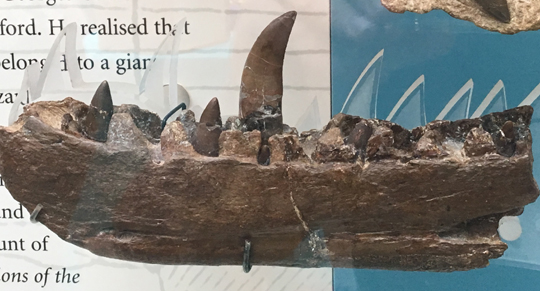
The partial dentary for teeth associated with Megalosaurus bucklandii.  Picture credit: Everything Dinosaur.

Picture credit: Everything Dinosaur

The picture above shows the right dentary of Megalosaurus.  It is on display at the Oxford University Natural History Museum.

Using state-of-the-art computer tomography scanning technology and three-dimensional computer generated modelling software, the researchers from the Warwick Manufacturing Group (WMG), an academic department at the University of Warwick, in collaboration with scientists from the University of Oxford’s Museum of Natural History have been able to provide new insights about one of the most iconic fossils in the world.

One of the authors of the study, presented this week at the Institute of Electrical and Electronics Engineers (IEEE)’s conference in Italy, Professor Mark Williams stated:

“Being able to use state-of-the-art technology, normally reserved for aerospace and automotive engineering, to scan such a rare and iconic natural history specimen was a fantastic opportunity.  When I was growing up I was fascinated with dinosaurs and clearly remember seeing pictures of the Megalosaurus jaw in books that I read.  Having access to and scanning the real thing was an incredible experience.”

Famous Dinosaur Jawbone

In 1824, the Reverend William Buckland published a description of various fossils that had been found as quarrying tunnels were excavated at Stonesfield, north of Witney in Oxfordshire.  The fossils had been found some years before, the dentary having been placed in the collection of the Oxford Anatomy School at Christchurch College (Oxford) in 1797.  Reverend Buckland believed the fossilised bones and teeth came from a giant, antediluvian lizard, hence the name “Big Lizard”, Megalosaurus having been proposed by James Parkinson in 1822.

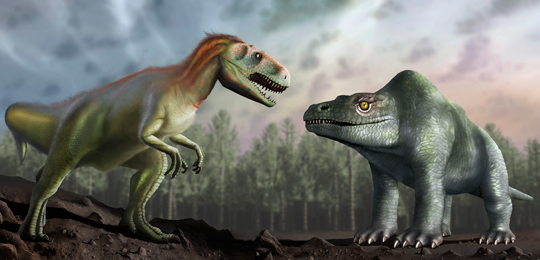
A 19th Century Interpretation of Megalosaurus Compared to a Modern Interpretation of M. bucklandii

The changing view of Megalosaurus.

A modern interpretation of Megalosaurus (left) with a reconstruction based on the original illustration by Richard Owen (right).

Picture credit: University of Warwick/Mark Garlick

The illustration above shows an artist’s impression of how Victorian palaeontologists such as Richard Owen thought the Megalosaurus looked (right), compared with a modern interpretation of this Middle Jurassic carnivore.

Digital Three-dimensional Image of the Dentary

Using state of the art CT scanning technology and specialist three-dimensional analysis software, Professor Williams took more than 3,000 X-ray images of the world-famous Megalosaurus jawbone, creating a digital three-dimensional computer generated image.  The image revealed five previously unseen teeth embedded in the dentary and also provided important insights into historical repairs.  It turns out that there is actually less plaster and filler in the fossil, as this technique has allowed scientists to see the extent of the infilling and repairs for the first time.

Megalosaurus bucklandii was Probably an Apex Predator

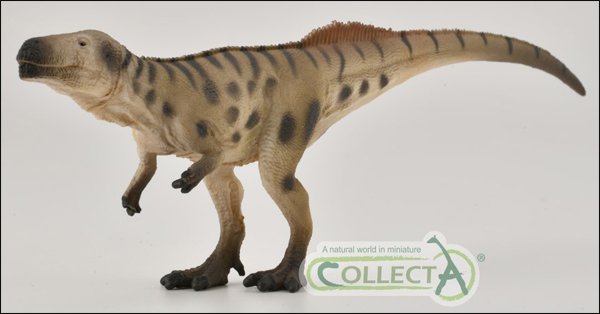
CollectA Megalosaurus in ambush dinosaur model.

The new for 2021 CollectA Megalosaurus in ambush dinosaur model.

The picture (above) shows the CollectA Megalosaurus in ambush dinosaur figure.

To view this range: CollectA Age of Dinosaurs Popular Figures.

Megalosaurus Fossil Jawbone

The specimen is damaged, it is likely that some of the damage occurred when the fossil was excavated but over the two hundred years since the fossil was found some restoration work has taken place.  For example, records at the Oxford University Museum of Natural History, where the specimen is housed, show that sometime between 1927 and 1931 repairs to the jawbone took place.  The scans show the true extent of repairs on the fossil for the first time, revealing that there may have been at least two phases of repair, using different types of plaster.  This new information will help the museum make important decisions about any future restoration work on this iconic fossil.

The analysis also revealed the presence of five teeth that had not been detected before.  The teeth consist of the remains of old, worn and broken teeth plus embryonic replacement teeth.  Unlike us, Megalosaurus was able to continually replace its teeth throughout its life.  The replacement tooth grew inside the jaw, adjacent to the root of the active tooth on the lingual* side of the jaw.

A full-sized, but very thin crown formed first and this grew in thickness as more layers of dentine were added.  The growth of the embryonic tooth placed pressure on the active tooth root, causing the root to become slowly reabsorbed into the jawbone.  The replacement tooth was able to push itself inside the old tooth root and effectively usurp that tooth from the socket in the jaw where it had been located.  The old, worn tooth having been weakened, would most likely break and the crown would be lost, permitting the younger tooth to replace it in the jawline.  A similar process is seen in extant Crocodylia today.

Helping to Identify Forgeries

This research was made possible through a collaboration between Professor Williams’ research group at WMG, University of Warwick – including PhD researcher Paul Wilson – and Professor Paul Smith, director of the Oxford University Museum of Natural History.   When not being scanned or used in other research, the Megalosaurus jawbone forms part of an extensive British dinosaur fossil display at the Oxford University Museum of Natural History.

An ability to utilise a non-invasive technique to map fossil material provides palaeontologists and conservators with vital information about the preservation status of a specimen.  It also identifies and maps any repairs that have taken place previously.  In addition, this technique which does not harm the fossil, can detect the presence of filler and other modifications often added by unscrupulous dealers to raise the potential value of their fossil finds.

Forgeries and hoaxes have no hiding place when it comes to CT scans.

The research was recently presented at the Institute of Electrical and Electronics Engineers (IEEE)’s International Instrumentation and Measurement Technology Conference in Torino, Italy.

The scientific paper, “Utilising X-Ray Computed Tomography for Heritage Conservation: The case of Megalosaurus bucklandii”

Visit the Everything Dinosaur website: Everything Dinosaur.

8 06, 2017

Everything Dinosaur Adds Mojo Models to the Range

By |2023-07-26T07:02:03+01:00June 8th, 2017|Categories: Dinosaur Fans, Everything Dinosaur News and Updates, Everything Dinosaur Products, Main Page, Photos of Everything Dinosaur Products, Press Releases|2 Comments

Mojo ” Prehistoric and Extinct” Models Available from Everything Dinosaur

Everything Dinosaur has added the Mojo “Prehistoric and Extinct” model range to its portfolio of prehistoric animal models.  All thirty-one of the current range of figures is now stocked by Everything Dinosaur, everything from Ankylosaurus to the Young Tyrannosaurus rex and every model in between.

Everything Dinosaur is Proud to Add Mojo Models to Its Range

Mojo dinosaur and prehistoric animal models.

Mojo “Prehistoric and Extinct” model range.  Picture credit: Everything Dinosaur.

Picture credit: Everything Dinosaur

To view the complete range of Mojo models stocked by Everything Dinosaur: Mojo “Prehistoric and Extinct” Models.

Dinosaur Models

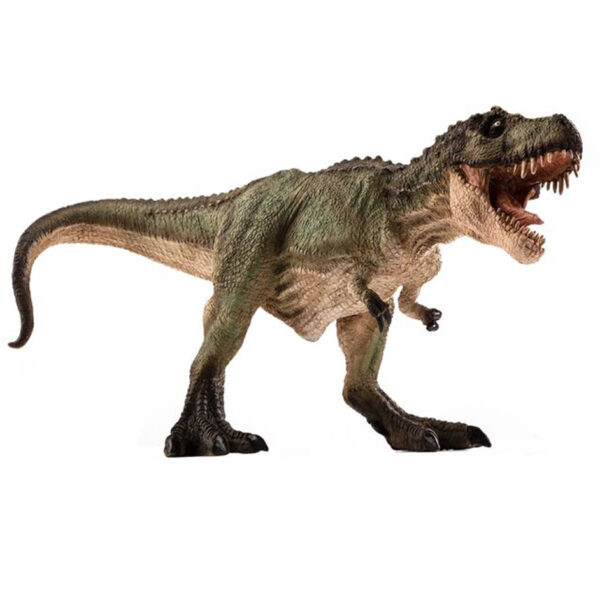
The current range includes all the popular dinosaurs.  There are Brachiosaurus models, stegosaurs, Velociraptors and of course several different models of T. rex including a 1:40 scale replica and a new for 2017, pair of hunting “Tyrant Lizard Kings”.  You have a choice, do you prefer the green hunting T. rex or the fiery red version?

The Green Hunting Tyrannosaurus rex Dinosaur Model by Mojo

Hunting T. rex dinosaur figure (Mojo).

The Mojo hunting T. rex (green).

Mojo Fun Models

For fans of theropods, along with the T. rex replicas and three different Velociraptor models to collect, there is also a new for 2017 Allosaurus model too.  All of the models are suitable for children from three years of age and they are all hand-painted.

Not Just Dinosaurs but Prehistoric Mammals Too!

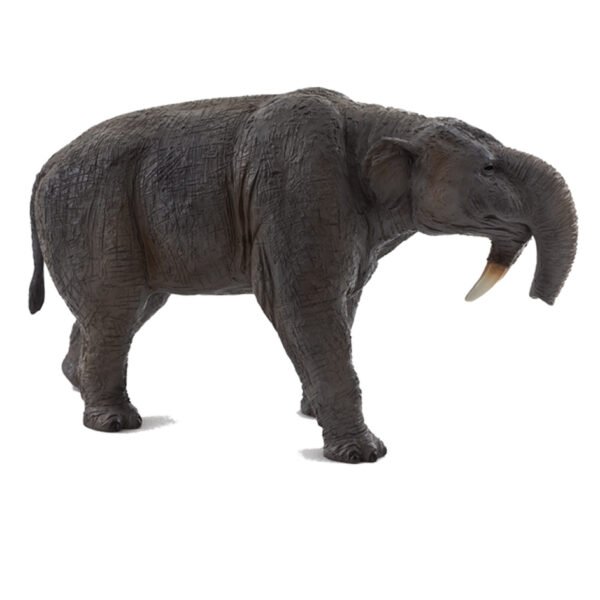
One of the great things about the Mojo “Prehistoric and Extinct” model range is that it features lots of other types of extinct animal as well as dinosaurs.  For example, the current range also includes a Deinotherium, Sabre-toothed Cat, an entelodont (Daeodon), the vicious Hyaenodon gigas, two Woolly Mammoth replicas and a wonderful brontothere (Brontotherium).  We at Everything Dinosaur accept that Brontotherium is a junior synonym of Megacerops, but that did not stop us writing a fact sheet about this “Thunder Beast”!  In fact, all of the Mojo models sent out by Everything Dinosaur are despatched with a fact sheet about the animal, written and researched by our own team members.

The Mojo ” Prehistoric and Extinct” Deinotherium Model

The Deinotherium model by Mojo.

Mojo Deinotherium model.

Recently Extinct Creatures

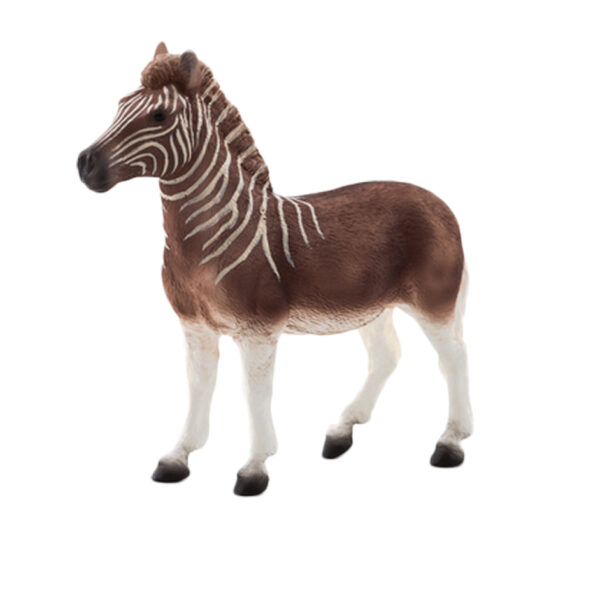
Everything Dinosaur has also brought in models representing animals that have only recently been declared extinct*.  Within the Mojo range there is a model of the Quagga, a recently extinct sub-species of Plains Zebra from southern Africa.  There is also an excellent Thylacine replica for fans to collect.

The Mojo Quagga Model

Mojo Quagga replica.

* There is an ongoing selective breeding programme to breed back Quagga traits in a herd of zebra, subsequent generations have produced animals with more Quagga-like colouration.

* Scientists in Australia are currently setting camera traps in a bid to capture evidence of a small living population of Thylacines.  The “Tasmanian Wolf” may not be extinct, some fragmented populations may still exist in the more remote parts of Australia, especially on the island of Tasmania.

These two figures certainly don’t look out of place amongst all the Mojo dinosaur models.

To view all the Mojo “Prehistoric and Extinct” replicas available from Everything Dinosaur: Mojo Fun Prehistoric Animal Models.

Visit the Everything Dinosaur website: Everything Dinosaur.

8 06, 2017

T. rex Not Feathered After All According to New Research

By |2024-05-09T08:20:50+01:00June 8th, 2017|Categories: General Teaching|Comments Off on T. rex Not Feathered After All According to New Research

Tyrannosaurus rex Had Scaly Skin

A team of international scientists including Professor Phil Currie (University of Alberta) and Robert T. Bakker (Houston Museum of Natural Science), have concluded that Tyrannosaurus rex was probably not covered in a coat of shaggy feathers.  A study of T. rex skin impression fossils found in association with a 30% complete skeleton of the “Tyrant Lizard King” in Montana indicate that this iconic carnivorous dinosaur had scaly skin like a modern-day reptile.

Tyrannosaurus rex Not Covered in Feathers

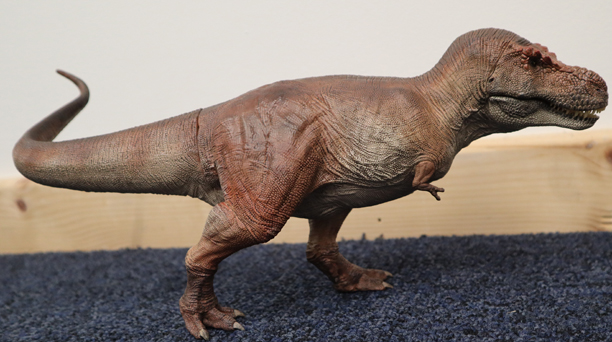
Rebor T. rex Tusk dinosaur model.

The Rebor T. rex Tusk King T. rex Requiem model is supplied with a clear plastic support base but our models appear quite stable even standing on our office carpet without the need for the support stand. This is a T. rex model that does not show any feathers. Picture credit: Everything Dinosaur.

Picture credit: Everything Dinosaur

The model (above) is a Rebor T. rex figure.

To view the Rebor model range: Rebor Prehistoric Animal Models.

Dinosaurs with Feathers

A number of dinosaurs are known to have sported feathers and some did have shaggy, feathery coats.  A member of the same clade of dinosaurs to which T. rex belongs, a big, meat-eating dinosaur called Yutyrannus (Y. huali), from China did have a feathery coat.  Based on this evidence a number of scientists proposed that dinosaurs such as Tyrannosaurus rex and its near relatives were also feathered.

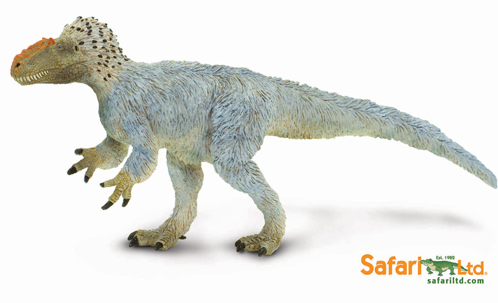
A Feathered Tyrannosaur Dinosaur Model

Available from Everything Dinosaur.  A feathered tyrannosaur figure.

The model (above) is from the Wild Safari Prehistoric World range.

To view this range: Wild Safari Prehistoric World Figures.

Extension Ideas

How do scientists know that some dinosaurs had feathers?   Link to fossil evidence and what fossils can tell us about life in the past.  This article might prove helpful as it provides pictures of feathered dinosaur fossils and a reconstruction of a feathered dinosaur: New Feathered Dinosaur from China with Pennaceous Feathers.

Why might some dinosaurs have had feathers?  There are a number of potential answers, for example, some dinosaurs may have had dense coats of feathers to help keep them warm, (insulation), in the same way that many birds and mammals have insulating feathers and fur today.  Can the class provide of examples from the natural world?  Feathers might also have been used for display or for visual communication.  Can the children provide examples of birds that use feathers not just for flying but for display – peacocks, birds of paradise etc.

One of the T. rex Skin Impression Fossils 

Tyrannosaurus rex skin impression.

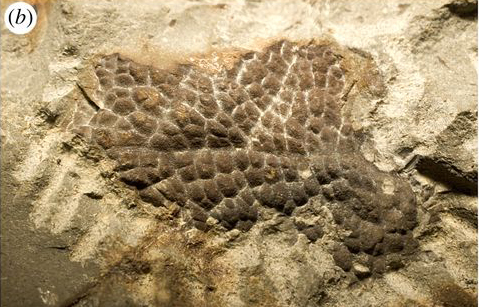
Preserved integument from the neck (b) of T. rex specimen HMNS 2006.1743.01

Picture credit: Biology Letters

For more information about the recent research into the Montana T. rex specimen with its skin impressions: Has T. rex Shed Its Feathers?

Visit the Everything Dinosaur website: Everything Dinosaur.

7 06, 2017

T. rex Sheds Its Feathers?

By |2023-07-25T07:47:34+01:00June 7th, 2017|Categories: Dinosaur and Prehistoric Animal News Stories, Dinosaur Fans, Main Page|6 Comments

The Scaly Skin of Tyrannosauroids

So, it is published!  A team of eminent scientists, some of the leading lights in palaeontology, have published in the Royal Society Biology Letters details of research that questions whether Late Cretaceous tyrannosaurids, including the iconic Tyrannosaurus rex sported a coat of feathers.

Research into T. rex Feathers

At Everything Dinosaur, we have known about the fossils upon which this research is based, for some time.  Indeed, we are aware of a number of research projects taking place exploring the evidence for integumentary coverings in the Dinosauria.  This new study looks at skin impressions from several Late Cretaceous, giant tyrannosaurs and concludes that despite early tyrannosauroids having feathers, T. rex and its near relatives, most likely had scaly skin.

A Fluffy, Feather Covered Tyrannosaurus rex
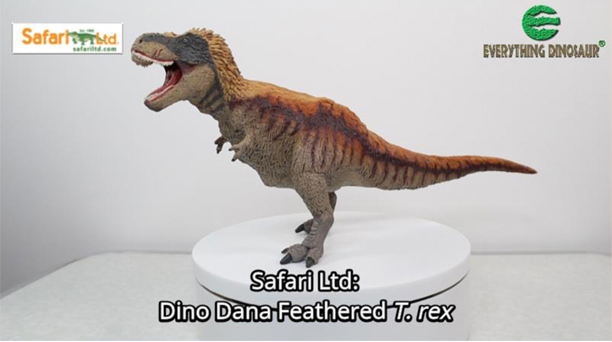
Dino Dana feathered T. rex video showcase.

The Dino Dana feathered T. rex video showcase titles.  A feathered T. rex.

Picture credit: Everything Dinosaur

The image (above) shows the Dino Dana feathered T. rex figure.

To view this range: Wild Safari Prehistoric World.

The research has generated some surprising headlines, looks like many media outlets have got into a bit of a flap:

“Feather furore: T. rex may not have been fluffy after all, skin study suggests” – The Guardian.

“Tyrannosaurus rex had scaly skin:  Here are the controversial reasons why scientists think the dinosaur was NOT covered in feathers” – Mail Online

“Jurassic Park may have been right about the T-rex after all” – Silicon Republic

“Here’s what it would feel like to pet a T. Rex” – National Geographic

Some quick points:

  • If you publish a story that features Tyrannosaurus rex lots of media outlets are likely to cover it.
  • You can expect some sensational headlines.
  • Expect numerous faux pas when it comes to the “Tyrant Lizard King” – rapped knuckles for Silicon Republic and National Geographic!  No hyphen in T-rex, no capital letter for the trivial name etc.

What Does the Study Show?

The research team led by Dr Phil Bell (University of New England, New South Wales, Australia), examined the fossilised skin impressions associated with a partial skull and postcranial material of a Tyrannosaurus rex specimen “Wyrex” from the Hell Creek Formation of Montana.  These fossils are part of the vertebrate fossil collection at the Houston Museum of Natural Science, hence one of the co-authors, Robert T. Bakker’s (curator of palaeontology at the Houston museum), involvement in the study.

The specimen represents around 30% of an entire skeleton, it was excavated from upper Maastrichtian strata near the town of Baker (Montana), in 2003 and it was formerly part of the Black Hills Institute fossil collection (BHI 6230), hence the participation in the study by Pete Larson (Black Hills Institute of Geological Research, South Dakota).  The gracile form of the skeleton suggests that “Wyrex” was male.

Preserved Skin Impression on the Neck of “Wyrex”
Tyrannosaurus rex skin impression.

Preserved integument from the neck (b) of T. rex specimen HMNS 2006.1743.01

Picture credit: Biology Letters

“Wyrex” is Special

“Wyrex” is special, as in association with the fossilised bones and teeth, several patches of the integument are preserved as impressions.  These impressions represent skin from the neck, the pelvic area and from the tail.  The tail skin impressions are the most numerous, but all of them combined do not represent a very large part of the surface area of a T. rex.  The patches are very small ranging in size from less than a postage stamp in area to an impression of approximately 30 square centimetres, a tail skin impression that that would have covered less than a third of the screen on an average mobile phone.  Although these impressions are very small, any form of integument preservation is remarkable and they have provided an invaluable insight.

Integument of Tyrannosaurus rex (HMNS 2006.1743.01)
The extent of the skin impressions.

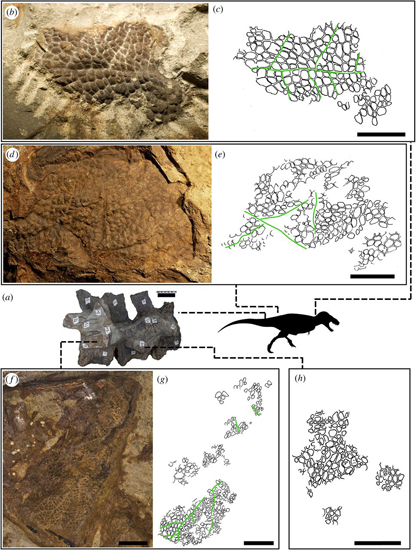
The extent of the skin impressions on the “Wyrex” specimen.

Picture credit: Biology Letters

Skin Impressions on Tyrannosaurus rex Fossil

The picture above shows impressions and where they are located on the T. rex (see silhouette).  Three bones are shown (a), they are bones from near the base of the tail (caudal vertebrae 6-8) which are associated with skin impressions (f), (g) and (h).  Integument from the neck (b, c) and from the ilium (pelvis) in (d, e).  The line drawings show the great variation in the size and shape of the scales.  The researchers highlight the variety of the scales, some are elliptical, some are elongated, whilst others are irregular six-sided polygons.

Note the scale bars, in a lot of the media coverage, the actual size of the impressions has not been reported, the scale bars in the picture above:

(a) = 10 centimetres, (b-e) = 5 millimetres and (f-h) = 10 millimetres

Not Just Tyrannosaurus rex Skin in the Study

To the north of Montana, lies the Canadian Province of Alberta.  Geography lesson over, but noting the location of Montana is significant, as scientists from the University of Alberta and the Royal Tyrrell Museum (also in Alberta), have played a part in this research.  Illustrious figures from the world of palaeontology such as Professor Phil Currie and Scott Persons (University of Alberta) and Darren Tanke (Royal Tyrrell Museum).  These luminaries along with Nicolás Campione (Uppsala University, Sweden), have helped compile a new data set plotting tyrannosauroid integument against body size.

This study looked at fossil skin impressions from a number of other Late Cretaceous relatives of T. rex, monsters such as Albertosaurus, Gorgosaurus, Daspletosaurus, all from North America, plus Tarbosaurus from Asia.

The Late Cretaceous Daspletosaurus (Fossils found in Montana and Alberta)
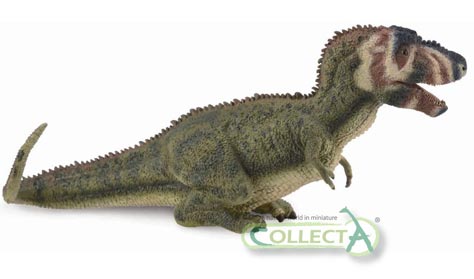
A sitting Daspletosaurus.

The fearsome tyrannosaurid Daspletosaurus.

Picture credit: Everything Dinosaur

The model (above) is the CollectA Prehistoric Life Daspletosaurus.

To view this model range: CollectA Prehistoric Life Replicas.

Large-bodied Forms had Scaly Skin

The research team conclude that these large-bodied forms possesses scaly, reptilian-like skin.  By mapping integument against body size against the tyrannosauroids, a more extensive data set than just the Tyrannosauridae family, the team postulate that large body-size evolved two times in the evolutionary history of this substantial group.  Early tyrannosauroids such as Yutyrannus (Y. huali), which was feathered, was part of one branch of the tyrannosauroids that became giants and gigantism occurred again in later tyrannosaurids such as T. rex, Gorgosaurus, Albertosaurus et al.

The data suggests that shaggy, feathery coats as found in some early tyrannosauroids, were lost by the Albian faunal stage (around 112 million years ago).  Later tyrannosaurs, those that were the ancestors of the very last members of the Tyrannosauridae to evolve, did not have feathery coats.

 Yutyrannus Roamed Northern China 125 Million Years Ago
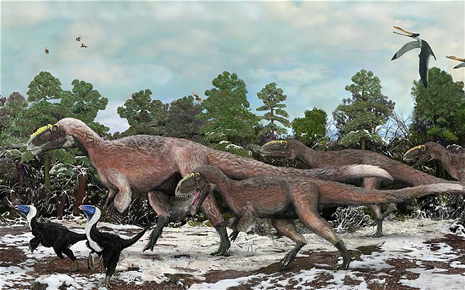
A flock of Yutyrannus.

Giant theropod with Feathers from Liaoning Province

Picture credit: Brian Choo

To read an article about the discovery of Yutyrannus hualiOne Tonne Feathered Tyrannosaur.

Yutyrannus – A Tyrannosaur Game Changer

The discovery of a large (up to nine metres long and weighing 1.4 Tonnes), tyrannosaur provided evidence that giant theropods could have been covered in a shaggy coat.  Prior to the description of Y. huali (the name means beautiful feathered tyrant), back in 2012, the only tyrannosaurs discovered with proto-feathers were much smaller animals, dinosaurs such as Dilong, (D. paradoxus), which also roamed China.  It had been thought that smaller tyrannosaurs, with their warm-blooded metabolisms evolved feathers to help keep their bodies insulated.  However, here was a much larger dinosaur, one that was also covered in feathers.

In this new research, the scientists conclude that the environment that Late Cretaceous giants such as Albertosaurus and T. rex lived in had a similar climate to the environment that Yutyrannus lived in millions of years before.  They discount the idea that the big Late Cretaceous tyrannosaurs had feathers to keep them warm.  The larger the animal, the smaller the surface area compared to their volume and therefore big creatures tend to be better at retaining heat than smaller ones.  In the paper, it is argued that a big, thick coat of feathers may have been a real hindrance to a Tyrannosaurus rex, as its active lifestyle could have given it serious problems with over-heating.

A Close View of the Skin Impression over the Pelvic Area (Ilium) of T. rex
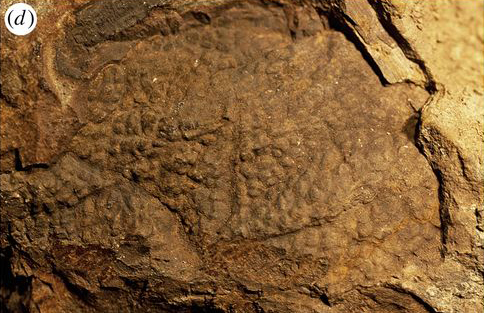
Scales on a T. rex.

T. rex integumentary covering over the ilium.

Picture credit: Biology Letters

Tyrannosauroid versus Tyrannosauridae

The assessment of these scale impressions along with the analysis of tyrannosauroid integument against body size does not necessarily mean that T. rex was definitely covered in scaly skin.  This new research may cast doubt on the idea of an adult, Late Cretaceous tyrannosaur looking like a giant chicken, but it is important to note that the researchers comment that dinosaurs such as Albertosaurus, Gorgosaurus and T. rex may have had feathers on those parts of the their body which are not represented by skin impressions in the fossil record – on their backs, or around the top of the head for example, hence the partially feathered Tyrannosaurus rex image featured in this article.

As juveniles, having an insulating covering of downy feathers does make anatomical sense.  The idea that members of the Tyrannosauridae may have had feathers at some stage of their lives cannot be discounted in the same way as that stating that T. rex may have had feathers on some parts of the body cannot be discounted as we lack the fossil evidence to disprove this statement.

The scientists do state that whilst more basal members of the Tyrannosauroidea may have had feathers, later more derived tyrannosaurs, those animals within the family Tyrannosauridae probably did not.   The key word to note is “probably”.

Let’s quickly explain what this means.

An Ancient Lineage of Dinosaurs

The tyrannosaurs are a very ancient lineage of dinosaurs, they evolved in the Jurassic and persisted right up until the Cretaceous mass extinction event.  The clade Tyrannosauroidea represents the family Tyrannosauridae, to which Albertosaurus, Tarbosaurus, Gorgosaurus, Daspletosaurus and T. rex are part, along with more basal, earlier tyrannosaurs.

Tyrannosauroids and Tyrannosauridae Explained
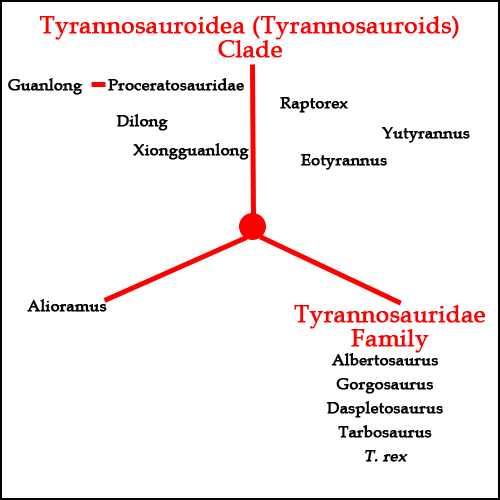
Tyrannosauroids and Tyrannosauridae members.

The difference between the Tyrannosauroidea and the Tyrannosauridae.

Picture credit: Everything Dinosaur

In the simplified diagram above, the Tyrannosauridae family is shown as being a part of the larger Tyrannosauroidea clade.  Some well-known examples of the Tyrannosauroidea clade as well as members of the Tyrannosauridae family are listed.

The Preservation Factor

Only in very exceptional circumstances can delicate feathers and proto-feathers be preserved.  Tough skin has a better preservation potential than filamentous feathers that formed a shaggy coat.  Feathers could have been present in members of the Tyrannosauridae, but they simply have not been preserved, so we have no evidence of their existence. Experiments revealing how the corpses of birds decay may help palaeontologists to better understand what happens to feathers after death and their likelihood of being preserved.

Conclusions

In what is a thought provoking and well-argued piece, the scientists comment that their findings reveal significant changes within the integument of tyrannosauroids, especially when compared to skin impressions of later members of the Tyrannosauridae.  These changes in body coverings require better understanding and further evidence to help palaeontologists to explain them.  The unambiguous loss of extensive body coverings in the Tyrannosauridae merits further discussion.

To mark the publication of the Biology Letters article, we cooked chicken.  We left the skin on and from the picture below, you can see the skin but there are no signs of the feathers that would have covered parts of the bird.  We suspect that this debate over the appearance of more derived tyrannosaurs is going to rumble on.

Commemorating the Publication with a Chicken Dish
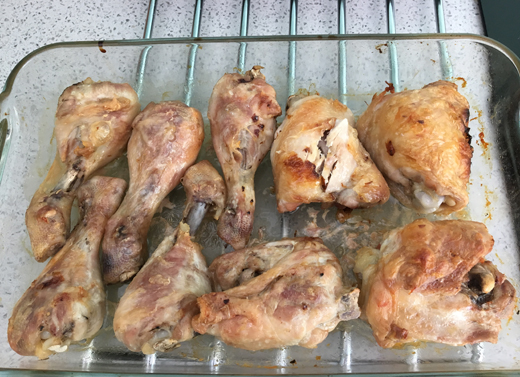
Cooked chicken showing the skin.

Cooked chicken, you can see the skin but not much evidence of feathers.

Picture credit: Everything Dinosaur

Which Do You Prefer Feathered or Non-Feathered?
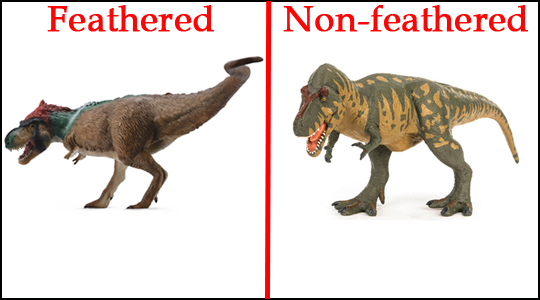
Did T. rex have feathers?

Which do you prefer a feathered or a non-feathered T. rex?

The scientific paper: “Tyrannosauroid Integument Reveals Conflicting Patterns of Gigantism and Feather Evolution”, by Phil R. Bell, Nicolás E. Campione, W. Scott Persons, Philip J. Currie, Peter L. Larson, Darren H. Tanke, Robert T. Bakker published in the Royal Society Biology Letters.

Visit the Everything Dinosaur website: Everything Dinosaur.

6 06, 2017

Foul-mouthed Study – Variation in Duck and Goose Beaks

By |2023-07-25T07:25:20+01:00June 6th, 2017|Categories: Animal News Stories, Dinosaur and Prehistoric Animal News Stories, Dinosaur Fans, Main Page|0 Comments

Diet Shaped the Evolution of the Beaks of Ducks and Geese

For Aaron Olsen, a walk in a park to see the ducks and other birds serenely swimming on the local pond has added significance.  Ducks and geese, common waterfowl that we are all familiar with, have fascinated the postdoctoral researcher at Brown University (Rhode Island, USA).  For Aaron, seeing gaggles of geese and rafts of ducks has led him to question how such a myriad of different beak forms have evolved within the waterfowl clade (Anseriformes).  Publishing in the academic journal “Functional Ecology”, the scientist has concluded that different diets and different feeding strategies are the main drivers of beak shape.

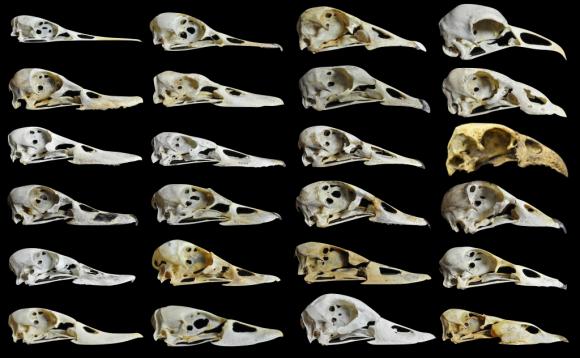
The Beaks of Ducks and Geese Come in All Shapes and Sizes

Anseriformes - skulls variation due to dietary preferences.

From left to right a gradient of duck-to-goose-skulls. Research shows that waterfowl beaks vary primarily because of differences in diet and feeding behaviour.

Picture credit: Aaron Olsen

Ancient Anseriformes (Prehistoric Ducks and Geese)

The analysis of the relationship between beak shape and diet amongst waterfowl shows that feeding is most likely to be the major influence on bill shape, but it also suggests that the early members of the Anseriformes were more like ducks than geese.  The main evolutionary driver when it comes to the shape of the beaks of waterfowl is their diet.

Commenting on his research, Aaron Olsen, of the Department of Ecology and Evolutionary Biology at Brown University stated:

“This is the most comprehensive look to date at the relationship between diet and beak shape.”

The oldest member of the Anseriformes is Vegavis (V. iaai), fossils of which have been found in Upper Cretaceous rocks (Maastrichtian faunal stage) of Antarctica.  Waterfowl, the ancestors of today’s ducks and geese were present some 66 million years ago, although their evolutionary roots probably go back further into the Mesozoic.

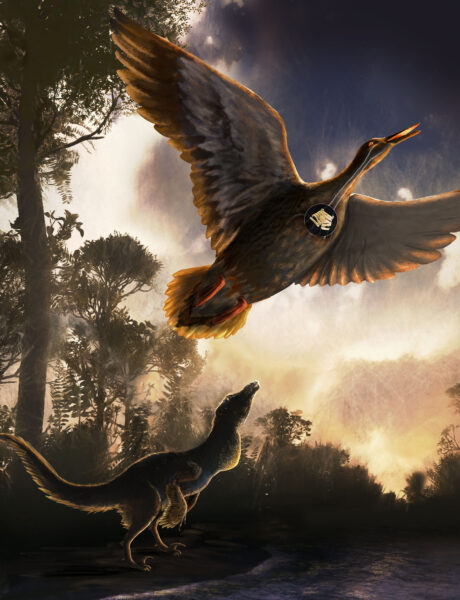
Vegavis of Late Cretaceous Antarctica

The vocalisation of dinosaurs and birds.

Vegavis takes off whilst a male theropod dinosaur vocalises close by.

Picture credit: Nicole Fuller/Sayo Art for University of Texas at Austin

Scientists have identified the vocalisation organ of Vegavis, this bird may have made a honking sound.

To read more about this research: Ancient Bird Box Sheds Light on the Sounds of Early Anseriformes.

Waterfowl – Different Beak Shapes

Whilst working at the University of Chicago and the nearby Field Museum of Natural History, Aaron set out to explore the reasons why waterfowl have such differently shaped beaks.  He suspected that diet and feeding behaviour might play a pivotal role in beak morphology, but rather than compare diets and feeding strategies he undertook a detailed three-dimensional analysis of bird skulls and their bills.  He then cross-referenced his findings with literature on the diet of each bird.  A total of 136 specimens were involved in the study, covering 46 genera and 51 species.

As well as looking at living species, the study included an analysis of the recently extinct, flightless duck Thambetochen chauliodous of the larger Hawaiian Islands (except Hawaii), which prior to the arrival of domesticated animals, were the main browsers of vegetation on the isolated archipelago.  The research also involved an analysis of the skull and beak of a much older water bird – Presbyornis spp. from the Palaeocene and the Eocene Epochs.

Extant Goose Skull and Extant Duck Skull Compared to the Ancient Anseriform Presbyornis

Comparing duck and goose skulls.

A Cape Barren goose skull (top) has a very different beak than that of a freckled duck (middle), which does resemble the fossil skull of Presbyornis (bottom).

Mathematical Analysis – Plotting Beak Evolution

Data analysis revealed that there was a strong correlation between dietary preferences and beak shape.  Ducks tend to have relatively long, wide-tipped beaks that can accommodate a lot of water. Ducks feed by filtering out food such as invertebrates and plant seeds from water, whereas geese evolved to feed on the leaves and roots of plants (although some still filter feed).  Most geese have shorter, narrower beaks better designed for browsing on plants.

Dr Olsen contends that the correlation between beak morphology and diet is so strong that other roles for beaks, such as preening and cooling would have had little influence, although he does not rule out these other functions having a role in the evolution of beak shape.

First Ducks then Geese

In a review of the scientific literature, Aaron, a specialist in anseriform research, suggests that the early ancestors of extant ducks, geese and other related waterfowl, were very duck-like.  Geese-like beaks evolved later, evolving several times in several places.  In summary, Dr Olsen concludes a duck-like beak is ancestral for most waterfowl with several independent transitions to a more goose-like beak shape occurring over time.

Next time you are in the park, take a look at the ducks and other water birds, the ancestors of these birds lived alongside the dinosaurs.  It’s also worth noting that ducks and geese are technically dinosaurs too, after all, they are all members of the Theropoda.

Non-Avian Dinosaurs and Avian Dinosaurs (Birds)

Dinosaurs and birds.

Avian and non-avian dinosaurs.

Picture credit: Everything Dinosaur

The scientific paper: “Feeding Ecology is the Primary Driver of Beak Shape Diversification in Waterfowl”, by Aaron M. Olsen published in Functional Ecology.

Visit the Everything Dinosaur website: Everything Dinosaur.

5 06, 2017

A Couple of CollectA Video Reviews

By |2023-07-25T07:14:47+01:00June 5th, 2017|Categories: Dinosaur Fans, Everything Dinosaur Products, Everything Dinosaur videos, Main Page, Product Reviews|0 Comments

CollectA Gigantspinosaurus and CollectA Excalibosaurus Video Reviews

Everything Dinosaur takes a look at two CollectA prehistoric animal model video reviews.

Visit Everything Dinosaur’s website: Everything Dinosaur.

Matthew the Dinosaur King’s YouTube channel has nearly 150 dinosaur and prehistoric animal themed videos on it.  In the last few days, two new videos have been posted, both reviews of new for 2017 CollectA Prehistoric Life models.  Matthew has provided a video review of the Chinese basal stegosaurid Gigantspinosaurus and the English Jurassic marine reptile Excalibosaurus and both videos are extremely informative.

Matthew the Dinosaur King Presents a Video Review of the CollectA Gigantspinosaurus

Video credit: Matthew the Dinosaur King (YouTube channel)

Matthew’s YouTube channel has over 6,000 subscribers (that’s awesome) and we at Everything Dinosaur enjoy seeing the various prehistoric animal reviews and other items that the enthusiastic channel owner posts up.  It is a great channel for fans of dinosaurs and dinosaur model collecting.

The CollectA Gigantspinosaurus Model (CollectA Prehistoric Life Series)

In the Gigantspinosaurus video, which lasts a little over five minutes, viewers are given the opportunity to have a really good look at this exotic member of the Thyreophora.  It is one of a number of armoured dinosaurs that have been added to the CollectA Prehistoric Life model series over the years, it is good to see such a wide variety of armoured dinosaurs in the range.

The narrator pays special attention to those amazing parascapular spines, although the anatomical position of these huge “comma-like” spines is still debated and their exact purpose open to some speculation, most palaeontologists would agree with the way in which these structures are portrayed in the CollectA model.  All praise to the video maker for taking time out to show the detail on the small head, including on the inside of the mouth.   In the video, the colour scheme is commented upon, like the narrator, we at Everything Dinosaur like the choice of colours.

The CollectA Excalibosaurus Marine Reptile Model

The CollectA Excalibosaurus Video Review

Video credit: Matthew the Dinosaur King (YouTube channel)

In this short video (duration 3:43), the narrator provides information about when this bizarre marine reptile lived, how big it was and where its fossils have been found.  The CollectA Excalibosaurus model is then reviewed with the model being shown at lots of different angles so that would-be collectors can get a good look at this replica.

The CollectA Deluxe Pliosaurus

Towards the end of the video the CollectA Deluxe Pliosaurus model is introduced to provide a size comparison.  It’s helpful when various models are compared side by side, although for the Excalibosaurus in this case, it does not end well, with the narrator placing the figure in the jaws of the giant Pliosaurus.

To view the CollectA Deluxe model range: CollectA Deluxe Prehistoric Animal Model Range.

Videos like these permit fans of prehistoric animal models and figures to discuss their collection, to highlight the details in certain models and to inform and educate the viewers about what scientists have deduced about these long extinct animals from their fossils.  We urge our blog readers to checkout Matthew the Dinosaur King’s YouTube channel.

To view the CollectA Gigantspinosaurus and the CollectA Excalibosaurus figures and the rest of the CollectA Prehistoric Life model range: CollectA Prehistoric Life models

4 06, 2017

Thumbing Through the Amazing Iguanodontia

By |2024-05-09T08:21:25+01:00June 4th, 2017|Categories: Dinosaur and Prehistoric Animal News Stories, Dinosaur Fans, Main Page|0 Comments

Sorting Out Eolambia caroljonesa

The Cedar Mountain Formation of the western United States has yielded a number of important dinosaur discoveries, helping to map the megafauna of America during the Cretaceous.  Iconic dinosaurs such as the armoured herbivore Gastonia and the “raptors” Deinonychus and Utahraptor are known from the various members that make up the Cedar Mountain Formation.  However, the most abundant dinosaurs in terms of the genera named are ornithopods and a team of scientists including researchers from the Field Museum (Chicago), have published a new paper helping to identify where, in the dinosaur family tree, one ornithopod – Eolambia caroljonesa should be placed.

An Ornithopod Dinosaur Riddle

The youngest member of the Cedar Mountain Formation (a member being a distinct, identifiable portion of a rock formation that can be identified as a stratigraphic unit), is the Mussentuchit Member and the most common dinosaur fossils associated with these strata relate to Eolambia caroljonesa.

This herbivorous dinosaur is known from quite extensive fossils including skull material and three bonebeds that contain the jumbled up remains of a number of juveniles.  Named by the famous American palaeontologist James Kirkland in 1998, Eolambia means “early or dawn Lambeosaur”, reflecting the proposed taxonomic position of this dinosaur as being a basal member of the lambeosaurines (crested duck-billed dinosaurs).

Eolambia caroljonesa

Over the last two decades, since the discovery and naming of Eolambia, many more iguanodontian dinosaurs have been named.  This has helped palaeontologists to better understand the evolution of ornithopods from the non-hadrosaurid forms known from the Early Cretaceous to the duck-billed dinosaurs which were prevalent during the Campanian to Maastrichtian faunal stages of the Cretaceous (Late Cretaceous).

Writing in the on-line academic journal PLOS One, the researchers describe some further postcranial remains of Eolambia from the Mussentuchit Member.  The fossils represent a sub-adult animal and as a result, these bones are more helpful when it comes to establishing autapomorphies (unique features), that help to establish where in the dinosaur family tree Eolambia should be nested.

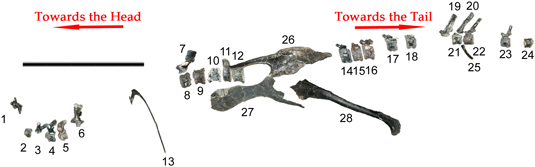
The Eolambia Postcranial Fossils Laid Out in an Approximate Life Position

Eolambia fossils.

Eolambia postcranial fossil material laid out in approximate life position.

Picture credit: PLOS One with additional annotation by Everything Dinosaur

Calculating the Size of Eolambia caroljonesa

The picture above shows the newly described postcranial fossil material laid out in approximate skeletal position, using the better known iguanodontid Mantellisaurus atherfieldensis as a template.  The scale bar equals one metre.  One of the outcomes of this new study is that the research team will be able to provide a better estimate of the true size of Eolambia.

When first named by Kirkland, this dinosaur was estimated to be around eight to nine metres in length.

However, Gregory S. Paul (2010), suggested that Eolambia was considerably smaller with a total body length of around six metres.  Having to rely on juvenile material makes estimating the adult size of a dinosaur very difficult.  The ilium (number 26 in the picture above), measures a fraction under seventy-one centimetres in length.  Everything Dinosaur team members have examined their data files and compared this measurement to the size of ilia from other iguanodontids.  For example, the ilium of the Spanish iguanodontid Delapparentia turolensis measures seventy-eight centimetres long.  As Delapparentia is estimated to have been up to ten metres in length, it is likely that a fully-grown Eolambia could perhaps measure around nine metres from nose to tail.

Comparing Eolambia Pelvic Material (E. caroljonesa)

Eolambia pelvic fossils.

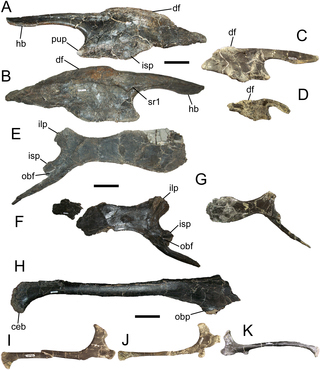
Eolambia pelvic material (sub-adult specimen compared to juvenile material).

Picture credit: PLOS One

The picture above shows the sub-adult pelvic material representing the new specimen FMNH PR 3847 (A, B, E, F, H and K) compared to other known fossil material including juvenile remains (C, D, G, I and J).  The scale bar equals ten centimetres.  Histological analysis from a sample of rib bone indicates that this dinosaur was between eight to nine years of age when it died.

Eolambia in the Dinosaur Family Tree

Specimen FMNH PR 3847 provides new anatomical detail regarding the back bone and pelvic girdle of E. caroljonesa.  As the fossils come from a sub-adult, the scientists have been more confident in the phylogenetic assessment of where within the Ornithopoda Eolambia should be nested.  The researchers conclude that this dinosaur was only very distantly related to the lambeosaurines and that it was a basal hadrosauromorph closely related to Protohadros byrdi, fossils of which come from similarly aged rocks (Cenomanian faunal stage), from Texas (Woodbine Formation).

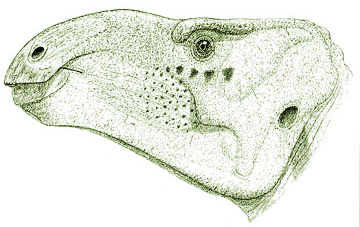
An Illustration of Eolambia

Eolambia illustration.

An illustration of the hadrosauromorph Eolambia.

Signs of a Predatory Dinosaur

The fossils were deposited in strata that was formed in a crevasse splay feature – sediment deposited when a stream breaks its banks and deposits sediment on the flood plan.  Along with the dinosaur bones the scientists identified a large number of crocodylomorph teeth and small bones and a tooth from a gar (fish).  Intriguingly, the team also found broken teeth from a large, meat-eating dinosaur.  Although, the exact taxon cannot be pinned down, the scientists postulate that these teeth could have come from Siats meekerorum, an apex predator known from similar aged strata in Utah.

Teeth Found in Association with the Eolambia Material

Teeth found in association with Eolambia fossil material.

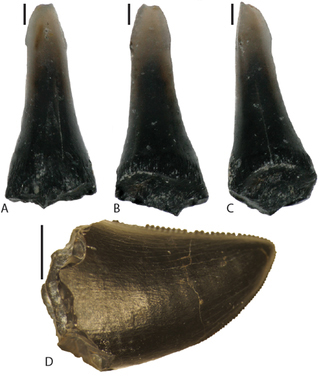
Views of a tooth from a gar (fish) and below a theropod tooth Siats meekerorum?

Picture credit: PLOS One

The scale bar for the single gar tooth (several views) is 0.2 centimetres, the scale bar for the theropod tooth is 0.5 centimetres.

The Eolambia species name honours Carole Jones who, along with her husband Ramal Jones, discovered the fossil site from which the first fossils of this dinosaur including the holotype material was collected.

For dinosaur models and prehistoric animal replicas: Dinosaur and Prehistoric Animal Models.

3 06, 2017

Everything Dinosaur Achieves a Remarkable 100% FEEFO Service Rating

By |2024-05-09T08:21:46+01:00June 3rd, 2017|Categories: Everything Dinosaur News and Updates, Main Page, Press Releases|0 Comments

Everything Dinosaur Sets Standard with Customer Service

Everything Dinosaur has reached the milestone of achieving 100 independent customer reviews on FEEFO with a service rating of 100%.  We would like to take this opportunity to thank all our customers who have reviewed our products and customer service on FEEFO, we are truly humbled to have received the feedback and to be able to set and continue to set such a high standard.

Everything Dinosaur Rated 100% for Customer Service

100% service rating (Everything Dinosaur).

Everything Dinosaur service rating 100%.

Picture credit: Everything Dinosaur

Everything Dinosaur and Feefo Ratings

When Everything Dinosaur launched their new website Everything Dinosaur, on the 23rd of February, one of many innovations added to the site was the FEEFO feedback section.  FEEFO collects genuine reviews from customers, giving those people who have purchased from us the opportunity to provide feedback on how we dealt with their order.  To date, we have received 119 service reviews and a staggering 225 product reviews, not too bad considering the FEEFO section has been operating for just over a hundred days!

FEEFO Rates Everything Dinosaur 100%

Feefo service rating for Everything Dinosaur 100%.

Everything Dinosaur’s current service rating (June 2017) = 100%.

Picture credit: Everything Dinosaur

FEEFO believe that dedication to excellent service should be celebrated.  The company offers a number of awards, for example, the independent Trusted Merchant accreditation.  If a business receives a hundred reviews within a year, with a service rating of 95% and over, that company has earned FEEFO’s most prestigious award the “Gold Trusted Merchant Award”.

Annual Awards

Trouble is, FEEFO’s marketing department sends out awards just once a year (March), so companies like Everything Dinosaur, which started gathering reviews late February, did not have enough time to collect the number of reviews required to win the award in 2017.  However, we think it is important to acknowledge the feedback from our customers, so today we are posting up this short article to celebrate reaching this landmark.

In addition, we have created our own badge to commemorate this achievement.

Everything Dinosaur and FEEFO

Everything Dinosaur and FEEFO customer service.

Everything Dinosaur has a 100% FEEFO service rating.

Picture credit: Everything Dinosaur

To view Everything Dinosaur’s page on the FEEFO website: Everything Dinosaur on FEEFO.

FEEFO Ratings Are Prominently Displayed on the Everything Dinosaur Website

Everything Dinosaur customer ratings.

Feefo ratings on the Everything Dinosaur website.

Picture credit: Everything Dinosaur

Visit the award-winning Everything Dinosaur website: Everything Dinosaur.
Go to Top