All about dinosaurs, fossils and prehistoric animals by Everything Dinosaur team members.
5 03, 2010

The Red Headed League Research into the Colour of Dinosaurs

By |2024-04-19T09:48:59+01:00March 5th, 2010|Categories: Dinosaur Fans, Educational Activities, Everything Dinosaur News and Updates, Main Page|0 Comments

Red Colouration in Predatory Dinosaurs

Team members at Everything Dinosaur explore the idea that there was red colouration in predatory dinosaurs.

Evidence suggests that dinosaurs had good colour vision, studies of brain cases can provide an indication of the volume of the brain and analysis of the preserved holes in the skull that carried the nerves back and forth can suggest which senses were important.  For example, with Tyrannosaurus rex the orbits in the skull (eye sockets) were large compared proportionately with other reptiles, birds and mammals.  Some scientists have postulated that the big tyrannosaurs had the largest eyes of any land animal.  The optic nerve of T. rex has been estimated to be more than 2 cm in diameter, indicating that a lot of information was being passed from the eyes to the brain.

Red Colouration

Crocodiles and birds have colour vision, indeed some birds, most notably the raptors have exceptional eyesight – hence the phrase “eyes like a hawk”.  Recent discoveries have shown that many dinosaurs may have been brightly coloured, so colours of plumage and scales may have been very important to the Dinosauria.  A recent paper, published on behalf of a group of British and Chinese scientists even suggested that some small, theropod dinosaurs were ginger coloured.

To read more about “ginger” dinosaurs: Melanosomes Provide Further Proof of Feathered Dinosaurs.

With the theory that dinosaurs had good colour vision; model makers and manufacturers can go to town with the colours and patterns they put onto their various dinosaur replicas and toys.  Just like animals today, many dinosaurs would have been camouflaged or patterned in a particular way, natural selection favouring those creatures that were best adapted to their environments.  Other dinosaurs may have used colour to communicate with other members of their species or to threaten or intimidate predators and prey.

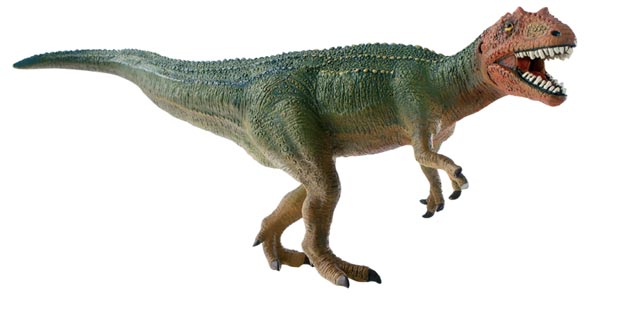
An example, of a novel use of colour can be seen in the new scale model of the fearsome meat-eater Giganotosaurus by Bullyland of Germany.  This hand-painted 1:30 scale model is painted a mixture of dark green and mustard on the tail, the back and the flanks, but the head and the throat has been depicted in a contrasting, bright red pigment.

The Giganotosaurus Model from Bullyland of Germany
Picture credit: Everything Dinosaur

To view the Bullyland range of prehistoric animal figures: Bullyland Dinosaur and Prehistoric Animal Models.

Bullyland Giganotosaurus

This is a large model, of a large carnivorous dinosaur.  Indeed, based on the fossil evidence, Giganotosaurus may be one of the largest meat-eating dinosaurs of all time.  Fossils excavated from Patagonia in Argentina (remarkably 70% of an adult skeleton is known), indicate that these animals may have reached lengths in excess of 50 feet.  The bright red head is very striking when compared to the rest of the body and at first glance this looks like an unusual choice of colouration for a model of an apex predator, especially when considered in context with other data known about Giganotosaurus.

Studies have shown that the ratio of the thigh bone to the lower leg bones indicate that this dinosaur was not a particularly fast runner.  It probably specialised in hunting the large long-necked, slow moving titanosaurs.

But why the red head?  There has been a lot of controversy over whether large theropod dinosaurs were hunters or mainly scavengers.  The American palaeontologist John “Jack” Horner has championed the hypothesis that these large creatures were primarily scavengers.  The hunter versus scavenger debate continues today, with advocates citing evidence from both extinct and extant creatures to support their point of view.  In all likelihood, a large carnivore such as T. rex or Giganotosaurus would not turn down the opportunity of a free meal if it came across a carcase.  So it is quite likely that these animals were opportunist scavengers to some extent.

Those predators that could chase off other carnivores and steal their kills would have a distinct advantage.  This behaviour is seen in Africa today, with, for example hyenas chasing off lions and robbing them of their hunting spoils.  A big theropod, with a strikingly marked head appearing on the scene could intimidate other predators and scare them away from their meal.

Hence the reason for the bright markings on the head of the Giganotosaurus model.  Smaller allosaurs confronted with a large 40 foot plus predator roaring, and flashing its large teeth in its huge jaws with some vigorous head bobbing would have probably been enough to see off even the most determined and hungry dinosaur.
4 03, 2010

Mass Extinction Event at end of Cretaceous was Caused by Extra-terrestrial Impact According to New Study

By |2024-04-19T09:47:43+01:00March 4th, 2010|Categories: Dinosaur and Prehistoric Animal News Stories, Geology, Main Page|0 Comments

Dinosaurs Wiped out by Extra-terrestrial Impact

An international panel of experts having reviewed the current evidence related to the Cretaceous mass extinction event have come down strongly on the side of those scientists that claim it was a huge space impact that led to the extinction of the dinosaurs.

Cretaceous Mass Extinction Event

The team of experts published their conclusions following a review of the last twenty year’s research into the extinction event located at the K/T boundary.  Their findings were discussed at the 41st Lunar and Planetary Science Conference held in Texas.

According to this eminent group, the dinosaurs, flying reptiles, marine reptiles and a number of other major groups of animals became extinct 66 million years ago, when an extra-terrestrial object, an asteroid or meteorite, smashed into the Gulf of Mexico.  This huge rocky object, estimated at over 10 kilometres wide; blasted a hole more than 100 kilometres across in the Earth’s crust and hit the Earth with the estimated force of 100 million hydrogen bombs.  Geophysical analysis of the Chicxulub crater (the site of the impact), suggests that the object from space was travelling at more than 30 kilometres a second when it crashed into the sea.  Analysis of the impact crater suggests that this object approached at a low angle from the southeast, a furrow in the south west segment of the crater provides the tell-tale evidence of the direction of the impact.

Space Impact Theory

The first scientists to put forward the theory of a space impact causing the mass extinction event marking the end of the age of reptiles and wiping out approximately 50% of all the species on the planet was father and son team, Luis and Walter Alvarez.  In 1980, they publicised the discovery of a worldwide layer of clay rich in the rare element iridium.  They speculated that the iridium had been deposited as the result of a huge collision with a large, rocky object from outer space.  A number of theories for the demise of much of the mega fauna approximately 65 million years ago have been put forward.  A strong candidate was the potential global catastrophe caused by repeated volcanic eruptions in India – the Deccan Traps.  The changes in the climate would have had a significant impact on life on Earth, but the scientists meeting in Texas have strongly endorsed the space impact theory as being the primary cause of the death of the likes of Tyrannosaurus rex, the ammonites and the mosasaurs.

Commenting on this new report, Dr Gareth Collins from the Department of Earth Science and Engineering at Imperial College London stated:

“The asteroid was about the size of the Isle of Wight and hit Earth 20 times faster than a speeding bullet.  The explosion of hot rock and gas would have looked like a huge ball of fire on the horizon, grilling any living creature in the immediate vicinity that couldn’t find shelter.  Ironically, while this hellish day signalled the end of the 160 million year reign of the dinosaurs, it turned out to be a great day for mammals, who had lived in the shadow of the dinosaurs prior to this event.  The KT extinction was a pivotal moment in Earth’s history, which ultimately paved the way for humans to become the dominant species on Earth.”

The object from space would have caused fire storms and earthquakes, and blasted material high into the atmosphere, blocking out the Sun to trigger a “nuclear winter” that would have killed off much of the Earth’s life in a matter of days.

Scientists have speculated that most of the large animals in North America would have perished within a short period of time following the impact.  Other types of creature, living in areas further away from the impact would have become extinct over a longer period of time.  Ammonites for example, already under pressure according to the lack of fossils and lack of diversity of genera in Upper Cretaceous sediments may have persisted for another 250,000 years before finally becoming completely extinct.

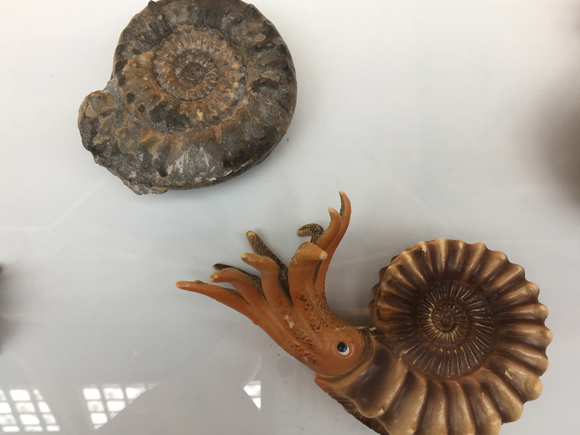
An Ammonite Fossil and a Replica

We spotted a Bullyland ammonite model being used to help illustrate a display of ammonite fossils. Ammonite replicas.

The iconic ammonite!  These cephalopods may have persisted for a few thousand years after the impact event before finally becoming extinct. A Bullyland ammonite model is used to help illustrate a display of ammonite fossils. Picture credit: Everything Dinosaur.

Picture credit: Everything Dinosaur

The model shown above is a Bullyland ammonite replica. To view the Bullyland range of prehistoric animal figures: Bullyland Prehistoric Animal Models and Figures.

Last year, we reported on the publishing of a scientific paper that refuted the claim that an extra-terrestrial collision caused the mass extinction.  It seems that this debate is set to continue for a long time.

To read the article challenging the impact theory: Published Study Rejects Asteroid Impact Theory.

In another controversial twist to the arguments being presented, a team of scientists from the U. S. Geological Survey, published a paper last year on their research into the survival of some types of dinosaur into the Cenozoic.  This team reported on the findings of hadrosaur fossils that may have been found in post-Cretaceous strata.  Whether this was evidence of some types of dinosaur surviving the mass extinction event or whether this is evidence of fossil re-deposition has been hotly debated.

To read more about dinosaurs surviving beyond the Cretaceous: Did some Dinosaurs survive into the Palaeogene?

3 03, 2010

Dinosaurs Around 10 Million Years Earlier than Previously Thought

By |2023-03-04T19:56:11+00:00March 3rd, 2010|Categories: Dinosaur and Prehistoric Animal News Stories, Main Page|0 Comments

Fossil Evidence from Tanzania Provides New Insight into Dinosaur Evolution

The Triassic is regarded as a transitional period in the evolution of vertebrates, the Permian mass extinction event devastated the mega fauna of planet Earth, with something like 95% of all species becoming extinct.  It was into this brave, new world of the Triassic, that the ancestors of the dinosaurs evolved and they, plus their archosaur relatives were soon to dominate life on land for many millions of years.

The first dinosaur fossils have been dated to approximately 230 million years ago, but a team of scientists working in Tanzania (Africa) have uncovered evidence of the closest relatives of the Dinosauria in much older rocks dating to the Early Triassic.  This latest discovery, reported in the scientific publication “Nature” pushes back the origin of the dinosaurs by at least 10 million years.

Dinosaur Evolution

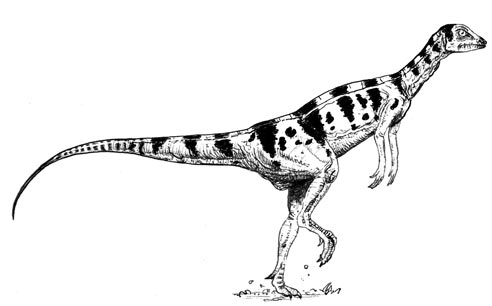
Although the exact evolutionary lineage of the dinosaurs is still debated, it is clear that by approximately 228-230 million years ago a number of different types of dinosaur had evolved.  One of the better known early dinosaurs is Herrerasaurus.  Herrerasaurus (H. ishigualestensis), was a large theropod dinosaur named and described in 1988 when skull material of this dinosaur species was found.  Other elements of the skeleton had been discovered in 1959, but with the skull; a more positive description of this early, meat-eater could be made.

An Illustration of the Early Carnivore Herrerasaurus

Herrerasaurus scale drawing.

Herrerasaurus drawing.

Picture credit: Everything Dinosaur

2 03, 2010

Baby Dinosaurs Attacked by Snake

By |2023-03-04T19:57:35+00:00March 2nd, 2010|Categories: Dinosaur and Prehistoric Animal News Stories, Dinosaur Fans, Main Page, Palaeontological articles|0 Comments

Ancient Indian Constrictor Attacked Baby Sauropods

Scientists have discovered the remarkable fossil of a baby dinosaur that was attacked by a snake.

An adult sauropod would have had few enemies, their sheer size and strength making them invulnerable to attack from all but the most determined or foolhardy theropod.  However, the discovery of a fossil from Gujarat in Western India indicates that for baby long-necked dinosaurs, life was very hazardous, even at the moment of hatching from their eggs.

In a paper published in the scientific journal “PLoS Biology”, a team of scientists report on the macabre discovery of a 3.5 metre long snake caught in the act of raiding a sauropod dinosaur’s nest and attacking a newly hatched dinosaur.  A number of sauropod nesting sites have been discovered in Western India, in Late Cretaceous deposits (Maastrichtian faunal stage).  The nest was that of a titanosaur, the last group of sauropods to evolve.  Palaeontologists are confident that these large herbivores migrated to traditional nesting sites year after year and laid their eggs in extensive nesting colonies.

The females would scrape out a hollow in the ground and then carefully lay a clutch of eggs (as many as twelve per nest), then they carefully covered the eggs again, perhaps putting a layer of vegetation on top of the eggs to help incubate them.  Then the nest was abandoned and the eggs and any hatchlings left to their fate.  Such nesting sites would have provided a number of small predators, dinosaurs, lizards, birds and of course snakes with an easy meal once the adults had moved on.

Baby Dinosaurs

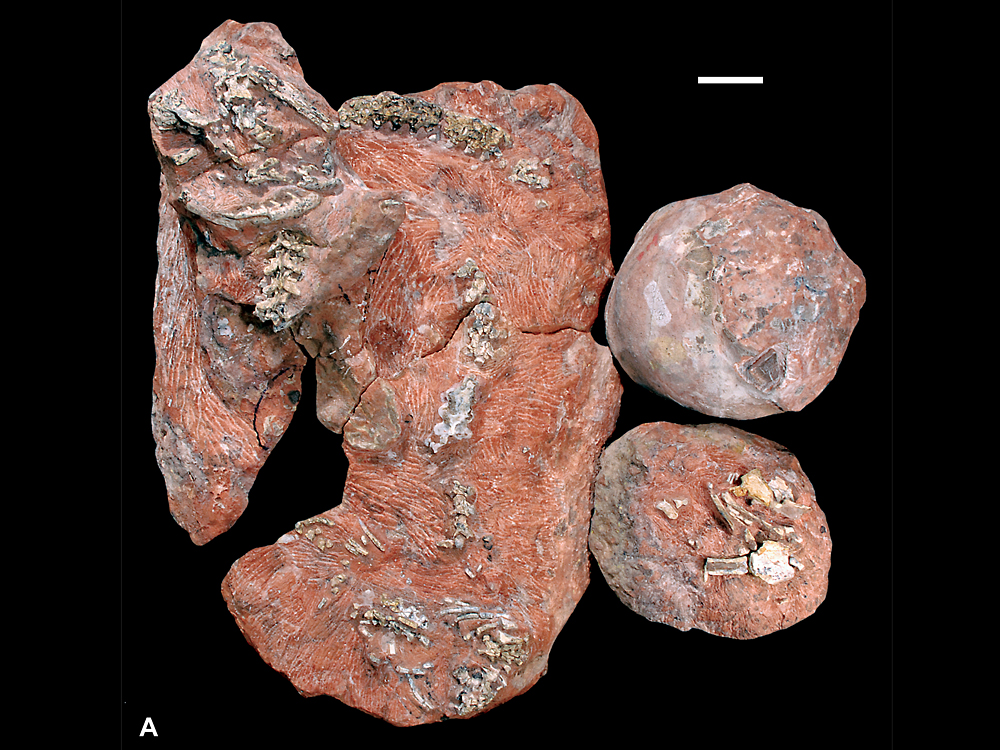
Primitive constrictor snakes had been found in association with dinosaur nesting sites on previous occasions, but this remarkable fossil shows a snake caught in the act of attacking a 40 cm long hatchling.  The fossil, known as an “ethofossil” as it shows feeding behaviour; comes from a sauropod nesting site first discovered in 1984.  The remains of the snake are preserved in close association with unhatched eggs, egg fragments and some of the bones of the newly emerged sauropod.  The nesting site is adjacent to an ancient river bed.  The snake and its victim were suddenly buried by sediment, perhaps as the result of a downpour or the collapse of part of the river bank.

The discovery was made by Jeffrey Wilson, a Professor at the University of Michigan (United States).  He had heard about the amazing fields of dinosaur eggs discovered in India and when shown a small block of matrix with the fossilised egg entombed within it, he observed the remains of the snake vertebrae which were just visible on the surface of the rock.

Professor Wilson commented:

“I was stunned when I saw it, because sort of leaping out at me were the peculiar articulations between the vertebrae of a snake”.

Having been granted permission by the Indian Government, Professor Wilson returned home with the fossil and began the year long process of cleaning and preparing the fossil.

Grain by grain the surrounding sandstone rock matrix was removed and the eggs, the snake and the hatchling were slowly and surely revealed.  The grim scene became apparent, a moment frozen in time when a 3.5-metre-long predator attacked the defenceless hatchling.

Recalling the moment when the details of the fossil were revealed, Professor Wilson stated:

“It was amazing.  We realised that not only did we have an egg, not only did we have a chain of vertebrae, but they were arranged in a coil, and on top of the coil was a skull.”

Coiled Around the Broken Eggshell

The snake was coiled around the broken eggshell and adjacent to the coil, eggshell and the bones of a baby titanosaur.  The primitive snake was unable to open its jaws wide enough to swallow the large dinosaur egg, but with an estimated gape in excess of 16 cm wide, it could manage to constrict and then swallow the newly emerged dinosaur hatchling.  It must have detected the nest and then moved in to attack the youngster as it emerged from its egg.

Wilson says scientists have since found three snake fossils and more eggs at the same site this one came from.  They add new details to a 67-million-year-old story, says the University of Michigan scientist.

Snakes and other predators would remember the location of a titanosaur nesting site and perhaps an entire eco-system sprang up around the annual dinosaur nesting.

The Fossil of the Cretaceous Snake and Sauropod Remains

Snake attacks baby dinosaurs.

Picture credit: Wilson et al 2010

The snake, a new genus has been named and described by the U.S. based team, it has been called Sanajeh indicus which means “ancient gaped one from India”.  Two other snake fossils have been found in this area, indicating that perhaps snakes and other predators congregated around the nesting site looking for an easy meal.

Palaeontologist Jason Head, of the University of Toronto, who helped produce the research paper used two recent movie titles to describe his feelings about the fossil discovery:

It’s Anaconda meets Jurassic Park” he stated.

Dr Head went onto comment:

“These sauropods would lay these huge fields of eggs that we find in India, just kind of kilometres of dinosaur eggshell, and so with these hatchling dinosaurs it must have just been a smorgasbord where a whole ecosystem of predators could basically come in and feed on them.”

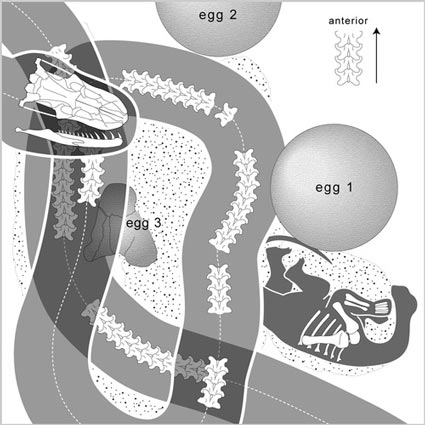
An Illustration of the Dinosaur/Snake Fossil

Attacked by a snake.

Illustration credit: Wilson et al 2010

The diagram above shows a detailed illustration of the fossil, looking down onto it.  The remains of the baby sauropod are to the right with the head of S. indicus in the top left corner.

Sanajeh indicus had a different jaw arrangement compared to modern constrictors such as Boas.  It could not unhinge its jaws to swallow large prey like a modern snake, instead the lizard like jaw was able to gape which permitted it to swallow prey wider than itself.

Dr Head went onto state:

“This is the first direct evidence of feeding behaviour in a fossil of a primitive snake, and shows us that the ecology and early evolutionary history of snakes were much more complex than we would think just by looking at modern snakes today.”

The evolution of large-gape snakes such as pythons and boas ( known as Macrostomatans) capable of feeding on large prey and their ancestral habitat has remained controversial.  Modern-day pythons have excellent jaw adaptations and an elongated skull; fully grown pythons have a gape as wide as nearly 60 cm; enabling them to swallow animals much larger than themselves. Among other adaptations, Macrostomatans have really long lower jaws and increased mobility of jaws compared with the more primitive S. indicus.

The lower jaw of S. indicus is approximately 12 cm long, and this, in conjunction with other anatomical features that give the jaws greater mobility and flexibility would have enabled Sanajeh indicus to swallow hatchling dinosaurs.

Dr Head commented that the snake probably made up for its inability to unhinge its jaws completely like a modern constrictor by growing large to increase its ability to gape.  It would have grown rapidly by consuming as many young dinosaurs as it could during the breeding season and then perhaps lying dormant until the following year.  For the sauropods, as they emerged from the nests they were extremely vulnerable without their parents to protect them.  It would seem that the best survival strategy for a young titanosaur would be to grow up as fast as possible.

Everything Dinosaur stocks a range of titanosaur models and even replicas of giant prehistoric snakes (Titanoboa). Visit the model section of the company’s website: Prehistoric Animal Models and Replicas.

The scientific paper: “Predation upon Hatchling Dinosaurs by a New Snake from the Late Cretaceous of India” by Jeffrey A. Wilson, Dhananjay M. Mohabey, Shanan E. Peters, Jason J. Head published in PLoS Biology.

1 03, 2010

The Controversy over the Polar Bear Highlighted by New Research

By |2024-04-19T09:34:21+01:00March 1st, 2010|Categories: Animal News Stories, Main Page|0 Comments

Polar Bear Jawbone gives Clues to Evolution of Polar Bear Species

Scientists have known for some time that the Polar Bear (Ursus maritimus) is most closely related to the Brown Bear (Ursus arctos) or a sub-species thereof.  However, the timing of the evolution of a bear adapted to the cold and subsequently being named and described as a new species has been debated.

Polar Bear Jawbone

In a research paper published by a team of Scandinavian scientists, on the study of a fossilised jawbone from an ancient Polar Bear, one of the conclusions drawn is that Polar Bears evolved as recently as 150,000 years ago, in response to dramatic climate change in the northern hemisphere.  The jawbone is the oldest Polar Bear fossil found to date and it suggests that Brown Bears trapped on remote islands at the onset of a period of global cooling adapted to the cold conditions and over many thousands of years they evolved into a new species – the Polar Bear.

Affinity Between the Polar Bear and the Brown Bear

The close affinity between the Polar Bear and the Brown Bear is well known, with genetic studies indicating how closely related these two species are.  There have also been several reports of “hybrid” bears being discovered in the wild and bred in zoos, natural crosses between a Brown Bear and a Polar Bear.  This has caused certain difficulties for hunters in the Canadian frozen wastes, as although they may have had the correct hunting permit to shoot Polar Bears (around 500 such bears are shot legally each year), sometimes a hybrid is shot a “pizzly” as they are referred to by the locals and this can get the hunter into trouble with the Canadian authorities.

Discovery on an Arctic Island

The bone was discovered at Poolepynten on the Arctic island of Svalbard by Professors Olafur Ingolfsson, of the University of Iceland, and Oystein Wiig, of the University of Oslo.

In a research paper the researchers concluded:

“The Poolepynten subfossil mandible, which we argue is from a fully grown male, is probably the oldest Polar Bear find discovered so far.  Its true age is interpreted to be 110,000-130,000 years old.”

Academics have debated the Polar Bear lineage for many years, some believe that it evolved as recently as 50,000 years ago, whilst other scientists have argued that this species evolved more than a million years in the past.

Svalbard Fossil

The existence of the Svalbard fossil indicates that polar bears were already a distinct species by about 130,000 years ago.  But anatomical and DNA evidence from the fossil indicate a closeness between Polar Bears and Brown Bears of the time — suggesting the species diverged no more than about 200,000 years ago and probably about 150,000 years ago.

This sharply narrows the “window” during which Polar Bears might have emerged to a period when the Northern Hemisphere was being drawn into an ice age that lasted from approximately 190,000 to 130,000 years ago.  This period of dramatic climate change would have put pressure on the northerly enclaves of Brown Bears, especially those on isolated islands such as Admiralty Island and its neighbours Baranof Island and Chichagof Island (known locally as the ABC islands).

Examining DNA

One research group, led by Gerald Shields, of the University of Alaska Fairbanks, used DNA from 61 Brown Bears taken from three populations in Alaska and 55 Polar Bears from Arctic Canada and Siberia.  The scientists wanted to work out not only when Polar Bears evolved but also, potentially, where from and from which population of Brown Bears.

The researchers discovered that the DNA of the ABC island bears was closer to that of the Polar Bear than any other Brown Bear population studied.

In a paper they research team concluded:

“Brown Bears of the ABC islands may be descendants of ancient ursids [bears] that diverged from other lineages of Brown Bears and subsequently founded the Polar Bear lineage.”

This view is expected to get support from new research, out this week, based on DNA extracted from the Poolepynten jawbone.

It means polar bears have already survived a global warming that affected the northern hemisphere from 130,000 to 115,000 years ago, when the Greenland ice sheet and the Arctic ice cap were smaller than now.  Professor Chris Stringer, of the Natural History Museum in London, an expert in ice age mammals and the evolution of hominids, commented:

“Early Polar Bears would not have had all the specialisations of modern animals and we know nothing about their behaviour.”

Reflecting on the current plight of Polar Bear (listed as vulnerable under the Endangered Species Act), Professor Stringer said:

“Living through a warm period back then does not mean they are resilient to climate change now.”

For models and replicas of prehistoric animals: Prehistoric Animal Models and Figures.

28 02, 2010

Monster Crocodile a Predator of Early Hominids

By |2023-01-02T20:29:39+00:00February 28th, 2010|Categories: Animal News Stories, Dinosaur and Prehistoric Animal News Stories, Main Page|0 Comments

Fear of Crocodiles an Ancient Human Trait

In the first episode of the BBC television series “Walking with Cavemen”, the episode entitled “First Ancestors” an adult Australopithecus afarensis is taking a drink from a river when a crocodile attacks, grabs the unfortunate hominid and drags him into the water to his death.  Although this scene was depicted in a fictional, albeit educational television series; this incident reflects what has been found in the fossil record, as some early hominid fossil bones have marks on them reputedly made by feeding crocodiles.

Most scientists had thought that these attacks were from Nile Crocodiles (Crocodylus niloticus) or at least a very similar species to the large extant predator found in this part of Africa today.  However, a new study from a joint team of U.S. based scientists and researchers from the National Natural History Museum of Tanzania indicates that hominid attacks around 2 million years ago, may have been carried out by a different type of crocodile.

Monster Crocodile

Following a review of partial and fragmentary crocodilian remains from 1.8 million-year-old strata from the Olduvai gorge region of Tanzania, a new species of large crocodile has been identified, an animal similar in size to today’s Nile crocs, but one with a distinct crest of bone over the back of skull.  According to the authors of the crocodilian study, Chris Brochu, a vertebrate palaeontologist from the University of Iowa, Robert Blumenschine and Tanzanian Jackson Njau, it is this crocodile that may have terrorised our ancestors.

In the report, published in this month’s edition of the online journal PLoS One, this crocodile may have been the largest predator these ancient humans encountered in their East African world.

Commenting on the fossil evidence showing crocodile attacks on prehistoric people Chris Brochu stated:

“I can’t guarantee these crocodiles were killing our ancestors, but they were certainly biting them.”

It was Brochu who named and described this new crocodilian Crocodylus anthropophagus, the name means “man eating crocodile”, as Chris remarked he hopes that “people get the joke.”

The re-evaluation of the crocodile fossils found in the Olduvai gorge deposits indicate that this new species of crocodile could have been responsible for the attacks on people.  Certainly, our ancestors such as A. africanus et al were relatively small and light, many of them less than one metre tall.  Such small animals would have been no match for this 7-metre-long predator.

Crocodylus anthropophagus

Although roughly the same size as the modern reptilian apex predators of the Nile, the Olduvai crocodiles had thinner, more flared snouts and large horns that are more characteristic of a Madagascan crocodile that went extinct in the past few thousand years.

The discovery of C. anthropophagus points to far more diversity in African crocodiles in the past 2.5 million years than previously thought, Brochu stated:

“People have always perceived crocodiles as these slowly evolving, living fossils. That’s just nonsense.”

His team haven’t found many fossils belonging to C. anthropophagus, and none that is complete, so it’s impossible to determine its precise relationship to modern Nile crocodiles or when these particular man-eaters went extinct.  Crocodiles remain dangerous to humans today and a number of species are known to have attacked people and caused fatalities.  Our smaller ancestors had to cope with animals just as big as the ones we see in the Nile or in Australia today.

Perhaps, our fear of these scaly creatures began farther back in our prehistory than previously thought.  Humans reliance on freshwater and our underdeveloped senses when compared to other mammals would have made us vulnerable to ambush attacks from these freshwater predators.

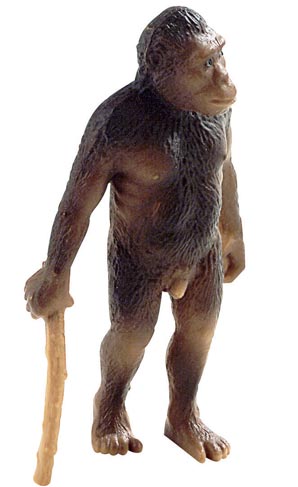
A Replica of an Australopithecine

Australopithecus

At home on the plains. An australopithecine.

The picture (above), shows an australopithecine model that was created by Bullyland of Germany.

To view the Bullyland range of prehistoric animal models: Bullyland Prehistoric Animal Figures.

27 02, 2010

New Evidence of a “Leedsichthys Legacy” Fossil Evidence Fills 100 million gap

By |2024-04-19T09:44:50+01:00February 27th, 2010|Categories: Dinosaur and Prehistoric Animal News Stories, Dinosaur Fans, Main Page|0 Comments

Giant Bony Fish Swam in Prehistoric Seas

The giant Jurassic fish Leedsichthys was not the only huge plankton feeding fish of the Mesozoic.

Darwin described the fossil record as being like individual words in a book when the rest of the sentence, the rest of the paragraph, the rest of the chapter was missing.  One of the strongest arguments put forward against Darwin’s theory of natural selection was why did the fossil record that show many different types of intermediate forms as natural selection led to the evolution of a new species from an older species?

Leedsichthys

Darwin argued that the fossil record was so poor and fragmentary that the lack of evidence to support his theory was only to be expected, after all, only parts of the geology of the world had been explored at the time of Darwin’s ground-breaking (no pun intended) “On the Origin of Species”.

Even today the paucity of the fossil record is widely accepted, despite the fact that very much more of the world’s geology has been explored than in Darwin’s day.  However, there are still huge gaps, such as the fact that during the Middle Jurassic around 170 million years ago there were giant plankton eating fish and then nothing until the ancestors of whale sharks, manta rays and such like plus the first filter feeding whales appeared during the end of the Mesozoic/beginning of the Cenozoic and began to fill this ecological niche.

A team of scientists from the UK and America may have helped to “plug” this gap in the fossil record as they have re-interpreted known fossils and examined new specimens determining that filter feeders were around in prehistoric oceans after all.  The team of researchers, writing in the journal “Science” have identified fossil evidence that shows such fish existed between the time of Leedsichthys and the end of the Cretaceous 66 million years ago.

Leedsichthys problematicus

Leedsichthys (Leedsichthys problematicus) was a member of the Pachycormidae, a group of ray-finned fishes known only from Mesozoic fossils.  Named after the discoverer and one of the first researchers into these huge fish, Alfred Leeds, this fish is only known form a few isolated remains.  One of the problems of cartilaginous fish is that they tend not to leave many fossil remains, their soft cartilage does not preserve anywhere near as well as the bony skeletons of Teleosts for example.

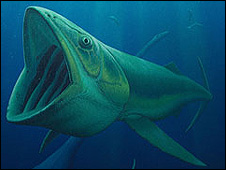
Their are no close living relatives of the Pachycormidae today, the closest relatives are believed to be the North American Bowfin fish.  Leedsichthys was a large animal with a powerful tail. broad fins, an elongated body and a huge, gaping mouth.  When feeding these enormous fish would open their mouths very wide and swim forward causing large amounts of sea water to pass over their gill-rakers filtering out any plankton and small fish fry which was this animal’s prey.

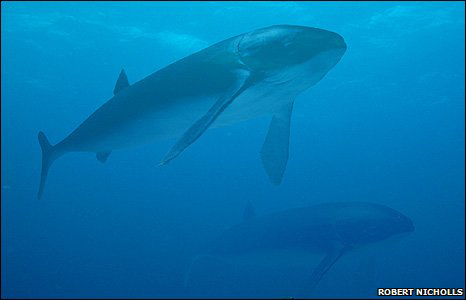
An Illustration of Leedsichthys

Picture credit: Robert Nicholls

These animals are reminiscent of the ray-finned filter feeders of today, creatures such as the Whale shark and the Basking shark.  Like these extant species of fish, Leedsichthys probably travelled great distances searching for food.  This life style is indicated by the geographical spread of Leedsichthys fossils – from East Anglia in England, to France, Germany and South America (Chile).

A Review of Pachycormidae Fossil Material

The international team of scientists that carried out the review of Pachycormidae fossil material included academics from Glasgow and Oxford Universities, plus researchers from Fort Hays University in Kansas, DePaul University in Chicago and the University of Kansas.  The team believes that they have uncovered a “missing piece in the evolutionary study of fish, mammals and ocean ecosystems.”

The project began in Glasgow, with a review of the known remains of the giant Jurassic fish Leedsichthys, in conjunction with the excavation of a new specimen of this creature in Peterborough (Cambridgeshire, England).  At first thought to have been the largest fish that ever existed, with an estimated length in excess of 25 metres, scientists now believe that Leedsichthys was not quite so huge, with some specimens perhaps as much as 17 metres long.  Leedsichthys was viewed as an isolated example of a large filter feeder in the oceans during the Mesozoic.

There was still a gap in the fossil record between the last fossils of this Jurassic leviathan and the first appearance of modern filter-feeders towards the end of the Cretaceous.  The first whales were toothed predators, filter feeding whales such as the Blue or the Grey evolved later, but mammals did not attempt to fill this ecological niche for many millions of  years after the extinction of the dinosaurs and marine reptiles.

Dr Jeff Liston, from Glasgow University, was responsible for the excavation in Peterborough and found the new specimen to be an anomaly.

He commented:

“The breakthrough came when we discovered additional fossils, similar to Leedsichthys, but from much younger rocks”.

Dr Liston went onto add:

“These specimens indicated that there were giant filter-feeding fishes for much longer than we thought.  We then started to go back to museum collections, and we began finding suspension-feeding fish fossils from all round the world, often unstudied or misidentified.”

Several of the most important new fossils – all from the same extinct bony fish family as Leedsichthys – came from sites in Kansas (United States), but other specimens from as far afield as Dorset, Kent and Japan were examined by the team as they attempted to piece together the story of large filter feeders in ancient oceans.

Dr Liston added:

“The fact that creatures of this kind were missing from the fossil record for over 100 million years seemed peculiar.  What we have demonstrated here is that a long dynasty of giant bony fish filled this space in time for more than 100 million years.  It was only after these fish vanished from the ecosystem that mammals and cartilaginous fish such as Manta rays, Basking sharks and Whale sharks began to adapt to that ecological role.”

The teams findings have “implications for our understanding of biological productivity in modern oceans, and how that productivity has changed over time”.

Kansas Specimens

One of the best preserved Kansas specimens had previously been interpreted as being a fanged, predatory swordfish.  However, when the team began to prepare the specimen in more detail they discovered a toothless gaping mouth, with an extensive network of gill-rakers to extract huge quantities of microscopic plankton.

The team have named and described this new type of Pachycormidae – Bonnerichthys in honour of the Kansas family who discovered the fossil.

An Illustration of the Kansas Pachycormidae – Bonnerichthys

“Big Mouth” Bonnerichthys.

Picture credit: Robert Nicholls

Although, not quite the size of Leedsichthys the Kansas specimen indicates that these fish could grow up to 5 metres in length.

To see the range of marine reptile and sea monster figures stocked by Everything Dinosaur: Sea Monsters.

26 02, 2010

Dinosaur Dreaming Digs up Remarkable Wallaby-Like Dinosaur

By |2024-04-19T07:19:18+01:00February 26th, 2010|Categories: Dinosaur and Prehistoric Animal News Stories, Dinosaur Fans, Main Page|0 Comments

Annual Dinosaur Dreaming Event digs up Aussie Dinosaur that looked like a Wallaby

The Annual dinosaur dreaming event in Australia discovers a dinosaur that looked like a walllaby.

Wallabies, a small kangaroo-like marsupial (family Macropodidae) are native to Australia, making up part of the unique wildlife of that huge country.  However, wallaby-like animals may have roamed Australia millions of years before as the fossilised bones of a wallaby-like dinosaur have been found in an excavation south-east of Melbourne.

Each year in the south-eastern part of Australia, scientists from the Victoria state museum and Monash University organise volunteers to come and have a go at digging up dinosaurs from Australia’s Cretaceous past at a number of palaeontological sites near to the town of Inverloch about 100 miles south-east of Melbourne.  The event is known as “Dinosaur Dreaming” and since its inception in 1992 groups of amateur palaeontologists have helped to uncover many thousands of dinosaur bones, teeth and other fossil specimens from fossiliferous strata dating back 120 million years or so.

In this years, six week long event, more than 400 bones and teeth have been found, but for one of the event co-ordinators, Lesley Kool of Monash University’s School of Geosciences, the discovery of a wallaby-like dinosaur skeleton is the star find.

Commenting on the finding of these fossilised remains, she stated:

“Four limb bones very close together, within centimetres of one another, which is what has us hoping that we actually have part of a skeleton of one of these small dinosaurs.  We think that it belonged to a small plant-eating dinosaur probably the size of a wallaby, and also the same body shape as a wallaby.”

An Artist’s Impression of the Wallaby-like Dinosaur

Picture credit: Everything Dinosaur

This part of Victoria is known as East Gippsland and is famous for a number of Hypsilophodontidae fossils, dinosaurs such as Leaellynasaura and Atlascopcosaurus.  Although, superficially resembling a wallaby, it is clear that this particular, as yet unidentified dinosaur was a fast runner.

Mrs Kool went onto add:

“Even though it [the dinosaur] was the shape of something like a wallaby or a small kangaroo, we can tell from the bones in the hind leg that it didn’t hop.”

The discovery was made at the Flat Rocks fossil site and it may represent a new species of ornithopod, most likely a member of the Hypsilophodontidae.  The area is known for a number of small, cursorial dinosaur genera, mostly dating from the Aptian to Albian faunal stages of the Cretaceous.

Commenting on this new discovery, Mrs Kool declared:

“They had a long, powerful tail — like a kangaroo, very long, powerful hind legs, short forearms and small head.  If you think of a wallaby or a kangaroo without its fur and without its ears and covered in scales, that is what we think that these small dinosaurs looked like.  They certainly were not wallabies in any way, shape or form.” 

 The Dinosaur Dreaming event has attracted dozens of volunteers and over the years a number of important and unique discoveries have been made including fossils of large meat-eating dinosaurs, as well as birds, fish, turtles and small mammals.

Visit Everything Dinosaur’s award-winning website: Everything Dinosaur.

25 02, 2010

Dinosaur Sunday A Very Special Day

By |2024-04-19T07:16:36+01:00February 25th, 2010|Categories: Dinosaur Fans, Everything Dinosaur News and Updates, Main Page|0 Comments

Dinosaur Sunday – Reassessing Science and Faith

At Everything Dinosaur, we get involved in all sorts of unusual projects, helping schools, museums and community groups by providing information and resources related to dinosaurs and other prehistoric animals.  One such example was when we were contacted by the Brighthelm United Reformed Church and Community Centre to assist them with their dinosaur themed church service – Dinosaur Sunday.

Dinosaur Sunday

As this particular group is based in Brighton, (East Sussex), they find themselves surrounded by important geological sites.  For example, to the west is the beginnings of the area designated as the “Jurassic Coast” – the famous stretch of English coastline which is a World Heritage Site.  To the east is the town of Lewes, the birthplace and home of Dr Gideon Mantell, the amateur geologist and scientist who is credited for naming Iguanodon, only the second dinosaur to be formerly named and studied.

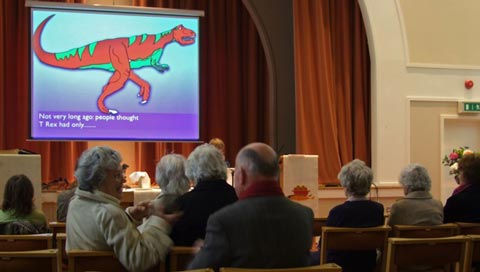
Dinosaur Sunday described by the organisers as a celebration of science and faith, with two church services emphasising the wonders of the world that surround this area of Britain’s south coast.  Talie, a young member of the church group gave a presentation to the congregation about how it is important to keep reassessing both science and faith.

The afternoon service, was held in the dark, with wall projections showing some of the prehistoric animals whose fossils have been found in the region.  A small piece of fossilised dinosaur bone (iguanodontid) found in the Hastings area was brought in for church members to see and touch.

Part of the Church Service on Dinosaur Sunday

Picture credit: Rev. David Coleman

The Everything Dinosaur contribution consisted of providing some information on Dr Mantell’s views and our changing opinions regarding the Cretaceous ornithopod Iguanodon.  After all, Mantell originally perceived Iguanodon to be a quadruped, then the Belgian palaeontologist Louis Dollo, who was responsible for the first reconstruction of the fossilised bones of Iguanodon thought it was a biped.  Now scientists, with many more fossils to study think that Iguanodon was capable of walking on its hind legs as well as on all fours.

To view a scale model of Iguanodon (whilst stocks last), we recommend the: CollectA Deluxe Prehistoric World range.

24 02, 2010

Abydosaurus – Gives Sauropod Research a Head Start

By |2023-01-02T19:18:55+00:00February 24th, 2010|Categories: Dinosaur and Prehistoric Animal News Stories, Main Page, Palaeontological articles|0 Comments

Abydosaurus – Skull Material in Cretaceous Sauropoda

Sauropod skull material is a bit like London buses, you wait ages for one to turn up and then four come along at once.  Thanks to a discovery in Utah (United States), scientists at Brigham Young University have an embarrassment of riches of sauropod skull material to work on at the moment and all the skull material belongs to a single, new dinosaur genus – Abydosaurus.

An Abydosaurus Skull

Skull material in long-necked dinosaurs (sauropods) is exceptionally rare in the fossil record, less than 10% of all the articulated or associated long-necked dinosaur fossils ever discovered actually have some skull material present at the dig site.  The reason for this is quite simple, take an animal such as Diplodocus, this diplodocid dinosaur could reach lengths in excess of 25 metres, but even in an immense adult; the head was no bigger than that of a horse’s head.  So the heads were relatively small and being on a long, thin neck, skulls were prone to fall off any carcase, becoming detached.  Femurs, and vertebrae being much heavier than the skull bones have a greater chance of remaining close to other bones and surviving the preservation process.  These heavy bones are much more common than the skull.  Some sauropods, the Early Cretaceous Nigersaurus from West Africa, for example, had an exceptionally light and delicate skull.  The thin struts of bone that make up part of the skull material would only very rarely have survived the fossilisation process.  Even famous mounted exhibits in Natural History museums do not necessarily have the right head posed on the rest of the sauropod’s body.  For example, there  have been instances where both Apatosaurus and Diplodocus exhibits have had casts of Camarasaurus skulls (a Macronaria-type sauropod) stuck onto them.  This in the past was down to ignorance, or in some cases deliberately done to finish off an exhibit even though scientists were actually unaware at the time of what diplodocid dinosaur skulls looked like.

But why all the fuss about skull material, surely with several tonnes of fossil bones to be getting on with in your average sauropod skeleton, that’s enough to keep even the most grumpy palaeontologist happy.  True, but skulls can tell scientist a great deal about an animal.  If the jaws are present an insight into diet and feeding behaviour can be obtained.  Studies into the braincase can be carried out and very importantly skull material can help establish whether the fossils represent a new genus or species of a dinosaur in many cases.

Abydosaurus

A paper on the new brachiosaurid dinosaur named Abydosaurus mcintoshi was published yesterday in the German science publication Naturwissenshaften.  The research paper was compiled by scientists at Brigham Young University and this new Cretaceous brachiosaurid is significant not just for the skull material associated with it, but because brachiosaur fossils are increasingly rare in younger Mesozoic strata.   The brachiosaurs seemed to have had their hey day in the Late Jurassic, but over the course of the Cretaceous, the main types of sauropod, such as the diplodocids and brachiosaurids become increasingly rare in the fossil record.  The sauropods were by no means finished, particularly in the Southern Hemisphere, as the titanosaurs were about to come to the fore, but the food chains and ecosystems of the Cretaceous were becoming increasingly dominated by herbivorous ornithischian dinosaurs.

Dinosaur Skulls

The remains and the fossilised skulls of this new dinosaur, were found at the National Dinosaur Monument site in Utah (United States), not in the famous Morrison Formation, but in much younger, sandstone rocks dating from around 105 million years ago (Albian faunal stage) – the Cedar Mountain Formation.

Finding just one skull would be impressive, but four is beyond what any dinosaur hunter could hope for.  The skulls revealed jaws crammed with dozens of tiny, peg-like teeth.

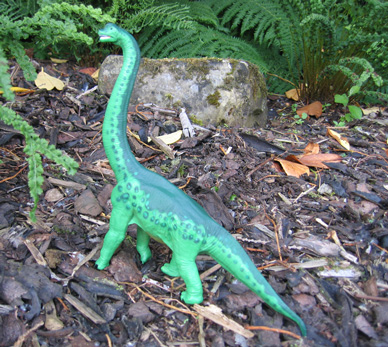
A Model of a Brachiosaurid Dinosaur (Brachiosaurus)

Wild Safari Prehistoric World Brachiosaurus.

Wild Safari Prehistoric World Brachiosaurus dinosaur model.  A replica of a brachiosaurid dinosaur.  Picture credit: Everything Dinosaur.

Picture credit: Everything Dinosaur

To view the brachiosaurids and other figures in the Wild Safari Dinos series: Wild Safari Prehistoric World Models.

Commenting on the skull material, Professor Brooks Britt, a geologist at Brigham Young University stated:

“It’s quite a fortuitous thing.  In many dinosaurs, the bones of the head do not fuse up, especially in sauropods.  You have an array of components that are held together by soft tissue.  The only thing that stays together is the brain case.”

National Park Service employees first discovered an interesting cache of bones near the monument’s visitor’s centre in the late 1990s and enlisted Professor Britt’s help to prepare the specimens.  After the initial find, park staff delivered a two-tonne block to Brigham Young’s University Museum of Palaeontology.  Dinosaur bones, including pieces of a skull, were apparent on the surface, but as the researchers carefully prepared the sandstone block, a second almost complete skull was revealed.

The skulls are on display at the Brigham Young University Museum, where visitors can watch students work on other Abydosaurus bones in the preparation laboratory.

Professor Britt made follow-up trips to the dig site and found a fourth skull in 2003.  All four specimens belonged to juveniles who may have died in the same event and were quickly buried before scavengers and bacteria could destroy the carcasses.   Although it is difficult to estimate the size of an adult Abydosaurus from the fossil remains found so far, the research team have estimated that these animals could have reached lengths in excess of 25 metres.

The teeth of Abydosaurus are most intriguing, in a statement Professor Britt said:

“They [the teeth] are small, small as a triple-A battery cut in half, a centimetre in diameter.  Why is that?  Perhaps the teeth reflect food sources and eating habits, but the small teeth fit a pattern seen over the course of dinosaur evolution from the Jurassic to the Cretaceous.

“There is a trend from large to small teeth, packing them in there close together, not just in Brachiosaurus, but all the sauropods that survived into the Cretaceous.  In the Jurassic, they had an array of tooth sizes, but in the end everyone has these small pencil-like teeth.  We attribute it to a way to increase the enamel, so their teeth last longer.”

Researchers believe that sauropod dentition evolved over time to offer a greater surface area of enamel.  This would make them more durable and more hard-wearing when being employed to strip foliage.  It could also be an adaptation that reflects the growing numbers of Angiosperms (flowering plants) that were evolving and beginning to make up an increasing proportion of the diet of these huge animals.

Go to Top